Gaspare M. Genna Department of Political Science
University of Texas at El Paso 500 W. University Avenue El Paso, TX 79968-0547
Abstract
Why are some free trade agreements (FTAs) in the western hemisphere successfully negotiated and implemented while others seem to stagnate during negotiations? FTAs develop when there is an asymmetrical power relationship and potential partners are satisfied with potential trade patterns. The European Union (EU) and United States have been successful in negotiating agreements with the Caribbean and Central American countries. However, current bilateral and multilateral trade talks between the EU, the Common Market of the South (MERCOSUR), and US are at a standstill. Trade patterns are unsatisfactory for the MERCOSUR members because they are not able to maximize their comparative advantage. Additionally, neither the EU nor US are willing to use their power capabilities to reduce this dissatisfaction. Finally, the growing Chinese economic profile in Latin America further complicates the ability for the three actors to achieve a set of satisfactory trade relations. Evidence to support these arguments comes from archival research of the failed EU-MERCOSUR FTA and Free Trade Agreement of the Americas negotiations.
Introduction
The progress in completing free trade agreements (FTAs) in the western hemisphere is a mix of
successful and unsuccessful accounts in the opening years of the 21st century. I seek to explain
this mixed progress by analyzing the power and developmental dynamics of the actors involved.
Krasner (1976) correctly predicts some of the events; however his analysis is silent on the
behavior of medium-size states. Explaining their behavior is important because western
hemisphere negotiations that are currently at a stalemate include these types of states. Why are
these negotiations to date unsuccessful? The answer centers on the current transformation
underway in the international hierarchy which affects the cost-benefit calculations of a
medium-size states in South America, with particular attention to Brazil.
This paper will examine two sets of negotiations, one successful and the other unsuccessful.
The latter set is the triangular negotiations between the European Union (EU), Common Market
of the South (MERCOSUR),1 and United States, and is the primary focus of this paper.
Specifically, these include the failures in 2005 by US Trade Representative Robert B. Zoellick
and EU Trade Commissioner Pascal Lamy to complete negotiations on the Free Trade Area of
the Americas (FTAA)2 agreement and the EU-MERCOSUR FTA,3 respectively. Explaining these
failures rests not only on the details of the negotiations about also the influence of the ascending
negotiations between Caribbean and Central American states, the EU, and the US. The EU
negotiations involve the post-Lomé trade relations while the US negotiations culminated in the
Central American and Dominican Republic FTA (CAFTA-DR).
To understanding why the two important and high profile negotiations are in stalemates while
others are successfully completed, I test hypotheses developed from power transition theory
(PTT) (Organski 1958; Organski and Kugler 1980) with particular attention to its recent
extension into the area of regional integration (Efird and Genna 2002). While PTT has many
similarities with hegemonic stability theory (HST) (Krasner 1976; Gilpin 1981), it is more
capable to explain the behavior of middle-size states especially during the initial rise of a power.
In general, FTAs are more likely to form when actors find themselves better off signing than not
signing. What constitutes being “better off” depends on the preferences of the larger actor
vis-à-vis the other actor(s). Preferences reflect a desired pattern of trade that depends on the
actors’ comparative advantage. Developing actors (MERCOSUR members) would prefer a
trading relationship where they can ease market entry of their primary goods while hoping to
shield infant industries. Developed (EU and US) actors prefer a relationship where they can
maximize exports of their capital-intensive goods while protecting their agricultural sectors.
Rapidly growing actors (China) need access to inexpensive primary goods to feed their
economic asymmetries can lead smaller actors to accept less than preferred trade patterns if
being locked out of the larger market would make them worse off as stated by both HST and PTT.
But a point can be reached when the economic size differential is not large enough to accept
trade patterns demanded by the larger actor(s). Furthermore, actors that can switch markets for
their exports are less vulnerable to the demands of larger actors. The likelihood of switching
export marks increases when a large and rapidly economy is present. PTT predicts this because
of its focus on the changing dynamics of the international system. More specifically, both the EU
and US are attempting to reorganize the global trade regime along their preferences through the
EU-MERCOSUR FTA and FTAA, respectively. However, the members of MERCOSUR see this
reorganization to their economic disadvantage. Having the limited access to the EU and US
markets does not have enough economic value for MERCOSUR because a rapidly growing
China offers an alternative market for MERCOSUR exports. Therefore the developing structural
change of the international political economy lowers the likelihood of signing FTAs with the EU
and US.
The remainder of this paper will explain the logic behind the western hemisphere’s FTA
stalemates and successful negotiations by explaining how economic size, actor preferences play,
and alternative markets into the decision-makers’ perceptions of their countries’ benefits.
negotiations as well as the actions of the EU and US in the Caribbean and Central America and
the indirect influence of China. The final section will conclude with policy implications in
regards to both trade and security.
Explaining the Stalemate: Relative Size and Actors’ Preferences
In order to explain the EU-MERCOSUR and FTAA stalemates, a brief overview of the prior
research4 indicates that successful development of regional integration depends on the economic
asymmetries and compatible preferences. Power theories stress the distribution of power among
states as a central factor influencing the outcomes of international relations. Among such theories,
neo-realism argues that the asymmetric gains from exchange tend to hinder international
cooperation (Waltz 1979; Grieco 1988). This reasoning is countered by proponents of HST and
PTT who argue that the presence of a preponderant state is a necessary condition for liberal
international and regional commerce (Krasner 1976; Gilpin 1987; Efird and Genna 2002). Others
demonstrate empirically that cooperation can develop under asymmetric conditions if political
and military alliances are present (Gowa and Mansfield 1993; Gowa 1994; Mansfield and
Bronson 1997; Gilpin 2001). It is logical for allies to cooperate economically because of the
intimate relationship physical security has with economic security; reciprocal enhancement of an
allies’ economic strength will aid in improving military readiness.
preferences can be contested. Trade policies can run counter to the ideal suggested by the
alliance portfolio literature because of the consequences a potential FTA poses to domestic
groups and the related implication it would have on political leadership survival, especially in
Latin America (Genna and Hiroi 2004). The preferences of an actor would therefore also need to
balance the needs of potential FTA winners and losers in the actor’s society with a stronger
emphasis on the more powerful and better organized interest groups (Putnam 1988; Milner 1988,
1997; Frieden 1991, 1998; Rogowski 1989; Garrett and Lange 1995; Moravcsik 1997).
In general, power asymmetry and domestically derived preferences, in combination, can offer
an accurate picture of when FTA negotiations, and other developments of regional integration,
are successful (Efird and Genna 2002; Genna and Hiroi 2004). Open trade develops because the
larger member of the asymmetric power relationship provides incentives to small states by
leveraging its economic size. Leverage employed can vary from offering economic assistance to
discontinuing assistance. It could also include retaliatory actions such as increasing existing trade
barriers.
Preferences in trade patterns also matter. Compatible preferences are associated with overall
trade dependence; the more trade dependent the potential partners, the more likely they will
integrate formally. Identifying the preferences of a state could be fine-tuned through an
who own relatively abundant factors that are used intensively in production would favor a FTA
while those that do not would oppose (Magee, Brock, and Young 1989; Rogowski 1989).5
Current trade patterns would reflect the preferences of potential FTA partners. In order for all
sides to be satisfied, the negotiations need to favor those economic sectors that have a higher
volume of trade than other sectors. For developing countries, these are the primary goods sectors
(especially agriculture) while for developed countries this includes the capital-intensive
manufacturing, financial, and service sectors. Therefore, a smaller, lesser developed member
would not join a FTA if it would be worse off; but if this type of actor is satisfied with the current
relationship and would not wish to harm that relationship, it would join the FTA.
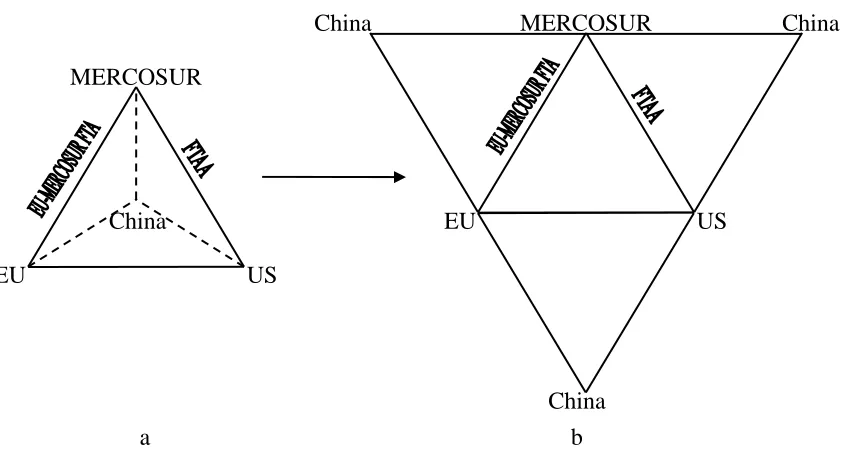
[Place figure 1 here]
Explaining successful FTA negotiations under extreme observations of power asymmetries is
not new. However little is known about the behavior of medium-size economies. Using the cases
of the EU-MERCOSUR FTA and FTAA stalemates, I will pose a set of hypotheses that talk to
this gap in the literature. Figure 1 displays the interaction of each actor in this analysis. In figure
1-a, MERCOSUR is tied with the EU in the EU-MERCOSUR FTA negotiations and with the US
in the FTAA negotiations. The EU-US linkage refers to their similar strategies. In the
background, China is tied to all three. It is important to first look at the logic of the EU and US
competitive liberalization whose central idea is that nonmembers will fear a cost of being
excluded from FTAs (Andriamananjara 2003). Nonmembers perceive that an established FTA is
a “gold standard” for trade that incurs a cost for them in the denial of access to a large market for
their products (Hufbauer and Wong 2004). Not wanting to lose, they join the arrangement.
Therefore, FTAs expand when a large economy forms the hub of a FTA wheel and other smaller
economies are the spokes. The nonmember decides that it prefers to trade-off the costs of
increased competition in its domestic market with the gains of access to the FTA market. The
final conclusion of competitive liberalism is that a global trading system emerges from the
expanding FTA, primarily along the preferences of the hub economy.
However, competitive liberalization has two problems because it assumes that its intrinsic
power leverage is in a static international structure. Knowing that the dominant economy has this
leverage, similar sized or medium-size economies would also adopt the same strategy by
developing their own trading blocs. The goal would be to develop a “competitive leverage”
against the dominant player that wishes to play the role of the global trade hub. It is possible for
a group of economies to compete as a unit to either be that hub economy or more likely, to
diminish the leveraging power of the dominant economy in its effort to reorganize the global
trade regime under its preferred trading pattern. This alone would not doom the competitive
the international political economy that can frustrate the potential hub actor’s efforts. If
middle-size actors have an alternative market for their goods and this market is relatively easy to
access, then the leverage of the potential hub actor diminishes. In sum, the preponderant power’s
leverage is countered when a raising power can offer an alternative market to a coalition of states
that are dissatisfied by the preponderant power’s trade preferences.
PTT has already developed predictions of the increasing challenge China poses for US
physical security (Rapkin and Thompson 2003; Lemke 2003), however no study examines the
potential challenge China can have on the international trade regime and especially on EU and
US trade relations with Latin American states. In figure 1-a we see the ties China has with all
three actors. By unwrapping figure 1-a to reveal figure 1-b, we can more clearly see the Chinese
ties and the expanded trade negotiating triangles. China’s rise influences both set of negotiations
because of its alternative markets to MERCOSUR exports. The bottom triangle of 1-b illustrates
negative influence China has on both the EU and US negotiating strategies.
Preferences therefore play a key role and interact with the asymmetric conditions in
successfully negotiating an FTA. If the dominant economic power wishes to develop or expand a
FTA along its preferences, the likelihood of success diminishes the larger the nonmember’s
economic size and the less satisfied with the dominant actor’s preferences. The medium-size
economy is not that much bigger than its own and is dissatisfied with the dominant actor’s
preferences. However, the smaller the nonmember’s size, the greater the likelihood of a
successful FTA even if preferences are not ideal because not joining the FTA would leave the
smaller economy worse off. Finally, the presence of an accessible alternative market further
diminishes the likelihood of a FTA negotiated by the large actor that follows the competitive
liberalization strategy. Specific to the context of recent western hemispheric trade negotiations,
the evidence in the following section will demonstrate support for the following hypotheses:
• Both the EU and US are developing FTAs with Latin American countries in order to
reorganize the global trade regime along their preferences and are attempting to be
global hubs under the logic of competitive liberalization.
However, among the LA countries lies MERCOSUR, and within it, Brazil:
• Brazil as the dissatisfied and largest economy in Latin America forms its own trade
bloc in order to maximize the expression of its own preferences in the global trade
regime.
• Trade negotiations between the Caribbean and Central American states and the EU
and US are successful due to large size asymmetries and satisfaction with current
trade patterns with the EU and US.
FTAA negotiations as an outside player:
• Stalemates develop in the EU-MERCOSUR FTA and FTAA negotiations due to the
lack of economic leverages (accessibility to China’s market) and trade pattern
preferences of Brazil, the EU, and the US.
Trade Triangulation
EU and US Strategies. The EU and US are of the same mind in certain key issues that have
characterized the talks between these economically developed actors and their developing
counterparts. While the US follows an explicit strategy of competitive liberalization, the EU
follows an implicit one under its Common Commercial Policy (CCP). Their goal is to reorganize
the global trade regime by establishing bilateral or multilateral FTAs outside the WTO
negotiations. Each actor attempts to become the hub of a FTA wheel and thereby slowly
developing a trade regime along their trade preferences.
Demonstrating the US strategy is straightforward; a brief overview of the statements of the
leading negotiators can suffice. Allen F. Johnson, Chief Agriculture Negotiator, made the
following statement before a US Senate subcommittee:
Echoing this view and providing greater insight is Johnson’s supervisor, Robert Zoellick before a
US House of Representatives committee:
We would like to pursue FTAs with the largest markets around the world, including the European Union and Japan among others. But right now, those countries are unwilling to move forward. As a result, we are pushing for the liberalization of their markets through the WTO. At the same time, as another facet of competitive liberalization, we hope our progress on other FTAs will encourage these important markets to reconsider their stance (US House of Representatives 28 April 2004).
But Johnson goes deeper into the US strategy in another quote from his US Senate subcommittee
testimony:
This competition in liberalization strengthens the United States’ already considerable leverage, including in the WTO…Our bilateral and regional FTAs in the hemisphere – the U.S.-Chile FTA, the CAFTA, and the FTAA – also complement our trade objectives in the WTO. They set high standards for trade agreements and spur competitive liberalization. They provide a counterweight to the FTAs our Western Hemisphere partners have signed with other countries, including Canada, Chile, and the EU. Finally, U.S. trade pacts in the Western Hemisphere deepen our ties with individual and small groups of trading partners – alliances that could help us in the WTO (US Senate 20 May 2003).
In sum, the US strategy, under the logic of comparative liberalization, is to gather steam in the
WTO by establishing FTAs with willing partners. These FTAs would begin a process of making
its preferences resonate in the global trade regime by countering other FTAs and establishing
greater leverage against the biggest economies, namely those of the EU and Japan.
The EU strategy is parallel to that of the US, but not as explicit. In 1996, the EU developed
obtain access to external markets. How this is done depends upon resources and legal
alternatives involved. While legal remedies (like the WTO dispute settlement procedure) and
greater information for EU firms using advanced technologies (such as the Market Access
Database) are the highlighted facets of the MAS (WTO 2002), the use of bilateral and
multilateral negations are important instruments for the elimination of important market barriers.
To this end, the EU negotiates all external trade associations under the CCP. Given the EU’s
customs union status, Articles 131-135 of the Treaty Establishing the European Community
require members of the common external tariff to negotiate with one voice (Dinan 1999). Part of
the CCP is the contractual commercial policy that gives the EU Commission the power to initiate
and the exclusive right to negotiate trade agreements (Marsh and Mackenstein 2005). The
Commission can use its supranational stature to negotiate with nonmembers not only regarding
tariffs and quotas but also non-tariff barriers, without the fear that another body will amend the
final trade agreement. The EU Council, however, oversees negotiations through observers and
the 113 Committee.6 Final negotiations need to be approved by the Council using qualified
majority voting (Articles 133 and 300), operating like a legislature that only has an up or down
vote (Hix 1999).
Given this single voice, the Commission, through its chief negotiator, can develop specific
is following a parallel strategy vis-à-vis the US. For example, the EU has trade association
agreements with Chile and Mexico. In addition to the current talks with MERCOSUR members,
the EU is also in the beginning stages of negotiations with the Central American states and
Andean Community for future FTAs. Given this pattern, the EU strategy reflects the competitive
liberalization logic, and with it, a potential center of global trade regime reorganization.
More telling of the EU and US parallel strategies is their behavior with the smaller
economies of the Caribbean basin. Small, more trade-dependent countries need agreements to
remove uncertainty from their trade relations with larger economies. The US provides
preferential access for Caribbean countries (including Guatemala and El Salvador but not Cuba)
under the Caribbean Basin Initiative (CBI), but it does so unilaterally. The CBI came into being
with the signing into law of the Caribbean Basin Economic Recovery Act, which came into
effect 1 January 1984. Other legislation was enacted to expand the types of products and
conditions for further preferential trade relationships, namely through the Caribbean Basin
Economic Recovery Expansion Act of 1990 and the US-Caribbean Basin Trade Partnership Act
of 2000. The CBI provides tariff reductions or exemptions for products from Central American
and Caribbean countries. CBI benefits are, however, conditional. As stated in Section 202 of the
Trade Partnership Act:
(b) POLICY- It is the policy of the United States--
the FTAA or another free trade agreement, tariff treatment essentially equivalent to that accorded to products of NAFTA countries… and
(2) to seek the participation of Caribbean Basin beneficiary countries in the FTAA or another free trade agreement at the earliest possible date, with the goal of achieving full participation in such agreement not later than 2005.
This section sets up the precondition of signing on to the FTAA or other FTAs on terms that were
yet to be specified, but giving the CBI countries benefits immediately. The US established a
status quo that would cause these countries to be worse off by not signing on to a FTA because
not doing so could lead to losing access to the US market. Singing the FTA will lock in the trade
arrangements of the CBI. The result was the enactment of the Central American-Dominican
Republic FTA and the current negotiations with the other Caribbean countries.
The EU also practices a similar relationship with Caribbean countries that were former
colonies of the member states. First initiated under the Lomé Convention,7 the EU has a
preferential trading relationship with a group of countries referred to as the African, Caribbean,
Pacific group (ACP). Lomé provided a development assistance package that included free access
to the European market for products that originated in the ACP countries as well as aid and
technical assistance (Dinan 1999). The EU-ACP relationship is currently evolving as a result of
the Cotonou Partnership Agreement (2000). A central pillar of the agreement is the movement
away from the non-reciprocal trade arrangement under Lomé to a series of negotiated economic
rationale is to make the ACP economies more competitive in the global economy. However the
choice for each trade-dependent state, like the case of the CBI, is to either lose access to the
larger market or sign EPAs and lock-in access through a WTO recognized agreement. Again, the
smaller states would opt for the free trade arrangement and diminish the uncertainty that may
result from not signing.
Brazilian Strategy. During an interview with an Argentine journalist, Brazil’s Foreign Affairs
Minister Celso Amorim said,
Even though Brazil is the largest economy in South America, it needs the company of other countries, and above all, it needs MERCOSUR. To have a true multipolar system, there must be some minimal correlation of power. (Niebieskikwiat 5 February 2003). These two sentences were given in the context of the EU-MERCOSUR FTA and FTAA
negotiations, and provide the key component of the Brazilian strategy vis-à-vis the EU and US.
By developing its own trading bloc, Brazil can credibility attempt to maximize the expression of
its preferences in the global trade regime. While the size of the MERCOSUR five economies is
small when compared to the EU or US, the strategy has been endorsed by the Inter-American
Development Bank (IDB 2002). By combining the economic weight of several Latin American
countries, Brazil has the ability to reduce the economic leverage of the economic heavyweights.
Neither the EU nor US has the economic capacity to offer countries like Brazil and Argentina the
calculation for forming a FTA differs: it could be worse off by signing a FTA if the trade
preferences of the larger states are very distant from its own. If it can convince other states to
form a bloc with aligned trade preferences, then it is not stuck in the competitive liberalization
trap because it will not be left out of a market that others access. In this reworking of the
conditions, its cost of not joining is low.
However, Brazil must do what the other larger actors do, namely provide incentives for
regional partners to form a trading bloc. Although Brazil does not have as large a capacity as the
EU or US, it has demonstrated the ability to keep the block together even in the worst of times
(Genna and Hiroi 2005). Brazil has provided benefits to other members during key episodes of
MERCOSUR’s development. For example, Brazil accepted Argentina’s trade needs during the
2002 economic crisis even when those measures were costly in the short run. This and other
episodes demonstrate the importance Brazil places on regional integration. This leadership
continued in December 2004 when a FTA was finalized between MERCOSUR and the Andean
Community bringing about the South American Community (SAC). In a practical sense, a free
trade area of the Americas has already formed with the SAC given Mexico’s upcoming associate
status with MERCOSUR. It is one, however, where Brazil is potentially more of the hub
economy than the US.
strategies include the desire of the larger actors to reorganize the global trade regime under their
preferences, the execution of those strategies with the Caribbean and Central American states,
and Brazil’s desire to modify that reorganization. However, the central argument rests on two key
variables, with relative size being only one. The other is the degree of satisfaction actors have
with the reorganization of the global trade regime. This satisfaction comes out of specific
preferences associated with the EU-MERCOSUR FTA and FTAA negotiations. Each of the
actors wishes to maximize market access for those sectors where they have a comparative
advantage while attempting to limit competition in their respective markets. The next two
sections explain the stalemates in the EU-MERCOSUR FTA and FTAA negotiations, which
ensued due to divergent preferences and the relative size of the actors.
EU-MERCOSUR FTA. This section outlines the preferences of the EU and MERCOSUR
derived from the pattern of trade. Overall, the trade relationship is asymmetric with
MERCOSUR having the greater dependence on the EU market. However, the EU-MERCOSUR
trade patterns illustrate a high percentage of primary goods exports from MERCOSUR and a
larger proportion of manufactures exports from the EU. This characteristic of the current trade
pattern leads Brazil (and MERCOSUR in general) to demand greater openness for agricultural
products. The stalemate came about when the EU refused to open up their agricultural market,
manufactured products.
First, MERCOSUR is dependent on the EU for their trade. In 2004 Brazil was the EU’s 11th
major trading partner but accounted for only 1.8% of overall EU trade (Eurostat 2005). The
remaining four MERCOSUR members scored in the bottom of the rankings. However, the EU
ranks as the number one trading partner for MERCOSUR, accounting for 22.9% of its total trade
(Eurostat 2005).
[Place figure 2 here]
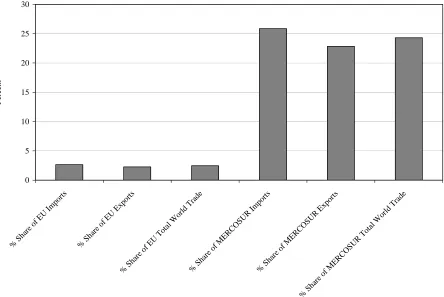
This story is repeated in a closer examination of the trade statistics. Figure 2 illustrates the
EU-MERCOSUR trade patterns (1999-2004). The first three bars illustrate the trade dependence
the EU has with MERCOSUR. MERCOSUR’s share of total EU trade averaged 2.46% (s.d.
0.18%). Its percent share of EU imports and exports averaged 2.65% (s.d. 0.12%) and 2.26% (s.d.
0.49%), respectively. Overall, the degree of the EU’s overall trade dependence on MERCOSUR
is very small. The largest category of products sold in the MERCOSUR market is machinery and
transport equipment. In 2004, this accounted for 50.1% of exports, but only 2.1% of total EU
exports (Eurostat 2005). The next largest category is chemicals and related products, which
account for 22.5% of MERCOSUR trade, but only a 2.7% share of total exports (Eurostat 2005).
However, when we examine specific categories of products imported into the EU in 2004, a
37.2% of imports from MERCOSUR and 20.2% of total EU imports (Eurostat 2005). The next
category is raw goods (except fuels), accounting for 25.7% of MERCOSUR imports and 17.1%
of all imports (Eruostat 2005). In total, these primary materials comprise 37.3% of all EU
imports. Therefore, there is some EU trade dependence on MERCOSUR, but only in primary
goods.
The last three bars display the EU share of MERCOSUR world trade.8 From 1999 to 2004,
the EU’s percent share of overall trade averaged 24.3% (s.d. 1.65%). This is reflected in both
exports and imports, which averaged 22.8% (s.d. 2.14%) and 25.9% (s.d. 1.77%) respectively.
However, MERCOSUR’s export dependence with the EU is not as high as the EU dependence
on MERCOSUR. While 25.7% of the EU’s imports of food and live animals are from
MERCOSUR, this is only 9.9% of total MERCOSUR exports but 37.2% of exports to the EU in
2004 (Eurostat 2005). In addition, 6.8% of total MERCOSUR exports of raw materials
(excluding fuels) go to the EU, accounting for 25.7% of all exports to the EU. The two items
together account for 16.8% of all MERCOSUR exports but 62.9% of exports to the EU. In sum,
MERCOSUR’s main export to the EU and the EU’s main dependence is in the category of
primary goods.
In the case of EU exports to MERCOSUR, we again see a small amount of value, but a large
imports from the EU are machinery and transportation equipment, chemicals, and other
manufactured goods. Together they are 22.4% of world imports into MERCOSUR, but 89.6% of
EU imports (Eurostat 2005). However this is only 1.7% of global EU exports. Again,
MERCOSUR does not represent a large value of trade for EU exports, but manufactured
products do overwhelm the value of trade into MERCOSUR.
The areas of negotiation are centered on the primary products and manufactured goods. Both
sides wish to maximize the amount of trade in their favored area of comparative advantage while
attempting to minimize competition for domestic firms. In March 2003, MERCOSUR offered to
eliminate tariffs on 83-85% of the average value of EU goods over ten years with the remaining
15% eliminated over a period greater than ten years (BBC MIR 5 March 2003). The EU,
however, wanted to see 90% instead of 85%. The EU’s counteroffer was an exclusion from
tariffs for 10% of MERCOSUR imports, which were primarily agricultural goods (BBC MIR 5
March 2003). The increase by MERCOSUR to 85% was an attempt to get the EU to discuss
agricultural subsidies, which the EU refuses to do bilaterally but wanted instead to hold such
discussions at the WTO talks (BBC MIR 5 March 2003). In November 2003, the EU attempted
to gain greater access for their products through the liberalization of MERCOSUR members’
government procurement and services sector (Osava 3 November 2003). The EU offered to
who insisted on discussing agricultural subsides (Osava 3 November 2003). The EU offered to
further increase the agricultural import quota if MERCOSUR did not request a reform of the EU
agricultural subsides in December 2003 (Osava 3 November 2003). The new negotiations at the
beginning of 2004 began with deep frustration on the EU side. At the commencement of the
March 2004 talks, EU trade representative Karl Falkenberg questioned the integration of the
MERCOSUR members when he stated that it was “more a vision than reality” and went on to
question the degree of trust among the four members (MercoPress 11 March 2004). This lead to
a defense of MERCOSUR’s integration practices by the Argentine trade representative, Martín
Redrado (MercoPress 11 March 2004). The talks also failed due the MERCOSUR refusal to
open government procurement contracts and the services sector because the EU would not allow
unrestricted access for beef, cereals, poultry and other agricultural products (MercoPress 30
March 2005). In April 2004, the same requests were made again, but both sides refused to
acquiesce (Benson 21 April 2004). MERCOSUR negotiators did budge in June 2004 and agreed
to increase the percentage of manufactured goods coming in at a reduced tariff to 90%, without a
favorable reply from the EU side (Latin News Daily 14 June 2004; O Estado de São Paulo 14
June 2004). In an interesting escalation of negotiations, MERCOSUR negotiators walked out of
the July Brussels discussions after the EU negotiators reduced the quota amounts on agricultural
returned the favor by walking out of the August Brasília negotiations over the issue of
agricultural products (Teixeira 13 August 2004). At the beginning of September 2004, Pascal
Lamy stated that the problem with the EU-MERCOSUR negotiations is with the MERCOSUR
members because they were unwilling to match the agricultural concessions the EU made with
greater access to investment markets, telecommunications, maritime transport, and banking
services (MercoPress 1 September 2004). However, the MERCOSUR negotiators (after agreeing
not to talk about EU agricultural subsidies) felt that the concessions were not enough and wanted
larger agricultural quotas, especially for wheat and beef, and for these quotas not to have a ten
year limit (MercoPress 1 September 2004).
On 26 May 2005, EU and MERCOSUR representatives put forth a joint communiqué
reiterating their comment to finalizing a FTA in conformity with the 1995 Declaration on
Political Dialogue that began the negotiation process. The publication of the communiqué
signaled that the FTA would not be finalized soon. The transatlantic stalemate occurred because
MERCOSUR members understood that they had nothing to lose from not signing the FTA. The
EU already depends on their exports of primary goods and would continue to import. The large
share of EU manufactured goods entering into the MERCOSUR market would threaten domestic
producers leaving MERCOSUR economies worse off. Unless the EU liberalized their
FTAA. The conditions of negotiations were not different with regard to the FTAA. While
the US was able to develop willing partners among the small trade dependent states of Central
America, the Caribbean, and its NAFTA partners, it could not develop such relations with the
MERCOSUR members.
[Place figure 3 here]
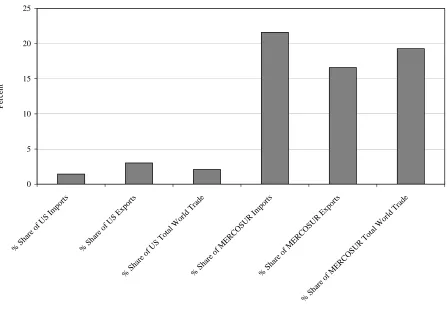
Like the EU-MERCOSUR trade relationship, MERCOSUR is more trade dependent on the
US than vice versa. Figure 3 illustrates the US-MERCOSUR trade patterns. The first three bars
illustrate the trade dependence the US has with MERCOSUR. As with the EU, the overall
percent value of trade is not high. Total trade has remained somewhat level during the 1997-2001
timeframe an average value of 2.09% (s.d. 0.17%). The percent value of imports to MERCOSUR
also has remained level averaging at 1.43% (s.d. 0.07%). Furthermore, US exports averaged
3.02% (s.d. 0.33%). MERCOSUR’s overall trade dependence on the US resembles the EU (last
three bars of figure 3). Overall, the percent share of global MERCOSUR trade averaged 19.3%
(s.d. 1.48%). Imports from the US account averaged 21.6% (s.d. 0.70%). Exports to the US
averaged 16.6% (s.d. 3.43%).
A deeper look exposes the same pattern of trade between MERCOSUR and the US as in the
EU-MERCOSUR case. While 28.3% of the US imports from MERCOSUR is in the category of
83.3% of the MERCOSUR imports from the US are in the category of manufactured goods,
accounting for 17.4% of total US exports. Therefore, primary goods sent to the US is a small
portion of MERCOSUR exports but manufactured goods represent a larger share of US exports
to MERCOSUR. In sum, while MERCOSUR is more dependent on trade with the US, the US
also is dependent on MERCOSUR for sales of manufactured goods and acquisitions of primary
products.
When examining the negotiations for the FTAA, the first item that becomes apparent is the
emphasis on manufactured goods at the expense of primary goods. The nine official areas of the
negotiations are: 1) market access, 2) agriculture, 3) government procurement, 4) Investment, 5)
competition policy, 6) intellectual property rights, 7) services, 8) trade dispute settlement, and 9)
subsides, antidumping, and countervailing duties. Only a small fraction of the areas lend
themselves to liberalizing primary commodity markets but many do talk about the liberalization
of sectors that will increase trade in manufactured goods. Like the EU, the US has been and
continues to be opposed to discussing agricultural subsides at the FTAA table, insisting that it be
discussed at the WTO level. With this off the FTAA table, the vast majority of discussions
involve manufactured goods.
The discussions of the meetings divided the participants in the predicted manner. Sides were
comprehensive agreement while MERCOSUR members wished to remove subjects such as
government procurement, services rules and intellectual property rights from discussions (Sevilla
2004). Given the ties that Canada, Mexico, and Central American countries already had with the
US, they favored the US position that included negotiation topics that would liberalize sectors
and be receptive for its products. However, MERCOSUR, given the current trade pattern, would
be at a disadvantage by signing an agreement that did not liberalize market sectors that would
favor their products (i.e. agricultural products).
To end this impasse, Brazil suggested in May 2003 a “4+1” set of negotiations. This would
produce two versions of the FTAA. One version is that the members of MERCOSUR negotiate
with the US directly. The other is a parallel set of negotiations that would include the US and the
remaining states (Osava 28 May 2003). The proposed arrangement would permit the process to
continue at two speeds and allow Brazil to focus on issues that the US and its coalition wanted to
ignore. Robert Zoellick rejected Brazil’s suggestion knowing that it would be possible to get a
wider FTAA by keeping the US coalition together in order to thwart Brazil’s preferences. This
would allow no discussions of agricultural subsidy cuts and anti-dumping rules, both of which
the US wanted to defer to the Doha Round. In addition, by keeping the coalition together, it
would be more likely to get the service sector liberalized and reward the Caribbean and Central
The talks became more heated after the failure of the September 2003 WTO Cancún talks.
Recall that the EU and US requested that the MERCOSUR members forgo discussing
agricultural subsidies until the Doha Round resumed. Brazil along with other members of the
G-209 held the EU and US (as well as Japan) to their words, but without a satisfactory outcome.
At the resumption of the FTAA negotiations, the MERCOSUR members reintroduced the topic
of agricultural subsidies, which the US refused to discuss but pointed to the need for the
liberalization of services, which the MERCOSUR members stated would be better discussed at
the Doha Round (Valente 24 October 2003). This response prompted US Deputy Trade
Representative Peter Allgeier to state that an FTAA can be created without Brazil (Valente 24
October 2003). This was not the only time a US trade representative mentioned that Brazil could
be left out of the competitive liberalization formula. In 2002, Zoellick stated that Brazil could
trade in “another direction…Antarctica” if it did not want to trade with the US (Hay 29
December 2004). In reaction, the MERCOSUR members formalized their unity by signing the
“Buenos Aires Consensus” outlining a common position regarding agricultural subsidies (Valente
24 October 2003).
In the hope of moving the negotiations forward, a new negotiation framework was decided
ahead of the ministerial meetings in Miami in November 2003. “FTAA lite,” as it was called,
2003). However this did not stop the MERCOSUR members from continuing their common
strategy, which was further developed ahead of the February 2004 meetings (Invertia 16 January
2004). Most of 2004 resulted in the same stalemate between MERCOSUR and the US regarding
agricultural subsidies and liberalization of services. In the most recent attempt, Brazil and US
representatives met in Washington, DC from 22-23 February 2005. The result was an insipid
joint communiqué stating that both sides are committed to a FTAA in the future but without
stating how this would occur.
Like the EU-MERCOSUR stalemate, the FTAA stalemate occurred because MERCOSUR
members understood that signing the FTAA would place them in a worse position. The US
exports a large percentage of manufactured goods to and imports a fair percentage of primary
goods from MERCOSUR members. As in the case of the EU, an increase of manufactured goods
entering into the MERCOSUR market would threaten domestic producers leaving MERCOSUR
economies worse off. However the final factor that gave the MERCOSUR members more
incentives to reject both the EU and US proposals was the indirect impact of China’s economic
relations with Latin America.
[Place figure 4 here]
The Impact of China. With average annual growth rates of 8%, the Chinese economy is
the world’s largest oil consumer since 2003. They continually need reliable sources of raw
materials with a portion of them already arriving from Latin America. Volume of exports from
the Caribbean, Central America, and South America to China has dramatically increased over the
last 10 years (see figure 4). From 1994 to 2005, the proportion of total exports leaving these
countries to China increased from 1.63% to 6.47%. The overall growth of MERCOSUR
members’ exports was 73.3% and now accounts for approximately 8.5% of total exports. The
growth was larger among the Caribbean and Central American countries (98.2%) but exports are
still a small percentage of the total (approximately 2.50%). Other South American countries saw
an increase of approximately 77%, with approximately 5.6% of total exports heading to China in
2005. Therefore, the MERCOSUR countries are taking a greater advantage of China’s market
than the smaller Caribbean and Central American countries.
China is also becoming an active business partner, accounting for 36.5% of total foreign
direct investment in Latin America in 2003 (MercoPress 11 November 2004). Although trade
with Latin America only accounted for 3.4% of total Chinese trade volume in 2003, and with a
growing trade deficit with Latin America, Chinese state analysts say trade is valuable if they are
able to secure raw materials for their fast growing economy (Business Daily Update 3 December
2004). If China is willing to buy more and more Latin American goods along favorable trade
their products even with the EU and US stalemates. In addition, pressure would be off of these
countries to sign unfavorable FTAs.
Latin American leaders welcome and actively seek out China’s economic partnership. In May
2004 Brazilian President Luiz Inácio “Lula” da Silva visited China with a large entourage of
business representatives in order to begin the process of extending commercial ties for exports
such as food products, chemicals, and machinery, among others (Osava 18 May 2004). In return
for officially recognizing China as a market economy within the rules of the WTO during
President Hu Jintao’s visit in November 2004, China signed numerous commercial agreements
with Brazil (Deutsche Presse-Agentur 12 November 2004). One such agreement partnered
Brazilian and Chinese state-owned oil firms (Petrobras and China Petroleum and Chemical
Corporation) and China’s Export and Import Bank for a US$1 billion Brazilian north-south
natural gas pipeline construction project (MercoPress 13 November 2004). Another was a US$2
billion investment in Brazilian rail so as to improve freight transportation and lower commodity
prices (MercoPress 13 November 2004). Overall, Hu pledged US$10 billion for multiyear
investments in Brazil during his visit (Business Daily Update 3 December 2004).
China has wider economic plans in Latin America. China and Argentina singed a US$19.7
billion investment package for infrastructure improvement and hydrocarbon exploration and
Chinese sanitary authorities later certified several Argentine beef and poultry processing plants,
thereby expanding trade of these products for the Chinese market and Argentina granted China
WTO market economy status (MercoPress 13 July 2005). Finally, China represents Argentina’s
top market for soybeans (MercoPress 26 August 2006). Chile and China began negotiations for a
FTA in November 2004 (China Daily 26 January 2005) with its enactment in August 2006
(Financial Times 23 August 2006). This FTA represents the first one for China in Latin America.
Its presence in the political sphere is also growing with its acceptance as a formal observer in the
Organization of American States (MercoPress 26 August 2006) and its wish to join the
Inter-American Development Bank (MercoPress 11 April 2005). The latter move has garnered
MERCOSUR’s support, with opposition coming from the US and the Central American states
(MercoPress 11 April 2005).
Conclusions
The EU-MERCOSUR and MERCOSUR-US stalemates resulted from a combination of
disjointed preferences, relative market size, and the growing advantages of trade with China.
When entering into a FTA, all potential partners prefer to sign an agreement so long as they are
better off than not signing it. For a large economy the goal of signing FTAs with smaller
economies does have a marginal economic advantage, but the primary goal is an evolution
favorably on accessing larger markets, but they fear domestic market competition. If their
domestic market is vulnerable, then they would be better off signing an FTA if current trade
could be cut off by the larger economy. Medium sized economies are less likely to sign when
they cannot exploit comparative advantages. Alternative markets in rapidly growing economies
also lower the incentives to sign.
The EU and the US have similar goals. The idea of establishing FTAs allows for a
reorganization of the global trade regime along their preferences. The idea is to expand markets
for their exports while protecting their more vulnerable products. If they convince states to sign
FTAs along these preferences, then they have a de facto global trade regime without the WTO
negotiations. As such they consolidate their status as hub economies and continue to compete
with each other over a greater share of the global market.
While some states are willing to sign FTAs, others have deep reservations. The EU and US
have developed FTAs in the Western Hemisphere, but with the smaller more dependent states.
The Caribbean and Central American states benefited from favorable trade relations established
by the EU and US through their respective unilateral policies. Therefore not signing an FTA for
these countries could threaten their trade dependence with the larger actors. The MERCOSUR
members, on the other hand, do not have such incentives. They primarily sell raw goods to the
wish to increase sales of manufactured goods to MERCOSUR without exposing domestic
agricultural producers to competition. In addition, China’s growing economy is in need of raw
materials and an improved status in the WTO, both of which MERCOSUR is willing to provide.
In return, China does provide incentives for MERCOSUR cooperation. The current trajectory
implies greater trade relations between the larger economies of the developing world and
problems for the north-south variety of trade. Since little incentive is present, a successful end to
the FTAA and EU-MERCOSUR FTA negotiations is not very likely under the current
preferences of the EU and US.
One implication is the possible spillover into the security realm as potential alliances develop
among burgeoning economic partners. The growth of China in conjunction with western
hemispheric dissatisfaction can produce unnecessary and unwanted consequences. The growth of
Chinese importation of Latin American primary products and investment in the region can
produce possible security issues for both the EU and the US. Scholars have already recognized
the future power transition between China and US and its implication for potential conflict (Efird,
Genna, and Kugler 2003). When China and US achieve parity in economic and military power,
and should this parity come with Chinese dissatisfaction with the US management of the global
status quo, there is a good likelihood of armed conflict. This conflict will not likely see the EU
resources can possibly shift away from China to toward EU and US markets given their higher
per capita income. Opening up the EU and US markets could mean an increase in primary
commodity prices as demand for Latin American goods increase. This will benefit EU and US
growers since high price guarantees are at the root of subsidies. It could also slow the growth of
China’s economy and therefore extending the timeframe of the next power transition. In addition,
it will lessen the possible military alliances that may become associated with the stronger
investment and trade between China and Latin America.
To improve the degree of global trade cooperation, greater incentives are needed from the EU
and US. The liberalization of the agricultural sectors is an important first step towards this.
Another policy suggestion is a slow opening for services and government procurement in the
MERCOSUR members so as to improve the integration of these sectors in the international
market. The final policy implication is the strengthening of the Asia-Pacific Economic
Cooperation (APEC) with the added membership of the MERCOSUR countries. A FTA that
spans the Pacific Rim can further not only economic growth but also security. To improve APEC
members’ integration, the US, as the preponderant power, will need to modify its trade
Works Cited
Andriamananjara, Soamiely. 2003. “Competitive Liberalization or Competitive Diversion?
Preferential Trade Agreements and the Multilateral Trading System.” Working paper. US
International Trade Commission.
BBC Monitoring International Reports. IR 5 March 2003. “Mercosur to Present ‘Ambitious’
Tariff-Elimination Proposal to EU.”
Benson, Todd. 21 April 2004. “EU Nears Trade Pact with Latin America.” New York Times.
Brazil Report. 23 November 2004. “Brazil Seals Partnership with Asia and Russia.”
Business Daily Update. 3 December 2004. “Latin American Free Trade.”
China Daily. 26 January 2005. “Sino-Chilean FTA Talks Launched.”
Cotonou Partnership Agreement. 2000. europa.eu.int/comm/development/body/cotonou/pdf/
agr01_en.pdf#zoom=100
Deutsche Presse-Agentur. 12 November 2004. “2nd Roundup: Brazil Recognizes China as
Market Economy.”
Dinan, Desmond. 1999. Ever Closer Union: An Introduction to European Integration, 2nd edition.
Boulder, CO: Lynne Rienner.
Efird, Brian and Gaspare M. Genna. 2002. “Structural Conditions and the Propensity for
Efird, Brian, Gaspare M. Genna, and Jacek Kugler. 2003. “From War to Integration:
Generalizing the Dynamic of Power.” International Interactions. 29(4): 293-313.
Eurostat. 2005. “EU Bilateral Trade and Trade with the World: MERCOSUR.”
trade-info.cec.eu.int/doclib/html/113488.htm
Feng, Yi, and Gaspare M. Genna. 2003. “Regional Integration and Domestic Institutional
Homogeneity: A Comparative Analysis of Regional Integration in the Americas, Pacific
Asia, and Western Europe.” Review of International Political Economy. 10(2): 278-309.
Financial Times. 23 August 2006. “Chile Enacts China’s First Free-Trade Pact with Latin
America.”
Free Trade Area of the Americas. 2005. “Hemispheric Trade and Tariff Database.”
www.ftaa-alca.org/NGROUPS/NGMADB_E.asp
Frieden, Jeffry A. 1991. Debt, Development, and Democracy: Modern Political Economy and
Latin America, 1965-1985. Princeton: Princeton University Press.
______. 1998. “Who Wins? Who Loses?” Foreign Policy. September 1998: 25.
Garrett, Geoffrey and Peter Lange. 1995. “Internationalization, Institutions, and Political
Change.” International Organization, 49: 627.
Genna, Gaspare M. and Taeko Hiroi. 2004. “Power Preponderance and Domestic Politics:
International Interactions. 30(2): 143-164.
_____. 2005. “The Effects of Unequal Size: Costs and Benefits of Unilateral Action in the
Development of Mercosur.” Journal of Developing Societies, 21(3/4): 337-355.
Gilpin, Robert. 1987. The Political Economy of International Relations. Princeton: Princeton
University Press.
______. 2001. Global Political Economy: Understanding the International Economic Order.
Princeton: Princeton University Press.
Gowa, Joanne. 1994. Allies, Adversaries, and International Trade. Princeton: Princeton
University Press.
_____ and Edward D. Mansfield. 1993. “Power Politics and International Trade.” American
Political Science Review. 87: 408.
Grieco, Joseph M. 1988. “Anarchy and the Limits of Cooperation: A Realist Critique of the
Newest Liberal Institutionalism.” International Organization. 42: xx.
Hix, Simon. 1999. The Political System of the European Union. Hampshire, UK: Palgrave.
Hufbauer, Gary C. and Yee Wong. 2004. “Grading Growth: The Trade Legacy of President
Bush” Harvard International Review 26 (2) (Summer).
Inter-American Development Bank. 2002. Beyond Borders: The New Regionalism in Latin
Invertia. 16 January 2004. “Argentina, Brazil Agree on Common Strategy in FTAA Talks.” Latin
America News Digest.
Johnson, Allen F. 2003. “Statement before Senate Committee on Foreign Relations,
Subcommittee on Western Hemisphere, Peace Corps, and Narcotics Affairs.” United States
Senate. May 20, 2003
Krasner, Stephan. 1976. “State Power and the structure of International Trade.” World Politics.
28: 317.
Krugman, Paul R. and Maurice Obstfeld. 2002. International Economics: Theory and Policy, 6th
edition. Boston: Addison Wesley.
Lemke, Douglas. 2003. “Investigating the Preventive Motive for War.” International Interactions.
29: 273.
Latin News Daily. 14 June 2004. “Brazil: Breakthrough in Mercosur-EU Negotiations.”
Magee, Stephen P., William A. Brock, and Leslie Young. 1989. Black Hole Tariffs and
Endogenous Policy Theory : Political Economy in General Equilibrium. Cambridge, UK:
Cambridge University Press.
Mancini, Claudia. 22 July 2004. “Mercosur Suspends Negotiations for Commercial Agreement
with European Union.” Gazeta Mercantil.
Trade Flows,” in Edward D. Mansfield and Helen V. Milner (eds), The Political Economy of
Regionalism. New York: Columbia University Press.
Marsh, Steve and Hans Mackenstein. 2005. The International Relations of the European Union.
Harlow, UK: Pearson Longman.
MercoPress News Agency. 11 March 2004. “Mercosur ‘is more vision than reality’ claims EU.”
www.mercopress.com/Detalle.asp?NUM=3380
_____. 1 September 2004. “EU blames Mercosur for stalled trade talks.”
www.mercopress.com/Detalle.asp?NUM=4191
_____. 11 November 2004. “Latin America quick to dance to China’s tune.”
www.mercopress.com/Detalle.asp?NUM=4603
_____. 13 November 2004. “Brazil signs lucrative deals with China.”
www.mercopress.com/Detalle.asp?NUM=4614
_____. 17 November 2004. “China will finance Argentine infrastructure.”
www.mercopress.com/Detalle.asp?NUM=4638
_____. 30 March 2005. “Mercosur ‘surprised’ by EU uncompromising stance.”
www.mercopress.com/Detalle.asp?NUM=5366
_____. 11 April 2005. “Latin America after closer ties with Asia.”
_____. 13 July 2005. “New EU-Mercosur target: Vienna May 2006.”
www.mercopress.com/Detalle.asp?NUM=6028
_____. 26 August 2006. “China’s growing presence in Latin America.”
www.mercopress.com/Detalle.asp?NUM=8609
Milner, Helen. 1988. Resisting Protectionism. Princeton: Princeton University Press.
_____. 1997. “Industries, Governments, and the Creation of Regional Trade Blocs,” in Edward D.
Mansfield and Helen V. Milner (eds), The Political Economy of Regionalism. New York:
Columbia University Press.
Moravcsik, Andrew. 1997. “Taking Preferences Seriously: A Liberal Theory of International
Politics.” International Organization. 51(5): 513-553.
Niebieskikwiat, Natasha. 5 February 2003. “Brazil’s Amorim Wants Strong Mercosur to
Negotiate with United States.” Buenos Aires Clarin.
Organski, A.F.K. 1958. World Politics, 1st edition. New York: Alfred A. Knopf.
Organski, A.F.K. and Jacek Kugler. 1980. The War Ledger. Chicago: University of Chicago
Press.
O Estado de São Paulo. 14 June 2004. “Mercosur, European Union Unlock FTA Negotiations.”
Osava, Mario. 28 May 2003. “Trade-Americas: Brazil and US Face Off in Decisive FTAA
_____. 3 November 2003. “FTAA is the Key for a Mercosur-EU Accord.” Inter Press Service.
_____. 20 November 2003. “Trade-Americas: Flexible New Trade Pact Welcome by Most.” Inter
Press Service.
_____. 18 May 2004. “Lula is Going to china, Brazil’s Third-Largest Market.” Inter Press
Service.
Putnam, Robert D. 1988. “Diplomacy and Domestic Politics: The Logic of Two-Level Games.”
International Organization. 42: 427-460.
Rapkin, David and William R. Thompson. “Power Transition, Challenge and the (Re)Emergence
of China.” International Interactions. 29: 315.
Rogowski, Ronald. 1989. Commerce and Coalitions: How Trade Affects Domestic Political
Alignments. Princeton, NJ: Princeton University Press.
Sevilla, Christina R. 2004. “Can the United States and Brazil Spur Free Trade in the Americas?”
In the National Interest. 3(1) (January 2004).
Teixeira, Gisele. 13 August 2004. “Negotiations Between Mercosur and European Union are
Interrupted Once Again; Impasse Continues Between EU and Mercosul.” Gazeta Mercantil.
United Nations Development Programme. 2005. “Human Development Reports.”
hdr.undp.org/statistics/data/
Subsidies; FTAA Puts Consensus to the Test.” Inter Press Service.
Waltz, Kenneth N. 1979. Theory of International Politics. New York: McGraw-Hill Publishing
Company.
World Trade Organization. 2002. “WTO Trade Policy Reviews: European Union” Washinton,
DC: World Trade Organization.
Zoellick Robert B. 2004. “Statement of U.S. Trade Representative before the Committee on
Figure 1. Trade Negotiation Triangulations
China MERCOSUR China
MERCOSUR
China EU US
EU US
China
Figure 2. EU-MERCOSUR Trade Patterns (1999-2004 Averages) 0 5 10 15 20 25 30
% S hare of E
U Im ports
% Sha re o
f EU Exp
orts
% S hare o
f EU Tot al Wo rld Trad e % S hare of
MER COSUR
Im ports
% Sh are of
ME RCO
SUR Ex ports % Sha re o f ME RCO SUR Tota l W orld Tra
de
Pe
rc
en
t
Figure 3. US-MERCOSUR Trade Patterns (1997-2002 Averages) 0 5 10 15 20 25 % Sha re o
f US Imp
orts
% Sh are o
f US Ex ports
% Sh are
of U S To
tal Wo rld Tra
de
% Sh are o
f ME RCOSUR
Im ports
% Sha re o f ME RCO SUR Ex ports % Sha re o f ME RCO SUR Tota l W orld Tra
de
Pe
rc
en
t
Figure 4. Percentage of Exports to China (1994-2005) 0 1 2 3 4 5 6 7 8 9 10 199 3 199 4 199 5 199 6 199 7 199 8 199 9 200 0 200 1 200 2 200 3 200 4 200 5 200 6 Year Pe rc en t
MERCOSUR SA without MERCOSUR Central America + Caribbean
1
The MERCOSUR customs union includes Argentina, Brazil, Paraguay, Uruguay, and Venezuela with Chile, Bolivia, and Peru as associate members. In 2002, MERCOSUR market size was 223.4 million people with a total output of US$572 million, of which Brazil represents a little less than 80% (UN Development Programme 2005).
2
Negotiations for the FTAA began in 1994 with the idea of establishing a FTA that would include all the economies of the western hemisphere, except Cuba (34 economies in all). The total market size is estimated to be 841.2 million people with a total output of US$12.8 trillion in 2002, of which the US would account for a little more than 81% (UN Development Programme 2005).
3
Negotiations for the EU-MERCOSUR FTA began in earnest in 1999 after years of preliminary talks. It would represent an estimated market size of 602.5 million people with a total output of US$9.2 trillion in 2002, of which the EU would account for approximately 94% (UN
Development Programme 2005).
4
See Feng and Genna 2003 and Genna and Hiroi 2004 for a complete assessment of regional integration theory.
5
See also the Heckscher-Ohlin and Stopler-Samuelson theorems (Krugman and Obstfeld 2002).
6
The name “113 Committee” comes from Article 113 using the old numbering system of the Treaty Establishing the European Community. This is the same as Article 133 using the new numbering system (Treaty of Amsterdam); however the name “133 Committee” has not come into vogue.
7
The Lomé Convention was actually a series of five agreements: Lomé I-IV and an amended IV.
8
2004 MERCOSUR trade figures are estimated based on the first nine month figures and 2003 annual figures.
9