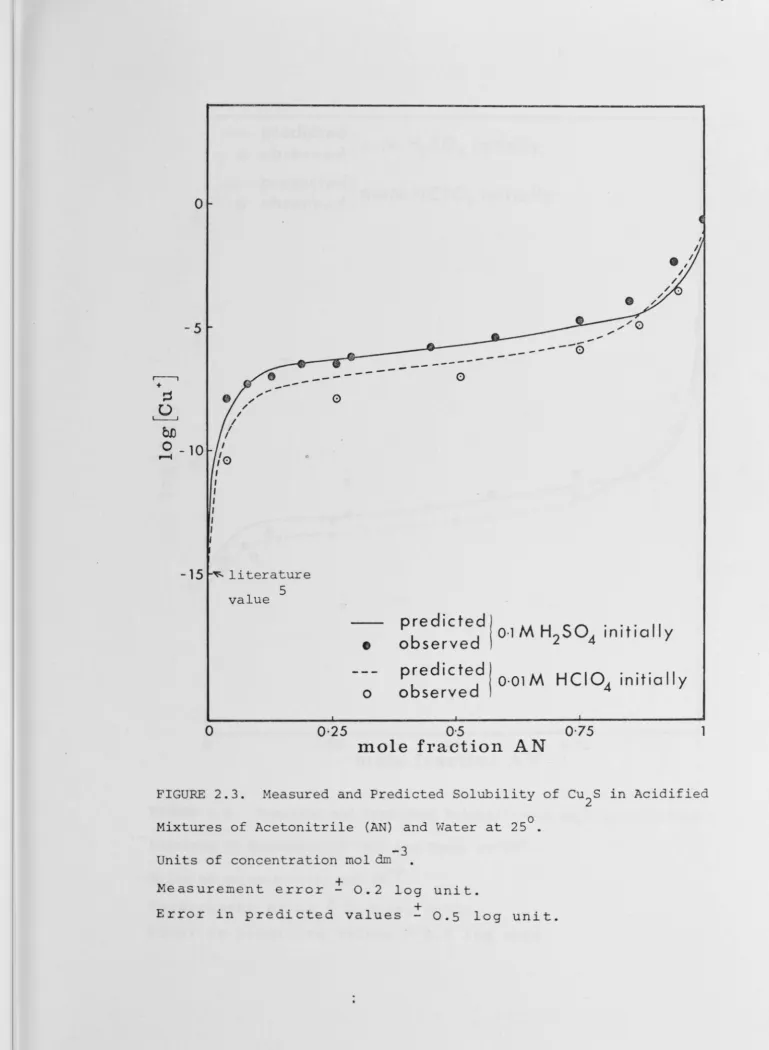
.
•
.'
.
Robert Ian Tilley, A.C.I.T.
A thesis submitted for the degree of
Doctor of Philosophy ... at
The Australian National University
.
.
.
.
Research School of Chemistry The Australian National University
Canberra, A.C.T.
The work described in this thesis is my own, except where otherwise stated, and has not been submitted in support of an
application for any other degree. It was carried out in The Research School of Chemistry, The Australian National University (1971-1974) during the tenure of an Australian National University Postgraduate
Scholarship.
9.
ACKNOWLEDGEMENTS
I am indebted to my supervisor, Professor A.J. Parker, for his
guidance and encouragement before and during the course of this thesis.
I would also like to thank Professor R.L. Martin for supervisory
assistance during 1974.
Drs. Cox, Hedwig, Diggle, Giles, Webb, Dack and Buckingham
deserve my thanks for helpful discussions and comments. Thanks are also due to Dwain Owensby for his assistance in some of the hydroxide
solubility measurements.
I wish to express my gratitude to the members of The Faculty
Board of The Research School of Chemistry (1971) who allowed me to
undertake this course.
Fihally, the award of an Australian National University
Postgraduate Scholarship is gratefully acknowledged.
i i i.
CONTENTS
Units and Abbreviations 1.
Summary
Chapter 1
Chapter 2
1.1.
1.2.
1.3.
2.1.
2.2.
STABILISATION OF Cu(I) IN .SOLUTION Introduction
Results and Discussion
1.2.1.
1.2.2.
+ 0 2+ +
Potentials of Cu /Cu and Cu /Cu Couples
Stabilisation of Copper {I~
1.2.3. Stabilisation of Cu(I) and Cu(II)
2.
3. 4.
7.
7.
13. 16· 1.2.4. Effect of pH on the Stability of Copper (I)
1
7
.
1.2.5. Stability Constants of Cu(I) Complexes 20. 1.2.6. Preparation and Properties of Some Cu(I)
Complexes
References
SOLUBILITIES AND EQUILIBRIA INVOLVING COPPER(I)
Introduction
Results and Discussion
2.2.1. The Behaviour of Solutes in Mixtures of Acetonitrile and Water
2.2.1.1. General Considerations
2.2.1.2. Solubility of Cu(I) and Ag(I) Sulphide
2.2.1.3. Dissociation of Sulphuric Acid and Hydrogen Sulphide
2.2.1.4. Solubility of Cu(I) Salts
24.
29.
3
2.
33.
34 .
34. 34.
39.
Chapter 3
Chapter 4
2.3.
3.1. 3.2.
3.3. 3.4. 3.5.
4.1.
2.2.2. Comparison of Measured and Predicted Solubilities
2.2.3. Equilibria Involving Copper (I)
47. 52. 2.2.3.1. Studies in Dipolar Aprotic Solvents 52. 2.2.3.2. Equilbria in Mixtures of
Acetonitrile and Water References
COPPER (I) IN MINERAL CHEMISTRY, ORGANIC CHEMISTRY, AND BIOLOGICAL CHEMISTRY
Introduction
+
Cu in Mineral Chemistry
55. 57.
59.
60.
61.
3.2.1. Copper Recovery using Cu(I) Salt Solutions 61.
0
3.2.1.1. Production of Cu(I) Salt Solutions
3.2.1.2. Disproportionation of Cu(I) Salt Solutions
3.2.1.3. Electrodeposition of Copper from Cu(I) Salt Solutions
3.2.2. The Use of Organic Nitriles in Copper Processing
3.2.3. Purification of Cu(I) Salt Solutions by Selective Precipitation of Hydroxides Compounds of Cu(I) in Organic Chemical Reactions Cu(I) in Biological Chemistry
References
EXPERIMENTAL Reagents
4.1.1. Solvents 4.1.2. Acids
61.
62.
68.
.71.
72.
75.
.77.
78.
8
-
,..
82. 82 •
4.2.
4.3.
4.4. 4.5. 4.6. 4.7.4.1.3. Copper Compounds
4.1.3.1. Simple Salts
4.1.3.2. Tetrakis (Acetoni trile) Copper Bi sulphate
4.1.3.3. Tetrakis (Pyridine) Copper (I)
Perchlorate
4.1.3.4. Tetrakis (Acetroni trile)
Perchlorate
4.1.4. Ligands
4.1.4.1. Non-Gaseous
4.1.4.2. Gaseous
4.1.5. Miscellaneous
Preparation of Cu(I) Salt Solutions
General Techniques
4.3.1. Potentiometry
4.3.2. Conductance
4.3.3. Infra-Red Spectroscopy
Chemical Analyses
4.4.1.
4.4.2.
4.4.3.
+
2+
Cu /Cu Mixtures
Ethylene
Miscellaneous
Copper
+
02+
+
Measurement of Cu /Cu and Cu /Cu Potentials
Non-Gaseous Ligands
Gaseous Ligands 4.5.1.
4.5.2.
4.5.3.
+
0
pH Dependence of the C~ /Cu Potential
Measurement of Stability Constants Measurement of Solubilities
4.7.1. Cu(I) Sulphide
4.7.2. Ag(~) Sulphide
4.7.3. Hydrogen Sulphide 94.
4.7.4. Sulphur 94.
4.7.5. Cu (I) Salts 94.
4.8. Dissociation Constants of Acids
94.
4.8.1. Sulphuric Acid 94.
4.8.2. Hydrogen Sulphide 95.
4.9. Measurement of Log
w
s
YH+
95.
95. 4.10. References
97 Appendix
FIGURES
+
1.1. Free Energy of Transfer of Cu ·from Water to Aqueous
Solutions of Ligands at 25°.
+
1.2. Free Energy of Transfer of Cu from Water to Aqueous
Solutions of Gaseous Ligands at 25°.
1.3.
Effect of pH on the Potential of the Cu /Cu Couple in+
0Aqueous Solutions of Ligands.
2.1. Solvent Activity Coefficients for Transfer from Water to
2+
+
-
-
-AN-Water Mixtures of Cu , H, Cl, Br, I , H
20, H2S, S,
+
+
0Ag and Cu at 25 .
2.2. The Solubility of H
2s and Sulphur in Mixtures of
Acetonitrile and Water at 25°.
2.3. Measured and Predicted Solubility of Cu
2
s
in Acidified ...25°. , Mixtures of Acetonitrile and Water at
.
r"
•_.
2.4. Measured and Predicted Solubility of Ag~
.
2
s
in Acidified Mixtures of Acetonitrile and Water at 25 . 02.5. Dissociation Constants of H
2
so
4 and H2S in Mixtures ofAcetonitrile and Water at 25°.
2.6. Titration Curves in Mixtures of Acetonitrile and Water at
2.7. pH Dependence of Copper Hydroxide Solubilities in Water
and Acetonitrile.
3.1. Solubility of Ethylene in Acidified Cu(I) Sulphate
Solutions at 25°.
ix .
11.
12.
18.
35
38.
. 40.
41.
42~
43
.
.
46.
3.2. Simplified Flow Diagram for a Copper Recovery Process
4.1.
4.2.
using Gaseous Ligands.
+
0Apparatus used for the Measurement of Cu /Cu and 2+
1
+
,
,
,
r •Cu Cu Potentials in Solutions or Gaseous Ligands.
Apparatus used to Measure the Solubilities of cu
2s and
Ag
2
s
in Acidified Mixtures of Acetonitrile and Water.67
88
93·
TABLES
1.1. Potentials of Cu /Cu . + 0 and Cu 2+ /Cu + Couples at 25 0 in
Aqueous Sol·.1tions of Ligands.
1.2. Potentials of Cu /Cu
+
0 and Cu 2+ /Cu+
Couples at 25 o . inAqueous Solutions of Propylene, Ethylene and Carbon
Monoxide.
1.3. Potentials of Cu . + /Cu 0 and Cu 2+ /Cu + Couples at 25 0 in
Aqueous Solutions of two Ligands.
1.4. Free Energy of Transfer of Cu 2+ from Water to Aqueous
Solutions of Ammonia and Pyridine at 25°.
1.5. Behaviour of Aqueous Solutions of Cu(I) and Various
Ligands at Varying pH Values.
1.6. Stability Constants of Cu (I) Complexes in Aqueous
..
,Solution.
.
..
..
.
·,-
.
.
.
-1.7. Stability Constants of Complexes of Cu (I) with Cl
'
Brvi i.
8.
10.
16 .
19.
2
1
.
-
-'
I'
Thiourea, SDMF and Pyridine in Water and Acetonitrile at 25°. 25 ~
1.8. Infra-red Absorption Frequencies.
1.9. Potentials of the Cu+/cu° Couple in Acidified Aqueous
Solutions under Carbon Monoxide at 25°.
2.1. Measured and Predicted Solubilities at 25° of Cu{I) Salts
in AN-Water Mixtures Initially Containing HC10 4.
2.2. Reported Solubili~y Product s of Cu ~I )
'
Cu(II) and Ag(I)27.
28 .
45.
2.3. Solvent Activity Coefficients for Transfer from Water t o
+ + + - -
-AN-Water Mixtures of H , Cu, Ag, H
2
s,
S, Cl , Br, I ,0
SCN and HCN at 25 .
2.4. Calculated Data for the Solubility of cu
2
s
in AN-WaterMixtures Initially Containing H
2
so
4 and H2s.
2.5.
2.6.
+
-
0Solvent Activity Coefficients of Cl, H and Cucl
2 at 25
for Transfer from Water to Acetone, DMF and DMSO.
0 Estimated Values of Log K
10 in Acetone, DMF and DMSO at 25
and Experimental Observations on Reaction 10.
2.7. Equilibrium Constants of Reactions in Water and AN-Water
Mixtures at 25°.
3.1. Equilibrium Constant of the Reaction Cu 2+
+
Cu 0 ~ 2Cu+
in 0Aqueous Solutions of Various Ligands at 25 .
3.2. Copper(I)and Copper(II)Concentrations in Aqueous Acidic
-49 .
51.
53.
55.
56.
63 .
, Solutions Saturated with Ethylene at Atmospheric Pressure. 65 ·
.
.
'
3.3. Polarization:;ef·Copper Electrodes during Electrolysis in
Electrolytes Containing Acetonitrile and Allyl Alcohol.
3.4. Solubilities of Metal Hydroxides in Water and AN-Water
Mixtures at 2s0 •
70.
UNITS AND ABBREVIATIONS
SI units have been used in this thesis. The symbol M has
been used to represent mol dm-3 and square brackets to represent
concentration. The term "ion" is not intended to mean the free
ion (only found in the gaseous state). In this thesis, "ion" is to
be taken as the solvated or complexed species of the free ion in
solution. Unless otherwise stated, all solubility and
equilibrium constants are based on the molar concentration scale.
The following abbreviations appear in this thesis:
AN
tu
SDMF
PY
AA
SCE
DMF
DMSO
TATB
E I.J
KSO
acetonitrile
thiourea
dimethylthioformamide
pyridine
allyl alcohol
saturated calomel electrode
dimethylformamide
dimethylsulphoxide
tetraphenylarsonium-tetraphenylboride
liquid junction potential
solubility product
1.
SUMMARY
This thesis has been divided into four chapters. The first deals
with the chemistry of Cu(I) species in solution. The stabilisation of
Cu+ in water by a variety of ligands has been examined in detail.
+
Changes in the free energy of Cu on transfer from water to aqueous
solutions of the ligands have been determined FOtentio~etrically.Some
free energy changes ofCu(II) species have been likewise determined.
Stability constants of some Cu(I) complexes have been measured and three
complexes synthesised. The effect of pH on the stability of Cu(I)
complexes in solution has also been studied.
The second chapter deals with the solubilities of Cu(I) salts,
and with equilibria involving Cu(I) species _, in non-aqueous solvents
and in mixtures of acetonitrile and water in particular. Solvent
_transfer -activity coefficients have been evaluated and used to predict
solubilities , and equilibrium constants, in the solvents mentioned above.
The predicted values have been compared with those determined
experimentally and good agreement has been found.
Chapter 3 discusses practical applications of some of the work
described in the preceding two chapters. Particular attention has been
paid to the use of hydrometallurgical techniques for the recovery and
processing of copper. The relevance of some of the work in the thesis
to copper-catalysed organic chemical reactions, and to biological
chemistry, is also briefly mentioned.
Chapter 4 describes the reagents and techniques used in chapters 1
to 3. An Appendix which gives stability constants of CU(I) and Cu(II)
complexes has been included.
3.
CHAPTER 1
0
1.1. Introduction
The Cu(I) ion is not a stable species in water,the following
disproportionation reaction occurring:
+
2+ o2Cu ~ Cu + Cu ( 1)
The equilibrium constant for reaction 1 is 106 mol-l
am
3+.
Thereaction can be represented by an oxidation and a reduction step as follows:
2+
+
Cu -+ Cu
+
e+
0Cu + e -+ Cu
+
(oxidation of Cu)
(reduction of Cu+)
(2)
(3)
When these electron transfer reactions are prevented or considerably
inhibited,aqueous solutions of Cu+ are obtained. This has been achieved by
2
Altermatt and Manahan who were able to keep solutions of Cu(I) perchlorate
in
aqueous perchloric acid (O.lM) ato
0 for 10 hours before disproportionationwas detected. This entailed the use of scrupulously clean glassware and the
exclusion of oxygen and metal surfaces. The extreme instability of these
solutions makes their use impractical for studying Cu(I) species in
solution. However,as will be shown later,stable Cu(I) salt solutions are
easily obtainable in aqueous media by complexing the ion with ligands which
stabilise the Cu(I) state .
..
Largely as a result·~~·the facility of the disproportionation reaction
(1), the chemistry of Cu(I) is not as extensive as that of Cu(II). However,
stability constants for a variety of Cu(I) complexes have been tabulated by
·1 ,. 1 ) . . 1 3
Si len, and olefinic Cu(I complexes are discussed in a review by Hart ey.
Stability constants of Cu(I) complexes found in the literature are
tabulated in the Appendix.
One of the earliest reported studies on nitrile complexes of Cu(I) is
that of Morgan4 ,who in 1923 described the preparation and some properties of
Cu(AN)
4No3, Cu(NC CH2cH2CN) 2 N03, Cu.AN.Cl, and Cu.AN.Br (AN= acetonitrile).
Further work involving nitr~les as Cu(I) ligands has been reported by
Hathaway and co-workers5, Hemmerich and Sigwart6 , Farha and Iwamoto7,
studies concerned with the redox potent ials of copper complexes have
~
k d ·11· 11 d' dbeen carried out by a nurr~er or wor ers. James an Wi iams stu i e
copper complexes of 1,10-phenanthroli nes, bipyr idyls and other nitrogenous
bases; Hawkins and Perrin12 used pyridine, 4-methylpyridine, imidazole , benzimidazole, and 2-methylthioethylamine as ligands while Vallon and Badinand13 studied copper complexes of penicillamine and
N-acetylpenicillamine.
A number of papers have described Cu(I) complexes with molecules
containing carbon-carbon double bonds. The solubility of Cu(I) chloride in aqueous solutions of unsaturated alcohols and acids has been
d etermine . d 14 ' 15 an d stu ies invo ving a d. . 1 . 11 1 y a coo 1 h 1 16 ' l 7 , propene and 2 -met y proph 1 ene 18 , an d eye oo e ins 1 1 f' 19,20,21 h ave a so 1 b een ma e. d
Other ligands studied include diphenylphosphinobenzene-m-sulphonate22, ammonia23, benzene21'24, dipyridyl, orthophenanthroline and thiourea25,
. h . . . d . h 'b. 26 h hl . d
trip enylphosphine, triphenylarsine, an trip enylsti ine , t e c ori e
. 10,27 . 28 h 'd . 29 d . 30
ion , cysteine , t e cyani e ion , an amines This list is not exhaustive but indicates the wide variety of ligands able to stabilise Cu (I) .
31
Recent work by Parker and his group has demonstrated the use of aqueous .acetoni trile solutions of Cu (I) salts to facilitate the
.
.
extraction and refining pf ~opper metal. The technique relies on the fact
.
..
..
'
h . 2+ o d.
t a t AN can be added to acidic solutions of Cu and Cu to issolve copper metal, and subsequently removed from the resultant C~(I) salt solutions
2+ (e.g. by steam distillation) to precipitate pure copper and regenerate Cu These reactions will be discussed in greater detail in Chapter 3.
As will be shown in this work, other ligands are amenable to these
operations, particularly low-boiling liquids or gases, where addition and removal are facile processes. A variety of ligands which stabilise Cu(I)
- 2- - -
-in aqueous solutions have been exam-ined, i.e. CN,
s
2
o
3, SCN, Cl , Br,-I , thiourea(tu), dirnethylthi~formamide (SDMF), pyridine (py) , ammonia, allyl alcohol (AA), acetonitrile, ethylene, propylene, and carbon
monoxide together with mixtures of ligands (e.g.
AN
and Cl , AN and CO) .+ 0 2+ +
Potentials of the Cu /Cu and Cu /Cu couples have been measured
over a range of ligand concentrations enabling the free energy of
+ 2+
transfer of Cu and Cu from water to aqueous solutions of the ligands
to be .~eterrnined. Differences between the standard free energy of an ion
(or other chemical species) in water, G
-
w
, and in aqueous complexingi
- s
media, G , can be viewed loosely as the free energy required to transfer
i
the ion from water to the given medium. W6G s is defined by:
i
w -
s
6G,1
where
-
w
G.
1
- s
G.
1
=
2.303RT logw
s
y, '
1
32
w
s
y. is the transfer activity coefficient.
1
(4)
A negative value of
w -
6G s indicates that the ion is more stable ini
medium S than in water. Thus, measurements have been made which have
enabled values of
w -
tG
Cu+ to be determined in a variety of s aqueous media.In this way, a measure of the relative stability of the copper (I) species
in various media has been obtained.
4 •
.
.
.
• I...
.
.
•w •• .
• ... ~i"' ••
In Chapter 2 use is"made of transfer activity coefficients to
calculate solubility and equilibrium constants in new media. The use of
w
s
y, values rather than free energies for these calculations was found to 1
be more convenient as much solubility and equilibrium data in the
literature are given in terms of solubility products and equilibrium
constants rather than free energy changes. However, i t should be noted
that the two quantities, 6G and
y,
are forms of the same thermodynamicquantity (see equation 4). F,urther discussion on the use of
w
s
y. values follows in Chapter 2.
Potentiometry has been employed to detect the highest Cu(I) complex
(i.e. the complex containing the most ligands) formed in solution and to
measure its stability constant. The effect of pH on the stability of the
cu(I) complexes in solution has been studied and three solid Cu(I)
complexes prepared and, in the case of Cu(AN)
4Hso4, characterized.
1.2. Results and Discussion
1.2.1. Potentials of Cu /Cu + 0 and Cu 2+ /Cu + Couples
+
0 2+ 0The potentials of the Cu /Cu and Cu /Cu couples in water and
aqueous solutions of ligands are given in Tables 1.1, 1.2 and 1.3. The free
energy of transfer of the Cu(I) ion from water to solutions of the various
ligands, W~G~u+(kJ mol-~ was calculated as follows:
Wi,, S
DG
+
=
Cu
0
s
(E
+/
o Cu Cuw
E+
1
o)
Cu Cu 0.096 (5)
S . W
+
0where EC
+
1
o and E + o are the potentials in mV of the Cu /Cu couple u Cu Cu /Cuin the ligand solutions and in water.
WtG8 2+ (kJ mol-l) was calculated as follows: Cu
=
0.096+
(6)Values of W~GS
+
calculated using equation 5 are given in Figures 1.1 and 1.2. CuCu(I) salt solutions used to obtain the potentials given in Table 1.1
were prepared by dissolving Cu(AN)
4c104 (0.0lM) in the presence of each ligand.
Thus,each solution contained 0.04 moles per litre of AN. This will have a
small effect on the measured potential when ligand concentrations are low
(i.e. O.lM), but at higher concentrations this effect will be minimal. For
example,a solution of AN (0.4M) and SDMF (2M) ~ave a potential reading of
7.
+
0682mV for the Cu /Cu couple versus the SCE. Upon increasing the AN content to
1.2M the reading only changed to 678mV. It is therefore expected that
AN(0.04M) in solutions containing much greater amounts of a stronger ligand
TABLE
1.1.
a + o 2+ + o
Potentials of Cu /Cu and Cu /Cu Couples at 25 in Aqueous Solutions of
Ligands.
-3
Potentials (rnV) in solutions containing x mol dm of ligand (s)
Ligand (s) b Water CN tu SCN Cl
Br
I AA AN NH3 AA,Cl AN,Clx=O.l
160
-1300(11.2)
- 500
- 470(11.4)
- 360
20
20 f f f f- 180(6.
8)h
90
f+
0Cu /Cu
x=0.5
160
-1420 (11. 5)
- 670
- 630 (11.
5)- 550
f- 100
- 170
f70
50
- 2 70 (7.
6)- 400(12.2)
- 190
- 130
X
=
2160
-15 50 ( 11 . 8)
d
- 750(11.6)
- 680
- 550(11.0)
- 200
- 270
- 450
90 - 130- 3
60 (
7. 8)- 440 (12 .1)
- 290- 230
2+ +
Cu /Cu
x=O.l -89 C C C C C f f C
120
40
140(6.8)
h x=0.5 -89 C C C C C160
220
C170
120100(7
.6) fSolution pH= 2-3 except where parenthesised values indicate otherwise.
All ionic ligands are potassium salts except
s
2o
32
- which is the sodium salt.
Abbreviations used are as follows: tu, thiourea; SDMF, dimethylthioformamide;
AA, allyl alcohol;
AN,
acetonitrile; py, pyridine.a b C d e f g h
Saturated calomel electrode (SCE) reference, estimated error in
potentials ~ 10 mV. Cu(I) and Cu(II) concentration 0.01 M.
Reference 33.
cu2+ reduced to cu+ by the ligand.
2M
solution precluded by insolubility of tu.0.4M AN
present.Precipitation occurred.
1.9M
AN
present.Stable solution of Cu+ could not be prepared (see text).
9.
TABLE 1.2.
. a + o 2+ + o · . b
Potentials of Cu /Cu and Cu /Cu Couples at 25 in Aqueous Solutions
of Propylene, Ethylene and Carbon Monoxide.
Ligand
C Water
Propylene
Ethylene
co
.
.
.
,
..
Potentials (mVk in solutions under a ligand pressure of 10 x pascals
+
0 Cu /CuX - 0.95
160
.10
-30
-70
~:
'.
.
.
.
'
X
=
4. 75160
-30
-80
-110
2+
+
Cu /CuX
=
0. 95-89
50
110
120
X
=
4. 75-89
90
160
160
a SCE reference, estimated error in potentials
+
10 mV. Cu (I) and Cu (II) concentration O.OlM.b Solution pH 2-3.
c Reference 33.
[image:20.802.10.787.20.1070.2]TABLE 1.3.
a +
o
2+ +o
bPotentials of Cu /Cu and Cu /Cu Couples at 25 :in Aqueous Solutions of
two Ligands.
Potentials (rnV) in solutions under a ligand
pressure of l05x Pa
Ligands Cu /Cu + 0 Cu 2+ /Cu +
X
=
0.95 X=
4.75 X=
0.95 X=
4.75Water ,C 160 160 -89 -89
Ethylene, O.lM Cl
-
70 -100 150 170Ethylene, O.lM AN -40
-
90Ethylene, O.SM AN -80 -110
Ethylene, 2M AN -160 -1 70
co,
O.lM Cl -110 -150 170 210CO, O.lM Br -120d,e -160 d 210
co,
O.lM AN-70
-120co,
O.SM AN -100 -140..
CO, 2~ ~ , -160 -190
.
..
CO, 0.
lM
pyridine f.
.
.
.
.
d -230 d 160.
.
a SCE reference, estimated error+ 10 mV. Cu(I) and Cu(II) concentration
0.01 M.
b Solution pH 2-3 unless otherwise stated.
c Reference
33.
d Precipitation occurred.
e Extrapolated value.
160
140
80
,--0
E
'-' +
:>
.,,u
c.,
.~<J
. ·1
,
-
.
·
.
.
.
40
20
0
----
-
-
--re o
-
thiO~----
-
---
----scN-:._ _. -- -- - - --
-
-
-
--
ammon10 _ _---~~----::-::::-::::-==-=---~-,
,-
---
---11.
---.,...---__J~~~~~~~;,;~~1
M AN resent) _ _ - -ridinell·9 - - - . 0ie)0
,,..- - - ~ ·d·neles\1rn
- - - -"" pyr1 I
--0·5 1·0 1·5 2·0
ligand
concentration(mol
dm-3)
[image:22.808.35.782.10.1086.2]+
FIGURE 1.1. Free Energy of Transfer of Cu from Water to Aqueous
Solutions of Ligands ati
2
s
0 ,a See text.
40
,--0
E
30
10
0
1
CO, 0·1 M py
CO, 2M AN
-~---e-CO,O·lM AN / Et,0·5M AN
co
Et,O·l M CI-Et,O·lM AN
~---~=
ethylene(Et)2
3
4
5
6
gas pres
sure
(pascals
x
i.o-5 )
7
FIGURE 1.2. Free Energy of Transfer of Cu
+
from Water to AqueousSolutions of Gaseous Ligands at 2s0 , W6G8
+·
Cu.
[image:23.790.17.772.15.1054.2]. The potentiometric measurements made involved the use of a
saturated aqueous calomel electrode in a variety of aqueous solutions.
The similar mobilities of the potasium and chloride ions present in
the salt bridge of the SCE reduces the uncertainty in the liquid
. 34
junction potential to 1 or 2 mV in aqueous solutions.
1.2.2. Stabilisation of 9oppe~ (J)
13 .
It is clear from Figures 1.1 and 1.2 that the cyanide ion has by far the greatest stabilising effect on copper (I). It is well established th a t CN is an exce 11 en-t 1 ' igan d f or many transition meas • • t 1 3 5 I 3 6 . As well as being a strong nucleophile i t has the ability to accept electron density
from a metal into its vacant TI* orbitals. The latter is an important factor
+
in bonding with metals in low formal oxidation states (e.g. Cu). In
ad . . h b d f d d . + f . f
a ition t o t e
a-
on orme by onation to Cu o the lone-pair oelectrons from the nitrogen atom a type of TI-bond is formed by back donation
of electrons from the metal to the vacant anti-bonding orbitals of the ligand. This type of bon~ing is important in Cu+ complexes and ligands
.
'having.
.
.~his.
TI-acceptor ability include allyl alcohol, acetonitrile, pyridine, ethylene, propylene, carbou monoxide, thiourea and SDMF.From the data presented in Figures 1.1 and 1.2 i t is also evident that ligands having a sulphur atom as donor considerably stabilise the
C u (I) state. In f act t e h f our ligands of this type studied reduce Cu . . . 2+ to
+
Cu in solution. Again these ligands are able to accept electron density from the metal atom into vacant orbitals forming dative TI-bonds.
The concept of hard or class (a) and soft or class (b) ligands and
37 38
acceptors ' is also useful in describing results obtained. Ahrland,
Chatt, and Davies38 state that class (b) character appears to depend on the
availability of electrons fro~ the lower a-orbitals of the metal for dative
39
class (b) acceptors and donors and factors contributing to class (b)
40
behaviour in acceptors . The Cu(I) ion is classified as a class (b) or soft cation. Thus,the high stability shown with ligands having a sulphur atom as donor is not unexpected (see Figure 1.1). The outer electrons of the sulphur atom are highly polarizable this being a characteristic
property of class (b) donors. Also,the order of stabilities shown by the halides in Figure 1.1 is consistent with the class (a), class (b) concept
with
iodide being softer than bromide which in turn is softer than chloride.Figure 1.1 illustrates the difference in curve shapes between allyl alcohol and ammonia and the remainder of the ligands. The stabilisation of
+
Cu by allyl alcohol and ammonia levels off after a ligand concentration of
-O.SM has been reached, whereas the stabilisation due to AN, Cl and Br, for example, continues to increase. This is due to the fact that allyl alcohol only forms a 1:1 complex with Cu+ and ammonia a 2:1 complex; the other
ligands may form complexes with ligand to metal ratios of 3:1 and 4:1,as will be discussed later in this chapter. The broken lines shown in Figure 1.1
were
obtained by assuming similar curve forms to those exhibited byneighbouring ligands.
The full curves drawn for pyridine and SDMF were obtained from
measurements made in the presence of 1.9M and 0.4M AN respectively. The AN
was
necessary to prevent the formation of precipitates in the solutions under study. For SDMF a small error is expected due to the AN present; however,for pyridine significant errors due to the added AN are expected. The broken line in Figure 1.1 will give a more accurate representation of the stabilisation of Cu+ due to pyridine. The precipitate formed when no AN was added was the tetrakis(pyridine)copper(I) complex and further details will be given later. The insolubility of this complex in aqueous solutions
15.
In Figure 1.2 similar curves to that exhibited by allyl alcohol are
found for propylene, ethylene, and carbon monoxide. These gaseous ligands
in order of decreasing Cu+ stabilisation are CO>ethylene>propylene. The reason for this order is thought to be a steric one as indicated by Hartley
in his review of olefin and acetylene complexes of transition metals3. The
optimum approach of the metal to the olefin may be hindered by groups
attached to the a and
S
carbon atoms. CO has no attached groups, ethylenehas four hydrogen atoms, and propylene has three hydrogen atoms and a methyl group attached to the doubly-bonded carbon atoms.
+
Figures 1.1 and 1.2 show the stabilisation of Cu by various
combinations of ligands. In all cases the degree of stabilisation afforded Cu+ by the mixtures of ligands is equal to or greater than that afforded by
each individual ligand. The results are consistent with the following orders of Cu+ stabilisation strengths, i.e. CO>ethylene, Br->Cl >AN, and
with competition between ligands for sites around copper (I). For
example,the results in Figure 1.2 for mixtures of ethylene and AN, and CO
and AN show that,at low concentrations of AN,the value of the free energy of transfer (~G ) from water to the mixture is approximately the same as
tr
~Gtr from water to the solution containing the gas alone. However,as the concentration of AN increases,~G from water to the mixture approaches
tr
~Gtr from water to a solution of AN alone. That is,at low concentrations of AN the gaseous ligand is the stronger competitor for the ligand sites
+
around Cu ,whereas at higher concentrations of AN the latter competes more effectively.
Mixtures of allyl alcohol and chloride ion, and AN and Cl were
d · d · . .
+
4, 14.stu ie as mixed complexes of each pair of ligands with Cu are known The results found are given in Figure 1.1 and show an interesting
difference between the two combinations. The AN,Cl results show that the stabilisation of Cu+ obtained with these ligands is only slightly greater
.
-increase the stabilisation over that found for Cl . The increased
stabilisation provided by the combination of allyl alcohol and the chloride
ion suggests that a synergistic effect may be operating.
1.2.3. Stabilisation of Cu(I) and .Cu(II)
2+ +
The only two ligands which appreciably stabilise Cu as well as Cu
are ammonia and pyridine. Free energies of transfer of Cu 2+ from water to
aqueous solutions of NH
3 and pyridine have been calculated from the
potentials given in Table 1.1 and are given in Table 1.4. Cu (I) salt
solutions could not be prepared in O.lM solutions of ammonia for the following reasons. At a pH of 5 cu
2
o
precipitated,and at pH4.8
+
disproportionation of Cu occurred. The difficulty experienced highlights
. . f . h + 2 + h. h . 1
the competition or ammonia b y t e proton, Cu, and Cu w ic wil be discussed further in a following section.
TABLE 1. 4.
2+
Free Energy of Transfer of Cu from Water to Aqueous Solutions of Arrunonia
0 W S
and Pyridine at 25 , 6Gcu2+·
Ligand
W s -3
6Gcu2+ at ligand ~cr1centrations of x mol drn
(kJ rnol )
X
=
0.1 X=
0.5 X=
1
X=
2Ammonia a b - :79. 9 - 80. 7
Pyridine - 5. 9 - 21.3
+
0a
Cu /Cu couple could not be measured at this concentration of NH3 (see
text).
b Cu(OH)
17.
The ability of NH
3 and pyridine to stabilise Cu+ and cu
2
+ has important
2+ 0 +
implications when equilibria such as Cu + Cu ~ 2Cu are considered. Ligands which stabilise Cu+ only may shift the reaction to the right while
+ 2+
those which stabilise Cu and Cu may or may not shift the equilibrium
depending on the relative degrees of stabilisation. It should be noted that stabilisation of cu2+ would need to be twice that of Cu+ to prevent
any shift of the equilibrium to the right.
1.2.4. Effect of
pH
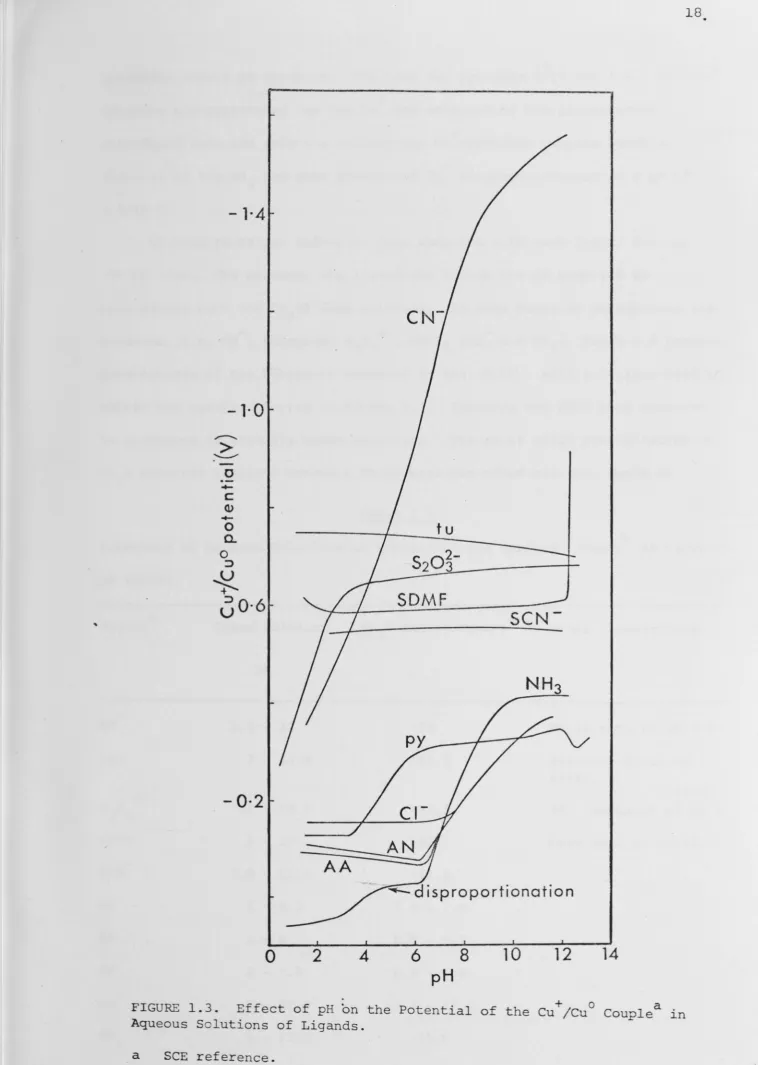
on the Stabil i ty of Copper (I)It can be seen from Tables 1.1, 1.2, and 1.3 that potential measure-ments have been made at various pH values. This was necessary because the ability of each ligand to stabilise Cu+ was affected by pH. Figure 1.3 shows the effect of pH on the potential of the Cu+/cu0 couple in the
presence of various ligands. It is evident that within a pH range of 2 to
-
-6 the ability of acetonitrile, allyl alcohol, Cl , SCN , SDMF and thiourea to stabilise Cu+ is little affected. Thus,potential measurements involving
-
2-these ligands were made at pH values between 2 and 3. However,CN,
s
2
o
3 , pyridine and ammonia show marked effects over this pH range. Potential measurements in solutions containing the first three ligands were made at?
the pH
.
·which.
resulted from their dissolution in water. These pH values are..
contained in parenthese$ ··~!ter the potentials given in Table 1.1. Sodium hydroxide was added to ammoniacal solutions to give the pH indicated in
Table 1.1.
A number of factors need to be considered to explain the data
presented in Figure 1.3. Firstly,at low pH values the proton will compete
with Cu+ for the more basic ligands, i.e. CN ,
s
2
o
3 2-, pyridine, NH
3. In
2-the case of
s
2
o
3 the ligand was decomposed by acid andso
2 eventually liberated. Also,as the pH was lowered cyanide ions associated with protonsto form HCN in solution and pyridine and NH
3 were protonated. In the
+
0preceding cases the potential_ of the Cu /Cu couple became more positive as
the effective ligand became unavailable to the Cu(I) ion and as
,
+
0- 1·4
-1-0
0
·-
+-cCl>
+-0
Q.
0 :::,
~
+
=>
O· 6
u
-0·2
tu
SDt
v\F
~
a
isproportionation
0
2
4
6
8
10
12
14
pH
·
+
o aFIGURE 1.3. Effect of pH on the Potential of the Cu /Cu Couple in
Aqueous Solutions of Ligands.
a SCE reference.
[image:29.798.22.781.11.1076.2]19.
potential versus pH occurred. The plot for pyridine fell until all of the
+
pyridine was protonated and the Cu was solvated by the acetonitrile
introduced into the solution to keep the Cu+-pyridine co~plex soluble.
+
When all of the NH
3 had been protonated Cu disproportionated at a pH of
4.5 to 5.
At high pH values hydroxide ions competed with each ligand for the
Cu (I) ion. The stronger the ligand the higher the pH required to
precipitate CuOH (or cu
20) from solution. In some cases no precipitate was
2-obtained, i.e. CN, thiourea,
s
2
o
3 , SDMF, SCN and ~1-!3. Table 1.5 containsdescriptions of the behaviour observed in the Cu(I) salt solutions used to
obtain the results plotted in Figure 1.3. Thiourea and SDMF both appeared
to decompose in strongly basic solutions. The pH at which precipitation of
cu
2
o
occurred remained constant while base was added and thus could beTABLE 1.5
Behaviour of Aqueous Solutions of Copper(I)a and Various Ligandsb at Varying
pH Values.
. de Ligan
CN
tu
S203
2-SDMF
SCN
Cl
AA
AN
e
PY
NH3
Clear solution
pH
3.5 - 12
2 - 11.5
11 - 12.5
1 - 10
2.8 - 11.4
1 6.2
1 - 6
1 -
5.82 - 11.8
1 - 11.9
Other observations
>12 White ppte at pH 3-4
>11.5 Solution brown at
pH~l2.
>12.5
so
2 liberated at pH 1
>10 Dark ppte at pH>lO.
>11.4
7.4 - 7.6
6.5 - 6.7
6.3 - 6.4
12.3 12.6
(Table 1.5 continued) a O.OlM CuC10
4.
b Ligand concentration= lM, except SCN = 2M.
c Abbreviations as in Table 1.1.
d Point at which pH remained constant while base was added.
e
1.9M AN present.readily detected. Also,the point at which the slope of the plots in
Figure 1.3 change abruptly indicates the pH at which precipitation occurred
-in the case of allyl alcohol, AN and Cl. The practical significance of these results will be discussed in a later chapter.
1.2.5. Stability Constants of Cu(I) Complexes
Table 1.6 contains stability constants for some Cu(I) complexes in aqueous solution. Literature values found for the ligands studied in this
work have been included together with constants determined by the
potentiometric method described in Chapter 4. No literature values could
be found for SDMF, ethylene and CO. The following equilibrium has been measured:
+
Cu(aq) + nL (aq)
e
n
~
+
. - CuL (
n
aq )Results are expressed as concentration, rather than thermodynamic, constants as no corrections for ionic effects have been made. Many of the literature values in Table 1.6 are also concentration constants.
As well as enabling stability constants to be deterrnined,the method used in this work enables the highest complex ·in solution to be found. This
number (n) is given in Table 1.6 and applies to Cu+-ligand ratios of 1:10 to 1:200. The potentiometric method is simple, rapid and accurate its main
disadvantage being that stability constants for lower complexes can only be
[image:31.801.12.791.24.1102.2]TABLE 1. 6.
Stability Constants of Cu(I) Complexes in Aqueous Solutions
. da
Ligan
CN
tu
S203
2-SDMF SCN Cl Br I 25 25 'vl8 'vl8 25 25 25 25 25 25 25 20 25 25 23 20 25 25 'v 19 25 'vl9 25 20
+
Cu(aq)
+
nL(aq) ~ ....- CuL ( n+
aq )d . . b
Con itions n
0 corr 4
0 corr 4
var 4
var
40.1 KN0
3 4
µ'vO. 02 4
1 Na
2
so
4 31.2 KN0
3 3
µ'v0.02 3
µ'v0. 02 4
var 4
var 4
0 corr 2
..
0 corr 2
0 corr 3
0 corr 3
5 NaCl0
4 3
0 corr 2
I<Br var 2
var 3
var 2
O.
.
corr 20.6 NaN0
3 2
Log
S
·
n 30.3 27.56 28.0 27.3 15.39 14.8 13.64 14.3 14.1 13.6 9.15 10.09 5.54 4.73 5.84 5.7 5.99 5.92 5.04 6.1 8.19 8.85 9.03
. 21.
(Table 1.6. continued)
AA 25 0.1 HCl0
4
25 0.1 NaC10
4
AN 25 0.1 LiCl0
4
25 µrvo.02
PY
25 µt\iO. 02NH3 25 0.15 K2
so
418 1 NH
4N03
Propylene 25 0 corr
a Abbreviations as in Table 1.1.
b
O
corr= corrected to zero ionic strength. var= varying ionic strength0.1 MX = 0.1 molar MX.
µ=ionic strength.
c This work.
1 4.72 14
1 4.7 17
3
4.1
413 4.6 C
3 8.4 C
2 10.55 41
2 10.86 1
1 5.02 18
stability constants is the same as that of the free energies of transfer
found in Figures 1.1 and 1.2 which is expected. The detection of
+
tetracoordinated Cu in the presence of thiourea confirms the polarographic
1 f d . . 25
- resu t o Onstott an Laitinen .
In the case of AN ,the highest complex found in this study (i.e. 3) is
at variance with a value of 2 found by Hemmerich and Sigwart6 for solutions
containing similar metal-ligand ratios. The explanation can be found in
the two different methods of measurement. DC polarography (as used by
Hernrnerich and Sigwart) can detect electrochemical charge transfer processes
-2
-1
having rates of 10 cm sec or lower. Potentiometry detects the highest
equilibrium complex formed under specific experimental conditions. It is
.
.
+
conceivable that the reaction Cu(AN)
23 .
its detection by DC polarography. Voltammetry, a technique capable of
+
detecting faster processes, has been used to study the AN complexes of Cu
8
+
in water and Cu(AN)
3 was detected.
The highest pyridine complex found was Cu(py)
3
+
which disagrees withthe 1:2 complex found by Gupta and Chatterjee23 for solutions containing 0.1 - 0.55M pyridine. Chen and Iwamoto
42
also state t hat the highest+
complex that Cu(I) is known to form with pyridine in water is Cu(py )2 •
Again polarographic techniques were employed in these reports so that a
similar argument to that proposed above may apply. However,work by Chen and
30,42
Iwamoto in propylene carbonate has demonstrated the existence of a
quadricovalent Cu(I)-pyridine complex. No previously measured_value of the
+
stability constant of Cu(g,)
3 could be found in the l iterature although
. 11 8.29 . .
James and Williams have calculated a value of 10 which is close to that determined in this work, i.e. 108·4 (see Table 1.6).
Stability constants of the Cu(I) complexes of thiourea and SDMF might be expected to be very similar because of the identical nature of the
donor atom ( C=S). The fact that the value for SDMF is lower may be explained by the greater ability of thiourea to disperse charge. The following tautomeric forms can be drawn:
EB
EB /NH2 EB /NH
2 .,,.NH2
Cu -
s
=c-...
+-+ Cu - S - C +-+ Cu - S - CNH2 '-NH 2 'NH 2
Cu - S
-/NH2
C
'-NH
e
2Thus the positive charge can be delocalised over the whole thiourea molecule. This cannot be achieved in SDMF which has the following structure:
Charge may still be delocalised onto the tertiary amino nitrogen atom but not
.
onto the hydrogen atom. Anotlier factor which may help to explain the
+
salvation. It should be remembered when comparing the stability constants
listed in Table 1.6 that they refer to water-solvated species and
differences in ligand salvation may be important. Attention has been drawn
43 to this factor in a recent communication by Hinz and Margerum .
It is interesting to compare the stability constants of some Cu(I)
. . . . d h . 44
complexes in water and in anhydrous acetonitrile. Heerman an Rec nitz
have determined values for the halides by potentiometry. These are given in
Table 1.7 together with values for thiourea, SDMF and pyridine measured in
this work. It can be seen that the order of stability of the halide
complexes is reversed on transfer from water to AN. This is primarily a
result of the different salvation of the halides in the two solvents. The
-free energies of transfer from water to AN of Cl, Br and I have been
reported by Cox et. al. 45 to be 42.2,31.6 and 18.8 kJ mol -1 respectively.
The higher activity of Cl in AN displaces equilibrium 6 (Hal= Cl) further
to the right than the relatively smaller increase in Br and I activity
_(Hal = Br or I). The activity of Cu+ is constant in all three equilibria
+
Cu
+
2Hal ~ Cu(Hal)2
(6)
and free energies of transfer of the Cu(Hal)
2 complexes will be similar as
the latter are all large polarizable ions. These considerations will be
amplified in Chapter 2.
The differences in stabilities of the thiourea, SDMF and pyridine
+
complexes in water and AN are largely due to the decreased activity of Cu
in AN. Salvation of the ligands and
but not to the same extent.
Cu(I) complexes will also be changed
1.2.6. Preparation and Properties of Some Cu(I) Complexes
4
In some of the earliest studies on nitrile complexes of Cu(I) Morgan proposed a tetrahedral disposition of ligands about quadricovalent Cu(I).
5,8,9,29
Further reports supported this
.
proposal and helped lead to theTABLE 1.7.
-
-Stability Constants of Complexes of Cu(I) with Cl , Br ,
I , Thiourea,
SDMF and Pyridine in Water and Acetonitrile at 25°.
. da
Ligan n
+
Cu
+
nL CuLn
log
Bn
25.
Water Acetonitrile
Cl 2 5.54, 4.73b b 10.7c
Br 2 5.92 b 7.8c
I 2 8.85 b 6.4c
tud 4 14.8 9.41
SDMFd 4 13.6
1 2.32
PY
3 8.41 1.72
a Abbreviations as in Table 1.1. b Reference 1.
c Reference 42.
d This work.
36 46 47
Cu(I) is tetrahedral ' ' although linear two-coordinate and planar
[image:36.809.10.790.15.1091.2]Further discussions on the coordination number of the Cu(I) ion and the
type of bonding exhibited may be found in papers by Jai~es and Williarns11 and
Hawkins and Perrin12. Bonding in linear two-coordinate Cu(I) complexes
+
·
. .
.
11 1 h h(e.g. Cu[NH
3
J
2 ) has been considered to involve sp-hybridisation a t ougan alternative explanation invoking mixing of the s- and d- states has been 48
proposed .
31
Recent studies by Parker and co-workers have involved the use of
Cu(I) salt solutions for the extraction and refining of copper metal. The
Cu(I) state has been stabilised by organic nitriles in an aqueous sulphuric acid medium where the bisulphate ion predominates. No previous relevant work involving this anion has been reported and so tetrakis(acetonitrile)
copper(I) bisulphate was prepared by the reaction of cuso
4, sulphuric acid and copper powder in AN as detailed in Chapter
4.
The equivalent conductance-1 -1 o
of a 0.0093M solution of the complex in AN was found to be 118ohm cm at 25,
5
which is indicative of a 1:1 electrolyte. The pK of the bisulphate
a
moiety was determined in a solution containing 80% by volume of AN and 20% water and found to be 4.8 which is similar to that measured in work
described in Chapter 2.
In air the colourless transparent crystals of the complex begin to disproportionate immediately, a behaviour which contrasts to that of Cu(AN)
4
c104
whose crystals are stable in air for about 15 minutes. Hathaway5
et. al. , explaining the instability of the Cu(AN)
4No3 complex compared to the analogous c10
4 and BF4 complexes,invoked the concept of weak
coordination of the nitrate ion to the metal with a resultant distortion of the tetrahedron of AN molecules and a lowering of stability. The similar instability of the HS0
4 complex may be due to a similar weak coordination of the bisulphate anion. Infra-red absorption peaks found for ionic
NaHso
4 are shifted in the spectrum of particular,the absorption pea~ at 872
shifted to 839 crn-l for Cu(AN)
4Hso4.
Cu(AN)
4Hso4 (see Table 1.8). In
-1
cm in the spectrum of NaHS0
4 has
.
.
TABLE 1.8.
-1 Infra-red Absorption Frequencies (cm )
Cu(AN)
4Hso4 a
NaHS0 4
b
394 m
432 m 453 w
519 w
587 s 591 s
735 w 734 w
775 m 819 m
839 s 872 s
919
vw,
she934 w, she
1048 s 1068 s
1158 VS 1173 vs
1238 VS 1218 VS
2273
1· C
s p i t 2304
Abbreviations:
vw,
very weak; w, weak; m, medium; s, strong;a Nujol mull.
b KBr disc.
vs, very strong; sh, shoulder.
5 ,4 9 c Absorptions due to AN .
2 7.
Further evidence supporting the abovementioned hypothesis was obtained
+
0+
by measurement of the Cu /Cu couple in solutions containing Cu (O.OlM),
sulphuric acid (lM) or perchloric acid (l.lM), and carbon monoxide at
5 5
pressures of 0.95 x 10 and 4.75 x 10
.
pascals. Table 1.9 gives the resultsof these measurements and i t can be seen that the solution containing H 2so4
+
0+
-favourable interaction occurs between Cu and HSO
4 , al though the exact
nature of the interaction cannot be gauged from this single experiment.
HS0
4 may ion-pair more strongly than c104 with Cu(I) species,or there may be
+
weak coordination between Cu and HS0
4 • However, together with the lR
spectral and stability properties of Cu(AN)
4
Hso4
weak coordination of Hso4
isindicated.
TABLE 1.9.
a
+
oPotentials of the Cu /Cu Couple in Acidified Aqueous Solutions under
Carbon Monoxide at 25°.
Solution composition
-O.OlM
0.005M
+
+
Cu , lM H ,
2- b so
4
lM HSO 4 ,
+
+
O.OlM
Cu, l.lM H, l.lM Cl0 4a SCE reference.
b Calculated from pK 's of H SO in water.
a 2 4
Cu+/cu0 potential (mV) at CO
5
pressure of 10 x pascals
X
=
0. 95 X=
4.75-81
-126-62 -101
42
Chen and Iwamoto have prepared tetrakis(pyridine)copper(I)
perchlorate in propylene carbonate by displacement of AN from Cu(AN)
4c104
29.
highest known in aqueous solution. However, as discussed previously,the
addition of a little acetonitrile enables the 3:1 complex to be detected
and in fact,Cu(py)
4c104 was prepared by the reaction of Cu(AN)4c104 and
pyridine in a mixture of AN and water (see Chapter 4 for details). The
product obtained was light yellow with no greenish tinge (that prepared in
propylene carbonate by Chen and Iwamoto had a greenish tinge) indicating
complete absence of any Cu(II). An infra-red spectrum of the complex in a
Nujol mull gave no evidence of the presence of water or AN.
Tetrakis(acetonitrile)copper(I) perchlorate was prepared and
5
recrystallized by a previously reported method. Its use as a reagent for
the introduction of Cu(AN)
+
species into aqueous solution has beenn
described by Hemmerich and Sigwart6 In the work carried out in this thesis
Cu(AN)
4c104 was found to be very useful for the preparation of _ Cu(r) salt
solutions.
Its advantages can be swnmarised as follows:
A. Easy to prepare and purify.
B. Indefinitely stable when stored under dry nitrogen. Stable for
15 minutes in the air allowing laboratory manipulations (e.g. weighing) to
be performed with little risk of decomposition.
+
C. Because of the relatively weak interaction between CU and AN in
solution (see Figure 1.1) many ligands will displace AN,thus providing a
a method bf obtaining Cu(I} salt solutions suitabJe for investigation.
1.3. References
1. Sillen, L.G., and Martell, A.E., "Stability Constants of Metal-Ion
Complexes", J.C.S. Special Publication No. 17, The Chemical Society,
London, 1964.
2. Altermatt, J.A., and Manahan, S.E., Anal. Chem., 40, 655 (1968).
3. Hartley, F.R., Chem. Rev., 73, 163 (1973) .
.
5. Hathaway, B.J., Holah, D.G., and Postlethwaite, J.D., J. Chern. Soc.,
3215 (1961).
6. Hernrnerich, P., and Sigwart, C., Experientia, 19, 488 (1963).
7. Farha, F., Jr., and Iwamoto, R.T., J. Electroanal. Chern., 8, 55 (1964) .
8. Manahan, S.E., and Iwamoto, R.T., J. Electroanal. Chern., 14, 213 (1967).
9. Kubota, M., and Johnston, D.L., J. Inorg. Nucl. Chern., 29, 769 (1967).
10. Glinter, A., and Zuberblihler, A., Chimia, 24, 340 (1970).
11. James, B.R., and Williams, R.J.P., J. Chern. Soc., 2007 (1961).
12. Hawkins, C.J., and Perrin, D.D., J. Chern. Soc., 1351 (1962).
13. Vallon, J.J., and Badinand, A., Anal. Chim. Acta, 42, 445 (1968).
14. Keefer, R.M., Andrews, L.J., and Kepner, R.E., J. Am. Chern. Soc., 71,
3906 (1949).
15. Andrews, L.J., and Keefer, R.M., J. Am. Chern. Soc., 71, 2379, 2381
(1949) .
16. Treger, Y.A., Flid, R.M., Antonova, L.V., and Spektor, S.S., Russ. J.
Phys. Chern., 39, 1515 (1965).
17. Manahan, S.E., Inorg. Chern., 5, 482 (1966).
18. Oleinickova, A.L., Temkin, O.N., Bogdanov, M.I., and Flid, R.M., Russ.
·~r-.
Phys. Chern., 44, 1373 (1970) .. • .
-
.
19. Harvilchuck, J.M., Ai~~ns, D.A., and Murray, R.C., Jr., Inorg. Chern.,
~, 539 (1969) .
20. Manahan, S.E., Inorg. Chern.,
2_,
2063 (1966).21. Salomon, R.G., and Kochi, J.K., J. Am. Chern. Soc., 95, 1889 (1973).
22. George, R., and Bjerrurn, J., Acta Chern. Scand., 22, 497 (1968).
23. Gupta, S.L., and Chatterjee, M.K., Indian J. Chern., 4, 22 (1966).
24. Dines, M.B., and Bird, P.H., J.C.S. Chem. Comm., 12 (1973).
25. Onstott, E.I., and Laitinen, H.A., J.
Arn.
Chern. Soc., 72, 4724 (1950).26. Reichle, W.T., Inorg. Chim. Acta,
2_,
325 (1971).31.
28. Stricks, W., and Kolthoff, I.M., J. Am. Chem. Soc., 73, 1723 (1951).
29. Izatt, R.M., Johnston, H.D., Watt, G.D., and Christensen, J.J., Inorg.
Chem.,
§_,
132 (1967).30. Chen, K.H., and Iwamoto, R.T., Inorg. Chim. Acta,~, 97 (1971).
31. e.g. Parker, A.J., Search,
i_,
426 (1973). 32. Popovych,o.,
Anal. Chem., 46, 2009 (1974).33. Pourbaix, M., "Atlas of Electrochemical Equilibria in Aqueous Solutions",
Pergamon Press Ltd., Oxford, 1966.
34. "Reference Electrodes", Ives, D. J. G. , and Janz, G. J., ed., Academic Press
Inc., New York, 1961.
35. Perrin, D.D., Rev. Pure Appl. Chem.,
2_,
257 (1959).36. Cotton, F.A., and Wilkinson, G., "Advanced Inorganic Chemistry", John
37.
38. 39.
40.
41.
Wiley and Sons, Inc., London, 1972.
Pearson, R. G. I J. Am. Chem. Soc., 85, 3533 (1963).
Ahrland,
s.
,
Chatt, J. , and Davies, N .R. I Quart. Rev., 12, 265 (1958)Ahrland,
s.
,
Structure and Bonding, 5, 118 (1968) .Ahrland,
s.
,
Structure and Bonding,l,
207 (1966).Sillen, L. G., and Martell, A. E., "Stability Constants of Metal-Ion Complexes", J.C.S. Special Publication No. 25, The Chemical Society, London, 1971.
42. Chen, K., and Iwamoto, R.T., Inorg. Nucl. Chem. Letters,
i_,
499 (1968). 43. Hinz, F.P., and Margerum, D.W., J. Am. Chem. Soc., 96, 4993 (1974). 44. Beerman, L.F., and Rechnitz, G.A., Anal. Chem., !4, 1655 (1972).45. Cox, B.G., Hedwig, G.R., Parker, A.J., and Watts, D.W., Aust. J. Chem. 27, 477 (1974).
46. Cox, E.G., Wardlaw, W., and Webster, K.C., J. Chem. Soc., 775 (1936). 47. Hatfield, W.E., and Whyman, R., Trans. Metal Chem.,
2_,
47 (1969).48. Orgel, L.E., J. Chem. Soc., 4186 (1958).
CHAPTER 2
SOLUBILITIES AND EQUILIBRIA INVOLVING COPPER(I)
:~
'·
'