White Rose Research Online URL for this paper:
http://eprints.whiterose.ac.uk/151905/
Version: Accepted Version
Article:
Ko, Youngwook and Choi, Jinho (2019) Unsupervised Machine Intelligence for Automation
of Multi-Dimensional Modulation. IEEE Communications Letters. ISSN 1089-7798
https://doi.org/10.1109/LCOMM.2019.2932417
[email protected] https://eprints.whiterose.ac.uk/ Reuse
Items deposited in White Rose Research Online are protected by copyright, with all rights reserved unless indicated otherwise. They may be downloaded and/or printed for private study, or other acts as permitted by national copyright laws. The publisher or other rights holders may allow further reproduction and re-use of the full text version. This is indicated by the licence information on the White Rose Research Online record for the item.
Takedown
If you consider content in White Rose Research Online to be in breach of UK law, please notify us by
Unsupervised Machine Intelligence for Automation
of Multi-Dimensional Modulation
Youngwook Ko, and Jinho Choi
Abstract—In this letter, we propose a new unsupervised ma-chine learning technique for a multi-dimensional modulator that can autonomously learn key exploitable features from significant variations of multi-dimensional wireless propagation parameters, followed by a real-time prediction of the best multi-dimensional modulation mode to be used for the next resilient transmission. The proposed method aims to embrace the potential of the
unsupervisedK-means clustering into the physical layer of
non-coherent multi-dimensional transmission. Simulation results show that the proposed scheme can outperform the benchmarks at a cost of simple offline training.
Index Terms—Unsupervised machine learning, non-coherent prediction, autonomous multi-dimensional modulation
I. INTRODUCTION
Due to the limited resources of machine type commu-nications (MTC) devices, new analytics techniques such as machine learning and data analytics are emerging to support reliable connectivity of such MTC networks, which involve big data typically in unknown locations [1].
Since the 3rd Generation Partnership Project (3GPP) sys-tems’ MTCs are based on a group of multi-carriers [2], the index modulation for orthogonal frequency division multiplex-ing (IM-OFDM) that was studied to enhance the reliability and energy efficiency (e.g., see [3], [4]) can be employed for MTC. In IM-OFDM, both index and sub-carrier domains were used in modulation and various approaches have been proposed to improve the reliability. For example, [5] proposed the transmit diversity for IM-OFDM, while [6] studied the adaptive modulation for IM-OFDM with the use of channel information. The cooperative IM-OFDM for relay networks was investigated in [7], while the potentials of spread IM-OFDM were studied to increase the reliability and efficiency in [8], [9]. However, the existing works only consider pre-defined transmission protocols that do not adapt to their deployment environments. Furthermore, since MTC devices are usually affected by diverse physical layer features, which are difficult to be uniquely characterized by a few parameters across diverse MTC’s surrounding, the existing works may hardly guarantee the expected reliability with limited knowledge of surrounding.
Machine learning techniques have been very recently ex-plored at the physical layer of wireless communications [10]– [13]. For example, [11] developed a deep-learning (DL) au-toencoder for single-input multiple-output (SIMO) communi-cation systems with deep neural networks (DNNs). In OFDM
Youngwook Ko is with Queens University of Belfast, United Kingdom (Email: [email protected]). Jinho Choi is with School of Info Technology, Deakin University, Australia (Email: [email protected]).
systems, the DL was also utilized to design a joint channel estimation and signal detection receiver [12]. [13] used the DL for single-dimensional modulation recognition at the receiver. In this paper, we focus particularly on the potential of unsupervised machine learning techniques in the physical layer of multi-carrier communications. To the best of our knowledge, this work is the first attempt to embrace the potential of machine learning into an autonomous IM-OFDM in specific, and generally, autonomous multi-dimensional mod-ulation (MDM) where data bits are mapped to several domains. We develop multiclass clustering, as a primary task in machine learning, for automation of MDM transmission in a non-coherent manner. So-called, Auto-MDM aims to automatically adapt a modulation mode by clustering variations of multi-dimensional training channel vectors, which is not feasible at the classical adaptive modulation under limitation of an established one-dimensional threshold between modes. From such training, we learn exploitable physical layer features and offline obtain a clustering set that is used to cluster a new multi-dimensional observation and to autonomously predict the best mode for the next resilient communications (i.e., learning-driven prediction). Over the existing multicarrier transmissions that are limited to the fixed modulation with lack of knowledge on the surroundings, novel contribution of the Auto-MDM is three-fold: (i) to embrace the unsupervised learning (i.e., a simple end-to-end training and unsupervised
K-means clustering) into the multi-dimensional modulation design; (ii) to automatically predict the best mode for Auto-MDM across variations of multiple sub-carrier signals with a non-coherent observation; and (iii) to obtain a better reliability with variable rates, outperforming the existing IM-OFDM alternatives at the cost of simple, offline training. The proposed work provides insights into a convergence of machine learning and MDM transceiver.
II. SYSTEMMODEL
Consider a multi-carrier system which consists of a block of Nc sub-carriers in a time division duplexing (TDD)-based
MTC application [2]. Each block can be divided intoGgroups of N sub-carriers, i.e., Nc = GN. Denote by M and C
a set of complex data constellations and a codebook of N
codewords, respectively, where M = {M0,M1,· · ·,MT},
C={c1,· · ·,cN} andMt=|Mt|denotes the cardinality of
Mt-ary constellation, ∀t.
For every transmission, p(= p1+p2) data bits per group
are divided to two parts such that p1 and p2 bits are used
indices of k active codewords (θi = {i1,· · ·, ik}),
respec-tively, where for a givenMt,sa ∈ Mtandia∈ {1,· · ·, N}
for a = 1,· · ·, k. Denote by x the signal vector to be
transmitted overNsub-carriers with the aid of precoder matrix
Cθ= [ci1,· · ·,cik], wherex=Cθsand details on the choice
ofkare addressed in Section III. Notice thatp1=klog2(Mt)
bits correspond tokdata symbols (DS) whilep2=⌊log2|Σθ|⌋
bits to codeword index symbol (CIM), θi, whereΣθ denotes
the constellation of θi’s. Due to the fact that each group
performs independently, without loss of generality, we present only one group hereinafter. The downlink received signal for each group can be given, in the frequency domain, by
y=Hx+v, (1)
where x = [x1,· · ·, xN]T, xn =
Pk
a=1ciansa, cian repre-sents the n-th entry ofcia,H = diag(H1,· · · , HN)denotes the fading channel matrix ofN sub-carriers,Hnrepresents the
channel coefficient of sub-carriern, andv= [v1,· · · , vN]T is
the additive white Gaussian noise vector, i.e., vn∼ CN(0,1).
Assume the followings: A1) the transmitter does not know the channel matrixH, while the uplink received signal energy per sub-carrier is available to the transmitter; A2) the trans-mitter adapts a modulation order Mt of each group, learning
multi-dimensional physical layer features in a non-coherent manner, with no use of pre-defined switching thresholds; and A3) codewords cn are orthogonal to each other with
kcnk2 = 1 and kck0 = N,∀n. Even through non-coherent
manner and without any pre-defined switching thresholds, the transmitter intends to automatically predict and choose Mt
used for the transmit vectorx, which differs from the existing multi-carrier transceivers that use a fixed modulation mode.
Due to the fading channel ambiguity and A1)- no channel state information at the transmitter (CSIT), Mt cannot be
uniquely selected from the variations of uplink signal across
N-dimensional sub-carriers, even in the noiseless case. In such unknown real-time wireless environments, multi-dimensional randomness and fading channel ambiguity are the dominating factors that limit the performance of non-coherent multi-dimensional transceiver. This is the main problem to resolve through the unsupervised machine learning, jointly developed by the non-coherent multi-dimensional modulator.
III. LEARNING-DRIVENAUTO-MDM
We propose new unsupervised learning–driven algorithms for Auto-MDM. To this end, the manipulation of end-to-end training sets to be embraced for the proposed Auto-MDM transceiver is firstly presented, followed by multi-dimensional clustering and online prediction test for Auto-MDM.
A. End-to-End Training Set of Auto-MDM
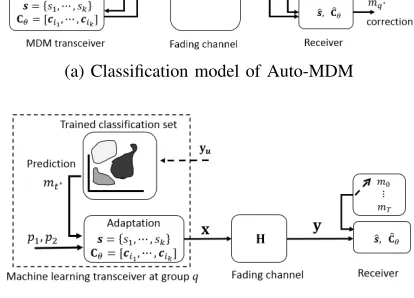
The structure of the proposed Auto-MDM is depicted in Fig. 1. It consists of training and testing procedures, taking into account clustering and learning-driven MDM automation, re-spectively. Specifically for the clustering in training procedure, we propose an end-to-end training structure, the key advantage of which is that the training becomes straightforward. In the training structure, the channel observation at a given time is
(a) Classification model of Auto-MDM
[image:3.612.336.543.84.233.2](b) Learning-driven Auto-MDM framework
Fig. 1: The structure of machine learning Auto-MDM
assumed to be known at the receiver. Consider Q simulated training data (H1,· · ·,HQ) based on a stochastic channel
model, and denote bymt= (N, k(t),M(t))the t-th possible
modulation mode that is related to k(t) ∈ {1,· · · , k} active
CIMs and M(t) ∈ M constellation. For each simulative
observation Hq, the transmitter and receiver collaborate to
supervise a right choice ofmtso that the bit error probability
(BEP) (denoted byPe) remains less than or equal to the target
levelµ(i.e.,Pe≤µ), at the largest data bits (Rt) that rely on
mt. Note that the value for Q trades off complexity against
learning accuracy, as the common overfitting problem. In particular, prior to the clustering of training proce-dure, we need to constitute a training data set. Denote
by z = {z1,· · · ,zQ} the training data set, where zq =
(|H1q|2,· · · ,|HN q|2, q∗)determines theq-th simulated
train-ing data,|Hnq|is a real-valued amplitude of n-th sub-carrier
of Hq, andq∗∈ {0,· · ·, k T} an index for one of (1 +kT)
mts. The key idea is to train the automated MDM over
substantial variations across theN-dimensional boundaries of each simulative channel vector and then to adopt the index of most potential modulation mode (denoted by mq∗). Here, we train by the channel vectors, not the received signals y, because yare additionally distorted by the background noise in less relation to surrounding. So, after the Q simulative training observations, we will obtain the data set z based on a stochastic channel model and the collaboration between transmitter and receiver. Intuitively, such training data set can help relate N dimensional variations of simulated fading channel coefficients inHq to a supervised index of the chosen
mq∗, for each training observation.
To obtain a better training data set in relation to the prediction accuracy ofmt,yandHq can be processed offline
before the clustering. Referring to the simulative knowledge of the non-adaptive MDM (e.g., the existing IM-OFDM [4]), firstly, the well-known maximum likelihood (ML) detector is employed to estimate the transmitted vector as follows:
ˆ
x= arg minky−Hqxk2. Based on xˆ= ˆCθˆs, this optimum
as the k non-zero M-ary data symbols from ˆs. Based on such pre-processing before the clustering, estimated data bits can result in Pe. Secondly, the simulative results of Pe can
be used to reveal the choice of mq∗ whose index satisfies
q∗= arg max
t {Rt|Pe(mt)≤µ} for t= 0,· · · , k T.
B. Multi-Dimensional Clustering by Manipulated Training
In order to run the proposed automated MDM, we need to train the transceiver with the data set collected from the training observations. We employ the simple but effective unsupervised learning algorithm (i.e., K-means clustering) because of its linear complexity, suitable to low-complexity device applications. Once the training data set zis collected, the Auto-MDM is trained offline by clustering variations of
N-dimensional training data into one of the clusters that represents the best modulation mode.
Given the set z={z1,· · · ,zQ}, each observation zq is a
(N + 1)-dimensional real-valued vector. K-means clustering aims to partition theQobservations intoKcclusters, as shown
in Algorithm 1.
Algorithm 1 K-means clustering algorithm
1: SelectKc(≤Q), and generate a set of input datazq,∀q.
2: procedureCLUSTERING(z,u, Kc)
3: repeat 4: i=i+ 1.
5: Form Kc clusters by assigning all points zq,∀q
into the clostest centroid.
6: Recompute the centroid of each cluster,u(l),∀l. 7: untilΣi= Σi−1 ⊲ We have the answer if the
centroids don’t change
8: returnΣi
Notice that in the above algorithm, the initial centroids are chosen randomly. Clusters produced vary from one iteration to another. In every iteration, the centroid indicates the mean of the points within the cluster. Specifically at step 5 of the algorithm, the closest centroid is determined by measuring the squared Euclidean distance, which is written, for givenzq, by
d2e,l=ku(l)−zqk2, forl= 1,· · ·, Kc. (2)
Thus, the index of the closest cluster that zq will belong to
at each iteration becomes(l) = arg minld2e,l. Accordingly, at
step6, if cluster(l)containsn(l)(N+ 1)-dimensional points
at a given iteration, then the centroid of cluster(l)is
u(l)= 1
n(l)
n(l)
X
j=1
zj,(l), (3)
wherezj,(l)is the j-th point within the cluster(l).
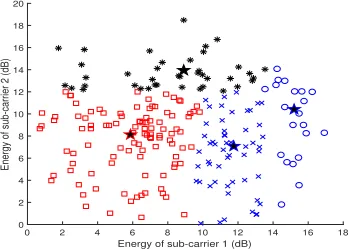
In Fig. 2, an exemplary clustering set along with four cen-troids is depicted, experimentally finding multiple boundaries between clusters in the two-dimensional space. Notice that once the iterations are over, the (N+ 1)-th entries ofu(l) at
each cluster(l)for l= 1,· · · , Kc are re-computed to provide
an integer index of the modulation mode that appears most likely within the cluster (l), denoted by u(l),N+1.
0 2 4 6 8 10 12 14 16 18
Energy of sub-carrier 1 (dB) 0
2 4 6 8 10 12 14 16 18 20
[image:4.612.351.525.54.179.2]Energy of sub-carrier 2 (dB)
Fig. 2: An exemplary clustering set for the Auto-MDM when
(N, k) = (2,1),Mt∈ {0,2,4}, andKc = 4. For illustration,
only two dimensional sub-carrier vector is used: each ’star’ marker represents the centroid of each cluster.
C. Online Prediction Test for Auto-MDM
Given the clustering set of (u(1),· · · ,u(Kc)), we are now ready to test a prediction for the modulation mode to be applied into automated MDM in real-time. According to A1-A2), refer to the energies of new uplink signals y˜u =
(|yu,1|2,· · ·,|yu,N|2)and the clustering set is applied to firstly
determine the closest cluster, whose index satisfies:
l∗= arg min
l ky˜u−u(l),1:Nk
2
, (4)
where u(l),1:N is the vector of the first N entries of u(l)
– trained N dimensional channel energies– and l∗ denotes
the index of the cluster which produces the trained channel energies closest to the given uplink energy observation. Based on the choice of clusterl∗, we secondly predict u
(l∗),N+1 to
be the best mode index for the next Auto-MDM transmission. Note that u(l∗),N+1 represents the one appearing most often
within the cluster (l∗). Such prediction is highlighted in
Al-gorithm 2. Notice that the complexities of training and testing for the proposed algorithms grow linearly as O(N KcQnit)
andO(N Kc), respectively, wherenit denotes the number of
iterations forK-means algorithm.
Algorithm 2 Prediction algorithm for Auto-MDM
1: Refer to the trained clustering set Σu =
(u(1),· · · ,u(Kc)).
2: Set t∗= 1 as an initial modulation mode index. 3: procedure ONLINEPREDICTION(˜yu,Σu)
4: Non-coherent observation of a newy˜u.
5: Findl∗= arg minlky˜u−u
(l),1:Nk2.
6: Updatet∗=u
(l∗),N+1 wheret∗∈ {0,· · · , k T}. 7: returnt∗ ⊲ The prediction for Auto-MDM is made 8: Prediction of the next modulation mode to mt∗.
9: Adaptxbased on mt∗ for the transmission.
Remarks: Notice that in such a real-time prediction,
thresholds per group, as summarized in Algorithm 2. The am-biguities of multi-dimensional fading channel coefficients and background noises in the prediction for every MDM adaptation are taken into account by performing the unsupervised training of the multiclass clustering set. The accuracy of such learning-driven automation of MDM is simulated in Section IV.
Notice that the size ofKccan influence the sensitivity of the
clustering and thus, the prediction performance of the Auto-MDM. Precisely speaking, a smaller Kc, a larger distance
between each trained centroid and its cluster edge points. This may lead to an ambiguity of the clustering. Therefore, the prediction distortion can be influenced by the ambiguity of the clustering set Σu, which can be indicated by the average
distance betweenzq and its cluster’s centroid, which is given:
DKc =Q
−1
Q
X
q=1
kzq−u<q>k2, (5)
where u<q>∈(u(1),· · · ,u(Kc)) denotes the centroid of the cluster to whom zq belongs. Therefore, at Kc making DKc small enough, u<q>,N+1 approaches zq,N+1. The prediction
of u(l∗),N+1 improves at the linear complexity with Kc.
IV. SIMULATIONRESULTS
We present simulation results for the proposed Auto-MDM. Provided that Nc= 256 sub-carriers are divided intoG= 64
groups of N= 4 sub-carriers, the proposed machine learning trains the Auto-MDM only at the SNR of10dB, along with the number of training datasetQ= 500and the size ofzq N+1 =
5. Training only at10 dB helps to reduce signalling burdens but faces the overfitting problem. Consider two cases of either three or five possible modulation modes. Given N = 4 and
k = 1,2, for example, there are five modes, among which a choice of the first modulation mode (m0= (4,2,0)) means no
transmission, whilem1= (4,2,2)andm2= (4,2,4)produce
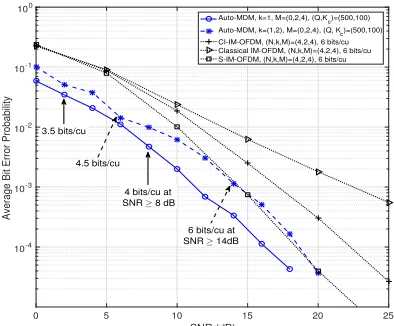
the data rate ofp= 4 bits/cu andp= 6 bits/cu, respectively. In Fig. 3 the average BEP of the Auto-MDM is depicted for the two cases of either k= 1 or k= (1,2), when Q= 500, Kc = 100,µ= 10−2, andnit= 7 atk= 1andnit= 8
at k= (1,2). For givenQ= 500, the value forKc= 100is
numerically found to decrease (5), due to the trade-off between sensitivity and complexity. For comparison, the existing IM-OFDM methods are depicted. As seen in Fig. 3, the Auto-MDM benefits from the capability of automatically adjusting its best mode. For low and moderate SNRs, the average BEP gets higher than µ because of the overfitting problem, being still lower than the benchmarks at variable rate less than 6 bits/cu. At high SNRs, the Auto-MDM is equally likely to the spread IM-OFDM because the prediction ofm5gets dominant
over others, obtaining 3 dB power gain over the CI-IM-OFDM for the average BEP of 10−3. The ripples on the BEP results
from the varying rate.
V. CONCLUSIONS
We have proposed the unsupervised machine learning tech-nique for Auto-MDM. Exploiting the proposed off-line train-ing and clustertrain-ing algorithms, the Auto-MDM autonomously
0 5 10 15 20 25
SNR (dB)
10-4
10-3
10-2
10-1
Average Bit Error Probability
c
Auto-MDM, k=(1,2), M=(0,2,4), (Q, K
c)=(500,100)
CI-IM-OFDM, (N,k,M)=(4,2,4), 6 bits/cu Classical IM-OFDM, (N,k,M)=(4,2,4), 6 bits/cu S-IM-OFDM, (N,k,M)=(4,2,4), 6 bits/cu
3.5 bits/cu
4.5 bits/cu
4 bits/cu at
SNR ≥ 8 dB
6 bits/cu at
[image:5.612.339.536.56.219.2]SNR ≥ 14dB
Fig. 3: Average BEP of the Auto-MDM when N = 4, k = (1,2), Mt = (0,2,4), Q= 500, andKc = 100. For
compar-ison, classical OFDM [3], Coordinated Interleaving IM-OFDM [5] and spread IM-IM-OFDM [8] are depicted.
learned key exploitable physical layer features from the wire-less propagation environment and was able to perform the non-coherent adaptation to multi-dimensional variations of the sig-nal energy vector. Unlike the existing methods that lack details of surrounding contexts and rely on pre-defined modulation rules, the Auto-MDM is flexible to program adaptation rules and predicts the best modulation mode without the channel information. The simulation results showed that the Auto-MDM benefited from the potentials of machine learning.
REFERENCES
[1] S. Bi and et al., “Wireless communications in the era of big data,”IEEE Communications Magazine, vol. 53, no. 10, pp. 190–199, October 2015. [2] 3GPP, “Cellular system support for ultra-low complexity and low throughput internet of things CIoT,”3GPP TR 45.820, vol. 13.1.0, Nov. 2015.
[3] E. Basar, U. Aygolu, E. Panayirci, and H. V. Poor, “Orthogonal frequency division multiplexing with index modulation,”IEEE Trans. Signal Process., vol. 61, no. 22, pp. 5536–5549, Nov. 2013.
[4] Y. Ko, “A tight upper bound on bit error rate of joint OFDM and multi-carrier index keying,”IEEE Commun. Lett., vol. 18, no. 10, pp. 1763– 1766, Oct. 2014.
[5] E. Basar, “OFDM with index modulation using coordinate interleaving,” vol. 4, no. 4, pp. 381–384, Aug 2015.
[6] S. Colak and et al., “Adaptive dual-mode OFDM with index modulation,” Physical Communication, vol. 30, pp. 15–25, Oct. 2018.
[7] J. Crawford and Y. Ko, “Cooperative OFDM-IM relay networks with partial relay selection under imperfect csi,”IEEE Trans. Veh. Technol., vol. 67, no. 10, pp. 9362–9369, Oct 2018.
[8] T. V. Luong and Y. Ko, “Spread OFDM-IM with precoding matrix and low-complexity detection designs,”IEEE Trans. Veh. Technol., vol. 67, no. 12, pp. 11 619–11 626, Dec 2018.
[9] Q. Li, M. Wen, E. Basar, and F. Chen, “Index modulated OFDM spread spectrum,” IEEE Trans. Wireless Commun., vol. 17, no. 4, pp. 2360– 2374, April 2018.
[10] T. OShea and J. Hoydis, “An introduction to deep learning for the phys-ical layer,” IEEE Trans. Cognitive Communications and Networking, vol. 3, no. 4, pp. 563–575, Dec 2017.
[11] S. Xue, Y. Ma, N. Yi, and R. Tafazolli, “Unsupervised deep learning for MU-SIMO joint transmitter and noncoherent receiver design,”IEEE Wireless Communications Letters, pp. 1–1, 2018.
[12] H. Ye, G. Y. Li, and B. Juang, “Power of deep learning for channel estimation and signal detection in OFDM systems,” IEEE Wireless Communications Letters, vol. 7, no. 1, pp. 114–117, Feb 2018. [13] D. Zhang and et al., “Automatic modulation classification based on deep