
White Rose Research Online URL for this paper:
http://eprints.whiterose.ac.uk/151108/
Version: Accepted Version
Article:
Knight, Marina Iuliana orcid.org/0000-0001-9926-6092, Leeming, Kathryn, Nason, G.P. et
al. (1 more author) (Accepted: 2019) Generalised Network Autoregressive Processes and
the GNAR package. Journal of Statistical Software. ISSN 1548-7660 (In Press)
[email protected] https://eprints.whiterose.ac.uk/ Reuse
Items deposited in White Rose Research Online are protected by copyright, with all rights reserved unless indicated otherwise. They may be downloaded and/or printed for private study, or other acts as permitted by national copyright laws. The publisher or other rights holders may allow further reproduction and re-use of the full text version. This is indicated by the licence information on the White Rose Research Online record for the item.
Takedown
If you consider content in White Rose Research Online to be in breach of UK law, please notify us by
MMMMMM YYYY, Volume VV, Issue II. doi: 10.18637/jss.v000.i00
Generalised Network Autoregressive Processes and
the
GNAR
package
Marina Knight
University of York
Kathryn Leeming
University of Bristol
Guy Nason
University of Bristol
Matthew Nunes
University of Bath
Abstract
This article introduces the GNAR package, which fits, predicts, and simulates from a powerful new class of generalised network autoregressive processes. Such processes consist of a multivariate time series along with a real, or inferred, network that provides information about inter-variable relationships. The GNAR model relates values of a time series for a given variable and time to earlier values of the same variable and of neighbouring variables, with inclusion controlled by the network structure. The GNAR
package is designed to fit this new model, while working with standard tsobjects and theigraphpackage for ease of use.
Keywords: multivariate time series, networks, missing data, network time series.
1. Introduction
Increasingly within the sciences, networks and network methodologies are being used to an-swer research questions. Such networks might be observed, such as connections in communi-cation network or information flows within, or they could be unobserved: inferred networks that can explain a process or effect. Given the increase in the size of data sets, it may also be useful to infer a network from data to efficiently summarise the data generating process. We consider time series observations recorded at different nodes of a network, or graph.
Our GNAR package (Leeming, Nason, Nunes, and Knight 2019) and its novel generalised
network autoregressive (GNAR) statistical models focus on partnering a network with a multivariate time series and modelling them jointly. One can find an association network,
see, e.g., Chapter 7 of Kolaczyk (2009), or Granger causality network, e.g., Dahlhaus and
Networks can provide strong information about the dependencies between variables. Within our generalised network autoregressive (GNAR) model, each node depends on its previous values as in the univariate autoregressive framework, but also may depend on the previous val-ues at its neighbours, neighbours of neighbours, and so on. Our GNAR modelling framework is flexible, allowing for different types of network, networks that change their structure over time (time-varying networks), and also can be powerfully applied in the important practical situation where the time series feature missing observations.
Driven in part by the increased popularity and recent research activity in the field of statistical network analysis, there has been a concurrent growth in software for analysing such data. An exhaustive list of these packages is beyond the scope of this article, but we review some relevant ones here.
Existing software in this area predominantly focusses on the various models for network-structured data. In the static network setting, these include packages dedicated to latent
space network models, such as collpcm (Wyse, Ryan, and Friel 2017), HLSM (Adhikari,
Junker, Sweet, and Thomas 2018), latentnet(Krvitsky, Handcock, Shortreed, Tantrumet al.
2018b) amongst others; exponential random graph models and their variants, for example
ergm (Handcock, Hunter, Butts et al.2018),GERGM(Denny, Wilson, Cranmer, Desmarais, and Bhamidi 2018) orhergm(Schweinberger, Handcock, and Luna 2018); and block models in
e.g.,blockmodels(Leger 2015). For dynamic networks, packages for time-varying equivalents
of these network models are also available, see e.g., thetergmpackage (Krvitsky, Handcock,
Hunter, Goodreauet al. 2018a) or dynsbm(Matias and Miele 2018). There are also a multi-tude of more general packages for network analysis, e.g., for network summary computation or implementations of methodology in specific applications of interest.
Despite this, software dedicated to the analysis of time series and other processes on
net-works is sparse. A number of packages implement epidemic (e.g., SIR) models of disease
spread, notably epinet (Groendyke, Welch, and Hunter 2018), EpiLM/EpiLMCT (Warriyar
and Deardon 2018; Almutiry, Warriyar, and Deardon 2018) and hybridModels (Marquez, Grisi-Filho, and Amaku 2018); these use transmission rates to model processes as opposed
to temporal and network dependence through time series models as in GNAR. Similarly,
the NetOrigin software (Manitz and Harbering 2018) is dedicated to source estimation for propagation processes on networks, rather than fitting time series models. Packages such asnetworkTomography (Blocker, Koullick, and Airoldi 2014) deal with time-varying models
for (discrete) count processes or flows on links of afixed routing network; thetnam package
(Leifeld and Cranmer 2017) fits models using spatial (and not network-node) dependence.
Both of these are in contrast to the GNAR package, which implements time series models
which account for known time-varying network structures.
Other packages can implicitly develop network-like structured time series models through
pe-nalised or constrained variable selection, such asautovarCore(Emerencia 2018),nets(
Brown-lees 2017),sparsevar(Vazoller, Frattarolo, and Billio 2016), as well as thevarspackage (Pfaff
2008). Packages that take a graphical modelling approach to the dependence structure within
time series include gimme (Lane, Gates, Fisher, Molenaar et al. 2019), graphicalVAR (
Ep-skamp 2018),mgm(Haslbeck 2019),mlVAR(Epskamp, Deserno, and Bringmann 2019), and
sparseTSCGM(Abegaz and Wit 2016). These approaches also differ fundamentally from the
GNAR models since the network is constructed during analysis, as opposed toGNAR, which
specifically incorporates information on the network structure into the model a priori. The
models and this existing class of techniques.
Section 2 introduces our model, and demonstrates how GNAR can be used to fit network
models to simulated network time series in Section 2.4. Order selection and prediction are
discussed in Section3, which includes an example of how to use BIC to select model order for a
wind speed network time series in Section3.2. An extended example, concerning constructing
a network to aid GDP forecasting, is presented in Section 4. Section 5 discusses different
network modelling options that could be chosen, and presents a summary of the article. All
results were calculated using version 3.5.1 of the statistical softwareR(RCore Team(2017)).
2. Network time series processes
We assume that our multivariate time series follows an autoregressive-like model at each node, depending both on the previous values of the process at that node, and on neighbouring nodes at previous time steps. These neighbouring nodes are included as part of the network structure, as defined below.
2.1. Network terminology and notation
Throughout we assume the presence of one or more networks, or graphs, associated with the observed time series. Each univariate time series that makes up the multivariate time series occurs, or is observed at, a node, or location on the graph(s). These nodes are connected by a set of edges, which may be directed, and/or weighted.
We denote a graph by G = (K,E), where K = {1, ..., N} is the set of nodes, and E is the
set of edges. A directed edge from node i ∈ K to j ∈ K is denoted i j, and an
un-directed edge between the nodes is denoted i ! j. The edge set of a directed graph is
E={(i, j) :i j;i, j∈ K}, and similarly for the set of un-directed edges.
Stage-r neighbourhoods
We introduce the notion of neighbours and stage-neighbours in the graph structure as follows;
for a subset A ⊂ K the neighbour set of A is given by N(A) = {j ∈ K/A : i j;i ∈ A}.
These are the first neighbours, or stage-1 neighbours of A. The rth stage neighbours of a
node i∈ K are given by N(r)(i) =N {N(r−1)(i)}/[{∪r−1
q=1N(q)(i)} ∪ {i}], for r = 2,3, ... and
N(1)(i) =N({i}).
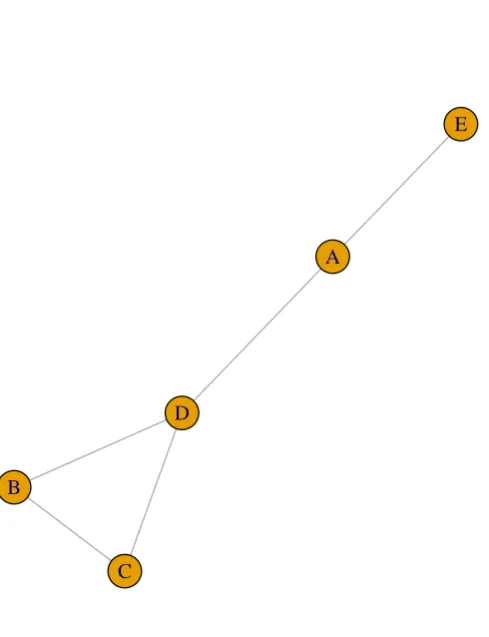
Figure1 shows an example graph, where node E has stage-1 neighbour A, stage-2 neighbour
D, and stage-3 neighbours B and C. Neighbour sets for this example include N(1)(D) =
{A, B, C}, and N(3)(E) = {B, C}. In the time-varying network setting, a subscript t is
added to the neighbour set notation.
Connection weights
Each network can have connection weights ω ∈ [0,1] associated with every pair of nodes.
This connection weight can depend on the size of the neighbour set and also encodes any
edge-weight information. Formally, the values of the connection weights from a nodei∈ Kto
its stage-r neighbour j∈ N(r)(i) will be the reciprocal of the number of stage-r neighbours;
ωi,j = |N(r)(i)|−1, where | · | denotes the cardinality of a set. In Figure 1 the connection
necessarily symmetric, even for an un-directed graph. We note that this choice of these inverse distance weights is one of many possibilities, and some other means of creating connection weights could be used.
When the edges are weighted, or have a distance associated with them, we use the concept
of distance to find the shortest path between two vertices. Let the distance from node i
to ℓ be denoted di,ℓ ∈ R+, and if there is an un-normalised weight between these nodes,
denote this µi,ℓ ∈ R+. To find the length of connection between a node i and its stage-r
neighbour, k, we sum the distances on the paths with r edges from i to k and take the
minimum (note that there are no paths with fewer edges thanr askis a stage-r neighbour).
If the network includes weights rather than distances, we find the shortest r length path
wheredi,ℓ = µ−i,ℓ1. Then the connection weights between node iand its stage-r neighbour k
are either ωi,k = d−i,k1{Pℓ∈N(r)(i)d−i,ℓ1}−1 for distances, or ωi,k = µi,k{Pℓ∈N(r)(i)µi,ℓ}−1 for a
network with weights. This definition means that all nodes will have connection weights that sum to one for any non-empty neighbour set, whether they are in a sparse or dense part of the graph.
Edge or node covariates
A further important innovation permits a covariate that can be used to encode edges effects
(or nodes) into certain types. Our covariate will take C ∈Ndiscrete values and be indexed
by c. A more general covariate could be considered, but we wish to keep our notation simple
in the definition that follows. For example, in an epidemiological network we might have two edge types: one that carries information about windborne spread of infection and the other carries information about identified direct infections. The covariates do not change our
neighbour sets or connection weight definitions, so we have the property P
q∈N(r)(i)
C
P
c=1
ωi,q,c = 1
for all i∈ K and r∈Nsuch thatN(r)(i) is non-empty.
2.2. The generalised network autoregressive model
Consider an N ×1 vector of nodal time series,Xt= (X1,t, . . . , XN,t)′, whereN is considered
fixed. Our aim is to model the dependence structure within and between the nodal series
using the network structure provided by (potentially time-varying) connection weights, ω.
For each node i∈ {1, . . . , N} and time t ∈ {1, . . . , T}, our generalised autoregressive model
of order (p,[s])∈N×Np
0 forXt is
Xi,t = p
X
j=1
αi,jXi,t−j +
C
X
c=1
sj
X
r=1
βj,r,c
X
q∈Nt(r)(i)
ωi,q,c(t) Xq,t−j
+ui,t, (1)
wherep∈Nis the maximum time lag, [s] = (s1, . . . , sp) andsj ∈N0 is the maximum stage of
neighbour dependence for time lagj, with N0 =N∪ {0}, Nt(r)(i) is the rth stage neighbour
set of node i at time t, ωi,q,c(t) ∈ [0,1] is the connection weight between node i and node q
at timet if the path corresponds to covariate c. Here, we consider a sum from one to zero
to be zero, i.e.: P0
r=1(·) := 0. The αi,j ∈ R are ‘standard’ autoregressive parameters at lag
j for node i. The βj,r,c ∈ R correspond to the effect of the rth stage neighbours, at lag j,
to achieve process stationarity over the network. Here the noise, {ui,t}, is assumed to be
independent and identically distributed at each node i, with mean zero and variance σ2i.
Our model meaningfully enhances that of the arXiv publication Knight, Nunes, and Nason
(2016) by now additionally including different autoregressive parameters, connection weights
at each node and, particularly, parametersβ that depend on covariates. Note that the IID
assumption on the noise{ui,t}could of course be relaxed to include correlated innovations.
We note that crucially, the time-dependent network topology is integral to the model parametri-sation through the use of time-varying weights and neighbours. These features yield a model that is sensitive to the network structures and captures contemporaneous as well as
autore-gressive relationships, as defined by equation (1). The network should therefore be viewed
not as an estimable quantity, but as a time-dependent known structure.
In the GNAR model, the network may change over time, but the covariates stay fixed. This means that the underlying network can be altered over time, for example, to allow for nodes to drop in and out of the series but model fitting can still be carried out. Practically, this
is extremely useful, as shown by the example in Section 4. Our model allows for the α
parameters may be different at each node, however the interpretation of the network regression
parameters,βj,r,c, is the same throughout the network.
A more restrictive version of the above model is the global-α GNAR(p,[s]) model, which
has the same autoregressive covariate at each node, where the αi,j are replaced by αj. This
defines a process with the same behaviour at every node, with differences being present only due to the graph structure.
2.3. GNAR network example
Networks in the GNAR package are stored in a list with two components edges and dist.
The edges component is itself a list with N slots each containing a vector whose entries
are indices to their neighbouring nodes. For example, if 3!4 denotes an undirected edge
between nodes 3 and 4 then the vector edges[[3]] will contain a 4 and edges[[4]] will
contain a3. If the network is undirected this will mean that each edge is ‘double counted’ in
summary information. A directed edge 3 4 would be listed in edges[[3]]as a 4, but not
edges[[4]]if there is no edge in the opposite direction. The distcomponent is of the same
format as edges, and contains the distances corresponding to the edge links, if they exist.
For example, in an un-weighted setting, the connection weights are such that all neighbours
of a node have equal effect on the node. This is achieved by setting all entries of the dist
component to one, and the software calculates the connection weight from these. A GNAR
network is stored in aGNARnet object, and an object can be checked using the is.GNARnet
function. The S3 methodsplot,print, andsummary are available for GNARnetobjects.
Figure 1 shows an example that is stored as a GNARnet object called fiveNet and can be
reproduced using
R> library("GNAR") R> library("igraph")
R> plot(fiveNet, vertex.label = c("A", "B", "C", "D", "E"))
The basic structure of the GNARnet object is, as usual, displayed with
●
●
●
●
●
A
B
C D
E
Figure 1: An example un-directed, un-weighted graph with five nodes labelled A to E.
GNARnet with 5 nodes and 10 edges of equal length 1
Converting a network to GNARnet form
Our GNARnet format integrates with other methods of specifying a network via a set of
functions that generate aGNARnetfrom others, such as anigraphobject.
An igraph object can be converted to and from the GNARnet structure using the functions
igraphtoGNAR and GNARtoigraph, respectively. For example, starting with the fiveNet GNARnetobject,
R> fiveNet2 <- GNARtoigraph(net = fiveNet) R> summary(fiveNet2)
[image:7.595.195.440.116.435.2]R> fiveNet3 <- igraphtoGNAR(fiveNet2) R> all.equal(fiveNet, fiveNet3)
[1] TRUE
whereas the reverse conversion would be performed as
R> g <- make_ring(10) R> print(igraphtoGNAR(g))
GNARnet with 10 nodes
edges:1--2 1--10 2--1 2--3 3--2 3--4 4--3 4--5 5--4 5--6 6--5 6--7 7--6 7--8 8--7 8--9 9--8 9--10 10--1 10--9
edges of each of length 1
We can also use theGNARtoigraphfunction to extract graphs involving higher-order neighbour
structures, for example, creating a network of third-order neighbours.
In addition to interfacing withigraph, we can convert betweenGNARnetobjects and adjacency
matrices using functionsas.matrixandmatrixtoGNAR. We can produce an adjacency matrix
for thefiveNetobject with
R> as.matrix(fiveNet)
[,1] [,2] [,3] [,4] [,5]
[1,] 0 0 0 1 1
[2,] 0 0 1 1 0
[3,] 0 1 0 1 0
[4,] 1 1 1 0 0
[5,] 1 0 0 0 0
and an example converting a weighted adjacency matrix to aGNARnetobject is
R> adj <- matrix(runif(9), ncol = 3, nrow = 3) R> adj[adj < 0.3] <- 0
R> print(matrixtoGNAR(adj))
GNARnet with 3 nodes
edges:1--1 1--2 1--3 2--1 2--3 3--1 3--2 edges of unequal lengths
2.4. Example: GNAR model fitting
ThefiveNet network has a simulated multivariate time series associated with it of class ts
called fiveVTS. The pair together are a network time series. The object can be loaded in
from GNAR models: GNARfit and the predict method, respectively. These make use of
the familiar R command lm, since the GNAR model can be essentially re-formulated as a
linear model, as we shall see in Section 3 and Appendix B. As such, least squares variance
/ standard error computations are also readily obtained, although other, e.g. HAC-type variance estimators could also be considered for GNAR models.
Suppose we wish to fit the global-αnetwork time series model GNAR(2,[1,1]), a model with
four parameters in total. We can fit this model with the following code.
R> data("fiveNode")
R> answer <- GNARfit(vts = fiveVTS, net = fiveNet, alphaOrder = 2, + betaOrder = c(1, 1))
R> answer
Model:
GNAR(2,[1,1])
Call:
lm(formula = yvec ~ dmat + 0)
Coefficients:
dmatalpha1 dmatbeta1.1 dmatalpha2 dmatbeta2.1
0.20624 0.50277 0.02124 -0.09523
In this fit, the global autoregressive parameters are ˆα1 ≈ 0.206 and ˆα2 ≈ 0.021 and the β
network parameters are ˆβ1,1,1 ≈0.503 and ˆβ2,1,1 ≈ −0.095. Also, the network edges only have
one type of covariate so C =c= 1. We can just look at one node. For example, the model
at node A is
XA,t= 0.206XA,t−1+0.503(XE,t−1+XD,t−1)/2+0.021XA,t−2−0.095(XE,t−2+XD,t−2)/2+uE,t.
The model coefficients can be extracted from aGNARfitobject using the coef function as is
customary. The GNARfit object returned by GNARfit function also has methods to extract
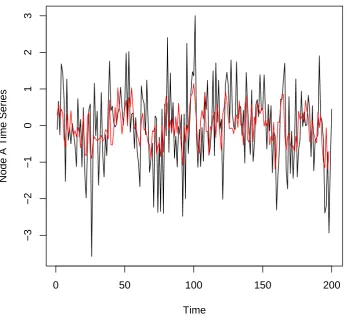
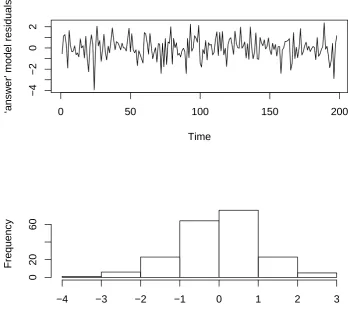
fitted values and the residuals. For example, Figure 2 shows the first node time series and
the residuals from fitting the model. Figure2was produced by
R> plot(fiveVTS[, 1], ylab = "Node A Time Series") R> lines(fitted(answer)[, 1], col = 2)
Alternatively, we can examine the associated residuals:
R> myresiduals <- residuals(answer)[, 1] R> layout(matrix(c(1, 2), 2, 1))
R> plot(ts(residuals(answer)[, 1]), ylab = "`answer' model residuals")
R> hist(residuals(answer)[, 1], main = "", xlab = "`answer' model residuals")
By altering the input parameters in the GNARfit function, we can fit a range of different
Time
Node A Time Ser
ies
0 50 100 150 200
−3
−2
−1
0
1
2
3
Figure 2: Time series of first node (black) with fitted values from ‘answer’ model overlaid in red.
2.5. Example: GNAR data simulation on a given network
The following example demonstrates network time series simulation using the network in
Figure1.
Model(a)is a GNAR(1,[1]) model with individualαparameters, (αA,1, αB,1, αC,1, αD,1, αE,1) =
(0.4,0,−0.6,0,0), and the same β parameter throughout, β1 = 0.3. Model (b) is a global-α
GNAR(2,[2,0]) model with parameters α1 = 0.2, β1,1 = 0.2, β1,2 = 0.3 and α2 = 0.3. Both
simulations are created using standard normal noise whose standard deviation is controlled
using thesigmaargument.
R> set.seed(10)
R> fiveVTS2 <- GNARsim(n = 200, net = fiveNet,
+ alphaParams = list(c(0.4, 0, -0.6, 0, 0)), betaParams = list(c(0.3)))
By fitting an individual-alpha GNAR(1,[1]) model to the simulated data with the fiveNet
[image:10.595.119.467.154.472.2]Time
‘answ
er' model residuals
0 50 100 150 200
−4
−2
0
2
‘answer' model residuals
Frequency
−4 −3 −2 −1 0 1 2 3
0
20
60
Figure 3: Residual plots from ‘answer’ model fit. Top: Time series; Bottom: Histogram.
-0.6, 0, 0 and 0.3. This agreement does not come as a surprise given that we show theoretical
consistency for parameter estimators (see Appendix B).
R> print(GNARfit(vts = fiveVTS2, net = fiveNet, alphaOrder = 1, + betaOrder = 1, globalalpha = FALSE))
Model: GNAR(1,[1])
Call:
lm(formula = yvec ~ dmat + 0)
Coefficients:
dmatalpha1node1 dmatalpha1node2 dmatalpha1node3 dmatalpha1node4
[image:11.595.114.463.140.457.2]dmatalpha1node5 dmatbeta1.1
0.02249 0.24848
Repeating the experiment for the GNAR(2, [2, 0]) Model (b), the estimated parameters are
again similar to the generating parameters:
R> set.seed(10)
R> fiveVTS3 <- GNARsim(n = 200, net = fiveNet, + alphaParams = list(rep(0.2, 5), rep(0.3, 5)), + betaParams = list(c(0.2, 0.3), c(0)))
R> print(GNARfit(vts = fiveVTS3, net = fiveNet, alphaOrder = 2, + betaOrder = c(2,0)))
Model:
GNAR(2,[2,0])
Call:
lm(formula = yvec ~ dmat + 0)
Coefficients:
dmatalpha1 dmatbeta1.1 dmatbeta1.2 dmatalpha2
0.2537 0.1049 0.3146 0.2907
Alternatively, we can use thesimulateS3 method forGNARfitobjects to simulate time series
associated to a GNAR model, for example
R> fiveVTS4 <- simulate(GNARfit(vts = fiveVTS2, net = fiveNet, alphaOrder = 1, + betaOrder = 1, globalalpha = FALSE), n = 200)
2.6. Missing data and changing connection weights with GNAR models
Standard multivariate time series models, including vector autoregressions (VAR), can have significant problems in coping with certain types of missingness and imputation is often used, see Guerrero and Gaspar (2010), Honaker and King (2010), Bashir and Wei (2016). While in VAR modelling successful solutions have been found to cope with specific missingness
scenarios, such as implemented in the gimme R package. However, if a variable has e.g.
block missing data, the coefficients corresponding that variable can be difficult to calculate, and impossible if their partner variable is missing at cognate times. In addition, due to
computational burden gimmeis limited to modelling a single time lag. A key advantage of
connections and weightings need altering accordingly. Again, using the graph in Figure 1, consider the situation where node A does not have any data recorded. Yet, we want to pre-serve the stage-2 connection between D and E, and the stage-3 connection between E and both B and C. To do this, we do not redraw the graph and remove node A and its con-nections, instead we reweight the connections that depend on node A. As node A does not
feature in the stage-2 or stage-3 neighbours of E, the connection weightsωE,D, ωE,B, ωE,C do
not change, but the connection weightωE,A drops to zero in the absence of observation from
node A. Similarly, the stage-1 neighbours of D are changed without A, soωD,A drops to zero
and the other two connection weights from node D increase accordingly;ωD,B=ωD,C = 0.5.
Missing data of this kind is handled automatically by theGNAR functions using customaryNA
missing data values present in thevts(vector time series) component of the overall network
time series. For example, inducing some (artificial) missingness in thefiveVTSseries, we can
still obtain estimates of model parameters:
R> fiveVTS0 <- fiveVTS
R> fiveVTS0[50:150, 3] <- NA
R> nafit <- GNARfit(vts = fiveVTS0, net = fiveNet, alphaOrder = 2, + betaOrder = c(1, 1))
R> layout(matrix(c(1, 2), 2, 1))
R> plot(ts(fitted(nafit)[, 3]), ylab = "Node C fitted values") R> plot(ts(fitted(nafit)[, 4]), ylab = "Node D fitted values")
As shown in Figure4, after removing observations from the time series at node C, its
neigh-bour, node D, still has a complete set of fitted values.
2.7. Stationarity conditions for a GNAR process with fixed network
Theorem 1 Given an unchanging network, G, a sufficient condition for the GNAR model (1) to be stationary is
p
X
j=1
|αi,j|+
C
X
c=1
sj
X
r=1
|βj,r,c|
!
<1 ∀i∈1, ..., N. (2)
The proof of Theorem1can be found in Appendix A.
For the global-α model this condition reduces to
p
X
j=1
|αj|+
C
X
c=1
sj
X
r=1
|βj,r,c|
!
<1. (3)
We can explore these conditions using the GNARsim function. The following example uses
parameters whose absolute value sums to greater than one and then we calculate the mean over successive time periods. The mean increases rapidly indicating nonstationarity.
R> set.seed(10)
R> fiveVTS4 <- GNARsim(n = 200, net = fiveNet,
+ alphaParams = list(rep(0.2, 5)), betaParams = list(c(0.85))) R> c(mean(fiveVTS4[1:50, ]), mean(fiveVTS4[51:100, ]),
Time
Node C fitted v
alues
0 50 100 150 200
−1.0
0.0
1.0
Time
Node D fitted v
alues
0 50 100 150 200
−1.0
0.5
1.5
Figure 4: Fitted values of global-α GNAR(1,[1]) fit to the ‘fiveVTS’ data, with observations
50–150 removed from node C. Fitted values: Top: Node C; Bottom: Node D.
[1] -120.511 -1370.216 -15725.884 -180319.140
2.8. Benefits of our model and comparisons to others
Conditioned on a given network fixed in time and with a known (time-dependent) weight- and neighbourhood structure, the GNAR model can be mathematically formulated as a specific restricted VAR model, where the restrictions are imposed by the network and thus impact
model parametrisation, as mathematically encoded by equation (1). This is explored in more
depth in Appendix B and contrasts with a VAR model where any restrictions can only be
imposed on the parameters themselves.
An unrestricted VAR model with dimensionnhasO(n2) parameters, whereas a GNAR model
with known network (usually) hasO(n) parameters, and a global-α GNAR model can have
O(1) parameters. The large, and rapidly increasing, number of parameters in VAR often make
[image:14.595.115.468.141.474.2]to mitigate those challenges. Further, the large number of VAR parameters usually mean that it fits multivariate time series well, but then performs poorly in out-of-sample prediction. An
example of this is shown in Section4.
Our model has similarities with the network autoregression introduced byZhu, Pan, Li, Liu,
and Wang(2017), motivated by social networks.
In our notation, the Zhuet al. (2017) model can be written as a special case as
Xi,t =β0+Zi⊤γ+ p
X
j=1
αjXi,t−j+βj
X
q∈N(1)(i)
ωiXq,t−j
+ui,t, (4)
whereβ0 is a global intercept term,Ziis a vector of node-specific covariates with
correspond-ing parameters γ, ωi is the reciprocal of the out-degree of node i, and the innovations are
independent and identically distributed, with zero mean, such that var(ui,t) = σ2. Hence,
the Zhu et al. (2017) model without intercept and node-specific covariates is a special case
of our GNAR model, with max
j∈{1,...,p}sj = 1, i.e. dependencies limited to stage-1 immediate
neighbours, and un-weighted edges.
Our model is designed to deal with a time-varying network, and our βj,r,c parameters can
include general edge-based covariate information. A further important advantage is that our
GNAR model in Section 2.2 can express dependence on stage-r neighbour sets for any r.
An earlier model with similarities to the generic network autoregression is the Dynamic
Bayesian Network (DBN) model considered in Spencer, Hill, and Mukherjee (2015). Their
model can be written as
Xi,t =β0,i+
X
q∈N(1)(i)
βi,qXq,t−1+ui,t, (5)
where β0,i is a node-specific intercept term, the other β parameters describe the network
autoregression, and ui,t ∼ N(0, σi2). The DBN model is also a constrained VAR model,
but with no univariate autoregression terms, and the network autoregression only includes
the stage-1 neighbours. Unlike our model and the Zhu et al. (2017) model, there are no
restrictions on the parameters other than parameters only being present when there is an
edge between two nodes. The Spenceret al. (2015) framework does not allow for a range of
networks, as their underlying network is assumed to be a Directed Acyclic Graph. With these assumptions, the network and parameters are inferred by considering potential predictors for
each node in turn. A key difference between our model and theSpenceret al.(2015) model is
that we assume that the behaviour of connected nodes is the same throughout the network,
whereas the DBN model allows for differentβ parameters for different connections, including
allowing a change of sign.
The benefits of the GNAR model compared to these, and other models, include the ability to deal with a time-changing network, missing observations, and using network information
to reduce the number of parameters. As detailed in Section 2.6, we can incorporate missing
3. Estimation
In modelling terms, our GNAR model is a linear model and we employ standard techniques such as least squares estimation to fit them and to provide statistically consistent estimators,
as verified in Appendix B. An important practical consideration for fitting GNAR models is
the choice of model order. Specifically, how do we selectp ands?
3.1. Order selection
We use the Bayesian information criterion (BIC) proposed by Schwarz (1978) to select the
GNAR model order. Under the assumption of a constant network, and that the innovations are independent and identically distributed white noise with bounded fourth moments, this
criterion is consistent, as shown in Lütkepohl(2005). The BIC allows us to select both the
lag and neighbourhood orders simultaneously by selecting the model with smallest BIC from a set of candidates.
For a general candidate GNAR(p,[s]) model withN nodes, the BIC is given by
BIC(p,s) = ln|Σˆp,s|+T
−1Mln(T), (6)
where ˆΣp,s=T
−1Uˆ′Uˆ, ˆU is the residual matrix from the NAR(p,[s]) fit, and M is the
number of parameters. In the general case M =N p+CPp
j=1sj, and in the global-α model
M =p+CPp
j=1sj. The covariance matrix estimate, ˆΣp,s, is also the maximum likelihood
estimator of the innovation covariance matrix under the assumption of Gaussian innovations.
GNAR enables us to easily compute the BIC for any model by using the BIC method for
GNARfit objects. For example, on the default model fitted by GNARfit, and an alternative model that additionally includes second-order neighbours at the first lag into the model, we can compare their BICs by
R> BIC(GNARfit())
[1] -0.003953124
R> BIC(GNARfit(betaOrder = c(2, 1)))
[1] 0.02251406
Whilst we focus on the BIC for model selection for the remainder of this article, the GNAR
package also include functionality for the Akaike information criterion (AIC) proposed by
Akaike(1973) as
AIC(p,s) = ln|Σˆp,s|+ 2T
−1M, (7)
where ˆΣp,s is as defined in equation (6) and M is again the number of model parameters.
Similar to above, the AIC can be obtained by using the code
R> AIC(GNARfit())
R> AIC(GNARfit(betaOrder = c(2, 1)))
[1] -0.05994387
Similar to the BIC, the model with the lowest AIC is preferred. Note that the likelihood of
the data associated to the model fit can also be obtained using e.g.,logLik(GNARfit()).
Various models can be tried to obtain a good fit whilst, naturally, attending to the usual aspects of good model fitting, such as residual checks. A thorough simulation study that
displays the numerical performance of our proposed method appears in Section 4.5 ofLeeming
(2019).
3.2. Model selection on a wind network time series
GNAR incorporates the data suite vswind that contains a number of R objects pertaining
to 721 wind speeds taken at each of 102 weather stations in England and Wales. The suite
contains the vector time series vswindts, the associated network vswindnet, a character
vector of the weather station location names in vswindnamesand coordinates of the stations
in the two column matrix vswindcoords. The data originate from the UK Met Office site
http://wow.metoffice.gov.ukand full details can be found in the vswindhelp file in the
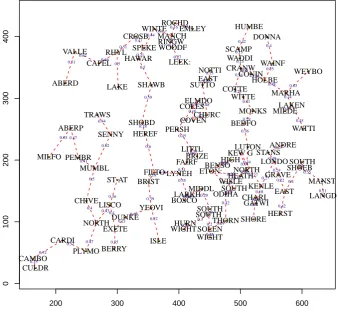
GNARpackage. Figure5shows a picture of the meteorological station network with distances
created by
R> oldpar <- par(cex = 0.75) R> windnetplot()
R> par(oldpar)
We investigate fitting a network time series model. We first fit a simple GNAR(1,[0]) model
using a singleα, followed by an equivalent model with potentially individually distinct αs
R> BIC(GNARfit(vts = vswindts, net = vswindnet, alphaOrder = 1, + betaOrder = 0))
[1] -233.3848
R> BIC(GNARfit(vts = vswindts, net = vswindnet, alphaOrder = 1, + betaOrder = 0, globalalpha = FALSE))
[1] -233.1697
Interestingly, the model with the single α gives the better fit, as judged by BIC. The single
αmodel with alphaOrder = 2and betaOrder = c(0, 0)gives a lower BIC of−243, so we
investigate this next. Note that this model also gives the lowest AIC score. In particular,
we explore a set of GNAR(2,[b1, b2]) models with b1, b2 ranging from zero to 14 using the
following code:
200 300 400 500 600 0 100 200 300 400 0.62 0.51 0.46 0.51 0.5 0.27 0.5 0.21 0.27 0.51 0.13 0.13 0.13 0.42 0.15 0.34 0.34 0.4 0.38 0.25 0.59 0.23 0.31 0.48 0.63 0.24 0.65 0.47 0.44 0.62 0.18 0.6 0.45 0.43 0.06 0.16 0.48 0.22 0.36 0.29 0.45 0.41 0.5 0.59 0.19 0.15 0.16 0.30.24 0.08 0.34 0.14 0.23 0.55 0.1 0.4 0.36 0.430.4 0.35 0.31
0.060.19 0.29 0.18 0.42 0.24 0.31 0.04 0.17 0.22 0.18 0.27 0.27 0.22 0.24 0.21 0.15 0.72 0.57 0.47 0.62 0.21 0.52 0.39 0.28 0.25 0.29 0.2 0.42 0.4 0.16 0.11 0.39 0.05 0.09 0.3 0.07 0.31 0.44 0.35 ● ● ● ● ● ● ● ● ● ● ● ● ● ● ● ● ● ● ● ● ● ● ● ● ● ● ● ● ● ● ● ● ● ● ● ● ● ● ● ● ● ● ● ● ● ● ● ● ● ● ● ● ● ● ● ● ● ● ● ● ● ● ● ● ● ● ● ● ● ● ● ● ● ● ● ● ● ● ● ● ● ● ● ● ● ● ● ● ● ● ● ● ● ● ● ● ● ● ● ● ● ● VALLE CAPEL RHYL CROSB HAWAR LEEK: EMLEY WOODF NOTTI SCAMP WADDI CRANW DONNA CONIN WAINF
ABERD LAKE SHAWB
COTTE WITTE HOLBE MARHA WEYBO ABERP TRAWS SENNY SHOBD HEREF PERSH COLES CHURC BEDFO WATTI MILFO PEMBR MUMBL FILTO LITTL BRIZE BENSOHIGH NORTH ANDRE SHOEB CHIVE LISCO
ST AT LYNEH
LARKH BOSCO
MIDDL
ODIHASOUTHCHARL HEATH KENLE GRAVE LANGD MANST CAMBO CULDR CARDI PLYMO DUNKE YEOVI ISLE HURN WIGHT THORN SOLEN SHOREHERST EAST ROCHD ELMDO RINGW BRIST LUTON GATWI LONDO HUMBE EAST STANS MILDE FAIRF MONKS SUTTO COVEN WISLE KEW G ETON: SOUTH WIGHT WINTE MANCH NORTH BERRY LAKEN SPEKE SOUTH EXETE SOUTH
Figure 5: Plot of the wind speed network. Blue numbers are relative distances between sites; labels are the site name.
+ for(b2 in 0:14)
+ BIC.Alpha2.Beta[b1 + 1, b2 + 1] <- BIC(GNARfit(vts = vswindts, + net = vswindnet, alphaOrder = 2, betaOrder = c(b1, b2))) R> contour(0:14, 0:14, log(251 + BIC.Alpha2.Beta),
+ xlab = "Lag 1 Neighbour Order", ylab = "Lag 2 Neighbour Order")
The results of the BIC evaluation for incorporating different and deeper neighbour sets, at
lags one and two, are shown in the contour plot in Figure6. The minimum value of the BIC
occurs in the bottom-right part of the plot, where it seems incorporating five or sixth-stage neighbours for the first time lag is sufficient to achieve the minimum BIC, and incorporating further lag one stages does not reduce the BIC. Moreover, increasing the lag two neighbour sets beyond first stage neighbours would appear to increase the BIC for those lag one neighbour stages greater than five (the horizontal contour at 0 in the bottom right hand corner of the plot). A fit of a possible model is
[image:18.595.133.472.147.460.2]Lag 1 Neighbour Order
Lag 2 Neighbour Order
0 0.2
0.2
0.2
0.4 0.6
0.8 1
1.2
0 2 4 6 8 10 12 14
0
2
4
6
8
10
12
[image:19.595.120.466.156.462.2]14
Figure 6: Contour plot of BIC values for the two-lag autoregressive model incorporating
b1-stage andb2-stage neighbours at time lags one and two. Values shown are log(251 + BIC)
to display clearer contours.
+ betaOrder = c(5, 1)) R> goodmod
Model:
GNAR(2,[5,1])
Call:
lm(formula = yvec ~ dmat + 0)
Coefficients:
dmatalpha1 dmatbeta1.1 dmatbeta1.2 dmatbeta1.3 dmatbeta1.4
0.56911 0.10932 0.03680 0.02332 0.02937
dmatbeta1.5 dmatalpha2 dmatbeta2.1
We investigated models with alphaOrder equal to two, three, four and five, but with no
neighbours. As judged by BIC, alphaOrder = 3 gives the best model. We could extend
the example above to investigate differing stages of neighbours at time lags one, two and three. However, a more comprehensive BIC investigation would examine all combinations of neighbour sets over a large number of time lags. This would be feasible, but computationally intensive for a single CPU machine, but could be coarse-grain parallelized. Further analysis would proceed with model diagnostic checking and further modelling as necessary.
3.3. Constructing a network to aid prediction
Whilst some multivariate time series have actual, and sometimes obvious, networks associated with them, our methodology can be useful for series without a clear or supplied network. We propose a network construction method that uses prediction error, but note here that our scope is not to estimate an underlying network, but merely to find a structure that is useful in the task of prediction. Here, we use a prediction error measure, understood as the sum of
squared differences between the observations and the estimates: PN
i=1(Xi,t−Xˆi,t)2.
ThepredictS3 method for GNAR models takes an inputGNARfitmodel object and from this
predicts the nodal time series at the next timepoint, similar to the S3 method for theArima
class. This allows for a ‘ex-sample’ prediction evaluation. Thepredictfunction outputs the
prediction as a vector. For example, to predict the series at the last timepoint
R> prediction <- predict(GNARfit(vts = fiveVTS[1:199,], net = fiveNet, + alphaOrder = 2, betaOrder = c(1, 1)))
R> prediction
Time Series: Start = 1 End = 1
Frequency = 1
Series 1 Series 2 Series 3 Series 4 Series 5 1 -0.6427718 0.2060671 0.2525534 0.1228404 -0.8231921
For a small-dimensional multivariate series, any and all potential un-weighted networks can
be constructed and the corresponding prediction errors compared using thepredictmethod.
Next, we consider the larger data setting where it is computationally infeasible to investigate
all possible networks. Erdős-Rényi random graphs can be generated with N nodes, and a
fixed probability of including each edge between these nodes, see Chapter 11 of Grimmett
(2010) for further details. The probability parameter controls the overall sparsity of the graph.
Many random graphs of this type can be created, and then our GNAR model can be used for within-sample prediction. The prediction error can then be used to identify networks that aid prediction. We give an example of this process in the next section.
4. OECD GDP: Network structure aids prediction
We obtained the annual gross domestic product (GDP) growth rate time series for 35 countries
from the OECD website1. The series covers the years 1961–2013, but not all countries are
included from the start. The values are annual growth rates expressed as a percentage change compared to the previous year. We differenced the time series for each country to remove the gross trend.
We use the first T = 52 time points and designate each of the 35 countries as nodes to
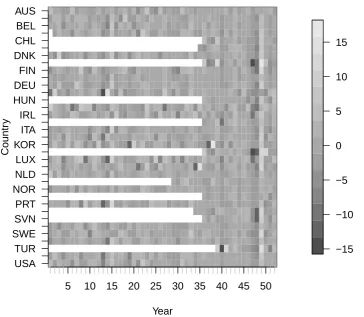
investigate the potential of modelling this time series using a network. In this data set 20.8% (379 out of 1820) of the observations were missing due to some nodes not being included from the start. We model this by changing the network connection weights as described in
Section 2.6. In this example, we do not use covariate information, so C= 1. The pattern of
missing data along with the time series values is shown graphically in Figure 7, produced by
the following code.
R> library("fields")
R> layout(matrix(c(1, 2), nrow = 1, ncol = 2), widths = c(4.5, 1)) R> image(t(apply(gdpVTS, 1, rev)), xaxt = "n", yaxt = "n",
+ col = gray.colors(14), xlab = "Year", ylab = "Country")
R> axis(side = 1, at = seq(from = 0, to = 1, length = 52), labels = FALSE, + col.ticks = "grey")
R> axis(side = 1, at = seq(from = 0, to = 1, length = 52)[5*(1:11)], + labels = (1:52)[5*(1:11)])
R> axis(side = 2, at = seq(from = 1, to = 0, length = 35), + labels = colnames(gdpVTS), las = 1, cex = 0.8)
R> layout(matrix(1))
R> image.plot(zlim = range(gdpVTS, na.rm = TRUE), legend.only = TRUE, + col = gray.colors(14))
4.1. Finding a network to aid prediction
This section considers the case where we observe data up tot= 51, and then wish to predict
the values for each node att= 52. We begin by exploring ‘within-sample’ prediction att= 51,
and identify a good network for prediction. We use randomly generated Erdős-Rényi graphs
using theGNAR functionseedToNet. To demonstrate this, theGNARpackage contains the
gdp data and a set of seed values, seed.nos so that the random graphs can be reproduced
for use with the time series objectgdpVTShere.
R> net1 <- seedToNet(seed.no = seed.nos[1], nnodes = 35, graph.prob = 0.15) R> net2 <- seedToNet(seed.no = seed.nos[2], nnodes = 35, graph.prob = 0.15) R> layout(matrix(c(2, 1), 1, 2))
R> par(mar=c(0,1,0,1))
R> plot(net1, vertex.label = colnames(gdpVTS), vertex.size = 0) R> plot(net2, vertex.label = colnames(gdpVTS), vertex.size = 0)
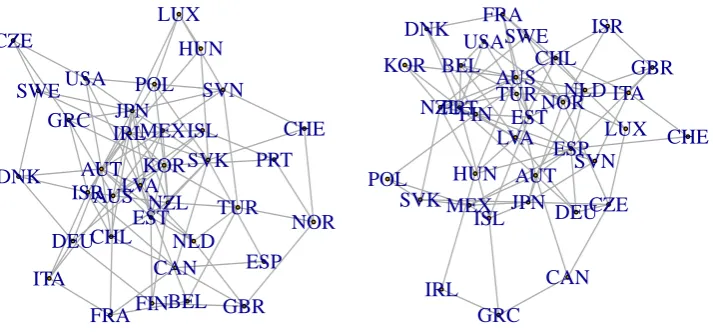
Figure 8 shows two of these random graphs.
As well as investigating which network works best for prediction, we also need to identify the number of parameters in the GNAR model. Initial analysis of the autocorrelation function at each node indicated that a second-order autoregressive component should be sufficient, so
Year
Countr
y
5 10 15 20 25 30 35 40 45 50 USA
TUR SWE SVN PRT NOR NLD LUX KOR ITA IRL HUN DEU FIN DNK CHL BEL AUS
−15 −10 −5 0 5 10 15
Figure 7: Heat plot (greyscale) of the differenced time series, where the initial white space indicates missing time series observations.
sets at each time lag. The GNAR models are: GNAR(1,[0]), GNAR(1,[1]), GNAR(2,[0,0]),
GNAR(2,[1,0]), GNAR(2,[1,1]), GNAR(2,[2,0]), GNAR(2,[2,1]), and GNAR(2,[2,2]), each
fitted as individual-α and global-α GNAR models, giving sixteen models in total.
For the GDP example, we simulate 10,000 random un-directed networks, each with connection probability 0.15, and predict using the GNAR model with the orders above. Hence, this example requires significant computation time (about 90 minutes on a desktop PC), so only a segment of the analysis is included in the code below. For computational reasons, we first divide through by the standard deviation at each node so that we can model the residuals
as having equal variances at each node. The function seedSim outputs the sum of squared
differences between the prediction and original values, and we use this as our measure of prediction accuracy.
R> gdpVTSn <- apply(gdpVTS, 2, function(x){x / sd(x[1:50], na.rm = TRUE)}) R> alphas <- c(rep(1, 2), rep(2, 6))
[image:22.595.117.482.153.470.2]● ● ● ● ● ● ● ● ● ● ● ● ● ● ● ● ● ● ● ● ● ● ● ● ● ● ● ● ● ● ● ● ● ● ● AUS AUT BEL CAN CHL CZE DNK EST FIN FRA DEU GRC HUN ISL IRL ISR ITA JPN KOR LVA LUX MEX NLD NZL NOR POL PRT SVK SVN ESP SWE CHE TUR GBR USA ● ● ● ● ● ● ● ● ● ● ● ● ● ● ● ● ● ● ● ● ● ● ● ● ● ● ● ● ● ● ● ● ● ● ● AUS AUT BEL CAN CHL CZE DNK EST FIN FRA DEU GRC HUN ISL IRL ISR ITA JPN KOR LVA LUX MEX NLD NZL NOR POL PRT SVK SVN ESP SWE CHE TUR GBR USA
Figure 8: Erdős-Rényi random graphs constructed from the first two elements of the
seed.nosvariable with 35 nodes and connection probability 0.15.
+ c(2, 2))
R> seedSim <- function(seedNo, modelNo, globalalpha){
+ net1 <- seedToNet(seed.no = seedNo, nnodes = 35, graph.prob = 0.15) + gdpPred <- predict(GNARfit(vts = gdpVTSn[1:50, ], net = net1,
+ alphaOrder = alphas[modelNo], betaOrder = betas[[modelNo]], + globalalpha = globalalpha))
+ return(sum((gdpPred - gdpVTSn[51, ])^2)) + }
R> seedSim(seedNo = seed.nos[1], modelNo = 1, globalalpha = TRUE)
[1] 23.36913
R> seedSim(seed.nos[1], modelNo = 3, globalalpha = TRUE)
R> seedSim(seed.nos[1], modelNo = 3, globalalpha = FALSE)
[1] 18.96766
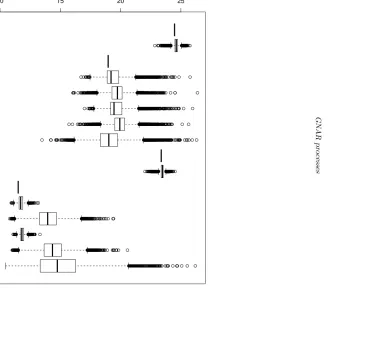
Prediction error boxplots over simulations from all sixteen models and 10,000 random
net-works are shown in Figure 9 (accompanying code not shown due to significant computation
time). The global-α model resulted in lower prediction error in general, so we use this version
of the GNAR model. For GNAR(1,[0]) and GNAR(2,[0,0]), the first and third model in
Figure 9 the “boxplots” are short horizontal lines as the results for each graph are
identi-cal, as no neighbour parameters are fitted. As the other global-α models are nested within
it, we select the randomly generated graph that minimises the prediction error for global-α
GNAR(2,[2,2]); this turns out to be the network generated fromseed.nos[921].
R> net921 <- seedToNet(seed.no = seed.nos[921], nnodes = 35, + graph.prob = 0.15)
R> layout(matrix(c(1), 1, 1))
R> plot(net921, vertex.label = colnames(gdpVTS), vertex.size = 0)
The network generated fromseed.nos[921]is plotted in Figure10, where all countries have
at least two neighbours, with 97 edges in total. This “921” network was constructed with GDP prediction in mind, so we would not necessarily expect any interpretable structure in our found network (and presumably, there were other networks with not too dissimilar predictive power). However, the USA, Mexico and Canada are extremely well-connected with eight, eight and six edges, respectively. Sweden and Chile are also well-connected, with eight and seven edges, respectively. This might seem surprising, but, e.g., the McKinsey Global
Institute MGI Connectedness Index, see Manyika, Lund, Bughin, Woetzel, Stamenov, and
Dhingra (2016), ranks Sweden and Chile 18th and 45th respectively out of 139 countries, and each country is most connected within their regional bloc (Nordic and South America, respectively). Each of these edges, or subgraphs of the “921” network could be tested to find a sparser network with a similar predictive performance, but we continue with the full chosen network here.
Using this network, we can select the best GNAR order using the BIC.
R> res <- rep(NA, 8) R> for(i in 1:8){
+ res[i] <- BIC(GNARfit(gdpVTSn[1:50, ],
+ net = seedToNet(seed.nos[921], nnodes = 35, graph.prob = 0.15), + alphaOrder = alphas[i], betaOrder = betas[[i]]))
+ }
R> order(res)
[1] 6 3 4 7 8 5 1 2
R> sort(res)
GNAR
p
ro
ce
sse
s
10 15 20 25
GNAR(1,[0])
GNAR(1,[1])
GNAR(2,[0,0])
GNAR(2,[1,0])
GNAR(2,[1,1])
GNAR(2,[2,0])
GNAR(2,[2,1])
GNAR(2,[2,2])
GNAR(1,[0]) g−α
GNAR(1,[1]) g−α
GNAR(2,[0,0]) g−α
GNAR(2,[1,0]) g−α
GNAR(2,[1,1]) g−α
GNAR(2,[2,0]) g−α
GNAR(2,[2,1]) g−α
GNAR(2,[2,2]) g−α
re
9:
P
re
d
ic
tion
error
b
oxp
lots
at
t
=
51
ov
er
10,000
ran
d
omly
ge
n
erate
d
n
et
w
orks
u
sin
g
an
d
d
iffe
re
n
t
GNAR
mo
d
els,
wh
ere
‘g-α
’
in
d
ic
ate
s
a
glob
al-α
GNAR
mo
d
[image:25.595.220.601.76.512.2]●
●
●
●
● ●
●
● ●
●
●
● ●
●
●
●
●
●
●
● ●
●
●
●
●
●
●
● ●
● ●
● ●
●
●
AUS
AUT BEL
CAN CHL
CZE
DNK
EST FIN
FRA
DEU
GRC HUN
ISL
IRL
ISR
ITA
JPN
KOR
LVA LUX
MEX
NLD
NZL
NOR
POL
PRT
SVK SVN
ESP SWE
CHE TUR
GBR
[image:26.595.186.447.160.415.2]USA
Figure 10: Randomly generated un-weighted and un-directed graph over the OECD countries
that minimises the prediction error att= 51 using GNAR(2,[2,2]).
The model that minimised BIC in this case was the sixth model, GNAR(2,[2,0]), a model with
two autoregressive parameters and network regression parameters on the first two neighbour sets at time lag one.
4.2. Results and comparisons
We use the previous section’s model to predict the values att= 52 and compare its prediction
errors to those found using standard AR and VAR models. The GNAR predictions are found
by fitting a GNAR(2,[2,0]) model with the chosen network (corresponding toseed.nos[921])
to data up tot= 51, and then predicting values at t= 52. We first normalise the series, and
then compute the total squared error from the model fit.
R> gdpVTSn2 <- apply(gdpVTS, 2, function(x){x / sd(x[1:51], na.rm = TRUE)}) R> gdpFit <- GNARfit(gdpVTSn2[1:51,], net = net921, alphaOrder = 2,
R> summary(gdpFit)
Call:
lm(formula = yvec2 ~ dmat2 + 0)
Residuals:
Min 1Q Median 3Q Max
-3.4806 -0.5491 -0.0121 0.5013 3.1208
Coefficients:
Estimate Std. Error t value Pr(>|t|) dmat2alpha1 -0.41693 0.03154 -13.221 < 2e-16 *** dmat2beta1.1 -0.12662 0.05464 -2.317 0.0206 * dmat2beta1.2 0.28044 0.06233 4.500 7.4e-06 *** dmat2alpha2 -0.33282 0.02548 -13.064 < 2e-16 ***
---Signif. codes: 0 '***' 0.001 '**' 0.01 '*' 0.05 '.' 0.1 ' ' 1
Residual standard error: 0.8926 on 1332 degrees of freedom (23 observations deleted due to missingness)
Multiple R-squared: 0.1859, Adjusted R-squared: 0.1834 F-statistic: 76.02 on 4 and 1332 DF, p-value: < 2.2e-16
GNAR BIC: -62.86003
R> sum((predict(gdpFit) - gdpVTSn2[52, ])^2)
[1] 5.737203
The fitted parameters of this GNAR model were ˆα1 ≃ −0.42,βˆ1,1 ≃ −0.13,βˆ1,2 ≃0.28, and
ˆ
α2 ≃ −0.33.
We compared our methods with results from fitting an AR model individually to each node
using theforecast.ar()andauto.arima()functions from version 8.0 of the CRANforecast
package, for further details seeHyndman and Khandakar(2008). Due to our autocorrelation
analysis from Section4.1we set the maximum AR order for each of the 35 individual models
to bep= 2. Conditional on this, the actual order selected was chosen using the BIC.
R> library("forecast")
R> arforecast <- apply(gdpVTSn2[1:51, ], 2, function(x){
+ forecast(auto.arima(x[!is.na(x)], d = 0, D = 0, max.p = 2, max.q = 0, + max.P = 0, max.Q = 0, stationary = TRUE, seasonal = FALSE, ic = "bic", + allowmean = FALSE, allowdrift = FALSE, trace = FALSE), h = 1)$mean + })
R> sum((arforecast - gdpVTSn2[52, ])^2)
Model # Parameters Prediction error
GNAR(2,[2,0]) 4 5.7
Individual AR(2) 38 8.1
[image:28.595.171.437.107.166.2]VAR(1) 199 26.2
Table 1: Estimated prediction error of differenced real GDP change at t = 52 for all 35
countries.
Our VAR comparison was calculated using version 1.5–2 of the CRAN package vars, Pfaff
(2008). The missing values at the beginning of the series cannot be handled with current
software, so are set to zero. The number of parameters in a zero-mean VAR(p) model is
of order pN2. In this particular example, the dimension of the observation data matrix is
T×N, withT <2N, so only a first-order VAR can be fitted. We fit the model using theVAR
function and then use therestrictfunction to reduce dimensionality further, by setting to
zero any coefficient whose associated absolutet-statistic value is less than two.
R> library("vars")
R> gdpVTSn2.0 <- gdpVTSn2
R> gdpVTSn2.0[is.na(gdpVTSn2.0)] <- 0
R> varforecast <- predict(restrict(VAR(gdpVTSn2.0[1:51, ], p = 1, + type = "none")), n.ahead = 1)
This results in forecast vectors for each node, so we extract the point forecast (the first element of the forecast vectors) and compute the prediction error as follows
R> getfcst <- function(x){return(x[1])}
R> varforecastpt <- unlist(lapply(varforecast$fcst, getfcst)) R> sum((varforecastpt - gdpVTSn2.0[52, ])^2)
[1] 26.19805
Our GNAR model gives a lower prediction error than both the AR and VAR results, reducing
the error by 29% compared to AR and by 78% compared to VAR. Table1 summarises these
results and also shows the number of parameters fitted. It is clear that GNAR is particularly parsimonious.
We repeat the procedure above to perform analysis based upon two-step ahead forecasting. In this case, a different network minimises the prediction error for model GNAR(2,[2,2]). However, the BIC step identified that the GNAR(2,[0,0]) model had the best fit, which is a model that does not include network regression parameters.
R> gdpVTSn3 <- apply(gdpVTS, 2, function(x){x / sd(x[1:50], na.rm = TRUE)}) R> gdpPred <- predict(GNARfit(gdpVTSn2[1:50,], net = net921, alphaOrder = 2, + betaOrder = c(0, 0)), n.ahead=2)
R> sum((gdpPred[1,] - gdpVTSn3[51, ])^2)
[1] 11.7874
Model Prediction error at t= 51 Prediction error att= 52
GNAR(2,[0,0]) 11.8 8.1
Individual AR(2) 18.6 11.3
[image:29.595.116.486.106.165.2]VAR(1) 115.0 120.4
Table 2: Estimated prediction error of differenced real GDP change at t= 51,52, for all 35
countries.
[1] 8.067577
R> arforecast <- apply(gdpVTSn3[1:50, ], 2, function(x){
+ forecast(auto.arima(x[!is.na(x)], d = 0, D = 0, max.p = 2, max.q = 0, + max.P = 0, max.Q = 0, stationary = TRUE, seasonal = FALSE, ic = "bic", + allowmean = FALSE, allowdrift = FALSE, trace = FALSE), h = 2)$mean + })
R> sum((arforecast[1,] - gdpVTSn3[51, ])^2)
[1] 18.56074
R> sum((arforecast[2,] - gdpVTSn3[52, ])^2)
[1] 11.31722
R> gdpVTSn3.0 <- gdpVTSn3
R> gdpVTSn3.0[is.na(gdpVTSn3.0)] <- 0
R> varforecast <- predict(restrict(VAR(gdpVTSn3.0[1:50, ], p = 1, + type = "none")), n.ahead = 2)
R> getfcst <- function(x){return(x[,1])}
R> varforecastpt <- matrix(unlist(lapply(varforecast$fcst, getfcst)), + nrow=2, ncol=35)
R> sum((varforecastpt[1,] - gdpVTSn3[51,])^2)
[1] 114.9876
R> sum((varforecastpt[2,] - gdpVTSn3[52,])^2)
[1] 120.4467
Table2shows that the GNAR model is again the best performing, although in the two-step
ahead prediction the fitted model is a special case of GNAR model with no neighbourhood parameters.
Results in Tables1and2indicate that the VAR model works particularly poorly here, despite
p, it can capture. In addition, we were unable to find software to fit VAR models with for missing data at the start of a series.
We end this section by noting that using Erdős-Rényi graphs are not the only type of network that could be used to aid prediction. As suggested by a referee, models such the Chung-Lu
model (Aiello, Chung, and Lu 2001; Chung and Lu 2002) could also be used to simulate
random networks for this task; these graphs would allow for more flexible network generation, for example using node-specific connection probabilities proportional to a country’s size.
5. Discussion and summary
TheGNAR package can be used to model network time series using a network autoregressive
structure. Estimation under the proposed model is informed by the, potentially time-varying, structure of the network, assumed known. Network time series models are in an early stage of development, but there is enormous potential, especially as network data are increasingly being collected and analysed in many fields. As far as possible, we attempt to integrate our methods with existing valuable R functionality, such as its linear modelling capability and thefit/ summary/ predictmethods that are familiar with Rusers.
Within our model a network is formed using edges of all covariates simultaneously, and the
connection weights of this single network can be calculated e.g. as described in Section2.1.2.
Another approach is to consider a separate network for each covariate, and then calculate connection weights for each of these networks. This would result in different (known)
weight-ings,ω, and consequently different fitted coefficients,β. The single network approach is more
appropriate for sparse networks and when different types of edge are closely related. In com-parison, when covariates relate completely separate link information between the nodes, use of different networks would be appropriate.
When covariates are present, the neighbour set structure is more complex, as different edge
types can be included in a path between nodes. For example, in a network with event and
proximal edges, network paths between stage-2 neighbours could include edges event-event,
event-proximal / proximal-event, or proximal-proximal. These different types of path could
be represented separately in the model using additional β parameters. We note that the
number of such parameters would increase greatly for large covariate cardinality C or high
neighbour set stagesj, so, in these cases, the large number of additional parameters may not
enhance the model. Our model permits regression on any non-empty stage neighbour set, so
models with highsj can be fitted. For large sj, the neighbour sets may not be scientifically
interpretable so small sj is recommended, to favour parsimony and interpretability.
Trend is another factor that can seriously affect modelling and estimation, just as in the regular time series situation. However, trend can be successfully modelled and estimated by
using second-generation wavelet (lifting) techniques before stochastic modelling, as inNunes,
Knight, and Nason(2015).
With the option of having different covariates and high order neighbourhood structures
in-cluded, our GNAR model as presented in Section 2 is incredibly flexible. In this article a
References
Abegaz F, Wit E (2016). TSCGM: Sparse Time Series Chain Graphical Models. R package
version 2.5, URLhttp://CRAN.R-project.org/package=SparseTSCGM.
Adhikari S, Junker B, Sweet T, Thomas AC (2018).HLSM: Hierarchical Latent Space Network
Model. Rpackage version 0.8, URLhttp://CRAN.R-project.org/package=HLSM.
Aiello W, Chung F, Lu L (2001). “A random graph model for power law graphs.”Experimental
Mathematics,10(1), 53–66.
Akaike H (1973). “Information Theory and An Extension of the Maximum Likeihood
Princi-ple.” InProc. 2nd International Symposium on Information Theory, pp. 267–281. Academiai
Kiado, Budapest, Hungary.
Almutiry V, Warriyar KV, Deardon R (2018). EpiLMCT: Continuous Time Distance-Based
and Network Based Individual Level Models for Epidemics. Rpackage version 1.1.2, URL
http://CRAN.R-project.org/package=EpiLMCT.
Bashir F, Wei HL (2016). “Handling Missing Data in Multivariate Time Series Using a
Vec-tor AuVec-toregressive Model Based Imputation (VAR-IM) Algorithm.” InProc. 24th
Mediter-ranean Conference on Control and Automation (MED), pp. 611–616. IEEE, Athens, Greece.
Blocker AW, Koullick P, Airoldi E (2014). networkTomography: Tools for Network
Tomography. R package version 0.3, URL http://CRAN.R-project.org/package=
networkTomography.
Brockwell PJ, Davis RA (2006). Time Series: Theory and Methods. 2nd edition.
Springer-Verlag, New York.
Brownlees C (2017). nets: Network Estimation for Time Series. Rpackage version 0.9, URL
http://CRAN.R-project.org/package=nets.
Chung F, Lu L (2002). “Connected components in random graphs with given expected degree
sequences.” Annals of Combinatorics,6(2), 125–145.
Dahlhaus R, Eichler M (2003). “Causality and Graphical Models for Time Series.” In
PJ Green, NL Hjort, , S Richardson (eds.), Highly Structured Stochastic Systems., pp.
115–137. Oxford University Press, Oxford.
Denny MJ, Wilson JD, Cranmer S, Desmarais BA, Bhamidi S (2018). GERGM:
Estima-tion and Fit Diagnostics for Generalized Exponential Random Graph Models. R package
version 0.13.0, URLhttp://CRAN.R-project.org/package=GERGM.
Emerencia A (2018). autovarCore: Automated Vector Autoregression Models and Networks.
Rpackage version 1.0-4, URL http://CRAN.R-project.org/package=autovarCore.
Epskamp S (2018). graphicalVAR: Graphical VAR for Experience Sampling Data. Rpackage
version 0.2.2, URLhttp://CRAN.R-project.org/package=graphicalVAR.
Epskamp S, Deserno MK, Bringmann LF (2019).mlVAR: Multi-Level Vector Autoregression.
![Figure 4:Fitted values of global-α GNAR(1, [1]) fit to the ‘fiveVTS’ data, with observations50–150 removed from node C](https://thumb-us.123doks.com/thumbv2/123dok_us/1865753.143527/14.595.115.468.141.474/figure-fitted-values-global-gnar-vevts-observations-removed.webp)

![Figure 10: Randomly generated un-weighted and un-directed graph over the OECD countriesthat minimises the prediction error at t = 51 using GNAR(2, [2, 2]).](https://thumb-us.123doks.com/thumbv2/123dok_us/1865753.143527/26.595.186.447.160.415/figure-randomly-generated-weighted-directed-countriesthat-minimises-prediction.webp)
