THE EFFECTIVENESS OF DIGITAL MARKETING ON CONSUMERS’
POST-PURCHASE DECISION
ONG BOON ZIAN
The thesis is submitted in partial fulfilment of the requirements for the award
of Bachelor of Technology Management (High Technology Marketing)
Faculty of Technology Management and Technopreneurship
Universiti Teknikal Malaysia Melaka
‘I/We, here declared that I/We had read through this thesis and in my/our opinion that this thesis is adequate in term of scope and quality which fulfil the requirements
for the award of Bachelor of Technology Management (High Technology Marketing)
SIGNATURE :
NAME OF SUPERVISOR : PUAN AZRINA BINTI OTHMAN
DATE :
SIGNATURE :
i
DECLARATION
“I admit that this report is the result of my own, except certain explanations and passages where every of it is cited with source clearly.”
SIGNATURE :
NAME : ONG BOON ZIAN
DEDICATION
iii
ACKNOWLEDGEMENT
I would like to take this opportunity to express my sincere appreciation to my supervisor, Pn Azrina Binti Othman for guidance and encouragement throughout the journey of completing this final year project. Because of her guidance, I managed to finished my final year project successfully. Besides that, there are also a lot of important people involved in my final year project, for instance, my lecturers, friends, housemates and course mates. I am deeply grateful and appreciate for the guidance towards this project as play an important role for this project.
Furthermore, I sincerely thanks to the researchers that did their research papers and uploaded online. Although the topic of the research papers were different, but the theory and knowledge provided were fruitful.
ABSTRACT
Due to the dramatically growth of technology, many organizations would like to move their business from traditional business into digital world. E-commerce has become the trend of business todays. This has open an opportunity for the marketers to conduct marketing activities in the digital world. Besides that, due to the technology advancement, the rise of the internet and the development of Web 2.0, it has enabled the interconnectivity of the consumers to increase. As a result, the consumer behavior has changed. It is very important for the organization to understand the consumers’ post-purchase in order to reduce cognitive dissonance and build a long term relationship with the consumers. For that reason, this study was conducted to study the effectiveness of digital marketing on consumers’ post-purchase decision. The data will collect using questionnaires from 384 respondents in Selangor and Melaka area. The factors that may influence the effectiveness of digital marketing on consumers’ post-purchase decision include perceived ease of use, perceived usefulness, perceived benefit and perceived risk. In this research, perceived ease of use and perceived risk were significant in influencing the effectiveness of digital marketing on consumers’ post-purchase decision. The result of this study contributes exceptional judgement to marketers and the organizations in Malaysia.
v
ABSTRAK
Disebabkan pertumbuhan teknologi secara mendadak, banyak organisasi telah memindahkan perniagaan mereka dari perniagaan tradisional ke perniagaan digital. E-dagang telah menjadi trend perniagaan pada hari ini. Ini telah membuka peluang kepada para pemasar untuk menjalankan aktiviti pemasaran di dunia digital. Selain itu, disebabkan kemajuan teknologi, kebangkitan internet dan pembangunan Web 2.0, ia telah membolehkan interaksi antara pengguna meningkat. Akibatnya, tingkah laku pengguna telah berubah. Jadi, organisasi mestilah memahami sikap pengguna selepas pembelian bagi mengurangkan percanggahan kognitif dan membina hubungan yang erat dengan pengguna. Oleh itu, kajian ini telah dijalankan untuk mengenalpasti keberkesanan pemasaran digital terhadap keputusan pengguna selepas pembelian. Data kajian ini telah dikumpulkan melalui soal-selidik sebanyak 384 responden di Selangor dan Melaka. Faktor-faktor yang mungkin mempengaruhi keberkesanan pemasaran digital terhadap keputusan pengguna selepas pembelian termasuk sikap berasa senang diguna, kegunaannya, manfaat yang diterima dan risiko yang dihadapi. Dalam kajian ini, sikap berasa senang diguna dan risiko yang dihadapi akan mempengaruhi keberkesanan pemasaran digital terhadap keputusan pengguna selepas pembelian. Keputusan kajian ini menyumbangkan kepada pemahaman yang dalam kepada pemasar-pemasar dan syarikat-syarikat di Malaysia.
TABLE OF CONTENTS
CHAPTER TITLE PAGE NUMBER
DECLARATION i DEDICATION ii ACKNOWLEDGEMENT iii
ABSTRACT iv
ABSTRAK v
TABLE OF CONTENTS vi
LIST OF TABLES x
LIST OF FIGURES xi
LIST OF ABBREVIATION AND SYMBOL xii
LIST OF APPENDICES xiii
CHAPTER 1 INTRODUCTION 1
1.0INTRODUCTION 1
1.1BACKGROUND OF STUDY 1
1.2PROBLEM STATEMENT 2 1.3RESEARCH QUESTION 3 1.4RESEARCH OBJECTIVE 3 1.5SCOPE OF STUDY 4
1.6LIMITATION OF STUDY 4
1.7IMPORTANT OF RESEARCH 5
1.8SUMMARY 5
CHAPTER 2 LITERATURE REVIEW 6
2.0INTRODUCTION 6
2.1MARKETING 6
vii
2.1.2 Promotion 9
2.2DIGITAL MARKETING 9 2.2.1 History of Digital Marketing 10 2.2.2 Digital Marketing’s Trends 11 2.2.3 Digital Marketing Channel 12 2.2.4 Advantages of Digital Marketing 15 2.2.5 Disadvantages of Digital Marketing 16
2.3CONSUMER BEHAVIOR 17 2.3.1 Consumer Purchase Decision 18 2.3.2 Post-Purchase Decision 20
2.4DIGITAL MARKETING AND POST-PURCHASE 21
2.5SUCCESSFUL FACTORS OF DIGITAL MARKETING ON CONSUMERS’
POST-PURCHASE DECISION 22
2.6RESEARCH FRAMEWORK 26 2.7HYPOTHESIS 27
2.8SUMMARY 28
CHAPTER 3 RESEARCH METHODOLOGY 29
3.0INTRODUCTION 29 3.1RESEARCH DESIGN 30 3.2METHODOLOGY CHOICE 31 3.3PRIMARY AND SECONDARY DATA SOURCE 31 3.4LOCATION OF RESEARCH 32
3.5TIME HORIZON 33 3.6QUESTIONNAIRE DESIGN 33 3.7SAMPLING DESIGN 35 3.8RESEARCH STRATEGY 35
3.8.1 Pilot Test 36
3.9DATA ANALYSIS METHOD 36
3.10VALIDITY AND RELIABILITY 38 3.10.1 Internal validity 39 3.10.2 External validity 39 3.10.3 Reliability 40
CHAPTER 4 DATA ANALYSIS 42
4.0INTRODUCTION 42
4.1PILOT TEST RESULT 43 4.2DESCRIPTIVE STATISTICS ANALYSIS 46
4.2.1 Profile of Respondents 46 4.2.1.1 Gender 46 4.2.1.2 Age 47 4.2.1.3 State 48 4.2.1.4 Educational level 48 4.2.1.5 Hours Spending Actively on Internet in Week 49 4.2.1.6 Cross Tabulation of State and Hours Spending Actively on Internet in a Week 50
4.3IMPACT OF ONLINE MEDIUM TO CONSUMERS’POST-PURCHASE
DECISION 51
4.4DATA ANALYSIS OF RESEARCH QUESTIONS 52
4.4.1Descriptive Statistics of Dependent Variable and
Independent Variable 52
4.4.2 Descriptive Statistic of Perceived Ease of Use (IV1) 53 4.4.3 Descriptive Statistic of Perceived Usefulness (IV2) 54 4.4.4 Descriptive Statistic of Perceived Benefit (IV3) 56 4.4.5 Descriptive Statistic of Perceived Risk (IV4) 57
4.5RESULT OF MEASUREMENT 59 4.5.1 Test Validity 59 4.5.2 Reliability Test 61
4.6HYPOTHESIS TESTING 63
4.6.1 Multiple Regression Analysis 63
4.7SUMMARY 67
CHAPTER 5 DISCUSSION, IMPLICATION AND CONCLUSION 68
5.0INTRODUCTION 68
5.1SUMMARY OF DESCRIPTIVE ANALYSIS 69
ix
5.2.1 Objective 1: To identify the impacts of online medium that influences the effectiveness of digital marketing on consumers’ post-purchase decision. 72 5.2.2 Objective 2: To investigate the factors that influence the effectiveness of digital marketing on consumers’
post-purchase decision. 74
5.2.3 Objective 3: To determine the most important factor that influence the effectiveness of digital marketing on consumers’ post-purchase decision. 79
5.3IMPLICATIONS OF STUDY 79
5.3.1 Managerial Implication 80
5.4RECOMMENDATION FOR THE FUTURE RESEARCH 81 5.5CONCLUSION 82
5.6SUMMARY 82
LIST OF TABLES
TABLE TITLE PAGE
3.6.1 5-point Likert Scale 34
4.1.1 The Result of Correlations Analysis for All Variable
44
4.1.2 Reliability Statistics 45
4.2.1.1 Gender of Respondents 46
4.2.1.2 Age of Respondent 47
4.2.1.3 State of Respondent 48
4.2.1.4 Educational Level of Respondents 48 4.2.1.5 Hours Spending Actively on Internet in A
Week
49
4.2.1.6 Cross Tabulation of State and Hours Spending Actively on Internet in a Week
50
4.3.1 Descriptive Statistics of Dependent Variable 51 4.3.2 Mean Score Interpretation 51 4.4.1 Descriptive Statistics of DV and IV 52 4.4.2 Descriptive Statistic of Perceived Ease of Use 53 4.4.3 Descriptive Statistic of Perceived Usefulness 54 4.4.4 Descriptive Statistic of Perceived Benefit 56 4.4.5 Descriptive Statistic of Perceived Risk 57
4.5.1 Correlation 60
4.5.2 Reliability Statistics 62
xi
LIST OF FIGURES
FIGURE TITLE PAGE
2.1.1.1 “4P” Marketing Mix Element 7 2.2.2.1 Estimated Malaysia Digital Revenue 11 2.2.3.1 Digital Marketing Channel 12 2.3.1.1 Consumer Purchase Decision 18
2.5.1 TAM Model 23
2.6.1 Research Framework- Effectiveness of Digital Marketing on Consumers’ Post-Purchase Decision
26
LIST OF ABBREVIATIONS AND SYMBOL
ABBREVIATIONS MEANING
ANOVA Analysis of Variance IV Independent Variable DV Dependent Variable PEU Perceived Ease of Use
PU Perceived usefulness PB Perceived Benefit
PR Perceived Risk
H0 Null Hypothesis
H1 Alternative Hypothesis
xiii
LIST OF APPENDICES
APPENDIX TITLE
CHAPTER 1
INTRODUCTION
1.0 Introduction
This chapter will discuss the background of study of the researcher where the topic of the research is the effectiveness of digital marketing on consumers’ post-purchase decision in Malaysia. In this chapter, it will introduce what is digital marketing and also consumers’ post-purchase decision. Besides that, this chapter will also describe the problem statement, research question, research objective, scope and limitation of the study, and also the important of research.
1.1 Background of Study
2
activities in the digital world.
Besides that, according to the report in the Digital Integration & Business Transformation Asia Conference (2016), the estimated Malaysia digital revenue will increase continually from year to year and it stated that the digital revenue in 2016 is RM1,336.85mil. This showed that marketers can gained a lot of benefits if they conduct digital marketing. But, as stated by Chang & Tseng (2014), the purchased item that the consumer received may not living up to pre-purchase expectation, this may influence the consumer post-purchase decision. The issue that faced by the marketers currently is how to effectively conduct digital marketing on consumers’ post-purchase decision in order to build a long term relationship with the consumers and reduce cognitive dissonance.
Therefore, the purpose of the study is to understand the effectiveness of digital marketing on consumers’ post-purchase decision. This study also determines the factors that influence the effectiveness of digital marketing.
1.2 Problem Statement
The amount of trade that is conducted electronically using online shopping has increased with a wide spread usage of internet and technology (Vanitha & Prakash, 2016). Nowadays, people preferred shopping online. This has opened an opportunity for the marketers to conduct digital marketing in order to attract more consumers and build a long term relationship with them. Unfortunately, according to Li & Darban (2012), e-commerce also raises a number of further problems for firms including dealing with post-purchase complaints and many more. Therefore, in order to solve this problem, the researcher decided to study the effectiveness of digital marketing on consumers’ post-purchase decision in this study.
on how to encourage purchase decisions. There are few studies in marketing literature have focused on strengthening and maintaining brand attitudes following a purchase and much less attention has been paid to the emotion consumers experience after purchase. There are a research gap and this has attracted the researcher to conduct research regarding to effectiveness of digital marketing on consumers’ post-purchase decision.
1.3 Research Question
Further from here, three research questions have formatted from problem statement.
1. What is the impacts of online medium that influences the effectiveness of digital marketing on consumers’ post-purchase decision?
2. What are the factors that influence the effectiveness of digital marketing on consumers’ post-purchase decision?
3. What is the most important factor that influence the effectiveness of digital marketing on consumers’ post-purchase decision?
1.4 Research Objective
The primary objective of this study was to investigate the effectiveness of digital marketing on consumers’ post-purchase decision. Besides that, the study also determined significant critical factors that influencing the effectiveness of digital marketing on consumers’ post-purchase decision.
1. To identify the impacts of online medium that influences the effectiveness of digital marketing on consumers’ post-purchase decision.
4
3. To determine the most important factor that influence the effectiveness of digital marketing on consumers’ post-purchase decision.
1.5 Scope of Study
The purpose of this study was to identify the critical factors that influence the effectiveness of digital marketing on consumers’ post-purchase decision. In this study, researcher has suggested 4 factors which associate with the effectiveness of digital marketing on consumers’ post-purchase decision. These factors include perceived ease of use, perceived usefulness, perceived risk and perceived benefit. Researcher believed that these factors has strong relationship towards the effectiveness of digital marketing on consumers’ post-purchase decision
1.6 Limitation of Study
1.7 Important of Research
The importance of this research was to understand how marketers can use digital marketing to influence consumers’ post-purchase decision. This research may provide a guideline for the marketers while conducting digital marketing to influence consumers’ post-purchase decision. The researcher has suggested 4 factors that may influence the effectiveness of digital marketing on consumers’ post-purchase decision. Therefore, the marketers can take it as reference in order to eliminate cognitive dissonance and build relationship with the customers.
Besides that, this research can help in academic field which will provide a different prospective for the researchers in understanding the content of digital marketing and also consumers’ post-purchase decision. This research also provides a clue to the researcher for future study.
1.8 Summary
6
CHAPTER 2
LITERATURE REVIEW
2.0 Introduction
In this chapter, researcher discussed about marketing. Besides that, the researcher focused on digital marketing. Moreover, the researcher discussed about the trend of digital marketing and also the advantages and disadvantages of digital marketing. Furthermore, this chapter discussed about consumer behavior and consumer purchase decision. Then, the researcher related digital marketing with post-purchase. Next discussion was about the contribution of success factors that influence the effectiveness of digital marketing on consumers’ post-purchase decision. Finally, the researcher constructed a research framework to relate the dependent variable with independent variables. Researcher also made hypothesis based on independent variables to identify the significant relationship between dependent variable.
2.1 Marketing
2014). Marketing is an activity in which it helps to create value that satisfy the needs and wants of the consumers and on the other hand that help the organization to achieve its goal. Besides that, as described byChartered Institute of Marketing(2015), every product we buy, every choice we make and every media message we receive in our consumer society has been shaped by the forces of marketing. This showed that marketing plays a very important role in a business where marketing can help a business to deliver the information and message to the customers, and also communicate with the target audience.
2.1.1 Four P’s
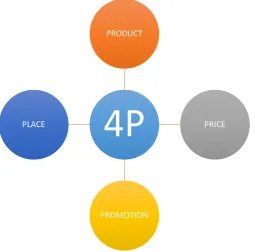
[image:22.595.205.461.468.720.2]Figure below showed 4P’s marketing mix element. The 4P’s included product, place, promotion and price.
Figure 1: “4P” Marketing Mix Element (Išoraitė, 2016)
4P
PRODUCT
PRICE
8
Product
As described by Išoraitė (2016), product is defined as a physical service or product to the consumer for which he is willing to pay. It is best viewed as the “bundle” of characteristics and benefits that the customers perceive they will obtain by purchasing it, based on their perceived needs, expectations and wants (Gomez, 2013). An organization offered the product to the customers in order to satisfy the needs and wants of the customers.
Price
Price can considered as one of the most important marketing mix (Išoraitė, 2016). It is the amount of money that the customers paid to obtain the product (Londre, 2016). It is the only element in the marketing mix that generates revenue and therefore, has a significant impact over a firm’s profitability (Gomez, 2013).
Promotion
Promotion is some strategies used by marketers to helps to increase awareness of the consumers in terms of the products that may leads to higher sales and helps to build brand loyalty (Išoraitė, 2016). It will helps the marketers to promote the organization’s product or services to the customers.
Place
2.1.2 Promotion
As described by Išoraitė (2016), promotion is a marketing tool that can helps to disseminate information, encourage the purchase and affects the purchase decision process. Besides that, promotion also refers to the marketing tool that a firm uses to communicate with its current or potential customers (Gomez, 2013). This means that promotion can help an organization to deliver the information to the customers and also influence the consumers’ purchase decision.
Promotion can affect the consumers’ purchase behavior. In order to promote the brand, products or services to the public, there are some elements that the marketers should considered such as advertising, personal selling, sales promotion, direct marketing and public relations (Išoraitė, 2016). With the increasing penetration of mobile Internet and the number of mobile users, the technology, marketing and advertising opportunities using smartphones and tablets are developing a lot (Pogorelova, Yakhneeva, & Anna, 2016). This showed that it has become an opportunity for many marketers to conduct marketing activities in the digital world.
2.2 Digital Marketing