Int. J. Electrochem. Sci., 10 (2015) 5747 - 5755
International Journal of
ELECTROCHEMICAL
SCIENCE
www.electrochemsci.org
Short Communications
The Electrochemical Behavior of Nafion/Reduced Graphene
Oxide Modified Carbon Electrode Surface and Its Application
To Ascorbic Acid Determination
Wenli Liao1,†, Chaozhong Guo1,2,* †, Lingtao Sun2, Zhongbin Li1, Liangliang Tian2,*, Jiahong He1, Junjun Li2, Jie Zheng3, Zili Ma4, Zhongli Luo5, Changguo Chen4,*
1
School of Materials and Chemical Engineering, Chongqing University of Arts and Sciences, Chongqing 402160, China.
2
Research Institute for New Materials Technology, Chongqing University of Arts and Sciences, Chongqing 402160, China.
3
School of Laboratory Medicine, Chongqing Medical University, Chongqing 400016, China
4
School of Chemistry and Chemical Engineering, Chongqing University, Chongqing 400044, China
5
School of Basic Medical Sciences, Chongqing Medical University, Chongqing 400016, China
†
These authors equally contributed to this work and they are co-first authors to this work.
*
E-mail: [email protected]; [email protected]; [email protected]
Received: 15 April 2015 / Accepted: 9 May 2015 / Published: 27 May 2015
In this study, we has utilized electrochemically reduced graphene oxide and nafion co-modified glassy carbon electrode as a novel and sensitive electrochemical sensor for ascorbic acid in weak acid buffer solution. The modern voltammetric technique was chosen for studying the redox property of Fe(CN)63-
electrochemical probe and electrochemical behavior of ascorbic acid at this modified carbon electrode surface. We have also proposed a possible mechanism to better understand how to facilitate the electron transfer between ascorbic acid and modified electrode surface. The electrochemical results have suggested that ascorbic acid exhibited a very sensitive anodic peak at about 0.3 V on as-prepared modified electrode, and its anodic peak current was enhanced about two-times more than that on the bare glassy carbon electrode. A reasonable linear relationship between the anodic peak current and the ascorbic acid concentration (0.1~100 mM) and a low detection limit of 10 μM were obtained using the prepared modified electrode. More importantly, here the proposed method can be successfully applied to the practical samples with excellent sensitivity and reproducibility.
1. INTRODUCTION
Ascorbic acid (AA) is a water soluble vitamin and one of the essential nutrients in animals and plants, which participates in many important life processes. It has been applied to the prevention and treatment of scurvy, common cold, mental illness, hepatic disease and cancer [1,2]. Determination of the AA content in vegetables and fruits is important for the evaluation of peoples’ AA intake. Besides, AA is also a widely used industrial raw materials. Hence it can conclude that it is of great significance to the determination of AA content in organisms and environments. At present, the detection of AA has been performed by various methods such as spectrophotometry [3], chromatography [4] and fluorimetric dynamics method [5]. The accuracy of these methods is very high, but their selectivity is poor and the operation is relatively cumbersome. More significantly, a large amount of chemical reagents will be used in the process of AA detection. The chemically modified electrodes have the advantages of simple preparation, high sensitivity, fast response, low detection limit and fewer solvents, which is one of many methods with high efficiency and quick determination of AA [6–9].
A new discovered nanoscale carbon – graphene (GPE) sheet of sp2-bonded carbon atoms with a planar structure was usually packed in a honeycomb-like crystal lattice and widely employed in the specific fields such as optoelectronics, medicine bioscience, catalysis-chemistry, and electrochemical energy storage and conversion, which is due to its unique electronic properties [10]. It is notably that GPE has exhibited sixty-times better conductivity, higher stability, greater sensitivity and also more surface charge density compared to other materials such as carbon nanotubes (CNTs) [11,12]. On the basis of these excellent properties, GPE is being in the large application of biosensors at present [13]. Recently, the surface modification of carbon electrodes via using graphene or reduced graphene oxide nanomaterials has been rapidly developed to improve the sensitivity and selectivity of electrochemical sensors for the detection of dopamine [7,13], uric acid [7], L-tryptophan [8] and other organic species [9]. In this study, we have prepared a new modified carbon electrode (Nafion/rGO/GCE) with graphene oxide and Nafion solution, following by a directly electrochemically reduction process. The electrochemical behavior of Nafion/rGO/GCE and its rapid determination of AA were investigated. This electrode was successfully used to the detection of AA in real medical tablet. Compared with the bare GCE, Nafion/rGO/GCE effectively enhances the anodic oxidation peak current of AA, indicating a conspicuous enhancement effect upon the oxidation reaction of AA, which may be contributed to the excellent electrical conductivity of reduced graphene oxide (rGO) at the modified electrode surface. Our research results have further revealed that Nafion/rGO/GCE prepared in this work could be a promising candidate for electrochemical biosensor applications.
2. EXPERIMENTAL
2.1. Reagents and materials
pre-procedure of microwave assisted expansion [14]. Other chemicals were of analytical reagent grade from Chongqing Beibei Chemical Reagent Co. Ltd and used without further purification. All stock solutions were prepared using distilled water, purging with nitrogen and were guaranteed to be fresh unless otherwise stated.
2.2. Preparation of Nafion and rGO co-modified GCE (Nafion/rGO/GCE)
Bare glass carbon electrode (GCE) were firstly polished with alumina slurry (diameter = 0.5 μm) on a polishing cloth, then cleaned under bath sonication for 10 min in ethanol and distilled water, and finally rinsed with large amounts of water. For fabricating the modified electrode, 1.0 mg of GO was added into DI water (1 mL) and then sonicated for 20 min to get a homogeneous suspension. 10 μl of GO dispersion was dropped on GCE and then dried at ambient temperature. After doing this, 5 µl of 0.5% Nafion solution (diluted by isopropanol) was also dropped on the GO/GCE surface and dried in oven at 60 °C to form the Nafion and GO modified GCE (Nafion/GO/GCE). The electrochemical reduction of Nafion/GO/GCE was carried out via cyclic voltammetry scanning for 8 cycles with a range of –1.7 ~ 0.2 V at 100 mV s–1 in N2-saturated 0.2 M KCl solution to obtain Nafion/rGO/GC
working electrode [8].
2.3. Instruments and measurements
All electrochemical tests were carried out on a μIII Autolab electrochemical workstation with a conventional three-electrode system. The working electrode was bare GCE or Nafion/rGO/GCE with a diameter of 4 mm. A platinum wire and a saturated calomel electrode (SCE) were used as the counter and the reference electrodes, respectively. All the following electrochemical experiments including cyclic voltammetry (CV) tests and amperometric current-time (I – t) curves were performed at room temperature.
3. RESULTS AND DISCUSSION
3.1. Electrochemical behavior of different carbon electrodes
The electrochemical characteristics of GCE and Nafion/rGO/GCE were studied to illuminate their electron-transfer behavior by using Fe(CN)63– as a redox probe. The CVs for two kinds of
carbon electrodes were obtained in the electrolyte solution containing 5 mM Fe(CN)63– and 0.1 M
KCl at 50 mV s–1, as displayed in Fig.1. It can be found that a pair of well-defined redox peak with a difference of peak potential (ΔEp) of 80 mV can be obtained at bare GCE, whereas the ΔEp present on
Nafion/rGO/GCE is only 70 mV. Moreover, the redox peak current of Fe(CN)63– has importantly
which exist in graphene oxide, can lead to the large amount of sp3-hybridized carbon atoms. The process of electrochemical reduction in 0.2 M KCl solution at the range of 0.2 to –1.7 V can remove these oxygen functional groups and restore sp2-hybridized carbon atoms, which has changed GO to GPE. The GPE with excellent electrical conductivity and superior electron transport property can powerfully accelerate the rate of electron transfer at the interface of carbon electrode/electrolyte.
-0.3 0.0 0.3 0.6 0.9
-0.6 -0.3 0.0 0.3 0.6
-0.3 0.0 0.3 0.6 0.9
-0.02 -0.01 0.00 0.01 0.02 0.03 b
C
ur
rent
/
m
A
Potential / V (vs.SCE)
GCE (a) rGO/GCE (b)
a
C
u
rr
e
n
t
/
m
A
[image:4.596.173.419.183.406.2]Potential / V (vs.SCE)
Figure 1. CVs obtained at bare GCE (a) and Nafion/rGO/GCE (b) in 0.2 M KCl solution containing 5
mM K3[Fe(CN)6] at a potential scan rate of 50 mV s–1.
3.2. Electrochemical behavior of AA at carbon electrodes
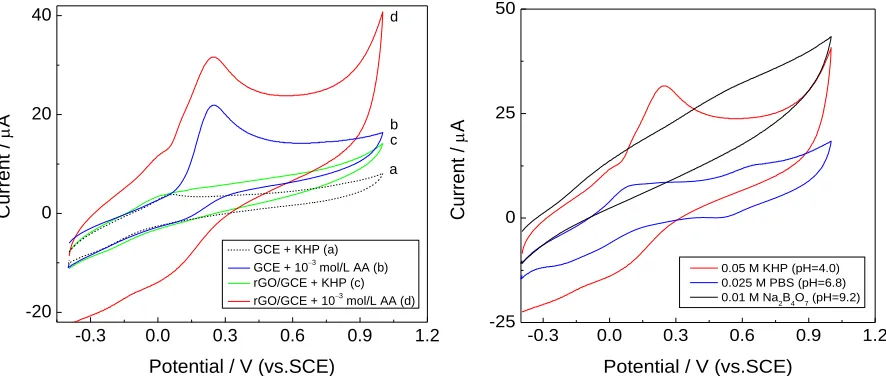
The CVs for 1.0 mM AA recorded on the bare GCE and Nafion/rGO/GCE is shown in Fig. 2a. The redox peaks have been not observed on the CVs (curve a and c) obtained from two carbon electrodes in blank KHP buffer solution (pH 4.0). However, the voltammogram of 1mM AA on bare GCE (curve b) and Nafion/rGO/GCE (curve d) under similar conditions exhibited only one anodic oxidation peak at about 0.30 V with no peak on the reverse scan, indicating the totally irreversible nature of the electrode reaction of AA biomolecule. Additionally, lower oxidation peak current can be ascribed to low electrical conductivity and small electro-active surface area of GCE. After the GCE was modified with rGO and Nafion solution and followed by electrochemical reduction, the oxidation peak at 0.25 V of AA was greatly increased with a notable increase of peak current, which was about twice as large as the response of bare GCE. It indicated that the reduced GO materials have played a key role in the improvement of response signals, which can be due to its excellent physical properties, such as high conductivity, large specific surface area, strong accumulation efficiency, effectively facilitating the electron transfer between the AA molecule and the carbon electrode surface.
0.025 M PBS (pH 6.8), and 0.01 M Na2B4O7 (pH 9.2) as the buffer solution, respectively. It is
observed that the oxidation peak of AA can be found in KHP and PBS solutions, but the oxidation reaction of AA has not occurred in Na2B4O7 solution (Fig. 2b), which may be owing to the
inter-reaction of AA and Na2B4O7. Moreover, a higher peak current of AA has been observed in KHP than
in PBS. Additionally, the effect of pH on the electrochemical behavior of system is of much concern. The current response of 1.0 mM AA at Nafion/rGO/GCE was carefully studied by CV technique in the range of pH = 2~6 in 0.05 M KHP (not shown here). It has been found that maximum anodic peak current for AA were observed at pH 4. Therefore, it can reasonably conclude that the electrohemical oxidation of AA should be easy to occur at KHP solution with faintly acid.
-0.3 0.0 0.3 0.6 0.9 1.2
-20 0 20
40 d
c b
C
ur
rent
/
A
Potential / V (vs.SCE) GCE + KHP (a)
GCE + 103
mol/L AA (b) rGO/GCE + KHP (c)
rGO/GCE + 103
mol/L AA (d)
a
-0.3 0.0 0.3 0.6 0.9 1.2
-25 0 25 50
C
ur
rent
/
A
Potential / V (vs.SCE) 0.05 M KHP (pH=4.0) 0.025 M PBS (pH=6.8)
[image:5.596.75.518.256.444.2]0.01 M Na2B4O7 (pH=9.2)
Figure 2. (a) CVs obtained at bare GCE and Nafion/rGO/GCE in 0.05 M KHP (pH 4.0) solution (a, c)
and the presence of 0.05 M KHP (pH 4.0) containing 1.0 mM AA (b, d) at 50 mV s–1. (b) CVs of Nafion/rGO/GCE in different buffered solutions containing 1.0 mM AA at 50 mV s–1.
The effects of potential scan rates on the electrode response of Nafion/rGO/GCE towards the AA oxidation in a buffer solution (pH 4.0) were further examined and the results are suggested in Fig. 3a. It can be clearly observed that the anodic oxidation peak currents (Ipa) have increased linearly with
increasing of potential scan rates (v) from 10 to 450 mV s–1. Meanwhile, the anodic peak potential (Epa)
was shifted positively with the increase of scan rates, as indicated in Fig. 3b. The anodic peak current increased linearly (inset in Fig. 3a), implying that the process of electrode reaction may be controlled by the adsorption of the AA analyte. The linear relationship obeys the following equation:
Ipa / (μA) = 25.5899 + 0.1778 v / (mV s– 1) (R = 0.997, n = 7)
the fact that the electron transfer was blocked by the adsorption AA or its reaction products leading to the decrease of effectively active sites on modified electrode surface [15,16].
-0.3 0.0 0.3 0.6 0.9 1.2 -50
0 50 100
0 100 200 300 400 500
20 40 60 80 100
1.6 1.8 2.0 2.2 2.4 2.6 2.8 0.30
0.32 0.34 0.36 0.38 0.40
C
ur
rent
/
A
Potential / V (vs.SCE)
C
u
rr
e
n
t
/
A
/ mV s1
(a)
B
1.6 1.8 2.0 2.2 2.4 2.6 2.8 0.30
0.32 0.34 0.36 0.38 0.40
Po
tent
ial
/
V
(vs.
SC
E)
log (mV s)
(b)
Epa = 0.0920 log + 0.1492
R2
[image:6.596.74.524.129.323.2]= 0.995
Figure 3. (a) CVs obtained at Nafion/rGO/GCE in 0.05 M KHP (pH 4.0) solution containing 1.0 mM
AA at different scan rates (10, 50, 100, 150, 250, 350 and 450 mV s–1); Inset: a plot of Ipa vs.
scan rate. (b) A plot of Epa vs. log v.
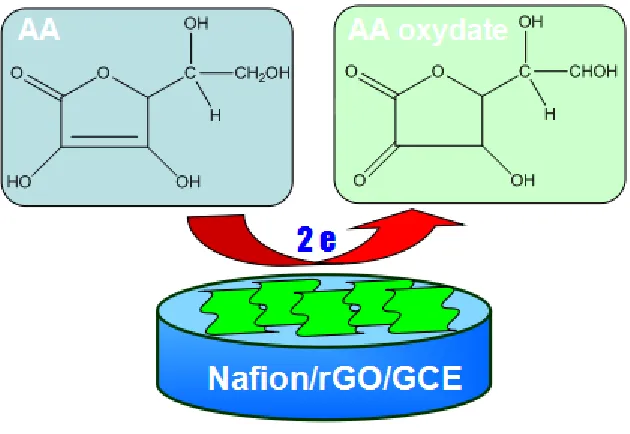
Figure 4. Electrochemical oxidation process of AA at Nafion/rGO/GCE.
In addition, on the basis of an adsorption-controlled electrode process, this system could be analyzed with the help of Laviron’s model and obey the following relational expression in irreversible conditions [17]:
[image:6.596.142.457.412.629.2]
A linear regression equations of Epa on log v is plotted (Fig.3b) and expressed as Epa (V) =
0.0920 log v (mV s–1)+ 0.1492 (R = 0.998, n = 6). Based on fitting a linear relationship between Epa
and log v within a limited range of scan rate (50 to 450 mV s–1), the value of slope is 0.092. Afterwards, the electron transfer coefficient (α) can be estimated to be 0.68 at 25 °C, supposing that the number of electron transfer (n) of AA at carbon electrodes refers to two. The use of the peak width at mid-height (W1/2) as a simple method was further exploited to calculate the value of n. According to the previously
reported results by Laviron [17], W1/2 was 62.5/(1–α)n mV. When W1/2 is about 120 mV in this paper,
n is calculated to be 1.63, close to 2. Therefore, we have reasonably proposed the reaction mechanism of AA oxidation at Nafion/rGO/GCE, which is demonstrated in Fig. 4.
3.3. The CV determination of AA at Nafion/rGO/GCE
The Nafion/rGO/GCE was utilized for the electrochemically analytical detection of AA using the CV technique. Fig. 5a shows the anodic peak current responses (Ipa) observed for oxidation of
various concentrations of AA at Nafion/rGO/GCE. The Ipa was increased linearly with the increasing
of AA concentration from 0.1 to 100 mM. The regression equation was expressed as Ipa (mA) = 9.2421
CAA (mM) + 0.0498 with a correlation coefficient of 0.996 (n = 8), and the detection limit (S/N=3) can
be estimated to be 10.0 µM. On the basis of previous research results, detection limits of 10.1 µM, 9.6 µM, 30 µM, 73.5 µM, and 20.0 µM were obtained for AA at tryptophan-functionalized Graphene/GCE [18], Nafion/AgNP/GO/GCE [19], Ni/solar/Graphene/GCE [13], Graphene flowers/Carbon fiber/GCE [20], and Pd particles/Graphene/Chitosan/GCE [21], respectively. Besides, as shown in Fig. 5b, the steady state current can be rapidly obtained at Nafion/rGO/GCE about 5 s after the addition of AA, which further suggests that this modified electrode is very sensitive to the detection of AA. Hence, it can be concluded that this electrode prepared in this work shows good sensitivity and low detection limit for AA in weak acid solution, and can be used as a nonenzymatic electrochemical biosensor.
Besides, seven repetitive CV tests of 1.0 mM AA have exhibited excellent reproducibility with a relative standard deviation (RSD) of 3.5%, while RSD was 4.6% for five freshly prepared electrodes, suggesting that Nafion/rGO/GCE was precise. Also, some common co-existing organic complexes and inorganic ions were used to study the ability of this modified electrode against interference in 1.0 mM AA detection. The electrochemical results demonstrated that at least 100-fold concentration of L-glutamic acid, alanine, leucine, and serine; 200-fold concentration of Ca2+ Fe3+, Cu2+, Na+, K+, Cl– and SO42– did not obviously interfere with AA determination within below 5% deviations, which
provides us an interesting indication that the Nafion/rGO/GCE can be suitable for the measurement of AA in real samples.
-0.3 0.0 0.3 0.6 0.9 1.2 0.0
0.5 1.0
-0.3 0.0 0.3 0.6 0.9 1.2
-20 0 20 40 i h g f e d c b C ur rent / m A
Potential / V (vs.SCE)
a C u rr e n t / A
Potential / V (vs.SCE)
50 100 150 200 250 300 350 400 450 1.5 2.0 2.5 3.0 Cur re n t / A
Time / s
[image:8.596.77.520.75.263.2]10 M AA
Figure 5. (a) CVs obtained at Nafion/rGO/GCE in 0.05 M KHP (pH 4.0) solution containing different
AA concentrations (a ~ i: 0, 0.1, 1, 5, 10, 25, 50, 75, 100 mM) at 50 mV s–1. (b) Amperometric curves for successive addition of 10 μM AA in buffer solution; applied potential: 0.3 V.
Table 1. Electrochemical detection results of AA in medical tablet samples (n=5).
Sample Original (mM) Added (mM) Found (mM, RSD<3.5%) Recovery (%)
1 0.5 0.5 1.03 103.0
2 0.5 1.0 1.48 98.7
3 0.5 2.0 2.56 102.4
4. CONCLUSIONS
This work has developed a novel electrochemical sensor with reduced graphene oxide for the investigation of electro-oxidation behavior and detection of AA in weak-acid solution via cyclic voltammetry. The Nafion/rGO modified glass carbon electrode showed significantly enhanced peak current and excellent electron transfer rate towards the oxidation of AA. It is found that this new biosensor is proven to be of high sensitivity, rapid response, good reproducibility as well as excellent accuracy in contrast with other sensors by various modifiers. At the same time, this modified electrode was successfully used to detect AA in medical tablet samples. All of these research results reveal that Nafion/rGO/GCE could be a promising candidate for electrochemical biosensor applications.
ACKNOWLEDGEMENTS
[image:8.596.53.542.377.438.2]
References
1 W. Shi, C. Liu, Y. Song, N. Lin, S. Zhou and X. Cai, Biosens. Bioelectron., 38 (2012) 100. 2 X. Zhang, Y. Cao, S. Yu, F. Yang and P. Xi, Biosens. Bioelectron., 44 (2013) 183.
3 M. Noroozifar and M. Khorasani-Motlagh, Turk. J. Chem., 27 (2003) 717.
4 M. Szultka, M. Buszewska-Forajta, R. Kaliszan and B. Buszewski, Electrophoresis, 35 (2014) 585. 5 J. H. Yang, Q. L. Ma, F. Huang, L. M. Sun and J. Dong, Anal. Lett., 31 (1998) 2757.
6 C.-Z. Guo and C.-G. Chen, Chem. Res. Appl. (Chin Ver), 22 (2010) 1479. 7 H. Teymourian, A. Salimi and S. Khezrian, Biosens. Bioelectron., 49 (2013) 1. 8 K.-Q. Deng, J.-H. Zhou and X.-F. Li, Colloid Surface B, 101 (2013) 183.
9 B. Devadas, R. Madhu, S. M. Chen, V. Veeramani and M. Rajkumar, Sci. Adv. Mater., 7 (2015) 654.
10 R. M. Westervelt, Science 320 (2008) 324.
11 S. Alwarappan, A. Erdem, C. Liu and C.-Z. Li, J. Phys. Chem. C, 113 (2009) 8853. 12 J. Wang, Electroanalysis, 17 (2005) 7.
13 T. E. M. Nancy, V. A. Kumary Electrochim. Acta 133 (2014) 233.
14 Z. Luo, Y. Lu, L. A. Somers, A. T. C. Johnson, J. Am. Chem. Soc., 131 (2009) 898. 15 C. Z. Guo, C. G. Chen, Z. L. Luo and A. D. Zhao, Asian J. Chem., 24 (2012) 3665. 16 C. Guo, C. Chen, Z. Luo and L. Chen, Anal. Methods, 4 (2012) 1377.
17 E. Laviron, J. Electroanal. Chem., 52 (1974) 395.
18 Q. Lian, Z. He, Q. He, A. Luo, K. Yan and D. Zhang. Anal. Chim. Acta, 823 (2014) 32. 19 B. Kaur, T. Pandiyan, B. Satpati and R. Srivastava, Colloid Surface B, 111 (2013) 97.
20 J. Du, R. Yue, F. Ren, Z. Yao, F. Jiang, P. Yang and Y. Du, Biosens. Bioelectron., 53 (2014) 220. 21 X. Wang, M. Wu, W. Tang, Y. Zhu, L. Wang, Q. Wang, P. He and Y. Fang, J. Electroanal. Chem.,
695 (2013) 10.
![Figure 1 . CVs obtained at bare GCE (a) and Nafion/rGO/GCE (b) in 0.2 M KCl solution containing 5 mM K3[Fe(CN)6] at a potential scan rate of 50 mV s–1](https://thumb-us.123doks.com/thumbv2/123dok_us/1888556.146364/4.596.173.419.183.406/figure-obtained-bare-nafion-gce-solution-containing-potential.webp)