Int. J. Electrochem. Sci., 9 (2014) 6103 - 6112
International Journal of
ELECTROCHEMICAL
SCIENCE
www.electrochemsci.org
Short Communication
Electrocoagulation Process Coupled with Advance Oxidation
Techniques to Treatment of Dairy Industry Wastewater
Ana L. Torres-Sánchez, Sandra J. López-Cervera, Catalina de la Rosa, María Maldonado-Vega, María Maldonado-Santoyo, Juan M. Peralta-Hernández*
Centro de Innovación Aplicada en Tecnologías Competitivas (CIATEC), Departamento de
Investigación y Posgrado, Omega-201, Fraccionamiento Industrial Delta. León, 37545, Guanajuato, México
*
E-mail: [email protected]
Received: 13 May 2014 / Accepted: 2 July 2014 / Published: 25 August 2014
In this study electrochemical treatment of dairy industry wastewater, generated ice cream manufacturing was studied using a combined system comprising of electrocoagulation (EC), Fenton
reaction and ozone processing. Dairy industry wastewater is characterized by high biochemical oxygen
demand (BOD5), chemical oxygen demand (COD), and other pollutants. The objective of this research
was to investigate the effects of the operating parameters such as: applied current density (j), reaction time, hydrogen peroxide (H2O2), iron (Fe2+) and ozone dosage as a wastewater treatment method. For
this propose rectangular aluminum anodes and iron cathodes were used in parallel within an electrochemical device. Electrocoagulation is efficient and able to achieve a 40% COD removal at a current density (j) of 5 mA/cm2, the addition of a Fenton process to the electrocoagulation further increases the treatment efficiency close to 25% in at a ratio 1:1 H2O2/Fe2+. When used in combination
with ozone promotional system further contributes an additional 30% COD removal. These results demonstrate the viability of coupled electrocoagulation with advance oxidation process processing as a reliable technique for removal of pollutants from ice cream manufacturing wastewater.
Keywords: Ice cream wastewater, Electrocoagulation, Fenton reaction, Ozone process
1. INTRODUCTION
processed milk, which is why the quantity of waste discharged one of the largest generators of wastewater 3. For this reason, the treatment dairy wastewater is of critical importance not only for the environment, but also for the purpose of recycling water for further use in industrial processes 4.
The current treatment for diary wastewater typically implements biological techniques such as: activated sludge processing, aerated lagoons, aerobic bioreactors, trickling filters, sequencing batch reactors (SBR), up-flow anaerobic sludge blanket (UASB) reactors, up-flow anaerobic filters, and bio-coagulation methods,, [2, 5–8].
Increased research has been dedicate towards the treatment of wastewater using electrocoagulation (EC) and advance oxidation process (AOP’s) such as Fenton reaction or ozone process because of the increase in environmental restrictions on discharge of untreated wastewater. Electrocoagulation (EC) is an electrochemical method for the treatment polluted water which has been successfully implemented in of soluble or colloidal wastewater pollutants found in slaughterhouses 9, vegetable oil refineries and dairy manufacturing facilities 11,12.
Electrocoagulation is an electrochemical technique that consists of the generation of coagulants in situ by dissolving electrically through either aluminum or iron ions from electrodes. The metal ion generation occurs at the anode, when the hydrogen gas is released from the cathode. The hydrogen gas assists in floating the flocculated particles to the surface. During this process the electrodes can be arranged in a mono-polar or bipolar mode [3, 13, 14].
When an aluminum anode is used, the electrolytic dissolution of the aluminum anode produces cationic monomeric species such as Al3+ and Al(OH)2+ at low pH, which at appropriate pH values are
transformed initially into Al(OH)3 and finally polymerized to Aln(OH)3n according to the following
15,16:
Al e
Al(s) (3aq) 3 1)
) ( ) ( 2 ) ( 2 3 )
(aq 3H Ol Al(OH) s 3Haq
Al 2)
n
n OH
Al OH
nAl( )3 ( )3 3) Oxidation of iron in an electrochemical process generation occurs through iron hydroxide, Fe(OH)n, where n = 2 or 3. Two mechanisms have been proposed for the production of Fe (OH)n; 1) is
provided below in next anode reaction:
Fe e
Fes 4 aq 8
4 ( ) (2 )
4) ) ( ) ( 3 ) ( 2 ) ( 2 2 )
( 10 4 ( ) 8
4Feaq H Ol O g Fe OH s Haq
5) Cathode: ) ( 2 )
( 8 4
8Haq e H g
6) Overal: ) ( 2 ) ( 3 ) ( 2 ) ( 2 )
( 10 4 ( ) 4
4Fes H Ol O g Fe OH s H g
7) Under a different context, Fenton oxidation treatment is a catalytic reaction of H2O2 with iron
ions [17] that predominantly produces free hydroxyl radicals (●OH) as the principal oxidizing species [18,19], as shown in equation 8.
OH OH
Fe O H
Fe2 2 2 3
The Fe3+ can then be reduced by reaction with the excessive H2O2 to reform ferrous ions and
more radicals. The latter step in the second process is slower [20] in reaction (8) and allows Fe2+ regeneration, leading to a catalytic mechanism, as shown below:
H FeOOH O
H
Fe3 2 2 2
9)
2
2 2
Fe HO FeOOH
10)
H O Fe HO
Fe3 2 2 2
11) A number of reported studies have demonstrated that the removal of organic compounds from water by Fenton’s reagent is highly efficient and inexpensive [21] compared with other treatments, such as membrane-based methods or the coagulation–flocculation based processes. In addition, the byproducts of AOPs either are CO2 and H2O when complete oxidation occurs and are byproducts that
could be efficiently treated by biological processes or removed by adsorption treatment [19].
On the other hand, ozone-nation of wastewater is an emerging technology. Ozone is a strong oxidant with a standard potential of 2.07 V/NHE in acidic solutions and 1.25 V/NHE in basic solutions [22]. In general, ozone oxidation pathways include direct oxidation by ozone or indirect oxidation by hydroxyl radicals (●OH). Direct oxidation involves degradation of organic compound by ozone molecules under acidic conditions, in which an ozone molecule reacts with an unsaturated band due to its dipolar structure, leading to a splitting of the band [23,24].
2 2
3 OH HO O
O
12) 2
2 2
3 OH OH O O
O
13) With the motivation of these ideas, the aim of this research was to evaluate the electrochemical treatment of ice cream wastewater by EC, Fenton reaction and ozone processing. This is a pioneering study because in the electrocoagulation treatment, the polarity of the electrodes was exchanged every specific time, in order to avoid passivation and sludge buildup between the electrodes. The polarity changes were made using internally designed software.
2. EXPERIMENTAL
2.1. Ice cream wastewater
Table 1. Characteristics of the ice cream wastewater used for this study:
Parameter Value
COD (mg/L) 5902
pH 4.4
The wastewater samples were taken from the local dairy factory in Salamanca, Guanajuato, with 30,000 (average) kg milk per day processed. Although the characteristics of the effluent varied, as the samples consisted of flavored milk. The typical characteristics of the raw dairy wastewater are presented in Table 1.
Samples were collected in polypropylene bottles, shipped refrigerated and cold stored at 6 ∘C prior to use. The effluent was sampled at different times during this study, and with the initial characteristics varying with time (Table 1).
2.2. Experimental set up
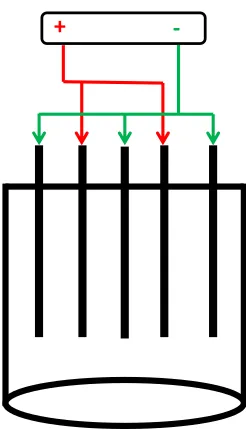
Laboratory scale pilot electrocoagulation for COD abatement is described in Figure 1. All electrolyses were conducted in an open and undivided tank reactor containing 3 L of real solution. The reactor was composed of PYREX® Becher glass, with 2 aluminum anodes and 3 iron cathodes connected to a BK Precision power supply (model 1900) with a bipolar connection. The geometric area of all electrodes in contact with the solution was 160 cm2. Tests were conducted with 5 mA/cm2 current density. To monitor degradation, multiple samples (100 mL) were collected every 10 minutes, along with the cells.
+
-Figure 1. Experimental setup of electrocoagulation cell.
[image:4.596.236.359.390.605.2]
the electrochemical reactor such as the duration, the flow rate required, and the necessary voltage. The results of the tests are shown with charts which enable the reader to view the evolution of the data.
2.3. Fenton oxidation reagent.
The free hydroxyl radicals OH, was generated in situ by addition of the following regents in aqueous solution: hydrogen peroxide (H2O2) 30% w/v and ferrous sulfate FeSO4·7H2O, 99.5%, both
by Merck.
2.4. Ozone process.
Ozone in-line injection, were provided with a Aquazon 40 ozone generator, generating a stream of ozone of 250 mg/h.
2.5. Analytical procedure.
Chemical oxygen demand (COD), total suspended solids (TSSs), conductivity, and pH determinations were evaluated according to the standard methods (APHA, 2005). COD was measured using COD reactor and direct reading spectrophotometer (DR/5000, HACH, USA). The pH and conductivity were adjusted to a desirable value using NaOH or H2SO4 and NaCl and measured using a
pH meter model Denver model 250 and a conductivimeter model Hach. 3. RESULTS AND DISCUSSION
The effects of some parameters such as applied current, reaction time, iron and hydrogen peroxide dosage and ozone addition have been evaluated under specific conditions for a constant temperature.
3.1. Wastewater Characterization.
Table 1 shows the real ice cream wastewater characteristics prior to treatment, after 12 h settling time and qualifies under the guidelines established by Mexico for effluent discharge requiring treatment. The values of the pollution parameters were decreased after 12 h of preliminary settling time. Also, the comparison of these values showed that the COD and the concentration of TSS, acceded those recommended by Mexico environmental standards. Consequently, the dairy effluent required treatment prior to discharge.
3.2. Effect of Preliminary Settling Time.
little information available in the literature on the effect of the preliminary settling time on pollutants removal capacity 3.
In this research, the raw dairy wastewater allowed to settle in a deposit prior to the electrocoagulation process. Regardless, the process had an influence on COD and TSS removals within the first 20 min. COD was reduced from 5902 to 4708 mg/L (resulting in more than 20% COD removal efficiency), TSS concentration was reduced from 32.69 to 18.25 mg/L (resulting in more than 85.56% TSS removal efficiency).
3.3. Electrocoagulation process.
Electrocoagulation is a process where a direct current is applied between metal electrodes immersed in wastewater. The direct electrical current causes the dissolution of metal electrodes commonly iron and aluminum into wastewater. The dissolved metal ions, at an appropriate pH, can form wide variations of coagulated species and metal hydroxides which destabilize and aggregate the suspended particles or precipitate and adsorb dissolved contaminants [25, 26].
[image:6.596.164.429.499.701.2]Two alternatives for electrocoagulation treatment were tested, one under reverse polarity (referred to “process a”) and the other without change of polarity (referred to “process b”). Figure 2 illustrates the improvement on the electrocoagulation treatment when the polarity change is carried out, without regard to polarity change. Process A achieves close to 37.3% of COD abatement, while in the process b can only get a maximum of 27.6% COD abatement. In both cases the applied voltage was 5.5 mA/cm2 at pH 4.4 and 4.24 mS/cm after 120 minutes of treatment. This result can be explained by the fact that in process b the aluminum plates act as sacrifice electrodes, resulting greater wear (corrosion) and as a result generate increased ion leakage. Additionally, the formation of an oxide layer on the surface of the cathode contributes to a decreased effectiveness of the overall process 15.
Figure 2. Effect of reaction time on COD removal from ice cream wastewater at pH 4.4, 4.24 mS/cm of conductivity and current density of 5.5 mA/cm, a) Under polarity change and b) Without polarity change.
t(min)
0 20 40 60 80 100 120
C
O
D
R
e
m
o
va
l e
ff
ici
e
n
cy
(
%
)
10 15 20 25 30 35 40
As reported by Yusuf et al 16, the change of polarity (process a) will have a uniform consumption of the electrodes, as the oxidation slows and reduces the oxide layer on the cathode increasing the lifespan of the electrodes. In process A which included aluminum ions, iron ions are produced, from their corresponding hydroxides acting together as coagulating species. According to Mullah et al 27, the variation of the electric field in the medium avoids the electrophoretic transport of charged particles which can induce dipole-dipole interactions and adversely affect the stability of dipole structures in the system; this effect does not occur in a process without change of polarity, and therefore, the process a acquires greater scope for the degradation of species b. In the above process the improvement of process a versus b in terms of process COD removal is feasible and expected.
On the other hand, the current density applied to the electrochemical reactor is directly proportional to the electrical energy consumption 16. In this context, the arrangement of electrodes used for this study was a parallel configuration, the power consumption is determined by the voltage consumed during treatment, the current held at a constant 5 mA/cm2. For instance, after 120 min electrolysis, energy consumption for process A corresponds to 4 KWh/m3, meanwhile, process B is close to 7 KWh/m3. In the light of these results, the change in polarity of the electrodes is an interesting practice for the observation of these similar reactive processes.
3.4. Fenton treatment.
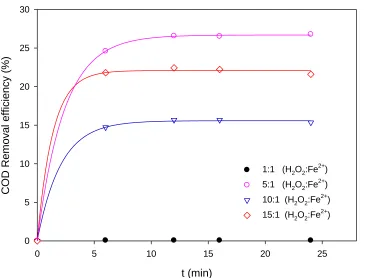
Figure 3. Variation of COD abatement efficiency with different H2O2/ Fe2+ relations (j = 5 mA/cm2,
pH 3)
t (min)
0 5 10 15 20 25
C
O
D
R
e
mov
a
l e
ff
ic
ie
n
c
y
(
%
)
0 5 10 15 20 25 30
1:1 (H2O2:Fe 2+
)
5:1 (H2O2:Fe2+)
10:1 (H2O2:Fe2+)
15:1 (H2O2:Fe 2+
[image:7.596.104.476.412.690.2]
The next groups of assays correspond to the Fenton reaction, whereby the tests were conducted in 2 L of clarified solution obtained for the electrocoagulation process. This effluent exits the EC treatment with a COD of 1756 mg/L. In accordance with the previous results obtained by Yavuz 16 where he demonstrated that the specific method of feeding H2O2 is a significant factor affecting the
performance of the electrochemical system. These findings suggested the gradual addition of H2O2
instead of initial addition in a single step at the beginning of the study. Since in the electrocoagulation process significantly increases the concentration of iron in water, in our case it was determined that in 91.2 mg/L, the parameter remained fixed, and thus, gradual addition of H2O2 was implemented in the
current studies. The relations tested H2O2/ Fe2+ were 1:1, 5:1, 10:1 and 15:1 respectively. The time for
this treatment was carrying out for 24 min, results are showed in Figure 3.
As demonstrated in Figure 3, best results are achieved at a 5:1 ratio of H2O2: Fe2+ with a peak
removal of 23.4% during a 12 minute interval.The additional ratios tested in this study, 1:1, 10:1 and 15:1 achieved no greater than 8% removal..
The 1:1 ratio shows that an excess of iron within the system decreases the effectiveness of treatment due to side reactions and processes such as precipitation of species Fe(OH)3 when the H2O2
decomposes into oxygen and water is introduced 28; promoting chemical coagulation. Excessive iron promotes the scavenging and reaction of hydroxyl radicals with Fe2+ ion, reaction (14). On the other hand, an excess of hydrogen peroxide causes hydroxyl radical scavenging, in accordance with reaction (15) generating hydroperoxide radicals (OH2) which are less efficient oxidants 29,30. Therefore,
10:1 and 15:1 relationship by excess hydrogen peroxide is ineffective for treatment of the effluent.
OH Fe
OH
Fe2 3
14) O
H OH O
H
OH 2 2 2 2
15) For all experiments of this set the optimal treatment time was 12 min, after which a decrease was observed in the removal of COD.
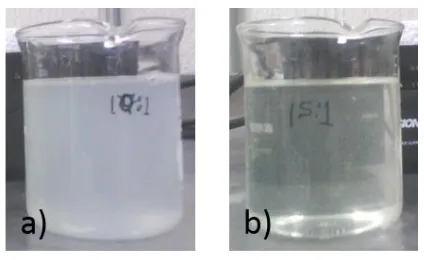
[image:8.596.194.406.581.711.2]Figure 4 shows a photograph in which the color change of the treated water by the Fenton process can be observed. (Picture a, shows a milky white opaque water sample which was subjected to the electrocoagulation process, while the translucent water sample shown in picture b. was as result of the applied Fenton process).
3.5.Ozone-Fenton treatment.
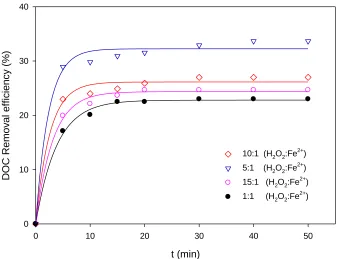
The last system tested as post-treatment of effluent from electrocoagulation was the combination of ozone and hydrogen peroxide system. For this, an Aquazon 40 ozone generator was used, generating a stream of ozone of 250 mg/h. In this process, a volume of 0.5 L was clarified, though an exposure of 50 min. of ozonation. As mentioned earlier, the effluent from electrocoagulation process maintains a concentration Fe2+ close to 91 mg/L.For this reason, we attempted to achieve a condition which promotes a combined system O3-H2O2-Fe2+ , by testing the following H2O2/Fe2+ ratios
[image:9.596.133.483.243.502.2](1:1, 5:1, 10:1, 15:1) . Theresults are presented in the Figure 5.
Figure 5. Electrocoagulation treatment clarified by combining O3-H2O2-Fe2+.
As can be seen in Figure 5, a 5:1 ratio of H2O2-Fe2+ promotes an improvement in the process,
approaching 30% of the re-motion of the DOC. This result is consistent with the findings of some authors, where a reported improvement was caused by the combination of ozone and hydrogen peroxide as oxidants as opposed to use of ozone only 31. However, the rations of 10:1 and 15:1 do not promote an improvement in the treatment, as shown above in Figure 3.
4. CONCLUSIONS
To evaluate the influence of various experimental parameters on the removal of pollutants from ice cream wastewater batch electrocoagulation processes were implemented.. The results of this study demonstrate the applicability of electrocoagulation in the treatment of dairy industry wastewater. Peak
t (min)
0 10 20 30 40 50
D
O
C
R
e
mov
a
l e
ff
ic
ie
n
c
y
(
%
)
0 10 20 30 40
experimental conditions were achieved at: a current density of 5 mA/cm2; natural pH, without supporting electrolyte addition; relation H2O2/Fe2+ 5:1 and 250 mg/h ozone.Under these conditions,
70% COD removal was achieved.
ACKNOWLEDGEMENTS
This study was supported by CONACYT with grant No: GTO-2012-C01-192117.
References
1. U. Tezcan Un, E. Ozel, Sep. Purific. Technol., 120 (2013) 386.
2. B. Demirel, O. Yenigun, T. Onay, Process Biochemistry, 40 (2005) 2583.
3. E. Bazrafshan,1H. Moein,2 F. Kord Mostafapour,S. Nakhaie, J. Chem. 2013 (2013) 1. 4. A. Hamdani, M. Mountadar, O. Assohei, Int . J. Dairy Technol. 58 (2005) 83.
5. M. W. Heaven, K. Wild, V. Verheyen, A. Cruickshank, M. Watkins, D. Nash, Bioresource Technology. 102 (2011) 7727.
6. P. N. Dugba, R. Zhang, Bioresource Technology. 68 (1999) 225.
7. G. Vidal, A. Carvalho, R. Mendez, and J. M. Lema, Bioresource Technology. 74 (2000) 231. 8. P. Seesuriyachan, A. Kuntiya, K. Sasaki, C. Techapun, Process Biochemistry. 44 (2009) 406. 9. Ü. Tezcan Ün, A. S. Koparal, Ü. Bakir Öütveren, J. Hazard. Mat. 164 (2009) 580.
10. Ü. Tezcan Ün, A. S. Koparal, Ü. Bakir Öütveren, J. Environ. Management. 90 (2009) 428. 11. I. A. Şengil, M. özacar, J. Hazard. Mat. 137 (2006) 1197.
12. S. Tchamango, C. P. Nanseu-Njiki, E. Ngameni, D. Hadjiev, A. Darchen, Sci. Tot. Environ. 408 (2010) 947.
13. G. H. Chen, Sep. Purif. Tech. 38 (2004)11.
14. N. Adhoum, L. Monser, N. Bellakhal, J. E. Belgaied, J. Hazard. Mat. 112 (2004) 207. 15. M. Mollah, R. Schennach, JR. Parga, DL. Cocke, J. Hazard. Mater. B84 (2001) 29.
16. Y. Yavuz, E. Öcal, A. Savaş Koparal, Ü. Bakır Öǧütverena, J. Chem. Technol. Biotechnol. 86
(2011) 964.
17. H. Fenton, J. Chem. Soc. 65 (1894) 899.
18. P. Miró, A. Arques, A.M. Amat, M.L. Marin, M.A. Miranda, Appl. Cat. B: Environ. 140– 141(2013) 412.
19. A. Saldaña-Robles, R. Guerra-Sánchez, M.I. Maldonado-Rubio , J.M. Peralta-Hernández. J. Ind. Eng. Chem. 20 (2014) 848.
20. J.J. Pignatello, E. Oliveros, A. Mackay, Critical Rev. Environ. Sci. Technol. 36 (2006) 1. 21. R. Bauer, H. Fallman, Res. Chem. Intermediates. 23 (1997) 341.
22. N. Kishimoto. Y. Morita, H. Tsuno, T. Oomura, H. Mizutani, Wat. Res. 39, (2005), 4661. 23. J. Lambert, M. Maldonado Vega, . Isarain-Chavez, J.M. Peralta-Hernández, IJETAE. 3 (2013) 1. 24. U. von Gunten, Wat. Res. 37 (2003) 143.
25. G. H. Chen, Sep. Purific. Technol. 38 (2004)11.
26. P. Cañizares, M. Carmona, J. Lobato, F. Martínez, M. A. Rodrigo, Ind. Eng. Chem. Res. 44(2005) 4178.
27. M. Mollah, R. Schennach, J. Parga, D. Cocke, J. Hazard. Mat. B84 (2001) 29. 28. A. Guedes, L. Madeira, R. Boaventura, C. Costa, Water Res. 37(2003) 3061. 29. X. Wang, G. Zeng, J.Zhu, J. Haz. Mat, 153(2008) 810.
30. X. Wang, S. Chen, X. Gu, K. Wang, Waste Manag. 29(2009) 1354.
31. P. Chelme-Ayala, M. El-Din, D. Smith, C. Adams, Water Res. 42 (2011) 2517.