Short Communication
Sampling duration and freezing temperature in
fl
uence the analysed
gastric inositol phosphate composition of pigs fed diets with different
levels of phytase
Steven Laird
a,*, Imke Kühn
b, Michael R. Bedford
b, Hayley Whit
fi
eld
c, Helen M. Miller
aaFaculty of Biological Sciences, University of Leeds, Leeds, LS2 9JT, United Kingdom
bAB Vista, Marlborough, SN8 4AN, United Kingdom
cSchool of Biological Sciences, University of East Anglia, Norwich, NR4 7TJ, United Kingdom
a r t i c l e i n f o
Article history: Received 18 April 2018 Received in revised form 6 December 2018 Accepted 28 December 2018 Available online xxx
Keywords: Pig
Inositol phosphate Phytase Sampling time Freezing temperature
a b s t r a c t
This experiment was conducted to determine the effects of time and freezing temperature during sampling on gastric phytate (myo-inositol [MYO] hexakisphosphate [InsP6]), lower inositol phosphates (InsP2e5) and MYO concentrations in pigs fed diets containing different levels of phytase. Forty pigs were
fed 1 of 4 wheat-barley diets on anad libitumbasis for 28 d. The diets comprised a nutritionally adequate positive control (PC), a similar diet but with Ca and P reduced by 1.6 and 1.24 g/kg, respectively (NC), and the NC supplemented with 500 (NCþ500) or 2,000 (NCþ2000) FTU phytase/kg. At the end of the experiment, chyme were collected from the stomach, thoroughly mixed and 2 subsamples (30 mL) were frozen immediately: one snap-frozen at79C and the other at20C. The remaining chyme were left to sit at room temperature (20C) and further subsamples were collected and frozen as above at 5, 10 and 15 min from the point of mixing. There were linear reductions in gastric InsP6concentration over time during sampling (P<0.001), irrespective of diet or freezing temperature. Moreover, InsP6concentration was influenced by a dietfreezing temperature interaction (P<0.05), with less InsP6measured in chyme frozen at20C than at79C; however, this difference was greater in the control diets than the phytase supplemented diets. Freezing chyme at79C recovered morePInsP2e5þMYO than freezing at20C in pigs fed phytase supplemented diets; however, this difference was not apparent in the diets without phytase (diet freezing temperature,P<0.01). It can be concluded that significant phytate hydrolysis occurs in the gastric chyme of pigs during sampling and processing, irrespective of supplementary phytase activity. Therefore, to minimise post-slaughter phytate degradation and changes in the gastric inositol phosphate profile, chyme should be snap-frozen immediately after collection.
©2019, Chinese Association of Animal Science and Veterinary Medicine. Production and hosting by Elsevier B.V. on behalf of KeAi Communications Co., Ltd. This is an open access article under the CC BY-NC-ND license (http://creativecommons.org/licenses/by-nc-nd/4.0/).
1. Introduction
Super doses of phytase have been shown to improve the growth efficiency of monogastric animals, often beyond that expected due
to improved phosphorus (P) bioavailability (Cowieson et al., 2011; Santos et al., 2014). However, despite much research, the‘ extra-phosphoric’effects of phytase remain inconsistent. Factors known to influencein vivophytase efficacy include phytase source, phytate concentration, dietary calcium (Ca) to phosphorus ratio and species (Dersjant Li et al., 2015). Furthermore, although it has received less attention, it seems reasonable to assume that the lack of stand-ardised inter-laboratory sampling and analytical methodology within the scientific community has played a major role in gener-ating these inconsistencies. Clearly, identifying the factors governing the phytase response presents a tremendous opportu-nity to further improve the economic and ecological value of phy-tase supplementation.
*Corresponding author.
E-mail address:[email protected](S. Laird).
Peer review under responsibility of Chinese Association of Animal Science and Veterinary Medicine.
Production and Hosting by Elsevier on behalf of KeAi
Contents lists available atScienceDirect
Animal Nutrition
j o u r n a l h o m e p a g e : h t t p : / / w w w . k e a i p u b l i s h i n g . c o m / e n / j o u r n a l s / a n in u /
https://doi.org/10.1016/j.aninu.2018.12.003
The development of superior inositol phosphate (InsP) quanti-tation methodologies has seen a rise in the number of studies measuring phytate and its degradation products in the digesta of monogastrics, as a means of determining phytase efficacy. At pre-sent, there is no standardised method for the sampling of digesta for subsequent InsP analysis. Ostensibly, the most common practise is to freeze the digesta immediately at20C (Kemme et al., 1999; Schlemmer et al., 2001; Kühn et al., 2016; Walk et al., 2018). However, this method is not shared by all, for exampleBlaabjerg et al. (2010)chilled the digesta on ice prior to freezing at20C, whereasLaird et al. (2018)froze the digesta at79C. Many others have not disclosed the freezing temperature (Blaabjerg et al., 2011; Walk et al., 2014; Beeson et al., 2017).
Therefore, the aim of this study was to determine if differences in sampling methodology, in particular freezing temperature and time taken to freeze the sample, influence phytate (InsP6), InsP2e5 and myo-inositol (MYO) content in pig gastric chyme. Moreover, chyme were obtained from pigs fed diets containing differing levels of phytase activity to determine if the response to different processing methods varies with phytase inclusion rate. Gastric chyme were the focus of this study as the stomach is the primary site of phytase activity in the pig (Kemme et al., 1998), and it is clear that the rapidity and extensiveness of phytate hydrolysis occurring here is key in determining the magnitude of the phytase response (Adeola and Cowieson, 2011).
2. Material and methods
This protocol was approved by the University of Leeds Animal Welfare and Ethical Review Body.
2.1. Animals and management
As part of a larger experiment, 160 crossbred (Large whiteLandraceMaxgro)finisher pigs (~12 weeks of age; initial BW±SE¼36.7±0.3 kg) were blocked into pens of 4 balancing for weight, sex and litter. Pens within a replicate were randomly allotted to 1 of 4 dietary treatments (n¼10). Pigs were housed in an indoor finisher facility with rooms thermostatically maintained at 21±2C for the duration of the 28 d experiment. All pens (230 cm220 cm) had fully slatted plastic floors and were equipped with a single spaced trough feeder, 2 nipple drinkers and a ball and chain for enrichment. Feed and water were provided on anad libitumbasis. On d 28, 40 mixed sex pigs (one per pen; mean BW±SE¼58.7±0.6 kg) were slaughtered via captive bolt penetration followed by exsan-guination for the collection of gastric chyme. The pigs selected for slaughter had a BW that closely matched that of the pen average, and where possible, those within a replicate were littermates.
2.2. Dietary treatments and experimental design
This randomised complete block experiment was designed to determine the effect of time and freezing temperature during sampling on gastric InsP2e6and MYO concentrations in pigs fed wheat-barley based diets containing different levels of phytase. The 4 dietary treatments included: a positive control (PC) formulated to meet or exceed theBSAS (2003)nutrient recommendations for all nutrients; a negative control (NC) similar to the PC but with re-ductions in Ca (1.6 g/kg), P (1.24 g/kg) and NE (0.170 MJ/kg), in accordance with the matrix values for 500 FTU/kg of the tested phytase; and the NC diet supplemented with phytase at 500 (NCþ500) or 2,000 (NCþ2000) FTU/kg. The phytase doses were selected to represent a standard (500 FTU/kg) and a super-dose (2,000 FTU/kg) of phytase commonly used in pig production. The phytase enzyme used was Quantum Blue 5G (AB Vista, UK), which
is a modifiedE. coliderived phytase. One FTU denotes the amount of enzyme activity necessary to liberate 1
m
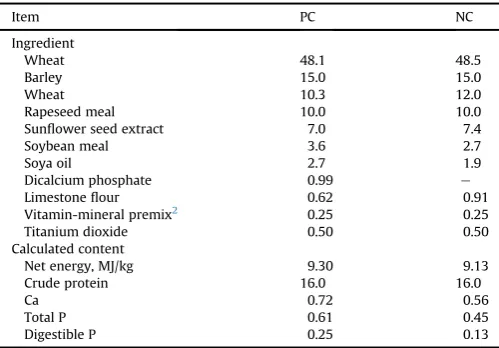
mol of inorganic phos-phate/min from an excess of Na-phytate at 37C and pH 5.5. All diets were pelleted through a 3-mm die at a temperature of 62 ± 2 C. A detailed composition of the diets and formulated nutrient content is presented inTable 1.2.3. Gastric chyme collection
Following the confirmation of death, clamps were positioned at the pyloric sphincter and the lower oesophageal sphincter and the stomach was excised from the abdominal cavity. The total gastric contents were mixed by massaging and inverting the stomach. A subsample of the gastric contents was collected into a glass beaker, mixed further and the pH recorded. Two representative subsamples of the mixed chyme (ca.30 mL) were decanted into separate polypropylene screw topped tubes and frozen immedi-ately; one at20C and the other snap-frozen at79C (on dry ice). Thereafter, the remaining chyme were left to sit at room temperature (20C) before a further 2 subsamples were collected and frozen as above at 5, 10 and 15 min from the point of mixing. It should be noted that the mixing of chyme occurred at approxi-mately 4 min following the confirmation of death. Within replicate, sampling was conducted in a random fashion in order to equalise for variance introduced due to post-prandial time between the dietary treatments.
2.4. Laboratory analyses
[image:2.595.302.552.508.682.2]Chyme were freeze dried, ground to pass a 1-mm sieve, and frozen at20C pending subsequent analyses. Representative feed samples were sent to Sciantec Analytical Services Ltd. (Stockbridge Technology Centre, UK) for Ca and P analyses by ICP-OES (SOP S1015). Phytate and phytase activity in the feed were analysed by Enzyme Services and Consultancy (Ystrad Mynach, Wales, UK). Phytase was analysed according to the internal manufacturer's assay for Quantum Blue (Standard Analytical Method 020; AB Vista), whereas phytate was analysed by near-infrared spectros-copy (NIR). Chyme and feed were analysed for InsP2e6and MYO.
Table 1
Composition and nutrient specifications of experimental diets (as-fed basis, %).1
Item PC NC
Ingredient
Wheat 48.1 48.5
Barley 15.0 15.0
Wheat 10.3 12.0
Rapeseed meal 10.0 10.0
Sunflower seed extract 7.0 7.4
Soybean meal 3.6 2.7
Soya oil 2.7 1.9
Dicalcium phosphate 0.99 e
Limestoneflour 0.62 0.91
Vitamin-mineral premix2 0.25 0.25
Titanium dioxide 0.50 0.50
Calculated content
Net energy, MJ/kg 9.30 9.13
Crude protein 16.0 16.0
Ca 0.72 0.56
Total P 0.61 0.45
Digestible P 0.25 0.13
1 PC, a nutritionally adequate positive control; NC, a similar diet but with Ca and P
reduced by 1.6 and 1.24 g/kg, respectively.
2 Vitamin and trace mineral premix provided per kilogram of diet: 7,500 IU
vitamin A, 1,650 IU vitamin D3, 35 IU vitamin E, 2 mg vitamin K, 1.5 mg thiamine
(B1), 3 mg riboflavin (B2), 2 mg pyridoxine (B6), 15mg vitamin B12, 8 mg pantothenic
acid, 20 mg nicotinic acid, 50mg biotin, 0.3 mg folic acid, 15 mg CuSO4, 1 mg iodine,
Inositol phosphates were analysed by anion-exchange HPLC with post-column addition of ferric nitrate in HClO4according toLee et al. (2018). For MYO measurement, extracts were diluted 50-fold in water and analysed by pulsed amperometric detection on a gold electrode after 2 d separation on CarboPac PA1 and CarboPac MA1 columns (Lee et al., 2018).
2.5. Statistical analysis
Data were analysed as a 424 factorial using a three-way mixed ANOVA with the individual pig serving as the experi-mental unit (SPSS Statistics, Version 22; SPSS Inc., Chicago IL, US). The model included the effects of diet, freezing temperature, time and all appropriate interactions, with both time and freezing temperature included as repeated factors. No three-way in-teractions were observed for any of the parameters measured. Data displaying non-normal residuals or heteroscedasticity were log transformed log10 (xþ1) prior to statistical analysis. Polynomial contrasts were used to test for linear and quadratic effects of time. Differences were classed as significant if P< 0.05, or a trend if P<0.10. Significantly different means were separated using the Tukey's honest significant difference (HSD) test.
3. Results
The recorded temperature of the freezer used to freeze chyme at20C throughout the experiment was26 C. The analysed nutrient composition of the experimental diets is presented in Table 2. Diets contained moderate amounts of phytate which are in line with those reported in other wheat-barley based pig diets (Blaabjerg et al., 2010, 2011). The mean pH of the gastric chyme from slaughtered pigs receiving the PC, NC, NCþ500 and NCþ2000 treatments were similar at 4.1, 4.0, 3.6 and 3.7, respectively (SEM¼0.28,P¼0.516), and thus gastric pH was not deemed a confounding factor for phytate hydrolysis.
3.1. Gastric phytate concentration
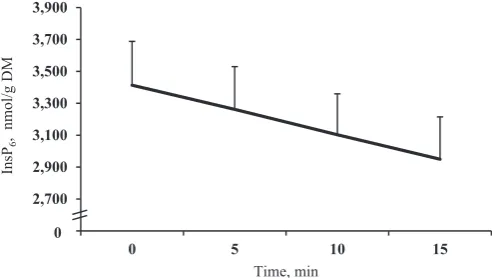
Phytate (InsP6) was continuously hydrolysed over time during sampling (linearP< 0.001), irrespective of diet or freezing tem-perature (Fig. 1). This equated to a 13.6% reduction in gastric InsP6 concentration from 0 to 15 min at a constant rate of approximately 30.9 nmol/g DM per minute. Delaying the freezing of the gastric contents by 5 min from collection resulted in significant phytate hydrolysis (3,413 vs. 3,262 nmol/g DM;P < 0.05). Chyme InsP6 concentration was also influenced by a significant dietfreezing temperature interaction (P<0.05), as presented inFig. 2. Less InsP6 was hydrolysed in chyme frozen at79 C compared with that
frozen at20C; however, the difference between the two freezing temperatures was greater in diets devoid of added phytase. Moreover, within freezing temperature, diets with added phytase had significantly less InsP6 than those without added phytase (P<0.001); however, there was no difference between the two phytase diets or the two control diets.
3.2. Gastric concentrations of phytate hydrolysis products
Time had no influence on the total concentration of measured phytate hydrolysis products in chyme, or on individual InsP5, InsP4, InsP2or MYO concentrations. The concentration of InsP3, however, increased in a linear manner over time in the PC, NC and NCþ500 diets (P<0.05), but remained relatively constant in the NCþ2000 diet, resulting in a tendency for a diettime interaction (P¼0.06; data not presented).
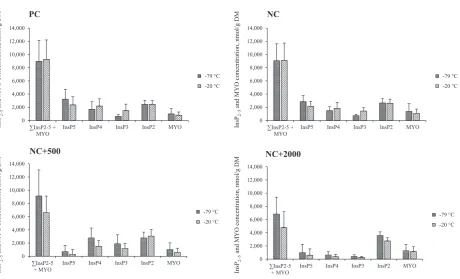
[image:3.595.314.562.67.206.2]The effect of diet and freezing temperature on the concentration of InsP2e5and MYO is presented inFig. 3. As with InsP6, the effect of freezing temperature on the sum of measured phytate hydrolysis products (PInsP2e5 þ MYO) was dependent on the diet fed, resulting in a significant dietfreezing temperature interaction (P<0.01). In diets with no added phytase, freezing temperature had no effect onPInsP2e5þMYO concentration; however, in diets
Table 2
Analysed chemical composition of the experimental diets (as fed-basis, nmol/g).1
Item PC NC NCþ500 NCþ2000
Phytase, FTU/kg 85 <50 751 2,420
Ca, % 0.71 0.58 0.57 0.61
Total P, % 0.60 0.43 0.41 0.43
InsP6 9,532 10,748 10,565 10,000
InsP5 1,464 1,782 2,047 2,284
InsP4 145 228 259 290
InsP3 154 189 263 294
InsP2 1,205 1,662 1,743 1,713
MYO 488 483 566 572
InsP6 ¼myo-inositol hexakisphosphate; InsP2e5 ¼lower inositol phosphates;
MYO¼myo-inositol.
1 PC, a nutritionally adequate positive control; NC, a similar diet but with Ca and P
reduced by 1.6 and 1.24 g/kg, respectively; NCþ500, NC supplemented with 500 FTU phytase/kg; NCþ2000, NC supplemented with 2,000 FTU phytase/kg.
2,700 2,900 3,100 3,300 3,500 3,700 3,900
0 5 10 15
InsP
6
, nmol/g DM
Time, min
0
Fig. 1.Effect of time from sampling to freezing on InsP6concentration in pig gastric
digesta. InsP6 ¼ myo-inositol hexakisphosphate. Values are the means of 40
observationsþSEM. Trend analysis: linear,P<0.001; quadratic,P¼0.985.
0 1,000 2,000 3,000 4,000 5,000 6,000 7,000 8,000 9,000 10,000
PC NC NC+500 NC+2000
InsP
6
M
D
g/l
o
mn
,n
oit
art
ne
cn
oc
Diet
-79 °C -20 °C
a
b a
b b a
b a
* *
[image:3.595.316.562.517.649.2]° °
Fig. 2. Interactive effects of diet and freezing temperature on InsP6concentration in
pig gastric digesta. InsP6 ¼ myo-inositol hexakisphosphate; PC, a nutritionally
adequate positive control diet; NC, a similar diet but with Ca and P reduced by 1.6 and 1.24 g/kg, respectively; NCþ500, NC supplemented with 500 FTU phytase/kg; NCþ2000, NC supplemented with 2,000 FTU phytase/kg. Values are means of 10 observationsþSD. Significance: dietfreezing temperature,P<0.05; diet,P<0.001; freezing temperature,P<0.001. Within a diet, an asterisks (*) denotes a significant difference (P<0.001) between freezing temperatures, whereas a circle () denotes a trend (P<0.10).a, bWithin freezing temperature, mean values that do not share a
[image:3.595.43.292.603.699.2]with added phytase, more PInsP2-5 þ MYO were measured in chyme frozen at79C.
Within freezing temperature, the composition of measured InsP6hydrolysis products between the PC and NC fed pigs did not differ. Adding phytase at either level reduced InsP5 content (P<0.001), though there was no difference between the two doses tested. Chyme InsP5content was also influenced by freezing tem-perature (P<0.001): chyme frozen at20C contained 30% less InsP5 than that frozen at 79 C (1,353 vs. 1,941 nmol/g DM). Gastric concentrations of InsP4, (P<0.001) InsP3(P<0.10; trend) and InsP2 (P< 0.01) were each influenced by a dietfreezing temperature interaction. In the PC and NC diets, chyme frozen at20 C tended to have higher levels of InsP4than that frozen at79C (P<0.10). Conversely, within the NCþ500 treatment, chyme frozen at20C had lower levels of InsP4(P<0.05) than that frozen at79C. In the NCþ2000 fed pigs, however, gastric InsP4concentration was similar irrespective of freezing tempera-ture. The diet freezing temperature trend observed for InsP3 concentration was similar to that described for InsP4. Within freezing temperature, increasing phytase activity from 500 to 2,000 FTU/kg reduced chyme InsP4and InsP3concentrations (P<0.01). Inositol bisphosphate (InsP2) concentration was similar between PC, NC and NCþ500 treatments irrespective of freezing temper-ature; however, in the NCþ2000 treatment, InsP2concentration was higher in chyme frozen at79C. Gastric MYO concentration was not influenced by any of the treatments.
4. Discussion
In the present study, the analysed inositol phosphate composi-tion of pig gastric chyme was influenced by time taken to freeze the
chyme after sampling. Phytase induced phytate hydrolysis is a time-dependent process, which in the pig is often limited by the relatively short retention time of the digesta in the stomach (Blaabjerg et al., 2011). Therefore, it was unsurprising that this enzyme catalysed reaction continued in the chyme after sampling from pigs fed diets with added phytase. Interestingly, phytate continued to be hydrolysed after sampling in chyme from pigs fed steam-pelleted diets without supplementary phytase. These data are contrary to the results ofKemme et al. (2006), who found that almost no phytate was degraded in the stomach of pigs fed a low phytase (35 FTU/kg) corn-soybean meal based diet. The reason for the discrepancy between thefindings of these two studies is un-clear, but may be due to differences in diet composition. Both wheat and barley possess much higher levels of intrinsic phytase activity than corn (Eeckhout and De Paepe, 1994); however, their contri-bution to phytate hydrolysis is commonly disregarded as this activity is generally lost during the pelleting process. Given the degree to which phytate was hydrolysed in both unsupplemented dietary treatments, an alternative source of phytase cannot be excluded. It is known that certain species of lactic acid bacteria reside within the pig stomach (Cranwell et al., 1976; Chow and Lee, 2006); however, whether these bacteria are capable of producing and secreting extracellular phytase remains a contentious issue (Reale et al., 2007).
Another keyfinding of the present study was that analysed InsP6 concentration in the chyme, irrespective of initial phytate concen-tration, was influenced by freezing temperature, with samples frozen at 20 C containing less InsP6 than that snap-frozen at79C. This study is thefirst to demonstrate that phytate con-tinues to be hydrolysed throughout the freezing process. It is, therefore, clear that chyme must be frozen as quickly as possible in 0
2,000 4,000 6,000 8,000 10,000 12,000 14,000
∑InsP2-5 + MYO
InsP5 InsP4 InsP3 InsP2 MYO
PC
-79 °C -20 °C
0 2,000 4,000 6,000 8,000 10,000 12,000 14,000
∑InsP2-5 + MYO
InsP5 InsP4 InsP3 InsP2 MYO
NC+500
-79 °C -20 °C
0 2,000 4,000 6,000 8,000 10,000 12,000 14,000
∑InsP2-5 + MYO
InsP5 InsP4 InsP3 InsP2 MYO
NC
-79 °C -20 °C
0 2,000 4,000 6,000 8,000 10,000 12,000 14,000
∑InsP2-5 + MYO
InsP5 InsP4 InsP3 InsP2 MYO
NC+2000
-79 °C -20 °C
InsP
2–5
and MYO concentration, nmol/g DM
InsP
2–5
and MYO concentration, nmol/g DM
InsP
2–5
and MYO concentration, nmol/g DM
InsP
2–5
[image:4.595.66.527.57.336.2]and MYO concentration, nmol/g DM
Fig. 3.Interactive effects of diet and freezing temperature on inositol pentakisphosphate (InsP5), inositol tetrakisphosphate (InsP4), inositol trisphosphate (InsP3), inositol bisphosphate
(InsP2),myo-inositol (MYO) and total InsP2e5þMYO concentrations (nmol/g DM). PC, a nutritionally adequate positive control diet; NC, a similar diet but with Ca and P reduced by 1.6 and
1.24 g/kg, respectively; NCþ500, NC supplemented with 500 FTU phytase/kg; NCþ2000¼NC supplemented with 2,000 FTU phytase/kg. Values are means of 10 observationsþSD. Significance:PInsP2e5þMYO, diet (D)freezing temperature (FT)¼P<0.01, D¼P<0.001, FT¼P<0.01; InsP5, DFT¼not significant (NS), D¼P<0.001, FT¼P<0.01; InsP4, DFT¼
order to terminate the enzyme catalysed reaction and prevent possible erroneous estimation of in vivo phytate hydrolysis. Although the analysed gastric InsP6content was consistently lower when frozen at20C, this difference was more apparent in chyme collected from pigs fed diets without added phytase. This interac-tion between freezing temperature and diet was not expected and is likely the result of phytase induced differences in initial phytate concentration. Phytate concentration was considerably higher in chyme obtained from pigs fed diets without supplementary phy-tase than those fed diets with added phyphy-tase, and therefore, the scope for continued phytate hydrolysis during the processing of such samples was greater. These findings suggest, whatever the initial phytate content at the point of collection, both sampling duration and freezing temperature are influential in subsequent phytate estimation, even in diets without supplementary phytase. The gastric InsP and MYO profiles in the chyme of pigs fed diets without added phytase did not differ. This suggests that the phytate from these diets is likely being degraded by the same mechanism, through similar phytases and phosphatases with similar specifi c-ities and reaction kinetics. It can also be inferred that small reductions in dietary Ca and P concentrations have no influence on in vivogastric phytate hydrolysis, which is in agreement with the findings ofKühn et al. (2016). Supplementing the control diet with 500 FTU/kg changed the InsP composition of the chyme, with re-ductions in InsP5 leading to small increases in InsP4 and InsP3 content. Adding 2,000 FTU/kg to the diet effectively reduced levels of InsP4and InsP3, resulting in more complete phytate hydrolysis. Thesefindings are in agreement with those ofLaird et al. (2018) who, using the same phytase enzyme, found that higher doses of phytase (2,500 FTU/kg) are needed to reduce levels of InsP4and InsP3in the ileal digesta of weaner pigs.
Interestingly, the more complete phytate hydrolysis achieved with the super-dose was not met with clear changes in InsP2or MYO concentration. Moreover, the sum of phytate hydrolysis products in the chyme from these treatments was lower than that of the controls. These results are suggestive of InsP1 formation. Unfortunately, it was not possible to measure InsP1using the InsP quantitation methodology used in this study. InsP1is considered a transient compound that is present in minute quantities in the digesta, as it is rapidly dephosphorylated by endogenous phos-phatases, or possibly absorbed directly across the brush border membrane of the small intestine (Adeola and Cowieson, 2011). Therefore, InsP1is frequently dismissed as having minor quantita-tive importance in ileal digesta; however, the results presented herein suggest that this is not the case in gastric chyme. These data are consistent with the view that most microbial phytase enzymes are unable to completely dephosphorylate phytate (Wyss et al., 1999). Interestingly, results from in house studies, including the present study (as yet unpublished), have demonstrated that super-doses of phytase increase ileal and portal plasma levels of MYO in pigs (Laird et al., 2018). Thesefindings indicate complete dephos-phorylation via phytase supplementation by the terminal ileum. Therefore, it seems plausible that while exogenous phytase is un-able to completely dephosphorylate phytate to MYO within the stomach, it is able to degrade the phytate molecule to lower mo-lecular weight, more soluble phytate esters, which are available to the animal's own endogenous phosphatase enzymes for further degradation to MYO.
5. Conclusion
It can be concluded that significant phytate hydrolysis occurs in the gastric chyme of pigs during sample collection and processing. There were linear reductions in the chyme phytate content when left to sit at room temperature for 15-min post-sampling.
Furthermore, freezing temperature during sampling was also influential, irrespective of initial phytate concentration, with greater phytate degradation occurring in chyme frozen at20C than that snap-frozen on dry ice. It is, therefore, the authors’ suggestion that future in vivo phytate quantitation assessments snap-freeze digesta on dry ice immediately after collection to minimise phytate degradation. Such measures would ensure that post-sampling changes in the gastric InsP profile are kept to a minimum and prevent possible erroneous determination of phytase efficacy.
Conflict of interest
We declare that we have nofinancial and personal relationships with other people or organizations that can inappropriately infl u-ence our work, there is no professional or other personal interest of any nature that could be construed as influencing the content of this paper.
Acknowledgements
This work was funded by AB Vista (a division of AB Agri Ltd., Marlborough, UK).
References
Adeola O, Cowieson AJ. BOARD-INVITED REVIEW: opportunities and challenges in using exogenous enzymes to improve non-ruminant animal production. J Anim Sci 2011;89:3189e218.
Beeson LA, Walk CL, Bedford MR, Olukosi OA. Hydrolysis of phytate to its lower esters can influence the growth performance and nutrient utilization of broilers with regular or super doses of phytase. Poult Sci 2017;96:2243e53. Blaabjerg K, Jorgensen H, Tauson AH, Poulsen HD. Heat-treatment, phytase and
fermented liquid feeding affect the presence of inositol phosphates in ileal digesta and phosphorus digestibility in pigs fed a wheat and barley diet. Anim 2010;4:876e85.
Blaabjerg K, Jorgensen H, Tauson AH, Poulsen HD. The presence of inositol phos-phates in gastric pig digesta is affected by time after feeding a non-fermented or fermented liquid wheat- and barley-based diet. J Anim Sci 2011;89:3153e62. British Society of Animal Science (BSAS). Nutrient requirement standards for pigs.
Midlothian, UK: British society of Animal Science; 2003.
Chow WL, Lee Y-K. Mucosal interactions and gastrointestinal microbiota. In: Ouwehand AC, Vaughan EE, editors. Gastrointestinal microbiology. Taylor and Francis; 2006. p. 123e36.
Cowieson AJ, Wilcock P, Bedford MR. Super-dosing effects of phytase in poultry and other monogastrics. Worlds Poult Sci J 2011;67:225e35.
Cranwell PD, Noakes DE, Hill KJ. Gastric secretion and fermentation in the suckling pig. Br J Nutr 1976;36:71e86.
Dersjant-Li Y, Awati A, Schulze H, Partridge G. Phytase in non-ruminant animal nutrition: a critical review on phytase activities in the gastrointestinal tract and influencing factors. J Sci Food Agric 2015;95:878e96.
Eeckhout W, De Paepe M. Total phosphorus, phytate-phosphorus and phytase activity in plant feedstuffs. Anim Feed Sci Technol 1994;47:19e29.
Kemme PA, Jongbloed AW, Mroz Z, Beynen AC. Diurnal variation in degradation of phytic acid by plant phytase in the pig stomach. Livest Prod Sci 1998;54:33e44. Kemme PA, Lommen A, De Jonge LH, Van Der Klis JD, Jongbloed AW, Mroz Z, Beynen AC. Quantification of inositol phosphates using 31P nuclear magnetic resonance spectroscopy in animal nutrition. J Agric Food Chem 1999;47: 5116e21.
Kemme PA, Schlemmer U, Mroz Z, Jongbloed AW. Monitoring the stepwise phytate degradation in the upper gastrointestinal tract of pigs. J Sci Food Agric 2006;86: 612e22.
Kühn I, Schollenberger M, Manner K. Effect of dietary phytase level on intestinal phytate degradation and bone mineralization in growing pigs. J Anim Sci 2016;94:264e7.
Laird S, Kühn I, Miller HM. Super-dosing phytase improves the growth performance of weaner pigs fed a low iron diet. Anim Feed Sci Technol 2018;242:150e60. Lee S, Dunne J, Febery E, Brearley CA, Mottram T, Bedford MR. Exogenous phytase
and xylanase exhibit opposing effects on real-time gizzard pH in broiler chicken. Br Poult Sci 2018;59:568e78.
Reale A, Konietzny U, Coppola R, Sorrentino E, Greiner R. The importance of lactic acid bacteria for phytate degradation during cereal dough fermentation. J Agric Food Chem 2007;55:2993e7.
Schlemmer U, Jany KD, Berk A, Schulz E, Rechkemmer G. Degradation of phytate in the gut of pigs-pathway of gastro-intestinal inositol phosphate hydrolysis and enzymes involved. Arch Anim Nutr 2001;55: 255e80.
Walk CL, Santos TT, Bedford MR. Influence of superdoses of a novel microbial phytase on growth performance, tibia ash, and gizzard phytate and inositol in young broilers. Poult Sci 2014;93:1172e7.
Walk CL, Bedford MR, Olukosi OA. Effect of phytase on growth performance, phytate degradation and gene expression of myo-inositol transporters in the small in-testine, liver and kidney of 21 day old broilers. Poult Sci 2018;97:1155e62. Wyss M, Brugger R, Kroenberger A, Remy R, Fimbel R, Osterhelt G, Lehmann M,