1
Heterogeneous Preferences, Information, and Knowledge for Organic Fish Demand1
Isaac Ankamah-Yeboah, Jette Bredahl Jocobsen, Søren Bøye Olsen, Rasmus Nielsen and Max Nielsen
Department of Food and Resource Economics, Faculty of Science, Copenhagen University, Rolighedsvej 25, 1958 Frederiksberg, Copenhagen, Denmark.
Abstract
The past decades have experienced growing demand for ecolabels displaying environmental and sustainability information, with associated price premiums. With growing number of ecolabels in the markets, strategic positioning is required to attract value. Nevertheless, consumer preference for other attributes, for example, local products appears to be overshadowing the value for ecolabels. A suitable communication and education strategy for consumers is warranted to counteract this effect. Using stated choice experiment, we test for the effect of different types of information regarding organic aquaculture production principles on the demand for portion size trout in the German market, while considering other important product attributes. The results indicate that consumers prefer organic produced trout to conventional, and ASC certified trout is seen identical to the conventional product in the status quo market. Influencing the market by providing information for consumers related to feed; stocking density; antibiotics use; and GMO, hormones and synthetic additives while linking to environmental, animal welfare concerns or combination of both reveals that, the preference for environmental is identical to the status quo. Animal health and welfare on the other hand increases the preference level and hence, the perceived value. Combination of environmental and animal welfare information shows a decrease from the animal welfare scenario, an indication that too much information claims on what ecolabel represents does overwhelm consumers. The preference for ecolabel is however, found to be inferior to the country of origin, with the highest value attributed to local production from Germany.
JEL Classification:
Keywords: fish demand, organic aquaculture, combining datasets, scale heterogeneity
1. Introduction
While organic production may not always mean the most environmental friendly production system, consumers link organic to a number of cues in their cognitive processing and among these are environmental and animal health and welfare concerns. Various definitions of organic are set by the different organic movement associations but also vary by the consumers understanding (Peterson and Li, 2011). The organic principle differentiates itself from the conventional by having respect for the environment, nature and livestock welfare (Alrøe, Vaarst and Kristensen, 2001). Nevertheless, consumers’ perception of what a product’s attributes are influences the product value and hence, an important factor in determining market prices.
With increasing demand for specialty products that exceed the minimum regulatory standards, market incentives in the form of high price premiums are warranted to ensure corresponding supplies.
2
The supplies of these products on the other hand need to be recognized for valuation among consumers, hence the development of eco-labelling to display environmental and sustainability information. Currently, there are numerous ecolabels competing in the same product market with different or similar levels of regulatory intensity; an example is the ecolabel for organic and Aquaculture Stewardship Council (ASC) in the aquaculture industry. It is therefore important to investigate competition between ecolabels as valued by consumers and identify ways by which value in the form of price premiums can be maintained for continual assurance for suppliers.
In this study, we employ a stated choice experiment to investigate the value for ecolabels in the presence of other attributes in the farmed portion size trout market in Germany. In effect, we explore how interventions such as provision of information for educating consumers on the ecological production methods based on the European organic aquaculture requirements can influence the organic value, the role of the type of information provided and how it varies with consumers’ level of learned knowledge.
Organic aquaculture is ultimately committed to sustainability by making sustainable use of resources for feeding. A sustainable aquaculture growth and production is aiming for progressive reduction in capture based fisheries resource as feed; given that approximately 3724 thousand tonnes of wild fisheries was used as feed in aquaculture (Tusche et al., 2011). Compared to the agriculture, organic ecolabels in the aquaculture industry is relatively new. Though the concept has existed for over decades, it was in 2010 that for example, the European Union implemented the organic aquaculture Regulation 710/2009 (European Union, 2009), and countries like the United States is now trying to play catch-up. Similarly, global ecolabels such as the ASC established in 2010, the aquaculture version MSC (Marine Stewardship Council established in 1999) for the wild capture fishery also exists with less stringent production requirements than the organic2. These ecolabels exist partly owing to the problems associated with fast growing aquaculture industry; including degradation of invaluable ecosystems, lack of concern for animal behavioral needs, non-sustainable origin of feed stuff given the interaction with the already over-exploited wild fish stocks and consumer concerns.
The growing interest in organic products in response to conventional practices regarding food safety and human concerns, animal welfare and environmental concerns (Harper and Makatoumi, 2002; Schifferstein and Ophuis, 1998) has prompted numerous studies that examine consumer demand and preference for organic food (Meas et al., 2015; Thompson, 1998; Zanoli and Naspetti, 2002; Marian et al., 2014; Bravo et al., 2013). Studies such as Aschemann-Witzel and Zielke (2015) and Yiridoe et al. (2005) provide extensive reviews. In general, the literature reveals that wholesomeness, absence of chemicals, environmental friendliness and taste are major determinants for the demand for organic food (Schifferstein and Ophuis, 1998). Furthermore, the central outcome for research regarding the demand for animal welfare products by consumers is the use as an indicator for other more important product attributes such as safety/quality and health (Harper and Makatoumi, 2002).
On seafood (loosely farmed and wild), and specifically in the wild capture industry, the MSC ecolabel has been estimated to command a price premium in the range of 10-14% for various fish species (Asche et al., 2015; Sogn-Grundvåg et al., 2013; Sogn-Grundvåg et al., 2014; Roheim et al., 2011; Blomquist et al., 2015). Stated preference literature on ecolabels demand is well documented in economic literature. Dolphin-safe ecolabel has been linked to consumer purchasing decisions (Teisl, Toe and Hicks, 2002). Other studies including Wessells, Johnston, and Donath (1999); Johnston et al. (2001); Johnston and Roheim (2006); Jaffry et al. (2004) have identified similar results for various ecolabels. In principle, wild fish has been known to be the most preferred over farmed fish (Roheim, Sudhakaran, and Durham, 2012) and whether it is due to quality differences or if ecolabels could compensate for the difference in preference is a matter of future enquiry.
3
Zeroing in on aquaculture, Aarset et al. (2004) provide evidence of distrust in regulatory regimes, unawareness and skepticism among European consumers about the concept of organic farmed fish in a focus group survey. Olesen et al. (2010) show evidence of Norwegian consumers seeing organic and welfare (Freedom Food) labeled salmon to be identical, and willing to pay a price premium of approximately 2 euros per kg (15%) for either. A price premium of 20% from a hedonic function is identified for organic salmon in the Danish retail market using revealed data (Ankamah-Yeboah et al., 2016) and 25% in the UK (Asche et al., 2015). In Italy, Mauracher et al. (2013) find a positive willingness to pay for organic Mediterranean Sea bass, but identified a much higher price premium for country of origin than the organic attribute. The authors recommended the need for a suitable communication from public policy or commercial perspective to be taken for consumers to perceive the added value in the production method.
The literature on ecolabel demand in the aquaculture industry is limited. Our study fills in this gap, but also presents unique evidence of consumer preference for two newly competing ecolabels (organic and ASC) in the status quo market, identifies communication strategies that could increase the value for EU organic certified aquaculture products by considering the role of environmental and animal welfare concerns. The organic livestock (aquaculture) production as opposed to crops provides unique stand in relating to environmental and animal health attributes. We therefore hypothesize that, communication of elements of the production requirements to consumers as a suitable ecological campaign could create differential in the perceived value of the production method. The hypothesis is tested in a random utility framework using state of the art choice model; the generalized random parameter logit model that allows for exploring scale and preference heterogeneity. The newly improved model (Hensher et al., 2015) provides advanced but easy ways of controlling for scale differences in data that arise from different information treatments of respondents.
The remainder of the study is organized as follows; section 2 presents on the methods for data collection and empirical analysis, section 3 discusses the results and section 4, the concluding remarks.
2. Methodology
2.1 Choice Experiment Design and Data Collection
Consumers’ preferences for varying attribute mixes of portion size trout were elicited using survey questionnaire. The questionnaire was first designed and pretested in a focus group in Denmark and subsequently among German consumers. The necessary corrections were made and then pretested online among 65 German consumers. The final data were generated through an internet questionnaire survey implemented by Userneeds Denmark through an online panel from Research Now database in July 20163. The recruitment of panel members for the panel survey is based on samples in the age range 18-65 years by gender, age, family structure, income and region.
The experiment involved subsampling respondents into control and information treatment samples on organic fish production. First respondents’ objective knowledge on selected European organic aquaculture production principles were tested in the form of a quiz regarding antibiotic use; GMO, hormones and synthetic additives; feeding; and stocking density requirements. After each quiz, information on the right requirement is provided to the respondent in the treatment groups. In total there were three information treatment groups in addition to the control sample. Treatment group 1 were informed that the reason for each of the production requirements was due to environmental concerns, group 2 were attributed to animal health and welfare concerns and group 3 attributed to both concerns. The knowledge gained from the information treatment is equal to the number of wrong choices.
4
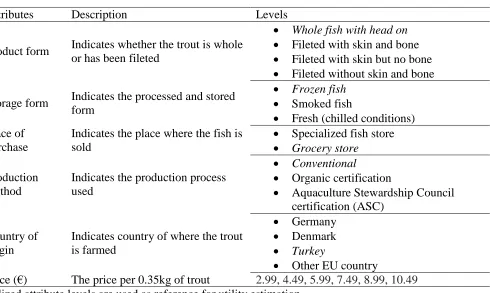
[image:4.612.71.561.201.494.2]The choice sets presented to respondents were designed using the software Ngene (ChoiceMetrics, 2014) and the D-efficient Bayesian design applied with priors from multinomial logit model estimation of the pilot survey. This design approach is employed to limit generating cumbersome choice sets associated with full factorial designs and to maximize the amount of information about consumers’ preferences from the choice experiments. Choice set attributes and attribute levels used in the survey are provided in Table 1 below with six attributes, their description and attribute levels. Attribute selection were motivated from fish preference literature and focus group discussions and are composed of interplay between search and credence attributes.
Table 1 Attributes and Attribute Levels
Attributes Description Levels
Product form Indicates whether the trout is whole or has been fileted
Whole fish with head on Fileted with skin and bone Fileted with skin but no bone Fileted without skin and bone
Storage form Indicates the processed and stored form
Frozen fish Smoked fish
Fresh (chilled conditions) Place of
purchase
Indicates the place where the fish is sold
Specialized fish store Grocery store
Production method
Indicates the production process used
Conventional Organic certification
Aquaculture Stewardship Council certification (ASC)
Country of origin
Indicates country of where the trout is farmed
Germany Denmark Turkey
Other EU country
Price (€) The price per 0.35kg of trout 2.99, 4.49, 5.99, 7.49, 8.99, 10.49
Italized attribute levels are used as reference for utility estimation
A total of 36 choice sets with 3 blocks were designed and randomly assigned to the subsamples. Hence, each respondent was presented with 12 choice sets of three alternatives and an opt-out. A sample of the choice set presentation is shown in Figure 1.
5
Figure 1 Sample choice card
[image:5.612.62.560.224.720.2]Data from a total of 1,236 completed and usable questionnaire was extracted for the four subsamples. A questionnaire response rate of 12% was achieved. The respective sample sizes were 308, 310, 309 and 309 for groups 1, 2, 3 and 4 where group 1 indicates the control sample and 2 to 4, the information treatment samples. The summary description of the socioeconomic characteristics of the sample is presented in Table 2. The regions were purposively selected to cover the northern (Hamburg/Schleswig-Holstein), eastern (Berlin/Brandenburg) and southern (Bayern) corners of Germany given that the entire population is relatively high.
Table 2 Socioeconomic Characteristics of the Sample
Characteristics 𝑛 %
Gender
Male 570 46.12
Female 666 53.88
Age (years)
18-34 405 32.77
35-49 427 34.31
50-65 404 32.69
Region
Bayern 426 34.47
Berlin/Brandenburg 396 32.04
Hamburg/Schleswig-Holstein 414 33.50
Household size
1 person 253 20.47
2 persons 481 38.92
3 persons 259 20.95
4 persons 180 14.56
Above 5 persons 63 5.09
Occupation
Part time 199 16.10
Full time 766 61.97
Other 271 21.93
Household monthly income
< €1.000 127 10.28
€1,000 to < €1,500 128 10.36
€1,500 to < €2,000 145 11.73
€2,000 to < €2,500 150 12.14
€2,500 to < €3,000 164 13.27
€3,000 to < €3,500 130 10.52
€3,500 to < €4,000 114 9.22
€4,000 to < €4,500 86 6.96
> €4,500 192 15.53
Family status
Single 305 24.68
6
Live together 220 17.80
Separated/widow/divorce 111 8.98
Education Level
Basic Education 100 8.09
Secondary school 349 28.24
Higher secondary school 111 8.98
Post-Secondary Education 242 19.58
Tertiary Education 421 34.06
Other 13 1.05
Total observations 1,236 100
2.2 Discrete Choice Modeling: Generalized Mixed Multinomial Logit
Developed by McFadden (1974), the random utility theory has become increasingly used for the analysis of choices in discrete choice experiments (DCEs). The approach has the ability to estimate marginal values for different attributes of a good. Assuming that person 𝑖 faces a set of alternatives
𝑄 ={𝑄1, 𝑄2, … , 𝑄𝑁} at time 𝑡 and vectors of 𝑥 attributes specific to respondents and alternatives. Each
chosen alternative 𝑄𝑗 ∈ 𝑄 has a corresponding net utility 𝑈𝑖𝑗𝑡 for individual 𝑖 that is assumed to be composed of two separable parts; the systematic (𝑉𝑖𝑗𝑡) and random (𝜀𝑖𝑗𝑡) components expressed as (Train, 2009):
𝑈𝑖𝑗𝑡 = 𝑉𝑖𝑗𝑡+ 𝜀𝑖𝑗𝑡 (1)
The idiosyncratic error term is assumed to be independent and identically distributed extreme value. The probability that individual 𝑖 chooses alternative 𝑗 from a particular set 𝑄can be written as:
𝑃𝑖𝑗 = 𝑃(𝑈𝑖𝑗 > 𝑈𝑖𝑞; ∀ 𝑞(≠ 𝑗) ∈ 𝑄) = 𝑃(𝜀𝑖𝑞 < 𝜀𝑖𝑗 + 𝑉𝑖𝑗− 𝑉𝑖𝑞; ∀ 𝑞(≠ 𝑗) ∈ 𝑄) (2)
Traditionally, the multinomial logit (MNL) model would be estimated. However, the past two decades have seen development of competing models that allow for taste and scale heterogeneity, and overcome the assumptions of the independent and irrelevant alternatives linked to the MNL specification. Moreover, the confounding scale parameter in the utility parameter has become less desirable. In this study, we follow the much more flexible generalized mixed multinomial logit (GMNL) specification in Fiebig et al (2010) and express the systematic component of the utility function in equation (1) with or without alternative specific constants as:
𝑉𝑖𝑗𝑡 = 𝛽𝑖𝑥𝑖𝑗𝑡 = [𝜎𝑖𝛽 + 𝛾𝜂𝑖 + (1 − 𝛾)𝜎𝑖𝜂𝑖]𝑥𝑖𝑗𝑡 (3)
where 𝛽𝑖 is the individual specific taste parameter confounded with a scale of the error term. It is assumed to follow a multivariate distribution with means and variance-covariance matrix 𝛴,
𝛽𝑖~𝑓(𝛽, 𝛴). Decomposing 𝛽𝑖 to follow the square bracket terms in equation (3) allows heterogeneity to be described by scale heterogeneity (i.e., scaled multinomial logit - SMNL), taste heterogeneity (i.e., mixed or random parameter logit - RPL) or some combination of the two (GMNL type models). From equation (3), Assuming 𝜎𝑖 = 𝜎 = 1 collapses the formulation to RPL where 𝜂𝑖 is the individual
7
An important feature for considering GMNL in the present study is the ability to simultaneously account for preference heterogeneity and scale differences arising from different data sets. Scale may vary across data sets due to differences in sampling or information provided to respondents (Hensher et al. 1998) as designed in this study. Failing to account for these differences when combining data sets may lead to wrong conclusions. We follow Hensher et al (2015, page 861) on combining data sets in choice modeling and allow 𝜏 to be a function of a series of dummy variables that identify the presence of scale heterogeneity between the different data sets from the sample or information treatments. Thus,
𝜏 = 𝜏 + 𝛿𝐷𝑠 where 𝛿 is data specific scale parameter and 𝐷𝑠 = 1 for data set 𝑠 and 0 otherwise,
with 𝑠 = 1,2, … , 𝑆 − 1. As noted in Czajkowski et al. (2016), this approach has advantage over willingness to pay space data specific estimations as it avoids confounding preferences with marginal utility of income (cost), allows ease of testing for dispersion among random parameters and for equality of mean willingness to pay.
3. Results and Discussion
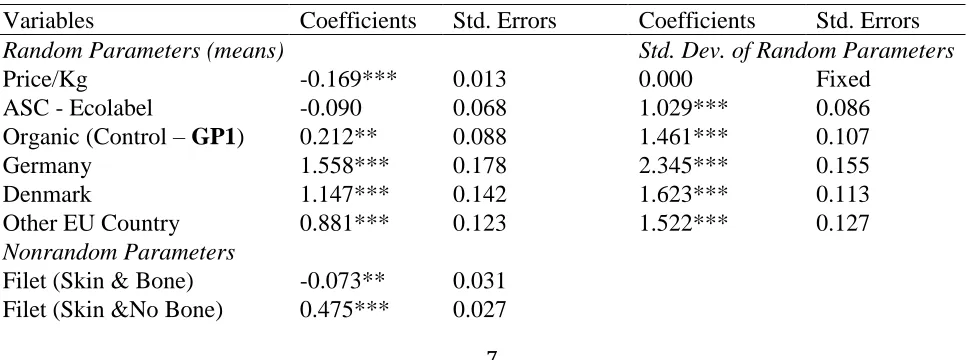
In this section, we report on the estimation results from the generalized random parameter logit model outlined in section 2. The decision to the selected model was undertaken through a search process to determine the best fitting model. Models initially estimated included the multinomial, scaled multinomial, random parameter and GMNL type logit models. For random parameter assumptions, different distributional assumptions were also considered. The best fitting model based on the simulated log-likelihood values, McFadden pseudo r-square and information criteria was the GMNL model presented in Table 3. The model was estimated using parameters estimates from random parameter logit model as the starting values and 1200 draws (stability of parameters confirmed at this point).
[image:7.612.60.544.558.738.2]The model was estimated with normally distributed random parameters and allowing for correlated parameters in order to control for unobserved effects that are correlated among alternatives in a given choice situation. Attributes including the product form, storage form and place of purchase (search attributes) and the no purchase option were treated as fixed parameters, while the production method and country of origin were treated as random parameters following a normal distribution. The price variable was converted from per 0.35kg to per kg and also treated as a random parameter with non-stochastic distribution (i.e., variance equals zero). This implies that no a priori distribution is imposed, allowing testing for heterogeneity around the mean of the random parameter without having to worry about the distribution from which it was drawn (Hensher, 2005) as linked to willingness to pay calculations.
Table 3 Generalized Mixed Random Parameter Logit Model
Variables Coefficients Std. Errors Coefficients Std. Errors
Random Parameters (means) Std. Dev. of Random Parameters
Price/Kg -0.169*** 0.013 0.000 Fixed
ASC - Ecolabel -0.090 0.068 1.029*** 0.086
Organic (Control – GP1) 0.212** 0.088 1.461*** 0.107
Germany 1.558*** 0.178 2.345*** 0.155
Denmark 1.147*** 0.142 1.623*** 0.113
Other EU Country 0.881*** 0.123 1.522*** 0.127
Nonrandom Parameters
8
Filet (No Skin & No Bone) 0.806*** 0.035
Fresh 0.376*** 0.029
Smoked 0.011 0.023
Specialized Store -0.009 0.024
Organic2 (GP2) 0.086 0.061
Organic3 (GP3) 0.193*** 0.057
Organic4 (GP4) 0.126** 0.053
No Purchase -1.558*** 0.048
Covariances of Random Parameters
Tau Scale 1.287*** 0.074
Heterogeneity in tau(i)
Tau*GP2 0.076 0.062
Tau*GP3 -0.004 0.062
Tau*GP4 0.017 0.061
Weighting parameter gamma in GMX model
Gamma MXL 0.257*** 0.029
Sample Mean Sample Std. Dev.
Sigma(i) 0.958 1.664
Log likelihood -16067.280
Restricted log likelihood -20561.518
Chi-Square (36) 8988.518***
McFadden Pseudo R-Square 0.219
AIC 32206.6
AIC/N 2.171
Panel Groups 1,236
Observations 14,832
Used Halton sequences in simulations; Replications for simulated probs. is 1200; Use RP as starting values. GP1 – Control Group; information treatment groups are GP2 – Environmental Information; GP3 – Animal Health and Welfare information; GP4 – Combined GP2 and GP3.
In Table 3, we present the separation of heterogeneity in the error variance from the preference heterogeneity under the subheading Covariances of the random parameters so as to draw accurate conclusions from the preferences. As can be seen, the Tau-scale parameter (𝜏) which reflects the level of scale heterogeneity is statistically significant at the 1% level. This indicates the presence of significant unobserved scale heterogeneity in the sample – thus, significant differences exist between respondents on how deterministic or random their choices are to the analyst. Controlling for heterogeneity in the scale heterogeneity that may have occurred from differences in sample treatments reveals that the scale heterogeneity is not attributed to data specific differences. This is shown by the nonsignificant estimates from interaction of the scale parameter with the data specific dummies (Tau*GP#s).
9
In terms of the storage form (frozen trout as reference): there is no significant difference in utility between smoked and frozen products. Relatively, the marginal utility from fresh trout is highest. Fresh fish as described here is one that by definition has received no treatment other than chilling and has remained above -1 degree Celsius. The high preference for freshness is as expected at least for the European consumer as quality of seafood is mostly determined by degree of freshness (Olsen, 2004). Freshness to the consumer is also often associated with safety, reassurance, superior taste (Olsen, 2004; Wang et al., 2009). The current evidence supports the seafood literature that freshness will continue to have an important role in determining consumer preferences for fish. The place of sale, either in a grocery store or specialized fish stores makes no difference on the consumers’ utility level. Alternative specific constant included in the model captures the utility associated with the “no purchase option”. This is negative and significant and signifies respondents have disutility in opting out of purchase.
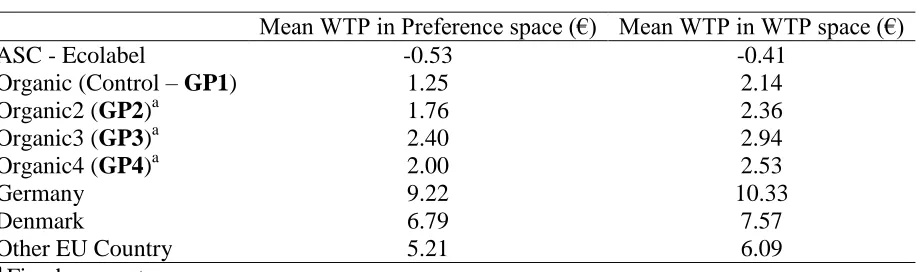
For the random parameter estimates, we observe that both the production method and country of origin reveal unobserved heterogeneous preferences among respondents as indicated by the significance of the attribute level standard deviations. First considering the country of origin with Turkey as the reference, it can be seen that the respondents have relatively very high preference for local German produced trout, followed by Denmark and then other European countries. Denmark and Turkey are top competing suppliers of trout in Europe with about 90% of Danish output landing in the German market. The corresponding willingness to pay (WTP) estimates computed as the ratio of the attribute parameter to the price is shown in Table 4 for values from preference space estimation and also WTP space estimation4.
[image:9.612.59.517.492.628.2]The WTP values from the preference space are lower than the WTP space values. However, the patterns of valuation remain the same. Consumers are willing to pay highest for local German trout (€10.33), followed by Danish trout (€7.57) and then other European countries (€6.09). The driving factor of the value for local might be linked to some of the emerging issues in literature regarding locally produced products. Local is linked to the environmental issues such as the carbon foot print in transporting a commodity from one place to another. In that case, the least transported is termed to be friendly to the environment. Denmark in the second place might also be linked to the relative stringent environmental requirements for aquaculture production (FAO, 2017) that could compensate for environmental claims of ecolabels.
Table 4 Willingness to Pay Values of random parameters
Mean WTP in Preference space (€) Mean WTP in WTP space (€)
ASC - Ecolabel -0.53 -0.41
Organic (Control – GP1) 1.25 2.14
Organic2 (GP2)a 1.76 2.36
Organic3 (GP3)a 2.40 2.94
Organic4 (GP4)a 2.00 2.53
Germany 9.22 10.33
Denmark 6.79 7.57
Other EU Country 5.21 6.09
a
Fixed parameters
Central to this study is the results from the production method and how bringing the consumer closer to knowledge about production practices of EU organic aquaculture production practices influences the marginal organic utility levels. The production method attribute levels include conventional production
10
(the reference level), the ASC and organic certification. The significance of the standard deviations of the random parameters reveals that there is heterogeneous preference among respondents for this attribute levels. The mean parameter for the ASC certification is however insignificant, indicating that on average equal proportions of the sample have or have no preference for this certification and so does not influence consumers choices, hence there is about €0.4 valuation of this attribute level.
The positive and significant parameter estimate associated with organic in the control group reflects the market status quo for organic preference without any intervention. That is, there is preference for organic in trout choice among respondents relative to the conventional. This evidence shows that in the German trout market, there is no competition between the organic and ASC labeled portion size trout. ASC is just considered a conventional trout and the organic considered superior.
Given that commercialization of organic aquaculture is new relative agriculture such as dairy products, growth in the sector is warranted and continuous supply depends on the value for the product. Would public intervention in the form of organic information campaigns that bring the consumer closer to the producer increase consumers’ preference and valuation? Does this depend on the information type and how does it vary with knowledge level? To provide answers to these questions, heterogeneity in the organic preferences is analyzed by interacting with the information treatment subsamples. What we observe is that treating responds with information on the organic production requirement and relating it to environmental concerns (organic2-GP2) does not seem to significantly shift respondents’
organic marginal utilities (only a slight increase in value of €0.22) from the status quo.
However, relating it to animal health and welfare concerns (organic2-GP3) almost doubles the marginal utility level from the status quo, an increase in corresponding value of €0.80. When the information is related to combined environmental and animal health and welfare concerns ( organic2-GP3), respondents retract on the marginal utility levels from the animal health and welfare only treatment, but significantly increase from the status quo. The finding shows that linking organic production requirements with animal health and welfare issues would achieve the highest welfare. This is because consumers’ perception of animal welfare has been found to be linked to ethical and impact on human health from food related hazards and food safety risks (Harper and Makatoumi, 2002; Verbeke and Viaene, 2000) of various food scandals and consequential food scares that have engulfed Europe (Naspetti and Zanoli, 2009).
Figure 2 Marginal utility for organic across information treatments and knowledge gain levels
-0.2 -0.1 0 0.1 0.2 0.3 0.4 0.5 0.6
Knowledge 0 Knowledge 1 Knowledge 2 Knowledge 3 Knowledge 4
M
ar
gi
n
al
U
ti
li
ty
Lev
el
fo
r
Or
gan
ic
Environment Animal Health & Welfare
11
Figure 2 presents how the level knowledge gained varies with the marginal utility levels for organic across the three information treatments. Knowledge level gained is equal to the size of wrong responses. Four quiz questions of four multiple choices with only one correct choice result in five levels of knowledge ranging from zero to four as shown in the x-axis of figure 2. Hence knowledge 0 is the respondent with full knowledge of the quiz (thus, all choices were correct). We observe that for each knowledge level, the marginal utility for organic in each information treatment is highest for the animal health and welfare, followed by the combined and least in the environmental treatment sample as shown in the model estimation results. Further, the preference structure reveals that for the respondent who gains 1 knowledge there is a little increase in the preference level but insignificant. As the knowledge level increases from 1 to 2 and 3, the preference structure equates to the respondent with the full a priori knowledge about the production practices. The last groups of respondents with knowledge 4 level (thus, those with no a priori knowledge) on average have disutility for organic trout in all treatments.
4. Conclusion
This study sought to determine consumer preferences for organic farmed trout in the presence of competing ecolabels and other important fish attributes that influences consumers purchasing decisions. Further, it explores avenues for increasing the value of organic aquaculture products by testing the effect of different types of information based on the EU organic aquaculture regulation. The information treatments involved relating feed; stocking density; antibiotics use; and GMO, hormones and synthetic additives to environmental, animal welfare concerns or combination of both. A state of the art generalized random parameter logit model based on the random utility theory was employed, given the flexibilities of modeling unobserved preference and scale heterogeneity and the ability to control for scale differences due to differences in sample treatments that could lead to biased conclusions.
The results indicate the presence of unobserved attribute taste and scale heterogeneity and lack of scale differences in the subsamples. It is shown that consumers prefer convenient fish products such as fillets. Thus, preference increases with increasing value addition in the form of fileting, when considering products with or without skin and bones. Fresh trout is also found to be a major positive determinant in purchasing decisions as it is often linked to quality and taste. On the other hand, country of origin features significantly and the level of the preference is greater than ecolabels; with local German trout being the most preferred, followed by Danish trout and then other European countries over trout from Turkey.
Considering the focal point of the study and hence the ecolabel attributes, we observe that the ASC ecolabel is equally recognized as a conventional product, however, the organic attribute relatively ranks high in purchasing decisions. This is an indication that the organic has value advantage among German trout consumers. Relating the organic production practices to environmental concerns in the event of public or commercial promotion campaigns does not further increase the perceived value consumers’ associate with the organic attribute. Value is increased when related to animal welfare issues only or combination of both.
12
knowledge, but for those with zero prior knowledge having the tendency to discount organic products on the avearge.
To promote green consumerism through interventions such as information campaigns to increase the overshadowing value of for example organic products, communication strategies would need to be carefully selected. For organic farmed trout for instance, bringing the consumer closer to productions principles based on animal welfare issues might be more satisfactory. This is because animal welfare issues are directly linked to human health impacts from food related hazards and food safety risks.
References
Aarset, B., Beckmann, S., Bigne, E., Beveridge, M., Bjorndal, T., Bunting, J., ... & Reisch, L. (2004). The European consumers’ understanding and perceptions of the “organic” food regime: The case of aquaculture. British Food Journal, 106(2), 93-105.
Alrøe, H. F., Vaarst, M., & Kristensen, E. S. (2001). Does organic farming face distinctive livestock welfare issues?–A conceptual analysis. Journal of Agricultural and Environmental Ethics, 14(3), 275-299.
Ankamah-Yeboah, I., Nielsen, M., & Nielsen, R. (2016). Price premium of organic salmon in Danish retail sale. Ecological Economics, 122, 54-60.
Asche, F., Larsen, T. A., Smith, M. D., Sogn-Grundvåg, G., & Young, J. A. (2015). Pricing of eco-labels with retailer heterogeneity. Food Policy, 53, 82-93.
Aschemann-Witzel, J., & Zielke, S. (2015). Can't buy me green? A review of consumer perceptions of and behavior toward the price of organic food. Journal of Consumer Affairs. http://dx.doi.org/10.1111/joca.12092
Blomquist, J., Bartolino, V., & Waldo, S. (2015). Price Premiums for Providing Eco‐labelled Seafood: Evidence from MSC‐certified Cod in Sweden. Journal of Agricultural Economics, 66(3), 690-704.
Bravo, C. P., Cordts, A., Schulze, B., & Spiller, A. (2013). Assessing determinants of organic food consumption using data from the German National Nutrition Survey II. Food Quality and Preference, 28(1), 60-70.
ChoiceMetrics (2014). Ngene 1.1.2 user manual and reference guide. Available at https://dl.dropboxusercontent.com/u/9406880/NgeneManual112.pdf
Czajkowski, M., Hanley, N., & LaRiviere, J. (2016). Controlling for the effects of information in a public goods discrete choice model. Environmental and resource economics, 63(3), 523-544.
European Union (2009). Commission Regulation (EC) No 710/2009 of 5 August amending Regulation (EC) No 889/2008 laying down detailed rules for the implementation of Council (EC) No 834/2007, as regards laying down detailed rules on organic aquaculture animal and seaweed production. Official Journal of the European Union 52, 15–34.
13
Fiebig, D. G., Keane, M. P., Louviere, J., & Wasi, N. (2010). The generalized multinomial logit model: accounting for scale and coefficient heterogeneity. Marketing Science, 29(3), 393-421.
Harper, G. C., & Makatouni, A. (2002). Consumer perception of organic food production and farm animal welfare. British Food Journal, 104(3/4/5), 287-299.
Hensher, D. A., Rose, J. M., & Greene, W. H. (2005). Applied choice analysis: a primer. Cambridge University Press.
Hensher, D. A., Rose, J. M., & Greene, W. H. (2015). Applied choice analysis, Second Edition. Cambridge University Press, United Kingdom.
Hensher, D., Louviere, J., & Swait, J. (1998). Combining sources of preference data. Journal of Econometrics, 89(1), 197-221.
Jaffry, S., Pickering, H., Ghulam, Y., Whitmarsh, D., & Wattage, P. (2004). Consumer choices for quality and sustainability labelled seafood products in the UK. Food Policy, 29(3), 215-228.
Johnston, R. J., & Roheim, C. A. (2006). A battle of taste and environmental convictions for ecolabeled seafood: a contingent ranking experiment. Journal of Agricultural and Resource Economics, 283-300.
Johnston, R. J., Wessells, C. R., Donath, H., & Asche, F. (2001). Measuring consumer preferences for ecolabeled seafood: an international comparison. Journal of Agricultural and resource Economics, 20-39.
Marian, L., Chrysochou, P., Krystallis, A., & Thøgersen, J. (2014). The role of price as a product attribute in the organic food context: An exploration based on actual purchase data. Food Quality and Preference, 37, 52-60.
Mauracher, C., Tempesta, T., & Vecchiato, D. (2013). Consumer preferences regarding the introduction of new organic products. The case of the Mediterranean sea bass (Dicentrarchus labrax) in Italy. Appetite, 63, 84-91.
McFadden, D. (1974). Conditional logit analysis of qualitative choice behavior. In: Zarembka P(ed) Frontiers in econometrics. Academic Press, New York, pp 105-142.
Meas, T., Hu, W., Batte, M. T., Woods, T. A., & Ernst, S. (2015). Substitutes or Complements? Consumer Preference for Local and Organic Food Attributes. American Journal of Agricultural Economics, 97(4), 1044-1071.
Naspetti, S., & Zanoli, R. (2009). Organic food quality and safety perception throughout Europe. Journal of Food Products Marketing, 15(3), 249-266.
Olesen, I., Alfnes, F., Røra, M. B., & Kolstad, K. (2010). Eliciting consumers' willingness to pay for organic and welfare-labelled salmon in a non-hypothetical choice experiment. Livestock Science, 127(2), 218-226.
Olsen, S. O. (2004). Antecedents of seafood consumption behavior: An overview. Journal of Aquatic Food Product Technology, 13(3), 79-91.
14
Roheim, C. A., Asche, F., & Santos, J. I. (2011). The elusive price premium for ecolabelled products: evidence from seafood in the UK market. Journal of Agricultural Economics, 62(3), 655-668.
Roheim, C. A., Sudhakaran, P. O., & Durham, C. A. (2012). Certification of shrimp and salmon for best aquaculture practices: Assessing consumer preferences in Rhode Island. Aquaculture Economics & Management, 16(3), 266-286.
Schifferstein, H. N., & Ophuis, P. A. O. (1998). Health-related determinants of organic food consumption in the Netherlands. Food quality and Preference, 9(3), 119-133.
Sogn-Grundvåg, G., Larsen, T. A., & Young, J. A. (2013). The value of line-caught and other attributes: An exploration of price premiums for chilled fish in UK supermarkets. Marine Policy, 38, 41-44.
Sogn‐Grundvåg, G., Larsen, T. A., & Young, J. A. (2014). Product differentiation with credence attributes and private labels: the case of whitefish in UK supermarkets. Journal of Agricultural Economics, 65(2), 368-382.
Teisl, M. F., Roe, B., & Hicks, R. L. (2002). Can eco-labels tune a market? Evidence from dolphin-safe labeling. Journal of Environmental Economics and Management, 43(3), 339-359.
Thompson, G. D. (1998). Consumer demand for organic foods: what we know and what we need to know. American Journal of Agricultural Economics, 80(5), 1113-1118.
Train, K. (2009). Discrete Choice Methods with Simulation. Cambridge University Press.
Tusche, K., Wuertz, S., Susenbeth, A., & Schulz, C. (2011). Feeding fish according to organic aquaculture guidelines EC 710/2009: Influence of potato protein concentrates containing various glycoalkaloid levels on health status and growth performance of rainbow trout (Oncorhynchus mykiss). Aquaculture, 319(1), 122-131.
Verbeke, W. A., & Viaene, J. (2000). Ethical challenges for livestock production: Meeting consumer concerns about meat safety and animalwelfare. Journal of Agricultural and Environmental Ethics, 12(2), 141-151.
Wang, F., Zhang, J., Mu, W., Fu, Z., & Zhang, X. (2009). Consumers’ perception toward quality and safety of fishery products, Beijing, China. Food control, 20(10), 918-922.
Wessells, C. R., Johnston, R. J., & Donath, H. (1999). Assessing consumer preferences for ecolabeled seafood: the influence of species, certifier, and household attributes. American Journal of Agricultural Economics, 81(5), 1084-1089.
Yiridoe, E. K., Bonti-Ankomah, S., & Martin, R. C. (2005). Comparison of consumer perceptions and preference toward organic versus conventionally produced foods: a review and update of the literature. Renewable Agriculture and Food Systems, 20(04), 193-205.
Zanoli, R., & Naspetti, S. (2002). Consumer motivations in the purchase of organic food: a means-end approach. British food journal, 104(8), 643-653.