IN THE NAME OF GOD
. THE MOST
BENEFICENT
, THE
USER CENTERED PASSIVE BUILDING DESIGN
Thesis submitted in accordance with the requirements of the
University of Liverpool for achieving the degree of
Doctor in Philosophy
By
ALI ALZAED
The University of Liverpool - School of Architecture
ABSTRACT
The full integration of End User Factors (EUFs) into the building design processes envi-ronment is still emergent. It has been suggested from other sectors that the integration of EUFs into design can improve work performance and promote the workforce’s physical and mental health. The need for EUFs in the passive design strategies (PDS) (i.e., ventilation, day lighting and thermal comfort) has become a prerequisite condition from clients to en-hance the user experience and harmonise their activities with PD performances. MFE (2011) claimed that architects are not fully engaged in the integration of EUFs in design. “The
de-sign team should involve future users and facilities management staff in the dede-sign process, and develop a building user’s guide to inform occupants of the building’s design intent”.
This research has carried out an intensive literature review into user centred design (UCD) methods and factors in the building, engineering and IT industries. The investigation spans from 1955 to date. The literature showed that there are no coherent models in the building industry that capture the total EUFs as portrayed in ISO standards. However, in the IT indus-try the theory of UCD is well advanced and developed.
The methodology that is followed by this research is based on a critical analysis of the lit-erature and prototype modelling. To ensure the appropriate EUFs are selected and integrated into design, the author needs to investigate what are the most relevant EUFs and how to inte-grate them into various PDs. To carry out this process effectively the author developed a systematic process that captures EUFs in the design processes. First, the research investigat-ed PDs and clusterinvestigat-ed them under three dimensions, which are passive ventilation, passive lighting and passive heating (PLVT). Second, the investigation sought to understand the dif-ference between users (Us) and end-users (EUs). This has resulted in creating classes of Us and EUs so that the extracted factors are mapped into these classes. Third, the research used ISO 13407 and ISO 9126 standards to develop a conceptual model. The first standard is used to organise the processes of UCD into coherent and dynamic steps. The second is used to systemise PD attributes (ATTs) and sub-attributes (S-ATTs) and map them into the processes that are developed in the previous stage, that is to say, according to ISO 13407. The output from this is the creation of a conceptual user centred passive building design model “UCPBD”. The model aims to assist designers to assess their design for the inclusion of
EUFs. The model could be used for both PDs and non PDs.
factors were 44 out of 132 EUFs. There was a statistical difference at the p<0.05 level signif-icant for four factors out of 132 factors. These are BB1: Durable, high quality finishes, BG2: Utility PD cores uniformly designed and vertically stacked, DA8: Design passive space that responds to changes in spatial dimensions (volume) and EB2: Use high quality material with long service life to handle passive functions in terms of professional role. In terms of the ar-chitect experience only nine EUFs out of 132 EUFs were rejected. These are AA2: Orient the building for optimum lighting, ventilation and thermal comfort, AC11: Narrow floor width to optimise natural ventilation, AC12: Provide solar-oriented interior zone to store and maxim-ise solar heat gain, AE9: Provide shading strategies for wall exposed to summer sun to mitigate unwanted solar gain for optimum ventilation and thermal comfort, BE3: The visual comfort of the lighting (e.g., glare, reflections, contrast), CA2: Consider the dimensions of passive spaces to suit human scale (avoiding undersize or oversize areas), DA10: Design passive layout based on future use scenarios, EB3: Consider the rate of expan-sion/contraction of material of PDs and FA7: Design for ease to adjust lighting, ventilation and thermal comfort physical element features. The post hoc comparisons using the Tukey HSD test also indicated these differences between four EUFs in terms of professional role and nine EUFs in terms of experience but found no significant differences between 128 and 123 EUFs respectively. The results of the cluster analysis indicate that the most influential EUFs can be grouped into six clusters. These are: passive design functionality (PDF), pas-sive design performance (PDP), paspas-sive design usability (PDU), paspas-sive design flexibility (PDFL), passive design reliability (PDR), and passive design maintainability (PDM). The clusters are grouped according to ISO standards. The result validity testing shows that select-ed clusters are characterisselect-ed by strong relationships. Only the reliability of PDR cluster shows low conformity (.539, but it is still acceptable statistical limits. The clusters are used to develop an assessment tool to map EUFs into PD processes. The model is generic and can be used as a tool to evaluate PDS for the inclusion of EUFs. The model was validated on four projects, which are namely Houghton Street Project, Cherry Mill Project, Fitzroy Street Project and Tullis Russell Environmental Education (TREE) Centre, to demonstrate the use and capabilities of the proposed model. The results show Satisfactory, Significant, Signifi-cant and Highly SignifiSignifi-cant respectively.
DECLARATION
I hereby declare that this thesis is my own work and effort and that it has not been sub-mitted anywhere for any award. Where other sources of information have been used, they have been acknowledged.
Signed………
ACKNOWLEDGEMENTS
Table of Contents
ABSTRACT ... iv
DECLARATION ... vii
ACKNOWLEDGEMENTS ... viii
Table of Contents ... ix
List of Figures... xvii
List of Tables ... xxi
List of Abbreviations ... xxvii
Chapter One: Introduction ... 28
1.1 Introduction: ... 28
1.2 Rationale of this Study and the Problem Statement ... 28
1.3 Research Questions ... 30
1.4 Research Hypotheses ... 30
1.5 Aim and objectives of this study ... 31
1.5.1 The aim of the Research ... 31
1.5.2 The Objectives ... 31
1.6 Scope of the study ... 31
1.7 Study Assumptions ... 32
1.8 Significance of the Study ... 32
1.9 Definition of Terms ... 32
1.10 Outline of the Thesis ... 33
1.11 Summary of this Chapter ... 34
Chapter Two: Architectural and Design Theories and Trends ... 36
2.1 Introuduction: ... 36
2.2 Modernism ... 36
2.3 Postmodern Architecture ... 37
2.4 Postmodern ecological ... 38
2.5 Traditional ... 38
2.6 Late Modern ... 39
2.7 New modern ... 40
2.8 Complexity paradigm ... 41
2.9 Sustainability and beyond ... 41
2.10 Recent design approaches, trends and theories ... 42
2.11 Summary of this Chapter ... 43
3.1 Introduction: ... 45
3.2 The Notion of the User ... 45
3.3 User Centred Design theory and background ... 49
3.3.1 Application of user centred design theory ... 50
3.3.1.1 Applying UCD in Education ... 50
3.3.1.2 Applying UCD in the Swedish National Union Catalogue ... 51
3.3.1.3 Applying UCD in Architecture ... 52
3.3.2 ISO 13407 ... 52
3.3.3 ISO 9126 ... 53
3.4 Summary of this Chapter ... 66
Chapter Four: Passive Design Human Attributes ... 67
4.1 Introduction: ... 67
4.2 Passive Design Functionality (PDF) ... 67
4.2.1 Site, Orientation and Vegetation ... 68
4.2.2 Building form ... 77
4.2.3 Space planning... 80
4.2.4 Roof ... 87
4.2.5 Façade and envelope ... 94
4.3 Passive design Performance ... 99
4.3.1 Site performance ... 101
4.3.2 Space ... 101
4.3.3 Thermal comfort ... 102
4.3.4 Ventilation... 103
4.3.5 Lighting ... 103
4.3.6 Acoustic ... 104
4.3.7 Adequacy of consumption and strategies ... 105
4.4 Passive design Usability ... 105
4.4.1 Operability ... 106
4.4.2 Human behaviour ... 109
4.5 Passive design Flexibility ... 110
4.5.1 Future Adaptability ... 111
4.5.2 Flexible space ... 115
4.6 Passive Design Reliability ... 117
4.6.1 Durability ... 117
4.6.2 Material Reliability ... 119
4.6.3 Resilience ... 120
4.7.1 Standardisation ... 122
4.7.2 Material ... 125
4.7.3 Accessibility ... 126
4.8 Summary of this chapter ... 128
Chapter Five: User Centered Passive Building Design Model ... 129
5.1 Introduction ... 129
5.2 Components of the Model ... 129
5.3 Core Passive Strategies ... 130
5.3.1 Passive Ventilation ... 131
5.3.2 Passive Lighting ... 132
5.3.3 Passive Heating ... 132
5.4 User Centred Passive Building Design Process ... 133
5.5 Passive design human attributes ... 134
5.5.1 Passive Design Functionality (PDF) ... 134
5.5.2 Passive Design Performance (PDP) ... 134
5.5.3 Passive Design Usability (PDU)... 135
5.5.4 Passive Design Flexibility (PDFL) ... 135
5.5.5 Passive Design Reliability (PDR)... 135
5.5.6 Passive Design Maintainability ... 135
5.6 Feedback ... 136
5.7 Implementing the model ... 136
5.7.1 Concept and Sketch stage: ... 137
5.7.2 Design and Development Stage ... 137
5.7.3 Design Synthesis Stage ... 138
5.7.4 The Post Evaluation ... 139
5.8 Retaliation between the Components of the Model ... 139
5.9 Discussion ... 140
5.10 Summary of this Chapter ... 140
Chapter Six: Research Methodology ... 141
6.1 Introduction: ... 141
6.2 The research methodology theory ... 141
6.2.1 Qualitative: Critical literature review ... 141
6.2.2 Qualitative: Questionnaire Design... 142
6.3 Rationale for designing the survey ... 143
6.4 Research methods process ... 143
6.4.1 Task 1: Initial research ... 144
6.4.2.1 Sub-task: Review design and architectural theories: ... 144
6.4.2.2 Sub-task: Review the PD ... 144
6.4.2.3 Sub-task: suitable method ... 144
6.4.2.4 Sub-task: Conceptual model ... 146
6.4.2.5 Sub-task: Passive design human attributes ... 147
6.4.3 Task 3: Questionnaire Design and Development ... 148
6.4.3.1 Sub-Task: Questionnaire Validation... 150
6.4.3.2 Sub-task: Questionnaire development ... 151
6.4.3.3 Sub-task: Select the software ... 151
6.4.3.4 Sub-task: Ethical Approval ... 152
6.4.3.5 Sub-task: Sample size and Delivering the Questionnaire to the Respondents ... 152
6.4.4 Task 4: Data Collection and analysis ... 153
6.4.4.1 Sub-task: Descriptive findings ... 153
6.4.4.2 Sub-task: Ranking findings ... 153
6.4.4.3 Sub-task: Testing hypotheses ... 153
6.4.4.4 Sub-task: Data Reduction and clustering ... 154
6.4.5 Task 5: UCPBD assessment tool ... 154
6.4.5.1 Sub-Task: Development of an UCPBD assessment tool ... 154
6.4.5.2 Sub-Task: Testing the tool... 154
6.4.6 Task 6: Discussion and Conclusion Chapter ... 154
6.5 Summary of this Chapter ... 155
Chapter Seven: Findings and Descriptive Analysis ... 156
7.1 Introduction: ... 156
7.2 Restatement of the Problem of the Study ... 156
7.3 Restatement of Research Hypotheses ... 156
7.4 Descriptions of Participants’ Information ... 159
7.4.1 Professional role ... 159
7.4.2 Respondents’ Years of Experience ... 159
7.4.3 Receiving a Copy of the Result ... 159
7.5 Questionnaire analysis ... 160
7.5.1 First part of the questionnaire: Passive design Human Attributes ... 160
7.5.1.1 Passive Design Functionality ... 160
7.5.1.2 Passive Design Performance ... 165
7.5.1.3 Passive Design Usability ... 167
7.5.1.4 Passive Design Flexibility ... 169
7.5.1.6 Passive Design Maintainability ... 172
7.5.2 Current Practice ... 173
7.5.2.1 Passive design Functionality ... 173
7.5.2.2 Passive design Performance and Usability ... 174
7.5.2.3 Passive design Flexibility ... 174
7.5.2.4 Passive Design Reliability ... 174
7.5.2.5 Passive Design Maintainability ... 174
7.5.3 Summary of this Chapter ... 174
Chapter Eight: Ranking the Findings ... 175
8.1 Introduction ... 175
8.2 Methodology ... 175
8.3 Ranking and analysis of end user factors ... 177
Measuring the architects’ harmonisation: ... 178
8.4 Ranking Data based on experience and professional role ... 178
8.4.1 Passive Design Functionality... 178
8.4.2 Passive Design Performance ... 180
8.4.3 Passive Design Usability ... 181
8.4.4 Passive Design Flexibility ... 182
8.4.5 Passive Design Reliability ... 183
8.4.6 Passive Design Maintainability ... 184
8.4.7 Current practice ... 185
8.5 Conclusion of overall ranking ... 185
8.6 Average Severity Indices of user centred passive building design attributes ... 187
8.7 Average Severity Indices of user centred passive building design sub- attributes188 8.8 Summary of this Chapter ... 188
Chapter Nine: Hypothesis and Reliability Testing ... 189
9.1 Introduction: ... 189
9.2 Method ... 189
9.3 Analysis of participants’ responses based on their professional role ... 189
9.3.1 ANOVAs Rating Based on Architects’ Professional role ... 190
9.3.1.1 Passive design Functionality ... 190
9.3.1.2 Passive design Performance ... 193
9.3.1.3 Passive design Usability ... 196
9.3.1.4 Passive design Flexibility ... 197
9.3.1.5 Passive Design Reliability ... 199
9.3.1.6 Passive design Maintainability ... 201
9.4.1 ANOVA Testing Based on Architects’ Experience ... 203
9.4.1.1 Passive Design Functionality ... 203
9.4.1.2 Passive Design performance ... 207
9.4.1.3 Passive design usability ... 210
9.4.1.4 Passive Design Flexibility ... 212
9.4.1.5 Passive Design Reliability ... 214
9.4.1.6 Passive Design Maintainability ... 216
9.5 Analysis of participants’ respondents based on their professional role for the second part of the questionnaire ... 218
9.6 Analysis of participants’ responses based on their experience for the second part of the questionnaire ... 220
9.6.1 Reliability ... 222
9.6.1.1 Reliability Testing of Passive Design Functionality: ... 222
9.6.1.2 Reliability Testing of Passive Design Performance: ... 223
9.6.1.3 Reliability Testing of Passive Design Usability ... 224
9.6.1.4 Reliability Testing of Passive Design Flexibility ... 225
9.6.1.5 Reliability Testing of Passive Design Reliability ... 225
9.6.1.6 Reliability Testing of Passive Design Maintainability ... 226
9.6.2 Discussion... 227
Chapter Ten: Data Reduction... 229
10.1 Introduction: ... 229
10.2 Methodology ... 229
10.3 Factor analysis ... 229
10.4 Findings analysis ... 230
10.5 Scree plot ... 231
10.6 Interpretation of each cluster ... 237
10.6.1 Passive Design Functionality... 237
10.6.2 Passive Design Performance ... 237
10.6.3 Passive Design Usability ... 238
10.6.4 Passive Design Flexibility ... 238
10.6.5 Passive Design Reliability ... 238
10.6.6 Passive Design Maintainability ... 238
10.7 Reliability Testing ... 239
10.8 The Result Implication: ... 240
10.9 Summary of this Chapter ... 240
Chapter Eleven: UCPBD Assessment Tool ... 241
11.2 Review the existing assessment tool ... 241
11.2.1 Comparisons ... 241
11.2.2 Design quality indicators ... 245
11.2.2.1The conceptual framework ... 245
11.2.2.2Data Tool ... 245
11.2.2.3The weighting mechanism ... 246
11.3 Developing a User Centred passive building design assessment tool ... 246
11.3.1 Scoring system... 247
11.3.2 Selection factor ... 247
11.3.3 Weighting of the factors based on components ... 247
11.3.4 Computing of the scoring ... 248
11.3.5 Plotting the result ... 248
11.4 The case studies ... 248
11.4.1 Houghton Street Project ... 249
11.4.2 Cherry Mill Project ... 253
11.4.3 Fitzroy Street Project ... 256
11.4.4 Tullis Russell Environmental Education (TREE) Centre ... 260
11.5 Implication and Discussion... 264
11.6 Summary of this Chapter ... 265
Chapter Twelve:Discussion and Conclusion ... 266
12.1 Discussion ... 266
12.1.1 User Centred Design ... 266
12.1.2 User classification ... 267
12.1.3 Passive design strategies ... 268
12.1.4 Passive design human attributes ... 269
12.1.5 User Centred Passive Building Design Model ... 269
12.1.6 Data analysis discussion ... 270
12.1.6.1Comparing the results ... 271
12.1.6.2Testing the hypotheses ... 274
12.1.6.3Data reduction and clustering ... 278
12.1.7 User Centred passive Building Design assessment tool ... 281
12.1.8 The Issues That Researcher Learened: ... 282
12.1.9 Implication:... 283
12.2 Conclusion and Recommendation ... 285
12.2.1 Summary... 285
12.2.2 Contribution ... 286
12.2.2.2UCPBD model ... 286
12.2.2.3UCPBD frameworks ... 286
12.2.2.4UCPBD assessment tool contribution ... 286
12.2.2.5The other contributions ... 287
12.2.3 Limitations ... 287
12.2.4 Recommendation and Suggestions for Further Research ... 288
References ... 290
Appendix A: Architectural Theories and Trends ... 316
Appendix B – Questionnaire ... 335
Appendix C – ETHICAL APPROVAL APPLICATION ... 345
Appendix D – Passive Design Functionality Histogram and Frequency Table ... 346
Appendix E – Passive Design Performance Histogram and Frequency Table ... 354
Appendix F – Passive Design Usability Histogram and Frequency Table ... 358
Appendix G – Passive Design Flexibility Histogram and Frequency Table ... 360
Appendix H – Passive Design Reliability Histogram and Frequency Table ... 363
Appendix I – Passive Design Maintainability Histogram and Frequency Table ... 365
Appendix J – Comparative Ranking ... 370
Appendix K – Rotated Component Matrix ... 372
Appendix L – UCPBD Assessment Tool Sheet ... 376
Appendix M – Draw Prize Process ... 377
List of Figures
Figure 1:1: Thesis Outline ... 35
Figure 2:1: Architectural Trends ... 36
Figure 3:1 The user type ... 45
Figure 3:2: The classification of the user type ... 45
Figure 3:3: End user experience ... 46
Figure 3:4: The relationship between the EU and U with life cycle design project. ... 49
Figure 3:5: ISO 31407 process (ISO 13407, 1999, p.6) ... 53
Figure 3:6: External and Internal Quality ISO 9126 (Padayachee, 2010, p.3) ... 54
Figure 4:1: UCPBD ATTs and S-ATTs ... 67
Figure 4:2: The effect of the landscape on sun collection (Panagopoulos, 2008) ... 68
Figure 4:3: Distribution of trees (Passive Solar Industries Council, National Renewable Energy Laboratory, and Charles Eley Associates, 1994) ... 69
Figure 4:4: The various positions of trees in the case study (Akashi et al, 2006) ... 69
Figure 4:5: Roof Garden (Punggol Roof Garden, 2003). ... 70
Figure 4:6: ACROS Fukuoka: The serene green roof of Japan (Kumar, 2008). ... 70
Figure 4:7: Various site orientations (Crobu, 2010) ... 71
Figure 4:8: South facade (Norton and Christensen, 2006, p.2 and 4) ... 71
Figure 4:9: The distribution of the building on the site (US DOE) (2001) ... 72
Figure 4:10: Perspective and south elevation of AMVIC office building –Romania (Badescu et al, 2011, p.143 and148) ... 72
Figure 4:11: Impact of the surrounding buildings (Hoof and Blocken, 2009)... 73
Figure 4:12: The site of the Design Faculty building at Newcastle University (Prasad and Fox, 1996). ... 73
Figure 4:13: Natural and unnatural site obstacles (Crobu, 2010) ... 74
Figure 4:14: The density of the building (Belakehal et al, 2004) ... 75
Figure 4:15: The width of the street and the affect of day lighting (Belakehal et al, 2004) ... 75
Figure 4:16: The Brighton Earth ship is located in Stammer Park (floor plan, section and perspective) (Ip and Miller, 2006 and 2009)... 76
Figure 4:17: Compact building (Ahsan, 2009). ... 77
Figure 4:18: Passive compact building in Munich (section, site plan and perspective) (Martin Pool Architects Munich, 2011). ... 77
Figure 4:19: Various building forms (Sigg et al, 2006). ... 78
Figure 4:20: The various shapes (Prom et al, 1989) ... 79
Figure 4:22: Combined direct and indirect gain for water wall, indirect gain and direct
(Kurtbas and Durmus, 2008) ... 80
Figure 4:23: Water wall (Kurtbas and Durmus, 2008)... 80
Figure 4:24: Central spaces (Tablada, 2009) ... 81
Figure 4:25: Long and narrow building form (Ministry for the Environment (1998-2011) ... 81
Figure 4:26: Optimal distribu-tion of residential buildings (Crobu ,2010) ... 83
Figure 4:27: Space planning of Design Faculty Newcastle University (Prasad and Fox, 1996). ... 83
Figure 4:28: Sunspace Brighton (Ip and Miller, 2006) ... 84
Figure 4:29: Insulation Opaqe building (Garcia-Hansen et al, 2002) ... 85
Figure 4:30: Square Shape, Rectangle Shape and Courtyard Shape ... 85
Figure 4:31:Thermosiphon (Garcia-Hansen et al, 2002) ... 85
Figure 4:32: Trickle advice (The National Domelight Company, 2009) ... 87
Figure 4:33: The different level of scoop in Pakistan (McDonough, 2002). ... 87
Figure 4:34: The widespread use of wind scoop to the same direction (McDonough, 2002) 88 Figure 4:35: Clerestory (American Institute of Architects, 2009). ... 88
Figure 4:36: Clerestory and roof monitor (Garcia-Hansen et al, 2002) ... 88
Figure 4:37: Saw tooth air movment (Kacira et al, 1998) ... 89
Figure 4:38: Skylight (Garcia-Hansen et al, 2002) ... 89
Figure 4:39: Sun pipe combination system (RH and Construction, 2009). ... 89
Figure 4:40 : Seaside Primary School in Lancing, West Sussex (RH and Construction, 2009). ... 90
Figure 4:41: Double roof ventilation (Gut and Ackerknecht, 1993) ... 92
Figure 4:42: The spread of windscoops on the roof of shopping mail on Kent, UK (McDonough, 2002) ... 92
Figure 4:43: Traditional wind scope (Elmualim, 2006) ... 92
Figure 4:44: Section explaining wind movement through the building (Sayigh et al, 1998) . 92 Figure 4:45: Duct ventilation (Odeh, 2006 and Greenspec, 2010). ... 93
Figure 4:46: Saw tooth roof of The Design Faculty building of Newcastle University (Prasad and Fox, 1996) ... 93
Figure 4:47: (top) Solar Chimneys ventilation diagram in the King Abdullah University of Science and Technology (Carboun, 2010). ... 95
Figure 4:48: Solar Chimney Coventry library (Santamouris, 2007)... 95
Figure 4:49: Various types of double skin facade (Boake, N/A) ... 95
Figure 4:50: The bridge insulation (Lamar ,2006) ... 96
Figure 4:51: Insulation of opaque envelope (Lamar ,2006) ... 96
Figure 5:2: Passive Design Strategies’ Dimensions... 130
Figure 5:3: User Centred Design Process (ISO 13407, 1999, p.6) ... 133
Figure 5:4: The correlation between UCPBD process and PDF ... 134
Figure 5:5: The correlation between UCPBD process and PDP ... 134
Figure 5:6: The correlation between UCPBD process and PDU ... 135
Figure 5:7: The correlation between UCPBD process and PDFL ... 135
Figure 5:8: The correlation between UCPBD process and PDR ... 135
Figure 5:9: The correlation between UCPBD process and PDM ... 135
Figure 5:10 : Feedback process (Dursun and Ozsoy, 2007, p.88) ... 136
Figure 5:11: User Centred Passive Building Design Process. (Concept stage, R: Requirements and C: Context) ... 137
Figure 5:11: The correlation between the model components ... 139
Figure 6:1: Research Process (This style adopted from Mohd Rahim, 2011) ... 145
Figure 6:2: The process of the research methods to develop a UCPBD conceptual model.. 146
Figure 6:3: The total number of EUFs ... 148
Figure 6:4: Sample of the first part of the design questionnaire ... 149
Figure 6:5: The second part of the design questionnaire of the level of keeping the EU in the architect’s mind when designing PBD ... 150
Figure 6:6: The last part of the design questionnaire collects personal information ... 150
Figure 6:7: Questionnaire design process (This style adopted from Mohd Rahim, 2011) ... 151
Figure 8:1: The Survey Hierarchy ... 175
Figure 8:2: UCPBD Attributes and Sub-Attributes ... 176
Figure 8:3: The number of EUFs of S-As of As of the questionnaire structure ... 177
Figure 8:4: Average severity index of each attribute: 1= Passive design functionality, 2= Passive Design Performance, 3=Passive Design Usability, 4=Passive design Flexibility, 5=Passive Design Reliability and 6=Passive Design Maintainability ... 187
Figure 8:5: Average severity index of each sub-attribute: Passive Design Functionality: 1= site, orientation and vegetation, 2 building form, 3= space planning, 4=roof, 5= façade and envelope. Passive Design Performance: 6= site performance, 7=space performance, 8= natural ventilation, 9= lighting, 10= thermal comfort, 11= acoustic, 12= adequacy consumption and strategies. Passive Design Usability: 13=operability, 14=human behaviour. Passive design Flexibility: 15= future adaptability, 16= flexible space. Passive Design Reliability: 17=durability, 18: material reliability, 19=resilience. Passive Design Maintainability: 20=standardisation, 21=material, 22= accessibility ... 188
Figure 10:1: Scree Plot of 132 Eco-indicators of the Study ... 232
Figure 10:3: Scree Plot of 33 end user factor of the Study (the point 33 components more
than 1) ... 233
Figure 10:4: The process of data reduction and group analysis ... 235
Figure 11:1: The details of section of DQI (Gann et al, 2003) ... 246
Figure 11:2: Diagram for Houghton Street ... 252
Figure 11:3: Cherry Mill Project (Denovodesign, 2012) ... 253
Figure 11:4: Diagram for Cherry Mill ... 255
Figure 11:5:Fitzroy Street Project (Denovodesign, 2012) ... 257
Figure 11:5: Diagram for Fitzroy Street ... 259
Figure 11:7:Tullis Russell Environmental Education (TREE) Centre (Atkins,2012) ... 261
List of Tables
Table 2-1: The issues learned from the literature ... 43
Table 3-1: Functionality Sub-Attributes (adapted from Chua and Dyson, 2004) ... 55
Table 3-2: Efficiency Sub-Attributes (adapted from Chua and Dyson, 2004) ... 57
Table 3-3: Usability Sub-Attributes (adapted from Chua and Dyson, 2004)... 58
Table 3-4: Flexibility Sub-Attributes (adapted from Chua and Dyson, 2004)... 59
Table 3-5: Reliability Sub-Attributess (adapted from Chua and Dyson, 2004) ... 61
Table 3-6: Maintainability Sub-Attributes (adapted from Chua and Dyson, 2004) ... 63
Table 3-7: The issues learned from the literature ... 65
Table 4-1: End user Factors passive design functionality: Site end user factors ... 77
Table 4-2: End user Factors passive design functionality: building form end user factors .... 80
Table 4-3: End user Factors passive design functionality: space planning end user factors... 87
Table 4-4: End user Factors passive design functionality: space planning end user factors... 87
Table 4-5: Various sun pipes (Kim and Gon, 2010) ... 91
Table 4-6: End user Factors passive design functionality: Roof end user factors ... 93
Table 4-7: Shading strategies (Li et al, 2006) ... 97
Table 4-8: End user Factors passive design functionality: Façade and envelope end user factors ... 99
Table 4-9: Passive design for Performance: Sub-Attribute: Site ... 101
Table 4-10: Passive design for Performance: Sub-Attribute: Space ... 102
Table 4-11: Passive design for Performance: Sub-Attribute: Thermal comfort ... 103
Table 4-12 : Passive design for Performance: Sub-Attribute: Ventilation ... 103
Table 4-13: Passive design for Performance: Sub-Attribute: Lighting ... 104
Table 4-14: Passive design for Performance: Sub-Attribute: Acoustic ... 104
Table 4-15: Passive design for Performance: Sub-Attribute: Adequacy consumption and strategies ... 105
Table 4-16: Passive design for Usability: Sub-Attribute: Operability ... 108
Table 4-17: Passive design for Usability: Sub-Attribute: Human Behaviour ... 110
Table 4-18: Passive design for Flexibility: Sub-Attribute: Future Adaptability ... 114
Table 4-19: Passive design for Flexibility: Sub-Attribute: Flexible space. ... 116
Table 4-20: Passive design for Reliability: Sub-Attribute: Durability ... 119
Table 4-21: Passive design for Reliability: Sub-Attribute: Material Reliability ... 119
Table 4-23: Maintenance Trebling (Hao et al, 2006) Definition of maintenance trebling is that “information of human movement and motion is described in the maintenance simulation” (Hui, 2004, p.1). ... 121 Table 4-24: Standardisation Measurements ... 125 Table 4-25: Material ... 126 Table 4-26: Accessibility Measurements ... 127 Table 4-27: The issues learned from the literature ... 128 Table 6-1: Relevant situations for different research strategies (Yin, 2003, p.5)... 143 Table 6-2: Scale based on EUFs’ effectiveness ... 149 Table 6-3: scale based on the level of keeping the EUFs in the architect’s mind when
designing PBD. ... 149 Table 7-1: The Professional role ... 159 Table 7-2: Years of experience ... 159 Table 7-3: The percentage of the respondents who are interested in receiving a copy of the
results ... 160 Table 7-4: Descriptive Information of the First Part of the Questionnaire Survey: Passive
Design Functionality ... 165 Table 7-5: Descriptive Information of the First Part of the Questionnaire Survey: Passive
Design Performance... 167 Table 7-6: Descriptive Information of the First Part of the Questionnaire Survey: Passive
Design Usability ... 168 Table 7-7: Descriptive Information of the First Part of the Questionnaire Survey: Passive
Design Flexibility ... 170 Table 7-8: Descriptive Information of the First Part of the Questionnaire Survey: Passive
Design Reliability ... 172 Table 7-9: Descriptive Information of the First Part of the Questionnaire Survey: Passive
Design Maintainability ... 173 Table 7-10: Current practice of passive design attributes ... 173 Table 8-1: User Centred Passive Building Design Attributes: Passive Design Functionality. S:
Ranking based on Sub-Attribute, A: Ranking based on Attribute, O: Overall ranking and N.: Total Responses ... 180 Table 8-2: User Centred Passive Building Design Attributes: Passive Design Performance.
... 181 Table 8-3: User Centred Passive Building Design Attributes: Passive Design Usability. .... 182 Table8-4: User Centred Passive Building Design Attributes: Passive Design Flexibility.S:
Table 8-5: User Centred Passive Building Design Attributes: Passive Design Reliability.S: Ranking based on Sub-Attribute, A: Ranking based on Attribute, O: Overall ranking and N.: Total Responses ... 184 Table 8-6: User Centred Passive Building Design Attributes: Passive Design Maintainability. S: Ranking based on Sub-Attribute, A: Ranking based on Attribute, O: Overall ranking and N.: Total Responses ... 185 Table 8-7: Current practice. The abbreviationS: L1= Architect practising, L2: Academic and
Architect practising, L3: Academic Architect, M1: 0-5 years experience, M2: 5-10 years experience, M3: More than 10 years Experience, S: Ranking based on Sub-Attribute, A: Ranking based on Attribute, O: Overall ranking and N.: Total Responses ... 185 Table 8-8:Most Effective Ranked End User Factors Extracted for User Centred Passive
Building Design ... 187 Table 9-1: Respondents’ classification based on their professional role ... 189 Table 9-2: The top end user factors of passive design functionality based on the F-value. .. 190 Table 9-3: The PDF: F-value and significant value of the ANOVA analysis ... 191 Table 9-4: The PDF: F-value and significant value of the ANOVA analysis ... 192 Table 9-5:The PDP: F-value and significant value of the ANOVA analysis ... 195 Table 9-6: The PDP: F-value and significant value of the ANOVA analysis ... 195 Table 9-7: Tukey HSD Post Hoc Multiple Comparison Test ... 195 Table 9-8: Kendall's Coefficient of Concordance ... 195 Table 9-9: The top EUFs of PFP ... 196 Table 9-10: The top end user factors of passive design usability based on the F-value ... 196 Table 9-11: The PDU: The F-value and significant value of the ANOVA analysis ... 197 Table 9-12: The top end user factors of passive design flexibility based on the F-value ... 198 Table 9-13: The PDFL: F-value and significant value of the ANOVA analysis ... 199 Table 9-14: Tukey HSD Post Hoc Multiple Comparison Test ... 199 Table 9-15: The top end user factors of passive design reliability based on the F-value ... 200 Table 9-16: The F-value and significant value of the ANOVA analysis ... 201 Table 9-17: Tukey HSD Post Hoc Multiple Comparison Test ... 201 Table 9-18: The top end user factors of passive design maintainability based on the F-value
Table 9-25: Tukey HSD Post Hoc Multiple Comparison Test ... 207 Table 9-26: The top end user factors of passive design performance based on the F-value . 208 Table 9-27: The PDP: The F-value and significant value of the ANOVA analysis ... 209 Table 9-28: The PDP: The F-value and significant value of the ANOVA analysis ... 210 Table 9-29: Tukey HSD Post Hoc Multiple Comparison Test ... 210 Table 9-30: The top end user factors of passive design usability based on the F-value ... 211 Table 9-31: The F-value and significant value of the ANOVA analysis ... 212 Table 9-32: Tukey HSD Post Hoc Multiple Comparison Test ... 212 Table 9-33: The top end user factors of passive design flexibility based on the F-value ... 213 Table 9-34: The F-value and significant value of the ANOVA analysis ... 214 Table 9-35: Tukey HSD Post Hoc Multiple Comparison Test ... 214 Table 9-36: The top end user factors of passive design reliability based on the F-value ... 215 Table 9-37: The PDR: The F-value and significant value of the ANOVA analysis ... 216 Table 9-38: Tukey HSD Post Hoc Multiple Comparison Test ... 216 Table 9-39: The top end user factors of passive design maintainability based on the F-value
... 217 Table 9-40: The PDM: F-value and significant value of the ANOVA analysis ... 218 Table 9-41: Tukey HSD Post Hoc Multiple Comparison Test ... 218 Table 9-42: The F-value and significant value of the ANOVA analysis ... 220 Table 9-43: Tukey HSD Post Hoc Multiple Comparison Test ... 220 Table 9-44: The F-value and significant value of the ANOVA analysis ... 221 Table 9-45: Tukey HSD Post Hoc Multiple Comparison Test ... 222 Table 9-46: Cronbach's alpha (George and Mallery, 2003, p. 231). ... 222 Table 9-47: Cronbach’s Alpha of the passive design functionality survey ... 223 Table 9-48: Cronbach’s Alpha of the passive design performance of the UCPBD survey ... 224 Table 9-49: Cronbach’s Alpha of the passive design usability of the UCPBD survey ... 225 Table 9-50: Cronbach’s Alpha of the passive design flexibility of the UCPBD survey ... 225 Table 9-51: Cronbach’s Alpha of the passive design reliability of the UCPBD survey ... 226 Table 9-52: Cronbach’s Alpha of the passive design maintainability of UCPBD survey ... 226 Table 9-53: Comparison of the rejected factors for both participants’ professional role and
experience based on the degree of significance of Anova analysis ... 227 Table 9-54: Comparison of the rejected factors for both participants’ professional role and
Table 10-4: Testing the reliability of the six clusters ... 240 Table 11-1: Summary of considered categories (Dirlich, 2011) ... 242 Table 11-2: Summary of comparison between BREEAM (Health and well-being) and DGNB
Label (Socio-cultural and Functional Quality): (-) = the criterion is not involved. (+) the criterion is involved ... 242 Table 11-3: Summary of comparison between BREEAM (BREEAM, 2011), CASBEE
(Chung, 2005), Green star (URS, 2006), LEED, FGNB Label, EU Ecolabel for new buildings, Code for Sustainable Homes, LEnSE, SBTool, TQB Criteria (Mötzl and Fellner, 2011) and the attributes of this study’s UCPBD tool ... 244 Table 11-4: BREEAM rating (Inbuilt, 2010) ... 244 Table 11-5: LEED Rating (Inbuilt, 2010) ... 244 Table 11-6: The component weight for each end user factor of the UCPBD tool ... 247 Table 11-7: UCPBD rating ... 249 Table 11-8: The points for each cluster on Houghton Street ... 252 Table 11-9: The points for each cluster on Houghton Street ... 252 Table 11-10: The points for each cluster on Cherry Mill ... 255 Table 11-11: The points for each cluster on Cherry Mill ... 255 Table 11-12: The points for each cluster on Fitzroy Street ... 259 Table 11-13: The points for each cluster on Fitzroy Street ... 259 Table 11-14: The points for each cluster on the Tullis Russell Environmental Education
(TREE) Centre ... 263 Table 11-15: The points for each cluster on the Tullis Russell Environmental Education
(TREE) Centre ... 263 Table 12-1: The highest effective factors in Chapter 11 ... 271 Table 12-2: The highlighted end user factors ranking in passive design functionality. ... 272 Table 12-3: The highlighted end user factors ranking in each passive design performance. 273 Table 12-4: The highlighted end user factors ranking each in passive design usability and
flexibility ... 273 Table 12-5: The highlighted end user factors ranking in each passive design reliability ... 274 Table 12-6: The highlighted end user factors ranking in each passive design maintainability
... 274 Table 12-7: The rejected end user factors ... 274 Table 12-8: Research Question (8) The rejected hypothesis based on professional role for the first part of the survey: A2, A4 and A5 Results ... 275 Table 12-9: Research Question (8) The rejected hypotheses based on architects’ experience
Table 12-11: Research Question (9) The rejected hypothesis based on architects’ professional role for the first part of the survey: A3 Results ... 277 Table 12-12: Research Question (9) The rejected hypothesis based on architect experience
List of Abbreviations
The Abbreviation Meaning
ATT Attribute
EU End User
EUF End User Factor
PB Passive Building
PBD Passive Building Design
PD Passive Design
PDFL Passive Design Flexibility
PDF Passive Design Functionality
PDHA Passive Design Human Attribute
PDM Passive Design Maintainability
PDP Passive Design Performance
PDR Passive Design Reliability
PDS Passive Design Strategies
PDU Passive Design Usability
PH Passive Heating (Thermal Comfort )
PL Passive Lighting (Day Lighting’)
PLVT Passive Lighting,Ventilation and Thermal Comfort
PV Passive Ventilation (Natural Ventilation)
S-ATT Sub-Attribute
U User
UCD User Centred Design
UCPBD User Centred Passive Building Design
Chapter One: Introduction
1.1
Introduction:
The design of buildings is a complex process and its complexity can be increased when the design strategy is based on passive design (PD). PD has been developed at the international level during the last decades. It is apparent in European countries, where it is one of the sustainable methods which rely on natural conditions such as passive lighting (day lighting) (PL), passive ventilation (natural ventilation) (PV) and thermal comfort (heating) (PH) (grouped together as PLVT), which of course leads to the laying off or reduced reliance on mechanical means. There are several definitions for PD; one of them is that “A Passive House is a building, for which thermal comfort (ISO 7730) can be achived solely by postheating or postcooling of the fresh air mass, which is required to fullfill suffi-cient indoor air quality conditions (DIN 1946) - without a need for recirculated air” (Feist, 2006). It is well documented how the environmental or ecological features direct the design process of PD. The end user factors (EUFs) were not placed as a main driver even though this definition gave an indicator about the indoor quality which, in one way or another, focuses on considering the end user (EU) re-quirnments. Even though EUFs are not used as the pivot around which the design carried out. For this reason, the architect should pay attention to consider the EU when specifying passive design strategies (PDS).
1.2
Rationale of this Study and the Problem Statement
Design is a process that involves several aspects; for this reason there are several definitions look-ing at design from different perspectives. Thorpe (2007, p.13) defined sustainable design as “theories
and practices for design that cultivate ecological, economic and cultural conditions that will support
human well-being indefinitely”. Craven (2011) defined green design as“an approach to building that
minimises harmful effects on human health and the environment”. In these definitions, the occupant is one of the main issues that should be considered besides the environment issues when designing the building. For this reason, the designer should realise and understand the EU in each stage of design for each Attribute (ATT). The theory which deals with the EU as a centre of design components and ATTs is User Centered Design (UCD), which will be given an overview in the following paragraph.
designing buildings, many authors have referred to the importance of fulfilling EU needs as follows. The need to incorporate EUFs into building design is highlighted by several authors. For example, The Ministry for the Environment (MFE) (New Zealand): Manatū Mō Te Taiao (2008, p.3) stated
"The design team should involve future users and facilities management staff in the design process,
and develop a building user’s guide to inform occupants of the building’s design intent". Noticeably
this statement advocates the integration of EUs’ needs by the designer into the design requirements and specifications. The idea here is that the designer ought to meet EU needs before completion of the design. This is necessary because retrofitting the design post-construction to meet EU needs will be an expensive business. Ismail and Hokoe (2009, p.3) support the MFE statement by declaring “The
area that is still not covered is the research on human factors, especially the post-occupancy
evalua-tion and the reuse or recycling of building products”. The authors indicate the importance of research on EUFs and in particular issues related to occupancy evaluation. This study argues that post-occupancy factors must be incorporated into usability, durability and performance agenda at the de-sign stage. EUFs should be considered during the development of the conceptual model and definitely before delivering the product to the EU. Karwowski (2007b, p.25) argued that "The greatest challenge for HF/E today is to develop a new mission of sustainable human-centered". Karwowski’s statement
emphasizes the EUFs and ergonomics as an important issue that needs to be considered and developed over time. This statement stresses that the comfort of the EU is one of the main pillars of design. The Technology Strategy Board (TSB) (2009, p.4) has recognized the importance of UCD in all aspects of building procurement processes. It put forward the declaration that "More expertise in human factors research and user-centered design is needed in engineering consultancies, product manufacturers,
building designers, facilities management companies and others". As the TSB referred to the role of the designer in integration of the EU within the design, other authors such as Levin (2003) have also referred to this interaction. Levin (2003, p.26) said that “Ultimately, provision of indoor environmen-tal quality that will achieve the highest level of occupant satisfaction and the lowest impact on the
environment must radically increase the use of so-called “passive” and “user-controlled”
technolo-gies, many of which are widely used in historically important examples. By integrating the analysis of
the interactions between building, occupants, and the larger environment, researchers and designers
will model successfully the fundamental relationships that should drive our design”. This statement referred to the PDS such as PD that can lead to enhance the EU satisfaction. It also paid attention to the significance of delivering designs that meet EU and ecological needs. The mismatch between EU and designer can lead to an increase in EU complaints. This was highlighted and indicated by Goins and Moezzi, (2012, p.1), who claimed that “When there is a mismatch between assumed and actual
user needs or assumed and actual operators’ practices, complaints can arise. These complaints might
be viewed as part of the information gap between the incorrect or incomplete assumptions made
These statements have identified the importance of EUFs and to what extent they should be part of the design process; they emphasize the necessity of considering the EU needs, as well as the im-portance of EUFs’ effectiveness on the design. Meeting the EU needs is required to be considered at all ATTs of building design, on the one hand. On the other hand, there is a demand to think of system-ic processes that enable EU needs to interact with PDS.
This research aims to bridge the gap between the EU needs and PDS through determining EUFs which could influence the use of passive building design (PBD). Various theories have considered the EUFs or referred to them; however, the various ATTs of EU issues have not been considered from the early stage. Some of them are looked at after the EU is using the building and others touch on some specific issues.
This study has conducted an extensive literature review to examine the previous theories of archi-tectural design and to investigate UCD and EUFs. The extensive review of litrature has confirmed that the EU and UCD theories as described in ISO standards is not invistigated in the domain of building design.
The problem set for this study was to identify the EUFs which can have a clear impact on PBD. In addition to that, it was also important to think of the way in which EUFs can be integrated into the design process to enhance the architects’ role to meet EU needs.
1.3
Research Questions
In order to achieve the problem statement, the study attempted to answer the following research questions:
- What are PBD strategies and how they will relate to the EU needs?
- What are the suitable methods for modelling, capturing and integrating EUFs into PBD? - What are the most effective EUFs for UCPBD?
- What is the most appreciate tool for integrating EU needs into PBD design?
1.4
Research Hypotheses
The main hypothesis which drives this research is investigation of whether or not the architects consider EU needs when they carry out PBD. The motivation is to contribute to PD by determination the EUFs which can be considered by the experienced architects. The ATTs of the proposed model are utilized in the research questionnaire. That will explore if the architects relate the EU needs to PD. This is achieved through breaking the main hypothesis of this study into four hypotheses as follows:
Ax: There is no statistically significant difference between the architects’ perceptions regarding the level of effectiveness of EUFs on PBD.
Bx: There is no obvious difference between the architects’ perceptions regarding the consideration of EU aspirations in PBD.
B0x: There is an obvious difference between the architects’ perceptions regarding the consideration of EU aspirations in PBD.
1.5
Aim and objectives of this study
1.5.1 The aim of the Research
The main aim of this research is to investigate the EUFs in PBD and
architects’ understanding of
the importance of considering EUFs when they are designing PBD
.1.5.2 The Objectives
- To review the architectural design theories, PDS and User definitions.
- To determine the suitable methods for modelling, capturing and integrating EUFs into PBD - To identify the most effective EUFs for UCPBD based on a questionnaire and statistics analysis. - To analysis, extract the most influential EUFs, discuss the result and propose an assessment tool that helps the designer to assess the level of meeting EU needs of PBD
1.6
Scope of the study
PBD as a trend is focused on ecological issues: how to benefit from the natural environment, which has been categorised as heating, ventilation, cooling and day lighting.
The scope of this study of the architects who practice PD is to ascertain if they consider EU needs in it. For this reason, a UCPBD model has been suggested to confirm whether or not the designers are considering and meeting EU meeds. To achieve this aim three steps have been considered.
The first step was through grouping the PDS lighting, ventilation and heating (PLVT) under five main areas (site, orientation and landscape, building form, space planning, roofs and façades), which is classified as one of the main ATTs of the model, namely PDF.
The second step was the development of a design process that the designer should follow to ensure that all ATTs of UCPBD are validated systamically.
The third step was identifying the ATTs (functionality, performance, usability, flexibility, reliability and maintainability). These ATTs were used to ensure if the EUFs were integrated or not, because one of the objectives of this study was to bridge the gap between the EUFs and PDS.
any formal ways as in ISO standards. In this regartds, this study contributes a novel step in advancing the use of the EUFs into PD.
Then the questionnaire was validated with various academics with expertise in sustainable building design or ecological design, before delivering it to architects who are familiar with PD and ecological design who were able to provide valuable information which reflected their experience. Their re-sponses were used to develop the UCPBD model which was used as a guide when designing the research questionnaire.
1.7
Study Assumptions
1. The architect should have knowledge to participate in this study.
2. The participating architects will provide answers that will reflect their experiences of practising PD and EU needs.
1.8
Significance of the Study
PD issues have been described as having to reduce using mechanical means and rely on the natural environment. Some of the definitions refer to the EU with regard to providing comfort for them or ensuring indoor air quality, which of course is for their benefit. There is no clear tool or theory that refers to considering EU needs during the PD process.
Even though it will be clearly significant if the architects understand that the EUFs could positive-ly influence PBD, it is also important to evaluate the architects’ assessment of the relationship between EU needs and the PDS. The result from this research will be a practical tool and theory for enhancing the delivery of PBD with considering EUFs within various ATTs, which of course can mit-igate or eliminate the EU complaints.
1.9
Definition of Terms
User Centred Passive Building Design: a PD approach that places both EU and PDS at the centre of the design process for focusing architects’ mind on EUs through the planning, design, development and operation of building assets.
Passive Design Human Attributes: Factors that capture the needs, wants and limitations of EUs in relation to functionality, performance, usability, flexibility, reliability and maintainability.
Passive Design Functionality is defined as: A set of design determinants that relate to the exist-ence of set of PD functions (i.e. Ventilation, Lighting and Heating) that fulfil EU needs.
Passive Design Performance is defined as: A set of determinants that measure PD functions’ per-formance under stated EU conditions.
Passive Design Flexibility is defined as: A set of ATTs that relate to the ability of PDS to be re-modelled to satisfy new use conditions.
Passive Design Reliability is defined as: A set of determinants that relate to the capability of PD functions to maintain their level of performance under EU stated conditions within the design service life period.
Passive Design Maintainability is defined as: A set of determinants that relate to the ease of in-specting, maintaining and modifying design to satisfy continuous evolving EU needs.
EU experience in PBD is defined as: The characteristics of the designed PB that enhance EU predispositions, expectations, needs, motivation, mood, etc, through the consideration of design con-structs of functionality, performance, usability, flexibility, reliability and maintainability in a way that make the EUs feel in control of their living environment.
EU: The EU is an individual or groups of individuals who uses, in a permanent or temporary sta-tus, a building asset. This should be extended to take into account EU gender, age, ability, physical ability and psychology.
User: The Us are the stakeholders who participate in the development, design, construction and operation of buildings assets. These stakeholders’ aim is to make the product possible for the EU.
1.10
Outline of the Thesis
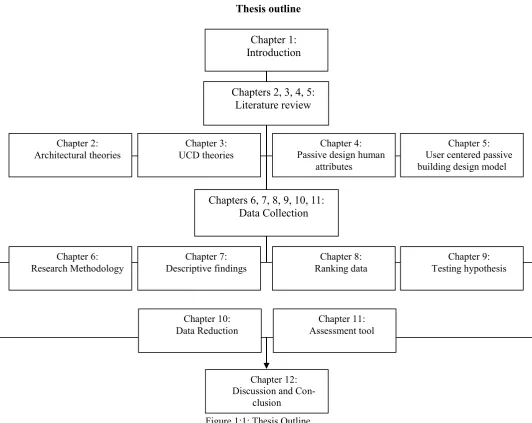
The outline of this research is shown in Fig 1:1 and introduced as follows:
Chapter 1: this chapter provides an overview and introduction for this research, including justifica-tion for the emergence of this research, the aim and objectives of this research, research quesjustifica-tion, scope and limitation of this research, definition of terms and the research contents.
Chapter 2: reviews the historical theory since 1954 until today. This entails a thorough review of various trends of architecture namely modernism, post-modern, post modern ecology, traditional, late modern, new modern, complexity paradigm, sustainability and recent design approaches, trends and theories.
Chapter 3: presents a review about the notions of EU, UCD theories and standards (ISO 9126 and ISO 13407). It reviews the application of UCD theory.
Chapter 4: extracts the EUFs of PDHAs (Passive Design Functionality, Passive Design Perfor-mance, Passive Design Usability, Passive Design Flexibility, Passive Design Reliability and Passive Design Maintainability).
Chapter 6: this chapter reviews the research methods of research and development of the question-naire through various stages. In addition to that, it discusses the advantages of using the questionquestion-naire as well as the quantitative and qualitative methods.
Chapter 7: focuses on the findings of the data collection. It describes the highest and the lowest ef-fective EUFs for each ATT through using the SPSS program using mean value and standard deviation methods.
Chapter 8: concentrates on the ranking of the questionnaire, finding the comparative of the ranking based on the S-ATT’s level, each ATT level and the grouping of ATTs’ level. In addition to that, the ranking was based on the architect experience level and professional role level.
Chapter 9: presents testing the hypothesis of the PDHAs based on both architect experience and the professional role and experience based on using one way ANOVA analysis. In addition to that, Tukey HSD Post Hoc was used to check the rejected EUFs. Further to that, it tested the reliability for each ATT based on professional role and experience of the respondents.
Chapter 10: In this chapter the most effective EUFs are refined by the researcher in order to use them in the proposed assessment tool. This was based on correlation of the EUFs. Then, the redundant one was identified to use in this research. This was achieved through using the SPSS program. After determining the most essential EUFs, they have been clustered in relation to their ATTs.
Chapter 11: The EUFs, which were extracted in chapter 10, are used to develop an assessment tool. Then it has been tested through 4 projects which are namely Houghton Street Project, Cherry Mill Project, Fitzroy Street Project and Tullis Russell Environmental Education (TREE) Centre. The test-ing was through the designers of these projects ranktest-ing the EUFs and calculating them with weight and without weight.
Chapter 12: presents the conclusion of the thesis, contribution and future research work.
1.11
Summary of this Chapter
Thesis outline
Chapter 1: Introduction
Chapters 2, 3, 4, 5: Literature review
Chapter 2: Architectural theories
Chapter 3: UCD theories
Chapter 4: Passive design human
attributes
Chapter 5: User centered passive building design model
Chapters 6, 7, 8, 9, 10, 11: Data Collection
Chapter 6: Research Methodology
Chapter 7: Descriptive findings
Chapter 8: Ranking data
Chapter 9: Testing hypothesis
Chapter 10:
Data Reduction Assessment tool Chapter 11:
Chapter 12: Discussion and
[image:35.595.36.569.70.493.2]Chapter Two: Architectural and Design Theories and Trends
2.1
Introuduction:
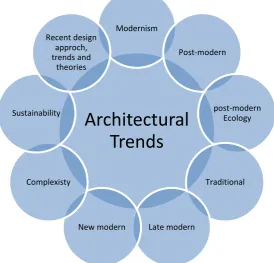
[image:36.595.158.433.408.671.2]The theory of architecture is an approach that reflects on the building design features. Generally, architecture is invigorated with technological revolution and environmental issues. The theory is an important benchmark of architecture since the previous decades. It is said that "theory is an engine of architecture" (Jencks and Kropf, 1997, p.8). This statement reflects the development of architectural practices. The building design approaches are an answer to and proof of that. The differences between architectural theories are a result of experience and the surrounding circumstances. The theories could be related to the trend of a specific period and could be related to a design process. The human is tak-ing a place in some theories through consideration of their comfort or productivity and some theories consider the environmental issues. This research has reviewed the architectural theories since 1954 until the present. This procedure comprised looking at eight out of nine groups which are namely (modernism, post-modern, post-modern ecology, traditional, late modern, new modern, complexity paradigm, sustainability and recent design approaches, trends and theories). Each one of these groups includes several theories as will be explained in the following sections.
Figure 2:1: Architectural Trends
2.2
Modernism
Amir et al (2012) looked at modernism from different perspectives. The modern could be referred to as the thought or character or practice. In addition, this term describes a new art movement
espe-Architectural
Trends
Modernism
Post-modern
post-modern Ecology
Traditional
Late modern New modern
Complexisty Sustainability
Recent design approch, trends and
cially in cultural terms. This change happened between the 18th and early 19th centuries. Modernism is defined as “a socially progressive trend of thought that affirms the power of human beings to create,
improve and reshape their environment with the aid of practical experimentation, scientific knowledge
or technology” (Bermann 1988, p.16,as cited in Amir et al , 2012). In terms of the practice, which is
one of the points that Amir referred to, Leach (2005, p.3) defined modernism as follows: “Modernism is the aesthetic practice of modernity”. Even though it considers the aesthetic, it still refers to changes
and looking to new forms. This trend refers to the ability of changes and movement. Leach (2005) indicated how the social changes have been exposed to the modernist trend. This is an indicator that the modernist trend has an effect at a social level. This trend also refers to the link between functional-ism and architecture, as a result, functionality has been considered in the conceptual model as a pivot compenent that could affect the rest design attributes.
2.3
Postmodern Architecture
de-tails, building and urban, as appear in Appendix A. Some of the theories and principles of this stage could be included in the proposed EUFs for fulfilling EU needs.
2.4
Postmodern ecological
Jencks and Kropf (2006) have listed several architecture manifesto and theories. The theories of this trend were formulated between 1969 and 1996. The list introduced the interaction between ecolo-gy and postmodern. This is obvious in several theories. One of the theories is design with nature. This theory was coined by Ian McHarg in 1969. This theory refers to the need to consider environmental issues. There are several criteria that have been indicated in this theory which are negentropy, apper-ception, symbiosis, fitness (fit ecologically), and pathology (relate to health). This theory looks at how to group various principles to drive the design, method and ecology at the same time. The human need has not taken a clear place within this direction. However, some of these principles could be consid-ered to match EU needs with PD. Sim Van Der Ryn (1979) coined the term integral design theory. This theory is an interaction between natural systems and the environment. The aim of this application is for people’s benefit. This trend is called bio architecture and ecotecture. The latest one comprises human system design which includes functionality, aesthetics and the natural ecosystem. This feature could be taken into account when bridging the gap between the PD and EU needs as introduced in the research problem of this thesis. Hassan Fathy (1986) is one of the architects who considered the eco-logical issues. Jencks and Kropf (2006) referred to the theory Natural Energy and Vernacular Architecture which was coined by Fathy. In this approach, both human and ecological needs have been considered. In terms of the human, buildings have been constructed that fit with their life styles, because this design is for lower class people. Consideration of their local culture (vernacular tradi-tions) as well as local materials that could be reliable to face the environmental issues was required. Considering the traditional style for building is part of consideration of EU needs. These principles should be taken into account when suggesting the factors that should be considered as EU needs.
2.5
Traditional
The majority theories of this trend are concentrated on the traditional style. This trend to some ex-tent is part of the historical trend. Consideration of the principles of traditional theories appeared in the theories of this period. The theories of this period were developed between 1969 and 1994. Hassan Fathy (1969) (as cited in Jencks and Kropf, 2006) developed the theory of architecture for the poor. This theory concentrated on the traditional methods and forms of construction, and has been adopted to accommodate the society’s needs. Looking to the local and traditional methods is required to fit the EU circumstances. Some of Fathy’s principles could be taken into account to meet EU needs, which is
be classified under accommodating changeability. This could enhance the EU needs in case they pre-fer to improve or interact with a new style. The theories of the traditional trends are centred on traditional issues. Demetri Porphyrios (1983) stated that classicism is not a style. Classicism can be defined as “symbolic elaboration of vernacular”. This theory is focused on simplification of the building form and its features. The style of the form and building is one of the essential elements of the buildingwhich could have a clear effective on meeting EU aspirations. This will be considered by the researcher during bridging the gap between PD and EU needs. One of the theories in this period is architecture and theology which made by Quinlan-Terry (1989). This theory shows the relationship between architecture and religion. Taking into account respecting their faith is part of considering EU needs. However, in case considered faith as EUFs will be related under culture EUF. This is also some other theories which will be introduced in the Appendix A.
2.6
Late Modern
The period of this trend was also between 1954 and 1994 as Jencks and Kropf (2006) listed. Pile (2005, p.422) defined late modern as “An alternative theme in recent design rejects the characteristics
of post-modernism in favour of continuing loyalty to the concepts of earlier modernism. Late
modern-ism describes work that does not imitate that of the modern pioneers, but that moves a head in ways in
which they might have been expected to develop their ideas if they were still actively involved in
de-signing buildings”. This trend shows a new route that does not agree with the ATTs of
or considering EU privacy. Non plan theory is a theory that was coined by Credic Price (1969). Non plan is intended to destroy such a system value. Give the possibility to society to change prioritise the regulation. It is enhanced to change and redevelop forms or activities that are not realized. The end result might not be as we want but it could still be positive. This theory seems to avoid the restriction of plan forever. The human factors were considered as part of it. However, it was not in various ATTs or central to architects’ thinking. Also, adaptability in flexibility and usability has solved this issue through responding to changeability and future changes. The theory of this period includes several EUFs that could be considered as EUFs.
2.7
New modern
Occurring between 1976 and 1994, the theories of this trend have been listed by Jencks and Kropf (2006). The architects’ interests in this period were various; some of them concentred on the issue of
functionalism, which is also indicated by some architects in some of the previous trends. Peter Eisen-man is a good example. The theory that was coined ispost functionalism. This theory is an attempt to move from cultural to modernist. This is opposite the humanist to modernist, which means opposite the function and the form. The volumes of theories of this trend include many aspects. With regard to the EUFs, this theory ignored the humanistic system. Considering EU issues with bridging to PD is the main purpose of this research. However, the issue of functionalism could be part of the EU re-quirements that need to be investigated. Bernard Tschumi (1977)is one of the architects of this period. The theory focused on the pleasure of architecture. This theory considered the EUFs by stating that the architecture should reflect what the EU desires. This theory is not related to PDHAs. Pleasure is a wide terminology that should be specified to several criteria such as in terms of human, aesthetic or environment. Considering the issue of the future was one of the features of this period. This is obvious in the Coop Himmelblau (1978) theory, the future of splendid desolation. It refers to the three main aspects: efficiency, economy and expediency. It also reflects the view that architecture is hiding the problem instead of creating awareness. It also believed that the main reason for desolation is the act of using. One issue that was considered in this period is space, via the theory of end space, which was coined by Daniel Libeskind (1979).Libeskind tried to use drawings and text to explore the tensions between various aspects as follows: “experience, intuition and formalisation, the voluntary and invol-untary”. He considered that there is not a clear indicator regarding the involvement of human factors
in this method. This is an approach that relies on the design method as well as the options that the de-signer should have to use in his design. This theory should be taken into account in the theory proposing a process that enhances EU needs.
The changes in architectural trends and philosophies during this period were phenomenal. This is made obvious by Coop Himmelblau’s (1980) philosophy. Architecture Must Blaze was coind by Co-op Himmelblau’s. This philosCo-ophy is said to be creative. In order to achieve this, manifesto said that