JOURNAL OFVIROLOGY, July1993,p. 3978-3988 0022-538X/93/073978-11$02.00/0
Copyright ©1993, American Society forMicrobiology
Characterization
of
Conserved Human
Immunodeficiency
Virus
Type
1gpl20
Neutralization
Epitopes Exposed
upon
gpl20-CD4 Binding
MARKUS THALI,l* JOHN P. MOORE,2 CRAIG FURMAN,' MAcARTHURCHARLES,' DAVID D. HO,2
JAMES ROBINSON,3 ANDJOSEPH SODROSKI14*
Division of Human Retrovirology, Department of Pathology, Dana-Farber CancerInstitute, HarvardMedical School,1andDepartment ofCancerBiology, Harvard SchoolofPublicHealth,4 Boston, Massachusetts 02115;AaronDiamond AIDS Research Center, NewYorkUniversity Schoolof Medicine, NewYork, New
York 100162; and University of ConnecticutHealth Sciences Center, Farmington, Connecticut060303 Received 22 January 1993/Accepted5April1993
Interaction with the CD4 receptor enhances the exposure on the human immunodeficiency type 1 gpl20
exterior envelopeglycoproteinofconserved, conformation-dependent epitopes recognizedby the 17band48d neutralizing monoclonal antibodies. The 17b and 48d antibodies compete with anti-CD4 binding antibodies such
as15eor21h, which recognize discontinuousgpl20sequencesneartheCD4binding region. To characterize the 17b and 48d epitopes,apanel of human immunodeficiency virus type 1gpl20mutantswastested forrecognition
by these antibodies in the absenceorpresenceofsoluble CD4.Single amino acid changes in five discontinuous, conserved, andgenerallyhydrophobic regions of thegpl20 glycoproteinresulted indecreasedrecognition and neutralization by the 17b and 48d antibodies. Some of these regions overlap those previously shown to be important forbinding of the 15e and 21h antibodiesorfor CD4binding. These results suggest that discontinuous,
conservedepitopes proximaltothebindingsites forboth CD4 and anti-CD4bindingantibodies become better exposedupon CD4binding andcan serve astargets forneutralizing antibodies.
Human immunodeficiency virus type 1 (HIV-1) is the etiologicagent of AIDS (4, 22). HIV-1 establishes a
persis-tentinfection inhuman hosts, eventually resultingin defec-tive cellularimmunity secondarytoCD4lymphocyte deple-tion(18, 41).
TheHIV-1exteriorenvelopeglycoprotein, gpl20,and the transmembraneenvelopeglycoprotein, gp4l, arederivedby
cleavage of the gp160 envelope glycoprotein precursor (2,
67). HIV-1 is tropic for CD4-positive cells by virtue of a
high-affinity interactionbetweenthegp120 exterior envelope glycoprotein and the CD4 glycoprotein, which acts as the virusreceptor(11, 38, 46, 49). Followinggpl20-CD4 binding, the fusion ofviral and hostcellmembranes,which involves both gp120 and gp4l envelope glycoproteins, allows virus entry(28, 75).Amino acidchangesinthethird variable(V3) regionofgpl20, which formsadisulfide-linked loop (44), the
fourthconserved (C4) gp120 region, the gp4l amino
termi-nus,thegp4l ectodomain,orthe gp4ltransmembrane region
dramatically reduce theefficiency ofthe membrane fusion
process (13, 20, 21, 25, 28, 30, 33, 39, 40, 60, 77, 84).
Neutralizing antibodiesappeartobeanimportant
compo-nentofaprotective immuneresponse (7, 16, 17, 24).HIV-1
neutralizing antibodiesaredirected against linearor
discon-tinuous epitopes of the gp120 exterior envelope glycopro-tein. Neutralizing antibodies that arise early in infected humansandthat arereadily generated in animals by
immu-nization with gp120 or gpl60 preparations are primarily
directed against linear determinants in the V3 loop of the gp120 glycoprotein (35, 47, 48, 55, 64-66, 69, 71). These antibodies generally exhibit the ability to neutralize only a
limited numberof HIV-1 strains (23, 48, 57, 61), although a
subset ofanti-V3antibodies recognizelessvariableelements
*Correspondingauthor.
of the region and therefore exhibit broader neutralizing activity(1, 24a, 34, 42, 58). Envelope glycoproteinvariation within the linearV3 epitope and outside of theepitopecan
allowescapeof viruses from neutralizationbythese antibod-ies(50, 56). These antibodies donotblockCD4bindingbut apparently interfere with post-receptor binding events in-volvedin virusentryandsyncytium formation, presumably by disruptingastepinthemembrane fusionprocess(45, 72). Later in the course of HIV-1 infection of humans,
anti-bodies capable of neutralizing a wider range of HIV-1
isolatesappear(6, 31, 53,55,64, 85).Thesebroadly
neutral-izingantibodies have been difficulttoelicit inanimals (7, 27) and are not merely the result of additive anti-V3 loop reactivities against diverse HIV-1 isolates that accumulate duringactiveinfection(64).Asubset of thebroadlyreactive antibodies, found inmostHIV-1-infected individuals, inter-feres with the binding ofgp120 andCD4 (36, 74). At least
some of these antibodies recognize discontinuous gp120
epitopes present only on the native glycoprotein (26, 74).
Antibodies that recognize conformation-dependent gp120 epitopes are highly prevalentin HIV-1-infected individuals (53). Human monoclonal antibodies derived from HIV-1-infected individuals have been identified thatrecognizethe gp120 glycoproteinsfromadiverserangeofHIV-1 isolates,
that block gpl2O-CD4 binding, and that neutralize virus infection (31, 37, 63, 68, 82). Recently, the discontinuous epitopes recognized by five of these human monoclonal antibodies havebeencharacterized (51, 78, 80). Amino acid changes in seven widely separated areas ofthe gp120 pri-mary sequence,four ofwhichoverlap regions definedtobe important for CD4 binding, disrupt recognition by these antibodies and, in some cases, allow the generation of
neutralizationescapemutants(51, 78, 80). The shared
com-ponentsof theantibody epitopesand thediscontinuous CD4 binding region include threonine 257, aspartic acid 368, 3978
Vol. 67, No. 7
on November 9, 2019 by guest
http://jvi.asm.org/
HIV-1 gp120 NEUTRALIZATION EPITOPES 3979 glutamic acid 370, lysine 421 to tryptophan 427, and aspartic
acid 457 (10, 43, 51, 59, 78, 80). The anti-CD4 binding antibodies and anti-V3 loop antibodies exhibit additive or synergisticneutralization of HIV-1 (8, 79, 81).
The 17b and 48d monoclonal antibodies, which were derived from different HIV-1-infected individuals (67a), compete with each other and with the anti-CD4 binding antibodies for gp120 binding. These antibodies neutralize a number of divergent HIV-1 isolates, which suggests that they bind awell-conserved structure on the envelope glyco-protein (67a). Here we characterize the interaction of the 17b and 48dantibodies with the HIV-1 gp120 glycoprotein.
MATERIALS AND METHODS
Binding ofradiolabeledanti-gp120 antibodies to transfected COS-1 cells. COS-1 cells were transfected with 10,ug of pSVIIIenv DNA expressing wild-type or mutant HIV-1 envelopeglycoproteins of the HXBc2 strain (28, 59). Sixty hours aftertransfection, the COS-1 cells were washed with phosphate-buffered saline
_PBS)
containing 2% fetal bovine serum andincubated with3"S-labeledmonoclonal antibodies against gp120, either in the absence or in the presence of soluble CD4 (sCD4). Approximately 108 antibody-producing hybridoma cells were labeled overnight in 60 to 80 ml of cysteine- and methionine-free RPMI medium containing 5 mCi each of [35S]cysteine and [35S]methionine (New En-gland Nuclear). Nonlabeled cysteine and methionine were added in excess to the labeled medium. One milliliter of the antibody-containing medium was added to each 100-mm-diameter dish of transfected COS-1 cells. The envelope-expressing COS-1 cells were incubated with the antibody and, in some cases, with 1.3 ,ug of sCD4 (5, 12, 19, 32, 73, 83) perml for 90 min at room temperature, washed three times with ice-cold PBS containing 2% fetal bovine serum, and lysed. Half of the lysates were incubated with protein A-Sepharose beads, which were washed according to the procedure used for immunoprecipitation (see below). The labeledantibody was visualized on a reducing sodium dode-cyl sulfate (SDS)-polyacrylamide gel.Immunoprecipitations. Immunoprecipitations were carried out as previously described (80, 86), using Nonidet P-40
(NP-40) buffer (0.5% NP-40, 0.5 M NaCl, 10 mM Tris HC1
[pH 7.5]) to lyse the transfected COS-1 cells, after labeling
with [35S]cysteine. In some cases, sCD4 was added to the
celllysatestoafinal concentration of 10 ,ug/ml. Labeled cell lysates were precipitated at 4°C either with a mixture of sera from AIDSpatients or withaparticularmonoclonal antibody (10 ,ug/ml, final concentration) and protein A-Sepharose beads. Theprecipitates were washed with NP-40 buffer and then analyzed on SDS-polyacrylamide gels. The relative
recognition of mutant glycoprotein was estimated by visual
inspection and, in some cases when decreases were ob-served, by densitometry.
ELISAdetermination of mutant gp120 recognition by anti-bodies. COS-1 cells were transfected with 10 ,ug of pSV-IIIenv DNA expressing wild-type or mutant HXBc2 enve-lopeglycoproteins. Sixty hours after transfection, cell super-natantswere collected and frozen. For analysis of antibody recognition, the supematants (100 ,ul), supplemented with 20
mM N-2-hydroxyethylpiperazine-N'-2-ethanesulfonic acid
(HEPES)buffer(pH7.0), were incubated in wells of
Immu-lon II enzyme-linked immunosorbent assay (ELISA) plates
(Dynatech, Ltd.) coated with sheep antibody D7324 to the
carboxyl-terminal 15 amino acids ofgpl20. Captured
indi-rectly onto a solid phase in this way,gpl20retains the ability
to bind sCD4 with high affinity (52). Monoclonal antibody 17b or 48d at a fixed concentration diluted in TMSS buffer (Tris-buffered saline [TBS] containing 2% nonfat milk pow-der and 20% sheep serum) was reacted with the captured gpl20, and bound antibody was detected with alkaline phosphatase-conjugated goat anti-human immunoglobulin (Accurate Chemicals) and the AMPAK system (Dako Diag-nostics) (53). The monoclonal antibody concentration was selected on the basis of titration curves to give approxi-mately 75% of the level of binding to the wild-type
gpl20
at saturating antibody concentrations. Use of this antibody concentration resulted. in signals of sufficient magnitude to be reliable while allowing sufficient sensitivity to small changes in the affinity of antibody for mutant glycoproteins. Since the concentrations of the different mutant glycopro-teins in the COS-1 supernatants differed and since normal-ization on a single wild-type well was too susceptible to random error, the binding of the monoclonal antibody to a particular mutant was compared with the binding to the entire panel of mutants. First, in quadruplicate plates, the reactivities of the gpl20 mutants with a pool of HIV-1-positive sera were measured. These measurements were carried out in the presence of 0.5% Tween 20 to maximize reactivity with multiple epitopes and thus provide a measure of the amount of mutant protein available in the wells. After correction for background (using a mock-transfected COS-1 supernatant), the mean optical density at 492 nm (OD492)value for each mutant was determined as a reference value. Second, the 17b or 48d antibody was assessed for binding to the mutant panel in duplicate or triplicate, and the mean
OD492values were determined. For each mutant, theOD492
ratio of monoclonal antibody to reference patient serum was calculated. The average value of this ratio (mean + standard deviation) for the entire mutant panel was then calculated, eliminating from the calculation values near zero (i.e., mu-tants that do not bind antibody) to avoid skewing of the data. Amino acid changes that were scored as inhibitory to anti-body binding exhibited ratios less than 0.5 times the mean ratio, which titration curves indicated represents a threefold or greater decrease in antibody affinity (data not shown and reference 51).
Antibody competition analysis. BH10 gpl20 (25 ng/ml in TBS-10% fetal calf serum [FCS]) (Celltech, Ltd.; provided by the U.K. MRC AIDS Directed Programme) was captured onto a solid phase by antibody D7324 as described above. Competitor murine monoclonal antibodies were reacted with the captured protein for 30 min in 50 ,ul of TMSS buffer before addition of test antibody (48d) in 50
,ul
of TMSS buffer for a further hour. The amount ofgpl20-bound48d antibody was determined by using alkaline phosphatase-conjugated goat anti-human immunoglobulin. Cross-reactivity of the goat antibody with the murine competitor antibodies was minimal and did not significantly interfere with the assays.Effect of sCD4 on antibody binding to monomeric gp120
glycoprotein. BH10 gpl20 (1 ,ug/ml in TBS-10% FCS) was incubated at room temperature for 45min in the presence of 40 jig of sCD4 per ml and then diluted 20-fold inTBS-10% FCS to yield a final gpl20concentration of 50 ng/ml and a final sCD4 concentration of 2 ,ug/ml. One hundred microli-ters of the mixture was captured onto wells coated by antibody D7324 for 2 h. The wells were washed twice with
TBS, and then different concentrations of monoclonal anti-body in 100 jil of TMSS were incubated with the wells for 1 h. Thewells were washed, and bound antibody was detected asdescribed above.
V'irus neutralization assay. Complementation of a single VOL.67,1993
on November 9, 2019 by guest
http://jvi.asm.org/
3980 THALI ET AL.
350
300
I-0
Co250
r0
.:
m 200
150
0)
ci100
Cu
cc
50
0
17b
-sCD4 +sCD4
48d -sCD4 +sCD4
Fl05
-sCD4 +sCD4I1
awa0.
co
o0.
0
m .oO.0.
c\lO
cz
0,CY)
a0,
O.
D0. co a)0
.C FIG. 1. Effect of sCD4binding on recognition of cell surface HIV-1 envelope glycoproteins by monoclonal antibodies. COS-1 cellsexpressing wild-typeHIV-1envelope glycoproteinswere incu-bated with radiolabeled antibody in the absence (grey bars) or
presence(black bars)of 1.3
p.g
of sCD4 per ml.The values shown arethose fromatypicalexperiment; theamountofantibody boundwasdeterminedby densitometricscanningof the antibody heavy-chainband.Nonspecific antibody bindingtoCOS-1cellstransfected withplasmid pSVIIIenvAKS, which contains adeletion within the
envgene, wassubtracted from all values.
round of replication of the env-deficient chloramphenicol
acetyltransferase (CAT)-expressing provirus by the mutant
envelope glycoproteins was performed as previously de-scribed(28,78,80).Forinhibition of virusreplication,either no antibody or 30 ,ug of monoclonal antibody per ml was incubated withrecombinantCAT-expressingvirus for 1 hat
37°C before exposure of the virus to targetJurkat
lympho-cytes.Theconcentration ofantibodywaschosento neutral-ize atleast80% ofthe virionscontainingwild-type HXBc2
envelopeglycoproteins. CATactivityinthe target cellswas
measured aspreviouslydescribed (28).
RESULTS
Enhanced recognition ofHIV-1 envelope glycoproteins by the17b and 48dantibodiesfollowing CD4 binding. To exam-ine the effect of CD4binding on recognition of the HIV-1
envelope glycoproteins by the 17b and 48d antibodies,
radiolabeled 17b and 48d antibodieswere incubated in the absence or presence of sCD4 (5, 12, 19, 32, 73, 83) with COS-1 cells expressing the HIV-1 envelope glycoproteins
(HXBc2strain).AnsCD4 concentration below thatrequired
tosaturatethemultimericenvelope glycoproteincomplexon the cellsurfaceandroomtemperatureincubationwereused
to minimize gpl20 shedding by sCD4 (27a, 51a). Figure 1 shows that incubation ofenvelope glycoprotein-expressing
COS-1 cellsat37°C with 1.3 ,ug of sCD4 per ml resulted in three- and twofold increases in binding of the 17b and 48d
antibodies, respectively. By contrast, binding of the F105
antibody, whichrecognizesanepitope overlapping the CD4
binding site (80), was slightly decreased by incubation of the COS-1 cells with the same concentration of sCD4. The
relatively small effect on F105 binding indicates that under
theseconditions,gpl20shedding is minimal and only a small fraction of the available envelope glycoproteins are occupied
bysCD4. F105 antibodybinding was reduced by more than
90% when a higher concentration (35 ,ug/ml) ofsCD4 was
used in this assay (data not shown). Binding of labeled
.6- ADP324
.5
-.4
-~.3
-~.2
-OI.
..1
-1
[image:3.612.51.285.60.234.2] [image:3.612.309.544.71.246.2]1/30,0001/10,0001/3,0W 111,000 1/300 1/100
[Antibody](dilution of supernatant)
.7 .6 1.5 .4
.-3
.2 1.1
c,0.6 15e
O0.5
-0
° 0.4
-o0.3
-x0.2
-DC0.1
-an
.3o .ci0.6 o0.5 0
'a0.4 o0.3
CD
n0.2
c0.1
a:,
0.03 0.1 0.3 1 3 10 [Antibody](jig/mi)
0.03 0.1 0.3 1 3 (Antibody] (jig/mi)
10
48d
0-~
0.03 0.1 0.3 1 3 10 [Antibody](gig/ml)
FIG. 2. Effectof sCD4onantibodybindingtomonomericgp120 glycoproteins. Binding of the ADP 324 (anti-V1/V2 region), 15e (anti-CD4 binding region), 17b, and 48d antibodies to captured HIV-1 gp120 glycoproteinis shown. Thegp120 glycoprotein was
preincubatedin either the presence(0)orabsence(0)of sCD4prior tocaptureasdescribedin Materials and Methods.
antibodies to COS-1 cells transfected with plasmid pSVIIIenvAKS, which contains a deletion within the env gene,wassignificantlylower than thatseenfor thewild-type glycoprotein andwas notenhancedby the presence of sCD4
(data not shown). These results demonstrate that sCD4
interaction with the HIV-1envelopeglycoproteinsresults in enhanced binding of the 17b and 48d antibodies to the
envelopeglycoprotein complex.Bindingof the 48dantibody
tomonomeric,recombinantgpl20attachedtoELISAplates
via a carboxy-terminal antibodywas also enhanced in the presenceof added sCD4(Fig. 2). Slight increasesinbinding
of the 17bantibodyto monomericgpl20in the presence of
sCD4werealsoseen(Fig. 2). Thus, HIV-1envelope
glyco-proteinoligomerizationisnotessential for thesCD4-induced
enhancement of 48d or 17b binding. However, because of differences in the assays usedherein,further studies will be
required to accurately assess the relative contributions of
monomer-andoligomer-specific interactionsto17b and 48d exposure.
Effectsofaminoacidchangesin theHIV-1gp120
glycopro-tein on antibody recognition. The 17b and 48d antibodies
recognize conformation-dependent epitopes on the HIV-1
gpl20 envelope glycoprotein and compete with each other
forbinding gpl20(67a).Since these antibodieswereraised in
infected patients to random HIV-1 strains yet efficiently
recognizeHIV-1 IIIB and other laboratoryHIV-1 isolates,
the antibody epitopes must be reasonably well conserved
among HIV-1 variants. To characterize theseepitopes, the
abilityof the 17b and48d antibodiestoprecipitateapanelof
HIV-1 (HXBc2 strain) gp120 mutants from transfected
COS-1 cell lysates was examined. Pilot experiments indi-cated that both 17b and48d antibodiesprecipitatedthegp160
andgpl20 glycoproteinsfrom COS-1 celllysatesprepared in
NP-40 buffer. By contrast, almost no detectable precipita-tion of theseproteins prepared inradioimmunoprecipitation
assay (RIPA) buffer (1% Triton X-100, 0.1% SDS, 1%
sodiumdeoxycholate, 150mM NaCl, 10mMTris HCl [pH
7.5])wasobserved(datanotshown), indicatingthat the17b
and 48d epitopes were either not well preserved or not
exposed under these conditions. Thus, studies using
enve-J.VIROL.
on November 9, 2019 by guest
http://jvi.asm.org/
HIV-1 gpl2O NEUTRALIZATION EPITOPES 3981 lope glycoproteins in celllysateswereperformed with NP-40
buffer. Since the studies described aboveindicatedthat CD4 binding could influence recognition of the HIV-1 envelope
glycoproteinsby theseantibodies,precipitation of the
enve-lopeglycoproteinswas performed in both the absence and
presenceof sCD4 in the COS-1 celllysates.
The results of the immunoprecipitation studies are
sum-marized in Table 1. Recognition of the HIV-1 envelope
glycoproteinsby the 17b and 48d antibodies in the absence of
sCD4 was decreased by changes in several amino acids located invariousregionsofgp120. Significantdecreases in
envelopeglycoproteinprecipitation byboth antibodieswere
observed for amino acidchanges inCl(Trp-69, Asn-88,and
Lys-117), C2 (Arg-252, Thr-257, andAsn-262), C3 (Glu-370
and Gly-380 to Phe-382), C4 (Ile-420, Lys-421, Trp-427,
Ala-433, Tyr-435, and Pro-438), and C5 (Met-475,Asp-477,
andLys-485). Whilesingle amino acidchangesinthe
gp120
variable regions exhibited little effect on recognition by
either antibody, neither the 17b nor 48d antibody
precipi-tated HIV-1 gp120mutants
containing large
deletions in theV1/V2orV3region(A119-205 and
A297-329).
Somemutants(183/184
PI/SG,
256 S/Y, 262 N/T, 266 A/E, 281A/V,
384Y/E, 421 K/L, and485 K/V)were recognized differently by
the 17b and 48d antibodies.
Incontrast tothe
enhancing
effect of sCD4onrecognition
of the HIV-1 envelope
glycoproteins by
the 17b and 48d antibodies observed at room temperature in the absence ofdetergent, the presence of sCD4 did not
significantly
affecttheabilityof thewild-type glycoproteintobe
precipitated
at4°C from NP-40 cell
lysates by
eitherantibody
(data
notshown). Similarly, all of themutants
efficiently
precipitated
bythese antibodies in the absence of sCD4were
precipitated
with equivalent efficiency in the presence of sCD4. By
contrast, a number of
envelope
glycoprotein
mutants thatwereinefficiently precipitated bythe 17b or48d
antibody
inthe absence of sCD4 exhibited
wild-type
levels ofrecogni-tion by these antibodies in the presence of sCD4. This
phenomenon was observed for mutants
containing single
amino acid
changes
(69 W/L,
88N/P,
113D/R, 183/184
PI/SG,
207K/W,
266A/E,281A/V.
370E/D,
and 381E/P)
as wellasfora mutant(A297-329) containing
alarge
deletionof the V3loop.Othermutantsexhibiting
lowrecognition
by
the 17b or48dantibody
inthe absence of sCD4exhibited someimprovement in
precipitation
by these antibodies whensCD4waspresent,but
recognition
inthe lattercase wasstilldiminished
compared
with thatseenfor thewild-type
glyco-protein. Finally,the low
recognition
ofanumber ofmutantswas not substantially
improved by
adding
sCD4 to thelysate. Insomecases,this lack of
improved
precipitation by
antibody might be due to the poor
ability
of the mutantglycoproteintobind sCD4
(e.g.,
257T/R,
370E/R,
427W/V,
and 427
W/S).
Inother cases, themutantglycoproteins
were ableto bind sCD4(59), indicating
that the poorrecognition
of themutant
by
theantibody
was noteffectively
alteredby
CD4
binding.
Examples
of the latter mutantsincludeA119-205, whichcontains adeletion of the
V1/V2
loop,
and 257T/A,257T/G,421
K/L,
433A/L,
470P/G
and 477D/V.
Recognition ofHIV-1 gp120 mutants by the 17b and 48d antibodiesin the absenceofdetergent.Since the
immunopre-cipitationsdescribed abovewerecarriedoutin the presence
ofNP-40, aminoacids
important
for17bor48drecognition
were studied in the absence of
detergent.
Because of thelabilityof the HIV-1
gp120-gp41
interaction,
afractionof thegp120
glycoproteinexpressed
inCOS-1 cells is shed into thecell supernatant
(29).
This solublegpl20
was bound toELISA plates by
using
anantibody
directed to thegp120
carboxyl
terminus(52).
Thereactivity
of the boundgpl20
mutants to the 17b or48d
antibody
wasmeasured, using
a mixture ofpolyclonal
serafrom HIV-1-infected individuals tonormalize theamountofmutantglycoprotein
available forbinding.
Withonly
afewexceptions,
theamino acidchanges
identifiedas
important
for 17bor48dprecipitation
ofgp120
in
NP-40-containing
celllysates
wereconfirmedtobeimpor-tant for
reactivity
in the ELISA. Theexceptions
were observed for mutant 88N/P,
which wasrecognized
effi-ciently by
both 17b and 48d antibodies in theELISA;
the mutantsinvolving changes
in threonine257,
which in theELISA were
recognized
efficiently
by
the 17b and 48dantibodies;
mutant 421K/L,
whichwasrecognized by
the 17bantibody equivalently
to thewild-type glycoprotein
in theELISA;
andmutants477D/V
and 485K/V,
whichwererecognized
efficiently
in the ELISAby
both antibodies(data
not
shown).
Inthe ELISA
format,
itwasnoted thatseveral amino acidchanges
(A119-205,
207K/W,
381G/F,
382E/P,
384Y/E,
420I/R,
421K/L,
427W/V,
427W/S,
and 438P/R) completely
eliminateddetectable 48d
antibody recognition regardless
ofthe
antibody
concentrationused. Forsomegpl20
mutants,however,
use of increased concentrations of the 48danti-body
allowedan increase inantibody binding
tothemutantglycoprotein.
Thisphenomenon
was observed for mutants 69W/L,
117K/W,
252R/W,
262N/T,
433A/L,
and 475M/S.
These results suggest that the
affinity
of the 48dantibody-antigen
interactionisaffected lessby
the latter thanby
the former group ofamino acidchanges.
Competition
forgpl20 binding
between 48d and other monoclonalantibodies. Tocomplement
themutagenic
anal-ysis
of the 48depitope,
several monoclonal antibodiesweretested forthe
ability
to compete with the 48dantibody
forbinding
toHIV-1gp120
from the BH10 strainimmobilizedonanELISA
plate
asdescribed above(52).
Asshown in Table2,
strongcompetition
forgpl20
binding
was observed be-tween the 48dantibody
andantibody
ICR39.13g,
whichrecognizes
a discontinuousgp120
epitope
overlapping
theCD4
binding
site(51).
A moderatedegree
ofcompetition
wasobserved between the 48d
antibody
and the G3-42 andG3-508 antibodies
(76),
whichrecognize
a linear C4se-quence
(EVGKAMYAPP)
betweenamino acids 429 and 438. The ADP 324antibody,
butnotthe ADP325antibody,
also exhibited moderatecompetition
forgpl20
binding
with the 48dantibody.
Both ADP 324 and ADP 325 antibodiesrecognize
determinants within theV1/V2
stem-loop
struc-ture(51b,
62).
Otherantibodies directedagainst
theV1/V2
structure did not
efficiently
competewith the48dantibody
for
gpl20
binding.
Weak or moderatecompetition
wasobserved forsomeantibodiesthat
recognize
linearepitopes
in the V3gpl20
region
or in the Clgpl20
region
between residues 60 and 90.Escape
from neutralizationby
17b and 48d antibodies. To examine whether the amino acidchanges
that affected 17bor48d
antibody
recognition
in COS-1 celllysates
might
altersensitivity
toneutralization,
an envcomplementation
assay was used(28).
In this assay, recombinant virions are pro-ducedby
cotransfection of COS-1 cells with aplasmid
expressing
thewild-type
or amutantenvelope
glycoprotein
and aplasmid
containing
an env-deleted HIV-1provirus
encoding
the CATprotein
(28).
The recombinant virions wereincubated in the presenceorabsenceof the 17bor48dantibody prior
toexposuretoJurkattarget
cells.Thedegree
ofneutralizationwas assessed
by
comparing
the CATactiv-ity
in thetarget cellsfollowing
exposuretovirusesincubatedwithorwithout
antibody.
VOL.67, 1993
on November 9, 2019 by guest
http://jvi.asm.org/
Recognition bymonoclonalantibody:
gpl20 Envelope 748
region glycoprotein1748
Without sCD4 With sCD4 WithoutsCD4 With sCD4
Wildtype ++++ ++++ ++++ ++++
C1 36V/L ++++ ++++ ++++ ++++
40Y/D ++++ ++++ ++++ ++++
45W/S ++++ ++++ ++++ ++++
69W/L + + ++++ ++ ++++
76P/Y ++ +++++++++
80N/R ++++ +++ ++++ ++++
88N/P + ++ ++ ++++
102E/L ++++ ++++ ++++ ++++
103Q/F +++ ++++ ++++ ++++
106E/A ++++ ++++ ++++ ++++
113D/A +++ ++++ ++++ ++++
113D/R ++ ++++ ++ ++++
117K/W + ++ ++ +++
120/121 VK/LE +++ +++ +++ +++
125L/G ++++ ++++ ++++ ++++
V1/V2 152/153 GE/SM ++++ ++++ ++++ ++++
166R/L ++++ ++++ +++ ++++
168K/L ++++ ++++ ++++ ++++
176/177FY/AT ++++ ++++ ++++ ++++
179/180 LD/DL ++++ ++++ ++++ ++++
183/184 PI/SG + + ++++ ++++ ++++
191/192/193
YSL/GSS +++ ++++ ++++ ++++
A119-205 -+ -+
C2 207K/W -+++ -++++
252R/W ++ +++ ++ +++
256S/Y ++++ +++ -+
257T/R + + + + + + + +
257T/A ++ ++ ++ + +
257T/G + + + ++ + +
262N/T + + +++ -+
266A/E + + ++++ ++++ ++++
267E/L +++ +++ +++ +++
269E/L ++++ ++++ ++++ ++++
281A/V + + ++++ ++++ ++++
V3 298R/G +++ +++ ++ +++
308/309/310 ++++ ++++ ++++ ++++
RIQ/RPELIPVQ
313P/S ++++ ++++ ++++ ++++
314G/W +++ ++++ ++++ ++
A297-329 -++++ -++++
356N/I ++++ ++++ ++++ ++
C3 368D/R ++++ ++++ ++++ ++++
368D/P ++++ ++++ ++++ ++++
368D/T ++++ ++++ ++++ ++++
368D/K ++++ ++++ +++ +++
370E/Q + ++++
370E/R ++ ++ ++ + +
370E/D + + ++++ + +
380G/F + ++++ + +++
380/381 GE/FY -++ -+
381E/P -++++ _+++
382F/L + + + + + +
384Y/E ++++ ++++ + ++++
V4 386N/Q ++++ ++++ ++++ +++
392N/E397
N/E ++++ ++++ ++++ ++
395W/S + + ++ ++ ++++++
406N/G ++++ ++++ ++++ ++++
C4 420I/R -+ - ++
421K/L ++ + + -+
427WIV--N
427
WlS----429KJL ++++ ++++ ++++ ++++
430V/S ++++ ++++ ++++ ++++
J. VIROL. 3982 THALI ET AL.
TABLE 1. Precipitationof HIV-1gpl20glycoprotein mutantsin COS-1 celllysates by17band 48d antibodies'
Continuedonfollowingpage
on November 9, 2019 by guest
http://jvi.asm.org/
HIV-1 gpl20 NEUTRALIZATION EPITOPES 3983
TABLE 1-Continued
Recognition by monoclonalantibody:
gpl20 Envelope 17b 48d
region glycoprotein
Without sCD4 WithsCD4 WithoutsCD4 WithsCD4
432 K/A +++ +++ ++++ ++++
433AlL ++ ++ ++
435Y/H +++ +++ ++++ ++++
435Y/S ++ + ++
438P/R ++ +++ + +++
450T/N ++++ ++++ ++++ ++++
456R/K ++++ ++++ ++++ ++++
457 D/A +++ +++ ++++ ++++
457D/G ++++ +++ +++ +++
457D/R +++ ++ +++ +++
457D/N ++++ ++++ ++++ ++++
457D/E ++++ +++ +++ ++++
V5 463 N/D ++++ ++++ ++++ ++++
C5 470P/G ++ ++ +++ +++
475 M/S ++ + ++
477D/V + ++ ++ ++
485K/V + ++ +++ +++
491
+1++
I/F ++++ +493P/K ++++ ++++ ++++ ++++
495G/K ++++ +++ +++
497/498/499
APT/VLL ++++ ++++ ++++ ++++
5001501
KA/KGIPKA +++ +++ +++ +++
aRecognitionof the mutantglycoproteinsbyeachmonoclonal antibody relativetorecognitionof thewild-type glycoproteinwasassessedbyprecipitation.The amountsof mutant andwild-type glycoproteins present in thelysatewereassessedby a parallelprecipitation usinga mixture of serafrom HIV-1-infected individuals. Symbols: ++++, precipitation approximatelyequivalent to thatofthewild-type glycoprotein;++ +,signals61 to90%of thewild-typelevel;++, signals16 to60% ofthewild-typelevel; +,signals1to 15% ofthewild-typelevel;-, noprecipitation.
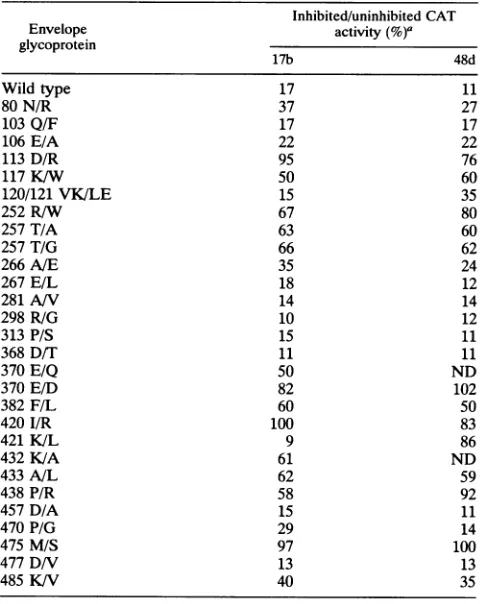
Table 3 shows the ratios of CATactivity inJurkat target cells detected afterexposureofrecombinantvirusesto30,ug of 17bor48dantibodypermlat37°Cfor 1 hcomparedwith the activity seen when recombinant virions were similarly
incubatedwithoutantibody. This concentration ofantibody neutralizedmorethan 80% of recombinant viruses
contain-ing the wild-typeHIV-1 envelope glycoprotein. The sensi-tivityofseveralmutants toneutralizationbyboth antibodies
was diminished compared with that of virus containing the wild-type glycoprotein. Although the efficiency of virus entryvariedamongthe differentenvelopeglycoproteins,this value didnotdemonstrate anyobvious relationship to
neu-tralization sensitivity. Significantdecreases in sensitivityto neutralizationbyboth the17b and48d antibodieswerefound
formutants 113D/R, 252R/W, 257T/A, 257T/G, 370E/D,
382F/L,420I/R,433A/L,438P/R,and475M/S.Mutant 421 K/Lwas theonly envelope glycoprotein tested that exhib-itedasignificant difference between 17b and 48d
neutraliza-tion. Mutant 421 K/Lwasneutralizedefficiently by the17b
antibodybutnotbythe48dantibody. DISCUSSION
For viruses like HIV-1 that fuse viral and target cell membranes at neutral pH, receptor binding is thought to induce conformational changes in the envelope glycopro-teinsnecessaryfor the fusionevent (3,40, 54). The 17b and 48d epitopesonthe HIV-1gpl20 envelope glycoprotein are
present onthe nativeenvelope glycoprotein complexin the
absence ofsCD4 butareincreasedinnumberoraccessibility
bysCD4binding.These results suggest that CD4bindingcan
induce conformational changes in the HIV-1 envelope gly-coprotein complex.That someenhancementof 48d and 17b
antibody binding to a monomeric gpl20 protein in ELISA
[image:6.612.61.561.88.353.2]occurred indicates thatatleast part ofthe gpl20 conforma-tional change can occur within a single polypeptide chain and that a change in accessibility probably underlies this
TABLE 2. Competitionofanti-gpl20monoclonal antibodies with the 48dantibodyforbindingtomonomericgpl20 Competing Concn ofcompeting HIV-1gp120 region %48dantibody
antibody antibody useda recognized bound+SD
None 100± 11
ICR39.13g 11500 DiscontinuousCD4 5 ± 2 bindingsite
G3-42 2 C4 35 4
G3-508 2 C4 33 ± 5
ADP324 1/100 V1/V2 44 ± 8
ADP325 1/20 V1/V2 92± 8
G3-4 2 V2 92 14
G3-136 5 V2 101 ± 8
BAT-085 10 V2 93 ± 6
52-581-SC258 10 V1/V2 70 ± 7
52-684-238 1 V1/V2 89 ± 7
BAT-123 1 V3 59 + 9
9284 5 V3 55 10
110.5 1/104 V3 85 ± 11
110.J 10 V3 41 ± 11
110.4 1/104 V3 71± 3
133/290 10 Cl(residues 60-72) 55 ± 8
ADP360 1/100 Cl(residues80-90) 49± 6
B2 10 Cl(residues90-100) 82 ± 10
aSaturating concentrations ofcompeting antibodies, determined in pilot experimnents,wereusedin all assays.Antibodyconcentrationsarereportedas
micrograms ofpurified antibodypermilliliteror asdilutions ofhybridoma
supernatants.
VOL. 67,1993
on November 9, 2019 by guest
http://jvi.asm.org/
[image:6.612.318.558.487.692.2]3984 THALI ET AL.
phenomenon. The importance of this or other reported CD4-inducedconformationalchangesin the HIV-1envelope glycoproteins (9, 70) for thefunctionof theglycoproteins is stillunknown.The targetingofthe 17band 48depitopes by antibodies able to neutralize virus infection makes these attractive candidates for functionally relevant conforma-tionalalterations.
Recognition by the 17b and 48d antibodies is markedly sensitive to changes in gpl20 conformation. Neither the gpl20 northegpl60 glycoproteinwasprecipitatedbythese antibodiesunder the conditionspresentinRIPAlysisbuffer. A large fraction of the amino acid changes tested in this study affected envelope glycoprotein recognition by both antibodies. Three approaches were used to identify gpl20
regions that are most important for antibody recognition underavariety ofconditions. First, the precipitationofthe HIV-1envelope glycoproteinsincelllysateswascarriedout inthepresenceofsCD4,whichrestoredantibody bindingto
anumber of mutantglycoproteins.Thisfindingsuggeststhat sCD4 canrestrict the conformational flexibility that results from some amino acid changes and thereby improve the efficiency of antibody recognition. Residues in which changes resulted in decreased recognition both in the
ab-sence and in the presence of sCD4 are more likely to
contribute significantly to the antigen-antibodyinteraction. Second,gpl20 recognition bythe17b and 48d antibodieswas
examined both indetergent-containingcelllysatesand incell supernatants in the absenceofdetergent. Solubleenvelope glycoproteins present in cell supernatants have been
se-lectedfor theabilitytobetransported throughthe endoplas-mic reticulum and Golgi complex, a process dependent on properglycoprotein folding (14, 15). Third, the replication-competent subsetof mutantswasexamined forsensitivityto neutralization. Since the conformation ofthe envelope gly-coproteins requiredforvirusentrymust approximatethatof the wild-type glycoproteins, neutralization escape studies identify changes thatdirectly affectantibody-gpl20 interac-tion without a global disruption of gpl20 conformation. Finally, a significant amount of information relevant to an
assessmentofconformational correctness has alreadybeen obtained for this mutant panel. This information includes
rate of gpl60 precursor processing, CD4 binding ability, gpl20-gp41 association,andrecognition byother conforma-tion-dependentantibodies (29, 59, 77).
Giventheseconsiderations,fivediscontinuous,conserved HIV-1gpl20elementsarelikelytocontributetothe17b and 48d epitopes or to reside close enough to the epitopes to influence antibody binding by local conformational effects. One element is the hydrophobic ring-like structure formed by a pair of disulfide bonds that link C3 and C4 (44). A second set ofelements is contributed by the amino acids locatedatthe baseofastem-loopstructure(44)thatincludes the Vi and V2 variable regions of the gpl20 glycoprotein. While the Vi and V2 regions located in the loops exhibit significant variabilityamong HIV-1 strains, the stem struc-tureapparentlyimportantfor17b and 48drecognitionis well conserved. Theconserved, hydrophobic C2region extend-ing fromarginine 252 to asparagine 262 apparently contrib-utes tothe17band 48depitopes. Changesinthemorepolar
glutamic acid at 370 affectedthe efficiency of both 17b and 48d bindingand neutralization. Finally, the bindingofboth antibodieswasaffectedbyachangeinmethionine475,inthe C5 gpl20 region. The generally hydrophobic nature ofthe mappedcomponentsisconsistentwiththerelatively limited exposure of the 17b and 48d epitopes on the native
glyco-proteincomplexin theabsence ofCD4.
The epitopes of the 17b and 48d antibodies mapped by
these techniqueswereverysimilar,withonly slight
quanti-tative differences in the effects ofmostamino acid changes
ontheantibody-gpl20interaction. Onequalitativedifference
in thebinding sites of thetwo antibodies is reflected in the
observation that in the solublegp120 recognitionassay and in the neutralization escape assay, the 421 K/L change
affects the48d-gp120interaction significantlymorethan the
17b-gpl20interaction.
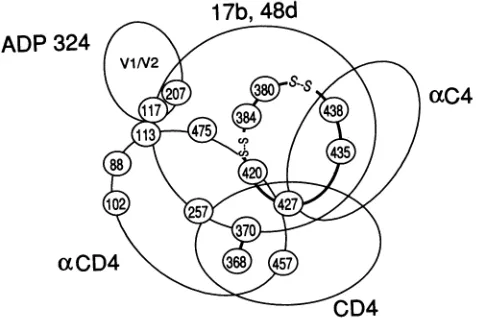
The characterization of the epitopes of the 17b and 48d antibodiesprovidessome insightinto the behavior of these antibodies with respect to CD4 and to other monoclonal antibodies(Fig.3).Both17b and 48depitopeswereaffected by changes in glutamic acid 370 and tryptophan 427, which make important contributions to CD4 binding (10, 59).
Alterations in theregions surrounding these residues follow-ing CD4 bindfollow-ing might account for altered accessibility of the 17b and48depitopes. The 17b and 48d cross-competition for
gpl20 binding with the anti-CD4 binding antibodies (67a)
(Table 2) can be explained by the importance of threonine 257 and glutamic acid 370 for recognition by both sets of antibodies (51, 78, 80). Some of the CD4 binding anti-bodies also depend on amino acids in C4 nearlysine 421 and tryptophan 427, in C5 near methionine 475, and in Cl near aspartic acid 113 and lysine 117 (51, 78, 80), all of which appear tobe inproximity to the 17b and 48depitopes. In this study, moderatecompetition for gp120 binding was observed between the 48d antibody and antibodies (76) directed
against an exposed linear C4 sequence extending from
TABLE 3. CATactivity inJurkat targetcells
Inhibited/uninhibitedCAT
Envelope activity
glycoprotein
17b 48d
Wild type 17 11
80N/R 37 27
103Q/F 17 17
106E/A 22 22
113D/R 95 76
117K/W 50 60
120/121VK/LE 15 35
252R/W 67 80
257T/A 63 60
257T/G 66 62
266A/E 35 24
267E/L 18 12
281A/V 14 14
298R/G 10 12
313P/S 15 11
368D/T 11 11
370E/Q 50 ND
370E/D 82 102
382F/L 60 50
420I/R 100 83
421K/L 9 86
432K/A 61 ND
433A/L 62 59
438P/R 58 92
457D/A 15 11
470P/G 29 14
475M/S 97 100
477D/V 13 13
485K/V 40 35
aRatio ofCATactivity (asapercentage)observed in Jurkatlymphocytes
incubated with virusplus monoclonal antibody compared withthatobserved
for cellsincubatedwith untreatedvirus.ND,notdetermined.
J. VIROL.
on November 9, 2019 by guest
http://jvi.asm.org/
[image:7.612.312.552.396.698.2]HIV-1 gpl2O NEUTRALIZATION EPITOPES 3985
ADP 324
V1N2
a~C4
102 2542
oaCD4
4CD4
FIG. 3. Schematic diagram of HIV-1 gpl20 residues important
for binding CD4 orantibodies. The amino acid residues in which
changes affectbinding of CD4,anti-CD4 binding antibodies (aCD4),
the 17b and 48d antibodies, the ADP 324 antibody, or antibodies
directed against a linearC4 epitope encompassing residues 429 to 438(aC4)areshown in the appropriatecircles. Residues thatarenot
completely included withina regionindicate amino acids inwhich
onlysome changes affectbinding (or, in the case of the anti-CD4
bindingantibodies, inwhich changes affectonly some members of
the group). The indicated overlap between the CD4 and 17b/48d
binding sitesongpl20 shouldnotbe interpreted toindicate
compe-tition between CD4 and the 17b/48d antibodies, but only that
changes inthese residuescanaffectboth CD4 and 17b/48d binding.
Thepresenceofdisulfidebonds(S- -S)linking theC3 and C4gp120
regions into ahydrophobic ring is indicated.
residues 429 to 438. This finding is consistent with the observation that amino acid changes in this region dimin-ished 17b and 48d recognition and resulted in decreased sensitivity to neutralization by these antibodies. Likewise, the ADP 324 antibody competed with the 48d antibody for binding to gpl20. The ADP 324 antibody recognizes a
conformation-dependent epitope within the V1/V2 region (51b), but the exact epitope recognized by this antibody is unknown. Recognition of the HIV-1 gpl20 glycoprotein by ADP324 is disruptedby the same amino acid changesnear
thebaseof theV1IV2stemthat affect 17b and 48d antibody recognition (Sib), suggesting that this conserved structure maybe proximal toboth the ADP 324 and the 17band 48d epitopes.
Further work will be necessary to understand the func-tional significance of the CD4-induced conformational changes in the gpl20 glycoprotein affecting 17b and 48d antibody recognition. It is interesting that the 17b and 48d epitopes appear to contain components of the CD4 binding site and thering-like structure formed by C3 and C4, which has been shown to contribute to the membrane fusion
processand tothe affinity of the gpl2O-gp4linteraction (29, 77). Exposure of the 17b and 48d epitopes may reflect
CD4-induced alteractions in the gpl2O-gp4l interaction im-portant for subsequent events leading to membrane fusion. In addition to promoting understanding of the virus entry process, knowledge of conserved HIV-1 neutralizing anti-body epitopes may help to define methods for effectively generatingprophylactic or therapeutic antiviral immune re-sponses.
ACKNOWLEDGMENTS
We thank Bruce Walker for reagents, Ginny Nixon for manuscript preparation, Amy Emmert for artwork, and Shu-Wing Poon (Aaron Diamond AIDS Research Center) for technical assistance. We also thank Abraham Pinter for communication of results prior to publi-cation.
Markus Thali was supported by the Swiss National Science Foundation. Joseph Sodroski was supported by the Aaron Diamond Foundation, the Leukemia Society of America, and the National Institutes of Health(Al 31783). MacArthur Charles received partial salary support from the Pediatric AIDS Foundation. James Robin-son was supported by National Institutes of Health grantAI24030. David D. Ho was supported by grants from the National Institutes of Health (AI22541, AI28747, AI24030, and A132427) and from the Aaron Diamond Foundation. John P. Moore was supported by the Aaron Diamond Foundation. This work was made possible by Center for AIDS Research core grants to the Dana-Farber Cancer Institute and New York University School of Medicine (AI27742).
REFERENCES
1. Akerblom, L., J. Hinkula, P. Broliden, B. Makitalo, T. Frid-berger, J. Rosen, M. Villacres-Eriksson, B. Morein, and B. Wahren. 1990. Neutralizing cross-reactive and non-neutralizing monoclonal antibodies to HIV-1 gp120.AIDS 4:954-960. 2. Allan, J., T. H. Lee, M. F. McLane, J. Sodroski, W. A.
Haseltine, and M. Essex. 1983. Identification of the major envelopeglycoprotein product of HTLV-III. Science 228:1091-1094.
3. Allan,J. S. 1991. Receptor-mediated activation of immunodefi-ciencyviruses in viral fusion. Science 252:1322.
4. Barre-Sinoussi, F., J. C. Chermann, F. Rey, M. T. Nugeyre, S. Chamaret,J.Gruest, C. Dauget, C.Axier-Bin,F. Vezinet-Brun, C. Rouzioux, W. Rozenbaum, and L. Montagnier. 1983. Isola-tion of a T-lymphocyte retrovirus from a patient at risk for acquired immunodeficiency syndrome (AIDS). Science 220: 868-871.
5. Berger,E.,T.Fuerst, and B. Moss. 1988. A soluble recombinant polypeptidecomprising the amino-terminal half of the extracel-lularregionof the CD4 molecule contains an active binding site for human immunodeficiency virus. Proc. Natl. Acad. Sci. USA 85:2357-2361.
6. Berkower, I.,G. Smith, C.Giri, and D. Murphy. 1989. Human immunodeficiency virus 1: predominance of a group-specific neutralizing epitope that persists despite genetic variation. J. Exp. Med. 170:1681-1695.
7. Berman, P., T.
Gregory,
L. Riddle, G. Nakamura, M. Champe, J.Porter,F.Wurm, R.Hershberg, E. K. Cobb, and J. Eichberg. 1990. Protection of chimpanzees from infection by HIV-1 after vaccination with recombinant glycoproteingpl20 but notgpl60. Nature(London)345:622-625.8. Buchbinder, A., S. Karwowska, M. Gorny, S. Burda, and S. Zolla-Pazner. 1992. Synergy between human monoclonal anti-bodies toHIVextends their effective biological activity against homologous and divergent strains. AIDS Res. Hum. Retrovi-ruses 8:425-427.
9. Clements, G., M. Price-Jones, P. Stephens, C. Sutton, T. Schulz, P. Clapham, J. McKeating, M. McClure, S. Thomson, M. Marsh, J. Kay, R. Weiss, and J. P. Moore. 1991. The V3 loops of the HIV-1 and HIV-2 surface glycoproteins contain proteo-lytic cleavage sites: a possible function in viral fusion? AIDS Res. Hum. Retroviruses 7:3-14.
10. Cordonnier, A., L. Montagnier, and M. Emerman. 1989. Single amino acid changes in HIV envelope affect viral tropism and receptor binding. Nature (London) 340:571-574.
11. Dalgleish, A. G., P. C. L. Beverly, P. R. Clapham, D. H. Crawford, M. F. Greaves, and R. A. Weiss. 1984. The CD4 (T4) antigen is an essential component of the receptor for the AIDS retrovirus. Nature (London) 312:763-767.
12. Deen, K., J. S. McDougal, R. Inacker, G. Folena-Wasserman, J. Arthos, J. Rosenberg, P. Maddon, R. Axel, and R. Sweet. 1988. Asoluble form of CD4 (T4) protein inhibits AIDS virus infec-tion. Nature (London) 331:82-84.
13. Dubay, J., S. Roberts, B.Brody, and E. Hunter. 1992. Mutations VOL.67, 1993
on November 9, 2019 by guest
http://jvi.asm.org/
[image:8.612.69.309.75.234.2]3986 THALI ET AL.
inthe leucinezipper of the humanimmunodeficiency virustype
1 transmembrane glycoprotein affect fusion and infectivity. J.
Virol. 66:4748-4756.
14. Earl, P. L., B. Moses,and R. W. Doms. 1991. Folding, interac-tion with GRP78-BiP, assembly, and transport of the human immunodeficiency virus type 1 envelope protein. J. Virol. 65:2047-2055.
15. Einfeld, D., and E. Hunter. 1991. Transport of membrane proteinstothecell surface,p.107-139. In R. W. Compans (ed.),
Protein traffic in eukaryotic cells. Springer-Verlag, New York. 16. Emini, E., P. Nara, W. Schlief, J. Lewis, J. Davide, D.Lee, J.
Kessler, S. Conley, M. Matsushita, S. Putney, R. Gerety,and J. Eichberg. 1990. Antibody-mediated in vitro neutralization of humanimmunodeficiency virustype 1 abolishes infectivity for chimpanzees. J. Virol. 64:3674-3678.
17. Emini, E., W. Schleif, J. Nunberg, A. Conley, Y. Eda, S. Tokiyoshi, S. Putney, S. Matsushita, K. Cobb, C. Jett, J. Eichberg, and K. Murthy. 1992. Prevention of HIV-1 infection
inchimpanzees bygpl20 V3 domain-specific monoclonal anti-body. Nature (London) 355:728-730.
18. Fauci, A., A. Macher, D. Longo, H. C. Lane, A. Rook, H. Masur, and E. Gelmann. 1984. Acquired immunodeficiency syndrome: epidemiologic, clinical, immunologic, and
therapeu-ticconsiderations. Ann. Intern.Med. 100:92-106.
19. Fisher, R., J. Bertonis, W. Meier, V. Johnson, D. Costopoulos,
T. Liu, R. Tizard, B. Walker, M. Hirsch, R. Schooley, and R. Flavell. 1988.HIVinfection isblocked in vitro byrecombinant solubleCD4.Nature (London) 331:76-78.
20. Freed, E., D. Myers, and R. Risser. 1990.Characterization of the
fusion domain of the human immunodeficiency virus type 1 envelope glycoprotein gp4l. Proc. Natl. Acad. Sci. USA 87: 4650-4654.
21. Freed, E., D. Myers, and R. Risser. 1991. Identification of the principal neutralizing determinant of human immunodeficiency
virustype 1as afusion domain. J. Virol. 65:190-194.
22. Gallo, R. C., S. Z. Salahuddin, M. Popovic, G. M. Shearer, M. Kaplan, B. F. Haynes, T. J. Palker, R. Redfield, J. Oleske, B.
Safai,G.White, P. Foster, and P. D. Markham. 1984. Frequent detection and isolation ofcytopathic retroviruses (HTLV-III) frompatients with AIDS andatriskfor AIDS.Science
224:500-503.
23. Gegerfelt, A., J. Albert, J. Morfeldt-Manson, K. Broliden, and E. M. Fenyo. 1991. Isolate-specific neutralizing antibodies in patientswithprogressive HIV-1-related disease. Virology 185: 162-168.
24. Girard, M., M. Kieny, A. Pinter, F.Barre-Sinoussi, P. Nara, H. Kolbe, K. Kusumi, A. Chaput, T. Reinhart, E. Muchmore, J. Ronco, M.Kaczorek, E. Gomard,J.-C. Gluckman, and P. Fultz.
1991. Immunization ofchimpanzees confers protection against challenge with human immunodeficiency virus. Proc. Natl.
Acad.Sci.USA88:542-546.
24a.Gorny,M., A. Conley, S. Karwowska, A. Buchbinder, J.-Y. Xu,
E.Emini, S. Koenig, and S. Zolla-Pazner. 1992. Neutralization
ofdiverse humanimmunodeficiency virustype1variantsbyan
anti-V3 humanmonoclonalantibody. J. Virol. 66:7538-7542.
25. Grimaila, R., B. Fuller, P. Rennert, M. B. Nelson, M.-L. Hammarskjold,B. Potts, M. Murray, S. Putney, and G. Gray. 1992. Mutations in theprincipal neutralization determinant of
humanimmunodeficiency virustype 1 affectsyncytium forma-tion, virus infectivity, growth kinetics, and neutralization. J.
Virol.66:1875-1883.
26. Haigwood, N., C. Barker, K. Higgins, P. Skiles, G. Moore, K. Mann,D.Lee,J. Eichberg, and K. Steimer. 1990. Evidence for neutralizing antibodies directed againstconformational epitopes
ofHIV-1gpl20.Vaccines90:313-320.
27. Haigwood, N., P. Nara, E. Brooks, G. Van Nest, G. Ott, K. Higgins, N.Dunlop, C. Scandella, J. Eichberg, and K. Steimer.
1992.Nativebutnotdenaturedrecombinant human immunode-ficiencyvirustype1gpl20generatesbroad-spectrum neutraliz-ing antibodies in baboons. J. Virol. 66:172-182.
27a.Hart, T., R. Kirsch, H. Ellens, R. Sweet, D. Lambert, S. Petteway, J. Leary, and P. Bugelski. 1991. Binding of soluble
CD4 proteins to HIV-1 and infected cells induces release of
envelope glycoprotein gp120. Proc. Natl. Acad. Sci. USA 88:2189-2193.
28. Helseth, E., M.Kowalski, D. Gabuzda, U.Olshevsky, W. Hasel-tine, and J. Sodroski. 1990. Rapid complementation assays measuring replicative potential of human immunodeficiency virus type 1 envelope glycoprotein mutants. J. Virol. 64:2416-2420.
29. Helseth, E., U. Olshevsky, C. Furman, and J. Sodroski. 1991. Human immunodeficiency virus type 1 gpl20 envelope glyco-protein regions important for association with the gp4l
trans-membrane glycoprotein. J. Virol. 65:2119-2123.
30. Helseth, E., U. Olshevsky, D. Gabuzda, B. Ardman, W. Hasel-tine, and J. Sodroski. 1990. Changes in the transmembrane region of the humanimmunodeficiency virus type 1 gp4l
enve-lope glycoprotein affect membrane fusion. J. Virol. 64:6314-6318.
31. Ho, D., J. McKeating, X. Li, T. Moudgil, E. Daar, N.-C. Sun, and J. Robinson.1991. Conformational epitope ongpl20 impor-tant in CD4 binding and human immunodeficiency virus type 1 neutralization identified by a human monoclonal antibody. J. Virol. 65:489-493.
32. Hussey, R., N. Richardson, M.Kowalski, N. Brown, H. Change, R. Siliciano, T. Dorfman, B. Walker, J. Sodroski, and E. Reinherz. 1988. A soluble CD4 protein selectively inhibits HIV replication and syncytium formation. Nature (London) 331:78-81.
33. Ivanoff, L., D. Looney, C. McDanal, J. Morris, F.Wong-Staal, A. Langlois, S. Petteway, and T. Matthews. 1991.Alterationof HIV-1 infectivity and neutralization by a single amino acid replacement in the V3 loop domain. AIDS Res. Hum. Retrovi-ruses7:595-603.
34. Javaherian, K., A. Langlois, G. LaRosa, A. Profy, D.Bolognesi, W.Herliky, S. Putney, and T. Matthews. 1990. Broadly neutral-izing antibodies elicited by the hypervariable neutralneutral-izing deter-minant of HIV-1. Science250:1590-1593.
35. Javaherian, K., A. J. Langlois, C. McDanal, K. L. Ross, L. I. Eckler, C. L. Jellis, A. T. Profy, J. R. Rusche, D. P. Bolognesi, S. D. Putney, and T. J. Matthews. 1989. Principal neutralizing domain of the human immunodeficiency virus type 1 envelope protein. Proc. Natl. Acad. Sci. USA 86:6768-6772.
36. Kang, C.-Y., P. Nara, S. Chamat, V. Caralli, T. Ryskamp, N. Haigwood, R. Newman, and H. Kohler. 1991. Evidence for non-V3-specific neutralizing antibodies that interfere with gpl2O/CD4 binding in human immunodeficiency virus-infected humans. Proc. Natl. Acad. Sci. USA 88:6171-6175.
37. Karwowska, S., M. K. Gorny, A. Buchbinder, V. Giankakos, C. Williams, T. Fuerst, and S. Zolla-Pazner. 1992. Production of human monoclonal antibodies specific for conformational and linear non-V3epitopes ofgpl20. AIDS Res. Hum. Retroviruses 8:1099-1106.
38. Klatzmann, D., E. Champagne, S. Chamaret, J. Gruest, D. Guetard, T. Hercend, J. C. Gluckman, and L. Montagnier. 1984. T-lymphocyte T4 molecule behaves as the receptor for human retrovirusLAV. Nature (London) 312:767-768.
39. Kowalski, M., L. Bergeron, T. Dorfman, W. Haseltine, and J. Sodroski. 1991. Attenuation of human immunodeficiency virus type 1 cytopathic effect by a mutation affecting the transmem-brane envelopeglycoprotein. J. Virol. 65:281-291.
40. Kowalski, M., J. Potz, L. Basiripour, T. Dorfman, W. G. Goh, E. Terwilliger, A. Dayton, C. Rosen, W. Haseltine, and J. Sodroski. 1987. Functional regions of the human immunodefi-ciency virusenvelope glycoproteins. Science 237:1351-1355. 41. Lane, M. C., J.Depper, W. Greene, G. Whalen, T. Waldmann,
and A. Fauci.1985. Qualitative analysis of immune functions in patients with the acquired immunodeficiency syndrome. N. Engl. J. Med.313:79-84.
42. LaRosa, G. J., J. P. Davide, K. Weinhold, J. A. Waterbury, A. T. Profy, J. A. Lewis, A. J. Langlois, G. R.Dreesman, R. N. Boswell, P. Shadduck, L. H. Holley, M. Karplus, D. P. Bolognesi, T. J. Matthews, E. J. Emini, and S. D.Putney. 1990. Conserved sequence and structural elements in the HIV-1 principal neu-tralizing domain. Science 249:932-935.
43. Lasky, L., G.Nakamura, D. Smith, C. Shimisaki, E. Patzer, and J. VIROL.
on November 9, 2019 by guest
http://jvi.asm.org/
HIV-1 gpl2O NEUTRALIZATION EPITOPES 3987
P. Berman. 1987. Delineation of a region of the human immu-nodeficiency virus type 1 gp120 glycoprotein critical for inter-action with the CD4 receptor. Cell 50:975-985.
44. Leonard, C., M.Spellman,L. Riddle, R. Harris, J. Thomas, and T.Gregory.1990. Assignment of intrachain disulfide bonds and characterization of potential glycosylation sites of the type 1 human immunodeficiency virus envelope glycoprotein (gpl20) expressed in Chinese hamster ovary cells. J. Biol. Chem. 265:10373-10382.
45. Linsley, P., J. Ledbetter, E. Thomas, and S.-L. Hu. 1988. Effects ofanti-gpl20monoclonal antibodies on CD4receptor binding by the env protein of human immunodeficiency virus type 1. J. Virol. 62:3695-3702.
46. Maddon, P. J., A. G. Daigleish, J. S. McDougal, P. R. Clapham, R. A. Weiss, and R. Axel. 1986. The T4 gene encodes the AIDS virusreceptor and is expressed in the immune system and brain. Cell 47:333-348.
47. Matsushita, M., M. Robert-Guroff, J. Rusche, A. Koito, T. Hattori, H. Hoshino, K. Javaherian, K. Takatsuki, and S. Putney. 1988. Characterization of a human immunodeficiency virus neutralizing monoclonal antibody and mapping of the neutralizing epitope. J. Virol. 62:2107-2144.
48. Matthews, T., A. Langlois, W. Robey, N. Chang, R. Gallo, R. Fischinger, and D. Bolognesi. 1986. Restricted neutralization of divergent human T-lymphotropic virus type III isolated by antibodies to the major envelope glycoprotein. Proc. Natl. Acad. Sci. USA 83:9709-9713.
49. McDougal, J. S., M. S. Kennedy, J. M. Sligh, S. P. Cort, A. Mawle, and J. K. Nicholson. 1986. Binding of the HTLV-III/ LAV to T4+ cells by a complex of the 110K viral protein and the T4molecule. Science231:382-385.
50. McKeating, J., J. Gow, J. Goudsmit, L. Pearl, C. Mulder, and R. Weiss. 1989. Characterization of HIV-1 neutralization escape mutants. AIDS 3:777-783.
51. McKeating, J., M. Thali, C. Furman, S.Karwowska,M. Gorny, J. Cordell, S. Zolla-Pazner, J. Sodroski, and R. Weiss. 1992. Aminoacid residues of the human immunodeficiency virus type 1 gpl20critical for the binding of rat and human neutralizing antibodies that block the gpl2O-sCD4 interaction. Virology 190:134-142.
51a.Moore, J., and P. J. Klasse. 1992.Thermodynamic and kinetic analysisof sCD4 binding to HIV-1 virions and of gpl20 disso-ciation.AIDS Res. Hum. Retroviruses 8:443-449.
51b.Moore,J.Submitted forpublication.
52. Moore, J. P. 1990. Simple methods for monitoring HIV-1 and HIV-2gpl20binding to sCD4 by ELISA: HIV-2 has a 25-fold loweraffinitythan HIV-1 for sCD4. AIDS 4:297-305.
53. Moore, J. P., and D. D. Ho. 1993. Antibodies todiscontinuous orconformationally sensitive epitopes on thegpl20 glycopro-teinofhumanimmunodeficiency virus type 1 are highly preva-lent in seraof infected humans. J. Virol. 67:863-875.
54. Moore, J. P., J. McKeating, R. Weiss, P. Clapham, and Q. Sattentau. 1991. Receptor-mediated activation of immunodefi-ciencyviruses inviral fusion. Science 252:1322-1323. 55. Nara, P., W.Robey, L.Arthur, D. Asher, A. Wolff, C. Gibbs,
D.C. Gajdusek, and P. Fischinger. 1987. Persistent infection of chimpanzees with human immunodeficiencyvirus: serological responses and properties of reisolated viruses. J. Virol. 61: 3173-3180.
56. Nara, P., L. Smit, N. Dunlop, W. Hatch, M. Merges, D. Waters, J. Kelliher, R. Gallo, P. Fischinger, and J. Goudsmit. 1990. Emergenceof viruses resistanttoneutralization by V3-specific antibodies inexperimental humanimmunodeficiencyvirus type 1 IIIBinfectionofchimpanzees. J. Virol. 64:3779-3791. 57. Nara, P. L., W. G. Robey, S. W. Pyle, W. C. Hatch, N. M.
Dunlop, J. W. Bess, Jr., J. C. Kelliher, L. 0. Arthur, and P. J. Fischinger. 1988. Purified envelope glycoproteins from human immunodeficiencyvirus type 1 variants induce individual, type-specific neutralizingantibodies. J. Virol. 62:2622-2628. 58. Ohno, T., M. Terada, Y. Yoneda, K. Shea, R. Chambers, D.
Stroka, M. Nakamura, and D. Kufe. 1991. A broadly neutraliz-ingmonoclonalantibody that recognizes the V3 region of human immunodeficiencyvirus type 1glycoproteingpl20.Proc. Natl.
Acad. Sci. USA 88:10726-10729.
59. Olshevsky, U., E. Helseth, C. Furman, J. Li, W. Haseltine, and J. Sodroski. 1990. Identification of individual human immuno-deficiency virus type 1 gpl20 amino acids important for CD4 receptor binding. J. Virol. 64:5701-5707.
60. Page, K., S. Stearns, and D. Littman. 1992. Analysis of muta-tions in the V3 domain ofgpl60 that affect fusion and infectivity. J. Virol. 66:524-533.
61. Palker, T. J., M. E. Clar, A. J.Langlois, T. J. Matthews, K. J. Weinhold, R. R. Randall, D. P. Bolognesi, and B. F. Haynes. 1988. Type-specific neutralization of the human immunodefi-ciency virus with antibodies to env-encoded synthetic peptides. Proc. Natl. Acad. Sci. USA 85:1932-1936.
62. Pinter, A., S. Kayman, Z. Wu, S.Warrier, S. Tilley, D. Ho, M. Fung, M. Girard, E. Muchmore, and S. Pincus. 1992. Analysis of immune response of HIV-infected and vaccinated humans and chimpanzees to conformational and glycosylation-dependent epitopes located in the V1/V2 domains of gpl20, p. 163. In Advances in AIDS vaccine development. National Cooperative Vaccine Development Group, Chantilly, Va.
63. Posner, M., T. Hideshima, T. Cannon, M. Mukherjee, K. Mayer, andR.Byrn. 1991. An IgG human monoclonal antibody which reacts with HIV-1 gpl20, inhibits virus binding to cells, and neutralizes infection. J. Immunol. 146:4325-4332.
64. Profy, A., P. Salinas, L. Eckler, N. Dunlop, P. Nara, and S. Putney. 1990. Epitopes recognized by the neutralizing antibod-ies of an HIV-1-infected individual. J. Immunol. 144:4641-4647. 65. Putney, S., T. Matthews, W. G. Robey, D. Lynn, M. Robert-Guroff, W. Mueller, A. Langlois, J. Ghrayeb, S. Petteway, K. Weinhold, P. Fischinger, F. Wong-Staal, R. Gallo, and D. Bolognesi. 1986. HTLV-III/LAV-neutralizing antibodies to an E. coli-produced fragment of the virus envelope. Science 234: 1392-1395.
66. Robey, W. G., L.0.Arthur, T. J. Matthews, A. Langlois, T. D. Copeland, N. W. Lerche, S. Oroszlan, D. P. Bolognesi, R. V. Gilden, and P. J. Fischinger. 1986. Prospect for prevention of human immunodeficiency virus infection: purified 120-kDa en-velope glycoprotein induces neutralizing antibody. Proc. Natl. Acad. Sci. USA 83:7023-7027.
67. Robey, W. G., B. Safai, S. Oroszlan, L. Arthur, M. Gonda, R. Gallo, and P. J. Fischinger. 1985. Characterization of envelope and core structural gene products of HTLV-III with sera from AIDS patients. Science 228:593-595.
67a.Robinson, J., and D. D. Ho. Unpublished data.
68. Robinson, J., D. Holton, S. Pacheco-Morell, J. Liu, and H. McMurdo. 1990. Identification of conserved and variant epitopes of HIV-1 gpl20 by human monoclonal antibodies produced by EBV-transformed cell lines. AIDS Res. Hum. Retroviruses 6:567-580.
69. Rusche, J. R., K. Javaherian, C. McDanal, J. Petro, D. L. Lynn, R. Grimaila, A. Langlois, R. C. Gallo, L. 0. Arthur, P. J. Fischinger, D. P. Bolognesi, S. D. Putney, and T. J. Matthews. 1988.Antibodies that inhibit fusion of human immunodeficiency virus-infected cells bind a 24-amino-acid sequence of the viralenvelopegpl20.Proc. Natl. Acad. Sci. USA 85:3198-3202. 70. Sattentau, Q. J., and J. P. Moore. 1991. Conformational changes induced in the human immunodeficiency virus envelope glyco-proteins by soluble CD4 binding. J. Exp. Med. 174:407-415. 71. Skinner, M., A. Langlois, C. McDanal, J. S. McDougal, D.
Bolognesi, and T. Matthews. 1988. Characteristics of a neutral-izing monoclonal antibody to the HIV envelope glycoprotein. AIDS Res. Hum. Retroviruses 4:187-197.
72. Skinner, M., A. Langlois, C. McDanal, J. S. McDougal, D. Bolognesi, and T. Matthews. 1988. Neutralizing antibodies to an immunodominant envelope sequence do not prevent gpl20 binding to CD4. J. Virol.62:4195-4200.
73. Smith, D., R.Byrn, S. Marsters, T. Gregory, J. Groopman, and D. Capon. 1987. Blocking of HIV-1 infectivity by a soluble secreted form of the CD4 antigen. Science 238:1704-1707. 74. Steimer, K. S., C. J. Scandella, P. V. Skiles, and N. L. Haigwood.
1991. Neutralization of divergent HIV-1 isolates by conforma-tion-dependent human antibodies to gpl20. Science 254:105-108.
VOL. 67,1993
on November 9, 2019 by guest
http://jvi.asm.org/
3988 THALI ET AL.
75. Stein, B., S. Gouda, J. Lifson, R. Penhallow, K. Bensch, and E. Engleman. 1987. pH-independent HIV entry intoCD4-positive Tcells via virus envelope fusion to the plasma membrane. Cell 49:659-668.
76. Sun, N. C., D. D. Ho, C. R. Y. Sun, R.-S. Liou, W. Gordon, M. S. C. Fung, X.-L. Li, R. C.Ting, T.-H. Lee, N. T. Chang, and T. W.Chang. 1989. Generation andcharacterizationof mono-clonalantibodiestothe putativeCD4-bindingdomain of human immunodeficiencyvirus type 1gpl20. J. Virol. 63:3579-3585. 77. Thali,M., C. Furman, E. Helseth, H. Repke, and J. Sodroski.
1992. Lackofcorrelationbetween soluble CD4-induced shed-ding of the human immunodeficiency virus type 1 exterior envelopeglycoproteinandsubsequent membrane fusion events. J.Virol. 6:5516-5524.
78. Thali, M., C. Furman, D. D. Ho, J. Robinson, S. Tilley, A. Pinter, and J. Sodroski. 1992. Discontinuous, conserved neu-tralization epitopes overlapping theCD4bindingregionof the humanimmunodeficiencyvirus type 1gpl20 envelope glycopro-tein. J.Virol.66:5635-5641.
79. Thali, M., C. Furman, B. Wahren, M. Posner, D. Ho, J. Robinson, and J.Sodroski. 1992. Cooperativity ofneutralizing antibodiesdirectedagainst the V3 loop and CD4 binding regions of the humanimmunodeficiencyvirusgpl20envelope glycopro-tein. J.Acquired ImmuneDefic.Syndr. 6:591-599.
80. Thali, M., U. Olshevsky, C. Furman, D. Gabuzda, M. Posner, and J. Sodroski. 1991. Characterization of a discontinuous humanimmunodeficiencyvirus type 1gpl20epitope recognized
by a broadly neutralizing humanmonoclonal antibody.J. Virol. 65:6188-6193.
81. Tilley, S. A., W. Honnen, M. Racho, T.-C. Chou, and A. Pinter. 1992.Synergistic neutralization of HIV-1 by human monoclonal antibodies against the V3 loop and the CD4-binding site of gpl20.AIDS Res. Hum.Retroviruses 89:461-466.
82. Tilley, S. A., W. J. Honnen, M. Racho, M. Hilgartner, and A. Pinter. 1991. A human monoclonal antibody against theCD4 binding site ofHIV-1gpl20 exhibitspotent,broadlyneutralizing activity.Res.Virol. 142:247-259.
83. Traunecker, A., W. Luke, and K. Karjalainen. 1988. Soluble CD4molecules neutralize humanimmunodeficiencyvirus type 1. Nature(London)331:84-86.
84. Travis, B., T. DyKers, D. Hewgill,J. Ledbetter, T. Tsu, S.-L. Hiu, and J.Lewis. 1992.Functional rolesof the V3 hypervari-ableregionof HIV-1gpl60in theprocessing of gpl60 andin the formationofsyncytiainCD4+ cells.Virology 186:313-317. 85. Weiss, R. A., P. R. Clapham, J. N. Weber, A. G.Dalgleish,L. A.
Lasky, and P. W. Berman. 1986.Variable and conserved neu-tralization antigensof human immunodeficiencyvirus. Nature (London) 324:572-575.
86. Wyatt, R., M.Thali,S. Tilley, A. Pinter, M. Posner, D. Ho, J. Robinson, and J. Sodroski. 1992. Relationship of the human immunodeficiencyvirus type 1 gpl20 thirdvariable loop to a component of the CD4 binding site in the fourth conserved region. J. Virol.66:6997-7004.
J. VIROL.