0022-538X/95/$04.0010
Copyrightq1995, American Society for Microbiology
Effects of Second-Site Mutations on Dominant Interference by
a Human Immunodeficiency Virus Type 1 Envelope
Glycoprotein Mutant
GARY L. BUCHSCHACHER, JR.,1ERIC O. FREED,2
ANDANTONITO T. PANGANIBAN1*
McArdle Laboratory for Cancer Research, University of Wisconsin, Madison, Wisconsin 53706,1and Laboratory of
Molecular Microbiology, National Institute of Allergy and Infectious Diseases, Bethesda, Maryland 208922
Received 1 August 1994/Accepted 25 October 1994
We have demonstrated previously that a human immunodeficiency virus type 1 (HIV-1) envelope glycopro-tein containing a Val-to-Glu substitution at the second amino acid of the transmembrane glycoproglycopro-tein gp41 (termed the 41.2 mutant) dominantly interferes with wild-type envelope-mediated syncytium formation and virus infectivity. To understand the mechanism by which the 41.2 mutant exerts the dominant interfering phenotype and thereby determine further how the mutant might be used as an inhibitor of viral spread, additional mutations were made in the envelope gene, and the effects of these mutations on interference were determined. It was found that processing of the 41.2 mutant glycoprotein to gp120 and gp41 subunits and a functional CD4-binding domain are necessary for the interfering phenotype to be exhibited fully. However, neither a wild-type V3 loop nor the gp41 cytoplasmic tail is necessary for efficient interference. In addition, it was determined that the dominant interfering phenotype is not conferred exclusively by the glutamate sub-stitution at amino acid 2 of gp41, since a subsub-stitution with a basic residue at this position also results in a dominant interfering envelope glycoprotein.
Several dominant interfering mutants of human immunode-ficiency virus type 1 (HIV-1) viral gene products have been identified (7). HIV dominant interfering mutants are of inter-est because they provide insight into the function of the wild-type gene product and can provide a way to slow wild-wild-type virus spread (1). We have described previously a mutant HIV-1 envelope glycoprotein, termed the 41.2 mutant, that domi-nantly interferes with wild-type envelope-mediated syncytium formation and virus infectivity (9). Subsequent experiments demonstrated that the mutant env gene can be stably main-tained in HeLa T4 cells and that expression of this gene can be induced to inhibit the spread of wild-type virus (2).
The 41.2 mutant contains a Val-to-Glu substitution of the second amino acid of the transmembrane glycoprotein gp41. It is hypothesized that this acidic amino acid substitution in the otherwise hydrophobic amino-terminal fusion domain of gp41 disrupts a hydrophobic pore produced by multiple envelope glycoprotein interactions. Such a hydrophobic pore has been postulated to form during influenza virus hemagglutinin-in-duced membrane fusion (23). According to this model, mem-brane fusion requires the interaction of multiple envelope gly-coproteins at the plasma membrane. A prediction of this model is that a single-mutant glycoprotein incorporated into such a complex would disrupt the functional unit enough to inhibit its normal function, thereby inhibiting fusion.
Several observations with the 41.2 mutant are consistent with this model (9). Interference with wild-type envelope func-tion was seen even when high wild-type/41.2 mutant DNA ratios were used in transient transfection experiments, as might be expected if disruption of higher-order envelope glycopro-tein or envelope glycoproglycopro-tein-receptor complexes was taking place. Interference did not result via an effect on envelope processing, transport, or CD4 binding. Furthermore,
interfer-ence was not HIV-1 strain specific, though the HIV-1 41.2 mutant was unable to interfere with HIV-2-mediated fusion. Testing of additional envelope mutants containing substitu-tions at other sites in the gp41 fusion domain demonstrated that the dominant interfering phenotype is not a general char-acteristic of fusion domain mutants.
Additional information regarding the interference process would be useful since it might provide insight into how normal fusion and interference take place and might be of assistance in determining if the 41.2 mutant could be used to interfere with wild-type HIV spread. Membrane fusion induced by the HIV-1 envelope glycoprotein requires proper proteolytic processing of gp160 to gp120 and gp41 (10, 20). Fusion also requires a functional gp120 V3 loop, a hydrophobic gp41 amino terminus, and an intact CD4-binding domain (11, 12, 16, 19, 22). Other domains of the HIV-1 envelope glycoprotein, including the cytoplasmic tail of gp41, have been shown to modulate fusion activity (6, 13, 25). Mutations which disrupt the function of these domains might perturb the ability of the 41.2 mutant to dominantly interfere with HIV-1 envelope-induced fusion. To examine other domains of gp120 and gp41 that might affect interference, we constructed double mutants in which the 41.2 mutation was coupled with mutations in the V3 loop or CD4-binding domain of gp120, the gp160 processing sequence, and the C terminus (cytoplasmic tail) of gp41. We analyzed the abilities of these double mutants to dominantly interfere with syncytium formation and the infection process mediated by the wild-type HIV-1 envelope glycoprotein. In addition, alternate point mutations were made at the second amino acid of gp41 to determine if the dominant interfering phenotype was spe-cific for the Val-to-Glu substitution.
Analysis of interference by using second site mutations.The
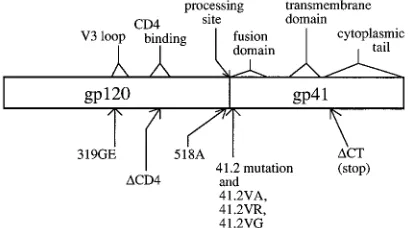
locations of the env mutations used in this analysis are shown in Fig. 1. Derivatives of plasmid pHenv (10) were used to express three of the four double mutants. One gp120 mutation used in this study resulted in an Arg-to-Thr substitution of amino acid 518 (10). This point mutation (termed 518A), lo-* Corresponding author. Mailing address: McArdle Laboratory for
Cancer Research, University of Wisconsin, 1400 University Ave., Mad-ison, WI 53706. Phone: (608) 263-7820.
1344
on November 9, 2019 by guest
http://jvi.asm.org/
cated at the gp120-gp41 cleavage site, has been shown previ-ously to prevent gp160 processing without affecting cell surface expression or CD4 binding (10, 14). The 518A mutant, when coexpressed with wild-type envelope, does not efficiently inter-fere with fusion, reducing by only about 40% the ability of wild-type envelope to cause fusion (9). Use of the 518A/41.2 double mutant, then, provides information regarding the ne-cessity of glycoprotein processing in the interference process. A second double mutant (319GE/41.2) contains the 41.2 mu-tation and a Gly-to-Glu substitution at amino acid 319 of gp120. This mutation, located in the highly conserved tip of the V3 loop, has been shown previously to prevent envelope-me-diated fusion; however, other glycoprotein functions, such as gp160 processing and CD4 binding, are not affected (12); therefore, its use here could determine the requirement for a wild-type V3 loop in the interference process.
A double mutant which contains the 41.2 mutation and a previously reported CD4-binding mutation (18) was con-structed. This CD4-binding mutant lacks a 12-amino-acid se-quence between gp120 residue 410 and 421. This single dele-tion blocks CD4 binding but does not significantly affect gp160 processing (24). A double mutant containing both the 41.2 mutation and a stop codon inserted just after the transmem-brane domain of gp41 (at amino acid 231), which eliminated the cytoplasmic tail, was expressed as a derivative of plasmid pIIIenv3-1 (21). HIV-1 envelope glycoproteins containing cy-toplasmic tail deletions have been shown to have wild-type or increased abilities to cause syncytium formation but to be de-fective in their abilities to mediate virus infection (4–6, 13).
Each mutation was introduced into envelope expression plasmids containing wild-type or 41.2 mutant gp41 fusion do-mains. This allowed us to detect any effect of a single second-site mutation on envelope-mediated fusion. The V3 and pro-cessing site substitution mutants and the CD4-binding mutant (containing wild-type gp41 sequences) have been shown pre-viously to be fusion defective (10, 12, 24). When tested, the cytoplasmic tail deletion (DCT) mutant still was able to effi-ciently mediate cell-to-cell fusion (reference 4 and data not shown). However, testing of all four mutants demonstrated that they did not efficiently interfere with wild-type envelope-mediated fusion (reference 9 and data not shown).
To determine if the 41.2 mutant envelope glycoproteins con-taining second-site mutations retained the ability to domi-nantly interfere with wild-type envelope-mediated syncytium formation, the mutant env expression constructs were cotrans-fected into HeLa T4 cells along with a plasmid that expresses type envelope. In this syncytium assay, expression of wild-type envelope causes fusion of the CD41cells via glycoprotein-receptor interactions; the number of syncytia that forms
indi-cates the efficiency with which the envelope can mediate cell-to-cell fusion. The results (Table 1) indicated the mutants containing the cytoplasmic tail deletion and the gp120 position 319 Gly-to-Glu substitution in V3 retained the ability to inter-fere, suggesting these mutations did not block the incorpora-tion of the double-mutant envelope glycoproteins into a puta-tive fusion complex.
The 41.2 mutant containing the processing site mutation (518A/41.2) did not interfere with wild-type envelope function any more efficiently than an envelope glycoprotein containing the processing defect alone (9), indicating that proteolytic pro-cessing of the 41.2 mutant to gp120 and gp41 subunits is nec-essary for interference to take place. This observation suggests that proteolytic processing is necessary for the amino terminus of gp41 to be exposed in a fusion complex. Presumably, the failure of the 518A/41.2 double mutant to interfere results from an inability of the Glu residue to interact with other glycoprotein molecules and thereby disrupt the fusion com-plex. TheDCD4/41.2 mutant is able to interfere only partially with syncytium formation induced by wild-type envelope gly-coprotein. The observation that the CD4-binding mutation partially abrogates the ability of the 41.2 mutant to dominantly interfere with wild-type-induced syncytium formation suggests that CD4 binding may be a necessary step in the interference process. Alternatively, the fact that theDCD4/41.2 mutant is partially defective for gp160 processing (Fig. 2) may again indicate, consistent with our results with the 518A/41.2 mutant, that gp160 processing is a requirement for interference.
[image:2.612.75.280.73.187.2]To determine the effect of the second-site mutations on the ability of the 41.2 mutant to interfere with virus infectivity, a replication-defective vector (GB107) and CD4-LTR/b-gal in-dicator cells (15) were used to quantitate the production of infectious virus. GB107 (3) is a replication-defective HIV-1 construct containing a deletion in the env gene. When enve-lope is provided in trans, infectious particles that can undergo FIG. 1. Locations of mutations in HIV-1 env. A diagram of the HIV-1
en-velope gene is shown. Relevant functional domains are indicated at the top. The locations and descriptions of the mutations are shown at the bottom.
TABLE 1. Effects of second-site mutations on 41.2-mediated interference with syncytium formation and infectivity
Mutant env plasmida
Mutant description
Relative syn-cytium forma-tion6SDb
Relative infectivity
6SDc
pHenvKFS env frameshift 100 100
pGB122 or pHenv41.2 41.2 mutation 1063 1566 pHenv319GE/41.2 V3 loop G3E/41.2 863 1669 pHenv518A/41.2 Processing site/41.2 56611 6269 pHenvDCD4/41.2 CD4 binding/41.2 45616 50615 penvDCT/41.2 DCT/41.2 1865 1067
aFor syncytium assays, 83105HeLa T4 cells, maintained at 378C in Dulbecco’s
modified Eagle’s medium–7% calf serum–800mg of G418 per ml, were trans-fected by the calcium phosphate coprecipitation method with equal amounts of a mutant envelope-expressing plasmid and either pHenv or pIIIenv3-1 and pSV2tat 72 (wild-type envelope and Tat-expressing plasmids [8, 12, 21]), using 15 mg of total DNA. At 36 to 48 posttransfection, cells were fixed and stained, and syncytia were scored microscopically as described previously (9). For infectivity assays, 53105HeLa cells were transfected with equal amounts of pGB107 (an
HIV vector), pIIIenv3-1 or pHenv (wild-type envelope expression plasmids), and the indicated mutant plasmid DNA, using 15mg of total DNA. Two days fol-lowing transfection, HeLa cell medium was changed, and 43104CD4-LTR/b
-gal indicator cells were plated in 24-well tissue culture plates for cell-free infec-tion the next day, using DEAE-dextran as described previously (15). Two days following infection, indicator cells were fixed and stained with X-Gal, and blue foci were counted.
b
The number of syncytia resulting from transfection of wild-type envelope plus pHenvKFS was approximately 1,000 permg of wild-type envelope-express-ing plasmid. Data represent averages of at least four syncytium assays.
c
Transfection of vector, wild-type envelope, and pHenvKFS resulted in ap-proximately 103
infectious units per ml of harvested media. Data represent averages of at least three infectivity assays.
on November 9, 2019 by guest
http://jvi.asm.org/
[image:2.612.315.555.92.184.2]only a single round of replication are produced. The CD4-LTR/b-gal indicator cells are CD41 HeLa cells that stably contain the b-galactosidase gene expressed from the HIV-1 long terminal repeat. Because efficient expression from the HIV long terminal repeat is dependent upon the regulatory protein Tat,b-galactosidase normally is not produced. How-ever, following infection with a HIV construct which supplies Tat, such as GB107, b-galactosidase expression is induced. Following fixing and staining of infected cells with 5-bromo-4-chloro-3-indolyl-b-D-galactopyranoside (X-Gal), the titer of
infectious virus produced is reflected by the number of blue foci scored during microscopic examination of the cells.
Virus was produced by transfecting HeLa cells with vector-and envelope-expressing DNA plasmids. The results (Table 1) demonstrated that the effect of each second-site mutation on interference by the 41.2 mutant paralleled the results of the syncytium assay. That the DCT/41.2 mutant interferes with infectivity suggests indirectly that the DCT/41.2 envelope is incorporated onto virus particles. The fact that theDCT/41.2 double mutant could interfere with infectivity does not dem-onstrate that the cytoplasmic tail is unimportant for incorpo-ration onto virions; it is possible that the tailless glycoproteins were incorporated onto a particle only after forming het-erodimers (or multimers) with wild-type glycoprotein that con-tained cytoplasmic tails.
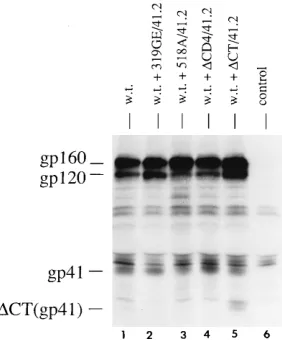
Immunoprecipitation analysis was performed as described previously (10) to monitor mutant and wild-type glycoprotein expression following transfection of cells with plasmid DNA (Fig. 2). All double mutants are expressed efficiently. Surpris-ingly, theDCD4/41.2 double mutant is partially defective for gp160 processing. This was unexpected since neither the CD4-binding mutant (24) nor the 41.2 mutant (9) alone affects gp160 processing. Since the results with the 518A/41.2 mutant suggest that efficient gp160 processing is required for 41.2-mediated interference, the lack of interference observed with the DCD4/41.2 mutant may be a result of the reduction in gp160 processing efficiency rather than a direct effect of the
DCD4 mutant. In addition to immunoprecipitation analysis, indirect immunofluorescence analysis using AIDS patient se-rum and fluorescein isothiocyanate-conjugated goat anti-hu-man immunoglobulin G, performed with HeLa T4 cells trans-fected with Tat- and envelope-expressing plasmids, indicated
no differences in expression or obvious alterations in subcellu-lar localization of any of the mutant glycoproteins tested (data not shown).
To determine if expression of mutant glycoprotein affected expression and processing of wild-type glycoprotein when the two were coexpressed in cells, immunoprecipitation analysis was also performed on cells cotransfected with wild-type and mutant envelope-expressing plasmids. The results of this anal-ysis demonstrated that the mutant was efficiently expressed and that expression of mutant envelope glycoprotein could occur without affecting that of wild-type glycoprotein (Fig. 3). These data support our previous results (9) that interference does not occur by interfering with wild-type envelope expression or pro-cessing. With the 518A/41.2 (processing site) mutant, we can distinguish wild-type envelope from mutant envelope, since only wild-type glycoprotein can be processed into the observed gp120 and gp41. With the DCT/41.2 double mutant, we can distinguish wild-type from mutant processing, since gp41 mol-ecules of the wild type andDCT/41.2 differ in size. The fact that we see continued equivalent expression of gp120 and gp41 in a situation in which interference is blocked and see equivalent amounts of wild-type and mutant gp41 in a situation in which interference occurs (Fig. 3 and Table 1) indicates directly that the mutant does not interfere with wild-type processing.
A basic amino acid substitution at the second position of gp41 also results in a dominant interfering envelope
glyco-protein.The 41.2 mutation was originally determined to
dom-inantly interfere with wild-type envelope glycoprotein function when a number of previously constructed envelope mutants were tested, in transient transfection assays, for the ability to interfere. At that time, the glycoprotein containing the second position Val-to-Glu substitution was the only mutant found to interfere efficiently with wild-type envelope function (9). The reason for this was unclear, since other mutations in the ami-no-terminal fusion domain of gp41 also were tested and found not to interfere. Because it was not known if the dominant interfering phenotype of the 41.2 mutant is a general phenom-enon resulting from loss of the Val residue or a result of the FIG. 2. Immunoprecipitation analysis of double mutants. HeLa cells were
[image:3.612.365.506.71.241.2]transfected with 10mg of plasmid expressing either wild-type (w.t.) envelope, 319GE/41.2, 518A/41.2,DCD4/41.2, orDCT/41.2 mutant envelope, or no DNA, along with 5mg of pHenvKFS. All double mutants are expressed efficiently. Envelope glycoprotein precursor (gp160) and the cleavage products gp120 and gp41 are indicated. TheDCD4/41.2 mutant is partially defective for gp160 pro-cessing. The smaller size of theDCT/41.2 transmembrane glycoprotein can be seen.
FIG. 3. Immunoprecipitation analysis showing coexpression of wild-type and double-mutant glycoproteins. HeLa cells were transfected with plasmids express-ing wild-type (w.t.) and double-mutant envelope glycoproteins. Lanes: 1, 10mg of pIIIenv3-1 plus 5mg of pHenvKFS; 2 to 5, 5mg of pIIIenv3-1 plus 5mg of pHenvKFS plus 5mg of double-mutant-expressing plasmid; 6, 5mg of pHenvKFS only. Cotransfection of wild-type and mutant plasmids does not affect wild-type glycoprotein expression, as can be seen by the fact that gp120 and gp41 are produced when wild-type and 518A/41.2 proteins are coexpressed and by the fact that both wild-type andDCT gp41 are produced when wild-type andDCT/41.2 proteins are coexpressed.
on November 9, 2019 by guest
http://jvi.asm.org/
specific introduction of Glu at position 2 of the hydrophobic fusion domain, alternate amino acid substitutions were made at the second position of gp41 (Fig. 1), and their effects on fusion were determined.
When the amino acid sequences of a number of HIV-1 isolates were examined, it was observed that the second posi-tion of gp41 was either Val of Ile. The fact that hydrophobic amino acids have been conserved at this position argues for their role, either directly or indirectly, in the fusion process. Alternate mutations resulting in the substitution of basic or hydrophobic amino acids were produced by site-directed mu-tagenesis essentially as described previously (17), using an en-velope gene fragment subcloned into M13mp18 as the tem-plate.
The mutants tested contained individual Gly, Ala, or Arg substitutions of Val at gp41 position 2. The codon at position 2 of gp41 was mutated from GTG (Val) to either GCC (Ala), CGC (Arg), or GGC (Gly), which resulted in the generation of an NgoMI, BaaHII, or NgoMI restriction enzyme recognition site, respectively. Each mutation was then subcloned into a pIIIenv3-1 derivative to generate clones penv41.2VA, penv41.2VR, and penv41.2VG. The presence of the mutations was confirmed by DNA sequencing. Each mutant envelope glycoprotein was tested, using the assay described above, for its ability to cause syncytia when expressed in HeLa T4 cells. Plasmids expressing each mutant were cotransfected into HeLa T4 cells along with the Tat-expressing plasmid pSV2tat72. Following fixing and staining of cells, the syncytia
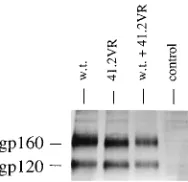
were counted. The results (Table 2) demonstrated that the envelope glycoproteins containing the Gly (mutant env41.2VG) and Ala (env41.2VA) substitutions still were capable of caus-ing cell fusion, although the number and size of syncytia ob-served with the Gly mutant were reduced relative to those observed with the wild type. The Arg mutant (env41.2VR) was completely fusion defective. Similar expression of all three mutants was observed by indirect immunofluorescence (data not shown). Immunoprecipitation analysis of wild-type and 41.2VR envelope was performed as described above. Again, the results showed that the mutant and wild-type glycoproteins were expressed at comparable levels and that cotransfection of the plasmid constructs did not affect overall envelope expres-sion (Fig. 4).
The mutants were then tested for the ability to interfere with wild-type envelope-mediated syncytium formation and virus infectivity. As might be expected from the foregoing results, the Gly and Ala mutants were unable to interfere with either process. The Arg mutant, however, effectively abrogated the ability of wild-type envelope to mediate fusion (Table 3). Both the number and size of resulting syncytia were reduced
com-pared with those for the wild type. As had been observed for the original Glu mutant (9), the interfering effect of the mutant envelope on wild-type envelope function could be detected even in the presence of excess wild-type glycoprotein, as as-sayed in cotransfection experiments in which different ratios of wild-type to mutant DNAs were used (data not shown). These results, taken together with previous data demonstrating that the dominant interfering phenotype is not a property of all fusion domain mutants (9), suggest the phenotype is a result of the introduction of a charged amino acid at position 2 of gp41. This observation supports the hypothesis that interference of fusion occurs by disruption of a hydrophobic fusion pore formed at least in part by the amino termini of multiple gp41 molecules.
These studies have provided additional information regard-ing some of the requirements for and limitations of interfer-ence by the 41.2 mutant envelope glycoprotein. This informa-tion can now be used to direct both the future study of envelope glycoprotein fusion and interference and the devel-opment of more effective strategies in which to use the mutant to interfere with wild-type HIV-1. Additional analysis of 41.2 double mutants containing alternate second-site mutations will be helpful in further assessing the importance of various re-gions of the HIV envelope glycoprotein in both the formation of functional fusion complexes and interference. Also, bio-chemical studies might provide information as to what steps in the fusion complex formation/fusion interference sequence are being disrupted. In addition, saturation mutagenesis of the gp41 fusion domain will result in a more thorough understand-FIG. 4. Immunoprecipitation analysis of the penv41.2VR double mutant. HeLa cells were transfected with pSV2tat72 and either pIIIenv3-1 (wild-type
[image:4.612.384.478.71.162.2][w.t.] env), penv41.2VR, pIIIenv3-1 plus penv41.2VR, or no DNA. TABLE 2. Effects of envelope mutations on syncytium formation
env plasmida
Mutation description Relative syncytium formation6SDb
pHenvKFS env frameshift ,1
pIIIenv3-1 Wild-type envelope 100
penv41.2VA Val3Ala 96617
penv41.2VR Val3Arg ,1
penv41.2VG Val3Gly 5667
aA total of 83105HeLa T4 cells were transfected by the calcium phosphate
coprecipitation method with equivalent amounts of pSV2tat72 and either
wild-type or mutant envelope-expressing plasmids as indicated.
bTransfection of pSV
2tat72 plus pIIenv3-1 resulted in approximately 1,000
[image:4.612.55.298.85.157.2]syncytia permg of pIIIenv3-1 plasmid DNA. Data represent averages of four assays.
TABLE 3. Abilities of envelope mutants to interfere with syncytium formation and infectivity
env
plasmida
Mutation description
Relative syncytium formation
6SDb
Relative infectivity
6SDc
pHenvKFS env frameshift 100 100
pGB122 41.2 mutation (Val3Glu) 1065 1566
penv41.2VA Val3Ala 90629 ND
penv41.2VR Val3Arg 12610 865
penv41.2VG Val3Gly 9267 ND
a
For syncytium assays, HeLa T4 cells were transfected with equal amounts of pSV2tat72, pIIIenv3-1 (wild-type env), and the indicated mutant plasmid DNA as
outlined in Table 1, footnote a. For infectivity assays, virus was produced by transfecting HeLa cells with equal amounts of pGB107, pIIIenv3-1, and the indicated mutant plasmid DNA, and indicator cells were infected as outlined in Table 1, footnote a, and the text.
b
The number of syncytia resulting from transfection of wild-type envelope plus pHenvKFS was approximately 1,000 permg of wild-type envelope-express-ing plasmid.
c
Transfection of vector, wild-type envelope, and pHenvKFS resulted in ap-proximately 103
infectious units per ml of harvested medium. ND, not done.
on November 9, 2019 by guest
http://jvi.asm.org/
[image:4.612.316.555.547.638.2]ing of the requirements for and mechanisms of both the fusion and interference processes.
We are grateful for helpful discussion and comments on the manu-script given to us by the late Howard M. Temin. We thank Leslie A. Raffini for assistance with mutagenesis and cloning, Carolyn R. Casella for supplying the cytoplasmic tail deletion mutant, M. Scott McBride for commenting on the manuscript, and Malcolm A. Martin for pro-viding continued support.
This work was supported by Public Health Service grant CA22443 from the NIH.
REFERENCES
1. Buchschacher, G. L., Jr. 1993. Molecular targets of gene transfer therapy for HIV infection. JAMA 269:2880–2886.
2. Buchschacher, G. L., Jr., E. O. Freed, and A. T. Panganiban. 1992. Cells induced to express a human immunodeficiency virus type 1 envelope gene mutant inhibit the spread of wild-type virus. Hum. Gene Ther. 3:391–397. 3. Buchschacher, G. L., Jr., and A. T. Panganiban. 1992. Human
immunode-ficiency virus vectors for inducible expression of foreign genes. J. Virol. 66:2731–2739.
4. Casella, C. R. (University of Wisconsin—Madison). 1993. Personal commu-nication.
5. Delwart, E. L., G. L. Buchschacher, Jr., E. O. Freed, and A. T. Panganiban. 1992. Analysis of HIV-1 envelope mutants and pseudotyping of replication-defective HIV-1 vectors by genetic complementation. AIDS Res. Hum. Retroviruses 8:1669–1677.
6. Dubay, J. W., S. J. Roberts, B. H. Hahn, and E. Hunter. 1992. Truncation of the human immunodeficiency virus type 1 transmembrane glycoprotein cy-toplasmic domain blocks virus infectivity. J. Virol. 66:6616–6625. 7. Feinberg, M. B., and D. Trono. 1992. Intracellular immunization:
trans-dominant mutants of HIV gene products as tools for the study and inter-ruption of viral replication. AIDS Res. Hum. Retroviruses 8:1013–1022. 8. Frankel, A. D., and C. O. Pabo. 1988. Cellular uptake of the Tat protein from
human immunodeficiency virus. Cell 55:1189–1193.
9. Freed, E. O., E. L. Delwart, G. L. Buchschacher, Jr., and A. T. Panganiban. 1992. A mutation in the human immunodeficiency virus type 1 transmem-brane glycoprotein 41 dominantly interferes with fusion and infectivity. Proc. Natl. Acad. Sci. USA 89:70–74.
10. Freed, E. O., D. J. Myers, and R. Risser. 1989. Mutational analysis of the cleavage sequence of the human immunodeficiency virus type 1 envelope glycoprotein precursor gp160. J. Virol. 63:4670–4675.
11. Freed, E. O., D. J. Myers, and R. Risser. 1990. Characterization of the fusion domain of the human immunodeficiency virus type 1 envelope glycoprotein
gp41. Proc. Natl. Acad. Sci. USA 87:4650–4654.
12. Freed, E. O., D. J. Meyers, and R. Risser. 1991. Identification of the principal neutralizing determinant of human immunodeficiency virus type 1 as a fusion domain. J. Virol. 65:190–194.
13. Gabuzda, D. H., A. Lever, E. Terwilliger, and J. Sodroski. 1992. Effects of deletions in the cytoplasmic domain on biological functions of human im-munodeficiency virus type 1 envelope glycoproteins. J. Virol. 66:3306–3315. 14. Guo, H., F. diMarzo Veronese, E. Tschachler, R. Pal, V. S. Kalyanaraman, R. C. Gallo, and M. S. Reitz, Jr.1990. Characterization of an HIV-1 point mutant blocked in envelope glycoprotein cleavage. Virology 174:217–224. 15. Kimpton, J., and M. Emerman. 1992. Detection of replication-competent
and pseudotyped human immunodeficiency virus with a sensitive cell line on the basis of activation of an integratedb-galactosidase gene. J. Virol. 66: 2232–2239.
16. Kowalski, M., J. Potz, L. Basiripour, T. Dorfman, W. C. Goh, E. Terwilliger, A. Dayton, C. Rosen, W. Haseltine, and J. Sodroski.1987. Functional regions of the envelope glycoprotein of human immunodeficiency virus type 1. Sci-ence 237:1351–1355.
17. Kunkle, T. A., J. D. Roberts, and R. A. Zakour. 1987. Rapid and efficient site-specific mutagenesis without phenotypic selection. Methods Enzymol. 154:367–382.
18. Lasky, L. A., G. Nakamura, D. H. Smith, C. Fennie, C. Shimasaki, E. Patzer, P. Berman, T. Gregory, and D. J. Capon.1987. Delineation of a region of the human immunodeficiency virus type 1 gp120 glycoprotein critical for inter-action with the CD4 receptor. Cell 50:975–985.
19. Maddon, P. J., A. G. Dalgleish, J. S. McDougal, P. R. Clapman, R. A. Weiss, and R. Axel.1986. The T4 gene encodes the AIDS virus receptor and is expressed in the immune system and the brain. Cell 47:333–348. 20. McCune, J. M., L. B. Rabin, M. B. Feinberg, M. Lieberman, J. C. Kosek,
G. R. Reyes, and I. L. Weissman.1988. Endoproteolytic cleavage of gp160 is required for the activation of human immunodeficiency virus. Cell 53:55–67. 21. Sodroski, J., W. C. Goh, C. Rosen, K. Campbell, and W. A. Haseltine. 1986. Role of the HTLV-III/LAV envelope in syncytium formation and cytopath-icity. Nature (London) 322:470–474.
22. Thali, M., C. Furman, E. Helseth, H. Repke, and J. Sodroski. 1992. Lack of correlation between soluble CD4-induced shedding of the human immuno-deficiency virus type 1 exterior envelope glycoprotein and subsequent mem-brane fusion events. J. Virol. 66:5516–5524.
23. White, J. M. 1992. Membrane fusion. Science 258:917–924.
24. Willey, R. L., F. Maldarelli, M. A. Martin, and K. Strebel. 1992. Human immunodeficiency virus type 1 Vpu protein induces rapid degradation of CD4. J. Virol. 66:7193–7200.
25. Yu, X., X. Yuan, M. F. McLane, T. Lee, and M. Essex. 1993. Mutations in the cytoplasmic domain of human immunodeficiency virus type 1 transmem-brane protein impair the incorporation of Env proteins into mature virions. J. Virol. 67:213–221.