ISSN 0252-8266
%
eurostat
EUROSTATISTIK
Daten zur Konjunkturanalyse
EUROSTATISTICS
Data for short-term economic analysis
EUROSTATISTIQUES
Données pour l'analyse de la conjoncture
Monatlich D Monthly D Mensuel
3
D
1987
i
Themenkreis
D
Theme
D
Thème
Allgemeine Statistik Π General statistics
Statistiques générales
eurostat
OFICINA ESTADÍSTICA DE LAS COMUNIDADES EUROPEAS
DE EUROPÆISKE FÆLLESSKABERS STATISTISKE KONTOR
STATISTISCHES AMT DER EUROPÄISCHEN GEMEINSCHAFTEN
ΣΤΑΤΙΣΤΙΚΗ ΥΠΗΡΕΣΙΑ ΤΩΝ
ΕΥΡΩΠΑΪΚΩΝ ΚΟΙΝΟΤΗΤΩΝ
STATISTICAL OFFICE OF THE EUROPEAN COMMUNITIES
OFFICE STATISTIQUE DES
COMMUNAUTÉS EUROPÉENNES
ISTITUTO STATISTICO DELLE COMUNITÀ EUROPEE
BUREAU VOOR DE STATISTIEK DER EUROPESE GEMEENSCHAPPEN
SERVIÇO DE ESTATÍSTICA DAS COMUNIDADES EUROPEIAS
L2920 Luxembourg Tél. 43011 Télex : Comeur Lu 3 4 2 3
B1049 Bruxelles, bâtiment Berlaymont, rue de la Loi 2 0 0 (bureau de liaison) Tél. 2351111
Las publicaciones de Eurostat están clasificadas por temas y por series. La clasificación se encuentra al
final de la obra. Para mayor información sobre las publicaciones, rogamos se pongan en contacto con
Eurostat.
Para los pedidos, diríjanse a las oficinas de venta cuyas direcciones figuran en la página interior de la
contracubierta.
Eurostats publikationer er klassificeret efter emne og serie. En oversigt herover findes bag i hæftet.
Yderligere oplysninger om publikationerne kan fås ved henvendelse til Eurostat.
Bestilling kan afgives til de salgssteder, der er anført på omslagets side 3.
Die Veröffentlichungen von Eurostat sind nach Themenkreisen und Reihen gegliedert. Die Gliederung ist
hinten in jedem Band aufgeführt. Genauere Auskünfte über die Veröffentlichungen erteilt Eurostat.
Ihre Bestellungen richten Sie bitte an die Verkaufsbüros, deren Anschriften jeweils auf der dritten
Umschlagseite der Veröffentlichungen zu finden sind.
Οι
εκδόσεις της Eurostat ταξινομούνται κατά θέμα και κατά σειρά. Η ακριβής ταξινόμηση αναφέρεται στο
τέλος κάθε έκδοσης. Για λεπτομερέστερες πληροφορίες σχετικά με τις εκδόσεις, μπορείτε να απευθύνεσθε
στην Eurostat.
Για τις παραγγελίες μπορείτε να απευθύνεσθε στα γραφεία πώλησης, των οποίων οι διευθύνσεις αναγράφονται
στη σελίδα 3 του εξωφύλλου.
Eurostat's publications are classified according to themes and series. This classification is indicated at the
end of the publication. For more detailed information on publications, contact Eurostat.
Orders are obtainable from the sales offices mentioned on the inside back cover.
Les publications de l'Eurostat sont classées par thème et par série. Cette classification est précisée à la fin
de l'ouvrage. Pour des informations plus détaillées sur les publications, contactez l'Eurostat.
Pour les commandes, adressez-vous aux bureaux de vente dont les adresses sont indiquées à la page 3
de la couverture.
Le pubblicazioni dell'Eurostat sono classificate per tema e per serie. Tale classificazione è precisata alla
fine dell'opera. Per informazioni più dettagliate sulle pubblicazioni rivolgersi all'Eurostat.
Per eventuali ordinazioni rivolgersi a uno degli uffici di vendita i cui indirizzi figurano nella 3
apagina
della copertina.
De publikaties van Eurostat zijn ingedeeld naar onderwerp en serie. Deze indeling is achter in het boek
opgenomen. Voor nadere informatie over de publikaties kunt u zich wenden tot Eurostat.
Gelieve bestellingen op te geven bij de verkoopbureaus, waarvan de adressen op bladzijde 3 van de
omslag zijn vermeld.
As publicações do Eurostat estão classificadas por tema e por série. Esta classificação está indicada
no fim da obra. Para mais informações sobre as publicações é favor contactar Eurostat.
EUROSTATISTIK
Daten zur Konjunkturanalyse
EUROSTATISTICS
Data for shortterm economic analysis
EUROSTATISTIQUES
Données pour l'analyse de la conjoncture
.
<
«
<
<
>
:
>
"
·
·
" > ■ ■ " *
Luxembourg: Office des publications officielles des Communautés européennes, 1987
Kat./cat: CA-BJ-87-003-3A-C
© EGKS-EWG-EAG, Brüssel — Luxemburg, 1987
Nachdruck — ausgenommen zu kommerziellen Zwecken — mit Quellenangabe gestattet.
© ECSC-EEC-EAEC, Brussels — Luxembourg, 1987
Reproduction is authorized, except for commercial purposes, provided the source is acknowledged.
© CECA-CEE-CEEA, Bruxelles — Luxembourg, 1987
Reproduction autorisée, sauf à des fins commerciales, moyennant mention de la source.
Vorwort
Mit der monatlich erscheinenden Veröffentlichung „Eurostatistik" - Daten zur
Konjunk-turanalyse werden innerhalb kürzester Frist die neuesten statistischen Daten über die
Europäische Gemeinschaft als Ganzes (EUR 12), über jedes Mitgliedsland sowie über
die Vereinigten Staaten und Japan bekanntgegeben.
„Eurostatistik" enthält nicht die Gesamtheit des bei Eurostat verfügbaren statistischen
Materials, sondern eine Auswahl der relevantesten Reihen über die konjunkturelle
Ent-wicklung.
Die Reihen werden jeweils für die letzten 15 Monate, die letzten fünf Quartale und die
letzten vier Jahre veröffentlicht, um eine kurz- oder mittelfristige Analyse -
gegebenen-falls mit überarbeiteten Zahlen - zu ermöglichen.
Schnelligkeit und Pünktlichkeit sind die wichtigsten Vorzüge dieser Veröffentlichung.
Aus diesem Grunde wurde sie im Umfang bewußt klein gehalten und enthält keine
Anmerkungen zur Methodik, die im übrigen in den spezialisierten Veröffentlichungen
von Eurostat zu finden sind.
„Eurostatistik" besteht aus vier Teilen:
- Die Rubrik „kurz notiert" gibt die wichtigsten Ereignisse und Entwicklungen der
jüngsten Zeit im wirtschaftlichen, finanziellen und sozialen Bereich wieder.
- Im Schaubilderteil werden die wichtigsten Reihen über die wirtschaftliche
Entwick-lung in der Gemeinschaft, den Mitgliedstaaten, den Vereinigten Staaten und Japan
veranschaulicht.
- Im Konjunkturdatenteil werden die Daten, die von Eurostat auf der Grundlage
gemeinsamer Kriterien harmonisiert wurden, für sämtliche Mitgliedstaaten
darge-stellt und mit den Daten der Vereinigten Staaten und Japans verglichen.
- Der Ländertabellenteil schließlich gibt für jedes Land auf je einer Seite die
wirt-schaftliche Entwicklung auf der Grundlage einer Anzahl von Indikatoren wieder, die
übrigens immer im Konjunkturdatenteil veröffentlicht werden.
Die in „Eurostatistik" veröffentlichten Daten stammen aus dem „ICG"-Bereich der
On-Iine-Datenbank „Cronos" von Eurostat.
Wer Zugang zu Cronos besitzt, kann jederzeit die Tabellen dieser Veröffentlichung
abfragen, wobei die Daten täglich auf den neuesten Stand gebracht werden. Hinweise
zur „on-line"-Benutzung finden sich auf S. 111.
Weitere Informationen über „Eurostatistik" können bei folgender Stelle angefordert
werden:
Eurostat - Direktion A
L-2920 LUXEMBURG
Telephon: (352) 4301-2046
4301-2038
Inhaltsverzeichnis
Zeichen und Abkürzungen
„KURZ NOTIERT"
SCHAUBILDER
. .
KONJUNKTURDATEN
1. Volkswirtschaftliche Gesamtrechnungen
2. Beschäftigung
3. Arbeitslosigkeit
4. Industrielle Produktion
5. Meinungsumfrage in der Industrie
6. Industrieerzeugnisse
7. Einzelhandel
8. Landwirtschaftliche Erzeugnisse
9. Außenhandel
10. Verbraucherpreise
11. Landwirtschaftliche Erzeugerpreise
12. Löhne und Gehälter
13. Finanzstatistiken
14. Zahlungsbilanz
LÄNDERTABELLEN
Titel (vollständiges Verzeichnis)
1. BR Deutschland
2. France
3. Italia
4. Nederland
5. Belgique/Belgïe
6. Luxembourg
7. United Kingdom
8. Ireland
9. Danmark
10. España
11. Hellas
12. Portugal
13. United States of America
14. Japan
5
15
35
39
42
45
52
56
60
61
63
84
87
88
89
93
96
97
98
99
100
101
102
103
104
105
106
107
108
109
110
%
%,
T4/T0
%,T12/T0
%,T/T12
%,SALDO
1980=100
EUR 10=100
EUR 12= 100
MIO
MRD
Τ
TR0EE
GWH
M3
Β
DK
D
GR
E
F
IRL
I
L
NL
Ρ
UK
USA
JAP
USD
ECU
SZR
EG
Eurostat
EUR 10 I
EUR 12 I
UEBL/BLEU
ACP
ESVG
NACE
SITC
Weniger als die Hälfte der verwendeten
Einheit
Prozent
Prozentualer Zuwachs eines Vierteljahres
gegenüber dem entsprechenden Vierteljahr
des Vorjahres
Prozentualer Zuwachs eines Monats
gegenüber dem entsprechenden Monat
des Vorjahres
Saldo zwischen den positiven Antworten
(Zunahme, Verbesserung der Situation) und
den negativen Antworten (Abnahme,
Verschlechterung der Situation) der
Konjunkturbefragung bei den
Unternehmern in der Gemeinschaft,
saisonbereinigt (Ländertabellen)
Basisjahr
Prozentuale Angaben im Verhältnis zur
Gemeinschaft der 10 oder 12 ( = 100)
Million
Milliarde
Metrische Tonne
Tonne Rohöleinheiten
Gigawattstunde = 10
6kWh
Kubikmeter
Belgique/België
Danmark
BR Deutschland
Ελλάδα/Griechenland
España
France
Ireland
Italia
Luxembourg
Nederland
Portugal
United Kingdom
United States of America
Japan
US-Dollar
Europäische Währungseinheit
Sonderziehungsrechte
Europäische Gemeinschaft[en]
Statistisches Amt der Europäischen
Gemeinschaften
Gesamtheit der Mitgliedsländer der
Europäischen Gemeinschaften vor bzw.
nach dem Beitritt Spaniens und Portugals
Belgisch-luxemburgische Wirtschaftsunion
Länder Afrikas, der Karibik und des Pazifiks
— Abkommen von Lomé
Europäisches System Volkswirtschaftlicher
Gesamtrechnungen
Allgemeine Systematik der
Wirtschaftszweige in den Europäischen
Gemeinschaften
Eurostatistik: Kurz notiert
1. HERAUSRAGENDE EREIGNISSE
Die Wirtschaftslage der Gemeinschaft scheint sich in ihrer Gesamtheit inner-halb der letzten drei Monate weniger günstig entwickelt zu haben.
Die gegenwärtig verfügbaren Daten weisen auf eine Verlangsamung des Wachstums im dritten und vierten Quartal 1986 hin.
Desgleichen ist bei der industriellen Erzeugung eine starke Verlangsamung festzustellen, die auf eine stagnierende Produktion von Investitionsgütern seit Ende des ersten Halbjahres 1986 zurückzuführen ist.
Im Währungsbereich waren in den letzten Wochen eine Wertsteigerung des Pfund Sterling, eine „relative Schwäche" der Deutschen Mark und vor allem weniger sprunghafte Wechselkursbewegungen des US-Dollars festzustellen. Zudem ist hinsichtlich der langfristigen Realzinssätze (inflationsbereinigter Nominalzins), die nach wie vor hoch sind, keinerlei Entspannung eingetre-ten.
Bei der Inflationsbekämpfung scheint man auf der Stelle zu treten. Trotz eines gemäßigten Anstiegs der Verbraucherpreise im Februar ( + 0 , 3 % für EUR 12) ist eine leichte Beschleunigung des Jahrestempos ( + 3%) zu ver-zeichnen, die zum Teil auf die ungünstige Preisentwicklung bei der impor-tierten Energie zurückzuführen ¡st. Gleichwohl ist anzumerken, daß diese Beschleunigung in den Ländern teilweise abgeschwächt ist, deren Währung eine regelmäßige Wertsteigerung erfährt.
Das hervorstechende Ereignis in diesem Bereich ist der Rückgang des Infla-tionsgefälles in der Gemeinschaft.
Was den Außenhandel angeht, so hat die Gemeinschaft innerhalb der drei Monate bis Januar 1987 10 o/o (in Volumeneinheiten) weniger ausgeführt als zuvor.
Im Gegensatz dazu ist bei der Einfuhr in die EG (in Volumeneinheiten) eine leichte Zunahme zu verzeichnen; ihr Außenhandelssaldo ¡st positiv geblie-ben.
Bemerkenswert ¡st in diesem Bereich die starke Zunahme der Einfuhr in die Gemeinschaft 3us Japan und den Ländern Südostasiens.
Abschließend ist für die EG insgesamt trotz der in einigen Mitgliedstaaten zu verzeichnenden guten Leistungen keine nennenswerte Verbesserung auf dem Beschäftigungssektor festzustellen.
2. BIP: Verlangsamte Zuwachsraten im dritten und
vier-ten Quartal 1986
Im dritten Quartal 1986 ist das saisonbereinigte BIP der Gemeinschaft, [-], um 0,6 % [umgerechnet auf das ganze Jahr] gestiegen. Im ersten und zwei-ten Quartal 1986 lagen die Zuwachsrazwei-ten noch bei 1,8 Wo bzw. 5,1 o/o. In den Vereinigten Staaten ¡st im dritten Quartal wieder ein Anstieg um 2,7 % nach 0,6 o/o im zweiten Quartal zu verzeichnen.
In Japan lag die Zuwachsrate bei 2,6 o/o nach 3,7 % im zweiten Quartal. In den wichtigsten Ländern der Gemeinschaft stellt sich die Situation wie folgt dar:
Bundesrepublik
Deutschland: Zuwachsrate von 3 % , verlangsamter Anstieg des Wachstums
Frankreich:
Italien:
Vereinigtes Königreich:
Aufgrund einer Basisänderung stehen keine Daten zur Verfügung
negatives Wachstum von 3,2 o/o, starker Rückgang der Investitionen
Zuwachsrate von 0,7 o/o.
Im vierten Quartal 1986 weisen die bisher verfügbaren Teilergebnisse des saisonbereinigten BIP auf das Jahr umgerechnet eine leichte Zuwachsrate ( +1,7 o/o) für die Wirtschaft der Vereinigten Staaten auf, Folge eines Immer noch ungünstigen Außenbeitrages und einer stagnierenden Inlandsnach-frage.
In Europa bestätigt der Rückgang (-0,6 o/o) in der Bundesrepublik Deutsch-land im vierten Quartal die bereits im vorhergehenden Quartal festgestellte Verlangsamung, die im wesentlichen im Exportrückgang begründet sein dürfte.
3. INDUSTRIELLE PRODUKTION: Kein Zuwachs bei der
Produktion von Investitionsgütern
Gegenüber 1985 zeigen die Jahresmittelwerte des Index der industriellen Produktion 1986 für die Gemeinschaft (EUR 12) eine Zunahme von rund + 2,1 o/o (während die Zunahme 1985 gegenüber 1984 +3,3 % betrug). Die Vereinigten Staaten verzeichneten eine Zunahme von +1,0 o/o ( + 1,7% 1985 gegenüber 1984), und in Japan kam es zu einem Rückgang um (-0,3 % ) , während 1985 gegenüber 1984 eine Zunahme von +4,5 o/o fest-gestellt wurde.
Die Mitgliedstaaten der Gemeinschaft lassen sich nach den Wachstumsra-ten der industriellen Produktion im Jahresmittel 1986 gegenüber 1985 in vier Gruppen unterteilen:
Mitgliedstaaten mit Änderungsraten unter +1,5 o/o: +0,3 o/o Griechen-land, Frankreich und die Niederlande +1,1 %, Vereinigtes Königreich
+ 1,5 0/0.
- Mitgliedstaaten mit Wachstumsraten von rund + 2 % : Bundesrepublik Deutschland und Belgien +2,1 %.
Mitgliedstaaten mit Wachstumsraten zwischen + 2 , 5 % und 3,5 o/o: + 2,7 o/o Irland, +3,2 % Italien, Luxemburg und Spanien.
Mitgliedstaaten mit Wachstumsraten von mehr als +3,5 o/o: Dänemark + 4,0 o/o und Portugal +5,0 o/o.
Der saisonbereinigte Index für Dezember beträgt 106,2. Dies entspricht einer klaren Verlangsamung des mittleren Wachstumstempos der industriel-len Produktion seit Beginn des Sommers; der Stand von 106,2 wurde näm-lich bereits im zweiten Quartal 1986 erreicht.
In den letzten drei Monaten, für die Angaben vorliegen, belief sich der Anstieg des Gesamtindex EUR 12 gegenüber dem des entsprechenden Vor-jahreszeitraums auf +1,5 %. Für diesen Zeitraum liegt die Steigerung in der BR Deutschland bei +0,4 o/o, in Frankreich bei +0,8 o/o, im Vereinigten Königreich bei +1,0 o/o und in Italien bei +3,7 o/o. In Dänemark und Grie-chenland ¡st ein Rückgang festzustellen. Die entsprechenden Werte betra-gen für die Vereinigten Staaten +0,9 o/o und für Japan um - 0 , 9 o/o.
4. STAHL: Erneuter Produktionsrückgang im Februar
( - 5 0 / 0 )Die Rohstahlerzeugung der Gemeinschaft (ohne Griechenland) hat im Februar 1987 mit 9,9 Mio t im Vergleich mit dem Vormonat saisonbereinigt um 1,3 0/o zugenommen; gegenüber Februar 1986 ist allerdings ein Rück-gang von 5 % zu verzeichnen.
Die Auftragseingänge (EUR 9, Massenstahl) erreichten 1986 82,9 Mio t; dies entspricht einem Rückgang um 4 0/0 gegenüber 1985 und um 1,3% gegen-über 1984.
Die Werkslieferungen zeigten mit 83,7 Mio t eine ähnliche Entwicklung: (-3,8 0/0 bzw. -0,7 % Im Vergleich zu 1985 bzw. 1984).
5. PREISE: Gemäßigter Anstieg für EUR 12 im Februar
( + 0,3%), jedoch leichte Beschleunigung der
jährli-chen Steigerungsrate ( + 3 % ) .
Nach den Berechnungen von Eurostat stieg der Verbraucherpreisindex In der gesamten Gemeinschaft zwischen Januar und Februar 1987 um 0,3 %. Mit diesem Anstieg sind bei dem Verbraucherpreisindex auf Gemeinschafts-ebene offenbar wieder die leichten Anstiegsraten zu verzeichnen, die seit Beginn des letzten Jahres festzustellen waren.
Im Februar ging der Index in Dänemark um 0,1 % zurück, während in den meisten Mitgliedstaaten leichte bis mäßige Zuwachsraten zu beobachten waren: 0,1 0/0 ¡n der Bundesrepublik Deutschland, 0,2 0/0 in Frankreich, Bel-gien, Luxemburg und in den Niederlanden, 0,4 0/0 in Italien, in Spanien, in Griechenland und im Vereinigten Königreich. Ein recht empfindlicher Preis-anstieg wurde mit 1,0 0/0 in Portugal verzeichnet.
Die auf ein Jahr umgerechnete Inflationsrate betrug für die gesamte Gemeinschaft (EUR 12) 3,0 0/0 (Februar 1987 gegenüber Februar 1986). Im Monat Januar lag diese Rate in den Vereinigten Staaten bei + 1 , 4 % und in Japan bei - 1 , 1 0/0.
Die jährlichen Zuwachsraten des Preisindex (Februar 1987 gegenüber Februar 1986) in den einzelnen Mitgliedstaaten sehen wie folgt aus: Niederlande -0,9 0/0, Bundesrepublik Deutschland -0,5 %, Luxemburg -0,50/0, Belgien +1,0 0/0, Frankreich +3,4 0/0, Irland +3,5 0/0 •.Vereinigtes Königreich +3,9 0/0, Italien +4,3 0/0, Dänemark +4,7 0/0, Spanien +6,0 o/o, Portugal +9,5 0/0, Griechenland +16,8%.
Es sei auf die deutliche Abschwächung des Preisanstiegs in Spanien und in Portugal hingewiesen, wo die Inflation vor einem Jahr bei 9 % bzw. 12,6% lag.
6. ARBEITSLOSIGKEIT: Erhöhung um 1,3 0/0 der in der
Gemeinschaft eingeschriebenen Arbeitslosen
Ende Februar 1987 betrug die Zahl der bei den Arbeitsämtern der Gemein-schaft der zwölf Mitgliedstaaten eingeschriebenen Arbeitslosen 17 Millionen Personen. Trotz des starken Winterwetters, das in den meisten Ländern der Gemeinschaft geherrscht hat, weist die Zahl der Arbeltslosen eine leichte Abnahme gegenüber dem Vormonat auf.
Im Gegensatz dazu hat sich die Zahl der eingeschriebenen Arbeltslosen im vergangenen Jahr gegenüber Februar 1986 um 222 000 Personen oder um 1,30/0 erhöht. Damit hat sich die Situation auf dem Arbeitsmarkt Insgesamt gesehen wenig verändert.
Die Zahl der jüngeren Arbeitslosen unter 25 Jahren ist in demselben Zeit-raum um 22 700 Personen oder 0,4 0/0 zurückgegangen. Daran wird deutlich, daß die Probleme der älteren Arbeltslosen von Mal zu Mal zunehmen. Abnahmen bei der Zahl der jüngeren Arbeitslosen finden sich für das ver-gangene Jahr bei den meisten Mitgliedstaaten, bis auf Italien, Irland, Grie-chenland und Spanien, in denen die Zahl um 50/0 und mehr zugenommen hat.
7. AUSSENHANDEL: Gemeinschaftsausfuhr rückläufig
(mengenmäßig —10%), leichter Anstieg bei der
Ein-fuhr (mengenmäßig + 1 % ) , Außenhandelssaldo
jedoch immer noch positiv
Erste Schätzungen für die drei Monate bis Januar 1987 zeigen, daß die Aus-fuhren der EG in Drittländer weiter sinken. Sie betrugen durchschnittlich 27 Mrd ECU je Monat und lagen damit 15 o/o unter dem Niveau des Ver-gleichszeitraums des letzten Jahres. Dies entspricht einem Mengenrück-gang von etwa 10 %.
Vorläufige Zahlen für 1986 zeigen, daß die Ausfuhren von durchschnittlich 28 Mrd ECU im Monat im Vergleich zu ihrem Stand 1985 wertmäßig um 10 o/o und mengenmäßig um 5 % zurückgingen. Die Ausfuhren In Entwicklungs-länder fielen um 17 o/o, was die verringerte Kaufkraft der Länder, die in erster Linie von der Ausfuhr von Öl und anderen Rohstoffen abhängig sind, wider-spiegelt. Andererseits waren die Ausfuhren in Industrieländer nur um 6 o/o niedriger. Sie machten 60 % der EG-Ausfuhren aus, während die Entwick-lungsländer und die Ostblockländer 32 % bzw. 8 o/o aufnahmen. Rund 82 o/o der Gesamtausfuhren waren Fertigwaren, deren Ausfuhren 1986 um 7 o/o fie-len, der Rückgang war damit deutlich niedriger als bei Nichtfertigwaren. In den drei Monaten bis Januar fielen auch die Ausfuhren der USA um 15 o/o und erreichten im Monatsdurchschnitt 17 Mrd ECU. Japans Ausfuhren in diesem Zeitraum lagen mit 16 Mrd ECU im Monat 10 % niedriger.
In den drei Monaten bis Januar 1987 lagen die Einfuhren der EG aus Drittlän-dern bei durchschnittlich 26 Mrd ECU je Monat. Wertmäßig waren dies 20 o/o weniger als die Einfuhren im Vergleichszeitraum des Vorjahres, obwohl es mengenmäßig wahrscheinlich einen leichten Anstieg bedeutet.
1986 gingen die Einfuhren wertmäßig um 17 o/o auf durchschnittlich 28 Mrd ECU je Monats zurück. Mengenmäßig stiegen die Einfuhren zwar um 7 o/o an, dies wurde jedoch durch einen Rückgang der Preise um 23 o/o mehr als ausgeglichen. Der Preis der Rohöleinfuhren halbierte sich fast ( - 4 8 %) und die Preise von Rohstoffen außer Nahrungsmitteln lagen 21 o/o niedriger. Infolgedessen halbierten sich die Rohöleinfuhren wertmäßig und die Einfuh-ren anderer Rohstoffe lagen 22 o/o niedriger, obwohl die Einfuhrmengen bei diesen Waren nur geringfügig zurückgingen. Die Einfuhren von Nahrungs-mitteln, Getränken und Tabak waren 8 % niedriger. Andererseits stiegen die Einfuhren von Fertigwaren wertmäßig um 1 o/o und mengenmäßig um 8 %. Die Industrieländer lieferten 5 9 % der EG-Einfuhren 1986, während 3 2 % aus Entwicklungsländern kamen.
Die Einfuhren aus den ersteren (hauptsächlich Fertigwaren) lagen 7 o/o nied-riger, bei den letzteren gab es dagegen einen Rückgang um 30 o/o. Die Ein-fuhren aus OPEC-Ländern lagen 45 o/o niedriger und die aus den AKP-Län-dern, dem Mittelmeerraum und Lateinamerika gingen um mehr als 30 % zurück. Dagegen stiegen die Einfuhren aus Japan um 16 o/o und die aus den Schwellenländern des Fernen Ostens um 4 %.
In den drei Monaten bis Januar lagen die Einfuhren der USA mit 31 Mrd ECU je Monat um 17 o/o niedriger. Japans Einfuhren gingen im Vergleich zum glei-chen Zeitraum des Vorjahres um 26 o/o auf 9 Mrd ECU im Monat zurück. Die EG hatte In den drei Monaten bis Januar einen geringen Handelsüber-schuß zu verzeichnen. Im letzten Jahr erreichte die Gemeinschaft zum erstenmal einen Jahreshandelsüberschuß durch eine Verbesserung der Handelsbilanz um etwa 33 Mrd ECU. Dies ist auf eine Verbesserung der Ölrechnung um 52 Mrd ECU und auf eine Verbesserung um 6 Mrd ECU bei anderen Rohstoffen zurückzuführen, teilweise ausgeglichen durch eine Ver-schlechterung des Handelsüberschusses für Fertigwaren um 25 Mrd ECU. Das Handelsdefizit der USA lag in den drei Monaten bis Januar bei durch-schnittlich 14 Mrd ECU je Monat, wobei die Ausfuhren nur 55 % der Einfuh-ren deckten. Dies bedeutet nur eine geringfügige Verbesserung gegenüber den 53 o/o des Vorjahres. Japan erreichte einen durchschnittlichen Über-schuß von 7 Mrd ECU je Monat, die Ausfuhren deckten die Einfuhren zu 171 o/o.
Die ¡nnergemeinschaftlichen Einfuhren lagen In den drei Monaten bis Januar bei durchschnittlich 37 Mrd ECU je Monat und damit rund 5 o/o niedriger als vor einem Jahr. Der Rückgang ist überwiegend auf den geringeren Wert des Ölhandels zurückzuführen - die Länder mit den deutlichsten Ausfuhrrück-gängen waren das Vereinigte Königreich und die Niederlande, die beiden größten Ölausfuhrländer der EG.
1986 fiel der innergemeinschaftllche Handel wertmäßig um 2 % auf 38 Mrd ECU im Monat. Mengenmäßig stieg der Binnenhandel der Gemeinschaft um
4 0/0.
8. WECHSELKURSE: Aufwertung des Pfund Sterling,
relative „Schwäche der DM" und der Dollar nicht mehr
so unbeständig
Der Anstieg des Pfund Sterling sowohl gegenüber dem Dollar als auch gegenüber den anderen Hauptwährungen war eine der wichtigsten Erschei-nungen auf den Geldmärkten in den letzten Wochen. Die günstigeren Zins-sätze für Anlagen in Pfund Sterling können als eine Erklärung für diesen Anstieg herangezogen werden. Die untenstehende Tabelle liefert die jüng-sten Daten über die Zinssätze der wichtigjüng-sten Währungen auf den Euro-Geldmärkten.
US-Dollar Schweizer Franken DM
Yen
6,1 o/o 4,3 o/o 4,0 o/o 3,9 o/o
Die genannten Zinsvorteile des Pfund Sterling sind jedoch nicht eine Erscheinung der jüngsten Vergangenheit und können deshalb nicht allein den jüngsten Anstieg erklären. Die folgenden zusätzlichen Faktoren schei-nen ebenfalls zu diesem Anstieg beigetragen zu haben: a) Die relative Schwäche der DM hat eine Reihe von Investoren zu Pfund-Anlagen geführt b) die Investoren erwarteten unmittelbare wirtschaftliche Maßnahmen, die das Pfund Sterling begünstigen würden (diese Maßnahmen wurden auch am 17. 3. anläßlich der Vorstellung des neuen Haushalts des Vereinigten König-reichs angekündigt).
Der US-Dollar befand sich Mitte März gegenüber den meisten Währungen auf einem höheren Niveau als einen Monat zuvor, aber das Hauptcharakten-stikum des Dollar war, daß er im Vergleich zu seinen vorhergehenden star-ken Ausschlägen an Stabilität gewann. Die Bereitschaft der Zentralbanstar-ken nach der „Pariser Vereinbarung" vom letzten Monat, die bestehenden Pari-täten zu verteidigen, trug wahrscheinlich mit dazu bei.
Innerhalb des EWS gab es seit Mitte Februar keine bemerkenswerten Verän-derungen. Die DM verlor während dieses Zeitraums etwas an Boden, nach-dem es Hinweise auf ein etwas geringeres Wachstum der deutschen Wirt-schaft als erwartet gegeben hatte. Diese Hinweise machten Finanzanlagen ind DM weniger attraktiv für Investoren, die hauptsächlich Kapitalgewinne (durch Währungsaufwertungen) erwarten, wenn sie Niedrigzinswährungen halten. Die relativen Positionen der übrigen EWS-Währungen veränderten sich kaum.
Bemerkenswert bei den übrigen Gemeinschaftswährungen war die relative Stabilität der griechischen Drachme in der letzten Zelt: Nach einem beträchtlichen Wertverlust im Laufe des Jahres 1986, der sich in einer fast kontinuierlichen Abwärtsbewegung ausdrückte, blieb der Kurs der Drachme gegenüber der ECU während des letzten Monats praktisch unverändert, was wahrscheinlich eine Änderung der Wechselkurspolitik widerspiegelt (der Wechselkurs der Drachme ist eine politisch festgelegte Variable).
9. ZINSSÄTZE: Steigende Zinssätze in Dänemark,
Frank-reich, Italien, den Vereinigten Staaten und Japan
Die langfristigen Zinssätze (d. h. die Erträge langfristiger Anleihen) entwik-kelten sich in den in dem vorliegenden Papier untersuchten Ländern im Februar im Vergleich zum Vormonat folgendermaßen:In Dänemark war der stärkste Anstieg bei den Zinssätzen festzustellen, der Durchschnitt lag dort im Februar (12,4 o/o) deutlich höher als im Januar (10,8 % ) . Geringe Anstiege waren in Frankreich und Italien zu verzeichnen, noch niedrigere in den USA und in Japan. Andererseits waren die Zinssätze in den übrigen Ländern, für die jüngste Daten verfügbar sind, geringfügig niedriger.
Ein genaueres Bild könnte die Untersuchung der „realen" (also inflationsbe-reinigten) langfristigen Zinssätze ergeben. Die untenstehende Tabelle liefert die jüngsten Daten über die realen langfristigen Zinssätze.
Reale langfristige Zinssätze (%) Luxemburg
Dänemark Niederlande Frankreich * Vereinigte Staaten BR Deutschland Vereinigtes Königreich
7.8 7,5 7 , 0 " 6,4 6.2 6.2 5.9
Belgien Japan
"· Portugal Italien Spanien ' Griechenland
5.7 5.6 5,4 4,8 4,6 2,2
Kurzfristige Euro-Geld-Zinssätze
Pfund Sterling 10,5 o/o Lira 9,5 o/o Französischer Franc 8,0 o/o
Januar-Daten, Dezember-Daten,
.Für Irland sind keine jüngeren Daten über die Inflationsrate verfügbar.
10. GELDVOLUMEN: Zunahme des Geldvolumens (M1) in
der Bundesrepublik Deutschland und in den
Vereinig-ten StaaVereinig-ten, jedoch Abnahme In Frankreich
Die Jahreszuwachsrate des Geldvolumens Im engeren Sinne (M1-Konzept, das im allgemeinen Banknoten, Münzen und übertragbare Sichteinlagen abdeckt) zeigte in den Ländern, für die jüngste Daten (Januar 87) verfügbar sind, die folgenden Veränderungen:
Foreword
Eurostatistics - data for short-term economic analysis
- is a monthly publication aimed
at providing, as rapidly as possible, the latest statistical data on the European
Com-munity as a whole (EUR 12), each Member State, the United States and Japan.
Eurostatistics
does not present all the statistics held by Eurostat, but a selection of the
most relevant series on the economic situation.
The series are published for the last 15 months, the last five quarters and the last four
years, thus permitting short- or medium-term analysis with figures that may have been
revised where necessary.
Speed of publication and punctuality are the main features of this publication; that is
why it is deliberately streamlined and does not contain any methodological notes, which
are given in Eurostat's specialized publications.
Eurostatistics
comprises four sections:
- The 'In brief' section outlines the main recent events and trends in the economic,
financial and social fields.
- The 'Graphs' section illustrates the most significant economic series for the
Com-munity, its Member States, the United States and Japan.
- The 'Short-term trends' section presents data harmonized by Eurostat on the basis
of common criteria for the Member States as a whole, with comparisons with the
USA and Japan.
- Lastly, the 'Tables by country' section shows on one page the trends in the
econo-mic situation in each country on the basis of a number of indicators, which are not
always published in the 'Short-term trends' section.
The data published in
Eurostatistics
are taken from the ICG domain of Eurostat's
on-line data bank, Cronos.
By linking up to Cronos it is possible to obtain daily the tables presented in this
publica-tion, containing data updated daily. The method of consultation can be found on p. 111
of this publication.
Further information about
Eurostatistics
can be obtained from the following address:
Eurostat - Directorate A
L-2920 Luxembourg
Tel.:(352)4301-2046
4301-2038
Contents
Symbols and abbreviations
Page
'IN BRIEF'
GRAPHICS
SHORTTERM TRENDS
1. National accounts
2. Employment
3. Unemployment
4. Industrial production
5. Opinions in industry
6. Industrial products
7. Retail sales
8. Agricultural products
9. External trade
10. Consumer prices
11. Producer prices of agricultural products
12. Wages and salaries
13. Financial statistics
14. Balance of payments
TABLES BY COUNTRY
Titles (complete list)
1. BR Deutschland
2. France
3. Italia
4. Nederland
5. Belgique/Belgïe
6. Luxembourg
7. United Kingdom
8. Ireland
9. Danmark
10. España
11. Hellas
12. Portugal
13. United States of America
14. Japan
96
97
98
99
100
101
102
103
104
105
106
107
108
109
110
9
15
35
39
42
45
52
56
60
61
63
84
87
88
89
93
0
%
%.
T4/T0
%,T12/T0 1
%,T/T12 J
%,BALANCE
•
1980=100
EUR 10=100
EUR 12= 100
MIO
MRD
Τ
TOE
GWH
M3
Β
DK
D
GR
E
F
IRL
I
L
NL
Ρ
UK
USA
JAP
USD
ECU
SDR
EC
Eurostat
EUR 10
EUR 12
UEBL/BLEU
ACP
ESA
NACE
SITC
Data less than half the unit used
Percent
Percentage increase on the corresponding
quarter of the previous year
Percentage increase on the corresponding
month of the previous year
Balance between positive replies (increase,
improvement in the situation) and negative
replies (reduction, worsening of the
situation) in the shorttermtrends inquiry
conducted among heads of enterprises in
the Community
Seasonally adjusted (Tables by country)
Reference year
Data for countries expressed as a
percentage of the Community of 10 or 12
( = 100) "
Million
Thousand million
Tonne
Tonne of oil equivalent
G i g a w a t t h o u r ( = 10
6kWh)
Cubic metre
Belgique/België
Danmark
BR Deutschland
Ελλάδα/Greece
España
France
Ireland
Italia
Luxembourg
Nederland
Portugal
United Kingdom
United States
Japan
US dollar
European currency unit
Special Drawing Right
European Communities
Statistical Office of the European
Communities
Total of the member countries of the EC
before and after the accession of Spain and
Portugal
Belgo-Luxembourg Economic Union
African, Caribbean and Pacific countries of
the Lomé Convention
European System of Integrated Economic
Accounts
General Industrial Classification of
Economic Activities within the European
Communities
Eurostatistics: in brief
1. HIGHLIGHTS
The overall economic situation in the Community seems to have been less favourable in recent months.
The data currently available indicate a slow-down in growth in the third and fourth quarters of 1986.
Similarly, industrial production slowed considerably owing to the absence of growth in the production of capital goods since the end of the first half of 1986.
In the monetary, field, recent weeks have seen upward movement in the pound sterling, a 'relative weakness' of the Deutsche Mark and, above all, less erratic movements of the US dollar.
In addition, there has been no slackening of real long-term interest rates (nominal rates corrected to allow for Inflation), which are still high.
The fight against inflation would appear to be marking time. Despite a mod-erate increase in consumer prices in February ( + 0.3% for EUR 12), there has been a slight acceleration of the annual rate ( + 30/0), partially due to the unfavourable trend In prices of imported energy. It should be noted, how-ever, that this acceleration has been offset to some extent in countries with regularly appreciating currencies. A striking feature in this field is the reduc-tion in the inflareduc-tion differentials within the Community.
As regard external trade, during the three months to January 1987 the Com-munity exported 10% less (in volume) than in the same period the previous year.
On the other hand, the Community imported slightly more (in volume), and its external trade balance remained positive. What is most striking in this connection is the considerable increase in imports to the Community from Japan and South-East Asian countries.
There has been no appreciable improvement in the employment sector for the Community as a whole, despite the progress made in certain Member States.
2. GDP: The growth rate slackened in the third and
fourth quarters of 1986
The seasonally adjusted increase in the Community's GDP for the third quarter of 1986 was equivalent to an annual rate of 0.6%. In the first and the second quarters of 1986 growth rates of I.80/0 and 5.1% respectively were recorded.
In the United States of America, the growth rate rose from O.60/0 in the second quarter to 2.70/o in the third quarter, while in Japan it fell from 3.70/o in the second quarter to 2.6% in the third quarter.
The situation in the main Community countries was as follows: FR of Germany: growth rate of 30/0, i.e. slow-down in growth; France: data not available owing to change of base; Italy: negative growth of - 3 . 2 % , sharp fall in investment; United Kingdom: growth of OJO/o.
In the fourth quarter of 1986, the provisional results for GDP (seasonally adjusted and annualized) showed only a marginal increase in growth ( + 1.70/0) in the United States economy. This was due to the combined effects of a continuing deficit in the external balance and sluggish domestic demand.
In Europe, the fall of -O.6O/0 recorded in the fourth quarter by the Federal Republic of Germany confirmed the clow-down observed during the pre-vious quarter, which was mainly due to a drop in exports.
4. STEEL: a further fall in production in February ( - 5 % )
In February 1987 Community crude steel production (without Greece) at 9.9 million tonnes, experienced a seasonally adjusted rise of 1.30/o compared with the previous month and a fall of 5% compared with February 1986. The total of new orders (EUR 9; ordinary steels) for 1986, at 82.9 million tonnes represents a drop of 40/o compared with 1985 and 1.30/o compared with 1984.Deliveries, at 83.7 million tonnes, show a similar trend: -3.80/o and —0.7% compared with 1985 and 1984 respectively.
5. PRICES: Moderate increase in the monthly rate for
EUR 12 in February ( + 0.3%) but a slight increase in
the annual rate ( + 3%).
According to Eurostat calculations the CPI for the Community as a whole rose by O.30/0 between January and February 1987.
It seems that this rise In the CPI has brought the Community back to the rates of increase which were recorded since the beginning of last year. In February the consumer price index in Denmark went down by 0.1%, whereas low to moderate increases were reported by most of the other Member States: 0 . 1 % in Germany (FR), 0.20/o in France, Belgium, Luxem-bourg and the Netherlands, O.40/0 in Italy, Spain, Greece and the United Kingdom.
A marked increase was recorded in Portugal: LOO/0.
The inflation rate for the Community as a whole (EUR 12) Is 3.0% (Febru-ary 1987 compared to Febru(Febru-ary 1986).
For January this rate was +1.40/0 in the USA and — Lio/o in Japan. For the EC Member States the inflation rates over 12 months (February 1987/February 1986) were as follows:
The Netherlands -O.90/0, Germany (FR) -O.50/0, Luxembourg -O.50/0, Bel-glum + 1.00/0, France +3.40/0, Ireland n.a., United Kingdom +3.9%, Italy
+ 4.30/0, Denmark +4.70/0, Spain +6.00/0, Portugal +9.50/0, Greece + 16.80/0.
It can be noted that a clear deceleration took place In the indices of the two Member States Spain and Portugal, where the inflation rates a year ago were 90/0 and 12.60/0 respectively.
6. UNEMPLOYMENT: A 1.3% rise of the registered
unem-ployed in the Community
At the end of February 1987, some 17 million persons were registered as unemployed at employment offices in the Community of the Twelve. Despite the bad winter experienced throughout most of the Community, this repre-sented a slight decrease compared to January 1987.
But, when compared to February 1986, the number of registrations at employment officies increased by 222 000 persons or I.30/0 over one year. The situation has therefore hardly changed in the long-term.
However, for persons aged under 25, the number of unemployed decreased over the year by 22 700 or O.40/0. Problems for the older unemployed would therefore seem to be worsening.
This drop in the number of younger registered unemployed persons is rela-tively general throughout the Member States, with the exceptions of Italy, Ireland, Greece and Spain who all experienced increases of 5% or more.
No growth in production
3. INDUSTRIAL PRODUCTION:
of capital goods
The average increase recorded in the index of industrial production of the Community (EUR 12) between 1985 and 1986 was around 2 . 1 % (compared with a rise of 3.3% between 1984 and 1985). The rate of increase in the USA was 1.0%, compared with I.70/0 the previous year, while Japan reports a fall of 0.3%, compared with a rise of 4.50/0 between 1984 and 1985.
The average year-on-year increases in industrial production recorded in the Community Member States can be classified into four groups:
(i) countries where the increase was under I.50/0: +0.3% in Greece, 1.1% In France and the Netherlands, 1.5% In the United Kingdom;
(¡i) countries which recorded a rise of around 2%: 2.IO/0 in the FR of Ger-many and Belgium;
(iii) countries with increases between 2.50/0 and 3.50/0: 2.7% in Ireland, 3.2% In Italy, Luxembourg and Spain;
(¡v) countries with rates of increase above 3.5%: 4.OO/0 in Denmark and 50/0 in Portugal.
The seasonally adjusted index for December, 106.2, reflects a substantial slowing-down of the average rate of increase in industrial production since the early summer, with the 106.2 level already reached in the second quarter of 1986.
For the three months for which figures are available the year-on-year increase in the EUR 12 index is I.50/0. The rates in the Member States are O.40/0 in the FR of Germany, O.8O/0 in France, LOO/0 in the United Kingdom and 3.70/0 in Italy, contrasting with a downward trend in Denmark and Greece. The corresponding rates for the USA and Japan are 0.9% and approximately -O.90/0 respectively.
7. EXTERNAL TRADE: Community exports down (10% in
volume) imports slightly up ( + 1 % in volume) external
trade balance still positive
First estimates for the three months to January 1987 show that EC exports to third countries are continuing to decline. They averaged 27 000 million ECU per month, some 150/o below the level of the corresponding period last year. This translates to a volume reduction of around 100/o.
Provisional figures for 1986 show that exports, which averaged 28 000 million ECU per month, declined by 100/0 in value terms and by 50/0 in volume terms from their 1985 level. Exports to developing countries fell by 170/0, reflecting the reduced purchasing power of countries which primarily depend on exports of oil and other raw materials. On the other hand exports to indus-trialized countries were only 6O/0 lower. They accounted for 6OO/0 of the EC's exports, whilst developing countries and Eastern block countries took res-pectively 32% and 80/0. Some 820/o of all exports were manufactured goods. Exports of these fell by 70/o in 1986, a much smaller decline than that of non-manufacture.
In the three months to January, the USA's exports also fell by 150/0, averag-ing 17 000 million ECU per month. Japan's exports in this period were IO0/0 lower at 16 000 million ECU per month.
In the three months to January 1987, EC imports from third countries aver-aged 26 000 million ECU per month. In value terms, this was 200/o below imports in the same period a year ago, though It probably represents a small rise in volume terms.
sequence, fuel imports halved in value and imports of other raw materials were 220/o lower, in spite of the volume of imports of these products being only slightly down. Imports of food, beverages and tobacco were 8% lower. On the other hand imports of manufactures rose Wo in value terms and 80/0 in volume terms.
Industrialized countries supplied 590/o of EC imports in 1986, whilst 32% came from developing countries.
Imports from the former (mainly manufactures) were 70/0 lower as against a 30% decline for the latter. Imports from OPEC were 450/0 lower, and those from the ACP, the Mediterranean Basin and Latin America declined by more than 300/0. In contrast Imports from Japan rose 16% and those from the newly industrializing countries of the Far East rose 40/0.
In the three months to January, the USA's imports were 170/0 lower at 31 000 million ECU per month. Japan's imports were 260/o down on the same period a year before to 9 000 million ECU per month.
The EC ran a small trade surplus in the three months to January. Last year was the first time the Community achieved an annual trade surplus, due to an improvement in the trade balance of around 33 000 million ECU. This can be ascribed to a 52 000 Million ECU improvement in the fuel account and a 6 000 million ECU improvement for other primary products, offset by a deter-ioration of 25 000 million ECU In the trade surplus for manufactures. The USA's trade deficit in the three months to January averaged 14 000 mil-lion ECU per month, with exports covering only 550/o of imports. This was only slightly better than the 530/o of a year ago. Japan averaged a surplus of 7 000 million ECU per month with exports covering 171% of imports. Intra-EC imports averaged 37 000 million ECU per month in the three months to January, around 5% lower than a year ago. This decline is largely attributable to the lower value of trade in fuels - the countries with the larg-est decline in exports being the United Kingdom and the Netherlands, the two largest EC fuel exporters.
In 1986 intra-EC trade fell 20/0 by value to 38 000 million ECU per month. In volume terms, intra-EC trade expanded by 40/0.
8. EXCHANGE RATES: sterling strenghtens,
Deutsche-mark relatively weaker, dollar less erratic
The rise of the pound sterling vis-á-vis the dollar as well as the other princi-pal currencies, has been one of the main features of the foreign exchange markets over the last weeks. The interest rate differentials in favour of ster-ling financial assets can be cited as one explanation of the said rise of the pound. The table below provides recent data on the interest rates of the main currencies in the Euro-currency markets.
Short-term Euro-currency Interest rates
Sterling IO.50/0 Lira 9.50/0 French franc 8.00/0 US dollar 6.IO/0 Swiss franc 4.30/0 German mark 4.00/0 Japanese yen 3.9% The said interest rate differentials in favour of sterling are, nevertheless, not a recent phenomenon and therefore cannot explain, by themselves, the recent rise of sterling. The following additional factors seem to have also contributed to this rise:
(a) the relative weakening of the DM by turning a number of investors towards sterling assets, and
(b) the investors' expectations of imminent economic measures favourable to the pound (measures which were realized on the 17th March on the occasion of the new UK budget).
The US dollar was found at mid-March at levels higher than those a month ago against most of the currencies, but the dollar's main characteristic was that it gained in stability in comparison to its previous erratic movements. The readiness of the central banks to defend the existing parities, following the 'Paris agreement' of last month, probably contributed to that.
Inside the EMS there were not considerable changes since mid-February. The Deutschemark lost some ground during this period, following indica-tions of a slower than expected rate of growth for the German economy. These indications rendered Deutsche Mark financial placements less attrac-tive to investors who expect principally capital gains (via currency apprecia-tion) out of holding low-interest-rate currencies. The relative position of the rest of the EMS currencies was little changed.
Noteworthy, from the rest of the Community currencies, was the relative sta-bility of the Greek drachma during last period: after a sizeable loss of value, during 1986, effected by a quasi-continuous sliding, the drachma's rate remained practically unchanged against the ECU over the last month, reflecting probably a change of exchange rate policy (drachma's exchange rate is a policy-determined variable).
9. INTEREST RATES: up in Denmark, France, Italy, USA
and Japan
The evolution of the long-term interest rates (i.e. the yields on L-T bonds) was as follows during February compared to their levels in the previous month.
The most important increase was noticed in Denmark's interest rates whose average level in February (12.40/0) was significantly higher than that of Janu-ary (10.8%). A small increase was registered in France and Italy and a lesser one in the USA and in Japan. On the other hand the interest rates in the rest of the countries for which recent data are available were slightly lower. An insight might be gained if the 'real' (i.e. inflation-adjusted) long-term interest rates are examined. The table below provides the most recent data on the said real interest rates:
Real L-T Interest rates (%) Luxembourg
Denmark The Netherlands France United States Germany, FR UK
7.8 7.5 7.0 6.4 6.2 6.2 5.9
Belgium Japan "Portugal Italy Spain 'Greece
5.7 5.6 5.4 4.8 4.6 2.2
January data. December data.
No recent data are available for Ireland. Remarks:
In arriving at the concept of 'real' Interest rates, the expected inflation rather than the current one should have been used. The use of current inflation rate data was made on the implicit assumption that they approximate the expected rates.
10. MONEY SUPPLY: M1 up in Germany and USA, down
in France
The 12-month rate of growth of the narrow measure of the money supply (M1-concept, covering in general banknotes, coin, and transferable sight deposits) showed the following changes for the countries for which recent data (January 1987) are available:
Avant-propos
«Eurostatistiques- Données pour l'analyse de la conjoncture» est une publication
men-suelle qui a comme but de fournir dans les meilleurs délais les données statistiques les
plus récentes pour la Communauté européenne en tant qu'ensemble (EUR 12), pour les
pays membres ainsi que pour leurs principaux partenaires extracommunautaires
(États-Unis d'Amérique et Japon).
«Eurostatistiques» ne publie pas d'une manière exhaustive toutes les statistiques
dis-ponibles auprès de l'Eurostat, mais les plus importantes parmi celles-ci.
Afin de permettre des analyses diverses et, si nécessaire, à plus long terme, sont
publiées généralement des données annuelles sur une période de quatre ans, des
don-nées trimestrielles pour les cinq derniers trimestres et des dondon-nées mensuelles pour
les quinze derniers mois disponibles.
Cette publication se veut rapide et facilement maniable. Pour cette raison, elle ne
com-porte pas de notes méthodologiques, disponibles d'ailleurs dans les publications
spé-cialisées de l'Eurostat.
«Eurostatistiques» contient quatre types d'informations, actualisés mensuellement:
- la rubrique «en bref» commente les principaux événements et tendances résultant
des évaluations récentes;
- la partie «Graphiques» illustre les séries économiques les plus importantes pour la
Communauté, les États membres, les États-Unis et le Japon;
- la partie «Données conjoncturelles» présente des données harmonisées par
l'Euro-stat sur la base des critères communs, pour l'ensemble des États membres et avec
des comparaisons avec les États-Unis et le Japon;
- la partie «Tableaux par pays» présente enfin en une page l'évolution de la situation
économique dans chaque pays sur base d'un certain nombre d'indicateurs qui ne
sont d'ailleurs pas toujours publiés dans la partie «Données conjoncturelles».
Les données publiées dans «Eurostatistiques» proviennent du domaine «ICG» de la
base de données Cronos.
En se connectant à Cronos, il est possible de suivre la mise à jour des tableaux de
cette publication journellement en consultant les données en temps réel. Le mode de
consultation «on line» se trouve à la page 111 de cette publication.
De plus amples informations concernant «Eurostatistiques» peuvent être obtenues à
l'adresse suivante:
Eurostat - Direction A
L-2920 Luxembourg
Tél.: (352)4301-2046
4301-2038
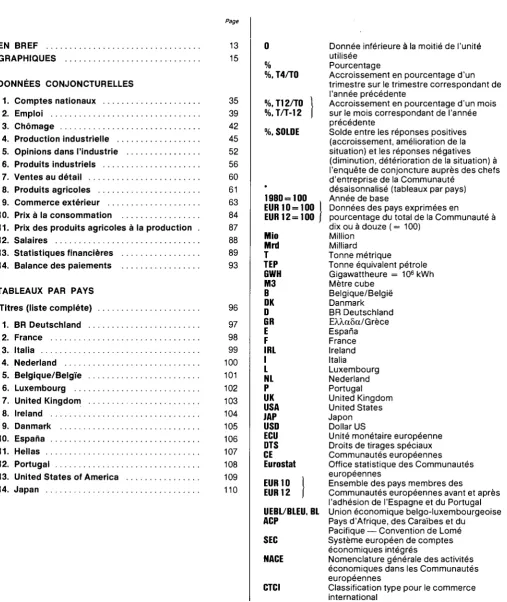
Table des matières
Signes et abréviations
EN BREF
GRAPHIQUES
DONNÉES CONJONCTURELLES
1. Comptes nationaux
2. Emploi
3. Chômage
4. Production industrielle
5. Opinions dans l'industrie
6. Produits industriels
7. Ventes au détail
8. Produits agricoles
9. Commerce extérieur
10. Prix à la consommation
11. Prix des produits agricoles à la production
12. Salaires
13. Statistiques financières
14. Balance des paiements
TABLEAUX PAR PAYS
Titres (liste complète)
1. BR Deutschland
2. France
3. Italia
4. Nederland
5. Belgique/Belgïe
6. Luxembourg
7. United Kingdom
8. Ireland
9. Danmark
10. España
11. Hellas
12. Portugal
13. United States of America
14. Japan
Page
13
15
35
39
42
45
52
56
60
61
63
84
87
88
89
93
96
97
98
99
100
101
102
103
104
105
106
107
108
109
110
%, T4/T0
%,T12/T0
%,T/T12
%,SOLDE
1980=100
EUR 10 = 100
EUR 12= 100
Mio
Mrd
Τ
TEP
GWH
M3
Β
DK
D
GR
E
F
IRL
I
L
NL
Ρ
UK
USA
JAP
USD
ECU
DTS
CE
Eurostat
EUR 10
EUR 12
UEBL/BLEU. BL
ACP
SEC
NACE
CTCI
Donnée inférieure à la moitié de l'unité
utilisée
Pourcentage
Accroissement en pourcentage d'un
trimestre sur le trimestre correspondant de
l'année précédente
Accroissement en pourcentage d'un mois
sur le mois correspondant de l'année
précédente
Solde entre les réponses positives
(accroissement, amélioration de la
situation) et les réponses négatives
(diminution, détérioration de la situation) à
l'enquête de conjoncture auprès des chefs
d'entreprise de la Communauté
désaisonnalisé (tableaux par pays)
Année de base
Données des pays exprimées en
pourcentage du total de la Communauté à
dix ou à douze ( = 100)
Million
Milliard
Tonne métrique
Tonne équivalent pétrole
Gigawattheure = 10
6kWh
Mètre cube
Belgique/België
Danmark
BR Deutschland
Ελλαδα/Grèce
España
France
Ireland
Italia
Luxembourg
Nederland
Portugal
United Kingdom
United States
Japon
Dollar US
Unité monétaire européenne
Droits de tirages spéciaux
Communautés européennes
Office statistique des Communautés
européennes
Ensemble des pays membres des
Communautés européennes avant et après
l'adhésion de l'Espagne et du Portugal
Union économique belgoluxembourgeoise
Pays d'Afrique, des Caraïbes et du
Pacifique — Convention de Lomé
Système européen de comptes
économiques intégrés
Nomenclature générale des activités
économiques dans les Communautés
européennes
[image:14.595.55.563.142.745.2]Eurostatistiques: En bref
1. FAITS SAILLANTS
La situation économique globale semble moins favorable dans la Commu nauté au cours des derniers mois.
Les données disponibles actuellement indiquent un ralentissement de la croissance du PIB aux 3e et 4e trimestres de 1986.
De même l'on constate un fort ralentissement de la production industrielle, dû à l'absence de croissance de la production des biens d'investissement depuis la fin du premier semestre de 1986.
Dans le domaine monétaire, on constate, au cours des dernières semaines, une appréciation de l'UKL une «relative faiblesse» du DM et surtout des mouvements moins erratiques de l'USD. En outre, il n'y a aucune détente concernant les taux d'intérêts réels à long terme (taux nominaux corrigés de l'inflation) qui restent toujours élevés.
La lutte contre l'inflaction semble marquer le pas. Malgré une hausse modé rée des prix à la consommation en février ( + 0,3 °/o pour EUR12), l'on cons tate une légère accélération du rythme annuel ( + 3 % ) , due partiellement à l'évolution défavorable des prix de l'énergie importée. Il faut néanmoins noter que cette accélération est atténuée partiellement dans les pays dont la monnaie s'apprécie régulièrement. Fait marquant dans ce domaine: la réduction des différentiels d'inflation au sein de la Communauté.
En ce qui concerne le Commerce extérieur, pendant les trois mois allant jusqu'à Janvier 1987, la Communauté a exporté 1 0 % en moins (en volume) qu'un an auparavant.
Par contre, ses importations ont légèrement augmenté (en volume) et son solde extérieur est resté positif.
Le fait marquant dans ce domaine est la forte progression des importations de la Communauté qui proviennent du Japon et des pays du SudEst asiati que.
Enfin, il n'y a aucune amélioration notable dans le secteur de l'emploi pour l'ensemble de, la Communauté, malgré les bonnes performances réalisées dans certains des Etats membres.
2. PIB: Ralentissement de la croissance aux 3
eet 4
etri
mestres 1986
Au troisième trimestre 1986, en données corrigées des variations saisonniè res, le PIB communautaire s'est accru de 0,6 % en équivalent de rythme annuel. Au premier et deuxième trimestres de 1986, le teux de croissance était encore respectivement de 1,8 % et 5,1 o/o.
Aux ÉtatsUnis, le croissance remonte à 2,7 o/o au troisième trimestre, après 0,6 o/o au deuxième trimestre.
Au Japan, on enregistre un taux de 2,6 %, après 3,7 o/o pour le deuxième trimestre.
Dans les principaux pays de la Communauté, la situation se présente comme suit:
En Allemagne: taux de 3 o/o, ralentissement de la croissance
En France: en raison du changement du base, les données ne sont pas disponibles
En Italie: croissance de 3 , 2 o/o, forte baisse de l'investissement Au RoyaumeUni: croissance de 0,7 o/o.
Au quatrième trimestre 1986, les résultats partiels disponibles du PIB en données corrigées des variations saisonnières et à un taux annuel Indiquent une faible croissance ( + 1,7 o/o) de l'économie américaine, conséquence conjointe d'un solde extérieur toujours mal orienté et d'une demande inté rieure stagnante.
En Europe, la baisse (0,6 o/o) du quatrième trimestre allemand confirme le ralentissement déjà observé le trimestre précédent et provenant principale ment d'une baisse des exportations.
3. PRODUCTION
INDUSTRIELLE: Absence de crois
sance de la production des biens d'investissement
Les moyennes annuelles de 1986 par rapport à 1985 des indices de la pro duction industrielle feront apparaître pour le Communauté (EUR 12) une hausse voisine de 2,1 o/o (alors qu'en 1985, par rapport à 1984, la hausse avait été de +3,3 o/o).
Pour les ÉtatsUnis la hausse est de + 1 , 0 % (alors qu'elle avait été de + 1,7 0/o) et, pour le Japon, Il s'agit d'une baisse de 0 , 3 % , alors que la hausse avait été de +4,5 0/0 en 1985 par rapport à 1984.
Les États de la Communauté, selon les pourcentages des évolutions de la production industrielle en moyenne annuelle de 1986 par rapport à 1985, peuvent être regroupés en quatre groupes:
ceux dont les évolutions seront inférieures à + 1 , 5 % : +0,3 0/0 en Grèce, +1,1 0/0 en France et aux PaysBas, +1,5 0/0 au RoyaumeUni; ceux dont les évolutions seront inférieures à +20/0: +2,1 % en RF d'Allemagne et en Belgique;
ceux dont les évolutions seront comprises entre +2,50/0 et + 3 , 5 % : + 2,7 0/0 en Irlande, +3,2 0/0 en Italie, au Luxembourg et en Espagne; ceux dont les évolutions seront supérieures à +3,5 % : + 4 % au Dane mark et + 5 0/0 au Portugal.
Après correction des variations saisonnières, l'indice de décembre 106,2 correspond à un net ralentissement du rythme moyen de croissance de la production industrielle depuis le début de l'été; en effet, ce niveau de 106,2 était déjà atteint au 2e trimestre de 1986.
Pour les trois derniers mois connus, la croissance par rapport aux trois mêmes mois de l'année précédente pour l'Indice d'ensemble EUR 12 est de + 1,5 %. Pour la même période, la variation est de +0,4 0/0 en RF d'Allema gne, + 0,8 0/0 en France, + 1 , 0 % au RoyaumeUni, + 3 , 7 % en Italie. On constate des baisses au Danemark et en Grèce. Les taux correspondants sont de +0,9 % aux ÉtatsUnis et d'environ 0 , 9 % au Japon.
4. ACIER: Nouvelle baisse de la production en février
( 5 0 / 0 )
En février 1987, la production communautaire (sans la Grèce) d'acier brut a connu, avec 9,9 mio t, une progression désaisonnallsée de 1,3% par rap port au mois précédent, et une baisse de 5 0/0 par rapport à février 1986. Le cumul des commandes nouvelles (EUR 9; aciers courants) pour l'année 1986 enregistre, avec 82,9 mio t, une baisse de 4 % par rapport à 1985 et de 1,3 0/0 par rapport à 1984.
Les livraisons montrent, avec 83,7 mio t, une évolution similaire: 3 , 8 0/0 et 0 , 7 0/0 par rapport à 1985 et à 1984 respectivement.
5. PRIX: Hausse modérée pour EUR12 en février
( + 0,3%), mais légère accélération du rythme annuel
( + 3 0 / 0 )
Selon les calculs de l'Eurostat, l'IPC, pour l'ensemble de la Communauté, a augmenté de 0,3 0/0 entre janvier et février 1987.
Avec cette hausse, l'IPC au niveau communautaire semble être revenu au rythme des accroissements modérés qu'il connaissait depuis le début de l'année dernière.
En février, l'indice du Danemark a diminué de 0,1 %, tandis que des accrois sements faibles à modérés sont observés par la plupart des pays membres: 0,1 0/0 en Allemagne (RF), 0,2 en France, en Belgique, au Luxembourg et aux Paysbas, 0,4 0/0 en Italie, en Espagne, en Grèce et au RoyaumeUni. Une hausse assez sensible a été enregistrée au Portugal: 1,0 0/0.
L'inflation pour, l'ensemble de la CE (EUR12) sur un an, a été de 3,0% (février 1987 par rapport à février 1986).
Pour le mois de janvier, ce taux était de +1,4 0/0 aus ÉtatsUnis et de 1 , 1 0/0 au Japon.
Pour les pays membres de la CE, les taux sur douze mois (février 1987 contre février 1986) sont les suivants:
PaysBas 0 , 9 o/o, Allemagne (RF) 0 , 5 0/0, Luxembourg 0 , 5 0/0, Belgique + 1,0%, France +3,4 0/0, Irlande +3,5 0/0 (1), RoyaumeUni +3,9 0/0, Italie
+ 4,30/0, Danemark +4,7 0/0, Espagne +6,0 0/0, Portugal +9,5 0/0, Grèce + 16,8 0/o.
Il est à signaler la nette décélération observée en Espagne et au Portugal, où il y a un an l'Inflation était de 9 % respectivement 12,6 0/0.
6. CHÔMAGE: Augmentation de 1,3% du nombre des
chômeurs inscrits dans la Communauté
Fin février 1987, 17 millions de personnes en chômage étaient Inscrites auprès des bureaux de placement dans la Communauté des Douze. Malgré un hiver rigoureux dans la plus grande partie de la Communauté, cela cons titue une légère baisse par rapport à janvier 1987.
Par contre, sur une année, par rapport à février 1986, le nombre des Inscrits auprès des bureaux de placement s'est accru de 222 000 personnes ou de 1,3 %. La situation n'a donc guère changé dans son ensemble.
On notera toutefois que, pour les personnes de moins de 25 ans, le nombre des inscrits a baissé au cours de l'année de 22 700 ou 0,4 o/o. Les problèmes s'accentuent ainsi de plus en plus pour les chômeurs plus âgés.
Cette baisse dans le nombre de jeunes inscrits aux bureaux de placement est relativement générale pour les États membres, à l'exception toutefois de l'Italie, de l'Irlande, de la Grèce et de l'Espagne, qui ont encore connu des augmentations de 5 o/o et plus.
7. COMMERCE EXTÉRIEUR: Exportations communau
taires en baisse ( — 10 % en volume), importations en
légère hausse ( + 1 % ) , mais solde extérieur toujours
positif
Les premières estimations relatives à la periode de trois mois allant jusqu'à janvier 1987 montrent que les exportations communautaires vers les pays tiers continuent à diminuer. Leur valeur moyenne était de 27 milliards d'Écus par mois, soit quelque 15 % de moins que pour la période correspondante de l'année dernière. En volume, la diminution est d'environ 10 o/o.
Les données provisoires afférentes à 1986 indiquent que les exportations, qui atteignaient en moyenne 28 milliards d'Écus par mois, ont diminué de 10 o/o en valeur et de 5 o/o en volume par rapport à leur niveau de 1985. Les exportations vers les pays en voie de développement ont diminué de 17 o/o, ce recul reflétant la baisse du pouvoir d'achat des pays qui sont principale ment tributaires d'exportations de pétrole et d'autres matières premières.
En revanche, les exportations vers les pays industrialisés n'ont diminué que de 6 %. Elles représentaient 60 o/o des exportations communautaires, alors que les pays en voie de développement et les pays du bloc de l'Est en ont absorbé 32 et 8 o/o respectivement. Quelque 82 o/o des exportations consis taient en produits manufacturés. Les exportations de ces produits ont baissé de 7 % en 1986, c'estàdire nettement moins que les exportations de produits non manufacturés.
Au cours de la période de trois mois précitée, les exportations des États Unis ont également diminué de 15%, s'établissant en moyenne à 17 mil liards d'Écus par mois. Quant aux exportations du Japon, elles ont diminué de 10 % au cours de cette période, atteignant 16 milliards d'Écus par mois. Au cours des trois mois allant jusqu'à janvier 1987, les importations de la Communauté en provenance de pays tiers atteignaient en moyenne 26 mil liards d'Écus par mois. En valeur, ce chiffre représente un recul de 20 o/o par rapport à la période correspondante de l'année précédente, bien que le volume des importations ait sans doute légèrement augmenté.
En 1986, les importations ont diminué de 17 o/o en valeur, tombant en moyenne à 28 milliards d'Écus par mois. En volume, les Importations ont connu une augmentation effective de 7 o/o, qui a cependant été largement neutralisée par une baisse des prix de 23 %. Les prix des importations pétrolières a presque chuté de moitié ( — 48 % ) , tandis que le prix des matières premières non alimentaires a connu une baisse de 21 o/o. C'est la raison pour laquelle les importations pétrolières ont diminué de moitié en valeur, tandis que les importations d'autres matières ont baissé de 22 o/o, bien que le volume des importations de ces produits n'ait guère diminué. Les importations d'aliments, de boissons et de tabac ont reculé de 8 o/o. Quant aux importations de produits manufacturés, elles ont augmenté de 1 o/o en valeur et de 8 % en volume.
En 1986, 59 o/o des importations communautaires provenaient de pays industrialisés et 32 o/o, de pays en voie de développement.
Les importations en provenance des pays industrialisés (produits manufac turés principalement) ont diminué de 7 o/o, alors que celles en provenance des pays en voie de développement ont connu une baisse de 30 o/o. Les importations en provenance des pays de ΓΟΡΕΡ ont diminué de 45 o/o et celles en provenance des pays ACP, du bassin méditerranéen et d'Améri que latine, de plus de 30 %. En revanche, les importations en provenance du Japon ont augmenté de 16 % et celles en provenance des pays nouvelle ment Industrialisés d'ExtrêmeOrient, de 4 %.
Au cours du trimestre précédant janvier, les Importations des ÉtatsUnis ont atteint 31 milliards d'Écus par mois, soit une baisse de 17 o/o. Les importa tions du Japon ont baissé de 26 o/o par rapport à la période correspondante de l'année dernière, tombant à 9 milliards d'Écus par mois.
Au cours de période précitée, la Communauté a enregistré un léger excé dent commercial. En 1986, c'est la première fois qu'un excédent s'est dégagé sur une période d'un an et ce, grâce à une amélioration d'environ 33 milliards d'Écus du résultat de la balance commerciale. Cette amélioration peut s'expliquer par le fait que le compte pétrolier s'est amélioré de 52 mil liards d'Écus et celui des autres matières premières, de 6 milliards d'Écus. En revanche, l'excédent commercial du compte des produits manufacturés a baissé de 25 milliards d'Écus.
Au cours de la période de trois mois précitée, le déficit commercial des ÉtatsUnis a atteint en moyenne 14 milliards d'Écus par mois, les exporta tions couvrant 55 o/o seulement des importations. Ce chiffre ne représente qu'une légère amélioration par rapport au taux de couverture de 53 o/o enre gistré un an auparavant. Au Japon, l'excédent moyen a été de 7 milliards d'Écus par mois, ies exportations couvrant les importations à raison de 171 o/o.
Les importations intracommunautaires ont atteint en moyenne 37 millions d'Écus par mois au cours du trimestre précité, ce qui représente un recul de 5 o/o par rapport à l'année précédente. Ce recul s'explique largement par la baisse, en valeur, des échanges de combustibles. La baisse des exporta tions a été la plus sensible au RoyaumeUni et aux PaysBas, qui sont les deux principaux exportateurs communautaires de combustibles.
En 1986, le commerce intracommunautaire a bais