ON THE DEVELOPMENT OF THE LABOUR MARKET
ANALYSIS OF THE EXPERIENCES OF
AND PROBLEMS ENCOUNTERED BY WORKER
TAKE-OVERS OF COMPANIES
IN DIFFICULTY OR BANKRUPT
MAIN REPORT
* * *
*
PAOODOCUMEN
COMMISSION
Cataloguing data can be found at the end of this publication.
Luxembourg: Office for Official Publications of the European Communities, 1987 ISBN 92-825-7580-2
Catalogue number: CB-50-87-033-EN-C
© ECSC-EEC-EAEC, Brussels - Luxembourg, 1987
Reproduction is authorized, except for commercial purposes, provided the source is acknowledged.
PROGRAMME FOR RESEARCH AND ACTIONS ON THE DEVELOPMENT OF THE LABOUR MARKET
ANALYSIS OF THE EXPERIENCES OF AND PROBLEMS ENCOUNTERED BY WORKER TAKE-OVERS OF COMPANIES IN DIFFICULTY OR BANKRUPT
Main Report
Author: Rob Paton
Cooperative Research Unit The Open University
U.K.
Study No. 85/4
Copyright ECSC-EEC-EAEC, Brussels - Luxembourg, 198.7
part of its programme for Research and Actions on the Development of the Labour Market.
ANALYSIS OF THE EXPERIENCES OF AND PROBLEMS ENCOUNTERED BY WORKER TAKE-OVERS OF COMPANIES IN DIFFICULTY OR BANKRUPT
Aims of Study
Attempts at WTO: Why, When and Where
Achieving a WTO
Planning the Business
Organising a WTO
Mobilising external support
After the take-over: varieties of success and failure
Policy issues
Rationales for the Support of WTO
Instruments, pitfalls and dilemmas
Some General Principles
Priorities for enhancing the support of WTOs
Removing obstacles to WTO
The Marginality Problem
the 'Large Plant' Problem
The aims of the study were
(i) to provide a comparative review of the experience of Worker
Take-Overs (WTOs) and attempted WTOs, in 6 member states,
(ii) to identify the factors that facilitate or restrict attempts to form rescue
enterprises, with particular attention to
- roles and attitude of Trade Union organisations
- roles and attitude of employers' organisations
- access to capital
- national and local Government attitudes
- legal frameworks
- role and experience of support agencies (and their scale and
distribution)
(iii) to identify areas of agreement concerning common pitfalls, dilemmas
and good practice in the support of WTOs as well as key policy issues
concerning them.
Six countries were selected for the study.
Italy
has had the most extensive, and the most successful, experience of
WTOs, with perhaps 1000 cases over the last decade. These generally
involve small or medium size enterprises, and usually employ, between
say, 30 and 200 people in the re-established enterprises. This experience has
been concentrated in particular areas of Northern Italy, creating a context in
which WTOs have become a normal feature of economic life.
The industrialised regions of
Spain
have also seen very large numbers of
WTOs, reflecting both the severity of the economic restructuring it has
undergone and the extent of public support for WTOs over the last 10 years.
In
France
the incidence and reputation of WTOs have both fluctuated
sharply over the last decade. More recently, between 50 and 100 WTOs per
year have continued to occur, with the most promising results being
achieved in sectors where co-operatives have traditionally had a presence.
have not been more. This highlights the importance of economic and
cultural factors and the traditions of the labour movement in
understanding the conditions which give rise to WTO and make it a
realistic strategy.
In
West Germany,
there have been 13 WTOs in the last two decades, but
well over 30 attempts, most occurring in the last few years. In general, the
experience of and capacity to support WTOs has increased quite rapidly in
the last few years - particularly around Bremen - but starting from a very
limited base, so that the institutional obstacles remain considerable.
Attempts at WTO: Why, When and Where
The great majority of attempts at a WTO are a response to the threat of
unemployment. As such, they tend to occur:
0
in industries undergoing re-structuring
° where the workforce possesses industry-specific skills for which
demand is limited
° where the threatened plant or enterprise is a major employer on
which the locality is economically dependent.
Such enterprises may be badly run down with little, if any, prospect of
commercial viability. However attempts at WTO do not only occur in such
circumstances. The owners of a viable, or potentially viable, enterprise or
plant may wish to dispose of it for a wide variety of reasons and yet they
may fail to attract a purchaser. Such failures in the market for enterprises
arise, essentially, because of the high transaction costs associated with the
decision to purchase an economic unit, and the likely difficulties of
managing the acquisition effectively. Hence the prospect of a high return
will be necessary in order to justify the risks involved. In short, an
enterprise or plant may be threatened with closure not because it is
unprofitable but becuase it is not considered to be profitable enough.
Whether or not the threat of closure and unemployment stimulates an
attempt at a WTO depends on the confidence of the workforce and the
credibility of the WTO idea. In this respect the attitude of various external
parties is crucial.
example, differences between unions, and between national and local
levels, in several countries.
In countries with worker co-operative sectors, the extent of support offered
by movement bodies for WTOs has, on occasions, been a controversial
issue. WTOs have been seen as offering great opportunities and also great
dangers. But in general the stronger the worker co-operative sector in a
country, the more credible is the WTO idea, and the more support for WTO
attempts there is available.
The actions of governments whether at national, regional or local level
-have also influenced the number of WTO attempts occurring in different
countries and areas. Though their reasons have differed somewhat,
governments of both the right and left have on occasions provided support
for WTO, and in other contexts, both have opposed WTOs. In general,
government actions towards WTO are best understood in relation to
political pressures for job preservation and to the prevailing reputation of
WTO for that purpose.
Overall, it is clear that attempts at a WTO are no longer an entirely
spontaneous initiative by the workforce. It
is
a response to the threat of
closure which has variously been promoted or discouraged, - either
explicity or tacitly.
Success tends to breed success. The credibility of the WTO idea and the
availability of support for WTO attempts is affected by the success or failure
of previous attempts. Over the last ten years, this had lead to
concentrations of WTO activity in particular localities. In a historical
perspective such self-sustaining tendenceis may explain the very different
institutional and cultural patterns of the labour and co-operative
movements that have developed in, for example, Denmark and Northern
Italy. In any event, it seems that the WTO response is more readily
u n d e r t a k e n and accepted where collective entrepreneurship and
decentralised self-help are established within the labour movement and the
wider society. Such cultural considerations provide a caution against
assuming that the experience of one country or region can be easily
reproduced elsewhere.
Achieving a WTO
The willingness of the workforce to accept responsibility for ensuring
viability is critical for the formulation of a realistic business plan - and the
discussion and preparation of the plan by the workforce is the vehicle by
which it starts to discover and come to terms with the implications of a
WTO. Decisions over job losses present these implications most starkly.
While a substantial reduction in employment is commonly required there
are a number of ways in which the difficulties this poses can be handled
without jeopardising the WTO - particularly where there is external
support from public agencies and other worker co-operatives.
The preparation of a credible business plan also depends on whether the
workforce can obtain the necessary information and advice. In this respect,
the attitude of the existing owners or managers, the extent to which the
new venture can adopt the products, markets etc of the old, and the
availability of appropriate support agencies or networks, are particularly
important.
The business plans for most WTOs can be understood as variants of two
basic strategies. The 'rescue' strategy is more like a conventional recovery
plan intended to cut costs and abandon unprofitable lines. It tries to avoid
any break in production and hence has the advantages of preserving the
customer base and maintaining continuity of employment. On the other
hand, the time available may not be sufficient to assess business prospects
in detail, or for the workforce to come to terms with commercial
self-reliance.
A 'phoenix' strategy is more like starting up a new enterprise - except that it
is based on some of the employees, assets and perhaps customers of the old
business. Characteristically there is a break of several months before
production re-starts. This can lead to problems if key workers seek
employment elsewhere. On the other hand, the additional time often
makes it easier to plan the business realistically, and allows for attitudes to
change, training to be undertaken, and the self-selection of a committed
and cohesive group of workers. In addition a selection of the assets can
often be purchased comparatively cheaply from the liquidator, thus
avoiding taking over the entire plant (which may be valued as a 'going
concern', and carry with it some liabilitites, in the case of a 'rescue').
strategy is unlikely to be viable; a phoenix strategy will only support a
small fraction of those previously employed; and neither approach is likely
to sustain the high cost of the new product development often required.
Organising a WTO
The organization of a WTO is a formative experience for the enterprise
created. Although some WTOs are promoted by external parties and the
leadership, with the workers themselves in a passive role, it is more
common for many of the workers to be actively involved. Ensuring the
effective involvement of the workforce in the direction of the project poses
severe problems - for structural, cultural and contextual reasons. Hence the
process may at times appear passionate, disorderly, and 'unprofessional'.
Nevertheless this involvement is often essential for a number of very
practical reasons - it generates the shared understanding and the
commitment necessary for new patterns of work and organization to
develop. Hence, too, the ideals of self-management often (but not always)
associated with WTOs cannot be dismissed as being irrelevant in principle
and damaging in practice, in relation to the primary objective of job
preservation. These populist and radical ideologies of worker autonomy
appear often to be highly functional - for example, in facilitating a change of
attitudes (e.g. from opposition to management to the acceptance of
(self-)management responsibilities); in encouraging individuals to come
forward to fill the managerial vacuum that commonly exists.
These and other organizational issues are often highlighted by difficult
choices over the legal constitution of the enterprise - choices which will
express the individualism or collectivism of the enterprise's philosophy,
affect its financial structure, and determine how it is to be controlled. The
absence of appropriate legal frameworks has been a serious problem in
several countries and contrasts with the situation in Italy where the legal
status of a co-operative provides clear advantages over other forms.
Mobilising external support
Although attempts at a WTO must gain the support of a range of external
parties - suppliers, customers, the receiver, etc - the financial support of a
bank is generally most critical. To gain this means overcoming three
problems
that are quite independent of the actual commercial prospects.
o the problem of capital structure (the workforce's resources provide
insufficient security for loans - and if loans' are obtainedthe financial
gearing may be excessive).
conventional basis)
o in most countries the banks are unfamiliar with WTOs; this, quite
apart from an ideological antipathy, often involves misconceptions
and evokes excessive caution.
In practice these closely interrelated problems mean that WTOs must
obtain a measure of public funding - e.g as loans or guarantees - to reduce
their commercial borrowing requirement, or the risk associated with it.
Hence WTO commonly seek political support as well.
The somewhat uneasy combination of political and commercial logics
poses problems for the workforce and usually follows one of two courses.
In the 'loosely-coupled' model, a political commitment to the WTO
precedes the detailed planning of the WTO and its financial requirements.
In the 'tightly-coupled' model, political support depends on the
commercial appraisal, and vice versa, so the process is iterative rather than
sequential. Each of these patterns can generate sound business plans, a
committed workforce and adequate financial support - and each, too, has its
own way of failing.
After the take-over: varieties of success and failure
Although the proportions seem to vary somewhat between countries, a
rough estimate is that, overall, up to 25% of WTOs fail without ever
achieving viability; up to 25% are able to consolidate as secure and
competitive enterprises; the remainder become marginal enterprises with
fluctuating profitability. In any year a number of these marginal ones will
fail - but some will continue for many years.
Cost reductions are the principal source of improved performance
following a WTO. These commonly arise from reductions in management
overheads, reduced labour costs, and improved production methods. The
productivity improvements associated with WTOs have regularly been
very substantial. On the other hand, shortages of capital, obsolete
equipment, a lack of financial and marketing expertise, and a neglect of
strategic management, have meant that the underlying competitive
position of many enterprises remains weak (marginality).
Where consolidation is achieved the infrastructure of the co-operative or
worker-owned sector (support agencies, consortia, financial institutions)
has usually played a vital role. The importance of a worker co-operative or
worker-owned sector is also apparent in providing cultural and
organizational support for WTO enterprises as they progress from the
Policy issues
Rationales for the Support of WTO
Support for WTO may be intended to serve a number of rather different, if
related, objectives.
Job saving.
In the context of Local Employment Initiatives support for this
purpose is likely to be realistic and well-justified. The number of WTOs in
an area does respond to policy initiatives. Comparatively modest amounts
of public funding is often able to facilitate substantial investment by the
workforce, the banks and other parties. Compared to the jobs created in
many other LEI projects, the number of jobs saved in WTOs is often high,
and the time and resources committed to WTO support appear to generate
more jobs than an equivalent effort spent on 'new starts'. The survival
rates of WTO enterprises do not at all support the popular view that these
enterprises soon fail. Finally, in terms of labour market management, it is
clear that support for WTOs is entirely consonant with the trend towards
supporting enterprise creation efforts by the unemployed that is apparent
through the European Communities.
Managing Decline.
It has been argued that in the case of 'large
plant'closures support for a WTO will often be justified even if the
prospects for viability are poor. In such cases an important objective for
governments is simply to manage the decline of the large plant so as to
minimise the adverse effects on the local economy and labour market.
Where some intervention is inevitable for social or political reasons, then
support for a WTO in the form of a co-operative or other worker owned
enterprise would be the preferred instrument on strictly economic grounds.
This rationale is economically sound but politically unrealistic. A policy
whose declared intention is to create viable workers enterprises cannot
result in a significant proportion of 'failures' without being seen as a waste
of public funds - even if, in fact, such 'failures' fall within the range of
acceptable outcomes.
Nevertheless these economic arguments may still justify a measure of
public funding for workforce-based re-employment initiatives that combine
a gradual run-down of the former activities, with the exploration and
preparation of potential 'phoenix' enterprises based on different products.
from the closure of one enterprise and the opening of another, often
in a different region.
(ii) WTOs can succeed where others have failed or are unwilling to try.
Even if (inevitably) WTO enterprises are marginal to begin with, they
can consolidate and develop.
These two propositions are basically sound but this objective is more
ambitious than simple job-saving. The financial resources, the expertise
and the time required to achieve this are much greater. Hence this
objective will not be achieved if it is not adequately resourced, and pilot
projects will be the appropriate first step in countries and regions with
limited WTO experience.
Promoting a worker co-operative sector and/or employee ownership.
The
very substantial contribution that WTO enterprises have made to the
growth of the worker co-operative sector in Italy, and the emergence of the
SAL phenomenon in Spain, demonstrate that support for WTO can be an
effective means of promoting 'economic pluralism'. This objective is
closely associated with that of promoting economic restructuring - a
dynamic sector can hardly be based entirely on marginal enterprises. In
addition, the development of a worker co-operative sector with its own
infrastructure (or equivalent secondary organizations for employee-owned
firms) increases the prospects for economic restructuring through the
support of WTOs. Hence, like the objective of promoting economic
restructuring through WTO, the pursuit of 'economic pluralism' is a
longer-term objective that would have to be resourced accordingly.
Instruments, pitfalls and dilemmas
WTOs have been supported in a wide variety of different ways. Many of
these initiatives have occurred as part of more general efforts to develop
local economic strategies, to support the cooperative sector or to create
employment. At least initially, however, support for WTOs has always
been ad-hoc and as such it has been characterised by a number of common
weaknesses:
(i)
Expecting too much, too soon.
Hastily prepared measures, limited time horizons, and over-ambitious
policies have often resulted in an unacceptably and unnecessarily high
proportion of failures.
(ii)
Inadequate support measures.
o providing insufficient funds
o providing funds on an inappropriate basis
o providing funds, but no other support
(iii)
Insufficient attention to smaller WTOs
Because of the greater political pressure cretated by the threat of large plant
closures the greatest effort (and the largest financial and political
investment) has been made in the most difficult cases. Much more
straightforward opportunities have been neglected.
(iv)
No evaluation of support policies.
The absence in any of the countries studied of any systematic efforts to
assess policies of support for WTO is striking.
Dilemmas
The experience of WTOs also highlights a number of dilemmas that are
inherent in any attempt to provide support:
o
Realism versus encouragement.
Any policy to support WTO must
avoid encouraging attempts on an inappropriate basis, or raising false
hopes.
o
Financial assistance versus financial dependence .
Where public
funds (or guarantees) are provided for a WTO, the danger arises that
the workforce may see itself as being rescued, rather than being the
rescuers.
o
The short-term versus the long-term.
Policy makers and agencies
will be under strong pressure to achieve results. But where existing
experience is limited, the cost of failure will be high and the
infrastructure to support WTOs effectively cannot be created over
night.
o
Support versus direction.
The nature of the, support relationship is
problematic. A reluctance to insist that particular problems are faced
may lead to costly mistakes jeopardising the enterprise. But efforts to
prevent failure may easily be counter-productive: insisting that
erosion of the psychological ownership of the project and the
self-reliance that are so important for its success.
Some General Principles
o Any support for WTO must recognise that the workforce are the
central figures in the project. If the workforce is not interested in a
WTO - and they may have good reasons for rejecting the option - then
the idea cannot sensibly be pursued.
o Financial support for a WTO should not be an entitlement. It must
always be justified in relation to the prospects for developing a viable
enterprise.
o Advisory support for a WTO is not the same as normal business
advice, nor is it effectively provided by conventional business advice
agencies.
o The financial support provided for WTOs should be commensurate
with the other support services available, and vice versa.
o Prolonged, close involvement by the Public Authorities and the Trade
Unions in the support of WTO is undesirable and ineffective. Their
general support, and occasional specific assistance, remain invaluable.
o The secondary organizations representing WTO enterprises
(Co-operative Associations, SAL federations etc) and agencies
associated with them, should be the principal locus of support for
WTO. Where such organizations do not yet exist, LEI and new social
movement networks should be recognised as the primary source of
support.
o The state has three roles in relation to the support of
WTO:-(i) Guaranteeing equal access
(ii) Enabling not directing
(iii) Co-ordinating and reviewing support for WTO
o Given the extreme urgency affecting most WTO, it is essential that the
provisions of any government measures are clear, and that they can
be effected quickly.
under very favourable circumstances.
o Some sectoral and geographic concentration of support for WTO is
likely to be more cost-effective in the long run.
Priorities for enhancing the support of WTOs
The following issues deserve particular attention in any efforts to develop
public policy in relation to WTO:
Removing obstacles to WTO
A range of administrative, legal and fiscal obstacles hinder attempts at
WTOs. Some of these obstacles are specific to WTOs; others affect
co-operatives more generally. Some are minor irritants; others are of
major significance. A few might require significant legislative time because
they involve fairly complex legal and other issues; many could be resolved
by minor additions or amendments to existing provisions or even on a
purely administrative basis. In no cases would removing such obstacles
require additional financial commitments by governments, beyond those
already committed to existing programmes.
The principle of equal access that justifies the removal of administrative
legal and fiscal anomalies that obstruct WTOs may also justify measures of
positive discrimination in favour of WTO. The workforce of a closing
plant or enterprise is often so disadvantaged in its attempts to mount a
WTO in relation to other interests (creditors, asset-strippers, mother
company etc), and so obstructed by a general lack of understanding of WTO
(among banks, suppliers, customers, Trade Unions, receivers etc) that only
government measures to legitimise and facilitate WTO will prevent
failures in the market for enterprises and allow the full benefits of this
option to be realised. Such measures might include:
o extensions to employee rights to information in the context of plant
and company closures
o modifications to receivership laws which are currently framed
entirely in terms of creditors and shareholders rights
o under specific conditions the introduction of a 'right to buy' for the
workforce.
The Marginality Problem
conditions of employment. Since most WTO are undertaken and
resourced with a limited, job-saving objective, criticism on the grounds that
they have not also achieved restructuring and consolidation is rather
severe. At any point, a substantial proportion of small and medium sized
enterprises can be considered 'marginal' and they still contribute
substantially to employment. Hence the problem is not one of
'marginality' as such. It is, firstly, that the worker co-operative and
worker-owned sectors have a disproportionate number of marginal
enterprises placing an undue burden on their resources and secondly, that
those enterprises with the potential to escape their marginal status
frequently lack access to appropriate finance and real services to allow this
to happen.
Ensuring the capacity to provide selective support for this purpose will
mean developing the infrastructure of the worker co-operative (or
worker-owned) sectors, especially in such areas as:
o Sectoral collaboration and joint ventures
o Consulting and advisory services
o Training and 'cultural' support for both workers and management
o The development of institutions for co-operative financing
Public support for measures to address the marginality problem (through
the development of the infrastructure of the worker co-operative and
worker-owned sectors) would obviously have to be commensurate with the
social benefits anticipated, but it appears well justified on employment
grounds (both directly as regards the enterprises themselves, and indirectly,
in maintaining the credibility of the WTO option with employees, Trade
Unions, Co-operative Associations and other such bodies); as a socially and
fiscally efficient contribution to restructuring; and as a
longer term investment in 'economic pluralism'.
The 'Large Plant' Problem
New approaches to the 'large plant' problem are required.
It is important to explore the possibility of other frameworks within which
workforce-based employment initiatives could be supported in such cases.
The aim would be to gain the advantages of a WTO - in enlisting the skills
and intelligence of the workforce, in cultivating an ethic of self help and
self-reliance, in providing a resource and organizational base for product
as a failure because it was unable to achieve commercial viability, and
unable to provide continuity of employment for all those involved in it.
Despite its many difficulties, the experience of the Bitteswell Employment
Alliance (see UK country study) is suggestive of the scope for workforce
based initiatives of this sort which, by being less individualistic and
paternalistic, would seem to have considerable advantages over the usual
employment advice services introduced in the context of large plant
closures.
The Evaluation and
Exchange
of
Experience
The following issues are seen as deserving particular attention in future
studies and conferences, both nationally and internationally:
(i) Management training and development.
The role of management in WTOs and other LEIs is both crucial and
problematic. A shortage of appropriate and competent managers is widely
believed to be a major constraint on future development. Little is known
about the profiles and career paths of those who do undertake managerial
roles in such projects. Currently there are reports of a number of
experimental m a n a g e m e n t training and development initiatives
underway, or being prepared, in several European countries. A
comparative review of these initiatives would be timely.
(ii) Support methodologies.
WTOs and other enterprise creation projects require advice and support
over a range of issues. Such support can only be provided by people with
the requisite business know-how and with the appropriate counselling
skills and approach. In practice, the latter skills are less well recognised and
are more difficult to find and develop. A study of the different models and
methodologies for providing such support in LEI contexts would raise
awareness of this issue and help to disseminate good practice.
(iii) Cost-benefit studies.
Although many case studies exist, very few provide information helpful to
policy-makers. The general case for supporting WTOs set out in this report
needs to be tested against a
few
more rigorous· studies of selected WTOs.
The aim would be to enable comparisons with alternative measures for
both job-saving and re-structuring.
A comparative study of recent developments in trade union - co-operative
relations is needed to review and disseminate experience of the agreements
that have been reached, the new initiatives that have been promoted (such
as co-operative sector branches, courses for Trade Unionists in respect of
WTOs, collaboration with the new social movements) and the extent to
which the legitimate anxieties of both sides are actually borne out in
practice.
ANALYSIS OF THE EXPERIENCES OF AND PROBLEMS ENCOUNTERED BY WORKER TAKE-OVERS OF COMPANIES IN DIFFICULTY OR BANKRUPT
This study examines the experiences of and problems encountered by worker take-overs of companies in difficulty or bankrupt, in the following member states: the United Kingdom, France, West Germany, Denmark, Italy and Spain. These countries provide a range of experience - from those where worker take-overs are rare, to those where they are an accepted feature of economic life.
The study reviews the similarities and differences among the experience of worker take-overs both within and between the member states in
order to identify the factors affecting success and failure, the
common pitfalls and dilemmas, and good practice concerninq the support for such rescue enterprises. It considers the roles and attitudes of Trade Union organizations, national and local government policies, the availability of capital, legal frameworks, and the requirements of support agencies.
The study aims to identify the key policy issues concerning whether, in what circumstances, in what ways, and to what specific ends, it may be appropriate for the principal parties likely to be concerned, to support attempts at worker take-overs.
This study was financed by the Commission of the European Communities as part of its Programme of Research and Actions on the Development of the Labour Market. The analyses and the results presented do not necessarily reflect the views of the Commission nor do they commit it to a particular view of the labour market or on other policy matters. The report has been made available for information only. It should not be quoted or referred to in published material without the authority of the Commission.
Enquiries relating to the study should be addressed to the Directorate General for Employment and Social Affairs - attention of Division V/8/2 Commission of the European Communities 200, rue de la Loi
1. Introduction 1
1 .1 Aims 1 1.2 The Scope of the Study 2
1.3 Approach 3 1.4 Introduction to the countries studied 4
1 .5 Overview 6 2. Attempts at worker take-overs: why, when and where. 6
2.1 Varieties of closure and workforce response 7
2.2 The credibility of the WTO option 11
2.2.1 Trade Union attitudes 11 2.2.2 Co-operative movement attitudes 13
2.2.3 Government attitudes and policies 15
2.3 WTO as a cultural phenomenon 17
2.4 Summary 19 3. Achieving a WTO 20
3.1 Formulating the Business Plan 21 3.1.1 Viability, job losses, and workforce attitudes 21
3.1.2 Obtaining information and advice 23 3.1.3 'Rescue' and 'pheonix' strategies - and the large plant 25
problem
3.2 Getting organised 28 3.2.1 The importance and difficulty of workforce involvement 29
3.2.2 Legal issues in the formation of a workers' enterprise 34
3.3 Securing external support 37 3.3.1 WTOs and the banks 38 3.3.2 Patterns of political support 42
3.4 Summary 43 4. After the take-over: varieties of success and failure 46
4.1 Overview: collapse, marginality and consolidation 46
4.2 Reducing costs 47 4.3 Implementing new product-market strategies 48
4.4 The problems of institutionalising collaborative management 50
4.5 Summary 52 5. Policy Issues 54
5.1 Rationales for the support of WTOs 54 5.2 Instruments, pitfalls and dilemmas 5o
5.3 Some general principles 5-] 5.4 Priorities for enhancing the support of WTOs ¿3
5.4.1 Removing unwarranted obstacles 63
5.4.2 The marginality problem 64 5.4.3 The 'large plant' problem 65 5.4.4 The evaluation and exchange of experience. 66
IV Worker Take-Overs: The French Experience 128 V Worker Take-Overs: The Italian Experience 159
This report considers a phenomenon which, according to many conven-tional views of business, should scarcely exist. To the extent that Worker Take-Overs (WTOs) do occur, such views would expect a report on
their experience to be "nasty, brutish and short". In fact, WTOs are no longer particularly rare events and their experience, though mixed, is certainly not a simple tale of failure - for example, in those regions where WTOs have become an accepted part of economic life, their numbers run in hundreds and the jobs saved in thousands. Indeed, the contrast between the quite definite achievements of WTOs and (in many countries) their publicly perceived failure, is striking. Although WTOs raise a number of other important questions, it is in relation to public support for job-preservation and creation that they have attracted most controversy. Since attempts at WTO tend to occur in the areas of greatest need - where unemployment levels are par-ticularly high - the pressure for public support is understandable. But whether policies of support for WTOs would tend to facilitate or to obstruct the processes of economic adjustment, and what costs and benefits they might contribute to other policy objectives, remain uncertain. Similarly, in countries where measures of support for WTOs have been explored, as additional instruments of labour market manage-ment and local economic strategy for example, it often remains unclear what the priorities should be and how such support may be most
effec-tively implemented. Hence in terms both of general desirability and of appropriate measures, the issues surrounding support for WTOs are controversial. However, in the absence of any systematic, comparative review of what is a complex and varied phenomenon, the conflicting arguments are hard to evaluate.
1.1 Aims
The aims of the study were
(i) to provide a review of the experience of WTOs, and attempted WTOs, in 6 member states, that would incorporate
- simple descriptive statistics on the scale of the phenomenon, - appropriate illustrative material
- an analysis of the main similarities and differences both between and within the designated member states;
(ii) to identify the factors that facilitate or restrict attempts to form enterprises, with particular attention to
- roles and attitude of Trade Union organisations - roles and attitude of employers' organisations - access to capital
- national and local Government attitudes - legal frameworks
issues concerning them. 1.2 The Scope of the Study
The following member states were selected:
Denmark
Federal Republic of Germany France
Italy Spain.
The United Kingdom
These countries range from those with very considerable experience of WTOs (Italy and Spain), to those with fairly limited experience
(Denmark and West Germany).
Attempts at WTOs, and support for them, are one of a number of respon-ses - including 'management buy-outs', 'community businesrespon-ses' and other local economic initiatives - to company and plant closures under conditions of rising unemployment and economic restructuring. There is no clear demarcation between some of these developments and some WTOs. For example, some management buy-outs (that is, the purchase of an economic unit from its owners by a group of its managers) involve substantial and widespread employee shareholdings; and some community businesses utilise the premises, and some of the equipment and
employees, of failed enterprises. For the purpose of this study a WTO is defined as a case in which a business is continued, or created,on the basis of the assets of a failing or bankrupt enterprise, by the workforce, or a part of it, within either a cooperative framework, or one satisfying the following conditions:
(i) A substantial proportion of the voting shares are held by members of the workforce;
(ii) A substantial proportion of the members of the workforce own voting shares (or are members of a corporate body owning the shares); (iii)The voting shares are fairly evenly distributed among those who own them, or in some other way it is ensured that ultimate control resides with the workforce.
Although many WTOs utilise co-operative legal frameworks to form workers' co-operatives, these conditions can be, and often are, satisfied by a wide range of structures using conventional company law. However, this definition does not include cases where an
still profitable, if marginally so, but where its underlying competitive position is weak. Such cases have been included in the scope of the study.
Using these definitions, WTOs may occur at any of three points in the decline of an enterprise or plant:
(i) 'conversions' refer to WTO that are arranged before the unit ceases trading or goes into receivership.
(ii) 'rescues' refer to WTOs that are arranged generally with little or no loss of trading continuity, when the enterprise is under the control of the receiver.
(iii) 'phoenixes' refer to WTOs based on some of the residual assets of a liquidated enterprise after trading has ceased, sometimes many months later.
1.3 Approach.
The study did not undertake more than a very limited amount of origi-nal investigation or research. In general, very little systematic data has been gathered or is available on the numbers of WTOs, their characteristics and outcomes. The 'hard facts' simply do not exist and in the time available there was no question of being able to remedy such an extensive deficiency. For example, even the most rudi-mentary questions about the numbers of worker take-overs, the numbers of jobs involved or the proportions of WTO enterprises that collapse, survive or expand, are generally impossible to answer except with crude estimates based on the opinions of those in support organisa-tions .
nevertheless, although the amount of published material on WTOs is limited, and tends to be case-specific, work in this area is now increasing and unpublished documents, conference reports etc. were obtained. Given that the existing learning regarding WTOs is often poorly articulated and disseminated within member states - let alone between them - the study concentrated on drawing together and
integrating the available information.
The study also refers to the views of various bodies, such as Trade Unions, and of leading practitioners, either as a result of
discussions with them or their staff, or on the basis of documents or reports. It was not always realistic or possible to check these sum-mary accounts of the perspectives of such bodies with them. Obviously
and debate.
1.4 Introduction to the countries studied
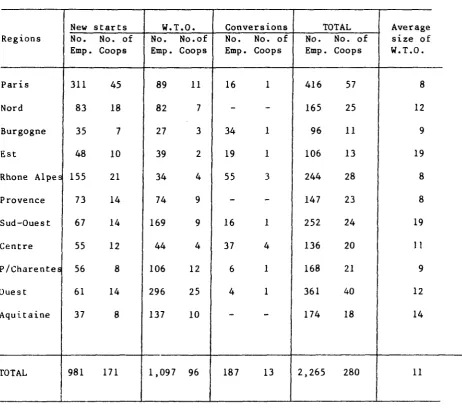
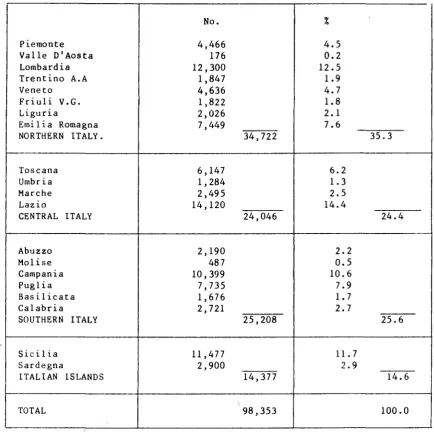
Italy has had the most extensive, and the most successful, experience of WTOs, with perhaps 1000 cases over the last decade. These
generally involve small or medium size enterprises, and usually employ, between say, 30 to 200 people in the re-established enterpri-ses. This experience has been concentrated in particular areas of Northern Italy, creating a context in which WTOs have become a normal feature of economic life.
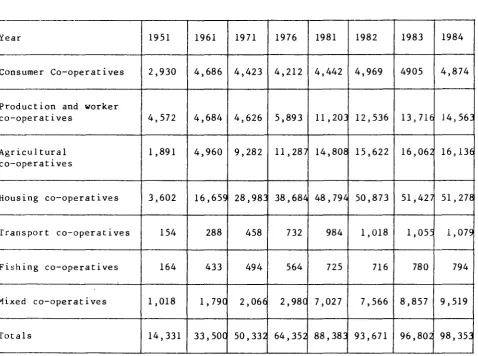
These developments have occurred in the context of an established and growing cooperative movement, which, although institutionally divided according to political orientation, nevertheless commands broad all party support. The cooperative movement has evolved sophisticated networks both of commercial consortia and of regional and sectoral support organisations, that ensure close collaboration with political authorities and Trade Unions. Such networks have been able to provide the financial, marketing and managerial assistance to re-orient
failing and failed enterprises in a range of sectors. However, these efforts have put a considerable strain on the resources of the
cooperative movement which is increasingly reluctant to accept respon-sibility for the failures of the private sector. While public funds have been provided to support the transformation of enterprises in crisis, this has sometimes been at the expense of efforts to promote longer-term developments of the cooperative movement in more dynamic sectors, and a range of legal institutional and policy issues remain to be resolved, particularly surrounding the long-delayed implemen-tation of the potentially far-reaching measures provided in the
'Marcora' law.
Tlie industrialised regions of Spain have also seen very large numbers of WTOs, reflecting both the severity of the economic restructuring it has undergone and the extent of public support for WTOs over the last 10 years. However, the particular instrument used to provide support initially took little account of commercial requirements and many of the WTO enterprises created by it fared badly. In the last few years new measures have been introduced to provide funds on a more realistic basis, as well as other support, and the situation has changed con-siderably. One unique feature of the Spanish experience is the large number of WTOs - a majority in fact - that have used the framework of conventional company law, forming Sociedades Anónimas Laborales, rather than cooperatives. Such SALs are now developing their own sup-port organisations, and in general the institutional environment for WTOs is evolving quite rapidly at the present time.
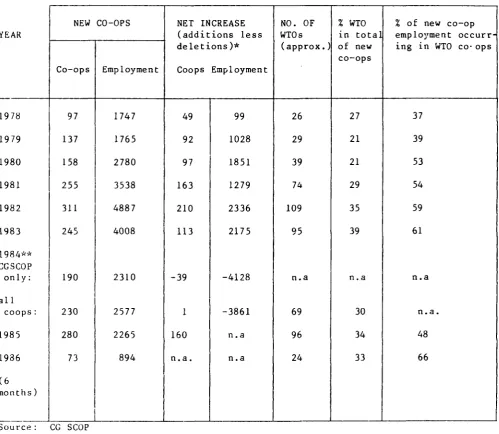
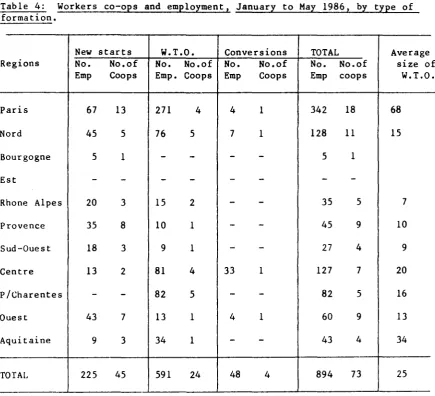
1983, following the election of a left government and a marked change in policy by major unions, the number of WTOs averaged about 100 per year, and included a greater number of larger enterprises. In 1984, however, these policies were abandoned at a national level, following the failure of a number of these WTO enterprises. Nevertheless bet-ween 50 and 100 WTOs per year have continued to occur since then, with
the most promising results being achieved in sectors where cooperati-ves have traditionally had a presence. Throughout this period a number of changes in related national and local government policies, and the evolving expertise of CGSCOP (the representative body of the worker cooperative movement) have significantly increased the capacity for support for WTO, even if Trade Union support has been erratic. British experience has been far more limited, with only about 80 cases in total. The poor publicity associated with the three large 'Benn' cooperatives in the mid-seventies, the weakness of the existing worker cooperative sector, and the considerable popularity of management buy-outs (both with finance houses and, it would seem, with Trade Unions) may have contributed to this, along with sceptical or negative attitu-des among many trade union leaders. However, the number of WTOs has tended to increase in recent years, particularly through the efforts of local authorities in relation to local economic initiatives. More WTOs are beginning to emerge in certain areas; and Trade Union attitu-des are being reconsidered. Hence the capacity to support WTOs is increasing and it is likely that their numbers will continue to increase.
In Denmark only 14 WTOs have occurred (with a higher proportion of 'conversions' and fewer 'rescues' and 'phoenixes'). The great
majority of these have been commercially successful so the interesting questions are why there have not been more and why there is not an increasing trend. Answering these questions highlights the importance of economic and cultural factors, and the traditions of the labour movement in understanding the conditions which give rise to WTO and make it a realistic strategy. Nevertheless, the continuing recession, a strong alternative movement, and a renewed interest in worker
ownership (in relation to debates about economic democracy) suggest that WTOs may not always be such a peripheral issue.
scope for converting to socially useful and ecologically sound pro-ducts. In general, the experience of and capacity to support WTOs has increased quite rapidly in the last few years - particularly around Bremen - but starting from a very limited base, so that the institu-tional obstacles remain considerable.
1.5 Overview
Chapters 2, 3 and 4 summarise the main features of the experience of worker take-overs, from the conditions under which attempts are likely to be made, through the problems that have to be overcome if a WTO is to be achieved, to the eventual success or failure of those enterpri-ses created. Considerable attention is paid to three aspects: the different types of WTO in terms of their size and economic
circumstances; the social dynamics of the WTO in terms of the indivi-dual and organizational learning that is essential; and the role of support agencies and networks. These aspects are essential in order to appreciate what can realistically be expected from a policy of sup-port for WTOs and the dilemmas any such policies will have to face. The final chapter draws together the policy implications arising from this experience. It examines criticlly the different objectives that support for WTOs may be designed to achieve, it highlights some of the more common pitfalls and dilemmas in providing support, and it sets out a range of general principles concerning the nature and location of support services. Finally it identifies a number of issues that require particular attention if support for WTOs is to be enhanced. Throughout the report reference is made to specific aspects of the WTO experience in the six countries studied. These 'country studies' are also available, and provide an account of the relevant legal, politi-cal and institutional context, recent trends and the extent of WTOs in each case. They also provide a range of illustrative material,
exemplifying particular points made in this report in much more detail .
2. Attempts at WTO: Why, When and Where
Attempts by workers to take-over and revive companies in crisis have been a recurring response to the threat of closure, particularly in times of economic recession. In Italy, WTOs have occurred periodi-cally throughout this century and a majority of the worker
co-operatives in Italy today originated in this way. Similarly, in the United Kingdom, there are substantial and successful co-operatives that were formed through WTOs over 100 years ago. during the recession of the 1870s. Thus the current wave, beginning in the 1970s and
to the threat of enterprise closure rather than others. It offers a broad overview of the phenomenon as a context for later, more speci-fic, discussions of WTO problems and policy options.
2.1 Varieties of closure and workforce response
Attempts at WTO are more common in industries - such as metal
working, woodworking and textiles - that are currently in decline, or being restructured, whether as a result of cyclical down-turns, tech-nological change, changes in tariff regulations (e.g. in Spain), or as part of wider changes in the international division of labour. In such cases, resisting closure of a plant or firm may be impossible because the owners see no scope for a return to profitable operations and no buyer is available. Hence unless the workers take it over, the plant will close and remain closed. If unemployment is already high or rising this may provide incentive enough to consider the WTO opt ion.
Two factors accentuate this general tendency. First, where the failing business is a major employer in the locality, the consequences of clo-sure are likely to be far more severe for the community. An extreme case of such circumstances is provided in areas of Spain where the threat of closure may effectively mean the de-industralization of the locality in which the plant in question had provided the first signi-ficant step towards industrial development. In such cases Local authorities, suppliers and other business interests, and the regional trade union officials, are more likely to support (or even promote) a WTO - indeed the national government may come under strong political pressure.
Secondly, where many of the skills in the threatened plant or firm are industry-specific, the effect of closure on the local labour market will be severe, even if unemployment in general is not particularly high.
These two factors - local economic dependency and industry-specific skills - occur in many of the larger and better known cases of WTO, such as Manuest (France) Olympia (FRG) Clems (Italy) and the Scottish Daily News (UK). Such large scale attempts constitute a particular type of WTO and are discussed in some detail in due course. They are not, however, typical. Most attempts at WTO occur in enterprises of less than 200 employees, and often the number is between 10 and 50. But whether large or small, the WTO attempts arising in the cir-cumstances outlined so far are usually characterised by three features :
Notwithstanding the prevalence of well-publicised WTO attempts in such circumstances, it is essential to realise that very many WTO do not conform to this pattern. In the first place, some WTOs occur where employment is not really a problem. For example, where a small or medium-sized enterprise with harmonious internal relationships becomes
insolvent, a worker-takeover may be mounted in order to preserve and financially re-structure the business. This has occurred even in cases where the labour market for the skills concerned is comparatively buoyant and most employees are unlikely to face unemployment. The motivation in such cases is primarily firm-saving, rather than
job-saving - the case of IKP in the Danish study provides an example and there have been others in the Italian newspaper industry. Although a pure firm-saving motivation is much less common, such a concern has often provided an important supplementary motivation for a WTO (for example, the strong desire of the Meriden workforce to continue pro-ducing the Triumph motorbike). Moreover, firm-saving WTO can and do occur in more dynamic sectors of the economy - a point of considerable significance for co-operative movements concerned to avoid marginali-zation in declining sectors.
Secondly, many attempts at WTOs although primarily aimed at job-preservation, are directed towards viable or potentially viable
enterprises and plants. It is simply not the case that WTO only occur in economic units with no prospect of viability. If the owners
and/or managers of an economic unit are unable or unwilling to arrange its profitable operation this does not necessarily mean the unit can-not be made viable; new owner/managers may succeed - as the con-siderable literature on business 'turn-arounds' testifies (1).
However, if other purchasers for the business are not forthcoming it is commonly assumed that therefore the business has little if any prospect of profitability. Such an assumption may or may not be just ified.
The general reason for questioning this assumption is that the market in firms, like other markets, has its imperfections. The transac-tions costs associated with the purchase of a plant or enterprise are very high. Considerable uncertainty usually exists regarding the sta-tus of human and capital assets and market trends - an uncertainty likely to be accentuated by doubts about the competence and motiva-tions of those selling the unit. Such uncertainties may be accen-tuated by time pressures. In addition, the management of acquisitions is notoriously difficult, especially where the acquisition involves unfamiliar (if related) processes and is geographically distant. The difficulties, costs and uncertainties associated with reducing
Such circumstances can arise in a variety of ways. First, the number of possible purchasers may be very restricted for reasons that have nothing to do with the status of the threatened plant. For example, in regions where industrialization is just starting there may be very few entrepreneurs with anything approaching the necessary resources or experience. Or the location of the plant in region affected by poli-tical instability may deter purchasers from outside the region. Second, there are cases where a group of companies has collapsed but contains profitable (or potentially profitable) units within it. Where the group's collapse is spectacular, possible purchasers may
fail to appreciate the business opportunity available because they lack the inside information. Such circumstances have also provided the occasion for successful management-led buy-outs (2).
Third, there are cases of corporate divestment (usually of smaller units) that fail to find buyers. Such divestments may arise because a unit is insufficiently profitable, or may follow from changes in busi-ness strategy, or may be the result of conglomerate mismanagement and under-investment leading to poor results. A fairly typical example is provided by the supermarket chain in the UK that decided to con-centrate on larger outlets in a more restricted geographical area. This meant closing a number of smaller outlets in North Wales, two of which were taken over as worker co-operatives and continue to trade successfully. Publications Elysee in Paris and the SWA case (see FRG study) are other examples. (Again, many management buy-outs have ari-sen in similar circumstance.) Such divestments have also occurred as part of strategies of productive decentralization; that is, par-ticular production activities are closed down and contracted out to a smaller firm. In Italy the workers concerned have sometimes taken over the necessary equipment and formed a co-operative based initially on sub-contracting to their former employer. This has also occurred in Denmark where employers in the newspaper industry have wished to avoid being directly involved in managing industrial relations in a period of technological restructuring.
Fourth, there are the cases (again usually smaller units) where an older owner-manager dies or wishes to retire. If, despite being pro-fitable, the competitive position of the firm is weak, it may be hard to interest prospective purchasers. Where management-worker relations have been harmonious, all concerned may consider a WTO the obvious solution, and it may be fairly straightforward to arrange. This has occurred in all the countries studied (with the possible exception of the UK).
Unions, which can lead in due course to threats of closure and esca-lating conflict. As a result, possible purchasers of the enterprise, and private and public sources of finance, may be put off from
investing by strikes, occupations and poor industrial relations - even though the underlying commercial problems are not particularly severe. Such situations have been quite common in Italy (the CLG case in the Italian study has many of these features). The usual pattern is for a prolonged period of uncertainty, and conflict during which produc-tion is suspended and demonstraproduc-tions, and negotiaproduc-tions with a range of interested parties, take place in pursuit of a solution that will pre-serve the enterprise. In due course (perhaps after some of the work-force have drifted away and thus solved the redundancy problem) a WTO with the support of a Co-operative Association may be arranged. That such an outcome should result from the original difficulties is cer-tainly not planned or intended - and sections of the workforce may at first be strongly opposed to a WTO.
Nevertheless, the underlying logic of such cases is clear: where industrial relations are a major factor in the enterprise's problems, then the strategy of a WTO and the formation of a co-operative is likely to have a competitive advantage, and to be viable where others would not be, - because it provides a different foundation to worker-management relations. This seems particularly to be the case in
labour-intensive industries where performance is strongly affected by the cost and quality of labour. (Of course, the suggestion that the co-operative option will often possess a competitive advantage in such circumstances does not mean that all industrial relations problems disappear in a co-operative.)
Sixth, there are cases where the only prospective purchasers are unac-ceptable to the parties involved. This occurs when the purchasing company has a reputation for 'asset-stripping', or is openly proposing to run down the plant for short-term financial gains. In such cases, local political interests may join with the workforce in pressing the existing owners to reject the offer, and in preparing a counter-offer based on the maintenance of productive activities in the locality. In all such cases, an offer by the workforce to purchase and run the unit prevents a failure in the market for enterprises and the closure of a profitable or potentially profitable unit. The fact that other purchasers are not available cannot therefore be taken as
demonstrating that a WTO will not be viable. A worker's 'turn-around' may be perfectly possible. The impression generated by
than in countries where social security provisions are far more limited. It would be surprising if this fact did not contribute to the frequency and intensity of attempts at WTO. Thus Denmark, where generous earnings-related unemployment benefit is virtually guaranteed for many years, with normal social security thereafter, has had very few WTO. By contrast, Italy and Spain, where unemployment benefit is more limited, have seen many.
More fundamentally, however, WTO attempts arise from the beliefs of the workforce - that it will not be possible to resist closure in other ways; that the plant is capable of profitable operation
(management claims not withstanding); and that they will be capable of running it themselves. Above all, a WTO attempt is much more likely where the idea of WTO is available to the workforce and has credibility.
2.2 The Credibility of the WTO Option
Whether or not a WTO will be seriously considered by a particular workforce facing closure often depends on the credibility of the idea with a range external bodies, - such as local government departments, trade unions and co-operative movement organizations. Where the WTO option is generally considered by one or more of these bodies to be worth exploring, then they are likely to support, or even promote, a WTO attempt by the workforce. By contrast, where the WTO option is widely discredited or distrusted, fewer WTO attempts tend to occur. Hence the attitudes of these bodies are an essential factor in
understanding the incidence of attempts at WTO. This section reviews the range of attitudes towards the WTO option that are held by these external parties and indicates some of the ways in which they can sti-mulate or undermine WTO attempts in particular countries or regions.
2.2.1 Trade Union Attitudes
The WTO option is not easily reconciled with many established trade union strategies and it is often dismissed for this reason. In Denmark the labour movement has traditionally adopted a centralised approach which is reflected both in the preference for Trade Union (rather than worker) buy-outs of enterprises in crisis, and in the current proposals for economic democracy based on central funds. Similarly, the ideological and institutional attachment of the labour movement in the Federal Republic of Germany to co-determination in industrial relations has been incompatible with stratgies of self-management and autonomy. Likewise, the fundamental commitment of
o Supporting attempts at WTO can undermine the fight against closure (and privatization).
o WTOs can lead to splits in the labour movement - as when workers elsewhere in the same industry feel their jobs are being threatened by support for workers in a WTO (e.g. the response of workers at Small Heath, Birmingham to the Meriden cooperative; similar
situations have occurred in Spain).
o Support for a WTO will involve collaboration in job losses, wage reductions and the violation of other Trade Union principles (e.g. concerning craft skills and job demarcations); in general,
WTO are seen as producing marginal enterprises in which market pressures force 'self-exploitation'.
o Support for WTOs diverts scarce skills and financial resources away from trade unions' primary responsibilities; and diverts atten-tion from the responsibility of governments to maintain
employment.
o Enterprises arising from WTO do not usually survive for long. Traditional approaches to the regulation of enterprises and the labour market have proved more effective, historically.
Such arguments have generally ensured that mainstream Trade Union movements are at best doubtful or indifferent, and at worst hostile, towards WTO. However rising levels of unemployment and the failure of traditional strategies for saving jobs have prompted a reconsideration of the WTO option within the labour movements of all the countries studies (except, so far, Denmark). The main arguments for Trade Union support for WTOs are:
o Self-management and producer initiatives are closely related to traditional labour movement aspirations.
o The enterprises created through a WTO can and do survive for many years.
o The membership in threatened plants frequently calls for Trade Union support.
o Unrealistic attempts to resist closure (and privatization) can seriously jeopardize the prospects for a WTO and continued employment by Trade Union members.
o Trade Union involvement is essential to prevent declining standards of employment, or to contain any modest or temporary reductions if these are genuinely necessary.
trend away from large enterprises in heavy industry towards
smaller organizations in service sectors. By becoming involved in these developments it may influence them; it is bound to lose influence if it simply ignores them.
Hence although WTOs are still considered mainly as a 'last resort' strategy Trade Union attitudes towards this option have become more varied and complex. Considerable differences exist between Unions (e.g. in France, in the Federal Republic, in the UK) but also within the same Union - local officials, for example may actively support WTO although the national policy is hostile or equivocal (e.g. IG Metal in the Federal Republic). Likewise, Union attitudes can vary between regions - as in Spain, where the experience of WTO varies very con-siderably in different parts of the country. The Italian Trade Unions have had the greatest involvement with WTO and have probably come clo-sest to a serious endorsement of the WTO option - in the form of agreements reached with the Co-operative Associations. But even here local trade union attitudes vary widely.
In any event, such variations in the legitimacy and support which Trade Unions provide for the idea of WTOs help to explain the marked variations in the number of attempts at WTO that occur in different regions and countries, and for the general increase in WTOs during the 80s. This is most sharply illustrated in the statistics for WTOs in France where the CGT union changed from opposing WTOs to supporting them - and then changed back again, a few years later. These shifts in the unions position were one important factor generating a marked but temporary increase in the numbers of WTOs occurring during this period.
2.2.2 Co-operative Movement Attitudes
The presence of successful worker co-operatives in the region or sec-tor in which a closure is threatened greatly increases the likelihood that the WTO option will be considered by the workforce. In general, when the worker co-operative sector is broadly based and integrated
into an established co-operative movement - as in Italy and parts of Spain - WTO attempts are much more common. By contrast, where
Thus it provides an intermediate case that confirms the general pat-tern.
While it is likely that the presence of worker co-operatives and worker-owned firms in itself lends credibility to the idea of a WTO,
the actions and attitude of co-operative movement bodies are very important. This is most obvious in Italy where some WTO have occurred as a result of interventions by the Co-operative Associations: the closure or divestment of an economic unit may be seen as providing an opportunity to make a strategic investment at a low price. Thus, if the enterprise in question can be readily integrated into a network, strengthening the market or geographical position of the Association, it may encourage and support the workforce in mounting a take-over. In general, however, support for WTOs is a controversial issue within worker co-operative movements. The main arguments for actively sup-porting WTO are:
o WTOs, despite the difficulties, provide the most promising means for rapidly extending the size, range and capital intensity of the cooperative sector. If WTOs are neglected the cooperative sector will be largely restricted to a few traditional and marginal sectors.
o Support for WTOs provides an opportunity to demonstrate practical solidarity and build up links with the Trade Union movement that will be important in the long term. In particular, it may provide an occasion to promote alternative and ecological ideas within the labour movement, especially regarding socially-useful production. o A great deal has been learnt about when and how to support WTOs.
A greater proportion of successes can realistically be anticipated in the future.
o Collaboration with local and national governments in relation to policies for supporting WTO provides an opportunity to gain political support and promote long over-due legal and fiscal reforms of benefit to co-operatives generally.
The arguments for more limited, cautious, and selective support for WTOs are:
o The workers in enterprises subject to a WTO are often reluctant cooperatore for whom other (temporary) forms of worker ownership are more appropriate. In addition cultural differences between the trade union and cooperative movements make
collabora-tion extremely difficult.
o The publicity associated with many WTOs and their subsequent failure discredits the cooperative movement.
o Support for WTOs will mean the co-operative movement providing care to the geriatric survivors of declining sectors. It will not pro-vide a basis for future growth. The government and the private sec-tor should take responsibility for their own failures.
Not surprisingly, the position of co-operative movement bodies on this issue tends to be influenced by the perceived success of those
enterprises formed through WTOs - as the policy reversals of the French federation (CG-SCOP) exemplify very clearly. Hence the degree of support which co-operative movements have provided for WTOs has varied at different times and in different areas. And this, too, helps to explain when and where WTO are more likely to occur.
2.2.3 Government Attitudes and Policies
Attempts to mount a WTO commonly include appeals to governments -whether local, regional or national - for support. Where this is pro-vided it constitutes a tacit invitation to others to request similar support. In consequence, questions concerning whether, in what ways, and to what extent public support should be given to WTO have arisen in most of the European communities. Moreover, it is clear that governments do not simply respond to pressure - they have also, on occasions, adopted measures that have more or less explicitly
encouraged and supported WTO. The clearest example is provided by the instrument used by the Spanish Ministry of Labour to make funds
available to workers to enable WTOs to be established. Although this instrument has since been redesigned to provide commercially more appropriate support, its existence encouraged numerous attempts at WTO and induced the formation of hundreds of 'Labour Companies' in the 10 years from 1976.Hence one cannot explain the current wave of WTOs without considering the attitudes and actions of governments.
The extent of government support, and the reasons for providing it vary enormously. Apart from a concern to preserve employment for political reasons, governments of the right have provided support for WTO on the grounds that:
o wider employee ownership will in due course contribute to improved industrial performance;
o WTO are a form of economic self-help that will help in the deve-lopment of an 'enterprise culture';
o where practical pressure makes intervention necessary, support for