This is a repository copy of The multifactorial interplay of diet, the microbiome and appetite
control: current knowledge and future challenges.
White Rose Research Online URL for this paper:
http://eprints.whiterose.ac.uk/91971/
Version: Accepted Version
Article:
Corfe, B.M., Harden, C.J., Bull, M. et al. (1 more author) (2015) The multifactorial interplay
of diet, the microbiome and appetite control: current knowledge and future challenges.
Proceedings of the Nutrition Society, 74 (3). 235 - 244. ISSN 0029-6651
https://doi.org/10.1017/S0029665114001670
[email protected] https://eprints.whiterose.ac.uk/ Reuse
Unless indicated otherwise, fulltext items are protected by copyright with all rights reserved. The copyright exception in section 29 of the Copyright, Designs and Patents Act 1988 allows the making of a single copy solely for the purpose of non-commercial research or private study within the limits of fair dealing. The publisher or other rights-holder may allow further reproduction and re-use of this version - refer to the White Rose Research Online record for this item. Where records identify the publisher as the copyright holder, users can verify any specific terms of use on the publisher’s website.
Takedown
If you consider content in White Rose Research Online to be in breach of UK law, please notify us by
"Fibre, Gut Microbiome and Appetite" 1
The multifactorial interplay of diet, the microbiome and
2
appetite control: current knowledge and future challenges
3
4
Bernard M. Corfe1,*, Charlotte J Harden1, Matthew Bull 2, Iveta Garaiova3
5
1. Molecular Gastroenterology Research Group, Academic Unit of Surgical Oncology, Department of 6
Oncology, University of Sheffield, Beech Hill Road, Sheffield, S10 2RX, UK 7
2. Organisms and Environment Division, Cardiff School of Biosciences, Cardiff University, Cardiff, 8
CF10 3AXUK 9
10
3. Cultech Ltd, Research Department, Port Talbot, SA12 7BZ, UK 11
* Author for Correspondence: Dr Bernard Corfe, Molecular Gastroenterology Research Group, 12
Academic Unit of Surgical Oncology, Department of Oncology, University of Sheffield, Beech Hill Road, 13
Sheffield, S10 2RX, UK; Tel: +44 (0) 114 271 3004; Email: [email protected] 14
15
16
Keywords: fibre, microbiome, appetite, obesity, short-chain fatty acids 17
18
Abstract 19
The recent availability of high-throughput nucleic acid sequencing technologies has rapidly advanced 20
approaches to analysing the role of the gut microbiome in governance of human health, including gut 21
health, but also metabolic, cardiovascular, and mental health, inter alia. Recent scientific studies suggest 22
EI perturbations at population level cannot account for the current obesity epidemic, and significant work 23
is investigating the potential role of the microbiome, and in particular its metabolic products, notably 24
short-chain fatty acids, predominantly acetate, propionate and butyrate, the last of which is an energy 25
source for the epithelium of the large intestine. The energy yield from dietary residues may be a significant 26
factor influencing energy balance. This review posits that the contribution toward EI is governed by 27
energy intake, diet composition (not just fibre), by the composition of the microbiome, and by levels of 28
physical activity. Furthermore we hypothesize that these factors do not exist in a steady state, but rather 29
are dynamic, with both short- and medium-term effects on appetite regulation. We suggest that existing 30
modelling strategies for bacterial dynamics, specifically for growth in chemostat culture, are of utility in 31
understanding the dynamic interplay of diet, activity and microbiomic oraganisation. Such approaches 32
may be informative in optimising the application of dietary and microbial therapy to promote health. 33
1. Overview 35
The availability of high-throughput nucleic acid sequencing technologies has facilitated a range of new 36
approaches to analysing the role of the gut microbiome in governance of human health (1). Modern 37
techniques suggest a role for the microbiome maintenance of, not only gut health but, systemic 38
conditions including cardiovascular health (2), mental health (3) and obesity (3). Despite wide media focus 39
on excess energy intake (EI), recent scientific studies suggest EI perturbations at population level cannot 40
account for the current obesity epidemic (4). The microbiome is responsible for production of a highly 41
complex and highly dynamic metaexometabolome. Well known components of this include the short-42
chain fatty acids acetate, propionate and butyrate, the last of which is an energy source for the epithelium 43
of the large intestine (5), as well as an inhibitor of histone deacetylation (and thereby cell fate 44
determination) (6). The energy yield from dietary residues entering the large intestine may account for as 45
much as 10% of EI (7) and is therefore a significant factor influencing energy balance. The guiding 46
theme of this review is that this contribution toward EI is governed by energy intake, diet composition, 47
the composition of the microbiome, and levels of physical activity. Furthermore we hypothesize that 48
these factors do not exist in a steady state, but rather are dynamic, with both short- and medium-term 49
effects on appetite regulation. There is therefore potential to modulate this component of EI through a 50
range of modalities to promote health. 51
52
2. Fibre /Dietary Residue 53
2.1 Scope of definitions of dietary fibre
54
Fibre is a component of diet which is highly complex and inconsistently defined. Approaches to the 55
definition vary from the biochemical, to the physiological, to the functional. The Englyst definition, for 56
example, is “non-starch polysaccharides” (8). This is in line with other definitions within nutrition, 57
although it is notable for the element of exclusion which places fibres in the general class of 58
polysaccharides outwith the subclass of starches. Fig 1 provides top-level indication of the potential 59
chemical complexity of this ontology (accessed from ChEBI 08.07.15). However, each endpoint within 60
this ontology masks further factors, including the degree of polymerisation: the nature and extent of 61
polymerisation of side-chains on any polysaccharide backbone. Against this rigid definition is the 62
Association of Official Agricultural Chemists (AOAC)-adopted version by Prosky (9), that fibres are 63
“remnants of plant cells resistant to digestion by human digestive enzymes”. This definition introduces a 64
physiological component, insofar as resistance to digestion implicates human physiology, but its relevance 65
to non-humans and humans with abnormal digestive capacity is questionable. For example, is “fibre” 66
different for animals with different profiles of digestive enzymes? Furthermore, what is the relationship 67
between fibre and personalised medicine? For example, in the case of an inborn error of metabolism 68
which may impair intraluminal digestion or absorption – is this definition personal, with each of us 69
potentially having a different profile of fibres? Finally, it introduces a source component, in this case 70
botanical, which raises the question of how fungi fit within this classification. The definition was further 71
extended to include an aspect of functionality in the following Scientific Advisory Committee on 72
Nutrition (SACN) statement: 73
SACN consider that a material can be considered as dietary fibre if it is resistant to digestion and absorption in the small
74
intestine and has a demonstrable physiological effect potentially associated with health benefits in the body, such as increasing
75
stool bulk, decreasing intestinal transit time or decreasing post prandial glycaemia. Evidence only of increased fermentation in
76
the gut should not be included under this definition, since although this has a direct effect on the microflora, it must also be
77
shown to have a demonstrable benefit to the host to be considered as dietary fibre.
(SACN Statement August 2008) 79
This extension to the Prosky definition includes and exemplifies health benefits of fibre, yet such 80
advantages are notoriously difficult to demonstrate and attribute. Additionally, it recognises that 81
functionalities may occur beyond the gut, implying indirect mechanisms, although other classes of 82
compound potentially yielding the same intermediate effectors would be excluded from this definition. 83
The SACN statement does not reflect the source (botanical or otherwise) of fibre, but does introduce 84
difficulties of defining fibres in potentially personalised terms. 85
This extended cynicism about mainstream definitions could be coupled to a simple, unifying observation: 86
bacteria cannot read research papers or position statements. The extent of compounds which reach the 87
colon has been demonstrated, inter alia, in studies of differentially diced almond skins, which were found 88
to yield a range of macro- and micro-nutrients (10). It can therefore be argued that the colon environment 89
is not solely nourished by fibres, but by the totality of the ileo-caecal efflueate (ICE) - the material that 90
passes through the ileocaecal valve, whether intact or part-digested, whether of plant, animal or fungal 91
origin, whether polysaccharide or not. For the purposes of a review of interactions between fibres and the 92
microbiome, this definition facilitates the full scope of potential interaction between dietary factors and 93
the microbiome in understanding the production of the exometabolome. Our concept of ICE resembles 94
the definition of fibre proposed by Ha “Any dietary component that reaches the colon without being 95
absorbed in a healthy human gut” (11). The authors critically assimilate the overarching effects of fibre, 96
reproduced in Figure 2 – the division between fermentable and non-fermentable fibres. Fermentable 97
fibres are generally progressively degraded to metabolic endproducts including short-chain fatty acids 98
2,2 The nature of the exometabolome
99
Major products ensuing from this fermentation are the short chain fatty acids (SCFAs) acetate, butyrate 100
and propionate, which can be utilised for lipid or gluconeogenesis (12). SCFAs have been estimated to 101
provide 10% of total dietary energy in humans, and host epithelial cells derive 60–70% of their energy 102
supply from SCFA, particularly butyrate (13). Acetate and propionate are transported across the mucosa 103
and into the hepatic portal and may be detected in the systemic circulation (14) although circulating 104
concentrations of butyrate are disproportionately depleted in the circulation due to mucosal metabolism. 105
Other key exometabolites include glucose, vitamins and precursors to neuropeptides. The GI tract has a 106
panel of cell types sensing and responding to these molecules, this interaction is linked to the nervous 107
system, and thereby the gut-brain axis (15). 108
3. Microbiome 109
The human GI tract houses a very complex microbial ecosystem of more than 100 trillion 110
microorganisms, ten times greater than the total number of the human cells in the body. Human-111
associated bacteria are dominated by two phyla; Firmicutes and Bacteroidetes, with Proteobacteria, 112
Actinobacteria and Verrucomicrobia present in minor proportions (16, 17), and each phyla containing 113
many different bacterial species (18).The gut microbiota plays an important role in metabolism, immune 114
function, protection of the host from pathogens and bidirectional communication between the GI tract 115
and the central nervous system (19). Dysbiosis, an aberrant state of imbalance of the gut microbiota, has 116
been associated with a diversity of diseases and syndromes such as inflammatory bowel disease, irritable 117
bowel syndrome, colorectal cancer, atopy, anxiety, depression, Type II diabetes and metabolic syndrome. 118
The role of the gut microbiota in obesity has been of particular interest, especially given that the global 119
prevalence of obesity in both children and adults is rapidly increasing (20), and is a leading cause of 120
preventable disability and death. Obesity results from a sustained net positive energetic balance whereby 121
energy contribute to obesity (21). A new but growing body of evidence suggests the gut microbiota, 123
through its role as an interface between nutrients and the host, may assist body weight regulation. The gut 124
microbiota can affect nutrient acquisition and energy harvest, as well as producing exometabolites that in 125
turn may regulate host metabolic pathways (6, 22). 126
Early indications that the gut microbiota was involved in obesity came when metabolically obese mice, 127
with a mutation in the leptin gene, were shown to have a significantly different microbiota compared to 128
mice without the mutation (23). Further investigation indicated that the ratio of Firmicutes to 129
Bacteroidetes in the gut microbiota of obese mice was shifted in favour of Firmicutes, whilst lean mice 130
were dominated by Bacteroidetes (24). In humans, the gut microbiota composition can respond to 131
changes in body weight and is altered in obese compared to non-obese individuals (18). Bacteroidetes 132
may be responsive to calorie intake because their levels increase when body weight is reduced following 133
a reduced calorie diet (25), although numerous human studies have failed to demonstrate a consistent 134
relationship between obesity and the ratio of Firmicutes to Bacteroidetes at both the phylum- and 135
species-level (26). 136
Hydrogen-producing Prevotellaceae and hydrogen-utilizing methanogenic Archaea were more abundant 137
in obese individuals suggesting a higher energy harvest in large intestine to hydrogen transfer between 138
bacterial and archaeal species (27). Changes in the composition of the gut microbiota have been linked 139
with (i) suppression of intestinal fasting-induced adipocyte factor (Fiaf), which is a contributing factor to 140
enhanced fat deposition (28), (ii) increased capacity to harvest energy from food and (iii) low-grade 141
inflammation due to activation of toll-like receptors (TLR4), endotoxin and proinflammatory cytokine 142
production (29, 30). Approximately 5% of ingested calories are lost in the stool and urine (31). Altered 143
nutrient load over a three-day period induced changes in the gut microbiota in both obese and non-obese 144
individuals, despite statistically significant differences in the composition of the lean and obese 145
microbiome at baseline under a weight maintaining diet (32). In the case of lean subjects, a 20% increase 146
in Firmicutes (and a corresponding decrease in Bacteroidetes) was observed over the three-day period and 147
was associated with a ≈150 kcal increase in energy absorption. 148
SCFAs have been implicated in metabolic diseases, including obesity (33). Higher levels of faecal SCFAs, 149
mainly butyrate and propionate, have been reported in obese adults (34) and children (35), compared to 150
lean individuals. Changes in the concentration and proportion of individual SCFA may be in line with 151
changes in the bacterial groups present (12, 35). 152
153
3. Appetite control 154
There are two general definitions of appetite (36). The first relates to food preference, selection and 155
intake, and the motivation to eat, whilst the second refers to qualitative and sensory aspects of food, 156
including the impact of environmental stimulation. These eclipse homeostatic theories which suggested 157
feeding corresponds to energy/nutrient deficit or excess (37), yet it is likely that a suite of homeostatic 158
and complex non-homeostatic factors determine the overall expression of appetite. Appetite is normally 159
described in terms of hunger, satiation and satiety. Hunger is associated with emptiness of the stomach, 160
irritability and light-headedness (36). Humans can and do, however, display hunger for other reasons: the 161
smell, sight or even thought of food can initiate feeding (38). Eating triggers a cascade of metabolic 162
signals that can suppress hunger and inhibit further consumption (39). Satiation is the point of 163
satisfaction that results in meal termination (38, 40, 41). Satiety is the (modifiable) post-ingestion period 164
Appetite is controlled by multiple integrated physiological signals (See Figure 3). Short-term signals help 166
regulate meal initiation and termination whereas long-term, humoral signals play a central role in body 167
weight regulation (43). This conceptual framework for examining the impact of feeding is continually 168
updated to represent an increasing number of factors encompassing peripheral physiological and 169
metabolic events, and brain responses that play important roles in appetite control (44). The GI tract 170
responds to feeding in three integrated phases: cephalic, post-ingestive and post-absorptive, all of which 171
depend on parasympathetic nerve transmission. The cephalic phase occurs at the point of food selection 172
and early ingestion, and is thus stimulated by conditioned processes and organoleptic factors (45, 46). It 173
is held that post-ingestive satiation signals arise largely from mechanical distention, while signals from the 174
GI tract derive predominantly from the chemical effects of food (47). In contrast, post-absorptive effects 175
are the result of interplay between hormones and the hypothalamic region of the brain that respond to 176
fluctuating concentrations of nutrients in the portal vein, plasma and brain. 177
3,1 Impact of the exometabolome on post-ingestive appetite regulation
178
Landmark human studies have shown intestinal nutrient infusions can reduce food intake with rapid 179
effects (48-50), indicating that satiation signals must originate from the gut as well as post-absorptively. 180
Numerous hormones, neurotransmitters and peptides stimulate orexigenic or anorexigenic responses. 181
Many peptide hormones are produced in the gastrointestinal tract and released in response to nutritional 182
stimuli. Anorexigenic hormones include CCK, glucagon-like peptide-1 and -2 (GLP-1 and GLP-2), 183
glucose-dependent insulinotropic polypeptide (GIP), oxyntomodulin, PP, peptide histidine isoleucine, 184
peptide histidine valine, peptide YY and somatostatin)(51, 52) . Enteroendocrine (EE) cells represent less 185
than one percent of the mucosal cell population, yet form the largest endocrine system in the human (53), 186
and is populated by singly distributed enteroendocrine cells which release a very significant portion of 187
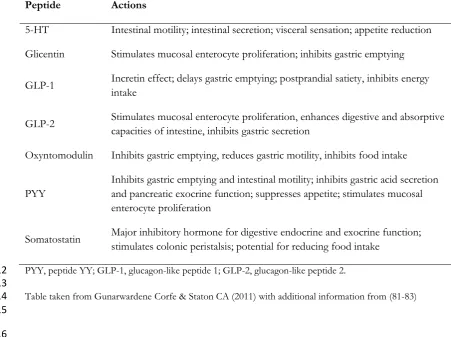
appetite regulating hormones (54). (TABLE 1). EE cells have a characteristic flask-shaped morphology 188
and have been divided into at least sixteen cellular subtypes based on the major products they produce 189
and secrete (55), although this model is contested and a continuum of cell types has also been proposed 190
(56). 191
The primary EE cell types in the colon are D cells, L cells and EnteroChromaffin (EC) cells (57). Whilst 192
all cell types may be found along the colon, EC are the most abundant, and D cells the least, with a 193
progressive increase in the proportion of L-cells along the caeco-rectal axis. As summarised in our review, 194
these cells harbour peptide/hormones involved in appetitive regulation including PYY, GLP-1, GLP-2 195
and oxyntomodulin. Intriguingly the EC subclass also contain 5HT (serotonin) and reports suggest that as 196
much as 95% of the body’s 5HT may exist in the gut (58) Serotonin has been implicated in appetitive 197
regulation, mood control and regulation of gut transit. This underwrites plausible links between luminal 198
content, motivation to eat and wider aspects of regulation of colorectal content through modulation of 199
transit time. These factors are explored in greater detail below. 200
SCFAs are important signalling components within the gut-brain axis, the system of communication 201
between the gut and the brain (19, 59) which interacts directly with gut endocrine cells, and stimulates 202
secretion of peptide YY (PYY) by activating two G-protein-coupled receptors (GPR41 and GPR43). EE 203
carry free fatty acid receptors (FFARs) on their surface which have differential affinity for SCFAs and 204
which signal the release of appetitive hormones from EEC (60). As components of the exometabolome, 205
SCFAs therefore act as key molecules governing the sensing-signalling pathway linking luminal 206
metabolism to appetite regulation. 207
Our group have recently identified a further plausible mechanism of action. A significant body of 208
literature suggests butyrate is a potent regulator of numbers of proliferating cells in the colon crypt. We 209
(61). Mathematical modelling suggests SCFA may modulate differentiation pathways on exit from the 211
stem cell compartment (62). Taken together these data suggest two possible tiers of regulation of post-212
ingestive appetite by the exometabolome: (1) an acute response in terms of regulating release of anorectic 213
hormones; and (2) an adaptive modulation of numbers of EEC and thereby available pools of appetite-214
regulatory hormones. 215
3,2 Impact of the exometabolome on post-absorbtive appetite regulation
216
Post-absorptive signals are stimulated by the entry of nutrients into the portal vein of the liver, or by 217
fluctuating nutrient concentrations in the plasma and brain (63). These signals act (via the hypothalamic 218
region of the brain and vagus nerve) on the periphery and central nervous system and also interact with 219
long-acting adiposity hormones (such as leptin) that help regulate body weight ibid. Two key areas are 220
impacted by the exometabolome: via intestinal gluconeogenesis and through pan-systemic propionate 221
sensing. 222
Gluconeogenesis has until relatively recently been viewed as a primarily hepatic and renal phenomenon, 223
and is not positively associated with health, reflecting excess energy intake. Relatively recently the 224
intestine has been identified as a site gluconeogenesis (distinguished as Intestinal GlucoNeogenesis – 225
IGN) (64). IGN is regulated by both butyrate and propionate. Butyrate acts to govern the levels of IGN 226
enzymes in the mucosa. In contrast propionate is both a substrate for IGN and is a regulator of IGN 227
enzyme activity mediated via FFAR3 signalling (Fig 4) (65). This paper therefore also suggests emergent 228
distinctions between the fates and activities of SCFA. Intestinally-produced glucose is transported to the 229
HPV where it is directly sensed by sodium-coupled glucose co-transporter (66). Critically, in contrast to 230
hepatic and renal gluconeogenesis, IGN associated with positive health outcomes (65) . 231
Post-ingestive appetite regulation may also occur at the level of FFAR3 signalling. There is growing 232
recognition that FFAR family receptors, including FFAR3 are expressed on a wide range of tissues 233
including adipose, liver. The role of FFAR3 in non-gut tissue is reviewed elsewhere in this issue (67). 234
3.3 Impact of the exometabolome on cephalic phase of appetite regulation
235
The impact of exometabolites upon cephalic phase of appetite has not been well explored however it is 236
reasonable to hypothesize that it does contribute to the wider mechanisms of appetite control as 237
precedents have been shown in microbiome-mood interactions. For example: perturbations of the gut 238
flora have been associated with schizophrenia and depression (68, 69); probiotic interventions in mouse 239
models have demonstrated anxiolytic potential of microbial intervention (70); probiotic interventions 240
have also shown impact upon brain activity (71) and on cognitive outcome (72). Recent reviews have 241
suggested potential mechanisms of action, including modulation of afferent signalling by SCFA, cytokine-242
mediated responses triggered through TLRs in the mucosa responding to the microbiome, and 243
modulation of GABA-mediated signalling (15). As a strong evidence-base is emerging for a role of the 244
microbiome and exometabolome in governance of mood and cognition, it seems likely that this will in 245
time extend through to cephalic phase appetite control. 246
247
4. Modification of the microbiome by alteration of transit (the chemostat analogy) 248
Although obesity and obesity-related disorders have been linked with alterations in the gut microbiota, 249
less attention has been directed towards investigating lifestyle aspects of obesity, such as exercise and diet, 250
and their effect on the microbial and physical environment of the gastrointestinal tract (73). In a recent 251
(high body mass index (BMI) ≈30) and age/gender matched (BMI <25) control groups (74). As the elite 253
athlete group also consumed a significantly different diet, which provided more calories per day from 254
carbohydrates, proteins and fat compared to the control groups, this study suggested that both diet and 255
exercise were driving factors in changing gut microbial diversity. Exercise has also been shown to 256
decrease transit time, particularly through the descending colon (74, 75). Previous reports have suggested 257
however, that physical activity does not necessarily improve overall gastrointestinal transit (76). 258
It may be convenient therefore to view the colon as a chemostat, a commonly used form of bioreactor 259
which has been applied in microbiological settings for the determination of growth parameters. (Fig 5). In 260
this simple model the ecosystem is fed at a specific rate (the dilution rate) which is also reflected in the 261
rate of effluent production. The population within this system will have a growth rate (µ) proportional to 262
the dilution rate (D). At a certain dilution rate µmax is reached – the maximal growth rate for a particular
263
species (in the context of an ecosystem this will be for a specific species as each will have a unique µmax ),
264
at this point the species will start to dilute from the system. The dilution rate therefore represents an 265
extremely strong selective pressure upon the microbiome. As discussed in sections above, fibre intake as 266
well as physical activity levels will influence transit time, which is analogous to the dilution rate in a 267
chemostat. Data suggest that individuals on high-fibre diets lose more energy in faecal material than those 268
on lower-fibre diets with an equivalent energy content (77), supporting a model whereby reduced energy 269
harvest associates with a factor affecting transit. 270
We therefore argue that a contributing longtundinal effect of high fibre intakes, or high physical activity, 271
or the combination thereof is the modification of the microbiome by exerting a specific selective 272
pressure. Contrastingly, excessive slow values for dilution rate, D, will provide opportunities for these 273
microbial products to interact with the host epithelium, potentially increasing host energy harvest in the 274
case of SCFAs, and elevating exposure to pro-inflammatory signalling and cytotoxic molecules. 275
276
6. Summary and future directions 277
The question of whether alterations in gut microbiota are a cause or a consequence of obesity still 278
remains unclear, although evidence from observational and intervention studies in humans appears to 279
suggest that both the microbiota and diet play a significant role in body weight regulation, beginning at 280
birth. Although the utility of animal models for conducting more controlled experiments investigating the 281
differences between the obese and lean microbiota has been established, translation to research in 282
humans has proved less fruitful in providing a clear consensus concerning the role played by the balance 283
between the most abundant bacterial phyla in the human gut. Indeed, the emerging evidence indicates 284
that even the effect of individual bacterial species cannot be disregarded from study. This means that 285
moving towards the use of high-resolution, standardised analytical techniques for surveying the gut 286
microbiota, combined with well-designed human studies taking all of the confounding variables (e.g. age, 287
sex, ethnicity, diet and genetic factors) into account, may allow us to identify a specific consortium of 288
microbes that contribute to obesity, elucidate their modes of action via host and diet interactions, and 289
evaluate novel strategies to regulate energy balance in obese individuals. Such strategies may for example 290
include approaches to modify (or restore “normality” to) the mircobiota in order to restore energy 291
balance. Changes in gut microbiota composition have been observed after consumption of a calorie 292
restricted diet in overweight and obese subjects (26). Inconclusive evidence exists on the effect of 293
supplementation with lactobacilli and bifidobacteria, alone or in combination with prebiotics, on weight 294
management in humans (78-80). As such, intervention strategies are an attractive approach to appetite 295
7. Key conclusions and areas for future research 297
Fibres are inconsistently defined and an oversight of the totality of nutrients entering the large 298
bowel may be more informative 299
Perturbations in the microbiome associate with obesity and increased energy harvest. The 300
relationship between the diet and microbiome and host health is mediated considerably by the 301
exometabolome. 302
Most studies to date are associative and greater emphasis needs to be placed on longitudinal or 303
prospective trials 304
The relationship between the exometabolome and the host is dynamic and multifactorial, 305
reductionist approaches are unlikely to yield an insight into health benefits. 306
307
Tables and Figure Legends
309
Table 1: The secretory products of enteroendocrine cells of the colon and rectum and their 310
actions 311
Peptide Actions
5-HT Intestinal motility; intestinal secretion; visceral sensation; appetite reduction
Glicentin Stimulates mucosal enterocyte proliferation; inhibits gastric emptying
GLP-1 Incretin effect; delays gastric emptying; postprandial satiety, inhibits energy intake
GLP-2 Stimulates mucosal enterocyte proliferation, enhances digestive and absorptive capacities of intestine, inhibits gastric secretion
Oxyntomodulin Inhibits gastric emptying, reduces gastric motility, inhibits food intake
PYY
Inhibits gastric emptying and intestinal motility; inhibits gastric acid secretion and pancreatic exocrine function; suppresses appetite; stimulates mucosal enterocyte proliferation
Somatostatin Major inhibitory hormone for digestive endocrine and exocrine function; stimulates colonic peristalsis; potential for reducing food intake
PYY, peptide YY; GLP-1, glucagon-like peptide 1; GLP-2, glucagon-like peptide 2. 312
[image:10.595.47.499.138.475.2]313
Table taken from Gunarwardene Corfe & Staton CA (2011) with additional information from (81-83) 314
315
316
317
Figure 1 A chemical Ontology for “Fibre” 319
Accessed from ChEBI (www.chebi.ebi.ac.uk), 08.07.14 320
321
Figure 2 An alternative definition of “fibre” 322
Based on Ha et al (2000) this definition encompasses all material able to enter the colon (ICE – Ileo 323
Caecal Effulent), as available for microbial metabolism. Some components are readily metabolised, some 324
highly resistant to metabolism. 325
326
Fig 3 Tiers of appetite regulation by short-chain fatty acids 327
328
Figure 4 Intestinal Gluconeogenesis Pathway 329
330
Figure 5 Analogy between the Chemostat and the Colon 331
Chemostat image: chemistry.about.com, colon image www.clker.com 332
334
1. Huttenhower C, Gevers D, Knight R, Abubucker S, Badger JH, Chinwalla AT, et al. Structure, 335
function and diversity of the healthy human microbiome. Nature. [Article]. 2012 Jun;486(7402):207-336
14. 337
2. Fava F, Lovegrove JA, Gitau R, Jackson KG, Tuohy KM. The gut microbiota and lipid 338
metabolism: Implications for human health and coronary heart disease. Curr Med Chem. [Review]. 339
2006;13(25):3005-21. 340
3. Grenham S, Clarke G, Cryan JF, Dinan TG. Brain-gut-microbe communication in health and 341
disease. Frontiers in physiology. 2011 2011;2:94. 342
4. England PH. National Diet and Nutrition Survey: Results from Years 1 - 4 (combined) of the 343
Rolling Programme (2008/2009 2011/12). 2014. 344
5. Roediger WEW. UTILIZATION OF NUTRIENTS BY ISOLATED EPITHELIAL-CELLS OF THE RAT 345
COLON. Gastroenterology. [Article]. 1982;83(2):424-9. 346
6. Corfe BM. Hypothesis: butyrate is not an HDAC inhibitor, but a product inhibitor of 347
deacetylation. Mol Biosyst. [10.1039/c2mb25028d]. 2012;8(6):1609-12. 348
7. McNeil NI. THE CONTRIBUTION OF THE LARGE-INTESTINE TO ENERGY SUPPLIES IN MAN. 349
American Journal of Clinical Nutrition. [Article]. 1984;39(2):338-42. 350
8. Englyst HN, Quigley ME, Hudson GJ, Cummings JH. DETERMINATION OF DIETARY FIBER AS 351
NONSTARCH POLYSACCHARIDES BY GAS-LIQUID-CHROMATOGRAPHY. Analyst. 1992;117(11):1707-352
14. 353
9. Prosky L. What is dietary fiber? Journal of Aoac International. 2000;83(4):985-7. 354
10. Mandalari G, Faulks RM, Rich GT, Lo Turco V, Picout DR, Lo Curto RB, et al. Release of 355
protein, lipid, and vitamin E from almond seeds during digestion. J Agric Food Chem. [Article]. 2008 356
May;56(9):3409-16. 357
11. Ha MA, Jarvis MC, Mann JI. A definition for dietary fibre. European Journal of Clinical 358
Nutrition. [Review]. 2000 Dec;54(12):861-4. 359
12. Schwiertz A, Taras D, Schafer K, Beijer S, Bos NA, Donus C, et al. Microbiota and SCFA in Lean 360
and Overweight Healthy Subjects. Obesity. [Article]. 2010 Jan;18(1):190-5. 361
13. Scheppach W, Sommer H, Kirchner T, Paganelli GM, Bartram P, Christl S, et al. EFFECT OF 362
BUTYRATE ENEMAS ON THE COLONIC MUCOSA IN DISTAL ULCERATIVE-COLITIS. Gastroenterology. 363
1992;103(1):51-6. 364
14. Knudsen KEB, Serena A, Canibe N, Juntunen KS. New insight into butyrate metabolism. 365
Proceedings of the Nutrition Society. [Article; Proceedings Paper]. 2003 Feb;62(1):81-6. 366
15. Forsythe P, Sudo N, Dinan T, Taylor VH, Bienenstock J. Mood and gut feelings. Brain Behav 367
Immun. [Review]. 2010 Jan;24(1):9-16. 368
16. Costello EK, Lauber CL, Hamady M, Fierer N, Gordon JI, Knight R. Bacterial Community 369
Variation in Human Body Habitats Across Space and Time. Science. [Article]. 2009 370
Dec;326(5960):1694-7. 371
17. Pflughoeft KJ, Versalovic J. Human Microbiome in Health and Disease. Annu Rev Pathol-372
Mech Dis. [Review; Book Chapter]. 2012;7:99-122. 373
18. Tremaroli V, Backhed F. Functional interactions between the gut microbiota and host 374
metabolism. Nature. [Review]. 2012 Sep;489(7415):242-9. 375
19. Chen VL, Surana NK, Duan JY, Kasper DL. Role of Murine Intestinal Interleukin-1 Receptor 1-376
Expressing Lymphoid Tissue Inducer-Like Cells in Salmonella Infection. Plos One. [Article]. 2013 377
Jun;8(6). 378
20. Nguyen DM, El-Serag HB. The Epidemiology of Obesity. Gastroenterology Clinics of North 379
America. 2010 Mar;39(1):1-+. 380
21. Clement K, Ferre P. Genetics and the pathophysiology of obesity. Pediatr Res. [Review]. 2003 381
22. Donohoe DR, Collins LB, Wali A, Bigler R, Sun W, Bultman SJ. The Warburg Effect Dictates the 383
Mechanism of Butyrate-Mediated Histone Acetylation and Cell Proliferation. Molecular Cell. 2012 384
Nov 30;48(4):612-26. 385
23. Ley RE, Backhed F, Turnbaugh P, Lozupone CA, Knight RD, Gordon JI. Obesity alters gut 386
microbial ecology. Proceedings of the National Academy of Sciences of the United States of America. 387
2005 Aug 2;102(31):11070-5. 388
24. Turnbaugh PJ, Ley RE, Mahowald MA, Magrini V, Mardis ER, Gordon JI. An obesity-associated 389
gut microbiome with increased capacity for energy harvest. Nature. [Article]. 2006 390
Dec;444(7122):1027-31. 391
25. Ley RE, Turnbaugh PJ, Klein S, Gordon JI. Microbial ecology - Human gut microbes associated 392
with obesity. Nature. 2006 Dec 21;444(7122):1022-3. 393
26. Tagliabue A, Elli M. The role of gut microbiota in human obesity: Recent findings and future 394
perspectives. Nutrition Metabolism and Cardiovascular Diseases. 2013 Mar;23(3):160-8. 395
27. Zhang H, DiBaise JK, Zuccolo A, Kudrna D, Braidotti M, Yu Y, et al. Human gut microbiota in 396
obesity and after gastric bypass. Proceedings of the National Academy of Sciences of the United 397
States of America. 2009 Feb 17;106(7):2365-70. 398
28. Backhed F, Manchester JK, Semenkovich CF, Gordon JI. Mechanisms underlying the 399
resistance to diet-induced obesity in germ-free mice. Proceedings of the National Academy of 400
Sciences of the United States of America. 2007 Jan 16;104(3):979-84. 401
29. Cani PD, Bibiloni R, Knauf C, Neyrinck AM, Delzenne NM, Burcelin R. Changes in gut 402
microbiota control metabolic endotoxemia-induced inflammation in high-fat diet-induced obesity 403
and diabetes in mice. Diabetes. 2008 Jun;57(6):1470-81. 404
30. Zhao LP. The gut microbiota and obesity: from correlation to causality. Nat Rev Microbiol. 405
[Article]. 2013 Sep;11(9):639-47. 406
31. Heymsfield SB, Pietrobelli A. Individual differences in apparent energy digestibility are larger 407
than generally recognized. American Journal of Clinical Nutrition. 2011 Dec;94(6):1650-1. 408
32. Jumpertz R, Duc Son L, Turnbaugh PJ, Trinidad C, Bogardus C, Gordon JI, et al. Energy-409
balance studies reveal associations between gut microbes, caloric load, and nutrient absorption in 410
humans. American Journal of Clinical Nutrition. 2011 Jul;94(1):58-65. 411
33. Nicholson JK, Holmes E, Kinross J, Burcelin R, Gibson G, Jia W, et al. Host-Gut Microbiota 412
Metabolic Interactions. Science. 2012 Jun 8;336(6086):1262-7. 413
34. Schwiertz A, Taras D, Schaefer K, Beijer S, Bos NA, Donus C, et al. Microbiota and SCFA in 414
Lean and Overweight Healthy Subjects. Obesity. 2010 Jan;18(1):190-5. 415
35. Payne AN, Chassard C, Zimmermann M, Mueller P, Stinca S, Lacroix C. The metabolic activity 416
of gut microbiota in obese children is increased compared with normal-weight children and exhibits 417
more exhaustive substrate utilization. Nutrition & Diabetes. 2011 Jul;1. 418
36. Blundell J. Making claims: functional foods for managing appetite and weight. Nature 419
Reviews Endocrinology. 2010 Jan;6(1):53-6. 420
37. Mayer EA, Naliboff BD, Craig ADB. Neuroimaging of the brain-gut axis: From basic 421
understanding to treatment of functional G1 disorders. Gastroenterology. 2006 Dec;131(6):1925-42. 422
38. Yeomans MR, Gray RW. Effects of naltrexone on food intake and changes in subjective 423
appetite during eating: Evidence for opioid involvement in the appetizer effect. Physiology & 424
Behavior. 1997 Jul;62(1):15-21. 425
39. Reid M, Hetherington M. Relative effects of carbohydrates and protein on satiety - A review 426
of methodology. Neuroscience and Biobehavioral Reviews. 1997 May;21(3):295-308. 427
40. Weenen H, Stafleu A, de Graaf C. Dynamic aspects of liking: post-prandial persistence of 428
sensory specific satiety. Food Quality and Preference. 2005 Sep;16(6):528-35. 429
41. Sclafani A. Gut-brain nutrient signaling. Appetition vs. satiation. Appetite. 2013 Dec 430
1;71:454-8. 431
42. Williams RA, Roe LS, Rolls BJ. Comparison of three methods to reduce energy density. Effects 432
43. Blundell JE, Lawton CL, Cotton JR, Macdiarmid JI. Control of human appetite: Implications for 434
the intake of dietary fat. Annual Review of Nutrition. 1996 1996;16:285-319. 435
44. Dalton M, Finlayson G. Hedonics, satiation and satiety. In: Blundell JE, Bellisle F, editors. 436
Satiation, Satiety and the Control of Food Intake: Theory and Practice2013. p. 221-37. 437
45. Nederkoorn C, Smulders FTY, Jansen A. Cephalic phase responses, craving and food intake in 438
normal subjects. Appetite. 2000 Aug;35(1):45-55. 439
46. Powley TL. Vagal circuitry mediating cephalic-phase responses to food. Appetite. 2000 440
Apr;34(2):184-8. 441
47. Powley TL, Phillips RJ. Gastric satiation is volumetric, intestinal satiation is nutritive. 442
Physiology & Behavior. 2004 Aug;82(1):69-74. 443
48. French SJ, Conlon CA, Mutuma ST, Arnold M, Read NW, Meijer G, et al. The effects of 444
intestinal infusion of long-chain fatty acids on food intake in humans. Gastroenterology. 2000 445
Oct;119(4):943-8. 446
49. Feltrin KL, Little TJ, Meyer JH, Horowitz M, Smout A, Wishart J, et al. Effects of intraduodenal 447
fatty acids on appetite, antropyloroduodenal motility and plasma CCK and GLP-1 in humans are 448
dependent on their chain length. Gastroenterology. 2004 Apr;126(4):A524-A. 449
50. Maljaars PWJ, Symersky T, Kee BC, Haddeman E, Peters HPF, Masclee AAM. Effect of ileal fat 450
perfusion on satiety and hormone release in healthy volunteers. International Journal of Obesity. 451
2008 Nov;32(11):1633-9. 452
51. Hussain SS, Bloom SR. The regulation of food intake by the gut-brain axis: implications for 453
obesity. International Journal of Obesity. 2013 May;37(5):625-33. 454
52. Perry B, Wang Y. Appetite regulation and weight control: the role of gut hormones. Nutrition 455
& Diabetes. 2012 Jan;2. 456
53. Rehfeld JF. Beginnings: A reflection on the history of gastrointestinal endocrinology. 457
Regulatory Peptides. 2012 Aug 10;177:S1-S5. 458
54. Cuomo R, D'Alessandro A, Andreozzi P, Vozzella L, Sarnelli G. Gastrointestinal regulation of 459
food intake: do gut motility, enteric nerves and entero-hormones play together? Minerva 460
Endocrinologica. 2011 Dec;36(4):281-93. 461
55. Choi S, Lee M, Shiu AL, Yo SJ, Hallden G, Aponte GW. GPR93 activation by protein 462
hydrolysate induces CCK transcription and secretion in STC-1 cells. American Journal of Physiology-463
Gastrointestinal and Liver Physiology. 2007 May;292(5):G1366-G75. 464
56. Gribble FM. The gut endocrine system as a coordinator of postprandial nutrient 465
homoeostasis. Proceedings of the Nutrition Society. [Article; Proceedings Paper]. 2012 466
Nov;71(4):456-62. 467
57. Gunawardene AR, Corfe BM, Staton CA. Classification and functions of enteroendocrine cells 468
of the lower gastrointestinal tract. International Journal of Experimental Pathology. 2011 469
Aug;92(4):219-31. 470
58. Spiller R. Serotonergic agents and the irritable bowel syndrome: what goes wrong? Current 471
Opinion in Pharmacology. 2008 Dec;8(6):709-14. 472
59. Cryan JF, Dinan TG. Mind-altering microorganisms: the impact of the gut microbiota on brain 473
and behaviour. Nature Reviews Neuroscience. 2012 Oct;13(10):701-12. 474
60. Darzi J, Frost GS, Robertson MD. Postgraduate Symposium Do SCFA have a role in appetite 475
regulation? Proceedings of the Nutrition Society. 2011 Feb;70(1):119-28. 476
61. Yu DC, Bury JP, Tiernan J, Waby JS, Staton CA, Corfe BM. Short-chain fatty acid level and field 477
cancerization show opposing associations with enteroendocrine cell number and neuropilin 478
expression in patients with colorectal adenoma. Mol Cancer. [10.1186/1476-4598-10-27]. 479
2011;10:27. 480
62. Smallbone K, Corfe BM. A mathematical model of the colon crypt capturing compositional 481
dynamic interactions between cell types. International Journal of Experimental Pathology. 2014 482
63. Cummings DE, Overduin J. Gastrointestinal regulation of food intake. Journal of Clinical 484
Investigation. 2007 Jan;117(1):13-23. 485
64. Croset M, Rajas F, Zitoun C, Hurot JM, Montano S, Mithieux G. Rat small intestine is an 486
insulin-sensitive gluconeogenic organ. Diabetes. 2001 Apr;50(4):740-6. 487
65. De Vadder F, Kovatcheva-Datchary P, Goncalves D, Vinera J, Zitoun C, Duchampt A, et al. 488
Microbiota-Generated Metabolites Promote Metabolic Benefits via Gut-Brain Neural Circuits. Cell. 489
2014 Jan 16;156(1-2):84-96. 490
66. Delaere F, Duchampt A, Mounien L, Seyer P, Duraffourd C, Zitoun C, et al. The role of 491
sodium-coupled glucose co-transporter 3 in the satiety effect of portal glucose sensing. Molecular 492
metabolism. 2012 2012;2(1):47-53. 493
67. Chambers E. S MDJ, Frost G. . Proceedings of the Nutrition Society in press. 494
68. Drexhage RC, Weigelt K, van Beveren N, Cohen D, Versnell MA, Nolen WA, et al. IMMUNE 495
AND NEUROIMMUNE ALTERATIONS IN MOOD DISORDERS AND SCHIZOPHRENIA. In: Guest PC, Bahn 496
S, editors. Biomarkers of Neurological and Psychiatric Disease2011. p. 169-201. 497
69. Foster JA, Neufeld K-AM. Gut-brain: how the microbiome influences anxiety and depression. 498
Trends in Neurosciences. 2013 May;36(5):305-12. 499
70. Messaoudi M, Lalonde R, Violle N, Javelot H, Desor D, Nejdi A, et al. Assessment of 500
psychotropic-like properties of a probiotic formulation (Lactobacillus helveticus R0052 and 501
Bifidobacterium longum R0175) in rats and human subjects. British Journal of Nutrition. 2011 502
Mar;105(5):755-64. 503
71. Tillisch K, Labus J, Kilpatrick L, Jiang Z, Stains J, Ebrat B, et al. Consumption of Fermented Milk 504
Product With Probiotic Modulates Brain Activity. Gastroenterology. 2013 Jun;144(7):1394-U136. 505
72. Owen LJ, Reinders, M.J. , Narramore, R., Marsh, A.M.R. ,Gar Lui, F. , Baron, R. , Plummer, 506
S.F., Garaiova, I. & Corfe, B.M. . A double blind, placebo controlled, randomised pilot study 507
examining the effects of probiotic administration on mood and cognitive function in healthy young 508
adults. . European Journal of Nutrition.submitted. 509
73. Hold GL. Western lifestyle: a 'master' manipulator of the intestinal microbiota? Gut. 2014 510
Jan;63(1):5-6. 511
74. Clarke SF, Murphy EF, O'Sullivan O, Lucey AJ, Humphreys M, Hogan A, et al. Exercise and 512
associated dietary extremes impact on gut microbial diversity. Gut. 2014. 513
75. Song BK, Cho KO, Jo Y, Oh JW, Kim YS. Colon Transit Time According to Physical Activity Level 514
in Adults. Journal of Neurogastroenterology and Motility. 2012 Jan;18(1):64-9. 515
76. Robertson G, Meshkinpour H, Vandenberg K, James N, Cohen A, Wilson A. EFFECTS OF 516
EXERCISE ON TOTAL AND SEGMENTAL COLON TRANSIT. Journal of Clinical Gastroenterology. 1993 517
Jun;16(4):300-3. 518
77. Beyer PL, Flynn MA. EFFECTS OF HIGH-FIBER AND LOW-FIBER DIETS ON HUMAN FECES. 519
Journal of the American Dietetic Association. 1978 1978;72(3):271-7. 520
78. Kadooka Y, Sato M, Imaizumi K, Ogawa A, Ikuyama K, Akai Y, et al. Regulation of abdominal 521
adiposity by probiotics (Lactobacillus gasseri SBT2055) in adults with obese tendencies in a 522
randomized controlled trial. European Journal of Clinical Nutrition. 2010 Jun;64(6):636-43. 523
79. Gobel RJ, Larsen N, Jakobsen M, Molgaard C, Michaelsen KF. Probiotics to Adolescents With 524
Obesity: Effects on Inflammation and Metabolic Syndrome. Journal of Pediatric Gastroenterology 525
and Nutrition. 2012 Dec;55(6):673-8. 526
80. Sanz Y, Rastmanesh R, Agostonic C. Understanding the role of gut microbes and probiotics in 527
obesity: How far are we? Pharmacological Research. 2013 Mar;69(1):144-55. 528
81. Dakin CL, Gunn I, Small CJ, Edwards CMB, Hay DL, Smith DM, et al. Oxyntomodulin inhibits 529
food intake in the rat. Endocrinology. 2001 Oct;142(10):4244-50. 530
82. Dakin CL, Small CJ, Park AJ, Seth A, Ghatei MA, Bloom SR. Repeated ICV administration of 531
oxyntomodulin causes a greater reduction in body weight gain than in pair-fed rats. American 532
83. Verdich C, Flint A, Gutzwiller JP, Naslund E, Beglinger C, Hellstrom PM, et al. A meta-analysis 534
of the effect of glucagon-like peptide-1 (7-36) amide on ad libitum energy intake in humans. Journal 535
of Clinical Endocrinology & Metabolism. 2001 Sep;86(9):4382-9. 536