White Rose Research Online URL for this paper: http://eprints.whiterose.ac.uk/88807/
Version: Accepted Version Book Section:
Davis, MC and Coan, P (2015) Organizational Change. In: Robertson, J and Barling, J, (eds.) The Psychology of Green Organizations. Oxford University Press , 244 - 274. ISBN 0199997489
[email protected] https://eprints.whiterose.ac.uk/ Reuse
Unless indicated otherwise, fulltext items are protected by copyright with all rights reserved. The copyright exception in section 29 of the Copyright, Designs and Patents Act 1988 allows the making of a single copy solely for the purpose of non-commercial research or private study within the limits of fair dealing. The publisher or other rights-holder may allow further reproduction and re-use of this version - refer to the White Rose Research Online record for this item. Where records identify the publisher as the copyright holder, users can verify any specific terms of use on the publisher’s website.
Takedown
If you consider content in White Rose Research Online to be in breach of UK law, please notify us by
Oxford University Press.
Chapter 11 Organizational Change
Mathew Davis and Phillipa Coan
“Implementation and organizational change are the key issues the
sustainability agenda is demanding action on” (Millar, Hind, & Magala, 2012, p.
491). This chapter sets out to provide insight into how organizational change
principles may be employed as a means of enacting Work Pro-Environmental
Behaviour (WPEB) more broadly across an organization and addresses the current
lack of clarity on how specifically to implement corporate sustainability
(Linnenluecke & Griffiths, 2010). We argue that organization-wide change promotes
a proactive approach to engaging with and addressing the environmental
sustainability agenda within organizations.
Efforts to promote WPEB can be considered as one part of a wider process of
organizational change whereby organizations seek to implement new ways of
working to deliver greater environmental sustainability (Davis & Challenger, 2009;
Dunphy, Benn, & Griffiths, 2003; Post & Altman, 1994). The role of individuals is
paramount to successful organizational change, whether it be through involvement in
designing initiatives, leading change, accepting changes to working practices or
cultivating a shared culture; whilst all of these areas influence WPEB, they also
ultimately contribute towards the organization’s wider environmental sustainability
(Andersson & Bateman, 2000; Bansal, 2003; By, 2005; Kotter, 1995; Weick &
Quinn, 1999).
In this chapter we make the link between wider organizational change theory
and environmental sustainability concepts and research. There is a need to integrate
Oxford University Press.
infrastructural or environmental management led change programs toward more
balanced organization-wide change initiatives that involve users and promote WPEB
(Bansal & Gao, 2006; Davis, Challenger, Jayewardene, & Clegg, 2014). This is
crucial as organizations are unlikely to be able to achieve environmental sustainability
through technology innovation alone (DuBois, Astakhova, & DuBois, 2013), human
behavior is key to long-term change (Steg & Vlek, 2009; Young et al., In Press).
There are clear parallels to the failures experienced with technology led business
change initiatives in general (e.g., Baxter & Sommerville, 2011; Clegg & Shepherd,
2007), where technological innovations have often turned out to be much less
effective in practice than when they were conceived (e.g., Broadhurst et al., 2010
Thompson, Pithouse & Davey, 2010; Eason, 2007), and in the introduction of more
energy efficient technologies, e.g., the poor energy performance exhibited in some
new commercial buildings with automated heating and ventilation systems (e.g.,
Wener & Carmalt, 2006).
We acknowledge from the outset that it would have been possible to write
individual chapters, and in some cases whole books, on the themes that we identify
within this chapter. However, our intention is to highlight what we believe are the
most salient aspects of change management that are relevant to promoting WPEB and
environmental sustainability within organizations, as well as to identify key themes
and challenges that face those researching or practicing in this area. In so doing, we
hope that this serves as a useful introduction and starting point for those considering
applying a change process to support WPEB.
To frame the topic, the chapter begins with a definition of environmental
sustainability and its link to organizational change. Next, four key areas of change
Oxford University Press.
agents; employee engagement; and differing forms that change may take. These
factors were selected based on their relatively consistent inclusion within key
organizational change models (e.g., Burnes, 1996, 2004; By, 2005; Clegg & Walsh,
2004) along with their initial success in driving WPEB (e.g., Fernandez, Junquera, &
Ordiz, 2003; Harris & Crane, 2002; Robertson & Barling, 2013). The role of each
concept in supporting organizational environmental change is discussed, together with
relevant research evidence drawn from the corporate sustainability; WPEB;
management and organizational change literatures. Then, Socio-Technical Systems
Thinking (STST) (e.g., Cherns, 1976, 1987; Clegg, 2000) is offered as a framework
with which to approach the design and implementation of holistic organizational
change. Finally, we outline a number of key research developments that are required
to aid progression within this domain and offer key practical recommendations for
enacting organizational change for environmental sustainability.
Defining Environmental Sustainability Within the Workplace
Pro-environmental behavior has been defined as “behavior that consciously
seeks to minimize the negative impact of one’s actions on the natural and built world”
(Kollmuss & Agyeman, 2002; pp.240). Within an organizational context, Ones and
Dilchert (2012) define employee green behaviors as “scalable actions and behaviors
that employees engage in that are linked with and contribute to or detract from
environmental sustainability” (pp.87). They have categorized these behaviors as
working sustainably (e.g., creating sustainable products and processes); influencing
others (e.g., educating and training for sustainability); avoiding harm (e.g., preventing
pollution); conserving (e.g., reusing); and taking initiative (e.g., lobbying and
activism; Ones & Dilchert, 2010). Within this chapter, in addition to these WPEBs we
Oxford University Press.
that has sought to impact on organization’s overall environmental performance.
Environmental sustainability within organizations broadly refers to seeking a balance
between industry growth and preserving the natural environment for future
generations (e.g., Jennings & Zandbergen, 1995; Ramus, 2002). However, the concept
of environmental sustainability within organizations is also often defined within a
broader framework of sustainability, corporate sustainability or sustainable
development which all tend to integrate environmental, social and financial
considerations, referred to as the ‘triple bottom line’ (Vanclay, 2004). Whilst some
researchers emphasize the environmental dimension as most important (e.g., Starik &
Rands, 1995), others subsume the environment under the social component (e.g.,
Sekerka & Stimel, 2011). Due to a larger proportion of research carried out on
sustainability, this chapter includes research that focuses on both environmental
sustainability and sustainability more generally (within organizations).
Organizational Culture
When implementing any change initiative a consideration of the
organizational culture is necessary (Weick & Quinn, 1999). Whilst there are varying
definitions across the literature, many scholars adopt Schein’s (2010) three-level
model of culture that outlines 1) a ‘surface level’ representing the visible artifacts
including published reports and communications; 2) the ‘value level’ which are the
values, norms and ideologies of organizational members; and 3) the ‘underlying level’
described as the organization’s core assumptions that determine both thinking
processes and behaviors. Schein (2010) posits that it is this final underlying level that
fully captures the ‘essence of a culture’ (pp.32). Researchers have consequently
argued that in order for an organization to become sustainable, its underlying values
Oxford University Press.
2011). This next section reflects on research that has explored 1) how an
organization’s culture influences the way in which it responds to environmental
sustainability; 2) how organizations might successfully enact environmental culture
change; and 3) the influence of subcultures within organizations.
Organizational Culture and Responses to Environmental Sustainability
Russell and McIntosh (2011) present a typology of organizations based on
their paradigmatic views and subsequent responses to sustainability. Building on
previous classifications (e.g., Carroll, 1979), they discuss the importance of culture as
organizations progress from a ‘reactive’ to a ‘proactive’ state (see also Colby's, 1991,
five category typology of environmental management). They outline five
classifications: towards one end of the spectrum ‘Reactive’ organizations tend to
emphasize purely economic priorities whilst ignoring sustainability issues;
‘Defensive’ organizations do only what is required to meet legislation; and
‘Accommodative’ organizations accept their social and environmental responsibilities
and begin to integrate environmental issues into corporate strategy, although often
external pressures serve as the main driver (Lee, 2011). At the other end of the
spectrum organizations are more ‘Proactive’; however, whilst actively engaging in
sustainable management some argue organizations in this category do not act out of
any moral obligation but are keen to be leaders in their industry (e.g., Carroll, 1979).
Finally, Russell and McIntosh (2011) introduce ’sustainable’ organizations, which
have a longer-term perspective fully embedding sustainability principles within their
values.
There is some debate in the literature regarding whether organizations need to
have an underlying moral commitment to sustainability for associated behavior to be
Oxford University Press.
and Griffiths (2010), for example, present a range of organizational culture types with
varying values and assumptions who may all pursue corporate sustainability but for
different reasons. There is also some empirical evidence supporting the view that
organizations can successfully enact sustainable practices without changing their core
values (e.g., Fineman, 1997; Fineman & Clarke, 1996). Crane (2000) refers to this as
the ‘amoralization’ of corporate greening. Others, however, have emphasized the need
for organizations to embrace a more ‘radical’ paradigm shift in corporate culture
developing an entirely new value system aligned to green issues (e.g., Crew, 2010;
Fernandez et al., 2003; Galbreath, 2009; Harris & Crane, 2002; Johnson & Macy,
2001; Stead & Stead, 1994; Welford, 1995). This is supported by mounting empirical
evidence that corporate environmental values directly relate to workplace
environmental behavior (e.g., Andersson, Shivarajan, & Blau, 2005; Nilsson, von
Borgstede, & Biel, 2004; Ramus & Steger, 2000; Sharma, 1999). Furthermore, by
fully embedding sustainability, organizations are less at risk of green washing or
appearing to merely bolt on sustainability to existing initiatives that may impede
employee buy-in and engagement (Lazlo & Zhexembayeva, 2011).
How to Enact Organizational Culture Change Towards Environmental
Sustainability
Whilst research on organizational culture change towards environmental
sustainability has been criticized for failing to provide practical suggestions for how
to enact such change (e.g., Harris & Crane, 2002; Newton & Harte, 1997), there are
some notable exceptions emerging from the literature. For example, linking culture to
Human Resource Management (HRM) practices including selection and recruitment,
training, performance appraisal and rewards (Fernandez et al., 2003; Renwick,
Oxford University Press.
ensuring buy-in and leadership support from senior management (e.g., Andersson &
Bateman, 2000; Linnenluecke & Griffiths, 2010; Ones & Dilchert, 2012; see also, the
section below on Leadership and Change Agents and Chapter 8); having a clear
environmental policy, mission and strategy statements, which are effectively
communicated (Post & Altman, 1994; Ramus & Steger, 2000); appointing key change
agents or champions across the organization (e.g., Andersson & Bateman, 2000;
Heijden, Cramer, & Driessen, 2012; see also, section below on Leadership and
Change Agents); and fostering a learning culture that promotes innovation and
creative thinking around how the organization can successfully move towards a more
sustainable future (Crews & Woman, 2010; Ramus, 2001).
The Presence of Subcultures
Whilst most definitions of organizational culture refer to a homogenous,
unified set of shared values and norms (e.g., Schein, 2010), more recently a number of
researchers have pointed to the existence of more fragmented subcultures within
organizations influencing the extent to which sustainability issues are diffused
throughout an organization (e.g., Harris & Crane, 2002; Howard-Grenville, 2006;
Linnenluecke & Griffiths, 2010; Stoughton & Ludema, 2012). These subcultures can
form across departments (e.g., Sackman, 1992), hierarchical levels (e.g., Riley, 1983),
personal networks and/or demographic groups (Suls, Martin, & Wheeler, 2002).
Importantly these different subcultures have been found to influence the way in which
sustainability is interpreted (e.g., Linnenluecke, Russell, & Griffiths, 2009) as well as
how problems are addressed and what strategies for action are adopted (e.g.,
Howard-Grenville, 2006). These findings suggest that taking a unitary top down approach to
environmental culture change is unlikely to be successful given the presence of these
Oxford University Press.
to the different groups throughout the organization as well as involving employees
from each group with any change intervention (Harris & Ogbonna, 1998;
Linnenluecke et al., 2009).
Leadership and Change Agents
The critical role of leaders in guiding, supporting and structuring
organizational change initiatives along with generating a shared vision, reinforcing
company values and building consensus is well recognized within the literature (e.g.,
Ferdig, 2007; Schein, 2010; Schneider, Ehrhart, & Macey, 2013; Weick & Quinn,
1999). It is therefore perhaps not surprising that initiating any change towards
environmental sustainability within organizations similarly relies on good leadership
(Millar et al., 2012; Stead & Stead, 1994). However, there is still some confusion in
the literature regarding who actually takes on the role of a leader within an
organization (Schein, 2010). Whilst the role typically falls with the CEO, a head of
department or manager, Schein (2010) highlights how ‘anyone who facilitates
progress toward some desired outcome is displaying leadership’. In line with this,
many researchers have argued that anyone in the organization can become a
‘sustainability leader’ or key environmental change agent regardless of their role or
position (Ferdig, 2007; Post & Altman, 1994). This next section will explore some of
the research that has looked at 1) the role of leaders in promoting WPEB and then 2)
the role of employees as key change agents for environmental sustainability.
The Role of Leaders
The influence of top management in driving forward environmental
sustainability stems from their ability to direct corporate strategy along with
organizational policies, programs, budgets and reward systems (Branzei, Vertinsky, &
Oxford University Press.
the corporate level, they also have been found to personally carry out WPEBs to a
greater extent compared to non-managers (Ones, Dilchert, & Gibby, 2010); and their
WPEBs have been found to influence other organizational members’ WPEB (e.g.,
Ones & Dilchert, 2012; Ramus & Steger, 2000). In a recent special issue in the
Journal of Organizational Behavior on the topic of environmental sustainability
within organizations, Robertson and Barling (2013) looked at the role of
environmentally-specific transformational leadership (ETFL). ETFL encompasses
sharing environmental values with employees, convincing followers they can achieve
WPEBs, helping employees consider environmental issues in new and innovative
ways, and establishing relationships with employees through which they can exert
influence. Not only did they find that leaders’ WPEB directly influenced both
employees’ environmental passion and their WPEBs (consistent with social learning
theory; Bandura, 1977), they also found that ETFL increased employees’
environmental passion which had subsequent effects upon their WPEB. Reflecting
traditional organizational change successes (e.g., Weick & Quinn, 1999), leaders
therefore, serve to influence and support employees’ WPEB as well model the desired
WPEB themselves.
Whilst a number of motivations may be driving leader’s WPEBs and
associated strategic decision-making including, for example, government regulations,
consumer demands, external pressure groups and market competition, there is
increasing evidence that the organizations which most successfully implement
environmental practices and innovations have leaders who show a persistent
commitment to improved environmental performance stemming from personal
eco-centric cognitions such as pro-environmental values and attitudes (e.g., Bansal &
Oxford University Press.
1995; Shrivastava, 1995; Stead & Stead, 1994), as well as previous experience with
environmental issues from past roles (Walls & Hoffman, 2013).
The Role of Employees
Whilst traditional leaders of organizations may play a prominent role in
directing sustainability efforts within an organization, many recognize that any
employee who is able to successfully engage with others regarding sustainability
issues can become a ‘sustainability leader’, environmental champion, or change agent
(e.g., Andersson & Bateman, 2000; Crane, 2000; Fineman & Clarke, 1996; Post &
Altman, 1994). Ferdig (2007) refers to these employees as ‘everyday leaders…who
take up power and engage with others to make a sustainable difference to
organizations’ (p.33). Sustainability leadership is therefore often dispersed across the
organization rather than being held by a single individual helping to diffuse
sustainability issues more widely (Redekop & Olson, 2010).
In the organizational change literature, traditional change agents use advanced
interpersonal, networking and influencing skills to mobilize change and elicit
cooperation and consensus from diverse departments whose ways of working and
personal interests may be challenged by the change initiative (Hartley, Benington, &
Binns, 1997; Weick & Quinn, 1999). Environmental change agents enact this same
role promoting WPEB like any other change initiative and playing an active role in
both facilitating the flow of environmental information across all employees and
‘sense-making’ any new initiative or sustainability framework to enable shared
understanding (Heijden et al., 2012; Post & Altman, 1994).
As well as communicating environmental issues and initiatives to other
employees, environmental change agents may also need to persuade top management
Oxford University Press.
(Fineman & Clarke, 1996; Post & Altman, 1994); For example, it was the employees
at Interface Inc. who presented Ray Anderson, the CEO, with relevant reading
material around environmental issues and asked him to articulate his environmental
vision (DuBois et al., 2013). Through this process, he transformed his approach to
conducting business successfully, directing the carpet manufacturing company from a
resource intensive firm towards sustainability (DuBois et al., 2013).
Andersson and Bateman (2000) used both interview and survey findings to
develop a framework for successful championing behaviors including how to identify,
package and sell environmental issues to management. Whilst acknowledging that
behaviors would need to be adapted to suit different organizational contexts and
cultures, their framework highlights the need to appropriately: 1) Research the
environmental issue, gathering background information and discussing this with
others; 2) Frame the environmental issue, for example as an urgent problem with
financial and reputational opportunities; 3) Present the issue in a traditional
business-like manner using formal language and protocol; and finally 4) Sell the environmental
issue by, for example appealing to management’s aspirations and goals and forming
coalitions with other respected employees. In line with traditional organizational
change processes, both change agents and top management commitment are therefore
integral to the success of any environmental change initiative to ensure the
environmental message is clearly communicated and disseminated to all employees.
Worker Engagement and Involvement
Employee engagement is recognized within numerous theories of
Oxford University Press.
in business practices (Armenakis & Bedeian, 1999; Burnes, 1996; Kanter, Stein, &
Jick, 1992; Kotter, 1995; Luecke, 2003; Weick & Quinn, 1999). Indeed, a failure to
engage or involve staff during change processes has often been associated with
unsuccessful outcomes (Holman et al., 2000). The principles of engagement and
involvement may hold open the prospect of more successful implementation and
better design of organizational change programs directed at increasing environmental
sustainability and WPEB change (Ramus, 2001; Young et al., In Press). This section
will 1) examine how employee engagement may be a necessary aspect of
environmental change and consider research that has employed techniques to engage
staff, and 2) discuss the distinction between engagement and involvement.
Engagement
Engaging employees in the change process is considered a key aspect of
enacting change and subsequently sustaining it (Kanter, 1983; Pasmore, 1994).
Engaged employees can be a valuable resource in helping to build readiness for
change and through “doing more of what needs to be done, changing what needs to
be changed” (Macey & Schneider, 2008, p.18) within organizations attempting to
increase their environmental sustainability.
Organizations are using a range of techniques to engage staff and motivate
employees in environmental sustainability initiatives and change programs (Cox,
Higgins, Gloster, Foley, & Darnton, 2012; Osbaldiston & Schott, 2012; Young et al.,
In Press). Similarly to individual behavior change initiatives in the workplace and at
home, we can expect engagement to be gained through the use of a number of
differing techniques to appeal to a range of individuals (Unsworth, Dmitrieva, &
Oxford University Press.
The use of communications and provision of information is the most common
engagement technique employed in this domain (Osbaldiston & Schott, 2012) and this
is reflected in studies that have sought to build engagement into change programs
(e.g., Handgraaf, Van Lidth de Jeude, & Appelt, 2013; White, 2009). The value of
such an approach in supporting large scale organizational change in general was
demonstrated by Schweiger and Denisi (1991) who showed that the use of
communications channels (e.g., telephone hotline, newsletters, staff meetings)
directed at keeping employees informed of progress on a merger significantly reduced
negative effects on employees (e.g., stress, turnover intent) compared to employees
who were not party to ongoing communications. These general principles have
likewise been supported in relation to environmental sustainability, for example,
McMakin, Malone, Lundgren (2002) used a variety of communication channels
(including focus groups, informational leaflets, videos, together with formal feedback
and communications through the military chain of command) to successfully engage
military personnel and families in energy reduction. Similarly, Procter and Gamble
sought to keep staff engaged in their ongoing sustainability program through the use
of newsletters, podcasts and site wide events (White, 2009).
Establishing open and continuing communications during periods of change
enables organizations to communicate their vision and keep employees informed of
planned change – with the aim of reducing resistance and worker uncertainty (Weick
& Quinn, 1999). Such communication also establishes a channel to enable employees
to share their thoughts and opinions on proposed changes, which has been recognized
as a key requirement for successful change (Morrison & Milliken, 2000; Dowie,
Oxford University Press.
A variety of incentives have also been offered by organizations to engage staff
in desired environmental change, for example, cash incentives or days off for
performing actions such as changing travel mode (Cox et al., 2012). Monetary
incentives have been found to help build engagement in environmental initiatives and
drive impressive changes in working practices within the construction industry (Chen
& Wong, 2002; Li & Wong, 2003). Non-monetary rewards have also been
successfully employed, for example, environmental gifts and public status have been
used as rewards for engaging in an environmental sustainability program in the
automotive industry (Davis et al, 2014). Interestingly, Handgraaf, van Lidth de Jeude
and Appelt (2013) found that public rewards were more effective than private rewards
and non-monetary rewards were more effective than monetary rewards in reducing
energy use in a Dutch organization. Despite these successes, however, how well
rewards can sustain engagement and change over time is unclear. Potential
alternatives in the form of feedback and goal-setting (Locke & Latham, 2004) have
helped to deliver employee engagement and motivate them to take part in workplace
environmental sustainability programs over the medium term (e.g., Lingard, Gilbert,
& Graham, 2001; Siero, Bakker, Dekker, & Van Den Burg, 1996).
If employees are not adequately engaged in the change process they may
potentially resist and undermine changes that are asked of them (e.g., By, 2005;
Davis, Leach, & Clegg, 2011; Weick & Quinn, 1999). Indeed, institutionalizing
environmental sustainability, changing associated culture and practices, will require
individuals not only to understand the proposed changes but also to want to adapt and
actively engage in WPEB to help to create a green organization.
Oxford University Press.
As previously discussed, many organizational efforts to “green” have been
technologically or process led (Bansal & Gao, 2006; Davis & Challenger, In Press).
Even amongst people led change programs there is a danger that it can become a
process that is decided from on high and simply imposed on or implemented toward
those employees below (Clegg & Shepherd, 2007; Guy, 2006). Although employee
engagement goes some way to counter potential employee resistance, it doesn’t
necessarily mean that a change program is employee led.
Involvement of employees from an early stage and enabling meaningful
participation in decision-making can support a more “bottom-up” and emergent form
of change (Armenakis & Bedeian, 1999; Burnes, 1996; Kanter et al., 1992; Weick &
Quinn, 1999; Woodman, 1989). This is congruent with what has been described as
“pull-based user-owned change” (Clegg & Walsh, 2004, p. 235), whereby end users
pull the change project through to successful completion by taking ownership of, and
having input into, the process, ensuring that it meets their needs. This form of change
caters to the general desire for control (e.g., Bandura, 1997; Karasek & Theorell,
1990) and the observation that employees require influence in addition to simply
information about the changes that are affecting them to maintain interest and support
(Heller, Pusic, Strauss, & Wilpert, 1998).
An employee led change process with high involvement also acknowledges
that employees themselves hold information valuable to the design and
implementation of environmental sustainability within organizations (Davis &
Challenger, 2009; Rothenberg, 2003; Young et al., In Press). Employees often possess
tacit knowledge about how organizations work in reality and how changes to practices
may best be implemented (Bansal, 2003; May & Flannery, 1995). However, whilst
Oxford University Press.
can be difficulties in practically facilitating employee involvement in change
processes. A key constraint can be the time requirements on project staff to
meaningfully involve large numbers of employees in the process or in managing
expectations and varying skills levels (Adams & McNicholas, 2007; Kujala, 2003).
Such difficulties are not insurmountable, however, and careful planning and a
considered mix of face-to-face and electronic facilitation techniques may be highly
effective in supporting meaningful employee involvement.
The Form of Change
The previous sections have demonstrated the many interlinking factors and
considerations that are involved in supporting successful organizational change. We
have considered the organizational culture, the role of both leaders and change agents,
together with the need to engage employees in successful environmental sustainability
programs. These levers of change relate to differing views regarding how to approach
organizational change, with two major perspectives dominating the literature
(Armenakis & Bedeian, 1999; By, 2005; Weick & Quinn, 1999) namely the planned
approach and the emergent approach. In this section we will: 1) discuss each of these
perspectives in turn and 2) briefly reflect upon the potential middle ground of a
contingency approach.
Planned Change
The planned approach to change grew out of the early work of Lewin on
organizational change and Lewin’s (1946, cited in Burnes, 2004) 3-step model of
change. The 3-step model describes organizational change as discrete steps whereby
(1) the current static state of the organization is unfrozen and old behaviors and
processes are discarded, (2) action is then taken to move the organization to the next
Oxford University Press.
accepted (Burnes, 1996; By, 2005). There have been many extensions and
developments of this basic model (e.g., Bullock & Batten, 1985) however, the
underlying premise that organizational change is a planned process led by
management is consistent (Weick & Quinn, 1999).
This approach to change can be viewed as highly dependent upon the skills
and knowledge of top managers, relying on them to initiate change and actively drive
the process within the organization from the top-down (Burnes, 1996). This approach
may not lend itself to the bottom-up, employee led aspect of change discussed earlier,
however, employee engagement and consultation in the process is encouraged (Kanter
et al., 1992). A planned approach to change may be particularly helpful in situations
where an organization is responding to very specific environmental challenges and the
objectives are clear to the management team involved. However, the reliance upon
leaders for initiating and setting the parameters of the process means that the change
initiatives may not be as responsive to the external environment, as flexible or open to
innovation as under an emergent approach and unable to produce the sorts of
transformational change that may be necessary to adapt to climate change (e.g.,
Burnes, 2004; By, 2005; Dunphy & Stace, 1993).
Emergent Change
In contrast, models of emergent change (e.g., Kanter et al., 1992; Kotter, 1996;
Luecke, 2003) stress that organizational change should not be wholly preplanned and
conducted over a fixed time period (Burnes, 2004) - rather change should be an
ongoing process in response to the evolving environment and business landscape (By,
2005). This perspective envisages a more active role for employees, with a largely
non-directive, bottom-up initiation of change responses. Employees have a role in
Oxford University Press.
organization (Weick & Quinn, 1999). Managers’ roles in this form of change can be
seen more as facilitators, leading change but not necessarily defining it, helping to
foster a learning culture that promotes innovation (Burnes, 1996; Crew, 2010).
The iterative and adaptive process supported by an emergent approach may
provide a means for responding to the complex and evolving nature of environmental
sustainability in particular (DuBois et al., 2013; Dunphy & Stace, 1993), for example,
changes in legislation, pressure groups and shifting agendas. Such responses, are,
however, predicated on employees possessing or obtaining the necessary skills or
knowledge to respond to the environmental challenges that they encounter.
Furthermore, the flexibility which an emergent approach offers, through being
bottom-up, may also result in employees’ attention being focused on particular
challenges that they have identified and not the environmental issues that
management foresee as obstacles to future growth (c.f., Burnes, 1996).
Contingency or a Middle Ground
It has been suggested that there is not one best way or approach to managing
and supporting organizational change (Burnes, 1996), nor are there sets of universal
rules to guide the way (Pettigrew & Whipp, 1993). A contingency approach offers a
middle ground, suggesting that the form of change most appropriate to an
organization will be contingent upon the situational variables that an organization
faces (By, 2005). The general principle suggests that the form of change an
organization adopts may vary over time as the organization or its situation varies
(Dunphy & Stace, 1993).
Despite criticisms regarding potential difficulties in moving between differing
forms of change (Burnes, 1996), it is suggested that it is likely that the form most
Oxford University Press.
change they are seeking to promote, e.g., to adapt production processes to meet
specific upcoming environmental regulation, encourage individuals to change their
travel habits, to innovate new products, or to revolutionize their whole way of
business. A combination of top-down and bottom-up is probably the most common
solution to help meet differing needs and outcomes – see Table 1 for a comparison
between these different forms of organizational change.
[INSERT TABLE 1 ABOUT HERE]
A Socio-Technical Approach to Organizational Change
Although the previous sections have highlighted aspects of organizational
change theory that are relevant to the promotion and management of wide-scale
environmental change within organizations, there is limited specific guidance
regarding how to go about designing environmental change initiatives. Indeed, a
consistent criticism of the organizational change literature in general is the lack of a
valid framework for pursuing organizational change (By, 2005). Socio-technical
systems thinking (e.g. Cherns, 1976, 1987; Clegg, 2000) offers well established sets
of principles and frameworks that can be applied to the design of organizational
interventions and change programs directed at encouraging environmental
sustainability within the workplace. This seems particularly relevant as environmental
sustainability has been identified as highly systemic in nature (DuBois et al., 2013;
Schrader & Thøgersen, 2011; Starik & Rands, 1995) and the complex issues involved
makes it suited to a socio-technical approach.
This section will 1) briefly introduce the concept of socio-technical systems
thinking and 2) introduce a framework for approaching and analyzing change.
Oxford University Press.
Socio-Technical Systems Thinking (STST) suggests that an organization can
be considered as a complex system, consisting of numerous inter-related parts (Trist
& Bamforth, 1951; van Eijnatten, 1997). For example, we would usually expect an
organization to include: people – who may have differing skills, attitudes and
perspectives; work processes; set goals and objectives; shared culture, and; various
technologies; all taking place within physical infrastructure and buildings (see, Davis
et al., 2014). No organization exists in isolation and we would anticipate the
regulatory and economic environments, together with stakeholder interests, to
influence various parts of the system, e.g., environmental regulation may set
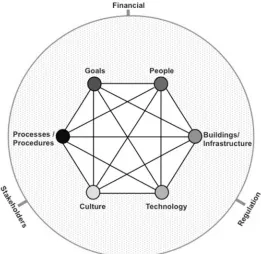
minimum standards for the work buildings and production processes in use. Figure 1
below provides a simple, yet powerful, conceptualization of a generic organizational
system, with interdependencies represented by lines between the nodes.
[INSERT FIGURE 1 AROUND HERE]
STST argues that attempting to alter any part of this system, be it the
introduction of a new technology, a new rewards system, or a business change
program without considering the implications on the other parts of the system is likely
to limit the effectiveness of the change (Hendrick, 1997). At its heart STST concerns
acknowledging the inter-relationships amongst different parts of the system, to pursue
jointly optimized design, whereby both social and technical factors are simultaneously
considered in the process (Cherns, 1976; Trist & Bamforth, 1951). This is of
particular relevance to environmental sustainability, given the dominance of
organizational initiatives that are rooted in technological (e.g., more efficient IT
hardware), systems standards (e.g. ISO14001/EMAS), or buildings (e.g., Energy
Performance of Building Directive, EPBD)based solutions and change. These
Oxford University Press.
Gao, 2006; Davis et al., 2014)and their role in supporting wider organizational
change is neglected. A STST approach to change management could help to not only
improve the implementation of technical innovations (e.g., helping to predict how
employees will react or behave within more sustainable buildings that may affect their
subsequent environmental performance, Davis et al., 2011; Wener & Carmalt, 2006),
but also to harness these technologies to help drive wider organizational change (e.g.,
to implement new smart meters to connect employees to their resource use or to act as
the basis for competition).
If we seek to achieve meaningful and lasting change directed at greening
whole organizations, then we need to examine how human behavior is embedded
within the system and ensure that we both remove organizational or technological
barriers wherever possible and identify strategies that make the system supportive of
intended behaviors and culture.
Applying a Socio-Technical Framework
The general principles of socio-technical systems thinking provide useful
guidance regarding how to approach the process of organizational change and design
(e.g., Cherns, 1976, 1987; Clegg, 2000; Mumford, 1983). Techniques such as
scenarios planning (e.g., Axtell, Pepper, Clegg, Wall, & Gardner, 2001), ETHICS
(Mumford, 1995) and the socio-technical hexagon framework presented in Figure 1
offer specific structures for involving staff and other stakeholders in the process of
organizational design and managing change. Common across these frameworks is the
emphasis upon multi-disciplinary inputs to change, acknowledging that no one
discipline holds all the answers to any particular problem (Clegg, 2000), and
flexibility, to enable the process to reflect the organizational context and stakeholder
Oxford University Press.
The hexagon framework in particular has two potential uses here, it can be
used to help analyze existing change programs and to involve staff in planning new
initiatives (Davis et al., 2014). In both cases we can use it to consider
inter-relationships between various factors involved in a change and the wider system, as
well as identify potential conflicts and gaps in coverage. For example, through
mapping elements of an existing change process onto the diagram, barriers to change
may be identified, e.g., rewards metrics that act as a disincentive to employees to
pursue environmental goals. The framework promotes the identification (and
removal) of conflicts to desired change and the inclusion of additional initiatives to
address gaps in coverage across the organizational system, supporting the design of
more holistic change programs (see, Challenger, Clegg, & Robinson, 2010 and Davis
et al, 2014, for guidance regarding applying the hexagon framework).
To illustrate this approach applied to analyzing an existing change program,
we have used the hexagon to help map and understand a global manufacturer’s
environmental change program at one of their UK production plants (see, Davis et al.,
2014). Figure 2 captures and identifies the various approaches and techniques that the
company has implemented to support environmental sustainability across the whole
plant. The systems diagram illustrates the key steps that the organization has taken,
which aspects of the system these steps have targeted, where the inter-relationships lie
and where least attention has been paid. It forms the basis for structured discussions
with stakeholders and a framework for planning future program extensions.
[INSERT FIGURE 2 HERE]
The analysis demonstrates that culture and goals have received less attention
than the more technological or process driven aspects of the change program. The
Oxford University Press.
technology, infrastructure and training issues relating to WPEB and environmental
sustainability. The organization is now increasing the ambition of its employee
engagement program to help widen and embed the organizational change, involving
and capitalizing upon their human resources – building upon the technological
investments already made. The analysis has helped to map the breadth of current
initiatives and made explicit inter-relationships, as well as where efforts may be used
to better reinforce one another (e.g., using the investment in buildings to emphasize
environmental goals). Preliminary analysis has demonstrated the value of a holistic
approach to change, with staff showing very high levels of engagement with the
employee WPEB change program, positive pro-environmental attitudes site wide,
ISO14001 certification and the site has won sustainability awards for its efforts.
The STST framework offers guidance for approaching and designing change
initiatives aimed at achieving greater environmental sustainability and WPEB. The
way of thinking promotes a holistic approach to change and may lessen the chance
that initiatives within an organization are either fragmented (being led by various
departments or specialisms), fall into the trap of being technologically led at the
expense of social issues, or that behaviorally orientated change programs fail to
recognize technological barriers or support (Davis et al., 2014; Young et al., In Press).
Future Research Directions and Practical Implications
This chapter has highlighted some central links across key success factors in
traditional organizational change and environmental sustainability efforts within
organizations. The literature on four key areas of change management have been
reviewed, each of which it is argued requires simultaneous consideration if
environmental change initiatives are to be successful: organizational culture;
Oxford University Press.
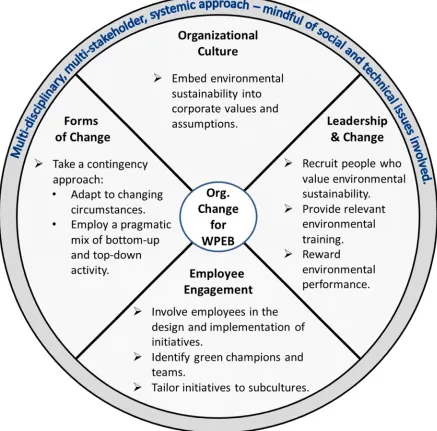
change that best suits the organization (see, Figure 3). Building upon this, STST has
been offered as a framework that may aid the design and implementation of
organizational change. Following on from this review, the current section proposes
five key directions to help develop research in this area and then provides four main
practical implications for organizations wishing to support environmental change.
Future Research Directions
Firstly, more research is required that measures the extent to which
environmental change initiatives have been successful. This would serve two
purposes: (1) provide support for investment in further (successful) change initiatives
by organizations; (2) enable competing change management approaches to be tested
and aid theorization. To assess the efficacy of change programs, success criteria need
to be carefully chosen to reflect the aim of improving environmental sustainability.
For example, a distinction needs to be made between simply the number of new
initiatives being introduced and the subsequent impact on the environment (Ones &
Dilchert, 2012). Furthermore, if the aim of a change program is to embed
environmental sustainability across an organization then it may be necessary to look
below the organizational level and measure individual employees’ WPEB (c.f., Weick
& Quinn, 1999), as ”the successful implementation of organizational environmental
sustainability strategies ultimately depends upon the collective array of behavior
changes from individual employees” (DuBois et al., 2013). Researchers also need to
look beyond self-report measures to make better use of objective environmental data
(e.g., energy performance data, product lifecycle analyzes, waste sent to landfill) or
longitudinal behavioral data (e.g., diary studies, Robinson, 2010 – see Chapter 5) to
Oxford University Press.
Secondly, more research is needed to better understand what an
environmentally sustainable organizational culture looks like and even whether a truly
sustainable organization is possible to achieve. Russell and McIntosh (2011) highlight
how there is little empirical evidence to demonstrate whether organizations can move
to the level of the sustainable organization. Research is required to uncover how to
move beyond compliance with environmental legislation and/or superficial efforts for
sustainability (e.g., presence of relevant cultural artifacts, Schein, 2010), toward the
adoption of voluntary proactive efforts with sustainability fully embedded into
organizational values. One line of enquiry may be to explore cultural fragmentation
across the organization. Whilst some researchers have begun to unpack the
complexities of subcultures within organizations and how they influence the uptake of
sustainability issues (e.g., Harris & Crane, 2002; Howard-Grenville, 2006), exploring
how best to utilize subcultures, and in particular dominant subcultures, to better
diffuse cultural change throughout the organization may be one useful avenue for
future empirical research.
Thirdly, it is unlikely that employees, including organizational leaders and
environmental champions, consider environmental issues solely at work. An area of
research that is currently underdeveloped is the potential spillover of environmental
attitudes and behaviors across work and non-work domains (Muster & Schrader,
2011). Whilst there is some initial evidence for such spillover (Berger, 1997; Tudor,
Barr, & Gilg, 2007), more research is needed to uncover how organizations can
facilitate a stronger link between environmental sustainability at work and during
non-work time to positively impact corporate cultures, employee and leadership
engagement and subsequent environmental change initiatives. For example, asking
Oxford University Press.
from their non-work life may increase engagement. Similarly, by incorporating
environmental behaviors that can be carried out during work and non-work time into
workplace green initiatives, employees might start to consider environmental issues
across multiple social contexts thereby helping to develop more consistent
environmental values and behavioral patterns. This stream of work may require new
or amended self-report measures of WPEB, to enable researchers to measure general
behaviors that employees could choose to engage in across a range of contexts.
Fourthly, action research (e.g., Cassell & Johnson, 2006) should be applied to
the study of environmental sustainability change. The approach offers researchers the
opportunity to gain a greater understanding of the nature of change over time and to
achieve direct impact on practice (Susman & Evered, 1978). For example, Adams &
McNicholas (2007) adopted an action research methodology enabling them to observe
and delve into a change process directed at improving sustainability reporting and
provide feedback that inputted back into the change process. The realization of such
mutually beneficial relationships is likely to be best supported by long-term
cooperative relationships between organizations and researchers – these are
challenging relationships to develop and maintain, however, the potential returns in
theoretical insight and practical impact are significant.
Finally, we propose that research needs to more fully uncover the conceptual
distinctions between traditional organizational change initiatives and environmental
change initiatives specifically. This is similar to Lueneberger and Goleman’s (2010)
call for executives to understand how sustainability issues differ from other corporate
initiatives. Whilst it is asserted that change management techniques should be broadly
applicable to the management of environmental sustainability, the nature of the topic
Oxford University Press.
This would be comparable to the differences that are observed in the efficacy of
behavior change techniques across differing WPEBs (Osbaldiston & Schott, 2012;
Steg & Vlek, 2009).
Practical Implications
This review has highlighted a number of implications for practice. However,
in this subsection we identify the recommendations that are thought to offer greatest
impact on practice (see, Figure 3), namely that organizations should: 1) cultivate the
right corporate culture; 2) select in and train up leaders and employees who value
environmental sustainability; 3) fully engage their employees; 4) take a contingency
approach to organizational change towards environmental sustainability; and 5) take a
multidisciplinary approach which utilizes socio-technical systems thinking. These will
briefly be considered in turn.
[INSERT FIGURE 3 ABOUT HERE]
Firstly, whilst this chapter has highlighted the debate in the literature as to
whether organizations need to change corporate values to improve environmental
performance, due to the steadily increasing number of papers showing direct links
between an organization’s environmental values and employee WPEB (e.g.,
Andersson et al., 2005; Nilsson et al., 2004; Ramus & Steger, 2000; Sharma, 1999),
we argue that organizations should embed environmental sustainability into their
underlying assumptions and values.
Secondly, HRM practices should be linked to an environmental
sustainability-driven organizational culture by, for example 1) recruiting new employees and leaders
into the organization who value environmental sustainability; 2) providing relevant
training to employees and leaders to increase environmental awareness, knowledge
Oxford University Press.
transformational leadership and management behaviors that facilitate environmental
innovations along with how to successfully champion and communicate
environmental ideas; and 3) rewarding environmental efforts via formal (e.g.,
performance management) and informal channels (e.g., praise and recognition, c.f.,
Renwick et al., 2013).
Thirdly, there are a number of strategies that organizations can incorporate to
ensure employees are aware of, and engaged with, green issues. Employee
involvement has been labeled one of the most successful avenues for continued
engagement (Renwick et al., 2013); encouraging employees to help in the design and
implementation of any change initiative is likely to be critical to its success. Setting
up organizational green teams and identifying green champions may also help
facilitate the diffusion of environmental sustainability as well as targeting and
tailoring initiatives to the different subcultures present within an organization.
Fourthly, this chapter has highlighted the differing approaches to managing
change that organizations could follow when preparing to promote environmental
sustainability and WPEB, ranging from planned to emergent and contingency forms
of change (Burnes, 1996; By, 2005). A contingency approach offers companies the
most flexible approach to the management of change, enabling leaders to adapt their
plans in response to changing circumstances and should permit a practical mix of both
top-down and bottom-up activities within a broad environmental sustainability change
program.
Finally, we argue that any approach to environmental sustainability should
adopt a systems view, taking into consideration the varied influences upon
organizational environmental performance. Applying STST frameworks that promote
Oxford University Press.
perspective in a flexible and on-going manner maximizes the chance of social and
technical issues receiving equal weighting and for the design of holistic initiatives.
Conclusion
This chapter has highlighted the potential for organizational change to be used
as a means of supporting environmental sustainability and promoting WPEB. In
particular, prominent aspects of organizational change, namely: organizational
culture; employee engagement; leadership and change agents; and differing forms of
change, have been identified as key components to focus on when managing change
in this area. The danger of allowing change to become technology led has been
discussed and STST offered as means of approaching holistic change. This chapter
has outlined some promising future directions for creating organization-wide change;
we hope researchers and practitioners in the area act now to capitalize on the potential
Oxford University Press.
References
Adams, C. A., & McNicholas, P. (2007). Making a difference: Sustainability
reporting, accountability and organisational change. Accounting, Auditing &
Accountability Journal, 20, 382 - 402.
Andersson, L. M., & Bateman, T. S. (2000). Individual Environmental Initiative:
Championing Natural Environmental Issues in U.S. Business Organizations.
Academy of Management Journal, 43, 548-570.
Andersson, L. M., Shivarajan, S., & Blau, G. (2005). Enacting Ecological
Sustainability in the MNC: A Test of an Adapted Value-Belief-Norm
Framework. Journal of Business Ethics, 59, 295-305.
Armenakis, A. A., & Bedeian, A. G. (1999). Organizational Change: A Review of
Theory and Research in the 1990s. Journal of Management, 25, 293-315.
Axtell, C., Pepper, K., Clegg, C., Wall, T. D., & Gardner, P. (2001). Designing and
evaluating new ways of working: The application of some sociotechnical
tools. Human Factors and Ergonomics in Manufacturing, 11, 1-18.
Bandura, A. (1997). Self-efficacy: The exercise of control. New York: W. H. Freeman
& Company.
Bansal, P. (2003). From Issues to Actions: The Importance of Individual Concerns
and Organizational Values in Responding to Natural Environmental Issues.
Organization Science, 14, 510-527.
Bansal, P., & Gao, J. (2006). Building the Future by Looking to the Past: Examining
Research Published on Organizations and Environment. Organization
Environment, 19, 458-478.
Bansal, P., & Roth, K. (2000). Why companies go green: A model of ecological
Oxford University Press.
Baxter, G., & Sommerville, I. (2011). Socio-technical systems: From design methods
to systems engineering. Interacting with Computers, 2, 4-17.
Berger, I. E. (1997). The Demographics of Recycling and the Structure of
Environmental Behavior. Environment and Behavior, 29, 515-531.
Branzei, O., Vertinsky, I., & Zietsma, C. (2000). From green-blindness to the pursuit
of eco-sustainability: An empirical investigation of leader cognitions and
corporate environmental strategy choices. In S. Havlovic (Ed.), Academy of
Management Best Paper Proceedings. Toronto, ON: Academy of
Management, ONE: C6
Broadhurst, K., Wastell, D., White, S., Hall, C., Peckover, S., Thompson, K., Davey,
D. (2010). Performing 'initial assessment': Identifying the latent conditions for
error at the front-door of local authority children's services. British Journal of
Social Work, 40, 352-370.
Bullock, R. J., & Batten, D. (1985). It's just a phase we're going through: A review
and synthesis of OD phase analysis. Group & Organization Management, 10,
383-412.
Burger, J. M. (1999). The foot-in-the-door compliance procedure: A multiple-process
analysis and review. Personality and Social Psychology Review, 3, 303-325.
Burnes, B. (1996). No such thing as ... a “one best way” to manage organizational
change. Management Decision, 34, 11-18.
Burnes, B. (2004). Kurt Lewin and the Planned Approach to Change: A Re-appraisal.
Journal of Management Studies, 41, 977-1002.
By, R. (2005). Organisational Change Management: A Critical Review. Journal of
Oxford University Press.
Carroll, A. B. (1979). A Three-Dimensional Conceptual Model of Corporate
Performance. Academy of Management Review, 4, 497-505.
Cassell, C., & Johnson, P. (2006). Action research: Explaining the diversity. Human
Relations, 59, 783-814.
Challenger, R., Clegg, C. W., & Robinson, M. A. (2010). Understanding Crowd
Behaviours Volume 1: Practical Guidance and Lessons Identified. London,
UK: TSO.
Chen, Z., Li, H., & Wong, C. T. C. (2002). An application of bar-code system for
reducing construction wastes. Automation in Construction, 11, 521-533.
Cherns, A. (1976). The Principles of Sociotechnical Design. Human Relations, 29,
783-792.
Cherns, A. (1987). Principles of Sociotechnical Design Revisited. Human Relations,
40, 153-161.
Clegg, C. W. (2000). Sociotechnical principles for system design. Applied
Ergonomics, 31, 463-477.
Clegg, C. W., & Shepherd, C. (2007). The biggest computer programme in the world
ever! Time for a change in mindset? Journal of Information Technology, 22,
212-221.
Clegg, C. W., & Walsh, S. (2004). Change management: Time for a change!
European Journal of Work and Organizational Psychology, 13, 217-239.
Colby, M. E. (1991). Environmental management in development: The evolution of
paradigms. Ecological Economics, 3, 193-213.
Cox, A., Higgins, T., Gloster, R., Foley, B., & Darnton, A. (2012). The impact of
Oxford University Press.
August 25, 2013, from
http://www.scotland.gov.uk/Resource/0039/00390309.pdf
Crane, A. (2000). Corporate greening as amoralization. Organization Studies, 21,
673-696.
Crew, D. E. (2010). Strategies for implementing sustainability: Five leadership
challenges. SAM Advanced Management Journal, 75, 15-21.
Crews, D. E., & Woman, T. (2010). Strategies for Implementing Sustainability: Five
Leadership Challenges. SAM Advanced Management Journal, 75, 15-22.
Davis, M. C., & Challenger, R. (2009). Climate Change: Warming to the task. The
Psychologist, 22, 112-114.
Davis, M. C., & Challenger, R. (In Press). Environmentally sustainable work
behaviors. In P. C. Flood & Y. Freeney (Eds.), Volume 7: Encyclopedia of
Organizational Behavior, in the Wiley Encyclopedia of Management (3rd ed.),
Cary L. Cooper (Ed. in chief). Chichester, UK: Wiley.
Davis, M. C., Challenger, R., Jayewardene, D. N., & Clegg, C. W. (2014). Advancing
socio-technical systems thinking: A call for bravery. Applied Ergonomics,
45(2), 171-180.
Davis, M. C., Leach, D. J., & Clegg, C. W. (2011). The Physical Environment of the
Office: Contemporary and Emerging Issues. In G. P. Hodgkinson & J. K. Ford
(Eds.), International Review of Industrial and Organizational Psychology
(Vol. 26, pp. 193-235). Chichester, UK: Wiley.
DuBois, C. L. Z., Astakhova, M. N., & DuBois, D. A. (2013). Motivating behavior
change to support organizational environmental sustainability goals. In A. H.
Huffman & S. R. Klein (Eds.), Green Organizations: Driving Change with
Oxford University Press.
Dunphy, D., Benn, S., & Griffiths, A. (2003). Organizational change for corporate
sustainability. London, UK: Routledge.
Dunphy, D., & Stace, D. (1993). The Strategic Management of Corporate Change.
Human Relations, 46, 905-920.
Eason, K. (2007). Local sociotechnical system development in the NHS National
Programme for Information Technology. Journal of Information Technology,
22, 257-264.
Ferdig, M. a. (2007). Sustainability Leadership: Co-creating a Sustainable Future.
Journal of Change Management, 7, 25-35.
Fernandez, E., Junquera, B., & Ordiz, M. (2003). Organizational culture and human
resources in the environmental issue: A review of the literature. International
Journal of Human Resource Management, 14, 634-657.
Fineman, S. (1997). Constructing the Green Manager. British Journal of
Management, 8, 31-38.
Fineman, S., & Clarke, K. (1996). Green stakeholders: Industry interpretations and
response. Journal of Management Studies, 33, 715-730.
Galbreath, J. (2009). Drivers of Corporate Social Responsibility: The Role of Formal
Strategic Planning and Firm Culture. British Journal of Management, 21,
511-525.
Guy, S. (2006). Designing urban knowledge: Competing perspectives on energy and
buildings. Environment and Planning C: Government and Policy, 24(5),
645-659.
Handgraaf, M. J., Van Lidth de Jeude, M. A., & Appelt, K. C. (2013). Public praise
vs. private pay: Effects of rewards on energy conservation in the workplace.
Oxford University Press.
Harris, L. C., & Crane, A. (2002). The greening of organizational culture:
Management views on the depth, degree and diffusion of change. Journal of
Organizational Change Management, 15, 214-234.
Harris, L. C., & Ogbonna, E. (1998). Employee responses to cultural change. Human
Resource Management Journal, 8, 78–92.
Hartley, J., Benington, J., & Binns, P. (1997). Researching the Roles of
Internal-change Agents in the Management of Organizational Change. British Journal
of Management, 8, 61-73.
Heijden, A. V. D., Cramer, J. M., & Driessen, P. P. J. (2012). Change agent
sensemaking for sustainability in a multinational subsidiary. Journal of
Organizational Change Management, 25, 535-559.
Heller, F., Pusic, E., Strauss, G., & Wilpert, B. (1998). Organisational participation:
Myth and reality. Oxford, UK: Oxford University Press.
Hendrick, H. (1997). Organizational design and macroergonomics. In G. Salvendy
(Ed.), Handbook of human factors and ergonomics (pp. 594-637). New York:
John Wiley & Sons.
Howard-Grenville, J. A. (2006). Inside the "Black Box": How Organizational Culture
and Subcultures Inform Interpretations and Actions on Environmental Issues.
Organization & Environment, 19, 46-73.
Jennings, P. D., & Zandbergen, P. A. (1995). Ecologically Sustainable Organizations:
An Institutional Approach. Academy of Management Review, 20, 1015–1052.
Johnson, D. B., & Macy, G. (2001). Using environmental paradigms to understand
and change an organization’s response to stakeholders. Journal of
Oxford University Press.
Kanter, R. M. (1983). The Change Masters: Corporate Entrepreneurs at Work.
London, UK: International Thomson Business Press.
Kanter, R. M., Stein, B. A., & Jick, T. D. (1992). The Challenge of Organizational
Change. New York, NY: The Free Press.
Karasek, R., & Theorell, T. (1990). Healthy Work: Stress, productivity, and the
reconstruction of working life. USA: Basic Books.
Kotter, J. P. (1995). Leading Change: Why Transformation Efforts Fail. Harvard
Business Review, 73, 59-67.
Kotter, J. P. (1996). Leading Change. Boston, MA: Harvard Business School Press.
Kujala, S. (2003). User involvement: A review of the benefits and challenges.
Behaviour & Information Technology, 22, 1-16.
Lazlo, C., & Zhexembayeva, N. (2011). Embedded Sustainability: The next big
competitive advantage. Sheffield, UK: Greenleaf Publishng.
Lee, M. P. (2011). Configuration of external influences: The combined effects of
institutions and stakeholders on corporate social responsibility strategies.
Journal of Business Ethics, 102, 281-298.
Li, H., Chen, Z., & Wong, C. T. C. (2003). Barcode technology for an incentive
reward program to reduce construction wastes. Computer-Aided Civil and
Infrastructure Engineering, 18, 313-324.
Lingard, H., Gilbert, G., & Graham, P. (2001). Improving solid waste reduction and
recycling performance using goal setting and feedback. Construction
Management and Economics, 19, 809-817.
Linnenluecke, M. K., & Griffiths, A. (2010). Corporate sustainability and