This is a repository copy of Small Modular Reactors: Licensing constraints and the way
forward.
White Rose Research Online URL for this paper:
http://eprints.whiterose.ac.uk/91108/
Version: Accepted Version
Article:
Sainati, T, Locatelli, G and Brookes, N (2015) Small Modular Reactors: Licensing
constraints and the way forward. Energy, 82. 1092 - 1095. ISSN 0360-5442
https://doi.org/10.1016/j.energy.2014.12.079
© 2015, Elsevier. Licensed under the Creative Commons
Attribution-NonCommercial-NoDerivatives 4.0 International
http://creativecommons.org/licenses/by-nc-nd/4.0/
[email protected] https://eprints.whiterose.ac.uk/
Reuse
Unless indicated otherwise, fulltext items are protected by copyright with all rights reserved. The copyright exception in section 29 of the Copyright, Designs and Patents Act 1988 allows the making of a single copy solely for the purpose of non-commercial research or private study within the limits of fair dealing. The publisher or other rights-holder may allow further reproduction and re-use of this version - refer to the White Rose Research Online record for this item. Where records identify the publisher as the copyright holder, users can verify any specific terms of use on the publisher’s website.
Takedown
If you consider content in White Rose Research Online to be in breach of UK law, please notify us by
1
Please cite this paper as Sainati, T., Locatelli, G., & Brookes, N. (2015). Small Modular Reactors: Licensing constraints and the way forward. Energy, 82, 1092-1095.”
Small Modular Reactors: licensing constraints and
the way forward
Tristano Sainati - Corresponding author
School of Engineering - University of Lincoln,
Brayford Pool, Lincoln, UK LN6 7TS
T +44 (0) 1522 83 79 46
Email: [email protected]
Giorgio Locatelli
School of Engineering - University of Lincoln,
Brayford Pool, Lincoln, UK LN6 7TS
T +44 (0) 1522 83 79 46
Email: [email protected]
Naomi Brookes
School of Civil Engineering - University of Leeds,
Woodhouse Lane, Leeds, UK LS2 9JT
2
Small Modular Reactors: licensing constraints and
the way forward
Abstract
Small Modular nuclear Reactors (SMR) are a type of power plant receiving an increasing deal of attention from industry e policy makers. A large number of SMR need to be built in the same site and across the word to compensate diseconomies of scale and be cost competitive with large reactors and other base load technologies. A major barrier is the licensing process, historically developed for large reactors, preventing the simply deployment of several identical units in different countries. This paper, discussing Ramana, Hopkins and Glaser [1], enlarges the view to all the SMR specific aspect of the licensing process presenting their legislative implications and market effects.
Keywords
3
Introduction
Ramana, Hopkins and Glaser in [1] provide an extensive review of the Licensing Process (LP) of Small Modular Reactors (SMR) in five countries: USA, Russia, South Korea, China and India. The leading reactor vendors for SMR belong to those countries and the respective governments are keen to support this industry because of the vast potential for establishing a competitive advantage and thereby significant market share afforded to the first movers. The LP of these countries are particularly important because, in order to gain credibility and demonstrate the technology, the reactor vendors aims firstly to build an SMR in their own country and subsequently to export the technology to other countries. Consequently, governments (and their regulatory bodies) are considering the revision of existing LP in order to tailor them for the assessment of SMR. The attractiveness of SMR, as investment, is mostly based on the principle of modular deployment fostering both economies of multiples and investing scalability [2] [4]. Economies of multiples exist because of construction learning process, co-siting cost sharing and mini-mass production of components from suppliers. Scalability refers to the ability to echelon the investment and to decide if, and when, to increase the power (i.e. then the number of SMR) installed in a certain site or utility portfolio [5]. The current research [1] primarily focuses on the issue of the Emergency Planning Zone (EPZ) because of the interest of coupling SMR with other industrial plants; e.g. [6]. As such, it is important to locate SMR close to industrial plants, hence the interest in EPZ. Although the EPZ is a key aspect of the LP it is important to be cognizant of other factors, as analyzed in this discussion paper. These aspects are crucial for the economics of SMR.
Discussion
Five main additional topics should be considered while overviewing the challenge of licensing SMR: 1. Licensing approach
2. Duration and predictability of the LP
3. Regulatory harmonization and international certification 4. Manufacturing License
5. Ad Hoc legal and regulatory framework.
Licensing approach.
The IAEA distinguishes between two major typologies of licensing approach: prescriptive based approach and goal setting one (or performance based approach) [7].
Prescriptive based approach (which is the most common: for instance, all countries mentioned into the paper adopt prescriptive based licensing approach) is mostly based on the deterministic safety assessment [8], [9]. The reactor design, material, components and the final facility are judged in their ability to respect pre-defined norms and principles. Under this approach, the regulator need to develop (or to adopt) a wide range of codes and standards enabling this technical judgment [10]. Traditionally, the prescriptive based approach worked properly, where few standardized reactors design where deployed several times (e.g. France, South Korea, and Russia). From the licensing point of view, this approach is efficient because the codes and the standards are almost tailored to the specific reactor designs and the country of construction. The main advantages of LP prescriptive based (once it has been established) are the speed and efficiency especially for experienced industrial operators: reactor vendors, contractors, and operators. Furthermore, the approach aims to reduce the level of uncertainty and ambiguity of the LP and it aims to reduce the subjectivity left to the regulatory body [7], [9]. For SMR, the
4
T oal setting approach (or performance-based) is typical of nuclear countries that base the nuclear program an open market principle (rather than a country development strategy promoting the domestic industry); United Kingdom is the typical example [12], [13]. Despite the USA Licensing systems is sometimes considered a prescriptive based approach, it also contains several element of the goal setting one (this is in line with the open market proposition associated to USA nuclear program) [14]. Goal setting approach relays more extensively to the risk informed regulation [15] [17] in combination with the ALARA/ ALARP (As Low As Reasonably Achievable/ As Low As Reasonably Possible) principle [18] [20]. The approach is more flexible in considering a new reactor design technology; the downside is that the LP is perceived more ambiguous and uncertain by the applicant. Furthermore, the regulatory body have higher degree of subjectivity. This
licensing approach relies extensively on D
Construction + Operation license) [21]. Design certification considers the general safety characteristic of reactor design and would permit to certify the SMR specific design. The remaining licenses (that may change depending on the country considered) are site and project specific. Since prescriptive norms are not in place (e.g. limit to the radioactive discharges into the environment or other relevant constrains) these boundary
conditions [22], [23]. License conditions can be understood as a
flexible regulatory mean that apply to the specific NPP rather than be general and uniform across the nuclear programme [24]. Usually the regulatory body considers the effort and the time associated to the issuance of license conditions on case-by-case basis. By contrast, prescriptive based LP is more rigid and any relevant modification of the facility require an entire new LP (this is a major constrain for modular facility). In the first phase SMR could take advantage of the wider flexibility offered by goal setting approach, especially during the early phases of a nuclear program while more technology are assessed.
SUMMARY: The types of licensing approach is a fundamental determinant for the deployment of SMR. At this stage of development most favorable to the deployment of SMR. By contracts, most of the countries involved (as reactor vendor, buyer or both) into a SMR nuclear program adopt a deterministic licensing approach.
Duration and predictability of the
.
Some of the key advantages of the modular SMR are: the scalability of the investment (deploying SMR when the demand of electricity rises), the reduced construction time construction risk (SMR are mostly manufactured in factories reducing the number of activities in the site ) [25], [26] . These SMR characteristics are essential for be economically and strategically competitive.
The existing LP have been designed for large nuclear power plants characterized by a long construction period. Large plants require various assessment that takes time and are performed in parallel with their construction. SMR are designed for a short construction, consequently the LP time could be longer than the SMR construction schedule time preventing the expected time saving. These constrains are due to two macro groups of reasons.
Firstly the existing LP may require additional time in order to cope with SMR because of their peculiarities: Novelty of the design technology
Issuance of different safety principles with respect the conventional Nuclear power plants Lack of experienced and specific regulatory framework
5
SUMMARY: existing LPs could extend the construction time of SMR beyond the pure technical schedule undermining the overall economics.
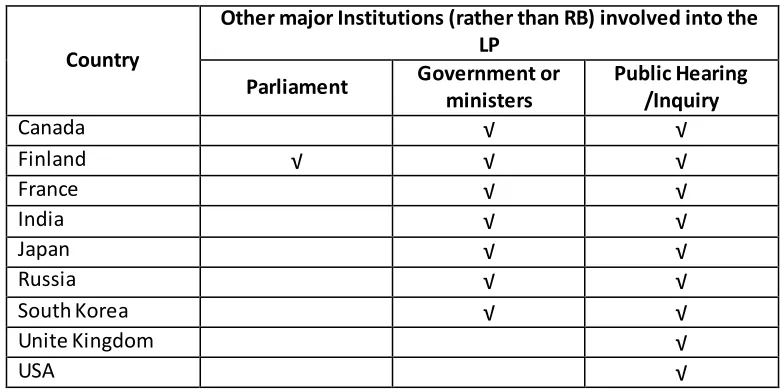
Country
Other major Institutions (rather than RB) involved into the LP
Parliament Government or ministers
Public Hearing /Inquiry
[image:6.596.102.494.106.302.2]Canada Finland France India Japan Russia South Korea Unite Kingdom USA
Table 1: Major institutions involved into the LP of nuclearized countries
Regulatory harmonization and international certification
.One of the key debate concerning licensing SMR is about the regulatory harmonization [28], [29]. In the nuclear industry, there are few major reactor vendors EPC
. However, the nuclear industry operates internationally (several countries are interested in SMR) and LP and the nuclear regulations are country-specific [28]. Consequently a certain reactor vendor cannot
A
for the deployment of identical units in more the one country is the harmonization of law and PL.
Nowadays, the international harmonization is promoted by three key groups of stakeholders: the international organizations (e.g. IAEA), the nuclear industry and the regulatory bodies. They have different perspective and power.
The International organizations have, by definition, an international perspective and exercises power in an indirect manner [30], [31].
Nuclear industry is promoting the idea of harmonizing the nuclear regulation and LP in order to reduce the uncertainty and the knowledge burden required to develop a NPP [32], [33]. This would be extremely beneficial to the feasibility of SMR. They can lobby for this toward government and RB [34].
RB are keen to collaborate at international level; with this respect, some mechanisms and devoted institutions are already in place (e.g. WENRA) [35]. RBs can take advantage in sharing information, experience and knowledge about reactor designs that have been already certified in some countries and are applying to other ones. They have regulatory power in their own country [36].
Despite most of nuclear stakeholders would beneficiate for regulatory harmonization it is extremely difficult to make significant progresses in this direction in the short-medium term because of the heterogeneity of [14], [36], [37]:
Legal systems and jurisprudence Institutional systems
LP structure and underlying principles
6
Along with the regulatory harmonization, there is a debate over the international certification of the reactor designs. Under this envisaged approach, SMR designs could be certified once at international level and the remaining assessments (required for a complete LP) would be issued at local (country) level [33]. This approach would be extremely advantageous for the SMR industry. Again, even if this is attractive, this would be extremely challenging at legal and institutional level. It is difficult to redesign the existing legal norms and to reassign the institutional duties. International certifications would conflict with the country sovereignty. The implementation of this licensing option would require coordinated reforms at mandatory (law) level (in several countries together), the implementation of major international conventions and a massive administrative reorganization.
SUMMARY: The fragmentation at country level of legal systems and jurisprudence, Institutional systems, LP structure constrain the SMR standardization. Since each country has power on and only his country the short term harmonization is unlikely.
Manufacturing License.
The manufacturing license was introduced by the US Nuclear Regulatory Commission for certifying the processes of the critical nuclear suppliers (e.g. Nuclear Steam Supply System) [38]. The manufacturing license does not substitute the LP but it speeds up the LP because the manufactures are known and certified by the RB. The deployment of SMR would be favored by the manufacturing license. Manufacturing activities are extremely important for the SMR: one of the key ideas of modularization is to move the work from the site to the factory. This mean that most of the licensing activities would be potentially performed within one or more factories [39]. Therefore, the main challenges for the regulatory body would be: traceability of components by considering the whole supply chain, distributed LP (as opposed to the existing concentrated one: at the country and site where NPP is developed), etc. The aircraft industry is often suggested as reference [34]. In this industry, few manufacturers design and built the aircrafts. This environment would be comparable to the case of where the manufacturing license is completely substitutive to the LP. In such extreme circumstance, the LP would focus only or mostly on the manufacturing process rather than to its outcome (SMR). This approach would be extremely beneficial for the SMR industry because it would permit an efficient manufacturing production.
Nowadays, the
feasible. The first Convention of Nuclear Safety (CNS I) [40] is the fundamental milestone for LP in nuclearized countries, and has been instituted in response to the major accident of Chernobyl [14]. One of the key idea of the CNS I is the institution of the licensing principles [41] in order to assess the plant and the responsible organization (the nuclear operator). The key implication is that the reactor owner cannot get rid in any way of the nuclear operator liability, it is the ultimate and sole responsible for the nuclear safety. The plant must still be certified in the site at the end of the construction.
“UMMARY E LP apply to another unit
of analysis: the system installed at the site. The reactor owner is in all the case the ultimate and sole responsible for the nuclear safety.
Ad Hoc legal and regulatory framework.
Another is the development of specific laws, regulations and LP for SMR. This approach is already common for small nuclear research facilities (e.g. the public hearings and inquiries). This exception of circumstances is settled by the nuclear legislation, it constrains the nominal thermal power (i.e. usually 50 MW) and the purpose of the facility (i.e. research activities) [7], [42].
7
It requires a significant review of the legal and regulatory framework
It implies a complete rethink of the LP that implies a redefinition the institutional framework It implies a reduction of the licensing guarantees in intuitional and democratic terms (e.g. exemption of
circumstances for the public inquiry). This reduction of guarantees is difficult to be justified in the eyes of the country citizen.
SUMMARY: an ad hoc legislation process similar to the one for research facilities could be the way forward. However there could be constrain in terms of public acceptability (people and total power installed in the site: they are designed for stand alone small research reactors
Conclusions
SMR are receiving an increasing amount of attention from both industry, academia and government. Unfortunately, there are several misconceptions regarding the LP of SMR which have the effect of preventing a fair analysis of these power plants. In fact, a key advantage for the widespread adoption of SMR is a tailored LP shared between several nations. The five key aspects discussed in this paper, along with the EPZ (well described by the original paper), are the main challenges associated to this long-term objective.
Tailoring of the LP for SMR as part of a strong political commitment by several countries and at the same time is essential. Since there is no one, true
8
Bibliography
1. Ramana, M. V., Hopkins, L. B. & Glaser, A. Licensing small modular reactors. Energy 61, 555-564 (2013).
2. Locatelli, G., Bingham, C. & Mancini, M. Small modular reactors: A comprehensive overview of their economics and strategic aspects. Prog. Nucl. Energy 73, 75-85 (2014).
3. Boarin Sara, Locatelli Giorgio, Mancini Mauro, R. M. E. Financial Case Studies on Small - and Medium-Size Modular Reactors. Nucl. Technol. 178, 218-232 (2012).
4. Carelli, M. D. et al. Economic features of integral, modular, small-to-medium size reactors. Prog. Nucl. Energy 52, 403-414 (2010).
5. Locatelli, G. & Mancini, M. Large and small baseload power plants: Drivers to define the optimal portfolios. Energy Policy 39, 7762-7775 (2011).
6. Kozier, K. S. The nuclear battery: A very small reactor power supply for remote locations. Energy 16, 583-591 (1991).
7. IAEA. Licensing Process for Nuclear Installations. (2010). at
http://www-pub.iaea.org/books/IAEABooks/8429/Licensing-Process-for-Nuclear-Installations-Specific-Safety-Guide
8. IAEA. Basic Safety Principles for Nuclear Power Plants. (1999). at http://www-pub.iaea.org/MTCD/publications/PDF/P082_scr.pdf
9. IAEA. Deterministic Safety Analysis for Nuclear Power Plants. (2009). at http://www-pub.iaea.org/MTCD/publications/PDF/Pub1428_web.pdf
10. IAEA. Safety margins of operating reactors. (2003). at http://nucleus.iaea.org/sites/gsan/lib/Safety Assessment TECDOCs/IAEA-TECDOC-1332 Safety Margins of Operating Reactors.pdf
11. IAEA. Advances in Small Modular Reactor Technology Developments. A Supplement to: IAEA Advanced Reactors Information System (ARIS). (2014). at
http://www.iaea.org/NuclearPower/Downloadable/SMR/files/IAEA_SMR_Booklet_2014.pdf
12. Bredimas, A. & Nuttall, W. J. An international comparison of regulatory organizations and licensing procedures for new nuclear power plants. Energy Policy 36, 1344-1354 (2008).
13. Snell, V. G. & Popov, N. K. CHAPTER 16 Regulatory Requirements and Licensing. (2014).
14. IAEA. Regulatory control of nuclear power plants Part A (Textbook). (2002).
9
16. IAEA. Review of Probabilistic Safety Assessments by Regulatory Bodies. (2002). at
http://www-pub.iaea.org/books/IAEABooks/6491/Review-of-Probabilistic-Safety-Assessments-by-Regulatory-Bodies
17. Himanen, R., Julin, A., Jänkälä, K., Holmberg, J.-E. & Virolainen, R. Risk-informed regulation and safety management of nuclear power plants--on the prevention of severe accidents. Risk Anal. 32, 1978-93 (2012).
18. Webb, G. A. M. & Lochard, J. ALARA in practice: how is it working? J. Soc. Radiol. Prot. 4, 58 (1984).
19. Jones-Lee, M. & Aven, T. ALARP-What does it really mean? Reliab. Eng. Syst. Saf. 96, 877-882 (2011).
20. Jamali, K. Use of risk measures in design and licensing of future reactors. Reliab. Eng. Syst. Saf. 95, 935-943 (2010).
21. Locatelli, G., Mancini, M., Sainati, T. & Sallinen, L. The licensing processes influence on nuclear market. (2011).
22. Office for Nuclear Regulation. Licensing of Nuclear Installations. 3rd Editio, (2014).
23. Office for Nuclear Regulation. Licence condition handbook attached to nuclear site licences. 1-24 (2014). at http://www.onr.org.uk/silicon.pdf
24. IAEA. Documentation for use in regulating nuclear facilities. (2002). at
http://www- pub.iaea.org/books/IAEABooks/6418/Documentation-for-Use-in-Regulating-Nuclear-Facilities-Safety-Guide
25. Generation, U. S., Rosner, R., Goldberg, S., Hezir, J. S. & Foundation, E. O. P. Small Modular Reactors - Key to Future Nuclear Power The Harris School of Public Policy Studies Contributor?: (2011).
26. Locatelli, G. & Mancini, M. A framework for the selection of the right nuclear power plant. Int. J. Prod. http://www.tandfonline.com/doi/abs/10.1080/00207543.2012.657965
27. World Nuclear Association. Country Profiles. (2014). at http://www.world-nuclear.org/info/Country-Profiles/Countries-T-Z/
28. Tronea, M. European quest for standardisation of nuclear power reactors. Prog. Nucl. Energy 52, 159-163 (2010).
29. Kirchsteiger, C. Workshop summary evaluation and how to proceed. International workshop on promotion of technical harmonisation on risk-based decision-making. Saf. Sci. 40, 383-395 (2002).
30. Langlois, L. IAEA Action Plan on nuclear safety. Energy Strateg. Rev. 1, 302-306 (2013).
31. IAEA. The Statute of the IAEA. (1989). at http://www.iaea.org/about/statute
10
33. CORDEL Group - World Nuclear Association. International Standardization of Nuclear Reactor Designs. (2010). at http://www.world-nuclear.org/WNA/Publications/WNA-Reports/CORDEL-Working-Group-Annual-Report/
34. CORDEL Group - World Nuclear Association. Cooperation in Reactor Design Evaluation and Licensing ( CORDEL ) Working Group. (2012). at
http://www.world-nuclear.org/WNA/Publications/WNA-Reports/CORDEL-Working-Group-Annual-Report/
35. Western European Nuclear Regulator's Association - WENRA. Progress towards harmonisation of safety. (2011).
36. IAEA. Governmental, Legal and Regulatory Framework for Safety. (2010). at
http://www- pub.iaea.org/books/IAEABooks/8434/Governmental-Legal-and-Regulatory-Framework-for-Safety-General-Safety-Requirements-Part-1
37. IAEA. Effective Nuclear Regulatory Systems Facing Safety and Security Challenges. in (IAEA, 2006).
38. Nuclear Regulatory Commission. 10 CFR-52.167 Issuance of manufacturing license. at http://www.nrc.gov/reading-rm/doc-collections/cfr/part052/part052-0167.html
39. Locatelli, G. & Mancini, M. The role of the reactor size for an investment in the nuclear sector: An evaluation of not-financial parameters. Prog. Nucl. Energy 53, 212-222 (2011).
40. IAEA. Convention on Nuclear Safety (review and amendements). (2014). at http://www-ns.iaea.org/conventions/nuclear-safety.asp?l=41
41. IAEA. Fundamental Safety Principles. 2, (2006).
42. IAEA. Handbook on nuclear law, implementing legislation. (2010). at