eurostat news
t
3 D 1986
BBÖiWeHKäKEEöäMd
-..A
^Γ^
Β ^^Ηpublications
1986
Format B5, 48 pages
eurostat
eurostat news
NEWS ITEMS
Conference of the Directors-General of the National Statistical Institutes
The work of Eurostat in 1985 Ovide, Reuters, and Eurostatistics New presentations for statistics Survey on international tourism Parliamentary questions
3 4 18 24 29
PUBLICATIONS
PublishedTo be published Periodicals
34 40 41
Editor: Mr Aristotelis Bouratsis, JMO B3/087A, Tel. 4301/2046 Secretariat: Mrs G. Conrath, JMO B3/96, Tel. 4301/3898 Dissemination: Mrs A. Zanchet, JMO B3/92, Tel. 4301/2038
The opinions expressed in the signed articles are not necessarily those of Eurostat.
Reproduction of the contents of this publication is subject to acknow-ledgment of the source.
Statistical Office of the European Communities
Eurostat News
is also published in French and German
DE ISSN 0378-505X FR ISSN 0378-360X
Conference of the Directors-General of the National
Statistical Institutes
Mr de Oliviera Mr Pfeiffer
The 65th Conference of the DirectorsGeneral of the National Statistical Institutes (DGINS) was held in Portugal on 28 to 30 May 1986 to mark the occasion of the first meeting with Spain and Portugal as full members. Mr Jose Francisco Graça Costa, President of the Instituto Nacional de Estatistica led the Portuguese delegation at the conference. Among the items on the agenda was the examination of the statistical implications of the completion of the internal market. The conference was also addressed by Mr Alois Pfeiffer, the Commissioner responsible for the Statistical Office of the European Communities on the subject of priorities and resources for Community statistics. Mr Pfeiffer, during his visit to Portugal, had discussions with Mr Luis Francisco Valente de Oliviera, Minister responsible for Planning and Regional Policy. Mr Valente de Oliviera and Mr Jose Albino da Silva Pineda, Secretary of State for Planning and Regional Development, were also present at the dinner offered by the Portuguese Government to Mr Pfeiffer and to participants at the conference.
£j
ΛΛ
Η·*
ι
■
^m
W
Λ. 1
^^JH
1
^t^B
If
J ? i
'\
M
Bi
mr-
-^
m
The work of Eurostat in 1985
1. General
In 1985 two new major themes dominated the work on European Community statistics.
1.1 First, the final preparations for the entry of Spain and Portugal into the European Community. As from January 1986 the EC has 12 Member States and the Community statistical system is immediately extended to cover the two new members. Many years of close collaboration prior to entry have helped to ensure that the transition will be as smooth as possible, although the burden of meeting Community statistical requirements, many of them laid down by EC law, is heavy. More-over, enlargement has an impact on the Com-munity system — for example, increasing the importance of agriculture, fishery and tour-ism statistics.
1.2 Second, the new European Commission which began work in 1985 has undertaken new initiatives, of which the most significant is a proposal, endorsed by the Heads of the Member States at the European Council in June 1985 'to achieve a single large market by 1992'. A programme of measures for the removal of the physical, technical and fiscal barriers between Member States has been drawn up. Eurostat, in collaboration with the national statistical services, is examining the statistical implications of this programme both for national statistics as well as for Community statistics. Eurostat is preparing proposals as regards trade statistics between Member States (see paragraph 4.1) but the examination will cover other aspects, includ-ing national accounts and balance of pay-ments.
1.3 A seminar on external trade indices was held in Luxembourg on the 6 to 8 November
1985 under the chairmanship of Professor Fourgeaud, Paris University 1 and
Cepre-map.1 Participants came not only from
Euro-pean countries, but also from North America, Africa and the Far East. International organizations were well represented. The sem-inar considered current theory and practice in this field and was informed of the develop-ment by Eurostat of a system of indices designed to produce indices for the European Community using harmonized Community statistics. A report of the proceedings will be published.
2. Processing and dissemination of statistical information
2.1 Eurostat continued its drive to promote statistical information in conjunction with the Commission's Spokesman's Group and the Cabinet responsible for the Statistical Office. On the external side information activities were diversified, with visits, conferences, introductory courses, demonstrations and seminars aimed at interested sectors.
A special brochure concerning the Com-munity of Twelve was released during the Milan summit meeting.
A specific action was undertaken vis-à-'vis the European Parliament.
A special issue of Eurostat News analysing the results of the European elections in 1984 was released during a demonstration of Eurostat publications at the July session in Luxembourg.
At the occasion of the enlargement to Spain and Portugal, information meetings took place in Madrid, Barcelona and Lisbon to
present the work, publications and data-bases of the Statistical Office.
2.2 Within the scope of the Commission's general policy on computing, the adoption by Eurostat of a distributed systems architecture has had important implications for the organ-ization and development of computing activi-ties within the office.
In particular, this decentralization has been accompanied by:
(i) a systematic management and adminis-tration of resources and a rationalization of their use;
(ii) a necessity to concentrate Eurostat's requirements for statistical software to a minimum number of commercially avail-able systems;
(iii) a growth in the development of local applications, allowing, amongst other things, the introduction of information technology into areas which have not as yet been automated.
In order to improve the quality and freshness of statistical data collected by Eurostat, stud-ies have been initiated into the possibility of using telecommunication between the office and the Member States, especially external trade data.
Certain developments involving new comput-ing techniques have been integrated into the current work of the office, especially in the areas of graphics and automatic photocompo-sition, in conjunction with the new version of the statistical table generating system Osiris.
2.3 Efforts to increase the use of the Eurostat data bases have been undertaken in five dif-ferent fields:
(i) The literature on the form and content of the data bases has been updated and widely disseminated in three languages.
(ii) Information has been provided system-atically and regularly to in-house users,
which has led to a substantial increase in the use of the bases.
(iii) The setting up of users' committees and appearances at specialist trade fairs and exhibitions has been an important factor in increasing the use of Eurostat data both by commercial hosts and in administrations directly connected to the Eurostat bases.
(iv) New statistics have been compiled which make it possible to follow more accu-rately the contents of the bases, the use made of them and the main users.
(v) Lastly, to facilitate the widest possible access to the most recent data an extract entitled 'Eurostatus', which contains 40 indicators for each country, is availa-ble to users every day. In addition, some 20 pages of statistical information are available on the Reuters system.
3. General economic statistics
3.1 National accounts
In 1985 Eurostat continued its conceptual work for the revision of the international systems of national accounts. This work is carried out in close cooperation with the OECD, UN Statistical office, IMF and the World Bank.
The working party examined a package of proposals by Eurostat relating to the defi-nition of total consumption of the popula-tion, including, in addition to consumers' expenditure, the individualized part of gov-ernment consumption, the definition of sumption subsidies, the individualized con-sumption of enterprises and the implications of these possible changes for the income measures.
The experts now have to refine and finalize the detail of the concepts and definitions.
The national and sector balance sheets are the principal area of development of the national accounts at the moment. In 1985 Eurostat, in conjunction with the working party, produced rules for the treatment and valuation of the stock of housing.
munity is also working closely with the OECD and the Economic Commission for Europe, with a view to expanding the field of com-parison to the third countries concerned.
Moreover, Eurostat is actively involved in world efforts aimed in particular at making worldwide comparisons by means of the core country system.
3.2
Classifications
In 1985 there was one of the two-yearly meetings of the joint Eurostat/UNSO work-ing party on the harmonization of classifi-cations at world level. The bulk of the meet-ing was given over to a discussion of a first draft of a classification of activities and pro-ducts for services. This draft and work to finalize the classification for goods must now be completed by the United Nations.
Following this meeting Eurostat concentrated on preparing a revised version of the Nace and adapting the CPC to the Nace so that the Community classifications fit into the world system of economic classifications.
3.3 All the work on Phase IV of the purchas-ing power parity exercise was completed, with the exception of the publication of the results at world level, in which Eurostat is collaborating with the UNSO and the OECD.
However, Eurostat's main efforts were devoted to the collection of data for Phase V (1985). Several price surveys were conducted during the year in the Member States (plus Spain, Portugal and Austria), in accordance with the work schedule drawn up at the end of 1983. The price surveys have in fact already been completed, with the exception of that on foodstuffs.
Eurostat once again took responsibility for coordinating work for the United Nations' international comparison project in a large number of African countries. The
Com-3.4 Work on weightings
In 1985 Eurostat embarked upon a major project on weightings. The weightings applied for the various Member States in 1985-86 need to be checked, and large-scale surveys were therefore conducted, with particular reference to officials' expenses, rents and prices.
Moreover, price surveys had to be conducted in the capital cities of the two new Member States in order to establish weightings for these countries.
The decision to standardize the remuneration system for officials working outside the Community entails a substantial amount of work. In 1985 Eurostat cooperated closely with other international organizations work-ing in this area (OECD and UN) in order to avoid duplication of effort. There are plans to coordinate the work and exchange basic information.
3.5
Family budgets
The publication of the standardized results of the national surveys of household expenditure was completed in 1985. All the results for the Member States (except Luxembourg) and Spain are now available in two publications.
3.6 Consumer price indices
There have been no changes in the work schedule for this area. Eurostat updated the report on the comparison of the methods used by the Member States to calculate consumer price indices.
3.7 Regional accounts and statistics
Application:
establishing the statistical machinery for es-tablishing the priority regions for aid from the European Social Fund based on a com-bination of the unemployement and GDP indices.
Development:
(i) first regional economic accounts for agri-culture (reference year 1982);
(ii) consultations with Spain and Portugal, with a view to extending regional statis-tics to include these two new countries;
(iii) study of a management system for a nomenclature of places in the Com-munity.
Dissemination:
(i) expansion of the Regio data base and development of the three-language (DE, EN and FR) interrogation procedure;
(ii) launching of a series of 'Rapid statistics' on the regions.
3.8 Financial accounts and statistics
As part of the work on financial balance sheets, an initial pilot questionnaire was sent to the Member States and met with broad approval. As from the end of 1986 Eurostat will therefore send out a regular questionnaire on financial balance sheets.
the financial accounts (flows) of the Com-munity countries. After covering Denmark, it proposes to turn its attention to those of Greece in 1986.
In future, an analysis will be made of the financial accounts, and these documents will be disseminated in the same way as those for the United Kingdom, Italy, France, the Netherlands and the Federal Republic of Ger-many for the reference year 1983.
On the subject of financial indicators, a new data bank storing information principally on ECU-denominated debenture issues is in the process of being set up.
3.9 Balance of payments
International trade in services
In preparation for the GATT negotiations, Eurostat is stepping up the collection and analysis of data on trade in services.
During 1985, analysts and statisticians con-centrated mainly on determining the require-ments for statistical information, establishing the present state of the statistical instrument and assessing the scope for improvement in the short and long term (feasibility studies).
The Community is adopting two closely-related approaches to this task:
(1) the collection and analysis of data on the basis of sources already available;
(2) the development of the requisite method-ological and operating base for a stat-istical system that is geared to future needs.
At its meeting in Luxembourg on 7 and 8 March 1985 the Eurostat Working Party on Balances of Payments approved the work schedule.
Eurostat is also continuing its efforts to obtain virtually total statistical coverage of
10 May 1985 — was drawn up on the basis of the satisfactory results of the data collection exercise designed to obtain from the Member States the statistical information needed to prepare the Community's contribution to the work of GATT. It encompasses the follow-ing:
(i) improvement of methods;
(ii) collection of detailed data on certain service headings;
(iii) geographical breakdown of flows;
(iv) breakdown by sector (what services are produced or consumed by what sec-tors?);
(v) methods of compiling certain ancillary accounts.
Eurostat is currently attending to these mat-ters, with the assistance of the Member States.
Experience has shown that the second stage in the design and implementation of a system of statistics on international trade and services will require more comprehensive figures than those which are traditionally recorded in bal-ances of payments.
Imbalance in intra-Community transactions
As part of the IMF's worldwide programme, Eurostat is currently studying imbalance in intra-Community transactions, with a view identifying ways of making the requisite adjustments to data for the purposes of more detailed analysis.
4. External trade, ACP and non-member countries, and transport statistics
4.1 Methodology and classification
Many meetings have been held to develop Community-codes for the purpose of
sim-plifying intra-Community and extra-Com-munity trade. These activities are carried out in the context of the system of Single Admin-istrative Document which should enter into force 1 January 1988.
Presently the Statistical Office of the Euro-pean Communities is preparing a draft of a Regulation taking in account the requirements of the White Paper on the internal market which should enter into force starting 1 Jan-uary 1992. This Regulation aims at a purely statistical system of collection since according to the White Paper, customs activities will be completely eliminated within the common market.
4.2 Nomenclature
Work has continued on integrating the Har-monized System into the nomenclature of goods for the external trade statistics of the Community and statistics of trade between Member States (Nimexe). Hopefully, this task will be finished soon.
4.3 Transport
Eurostat participates regularly in the work of the Group of Experts on Transport Statistics (GE6) of the Inland Transport Committee and has hitherto concentrated on aspects related to the main policy areas of the Euro-pean Economic Community: road, rail and inland waterways (three EEC Directives on the statistics of the carriage of goods: 78/ 546/EEC, 80/1177/EEC, 80/1119/EEC).
The UN/ECE Working Party on Facilitation of International Trade Procedures has been active in developing data elements and codes (including Recommendation No 19 'Modes of Transport'). Eurostat participated in order to ensure that EEC requirements (inland water-ways, etc.) were incorporated and has pre-sented 'Rules of Application' for this code for adoption, it is hoped, at the next session (TRADE/WP4/R273).
4.4 Data transmission
The Community external trade statistics were collected regularly every month on the basis of the Nimexe nomenclature in accordance with the basic regulations and transmitted to Eurostat.
At the beginning of 1986 the statistics of all the Member States are up to date and congra-tulations are in order to all the national administrations for the great efforts which were made in order to overcome the difficul-ties intimated earlier.
Preparations are already under way for the introduction of the Harmonized System and the unique document for the collection of statistics.
In the context of the innovation project Cad-dia, work is continuing which is aimed at the introduction of collection and transmission of external trade data by new methods of tele-communications. A keyword Retrieval System, based on the Harmonized System, is also being developed in this field.
4.5 Production of EC statistics
Pilot projects which were started earlier have been interrupted due to transmission diffi-culties. They will restart this year. The calcu-lation of results in other more aggregated nomenclatures such as SITC and textiles is still suffering from the use of numerous secret Nimexe positions. A satisfactory, workable system has not yet been found at Community
level. Once more the Working Group will have to make a concentrated effort to find a solution to these problems.
4.6 Dissemination
External trade data bank
The results of the external trade statistics of the Community, expressed in the Nimexe nomenclature and derived nomenclatures such as the SITC, Nace, CCT, textiles etc. has regularly been made available 'on-line' under the name Comext-Eurostat. Also, several external trade series are incorporated in Cronos.
This data bank is disseminated externally by the host company O S I . The only other exter-nal users directly connected to the Commis-sion data base are the national statistical offices.
The sale of microfiches and magnetic tapes
This was promoted by the production of a full catalogue providing for modulated dissemin-ation of the various types of statistics pro-duced.
User's guide to external trade statistics
The second edition has been drawn up and will be widely distributed in all the Com-munity languages as well as, for the first time, Portuguese and Spanish.
Publications on hard copy
The monthly bulletin and Nimexe 'Analytical tables' were brought out regularly and at very short notice.
For the first time a yearbook with historical series has been published under this title.
publi-cation of SITC analytical tables by micro-fiches.
Promotional events
Many promotional events and training courses for users in new methods of consult-ing data banks were organized within the Commission and also for external users.
4.7 Support for the commercial policy of the Community
In the context of trade negotiations, the GSP statistics (Generalized system of tariff prefer-ences) are collected and processed.
The system of collection of these statistics must be coordinated at national level with the surveillance system of the customs services. Numerous problems of discordance between the two sources are apparent and demand special attention from the national statistical
For the multilateral GATT negotiations a special data bank has been developed in order to give on-line access to the tariff statistics of the Community and of third countries.
This communication system has been com-pleted by the installation of a local support unit at the disposal of the Community delega-tion in Geneva. These systems will form the basis for the work regarding the enlargement of the Community and the introduction of the Harmonized System. In the future they will be extended to other statistics in order that they may be used for the new round of multilateral trade negotiations.
4.8 Analysis and development
Analysis
Analysis of EC trade with developing countries. The two studies completed in 1985 were both mainly for internal use. Both dealt with the most internationally competitive
developing countries, one generally, the second in relation to the generalized system of preferences where severe data problems caused difficulties. A brochure giving a sim-ple treatment of EC trade with China was produced on the occasion of the 1985 new enlarged cooperation agreement beween the EC and China.
Indices of external trade
A production system for calculating external trade unit value indices is now functioning and values of the last five years are being calculated. First results have ben discussed with Member States. A seminar on this sub-ject was held in early November 1985.
Technical cooperation
The technical cooperation programme has continued to expand. This reflects the interest shown by beneficiary countries and the pri-ority given by the Commission to cooperation with developing countries. Particular empha-sis continues to be placed on close collabora-tion with the Directorate-General for Devel-opment with EC Member States and with international organizations. The main pro-jects in progress are:
(i) Training of statisticians: following ap-proval of the recommendations of the Eurostat study on training needs in Africa, a first set of actions for funding by the European Development Fund (re-gional part) are being implemented.
(ii) WAEC' external trade statistics: work is proceeding on (a) implementing in WAEC countries the methodological regulation and on (b) computerizing the WAEC secretariat. A study has been completed reconciling the WAEC exter-nal trade nomenclature and the ECO-WAS2 customs nomenclature in the
framework of the Harmonized System.
The statistics interface of Unctad's Asy-cuda project (customs computerization — the source of external trade statistics in an increasing number of West African countries) is being supported.
(iii) ICP-Africa: arrangements have been made for Phase V (24 African countries).
(iv) National accounts: A test action is underway in Benin which may be extended to the Congo. With the help of the German Federal Statistical Office a programme to support the Tanzanian CBS is being mounted. More general aspects of the role of NA in developing countries are being studied with the French and UK authorities.
(v) Income/expenditure surveys: the EDF-funded project in Benin is well under way. A similar EDF-funded project in Togo has started.
(vi) Food strategy: Eurostat is associated with those Community projects which have a statistical character (CILSS, Kenya, etc.). Eurostat's detailed comple-mentary work in Mali is progressing well. Based on detailed feasibility studies in Tanzania various projects to streng-then statistics there are being mounted. A first investigation has been made of needs in the Horn of Africa.
(vii) Other: statistical contributions to EC cooperation with certain countries and regions has continued including Yugos-lavia, People's Republic of China and Latin America.
4.9 Statistics of developing countries
A programme of improvements to the existing contents of the relevant domains of the Cronos data base was successfully completed. Extensions to the contents which have been requested are being implemented. The 1986 version of the pocket size annual ACP: Basic
statistics has been issued comprising a selec-tion of the main macroeconomic series on some 65 associated countries with figures gen-erally to 1983. Preparations are well advanced for issuing both volumes of the two-yearly publication Yearbook of foreign trade stat-istics (i) ACP countries (ii) Mediterranean countries.
5. Energy and industrial statistics
5.1 Energy
Inter-secretariat energy group
Closer international cooperation has resulted in the creation, under the ECE/UNO in Geneva, of a 'Joint working group on energy statistics' involving the three most active European international organizations: ECE/ UNO, OECD/IEA and Eurostat.
Three regular consultations take place each year which aim to:
(i) maintain and build on the progress already made in the harmonization of definitions and balance sheet method-ology;
(ii) Coordinate the planning essential for a cohesive analysis of the energy econ-omy;
(iii) find practical ways of reducing the work-load on countries and international organizations in collecting and publish-ing data.
The main issue at the first meetings was a draft 'Standard international classification of activities in the energy sector' which must maintain the appropriate links with the base classifications.
EIS/Baden project (Energy information sys-tem/Base de données énergétiques)
the Commission. Work continued throughout 1985 towards its inauguration.
The structure of the data base has been estab-lished: it consists of logical entities, each containing all data accessible via a common key structure. The entities, classifications and associated access keys have been defined. The EIS/Baden base is at present being loaded and its contents have been extended to include energy production by nuclear power sta-tions.
Several applications of the Eurostat and the Directorate-General for Energy have already been programmed. In particular the new Eurostat monthly publication Energy starting in 1986 will be compiled from this data base.
ENER-1 Project (Household energy con-sumption survey)
The ENER-1 Project, partly financed by the Commission's Directorate-General for Infor-mation Market and Innovation and developed by Eurostat, is a pilot project intended to obtain better information on household energy consumption by means of restricted surveys. The project is under way in five Community Member States. The first results will be available at the beginning of 1987.
Energy prices
(a) Reviews of gas and electricity consumer prices from 1980 to 1985 were published and included explanations of tariff and taxation systems, an analysis of the results and an international comparison.
(b) Very long chronological series on con-sumer prices are being entered into the new energy data bank (EIS/Baden).
Energy input-output tables 1980
Analysis of available data is complete, but delays by some Member States in forwarding
the results are hampering the statistical pro-gramme.
5.2 Industry
Industrial Statistics Committee
The Industrial Statistics Committee met in January 1985 to take stock of the problems facing Community industrial statistics and to discuss future possibilities.
Two of the main problems raised were the late forwarding of survey results and the serious losses of information at Community level caused by statistical confidentiality. It was decided that the latter should be investigated in greater depth.
Statistics on the structure and activity of industry
Certain Member States realized some progress concerning the delay in the transmission of results of the coordinated annual inquiry into industrial activity. It has been possible to gain one quarter as against the delay of the preced-ing publication and to publish the results for the year 1982 in October 1985 (instead of January/February 1986).
Because of the problems of statistical confi-dentiality which arise for the results broken down by size of enterprises, the final adjust-ment work for the publication containing those data for 1981 has been more difficult. The manuscript of this publication was pre-pared in January and the publication should appear soon. There is reason to note that the data broken down by size of enterprises are very much requested because they are an interesting source of statistics on the small and medium-sized enterprises.
Statistics of products
in June and in December, a list of harmonized products was drawn up covering the field of 'Mechanical engineering' (Nace 32) and 'Electrotechnical products' (Nace 34). In these two sectors the so-called 'high-technolo-gy' products were particularly stressed (e.g. industrial robots, telecommunication material as well as electronic components).
Short-term economic indicators
New indices have been introduced into the monthly publication Industrial short-term trends. A supplement containing methodo-logical remarks on the indices of industrial production on the European Community was published in September 1985.
The Working Party 'Building and Civil Engi-neering' met in October to take stock of the progress on the development and the trans-mission of the indicators foreseen by the Directive 78/166/CEE.
Preparatory work has been done for the col-lection of statistics from Spain and Portugal with the aim of constructing the EUR 12 indicators.
Statistical yearbook.
In 1985, Eurostat published for the first time a Yearbook of industrial statistics, which pro-vides an aggregated, clear and comprehensive summary of industry in the EC. It endeavours to illustrate the position of industry as part of the European economy and regions, provides comparisons with industry of the United States of America and Japan, gives a general picture of industry in Spain and Portugal, and gives access to specialized and detailed series by reference to various publications and data banks. The first indications about the demand for this publication are encourag-ing.
Data base
A first prototype of a general consultation system for industrial data (SIMDI) has been
presented to the users in December 1985. In the course of 1986 the system should permit uniformed access to about 10 bases of differ-ent industrial data.
5.3 Steel
Programme of statistical research on con-sumption of steel by branches:
Realization of the second stage of the second triennial programme (1983—85) concerning figures for 1983. Preparation of the study plan 1985 concerning figures for 1984 (third stage of the triennial programme.)
Publication of a synthesis for the EC for 1983 in the Iron and steel yearbook 1985.
Establishment of 'Input-output steel' tables of the Member States:
Available at the end of 1985: Italy, Bel-gium-Luxembourg, Netherlands, United Kingdom, Denmark, Ireland (1975 or 1979/ 1980), Federal Republic of Germany (1978 and 1980).
Revision óf statistical questionnaires:
decided by the Commission's Steel Statistic Committee at its meeting in December 1984: Adaptation to technical progress: definitions of special steels (revision of Euronorm 20-74). Improvement of the calculation of apparent steel consumption. Revision of ques-tionnaires concerning deliveries and receipts for better market analysis and calculation of steel consumption.
Actions concerning steel and raw materials statistics for Spain and Portugal.
Enlargement of the number of series on Cronos (SEF SIDR) to 18 000. Development of the data bank 'Steel' (two year project: beginning May 1985). Special legal basis for steel statistics (start in 1986).
Raw materials balance sheets:
Elaboration and publication of data on mineral raw materials from 1975-83. Prepa-ration of the 1984 enquiry. Creation of a data base. Beginning of the test phase: December 1985.
taken to fight unemployment, with a view to ensuring that they are treated consistently and in line with international recommendations in employment statistics.
6. Demographic and social statistics
6.1 Employment and unemployment
During 1985, Eurostat has continued its efforts to expand and improve the range of statistics on the subjects of employment and unemployment.
The annual publication, issued in March, has been complemented and updated by statistical bulletins, the most recent dealing with employment in an enlarged Community.
Considerable attention has been paid to pre-paration for the integration of the two new Member States. It has been possible to include data for these two countries not only in the first monthly unemployment bulletin of 1986, but also in almost all the tables in the 1986 edition of the annual volume Employ-ment and UnemployEmploy-ment.
The Community labour force survey has been conducted annually since 1983; the regulation for the 1986 survey has been adopted by the Council, and covers all 12 Member States. The detailed publication containing results of the 1983 survey is available, as is a volume on the methods and definitions used.
This annual inquiry allows for improvements in the development of harmonized unemploy-ment rates, valid for comparison between countries and regions of the Community. These rates are now regularly included in Eurostat publications.
On the methodological side Eurostat, in for-mal cooperation with the ILO, has started a study on the statistical aspects of measures
6.2 Earnings, labour costs and social protection
Earnings and labour costs
Basic data for the labour costs survey 1984 was collected in Member States in mid-1985: validated data will be transmitted to Eurostat in the first quarter of 1986. Publication of the results is foreseen for the middle of the year 1986.
Exploiting results of the biennial survey on earnings in agriculture (autumn 1984) is under way. The results will be published in the first quarter of 1986.
Calculation of estimates of net earnings — in normal and real terms — of certain categories of manual workers (man, woman, separately, a couple with and without children, with one or two salaries) is under preparation. After consultation with the competent working party Eurostat foresees to publish these data in 1986.
Statistics of social protection
Development in 1985 of the European system of integrated social protection statistics (Esspros) comprised:
(a) publication of 1983 data (statistical bulle-tin 1-85);
(b) continuation of the analysis of the func-tion 'Promofunc-tion of employment' (to be finished shortly);
(c) study on four functions (illness, old age, expectation of life, family); harmonized data broken down by type of benefit will be available, synthesis will be done in
6.3 Population, education and general social statistics
Demography
Detailed country tables envisaged in the Com-munity programme for exploitation of the
1981 censuses in member countries have now been received from most countries and work is proceeding with the preparation of a publi-cation of comparative results. As far as shorter period population statistics are con-cerned, the regular annual volume of demo-graphic statistics containing data for member countries and the Community up to end 1983 as well as preliminary 1984 figures, was issued in mid-1985. Such demographic and popula-tion data are now also available in the compu-terized data bank system 'Cronos'.
Education and training
Common questionnaires with OECD and Unesco for the collection of routine data (number of pupils, students, teachers, fi-nance, etc.) came into use in 1985. At the time of writing we have not received sufficient replies to be able to judge whether there are any problems arising.
The size and pattern and comparability of vocational training systems is a matter of concern to the European Community, so there is a considerable demand for more sta-tistics on training and re-training. But there is no internationally agreed definition and in any case statistics are hard to collect. Eurostat in 1985, in conjunction with Cedefop (Centre pour le Développement de la Formation pro-fessionnelle), have started the preparation of a draft international standard for vocational training statistics but more work has yet to be done.
Industrial accidents
The format for the collection of total accident statistics provisionally agreed in 1983 was confirmed in 1984 and data according to the format is now submitted on a regular basis.
The second stage of the project to present the various data collected on occupational inju-ries in the Member States in a compatible manner was adopted by the working party.
Concerning industrial accidents in the iron and steel industry, data was received from a common questionnaire providing for an in-depth study into fatal accidents and a first analysis made.
Environment statistics
During 1985 the office collaborated both with CES and OECD in their work on the inter-national field and with DG XI (Environment and Consumer Protection) in the development of a Community system of environmental indicators.
7. Agriculture and fisheries
7.1 Agricultural accounts and struc-tures
Economic accounts for agriculture
forestry (EAA and EAF) and
The base year for calculations in constant prices was changed to 1980. Retroactive cal-culations of time series back to 1973 were made at the same time. Historical series of additional indicators of agricultural income are now available for most of the Member States from 1973 onwards. Regional agricul-tural accounts, for the year 1982, have been prepared by the Member Countries. Eurostat decided in addition to the ECU presentation to apply purchasing power standards to the EAA and EAF and to the sectoral income index.
Structure of agricultural holdings
1983 Farm structure survey
Farm structure surveys for 1985 and 1987
The Council has adopted the regulation governing procedures for these surveys. The programme of tables has been adopted by the Commission.
Data bank on farm structure surveys
The system for extracting data from the farm structure surveys (FSSRS) is now operation-al.
Fruit and wine-growing surveys
The results of the 1982 fruit survey were published in 1984; a comparative study of the results of the 1977 and 1982 surveys was made and published in 1985. The results of the wine-growing survey have been published.
Agricultural price statistics
The most important task in 1985 was to terminate the re-basing of the EC agricultural price indices (output and input) to 1980= 100. These indices are largely harmonized within the Community of Ten. The corresponding data are stored in the Cronos data bank, PRAG domain, which also contains the abso-lute agricultural prices. A new user handbook for the PRAG domain was published in August 1985.
A special publication entitled Methodology of the EC agricultural price indices will be avail-able from January 1986.
The monthly and annual agricultural price indices (output and input) will also be avail-able in deflated form in Cronos towards the end of the first half of 1986. The nominal agricultural price indices are deflated with the aid of the consumer price index.
Price series for cattle, pigs and sheep are currently being examined under a study con-tract; if appropriate, a new methodological base will be prepared to take account of the most recent developments in the agricultural
sector. In addition, consideration is being given to ways of setting up harmonized unit value statistics for the most important agricul-tural products.
Storage of the agricultural price statistics data for Spain will begin during 1986. It is not yet known when the data for Portugal will be available.
Animal production
Eurostat has received the report commis-sioned from an external expert on the survey and forecasting methods used in Member States in the beef, pork, sheep and goat sectors. The various language versions will be available in mid-1986.
The Commission decision which describes the statistics to be established by Member States in the milk and dairy products sector has been modified to take account of the developments noted in this sector. The Commission is cur-rently studying the best means of implement-ing the methods of assessimplement-ing the effect of the milk quotas, introduced in April 1984, not only on the dairy sector but also on other agricultural sectors.
Fishery Statistics
Work is at an advanced stage on the introduc-tion of a new enlarged Cronos domain 'Fish', which includes data on catches by fishing region of commercial species, foreign trade in the major groups of fishery products, fishing fleet statistics, fishermen statistics and supply balance sheets for fishery products. Although the new domain (at 100 000 series) will be about five times larger than the old, the use of automatic up-dating procedures will result in a more efficient maintenance of the data base. The up-dating procedure for the catches by fishing region is integrated with the proce-dure for detecting discrepancies in other inter-national data bases.
individual vessel records for FR of Germany. Discussions are being held for the inclusion of records for the Spanish and Portuguese fish-ing fleets.
Vegetable production
The totality of statistics on vegetable pro-duction in the Community was examined with Member States at the October 1985 meeting of the working party: state of harmonization of data, the data bank, data for Spain and Portugal, new products for the needs of the
CAP (common agricultural policy), Eurostat model for crop forecasting.
Ovide, Reuters, and Eurostatistics
New presentations for statistics
F. de Geuser1 F. Tack2
Eurostat News 2/1986 (Theme 9, Series C) introduced Eurostatus and highlighted this first attempt to extend the on-line use of data. Further work has taken the Eurostatus data bank as a starting point: Ovide (Videotex) and Reuters (specialist Videotex). At the same time the data from the monthly printed publi-cation Eurostatistics (Theme 1, Series B) have been gathered into a single collection in Cronos ICG.
I. The aims
Eurostat's main current concern is to make the data available not only from large-scale specialist data banks whose operation requires trained economic and computer scientists, but also from smaller systems aimed at specific types of use or user.
(A) Ovide
Our political masters and our decision-makers frequently need 'quick summaries' of essen-tial data readily accessible via the mass media without any particular constraints of hard-ware or specific user training, and for them Eurostat already produces short-term (month-ly) and medium-term (half-year(month-ly) reports. It seemed worthwhile having the updates to these files readily available on-line.
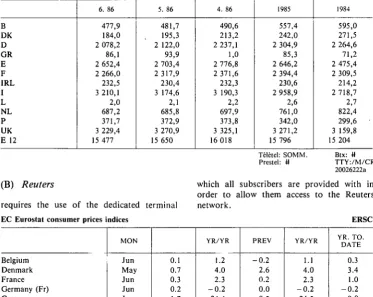
Ovide, a Europe-wide system made available to its Members by the European Parliament, allows access to a wide range of practical information on the day-to-day functioning of the European Parliament (agenda, com-mittees, directory, etc.) and on essential read-ing. Eurostat has a number of pre-formatted screens in Ovide with the same layout as the short and medium-term files and an easy-to-use menu-driven consultation proce-dure.
(B) Reuters
Reuters, the international news agency, has offered to Eurostat its specialized on-line information system which has some 100 000 subscribers around the world. Eurostat has never before had the opportunity to publish for a world-wide public of nearly 100 000. Two categories of users hitherto scarcely within Eurostat's reach are now able to draw on European data: the stockbroking, finan-cial and banking world, and the journalists who are amongst Reuters' subscribers. Screen pages of information and tables generally from Eurostatus are now available for consul-tation using a simple four-character code.
(C) Eurostatistics
Eurostatistics has the widest readership of any monthly Eurostat publication. For this reason
F. de Geuser is Head of 'Dissemination' Specialized
it seemed worthwhile to use the printed ver sion as the basis for a new Cronos ICG collection. The aim of the exercise has been to allow Eurostatistics' traditional readers to update the printed publication's data quickly from Cronos without the somewhat arduous recourse to the classification plans, by using a series coding based on the printed publication itself. Another advantage it offers is that the publication provides a data availability table.
Ovide
Unemployment total
II. Media used
The very latest technology has been used by Eurostat:
(A) Ovide
uses Videotex. Unfortunately Europe cur rently has three Videotex standards — BTX, Prestel and Télétel. The revolutionary feature of Ovide is that it can be consulted under any of the standards, or by using an asynchronous teletypecompatible terminal — the Volker Craig, for example.
χ / 000
Β DK D GR E F IRL I L NL Ρ UK E 12
6. 86
477,9 184,0 2 078,2 86,1 2 652,4 2 266,0 232,5 3 210,1 2,0 687,2 371,7 3 229,4 15 477
5. 86
481,7 195,3 2 122,0 93,9 2 703,4 2 317,9 230,4 3 174,6 2,1 685,8 372,9 3 270,9 15 650
4. 86
490,6 213,2 2 237,1 1,0 2 776,8 2 371,6 232,3 3 190,3 2,2 697,9 373,8 3 325,1 16018
1985
557,4 242,0 2 304,9 85,3 2 646,2 2 394,4 230,6 2 958,9 2,6 761,0 342,0 3 271,2 15 796
1984
595,0 271,5 2 264,6 71,2 2 475,4 2 309,5 214,2 2 718,7 2,7 822,4 299,6 3 159,8 15 204
Télétel: SOMM. Prestel: U
Btx: U TTY:/M/CR 20026222a
(Β) Reuters
requires the use of the dedicated terminal
EC Eurostat consumer prices indices
which all subscribers are provided with in order to allow them access to the Reuters network.
ERSC
Belgium Denmark France Germany (Fr) Greece Ireland Italy Luxembourg Netherlands United Kingdom
MON Jun May Jun Jun Jun Jun Jun Jun May Jun 0.1 0.7 0.3 0.2 1.7 1.2 0.9 0 . 1 0.0 0 . 1
YR/YR
1.2 4.0 2.3 0 . 2 24.4 4.4 6.8 0.1 0.5 2.5 PREV
0 . 2 2.6 0.2 0.0 0.5 1.2 0.4 0.0 0.4 0.2 YR/YR 1.1 4.0 2.3 0 . 2 24.5 4.4 6.4 0.4 0.7 2.8
YR. TO. DATE
(C)
Eurostatistics
is one of the ICG collections. This means that
it is available on Cronos either from the
computer centre's ICL or from decentralized
servers such as CISI-Wharton, Datacentralen
and GSI-ECO.
A comparison of the availability of data between the publication and on-line consultation
Extract from Eurostatistics
ERZEUGUNG NACH KATEGORIEN
PRODUCTION BY CATEGORY PRODUCTION PAR CATEGORIE
EUR 12 Β DK D GR E F IRL 1 L NL Ρ UK USA JAP
0406 - GRUNDSTOFFE UND PRODUKTIONSGUETER SAISONBEREINIGT
INTERMEDIATE GOODS
SEASONALLY ADJUSTED BIENS INTERMEDIAIRES DESAISONNALISE
1980 1982 1983 1984 1985 1985 I II III IV 1986 I 1985 feb mar apr mai jun jul aug sep oct nov dec 1986 jan feb mar apr 100,0 95,2 96,6 99,6 101,8 100,3 101,2 102,0 102,3 102,3 100,2 101,1 100,8 101,5 101,2 101,8 102,1 101,8 102,8 103,8 100,4 102,2 103,3 101,5 105,0
3,7 0,8 23,3 1,4 9,1 16,7 0,5 18,5
94,0 95,8 95,5 101,8 99,5 112,5 101,2 114,6 99,6 107,3 100,6 112,3 101,5 117,7 102,4 119,6 105,2 116,6 98,9 111,7 103,2 95,6 98,9 106,1 100,0 116,3 102,7 113,4 99,2 116,2 101,3 118,9 104,3 117,0 101,2 126,6 105,9 118,2 100,5 114,4 102,4 123,6 103,4 117,8 108,2 109,1 136,4
1980 = 100
0,3 4,5 1,8
On-line consultation screen SEF *** CONT χ χ9304065
EUR 12
05. 85 101,5 06. 85 101,3 07. 85 101,8 08. 85 102,1 09.85 101,8 10. 85 102,9 11.85 103,9 12. 85 100,5 0 1 . 8 6 102,2 02. 86 103,3 03. 86 100,8 04. 86 104,6* 05. 86 100,5* 0 6 . 8 6 102,1* 07.86
!!PROCEDURE = TABLE 3 / ERR = N / 1 9 PAGE = 14/14
PTY 01 PER * BELGIQUE 100,0 102,7 99,1 101,9 104,3 101,2 106,4 101,6 102,8 103,9 107,8 103,2 102,3 19,4
****** 25. 9. 86 DANMARK 116,3 113,4 116,2 118,9 117,0 126,6 118,2 114,4 123,6 117,8 109,1 134,8 122,7 124,0 118,8 TABLE
III. Contents
Broadly speaking, these three new systems contain the main indicators which allow rapid analysis of the economies of Member States and of Europe and its leading competitors — Japan and the USA.
(A) Ovide
The following information is available in four languages:
(a) Short-term statistics (updated around the 20th of each month):
1. National accounts
GDP
1. Total/total GDP at market price 2. Annual rates of variation 3. Per capita GDP index 4. Use of GDP
General government 5. Income 6. Expenditure
2. Employment
1. Activity rates 2. Unemployment rates 3. Female unemployment
3. Industrial production — Indices
4. External trade
1. Exports by partner country 1984 2. Imports by partner country 1984 3. Balance of trade 1986
5. Consumer prices
— Consumer price index — Annual rates of variation
6. Agriculture
1. Structure survey 1983 2. Harvests 1985 3. Harvests 1986
7. Finance and exchange rates
1. Exchange rates/ECU (average) 2. Exchange rates/US $
3. Day-to-day money-market rates 4. Money supply
5. Public sector bond yields
8. Balance of payments
— Current account
(b) Medium-term statistics (updated twice yearly in April and November, and, for certain variables such as national ac-counts and agricultural production, com-prising DG II and Eurostat forecasts):
1. ESA national accounts
— GDP
1. Volume changes 2. Price changes
— Gross fixed capital formation 3. Volume changes
4. Price changes
2. Unemployment
1.
2. 3. 4.
Percentage of total active popu lation
Total Female Under 25s
3. Manufacturing production
1.
2. 3.
All industries, seasonally justed
Crude steel Annual variation
ad
4. External trade
1. Cover ratio
2. Total balance of trade (FOB/ CIF)
3. FOB by Member State/total 4. EUR 10 by geographical zone/
5.
Consumer prices
1. General index
2. Annual variation
3. Monthly variation
6.
Agricultural prices
— Agricultural products
7.
Real long-term interest rates
8.
Current-account balance of payment
9.
Land area and population
Ovide
Agriculture crops 1986 EUR 12 Prevision
Rice Dried pulses Potatoes Sugar beet Tobacco Oil seeds Rape
Sunflower seeds Others 2: Yield
(1) 0,33 1,70 1,49 1,80 0,22 3,88 1,18 2,05 0,65 (2) 58,0 19,4 265 505 19,0 18,3 23,8 15,0 18,5 (3) 1,91 3,30 39,49 90,90 0,42 7,09 2,81 3,08 1,20 (4) + 3,2 + 6,8 8,3 3,8 + 2,4 6,1 2 4 , 5 + 10,0 + 16,7
Mio ha 100 kg/ha Mio t % 85/86 Tèlètel: SOMM.
Prestel: H TTY:/M/CR Btx: U
(B)
Reuters
The first screen page (code = ERSA) shows
current contents. The system is simple to use:
each page is identified by a fourcharacter
code and this is all that the user needs to enter
in order to display that page. The only dia
logue language currently available is English.
Eurostat-Statistical Office of Ihc European Community ERSA index** Tel: Luxembourg 4301 3220 Tx: Comeur Lu 3423
ERSB Key EC. data EUR 10 ERSC Consumer price indices ERSD Industrial production ERSE Industrial wages ERSF Unemployment ERSG Retail sales ERSH Comments on ERSJ ERSI Comments on ERSJ ERSJ Industrial indicator
ERSK ERSL ERSM ERSN ERSO ERSP ERSQ
Trade balance total 84/85 Crops Price index E10 agri Price index all agri Price index crop prod Price index animal Price index fruit/veg ERSRW Hydrocarbons ERSXZ General comments
Reuter Monitor 1250 EC Eurostat ■ Key economic data · EUR 10 sum all
EC States ERSB
(C)
Eurostatistics
Units period
Consumer P.I. May Wagesindustry 285 Unemployment May Unempl. rate % May Retail sales Jun Ind production Apr Confid. indi, bal May Trade balance Dec
THIS 0.2 103.2 15 641 10.7 99.6 107.3 7 1 026 PREV 0.4 102.4 16 019 11.0 103.4 103.1 7 961
1 YR AGO
0.4 102.0 15 355
10.5 96.9 101.7 6 857
The Eurostatistics collection comprises the
entire contents of the printed version bearing
the same name, plus the full series of indi
cators and all updates since publication of the
most recent printed version.
4. Industrial production
5. Opinions in industry
6. Industrial products
7. Retail sales
8. Agricultural products
9. External trade
10. Consumer prices
11. Producer prices of agricultural products
12. Wages and salaries
13. Financial statistics
14. Balance of payments
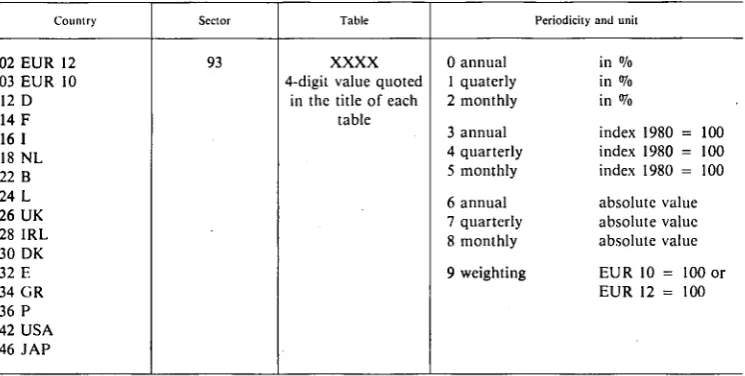
Each time series is identified by a 9-digit code broken down into subcodes which, in the
case of Eurostatistics, represent the country, the sector, the table, the unit and the
periodicity.
X
Unit and periodicity
XX
country
sector
XX
XXXX
Table
4-digit
value quoted in the
title
of each table
The significance of the various subcodes may be found in the table below:
Country
02 EUR 12 03 EUR 10
12 D 14 F 16 I 18 NL 22 Β 24 L 26 UK 28 IRL 30 DK 32 E 34 GR 36 Ρ 42 USA 46 JAP
Sector
93
Table
XXXX 4-digit value quoted
in the title of each table
Periodicity and unit
0 annual 1 quatcrly 2 monthly 3 annual 4 quarterly 5 monthly
6 annual 7 quarterly 8 monthly 9 weighting
in % in % in %
index 1980 = 100 index 1980 = 100 index 1980 = 100
absolute value absolute value absolute value
EUR 10 = 100 or EUR 12 = 100
It is too early to draw any conclusions about
these very recent developments. Initial reac
tions when they went on-line do nevertheless
[image:25.456.40.413.285.473.2]Survey on international tourism
S. Deroose'
Introduction
The European Community has recently pre sented — 5 February 1986 — a memorandum on Community actions in the field of tourism. It is noted that a good apprehension of the problems encountered is impeded by statisti cal deficiencies. The existing statistics show gaps and are based on different definitions and compilation methods, which hamper, if not preclude, international and intertemporal comparisons.
The balance of payments' section at Eurostat have been carrying out research activities on international tourism for quite a time already. The first stage, focusing on an assessment of available data on international trade in tourism for the European Community, has been finished recently. The main results of the report are highlighted below.
Overall economic importance of tourism
International tourism is an economic activity of major significance within the European Community, albeit its economic significance is difficult to grasp with existing data bases. In many fields it is amalgamated with domestic tourism. But even the branch tourism is diffi cult to isolate from other economic activities, such as transportation. In short, information available on tourism in current data bases is fragmentary, incomplete and inaccurate, re sulting in all probability in underestimated figures.
[image:26.456.34.227.29.257.2]Despite all deficiencies Table 1 attempts to summarize some major elements establishing the economic significance of tourism.
Table 1: Indicators on economic significance of 'tourism' (average 1978—83)
a. b. c. d. Β 2.9 4.0 3.1 1.2 DK 1.1 3.9 1.9 N A D 1.3 3.7 3.3 0.7 GR NA 1.3 N A N A F 2.1 1.4 2.7 1.6 IRL 1.9 4.3 NA NA I 1.7 0.7 3.4 1.4 L 2.1 — 4.4 1.4 NL 1.7 4.1 2.1 NA UK 1.7 2.0 4.3 1.5 EUR 10 2.0 2.5 3.3 NA a = Gross value-added at market prices of 'Lodging and catering' as % of gross domestic product.
b = Expenditures on international tourism as % of national private consumption. c = Employment in 'Lodging and catering' as % of total employment.
d = Gross fixed capital formation of 'Lodging and catering' as % of total gross fixed capital formation.
From Table 1 it can be seen that:
(i) The branch 'Lodging and catering' represents 2% of gross domestic product in EUR 10. This share remains very stable over time. The countries in which the figures differ most widely from the Community average are on the one hand Belgium with 2.9% and on the other hand Denmark (1.1%) and Germany (1.3%);
(ii) On average 3.3% of total employment is localized in 'Lodging and catering'. Fur thest remote from the Community aver age are the UK with 4.3% and Denmark with 4.9%. Comparison of employment with value-added does presume a relative low labour productivity, differing widely from country to country however;
(iii) statistics on gross fixed capital formation are rather scarce. Available figures reveal rather low shares;
(iv) expenditures on international tourism constitute a relatively important part of total national private consumption with 2.5%. France, Ireland and Italy are the countries in which tourist expenditures are modest relative to private final con sumption; they are highest in Ireland. In contrast with other indicators, which seems to be very stable, the share of tourist expenditures shows a significant increase over the period 1978—82, but drops in 1983, indicating a faster growth than other consumer expenditures.
Seasonal pattern of tourist activity
One of the most critical problems encoun tered in tourist activity is the strength of the seasonal pattern. Two sets of data are avail able to assess this phenomenon: monthly stat istics on nights spent in hotel accommodation and quarterly travel receipts and expendi tures. Graph 1, representing EUR 6 figures on nights spent, is endowed with a typical skew bell shape.
Graph 1: Nights spent in hotel accommodation (average 1978—84, in millions)
68 50 4Θ 30 20 · 19 θ
-JAN FEB HAR APR HAV
|EUR 6|
JUN JUL AUC SEP OCT NOU DEC
The seasonal dispersion of nights spent is also strongly pointed out by the coefficient of variation. Where the coefficient tends to zero in the case of a regular distribution, it reaches an average of 49.6% over the period
1980—84. Extreme coefficients are found for
The same phenomenon is outlined in Graph 2
based on quarterly travel data. The graph reveals in the case of receipts (the same is true for expenditures) a very smooth seasonal pat
tern, which takes off in the second quarter of the year, attaining its top value during sum mer and reaches its floor level in winter.
Graph 2: Travel receipts and balance (in thousand million ECU)
2 0
1 6 JBECEIPTSI
12 τ
8
4 t
■/θ
/
\
f
S
/
Vi
■*¿*<7?
λ
t ■ t I I I I
EUR i e
ι
ι
4
3
2
1
0
-1
I I '
2
-|Balance~|
1.tff>-ti-M»»jgr n >^»urf |
EUR 1 2
/ X
- 3
N ^
EUR
1 01 9 8 1
1 9 8 2
1 9 8 3
1 9 8 4
Apart from the seasonal pattern, Graph 2 also outlines another particular characteristic of tourism in EUR 10. Traditionally the EUR 10 travel account is in deficit, although it gradually tends to equilibrium to become positive for the first time in 1984. Not sur prisingly EUR 12 would record a much sounder travel balance.
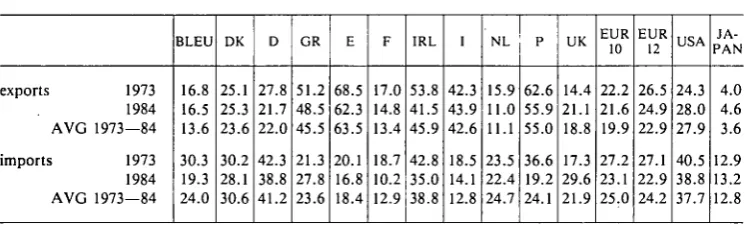
Importance of travel in international trade
As may be seen from Table 2 travel occupies a prominent position in international trans
[image:29.456.39.412.150.265.2]actions in tradable services. From 1973 to 1984 total exports of the Community amount to 20% on average, whilst imports to 25%. This corresponds respectively with 4.5% and 5.1% of total exports and imports of goods and services.
Table 2: Relative importance of TRAVEL in international transactions of tradable services (%)
exports 1973 1984
AVG 1973—84
imports 1973 1984
AVG 1973—84
BLEU 16.8 16.5 13.6 30.3 19.3 24.0 DK 25.1 25.3 23.6 30.2 28.1 30.6 D 27.8 21.7 22.0 42.3 38.8 41.2 GR 51.2 48.5 45.5 21.3 27.8 23.6 E 68.5 62.3 63.5 20.1 16.8 18.4 F 17.0 14.8 13.4 18.7 10.2 12.9 IRL 53.8 41.5 45.9 42.8 35.0 38.8 I 42.3 43.9 42.6 18.5 14.1 12.8 NL 15.9 11.0 11.1 23.5 22.4 24.7 Ρ 62.6 55.9 55.0 36.6 19.2 24.1 UK 14.4 21.1 18.8 17.3 29.6 21.9 EUR 10 22.2 21.6 19.9 27.2 23.1 25.0 EUR 12 26.5 24.9 22.9 27.1 22.9 24.2 USA 24.3 28.0 27.9 40.5 38.8 37.7 JA PAN 4.0 4.6 3.6 12.9 13.2 12.8
Tradable services have been calculated as the sum of the balances of payments items, 'Transport', 'Insurance on transport', 'Travel' and 'Other service'.
Surprisingly, perhaps, travel exports are of most importance in Ireland (45.9% but decreasing rapidly), closely followed by Greece (45.5%) and Italy (42.6%). They are of least importance in the Netherlands (11.1%). In the enlarged Community travel exports will be most prominent in Spain and Portugal. The share of travel imports, on the contrary, is highest in Germany (41.2%) and lowest in France (12.9%) and Italy (12.8%). From 1973 to 1984 the relative importance of both travel exports and imports dropped markedly in all Member States, except the UK and Italy (exports) and Greece (imports). Apart from any structural reason (viz. the upsurge of trade in other services), the decline is probably accounted for by the choice of the starting year, 1973, marking a booming over all economic situation in EUR 10.
Extra-EUR 10 travel balance
The extra-EUR 10 travel account (represent ing around 50% of total travel) is character ized by pronounced deficits throughout the 1970s and the early 1980s. The net import position peaked in 1981 and declined from then to reach virtually equilibrium in 1984. Therefore, the tourist account has had a de stabilizing impact on the extra-EUR 10 bal ance of payments, by enhancing the deficit as may be seen from Graph 3.
This overall picture hides, however, very sub stantial differences among the Member States. This is highlighted in Table 3, which shows the contribution of the individual Member States to extra-EUR 10 travel bal ance, using the formula:
contribution
with C = travel receipts D = travel expenditures i = Member States eur = EUR 10
Graph 3: ExtraEUR 10 travel balance
1C
e
-10
2 0
3 0
4 0
"1EUR XO\
ã
wm-m m
1979
1980
1981
1982
1983
1984
Β Travel balance (thousand million ECU)
E3 Current balance (thousand million ECU)
Π Current balance excluding travel (thousand million ECU)
It is shown that Germany, the Netherlands and the BLEU are in deficit on their tourism accounts, hence contributing negatively to the EUR 10 external travel balance. The large percentages of 14.4% and — 12.7% clearly show the preponderant weight of Germany, amounting to almost one half of the deficit.
Italy, France and the UK make a positive contribution. Since extraCommunity travel expenditure in Spain, and to a lesser extent in Portugal, accounts for the major part of the deficit, the external travel account will record a surplus from 1985 onward.
Table 3: Contribution of Member States to extraEUR 10 travel balance (%)
1979 1984
BLEU
1 . 5 0 . 6
DK
0.1 0.2
D
1 4 . 4 1 2 . 7
GR
2.4 1.4
F
4.3 6.2
IRL
0.2 0.1
I
7.0 6.4
NL
7 . 0 2 . 2
UK
5.9 1.2
Pending sore subjects and approaches considered
Data deficiencies as mentioned above are taken very seriously at Eurostat. The staff's work is concentrated on two specific topics:
* Bilateral balances and asymmetries
For the European Community it is of para
[image:30.456.34.431.41.315.2]Table 4: Asymmetries in EUR 10 travel account (in million ECU)
1978 1979 1980 1981 1982 1983
Credit
10 563 12 252 14 142 15 112 16 557 17 798
Debit
11 131 13 051 15 023 15 339 16 517 17 227
Net
-568 - 7 9 9 -881 -227 41 571
Relative Asymmetry
- 5 . 2 % - 6 . 3 %
- 6 . 0 %
- 1 . 5 % 0.2 %
3.3 %
By means of methodological and quantitative analyses Eurostat has been trying to reduce these asymmetries. There are encouraging signs that both approaches will bear fruit in the rather near future.
* Elaboration of a satellite account of tourism
Eurostat is aware of the lack of reliability and harmonization of statistics on tourism. In order to assess the feasibility of a more
har-monized system of travel statistics, the staff considers inter alia to proceed to the elabora-tion of a data bank recording a rather exhaus-tive set of information. More concretely, the pursuit of methodological studies amounting to a satellite account are in progress. This implies that the accuracy and the complete-ness of travel statistics will be tested and improved, perhaps, by confronting them with a systematic amalgamation (a satellite ac-count) of other sources such as statistics on nights spent, arrivals at frontiers, pattern of holidays, . . .
Parliamentary questions
Written question No 1088/85 by Mr Willy Kuijpers (ARC—B) to the Commission of the European Communities
(3 September 1985) (86/C 23/11)
Subject: Steel production in the Community
Can the Commission provide figures on steel production per Member State for the years 1980 to 1985 inclusive?
Can it also provide figures on the maximum level of production proposed by the Com-mission for these years?
Answer given by Mr Narjes on behalf of the Commission
(29 October 1985)
Crude steel production
(in million tonnes)
Germany France Italy Netherlands Belgium Luxembourg United Kingdom Ireland Denmark Greece EUR 9 EUR 10 1980 43.8 23.2 26.5 5.3 12.3 4.6 11.3 0.0 0.7 0.9 127.7 128.6 1981 41.6 21.2 24.8 5.5 12.3 3.8 15.3 0.03 0.6 0.9 125.1 126.1 1982 35.9 18.4 24.0 4.4 10.0 3.5 13.7 0.1 0.6 0.9 110.5 111.4 1983 35.7 17.6 21.8 4.5 10.2 3.3 15.0 0.1 0.5 0.9 108.7 109.5 1984 39.4 18.8 24.1 5.7 11.3 4.0 15.2 0.2 0.5 0.9 119.2 120.1 1985 (first six months) 20.5 9.9 12.3 2.7 5.5 2.0 8.2 0.1 0.2 — 61.5 —
As for the quota (maximum authorized pro-duction) system, the rules based on Article 58 of the ECSC Treaty require the Commission to fix quotas for each undertaking. At the same time all general decisions1 adopted
under Article 58 include an article which lays down that:
'For the purposes of this Decision any group of concentrated undertakings with-in the meanwith-ing of Article 66 of the ECSC Treaty shall be regarded as a single under-taking even if such underunder-takings are located in different Member States.'
Consequently, quotas allocated to a specific undertaking in a given Member State may well include production quotas for certain plant in other Member States.
Obviously it is for the management to appor-tion the undertaking's qutoas among its pro-duction units in the light of its commercial and industrial strategy.
This, and the confidential nature of such information, makes it impossible to give the honourable Member fuller details.
Article 1 (3) of Decision No 2794/80/ECSC of 31 October 1980 (OJ L 291, 31.10.1980);
Article 2 (4) of Decision No 1831/81/ECSC of 26 June 1981 (OJ L 180, 1.7.1981);
Article 2 (4) of Decision No 1696/82/ECSC of 30 June 1982 (OJ L 191, 1.7.1982);
Article 2 (4) of Decision No 2177/83/ECSC of 28 July 1983 (OJ L 208, 31.7.1983);
Written question No 1966/85
by Mr François Roelants du Vivier (ARC—Β) to the Commission of the European
Communities
(13 November 1985)
(86/C 87/40)
Subject: Level of dependence on raw materials of plant origin
In its reply to Written Question No 2329/84 by Mr JensPeter Bonde,' the Commission provides a table showing the level of depen dence of the Community, the United States and Japan on imports of nonenergy raw materials and minerals.
Will it provide a similar table for raw mater ials of plant