W O R K I N G P A P E R
Policy progress with REDD+ and the promise
of performance-based payments
A qualitative comparative analysis of 13 countries
Maria Brockhaus Kaisa Korhonen-Kurki Jenniver Sehring Monica Di Gregorio
With:
Samuel Assembe-Mvondo Andrea Babon
Melaku Bekele
Maria Fernanda Gebara Dil Bahadur Kahtri Hermann Kambire Felicien Kengoum Demetrius Kweka
Mary Menton Moira Moeliono Naya Sharma Paudel Thuy Thu Pham
Ida Aju Pradnja Resosudarmo Almeida Sitoe
Working Paper 196
Policy progress with REDD+ and the
promise of performance-based payments
A qualitative comparative analysis of 13 countries
Maria Brockhaus Kaisa Korhonen-Kurki Jenniver Sehring Monica Di Gregorio
Center for International Forestry Research (CIFOR) With:
Samuel Assembe-Mvondo Andrea Babon
Melaku Bekele
Maria Fernanda Gebara Dil Bahadur Kahtri Hermann Kambire Felicien Kengoum Demetrius Kweka
Mary Menton Moira Moeliono Naya Sharma Paudel Thuy Thu Pham
Ida Aju Pradnja Resosudarmo Almeida Sitoe
Working Paper 196
© 2015 Center for International Forestry Research
Content in this publication is licensed under a Creative Commons Attribution 4.0 International (CC BY 4.0), http://creativecommons.org/licenses/by/4.0/
DOI: 10.17528/cifor/005778
Brockhaus M, Korhonen-Kurki K, Sehring J, Di Gregorio M et al. 2015. Policy progress with REDD+ and the promise of performance-based payments: A qualitative comparative analysis of 13 countries. Working Paper 196.
Bogor, Indonesia: CIFOR.
Photo by Aulia Erlangga/CIFOR
Haze from the forest fires, Riau, Indonesia.
CIFOR
Jl. CIFOR, Situ Gede Bogor Barat 16115 Indonesia
T +62 (251) 8622-622 F +62 (251) 8622-100 E [email protected]
cifor.org
Contents
Abbreviations v Authors vi Acknowledgements viii
Executive summary ix
1 Introduction 1
2 Countries selected for the analysis 3
3 Method: A brief introduction to a two-step qualitative comparative analysis 4 4 Enabling conditions for establishing REDD+ 6
4.1 Outcome: Establishment of comprehensive policies targeting transformational
change in the REDD+ policy domain 6
4.2 Joint context 6
4.3 Institutional setting (remote conditions) 7
4.4 Policy arena (proximate conditions) 7
4.5 Evaluation of the factors 8
4.6 Current developments in enabling conditions for REDD+ in the countries studied 9
5 Results of the qualitative comparative analysis 14
5.1 Analysis of the institutional context (remote conditions) 14
5.2 Analysis of the policy arena (proximate conditions) 15
6 Toward transformational change in national REDD+ policy domains?
A brief discussion of methods and findings 19
7 Conclusions 21
8 References 22
Appendix: Definitions of all the factors 25
A1 Operationalization of the outcome. 25
A2 Operationalization of conditions for the institutional setting. 26
List of figures, tables and boxes
Figures
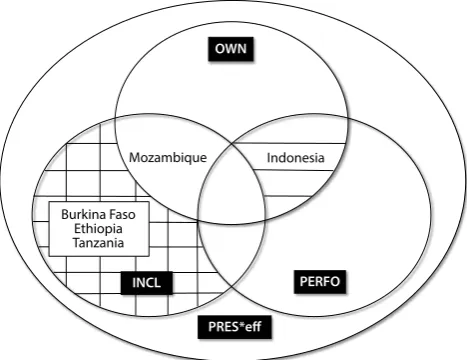
1 Observed configuration of the three remote conditions. 15
2 Observed configuration for already initiated policy change and the three proximate conditions. 17
3 Observed configuration for PRESS*eff and the three proximate conditions. 18
Tables
1 Countries in the qualitative comparative analysis, 2014. 3
2 Truth table for all the factors for 2012 and 2014. 8
3 Truth table for the institutional context in 2014 (remote conditions). 14
4 Truth table for already initiated policy change and the proximate conditions. 16
5 Truth table for PRES*eff and proximate conditions. 18
Box
Abbreviations
CIFOR Center for International Forestry Research CSO civil society organization
DRC Democratic Republic of the Congo
ER-PIN Emission Reduction Program Idea Note FCPF Forest Carbon Partnership Facility
GCS REDD+ Global Comparative Study on REDD+
INCL inclusiveness of the policy process
LOI Letter of Intent
MRV measurement, reporting and verification
OWN national ownership
PERFO availability of payment-for-performance funds for REDD+ (PERFO)
PNG Papua New Guinea
PRES pressure from shortage of forest resources QCA qualitative comparative analysis
R-PP Readiness Preparation Proposal
REDD+ reducing emissions from deforestation and forest degradation, and enhancing forest carbon stocks in developing countries
Authors
Maria Brockhaus is a Senior Scientist with the CIFOR’s Forests and Governance program. In her research, she focuses mainly on policy and institutional change, and policy and social network analysis. Since 2009 she has been leading the research on national REDD+ strategies and policies in CIFOR’s global comparative study (GCS-REDD+).
Kaisa Korhonen-Kurki is a Senior Associate with CIFOR and worked formerly as a scientist for the GCS-REDD+ in the Forests and Governance Program. She works as a Research Coordinator for the Interdisciplinary Environmental Research Center at the University of Helsinki, Finland.
Jenniver Sehring is a consultant for CIFOR’s Forests and Governance program. As a political scientist, she focuses on issues of governance and institutional change in natural resources management as well as on methods of comparative politics.
Monica Di Gregorio is a Lecturer in
Environmental Politics and Governance at the Sustainability Research Institute at the University of Leeds, UK. She is an Associate of the Centre for Climate Change Economics and Policy (CCCEP) and of CIFOR. Her main research interests relate to environmental politics, policy and natural resource governance. Her recent research focuses on climate change policy, politics and forests.
Samuel Assembe-Mvondo is a former CIFOR Scientist, and currently an Independent Consultant. His main areas of research focus on forests and climate change policy, forest governance, local communities and indigenous issues.
Andrea Babon is an environmental policy specialist whose research focuses on forest governance in the Asia-Pacific region. She recently completed a PhD thesis on the socio-cultural and political dimensions of policies for Reducing Emissions from Deforestation and forest Degradation (REDD+) in Papua New Guinea. This research was part of CIFOR’s GCS-REDD+.
Melaku Bekele is a scientist at the Wondo Genet College of Forestry, Ethiopia. He specializes in natural resource policy and institutions with a focus on land and forest tenure/governance issues. In the last eight years he has been engaged in a number of research studies and consultancy services in the area of policy and legal frameworks related to REDD+. He leads the team of experts for CIFOR’s GCS study in Ethiopia.
Maria Fernanda Gebara is a consultant for CIFOR and a Research Associate at the London School of Economics and Political Science. In her research, she focuses on social and political dimensions of measures to reduce deforestation in the Brazilian Amazon.
Dil Khatri is researcher associated with Forest Action Nepal. His research has focused around climate change and local institutions, options of ecosystem governance and process and politics around climate change related projects. Dil is currently pursuing a PhD from the Swedish University of Agricultural Sciences, examining politics and process of climate change related projects in Nepal.
Hermann Kambire is a research consultant with CIFOR’s forest governance and climate change work in Burkina Faso, West Africa.
Félicien Kengoum is researcher with CIFOR’s Forests and Governance programme. His work targets media discourse analysis, policy networks analysis and the implications of institutional change for state governance in Congo Basin Countries. Since 2009, Felicien has been leading the REDD+ media discourse and policy network work in Cameroon within the GCS-REDD+ project.
vii
Mary Menton is Director of policy & practice at SEED (Solutions & Evidence for Environment & Development). Previously based with CIFOR’s office in Lima, she coordinated the GCS-REDD+ activities in Peru from 2010-2012 and continues to work with the project as a collaborator.
Moira Moeliono is a Senior Associate with CIFOR. Her early work at CIFOR focused on issues of governance as social forestry and decentralization, with special attention to adaptive collaborative management, social and community based forestry and rights based issues. Since 2011, she was also involved in research on REDD+ related policy processes.
Naya Sharma Paudel is a researcher at ForestAction Nepal and has over two decades of research and development experiences on environmental governance, policy process and civic movements. His research and publications are focused on forest policy and governance, participatory resources management, nature conservation and livelihoods. In recent years he is increasingly involved in studying political economy of climate change, REDD+ and forest governance.
Pham Thu Thuy is a social scientist at CIFOR and has been working in the fields of PES, REDD+, climate change and poverty reduction for over 8 years in developing countries such as Vietnam. At CIFOR her research has focused on political and institutional analysis of PES and REDD+ and the potential of these schemes to be pro-poor.
Daju Resosudarmo is a Senior Scientist with CIFOR, Indonesia. She coordinates the Indonesian component of the Global Comparative Study on REDD+, in particular research on REDD+ sub-national initiatives. Her areas of research interest include natural resource governance, decentralization, political economy of natural resources and
development, and climate change.
Almeida Sitoe is Associate Professor of Tropical Forests Silviculture and Ecology at the Eduardo Mondlane University, Mozambique. His teaching and research activities are focused on forest dynamics including human-forest interactions in the dry forests of Southern Africa. Since 2009 he has been part of the Mozambique National REDD+ working team that is designing and testing the policy and practice on reducing emissions from deforestation and forest degradation.
Sven Wunder is a Principal Scientist (Economist) with CIFOR’s Forests and Livelihoods program. His research focuses mainly on forest and human well-being, payments for environmental services, and REDD+ policies.
Acknowledgements
and WWF. We are very thankful to Frances Seymour and Jonah Busch for their analytical guidance and contributions throughout the research and writing, and their support in managing the review process of this paper. We would like to thank five anonymous reviewers for their excellent inputs and insightful comments that helped us to improve earlier versions of this paper. Special thanks go to Christine Wairata, Bimo Dwisatrio and CIFOR’s publication team for their support in editing and layout. Funding was provided by the Norwegian Agency for
Development Cooperation; the Australian Agency for International Development; the European Union; the International Climate Initiative (IKI) of the German Federal Ministry for the Environment, Nature Conservation, Building and Nuclear Safety (BMUB); the United Kingdom Department for International Development; and the CGIAR Research Program on Forests, Trees and Agroforestry.
Executive summary
targeting transformational change in the REDD+ policy domain in some countries. We consider such transformational change a necessary step toward the full implementation of phase 3 of REDD+, the achievement of results-based payments for delivered emission reductions and co-benefits. The paper builds on a previously published qualitative comparative analysis of various countries’ progress with REDD+, conducted in 12 REDD+ countries in 2012 (Sehring et al. 2013; Korhonen-Kurki et al. 2014). A follow-up survey in 2014 was considered timely because the REDD+ policy arena, at international and country levels, is highly dynamic and undergoes constant evolution, which affects progress with REDD+ policy making and implementation. In this paper, we examine whether the ‘promise’ of performance-based funds has played a role in enabling the establishment of REDD+.
The results show a set of enabling conditions and characteristics of the policy process under which REDD+ policies can be established. Two key findings of our analysis, the importance of already initiated policy change and the relevance of available performance-based funding in combination with strong national ownership of the REDD+ process, may help guide other countries seeking to formulate REDD+ policies that are likely to deliver efficient, effective and equitable outcomes.
Reducing emissions from deforestation and forest degradation, and enhancing forest carbon stocks in developing countries (REDD+) has emerged as a promising climate change mitigation mechanism in tropical forest countries. A number of countries are now at different phases in the process of realizing REDD+, from policy design and technical readiness activities to actual implementation of policies and measures, with an anticipated following phase in which results-based payments occur. Indicators and criteria to measure progress with REDD+ policy making are required to identify which factors enable or hinder countries' performance in delivering necessary policy change. This paper examines the national political context in a number of REDD+ countries in order to identify the enabling conditions for achieving progress with the implementation of countries’ REDD+ policies and measures.
1 Introduction
policy making and implementation. In addition, due to current debates around finance uncertainty and the emphasis given to results-based finance and the performance element in REDD+, a new factor was introduced to the analysis: the promise of and commitment to performance-based funding for REDD+. Early on, terms such as measured results and the concept of ‘payments for performance’ featured prominently in the REDD+ terminology. They are also referred to as ‘output-based aid’ and ‘result-based aid’ in the world of development assistance (Angelsen 2013). The key element of this concept is “a contract between both partners that defines incentives to produce measurable results” (Klingebiel 2012). In this paper, we also examine whether the ‘promise’ of such funds has played a role in enabling the establishment of REDD+.
The REDD+ mechanism has not progressed toward implementation as quickly as anticipated. However, major national-level policy formulation is underway and policy outputs can be seen in the establishment of new institutions, procedures and capacity building; while in other areas, policy formulation, operationalization of policies and implementation have been limited (Brockhaus and Di Gregorio 2014). Thus, an analysis such as the QCA presented here does not yet focus on measured carbon and non-carbon policy outcomes that have resulted from a full-fledged REDD+ implementation. Nevertheless, several states have already established comprehensive policies targeting transformational change1 in the REDD+ policy domain that are likely to lead to an effective, efficient and equitable REDD+ implementation in the long term. The current analysis seeks to explain and identify enabling conditions for the establishment of such policies.
Decision-making processes do not emerge in a vacuum, but are shaped by both existing institutions and the agency (or lack of such) of actors relevant
1 ‘Transformational change’ is understood here as a shift “in discourse, attitudes, power relations, and deliberate policy and protest action that leads policy formulation and implementation away from business as usual policy approaches that directly or indirectly support deforestation and forest degradation” (Brockhaus and Angelsen 2012).
Reducing emissions from deforestation and forest degradation, and enhancing forest carbon stocks in developing countries (REDD+) has emerged as a promising climate change mitigation mechanism in tropical forest countries, supported by global initiatives such as the UN-REDD Programme and the World Bank-led Forest Carbon Partnership Facility (FCPF) or through bilateral agreements. A number of countries are now at different phases in the process of realizing REDD+, from policy design and technical readiness activities to actual implementation of policies and measures, with an anticipated following phase in which results-based payments occur (Meridian Institute 2009). Overall progress has been much slower than expected (Angelsen 2013). National policy outcomes in terms of actual emission reductions or achieved co-benefits are, for the most part, not yet observable nor measured at a large scale. Consequently, to date, REDD+ achievements are limited (Sills et al. 2014) to progress in improved technical capacity (Romijn et al. 2012) and the development of policies and measures (Wertz-Kanounnikoff and McNeill 2012). In search of explanations for this overall slow but differing progress, the timing for when REDD+ countries joined multilateral and bilateral agreements obviously matters. In addition, one argument
often put forward by national and international REDD+ actors is the lack of a global climate change agreement with binding targets, leading to uncertainty over REDD+ financing (Streck and Parker 2012). However, slow progress is also linked to specific, policy-relevant conditions within REDD+ countries, which can either enable or hinder policy progress with REDD+ (Korhonen-Kurki et al. 2014).
2 Maria Brockhaus, Kaisa Korhonen-Kurki, Jenniver Sehring, Monica Di Gregorio et al.
to the particular policy arena (see also Corbera and Schroeder 2011; Brockhaus et al. 2014). Hence, the analysis presented here considers as possible enabling factors those related to the institutional setting (such as existing forest legislation and features of forest governance, patterns of forest exploitation, etc.), as well as actor-related processes in the REDD+ policy arena (coalition building, participation and inclusion). As defined in Korhonen-Kurki et al. (2014), ‘institutional setting’ refers to “the formal and informal regulations, rules and norms that are established over time and that are not easily changed or transformed” (see also North 1990; Ostrom 1990; Scharpf 2000; Baumgartner et al. 2011). The other key concept, ‘the policy arena’, is viewed as being framed by institutions but shaped by the actions of the actors, whether individuals, communities, organizations or networks, and characterized by more or less hierarchical or inclusive processes, involving a range of powerful actors, which can foster or prevent
certain policies and influence policy formulation (Scharpf 1997; Corbera and Schroeder 2011; Arts 2012).
Section 2 provides a short rationale for the selection of the 13 REDD+ countries that are part of the QCA, and section 3 presents the methodology applied for data gathering and analysis. Section 4 presents the assessment of the enabling conditions identified. It is organized in six subsections: first, the outcome and the joint country context is
2 Countries selected for the analysis
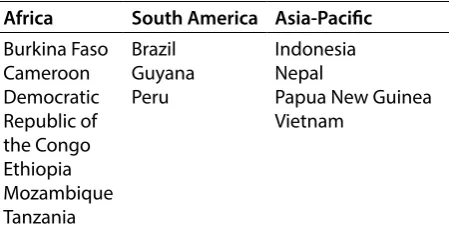
[image:14.595.317.542.280.395.2]The analysis forms part of the Global Comparative Study on REDD+ (GCS REDD+), led by the Centre for International Forestry Research (CIFOR), that is currently underway in 14 countries in South America, sub-Saharan Africa and the Asia-Pacific region (see Table 1), and builds on a QCA conducted in 2011–2012. Compared with the previous analysis, two countries were added: Ethiopia and Guyana. Ethiopia became part of the GCS REDD+ in 2013 and strengthens the valuable experience on REDD+ from the African continent. Guyana is not one of CIFOR’s core countries in the REDD+ study, but provides an interesting case, as it is among the countries receiving performance-based funding for REDD+. Another change to the previous analysis is that we have removed the case study of Bolivia from the comparison. Bolivia has engaged in the establishment of policies for reducing emissions from forests, but has created its own approach outside the
Table 1. Countries in the qualitative comparative analysis, 2014.
Africa South America Asia-Pacific
Burkina Faso Cameroon Democratic Republic of the Congo Ethiopia Mozambique Tanzania
Brazil Guyana Peru
Indonesia Nepal
Papua New Guinea Vietnam
formal United Nations Framework Convention on Climate Change (UNFCCC) REDD+ process (see more on Bolivia in the box below). As a result, our analysis focuses on the remaining 13 countries, of which seven are in sub-Saharan Africa, three in South America and four in the Asia-Pacific region (Table 1).
Box 1. Bolivia’s alternative approach to reducing emissions from deforestation and forest degradation.
In the mid-2000s, major political changes in Bolivia led to a questioning of existing public policies. This criticism included a strong emphasis on upholding alternative views such as the idea of ‘living in harmony and balance with Mother Earth’. However, despite changes in the discourse on the vision of forest management, no substantial changes in land and forest policy and legislation were made.
The Bolivian government was a staunch supporter of the proposal for reducing emissions from deforestation and forest degradation,and enhancing forest carbon stocks in developing countries (REDD+) – even before political changes had been considered. However, this position changed when Evo Morales took office in 2006. His government assumed a position against the marketization of nature and for climate justice in 2010. Bolivia eventually adopted a more proactive position that emphasized the importance of mechanisms that are not market based. In this context, the Bolivian government has developed the so-called Joint Mitigation and Adaptation Mechanism for the Integrated and Sustainable Management of Forests and Mother Earth. The proposal was formally adopted as public policy in the Law of Mother Earth, approved in 2012, and its regulatory decree of 2013.
3 Method: A brief introduction to a two-step
qualitative comparative analysis
the absence of C. Note that absence is not assessed as irrelevant but is measured and included in the analysis. For example, for our defined outcome – progress with REDD+, such an analysis allows us to identify whether and which particular set of conditions show a similar pattern in terms of presence and absence of specific conditions, for each successful case country.
However, by introducing a two-step analysis, it is possible to further divide the conditions, for example, to differentiate between institutional context and policy-specific conditions. The current analysis builds on the two-step fuzzy-set QCA (fsQCA) developed by Schneider and Wagemann (2006), but applies it as csQCA, that is, with only binary coding (0 = absence, 1 = presence). Schneider and Wagemann (2006) differentiate between remote and proximate conditions, which are analyzed in two separate steps. In this analysis, remote conditions are those of the institutional setting and proximate conditions are those of the REDD+ policy arena. In the first step of a two-step QCA, only the remote conditions are analyzed in order to identify ‘outcome-enabling conditions’. One or several configurations can emerge. In the second step, each of these configurations is analyzed in conjunction with the proximate factors. Thus, several analyses take place in parallel, but only with those cases that exhibit the relevant context, i.e. outcome enabling. The approach thus allows for inferences about which factors, or sets of factors, play a role if certain contextual conditions are given.
In line with the theoretical considerations presented in our previous study (Korhonen-Kurki et al. 2014), we defined six conditions for the two-step QCA, three for the institutional setting (remote conditions) and three for the policy arena (proximate conditions). The process of identifying and defining the relevant conditions for the analysis together with the country experts allowed us to capture the core comparable factors used in case-specific research studies carried out by more than 60 country experts since 2010 in the context of the overall GCS REDD+ project.
To identify the conditions, a preliminary list of potentially important factors was compiled during a workshop with research country teams in 2011. This study applies a QCA, a method that enables
systematic comparison of an intermediate number of case studies – usually applied to compare 5–100 cases. QCA can be a useful method to produce parsimonious and stringent research results from a multitude of in-depth case studies developed by numerous researchers. QCA can be used as a structuring tool that allows researchers to share understanding and produce coherent data, as well as a tool for understanding and explaining the presence or absence of a particular policy phenomenon (in our case, REDD+ policy progress) and the factors explaining this. Inferences from such an analysis are useful for generating policy recommendations in particular. For the purpose of this paper, we discuss only the main aspects that characterize QCA (see Sehring et al. (2013) for a detailed presentation of the method and its rationale).
In QCA, each case is understood as a specific combination (called a ‘configuration’) of factors, known as ‘conditions’. QCA is based on the concept of multiple conjunctural causation, meaning
that (i) most often not one condition alone but a combination of conditions will lead to the outcome; (ii) different combinations of conditions can produce the same outcome (equifinality); and (iii) one
condition can have different impacts on the outcome, depending on its combination with other factors and the context (Rihoux 2007).
Policy progress with REDD+ and the promise of performance-based payments 5
This list formed the basis for an online survey completed by project researchers in 2012. Following reviews of the REDD+ country studies, the number of factors was reduced (overlapping factors were merged, related factors were combined into meta-factors and some meta-factors were excluded based on theoretical expectations and case deduction). At the end of this process, a final list of conditions was defined, and indicators developed for the evaluation of the presence or absence of each particular
condition, as well as for the defined outcome (see the appendix). To allow cross-checking of results, a final assessment of the indicators and factors took place in a joint workshop in November 2012 attended by experts from the GCS REDD+ country teams. The results of this first round, as well as a methodological background paper, were published consecutively, by Korhonen-Kurki (2014) and Sehring et al. (2013). In 2014, these conditions, as part of a second research phase, were revised and a new condition added. The data presented here are the result of a comparison not only across countries but also over time. As mentioned above, a first assessment of conditions took place in 2012, and a second assessment in 2014.
The application of indicators was crucial for managing two major challenges of this study: (i) the assessment being based on expert opinions may include possible biases of the experts, and (ii) allowing only for a binary assessment doesn’t necessarily capture the differences in the expression of a particular factor within and across countries. The definition of indicators and the establishment of a minimum number of present indicators for achieving ‘presence’ (1) of a particular factor, allowed for a more nuanced assessment through the country experts. The assessment had to be grounded in tangible evidence for the expression of absence (0) or presence (1) of a particular factor and its indicators. In addition, working with country teams of experts
rather than only individuals enabled us to achieve a certain degree of intersubjectivity and to better balance potential biases in the assessments.
The evaluations presented here are a result of the second round of QCA carried out in February– September 2014 by the same CIFOR country case leaders who provided their assessments in 2012. The experts were asked to compare the current situation in their country with the results of their assessments in 2012, and to provide an evaluation of the new condition, the availability of performance-based funding. Country experts were also encouraged to justify their choices and explain whenever changes occurred in the indicators by providing additional information for each of these (see Table 2). Furthermore, country experts participated in explaining the results of the analysis. For the two new cases, Ethiopia and Guyana, only the situation in 2014 was assessed. In Guyana, the preliminary evaluation was conducted by external experts. This was followed by a national workshop in May 2014, consisting of key national REDD+ actors. All evaluations gathered initially in March 2014 were cross-checked and further revised by a working group consisting of country experts in a joint workshop in late April 2014. The QCA was conducted using the software Tosmana (Cronqvist 2011).
4 Enabling conditions for establishing REDD+
• All countries have shortcomings in effective horizontal, cross-sectoral coordination
mechanisms, which are necessary for ensuring the coordination of REDD+-related activities and processes among all relevant ministries. • Most countries have rather weak multilevel
governance systems, which leads to both the inadequate functioning of local agencies and poor vertical coordination between central, provincial and local levels.
• Most countries lack adequate professional and financial capacity in forest administration and for MRV activities.
• Almost all countries (the exceptions are
Burkina Faso and Nepal) have powerful drivers of deforestation (i.e. forest-related and land-use expanding sectors have a high economic significance and are well integrated in global markets), which translates into resistance to change from powerful interests.
• Nevertheless, the political leadership in most of the countries demonstrates a commitment to REDD+, as expressed by regular pro-REDD+ statements or engagement with the REDD+ policy arena at the national level.
• All the countries have political coalitions that advocate policy change and can lead debates and formulation of new policy directions away from approaches trying to preserve the status quo and business as usual in forest policy.3
In sum, the countries taking part in this study are tropical developing or emerging economy countries with a certain political commitment to REDD+, but typically with powerful drivers of deforestation, weak multilevel governance, low cross-sectoral horizontal coordination and inadequate capacity – all characteristics that hinder the quick implementation of an effective, efficient and equitable REDD+ (Korhonen-Kurki et al. 2014).
3 In the 2012 QCA, this was one of the proximate factors. In all countries since then, however, while at least a minimum of coalition building can be observed, it cannot explain differences in REDD+ progress. Therefore, it was re-defined as a joint context factor.
This section introduces the specific factors selected, including the outcome definition, and provides the reader with the results of the assessments, the country context in which these assessments are embedded and the findings of the QCA.
4.1 Outcome: Establishment of
comprehensive policies targeting
transformational change in the REDD+
policy domain
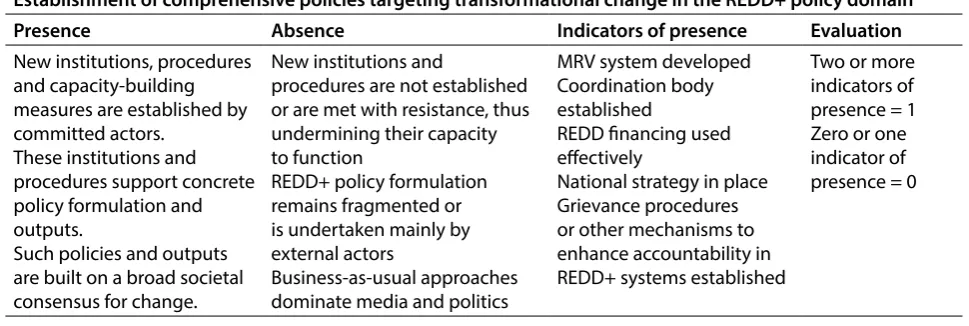
The objective of the analysis was to explain which factors contributed to the advanced establishment of comprehensive policies targeting transformational change in the REDD+ policy domain in some countries. We consider such transformational change a necessary step to the full implementation of phase 3 of REDD+, the achievement of results-based payments for delivered emission reductions and co-benefits. Thus, we define the outcome as ‘establishment of comprehensive policies targeting transformational change in the REDD+ policy domain’ (denoted by the abbreviation REDD). As indicators for the presence of this outcome, we asked country teams to assess the state of the measurement, reporting and verification (MRV) system; the
availability of REDD+ financing, coordination mechanisms and grievance procedures to safeguard the implementation; and the overall presence of a national strategy (see the appendix). We determined that at least two indicators must be present in order for the outcome to qualify as positive (see appendix).
4.2 Joint context
The comparison of the cases and the identification of causal factors explaining the outcome build on a ceteris paribus assumption (all other factors being equal) about the joint context of all case studies. The 13 countries analyzed here differ in many respects, but they do have in common several factors that are important for the success or failure of REDD+:2
Policy progress with REDD+ and the promise of performance-based payments 7
4.3 Institutional setting (remote
conditions)
REDD+ policy processes take place in an environment framed by existing institutions. The resulting path dependency can often explain difficulties in achieving institutional change, even in the presence of political will for reform. Historical experiences, as well as policy and institutional legacies limit present actions. Policies or individual and collective behaviors and beliefs that proved successful in the past, that are dominant, entrenched or that are in the interest of powerful actors are adhered to, and any change of these is perceived as a threat to vested interests and business-as-usual practices (Thelen 1999; Pierson 2000). This is a common phenomenon that may impede the national implementation of any international program (Victor et al. 1998; Barr et al. 2010).
To explore the institutional settings in the REDD+ policy arena, we define three remote conditions for REDD+ and related hypothetical assumptions: • Pressure from shortage of forest resources
(PRES): A high degree of forest are under pressure from economic activity due to the institutionalized patterns of forest use and might soon become unable to meet needs or fulfil usage interests. We expect that if a country’s forests are under high levels of pressure, it will face a stronger need to engage in active forest protection and overcome path dependency and resistance.
• Key features of effective forest legislation, policy and governance (EFF): Key features comprise the existence of a legal framework that defines tenure, use and management rights and include both formal and customary regulations, the enforcement of laws and policies related to sustainable forest management, participation by national and local authorities and the degree of compliance of forest users. We expect that achieving REDD+ outcomes requires that certain key elements of a sound legal forestry framework, featuring clearly defined rights and management regulations, are in place and are enforced to some extent.
• Already initiated policy change (CHA): Policy change is already underway, addressing forests and climate change and aimed at departing from business-as-usual practices that are broader than and/or developed prior to the UNFCCC REDD+ policy process, e.g. nationally appropriate
mitigation actions (NAMAs), anti-deforestation programs, low-carbon development strategies, forest-based adaptation and mitigation efforts, and forest-based payment for environmental services
(PES) schemes. We expect that effective REDD+ strategies can emerge more easily if governments are already successfully implementing policies aimed at departing from business-as-usual practices in the forest economy and thus provide scope for an institutional path change.
4.4 Policy arena (proximate conditions)
Whereas the institutional setting provides key conditions for an enabling context, actions by political actors shape the policy arena and the processes that lead to transformational change. We identified three proximate conditions with hypothetical assumptions on their impact on the policy arena (for more details see Korhonen-Kurki et al. (2014)) and investigated which of them are necessary to accomplish the outcome-enabling configurations and which combinations provide for a sufficient configuration:
• National ownership (OWN): National actors are dominant in shaping and supporting the policy discourse on REDD+ and are involved in the development of policy documents. The country is financially committed to REDD+. We expect that REDD+ policy documents are more likely to be translated into effective and sustainable activities if REDD+ policy processes are led by committed national actors and not driven only by international actors.
• Inclusiveness of the policy process (INCL): There is a high degree of participation and consultation of key stakeholders (including those from the private sector), civil society and indigenous people. Legal provisions supporting the right of indigenous people and communities to participate are in place. We expect that stakeholder participation in REDD+ policy processes ensures that multiple interests are taken into account and reduces resistance to the implementation of REDD+. Inclusion of stakeholders in the policy process is therefore crucial for legitimacy and sustainability.
The above five conditions were all included in the analysis conducted in 2012 (Korhonen-Kurki 2014). However, in the current analysis, we also aim to scrutinize whether the availability of performance-based funding is playing a role in the establishment of REDD+ (see more on performance-based funding in Angelsen (2013)); thus, a new factor was included: • Availability of payment-for-performance funds
8 Maria Brockhaus, Kaisa Korhonen-Kurki, Jenniver Sehring, Monica Di Gregorio et al.
donor. In a letter of intent (LOI) (or equivalent), the donor has committed to provide the funds, and the prospective recipient government has expressed interest in achieving eligibility to access those funds. We expect that those countries where payment-for-performance funds are available, and an LOI (or equivalent) has been signed to confirm the commitment of both parties, will have established REDD+ policies and achieved REDD+ outcomes faster than those countries where such performance-based funds are not available.
This new condition replaces the former condition ‘existence of transformational coalitions’ (COAL) in the current analysis. In the 2014 evaluation, all countries, except Cameroon, showed a positive result on the existence of transformational coalitions. As there is hardly any variation, this can be considered a joint context. In all countries, new coalitions of policy actors have emerged that promote a change from business-as-usual policies.
4.5 Evaluation of the factors
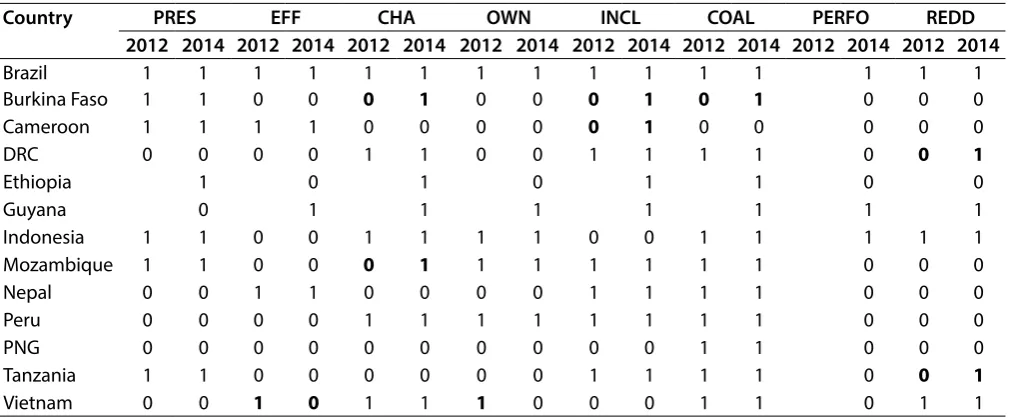
The new evaluation by country experts showed some remarkable policy developments, although not all of them are reflected in the table. Note that a limitation of the csQCA we use here is that only those changes that lead to a new presence/absence assessment of the
respective factors are captured, while gradual changes below this level are not visible. Evaluation of the factors was done using indicators developed for each factor (see appendix).
[image:19.595.44.552.506.715.2]As seen in Table 2, only a few changes in the overall value of conditions can be observed, and it seems that REDD+ at the national level is progressing slowly. While much is happening in the policy arena and changes are emerging at the indicator level, they are not yet seen in factor values. Thus, in the following section, we elaborate on current trends and trajectories in terms of developments and anticipated changes in indicators, as well as on the current situation of the national REDD+ policy arena in the countries studied. It is important to note that in the first round of our analysis in 2012, only Brazil, Indonesia and Vietnam had at least two of the five indicators present to qualify for the outcome being 1. In the second round, Tanzania and the Democratic Republic of the Congo (DRC) joined this group mainly due to their progress with a national REDD+ strategy, as did Guyana. While in all these countries, experts also noted challenges and backlashes in REDD+ policy development, as the following section will show, these five countries fulfilled sufficient criteria to confirm the presence of the outcome ‘establishment of comprehensive policies targeting transformational change in the REDD+ policy domain’.
Table 2. Truth table for all the factors for 2012 and 2014.
Country PRES EFF CHA OWN INCL COAL PERFO REDD 2012 2014 2012 2014 2012 2014 2012 2014 2012 2014 2012 2014 2012 2014 2012 2014
Brazil 1 1 1 1 1 1 1 1 1 1 1 1 1 1 1
Burkina Faso 1 1 0 0 0 1 0 0 0 1 0 1 0 0 0
Cameroon 1 1 1 1 0 0 0 0 0 1 0 0 0 0 0
DRC 0 0 0 0 1 1 0 0 1 1 1 1 0 0 1
Ethiopia 1 0 1 0 1 1 0 0
Guyana 0 1 1 1 1 1 1 1
Indonesia 1 1 0 0 1 1 1 1 0 0 1 1 1 1 1
Mozambique 1 1 0 0 0 1 1 1 1 1 1 1 0 0 0
Nepal 0 0 1 1 0 0 0 0 1 1 1 1 0 0 0
Peru 0 0 0 0 1 1 1 1 1 1 1 1 0 0 0
PNG 0 0 0 0 0 0 0 0 0 0 1 1 0 0 0
Tanzania 1 1 0 0 0 0 0 0 1 1 1 1 0 0 1
Vietnam 0 0 1 0 1 1 1 0 0 0 1 1 0 1 1
CHA = already initiated policy change; COAL = existence of transformational coalitions; DRC = Democratic Republic of the Congo; EFF = key features of effective forest legislation, policy and governance; INCL = inclusiveness of the policy process; OWN = national ownership; PERFO = availability of payment-for-performance funds for REDD+ (PERFO) ; PNG = Papua New Guinea; PRES = pressure from shortage of forest resources; REDD = establishment of comprehensive policies targeting transformational change in the REDD+ policy domain. Notes:
1. The final column is the outcome variable ‘REDD’.
Policy progress with REDD+ and the promise of performance-based payments 9
4.6 Current developments in enabling
conditions for REDD+ in the countries
studied
Brazil. No major changes in institutional settings in Brazil have been observed since 2012. The ‘pressure from shortage of forest resources’ factor, however, deserves some attention as the country managed to reduce deforestation rates sharply in the last decade and has already initiated policy change addressing climate mitigation, land use and forests. Nevertheless, forests are still considered to be under high levels of pressure, as also noted in the debates around the forestry code revisions. In 2013, increased levels of deforestation were observed, which then dropped again in 2014 and increased again in 2015 (Fonseca et al. 2015). These fluctuations indicate that Brazil has still not completely overcome path dependencies in deforestation and forest degradation, despite the country’s investments in command and control measures (see, for example, Maia et al. (2011) and Assunção et al. (2012)). While Brazil generally has sound and consistent forestry policies, in most cases they seem not to be fully enforced. The Amazon Fund represents one of the main financing mechanism for REDD+ initiatives at the federal level in Brazil. The fund, however, still needs to improve monitoring of its initiatives in order to effectively measure emission reductions and performance that results from funding provided by the mechanism. Brazil also has active policy actors and coalitions that lead policy discussions and formulations away from business as usual (Gebara et al. 2014). Their influence, however, was arguably reduced during President Dilma’s government, as exemplified by the changes adopted under the new Forest Code, which have undermined the requirements for forest conservation and restoration (May et al. 2011). Brazil has for some time now been constructing its national REDD+ strategy, but with difficulties related to the national accountability of emission reductions, benefit-sharing and positive incentives, performance measurements, and inclusion of disadvantaged actors (Gebara et al. 2014). Remaining challenges in this process arguably include: increasing participation by civil society and local actors; enhancing transparency in the design of the REDD+ strategy; monitoring the implementation of current policies; improving coordination and harmonization of forest policies; mainstreaming low-carbon and climate-resilient development into major Brazilian development policies and measures; and strengthening involvement of private actors both in financing and in participating in REDD+ initiatives (see, for example, Gebara and Thuault (2013)).
Burkina Faso. In 2012, the Nationally Appropriate Mitigation Action Plan was the only forest- and mitigation-related policy, but Burkina Faso has now started to formulate its REDD+ policy, with assistance through the Forest Investment Program (FIP). This builds on the country’s earlier efforts of forest-based adaptation measures stipulated in the country’s National Adaptation Programme of Action, which was introduced prior to REDD+ efforts through FIP (Kambire et al. 2015). Thus, the enabling remote condition ‘already initiated policy change’ has changed from 0 to 1, as has the condition ‘inclusiveness of the policy process’. In addition, there have been recent efforts in coalition building among the actors supporting an effective, efficient and equitable REDD+, and pro-REDD+ actors have increasingly improved access to the decision-making process. Because of this, the ‘existence of transformational coalitions’ factor has changed from 0 to 1 for Burkina Faso.
10 Maria Brockhaus, Kaisa Korhonen-Kurki, Jenniver Sehring, Monica Di Gregorio et al.
The Democratic Republic of the Congo. The major change in REDD+ in the DRC is that the country now has a national REDD+ strategy in place (Mpoyi et al. 2013). This, together with the presence of a REDD+ coordination body, means that our defined outcome on progress with REDD+ is assessed as being present. In 2014, the ER-PIN for Mai-Ndombe District was validated and submitted to the FCPF. However, even though the strategy has been approved by the government, and efforts are being made toward implementation, several stakeholders have cautioned that an effective implementation may not be achieved due to uncertain funding and questions related to the sustainability of political will for REDD+ across multiple governance levels. In addition, the lack of policy outputs from the REDD+ interministerial committee raises questions about its effective functioning. Finally, the national REDD+ Task Force which is supposed to coordinate the process does not have a strong voice beyond the Ministry of Environment. Apparently, this situation is partially due to the limited (accounted for) contribution of the forest and environment sector to the national economy compared with those of the mining and agriculture sectors. In sum, despite having now achieved a positive outcome assessment, there remain many uncertainties with regard to progress with REDD+ development in the DRC.
Ethiopia. As a new country in the study, Ethiopia is considered a second-generation REDD+ country, with activities having begun mainly after 2011 (Bekele et al. 2015). Much effort is underway on developing REDD+ activities (such as the MRV system, etc.) and the country aims to have its national strategy in place in 2015. At the moment, the most relevant processes for REDD+ in the country include: a revision of the existing national forest law to take into account REDD+ issues, the preparation of forest regulations to ease the implementation of various forestry activities in general and of REDD+ in particular, and the development of a comprehensive forest inventory for the whole country by the Food and Agriculture Organization of the United Nations (FAO). These processes were planned to be completed by the end of 2014, but will continue over the course of 2015.
Guyana. The other new country in the study, Guyana, is considered one of the most advanced REDD+ countries. Guyana started preparing REDD+ activities such as the MRV system in 2009 and its government is strongly committed to
REDD+. A recent assessment of Guyana’s REDD+ status describes notable strengthening of institutions of forest governance and considerable progress in developing an MRV system (Birdsall and Busch 2014). Furthermore, Guyana is also an early recipient of performance-based funding. Since 2009, Norway has committed to providing financial support of up to USD 250 million by 2015 for results achieved by Guyana in efforts to reduce emissions from deforestation and forest degradation.
Policy progress with REDD+ and the promise of performance-based payments 11
Mozambique. The pressure on forests continues to increase in Mozambique (Sitoe et al. 2012). Although the growth of small-farmer agriculture is believed to have leveled out as a result of low technology and migration to urban areas (Cunguara et al. 2013), new investments in sugarcane, maize, sesame and soy production have particularly increased the areas being farmed (BMI 2013), and may cause further encroachment on the forest frontier. Although Mozambique has put in place a legal framework to promote the sustainable use of forests (Forest and Wildlife Law and its regulation), there are no instruments in place to secure the implementation of this legislation. Mozambique has adopted a Green Economy Action Plan as one of the key instruments for development planning. The policy, approved by the Council of Ministers in 2013, promotes low-carbon development, including anti-deforestation measures and PES. This plan builds on reform stimuli much broader than REDD+, namely the Sustainable Development Goals process and efforts toward a ‘green economy’ supported by the United Nations Environment Programme (UNEP). As a consequence, condition ‘already initiated policy change’ is now assessed as being present. In terms of further direct progress with REDD+ and the development of demonstration activities, the Government of Mozambique approved a decree that provides the basic guidance for REDD+ pilot projects (Decree 70/2013, Boletim da República 20 December 2013). This is part of the REDD+ readiness (R-PP) process funded by the World Bank. In relation to foreign donor participation, the World Bank has increased its presence through the R-PP process since 2013. One of the objectives of the R-PP is to develop a REDD+ strategy and also to support pilot projects. In addition to the R-PP Process, Mozambique submitted the proposal for the Forest Investment Program (FIP) and the Carbon Fund Emission Reduction Project Idea Note (ER-PIN) for a subnational integrated landscape program. Mozambique has improved its consultation mechanisms but these developments are not yet sufficient to change the condition ‘inclusiveness of the policy process’ from being absent to being present. There is evidence that the central government is taking the debate to the provincial level and including stakeholders from different segments of society. In addition, it is now becoming common for CSOs to organize debates on REDD+ by bringing together actors for and against REDD+. Noteworthy progress is also being made to establish the MRV system, and the national REDD+ strategy and other processes seem to move forward now in 2015.
Nepal. In the recent past, Nepal has made significant progress in developing an institutional setting
conducive to REDD+ readiness (Paudel et al. 2013). By mid-2015, a national REDD+ strategy had been drafted and several important studies were conducted that include, among other topics, analysis of the drivers of deforestation and forest degradation, reference emission levels, social and environmental impacts, and MRV procedures. The government in partnership with the World Bank conducted a rather positive assessment of REDD+ readiness in Nepal (called R-package assessment). The assessment however has also pointed out gaps in some specific areas where further work is required, such as the REDD+ benefit sharing and payment mechanism, and consultation and outreach. In the meantime, Nepal has also initiated groundwork for a subnational REDD+ performance-based payment scheme. The ER-PIN for the Terai Arc Landscape of Nepal has been approved, by which the FCPF has committed funds to develop an Emission Reduction Program Document. Nepal should thus be implementing performance-based emission reduction programs in the next few years in the forest- and biodiversity-rich landscape of the Terai region. The government has recently declared Chure a conservation area; covering about 13% of the country’s land area, this region is experiencing high deforestation and forest degradation rates. However, declaration of this conservation area received strong criticism from CSOs, especially the Federation of Community Forest Users Nepal (FECOFUN). While the declaration is aimed at reducing deforestation and forest degradation in the region, growing disagreement among key stakeholders about forest policy processes may undermine the prospects of REDD+ implementation in the long term.
Peru. The Government of Peru continues to advance, albeit slowly, toward the consolidation of national strategies and laws regarding REDD+ and forests more broadly (Che Piu and Menton 2013). The New Forestry Law was passed in 2011, but as of August 2015 was still not being enforced due to delays in consultations and approval of its regulations. During the Lima Climate Change Conference in December 2014 (COP 20), the government presented a draft of its National Strategy for Forests and Climate Change. In September 2015, a new revised version was
12 Maria Brockhaus, Kaisa Korhonen-Kurki, Jenniver Sehring, Monica Di Gregorio et al.
of climate change, emphasizing both mitigation and adaptation and including REDD+ as one component of a broader strategy. Although it does not include details regarding all aspects of REDD+, it highlights key approaches, advances, objectives and institutional arrangements for further progress. A draft of the MRV strategy was also presented in April 2014. In June 2014, the Congress approved the Law for Payment for Ecosystem Services, which clarifies entities’ rights to carbon and other ecosystem services. Peru also took the lead in the development of the New York Declaration on Forests, together with Germany and Norway. While Peru’s role as host of COP 20 has shone the spotlight on climate change, it has also contributed to delays in advances in the development of REDD+ strategies, given the limited number of government employees working on climate change and REDD+. Nevertheless, at COP 20, Peru signed an agreement with Germany and Norway committing USD 300 million toward results-based payments for REDD+. It should be noted that our research was conducted before these developments in 2014, hence the factor ‘availability of payment-for-performance funds for REDD+’ was assessed as 0.
Papua New Guinea. There were no changes in the overall conditions in Papua New Guinea (PNG) between 2012 and 2014. However, there are several new or amended policies that warrant mention. In mid-2012, after several months of political turmoil, a new government was elected under Prime Minister Peter O’Neil. This saw the departure of a key REDD+ ‘policy entrepreneur’ – former Prime Minister Michael Somare, who was a leading proponent of REDD+ at both national and international levels (Babon et al. 2013). In June 2014, the government announced it would revoke a number of Special Agriculture and Business Leases, which had become a major driver of deforestation in the country and had been found by a Commission of Inquiry to have been obtained without due process. However, at the time of writing (August 2015) the leases had still not been revoked and logging continued in these areas (Garrett 2014). In August 2014, the government approved a Climate Compatible Development Policy after several years of delay. Overall, while there have been some steps in the right direction, they fail to constitute changes in the enabling conditions for REDD+ as put forward in this paper.
Tanzania. The Division of Environment under the Vice President’s Office is mandated to oversee all climate change initiatives in Tanzania, including
REDD+. However, the country has not set aside funds to operationalize the REDD+ policies and framework, and national ownership of REDD+ can be considered lacking in this regard. Thus, most REDD+ piloting activities are directly donor funded and implemented by CSOs (Kweka et al. 2015). Tanzania had bilateral agreements with Norway and Finland that provided most of its financial backing and technical assistance up to 2014, with contributions of USD 58 million from Norway and USD 5.9 million from Finland (NORAD 2014). Tanzania’s national REDD+ strategy favors the formation of a government-led National Carbon Trust Fund. However, some have questioned the efficacy of a strictly national fund approach, since previous government-led benefit-sharing initiatives have mostly failed to deliver benefits to local communities (e.g. in the areas of joint forest management (JFM), hunting blocks and tourism). The REDD+ strategy was created with strong stakeholder engagement in its development and a presence on the international climate change platform, the UNFCCC. However, clarity is lacking as to how to operationalize the strategy, and some of the key elements are still being contested by CSOs (i.e. equitable benefit sharing, the funding mechanism and carbon rights).
Policy progress with REDD+ and the promise of performance-based payments 13
as strong as it was in 2012 (e.g. the REDD+ office has been scaled down, leadership changes have been made over time); as a result, the condition ‘national ownership’ is not considered to be present anymore. Since 2013, a few negative articles on REDD+ have appeared in the media, which is controlled by the state, and pro-REDD+ media statements are no longer dominant. Furthermore, although there is a government agency that is mandated to lead REDD+ formulation, UN-REDD and other donors have taken more leadership and advisory roles in national REDD+ strategy development, compared to 2012, and now dominate REDD+ discourse in the country. However, despite these setbacks, Vietnam has developed its MRV system, and it is the first country to have grievance procedures and
other mechanisms that enhance accountability in REDD+ systems under development. In addition, there are some recent developments with regard to national ownership re-emerging, for example with the placing of the REDD+ office as an independent unit reporting to the vice-minister in 2015.
To sum up, several countries have been drafting their national REDD+ strategy and preparing an MRV system, but they are not all in place yet. There has been sufficient improvement in the DRC and in Tanzania for them to reach our defined outcome, as have Brazil, Guyana, Indonesia and Vietnam. Tanzania and the DRC are now among a few
5 Results of the qualitative comparative analysis
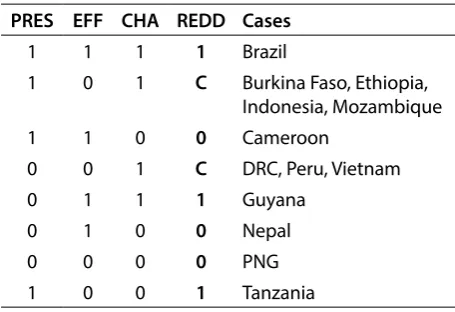
present; thus, it was one of six countries for which the outcome REDD was assessed as present (1). In an ideal analysis, those countries that share the same configuration would have the same outcome in common. In our analysis, however, we observe two contradictory results, where countries that share the same combination of conditions have different assessments of the outcome. This is the case for the combination of presence of the conditions PRES and CHA, combined with the absence of EFF. Here, we find Burkina Faso, Ethiopia and Mozambique without the outcome REDD, while Indonesia (which had the same combination of presence/presence/absence of these conditions) was among those where the outcome was assessed as present (see Table 2). Also, the combination of the absence of both PRES and EFF, and the presence of CHA, shows a similarly contradictory result, whereby the DRC and Vietnam have the outcome REDD present, while Peru has not achieved the outcome. The findings are summarized in Table 3.
In the next step, we consider all configurations of the remote conditions (institutional context) that show positive or contradictory results as outcome-enabling remote configurations. This will allow us to further investigate these contradictory cases, once we have analyzed the proximate, policy-arena-specific conditions.
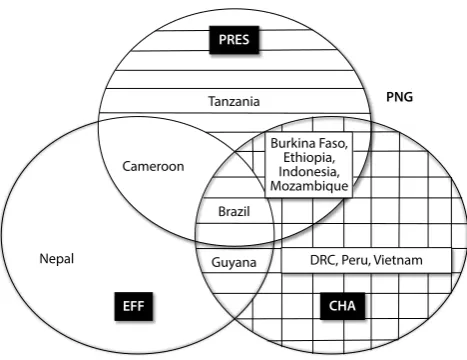
As shown in Figure 1, the configuration of
conditions that led to the positive outcome REDD, and those with contradictions are:
PRES*EFF*CHA + PRES*eff*CHA +
pres*eff*CHA + pres*EFF*CHA + PRES*eff*cha
Using Boolean logic, these can be reduced to:
CHA + PRES*eff
Comprehensive REDD+ policies targeting transformational change were successful in those countries that showed one of the following remote configurations:
1) At the institutional level, policy change in a related field had already been initiated (CHA).
5.1 Analysis of the institutional context
(remote conditions)
In the first step, we analyze the institutional context of the 13 countries, using the following factors: • pressure from shortage of forest resources (PRES) • key features of effective forest legislation, policy
and governance (EFF)
• already initiated policy change (CHA).
The purpose of this part of the analysis is to identify those combinations of presence or absence of the above conditions that provide an outcome-enabling context, namely where the outcome ‘establishment of comprehensive policies targeting transformational change in the REDD+ policy domain’ (REDD) was achieved and assessed as present (1).
[image:25.595.42.270.545.701.2]Table 3 shows that each of the eight mathematically possible combinations of the three conditions (PRES, EFF, CHA) and two possible expressions for presence or absence of these (0, 1) were observed among our 13 countries. For example, a combination of all conditions being absent was observed for PNG, where the outcome REDD was also absent and assessed as 0. In the case of Brazil, all conditions were
Table 3. Truth table for the institutional context in 2014 (remote conditions).
PRES EFF CHA REDD Cases
1 1 1 1 Brazil
1 0 1 C Burkina Faso, Ethiopia,
Indonesia, Mozambique
1 1 0 0 Cameroon
0 0 1 C DRC, Peru, Vietnam
0 1 1 1 Guyana
0 1 0 0 Nepal
0 0 0 0 PNG
1 0 0 1 Tanzania
Policy progress with REDD+ and the promise of performance-based payments 15
The presence of this condition is observed in Brazil, Guyana, Indonesia and Vietnam; that is, it occurs in all countries with a positive outcome apart from Tanzania. If CHA is present, it is irrelevant whether there is also PRES or EFF, as both countries with and without these conditions show a positive outcome.
or
2) There is a high level of pressure from a shortage of forest resources, but there are no key features of effective forest legislation, policy and governance in place (PRES*eff).
The presence of this condition is observed in Tanzania and Indonesia.
In this configuration, it is not relevant whether policy change has been initiated or not (as it is true for Indonesia, but not for Tanzania). The latter configuration might be surprising, but it shows that if pressure is strong enough, policies can be successful even when there is a lack of legislative framework and enforcement, and regardless of whether there was an already initiated policy change in related fields. However, proximate conditions are needed to explain why REDD is enabled in the context of this configuration.
With regard to already initiated policy change, it turns out to be a decisive factor. In contrast to the result of the 2012 QCA, it is not a necessary condition, but it is
a sufficient one as a sole remote condition. Thus, on the one hand, CHA seems to be stronger than in the previous analysis, where CHA always had to be combined with another remote factor (EFF*CHA or PRES*eff*CHA); but, on the other hand, it is also weaker, as the result can also be achieved without already initiated policy change. However, there is only one case that achieved progress without CHA, namely Tanzania. It is important to note that Tanzania, while not able to rely on earlier engagement in climate change policies, has a long history of implementation of participatory forest management programs.4 It might be a matter of discussion whether these policies initiated a similar path change and thus eased REDD+ policy formulation.
An important part of the second step is to examine the proximate factors in order to fully explain the outcome, and also to explain why some countries that have already initiated policy change (such as Burkina Faso and Ethiopia) do not show a positive result.
5.2 Analysis of the policy arena
(proximate conditions)
In the second step, we analyze the policy arena of those 10 countries that show the two outcome-enabling remote configurations. Cameroon, Nepal and PNG are not part of this step in the analysis, as they have a different configuration of remote conditions.
As explained earlier, since all countries have meanwhile developed some coalition building among pro-REDD+ actors, this factor was defined as a joint context. Instead, in the analysis presented here, we introduced a condition to assess the role of performance-based payments. The three proximate conditions added are therefore:
• national ownership (OWN)
• inclusiveness of the policy process (INCL)
• availability of payment-for-performance funds for REDD+ (PERFO).
In sections 5.2.1 and 5.2.2, we analyze first the enabling configuration of the presence of already initiated policy change combined with the proximate conditions. This is followed by an analysis of the
4 Participatory forest management was introduced into law in Tanzania with the passing of the Forest Act of 2002, which provides a clear legal basis for communities, groups or individuals across mainland Tanzania to own, manage or co-manage forests under a wide range of conditions. However, these programs have been implemented in the country for decades.
PRES
CHA EFF
PNG Tanzania
Burkina Faso, Ethiopia, Indonesia, Mozambique
DRC, Peru, Vietnam Brazil
Guyana Cameroon
[image:26.595.58.292.68.248.2]Nepal
Figure 1. Observed configuration of the three remote conditions.
CHA = already initiated policy change; DRC = Democratic Republic of the Congo; EFF = key features of effective forest legislation, policy and governance; PNG = Papua New Guinea; PRES = pressure from shortage of forest resources.
16 Maria Brockhaus, Kaisa Korhonen-Kurki, Jenniver Sehring, Monica Di Gregorio et al.
enabling configuration PRES*eff, where there is a high level of pressure from a shortage of forest resources and where there are no key features of effective forest legislation, policy and governance in place.
5.2.1 Proximate conditions and already initiated policy change
When running an analysis of the three identified policy arena (proximate) conditions and the remote condition of already initiated policy change, the truth table (Table 4) (again with eight possible combinations) shows five observed cases for the remaining nine countries where already initiated policy change is observed (1).
If we take the configurations that lead to a positive outcome (REDD) (including the contradictory one) among the observed cases, we get the following enabling configurations (see also Figure 2):
1) Already initiated policy change, together with national ownership and availability of payment-for-performance funds for REDD+ are all present (CHA*OWN*PERFO).
In Brazil, Guyana and Indonesia, already initiated policy change is complemented by a strong
ownership of the REDD+ process and the availability of performance-based funding. This combination of conditions has led to the REDD+ process being moved forward, irrespective of whether the process is inclusive or not. However, as noted also for the earlier analysis, inclusiveness may be crucial for the sustainability of REDD+ and effective implementation (Korhonen-Kurki et al. 2014).
2) Already initiated policy change remains
present, but national ownership and availability of payment-for-performance funds for REDD+ are both absent (CHA*own*perfo).
This configuration was observed for the DRC and Vietnam with positive outcomes and for Burkina Faso and Ethiopia with negative outcomes. This finding requires further investigation, as the DRC and Vietnam both lack national ownership (Vietnam was assessed as having stronger national ownership in the past), have no performance-based funding instruments in place and still show positive REDD+ outcomes, irrespective of whether there are inclusive policy processes or not. The explanation for this result is not straightforward. We must examine which proximate factors influenced the policy process
either by their presence or by their absence. For Vietnam, it is important to note that ownership of the REDD+ process has reduced only recently and that the REDD+ progress we see might be an effect of strong national ownership in the past (Korhonen-Kurki et al. 2014). On the other hand, the absence of national ownership means that the REDD+ process is dominated by foreign donors. Indeed, ‘own’ could be read as ‘DONOR’. This would mean that countries can be successful, independent of the funding source, when donors politically and financially dominate the REDD+ process. It should also not be forgotten that there is political commitment to REDD+ by the government as well as by coalitions of drivers of change (which we measured as part of the joint context).
[image:27.595.300.533.101.264.2]In contrast, Burkina Faso and Ethiopia have had previous policy change but no ownership and no performance-based instruments present, and the outcome (REDD) is negative. This is probably explained by the fact that both countries started their REDD+ process just recently. While the enabling remote condition (already initiated policy change) is present, the government is not yet committed to REDD+, the donors lead the process and no performance-based funding is available yet.
Table 4. Truth table for already initiated policy change and the proximate conditions.
CHA OWN INCL PERFO REDD Cases
1 1 1 1 1 Brazil, Guyana
1 0 1 0 C Burkina Faso,
DRC, Ethiopia
1 1 0 1 1 Indonesia
1 1 1 0 0 Mozambique,
Peru
1 0 0 0 1 Vietnam
1 0 1 1 Not observed
1 0 0 1 Not observed
1 1 0 0 Not observed
0 = absent, 1 = present, C = contradictory result; CHA = already initiated policy change; DRC = Democratic Republic of the Congo; INCL = inclusiveness of the policy process; OWN = national ownership; PERFO = availability of payment-for-performance funds for REDD+; REDD = establishment of comprehensive policies targeting transformational change in the REDD+ policy domain.