COMMISSION OF THE EUROPEAN COMMUNITIES
EVALUATION OF THE COMMUNITY
DEMONSTRATION PROGRAMMES
zz ~~ NC\1 CX)CX) ..._ ..._
C\11[) C'?C'?
...
~::::::
>>
COMMISSION OF THE EUROPEAN COMMUNITIES
EVALUATION OF THE COMMUNITY
DEMONSTRATION PROGRAMMES
INTHEENERGYSECTOR
CONTENTS
GLOBAL EVALUATION
1. Introduction . . .
5
2. The Community demonstration programme . . .
6
3. Evaluation of the results of the Community programme . . .
8
-
Energy saving . . .
9
-
Geothermal energy . . .
10
-
Solar energy...
10
-
Liquifaction and gasification of solid fuels . . .
11
4. Member States' demonstration programmes...
11
5. Continuation of the Community demonstration programmes...
13
6. Conclusions...
16
SECTORIAL ASSESSMENT
Introductory note . . .
21
1.
Energy saving . . .
23
1.1. Buildings . . .
23
1.2. Heat pumps...
27
1.3. District heating, power stations and combined
heat and power production . . .
29
1.4. Industry...
33
1.5. Fluidized beds...
44
1.6. Energy from waste...
47
1. 7. Transports . . .
50
1.8. Agriculture . . . .. . . .. .. .. . . .. .. . . .. .. . . .. . . .. . . .
53
2. Alternative energy sources
2.1. Solar energy . . .
57
2.1.1. Introduction...
57
2.1.2. Solar heating...
57
2.1.3. Photovoltaic techniques...
60
2.1.4. Biomass...
63
2.1.5. Conclusions...
65
2.2. Geothermal energy . . .
66
2.3. Liquefaction and gasification of coal . . . .. . .
70
2.4. Conclusions as regards alternative energy sources . . .
75
3. National programmes...
77
ANNEXES
Annexel
Detailed description assessment of current contracts
a) Energy saving ... .
b) Alternative energy sources : solar energy ... .
c) Alternative energy sources : geothermal energy ... .
d) Alternative energy sources : Liquefaction and gasification of
coal ... .
Annexell
83-84
108-109
125
129
List of independent experts . . . 133-134
Annexem
Statistics on the Community demonstration programme
a) Energy saving . . .
135
b) Alternative energy sources : Solar energy . . .
135
c) Alternative energy sources : Geothermal energy...
136
Global evaluation
1.
Introduction
1. On 23 February 1982 the Council of the European Communities decided that the Commission, with the Member States, would assess the role of demonstration projects on energy-saving and alternative energy sources in the energy and research policies of the Community and the Member States.
2. Furthermore, according to Regulations (ECC) No. 1302/78 and No. 1303/78, the Commission is required to report periodically on the application of these Regula-tions to the European Parliament and to the Council. A preliminary report was submitted in July 19811•
3. A technical evaluation of the Community demonstration programmes was un-dertaken by the Services of the Commission, with the help of independant experts. A more succint evaluation of national programmes was carried out by the Services of the Commission, based on the results of a survey in the Member States. From this work an evaluation report of Community demonstration programmes2 was
produced. This present document sets out the main technical conclusions of this report, considers a number of related questions and suggests directions future Community action could take. For further details reference should be made to the evaluation report; cross-references are given in the text.
4. Demonstration links the R&D stage, sometimes tested on pilot plant, and the later investment stage. It differs from the R&D and pilot stages in the industrial scale of the projects, the requirement of having prospects of economic viability, and from the normal investment stage in that the inherent risks are still considered by the entrepreneurs to be too high.
5. Demonstration is an essential stage at both national and Community level. The European Parliament, for it's part, has emphasised in several Resolutions3 the need for demonstration projects to develop alternative sources of energy and energy saving measures. When the Community regulations concerning demonstra-tion projects were adopted in 1978, only two Member States had introduced support measures for demonstration projects. Initially therefore the Communit-y
1. COM (81) 397 final. 2. COM (82) 324/2 final.
3. -Resolution of 17.11.77 on the 2 draft Commission Regulations. -Resolution of 18.02.80 on the energy objectives for 1990.
programme also served to ensure a minimum level of demonstration activity in all
Member States.
6. Since that time all Member States, often prompted by the Community pro-gramme, have set up national programmes to support demonstration projects. The Community programme - chiefly a stimulant until now - will in future, as in the case of the Community R&D programme, be required to coordinate and supple-ment national programmes as well.
7. The demonstration programme is not only the logical extension of Community R&D activities: because it provides the opportunity for exploiting projects from national R&D programmes at Community level it also opens up a European scale market for them.
2.
The Community demonstration programme
8. This programme covers energy-saving and alternative sources of energy:
Regulation No. 1303/78 on the granting of financial support for demonstration projects in the field of energy-saving lists the following possible fields of application: - buildings;
- supply and use of process heat and of electricity in industry; - energy industry;
- transport.
9. Regulation No. 1302/78 on the granting of financial support for projects to exploit alternative energy sources lists the following areas:
- exploitation of geothermal fields; - exploitation of solar energy;
- liquefaction and gasification of solid fuels; - exploitation of wave, tidal and wind energy.
Several considerations, including budgetory factors, have lead the Commission to limit action to the first three sectors for the time being.
10. Commitment appropriations in the Community Budget for demonstration pro-jects are as follows:
1978 1979 1980 1981 1982
Total: 243 MECU
Energy-saving 4
16
25 24 20 89MECU
Alternative energy sources 11
16
47 59 21 154MECU
The break-down between sectors would be as follows:
Energy Geothermal Solar Liquefaction saving energy energy and
gasifica-tionofcoal
Original total funding 55 22,5 22,5 50 150 million ECU
Increase: 55 million ECU 26 10 0 19 New total: 205 million ECU 81 32,5 22,5 69
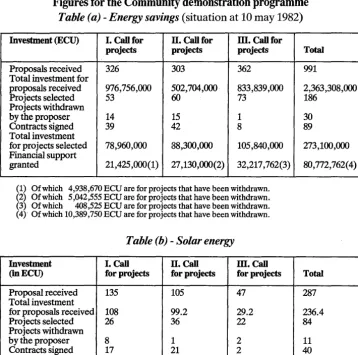
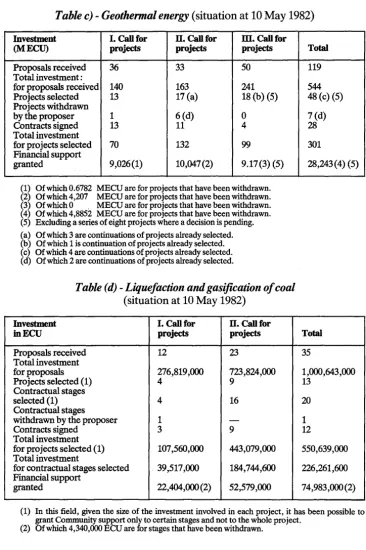
12. In the first three years of operation of the programmes, the Commission issued two invitations to submit projects in the solid fuel liquefaction/gasification sector and three invitations in each of the other sectors. No fewer than 1,432 projects were submitted to the Commission in response to these eleven invitations, corre-sponding to a total investment of 4,143 million ECU.
13. The Commission was assisted in selecting projects by four advisory committees whose members should be well-acquainted with national programmes because of their positions in national administrations. In some cases, the members of these advisory committees also sat on Community R&D programme committees; they gave the Commission valuable advice in selecting projects for support. Generally speaking, co-ordination between the R&D and demonstration programmes has become increasingly satisfactory.
14. To date the Commission has selected a total of 331 projects for financial support. Subsequently, 49 of these projects have been withdrawn by their propo-sers, chiefly because of difficulties in financing the part of the investment not covered by Community financial support. In many cases too, the proposers realized only later that the Community system, unlike national systems, imposes repayment requirements: if the project is commercially successful part of the Community support has to be refunded.
15. The selected projects represent total investment of nearly 900 million ECU. If it is assumed that investment projects take an average of three years, the volume of new investments stimulated by the Community demonstration programme is 300 MECU/year.
Energy Geothermal Solar Liquefaction
and gasifica- TOTAL saving energy energy
tionofcoal
Proposals submitted 991 119 287 35 1432
Total investment
of proposals sub- 2363 544 236 1000 4143 mitted (MECU)
Projects selected 186 48 84 13 331
Projects withdrawn
30 5 11 1 47
by the proposer
Contracts signed 89 28 40 12 169
Total investment
of selected projects 273,1 301 78,217 226,261 * 878,6 (MECU)
Average investment 1,47 6,27 0,93 17,405 2,65 per project
Financial support 80,773 28,243 22,915 74,983 206,9 granted (MECU)
Projects withdrawn 10,390 4,885 2,584 4,34 22,2 (MECU)
• First contractual phase only.
16. The financial limit (150 l'AECU) set for the programme by the Council in 1979, smaller than the budgetary allocation, has caused major difficulties in programme management. Since November 1981 the programme has effectively been hampered as a result of the dispute between the budgetary authorities. In particular, four Commission decisions on new demonstration projects are held up until the inten-tion expressed by the Council of 23 February 1982 to increase the financial limit by 551\AECU (to 2051\AECU) is implemented. As soon as an appropriate decision is taken this will align the total funding with the budget allocation at the end of 1981. Budget credits for 1982 exceed the 205 l\AECU ceiling, but the Council, whilst awaiting the examination of the technical evaluation report, has not taken a corresponding decision.
17. The Commission has dealt in detail with the question of diffusion of results in it's preliminary report of July 19811
• Since then, the Commission has published
quarterly reviews ("newsletters") reporting on the different programmes. The Commission has also started to establish complete and regular updated computer-ised documentation on the state of the programme and the results obtained.
3.
Evaluation of the results of the Community programme
18. All the projects for which contracts have been signed have been assessed, however only about 60 projects are sufficiently advanced for the results to be clear and for initial conclusions to be drawn2•
Energy Geothermal Solar Coallique-faction and saving energy energy
gasification
Number of projects assessed 91 22 70 4 Number of projects
suffi-ciently advanced for initial 23 22 16 4 assessment of the results
Of which projects completed 12 1 3 1
19. This technical evaluation was performed by Commission departments, includ-ing the Joint Research Centre, with the help of high-level independent experts. The experts were able to visit most of the projects which had reached an advanced stage.
Since many of the projects are still under way a technical and economic evaluation which is both comprehensive and final is not possible at present. The results already obtained nevertheless enable some valid comments to be made. The main points from the technical evaluation are summarised in the following paragraphs whilst the Commission's political conclusions, taking this evaluation fully into account, are set out in Chapter V.
Energy-saving
120. By 1990 the Community (the Ten) could be saving 130-150 million toe/year, or 12-14% of gross energy consumption at that time.
The Community projects so far approved are expected to yield energy savings of about 700 000 toe/year. These savings are expected to have a multiplier effect, depending upon the nature of the projects and the efforts made to disseminate the results. These projects feature energy savings which vary according to their techno-logical sector. In the industrial sector, for example, one project alone will save a steelworks 100 000 toe/year; the nine projects in the residential building sector will achieve no more than 60 toe/year. This is due to the inherent differences between the sectors and the nature of the projects.
21. The average levels of investment and of support granted are 1 450 000 ECU and 430 000 ECU respectively, in other words an average Community contribution of roughly 30%. This support has frequently been a determining factor in the achievement of the projects, the rate of support is thus considered to be satisfac-tory.
22. Altough all of the projects are technologically innovative, their degree of eco-nomic viability can vary considerably. Out of 23 projects whose results are cur-rently available for assessment, 13 are to be considered completely successful and commercially exploitable. One project has already started to pay back the Com-munity's financial contribution. Results from the other 10 are useful but fall short of the original aims.
23. Of the projects adopted, 14 are based on techniques which had previously received financial support under a national or Community R&D programme.
1. Evaluation report: Pages 1-51.
24. The assessment report suggests that, whilst keeping to the initially very wide range of possible applications of the programme, further action should place more stress on certain technological subsectors with particular promise. In it's own conclusions in Chapter V, the Commission draws heavily on the considerations put forward in the technical assessment report (see point 54).
Geothermal Energy
125. By 1990 geothermal energy could provide 4-5 million toe of the Community's energy needs, and, on some estimates, around 20 million toe at the tum of the century.
The Community's action has prompted many practical plans to exploit geothermal energy sources, previously used only for space heating in the Paris region and electricity generation in central Italy. It has consequently been possible to run demonstration projects in several French and Italian regions, in Greece, the Fed-eral Republic of Germany, the United Kingdom, Denmark, the Netherlands and Belgium.
26. Geothermal energy projects carry a significant "mining risk" in that the re-sources which can actually be exploited often fall short of the potential estimated before drilling. Exploitation of discoveries is sometimes further hindered by techni-cal problems and by a lack of suitable equipment. This situation is only likely to improve as more experience accrues from proliferation of actions throughout Community regions with a variety of geological conditions.
27. The preliminary results obtained from the 22 most advanced demonstration projects are encouraging and more than half of them are commercially exploitable.
28. Low-temperature sources of geothermal energy ( 40-1500) are the most plenti-ful. Their exploitation is crucial to the development of geothermal energy in the Community. The assessment suggests that as in the past, the development of low-temperature sources be also emphasized in the future, though without neglecting the particularly promising high-temperature sources. A special effort should be made to promote projects to tap geothermal energy for agriculture and industry.
Solar energy
229. Although the total solar energy incident upon the Community greatly exceeds our requirements, its low intensity and variable nature mean that we cannot expect more than 40 to 70 million toe from it by the year 2000. This is nevertheless a significant contribution. In certain developing countries the potential contribution of solar energy towards the year 2000 is considerable.
30. The Community programme has dealt with the three main aspects of solar energy use i.e. conversion into heat, photovoltaic conversion and biomass. Solar heating and biomass are technologically more advanced and so more projects were selected in these areas than in photovoltaic conversion. However, only low-temper-ature applications currently reach the break-even point. Amongst these are solar-heated swimming pools; in this field, the assessment report concludes that demon-stration has reached a satisfactory level now.
31. It can be seen from the distribution of thermal projects over the Member States that in northern and central Europe solar energy serves chiefly for hot water production and space heating; in the southerly regions agricultural and industrial applications predominate. The evalutation suggests that, in future, the programme should concentrate more on seasonal storage, solar-heated greenhouses and drying processes.
32. The use of photovoltaic cells is confined at present to a number of specific applications in telecommunications, telemetry, alarm systems, and electricity sup-ply for remote sites. The assessment suggests that if this sector is to be developed there must be further support at the R&D level; new invitation for the submission of proposals at the demonstration level is not envisaged in the short term. In the medium term photovoltaic arrays yielding a few KW should enable applications at remote locations and in developing countries to proliferate at an acceptable cost. It is with this type of application that the current demonstration programme is concerned.
33. Biomass is no doubt one form of solar energy likely to make a significant medium-term contribution to the Community's energy balance. Projects have been supported under both the regulation relating to energy-saving and that concerning alternative energy sources.
34. The evaluation of the solar projects was carried out from the viewpoint of their current application within the Community. The use of the same techniques, often in more favourable conditions in developing countries could greatly influence the level of economic viability.
Solid-fuel liquefaction and gasification
135. Although limited in scope by the funds available, the programme covers most of the major technological fields. The projects are helping to solve the, often severe, technical problems raised by the building and operation of large installa-tions. Only large-scale installations are effectively able to provide, in the event of major increase in oil prices, the possibility of reducing the degree of Community dependance on hydrocarbon imports. Effort applied to the liquefaction and gasifica-tion of solid fuels is given special importance in the light of this dependance.
36. While a number of projects are close to economic viability, others are more of a industrial pilot plant nature. In particular, the economic viability of the under-ground gasification and of liquefaction projects still largely depends on technical advances requiring large-scale installations and on relative oil-prices.
37. All projects for the gasification and liquefaction of solid fuels are large-scale and need long lead times and significant financial resources. Under the present programme Community participation has generally been limited to the opening phases of projects. Considerable public funds will still be needed to enable them to reach the operational phase.
4.
The Member States' demonstration programmes
238. In response to the Council's request for an evaluation of the importance of demonstration projects in the energy and research policies of the Member States the Commission undertook a survey by means of a questionnaire.
The results of the survey are set out in the technical assessment report and the Member States' replies in a separate Working Document. In view of the informa-tion supplied by the Member States and of time limitainforma-tions, the assessment was necessarily more succinct than for the Community programmes.
39. All Member States except Italy provide financial support for demonstration projects in the energy sector. In Italy, a law adopted in May 1982 should enable demonstration programmes to begin shortly. Generally speaking, demonstration programmes were not adopted until towards the end of the 1970s. Earlier pro-grammes concentrated on activities closer to the research stage. Support for dem-onstration projects in the field of energy saving developed in almost all the countries concurrently with the Community programme and in some cases under its impetus. Many of the Member States began their alternative-energy programmes after the Community scheme had got under way.
40. The scope of support measures varies considerably. In energy-saving the chief sectors are buildings and industry and alternative energy are solar heating, wind, biomass, geothermal and coal gasification.
41. From the information supplied to the Commission it emerges that the Member States have granted a total of approximately 815 million ECU 1 in financial support
since the inception of their demonstration programmes. A breakdown of national expenditure in 1982 by Member State and by sector is given in Table F of the assessment report. The following table summarises, for the various sectors, the total support granted to date in the framework of national actions and compares this with the financial envelope of the Community programmes.
Financial envelope National actions of Community
programmes
Energy saving 208 81
Alternative sources 162 124
o f - solar 128 22,5
- geothermal 22 32,5
-wind 12 0
Gasification/liquefication
of solid fuels 1 445 69
- -
-Totals 8152 205
42. The financial contribution depends on the nature of the project; it also varies considerably between Member States. In general it is not less than 25% of the total investment but may in some cases be as much as 100%.
43. The cost of feasibility studies is paid under most of the Member States' programmes (unlike the Community programme). The costs of data-logging and performance measurement are generally paid in full. Repayment does not seem to play a major role in national aid systems.
44. In the energysaving sector the size of the investments being supported and -consequently - the amount of support is on average much lower than under the Community programme: the exceptions are the Greek programme, which also includes support for research, and the Federal German programme which provides extensive support, at high percentage rates, for district heating. The Commission has not been able, from the information supplied by the Member States, to analyse the exact reasons for this difference between Community and National programmes. 45. Although a large number of demonstration projects have been completed in several Member States, the results do not seem to have been, in general, systemati-cally disseminated or made available. For demonstration programmes to have the desired multiplier effect a great deal remains to be done to disseminate results. 46. No Member State has yet carried out detailed, methodical evaluation the results of demonstration programmes. France has conducted an assessment but it was confined to the energy-saving programme in the tertiary sector. Denmark reported that it had made general evaluation of its programme but supplied no specific information on this subject. The United Kingdom stated that an evaluation would be completed in 1983. The Federal Republic of Germany has not yet assessed the energy-saving programme as a whole; it is to assess the solar and coal-gasification sectors in a few years. All the other contries believe that it would be premature to evaluate their programmes at the present stage.
47. National programmes are often of recent inception and are still evolving. New sectors are being phased in. All Member States believe that demonstration projects have an important role both in their energy and research policies and in their economic policies generally.
5.
Continuation of the Community demonstration programme
48. The period since 1978, when the Regulations setting up the Community dem-onstration programmes were adopted, has seen the Iranian revolution, the war between Iran and Iraq and the oil- price explosion; it has also been marked by continuing economic crisis. In these circumstances the Community's energy sup-plies are still vulnerable and, as was emphasised by the Council of 16 March 1982, the Community must not relax its endeavours to make more efficient use of energy and to diversify the supply.
49. In its Communication to the Council on investment in the rational use of energy1 the Commission emphasized the need for the Community and the Member
States to promote necessary structural changes, particularly so that demand may be effectively controlled. Such changes require a high level of investment in the rational use of energy. To promote demonstration - an intermediate stage be-tween research and investment- is one way of fostering that investment.
50. The essential role of demonstration was emphasised by the Commission when it made its proposals covering Community demonstration programmes in the fields of energy saving and of alternative energy sources. Furthermore, it is encouraging to note that the importance of demonstration led Member States to follow suit on a national basis so that all Member States now have their own demonstration grammes. However, there is as yet little coherence between these national pro-grammes and the sectoral coverage is patchy. Hardly any in-depth evaluation of these activities has yet been carried out.
51. The evaluation of the Community demonstration programme reveals that: - the choice of projects is pertinent;
- the technological coverage is sufficiently wide;
- an encouraging proportion of the projects are likely to achieve or even surpass their objectives, whilst others will achieve useful results;
- many demonstration projects have been supported at the R&D stage in Commu-nity or national programmes;
- priority sectors are progressively becoming clear;
- in promoting innovation throughout the Community, the programme has a stimulating effect;
- a good start has been made to a Community-wide diffusion of the results obtained;
- the programme promotes a growing level of cooperation between undertakings in different Member States.
52. National programmes naturally reflect national priorities. On the other hand, the Community demonstration programmes have the role of stimulating and com-pleting national actions in line with the energy strategy of the Community. Projects supported on a Community basis must be capable of encouraging other similar installations in a significant number of Member States and/or be such as to profit from a market of European dimensions. Priority will be given to projects stemming from Community and national R&D programmes.
To argue against Community demonstration programmes on the grounds that recent actions at National level have the same objectives is to reject one of the fundamental aspects of the Community: that of common and joint actions underta-ken in many sections of community life.
53. Coordination of national actions and Community programmes becomes from now on an important task, in the execution of which the Advisory Committees could render the Commission effective support. A periodic examination of national actions could be carried out in parallel with the yearly examination of the Member States' energy policies. To this end it would be necessary to set up regular and methodical communication to the Commission of demonstration actions underta-ken at national level. It will also be necessary to obtain the reaction of interested parties to the actions of the Community.
54. Priorities for the future have emerged with greater clarity as a result of the assessment of Community demonstration programmes.
In the energy-saving programme the original fairly wide spectrum of possible applications should remain, but in future more room should be found for industry, for tertiary-sector buildings1, and for energy production from waste.
The industrial sector is one of considerable potential, particularly the large energy consuming industries such as iron and steel (clearly shown in the results of an "energy audit" recently undertaken by consultants on the Commission's behalf), cement, non-ferrous metals, glass, heavy chemicals and paper.
In the buildings sector, demonstration activity should be directed towards projects by large investors, societies and cooperatives, who already manage large public and private building complexes, thus profiting from their potential as experience multi-pliers.
The use of combustible waste for energy purposes also permits the utilisation of the considerable energy resources of low-calorific-value solid fuels and of various waste materials so far unexploited.
The energy saving potential in transport is very high. The different transport sectors use some 24.5% of the Community's total energy and 44% of total oil supplies. So far, very few project proposals have been received for transport and all of those retained relate to road transport. As the European Parliament emphasized in its resolution1 of October 1981, it is necessary to work out a strategy at Community
level to achieve this energy saving potential. In this context the Commission will more closely define the contribution which demonstration projects can make to this important sector.
In the district heating sector, where proven techniques are mostly used, the Com-mission will concentrate it's efforts on new techniques, particular in those regions where heating networks are not well developed.
On the other hand, in sectors such as agriculture and some other industrial areas, the Commission takes the view that, in the light of experience, it is not appropriate to elevate the level of demonstration actions.
55. In the alternative-energy programme, work in the geothermal sector should continue substantially as at present. Proper development of geothermal energy in the Community is heavily dependent on support from public funds owing to the major financial risk when drilling in new regions. Even if the drilling and operating techniques are not always innovative, their application in varied conditions provi-des valuable experience for similar circumstances.
56. The solar energy programme should be kept open for all the sectors now covered, i.e. thermal use, photovoltaic conversion and biomass. But future effort should be directed at those fields, notably heating and biomass, which have the best prospects of economic application in the short and medium term. There are no plans at present for a further call for tenders on photovoltaics. As to thermal uses, the Commission takes the view expressed in the assessment, that demonstration action concerning swimming pool heating is at a satisfactory level, and does not intend to give further financial support to this type of project.
57. The Commission attaches special importance to projects for the liquefaction
and gasification of solid fuels. The processes used are directed towards the replace-ment of gaseous and liquid hydrocarburs by solid fuels, even in situation where the direct use of solid fuels is difficult if not impossible or where the use of electricity may not be the best solution. The exact moment when these procedures could become commercially viable varies from case to case - in some cases this has already happened - and depends on the development of other energy prices. Furthermore, it is probable that certain processes will be applied, at least in the first instance, in third countries rather than within the Community, due to inherent site advantages and proximity to cheaper sources of raw materials. The large industrialised countries, outside the Community, have a diminishing interest in these processes. In this situation, the Commission considers that the Community must itself ensure the development and demonstration of this technology, which it will certainly have need of in it's vulnerable energy situation. Because of their size and long lead times, projects in this sector are particularly costly, there is thus very real advantage in a joint development and demonstration activity at Community level. For those reasons, the Commission intends to persue this action diligently, together with improvements designed to take account of the special features of this sector. Further to those features already outlined, it should be noted (see Para. 36) that the associated projects are either of the demonstration of the industrial pilot plant type. In these circumstances, the Commission considers it necessary to devote a specific Regulation to this sector.
58. Still within the alternative programme and in response to the request of the European Parliament and of several Member States the Commission intends to extend action in the field of alternative energy sorces to include harnessing energy from the wind and the sea.
59. It also intends to include in this programme the harnessing of low-head
water-power sources. The emergence of new techniques gives rise to expectations that sites hitherto unused could be economically exploited.
60. One class of projects which could not be included in present programmes on the scale required by their importance relate to oil substitution. In the contect of it's efforts to reinforce the penetration of coal in the energy market, the Commission will propose the inclusion in the demonstration programme of projects concerning
new technologies for solid fuel combustion and the disposal of spoils and ash 1•
The Commission wishes to extend it's action to the fields of the substitution of oil
by electricity produced from non-hydrocarbon sources, and the transport,
distribu-tion and storage of heat.
Thus extended, the demonstration programme would acquire a new dimension in full accord with the Community energy strategy.
61. An important task of the demonstration programme is a systematic dissemina-tion of results. The Commission will pursue the acdissemina-tion, referred to in point 17, with increased effort, as soon as a significant quantity of results is available. Periodic seminars are proposed, as normally held in connection with the research pro-gramme, at which different contractors working in any one sector can meet. In suitable cases, the R&D and demonstration seminars could be combined. Also foreseen is the organisation of conferences on a European scale, at which experi-ences of both national and Community programmes may be exchanged.
The most interesting final project reports will be assembled and published. Sectoral reports, treating the results of projects in any one sector, will be prepared and widely circulated. Site visits may also be arranged.
The Commission will, in the course of dissemination of the results of the Commu-nity programme, include those results of national actions which the Member States agree should be circulated in this way.
VI.
Conclusions
62. The Commission is pleased that the Council decided that an evaluation of the Community demonstration programmes should be undertaken now, and that it should be combined with an assessment of actions at national level. This work has proved fruitful and should be repeated from time to time. Future evaluation should go into greater detail. To this end, the Commission will establish an appropriate methodology and will make greater use of outside consultants.
63. The evaluation has demonstrated to the Commission the need for improve-ments to the existing programmes in the following areas:
1) Closer co-ordination between national and Community actions;
2) Some adjustment of the fields covered by the Community programme: activity should be reduced or stopped in certain sectors and maintained or increased in others: certain new sectors should be included;
3) Community action should allow the support of projects inside as well as outside Community territory if so justified by the nature of the projects;
4) Some aspects of programme management should be modified, such as: - clearer distinction between demonstration projects and pilot-projects;
- extension of financial support to feasability studies prior to the realisation of projects;
- simplification as far as possible of the reimbursement clauses in the event of commercial success;
- more effective and systematic diffusion of results, by means of publications, seminars and conferences.
64. The Commission proposes that the Community demonstration programme should be pursued on the basis outlined above and that appropriate funding should be made available to do so. As to the necessary financing, the Commission has already made it's views known for the short term though the first draft of the 1983 budget. At the time of the establishment of this first draft, the Commission had most of the elements of the project assessment available; subsequent information has not given the Commission any reason to change it's position. However, supple-mentary information could be made available to the budgetary authority in the course of the budget approval procedure.
65. In the spirit of these considerations, the Commission will shortly submit to the Council the following proposed Regulations:
- a proposed Council Regulation concerning the granting of financial support to demonstration projects in the fields of the exploitation of alternative energy sources, of energy saving and of hydrocarbon substitution modifying Council Regulations (EEC) No. 1302/78 and 1303/78;
- a proposed Council Regulation concerning the granting of financial support to industrial pilot projects and demonstration projects in the field of liquefaction and gasification of solid fuels, modifying Council Regulation (EEC) No. 1302/78.
66. The Commission considers that the continuation of the demonstration pro-gramme along the lines indicated above will not only contribute to the reinforce-ment of the Community energy strategy but will also assist industry to obtain more advantage from a market of European dimensions.
INTRODUCTORY NOTE
At its meeting of 22 and 23 February 1982, the Council asked the Commission to make a rapid assessment of the demonstration projects being financed through the Community Budget.
This report relates to Regulations 1302/78 and 1303/781 which are intended to encourage industrial and commercial initiatives wih a view to developing alternative energy sources and using energy more efficiently.
The Commission submitted a Preliminary Report2 on this subject to Council and
Parlia-ment in July 1981.
The assessment made in this Report is a sector-by-sector analysis of this aspect of the Community's activities. Account is taken, in the analysis, of the state of the art in the. sector of technology concerned, and of similar programmes under way at national level. A detailed description of the contracts now running is attached as Annex I.
The information relating to the national programmes was submitted by the Member States on the basis of a questionnaire drawn up by the Commission departments concerned.
The assessment was carried out with the help of a panel of independent experts, a list of whom is given in Annex II.
The Commission Directorates-General concerned also contributed. The Community programmes have been assessed :
• on the basis of the results achieved in the case of projects that have been completed or are at an advanced stage of completion;
• in the light of the inter-relationships between the projects and the possibilities which are the most attractive from the technical and economic point of view in the sector to which they belong;
• taking into account previous national and Community research and development activi-ties;
• in relation to the national demonstration programmes; and • in the broader context of the Community's energy strategy.
Quantitative data relating to the Community demonstration programme are given in Annex III.
1. OJ No. L 158 of 16 June 1978. 2. COM (81) 397 final of 17 July 1981.
1 1
1 1
1 1
1 1 1
1 1
1 1
1 1
1 1
1 1
1 1
1 1 1
1 1
1 1
1 1
1 1
1 1
1 1
1 1 1
1 1
1 1
1 1
1 1
1.
ENERGY SAVING
1.1.
BUILDINGS
I.
Introduction
In 1980 the domestic and tertiary sector consumed 252 million toe, or in other words about 35% of the final consumption of primary energy within the Commu-nity. This energy was used first and foremost for space heating, ventilation and lighting. Since the potential energy saving for 1990 has been estimated at 20% i.e. 60 million toe, and for the year 2000 at 50% i.e. 160 millions toe, the domestic and tertiary sector holds great energy-saving promise.
The steps at present being taken to reduce energy consumption in buildings may be divided into 3 categories :
- reduction of energy requirements (better insulation, less ventilation, temperature control, etc.);
- rational use of fuels (higher efficiencies, heat pumps, district heating, CHP, energy storage);
- use of renewable energy sources (active and passive solar energy, bio-climatic buildings, fermentation gas for CHP, geothermal energy).
The demonstrable techniques would make it possible (a) to reduce heat require-ments to a minimum by means of suitable design of the structure itself and (b) to generate the necessary heat and light under conditions of optimum efficiency or by using so-called «free» sources.
The following is a list, for guidance purposes, of the fields within this category generally considered to be the most promising :
(a) Buildings in general:
Improvements to the structure itself:
insulation and condensation-control systems; - elimination of thermal bridges;
- improvement of ventilation systems.
Heat generation:
- improvements to existing systems (boilers, burners, insulation);
- replacement by high-efficiency boilers (condensation and low-temperature boil-ers);
- boiler regulation.
Heat distribution and emission systems :
(b) New heat-generation systems :
- heat pumps;
- solar collectors for heating domestic water; - combined heat and power production; - district heating.
(c) New bulldings :
- bio-climatic buildings; - radiant heating.
(d) Tertiary-sector bulldings :
- artificiallighting;
- ventilation (control of fresh-air flow) and air conditioning; - heat recovery.
II.
Community action and national programmes
In order to spur activity pursuant to Regulation 1303/78, 32 projects concerning buildings, either directly or indirectly, have been adopted or are about to be so. The «building sector» comprises 16 projects (and also project EE/213/80, as yet unadopted) whose principal aim is to improve the thermal behaviour of the struc-ture itself, although most of them also include techniques such as heat pumps and solar collectors.
A total of roughly 9 million ECU has been invested in these projects, including the measurement programmes, and support amounting to 3 100 000 ECU has been granted.
Most of the building projects cover new dwellings and various types of building within the tertiary sector (schools, office blocks), swimming pools, hospitals, etc. Two projects deal with new types of boiler. Where stress has been placed on a specific technology the remaining projects have been divided up into "heat pumps" (8 projects) and "CHP" (9 projects). The projects on low-energy dwellings involve the construction of 157 dwellings in 7 areas in 5 member countries. Two of these projects cover energy saving in existing buildings. It should be pointed out that only 2 projects have so far been completed.
When these projects were selected account was taken of the results and pointers arising from the "energy saving" R & D programme. The 16 projects adopted can be subdivided into 2 categories: residential sector (10 projects) and tertiary sector (6 projects).
(a) Projects involving the residential sector
Of the 10 projects in this sector, 9 are devoted to the construction of new low-energy houses and the tenth (EE/231/79) to a new high-efficiency boiler. Two of these projects also provide for the construction of flats (EE/323/79 and EE/290/80). These 2 projects are, moreover, the only ones also to include the renovation of existing buildings.
The construction or renovation of some 157 dwellings will enable well-insulated detached houses designed for the passive recovery of solar heat and equipped with heat pumps or solar collectors to be assessed systematically and uniformly.
The structures used in almost all of the projects are better insulated than their traditional forerunners. In addition, almost half of the projects include technical concepts promoting the passive recovery of solar energy.
The unconventional heating systems are mainly based on heat pumps or air-type solar collectors. Generally speaking systems of this type cannot meet a dwelling's full heating requirement and so back-up heating is provided whose nature varies quite widely, depending upon the project.
In most cases hot water is provided by water-type solar collectors (combined with the heating system of the building). Back -up heating is provided for sunless days. Project EE/231/79 - high-efficiency boiler- is the only project completed in the residential sector. It has enabled the reliability of this type of boiler, yielding a seasonal efficiency of 91 %, to be demonstrated.
Depending upon the project, the energy saving due to the introduction of new heating and hot-water equipment has been estimated at 30-65% of the consump-tion in equivalent, convenconsump-tional buildings. The payback period on the extra invest-ment needed for energy-saving techniques could vary between 6 and 37 years.
(b) Projects in the tertiary sector
There are 6 of theses and they relate to such diverse types of building as offices, sports centres, hospitals, schools and commercial premises.
Generally speaking the purpose of these projects is to determine the effectivness of a number of energy-saving techniques i.e. :
• medium-power heat pump for heat recovery; • heat exchangers for recovering heat from stale air;
• CHP;
• improvements to remote-control automatic regulation; • recovery of incinerator heat;
• ozone treatment of swimming-pool water; • improvements to artificial lighting systems;
• improvement to the seasonal efficiency of boilers by means of fuel-water emul-sions.
Some of these projects combine various of these methods in order to obtain major energy savings as compared with traditional buildings.
One of the projects (EE/201/80) includes a large tank for the seasonal storage of hot or chilled water.
These projects will assess separately the various ways of saving energy under actual operating conditions and will determine just what overall savings can be gained from the integration of several energy-saving devices in the same building :
- the project dealing with improvements to the artificial lighting of an office block (EE/215/79) is almost completed and has yielded an energy saving of about 73% - an excellent result. This will provide some very interesting feedback and the Commission will distribute whatever information is useful in the near future; - the project for improving the automatic regulation of school heating by remote
control (EE/131/80) is likewise almost completed and should also produce tangible results;
- the project on boilers fired by fuel-water emulsions has been completed. It was a success and is now being exploited commercially. This technique can be applied to all existing boilers, whether private or industrial.
As the other 3 projects are still in preparation their results will not be available before 1983.
In conclusion, when compared with equivalent conventional equipment, these 6 projects should provide energy savings in buildings of 11 to 67%, while the payback period for the extra investment should be 3-31 years.
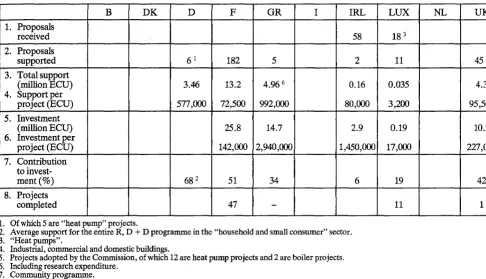
Table A
Buildings
B DK D F GR I IRL
LUX
NL UK EEC71. Proposals
18 3
received 58 255
2. Proposals
supported 61 182 5 2 11 45 4 36 5
3. Total support
4.966
(million ECU) 3.46 13.2 0.16 0.035 4.3 6.4
4. Support per
project (ECU) 577,000 72,500 992,000 80,000 3,200 95,500 178,000
~ 5. Investment (million ECU) 25.8 14.7 2.9 0.19 10.2 17.4
6. Investment per
project (ECU) 142,000 2,940,000 1,450,000 17,000 227,000 483,000
7. Contribution to
invest-ment (%) 682 51 34 6 19 42 37
8. Projects
completed 47 - 11 1 2
1. Of which 5 are "heat pump" projects.
2. Average support for the entire R, D + D programme in the "household and small consumer" sector. 3. "Heat pumps".
4. Industrial, commercial and domestic buildings.
5. Projects adopted by the Commission, of which 12 are heat pump projects and 2 are boiler projects. 6. Including research expenditure.
III.
1.2.
France is the only country to have supplied assessment results in this sector and the energy saving achieved by the projects themselves amounted to a total of 247,000 toe between 1975 and 1980, whereas the energy saving spread over the entire residential and tertiary sector has been estimated at 5.4 million toe.
Conclusions
In view of the rate of building replacement (2% per annum on average) incorpora-tion of the techniques being demonstrated both naincorpora-tionally and at Community level in all new buildings could cut household energy consumption by 1,800,000 toe per year.
The emphasis of the demonstrations should shift towards projects by the large tertiary investors, companies and cooperatives who manage numerous housing complexes and estates. This would offer several advantages, including the rapid, widespread appreciation of successful demonstrations and the centralization of decision making.
The following specific technologies deserve closer attention in future :
- building techniques enabling the heat requirements of large residential and tertiary buildings to be reduced;
- the use of micro-electronics to manage the energy requirements of existing or future residential and tertiary buildings.
HEAT PUMPS
I.
Introduction
The requirement for low-temperature heat, both for heating premises and produc-ing goods, accounts for more than 40% of total energy consumption in the Com-munity. It is therefore essential that energy-saving techniques should be applied in this field.
Heat pumps are a particularly appropriate way of meeting the requirement for low-temperature heat.
The conditions specific to each installation are best met by a particular type of system, so that no single technique will be generally applicable.
The key factor determining the success or failure of a given technique is the degree to which the interaction between the different components of a complex installation can be controlled. In practical terms, this means that the source, production and distribution of the heat must be correctly adjusted. At the moment this is possible in a few cases only, although it is the prerequisite condition for reducing investment costs. Only experiment will provide the answer.
Low-output heat pumps are mostly fitted with electric motors, while high-output systems incorporate an internal combustion engine; electric motors can sometimes be economic in the latter case as well. The heat pumps themselves may often be more sophisticated than the auxiliary equipment (heat source, regulation system, hot-water distribution, etc.); it is this equipment, however, which operation of the installation as a whole.
II.
Community and national action
In all, twelve projects have been signed in this field, representing a total investment of about 3m ECU and receiving 1,2 m ECU in financial support.
None of the twelve had been completed prior to assessment. Seven are in progress, being run as demonstration units, when a detailed measurement programme is carried out; the measurement results are not yet available. The other five, are at the pre-project stage.
These twelve heat pump projects may be classified in any of the following ways : - by the type of drive and the operating principle employed : heat pumps with an
electrically-driven compressor - 5 projects heat pumps with an ICE-driven com-pressor- 6 projects other heat-pump systems -1 project;
- by type of use : heating of premises and production of domestic hot water - 8 projects industrial applications- 4 projects;
- by the temperature of the useful heat: below 700C- 8 projects.- above 700C- 4 projects.
Nearly every project is distinguished by one or other of the following innovations in installation/ component design :
• heat extraction from the ground by large-area exchangers (approx. 9,000 m2 );
• recompression of steam by a compressor with an annular water-tube; • low-output (20 kW) ICE heat pump;
• steam generation by a high-temperature heat pump (llOOC).
Three projects are based on R & D work already carried out by a Member State and/or the Community: 00/035/79 - 171-77 EED; EE/011/81 - EE-A4-038D; EE/146/81-175-77EEUK, 369-78-EEUK, EE-B1-147-UK.
III.
Conclusions
Most of the demonstration projects selected involve current heat-pump techniques and compare their results. The majority of these projects are already economic or about to become so; they are therefore likely to be put on the market.
Some of the projects are based on the results of work carried out under national and Community programmes; others have given rise to subsequent projects.
The Community's prime objective is to halve by the year 2000 the quantity of energy required to produce low - and medium-temperature heat - a reduction of about 20 to 30% in gross energy consumption (100 to 140 million toe/year). Heat pumps could help to save about a quarter of this amount (25-35 m toe).
The whole range of heat-pump possibilities having been highlighted in the first stage of the demonstration programme, efforts should now be concentrated on those systems which, in the light of the experience gained, are technically and economically the most attractive. The two areas which should receive most empha-sis are:
- heat-pumps with a capacity of up to 200 kW in appartment blocks, and - heat pumps in industry (paper, textiles, foodstuffs, etc).
Several similar projects should be chosen, in each field, so that the most promising techniques in the Community can be compared and, in the medium term, costs reduced and the market developed by harmonizing technical specifications.
1.3. REMOTE HEATING SYSTEMS (including heat storage,
power stations and combined heat and power)
I.
Introduction
This sector of technology brings together three subsectors which are often closely linked:
(a) Remote heating systems The benefits of remote heating are : - scope for energy-saving;
- scope for substituting other energy sources for oil; - improved security of supply; and
- a considerable boost for employment, the balance of payments, the regional economy and certain industries now having a hard time.
As regards heat production for remote heating systems the emphasis is on : - the recovery and use of industrial waste heat;
- the use of new energy sources (energy from waste, solar energy, nuclear power, etc.); and
- new techniques (large heat pumps, combined heat and power, fluidized-bed combustion, etc.).
Heat storage becomes necessary where production of heat and demand for it in heating systems are out of phase and is important chiefly as a way of taking advantage of intermittent sources of industrial waste heat and of heat also available outside heating periods.
Economic transport of heat over longer distances than at present is essential for the
use of many industrial sources of waste heat and for cogeneration in large conven-tional or nuclear power stations. Any technique that can reduce the cost of heat transport has to be encouraged.
Distribution accounts for much of the capital cost of district heating systems. Further efforts will therefore be necessary to reduce its cost, e.g., by using new materials or new ways oflaying pipelines.
At present heat-distribution networks supply only 2-3% of the Community's low-temperature heat requirements. These, however, are about 40% of gross energy consumption. The energy saved by reticulated heat-supply systems through the use of combined heat and power and industrial waste heat amounts to 3-4 million toe/year. Systematic development of reticulated heat-supply systems could result by the beginning of the next century in 25% of the Community's low-temperature heat requirements being supplied by this means. The potential energy saving is believed to be some 50 millions toe/year.
(b) Power stations
Large power stations have now reached a high level of development; potential energy savings on an economic basis - leaving aside combined heat and power - are small. Endeavours to save energy must focus on special techniques chiefly relevant to industrial power plants of limited size.
Some examples are :
- combined cycles, i.e. a steam cycle with an upstream or downstream cycle using a different working fluid (heat-transfer medium);
- organic-fluid cycles; this is an important way of using relatively low-grade waste heat;
- advanced conversion systems (fuel cells);
- techniques for replacing oil and gas (e.g. gas turbines energized by solid fuels); - reducing the energy consumed by certain ancillaries (e.g. stack gas
desulphuriza-tion); and
- reducing the capital and operating costs of small hydroelectric plants in order to lower their minimum economic power level.
It is not easy to assess the potential energy savings that these technologies can provide; they will depend primarily on the technological advances achieved. In the medium term they will not exceed a few million toe/year.
(c) Combined heat and power (cogeneration)
Combined heat and power is a formidable means of saving energy :
as much as 30-40% less is consumed than with separate production of the same quantities of heat and power.
Conventional cogeneration techniques are based on : - back -pressure or pass-out steam turbines; and
- diesel engines, gas turbines and gas engines with exhaust-heat recovery.
Recent years have seen the development of modular units, with internal combus-tion engines and integral heat recovery; these burn gaseous or liquid fuels or gas/liquid mixtures. The engines drive either alternators, or compressors (e.g. for heat pumps) or other mechanical devices, or a combination of the two. The fuel cell may in the future provide a static means of combined heat and power produc-tion.
Cogeneration has grown up chiefly in industry. The need for large quantities of heat and power at the same time and in the same place and at high annual load factors has made cogeneration an attractive proposition. In the early 1970s cogen-eration in industry was saving 13-14 million toe/ year in the Community. The fuels used were mostly hydrocarbons (heavy fuel oil in particular) because they give the lowest capital and operating costs. But the abrupt rise in the oil price, the slacken-ing in industrial activity, the relative price stability of electricity produced by the utilities in large coal-fired and nuclear power stations, the high cost of new small and medium-sized coal-fired plants, high interest rates and a cloudy future for industry are all reasons why industry has found cogeneration less attractive.
Few new plants have been brought into service; existing ones are operating at reduced output or in some cases have actually been shut down. We are in a paradoxical situation where rising energy costs have caused a decline in interest in what is nevertheless one of the best ways of saving energy. Up to the year 2000 the potential for energy saving from cogeneration in industry is approximately 50 million toe/year, four or five times the present level. How far this potential can be realized will depend primarily on the economic and industrial climate. Meanwhile, industry must be encouraged to keep up its interest in cogeneration.
Cogeneration for district heating has developed somewhat in Germany and, to a lesser extent, in Denmark and France. Isolated systems, supplied by cogeneration plants are also to be found in Belgium, the Netherlands, the United Kingdom and Italy. The present energy saving is about 3 million toe/year. The potential for energy saving with cogeneration used for district heating is 30-40 million toe/year by the beginning of the next century ( 60-80% of total potential energy savings form heat-supply networks). Particularly as a result of the substantial aids in some Member States, the use of combined heat and power for district heating is enjoying steady growth.
II.
Community action and national programmes
There are fourteen projects in preparation or in hand under the Community demonstration programme. These projects typically require heavy investment. Two of them are exceptionally large (EE/120/79 and EE/217 /79) and will take several years to complete; Community finance has therefore had to be limited- initially-to the early stages.
Financial support for remote heating projects averages 21.4%; for power station projects 28.2%; and for cogeneration projects 34.5%. The sector average is 23%. This figure is relatively low because of the Commission's desire not to exclude big projects from a programme with limited resources behind it. Most projects, moreo-ver, (with the exception of Italy's) receive national aid, which has enabled the Commission to reduce the level of its own contributions.
Most of these fourteen projects needed Community support if additional, national aids were also to be obtained; it also considerably eased the problem of financing that portion of the investment not covered by national and Community support. At the time of writing none of the fourteen projects has been completed. Only three projects are in operation, and they are in the demonstration phase, during which a detailed data logging and analysis programme is carried out. The results are not yet available. Four projects are under construction. Six other projects are in the design stage or, if design is complete, construction has not yet begun. The contract for one project has still to be signed.
Remote heating, power stations and cogeneration largely rely on conventional, proven techniques. But the rise in energy prices dictates a review of some past approaches and the expedited developement of remote heating as a way of saving energy and replacing oil. This has resulted in new priorities which can be summa-rized as follows :
(a) In large cogeneration facilities it is necessary : - to reduce the use of oil products;
- to make more use of waste (both waste heat and waste substances) and alterna-tive energy sources; and
- to adopt technologies with higher performance.
(b) The use of waste heat requires heat to be transported over longer distances and stored for extended periods. Economic ways of doing both must be found.
(c) The development of heat-supply systems and of industrial cogeneration de-pends to a great extent on the administrative and legal context within each Member State. New policies for the heat market are essential if these techniques are to achieve greater penetration. "Institutional", just as much as technological, innova-tion must be promoted.
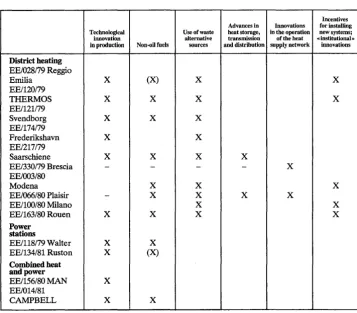
Table I
Incentives Advances in Innovations for installing Technological Use of waste heat storage, in the operation new systems; innovation alternative transmission of the heat «institutional,.
in production Non-oil fuels sources and distribution supply network innovations District heating
EE/028/79 Reggio
Emilia X (X) X X
EE/120/79
THERMOS X X X X
EE/121/79
Svendborg X X X
EE/174/79
Frederikshavn X X EE/217/79
Saarschiene X X X X
EE/330/79 Brescia - - - - X
EE/003/80
Modena X X X
EE/066/80 Plaisir - X X X X
EE/100/80 Milano X X
EE/163/80 Rouen X X X X
Power stations
EE/118/79 Walter X X EE/134/81 Ruston X (X) Combined heat
and power
EE/156/80 MAN X EE/014/81
CAMPBELL X X
Only one project is concerned with heat transport (EE/217/79) and only one with seasonal heat storage (EE/066/80).
Innovations in heat supply network operation are to be found in two projects, namely : - demand modulation (EE/330/79); and
- matching of heat demand to production by means of storage (EE/066/80).
Five projects contribute to the setting up of new heat-supply networks or display "Institutional" innovations.
Two Member States (F and D) have national demonstration programmes covering this sector. Greece has supported a project in the same field. Several Member States also provide aid for capital projects in this sector where they have no particular innovative character (F, D, NL, DK, IRL).
Feasibility studies are also promoted in several Member States.