Theses Thesis/Dissertation Collections
5-1-2008
Somnambulance
Jon KarafinFollow this and additional works at:http://scholarworks.rit.edu/theses
This Thesis is brought to you for free and open access by the Thesis/Dissertation Collections at RIT Scholar Works. It has been accepted for inclusion in Theses by an authorized administrator of RIT Scholar Works. For more information, please [email protected].
Recommended Citation
Somnambulance
An Experimental Film by Jon Karafin
MFA Imaging Arts / Computer Animation SCHOOL OF FILM AND ANIMATION ROCHESTER INSTITUTE OF TECHNOLOGY
ROCHESTER, NEW YORK MAY 2008
__________________________________________ Duane Palyka, Chair
Associate Professor
School of Film and Animation
__________________________________________ Stephanie Maxwell
Animation Chair
School of Film and Animation
__________________________________________ Tom Gasek
Visiting Professor
Title: somnambulance
Producer: Jon Karafin Budget (actual): < $1000 Start Date: October 2006 End Date: Summer 2008 Running Time: < 6 min Release Format: HD
ABSTRACT
Table of Contents:
Page 3. Discussion of Techniques and Metaphorical Imagery Page 6. General Layer Elements and Progression
Page 9. Appendix A - Original Proposal Treatment / Story / Synopsis Page 11. Approach
Page 12. Software
Page 13. Appendix B – Experimental Storyboard Examples / Test Footage Page 15. Timeline
Page 16. Budget
Page 17. Original Prose for somnambulance, libido
Discussion:
Through the two years it took to complete Somnambulance, many considerations were taken into account dealing with experimental visual forms. Many investigations led to the techniques abstracting and morphing the literal figurative forms where discussions with faculty led to new forms and new animation techniques. This animation is about the psychological space contained within the unconscious mind represented through tableau where a man attempts to find renewed energy with his lover. The experimental goal of this piece aimed to combine a multimedia of imagery without the physical techniques becoming apparent and to make an experimental animation that did not resort to angst, rather stemmed from a place of mystery and delight.
Layers, Visual Metaphor, and Initial vs. Final Techniques:
My initial explorations looked to rotoscope all imagery to bring motion to the still and allow me to use my brush to create particles to represent the body’s cellular structure. I experimented with various drawing techniques and amounts of information recreated, but continued to find the source imagery much more seductive and interesting as the rotoscope seemed contrived and added little to the resulting imagery. It appeared that my initial interest was driven by each still image I created, but when animated, actually clouded and confused the imagery. As a result, further exploration into photographic techniques, lighting, stop-motion and various 3D techniques were investigated.
Sleepwalking refers to the surrealism of conscious and unconscious thoughts. To represent this there are two major forms within the imagery: the literal still images that morph into one another to bring life and movement to flashes of memory (fig. 1 – see pg. 4), and ‘light painting’ imagery where movements are recreated through long exposures and light where movement is captured through a single still image (fig. 2, 3, 4). The frame-to-frame movement within this piece is important as it clearly distinguishes the differences between still images moving, and motion captured within a still image.
Within the compositing process, another aspect of metaphor developed to further perpetuate the idea of sleepwalking. One theory among many experts is that our dreams are black and white, and our minds actually overlay color onto these mental images. To represent this, the morphing still layers are overlaid onto the painted light layers where the areas of greatest saturation are reduced to grey scale. In this sense, the reality of the figures contained within the still images can only be seen through the cloud of grayscale imagery and the tertiary information is brightly colored to inform the way the viewer perceives each frame of information. The brightness and saturation of the imagery changes palette and hue throughout the piece from mostly red/blue to mostly
green/yellow to represent the transition from mind to body where the ‘passionate smoke’ that follows through the psychological space transforms into a more clear and coherent visual representation of the body. This aims to show a progression of the surreal world where the man in this animation strives to find rejuvenation through caffeination, thus making the world around him more clear, although never able to fully wake-up.
represented within this space, and the red/blue images (fig. 4) that contain the light-painted female form to literally dance within the space around the physical body in the previous images and acts to seduce the man back into the unconscious state. These layers are introduced within the timeline at different times and rates such that a progression of color and figurative elements evolve.
Once the still images morphed over time (fig. 7), a hand painted, stop-motion layer was created using colored water and linseed oil (fig. 5). This layer begins with exceptionally slow movement and accelerates towards the figurative climax of the animation through additional frames and greater change between each image. These painted particles are a representation of the cells within the body, where at the beginning of the sleepwalking are quite slow and meandering, and after the caffeine is ingested into the body begin to scatter and jump from side to side of the frame. Each frame of this layer was created through an intuitive abstraction of the resulting morphed images of the literal space and form.
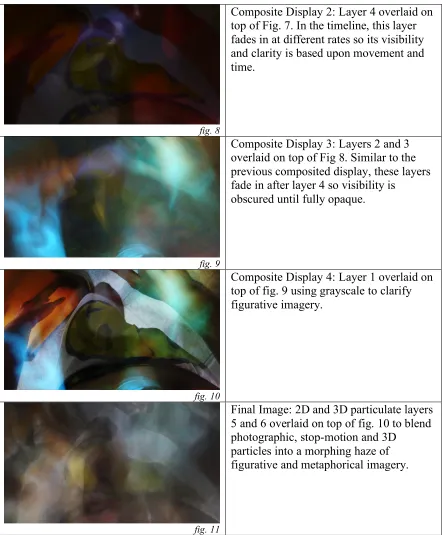
The last layer is a 3D particle smoke animation (fig. 6) that pulls its displacement mapping and color from the animation contained when all previous layers are animated and composited together (fig. 10). Geometric forms from the first layer (fig. 1) were modeled as particle emitters to create the smoke and recreate the physical space the smoke exists within. When composited overtop (fig. 11), the culminating animation results in smoke that appears to rise from the body and the female forms and lead the viewer through the evolving space that develops through these investigations of somnambulance.
Figurative vs. Abstraction / Word and Image:
The ratio between abstraction and clearly illustrated physical form was an area of constant struggle. In once sense, I wanted to clearly define the narrative that this
animation developed from, while simultaneously allowing the mystery within each frame to inform and intrigue without blatant explanation. There were times that I felt too much information was heavy handed and resulted in an uninteresting screensaver-like
animation, and there where times that too little information seemed confusing for the general viewer. The balance seemed to be facilitated by the experimentation with the written word, yet required a similar struggle to find the balance between too much information and too little.
This animation developed from a one-page prose I wrote several years ago. I wrote it as a visual poem and wanted to further develop the visual elements contained within its original conception. Many ideas and words were changed as the experimental animation progressed, as some ideas did not transcend the written word. In many of these cases, the thing that made the written prose strong were the mental ramblings of the main character for the piece. When animated, it seemed that restating something already
visually represented was repetitive, yet in many cases, if not mentioned through either the written word or through narration, was not clear. How then could I be sure to inform my audience without repeating information?
being able to focus on the imagery. I attempted to make the written word appear to be written on the frame as if it were a journal of the mind, but this too seemed contrived.
I began to record my voice, as this is a personal investigation into my mind, and placing the recorded words in the timeline of the animation. This seemed to compliment the progression of images much more effectively than text over image, yet was far too dense and still contained too much information, again taking the viewer away from the visual imagery. To accomplish the refined balance of spoken information, I removed anything that referred to something visual, and only left the thoughts of the man in the animation.
General Layer Elements and Progression:
Classifications of Source Images: Description:
fig. 1
Layer 1: This is a high-resolution still image that leads the animation through the psychological space of Somnambulance. It has a 3 light set-up to capture the image. The POV morphs from first to third person throughout the piece as to facilitate the surreal nature sleep walking.
fig. 2
Layer 2: This is a very slow exposure still image that uses green and yellow LEDs to highlight the movement from the
underlying image. To accomplish the ghosting effect, multiple exposures were taken for each image with long shutter times, mimicking the body’s position from the previous image. The green and yellow colors represent the blurring of vision, incoherent movement and the body.
fig. 3
fig. 4
Layer 4: This is the last layered photographic layer. Each contains a multiple, long exposure of the ‘smoke’ that follows the man’s body throughout the animation. Here we clearly see the female form, in a position that
compliments the composition of the underlying image (fig.1). Red and blue LEDs are used here to paint the light onto the image, to represent passion and the unconscious mind and enable a different set of colors to be overlaid during compositing.
fig. 5
Layer 5: This is stop-motion animation of droplets of colored water in linseed oil over a light table. Each frame attempts to mimic the forms and colors contained within the underlying image while using the seen within the smoke and body images to inform movement and composition.
fig. 6
Layer 6: These are the 3D particles generated in Maya that use numerous shaders and emitters with fig. 1 as a reference point. The morphed animation was the input color and displacement map of the particle cloud, using modeled geometry from the source imagery as the emitter, which allowed the resulting animation to mimic both the movements and composition from the underlying photographic image, while simultaneously providing the luscious smoke that
envelops each moment of animation.
fig. 7
fig. 8
Composite Display 2: Layer 4 overlaid on top of Fig. 7. In the timeline, this layer fades in at different rates so its visibility and clarity is based upon movement and time.
fig. 9
Composite Display 3: Layers 2 and 3 overlaid on top of Fig 8. Similar to the previous composited display, these layers fade in after layer 4 so visibility is
obscured until fully opaque.
fig. 10
[image:10.612.104.546.68.603.2]Composite Display 4: Layer 1 overlaid on top of fig. 9 using grayscale to clarify figurative imagery.
fig. 11
Final Image: 2D and 3D particulate layers 5 and 6 overlaid on top of fig. 10 to blend photographic, stop-motion and 3D
Appendix A – Original Proposal Treatment
©2008 Jon Karafin
Title: somnambulance
Producer: Jon Karafin Budget (actual): < $1000 Start Date: October 2006 End Date: Summer 2008 Running Time: < 6 min Release Format: HD
Story
An exhausted man looks for rejuvenation in caffeinated beverages during the lull between lovemaking. Somnambulance is an experimental film exploring the interaction between exhaustion and caffeine through various 2D and 3D techniques.
Original Synopsis
The script for libido is written very poetically and the film will visually parallel this style through a juxtaposition of nontraditional 2D/3D rotoscoping, 2D/3D animation, dynamics animation: particles, soft bodies and fluid containers, morphing, live action and animated water colors/oil paints.
We begin with a wash of color from black. Desaturated 2D and 3D paint dollops fall overtop, slowly at first, then exponentially more quickly. These colors begin morphing and forming simple lines. A dancing candle flame forms through contour. We capture the moment right before the candle extinguishes and the contours extend to follow the rising smoke. These lines wrap around the initial environment revealing empty wine bottles, overturned chairs, etc. The lines continue rising, like a dancing waft of smoke and forms more concrete objects.
An exhausted man staggers out of a bedroom wearing only smiley-faced boxers. As he leaves, he hears a noise. The lines freeze. The only thing moving is a dangling handcuff that interrupts the 3D mist in this space. After a brief moment of reassurance, the motion slowly continues. Lines wrap violently around his temples and wrists as his bruised body beats with his accelerated pulse. Through a tracking, consistently moving camera, we morph between 3rd person perspective images following the chaotic motion of this character. The fluid contours, morphing perspectives, animated paint, and rotoscoped 2D/3D images obscure his face. We continue in this fashion as the male attempts to make his way into a kitchen as his body strobes between movements.
his face and the liquid’s contours flow off of the 3D object. The camera tracks back to the coffee maker as it perks. A slow drip of brown falls. The noises seem to get closer, simultaneously represented through undulating lines, moving to the wave forms of sound, layered behind the character. His attention vacillates between the noise and the slowly perking coffee until he scoops a handful of grinds from the container and tosses it directly into his mouth.
The line structure solidifies. Everything is moving so quickly that more forms and shapes can be discerned.
From the right, a female contour, mimicking the smoke from the beginning, wraps her arms around the male character and pulls him off screen. The negative space where the character once was remains and slowly flows upward, like a fluid as we hear the bedroom door slam shut. The minimalist lines are all that remain over black with live action footage underneath.
The camera slowly returns to its first position, looking at the extinguished candle with the bedroom door behind. The lines, moving like smoke in a vacuum, migrate towards the candle. The live action behind slowly fades to black. The now red smoke forms around the candle, for a moment hovers, and then ignites.
Approach
©2008 Jon Karafin
For this film, there are many tools and techniques that were explored and utilized. As this is an experimental film, these techniques developed through my journey and further progress into this piece.
Description of Composited Techniques Explored:
Animated Paint: Backlit oils and watercolors in clear acetate with images photographed on an animation stand from overtop and on a digital scanner from underneath. This dual imagery gave me the flexibility to rotate between a variety of textures and styles for the tempo of this piece. This painted footage was then imported on top of the morphing images and be the stemming point for the rotoscoped lines as they were digitally pushed and pulled to form initial contours.
Morphing Images: the actual video for this piece originated from high resolution camera stills that followed the action of the character as described above. These pictures were masked to morph into each other.
3D Rotoscope: In Maya, using ‘sketching’ shaders and various scripts, the environment as described by the morphing images was modeled completely so that the motion can be interpolated to form a visual juxtaposition between the 2D morphing imagery and the 3D movement.
2D Rotoscope: This 3D rotoscope was then rotoscoped in 2D to allow me the flexibility to add emotive line, texture, and incorporate it into the animated paint as described above.
Software and uses as it pertains to this project:
Maya: 3D animation, 3D rotoscope, Dynamics
Silo: Advanced Modeling
TVPaint / Mirage: 2D rotoscope from 2D and 3D sources
Painter: Advanced painting techniques
Photoshop: Manipulation of 2D images, filmstrip images
AFX: Compositing, timing, layering, morphing
Shake: Advanced compositing, morphing
Final Cut Pro: Editing, timing
Digital Performer / ProTools: Advanced audio editing
SoundTrack: Initial scoring
Reason: Advanced scoring
Timeline © 2008 Jon Karafin
FIRST STAGE:
•Script drafts: 2005-2006
•Final script: October 5, 2006
•Thesis Chair decision and signature: November 2006
•Proposal accepted: November 2006
SECOND STAGE:
•Live action and still image shoot completed by: Fall 2007 •Modeled sets and characters created by: Fall 2007
•Paint Animation completed by: Fall 2007
•Morphing stills and timing created by: Fall 2007
THIRD STAGE:
•First pass 2D animation and rotoscope: Winter 2007 •First pass 3D animation and rotoscope: Winter 2007 •Second pass 2D animation and rotoscope: Winter 2007 •Second pass 3D animation and rotoscope: Winter 2007
FOURTH STAGE:
•Third pass 2D animation and rotoscope: Winter 2007 •Third pass 3D animation and rotoscope: Winter 2007
•Compositing and final score: Winter 2007
FINAL STAGE:
•General postproduction and time to fix unexpected problems: Spring 2008
•Titles, credits: Spring 2008
Budget ©2008 Jon Karafin
Title: somnambulance
Producer: Jon Karafin Budget (actual): < $1000 Start Date: October 2006 End Date: Summer 2008 Running Time: < 6 min Release Format: HD
This film, as it is both experimental and completely hand created, did not require much external funding. I owned most of the supplies necessary to complete this film. The majority of the cost developed as new methods came to fruition. Other unfortunate sources of cost were from software licensing for various plug-ins and software that I did not own.
Paint / traditional animation supplies: <$400
Storage media / DVDs: <$400
Contingency: <$200
Subtotal: <$1000
Software licensing: <$500
Original (unedited ‘inspiration’) Prose for somnambulance
soft focus. windows steamed opaque. like a pictorialist photograph.
laundry strewn over hardwood floors. empty bottles of wine over maroon walls. overturned chairs. tv flickering. table littered with half-eaten foods. no candles, just wax.
unlocking door. retreating man hobbles out revealing red velvet comforter over bare mattress. he dares not make a sound. a dangling handcuff from wrist interrupts the delicate mist.
a distant toilet flushes. cringes. wavering restraint. color drains from his already emaciated body. praying mantis.
thin man, sweaty man. continues limping. looks exhausted. only wearing smiley-face boxers. the only thing smiling. hair mussed in a half-mo-hawk. wrist and ankles swell. bruised deep red. blood-shot eyes even darker. stumbles a bit. head throbbing. temples pulse violently.
floorboards creek with every deliberate limping step.
hands shake uncontrollably. contours jitter. rising sun casts orange glow on glistening skin. rummages through cluttered closets. grabs ground coffee from cupboard. ‘caffeinated’. good. he pants. still out of breath. a sound. looks over shoulder.
splashes cold water on face. rinses mouth. spoons coffee into machine and flicks on switch. perking.
perking. perking.
a noise. keeps looking over shoulder. door opens a crack. crumpled laundry. dripping wax. congealed wine.
the bedroom door moves slightly. he freezes. even the coffee pot stops. looks guilty.
a slow trickle of coffee. not enough for one cup yet. a little impatient dance. a painfully slow drip of brown. still fatigued. he motions for the machine to hasten.
more rustling from the half-open door.
searching. finds some. whips the instant coffee into mouth, chews and drinks some water. a painful gulp. repeat. it’ll have to do.
things begin to solidify. we see him more clearly. the caffeine rushes to his head like a helium balloon under water. he walks back to the open door with renewed vigor. he gestures a small prayer. a moment to himself… before he finishes preparing, a female grabs his arm and throws him into the room. the door slams shut and locks.
moaning and rusty bed springs.
Final Report / Reactions
Somnambulance was very well received at the thesis screen on May 20, 2008. The final animation, consisting of over 2500 layers, took over three weeks on three multi-processor computers to render, so I was extremely pleased with the completion of the render and the timing of the exhibition.
I learned a lot about HD and question the short term potential for HD screenings with current processors in mind. As I understand it, Blu-ray discs use H.264
compression. For my animation, I rendered out three versions: H.264, HDV, and .mov (animation compressor) at 1280x720 resolution (although the piece is created at 1920 – the 1920 file would have taken four times longer to render). The H.264 rendered a 700mb file for this six-minute piece and looked terrible where pixels were blocky and artifacted, and motion was extremely distorted. The HDV file was nearly one gig and looked significantly better, yet still made the animation quite desaturated and left the subtle nuisances, which were imperative for this animation, murky at best. The .mov (animation compressor) rendered out a massive 20 gig file that looked beautiful, but the computer could not handle playing any more than short spurts of the file. Several other small tests were done with still images on other various compressors, but the consensus in the industry seems to lean towards H.264 for most HD compression. With the
rendered tests in mind, I have no idea how plans to utilize the H.264 compressor. At the screening, pieces compressed at DV SD resolution and scaled up to projector resolution looked far better with the less compression than the HD files that were not scaled, but needed extremely heavy compression to play at real-time. Until the processors of current technology can keep up with real time HD, I will be rendering out in SD resolution to prevent the artifacting that was experienced in all HD files at the screening.
The exploration of both story and technology that somnambulance has led me through is integral to my future as both a storyteller and an animator. I plan to utilize this knowledge and growth in all of my future endeavors, and hope my skills as an image-maker increase exponentially as a result of this film.
I thank the entire SOFA faculty, most notably Duane, Stephanie, Tom and Skip, for their continued help and support through this process and attribute its success to their