COMMISSION OF THE EUROPEAN COMMUNITIES
Brussels, 01.07.1999 COM(1999)328 final
99/0135 (CNS)
Proposal for a
COUNCIL DECISION
concerning the conclusion on behalf of the European Community of an agreement between the United States of America and the European Community
on the Co-ordination of Energy-Efficient Labelling Programmes
EXPLANATORY MEMORANDUM
1. Office equipment (personal computers, monitors, fax machines, scanners, copiers and printers) accounts for a large proportion of electricity consumption in the tertiary sector. It currently consumes about 50 TWh per year. Moreover, this is one of the fastest growing electricity loads in the Community, as it is linked to the fasted growing sector of the economy, the service sector, and to the increased use of information technology (e.g. internet, etc.). The Commission, under the SAVE1 Programme, has launched actions to reduce the electricity consumption of all the major end-use devices, including domestic appliances (e.g. refrigerators), service-sector equipment (e.g. ballasts), and industrial equipment (e.g. electric motors). Under the SAVE programme, particular care has been taken to implement the most effective and cost-effective measures to achieve energy savings, maximise the benefits for the consumer and minimise the impact on manufacturers. These measures include minimum efficiency standards, labelling and other consumer information actions, and negotiated agreements. For office equipment, the most effective energy-saving feature is the ability to substantially reduce power consumption while not in use, i.e. reduce power consumption while in stand-by2.
2. Member State and independent experts indicated that the most effective and cost-effective measure to reduce the energy consumption of office equipment was to introduce a voluntary labelling programme, using a logo to identify the most efficient office equipment. They also made other important points:
• office equipment was a fast-changing product area, where technical development was proceeding at a very fast pace; therefore, in order to keep up with technological development, a voluntary programme based on self-assessment was the recommended option;
• office equipment was traded world-wide (e.g. industry produces monitors in one country and ships them all around the world); for manufacturers therefore, it was essential to harmonise energy-efficiency requirements, test methods and labels to avoid the need to comply with many conflicting technical criteria;
• energy-efficient office equipment was capable of reducing power consumption while in stand-by, but this required the involvement of users or company IT managers to enable this feature3; there was consequently a need for labelling to go hand in hand with intensive information actions to educate users to enable the energy-saving features;
1
OJ L 307 of 8.11.1991, p.34 - Specific Actions for Vigorous Energy Efficiency. On 16 December 1996 the Council decided on a new multi-annual programme (SAVE II) OJ L 335 of 24.12.1996.
2
A typical PC with monitor consumes up to 200 KWh when in active mode, but if the energy-saving features are enabled this can be reduced to about 50 W or less.
3
• in the United States of America, the US EPA introduced in 1993 a voluntary labelling programme for office equipment, the Energy Star Program; this was a great success from the outset, resulting in a high level of participation by manufacturers, encouraging the vast majority of manufacturers to introduce energy-saving features, and raising consumer awareness of the stand-by losses of office equipment.
3. Against this background and in agreement with Member State experts and European manufacturers, the Commission decided that the best way of reducing the energy consumption of office equipment was to introduce the Energy Star Programme in the Community. This would: i) build upon the advantage of an already well-recognised logo in the Community market; ii) maximise manufacturers’ participation and their active involvement in promoting energy savings; and iii) use a well-recognised logo to educate users to energy savings. Moreover, this would result in clear advantage for Community economic operators. The Energy Star logo was the “de facto” required standard for office equipment sold on the US market. In addition, the Energy Star requirements were becoming standard world-wide (in the Community as well), and this without any European input. The Commission stated that the introduction of the Energy Star as the Community labelling programme for office equipment would be possible only if the Community were to become an equal partner alongside the US authorities in running the programme and setting the technical requirements. Moreover, this had to be translated into a binding agreement between the USA and the Community. At the time, Japan also expressed an interest in entering into such an agreement, and after exploratory talks it was therefore planned to negotiate and conclude a tripartite agreement.
4. On 14 February 1996,the Commission accordingly requested a mandate4 to negotiate an agreement with the USA and Japan on the co-ordination of labelling programmes for energy-efficient office equipment. In September 1996, the Council authorised5 the Commission to negotiate such an agreement with the USA and Japan, and approved a set of negotiating directives. During the early phase of the negotiations, it emerged that Japan was not interested in a binding international agreement, having already concluded an administrative arrangement with the USA. Japan therefore decided in February 1998 to withdraw from the negotiations. The Commission subsequently informed the Council of this change. Although a tripartite agreement would have done more to avoid an imbalance in favour of the USA, and better served the interests of EU economic operators, the Commission felt that the advantages of a bilateral agreement between the Community and the United Sates were still significant and therefore worth pursuing. The Council’s Energy working group was accordingly informed, and the Commission was allowed to continue negotiating with the USA on a bilateral agreement based on the same mandate.
4
SEC(96)224 final.
5
5. The Community’s negotiation position had to take full account of the European Community’s policies, in particular its energy, environmental and internal market policies. The negotiations resulted in the attached agreement, to be concluded by an Exchange of letters between the European Community and the United States of America. In particular, the present proposal would contribute to the Community’s objective of reducing CO2 emissions and result in large economic savings for office equipment users. The interests of EU economic operators are fully taken into account and Community IT industry fully supports the proposal. As regards the ways and means of implementing the Energy Star programme within the Community, the Commission will come forward with a Proposal for a Council Regulation on a Community labelling programme for office equipment. The proposed Council Regulation will reflect the terms of the present proposal.
6. In the light of the above considerations, the Commission proposes that the Council:
– conclude the attached Agreement between the Government of the United States of America and the European Community on the Co-ordination of Energy-Efficient Labelling Programmes; and
Proposal for a
COUNCIL DECISION
concerning the conclusion on behalf of the European Community of an agreement between the United States of America and the European Community
on the Co-ordination of Energy-Efficient Labelling Programmes
THE COUNCIL OF THE EUROPEAN UNION,
Having regard to the Treaty establishing the European Community, and in particular Article 130, in conjunction with Article 300(2), first sentence thereof,
Having regard to the Treaty establishing the European Community, and in particular Article 300(4) thereof,
Having regard to the proposal from the Commission, Having regard to the opinion of the European Parliament,
(1) Whereas a comprehensive study on energy efficiency in office equipment indicated that a voluntary labelling programme for office equipment is the most cost-effective action to achieve the potential energy savings; whereas the study proved that there is added value in an international co-ordination of labelling programmes to achieve the potential as well as to ensure fair comparability between products of the same type;
(2) Whereas it is desirable to facilitate international trade and to reduce the regulatory burden on the operators whilst maximising the energy savings; (3) Whereas the Council has authorised the Commission to negotiate an
agreement with Japan and the United States of America; Whereas Japan officially withdraw from the negotiation; Whereas there are clear benefits to conclude a bilateral agreement;
(4) Whereas an agreement has been negotiated with the United States of America; HAS DECIDED AS FOLLOWS:
Article 1
Article 2
The Council hereby authorises the Commission to adopt, on behalf of the European Community, modifications to the Agreement, following the procedures indicated in Article IX and X of the Agreement.
Article 3
The President of the Council is hereby authorised to designate the person empowered to sign the Agreement referred to in Article 1 in order to bind the European Community.
Done at Brussels,
ANNEX Agreement between
the Government of the United States of America and the European Community on the Coordination of Energy-Efficient Labeling Programmes
The Government of the United States of America and the European Community, hereinafter “the Parties”, desiring to maximize energy savings and environmental benefits by stimulating the supply of and demand for energy-efficient products, have agreed as follows :
Article I General Principles
1. A common set of energy-efficiency specifications and a common logo shall be used by the Parties for the purpose of establishing consistent targets for manufacturers, thereby maximizing the effect of their individual efforts on the supply of and demand for such product types.
2. The Parties shall use the International ENERGY STAR Logo for the purpose of identifying qualified energy-efficient product types listed in Annex C.
Article II Definitions
1. For the purposes of this Agreement :
(a) “ENERGY STAR” means the U.S.-registered service mark designated
in Annex A and owned by the United States Environmental Protection Agency (“U.S. EPA”);
(b) “International Logo” means the U.S.-registered certification mark
designated in Annex A and owned by U.S. EPA;
(c) “ENERGY STAR Marks” means the “ENERGY STAR” name and
the International Logo, as well as any versions of these marks that may be developed or modified by the Management Entities or Program Participants, as herein defined, including the sign or marking, contained in Annex A, which will be adopted by the European Community to implement the terms of this Agreement;
(d) “ENERGY STAR Labeling Program” means a program administered by a Management Entity using common energy-efficiency specifications, marks, and guidelines to be applied to designated product types;
(e) “Program Participants” means manufacturers, vendors, or resale
STAR Labeling Program by registering or entering an agreement with the Management Entity of either Party;
(f) “Specifications” are the energy-efficiency and performance requirements, including testing methods listed in Annex C, used by Management Entities and Program Participants to determine qualification of energy-efficient products for the International Logo.
Article III Management Entities
Each Party hereby designates a management entity responsible for implementation of this Agreement (the “Management Entities”). The European Community designates the Commission of the European Communities (“Commission”) as its Management Entity. The United States of America designates the U.S. EPA as its Management Entity.
Article IV
Administration of the ENERGY STAR Labeling Program
1. Each Management Entity shall administer the ENERGY STAR Labeling Program for the energy-efficient product types listed in Annex C, subject to the terms and conditions set forth in this Agreement. Program administration includes registering Program Participants on a voluntary basis, maintaining Program Participant and compliant product lists, and enforcing the terms of the logo use guidelines set forth in Annex B.
2. The ENERGY STAR Labeling Program shall use the Specifications listed in Annex C.
3. Each Management Entity shall take effective measures to educate consumers about the ENERGY STAR marks, in accordance with the logo use guidelines set forth in Annex B. These measures may include informing consumers about the benefits of purchasing energy-efficient products that meet the Specifications, and undertaking marketing or educational efforts to stimulate market demand for labeled products.
4. Each Management Entity shall bear the expenses for all of its activities under this Agreement.
Article V
Participation in the ENERGY STAR Labeling Program
1. Any manufacturer, vendor or resale agent may enter the ENERGY STAR Labeling Program by registering as a Program Participant with the Management Entity of either Party.
laboratory and that meet the Specifications set forth in Annex C, and may self-certify product qualification.
3. The registration of a Program Participant in the ENERGY STAR Labeling Program by the Management Entity of one Party shall be recognized by the Management Entity of the other Party.
4. To facilitate the recognition of Program Participants in the ENERGY STAR Labeling Program in accordance with Paragraph 3 above, the Management Entities shall cooperate in order to maintain common lists of all Program Participants and products that qualify for the International Logo.
5. Notwithstanding the self-certification procedures specified in Paragraph 2 above, each Management Entity reserves the right to test or otherwise review products that are or have been sold within its territories (in the territories of the European Community Member States in the case of the Commission) to determine whether the products are certified in accordance with the Specifications set forth in Annex C. The Management Entities shall communicate and cooperate fully with one another to ensure all products bearing the International Logo meet the Specifications set forth in Annex C.
Article VI
Program Coordination Between the Parties
1. The Parties shall establish a Technical Commission to review implementation of this Agreement, composed of representatives of their respective Management Entities.
2. The Technical Commission shall meet periodically to review the operation and administration of the ENERGY STAR Labeling Program, the Specifications set forth in Annex C, product coverage, consumer education efforts and the progress in achieving the objectives of this Agreement.
3. Nonparties (including other governments and industry representatives) may attend meetings of the Technical Commission as observers, unless otherwise agreed by both Management Entities.
Article VII
Registration of the ENERGY STAR Marks
1. The U.S. EPA, as owner of the ENERGY STAR marks, may seek to register the marks in the European Community. The Commission shall not seek or obtain any registration of the ENERGY STAR marks or any variation of the marks in any country.
Article VIII
Enforcement and Non-Compliance
1. In order to protect the ENERGY STAR marks, each Management Entity shall ensure the proper use of ENERGY STAR marks within its territory (within the territories of the European Community Member States in the case of the Commission). Each Management Entity shall ensure that the ENERGY STAR marks are used only in the form that appears in Annex A. Each Management Entity shall ensure that the ENERGY STAR marks are used solely in the manner specified in the logo use guidelines set forth in Annex B. To this end : 2. Each Management Entity shall ensure that prompt and appropriate action is
taken against Program Participants, whenever it has knowledge that a Program Participant has used an infringing mark or has affixed the ENERGY STAR marks to a product that does not comply with the Specifications set forth in Annex C. Such actions shall include, but not be limited to:
(a) Informing the Program Participant in writing of its non-compliance with the terms of the ENERGY STAR Labeling program;
(b) Through consultations, developing a plan to reach compliance; and (c) If compliance cannot be reached, terminating the registration of the
Program Participant, as appropriate.
3. Each Management Entity shall ensure that all reasonable actions are taken to end the unauthorized use of the ENERGY STAR marks or use of an infringing mark by an entity that is not a Program Participant. Such actions shall include, but shall not be limited to:
(a) Informing the entity using the ENERGY STAR marks of ENERGY STAR Labeling Program requirements and proper logo use guidelines; and
(b) Encouraging the entity to become a Program Participant and register qualified products.
4. Each Management Entity shall immediately notify the Management Entity of the other Party of any infringement of the ENERGY STAR marks of which it has knowledge as well as the action taken to end such infringement.
Article IX
Procedures for Amending the Agreement and its Annexes A and B, and for Adding New Annexes
2. A proposed amendment shall be made in writing and shall be discussed at the next meeting of the Technical Commission, provided that it has been communicated to the other Management Entity at least sixty days in advance of such meeting.
3. Amendments to this Agreement, to its Annexes A and B, and decisions to add new annexes shall be made by mutual agreement of the Management Entities.
Article X
Procedures for Amending Annex C
1. A Management Entity seeking to amend Annex C to revise existing Specifications, or to add a new product type (“Proposing Management Entity”) shall follow the procedures set forth in paragraphs 1 and 2 of Article IX, and shall include in its proposal :
(a) A demonstration that significant energy savings would result from revising the Specifications or adding the new product type;
(b) Evidence of existing technology that would make possible cost-effective energy savings without negatively affecting product performance;
(c) Information on the estimated number of product models that would meet the proposed specification and approximate market share represented;
(d) Information on the views of industry groups potentially affected by the proposed amendment; and
(e) A proposed effective date for the new Specifications, taking into consideration product life cycles and production schedules.
2. Proposed amendments that are accepted by both Management Entities shall enter into force on a date mutually agreed by the Management Entities.
3. If, after receipt of a proposal made in accordance with paragraphs 1 and 2 of Article IX, the other Management Entity (“Objecting Management Entity”) is of the view that the proposal does not meet the requirements specified in Paragraph 1 above or otherwise objects to the proposal it shall promptly (normally by the next Technical Commission Meeting) notify the Proposing Management Entity in writing of its objection and shall include any available information supporting its objection; for example, information demonstrating that the proposal, if adopted, would likely :
(a) Disproportionately and unfairly confer market power on one company or industry group;
(c) Conflict with its laws and regulations; or (d) Impose burdensome technical requirements.
4. The Management Entities shall make best efforts to reach agreement on the proposed amendment at the first meeting of the Technical Commission following the proposal. If the Management Entities are unable to reach agreement on the proposed amendment at this Technical Commission meeting, they shall seek to reach agreement in writing prior to the subsequent Technical Commission meeting.
5. If, by the end of the subsequent Technical Commission meeting, the Parties are unable to reach agreement, the Proposing Management Entity shall withdraw its proposal; and with respect to proposals to revise existing Specifications, the corresponding product type shall be removed from Annex C by the date agreed upon in writing by the Management Entities. All Program Participants shall be informed of this change and of the procedures to be followed to implement this change.
Article XI General Provisions
1. Other environmental labeling programmes are not covered by this Agreement and may be developed and adopted by either of the Parties.
2. All activities undertaken under this Agreement shall be subject to the applicable laws and regulations of each Party and to the availability of resources.
3. Nothing in this Agreement shall affect rights and obligations of any Party deriving from a bilateral, regional or multilateral agreement into which it has entered prior to the entry into force of this Agreement.
4. Notwithstanding any other provisions of this agreement, either Management Entity may register Program Participants with respect to products types not included in Annex C, that are part of its domestic labeling program; and neither Party shall hinder the import, export, sale or distribution of any product because it bears the energy efficiency marks of the Management Entity of the other Party.
Article XII
Entry into Force and Duration
1. This Agreement shall enter into force on the date upon which each Party has notified the other in writing that its respective internal procedures necessary for its entry into force have been completed.
Article XIII Termination
1. Either Party may terminate this Agreement at any time by providing three months written notice to the other Party.
2. In the event of termination or non-renewal of this Agreement, the Management Entities shall inform all Program Participants which they have registered of the termination of the joint program. Moreover Management Entities shall inform the Program Participants which they have registered that each Management Entity may continue the labeling activities under two separate individual programmes. In this case, the European Community labeling program will not use the ENERGY STAR marks. The Commission shall ensure that itself, the Member States of the European Community and any Program Participants which it has registered cease using the ENERGY STAR marks by the date agreed upon in writing by the Management Entities. The obligations contained in this Article XIII (2) shall survive the termination of this Agreement.
Done at ... this ... day of ... 1998.
For the United States of America : For the European Community : ... ...
ANNEX A
ENERGYSTARInternational Logo
International Logo: Black & White
ANNEX B
Guidelines for Proper Use of the ENERGYSTARName and International Logo
The ENERGYSTARname and International logo are U.S. registered marks of the U.S.
EPA. As such, the name and logo may only be used in accordance with the following guidelines and the Memoranda of Understanding (MOU) or the European Commission Registration Form signed by Program Participants in the ENERGYSTAR
labeling program. Please distribute these guidelines to those who will be
responsible for preparing ENERGYSTARmaterials on your behalf.
U.S. EPA (and the European Commission, in the European Community Member States Territory) oversee proper use of the ENERGYSTARname and International logo. This includes monitoring the use of the marks in the marketplace, and directly contacting those organizations that are using them improperly or without authorization. Consequences of misusing the marks may include the termination of the Program Participant's participation in the ENERGYSTARlabeling program, and, for
products imported into the U.S. improperly using the marks, the possible seizure by the U.S. Customs Service of those goods.
1. INTRODUCTION
The ENERGYSTAR name may be used for general educational purposes. The name
may be displayed when describing the ENERGYSTAR labeling program, such as in a special educational brochure, newsletter, annual report, or other article that provides the details of the program and the program’s requirements. (See Section II below for more information.)
The International logo may be used as a product label to designate specific products that meet the specifications contained in the ENERGY STAR MOUs or European
Commission Registration Form. (See Section III below for more information.)
2. GENERAL EDUCATIONAL USE OF THE ENERGYSTAR NAME
Program Participants are allowed to include the ENERGY STAR name in general
educational or informational materials that discuss the ENERGY STAR labeling
program. This includes brochures, newsletter articles, annual reports, etc.
3. USE OF INTERNATIONAL LOGO BY PROGRAM PARTICIPANTS AS A PRODUCT LABEL
3.1. Applying the International logo to Products
The International logo is a certification mark and may only be used to certify specific products that have been determined to meet the ENERGY STAR labeling program requirements. For those specific products, the International logo may be
logo, and the credibility of the ENERGYSTAR labeling program, it is imperative that this basic rule not be broken.
Each ENERGY STAR Program Participant has signed an MOU or the European
Commission Registration Form making it responsible for the proper use of the International logo. This includes its own use of the International logo, as well as use by its authorized representatives, e.g., ad agencies, dealers, etc. Therefore, the Program Participant should make available these logo use guidelines to any party that would be preparing materials on the Program Participant’s behalf.
3.2. Using the International Logo in Product Advertisements
When preparing print advertisements or brochures, the International logo should be placed on or directly adjacent to the compliant product. If only one product is pictured in the advertisement (and that product is compliant) the International logo may be placed anywhere on the page. But if multiple products are pictured, the International logo should be placed only next to those products which are compliant. The International logo may not be placed along the bottom or side of the advertisement next to other general icons unless every product pictured in the advertisement is
ENERGYSTARcompliant.
If the International logo is used in a general advertisement for a product line where only certain models are compliant, the Program Participant should include language that clarifies the situation (e.g., "The [product model name] meets the ENERGYSTAR
requirements") or the Program Participant may include specific language under each of the compliant models (e.g., include a bullet point "ENERGY STAR compliant" in a list of product attributes).
The only time a Program Participant may use the International logo without making reference to a specific product is when the Program Participant is informing the public of the certification purpose of the mark. For example, the Program Participant may include a statement stating, "Look for the (International logo) on our products. It represents that the product meets the ENERGYSTARguidelines for energy efficiency."
In addition, under no circumstances shall the name or logo be used in a manner that would imply U.S. EPA and/or the European Commission endorsement of the company, its products, or its services.
3.3. International logo Disclaimer Statement
As described in the MOU and European Commission Registration Form, when the International logo is used by a Program Participant, it shall always be accompanied by the following statement: “As an ENERGY STAR Program Participant, (your company
name) has determined that this product meets the ENERGYSTARguidelines for energy efficiency." The disclaimer statement must accompany the logo, but it does not have to appear side-by-side; the phrase may be placed where normal explanatory information is found. For example:
has determined that this product meets the ENERGY STAR guidelines for energy efficiency.").
• On brochures and manuals, the phrase must appear with the first use and/or in the front section with the recognition of other trademarks.
• When the logo is applied directly to the product, Program Participant may place this statement in the user's manual or on the nameplate.
• If the logo appears on the product packaging, the Program Participant is not required to include the disclaimer statement on the packaging; rather, the Program Participant may use the disclaimer statement in the user's manual, or in other collateral sales and marketing materials.
• As a general rule, the type must be visible -- at a minimum, 2.5 point type size.
4. REPRODUCTION OF THE INTERNATIONAL LOGO:
The International logo is available in color and in black and white on disk in two graphic formats: .EPS (Encapsulated Postscript) and .BMP (Bitmap). These files are for distribution to your customer graphics department. The .EPS version can be used on both PC and Mac computers (.TIF format is also available upon request). As described in all of the ENERGY STAR MOUs and the Registration Form, the International logo shall not be altered, cut apart, or separated in any way. Following are more detailed guidelines:
• The logo may be resized, but please maintain the same proportions.
• The colors of the 4-color logo must be reproduced faithfully (4-color process).
• The 4-color logo may be reproduced in black and white shading.
• The simplified outline or “line art” logo may be reproduced in the following manner:
– black or white on solid colors
– one-color version in the color of your choice
– two-color version, with colors from the 4-color version, e.g., blue and yellow, green and blue, yellow and blue.
5. REGISTERED MARK
As noted above, the ENERGY STAR name and International logo are U.S. registered marks of the U.S. EPA. When using the ENERGYSTAR name or International logo in
• When referring to the ENERGY STAR labeling program or its Program
Participants, the ENERGY STAR name must always be expressed in capital
letters. It is also appropriate to use a slightly larger point size for the first letter of each word, e.g., twelve point for the E and S, and ten point for the other letters — ENERGYSTAR.
• The Program Participant must indicate the registered status of the marks by including the registered symbol (®) each time the ENERGY STAR name or
International logo appears in the US market in a brochure, advertisement, poster, product packaging, etc. (i.e., ENERGYSTAR®). (Please note that in U.S.
EPA-developed materials where the phrase ENERGY STAR is used repeatedly, such as the logo use guidelines, the registered symbol will only appear once so as not to distract the reader.)
-AND-The Program Participant may provide in the US market the registered mark statement: "ENERGYSTARis a U.S. registered mark". Similar to the disclaimer
statement, the registered mark statement may be placed where normal explanatory information is found (e.g., at the bottom of an advertisement or poster, at the bottom of the relevant page in a manual or brochure, or on the product packaging).
6. OTHER ENERGY STAR LOGOS (NOT FOR USE BY OFFICE EQUIPMENT
PROGRAM PARTICIPANTS)
It is likely that you have seen other versions of the logo in the marketplace. These logos are either obsolete or are for use with other ENERGY STAR product areas.
Please do NOT use the following logos.
OBSOLETE LOGO LOGO FOR USE BY PARTICIPANTS IN OTHER PROGRAMMES (HVAC, HOMES, ETC.)
7. ADDITIONAL QUESTIONS REGARDING THE USE OF THE LOGO
ENERGYSTARHotline
In the U.S. call toll-free: 1-888-STAR-YES (1-888-782-7937) Outside of the U.S. call: 202 775-6650
Fax: 202 775-6680
20
ANNEX C
1. PERSONALCOMPUTER& MONITORSPECIFICATIONS 1.1. Definitions
1.1.1. Computer: A desktop, deskside, or smaller single-user unit, including high-end desktop computers, personal computers, workstations, network computer desktops, X terminal controllers, and PC-based point-of-sale retail terminals. To qualify, the unit must be capable of being powered from a wall outlet, but this does not preclude battery powered units. This definition is intended primarily to cover computers sold for use in businesses or homes.
1.1.2. Monitor: A cathode-ray tube (CRT), liquid crystal display (LCD) or other display device and its associated electronics. A monitor may be sold separately or included in the computer casing. This definition is intended primarily to cover standard monitors designed for use with personal computers. For purposes of this specification, however, the following may also be considered a monitor: mainframe terminals (sometimes called "dumb" terminals) terminals with some processing power and designed for use in a client/server environment (sometimes called "smart" terminals), and physically separate display units for ATM's and point-of-sale retail terminals
.
1.1.3. Integrated Computer System: Systems in which the computer and visual display monitor are combined into a single unit. Such systems meet all of the following criteria: the display unit is included in the computer casing; it is not possible to measure the power consumption of the two components separately; and the system is connected to the wall outlet through a single power cable.
1.2. Product Qualification for the Energy Star Logo 1.2.1. Technical Specifications
A. Monitors:
An Energy Star compliant monitor shall have the capability to automatically enter two successive low-power modes. In the first low-power "sleep" mode (similar to the Display Power Management Signaling (DPMS) "Suspend" mode), the monitor shall consume 15 watts or less after a period of inactivity. If the monitor continues to be idle, upon instructions from the CPU, it shall enter a second low-power "deep sleep" mode (similar to the DPMS "Off" mode). An Energy Star compliant monitor in this second low-power mode shall consume 8 watts of electricity or less. Monitors that have the capability to automatically proceed from active mode to a low-power mode of 8 watts or less are assumed to comply.
21
required to initiate a monitor's low-power modes, the software shall be shipped with the monitor.
B. Computers:
An Energy Star computer shall satisfy the following conditions:
i Power Consumption : A computer whose power supply has a maximum continuous output power rating less than or equal to 200 watts (< or = 200W) shall automatically enter a low-power “sleep” mode of 30 watts or less after a specified period of inactivity. A computer whose power supply has a maximum continuous output power rating greater than 200 watts (> 200W) shall automatically enter a low-power “sleep” mode of no more than 15 percent of its maximum continuous output power rating after a specified period of inactivity. The maximum continuous output power rating of a power supply is the value certified by a Nationally Recognized Testing Laboratory (NRTL) such as Underwriters’ Laboratories (UL) in the United States, or by a European accredited laboratory for products registered with the European Commission. Exit outlets mounted on the system enclosure for the connection of peripheral equipment which impose no load on the system power supply are not included in the wattage calculation. Fans and other devices necessary for the operation of the unit are included in the wattage calculation.
In order to prevent any inconvenience to the user, a computer in the low-power mode shall automatically "wake up" (i.e., return to the full-power or active mode) upon resumption of system activity or receipt of external input (e.g., mouse movement, keyboard activity, typing of a password, modem interrupts, etc.). When the system is awakened, the user shall be returned automatically to the same situation that existed prior to activation of the sleep mode, i.e., all files and software packages in use at the time the sleep mode is triggered shall be returned to the screen in the same condition. In cases where a security code or password is required, the computer shall be able to return to its previous condition after the user enters the security code or password. Computers that always maintain a level of power consumption less than or equal to 30 watts are also assumed to comply.
In order to ensure that the maximum number of users take advantage of the low-power "sleep" mode, manufacturers shall ship their computers with the power-management feature enabled. The default time shall be preset for between 15 and 30 minutes for computers whose power supply has a maximum continuous output power rating less than or equal to 200 watts. For computers whose power supply has a maximum continuous output power rating greater than 200 watts, the default time shall be preset for between 15 and 60 minutes. The user shall have the ability to change the time settings or disable the low-power mode.
22
and fully recovering from the low-power sleep mode while running in those operating systems.6 If the computer is not shipped with operating system software the manufacturer shall clearly specify which operating systems will render the computer
ENERGY STAR compliant. The manufacturer shall include this information in user's
manuals and datasheets. Brochures and advertisements shall be worded to avoid misleading interpretations. In addition, if any special software, hardware drivers, or utilities are necessary for the proper activation and recovery of the sleep mode, they must be installed in the computer.
iii Monitor Control : The computer shall include one or more mechanisms through which it can activate the low-power modes of an ENERGYSTAR® compliant monitor. Program
Participant shall clearly specify in product literature the manner in which its computer can control ENERGYSTAR®compliant monitors, and any special circumstances that must exist in order for monitor power management to be accomplished.
In order to increase the probability that the end user will utilize the monitor's low-power modes, Program Participant shall ship the computer with the monitor low-power management feature enabled. Program Participant shall also set the computer's default to activate the monitor's first low-power mode after between 15 and 30 minutes of user inactivity. Program Participant shall also set the default time for the next level of power management such that the monitor enters the "deep sleep" mode within 70 minutes of inactivity. (The combined total of the default times for both low-power modes shall not exceed 70 minutes. For example, a monitor will enter the first low-power “sleep” mode after 30 minutes of inactivity. If it remains idle for another 40 minutes, the monitor will enter the second low-power “deep sleep” mode.) The user shall have the ability to change the time settings or disable the low-power modes for the monitor control.
This monitor control requirement does not apply to integrated computer systems. However, integrated computer systems that are marketed and sold as part of a docking system shall have the ability to automatically control the power of an externally-connected monitor.
iv Network Compatibility : Many computers are purchased for use in a network environment. Therefore, it is preferred that the power management function of an
ENERGY STAR computer be designed to ensure that, when used according to
manufacturer instructions, it will not be inadvertently disconnected from a network while in the low-power sleep mode. To limit potential problems for users, Program Participant shall attempt to provide general guidelines and information to consumers
6
23
regarding the effective use of ENERGYSTAR computer models on Network environments.
For example, a Program Participant might include in product literature statements regarding network environments and network cards that are compatible with the computer's low-power mode. If a specific ENERGYSTAR computer model is not designed or intended for use in a network environment, then Program Participant shall clarify this situation in user's manuals and datasheets. Advertisements and brochures should be worded to avoid misleading interpretations.
C. Integrated Computer Systems
The all-in-one system must automatically enter a low-power sleep mode of no more than 60 watts after a specified period of inactivity. Program Participant shall ship the all-in-one system with the power-management feature enabled, and the default time set for between 15 and 30 minutes. The user shall have the ability to change or disable the time settings. All-in-one systems that always maintain a level of power consumption less than or equal to 60 watts are also assumed to comply. All of the above criteria for computers shall also be satisfied, except for the section on Monitor control.
2. PRINTER ANDFAXMACHINESPECIFICATIONS 2.1. Definitions
2.1.1. Printer: Imaging equipment manufactured as a standard model that serves as a hard-copy output device and is capable of receiving information from single-user or networked computers. In addition, the unit must be capable of being powered from a wall outlet. This definition is intended to cover products that are advertised and sold as printers.
2.1.2. Fax Machine: Imaging equipment manufactured as a standard model that serves as a hard-copy output device whose primary function is sending and receiving information. Plain paper fax machines are covered under this Specification (e.g., ink jet/bubble jet, laser/LED, and thermal transfer). The unit must be capable of being powered from a wall outlet. This definition is intended to cover products that are advertised and sold as fax machines.
2.1.3. Combination Printer/Fax Machine: Imaging equipment manufactured as a standard model that serves as both a fully-functional printer and fax machine, as defined above. This definition is intended to cover products that are marketed and sold as a combination printer/fax device.
2.2. Product Qualification for the Energy Star Logo 2.2.1. Technical Specification
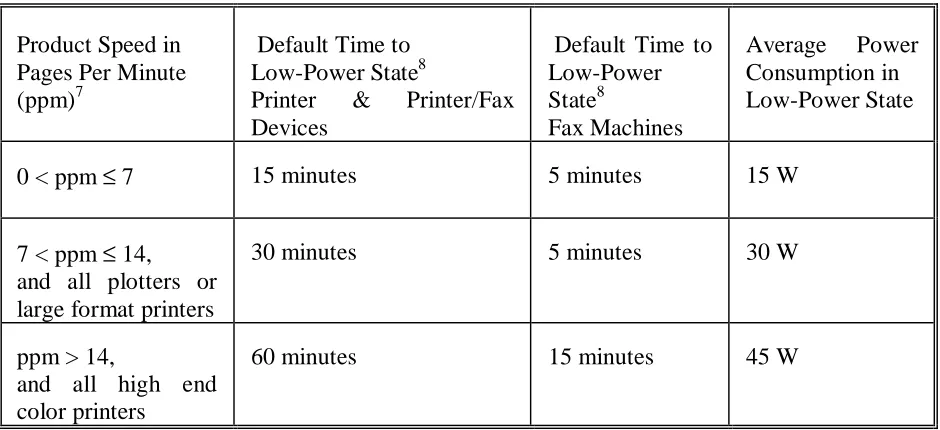
Table 1.
Product Speed in Pages Per Minute (ppm)7
Default Time to Low-Power State8
Printer & Printer/Fax Devices
Default Time to Low-Power State8
Fax Machines
Average Power Consumption in Low-Power State
0 < ppm≤7 15 minutes 5 minutes 15 W
7 < ppm≤14, and all plotters or large format printers
30 minutes 5 minutes 30 W
ppm > 14,
and all high end color printers
60 minutes 15 minutes 45 W
3. COPIERSPECIFICATIONS
3.1. Definitions
3.1.1. Copier: A commercial reprographic imaging unit whose sole function is the production of duplicates from a graphic hard copy original. A copier must include a marking system, an imaging system, and a paper handling module. All black and white plain paper copier technologies are covered under this Specification, though the intent is to focus on widely-used standard copier equipment such as light lens copiers. The Specifications outlined below apply to copiers designed for letter-sized paper (or A4). Large format copiers designed to handle 17" X 22" (or A2) paper or larger may be qualified under this program by complying with the specifications for low speed copiers.
3.1.2. Base Unit: For a given engine speed, the base unit is defined as the most basic version of a copier that is actually sold as a fully operational model. The base unit is typically designed and shipped in a single piece, and does not include any external power-consuming accessories that may be sold separately.
3.1.3. Accessories: A piece of additional equipment that is not necessary for the standard operation of the base unit, but that may be added before or after shipping in order to enhance or change copier performance. An accessory may be sold separately under its own model number, or sold with a base unit as part of a copier package or configuration. Examples of accessories include: sorters, large capacity paper feeders, etc. It is assumed that the
7
For printer and fax models sold in the US, the print speed shall be based on 8.5" x 11" letter-sized paper. For printer and fax models sold in Europe or Japan, the print speed shall be based on A4 paper.
8
addition of an accessory, irrespective of its own power consumption, will not substantially increase (more than 10 percent) the off mode power consumption of the base unit. Any accessories shall not impede the normal operation of the auto-off and low-power features.
3.1.4. Copier Model: For purposes of this Specification, a copier model is defined as a base unit and one or more specific accessories that are advertised and sold to consumers under a single model number. When advertised and sold to consumers without any additional accessories, a base unit is also considered a copier model.
3.1.5. Low-Power Mode: For purposes of this Specification, the low-power mode is the lowest power state the copier can automatically enter within some period of copier inactivity, without actually turning off. The copier enters this mode within a specified period of time after the last copy was made. For purposes of determining the power consumption in this low-power mode, the company may choose to measure the lowest of either the energy-saver mode or the standby mode.
3.1.6. Energy-Saver Mode: The condition that exists when the machine is not making copies, has previously reached operating conditions but is consuming less power than when the machine is in stand-by mode. When the copier is in this mode, there may be some delay before the copier will be capable of making the next copy.
3.1.7. Standby Mode: The condition that exists when the machine is not making copies, has reached operating conditions and is ready to make a copy, but has not yet entered into energy-saver mode. When the copier is in this mode, there will be virtually no delay before the copier is capable of making the next copy.
3.1.8. Auto-off Feature: For purposes of this Specification, the auto-off feature is defined as the ability for the copier to automatically shut itself off within a specified period of time after the last copy was made. The copier shall automatically enter its off mode after execution of this feature.
3.1.9. Off Mode: For purposes of this Specification, the off mode is defined as the condition that exists when the copier is connected to an appropriate electrical source, and has been recently shut off via the auto-off feature9. When measuring power in this mode, control equipment for remote servicing may be excluded.
9
3.1.10. Plug-in Mode: The condition that exists when the machine is connected to an appropriate electrical source and is not turned on. To turn the copier on, the user typically needs to manually restart the copier via the on/off switch.
3.1.11. Default Times: The time period set by the Program Participant prior to shipping that determines when the copier will enter its various modes, i.e., the low-power mode, the off mode, etc. Both the off mode default times and the low-power mode default times shall be measured from the time the last copy was made.
3.1.12. Recovery Time: The amount of time needed to bring the copier from a low-power mode to the standby mode.
3.1.13. Automatic Duplex Mode: The mode in which the copier automatically places images on both sides of a copy sheet, by automatically sending both the copy sheet and the graphic original through the copier model. Examples of this are one-sided to two-sided copying, or two-sided to two-sided copying. For purposes of this Specification, a copier model is considered to have an automatic duplex mode only if the copier model includes all accessories needed to satisfy the above conditions, i.e., an automatic document feeder and accessories for automatic duplexing capabilities.
3.1.14. Weekly Timer: An internal device that turns a copier on and off at predetermined times each business day. When programming a timer, the customer shall be able to distinguish between business days and weekends/holidays (i.e., a timer shall not turn on a copier on Saturday and Sunday mornings if employees are not normally in the office on weekends). The customer shall also have the ability to disable the timer. Weekly timers are optional features, and therefore are not required on ENERGY STAR
compliant copiers. If included in copier models, weekly timers shall not conflict with the functioning of the low-power and auto-off features.
3.2. Product Qualification for the ENERGYSTARLogo 3.2.1. Specifications
To qualify for the ENERGYSTAR logo, a copier shall meet the Specifications
outlined below:
Tier 2 Criteria for the ENERGYSTARCopier Program (Effective July 1, 1997)
Copier Speed (copes per
minute)
Low-Power Mode (Watts)
Recovery Time 30 seconds
Off Mode (Watts)
Off Mode Default Time
Automatic Duplex
Mode
0 < cpm < 20 None NA < 5 < 30 min No
Program Participant shall ship copier models with the default time for the low-power mode set at 15 minutes. Program Participant shall set the default times for the auto-off feature to the levels specified in the Table above. For all copier speeds where it is optional that the duplex mode be set as the default, if a model is shipped with automatic duplexing capabilities, then it is
recommended that duplexing be set as the default mode. Program Participant
may provide users with the ability to override this default duplex mode for single-sided copies.
3.2.2. Exceptions and Clarifications
After shipping, Program Participant or its designated service representative shall not alter the copier model in any way that will affect the copier's ability to meet the specifications outlined above. Certain exceptions are allowed in changing the default times, the off mode specifications, and the duplex mode. These exceptions are as follows:
A. Default Times: The Program Participant, designated service representative, or customer may change the default times for either the low-power or auto-off feature, but only up to a Program Participant set maximum of 240 minutes. The combined total for off mode and low-power mode default times shall not exceed 240 minutes.
B. Off Mode Power Consumption: In some cases, Program Participant may need to ship a copier model with the anti-humidity device disconnected in order to meet off mode power requirements. If this situation leads to sizable inconvenience for a specific customer, Program Participant (or the designated service representative) may connect the anti-humidity device. If Program Participant determines that in a certain geographical area there are chronic reliability problems associated with high humidity levels, Program Participant may contact the EPA program manager and discuss alternative solutions10. For example, EPA or the European Commission may allow Program Participant to connect the anti-humidity devices in copier models that are shipped to a very humid geographical area.
C. Disabling the Auto-Off Feature: In an individual case where the auto-off feature is causing a customer sizable inconvenience due to his/her particular usage patterns, the Program Participant, designated service representative, or customer may disable this auto-off feature. If Program Participant chooses to design its copier models to allow the customer to disable the auto-off feature, then the disable option shall be accessed in a manner different from the time settings (e.g., if a software menu provides off-mode delay times of 30, 60, 90, 120, and 240 minutes, then "disable" or "off" shall not be a choice in this menu. It shall be a hidden (or less obvious) choice, or included in a different menu.).
10
4. SCANNERSPECIFICATIONS 4.1. Definitions
4.1.1. Scanner: For purposes of this Specification, a scanner is defined as an electro-optical device for converting color or black-and-white information into electronic images that can be stored, edited, converted, or transmitted primarily in a personal computing environment. Scanners defined as such are typically used for digitizing hard-copy images. The intent of this Specification is to focus on widely-used desktop scanners (e.g., flatbed, sheet-fed, and film scanners); however, high-end office document management scanners that meet the specifications outlined below may qualify for the Energy Star logo. This Specification is for stand-alone scanners; it does not cover multifunction products with scanning capabilities, network scanners (i.e., scanners that connect exclusively to a network and are capable of managing the scanned information for transmissions to multiple locations on the network), or scanners that are not powered directly by the building power supply.
4.1.2. Base Unit: The base unit is defined as the most basic version of a scanner that is actually sold as a fully operational model. The base unit is typically designed and shipped in a single piece, and does not include any external power-consuming accessories that may be sold separately.
4.1.3. Scanner Model: For purposes of this Specification, a scanner model is defined as a base unit and one or more specific accessories that are advertised and sold to consumers under a single model number. When advertised and sold to consumers without any additional accessories, a base unit is also considered a scanner model.
4.1.4. Accessory: Any piece of additional equipment that is not necessary for the standard operation of the scanner, but that may be added in order to enhance or change scanner performance. An accessory may be sold separately under its own model number, or sold with a base unit as part of a scanner package or configuration. Examples of accessories include automatic document feeders (ADFs) and transparency adaptors.
4.1.5. Low-power Mode: For purposes of this Specification, the low-power mode is the lowest power state the scanner is designed to enter after some period of inactivity, without actually turning off. The scanner enters this mode within a specified period of time after the last image was scanned.
4.2. Product Qualification for the ENERGYSTARLogo 4.2.1. Technical Specification
Program Participant agrees to introduce one or more specific base units that meet the specifications outlined below.
Table 1. Criteria for the ENERGYSTARScanner Program Low-power Mode Low-power Mode Default Time
≤
12 watts≤
15 minutes5. MULTI-FUNCTIONDEVICESPECIFICATIONS
5.1. Definitions
5.1.1. Multifunction Device: A Multifunction Device (MFD) is a physically integrated device or a combination of functionally integrated components (the "base unit", see definition below) that produces hard copy duplicates from graphical hard copy originals (distinct from single sheet convenience copying, see next paragraph) as well as performing one or both of the following core functions: printing of documents (from digital information received from direct connect computers, networked computers, file servers and fax transmissions) or faxing (send and receive). An MFD may also include scanning to computer file or any other capabilities not listed in this Specification. The device may be connected to a network, and may output black & white, gray scale, or color images. EPA anticipates that a separate Specification may ultimately be required to cover color devices, because of likely technological developments related to color imaging, but for now these devices are included in this Specification.
This Specification covers products that are marketed and sold as multifunction equipment whose primary function is copying but that are able to perform one or both of the additional core functions of printing or faxing. Devices whose primary function is faxing and offer limited sheet copying capabilities (so-called single sheet "convenience copying") are covered under the printer/fax Specification.
If the MFD is not a single integrated unit but a set of functionally integrated components, then the manufacturer must certify that when installed correctly in the field the sum of all power use for all MFD components comprising the base unit will achieve the power levels listed below to qualify as an Energy Star MFD.
designed to measure print speed, then that test procedure shall supercede the output speed specifications listed in this section.
For all multifunction device models, engine speed shall be based on either 8.5" x 11" or A4-sized paper, depending on which is the standard in a particular market. If copier and print speeds are different, whichever speed is higher shall be used to determine to which speed category the device belongs.
For large format multifunction device models designed to handle primarily A2 or 17" x 22" paper or larger, the reproduction speed measured as A2 or A0-sized images per minute, shall be converted into A4-sized image reproduction speeds, as follows: (a) One A2 image per minute is equivalent to 4 A4 images per minute; (b) One A0 image per minute is equivalent to 16 A4 images per minute.
Multifunction Devices will be divided into the following categories:
Personal Multifunction Devices: Multifunction devices with an engine speed for producing multiple images of 10 images per minute or less.
Low Speed Multifunction Devices: Multifunction devices with an engine speed for producing multiple images of greater than 10 and less than or equal to 20 images per minute.
Medium Speed Multifunction Devices: Multifunction devices with an engine speed for producing multiple images of greater than 20 and less than or equal to 44 images per minute.
Medium/High Speed Multifunction Devices: Multifunction devices with an engine speed for producing multiple images of greater than 44 and less than or equal to 100 images per minute.
High Speed Multifunction Devices: Multifunction devices with an engine speed for producing multiple images of greater than 100 images per minute.
5.1.3. Base Unit: For a given engine speed, the base unit is defined as the most basic version of a multifunction device that is actually sold as a fully operational model. The base unit can be designed and shipped as a single piece or as a combination of functionally integrated components. The base unit must allow copying and one or both of the additional core functions of printing or faxing. The base unit does not include any external power-consuming accessories that may be sold separately.
will not substantially increase (more than a total of 10 percent for all accessories) the low-power or sleep mode power consumption of the base unit (irrespective of the power consumption of the accessories). Any accessories shall not impede the normal operation of the low-power and sleep mode features.
5.1.5. Multifunction Device Model: For purposes of this Specification, a multifunction device model is defined as a base unit and one or more specific accessories that are advertised and sold to consumers under a single model number. When advertised and sold to consumers without any additional accessories, a base unit is also considered a multifunction device model.
5.1.6. Standby Mode: The condition that exists when the machine is not producing output, has reached operating conditions and is ready to make hard copy output, but has not yet entered into the low-power mode. When the multifunction device is in this mode, there will be virtually no delay before the multifunction device is capable of making the next hard copy output.
5.1.7. Low-power Mode: For purposes of this Specification, the low-power mode is the condition that exists when the multifunction device is not producing hard copy output and is consuming less power than when in a standby mode. When the multifunction device is in this mode there may be some delay in the production of hard copy output. In this mode there shall be no delay in the acceptance of information from fax or printing or scanning input sources. The multifunction device enters this mode within a specified period of time after the last hard copy output was made no matter what the input source. For products that meet the low-power mode power requirements in standby mode, no further power reductions are required to be compliant.
5.1.8. Sleep Mode: For purposes of this Specification, the sleep mode is the lowest power state the multifunction device can automatically enter without actually turning off. In this mode both hard copy output and the acceptance of imaging information from some input ports may be delayed. The multifunction device enters the sleep mode within a specified period of time after the last hard copy output was made or after it has entered the low-power mode if a low-power mode is provided.
5.1.9. Default Times: The time period set by the Program Participant prior to shipping that determines when the multifunction device will enter its various modes, i.e., the low-power mode, the sleep mode, etc. Both the sleep mode default times and the low-power mode default times shall be measured from the time the last hard copy output was made.
5.1.10. Recovery Time: The amount of time needed to bring the multifunction device from the low- power mode to the standby mode.
automatic duplex mode only if the multifunction device model includes all accessories needed to satisfy the above conditions, i.e., an automatic document feeder and accessories for automatic duplexing capabilities.
5.1.12. Weekly Timer: An internal device that turns a multifunction device on and off at predetermined times each day. When programming a timer, the customer shall be able to distinguish between business days and weekends/holidays (i.e., a timer shall not turn on a copier on Saturday and Sunday mornings if employees are not normally in the office on weekends). The customer shall also have the ability to disable the timer. Weekly timers are optional features, and therefore are not required on ENERGYSTARcompliant MFDs. If included
in multifunction device models, weekly timers shall not conflict with the functioning of the low-power and sleep mode features.
5.1.13. Upgradeable Digital Copier: A commercial reprographic imaging unit whose sole function is the production of duplicates from a graphic hard copy original using digital imaging technology, but that provides the option of being upgraded to offer multiple functions, such as printing or fax capabilities, through the installation of add-on devices. In order to be classified as an upgradeable digital copier under the MFD Specification, the upgrade options must be available on the market or intended for availability within one year after the base unit is launched. Digital copiers that are not designed for functional upgrades must qualify for the ENERGY STAR logo
under the Copier Specification.
5.2. Product Qualification for the ENERGYSTARLogo 5.2.1. Technical specifications
ENERGY STAR Program Participant agrees to introduce one or more specific
multifunction device models that meet the specifications outlined in the Tables below.
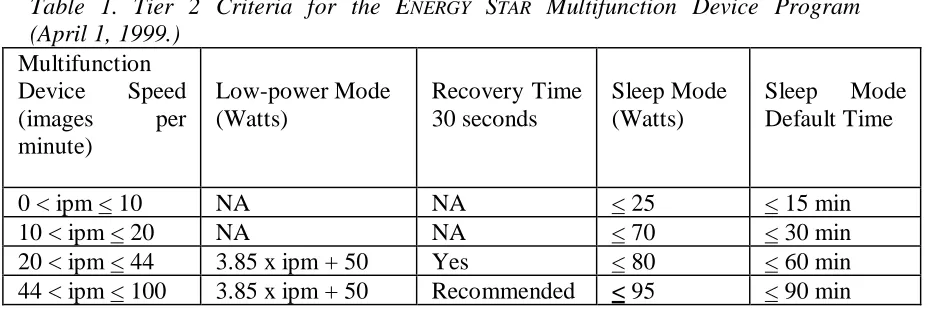
[image:32.595.75.540.608.763.2]A. Standard-sized Multifunction devices: To qualify as Energy Star compliant, multifunction device models designed to handle primarily 8.5" x 11" or A4-sized paper shall meet the specifications provided in Tables 1 and 2. All device speeds shall be measured with respect to the number of 8.5" x 11" or A4-sized images that feed through per minute, as described in Section II.B, above.
Table 1. Tier 2 Criteria for the ENERGY STAR Multifunction Device Program
(April 1, 1999.)
Multifunction Device Speed (images per minute)
Low-power Mode (Watts)
Recovery Time 30 seconds
Sleep Mode (Watts)
Sleep Mode Default Time
0 < ipm < 10 NA NA < 25 < 15 min
10 < ipm < 20 NA NA < 70 < 30 min
100 < ipm 3.85 x ipm + 50 Recommended < 105 < 120 min B. Large format devices: To qualify as ENERGY STAR compliant, large format
[image:33.595.105.512.204.355.2]multifunction device models designed to handle primarily A2 or 17" x 22" paper or larger shall meet the specifications provided in Table 2. All large format device speeds shall be measured with respect to the number of A4-sized images that feed through per minute, as described in Section II.B, above.
Table 2. Tier 2 Criteria for the ENERGYSTAR Multifunction Device Program--LARGE FORMAT DEVICES (April 1, 1999.)
Multifunction Device Speed (images per minute) Low-power Mode (Watts) Recovery Time 30 seconds Sleep Mode (Watts) Sleep Mode Default Time
0 < ipm < 40 NA NA < 70 < 30 min
40 < ipm 4.85 x ipm + 50 Recommended < 105 < 90 min
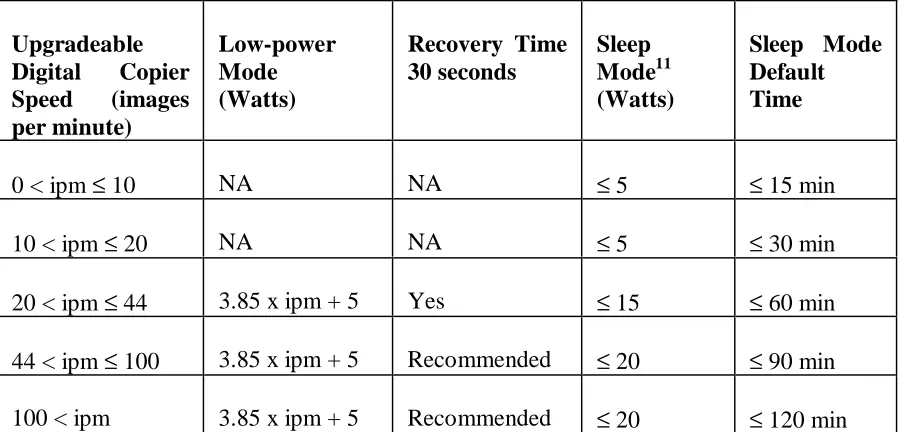
Table 3. Tier 2 Criteria for the ENERGYSTAR Multifunction Device Program — UPGRADEABLE DIGITAL COPIERS (April 1, 1999)
Upgradeable Digital Copier Speed (images per minute) Low-power Mode (Watts) Recovery Time 30 seconds Sleep Mode11 (Watts) Sleep Mode Default Time
0 < ipm≤10 NA NA ≤5 ≤15 min
10 < ipm≤20 NA NA ≤5 ≤30 min
20 < ipm≤44 3.85 x ipm + 5 Yes ≤15 ≤60 min
44 < ipm≤100 3.85 x ipm + 5 Recommended ≤20 ≤90 min 100 < ipm 3.85 x ipm + 5 Recommended ≤20 ≤120 min
Note that Tier 2 criteria for upgradeable digital copiers are identical to those of the Copier Specification, Tier 2.
11
[image:33.595.106.558.418.634.2]C. Large Format Upgradeable Digital Copiers : To qualify as ENERGY STAR
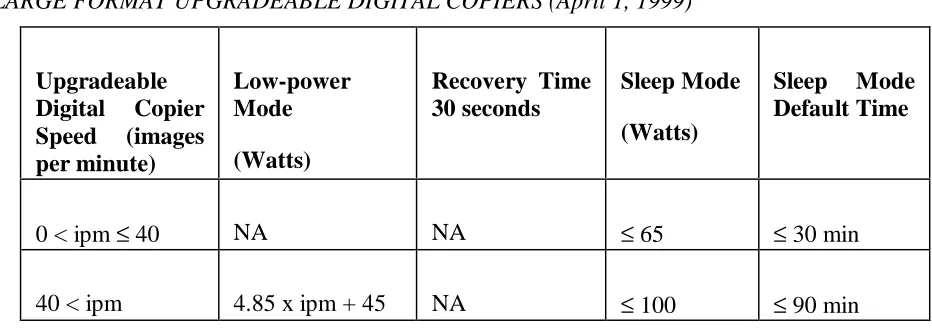
[image:34.595.94.560.172.337.2]compliant under the Multifunction Device Specification, upgradeable digital copiers designed to handle primarily A2 or 17" x 22" or larger sized paper shall meet the specifications provided in Table 4. All device speeds shall be measured with respect to the number A-4 sized images that feed through per minute, as described in Section II.B of the Specification.
Table 4. Tier 2 Criteria for the ENERGY STAR Multifunction Device Program — LARGE FORMAT UPGRADEABLE DIGITAL COPIERS (April 1, 1999)
Upgradeable Digital Copier Speed (images per minute)
Low-power Mode (Watts)
Recovery Time 30 seconds
Sleep Mode (Watts)
Sleep Mode
Default Time
0 < ipm≤40 NA NA ≤65 ≤30 min
40 < ipm 4.85 x ipm + 45 NA ≤100 ≤90 min
5.2.2. Additional requirements
In addition to the requirements shown in Tables 1 through 4, the following additional requirements must also be met.
A. Default time for low-power mode: For Tier 2 MFDs and upgradeable digital copiers, Partner shall ship multifunction device models with the default time for the low-power mode set at 15 minutes. Partner shall set the default times for the sleep mode to the levels specified in Tables 1 through 4. The default times for the low-power mode and the sleep mode shall be measured from the time the last copy was made or the last page was printed.
B. Recovery time from low-power mode: For Tier 2, the actual recovery time from low-power mode shall be placed in product literature for those products that have a low-power mode (see section IV.C.1).
C. Weekly timers: Note that weekly timers may be incorporated, but shall not adversely affect or interfere with the normal operation of the low-power or sleep modes. It is EPA’s intention that any added features complement the reduced power modes and not negate their effects.
D. Auto-duplex features: Duplexing is not required to be the default setting for any multifunction devices. However, it is required to be offered as an option for all standard size multifunction devices faster than 20 ipm. Further, it is
recommended that multifunction devices be shipped with automatic
duplexing set as the default mode for copying and any other feasible functions and described to customers upon installation.
5.2.3. Exceptions and Clarifications: