This is a repository copy of
Overview of systematic reviews of therapeutic ranges :
methodologies and recommendations for practice
.
White Rose Research Online URL for this paper:
http://eprints.whiterose.ac.uk/117502/
Version: Published Version
Article:
Cooney, Lewis, Loke, Yoon K, Golder, Su orcid.org/0000-0002-8987-5211 et al. (4 more
authors) (2017) Overview of systematic reviews of therapeutic ranges : methodologies and
recommendations for practice. BMC Medical Research Methodology. 84. ISSN 1471-2288
https://doi.org/10.1186/s12874-017-0363-z
[email protected] https://eprints.whiterose.ac.uk/
Reuse
This article is distributed under the terms of the Creative Commons Attribution (CC BY) licence. This licence allows you to distribute, remix, tweak, and build upon the work, even commercially, as long as you credit the authors for the original work. More information and the full terms of the licence here:
https://creativecommons.org/licenses/
Takedown
If you consider content in White Rose Research Online to be in breach of UK law, please notify us by
R E S E A R C H A R T I C L E
Open Access
Overview of systematic reviews of
therapeutic ranges: methodologies and
recommendations for practice
Lewis Cooney
1, Yoon K. Loke
2, Su Golder
3, Jamie Kirkham
4, Andrea Jorgensen
4, Ian Sinha
5†and Daniel Hawcutt
1,6*†Abstract
Background:Many medicines are dosed to achieve a particular therapeutic range, and monitored using therapeutic drug monitoring (TDM). The evidence base for a therapeutic range can be evaluated using systematic reviews, to ensure it continues to reflect current indications, doses, routes and formulations, as well as updated adverse effect data. There is no consensus on the optimal methodology for systematic reviews of therapeutic ranges.
Methods:An overview of systematic reviews of therapeutic ranges was undertaken. The following databases were used: Cochrane Database of Systematic Reviews (CDSR), Database of Abstracts and Reviews of Effects (DARE) and MEDLINE. The published methodologies used when systematically reviewing the therapeutic range of a drug were analyzed. Step by step recommendations to optimize such systematic reviews are proposed.
Results:Ten systematic reviews that investigated the correlation between serum concentrations and clinical outcomes encompassing a variety of medicines and indications were assessed. There were significant variations in the
methodologies used (including the search terms used, data extraction methods, assessment of bias, and statistical analyses undertaken). Therapeutic ranges should be population and indication specific and based on clinically relevant outcomes. Recommendations for future systematic reviews based on these findings have been developed.
Conclusion:Evidence based therapeutic ranges have the potential to improve TDM practice. Current systematic reviews investigating therapeutic ranges have highly variable methodologies and there is no consensus of best practice when undertaking systematic reviews in this field. These recommendations meet a need not addressed by standard protocols. Keywords:Systematic review methodology, Therapeutic range, Systematic review
Background
The therapeutic range of a drug is the dosage range or blood plasma or serum concentration usually expected to achieve the desired therapeutic effect. This does not mean that patients may not achieve benefit at concentrations below the minimum threshold, or may not experience ad-verse effects if kept within the range.
In order to maintain a patient within a defined thera-peutic range, they may be subject to therathera-peutic drug
monitoring (TDM). TDM involves measuring drug con-centrations, usually in the blood, and comparing the re-sult to a predefined window of serum concentrations that are considered to reflect the optimum efficacy and safety of the drug. As TDM is invasive, and will inform important clinical decisions, it is important that target therapeutic ranges are appropriate. If they are not, pa-tients may not experience the full potential benefit of the drug, or could be at risk of avoidable adverse effects. High quality evidence of clinical efficacy and safety should determine a drug’s therapeutic range.
The upper and lower boundaries of the therapeutic range should be determined by the extent of harm and benefit re-spectively. Many drugs were assigned therapeutic ranges based on small pharmacokinetic studies performed in the * Correspondence:[email protected]
†
Equal contributors
1Institute of Translational Medicine, University of Liverpool, Liverpool,
Merseyside, UK
6National Institute for Health Research Alder Hey Clinical Research Facility,
Alder Hey Children’s Hospital, Liverpool, Merseyside, UK
Full list of author information is available at the end of the article
© The Author(s). 2017Open AccessThis article is distributed under the terms of the Creative Commons Attribution 4.0 International License (http://creativecommons.org/licenses/by/4.0/), which permits unrestricted use, distribution, and reproduction in any medium, provided you give appropriate credit to the original author(s) and the source, provide a link to the Creative Commons license, and indicate if changes were made. The Creative Commons Public Domain Dedication waiver (http://creativecommons.org/publicdomain/zero/1.0/) applies to the data made available in this article, unless otherwise stated.
1960s and 1970s [1–3] or expert opinion. Most drugs are typically assigned a single therapeutic range for all indica-tions, at all ages, and regardless of medication and co-morbidity. Following introduction of a new drug, the age range, clinical indications, route of administration and for-mulation may change, while the therapeutic range is not considered. In addition, as there is a lack of empirical evi-dence investigating the precise serum concentrations for which a drug is most effective, reference values may differ between laboratories. This is demonstrated in carbamaze-pine guidelines, with quoted lower limit ranges from 4 to 8 mg/l, whilst its upper limit ranges from 8 to 12 mg/l [4].
A systematic review is the most robust method for evaluating and synthesizing existing literature on the beneficial and adverse effects of healthcare interventions. Whilst the methods are well established for studies of effi-cacy and increasingly so, for harm [5, 6], we were not aware of a consensus on the optimum methodology for a systematic review that aims to determine upper and lower limits of the therapeutic range for a particular drug. Such systematic reviews of therapeutic ranges are an emerging and uncertain field, but potentially more important with the advent of stratified medicine and individualised treat-ment due to increased understanding of interindividual variability in drug response. In this study, we have under-taken a systematic review of those systematic reviews in-vestigating the optimum therapeutic range of a drug, and detailed the methodology used. From lessons learnt and good practice examples from these studies, we propose step-by-step recommendations for designing, analysing and presenting systematic reviews of therapeutic ranges.
Methods
We performed a systematic overview of reviews investigat-ing either therapeutic ranges, or those that correlate serum drug concentrations with clinically relevant outcomes.
The Cochrane Database of Systematic Reviews (CDSR) and the Database of Abstracts and Reviews of Effects (DARE) were searched for relevant literature via The Cochrane Library and Centre for Reviews and Dissemin-ation (CRD) website. In particular, DARE uses a compre-hensive search strategy to capture relevant systematic reviews from other databases including MEDLINE and EMBASE, unpublished studies and was updated regularly until the 31st March 2015. This search was supplemented by directly searching the MEDLINE database for relevant studies. The search term ‘drug monitoring’ was used as both a Medical Subject Heading (MeSH) and as a free text term with OR Boolean operator. This search was per-formed in February 2016, and repeated in October 2016. A protocol was not published in advance.
Reviewer LC screened titles and abstracts for relevant studies, prior to review of full texts of articles. At each stage a sample of studies were reviewed independently
by DH with any disagreements resolved by consensus or by arbitration with reviewer IS.
Studies were included if they were systematic reviews investigating a correlation between the serum concentra-tion and either the efficacy of the drug, or the frequency/ severity of adverse effects for a condition. There was no restriction placed on the type of studies considered within the systematic reviews (e.g. randomised controlled trials, cohort studies, case reports, etc). In addition, there were no restrictions on the medication used, indication(s) for which the medication was used, the number of concurrent medications, co-morbidities of the patients who received the medication, age or gender of the participants. We ex-cluded systematic reviews comparing therapeutic drug monitoring vs clinical monitoring, narrative reviews and cost benefit analyses as these do not generate information that can inform a drug’s therapeutic range.
Reviewer LC extracted data from each of the included systematic reviews. Predefined review characteristics in-cluded the drug name, indication, and characteristics of participants and the aim of the review. We assessed whether a predetermined protocol was followed, how out-comes were selected, how relevant literature was identified, recommendations for clinical practice and the techniques used for data synthesis. An AMSTAR assessment was per-formed on each included systematic review to assess its quality. This tool assesses the domains of study identifica-tion and selecidentifica-tion, data analysis and bias assessment [7]. These findings were used to form recommendations for conducting a systematic review of therapeutic ranges.
Results
Characteristics of included studies
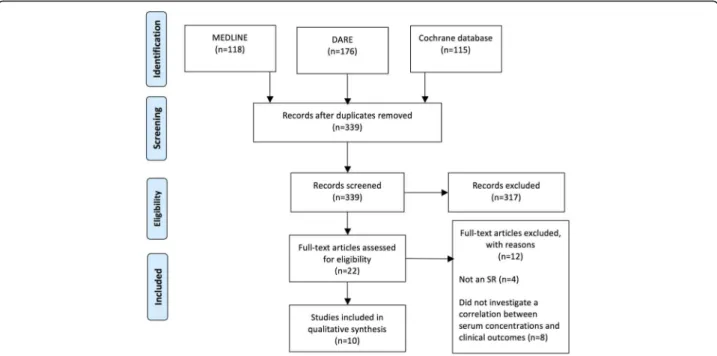
The search strategy returned 339 studies after duplicates were removed. After screening titles and abstracts twenty-two full text articles were assessed for eligibility. Of these, eight studies were excluded as they did not in-vestigate a correlation between serum drug level and clinical outcomes and four studies were not systematic reviews (see Fig. 1).
The ten systematic reviews were published from 2006 to 2016 and studied thiopurine metabolites (n= 3),
my-cophenolate mofetil (in post-transplant patients) (n= 2),
vancomycin trough concentrations (n = 1), amisulpride
(n= 1), aripiprazole (n= 1), olanzapine (n= 1), and
ami-nophylline (n= 1). The systematic reviews encompassed
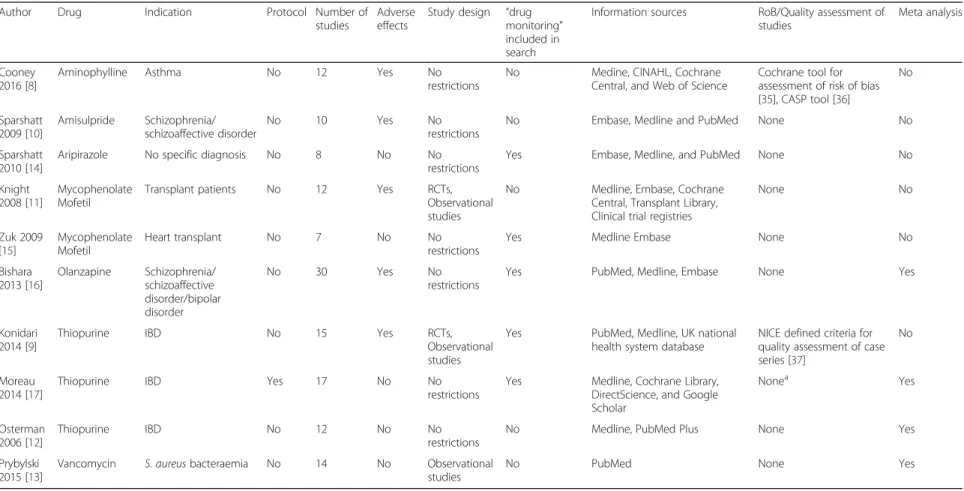
a variety of indications including, inflammatory bowel disease, asthma, Staphylococcous aureus infections, psy-chiatric disorders and patients receiving kidney, cardiac and liver transplants. All ten systematic reviews investi-gated the effects of serum concentrations on disease ac-tivity, while five systematic reviews also assessed the correlation between serum levels and adverse effects (Table 1).
Study participants
Of the included systematic reviews, two examined paedi-atric populations [8, 9] and four adult popuations [10– 13]. The remaining four systematic reviews imposed no age restrictions of participants [14–17].
AMSTAR assessment
The results of the AMSTAR assessment are shown in Table 2. The majority of systematic reviews performed a comprehensive literature search and appropriate tech-niques for data synthesis. A tool for assessment of quality/ risk of bias was used in only three reviews. The tools used were i) the National Institute for Health and Care Excel-lence (NICE) defined criteria for the assessment of case series [9], ii) Meta Analyses Of Observational Studies in Epidemiology (MOOSE) consensus statement [17], and iii) Cochrane tool for the assessment of risk of bias [8]. Though these systematic reviews used standardized as-sessment tools, the results of these asas-sessments were not formulated into conclusions. The remaining systematic re-views used no standardized assessment tool for the ap-praisal of quality or risk of bias in individual studies. Three reviews assessed the potential of publication bias across studies using the Egger method [12, 13, 17].
Protocols used
Of the ten included systematic reviews, one followed a predefined protocol [17]. This systematic review followed a generic protocol for the meta-analysis of clinical trials [18]. None of the included reviews followed a specific protocol for systematic reviews of therapeutic ranges.
Identifying relevant studies
All included systematic reviews involved PubMed/MED-LINE in their search strategies, five studies searched Embase [10, 11, 14–16]. Other literature searches included Google Scholar and DirectScience [17], clinical trials registers [11] and the UK national health system database [9]. Two sys-tematic reviews included a grey literature search via the Cochrane Register of Controlled Trials (CENTRAL) [8, 11].
Included studies
All included reviews analysed more than one study de-sign. Six systematic reviews placed no restrictions on the included study design [10, 12, 14–17], one systematic re-view included observational data only [13], and two sys-tematic reviews limited studies to randomised controlled trials, cohort studies and case control studies [9, 11].
Search terms
Five systematic reviews included the search terms ‘drug monitoring’, [9, 14–17]. Acronyms such as TDM [10] and AUC/MIC [13] were also used. Other terms in-cluded “Blood AND monitoring”, “physiologic monitor-ing”, [9] or “plasma levels” [10]. One systematic review did not outline the exact search terms used in the meth-odology [11], and two reviews used no terms specifically relating to therapeutic drug monitoring [8, 12].
Data extraction
For comparing serum drug levels achieved in each system-atic review, four reviews extracted an arbitrary threshold level, and measured the beneficial effects of the drug above Fig. 1Search results. DARE - Database of Abstracts of Reviews of Effects, SR–Systematic review
Table 1Included studies
Author Drug Indication Protocol Number of
studies
Adverse effects
Study design “drug monitoring”
included in search
Information sources RoB/Quality assessment of studies
Meta analysis
Cooney 2016 [8]
Aminophylline Asthma No 12 Yes No
restrictions
No Medine, CINAHL, Cochrane Central, and Web of Science
Cochrane tool for assessment of risk of bias [35], CASP tool [36]
No
Sparshatt 2009 [10]
Amisulpride Schizophrenia/ schizoaffective disorder
No 10 Yes No
restrictions
No Embase, Medline and PubMed None No
Sparshatt 2010 [14]
Aripirazole No specific diagnosis No 8 No No
restrictions
Yes Embase, Medline, and PubMed None No
Knight 2008 [11]
Mycophenolate Mofetil
Transplant patients No 12 Yes RCTs,
Observational studies
No Medline, Embase, Cochrane Central, Transplant Library, Clinical trial registries
None No
Zuk 2009 [15]
Mycophenolate Mofetil
Heart transplant No 7 No No
restrictions
Yes Medline Embase None No
Bishara 2013 [16]
Olanzapine Schizophrenia/ schizoaffective disorder/bipolar disorder
No 30 Yes No
restrictions
Yes PubMed, Medline, Embase None Yes
Konidari 2014 [9]
Thiopurine IBD No 15 Yes RCTs,
Observational studies
Yes PubMed, Medline, UK national health system database
NICE defined criteria for quality assessment of case series [37]
No
Moreau 2014 [17]
Thiopurine IBD Yes 17 No No
restrictions
Yes Medline, Cochrane Library, DirectScience, and Google Scholar
Nonea Yes
Osterman 2006 [12]
Thiopurine IBD No 12 No No
restrictions
No Medline, PubMed Plus None Yes
Prybylski 2015 [13]
Vancomycin S. aureusbacteraemia No 14 No Observational studies
No PubMed None Yes
RoBRisk Of bias,IBDInflammatory Bowel Disease,RCTRandomised controlled trial,CENTRALCentral Register of Controlled Trials a
Moreau et al. used the MOOSE consensus statement to assess reporting quality, but do not report the results of their assessment
Cooney
et
al.
BMC
Medical
Research
Methodology
(2017) 17:84
Page
4
of
this threshold [9, 12, 13, 17], and two extracted the data for area under the curve (AUC) or data on single point moni-toring [11, 15]. The remaining reviews extracted the mean ± standard deviation of drug level achieved across participants [8, 10, 16]. One review extracted the timing of drug measurement [11], and two reviews performed separ-ate analyses depending on the type of assay used [13, 17].
Statistical analyses
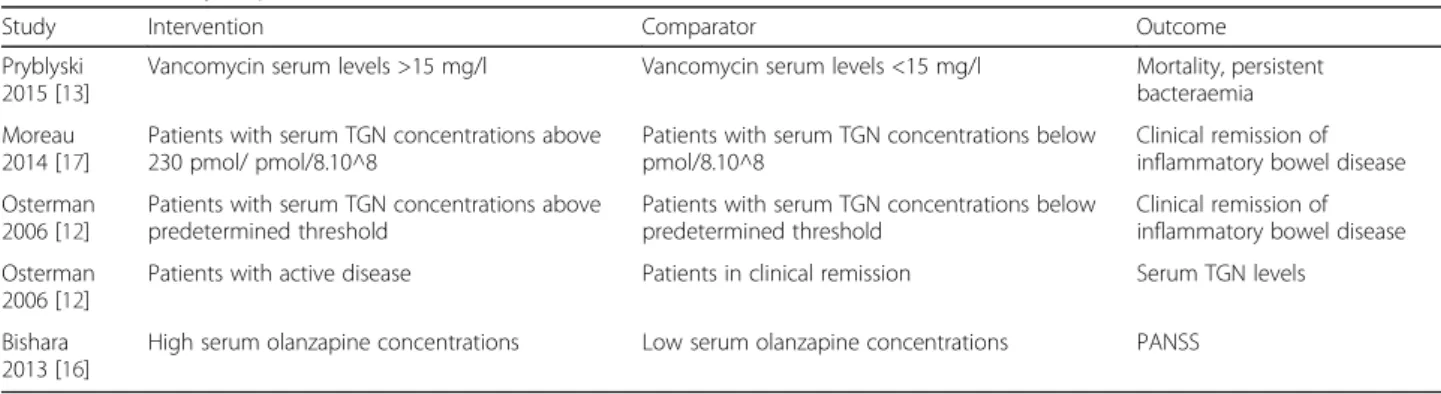
Of the ten included systematic reviews, four used meta-analyses to investigate the association between low versus high serum drug levels and clinically relevant outcomes (Table 3). One of these reviews assessed the relationship between vancomycin trough levels and treatment failure, defined as a composite endpoint that included mortality
and persistent bacteraemia. This review used data from several primary studies, which compared the occurrence of treatment failure in patients with serum levels below 15 mg/l with patients above 15 mg/l. This threshold level was chosen based on a cohort study indicating a two-fold risk of treatment failure when vancomycin levels are <15 mg/l in the treatment of MRSA bacteraemia [19]. This study relied on primary studies using similar thresh-old levels [13]. Two systematic reviews investigated the re-lationship between threshold values of tioguanine-6 (TGN-6) and clinical remission in patients with inflamma-tory bowel disease. In one systematic review, the authors only included studies which compared participants with TGN-6 concentration ≥ 230 pmol/8 × 108^8 RBC with
those below, with this figure decided a priori [17]. One
Table 2Results of AMSTAR assessment
Pryblyski 2015
Konidari 2014
Moreu 2014
Sparshatt 2009
Knight 2008
Osterman 2006
Cooney 2016
Sparshatt 2010
Zuk 2009
Bishara 2013
Was an a priori design (protocol) provided? ✗ ✗ ✓ ✗ ✗ ✗ ✗ ✗ ✗ ✗
Was there duplicate study selection and data extraction?
✗ ✓ ✓ ✗ ✗ ✗ ✓ ✗ ✗ ✓
Was a comprehensive literature search performed?
✗ ✓ ✗ ✓ ✓ ✗ ✓ ✗ ✓ ✓
Was the status of publication (i.e. grey literature) used as a criterion?
✗ ✓ ✗ ✗ ✓ ✗ ✓ ✗ ✗ ✓
Was a list of studies (included and excluded) provided?
✗ ✓ ✓ ✗ ✗ ✗ ✓ ✓ ✗ ✓
Were the characteristics of the included studies provided?
✓ ✗ ✓ ✓ ✓ ✓ ✓ ✓ ✓ ✗
Was the scientific quality of the included studies assessed?
✗ ✓ ✗ ✗ ✗ ✗ ✓ ✗ ✗ ✗
Was the scientific quality of the studies used in formulating conclusions?
✗ ✗ ✗ ✗ ✗ ✗ ✗ ✗ ✗ ✗
Were the methods used to combine the findings of the studies appropriate?a
✓ ✗ ✗ ✗ ✗ ✓ ✓ ✗ ✗ ✓
Was the likelihood of publication bias assessed?b
✓ ✗ ✓ ✗ ✗ ✓ ✗ N/A N/A ✗
Was a conflict of interest included? ✗ ✓ ✓ ✓ ✓ ✗ ✓ ✓ ✓ ✓
aMethods used to combine the findings of studies were deemed inappropriate if no a priori statistical techniques were outlined in the methodology bAMSTAR methodology states systematic reviews with <10 studies included do not to assess publication bias (marked N/A)
Table 3Meta analyses performed
Study Intervention Comparator Outcome
Pryblyski 2015 [13]
Vancomycin serum levels >15 mg/l Vancomycin serum levels <15 mg/l Mortality, persistent bacteraemia
Moreau 2014 [17]
Patients with serum TGN concentrations above 230 pmol/ pmol/8.10^8
Patients with serum TGN concentrations below pmol/8.10^8
Clinical remission of inflammatory bowel disease
Osterman 2006 [12]
Patients with serum TGN concentrations above predetermined threshold
Patients with serum TGN concentrations below predetermined threshold
Clinical remission of inflammatory bowel disease
Osterman 2006 [12]
Patients with active disease Patients in clinical remission Serum TGN levels
Bishara 2013 [16]
High serum olanzapine concentrations Low serum olanzapine concentrations PANSS
TGNtioguanine-6,PANSSPositive and negative symptom scale
study performed a similar analysis, but included studies with different threshold levels in the same meta analysis (either 235 pmol/8 × 108or 250 pmol/8 × 108) [12]. The fourth systematic review planned a meta analysis investi-gating the relationship between high and low olanzapine serum concentrations on symptom scores in patients with schizoaffective disorder, however there was insufficient data reported to enable meta analysis [16].
Six systematic reviews did not perform quantitative data synthesis, and instead data analysis was done descriptively. Four reviews planned no meta analysis a priori in their methodologies, it is not clear in these studies why quanti-tative data synthesis was not performed [9–11, 15]. One review performed a meta analysis correlating dosage to clinical outcomes, but had insufficient data for a similar analysis correlating plasma concentrations of aripirazole to clinical outcomes [14]. One systematic review planned a meta analysis a priori, but this was deemed inappropri-ate by the investigators following data extraction due to the heterogeneity of data due to variability in the thresh-old of drug levels used, and inconsistencies in reporting of drug levels achieved across participants [8].
Clinical relevance
No included systematic reviews were able to provide a de-finitive therapeutic range from systematically reviewed evi-dence. Though a relationship between serum concentration and clinical efficacy was found in three reviews [10–12], this was not translated into definable upper and lower limits of drug concentrations that conferred maximum effi-cacy and safety. This is because a definable cut off point reflecting efficacy and safety could not be established at the lower and upper limits respectively. One systematic review found that the established therapeutic range was able to predict toxicity but unable to predict clinical benefit in pa-tients receiving thiopurine for IBD [9], and three reviews found a weak association between serum drug concentra-tions and clinical outcomes [8, 11, 13].
Discussion
Published systematic reviews correlating serum concen-trations of a drug with clinical outcomes are scarce. There were none identified that were able to compare RCTs of different therapeutic ranges, and hence other study designs were used in data synthesis.
A strength of review is that it has identified methodo-logical variations, as well as considerable inconsistencies, in the reporting of existing published systematic reviews of therapeutic ranges. There is clearly a need to improve or standardize methods. A limitation of this review is that it only identifies drugs in which the therapeutic range has been systematically reviewed. There are classes of drugs where there is considerable evidence supporting the
therapeutic ranges but no systematic reviews have been undertaken (for example, aminoglycoside antibiotics).
We have developed recommendations for future reviewers examining therapeutic ranges based on these findings.
Determining the scope and question of the review
Most of our included systematic reviews investigated the ef-fect of serum concentrations of a particular drug, for a par-ticular indication, in a parpar-ticular population. Similar to typical systematic reviews, the research question should be specified a priori. The reviewers should report whether their review is focussed on the lower limit of the thera-peutic range, the upper limit, or both; and the population, indication, chronicity and route of the drug. It is important to consider these when deciding the review question as drugs may be used for more than one indication, and in groups of patients with differing characteristics. If the medi-cine has more than one indication, an appropriate range for each use should be explored as the optimal therapeutic range may vary with age, population and indication. For ex-ample, the plasma salicyclate range for the treatment of in-flammatory conditions is considerably greater than that required for analgesia [20].
Outcomes
Selected outcomes must reflect beneficial and harmful ef-fects of the drug that are relevant to clinical practice, in context of the population of interest. For example, focus-sing on surrogate physiological outcomes such as improve-ments in Forced Expiratory Volume in One Second (FEV1) in asthma [21] and electroencephalogram (EEG) measure-ments in epilepsy [3] may not reflect whether the drug has a beneficial clinical effect at a given concentration.
It is unclear how review outcomes were selected in most systematic reviews. One way of identifying important comes is to see whether there is an established core out-come set, which should be measured and reported in all clinical trials in a given condition [22]. The Core Outcome Measures in Effectiveness Trials (COMET) Initiative con-tains a database of existing core outcome sets [23], how-ever this does not comprehensively cover all possible harmful effects of drugs. A framework of outcomes has been developed [24], which may help decide which are most important and relevant for the particular topic under review. In some situations, patients have been involved in identifying which outcomes are directly relevant to them [25], and if such studies are available they should be con-sidered when identifying appropriate outcomes for a sys-tematic review.
With regards to adverse effects of drugs, at particular serum concentrations, it is important to consider whether the scope of the review should be broadened to include outcomes in wider populations and across other indications [26]. This will not only be determined by the time and
resources available, but also whether the pharmacological properties of the drug, and the susceptibility of the patient to adverse effects, varies between groups. One example where this may be particularly relevant is in preterm neo-nates, who are uniquely prone to long term side effects which may not be seen in other populations, for example cerebral palsy from steroid use [27–29], and problems with cardiovascular adaptation to extra-uterine life from non-steroidal anti-inflammatory drugs [30].
Included studies
Reviewers must balance the need to capture all relevant data with the time and resources available. Many thera-peutic ranges are under researched, and few primary stud-ies specifically aim to investigate the therapeutic range of a drug. Studies of most interest will be those that report both a measure of serum drug concentration and at least one of the selected clinical outcomes. Authors may consider the levels of available evidence they may find prior to searching for relevant studies. Categorising studies in this way helps systematically grade the available evidence. This avoids pla-cing inappropriate weight on studies that are methodologic-ally less robust when formulating conclusions.
The most useful studies are well designed randomised controlled trials (RCTs) comparing two or more thera-peutic ranges for the same drug, and reporting clinically relevant outcomes. Such studies have been conducted to examine serum concentrations of lithium in adults with bipolar disorder for prophylaxis of mania [31] and serum concentrations of teicoplanin in adults who are critically ill with gram negative infections [32].
In practice, trials directly comparing therapeutic ranges are uncommon, and we propose that the next level of evi-dence will incorporate either observational data or indir-ect comparisons between clinical trials such as RCTs comparing drug to placebo/other treatment or observa-tional studies.
Observational data may be obtained from cohort stud-ies, case-control studstud-ies, or case series. Indirect evidence may be gained from identifying RCTs that have com-pared the drug against a common comparator (likely placebo), and then analysing whether studies in which a higher serum concentration was achieved demonstrated better effects on beneficial and harmful outcomes.
Search terms
Combinations of indexing terms such as Medical subject headings (MeSH) and textwords should be used by re-viewers to form a search strategy that maximizes sensitivity whilst minimizing specificity whilst keeping the number of records to sift manageable within the logistical constraints of the review. If indirect evidence is considered for inclusion, the search strategy must be sufficiently sensitive to return studies that are not necessarily ‘labelled’ as
investigations into the therapeutic range of a drug (e.g. RCTs comparing drug to placebo). As Information on therapeutic ranges may be presented using variable termin-ology, MeSH terms such as“Drug-Related Side Effects and Adverse Reactions”, “Drug monitoring”, “ Pharmacovigi-lance”,“Adverse Drug Reaction Reporting Systems”,“ Moni-toring, Physiologic”, “Clinical Pharmacy Information Systems”may lead to inclusion of relevant studies in MED-LINE and other relevant indexing terms will be necessary in other databases.
Quality/risk of bias assessment
An assessment of quality allows the reviewers to present the degree to which the results in the available literature are likely to be valid and robust, and whether conclu-sions that impact on clinical practice should be imple-mented. There are specific considerations when conducting a systematic review of therapeutic ranges.
There are a large number of critical appraisal tools for different study designs, each with varying emphasis on dif-ferent aspects of quality, although many lack information on how they were developed [33]. These include the Crit-ical Appraisal Skills Programme (CASP) tools, the Graph-ical Appraisal Tool for Epidemiology (GATE) and the Case Reports (CARE) tool. These tools were not devised for the appraisal of therapeutic drug monitoring studies specific-ally, and therefore they may not address specific concerns when assessing the quality of included studies in reviews in-vestigating the optimum therapeutic range of a drug.
Risk of bias in RCTs can be conducted using the Cochrane risk of bias (RoB) tool available from http:// handbook.cochrane.org/chapter_8/8_assessing_risk_of_bia-s_in_included_studies.htm. This tool was developed for systematic reviews investigating the efficacy of an interven-tion, and allows a systemic and consistent approach to all included RCTs. Though this tool allows a systemic and consistent approach, it is limited by its inter-assessor vari-ability, and its tendency to judge older studies as a higher risk of bias. Risk of bias in non-randomised studies can be assessed using the ROBINS-I tool [34].
Although a specific systematic assessment tool for TDM studies is yet to be developed, we suggest the following considerations to be integrated into the quality assessment of included studies. Different assays vary in accuracy and this can lead to misleading measurements of serum con-centrations and reviewers should consider the appropri-ateness of the methods for determining serum drug concentrations in individual participants. Furthermore, drug clearance is a dynamic process and the time period between drug administration and serum measurement should be consistent between participants. Selected out-comes should adequately represent harm and benefit, and techniques for measuring adverse effects should be de-cided a priori as ad hoc measurement of adverse effects
carries risk of selective outcome reporting which could misinform the upper limit of a therapeutic range.
Statistical analysis
Data synthesis in systematic reviews of therapeutic ranges will involve a comparison of outcomes between participants who demonstrate differing serum levels of a drug. Studies vary in how they summarize the serum levels, and this will impact the approach to meta-analysis. For example, studies may compare mean serum levels between those responding to the drug and those not (or experiencing an adverse event or not) (continu-ous data), in which case a meta-analysis of differences in means can be undertaken to provide a pooled estimate of the difference. Alternatively, studies may compare numbers responding and not responding to a drug (or experiencing an adverse event or not) between those with serum levels below and above a particular threshold (dichotomous data). In such studies it would be com-mon to report the relative risk or odds ratio of the event of interest, in which case a meta-analysis of the effect estimates can be undertaken to provide a pooled effect estimate. In any case, it is important to assess for hetero-geneity between studies, and utilising a random effects approach to meta-analysis is recommended where the heterogeneity is found to be large. Potential sources of heterogeneity can also be explored by subgroup analyses and, where possible, meta-regression.
It is important to note that conducting a meta-analysis may not always be possible within a systematic review, and should only be undertaken where there are a suffi-cient number of studies with comparable outcomes and exposure groups. For example, where patients are grouped according to a drug level threshold, it may only be appropriate to meta-analyse studies which utilize the same, or at least similar, threshold, and some thought would need to be given as to what range of thresholds would be considered similar.
Where a meta-analysis is not appropriate, a descriptive analysis should be provided of the included studies’findings.
Interpreting the results of the review
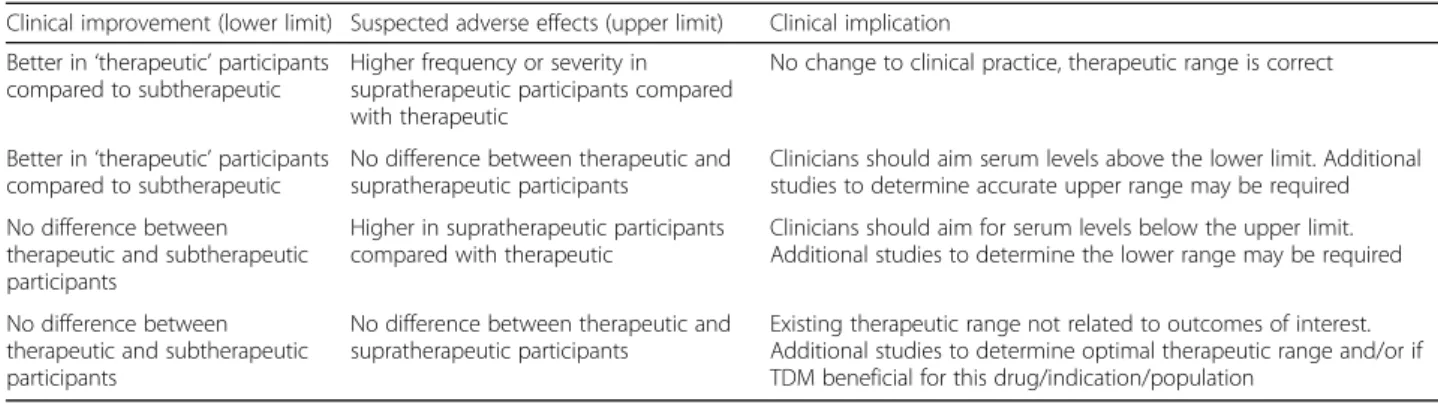
In reviews appraising the evidence around a standard therapeutic range used in practice, the results may have four possible implications. The range may be appropri-ate, the upper or lower limit should be amended in light of the review results, or there is no evidence on which to make any recommendations (Table 4).
The quality of the evidence around the recommenda-tions of the review should be presented, in context of a summary of the population, indication, and outcomes included in the review.
Conclusion
Evidence based therapeutic ranges have the potential to improve TDM practice. Current systematic reviews in-vestigating therapeutic ranges have highly variable meth-odologies and there is no consensus of best practice when undertaking systematic reviews in this field. Consistency in the searching, selection and appraisal of studies is necessary if these reviews are to inform pre-scribing practice. These recommendations meet a need not addressed by standard protocols.
Acknowledgements None.
Funding
No funding was received for this work.
Availability of data and materials All data is included in the manuscript.
Authors’contributions
DH, IS, and LC conceived the work. SG, YL, AJ and JK contributed expert knowledge of systematic review methodology. LC drafted the manuscript, all authors edited the manuscript. All the authors read and approved the final version of the manuscript.
Competing interests
The authors declare that they have no competing interests.
Consent for publication Not applicable.
Ethics approval and consent to participate
Not applicable–systematic review of published literature.
Table 4Clinical implications of systematic reviews of therapeutic ranges
Clinical improvement (lower limit) Suspected adverse effects (upper limit) Clinical implication
Better in‘therapeutic’participants compared to subtherapeutic
Higher frequency or severity in supratherapeutic participants compared with therapeutic
No change to clinical practice, therapeutic range is correct
Better in‘therapeutic’participants compared to subtherapeutic
No difference between therapeutic and supratherapeutic participants
Clinicians should aim serum levels above the lower limit. Additional studies to determine accurate upper range may be required
No difference between therapeutic and subtherapeutic participants
Higher in supratherapeutic participants compared with therapeutic
Clinicians should aim for serum levels below the upper limit. Additional studies to determine the lower range may be required
No difference between therapeutic and subtherapeutic participants
No difference between therapeutic and supratherapeutic participants
Existing therapeutic range not related to outcomes of interest. Additional studies to determine optimal therapeutic range and/or if TDM beneficial for this drug/indication/population
Publisher’s Note
Springer Nature remains neutral with regard to jurisdictional claims in published maps and institutional affiliations.
Author details
1Institute of Translational Medicine, University of Liverpool, Liverpool,
Merseyside, UK.2School of Medicine, Health Policy and Practice, University of
East Anglia, Norwich, UK.3Department of Health Sciences, University of York,
York, UK.4Department of Biostatistics, University of Liverpool, Liverpool, UK. 5Respiratory Department, Alder Hey Children’s Hospital, Liverpool, UK. 6National Institute for Health Research Alder Hey Clinical Research Facility,
Alder Hey Children’s Hospital, Liverpool, Merseyside, UK. Received: 14 February 2017 Accepted: 24 May 2017
References
1. Cereghino JJ, Brock J, Meter JCV, Pentry JK, Smith LD, White BG. Carbamazepine for epilepsy. Neurology. 1974;24(5):401.
2. Smith TW, Haber E. Digoxin intoxication: the relationship of clinical presentation to serum digoxin concentration. J Clin Invest. 1970, Dec;49(12):2377–86. 3. Buchthal F, Svensmark OLE, Schiller PJ. Clinical and electroencephalographic
correlations with serum levels of diphenylhydantoin. A.M.a. Arch Neurol. 1960;2(6):624–30.
4. Bialer M, Levy RH, Perucca E. Does carbamazepine have a narrow therapeutic plasma concentration range? Ther Drug Monit. 1998, Feb;20(1):56–9. 5. Centre For Reviews and Dissemination. Systematic reviews : CRD's guidance
for undertaking reviews in health care. York: University of York; 2009. 6. Higgins JPT, Green S, Collaboration C. Cochrane handbook for systematic
reviews of interventions. Chichester, England. Hoboken: Wiley; 2008. 7. Shea BJ, Grimshaw JM, Wells GA, Boers M, Andersson N, Hamel C, et al.
Development of AMSTAR: a measurement tool to assess the methodological quality of systematic reviews. BMC med res Methodol. 2007, Feb;7(1):10. 8. Cooney L, Hawcutt D, Sinha I. The evidence for intravenous theophylline
levels between 10-20mg/L in children suffering an acute exacerbation of asthma: a systematic review. PLoS One. 2016;11(4):e0153877.
9. Konidari A, Anagnostopoulos A, Bonnett LJ, Pirmohamed M, El-Matary W. Thiopurine monitoring in children with inflammatory bowel disease: a systematic review. Br J Clin Pharmacol. 2014;78(3):467–76.
10. Sparshatt A, Taylor D, Patel MX, Kapur S. Amisulpride - dose, plasma concentration, occupancy and response: implications for therapeutic drug monitoring. Acta Psychiatr Scand. 2009;120(6):416–28.
11. Knight SR, Morris PJ. Does the evidence support the use of mycophenolate mofetil therapeutic drug monitoring in clinical practice? A systematic review. Transplantation. 2008;85(12):1675–85.
12. Osterman MT, Kundu R, Lichtenstein GR, Lewis JD. Association of 6-thioguanine nucleotide levels and inflammatory bowel disease activity: a meta-analysis. Gastroenterology. 2006, Apr;130(4):1047–53.
13. Prybylski JP. Vancomycin trough concentration as a predictor of clinical outcomes in patients withStaphylococcus aureusbacteremia: a meta-analysis of observational studies. Pharmacotherapy. 2015;35(10):889–98. 14. Sparshatt A, Taylor D, Patel MX, Kapur S. A systematic review of
aripiprazole—dose, plasma concentration, receptor occupancy, and response: implications for therapeutic drug monitoring. J Clin Psychiatry. 2010;71(11):1447–56.
15. Zuk DM, Pearson GJ. Monitoring of mycophenolate mofetil in orthotopic heart transplant recipients—a systematic review. Transplant rev. 2009;23:171–7. 16. Bishara D, Olofinjana O, Sparshatt A, Kapur S, Taylor D, Patel M. Olanzapine:
a systematic review and meta-regression of the relationships between dose, plasma concentration, receptor occupancy, and response. J Clin
Psychopharmacol. 2013;33:329–35.
17. Moreau AC, Paul S, Del Tedesco E, Rinaudo-Gaujous M, Boukhadra N, Genin C, et al. Association between 6-thioguanine nucleotides levels and clinical remission in inflammatory disease: a meta-analysis. Inflamm Bowel Dis. 2014, Mar;20(3):464–71.
18. Cucherat M. Méta-analyse des essais thérapeutiques. France: Masson; 1997. 19. Kullar R, Leonard SN, Davis SL, Delgado G, Pogue JM, Wahby KA, et al.
Validation of the effectiveness of a vancomycin nomogram in achieving target trough concentrations of 15-20 mg/L suggested by the vancomycin consensus guidelines. Pharmacotherapy. 2011;31(5):441–8.
20. Rylance GW, Moreland TA. Drug level monitoring in paediatric practice. Arch Dis Child. 1980;55(2):89–98.
21. Turner-Warwick M. Study of theophylline plasma levels after oral administration of new theophylline compounds. Br med J. 1957, Jul 13;2(5036):67–9. 22. Williamson PR, Altman DG, Blazeby JM, Clarke M, Devane D, Gargon E, et al.
Developing core outcome sets for clinical trials: issues to consider. Trials. 2012;13(1):132.
23. Core outcome measures in effectiveness trials (COMET) initiative; Available from: http://www.comet-initiative.org. Accessed 7 January 2017. 24. Boers M, Idzerda L, Kirwan JR, Beaton D, Escorpizo R, Boonen A, et al.
Toward a generalized framework of core measurement areas in clinical trials: a position paper for OMERACT 11. J Rheumatol. 2014;41(5):978–85. 25. Sinha IP, Gallagher R, Williamson PR, Smyth RL. Development of a core
outcome set for clinical trials in childhood asthma: a survey of clinicians, parents, and young people. Trials. 2012;13(1):103.
26. Loke YK, Price D, Herxheimer A. Systematic reviews of adverse effects: framework for a structured approach. BMC med res Methodol. 2007, Jul;7(1):1. 27. Doyle LW, Halliday HL, Ehrenkranz RA, Davis PG, Sinclair JC. Impact of
postnatal systemic corticosteroids on mortality and cerebral palsy in preterm infants: effect modification by risk for chronic lung disease. Pediatrics. 2005;115(3):655–61.
28. Murphy BP, Inder TE, Huppi PS, Warfield S, Zientara GP, Kikinis R, et al. Impaired cerebral cortical gray matter growth after treatment with dexamethasone for neonatal chronic lung disease. Pediatrics. 2001;107(2):217–21.
29. Shinwell ES, Karplus M, Reich D, Weintraub Z, Blazer S, Bader D, et al. Early postnatal dexamethasone treatment and increased incidence of cerebral palsy. Arch Dis Child Fetal Neonatal Ed. 2000;83(3):F177–81.
30. Antonucci R, Zaffanello M, Puxeddu E, Porcella A, Cuzzolin L, Dolores Pilloni M, et al. Use of non-steroidal anti-inflammatory drugs in pregnancy: impact on the fetus and newborn. Curr Drug Metab. 2012;13(4):474–90. 31. Gelenberg AJ, Kane JM, Keller MB, Lavori P, Rosenbaum JF, Cole K, et al.
Comparison of standard and low serum levels of lithium for maintenance treatment of bipolar disorder. N Engl J med. 1989;321(22):1489–93. 32. Greeff O, Van Tonder J, Cromarty D, Lowman W, Becker P, Nell M. A
multi-centre, phase IV study to evaluate the steady-state plasma concentration and serum bactericidal activity of a generic teicoplanin preparation. South Afr J Infect Dis. 2015;30(3):89–94.
33. Katrak P, Bialocerkowski AE, Massy-Westropp N, Kumar S, Grimmer KA. A systematic review of the content of critical appraisal tools. BMC med res Methodol. 2004;4:22.
34. Sterne JA, Hernán MA, Reeves BC, SavovićJ, Berkman ND, Viswanathan M,
et al. ROBINS-I: a tool for assessing risk of bias in non-randomised studies of interventions. Bmj. 2016;355:i4919.
35. Higgins JPT, Altman DG, Gøtzsche PC, Jüni P, Moher D, Oxman AD, et al. The cochrane collaboration’s tool for assessing risk of bias in randomised trials. BMJ: British Medical Journal. 2011, Oct;343:d5928.
36. Critical appraisal skills programme. 12 questions to help you make sense of cohort study; Available from: http://media.wix.com/ugd/dded87_ e37a4ab637fe46a0869f9f977dacf134.pdf. Accessed 11 January 2017. 37. National institute of clinical excellence defined criteria for quality assessment of
case series; Available from: https://www.nice.org.uk/guidance/cg3/resources/ appendix-4-quality-of-case-series-form2. Accessed 11 January 2017.
• We accept pre-submission inquiries
• Our selector tool helps you to find the most relevant journal • We provide round the clock customer support
• Convenient online submission • Thorough peer review
• Inclusion in PubMed and all major indexing services • Maximum visibility for your research
Submit your manuscript at www.biomedcentral.com/submit