ISSN 0378-3693
European Commission
Bulletin
of the European Union
The Bulletin of the European Union reports on the activities of the Commission and the other Community institutions. It is produced by the Secretariat-General of the European Commission and published 10 times a year in the official European languages.
The following reference system is used: the first digit indicates the part number, the second digit the chapter number and the subsequent digit or digits the point number. Citations should there-fore read as follows: Bull 1/2-1994, point 1.1.1 or 2.2.3.
Supplements to the Bulletin are published in a separate series at irregular intervals. They contain official Commission material (e.g. communications to the Council, programmes, reports and pro-posals).
European Commission Secretariat-General
Editorial team: rue de Ia Loi 200- B-1049 Brussels- Tel. 2957930
Sent to press in December 1995
© ECSC-EC-EAEC, Brussels • Luxembourg, 1995
European Commission
Bulletin
of the European
Union
Bulletin information service
Readers can obtain information on developments since this issue went to press (date of
adoption of instruments by the Council, of opinions given by Parliament or the
Economic and Social Committee, of publication in the Official Journal, etc.) by
tele-phoning the documentation service of the Commission Offices on the following
numbers:
London
Belfast
Cardiff
Edinburgh
Dublin
References in the text
( 1 71) 222 8122
240 708
371 631
225 2058
671 2244
References to other parts of the same issue of the Bulletin are given in parentheses in
text, thus
(--+point 2.1.53 ).
Standardized abbreviations for the designation of certain monetary units in the different languages of the Community.
BFR ; Belgische frank I Franc beige DKR ; Dansk krone
DM ; Deutsche Mark DR ; Greek drachma ESC ; Escudo FF ; Franc fran~;ais
FMK ; Suomen markka
HFL ; Nederlandse gulden (Hollandse florijn) IRL ; Irish pound I punt
LFR ; Franc luxembourgeois LIT ; Lira italiana
OS ; Osterreichische Schilling PTA ; Peseta
Contents
Part One
ACTIVITIES IN SEPTEMBER 1995
News in brief
6
1 Union citizenship
7
2 Human rights
8
3 The Community economic and social area 10
Implementation of the White Paper on growth, competitiveness
and employment
10
Economic and monetary policy
10
Internal market 10
Competition
14
Industrial policy
20
Enterprise policy
20
Research and technology
21
Education, vocational training and youth
22
Economic and social cohesion
23
Trans-European networks
27
Energy
28
Transport
29
Information society, telecommunications
31
Environment
31
Agriculture
34
Fisheries
36
Employment and social policy
38
Equal opportunities
40
Solidarity
41
Public health
43
Consumer policy
43
Culture
43
Information, communication and audiovisual media
44
4 Role of the Union in the world
45
Common foreign and security policy
45
International organizations and conferences
48
Common commercial policy
49
Development policy
50
Humanitarian aid
52
Central and Eastern Europe, Baltic States
53
Mediterranean and Middle East
55
Independent States of the former Soviet Union; Mongolia
59
United States, Japan and other industrialized countries
59
Latin America 60 ACP countries, South Africa and OCTs 61
5 Justice and home affairs cooperation 64
6 Financing Community activities 67
Budgets 67
Financial operations 67
Measures to combat fraud 68
7 Statistical system 69
8 Community law 72
Monitoring the application of Community law 72 Decisions by the Court of Justice and the Court of First Instance 73
9 Institutional affairs 80
10 Community institutions 81
Parliament 81
Council 82
Commission 83
Community lawcourts 84
Court of Auditors 84
European Investment Bank 84
Economic and Social Committee 86
Committee of the Regions 87
Part Two
DOCUMENTATION
1 The ecu 90
2 Crossing external borders
92
3 European Union at UN 93
4 Additional references in the Official Journal 99
PART ONE
ACTIVITIES
News in brief
Union citizenship
o The Council adopts a Regulation determining the countries whose nationals must be in pos-session of a visa when crossing the external borders of the Member States (---+ point 1.1.1 ).
The Community economic and social area
Internal market
o Cross-border credit transfers: the Council agrees a common position on the proposal for a Parliament and Council Directive and the Commission approves a notice on the application of the EC competition rules (---+ points 1.3.12 and 1.3.13).
Trans-European nenworks
o The Council adopts a Regulation laying down general rules for the granting of Community financial aid (---+ point 1.3.61).
Energy
o
The Commission adopts a proposal for a Directive to introduce rational planning techniques in the electricity and gas distribution sectors (---+ point 1.3.66).Agriculture
o The Council adopts a Regulation derogating from Regulation (EEC) No 1765/92 establishing a support system for producers of certain arable crops as regards the set-aside requirements for the 1996/97 marketing year(---+ point 1.3.100).
Employment and social policy
o Part-time working: the social partners are consulted under the Agreement on social policy (---+ point 1.3.121).
Equal opportunities
1. Union citizenship
Freedom of movement and right of
residence
Non-Community nationals
1.1.1. Council Regulation (EC) No 2317/95 determining the countries whose nationals must be in possession of a visa when crossing the external borders of the Member States.
Reference: Council Regulation (EC) No 1683/95 laying down a uniform format for visas: OJ L 164, 14.7.1995; Bull. 5-1995, point 1.1.1 Commission proposal: OJ C 11, 15.1.1994; COM(93) 684; Bull. 11-1993, point 1.2.20; Bull. 12-1993, point 1.2.30
Parliament opinion: OJ C 128, 9.5.1994; Bull. 4-1994, point 1.1.6
Adopted on 25 September. This Regulation is
based on Article 1 OOc of the EC Treaty, which
Bull. EU 9-1995
requires the Council to determine the third coun-tries whose nationals must be in possession of a visa when crossing the external borders of the Member States. Following on from the Regu-lation laying down a uniform format for visas, it contributes to the harmonization of the policies of the Member States on visas with a view to the creation of an area without internal frontiers.
The Regulation, the main provisions of which will enter into force six months following publi-cation in the Official Journal, lays down a com-mon list of 101 countries and territorial entities whose nationals must be in possession of a visa when crossing the external borders of the Mem-ber States. It does not prevent Member States from maintaining national lists including other countries. Only visas for a stay of not more than three months are covered. The list is reproduced in Part Two (Documentation) (---+point 2.2.1).
OJ L 234, 3.10.1995
2.
Human rights
European Union countries
1.2.1. Parliament resolution on support for the
network of cities of asylum.
Adopted on 21 September. Parliament expressed
support for the initiative of the International Par-liament of Writers to set up a 'network of cities of asylum' for threatened or persecuted writers.
It welcomed the decision of a number of Euro-pean cities such as Almeria, Amsterdam, Berlin, Helsinki, Strasbourg, Venice and Sintra to join the network and asked the Commission to take action to fund related programmes.
OJ
c
269, 16.10.1995Human rights outside the European
Union
United Arab Emirates
1.2.2. Parliament resolution on the death
sen-tence passed on Sarah Balabagan in the United Arab Emirates.
Adopted on 21 September. Appalled at the death
sentence passed on Sarah Balabagan, a 16-year-old Muslim Filipino, for the murder of her em-ployer, overturning an earlier verdict recogniz-ing that the murdered man had raped the young woman, Parliament called on the relevant U AE authorities to re-examine the case. It asked the Council to make its grave concern clear to the government and to stress that relations with the EU would be damaged if the sentence was car-ried out.
OJ
c
269, 16.10.1995United States
1.2.3. Parliament resolution on the case of
Mumia Abu-Jamal in the USA.
Reference: Parliament resolution on the death penalty in the USA and the Abu-Jamal case: OJ C 166, 3.7.1995; Bull. 6-1995, point 1.2.8
Adopted on 21 September. Parliament reiterated
its call for Mr Abu-Jamal's case to be reviewed and called on the European authorities and the
Member State governments to make representa-tions to the Pennsylvanian authorities to prevent the execution and secure a review of the case.
OJ C 269, 16.10.1995
Indonesia
1.2.4. Parliament resolution on human rights
violations in East Timor and Indonesia.
Reference: Parliament resolution on the Com-mission communication entitled 'Towards a new strategy for Asia': OJ C 166, 3.7.1995; Bull. 6-1995, point 1.4.103
Adopted on 21 September. Parliament
con-demned outright Indonesian military oppression in East Timor and urged that basic human rights, including religious freedom, be respected in the region. It called on the international community, particularly EU Member States, to call an imme-diate halt to weapons sales and any kind of mil-itary assistance to Indonesia, and to suspend all economic cooperation while the occupation of Timor continued. It asked the Indonesian Gov-ernment to quash the death sentences, free all political detainees and grant amnesties to all 24 prisoners still held in connection with events dating back to 1965.
OJ C 269, 16.10.1995
Kenya
1.2.5. Parliament resolution on unfair trials in
Kenya.
Adopted on 21 September. Parliament demanded
the immediate and unconditional release of the human rights activists, Koigi wa Wamwere, Charles Kuria Wamwere, James Maigwa and G. G. Njuguna Ngengi, and called on the Kenyan authorities to put an end to the harass-ment and intimidation of political opponents.
OJ
c
269, 16.10.1995Russian Federation
1.2.6. Parliament resolution on the persecution
of Vladimir Orekhov.
Adopted on 21 September. Concerned at the
Trofimov, head of the FSB (successor to the KGB), had been particularly zealous in persecut-ing dissidents durpersecut-ing the Soviet era, and in view of the fact that Mr Orekhov had already been sentenced to eight years' hard labour in 1978 for helping dissidents, Parliament expressed the hope that the relevant authorities would reopen his case or quash his conviction. It stressed that any return to the methods and policies of the KGB would have an adverse effect on relations between Russia and the European Union.
OJ
c
269, 16.10.1995Turkey
1.2. 7. Parliament resolution on the
imprison-ment of Medhi Sana.
Reference: Parliament resolution on Turkish intervention in northern Iraq: OJ L 109, 1.5.1995; Bull. 4-1995, point 1.2.11
Adopted on 21 September. Parliament again
con-demned human rights violations in Turkey, particularly against Turks of Kurdish origin, and demanded the immediate release of Mr Sana, his wife and colleagues and all those Turkish citi-zens in prison for defending human rights in the country. It reiterated its determination to defend human rights in Turkey by all possible means and called on the Turkish Government to
com-Bull. EU 9-1995
Human rights
ply with the international human rights conven-tions to which the country was party.
OJ
c
269, 16.10.1995Financing
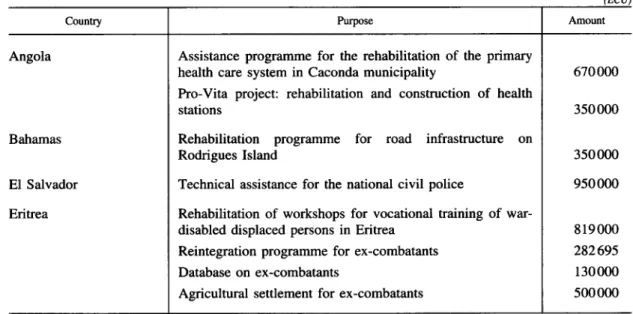
1.2.8. Financing of operations promoting
human rights and democracy (see Table 1).
Table 1 - Financing of operations promoting human rights and democracy
Purpose
Work placements in Portugal for Portuguese-speaking African jour-nalists
Support for presidential elections in Haiti
Support for the Haitian judiciary
Support for vulnerable groups in Haiti, particularly 'street' chil-dren
(ECU)
Amount
119000
1000625
489000
1813708
[image:11.472.254.454.173.368.2]3. The Community economic and social area
Implementation of the White
Paper on growth,
competitiveness and
employment
Trans-European networks
1.3.1. Proposal for a European Parliament and
Council Decision on Community guidelines for the development of the trans-European transport network (---+ point 1.3.62).
1.3.2. Council Regulation (EC) No 2236/95 of
18 September 1995 laying down general rules for the granting of Community financial aid in the field of trans-European networks (---+ point 1.3.61).
Economic and monetary
policy
Economic and monetary union
Coordination of economic policies
1.3.3. Council conclusions on the Swedish
convergence programme.
Adopted on 18 September.
'The Council welcomed the presentation of the Swed-ish convergence programme. The programme sets out the strategy of the Swedish Government for achieving compliance with the EMU convergence criteria and for restoring stability to the Swedish economy and thus creating the conditions for sustained growth of output and employment. At the centre of the con-vergence programme is a budgetary adjustment policy designed to reverse the serious imbalances in public finances which emerged in Sweden during the reces-sion in the early 1990s. The Council welcomed the
budgetary objectives of the programme (elimination of the government deficit by 1998 and a downward trend in the gross debt ratio after 1996) and found impressive the scale of the adjustment efforts being undertaken. It noted especially that most of the mea-sures necessary to achieve the adjustments have al-ready been decided by the government and adopted, with wide support, by the Swedish Parliament. The underlying macroeconomic assumptions are realistic. The programme, in its format and content, respects the code of conduct adopted by the Council in February
1994 and in that respect could serve as a model.
The Council also welcomed the clear support by the Swedish Government for the inflation objectives of the Swedish central bank. Determined implementation of the programme should progressively result in lower long-term interest rates in Sweden and a reduced bur-den on monetary policy. Keeping inflation low will also require moderation in wage developments.
The Council considered that success in achieving the objectives of the programme would depend crucially on maintaining control of public expenditure at all le-vels, including local government. It therefore attached considerable importance to the strengthening of the expenditure control system which the Swedish Gov-ernment envisages and to the proposed six-monthly monitoring of the implementation of the programme. It urged the Swedish Government to react quickly to offset any slippages that might become evident in this monitoring process and took the view that additional measures, if necessary, should concentrate on the expenditure side and not raise the tax burden further.'
Internal market
Free movement of goods
Technical aspects
Motor vehicles
1.3.4. Proposal for a Parliament and Council
States relating to measures to be taken against air pollution from emissions from motor vehi-cles.
Commission proposal: OJ C 390, 31.12.1994; COM(94) 558; Bull. 12-1994, point 1.2.12 Economic and Social Committee opinion: OJ C 155, 21.6.1995; Bull. 4-1995, point 1.3.7
Endorsed by Parliament on 20 September,
sub-ject to amendments aiming to shorten the transi-tion period and drop the introductransi-tion of interme-diate standards.
OJ
c
269, 16.10.19951.3.5. Proposal for a Parliament and Council
Directive amending Directive 88177/EEC on the approximation of the laws of the Member States relating to the measures to be taken against the emission of gaseous and particulate pollutants from diesel engines for use in vehicles.
Commission proposal: OJ C 389, 31.12.1994; COM(94) 559; Bull. 12-1994, point 1.2.13 Economic and Social Committee opinion: OJ C 155, 21.6.1995; Bull. 4-1995, point 1.3.8
Endorsed by Parliament on 20 September,
sub-ject to amendments aiming essentially to make the measures proposed by the Commission more binding, especially the limit values, and to give the Member States more flexibility in granting tax incentives.
OJ
c
269, 16.10.1995Dangerous substances
1.3.6. Proposal for a Parliament and Council
Directive amending for the 16th time Council Directive 761769/EEC.
Commission proposal: OJ C 382, 31.12.1994; COM(94) 570; Bull. 12-1994, point 1.2.17 Economic and Social Committee opinion: OJ C 236, 11.9.1995; Bull. 5-1995, point 1.3.14a
Endorsed by Parliament on 20 September,
sub-ject to technical amendments.
OJ
c
269, 16.10.1995Foodstuffs
1.3.7. Proposal for a Parliament and Council
Decision on the maintenance of national laws prohibiting the use of certain additives in the production of certain foodstuffs.
Commission proposal: OJ C 134, 1.6.1995; COM(95) 126; Bull. 4-1995, point 1.3.11
Bull. EU 9-1995
Internal market
Economic and Social Committee opinion deliv-ered on 13 September. The Committee,
con-cerned to preserve the free movement of tradi-tional products and promote clear information for the public, supports the proposal on condi-tion that the labelling of these products empha-sizes their traditional nature and their country of origin.
Animal and plant health
Animal health
1.3.8. Proposal for a Council Directive
amend-ing Council Directive 90/675/EEC layamend-ing down the principles governing the organization of vet-erinary checks on products entering the Commu-nity from third countries.
Commission proposal: OJ C 185, 19.7.1995; COM(95) 254; Bull. 6-1995, point 1.3.30
Endorsed by the Economic and Social Commit-tee on 13 September. However, the CommitCommit-tee
urges the Commission rapidly to complete the framework for harmonizing health standards for the import of livestock products from third countries.
Endorsed by Parliament on 22 September. OJ
c
269, 16.10.19951.3.9. Parliament resolution on the Conference
on the Use of Growth Activators in Stock-farm-ing.
References:
Parliament resolution on combating the 'hor-mone mafia': OJ C 89, 10.4.1995; Bull. 3-1995, point 1.3.11
Draft budget for 1996: Bull. 7/8-1995, point 1.6.3
Adopted on 22 September. Parliament welcomes
the organization of this Conference, and calls on the Commission to make it absolutely clear that the ban on hormones and BST will apply to imported farm products and foodstuffs, and that this ban will be guaranteed under World Trade Organization rules. It opposes the deletion by the Council, at the first reading of the 1996 bud-get, of budget headings Bl-213 and B1-214, which play a vital role in combating the illegal use of hormones. It calls on the Commission to set up a Community task force and to strengthen procedures for monitoring the use of hormones
Internal market
in stock-farming. It also urges it to promote a system guaranteeing quality control of livestock products from the farm to the consumer by introducing a recognized quality control label throughout the European Union.
OJ
c
269, 16.10.1995Animal feed
1.3.10. Proposal for a Council Directive laying
down the conditions and arrangements for approving certain establishments operating in the animal feed sector and amending Directives 70/524/EEC, 74/63/EEC, 79/373/EEC and 82/ 471/EEC.
Commission proposal: OJ C 348, 28.12.1993; COM(93) 587; Bull. 11-1993, point 1.2.18 Parliament opinion: OJ C 91, 28.3.1994; Bull. 3-1994, point 1.2.25
Economic and Social Committee opinion: OJ C 148, 30.5.1994; Bull. 3-1994, point 1.2.25
Agreed by the Council on 25 September. The
measure updates and supplements the criteria to be met by manufacturers, their staff and their fa-cilities so as to guarantee safe handling and use of the substances and products involved in ani-mal feedingstuffs. The proposal for a Directive makes provision for an approval procedure for establishments using certain substances for which a high level of monitoring is needed, and simple registration for those using only sub-stances considered less hazardous.
Plant health
1.3.11. Proposal for a Council Directive
amending Council Directive 77/93/EEC on pro-tective measures against the introduction into the Community of organisms which are harmful to plants or plant products and against their propagation within the Community.
Commission proposal: OJ C 192, 26.7.1995; COM(95) 239; Bull. 6-1995, point 1.3.33
Endorsed by Parliament on 22 September. OJ
c
269, 16.10.1995Freedom to provide services
Financial services
1.3.12. Proposal for a Parliament and Council
Directive on cross-border credit transfers.
Commission proposal: OJ C 360, 17.12.1994; COM(94) 436; Bull. 11-1994, point 1.2.21 Parliament opinion: OJ C 151, 19.6.1995; Bull. 5-1995, point 1.3.17
Economic and Social Committee opinion: OJ C 236, 11.9.1995; Bull. 5-1995, point 1.3.17 Amended Commission proposal: OJ C 199, 3.8.1995; COM(95) 264; Bull. 6-1995, point 1.3.38
Additional opinion delivered by the Economic and Social Committee on 13 September. The
Committee repeats its proposals on the banks' obligation to execute transfers within reasonable time-limits and to reimburse the full amount in the event of non-execution of transfers.
Common position agreed by the Council on 18 September. Under the common position, the
Directive should apply to cross-border credit transfers in the currencies of the Member States and in ecus of amounts less than ECU 25 000, this ceiling being raised to ECU 30 000 two years after the implementation of the Directive.
It would provide for:
o customer information, both in advance, con-cerning the conditions applying to transfers, and subsequently, concerning the execution and receipt of a transfer;
o the time-limits within which the originator's institution and the beneficiary's institution must execute the transfer (five banking business days and one banking business day respectively), fail-ing which compensation must be paid;
o the obligation to execute the transfer in ac-cordance with the instructions contained in the payment order, in particular with regard to the bearing of costs;
D in the event of non-execution of transfers, the obligation to refund the full amount up to a limit of ECU 10 000, plus interest and the amount of the charges, in principle within 14 banking busi-ness days.
1.3.13. Commission notice on the application
Commission approval of a draft notice: OJ C 322, 19.11.1994; COM(94) 436; Bull. 10-1994, point 1.2.11
Adopted on 13 September. The draft notice was
approved by the Commission in October 1994 and published in the Official Journal to enable interested parties to formulate their observa-tions. The notice supplements the proposal for a Parliament and Council Directive on cross-bor-der credit transfers(-+ point 1.3.12). It provides a framework allowing banks to set in place cooperation arrangements aimed at making cross-border credit transfers more efficient with-out unduly restricting competition. In the notice, the Commission addresses two main issues:
o market entry: the conditions for access to a payment system which constitutes an essential facility, i.e. a system to which access is crucial for banks wishing to handle the credit transfers concerned, should be objectively justified and applied in a non-discriminatory manner. Con-versely, smaller systems developed by groups of banks may limit their membership;
o price competition: the Commission states once more that banks are not allowed to con-clude agreements among themselves fixing the level of client fees or the way in which they will charge such fees. However, it also specifies that multilaterally agreed interchange fees, i.e. fees paid by one bank (here typically the originator's bank or its correspondent bank) to another bank (the beneficiary's bank) can in certain circum-stances be exempted from the ban on price agreements enshrined in Article 85(1) of the EC Treaty; in particular, in the case of OUR pay-ments, where the costs are fully borne by the originator of the payment, the beneficiary's bank is entitled to a multilaterally agreed interchange fee if that fee covers the costs it actually and necessarily incurs when handling a cross-border credit transfer.
OJ C 251, 27.9.1995
1.3.14. Proposal for a Parliament and Council
Directive amending Directive 89/647/EEC with respect to the supervisory recognition of con-tracts for novation and netting agreements ('con-tractual netting').
Commission proposal: OJ C 142, 25.5.1994; COM(94) 105; Bull. 4-1994, point 1.2.38 Economic and Social Committee opinion: OJ C 393, 31.12.1994; Bull. 9-1994, point 1.2.28 Parliament opinion (first reading): OJ C 56, 6.3.1995; Bull. 1/2-1995, point 1.3.15
Bull. EU 9-1995
Internal market
Amended Commission proposal: OJ C 165, 1.7.1995; COM(95) 170; Bull. 5-1995, point 1.3.19
Common position (EC) No 21/95 adopted by the Council on 6 September. The aim of the measure
is to enable Member States to ease calculation of the own-funds requirements imposed on credit institutions for the coverage of credit risks inher-ent in certain types of off-balance-sheet trans-actions, in order to take account of a reduction of these risks by bilateral netting agreements.
OJ C 288, 30.10.1995
1.3.15. Parliament resolution on financial
derivatives: their present role on capital markets, their advantages and risks.
Reference: Parliament resolution on international monetary cooperation within the framework of the easing of restrictions on capital markets: OJ C 20, 14.1.1994, Bull. 12-1993, point 1.2.55
Adopted on 22 September. In view of the
devel-opment of financial derivatives and the risks in-herent in their use, Parliament calls on the Com-miSSIOn to present in its annual work programme for 1996 proposals covering all banks, financial and non-financial companies dealing with financial derivatives. These propos-als would aim to codify the propospropos-als made by professional organizations on voluntary rules for managers, traders and users operating on deriv-ative markets, to adjust the accounting and dis-closure standards, to raise educational standards among managers and traders dealing with these instruments, to strengthen the validity of netting arrangements covering financial derivative con-tracts and encourage the use of other credit enhancement techniques such as the creation of multilateral clearing facilities. Parliament also requests the Commission to consider the possi-bility of creating a mechanism for assessing the degree of risk associated with each type of financial derivative, to investigate the implica-tions of the concentration of financial derivative transactions in the hands of a few suppliers and to submit to it and the Council regular reports on developments in financial derivative markets, as well as a report on the risks presented by deriv-atives.
OJ
c
269, 16.10.19951.3.16. Draft Convention on Insolvency
Proce-dures (-+ point 1.5.7).
Competition
Taxation
Indirect taxation
1 .3. 17. Commission report to the Council and Parliament on the rates of excise duty laid down in Council Directive 92179/EEC on the approxi-mation of taxes on cigarettes, Council Directive 92/80/EEC on the approximation of taxes on manufactured tobacco other than cigarettes, Council Directive 92/84/EEC on the approxima-tion of the rates of excise duty on alcohol and al-coholic beverages and Council Directive 92/82/ EEC on the approximation of the rates of excise duties on mineral oils.
Basic Directives:
Council Directive 92112/EEC on the general arrangements for products subject to excise duty and on the holding, movement and monitoring of such products (OJ L 76, 23.3.1992; Bull. 112-1992, point 1.3.9), as last amended by Direc-tive 92/108/EEC: OJ L 390, 31.12.1992; Bull. 12-1992, point 1.3.21
Council Directives 92179/EEC, 92/80/EEC, 92/ 82/EEC et 92/84/EEC: OJ L 316, 31.10.1992; Bull. 10-1992, points 1.3.11, 1.3.12, 1.3.14 and 1.3.17 respectively
Adopted by the Commission on 13 September. In
this report, the Commission describes the evolu-tion of the Community excise system since 1 January 1993 and examines the rates applied by the Member States for each of the groups of products concerned from the standpoint of the proper functioning of the internal market, the real value of the duty rates and the wider objec-tives of the Treaty. It believes that there are questions relating to a wide range of issues and that it is essential for Community excise policy, which has been implemented to ensure the proper functioning of the internal market, to be sufficiently coherent to secure tax revenues and guarantee sound economic conditions at national level while remaining consistent with the wider policies of the European Union. A longer-term excise policy which takes account of the impli-cations for other Community policies (common agricultural policy, health, energy and the envi-ronment, etc.) must be defined on the basis of the results of the Lisbon Conference. This Conference, whose objective is to assess the per-formance of the Community's current excise system, and more particularly to assist the Com-mission in its task of formulating an excise pol-icy for the future, will therefore probably be
fol-lowed by proposals for altering the existing rates.
COM(95) 285
Competition
Rules applying to businesses
General rules
1.3.18. Commission Regulation (EC) No 2131/95 amending Regulation (EEC) No 2349/84 on the application of Article 85(3) of the Treaty to certain categories of patent li-censing agreements.
Regulation amended: Regulation (EEC) No 2349/84 (OJ L 219, 16.8.1984), as last amended by Regulation (EC) No 70/95: OJ L 12, 18.1.1995; Bull. 112-1995, point 1.3.23
Adopted on 7 September. The period of validity
of Regulation (EEC) No 2349/84 is extended by six months.
OJ L 214, 8.9.1995
1 .3. 19. Commission notice on the application of the EC competition rules to cross-border credit transfers (---+point 1.3.13).
Mergers
Commission decisions under the Merger Control Regulation
Reference: Council Regulation (EEC) No 4064/89 on the control of concentrations be-tween undertakings: OJ L 395, 30.12.1989 (cor-rected version: OJ L 257, 21.9.1990); Bull. 12-1989, point 2.1.78; Supplement 2/90- Bull.
Noranda/Forest/Glunz
1.3.20. Adopted on 8 September. The decision
authorizes the setting-up of a joint venture by Noranda Forest Inc. and Glunz AG in the wood-products and wood-based panel board sector.
United Kingdom will be combined and sold to Norbord Holdings Ltd, currently a subsidiary of Noranda, which will be renamed CSC Forest Products Ltd.
The Canadian company Noranda Forest Inc. will withdraw from the European panel board mar-ket. The only panel board product for which the joint venture's combined market share will be substantial is oriented strand board (OSB}, a rel-atively new product in Europe and one for which Glunz and Norbord Holdings have the only lines currently producing in the European Union.
Total consumption of OSB is very small com-pared with that of other panel board products, notably chipboard and plywood. The combined market shares of Glunz and Norbord on the OSB and chipboard markets in the one case and on the OSB and plywood markets in the other will not be likely, however, to cause any competition problems. In addition, at least one other pro-ducer of panel board is currently installing an OSB production line.
The Commission has accordingly decided not to object to this merger and to declare it compat-ible with the common market.
Ricoh/Gestetner
1.3.21. Adopted on 12 September. The
deci-sion authorizes the acquisition of Gestetner by Rico h.
The Commission gave the go-ahead to the acquisition, as part of a takeover announced on 27 July, of the UK company Gestetner Holdings pic by the Japanese Ricoh Company Ltd.
The main sector concerned is the distribution of photocopiers. Following the acquisition, the combined market shares of the parties on the rel-evant markets will not exceed 25%. Important competitors, such as Canon and Rank Xerox, hold larger market shares.
The Commission also examined whether the transaction might possibly strengthen Ricoh's position on the production market; it reached the conclusion that, even if this were the case, any reinforcement would not be significant in terms of dominance.
Bull. EU 9-1995
Competition
Kimberly-Clark/Scott Paper
1.3.22. Adopted on 12 September. The
deci-sion initiates the second phase of the investiga-tion.
The Commission has decided to make a full investigation into the competition problems raised by the proposed merger between Kim-berly-Clark and Scott Paper.
The transaction concerns the merger of the American paper groups Kimberly-Clark and Scott Paper, which are both engaged on a large scale in Europe in the production and sale of tis-sue products for the private consumer and for in-dustrial use. The merger will create the largest manufacturer of tissue products in the world and will combine brands which are among the most renowned in the sector.
After the preliminary investigation, the Com-mission took the view that the transaction could lead to the strengthening of a dominant position in the European Union with very high market shares in the United Kingdom, particularly in toilet tissue and facials (75% in branded ucts) and kitchen towels (50% in branded prod-ucts). The new company's position would like-wise be very strong on the Irish and Italian markets, and possibly in other Member States as well.
Albacom (BTIBNL)
1.3.23. Adopted on 15 September. The
deci-sion finds that the agreement between Banca Nazionale del Lavoro (BNL) and British Tele-communications (BT) concerning the creation of a joint venture in the telecommunications sector is not a transaction covered by the Merger Con-trol Regulation.
BNL, an Italian banking group, and BT, a UK telecommunications group, notified a proposal to set up a new company offering commercial telecommunications services. BT will hold 50.5% of the shares and BNL 49.5%.
After assessing the transaction, the Commission found that the minority rights which BNL has will give it a decisive say in the running of the new company during the first three years only. After that period, BT will have definitive sole
Competition
control. The Commission took the view that a three-year period of joint control would not be enough to determine permanently the new com-pany's control structure.
The Commission therefore considers that the transaction consists of the acquisition by BT alone of part of BNL. As a result, the threshold for Community turnover specified in the Merger Control Regulation has not been reached and the transaction does not fall within the scope of the Regulation.
RTUVeronica/Endemol
1.3.24. Adopted on 20 September. The
deci-sion prohibits the creation of the joint venture Holland Media Groep in its present form.
As currently structured, Holland Media Groep SA (HMG), the joint venture between RTL, Veronica and Endemol, which has been oper-ational since 1 September, has been refused ap-proval by the Commission. The latter considers that the transaction gives the partners a dom-inant position at one and the same time on the television broadcasting, advertising and pro-gramme production markets in the Netherlands.
In the light of its investigation, the Commission has reached the conclusion that HMG, with the support of its three commercial channels, will become the largest television broadcaster on the Dutch market; with a probable audience share of 40%, it will significantly reduce the audience share of the public sector broadcasters.
Audience share determines to a large extent the position of broadcasters on the television ad-vertising market. HMG will therefore be by far the most important player on the Dutch televi-sion advertising market.
In 1994, despite an audience share of 32%, both RTL channels together had about 50% of the tel-evision advertising market in the Netherlands. If
Veronica is included, HMG will probably have at least 60% of that market.
HMG has a particular advantage over its com-petitors in that it can cover the target groups regarded as the most important by the advertis-ing companies, since it can coordinate the scheduling for its three channels. The Commis-sion has concluded that HMG will exercise a
dominant position on the Dutch television ad-vertising market.
Lastly, as regards Endemol- by far the largest independent maker of television programmes in the Netherlands - its shareholding in HMG gives it a structural link with the main broad-caster in the Netherlands, to whom it brings privileged access as the principal buyer on the Dutch television production market. On this market, therefore, Endemol's already dominant position will be strengthened still further.
The transaction did not have to be notified to the Commission, because the partners' combined turnover remained below the thresholds laid down in the Merger Control Regulation. How-ever, the Dutch Government had already inform-ed the Commission pursuant to Article 22 of the Regulation and the Commission was therefore competent to examine the transaction. One of the consequences of this procedure is that the transaction has not been suspended and that HMG has the right to pursue its activities tem-porarily.
As well as adopting a negative decision, the Commission has begun negotiations with the parties concerned on alternative formulas which should result, within no more than three months, in competition being restored to the Dutch media market.
Orkla/Volvo
1.3.25. Adopted on 20 September. The purpose
of the decision is to authorize the setting-up of a joint venture between Orkla and Volvo in the beverages sector.
The Commission has approved the creation of a joint venture, BCP-JV, which is designed to combine the activities in the beverages sector of the Swedish group Volvo and Ringnes, a mem-ber of the Norwegian group Orkla.
close cooperation with the Norwegian competi-tion authority and the EFf A surveillance author-ity, the Commission considered that the trans-action would lead to the creation of a dominant position with a market share in excess of 75% of the Norwegian market for sales of beer to retail-ers and to the hotel and catering industry.
Orkla and Volvo have therefore undertaken to sell the Norwegian brewery Hansa so as to reduce their market share; the Commission has given its agreement to the transaction on this condition.
Rhone Poulenc/Fisons
1.3.26. Adopted on 21 September. The
deci-sion approves the cash offer from Rhone Pou-lenc Rorer for Fisons.
The Commission has decided that the cash offer for Fisons pic from Rhone Poulenc Rorer Inc. does not raise competition issues.
Fisons' main interest is in the area of pharma-ceuticals, especially for the treatment of aller-gies. Rhone Poulenc Rorer, which is present in the same sector, belongs to the Rhone Poulenc group, whose business is in the chemicals, fibres and polymers, agrichemicals and health sectors.
The transaction basically concerns medicinal products. Despite large market shares in some categories of pharmaceuticals, the proposed transaction neither creates nor strengthens a dominant position, given the specific charac-teristics of the markets in question, which are: insignificant accretion, declining sales, competi-tion from generic products, or a combinacompeti-tion of these factors.
The two companies also have overlapping activ-ities in pharmaceutical research and develop-ment, laboratory supplies and horticultural prod-ucts. However, the transaction will not create or strengthen a dominant position in these areas.
The Commission has therefore decided not to object to the transaction.
Bull. EU 9-1995
Competition
Generate Bank/Credit Lyonnais Bank Nederland
1.3.27. Adopted on 25 September. The
deci-sion authorizes a concentration in the banking sector.
The Commission has approved the acquisition by the Belgian commercial bank Generale Bank NV (G-Bank) of Credit Lyonnais Bank Neder-land NV (CLBN), a Dutch subsidiary of the Cre-dit Lyonnais group.
CLBN's business is basically located in the Netherlands. G-Bank's activities in the Nether-lands are minor: the two banks' combined mar-ket shares are not such as to hinder competition, whether on domestic or international markets.
Upjohn/Pharmacia
1.3.28. Adopted on 28 September. The
deci-sion authorizes the merger of Upjohn Company (USA) and Pharmacia AB (Sweden).
The global management of the new company, Pharmacia& Upjohn Inc., will be located in London. The new company will rank ninth in the world and will account for about 2.5% of pharmaceutical sales worldwide, and a slightly higher percentage in Europe. The merger will create a significant addition of market shares only in corticosteroids (H2A) in Sweden and an overlap of R&D activity only in tumours and Parkinson's disease.
Since the companies concerned are subject to competition from large international companies on the product market and on the R & D market, the proposed transaction does not raise any seri-ous doubts as to its compatibility with the com-mon market, and the Commission has decided to authorize it.
State aid
General rules
1.3.29. Commission decisions and other
mea-sures in respect of State aid in agriculture and transport are dealt with under the relevant sub-ject headings (-+ points 1.3.104 and 1.3.80).
Competition
Decisions to raise no objection
Shipbuilding
Reference: Seventh Council Directive 90/684/ EEC on aid to shipbuilding (OJ L 380, 31.12.1990; Bull. 12-1990, point 1.3.64), as last amended by Council Directive 94/73/EC: OJ L
351, 31.12.1994; Bull. 12-1994, point 1.2.64
Germany
1.3.30. Commission decisions on aid to the
shipyards Warnow Werft, Wamemtinde and MTW-Schiffswerft GmbH, Wismar (Mecklen-burg-Western Pomerania).
Reference: Council Directive 92/68/EEC amend-ing Directive 90/684/EEC on aid to shipbuildamend-ing (which amended the seventh Directive so as to allow the additional aid needed to restructure shipyards in the new Lander): OJ L 219, 4.8.1992; Bull.7/8-1992, point 1.3.56
Previous decisions: Bull. 12-1992, point 1.3.77; Bull. 112-1993, point 1.2.65; Bull. 12-1993, point 1.2.78
Adopted on 20 September. The Commission has
decided to approve additional instalments of investment aid amounting to DM 66.9 million (ECU 35.7 million) for Wamow Werft and DM 194 million (ECU 103.4 million) for MTW-Schiffswerft. The Commission took into account the progress made on the restructuring plans for the two yards, which were deemed to be neces-sary when the yards were privatized in 1992. It found that the aid satisfied the criteria for exemption under the seventh Directive, as amended to allow supplementary aid for restruc-turing the shipyards in the new Uinder.
1.3.31. Commission decision on aid to the
Elbewerft yard, Boizenburg (Mecklenburg-Western Pomerania).
Previous decisions: Bull. 12-1993, point 1.2.78; Bull. 3-1995, point 1.3.37
Adopted on 20 September. The Commission has
authorized payment to Elbewerft of a new instal-ment (DM 500 000) of closure aid, which had been approved as part of the yard's restructur-ing. Pursuant to Article 7 of the seventh Direc-tive, the aid relates to the costs associated with the reduction of the workforce.
Greece
1.3.32. Commission decision on a Greek
ship-building aid scheme.
Adopted on 20 September. Since the seventh
Directive has been extended until 31 December 1995, the Commission has decided not to object to the extension until the same date of Minis-terial Decree 30512 of 9 August 1991, which governs aid to shipbuilding in Greece. The pro-visions of the Decree have not been amended and the ceiling set by the Commission on the granting of aid in 1995 will be complied with. After 1995 no more aid will be granted.
Other measures
Germany
1.3.33. Commission decision on aid to
ceram-ics manufacturer Winterling Porzellan AG, Bavaria.
Reference: Community guidelines on State aid for rescuing and restructuring firms in difficulty:
OJ C 368, 23.12.1994; Bull. 7/8-1994, point 1.2.42
Adopted on 20 September. Winterling Porzellan
produces stoneware and china tableware at sev-eral sites and has a workforce of more than 2000. Under its restructuring plan, which pro-vides for a 28% cut in production capacity resulting from the discontinuance of stoneware manufacture, it will receive aid in the form of a soft loan amounting to DM 4.5 million (ECU 2.4 million). The Commission has authorized the aid after checking that it is compatible with the Community guidelines on State aid for res-cuing and restructuring firms in difficulty.
France
1.3.34. Commission decision on an aid scheme
for the clock manufacturing and jewellery indus-try.
Adopted on 20 September. The Commission has
financed by the collection of a parafiscal charge. The yield will serve to finance the activities of technical centres carrying out programmes of interest to the industry as a whole. The Commis-sion took the deciCommis-sion after finding that the scheme was compatible with the common mar-ket, in particular since direct aid to firms was ruled out, imported products were exempt from payment of the tax and there was to be no aid of any kind for intra-Community exports.
Sweden
Reference: Community guidelines on State aid for rescuing and restructuring firms in difficulty: OJ C 368, 23.12.1994; Bull. 7/8-1994, point 1.2.42
1.3.35. Commission decision on aid to
Hlir-jedalens Mineral AB, Jlirntland, a company engaged in the extraction and processing of peat.
Adopted on 20 September. Hlirjedalens Mineral
AB, which employs 125 people, extracts and enriches peat for power stations in Uppsala. Un-der a restructuring plan, it will receive aid in the form of a grant of SKR 147 million (ECU 15.6 million) instead of State guarantees of an equivalent amount.
Since it generally favours measures to promote the exploitation of local energy resources, the Commission decided to authorize the aid after finding that it complied with the procedures for granting aid laid down in the Community guide-lines on State aid for rescuing and restructuring firms in difficulty.
Regional aid
Reference: Commission communication on the principles of coordination of regional aid schemes: OJ C 31, 3.2.1979
Spain
1.3.36. Commission decision on aid for the
improvement of environmental quality in Cas-tile-Leon.
Adopted on 20 September. The decision
autho-rizes a scheme of aid for investment associated with improvement of the environment in
Cas-Bull. EU 9-1995
Competition
tile-Leon. Eligible measures include the reduc-tion and prevenreduc-tion of pollureduc-tion, waste recovery and the rehabilitation of derelict industrial areas. The Commission found that the scheme com-plied with the ceilings it had set for the granting of regional aid in this region.
Research and development
Reference: Community framework for State aid for research and development: OJ C 83, 11.4.1986; Bull. 3-1986, points 1.1.1 to 1.1.6
France
1.3.37. Commission decision on aid to the
companies Sopra and Laserdot.
Adopted on 20 September. Sopra and Laserdot
will receive aid for carrying out a Eureka research programme, 'EU 205-Excimer', which requires a total investment of FF 87 million (ECU 13.33 million) over eight years and is designed to develop the use of excimer lasers and study their possible industrial applications. The Commission authorized the granting of the aid after finding that the rates and procedures complied with the Community framework for State aid for research and development.
Decision to initiate proceedings under
Article 93(2) of the EC Treaty
Spain
1.3.38. Commission decision on Spanish aid
schemes for the motor industry.
References: Commission decision on the Com-munity framework on State aid to the motor vehi-cle industry: Bull. 7/8-1995, point 1.3.52
Adopted on 20 September. The Spanish
Govern-ment has refused to reintroduce the framework as an appropriate measure, and, after examining the reasons, the Commission has found no valid grounds for that refusal; it has therefore decided to initiate proceedings under Article 93(2) of the EC Treaty with regard to the various Spanish schemes authorizing the granting of aid to motor manufacturers from 1 January 1996.
Industrial policy
Decision to terminate proceedings
Positive final decision
Germany
1.3.39. Commission decision on aid to
Berg-Spezial-Rohr GmbH, Siegen (North Rhine-Westphalia).
Reference: Framework for certain steel sectors not covered by the ECSC Treaty: OJ C 320, 13.12.1988
Initiation of proceedings: Bull. 3-1993, point
1.2.46
Adopted on 20 September. The Commission has
decided to authorize the grant of DM 359 000 (5% of the investment costs) in investment aid to Berg-Spezial-Rohr GmbH, a manufacturer of tubes for the construction industry. In the course of the proceedings, the Commission found that the investment qualifying for aid did not enable the company to increase production capacity. It took into consideration the fact that the aid was granted under a regional aid scheme which had already been approved and that the new invest-ment would help to improve and diversify the employment market in Siegen.
Industrial policy
Individual industries
Motor industry
1.3.40. Parliament resolution on the
commu-nication from the Commission to the Council and Parliament entitled 'The automobile indus-try - Current situation, challenges, strategy for the future and proposals for action'.
Commission communication: COM(94) 49;
Bull. 112-1994, point 1.2. 73
Adopted on 21 September. Parliament calls on
the Commission to develop a specific strategy for the European automobile industry compara-ble in scale to the similar efforts already under way in Japan and the United States. It empha-sizes, in particular, the importance of boosting
demand and of having a well-trained and skill-intensive labour force. It asks the Commission to take steps to promote technological research and development work aimed at creating the car of tomorrow as well as environmentally friendly models and at developing high safety standards. It also calls for close monitoring of customs and non-customs barriers impeding the access of European cars to third-country markets.
OJ
c
269, 16.10.1995Mechanical engineering
1.3.41. Parliament resolution on the
communi-cation from the Commission entitled 'Strength-ening the competitiveness of the European ma-chinery construction industry'.
Commission communication: COM(94) 380;
Bull. 10-1994, point 1.2.52
Adopted on 21 September. Parliament welcomes
the Commission's initiative for strengthening the competitiveness of the European machinery construction sector. It stresses in this connection the need to boost demand and the importance of vocational training. Highlighting the predom-inance of SMEs in this sector, it calls for mea-sures to be taken in favour of such businesses, particularly those which invest in research and development, for tax incentives and for better access to the venture capital market. It advocates closer coordination between industry and train-ing institutions, industrial research organiza-tions, and national and local authorities, with a view to an ongoing transfer and updating of best-practice methods and technical know-how.
It also considers that the presence of the Euro-pean machinery industry must be promoted in third countries.
OJ C 269, 16.10.1995
Enterprise policy
Small and medium-sized businesses
1.3.42. Report on the coordination of activities
References:
Commission communication on the implemen-tation of an integrated programme in support of small and medium-sized enterprises (SMEs) and the craft sector: COM(94) 207; Bull. 6-1994, point 1.2. 79
Council Decision 93/379/EC on a multiannual programme of Community measures to intensify the priority areas and to ensure the continuity and consolidation of policy for enterprise, in partic-ular SMEs, in the Community: OJ L 161, 2.7.1993; Bull. 6-1993, point 1.2.83
Commission notices to the Member States concerning Community initiatives such as the SME initiative and ADAPT: OJ C 180, 1.7.1994; Bull. 6-1994, point 1.2.133
Council Decision 94/819/EC establishing an action programme for the implementation of a European Community vocational training policy 'Leonardo da Vinci': OJ L 340, 29.12.1994; Bull. 12-1994, point 1.2.227
Adopted by the Commission on 8 September.
With this report, the Commission aims to pro-vide a complete picture of the initiatives in sup-port of SMEs taken by the European Union un-der its various policies. It describes the action taken as part of enterprise policy and other EU policies under the two main headings of the inte-grated programme: improvements to the legal, administrative, fiscal and financial environment of businesses, and SME support measures. The report draws attention to the significant progress made in the area of structural funds, especially via the Community SME initiative, with the ADAPT initiative and the new Leonardo pro-gramme, in research and technological devel-opment and vocational training. Where interna-tional cooperation is concerned, coordination between enterprise policy and the cooperation programmes with non-member countries has en-abled such countries to take advantage of the ex-pertise acquired and the existing networks of in-termediaries, while providing Community SMEs with better information on the opportunities available in these countries.
COM(95) 362
Tourism
1.3.43. Economic and Social Committee
opin-ion on the role of the European Unopin-ion in the field of tourism - Commission Green Paper.
Commission Green Paper: COM(95) 97; Bull. 4-1995, point 1.3.62
Bull. EU 9-1995
Research and technology
Adopted by the Economic and Social Committee on 14 September. The Committee welcomes the
policies set out in the Green Paper and recom-mends the insertion into the EC Treaty of a new title on tourism, to give this job-creating sector the means to withstand international competi-tion. It further recommends a Community tou-rism policy which, without interfering with national and regional policies, would make it possible to lay down common guidelines at European level to ensure that any action taken is in line with the objectives.
Research and technology
General
Research policy coordination
1.3.44. Council resolution on the Scientific
and Technical Research Committee (CREST).
Adopted by the Council on 28 September. This
resolution replaces the 1974 Council resolution setting up CREST, in order to adapt its role and tasks. It is an advisory body which assists the Council and the Commission in the research and technological development field by identifying strategic priorities, establishing mutual consis-tency between national and Community policies, and helping to formulate Community strategy with regard to international cooperation.
OJ
c
264, 11.10.1995International cooperation
Canada
1.3.45. Draft Agreement on scientific and
technical cooperation between the European Community and Canada.
Commission recommendation: Bull. 12-1992, point 1.3.115
Negotiating directives: Bull. 4-1993, point 1.2.69
Education, vocational training and youth
Commission proposal concerning signature: COM(94) 551; Bull. 12-1994, point 1.2.103 Signature: Bull. 6-1995, point 1.3.86
Commission proposal for a Council Decision concluding the Agreement adopted on 11 Sep-tember.
COM(95) 419
Education, vocational training
and youth
General
1.3.46. Committee of the Regions opinion on
the Commission communication entitled 'Edu-cation and training in the face of technological, industrial and social challenges: first thoughts'.
Commission communication: COM(94) 528; Bull. 11-1994, point 1.2.203
Adopted by the Committee of the Regions on 20 September. The Committee welcomed the
Commission's approach, but stressed the need for equal access for all citizens to new tech-nologies for education and training. It also advo-cated the development of European targets for education and training, and said it must be con-sulted on all decisions and measures provided for in any action plan.
Cooperation in the field of education
1.3.47. Annual report on the Cornett
pro-gramme for 1994.
Reference: Council Decision 89/27/EEC adopt-ing the second phase of the programme on coop-eration between universities and industry regard-ing trainregard-ing in the field of technology (COMETI II, 1990-94): OJ L 13, 17.1.1989; Bull. 12-1988, point 2.1.159
Previous report: COM(94) 368; Bull. 9-1994, point 1.2.187
Adopted by the Commission on 6 September. In
its report, covering the final year of the second
phase of Cornett II, the Commission takes stock of work under this programme, which aims to reinforce training in technology (particularly advanced technology), the development of highly skilled human resources and the competi-tiveness of European industry. In 1994, the Cornett programme provided funding for more than 7 800 transnational student placements, 250exchanges of personnel from universities and industry, and 700 joint training courses. The programme has thus enabled 175 513 people in Europe to benefit from technology training courses. In addition, a wide range of training materials have been developed, including vid-eos, CO-ROMs, audio cassettes, books and slides.
COM(95) 409
1.3.48. Annual report on the Erasmus
pro-gramme for 1994.
References:
Council Decision 89/663/EEC amending Deci-sion 87/327/EEC adopting the European Commu-nity action scheme for the mobility of university students (Erasmus): OJ L 395, 30.12.1989; Bull. 12-1989, point 2.1.123
Agreement establishing the European Econo-mic Area (EEA): Bull. l/2-1994, point 1.3.27 Previous report: COM(94) 281; Bull. 7/8-1994, point 1.2.168
Adopted by the Commission on 8 September. In
its report, the Commission describes the imple-mentation during the 1994/95 academic year of the Erasmus programme, a programme which sets out to promote interuniversity cooperation. The total number of interuniversity cooperation programmes (ICPs) funded by the Commission is now 2 280, 414 of which relate to the year un-der review. There was a 20% increase in the number of participating institutions and students involved in mobility schemes. There was also a 21% increase over 1993-94 in respect of teach-ing staff spendteach-ing a period abroad. Relations with Switzerland and Liechtenstein continued on the basis of the bilateral agreements concluded with the Community in 1991; schemes involving Austria, Finland, Iceland, Norway and Sweden are based, with effect from 1994, on the Agree-ment on the European Economic Area. The level of participation by these countries increased by some 50% over the 1993-94 period.
Youth
1.3.49. Parliament resolution on the
establish-ment of European civilian service.
Adopted by Parliament on 22 September.
Parlia-ment called on the Commission to initiate think-ing on the creation of a European civilian ser-vice scheme which would not take the place of national forms of statutory military service or ci-vilian service, but which could consolidate and complement exchanges between young Euro-pean Union citizens, giving precedence to the most disadvantaged young people.
OJ
c
269, 16.10.1995Cooperation with non-member
countries
Central and Eastern Europe
1.3.50. Committee of the Regions opinion on
the role of local and regional authorities in edu-cation and training supplied by the European Union in the countries of Central and Eastern Europe (---+ point 1.4.32).
Economic and social
cohesion
Structural action, regional policy
Policy aspects
General
1.3.51. Additional opinion of the Economic
and Social Committee on the Commission com-munication entitled 'Europe 2000+: cooperation for European territorial development'.
References:
Commission communication: COM(94) 354; Bull. 7/8-1994, point 1.2.102
Economic and Social Committee opinion: OJ C 133, 31.5.1995; Bull. 3-1995, point 1.3.77
Bull. EU 9-1995
Economic and social cohesion
Parliament resolution: OJ L 183, 17.7.1995; Bull. 6-1995, point 1.3.92
Committee of the Regions opinion: Bull. 7/8-1995, point 1.3.86
Adopted on 13 September. Supplementing its
opinion of 25 March 1995 on the communi-cation on cooperation for European territorial development, the Committee urged the Commis-sion, with a view to boosting cooperation, to launch studies and pilot schemes focusing on potential spatial planning areas and called for improved coordination of the various policies involved to promote better spatial cohesion. It
took the view that the European spatial devel-opment perspective proposed in the communi-cation must be tailored to regional trends and potentialities and must respect the regions' geo-graphical, socioeconomic and cultural differ-ences and that decision-making must be coor-dinated at all levels.
1.3.52. Committee of the Regions opinion on
the annual reports on the cohesion financial instrument and the Cohesion Fund.
References:
Annual Commission report on the cohesion financial instrument: COM(95) 1; Bull. 112-1995, point 1.3.80
Supplement to the Commission report on the cohesion financial instrument: COM(95) 222; Bull. 6-1995, point 1.3.105
Adopted on 21 September. The Committee
wel-comed the Commission's reports but took the view that local and regional authorities should take a more active part in the management of the Cohesion Fund by, among other things, provid-ing opinions on the financprovid-ing applications sub-mitted by the Member States concerned. The Committee also called for better analysis of the environmental impact of projects.
1.3.53. Own-initiative opinion of the
Commit-tee of the Regions on the Structural Fund inno-vatory measures 1995-99 and the second series of actions under Article 10 of the ERDF Regu-lation.
Reference: Council Regulation (EEC) No 4254/88 laying down provisions for imple-menting Regulation (EEC) No 2052/88 as regards the European Regional Development Fund (OJ L 374, 31.12.1988; Bull. 12-1988, point 2.1.200), as last amended by Regulation (EEC) No 2083/93: OJ L 193, 31.7.1993; Bull. 7/8-1993, point 1.2.117