Int. J. Electrochem. Sci., 6 (2011) 3858 - 3867
International Journal of
ELECTROCHEMICAL
SCIENCE
www.electrochemsci.org
New Solid-State Organic Membrane Based Lead-Selective
Micro-Electrode
Hassan A. Arida1,2,*, Ameera S. Al-haddad3, Michael J. Schöning4
1
Chemistry Department, Faculty of Science, Taif University, 888-Taif, KSA
2
Hot Laboratories Center, Atomic Energy Authority, 13759- Cairo, Egypt
3
Chemistry Department, Faculty of Science, Bahrain University, Bahrain
4
Institute of Nano- and Biotechnologies, Aachen University of Applied Sciences, Heinrich- Mußmann-Str. 1, 52428 Juelich, Germany
*
E-mail: [email protected]
Received: 12 July 2011 / Accepted: 15 August 2011 / Published: 1 September 2011
Microfabrication, characterization and analytical application of a new thin-film organic membrane based lead-selective micro-electrode have been elaborated. Prior to the fabrication of the assembly, the gold thin-film substrate has been electrochemically treated using a new technique. The developed micro-electrode based on tert-Butylcalix[4]arene-tetrakis(N,N-dimethylthioacetamide) as electroactive sensing material, carboxylated PVC as supporting matrix, 2-nitrophenyl octyl ether as solvent mediator and potassium tetrakiss (4-chlorophenyl) borate as lipophilic additive, respectively, provides a nearly Nernstian response (slope 28±0.5 mV/concentration decade) covering the concentration range 1x10⁻⁶
- 1x10⁻² mole L-1 of Pb(II) ions with reasonable selectivity over some tested cations. The merits offered by the new microelectrode include simple fabrication, low cost as well as automation and integration feasibility. Moreover, the suggested microelectrode has been successfully applied for the determination of lead ions in some aqueous samples. These samples were also determined using inductively coupled plasma atomic emission spectroscopy (ICP-AES) for comparison. The proposed electrode offers a good accuracy (the average recovery was 95.5%), high precision (RSD was <3%), fast response time (<30 s.) and long life span (>4 months).
Keywords: All-solid-state microelectrode, Thin-film, Substrate surface treatment, Organic membrane, Lead determination.
1. INTRODUCTION
sensor devices originating from potentiometric sensors has accelerated during the last few years, and this is likely to continue.
The realization of such devices seems to be accelerating as micro-scale construction makes it possible to apply principles that would not work in macro-scale analogous. In addition, accurate and reliable analysis using miniaturized chemical sensors is a very useful analytical technique because of the avoidance of laborious and time consuming preliminary sample treatment.
Moreover, micro-scale analyses of chemical species have many advantages over conventional methodologies, including high spatial resolution, rapid response, and minimal disturbance of the analyzed substrate [3]. Use of different organic and inorganic sensing materials with versatile properties in fabrication of all-solid-state micro-electrodes makes them suitable for the detection of many chemical species in solution at concentrations lying in the ppm range [4-10]. In realization of such devices, chalcogenide glasses were proven to be very promising ion-selective membranes especially for the detection of heavy metals in solution (Pb2+, Cd2+, Fe2+, Cu2+, Ag+...) [4-6]. However, organic membrane-sensitive layers prepared on transducers, fabricated using different, less or more complicated and expensive, technologies for measurements of potassium [7] and lead [8] have been reported, too.
In addition, particle labels (i.e., gold particles, silver tags, and semiconductor nano-crystals) have been used in the fabrication of potentiometric micro-sensors for detection of DNA hybridization [9] and carbon dioxide [10]. Miniaturization of solid-electrolyte gas sensors to thin-film micro-devices have been discussed in literature [11].
Micro-fabrication of chemical sensors and biosensors [12] as well as ISFET-based micro-sensors [13] for environmental monitoring has been reviewed. A Pt-Ir wire-based ISE has been suggested for monitoring the local spatial distribution of magnesium, pH and ionic currents [14]. Moreover, the realization of micro-sensors, based on a "lab-on-a-chip" has also been reviewed [15].
On the other hand, the development of organic membrane based micro-sensors has been recently introduced to overcome the low selectivity of chalcogenide glass and inorganic based thin-film micro-sensors [16-19].
However, there is an additional problem arise that the adhesion of the organic membrane to the thin-film substrate is usually poor, which produces an early degradation of those micro-sensors. To solve this problem, we had recently developed a new approach (Arida Approach) for the organic-based sensors micro-fabrications [17-19]. In this technique, the organic membrane-based sensitive layer has been nebulized in combination with a substrate surface treatment. Using these two steps in combination has distinctly improved the adhesion on the wafer surface. It decreases the leaching out of the ionophore and plasticizer, stabilizes the organic membrane, and consequently increases the micro-electrode’s life-time.
2. EXPERIMENTAL
2.1. Chemicals and apparatus
The solvent mediator, 2-nitrophenyl octyl ether and the lipophylic additive potassium tetrakis(4-chlorophenyl) borate were purchased from Sigma-Aldrich (CH-9471 Buchs, Switzerland). The membrane support matrix, high molecular weight (220,000) poly(vinylchloride) carboxylated and the membrane solvent, THF (tetrahydrofurane) were purchased from Riedel-de Haën chemical Company (Germany). The lead ionophore used was tert-Butylcalix[4]arene-tetrakis(N,N-dimethylthio-acetamide) (15343) purchased from Sigma-Aldrich chemical company. All the standard solutions of cations were prepared from their analytical reagent grade chemicals in de-ionized water, and then diluted to the desired concentration. Nitrate or chloride salts of the metal used were purchased from Riedel-de Haën. High purity standards (2% HNO3, Pb 1000 mg kg-1) were used for ICP-AES
validation measurements after appropriate dilution with de-ionized water. De-ionized water with conductivity <0.2 µS/cm used in the preparation and dilution of the reagents was produced using a Millipore Deionizer (Millipore, France, Elix 10).
The potentiometric measurements were performed at 20 oC with a HANNA microprocessor pH/ion analyzer (Model pH 211) using a thin-film lead micro-electrode in conjunction with a double-junction reference electrode immersed in stirred test solutions. The response characteristics and the selectivity coefficient KPbpot,M (obtained by separate solution method) of the thin-film lead micro-electrode have been measured using standard methods [21].
The morphology of the substrate surface was studied using a JEOL scanning electron microscope SEM (Model JSM 6390, Japan). A Perkin-Elmer (Optima 2100 DV) inductively coupled plasma atomic emission spectrometer (ICP-AES) instrument connected with an AS 93 Plus auto-sampler has been used for the standard determination of lead. The 40-MHz free-running generator was operated at a forward power of 1300 W; the outer, intermediate and Ar carrier gas flow rates were 15.0, 0.2 and 0.8 L/min, respectively. The pump flow rate was 1.5 mL/min. The carrier gas flow rate was optimized to obtain maximum signal-to-background ratios.
2.2. Micro-fabrication of the lead solid-state micro-electrode
A cocktail-coating mixture incorporating the Pb2+ ionophore was utilized as organic membrane-sensitive layer. The stock solution of this mixture was prepared by mixing thoroughly 33 mg of powdered PVC, 57 mg of 2-nitrophenyl octyl ether plasticizer, 3 mg of potassium tetrakis (p-chlorophenyl) borate anion excluder and 7 mg of tert-Butylcalix[4]arene-tetrakis(N,N-dimethylthioacetamide) lead (II) ionophore in a small beaker. The mixture was then completely dissolved in 5 mL THF [16-19]. The sensor chips with the thin-film gold substrates were fabricated at Research Centre Jülich as described elsewhere [16, 22-24].
using a home-made small electro-deposition cell. In combination with this step and based on the previously reported technique [17-19], the cocktail-coating mixture was nebulized on the treated surface of the gold thin-film substrate using a small commercial nebulizer. The nebulized solution was delivered to the substrate in fast pulses with 2 min intervals between the pulses. The deposition time was 30 min. After deposition of the organic membrane-sensitive layer, the sensors were scribed to single chips, glued and contacted via bonding to a printed circuit board (PCB) and encapsulated.
3. RESULTS AND DISCUSSIONS
3.1. Physical characterization of the lead micro-electrode
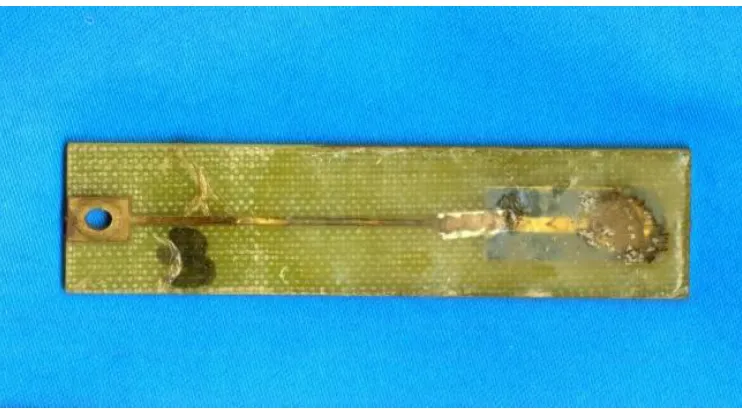
Using the nebulization method, the all-solid-state micro-electrode has been fabricated by depositing the organic membrane sensitive-layer on the treated surface of the silicon micro-chips (10 mm× 10 mm) and tested as lead-sensitive electrode. A video-microscopic picture of the organic membrane-based thin-film micro-electrode after integration into a PCB is shown in Fig. 1. The diameter of the thin-film micro-electrode is about 2 mm.
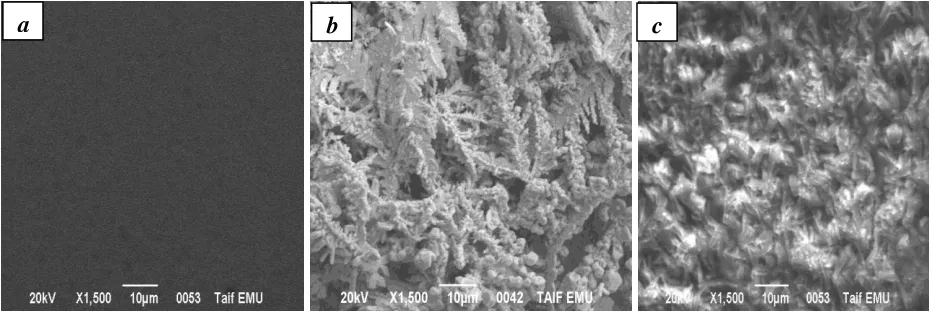
[image:4.596.113.484.532.737.2]Prior to the electrochemical characterization, the morphology studies on the gold thin-film substrate, treated substrate surface and organic membrane deposit have been performed using scanning electron microscopy (SEM) in order to check the film/membrane interface. The micrographs obtained are shown in Fig. 2. The surfaces of all films do not present any observable defects. While, the untreated film (a) appears smooth and luster with poor adhesive properties, the treated substrate surface (b) becomes more mountain-like with high roughness and consequently, good adhesion to the organic membrane. The organic membrane film (c) is textured, homogenous and uniformly distributed. This significantly enhances the stability and consequently, the life span of the suggested micro-electrode.
Figure 2. SEM micrograph of the thin-film surfaces; (a) untreated gold substrate, (b) electrochemical treated and (c) nebulized organic membrane-sensitive layer.
3.2. Electrochemical evaluation of the lead micro-electrode
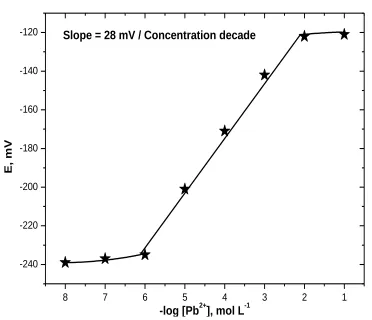
Our goal was to realize sensitive, stable and reliable all-solid-state lead micro-electrodes using the commercialized tert-Butylcalix[4]arene-tetrakis(N,N-dimethylthio-acetamide) lead ionophore. The suggested micro-electrode incorporating this ionophore has been electrochemically evaluated according to IUPAC recommendations in terms of sensitivity, stability, selectivity and reliability. In order to assess the reliability of the suggested micro-electrode, its response properties were compared with those reported for the bulk macro-electrode prepared by the same ionophore [20]. The data obtained are collected in Table 1. As can be seen, the micro-electrode showed a nearly theoretical Nernstian response (slope of 28±0.5 mV/concentration decade) with a straight line between 1x10⁻⁶
and 1x10⁻² mole L-1 of Pb(II) ions (see Fig. 3). The limit of detection determined from the intersection of the two extrapolated segments of the calibration, as recommended by IUPAC, was 5x10⁻⁷ mol L-1.
The response time and life span of an electrode are important features for analytical applications. Hence, the potentials of the suggested micro-electrode corresponding to four decade additions of Pb2+, starting from de-ionized water to 10−2 mol L-1 have been measured. The results obtained are presented in Fig. 4. The response time (t95%) of the suggested micro-electrode in the
whole linear concentration range was about 30 s. The stability and lifetime of the lead micro-electrode were also investigated by repeated calibrations at every two or three days for more than four months. During this period, the response time, slope and linear range are reproducible. Hence, the micro-electrode can be used for at least four months with practically unimpaired performance. Moreover, the suggested micro-electrode properties are almost similar or even somewhat better (life span) than the results observed for the lead macro-electrode based on the same ionophore [20]. The recently developed, nebulization technique of the organic membrane-sensitive layer in combination with the electrochemical treatment of the substrate surface significantly improves the adhesive properties of the membrane to the substrate surface, decreases the leaching out of the ionophore and plasticizer, stabilizes the organic membrane, and consequently increases the micro-electrodes’ life-time (4> months).
a a
b a
Table 1. Potentiometric performance properties of the thin-film lead micro-electrode and the bulk macro-electrode.
Parameter All-solide-state thin-film
micro-electrode
*
Lead bulk macro-electrode
Slope (mV/decade) 28±0.5 28.7
Response time t95%(s) <30 <10
Linear range (mol L-1) 1×10⁻²-1×10⁻⁶ 1×10⁻²-1×10⁻⁶
Detection limit (mol L-1) 5x10⁻⁷ 3.2x10⁻⁷
pH 2.2-6.3 3-6
Life span (months) >4 <2
*
Lead bulk macro-electrode [Ref. 20].
8 7 6 5 4 3 2 1
[image:6.596.87.459.266.586.2]-240 -220 -200 -180 -160 -140 -120
Figure 3.
Potentiometric calibration response of the organic membrane
based lead microelectrode.
E
,
mV
-log [Pb2+], mol L-1 Slope = 28 mV / Concentration decade
Figure 3. Potentiometric calibration response of the organic membrane baseb lead microelectrode
decreasing of the potential at higher pH values may be ascribed to the hydrolysis of Pb2+ ions, leading to a decrease in its concentration.
-60 0 60 120 180 240 300 360 420 480 540 600 660 720 780 -240
-220 -200 -180 -160 -140 -120
6 5 4 3 2
-240 -220 -200 -180 -160 -140 -120
E
,
mV
-log[Pb2+], mol L-1
Figure 4.
Potentiometric dynamic response of the organic membrane
based lead microelectrode.
10-2 mol L-1
10-3 mol L-1
10-4 mol L-1
E
,
mV
Time, s
10-5 mol L-1
Slope= 28 mV
Figurre 4. Potentiometric dynamic response of the organic membrane baseb lead microelectrode
Potentiometric selectivity reflects the relative response of the membrane electrode for the primary ion over other ions, present in solution. This feature is perhaps the most important characteristics, since our goal here is the realization of a highly selective organic membrane-based lead micro-electrode instead of inorganic-based micro-sensors with high cross-sensitivity. The potentiometric response of the lead micro-electrode was studied in presence of some alkali, alkaline earth, transition metals, aluminum and ammonium ions. The potentiometric selectivity coefficients
pot B Pb
0 1 2 3 4 5 6 7 8 9
[image:8.596.130.449.73.293.2]-210 -200 -190 -180 -170 -160 -150 -140
Figure 5. Effect of pH on the potentiometric response of the organic membrane
based lead microelectrode.
10-4, mol L-1
10-3, mol L-1
E
,
mV
pH
Figure 5. Effect of pH on the potentiometric response of the organic membrane baseb lead microelectrode -8 -7 -6 -5 -4 -3 -2 -1 0 Na+ Pb2+ Al3+ Fe3+ Cr3+ Cu2+ Cu2+ Zn2+ Zn2+
Sr2+ Co2+
Co2+ Ni2+ Mg2+ Mg2+ Cd2+ Cd2+ Na+ Hg2+ Ca2+ Ca2+ Ba2+ Ba2+
NH+4
NH+4
Li+
Li+
K+
K+ Na+
Bulk macro-electrode [Ref.20].
[image:8.596.139.463.360.604.2]Log K Pb ,B Thin-film micro-electrode Pb2+
Figure 6. Selectivity coefficients, log K
Pb,B,for organic lead macro- and micro-electrodes, [0.01 mol L-1of Pb+and interfering cations].
Figure 6. Selectivity coefficients, log KpbB, for organic lead macro-and micro-electrodes, [0.01 mol L -1
of Pb+ and interfering cations]
3.3. Analytical applications of the proposed micro-electrode
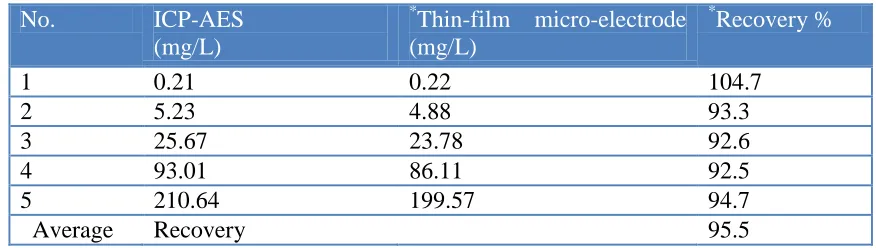
obtained with the proposed micro-electrode and the reference method. In short, the results reveal a high accuracy (recovery 95.5%) and good reproducibility (RSD<3%, n=6).
Table 2. Determination of lead in some aqueous samples employing the micro-electrode in comparison to the reference method ICP-AES.
No. ICP-AES
(mg/L)
*
Thin-film micro-electrode (mg/L)
*
Recovery %
1 0.21 0.22 104.7
2 5.23 4.88 93.3
3 25.67 23.78 92.6
4 93.01 86.11 92.5
5 210.64 199.57 94.7
Average Recovery 95.5
*
The data is a mean of n=3 measurements.
4. CONCLUSIONS
A new thin-film organic membrane-based lead micro-electrode incorporating tert-Butylcalix[4]arene-tetrakis(N,N-dimethylthioacetamide) as electroactive material in a PVC matrix has been realized. The micro-electrode responds to lead ions in a nearly Nernstian behavior and presents a good selectivity and detection limit. The micro-electrode reveals a fast response time and long-term stability. It has been successfully applied for the determination of lead in some aqueous samples. The micro-electrode showed a good accuracy and reproducibility in comparison to the independent ICP-AES method.
ACKNOLDGEMENT
The authors wish to thank Taif University for financial supports (Project number 766/431/1, 2010).
References
1. B. Eric, P. Ernö, Trends in Anal. Chem. 24 (2005) 199.
2. Y. Ru-Qin, Z. Zong-Rang, S. Guo-Li, Sensors and Actuators B: Chemical 65(2000) 150. 3. W. Wróblewski, A. Dybko, E. Malinowska, Z. Brzózka, Talanta 63 (2004) 33.
4. G. Taillades, O. Valls, A. Bratov, C. Dominguez, A. Pradel, M. Ribes, Sensors and Actuators B 59 (1999) 123.
5. A.Guessous , J. Sarradin, P. Papet, K. Elkacemi, S. Belcadi, A. Pradel, M. Ribes, Sensors and Actuators B 53 (1998) 13.
6. M.J. Schöning, J.P. Kloock, Areview, Electroanal. 19 (2007) 2029. 7. J. Zachara, W. Wróblewski, Analyst 128 (2003) 532.
[image:9.596.78.516.172.296.2]
9. A.Numnuam, K.Y. Chumbimuni-Torres, Y. Xiang, R. Bash, P. Thavarungkul, P. Kanatharana, E. Pretsch, J. Wang, E. Bakker, J. Am. Chem. Soc.130 (2008) 410.
10.C.X. Jennifer, G.W. Hunter, D. Lukco, C.C. Liu, B.J. Ward, NASA/TM 215436 (2008) 1. 11.A.Dubbe, Sensors and Actuators B 88 (2003) 138.
12.H. Suzuki, Mat. Scienc. and Eng. C 12 (200) 55.
13.C. Jimenez-Jorquera, J. Orozco, A. Baldi, Sensors 10 (2010) 61.
14.S.V. Lamaka, O.V. Karavai, A.C. Bastos, M.L. Zheludkevich, M.G.S. Ferreira, Elect. Comm. 10 (2008) 259.
15.L.J. Kricka, Clin. Chem. 44 (1998) 2008.
16.H.A. Arida, J.P. Kloock, M.J. Schöning, Sensors 6 (2006) 435. 17.H.A. Arida, Talanta 71 (2007) 1856.
18.H.A. Arida, T. Monika, R. David, M.J. Schöning, Electroanal. 21(2009) 1145. 19.H.A. Arida, Q. Mohsen, M.J. Schöning, Electrochim. Acta 54 (2009) 3543.
20.E. Malinowska, Z. Brzózka, K. Kasiura, R.J.M. Egberink, D.N. Reinhoudt, Anal. Chim. Acta 289 (1994) 253.
21.Y. Umezawa, P. Bühlmann, K. Umezawa, K. Tohda, S. Amemiya, Pur Appl. Chem. 72 (2000) 1851.
22.Y. Mourzina, M.J. Schöning, J. Schubert, W. Zander, A. Legin, Y. Vlasov, P. Kordos, H. Lüth, Sensors and Actuators B 71 (2000) 13.
23.J.P. Kloock, Y. Mourzina, Y. Ermolenko, T. Doll, J. Schubert, M.J. Schöning, Sensors 4 (2004) 156.
24.J.P. Kloock, Y. Mourzina, J. Schubert, M.J. Schöning, Sensors 2 (2002) 356.
![Figure 6. Selectivity coefficients, log KSelectivity coefficients, log KPb,B,for organic lead macro- and micro-electrodes, [0.01 mol L , for organic lead macro-and micro-electrodes, [0.01 mol L -1of Pb+and interfering cations].](https://thumb-us.123doks.com/thumbv2/123dok_us/1937762.153596/8.596.139.463.360.604/figure-selectivity-coefficients-kselectivity-coefficients-electrodes-electrodes-interfering.webp)