This is a repository copy of
OpenABL: A domain-specific language for parallel and
distributed agent-based simulations
.
White Rose Research Online URL for this paper:
http://eprints.whiterose.ac.uk/142529/
Version: Accepted Version
Proceedings Paper:
Cosenza, B., Popov, N., Juurlink, B. et al. (5 more authors) (2018) OpenABL: A
domain-specific language for parallel and distributed agent-based simulations. In:
Aldinucci, M., Padovani, L. and Torquati, M., (eds.) Euro-Par 2018: Parallel Processing.
24th International Conference on Parallel and Distributed Computing, 27-31 Aug 2018,
Turin, Italy. Lecture Notes in Computer Science, 11014 . Springer, Cham , pp. 505-518.
ISBN 9783319969824
https://doi.org/10.1007/978-3-319-96983-1_36
This is a post-peer-review, pre-copyedit version of a paper published in Aldinucci M.,
Padovani L., Torquati M. (eds) Euro-Par 2018: Parallel Processing. Euro-Par 2018.
Lecture Notes in Computer Science, vol 11014.. The final authenticated version is
available online at: http://dx.doi.org/10.1007/978-3-319-96983-1_36.
Reuse
Items deposited in White Rose Research Online are protected by copyright, with all rights reserved unless indicated otherwise. They may be downloaded and/or printed for private study, or other acts as permitted by national copyright laws. The publisher or other rights holders may allow further reproduction and re-use of the full text version. This is indicated by the licence information on the White Rose Research Online record for the item.
Takedown
If you consider content in White Rose Research Online to be in breach of UK law, please notify us by
OpenABL: A Domain-Specific Language for
Parallel and Distributed Agent-Based
Simulations
Biagio Cosenza, Nikita Popov, Ben Juurlink1 , Paul Richmond, Mozhgan Kabiri Chimeh2
,
Carmine Spagnuolo, Gennaro Cordasco, and Vittorio Scarano3
1
TU Berlin, Berlin, Germany 2
University of Sheffield, Sheffield, UK 3
University of Salerno, Fisciano (Salerno), Italy
Abstract. Agent-based simulations are becoming widespread among scientists from different areas, who use them to model increasingly com-plex problems. To cope with the growing computational comcom-plexity, par-allel and distributed implementations have been developed for a wide range of platforms. However, it is difficult to have simulations that are portable to different platforms while still achieving high performance. We presentOpenABL, a domain-specific language for portable,
high-performance, parallel agent modeling. It comprises an easy-to-program language that relies on high-level abstractions for programmability and explicitly exploits agent parallelism to deliver high performance. A source-to-source compiler translates the input code to a high-level intermediate representation exposing parallelism, locality and synchronization, and, thanks to an architecture based on pluggable backends, generates target code for multi-core CPUs, GPUs, large clusters and cloud systems.
OpenABLhas been evaluated on six applications from various fields such
as ecology, animation, and social sciences. The generated code scales to large clusters and performs similarly to hand-written target-specific code, while requiring significantly fewer lines of codes.
1
Introduction
With an increasing number of applications where agent modeling is used, there is also a growing demand for computational power, due to larger agent populations and increasingly complex models. For this purpose, parallel and distributed implementations targeting different platforms, such as desktop GPUs [7], HPC architectures [8], and distributed cloud systems [9] have been developed, each focusing on a specific class of simulations and particular parallelization issues. While the core concepts of all existing frameworks are fundamentally the same, the variety of both hardware platforms and application contexts has led to very different implementations. Ideally, ABS should be written in a portable environment that can target a variety of parallel and distributed systems without any program modifications.
The necessity of portable solutions to reproduce simulations on different par-allel implementations and hardware platforms, has led to the OpenAB initiative4
, a community-driven collaborative project to provide models and procedures for the benchmarking of multi-agent simulations on parallel and distributed com-puting systems. This work aims at providing an effective and efficient tool to these communities through the design and implementation of a domain-specific language (DSL) for portable, parallel and high-performance ABS.
The contributions of this paper are:
1. The design of OpenABL, a novel domain-specific language for agent-based
computational modeling and simulation. The language targets the core re-quirements of these simulations with tailored high-level semantics, and en-ables parallel processing by explicitly exposing agent-parallelism.
2. A source-to-source compiler implementing theOpenABLlanguage and
sup-porting five different parallel and distributed backends, which are capable of running on diverse platforms such as multi-core CPUs, GPUs, and dis-tributed clouds.
3. A collection of six test simulations from different application fields including biology, ecology and social sciences, and an experimental evaluation and comparison across different platforms.
2
Background
Many frameworks and libraries for implementing parallel ABS have been pro-posed; however, each addresses quite different target architectures, with distinct solutions for locality and synchronization. REPAST [10] is an agent-based simu-lation toolkit written in C++, later extended and parallelized into the REPAST-HPC framework [11], and tested on a Blue Gene/P REPAST-HPC cluster. Cosenza et al. [8] introduced a distributed load balancing schema for parallel ABS that scales a simulation with one million agents on a cluster with 64 processors. Mason [12] is a popular multi-agent simulation library written in Java. D-Mason [13, 14] provides an effective and efficient way of parallelizing Mason programs for distributed systems, handling communication strategies and load balancing [15],
4
tested on Amazon Web Services [15], and used on several social science scenar-ios [16]. Flame [7] is an agent-based environment based on an underlying formal model, called the X-Machine, and used in various scenarios such as cell simu-lations [17] and immune system modeling [18]. FlameGPU [19] is an extension of Flame that executes agent-based models on GPU architectures. Other GPU implementations have focused on bio-inspired visual clustering [20] and on ef-ficient compression of agent direction [21]. Several authors have performed a comparison among ABS toolkits, both sequential [22] and parallel [23].
The idea of assuring portability across parallel implementations through DSLs has been exploited in many application scenarios, in particular to target large-scale computing systems [24]. Liszt [25] is the most similar to our work, with a DSL for constructing mesh-based PDE solvers and capable of targeting clus-ters, SMPs and GPUs. Liszt applications perform within 12% of hand-written C++ code and scale to large clusters. Other DSL have been designed for stencil computations [26], graph algorithms [27], and image processing pipelines [28].
3
Language Design
The goal of theOpenABLlanguage is to provide a portable, efficient and
easy-to-use environment for agent-based modeling. This is achieved by a rich language supporting domain-specific constructs, allowing the users to quickly prototype, reproduce, and compare different models with different parameters. The lan-guage also provides implicit support for agent parallelism and locality, so that
OpenABLcodes can be efficiently mapped onto parallel and distributed
imple-mentations.
OpenABL frontend
.abl
OpenABL code
basic C
FLAME
MASON
D-MASON FLAME GPU
.c
.xml .c
.xml .cu
.java
.java D-MASON
dist.runtime Cluster
GPU
Multi-core Sequential
FuncDecl
step move_pointID: ParList
Type: Point
ID: in
ID: out
StmList
… ForStm NEAR
Type: Point
ID: other NEAR
ID: in
ID: radius
StmList
… …
Backend Frontend
[image:4.612.144.478.440.565.2]Intermediate Representation (AST)
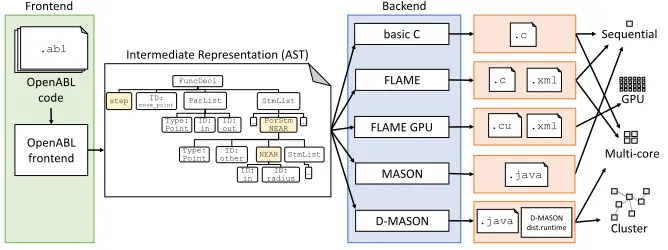
Fig. 1.OpenABLcompilation workflow. The input code is translated to an AST-based intermediate representation, from which different backends generate code for specific platforms. The AST shows an excerpt of Listing 1.1.
Listing 1.1 shows a simple OpenABL code that demonstrates the general
sec-tions: agent declarations, simulation parameters, environment parameters, step functions and the main code. The language uses C-like syntax to maintain famil-iarity with mostly C and Java based ABS frameworks, and supports standard operators and control-flow statements, as well as vector types.
1 // Agent d e c l a r a t i o n s
2 agent Point {
3 p o s i t i o n float3 pos ;
4 }
5 // S i m u l a t i o n p a r a m e t e r s and e n v i r o n m e n t def .
6 float radius = 5; 7 float e n v _ s i z e = 100;
8 param int n u m _ a g e n t s = 1000; 9 param int n u m _ t i m e s t e p s = 100;
10 e n v i r o n m e n t { max : float3 ( e n v _ s i z e ) }
11 // Step f u n c t i o n
12 step m o v e _ p o i n t ( Point in -> out ) {
13 // Move towards the average d i r e c t i o n of the n e i g h b o r s
14 float3 dir = float3 (0) ; 15 int n u m _ n e i g h b o r s = 0;
16 for ( Point other : near ( in , radius ) ) { 17 dir += n o r m a l i z e ( other . pos - in . pos ) ; 18 n u m _ n e i g h b o r s += 1;
19 }
20 out . pos = clamp ( in . pos + dir / num_neighbors , float3 (
e n v _ s i z e ) ) ;
21 }
22 // Main code : I n i t i a l i z a t i o n and e x e c u t i o n
23 void main () {
24 for ( int i : 0.. n u m _ a g e n t s )
25 add ( Point { pos : random ( float3 ( e n v _ s i z e ) ) }) ; 26 s i m u l a t e ( n u m _ t i m e s t e p s ) { m o v e _ p o i n t }
27 save ( " result . json " ) ;
28 }
Listing 1.1.An OpenABL code example implementing a simple agent motion.
Step Functions and Agent Parallelism It is important to incorporate agent parallelism into the language in a way that can be supported with the same semantics by all backends. InOpenABL, this is accomplished using step
func-tions, which take an input agent of some type and yield a modified output agent. For example, in
step m o v e _ p o i n t ( Point in -> out ) { ... }
of read-only agents and an output buffer of write-only agents, which are swapped at the end of a discrete simulation step. The strictin/outseparation is required in order to produce deterministic, order-independent simulations. Surprisingly, we found that many sequential agent libraries such as Mason do not provide a native double-buffering mechanism. Therefore their results are not deterministic, as they depend on the updating order of the agents.OpenABL overcomes this
limitation and always produces order-independent models.
Thesimulatestatement invokes a simulation for a certain number of timesteps, during which a list of step functions will be executed in the given order. First one step function is executed for all agents (of the applicable type), before the next step function is run. Between step functions, the outparameter becomes the new inparameter. For instance, in theAnts model
s i m u l a t e ( n u m _ t i m e s t e p s ) { ant_act1 , p h e r o m o n e _ d e p o s i t , a n t _ a c t 2 }
three step functions are called: the first on ant agents; the second on pheromone agents; the last again on ant agents.
The whole simulation starts at themain function, which is used to set up agents (typically from a file or randomly generated), to invoke the simulation and save the simulation results. Simulation parameters are declared as global constants. If a constant is prefixed with theparamkeyword it may also be over-ridden from the command line.
Locality A fundamental concept of agent-based modeling is locality, because in-teractions are usually limited to nearby agents. In general, this may be governed by arbitrary topologies, butOpenABLis currently limited to the common case
of two- and three-dimensional Euclidean topologies. Each agent declares a desig-natedpositionmember of typefloat2orfloat3, which provides the position of the agent for spatial queries. The agent neighborhood can then be accessed through the combination of aforloop and a radius-basednear()query:
for ( AgentT n e i g h b o r : near ( in , radius ) ) { ... }
The type of the input agent and the type of the neighboring agents that are fetched does not necessarily have to match. The query is performed using a backend-specific spatial acceleration data structure such as grid [19] and kd-tree [29].
Agent t : near(x,radius) radius x
AgentTt : near(x,radius)
[image:6.612.219.395.565.644.2]x radius
Simulations with heterogeneous agents, i.e. with multiple agent types, are implemented with multiple step functions on different agent types, and by spec-ifying different return types onnear()queries, as shown in Figure 2.
Environment properties are specified using anenvironmentdeclaration which includes the environment dimensionality and bounds (minandmax). Agent po-sitions must stay within these bounds. For performance reasons, this is not au-tomatically enforced by the language, but functions to perform the necessary clamping or wrap-around are provided. The radius used for spatial acceleration structures is usually determined automatically, but may also be explicitly given here. The standard library also provides commonly used functions for geometric and trigonometric operations.
Dynamic Agent Creation and Removal Typically, the agents are created at the beginning of the simulation and are not removed until the end; however, some simulations require a dynamic mechanism for the creation and removal of agents. For example, in thePredator-Prey model, predators pursue and eat prey, who reproduce at a given rate. As a result, the agent populations periodically increase and decrease during the course of a simulation. The language enforces a number of additional constraints for backend compatibility: in a step function, each agent may add at most one new agent. This means that in a single step, the number of agents can at most double. The new agent position must be the same as the generating agent position (e.g.,in.pos). An agent can remove itself by using theremoveCurrent()function, but cannot remove a different agent.
4
Implementation
Compilation Process OpenABL is a source-to-source compiler employing a
classical three-stage pipeline: First, Flex and Bison are used to parse the source code into anabstract syntax tree(AST), which acts as our primary intermediate representation. Then, target-independent analysis is performed, which validates the code and enforces semantic constraints, while also annotating the AST with necessary type and dependency information. Finally, different backends emit source code (and other auxiliary files) for the target platform based on the annotated AST.
Backends OpenABLcurrently supports five backend implementations
target-ing different agent models, acceleration data structures and platforms.
Abasic C backend serves as a reference implementation and basis for other C-based backends. It does not use acceleration structures, implements double-buffering using two arrays of agents swapped after each step, and uses OpenMP for trivial parallelization.
previous step. To support neighborhood queries, we determine which members of neighboring agents are used inside a for-near loop and generate one step function that sends a message containing all the used members. A second step function processes the messages falling into the specified neighborhood. A side-effect of this process is that no explicit double buffering of the agent memory is neces-sary: because messages are generated in a previous step, changes to agents in the current timestep are not observable. The backend generates the three parts of a Flame model: an XML model specification, an XML initial agent state file, and the C step function definitions. Flame does not support adding or removing agents at runtime and does not use spatial acceleration structures.
FlameGPU [19] is based on Flame, but targets execution on the GPU using CUDA. Our FlameGPU backend is structurally similar to the Flame backend. It supports grid-based spatial acceleration, which requires a specification of the environment dimensions and partitioning radius in the XML model. The environ-ment bounds must be adjusted upwards to be multiples of the radius. Runtime agent removal/addition is supported, but only the current agent may be removed and one added per step function. Both restrictions are enforced by the language. Mason [12] is an ABS and visualization library written in Java. The two main components are an environment, which supports grid-based neighborhood queries, and a schedule, which executes the step functions. Mason does not have native support for double-buffering: simulations are fundamentally order-dependent, based on the assumption that for most models it does not make a significant difference if the state from the current (rather than previous) timestep is used for some agents. To support our execution semantics, agents hold two state objects, which are used alternately and swapped at the end of a step func-tion. In Mason, each agent has only a single step function; however, our execution model may require multiple step functions, executed for all agents and in a spe-cific order.5
We solve this with a cyclic counter for each agent indicating which step function to execute. Mason supports both removal and addition of agents at runtime. This backend also produces code for the visualization of the simulation. D-Mason[13, 14] is a distributed extension of Mason that allows the distribu-tion of the simuladistribu-tion across multiple, even heterogeneous machines. It is based on a Master/Workers paradigm where the master partitions the simulation en-vironment into regions. All the agents in a region are assigned to a machine, which performs the simulation, handles the migration of agents, and manages the synchronization between neighboring regions. The D-Mason communication mechanism is based on the Publish/Subscribe pattern. Unlike Mason, D-Mason requires environments to use only positive coordinates. D-Mason supports agent removal/addition at runtime; however, new agents must be positioned in the current space partition.
Compiler flags are provided for further backend-specific configuration. For example, thefloatdata-type used byOpenABLis mapped to double-precision
5
floats by default, because this is the only type supported by all backends, but Flame and FlameGPU can switch to single-precision through a compiler flag.
5
Experimental Evaluation
OpenABL has been evaluated on six applications in terms of programmability
of the language and the performance of the code generated for the five backends, including single-node performance on CPUs and GPUs, scalability on a cluster, and a comparison against hand-written target-specific code.
Reference Simulation Models The evaluation uses six agent-based models from different domains, for which reference implementations were available for at least one of our targets. Table 1 lists general properties of these models.
Circle is a standardized benchmark part of the OpenAB initiative, for as-sessing the performance of fixed-radius near neighbor lookups, formally defined by Chisholm et al. [30].Boids [31] is a steering behavior for autonomous char-acters in animation and games, which simulates the flocking behavior of birds. The agent motion is derived from three components: separation, alignment, and cohesion. Conway’s Game-of-life is a cellular automaton model, implemented with one agent per cell and an alive boolean status variable. Sugarscape is a social science model where agents move on a grid of a regrowing resource (sugar), which they must consume to survive. We implement it using a stationary grid of agents. The Ants Foraging model simulates ants that, when they discover a food source, establish a trail of pheromones between the nest and the food source. The model uses two pheromones, which set up gradients and evaporate after some simulation steps, to the nest and to the food source respectively. We parallelized the original Mason model [32]: sequential access to global data structures, which is not suitable for parallelization, has been replaced by two step functions that handle the deposition and evaporation of (grid) pheromones, and one for the ant movement. Predator-Prey is our largest model, which in-volves three different agent types (prey, predator and grass), 13 step functions, and utilizes dynamic agent creation and removal. Both predators and prey im-plement short-range collision avoidance, a mid-range flocking, and can reproduce at different rates. Each predator follows the closest prey, which is eaten if it is too close. Conversely, prey avoids predators and eats grass, which regrows after a fixed time interval. All simulations have been executed with a different number of agents. The environment is scaled with the square root (for two-dimensional simulations) of the agent number, so that the agent density remains constant.
Programmability Evaluation To evaluate the programmability and ease of use of OpenABL, we compare the eLOC (effective lines of code, ignoring
Model Properties Implementation Size in eLOC
Application Area Types Steps AR OpenABL FlameGPU D-Mason
Circle micro-benchmark 1 1 36 184 (×5.1) 537 (×14.9)
Boids animation 1 1 82 240 (×2.9) 767 (×9.4)
Game of Life cellular automaton 1 1 48 133 (×2.8) 477 (×9.9)
Sugarscape social science 1 4 154 345 (×2.2) n/a
Ants Foraging animal ecology 2 3 191 n/a 967 (×5.1)
Predator-Prey animal ecology 3 13 3 248 858 (×3.5) n/a Table 1. Simulation benchmarks with the number of agent types, number of step functions, whether dynamic agent addition/removal is used (AR), effective lines of code (eLOC) of the implementations inOpenABL, FlameGPU and D-Mason.
from FlameGPU and D-Mason.6
As seen in Table 1, the FlameGPU implemen-tations are 2-5 times larger, while the D-Mason models are 5-15 times larger. While eLOC is not a very reliable indicator of programmability, it is clear that
OpenABL models tend to be significantly more compact than manual
imple-mentations.
Single-node Performance Comparison For single-node performance evalu-ation, we compared the performance of the code generated by the OpenABL
compiler for the basic C, Mason, Flame and FlameGPU backends. The six test models were run for 100 timesteps with population sizes ranging from 250 to 106 agents. The Predator-Prey model was only evaluated on backends supporting dynamic addition/removal of agents. The benchmarks were performed on a sys-tem with an Intel Core i5-4690K CPU (4 cores at 3.50GHz), 16GB of memory, running on Ubuntu 16.04. For FlameGPU, we used an NVIDIA Titan Xp (Pas-cal architecture) with 12GB of memory. The basic C backend was configured to use multiple threads using OpenMP.
The results in Figure 3 show that Flame and basic C scale quadratically with the number of agents. This is expected, as they do not use any spatial acceleration structure. Mason is much faster than Flame, and is the best im-plementation for small-sized simulations. FlameGPU pays a high overhead for small-sized simulations, because of the data transfer from the host to the GPU; however, it is the best-performing solution for larger simulations with more than 104
agents. For most models, both Mason and FlameGPU scale approximately linearly at large population counts. One notable exception isAnts, where Mason degenerates to quadratic behavior, because of a very dense agent clustering at the start of the simulation.
6
103
104
105
106
10−1
100 101 102 Circle R u n ti m e (s ) Mason FlameGPU Flame Basic C 103 104 105 106
10−1
100 101 102 Boids2D Mason FlameGPU Flame Basic C 103 104 105 106
10−2
10−1
100
101
102
Game Of Life Mason FlameGPU Flame Basic C 103 104 105 106 10−2 10−1 100 101 102 Sugarscape R u n ti m e (s ) Mason FlameGPU Flame Basic C 103 104 105 106
10−2
10−1
[image:11.612.122.479.111.322.2]100 101 102 103 Ants Mason FlameGPU Flame Basic C 103 104 105 106 100 101 102 103 Predator-Prey Mason FlameGPU
Fig. 3.Performance of generated Mason, FlameGPU, Flame and basic C code with a different number of agents (x-axis).
2 4 8 16 32 64 128
200,000
113,000
89,800
62,500
46,100
26,400
13,700
Circle R u n ti m e (s ) OpenABL ideal
2 4 8 16 32 64 128
14,300
8,900
4,300
2,710
1,700
552 400
Boids
OpenABL ideal
2 4 8 16 32 64 128
562 270 147 83 46 26 18 Game-of-Life OpenABL ideal
2 4 8 16 32 64 128
740,000
318,000
219,000
150,000
118,000
49,100
38,900
Sugarscape R u n ti m e (s ) OpenABL ideal
2 4 8 16 32 64 128
8,450
5,540
4,000
3,090
2,780
2,180
2,320
Ants
OpenABL ideal
2 4 8 16 32 64 128
1,310
700 402 294 254 236 222 Predator-Prey OpenABL ideal
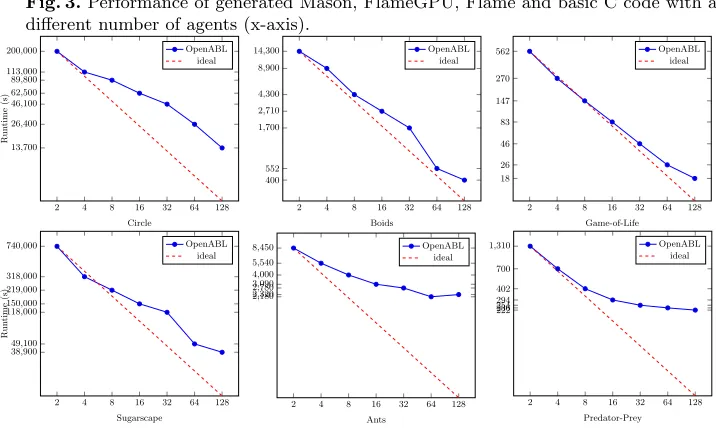
Fig. 4.OpenABL D-Mason strong scaling with different number of cores (x-axis).
Cluster Scaling To evaluate the performance scaling of the OpenABL
[image:11.612.122.480.333.547.2]simulat-ing 106
agents for 1000 timesteps. The plots show the runtime in seconds for an increasing number of logical processors (cores).
TheBoids model exhibits good scalability. Despite having similar behavior, Circle’s scaling is slightly worse due to different parametrization, e.g., a wider interaction radius. InGame-of-LifeandSugarscape, agents are distributed evenly in the space (on a grid) and are stationary, resulting in high scalability.Ants and Predator-Prey are the most complex simulations. TheAnts model suffers from a dense concentration of the ant agents, especially at the start of the simulation, resulting in an uneven distribution of the workload. Predator-Prey is highly dynamic because of the addition/removal of agents, which drastically affects prey-crowded areas after the arrival of predators. This represents a challenge for distributed memory system, leading to bad scalability. We believe that more advanced load balancing strategies may substantially improve this aspect [33].
Performance Comparison Against Manually-tuned Code The potential overhead of the generated code has been evaluated against manual implemen-tations of the Boids benchmark, because it is available for most libraries and is simple to validate. Results are summarized in Table 2. The generated code for Mason is 9% slower than the manual implementation; the reason is the dou-ble buffering mechanism introduced by OpenABLto ensure order-independent
correctness, not supported in standard Mason. For FlameGPU, both generated code and manual implementation have similar performance: the semantics of the language map very well without any noticeable overhead. The overhead for D-Mason is 30%, motivated essentially by an improvement of the synchroniza-tion mechanism for each step funcsynchroniza-tion (agent buffer analysis may potentially reduce such overhead by avoiding unnecessary synchronizations). We omitted Flame from the comparison because of its very poor scalability (impractical with>5000 agents).
Backend Overhead Main Reason
Mason 9% Double-buffering
D-Mason 30% Double-buffering and additional synchronization Flame n/a (Too slow to compare)
[image:12.612.134.482.473.537.2]FlameGPU 0% Perfect programming model match
6
Conclusion
We presentOpenABL, a domain-specific language designed for agent modeling
on high-performance parallel and distributed architectures. It comprises an easy-to-program language that relies on high-level abstractions for programmability and explicitly exploits agent parallelism to deliver high-performance. It supports a wide range of context-specific semantics such as order-independent step func-tions, neighborhood queries, heterogeneous agents, and dynamic agent addition and removal. A source-to-source compiler translates the input OpenABL code into an AST-based intermediate representation exposing parallelism, locality and synchronization at the agent level. Subsequently, a collection of pluggable back-ends generate target codes for multi-core CPUs, massively parallel GPUs, large clusters and cloud systems. TheOpenABLgenerated codes have been tested on
a collection of six applications from various fields. While a program written in
OpenABL is much smaller than one written for non-portable platform-specific
libraries, its performance is very close to manual implementations.
OpenABL is an open source project available at https://github.com/
OpenABL/OpenABL, with the goal of becoming an open research platform. The used code and instructions to reproduce our benchmarking results are available in a figshare repository [34].
This research has been partially funded by the DFG project CELERITY (CO 1544/1-1) and by the EPSRC fellowship Accelerating Scientific Discovery with Accelerated Computing (EP/N018869/1).
References
1. Epstein, J.M.: Agent-based computational models and generative social science. Complexity 4(5) (1999) 41–60
2. Epstein, J.M., Axtell, R.: Growing Artificial Societies: Social Science from the Bottom Up. The Brookings Institution (1996)
3. Kollman, K., Miller, J.H., Page, S.E.: Adaptive parties in spatial elections. Amer-ican Political Science Review 86(4) (1992) 929–937
4. Topa, G.: Social interactions, local spillovers and unemployment. The Review of Economic Studies68(2) (2001) 261–295
5. Haynes, T., Sen, S.: Evolving behavioral strategies in predators and prey. In: Int. Joint Conf. on Artificial Intelligence. (1995) 113–126
6. Pelechano, N., Allbeck, J.M., Badler, N.I.: Controlling individual agents in high-density crowd simulation. In: EG Symp. on Computer Animation. (2007) 99–108 7. Kiran, M., Richmond, P., Holcombe, M., Chin, L.S., Worth, D., Greenough, C.:
Flame: Simulating large populations of agents on parallel hardware architectures. In: Conf. on Autonomous Agents and Multiagent Systems. (2010) 1633–1636 8. Cosenza, B., Cordasco, G., Chiara, R.D., Scarano, V.: Distributed load balancing
for parallel agent-based simulations. In: Int. Euromicro Conf. on Parallel, Dis-tributed and Network-based Processing, PDP. (2011) 62–69
10. North, M.J., Collier, N.T., Vos, J.R.: Experiences creating three implementations of the repast agent modeling toolkit. Trans. Model. Comp. Sim.16(1) (2006) 1–25 11. Collier, N., North, M.: Parallel agent-based simulation with repast for high
per-formance computing. SIMULATION89(10) (2013) 1215–1235
12. Luke, S., Cioffi-Revilla, C., Panait, L., Sullivan, K., Balan, G.: Mason: A multiagent simulation environment. SIMULATION81(7) (July 2005) 517–527
13. Cordasco, G., De Chiara, R., Mancuso, A., Mazzeo, D., Scarano, V., Spagnuolo, C.: A framework for distributing agent-based simulations. In: Euro-Par Parallel Processing Workshops, HeteroPar. (2011) 460–470
14. Cordasco, G., De Chiara, R., Mancuso, A., Mazzeo, D., Scarano, V., Spagnuolo, C.: Bringing together efficiency and effectiveness in distributed simulations: The experience with D-Mason. SIMULATION89(10) (2013) 1236–1253
15. Cordasco, G., Chiara, R.D., Raia, F., Scarano, V., Spagnuolo, C., Vicidomini, L.: Designing computational steering facilities for distributed agent based simulations. In: SIGSIM Principles of Advanced Discrete Simulation. (2013) 385–390
16. Lettieri, N., Spagnuolo, C., Vicidomini, L.: Distributed agent-based simulation and GIS: an experiment with the dynamics of social norms. In: Euro-Par Parallel Processing Workshops, PADABS. (2015) 379–391
17. Oliveira, A.P., Richmond, P.: Feasibility study of multi-agent simulation at the cellular level with FLAME GPU. In: FLAIRS Conf. (2016) 398–403
18. Tamrakar, S., Richmond, P., D’Souza, R.M.: PI-FLAME: A parallel immune sys-tem simulator using the FLAME graphic processing unit environment. SIMULA-TION93(1) (2017) 69–84
19. Richmond, P., Walker, D., Coakley, S., Romano, D.: High performance cellular level agent-based simulation with Flame for the GPU. Briefings in Bioinformatics
11(3) (2010) 334
20. Erra, U., Frola, B., Scarano, V.: A GPU-based interactive bio-inspired visual clustering. In: Symp. on Comp. Intelligence and Data Mining. (2011) 268–275 21. Cosenza, B.: Behavioral spherical harmonics for long-range agents’ interaction. In:
Euro-Par Parallel Processing Workshops, PADABS. (2015) 392–404
22. Macal, C.M., North, M.J.: Tutorial on agent-based modeling and simulation. In: 37th Conf. on Winter Simulation. (2005) 2–15
23. Rousset, A., Herrmann, B., Lang, C., Philippe, L.: A Survey on Parallel and Distributed Multi-Agent Systems. In: Euro-Par Workshops, PADABS. (2014) 24. Grasso, I., Pellegrini, S., Cosenza, B., Fahringer, T.: A uniform approach for
programming distributed heterogeneous computing systems. J. Parallel Distrib. Comput.74(12) (2014) 3228–3239
25. DeVito, Z., Joubert, N., Palacios, F., Oakley, S., Medina, M., Barrientos, M., Elsen, E., Ham, F., Aiken, A., Duraisamy, K., Darve, E., Alonso, J., Hanrahan, P.: Liszt: a domain specific language for building portable mesh-based PDE solvers. In: Conf. on High Perfor. Computing Networking, Storage and Analysis. (2011) 9:1–9:12 26. Christen, M., Schenk, O., Cui, Y.: Patus for convenient high-performance stencils:
Evaluation in earthquake simulations. In: Conf. on High Performance Computing, Networking, Storage and Analysis, SC. (2012) 11:1–11:10
27. Hong, S., Chafi, H., Sedlar, E., Olukotun, K.: Green-marl: A DSL for easy and efficient graph analysis. In: ASPLOS. (2012) 349–362
29. Kofler, K., Steinhauser, D., Cosenza, B., Grasso, I., Schindler, S., Fahringer, T.: Kd-tree based n-body simulations with volume-mass heuristic on the GPU. In: 2014 IEEE International Parallel & Distributed Processing Symposium Workshops, Phoenix, AZ, USA, May 19-23, 2014. (2014) 1256–1265
30. Chisholm, R., Richmond, P., Maddock, S.C.: A standardised benchmark for as-sessing the performance of fixed radius near neighbours. In: Euro-Par Parallel Processing Workshops, PADABS. (2016) 311–321
31. Reynolds, C.W.: Flocks, herds and schools: A distributed behavioral model. ACM SIGGRAPH21(4) (1987) 25–34
32. Panait, L., Luke, S.: A pheromone-based utility model for collaborative foraging. In: Conf. on Autonomous Agents and Multiagent Systems. (2004) 36–43
33. Cordasco, G., Cosenza, B., De Chiara, R., Erra, U., Scarano, V.: Experiences with Mesh-like computations using Prediction Binary Trees. Scalable Computing: Practice and Experience, Scientific international journal for parallel and distributed computing (SCPE)10(2) (June 2009) 173–187