Rochester Institute of Technology
RIT Scholar Works
Theses Thesis/Dissertation Collections
8-2017
Discovering a Domain Knowledge Representation
for Image Grouping: Multimodal Data Modeling,
Fusion, and Interactive Learning
Xuan Guo
[email protected]Follow this and additional works at:http://scholarworks.rit.edu/theses
Recommended Citation
Discovering a Domain Knowledge Representation for
Image Grouping: Multimodal Data Modeling, Fusion,
and Interactive Learning
by
Xuan Guo, B.S.
DISSERTATION
A Dissertation Submitted in Partial Fulfillment of the
Requirements for the Degree of Doctor of Philosophy
in the B. Thomas Golisano College of
Computing and Information Sciences
Rochester Institute of Technology
Rochester, NY
Discovering a Domain Knowledge Representation for
Image Grouping: Multimodal Data Modeling,
Fusion, and Interactive Learning
by
Xuan Guo
Committee Approval:
We, the undersigned committee members, certify that we have advised and/or
supervised the candidate on the work described in this dissertation. We further certify that we have reviewed the dissertation manuscript and approve it in partial fulfillment of the requirements of the degree of Doctor of Philosophy in Computing and Information Sciences.
______________________________________________________________________________
Prof. Anne R. Haake Date
Dissertation Co-advisor
______________________________________________________________________________
Prof. Qi Yu Date
Dissertation Co-advisor
______________________________________________________________________________
Prof. Cecilia Ovesdotter Alm Date
Dissertation Committee
______________________________________________________________________________
Prof. Rui Li Date
Dissertation Committee
______________________________________________________________________________
Prof. Pengcheng Shi Date
Dissertation Committee
______________________________________________________________________________
Prof. Daniel Phillips Date
Dissertation Defense Chairperson
Abstract
Discovering a Domain Knowledge Representation for
Image Grouping: Multimodal Data Modeling, Fusion,
and Interactive Learning
Publication No.
Xuan Guo, Ph.D.
Rochester Institute of Technology, 2017
Supervisors: Dr. Anne R. Haake Dr. Qi Yu
In visually-oriented specialized medical domains such as dermatology
and radiology, physicians explore interesting image cases from medical
im-age repositories for comparative case studies to aid clinical diagnoses, educate
medical trainees, and support medical research. However, general image
clas-sification and retrieval approaches fail in grouping medical images from the
physicians’ viewpoint. This is because fully-automated learning techniques
cannot yet bridge the gap between image features and domain-specific
con-tent for the absence of expert knowledge. Understanding how experts get
As a prior study, we conducted data elicitation experiments, where
physicians were instructed to inspect each medical image towards a
diagno-sis while describing image content to a student seated nearby. Experts’ eye
movements and their verbal descriptions of the image content were recorded
to capture various aspects of expert image understanding. This dissertation
aims at an intuitive approach to extracting expert knowledge, which is to find
patterns in expert data elicited from image-based diagnoses. These patterns
are useful to understand both the characteristics of the medical images and
the experts’ cognitive reasoning processes.
The transformation from the viewed raw image features to
interpre-tation as domain-specific concepts requires experts’ domain knowledge and
cognitive reasoning. This dissertation also approximates this transformation
using a matrix factorization-based framework, which helps project multiple
expert-derived data modalities to high-level abstractions.
To combine additional expert interventions with computational
pro-cessing capabilities, an interactive machine learning paradigm is developed to
treat experts as an integral part of the learning process. Specifically, experts
refine medical image groups presented by the learned model locally, to
incre-mentally re-learn the model globally. This paradigm avoids the onerous expert
annotations for model training, while aligning the learned model with experts’
Acknowledgments
I would like to express the deepest appreciation to my advisors, Profs.
Anne R. Haake and Qi Yu, for the support, encouragement, inspiration and
guidance they provided me throughout my PhD study and life.
I am grateful to my dissertation committee: Profs. Cecilia Ovesdotter
Alm, Rui Li, and Pengcheng Shi for their insightful comments.
My appreciation goes to my colleagues and good friends Jingjia Xu,
Wenbo Wang, Tong Liu, Mohamed Elshrif, Jwala Dhamala, Ruslan Dautov,
Katy Tarrit, Preethi Vaidyanathan, and Dong Wang for their priceless presence
and support.
Lastly, I would like to express my gratitude to my dear parents for their
support, love, presence and patience.
The work presented in this dissertation is supported by grants from the
Table of Contents
Abstract iii
Acknowledgments v
List of Tables ix
List of Figures x
Chapter 1. Introduction 1
1.1 Background . . . 1
1.2 Problem Definition . . . 5
1.3 Dissertation Contributions . . . 7
1.4 Dissertation Organization . . . 8
Chapter 2. Related Work 10 2.1 Image-based Diagnostic Reasoning . . . 10
2.2 Conceptual Knowledge, Perceptual Expertise, and Human Com-putation . . . 11
2.2.1 Unified Medical Language System . . . 12
2.2.2 Natural language and domain knowledge . . . 13
2.2.3 Eye tracking and visual perception . . . 15
2.3 Representation Learning Approaches . . . 17
2.3.1 Classical models . . . 19
2.3.2 Matrix factorization-based models . . . 21
2.3.2.1 Nonnegative matrix factorization . . . 26
2.3.2.2 Sparse coding . . . 30
2.3.2.3 Graph-regularized NMF . . . 36
2.3.2.4 Medical knowledge-regularized NMF . . . 40
2.3.2.6 Summary and Discussions on Other Models . . 44
2.3.3 Technical connections between representation learning mod-els . . . 49
2.3.4 Sequential Models . . . 50
2.3.4.1 Hidden Markov model . . . 51
2.3.4.2 Infinite hidden Markov model . . . 53
Chapter 3. Modeling Diagnostic Verbal Narratives for Medical Conceptual Topics 60 3.1 Background . . . 60
3.2 Medical Term Extraction . . . 62
3.3 Clustering Verbal Narratives . . . 64
3.3.1 Ground truth for narrative clustering . . . 64
3.3.2 Narrative processing and visualization . . . 64
3.3.3 Topic modeling the narratives . . . 67
3.3.4 Narrative clustering performance evaluation . . . 71
3.4 Developing Lexical Metrics . . . 74
3.4.1 Lexical consensus score . . . 74
3.4.2 Top N relatedness scores . . . 75
3.4.3 Evaluation of the lexical metrics . . . 79
3.5 Modeling for Diagnostic Narration Patterns . . . 82
3.5.1 Gold standard . . . 84
3.5.2 Model description . . . 85
3.5.3 Inference algorithm . . . 87
3.5.4 The discovered verbal narration patterns . . . 90
3.5.5 Narrative correctness classification . . . 93
3.6 Conclusions . . . 95
Chapter 4. Multimodal Data Fusion 98 4.1 Background . . . 99
4.2 Mixture Components in Eye Fixations . . . 102
4.3 Human-centered Information Retrieval . . . 104
4.3.2 Eye tracking-based retrieval . . . 106
4.3.3 Verbal input-based retrieval . . . 110
4.3.4 Retrieval performance evaluation . . . 111
4.4 Multimodal Data Fusion . . . 115
4.4.1 Gold standard . . . 117
4.4.2 Multimodal data fusion framework . . . 117
4.4.3 Algorithm to solve the multimodal GrNMF . . . 119
4.4.4 Performance evaluation via clustering . . . 120
4.5 Conclusions . . . 125
Chapter 5. Interactive Machine Learning for Knowledge Dis-covery 128 5.1 Background . . . 129
5.2 Interactive Image Grouping Paradigm . . . 132
5.2.1 Paradigm overview . . . 134
5.2.2 Paradigm initialization . . . 135
5.2.3 Interface design . . . 136
5.2.4 Visualizing image groups . . . 137
5.2.5 Expert user-specified constraints . . . 138
5.2.6 Evaluation of the paradigm . . . 142
5.3 Conclusions . . . 148
Chapter 6. Summary 151 6.1 Conclusions . . . 151
6.2 Future Work . . . 152
6.2.1 External knowledge resources . . . 153
6.2.2 Multimodal data fusion . . . 153
6.2.3 Interactive machine learning . . . 154
Appendix 155
Appendix 1. Publications 156
Bibliography 158
List of Tables
1.1 Two types of thought units. . . 4
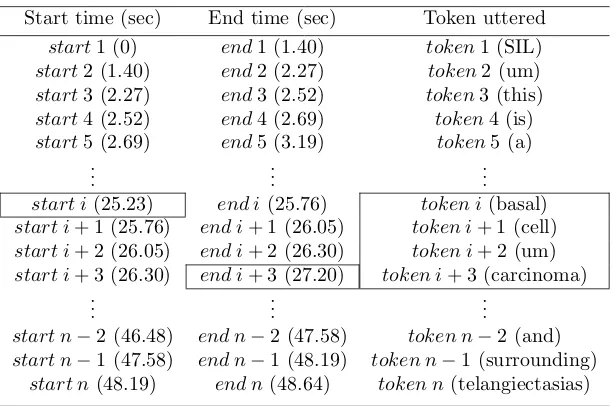
3.1 A diagnostic narrative corresponding to Figure 1.1 with time stamps and tokens. There is a multiword expression (basal cell carcinoma) boxed in the middle rows. . . 62
3.2 An illustration of the narrative in Table 3.1 after the detection of a medical multiword expression, basal cell carcinoma. . . 63
3.3 Narrative clustering performance. . . 74
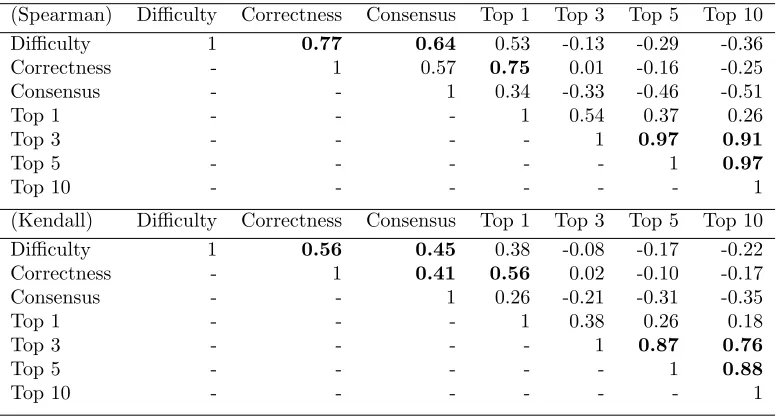
3.4 Correlation among different image rankings based on the Spear-man and Kendall methods, respectively. . . 82
3.5 Narrative correctness classification performances. The positive class for ROC is high-correctness. . . 95
3.6 Ranked features by random forest classifier. . . 95
4.1 Precision (P) and Recall (R) comparison at lesion morphology level. Among 48 images in the database, there are 9 images considered as containing the morphology macule, 38 papule, 5 bulla, 4pustule, and 1 nodule. . . 114
4.2 Precision (P) and Recall (R) comparison at lesion morphology level for the additional test that involve more images in the database. . . 115
4.3 Clustering performance by eye tracking data. . . 121
4.4 Clustering performance by verbal data. . . 121
4.5 Clustering performance by multimodal data. . . 121
5.1 Image grouping performances of fully automated learning and our paradigm. . . 144
5.2 The percentage of images in the reference list to appear within the top 10 retrieved neighbors . . . 145
5.3 The percentage of images in the reference list to appear within the top 15 retrieved neighbors . . . 145
List of Figures
1.1 Left: One medical image case used in the study (diagnosed as basal cell carcinoma; image courtesy of Dr. Cara Calvelli),
Right: image inspection, audio recording, and eye tracking. . . 3
1.2 The example eye gaze data instance (a) and a diagnostic nar-rative annotated by thought unit labels (b) that correspond to the same image. . . 4
1.3 Connections between chapters in this dissertation. . . 9
2.1 The term-term interaction graph computed using the semantic relatedness score in UMLS (details in Section 3.4.2). The ver-tices represent terms and edges the relatedness scores between terms. . . 42
2.2 Probabilistic latent semantic analysis. . . 45
2.3 Latent Dirichlet allocation. . . 46
2.4 Graphical illustration of PMF. . . 49
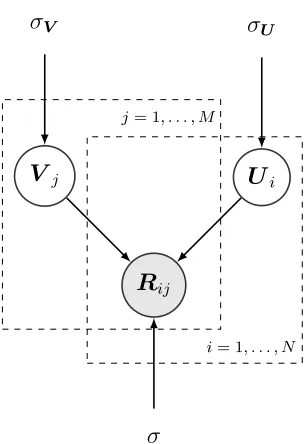
2.5 Relationships between representation learning models in the framework of matrix factorization. . . 50
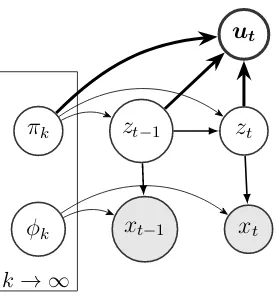
2.6 The hierarchical Dirichlet process-hidden Markov model that learns from a single observation sequence {xt}t=1,2,···,T. . . 53
2.7 Integrating outπ. For simplicity, the global measureGis omitted. 55 2.8 The auxiliary variables u depends on z and π. . . 58
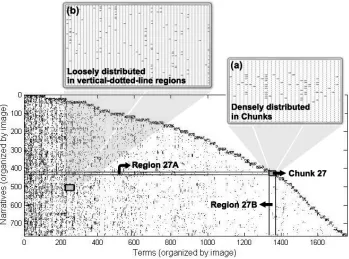
3.1 The narrative-term matrix with tf-idf scores is organized by image. The zero scores are plotted in white and others in dark grey. . . 65
3.2 An analysis of the occurrence of medical terms in narratives and distribution across images. . . 67
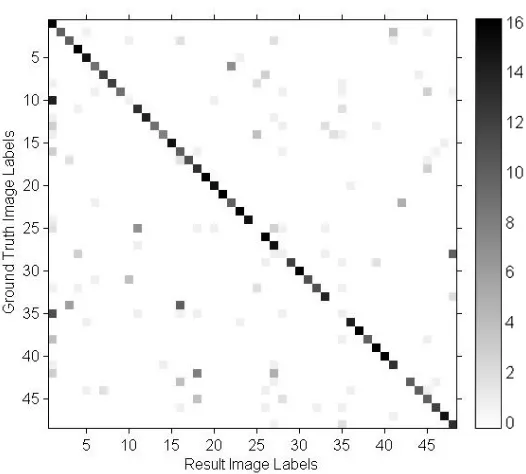
3.3 Confusion matrix of clustering results based on the anchor con-cept algorithm. The darkness of a block indicates the number of narratives that are in this block. . . 73
3.5 The correctness score distribution across all narratives. . . 85 3.6 The self-reported diagnostic confidence score distribution across
all narratives. . . 85 3.7 The hierarchical Dirichlet process-hidden Markov model that
learns from multiple narratives as a group. . . 86 3.8 Normalized state transitions in narrative groups regarding
diag-nostic correctness. One salient transition to discriminate both groups is from pattern 4 (the 4th row) to 1 (the 1st column). . 90
3.9 The correctness score distributions between the narratives with state transition (4→1) and those without. . . 90 3.10 Two narration patterns learned from all narratives in
Exper-iment I. Top 20 terms of each pattern are visualized through word cloud in which the font size indicates term frequency. Each table presents the thought unit (TU) proportion of the pattern. 91 3.11 Meaningful patterns discovered from diagnostic confidence study
in Experiment II. . . 91 3.12 Normalized state transitions in narrative groups regarding
di-agnostic confidence. Group (a) possesses slightly more self-transitions of 1, 5, 10 and 11 than group (b). . . 92 3.13 Two narration patterns learned from all narratives in
Experi-ment II. Word cloud shows top terms of each pattern. . . 92 3.14 Example narratives in the diagnostic correctness study. . . 94
4.1 A symmetrical viewing pattern detected by GMM in eye fixations.103 4.2 A solitary viewing pattern detected by GMM in eye fixations. 104 4.3 An overview of system design (user view). . . 106 4.4 An overview of system design (system view). . . 107 4.5 Using the end user’s and physicians’ eye movements as filters
for visual features to retrieve images. . . 110 4.6 Fusing multiple data modalities. Coefficient matrix, C, and
basis matrices,P and Q, are learned from an eye tracking data matrix, E, and a verbal description data matrix, V. . . 118 4.7 Confusion matrix of clustering trials by image based on
4.9 A template lesion of papule is derived from an eye fixated papule. This template can be used to detect visually similar lesions in the image. . . 127
5.1 Overview of the flow chart of our expert-in-the-loop paradigm. An expert encodes domain knowledge as special constraints through rounds of interactions. . . 132 5.2 Image grouping interface. . . 133 5.3 Image groupings generated using subsets of features. . . 134 5.4 An example of the visualization in popup window after the user
List of Algorithms
1 Projected gradient method [1] . . . 28
2 Alternating non-negative least square [2] . . . 28
3 Multiplicative rules for Euclidean distance [3] . . . 29
4 Multiplicative rules for KL-divergence [3] . . . 29
5 Feature-sign search algorithm (for each data instance xj) [4] . 35 6 A modified feature-sign search algorithm for GrNMF [5] . . . 39
7 The forward algorithm . . . 52
8 The backward algorithm . . . 52
9 The forward-backward algorithm . . . 52
Chapter 1
Introduction
1.1
Background
In visually-oriented specialized medical domains such as dermatology and
ra-diology, physicians need to study and compare medical image cases to aid
clinical diagnoses, support medical research, and educate medical trainees.
This can be aided by computational systems that organize medical images
according to the physicians’ understanding of the image content. This
dis-sertation proposes to understand the medical images from the perspective of
experts’ domain knowledge.
Since medical knowledge tends to be tacit and difficult to convey and
obtain, medical training usually takes years of internships and specialized
res-idencies. Medical training will benefit from approaches that can properly
represent and visualize expert knowledge. This dissertation develops
vari-ous representation learning strategies to extract expert knowledge from
mul-timodal datasets collected from physicians when they inspect medical images.
The datasets were constructed by the Human-Centric Multi-Modal Modeling
dermato-logical images (courtesy of Logical Images, Inc.) as visual stimuli. The images
in Experiment I represent a wide range of dermatology diagnoses [6], whereas
those in Experiment II focus on more examples of a few diagnoses.
Dermatol-ogy was chosen as a testbed, as it is a visually-based medical specialty that
requires specific, complex perceptual expertise. Following a modified
master-apprentice approach [7], each participating physician was asked to describe the
visual content of each image aloud, as if teaching a student who was seated
nearby [8]. The physicians’ speech and eye movements were recorded during
the experiments. These experiments were approved by Rochester Institute
of Technology’s Institutional Review Board, and all participants provided
in-formed consent before participating in the experiments.
The approach to gathering expert data during image inspection
effec-tively traces how experts use their knowledge for image-based problem solving.
This is because this approach involves a more natural task for physicians to
perform in contrast to asking them to conform to predefined image annotation
labels and rules. Figure 1.1 presents one of the images, and the experimental
setup. Figure 1.2 contains one corresponding eye tracking data instance and
diagnostic narrative transcribed from physicians’ spoken descriptions. Similar
to this example, all the spoken narratives were comprehensively transcribed
with sequences of words labeled by time stamps using the speech analysis tool
Praat [9]. Overall, the datasets comprise 1670 transcribed spoken narratives
and the same number of eye tracking trials.
Figure 1.1: Left: One medical image case used in the study (diagnosed asbasal cell carcinoma; image courtesy of Dr. Cara Calvelli),Right: image inspection, audio recording, and eye tracking.
-identified diagnostic thought units (TUs). These TUs cover the terminology
to standardize the description of skin lesions, including lesion arrangement,
distribution, texture, color, primary lesion type, and diagnosis [10]. For a
follow-up study of the reasoning processes of the collected diagnostic verbal
narratives, we recruited three dermatologists to evaluate the narratives from
the 16 participating physicians in Experiment I in terms of their diagnostic
correctness. A correctness score was assigned to each narrative, which balances
the correctness of described primary lesion type, differential diagnosis, and
final diagnosis. We refer to them as Type II thoughts to distinguish them (the
indirect findings) from the rest TUs that are direct findings. The identified TUs
are shown in Table 1.1, and one example annotation is in Figure 1.2-(b). In
addition to the semantic relevance, there is a temporal correspondence between
the data modalities, as both modalities of expert data were synchronously
(a) A collected gaze data instance.
(SIL) um this is a (SIL) pearly lobulated (SIL)
pink (SIL) papule with telangiectasias multi-lobulated
papule with telangiectasias (SIL) on the upper:::: cheek::::
(SIL) of (SIL) an elderly individual (SIL) say nodular. . . .
. . . .
basal. . . .cell. . . .carcinoma it’s a . . . .nodular basal. . . .. . . . cell. . . .carcinoma (SIL) uh (SIL) there is some surrounding. . . . sun . . . .. . . damage
(SIL) and surrounding telangiectasias
PRI ; SEC ; LOC ; DEM ;:::: DX or . . . .. . . DIF
(b) A dermatologist’s diagnostic narrative for the image. (SIL)represents silent pause.
Figure 1.2: The example eye gaze data instance (a) and a diagnostic narrative annotated by thought unit labels (b) that correspond to the same image.
Given the specialized domain, in which expert knowledge is required
to solve difficult problems (i.e., making diagnoses), the collected multimodal
expert data are ideal observations for this dissertation research to learn
repre-sentation of knowledge from human data. Besides, these datasets also reflect
the difficulty of research in the field—numerous medical images are not
an-Table 1.1: Two types of thought units.
Thought Unit Labels (Abbr.) Instances
T
yp
e
I
Patient DEMographics (DEM) elderly, caucasian, woman Body LOCation (LOC) arm, upper lip, knuckles Lesion CONfiguration (CON) linear, annular, grouped
SECondary finding (SEC) crust, ulcer, erythematous Lesion DIStribution (DIS) solitary, bilateral, extensive
T
yp
e
II PRImary lesion type (PRI) papule, plaque, patch
DIFferential diagnosis (DIF) X, Y or Z Final Diagnosis (DX) this is X
notated, meaning that we have to learn from a small annotated dataset for
knowledge that can be generally utilized. One important finding during data
collection is that the dermatology images can be difficult to inspect even for
ex-perts, because these photographic images often contain complex visual features
which may or may not be relevant to making an accurate diagnosis. Moreover,
in some cases the information in the image is not sufficient to support a final
diagnosis where the physicians requested biopsy as additional evidence. These
findings show the tight connection of the proposed research to the real-world
clinical settings and educational image uses.
1.2
Problem Definition
Eye movements provide insights into experts’ interests of the key visual
fea-tures and perceptually important regions in the images. Existing work in the
HCM3 Lab shows the correlation between image feature distribution and eye fixation arrangement [11]. These indicate the promising direction to
understand image content from expert-derived data.
Previous studies in HCM3 also include developing computational mod-eling to discover hidden visual behavioral patterns from eye movement data
[12, 13, 14]. Several distinctive types of patterns (i.e., Signature Patterns)
were discovered by a model and verified by a domain expert [15, 16]. This
indicates that it is possible to extract expert knowledge from the
collected behavioral data.
developed with domain experts in order to examine participating physicians’
diagnostic narration structure [8, 17]. A correspondence was found between
the learned eye movement patterns and the conceptual units of thought by
time-aligning the patterns with annotated narratives [12]. This finding
sug-gests another research direction taken in this dissertation; that is,
to mathematically fuse multimodal expert data for comprehensive
image understanding.
We are learning from a small dataset (compared with the large
vol-ume of medical images in the field), and the collected multimodal expert data
contain some data instances where the diagnoses are inaccurate. This makes
the outcome (e.g., the learned data representation, and the estimated
param-eters) sensitive to random variations in data (i.e., overfitting). To include
prior knowledge in the representation learning, this dissertation also aims
at developing a framework to receive additional inputs of domain
knowledge through expert interactions.
Given the elicited multimodal expert data and the promising research
directions above, the objectives of this dissertation are—(1) To build models
with the diagnostic verbal narratives for discovering expert-produced
behav-ioral and cognitive patterns. (2) To develop a framework that integrates the
features in multiple modalities for a unified data representation, which explains
the observations in these modalities and their correspondences. (3) To
imple-ment a machine learning system that allows expert manipulation of images
es-sentially inverse problems, where I discover experts’ uses of domain knowledge
and their diagnostic reasoning processes from the collected eye movements and
transcribed verbal narratives.
1.3
Dissertation Contributions
• The visual stimuli (i.e., the image content) and the expert cognitive
pro-cessing of the stimuli are interwoven. The collected expert data contain
the variances intrinsically from both the images and the experts. This
dissertation discovers interpretable behavioral patterns from expert data
and discloses both the characters of the medical images and those of the
participating experts.
• The multimodal data were collected during in-scenario experiments and
hence the data reflect different aspects of the same cognitive processes—
i.e., image-based diagnostic reasoning. In spite of the obvious semantic
relevance across data modalities, the relationship between the modalities
is hidden and needs modeled. This dissertation develops and studies a
machine learning framework that fuses multimodal expert data, so as to
recover the underlying conceptual and cognitive elements.
• The sparsity of the multimodal observations introduces an additional
challenge for accurate estimation of model parameters. The studies
in this dissertation incorporate knowledge resources as constraints in
medical knowledge resources (for representation learning) and additional
expert inputs (for interactive machine learning).
1.4
Dissertation Organization
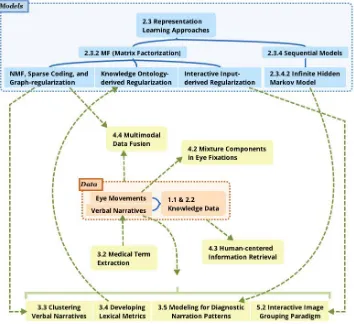
The following chapters in this dissertation are organized as follows (see
Fig-ure 1.3): Chapter 2 first introduces the background and related studies,
in-cluding the domain knowledge and visual perception in medical diagnosis, and
the idea of human computation through multimodal expert data. Chapter 2
also reviews various fundamental approaches that are used and referred to in
later chapters. Chapter 3 models the collected diagnostic verbal narratives
for medically meaningful topics. Section 3.2 presents the narrative processing
with the Unified Medical Language System (UMLS) [18] to extract medical
terms that are used for modeling and analysis in the rest of the dissertation.
Section 3.3 presents narrative clustering based on a topic modeling approach.
Section 3.4 develops two lexical metrics that are useful to explore the
at-tributes of physician groups and their diagnostic relevance based on the verbal
narratives. Section 3.5 develops a hierarchical dynamic model to recognize
the narration patterns that match physicians’ diagnostic reasoning stages and
are useful to predict diagnostic correctness. Chapter 4 reports on the
mix-ture components identified in physicians’ eye movement data that match the
medical abnormalities in the images. This finding supports two other
stud-ies in the chapter to develop a human-centered information retrieval (HCIR)
Figure 1.3: Connections between chapters in this dissertation.
multimodal data for a set of unified latent variables (Section 4.4). Chapter 5
describes an interactive machine learning paradigm developed for the case of
medical image grouping, where additional expert inputs can be used as
con-straints to guide the machine learning processes. Chapter 6 summarizes this
Chapter 2
Related Work
Since many medical images are inherently complex and noisy due to both
photographic inconsistency and different presentations of even the same
med-ical condition, grouping relevant medmed-ical images into semantmed-ically related and
meaningful groups has been a long-standing challenge. This chapter first lays
the theoretical foundation for research in the field of medical diagnosis in
Section 2.1, followed by describing the external language tools and multiple
human sensors from the human computation perspective (Section 2.2).
Sec-tion 2.3 then reviews the technical building blocks that can be used with the
tools and data to study expert knowledge and understand medical images.
Chapters 3, 4, and 5 use these building blocks for studies of diagnostic
reason-ing and medical image understandreason-ing, and the outcomes are useful to support
medical image grouping.
2.1
Image-based Diagnostic Reasoning
Since the content in medical images is beyond colors, textures, and shapes,
fully automated computer vision algorithms that only use low-level image
semantics and represent a medical image by a feature vector, we need to
under-stand the image content, especially the key content based on which a physician
can make a diagnosis about the image. However, the task of medical image
understanding remains challenging, because it requires domain knowledge and
perceptual expertise.
In the medical field, diagnostic reasoning processes can be explained
by two cognitive systems in thedual-process theory, namelyintuitive and
ana-lytical [19]. However, current research on medical diagnosis relies on research
interviews or clinical chart records [20], reports of clinicians [21], and
physi-cians’ response time [22], and hence overlooks much detailed information.
To contribute to both fields above, we jointly study the content in
medical images and physicians’ diagnostic decision-making. Specifically, we
collected multimodal data from physicians when they were engaged in
diag-nostic reasoning based on medical images (Section 1.1). To disentangle the
underlying factors that relate to expert interpretation of image content, In
this dissertation we model the collect data in Sections 3.3, 3.5, and 4.4. The
model outcomes help understand both physicians’ diagnostic reasoning
pro-cesses and their interpretations of image content by domain knowledge.
2.2
Conceptual Knowledge, Perceptual Expertise, and
Human Computation
The general computer vision algorithms that automatically detect semantic
se-mantics in medical images. Parsing and using the sese-mantics in medical
im-ages requires external knowledge [23]. One resource of domain knowledge is
the UMLS, which provides access to medical concepts and concept relations
in the medical domains. The domain experts constitute another knowledge
resource.
2.2.1 Unified Medical Language System
Ontology resources such as WordNet [24], VerbNet [25] and ImageNet [26] have
been used in general domains for extracting semantics in texts and images. The
UMLS can serve such a purpose in medical domains. It is a knowledge source
for medical terminology research and information retrieval [27], constituting
the largest existing semantic network of medical terms and their lexical
rela-tions [18, 28]. As an ontology of medical concepts it has been used to process
clinical records, to relate or disambiguate medical terminologies, and to serve
as a knowledge base for health care systems [18]. It has also been used to
assist feature engineering to tackle the intrinsic problem of data sparsity in
clinical texts [29, 30].
To represent expert knowledge from linguistic data, we have
prepro-cessed the data by programming with MetaMap, which is a knowledge-intensive
tool that automatically annotates biomedical text tokens by UMLS
Metathe-saurus concepts [31]. Our program first filters out the non-medical terms in
the verbal narratives, and then detects and reconstructs medical multiwords
this manner, each spoken narrative is segmented as a sequence of words and
multiword expressions, which can be used for further analysis and modeling.
2.2.2 Natural language and domain knowledge
Language is the primary conduit to express meaning. Our diagnostic verbal
image descriptions, collected during medical image inspections, form a
non-trivial corpus with different levels of language features. For example, speech
features can be used to study experts’ certainty in decision-making [32, 33, 34];
natural language can be processed and statistically analyzed at the lexical level
to reveal humans’ decision styles [35]; additionally, sense relationship can be
extracted using an ontology [36, 37]. This effort focuses on sense-based
repre-sentation as a reflection of human knowledge.
Studies in both computer vision and natural language processing use
the correspondence between image content and human annotations to reveal
semantics [38]. In natural scene image corpora, the annotations summarize the
meanings of visual content [39]. In return, the visual content in images provides
semantic context to disambiguate a lexical item (e.g., acrane as a bird vs. that
in a construction field). For example, Wu et al., defined the Flickr distance
to measure the relationship between semantic concepts (objects, scenes) in
the visual domain [40]. For each concept, a collection of images are obtained
from Flickr, and their visual characteristics are captured. Using information
in images helps capture the visual relationship between concepts. Their study
the resulting concept network is more statistically coherent to humans’ current
knowledge. There are more examples integrating verbal metadata with image
features [39]. A case of using language for characterizing the meaning of images
is shown in Li et al.’s study [41]. Using language tags of image regions, an
ontology of related concepts are introduced to achieve hierarchical annotation.
Natural language data provide multiple challenges: (1) Language is,
by nature, sparse [42]. In most linguistic data sets, the vast majority of
lex-ical items tend to occur rarely, and speakers can express similar meaning in
a variety of ways, both syntactically and lexically. (2) Semantic ambiguity
occurs in language data. The understanding and interpretation of ambiguous
language data depends on domain knowledge. (3) The difference in narration
styles among users results in variability that obscures common strategies of
diagnostic reasoning. (4) Language data are influenced by the mode in which
they were produced. Naturally occurring speech data differ substantially from
standard written text data.
Physicians in specialties such as radiology and dermatology have
de-veloped visual perceptual expertise. They better recognize domain-specific
patterns than unsupervised algorithms that lack guidance from medical
knowl-edge [13, 43]. However, it is time consuming and impractical for physicians
to manually annotate medical images since these images (1) can be stored in
large-scale image databases with a large and rapidly growing number of
dig-ital images, and (2) may reside within individual medical practices or small,
Researchers have made efforts to incorporate domain knowledge in
im-age clustering [44]. However, truly understanding physicians’ use of knowledge
(especially during image-based diagnosis) remains a challenging task, because
visual diagnostic reasoning is a complex interaction of domain knowledge,
per-ceptual expertise, reasoning processes [45], and idiosyncratic visual
informa-tion in the image case being inspected by physicians.
We elicit expert knowledge by collecting data from physicians as they
engage in medical image inspection. This approach involves a more natural
task for experts to perform in contrast to asking them to conform to predefined
image annotation labels and rules.
We exploit human experts’ knowledge to facilitate medical image
group-ing by applygroup-ing a methodology that is more objective and automated than
current research [22, 46, 47]. The intuition is that the meaning of a medical
image is expected to be mirrored by the spoken narrative of a physician when
s/he describes the image during a diagnostic process. In this way, we
incorpo-rate physicians’ domain knowledge, obtained from years of systematic study
and clinical training, to achieve more effective medical image grouping.
2.2.3 Eye tracking and visual perception
People are exposed to plenty of visual information everyday, but relatively
little of that information is processed due to our reliance on prior experience.
Humans shift the point of regard to regions requiring high resolution to gather
As a reflection of human responses to visual information, eye movements
re-veal the interaction between image features and human visual attention. It
highlights the important visual information perceived by human observers.
Eye movements can be described as a combination offixations and
sac-cades. Fixations occur when the eyes remain at a particular spatial location in
a visual stimulus, typically over a minimum duration of 100-200 milliseconds
[48]. To re-orient the eye to other locations of interest, the eye makes rapid,
ballistic movements known as saccades. Many eye tracking features/methods
have been defined based on statistical analysis of fixations and saccades in
raw data, including comparison of scanpaths [49], saliency maps [50], and
more complicated scanning patterns [12]. Although eye movements cannot
completely explain visual cognitive processes, many studies of individuals’ eye
movements, as they perform tasks, have established relationships between
vi-sual attention and cognition [51].
Eye movements are influenced by both bottom-up visual processing and
top-down search tasks and knowledge, so eye tracking opens a window to
ex-plore human visual information gathering guided by knowledge and intentions
[52]. In particular, human eye movements are a combination of visual input
and several cognitive systems, including short-term memory for previously
attended information in the current fixated position, stored long-term visual,
spatial and semantic information about other similar visual cases (knowledge),
and the goals and plans of the viewer (task) [53]. Fixations on particular parts
the structural information inherent in the image. These attributes of human
eye movements result in applications of eye tracking in various studies. For
example, Kunze et al. inferred participants’ language reading level from their
reading speed and fixation duration [54]. Human gaze has been utilized to
ex-tract regions of interest (ROIs) of an image to perform attention-based image
retrieval [55]. Visual attention has also been used as feedback in web searches
[56], for predicting salient regions of web pages [57], and to indicate different
levels of domain expertise by disclosing how experts vs. non-experts behave
visually when they are searching for task-relevant clues [58].
In vision-based complex problem-solving scenarios, such as image use,
human experts’ tacit knowledge is key to understanding and can be applied
toward enhancing computer vision algorithms. Eye tracking helps capture such
knowledge, because visual strategies are executed at a level below conscious
awareness and eye tracking is able to provide information that is not available
through methods such as introspection. Eye tracking a group of experts allows
us to study experts’ subconscious image viewing behaviors in common by
objectively measuring their eye movements.
2.3
Representation Learning Approaches
The data sparseness problem generally exists in natural language from
vari-ous domains. For example, there are a large number of distinct terms in our
dataset, because various naming preferences are used by physicians.
learning the transformations of raw data to compact and meaningful
repre-sentations. It has been successful in various domains. For example, topics
can be learned from the terms in documents [59], and levels of objects (e.g.,
edges, parts of faces, and faces) can be learned from pixels in face images [60].
Representation learning can also be applied to learn meaningful
representa-tions in audio signals and haptic data [61]. These learned new features are
usually in a more compact space and hence reduce the computational burden
of classification and prediction that follows.
Another use of representation learning is to visualize high-dimensional
data in a user panel as a low-dimensional embedding through techniques such
as multidimensional scaling (MDS) [62] and t-distributed stochastic
neighbor-hood embedding (t-SNE) [63]. This allows users to inspect, understand and
refine a large volume of data in a simple feature representation through
inter-actions.
In order to systematically arrive at a preferred representation,
repre-sentation learning essentially applies mathematical operations to the original
feature space. Constraints are usually designed in the objectives to keep only
those features that co-vary the most with respect to outcomes of interest. A
discussion of constraints can be found in Section 2.3.2. Although
representa-tion learning can be extended as a framework to include thehuman in the loop
for more preferred learning results (see Chapter 5), here we still consider it as
2.3.1 Classical models
In order to explain the general mechanisms of representation learning, we
first describe a popular data clustering technique (i.e., K-means) and two
unsupervised feature transformations (i.e.,principal component analysis [PCA]
and independent component analysis [ICA]). They were developed to learn a
new feature representation for different purposes.
K-means is a procedure to partition data set X = {x1,· · · ,xn} ⊂
Rm×ninto clustersC1,· · · , Ckbased on a specified numberk, where each data
point serves as a prototype of the cluster it belongs to.
k X
i=1
n X
j=1
zijkxj −µik
2 (2.1)
where the indicator variablezij = (
1, if xj ∈Ci
0, otherwise.
K-means is implemented through iterative refinement—in each
itera-tion, assigning each datum to the cluster with the nearest mean (E-step) and
updating the new cluster centroids by minimizing sum of distance to all data
in cluster (M-step; minimize Eq. (2.1) w.r.t., µ). The original feature space
(cardinalitym) is consequently projected to cluster labels (cardinality 1).
Principal Component Analysisis a procedure that transforms the
original space of possibly correlated features into a space of linearly
uncorre-lated features called principal components [64]. This transformation is defined
vari-ance (i.e., it accounts for as much of the variability in the data as possible),
and each succeeding component in turn has the highest variance possible under
the constraint that it is orthogonal to (i.e., uncorrelated with) the preceding
components. To retain the useful information (i.e., most of the variability in
the data) and remove noise, the number of components is optimized resulting
in usually only the first few components in the new space being kept. PCA
generates a new representation in which the new features are not correlated.
It is often used as data whitening to compress data and speed up the following
learning process [65], or for visualization purposes [66].
PCA essentially centers the data matrixX first and then uses singular
value decomposition (SVD) to decompose X into a diagonal matrix Σof the
same dimension as X and with nonnegative diagonal elements in decreasing
order, and unitary matrices U and V such that,
Xn×m ≈Un×nΣn×nV>n×m (2.2)
where the rows ofV> are eigenvectors of the covariance matrixPX =X>X.
The matrix Σ is diagonal, with each element σii =
√
λi (the ith eigenvalue).
Rows ofU are coefficients for basis vectors in V.
The manifold hypothesis believes that the probability mass
concen-trates near regions that have a much smaller dimensionality than the original
space where the data lives [67]. In other words, the data points are
actu-ally samples from a low-dimensional manifold that is embedded in a
the underlying factors through linear transformation in order to find a
low-dimensional representation of the data.
Independent Component Analysis is a computational method to
separate a multivariate signal into independent subcomponents. ICA is a
special case of blind source separation [68]. A common example application is
thecocktail party problemof listening in on one person’s speech in a noisy room.
ICA generates a new representation in which the new features are independent
signal sources. Each feature in the original space is a combination of these new
independent features. ICA can be used to disentangle noise from the target
signal [69].
The un-correlation used in PCA is characterized by,
E[xy] =E[x]E[y] (2.3)
whereas the independence is given by,
E[f(x)g(y)] =E[f(x)]E[g(y)] (2.4)
The uncorrelation only measures linear relationship, whereas the independence
is stronger to measure the existence of any relationship.
2.3.2 Matrix factorization-based models
Matrix factorization (MF) seeks to learn a low rank approximation from
an input data matrix using two factors [59]. Suppose we have a data matrix
The goal of matrix factorization is to generate a more compact and precise
rep-resentation of the input matrixX by approximating it via the multiplication
of two factor matricesH ∈Rn×k and C ∈
Rk×m.
X ≈HC (2.5)
min
H,CkX −HCk
2
F (2.6)
where the Frobenius norm k · k2
F is used to measure the error between the
original input X and its low rank approximation HC.
The matrix H (often referred to as basis matrix) can be viewed as
a dictionary, because it reveals the transformation from the original feature
space to latent variables that form a new basis. The matrixC (often referred
to ascoefficient matrix) represents the data instances by combinations of these
latent variables. The number of latent variables, k, is usually small to enforce
the low rank of both factor matrices.
Probabilistic interpretation of MF: Now assuming that the observed data
matrix can be recovered by its low-rank approximation HC with additional
Gaussian noise :
X ≈HC ⇐⇒ X−HC = (2.7)
where the is a matrix to denote the reconstruction error. The entries ij’s
are assumed to be independent and identically distributed (i.i.d.)
accord-ing to a Gaussian distribution with zero mean and variance σ2
reconstruction error). Due to the independent assumption the joint
distribu-tion of all data items factorizes:
p(X|H,C) =Y
i Y
j
N(Xij; [HC]ij, σ2r) (2.8)
=Y i Y j 1 √
2πσr
e
−1 2
Xij−[HC]ij σr
2!
(2.9)
Taking the logarithm yields the log-likelihood,
lnp(X|H,C) = −nmln
√
2πσr
− 1
2σ2
r X
i X
j
(Xij −[HC]ij)2
| {z }
DE(X,HC)
(2.10)
Maximum likelihood (ML) estimation: Maximizing the right hand side of Eq. (2.10) w.r.t. H and C is equivalent to minimizing the squared Euclidean distance DE(X,HC) for MF.
MF framework to explain classical representation learning models:
The framework of MF can be used to interpret the classical models in
Sec-tion 2.3.1, such as the popular data clustering technique (i.e., K-means), and
the unsupervised feature transformations (i.e., PCA and ICA).
K-means interpreted in MF-based framework: K-means can be
re-written in the MF framework. It is a special case of matrix factorization
to partition all documents in the corpus in K disjoint clusters, whereas the
matrix factorization generally allows each document characterized by one or
where each document may belong to several different clusters. Bauckhage
has shown that the problem of k-means clustering can be understood as a
constrained matrix factorization problem in the following form [70]:
min
Z kX−XZ >
ZZ>−1Zk2 (2.11)
s.t. zij ∈ {0,1} and X
i
zij = 1 (2.12)
Eq. (2.12) means that among all the clusters (or classes), each data point only
belongs to one cluster.
PCA interpreted in MF-based framework: To discover the
pat-terns in data that cover major variance, PCA can be formulated as,
min
U,Σ,VkX−UΣV >k2
F (2.13)
subject to: U>U =I,V>V =I, and Σ∈diag+ (2.14)
where the first few rows inU and the first few columns inV are major patterns
in the data-instance space and the feature space, respectively. Starting from
the first principal component (PC), succeeding PCs find linear combinations
of variables that correspond to the direction with highest variance under the
constraint of it being orthogonal (uncorrelated) to preceding ones. This is
basically a coordinate transformation, where the first few newly formed
coor-dinate axes (variables) captures most of the variance present in the data. By
ICA interpreted in MF-based framework: The mixture matrixA
that mixes signals S and outputs observations X is unknown to us:
X =AS (2.15)
ICA recovers the signal ˆS by finding the matrix W,
ˆ
S =W X (2.16)
whereW =A−1
The NMF with KL-divergence has a Bayesian formalization as the
Gamma-Poisson model (GaP), and the GaP model is a form of ICA [71].
The similarity between NMF and ICA is also shown for face recognition [72].
Comparisons—NMF, PCA, and K-means: NMF has been
com-pared with K-means and PCA by Lee and Seung [59], and their relationships
were discussed by Ding et al. [73]. Based on unary coded prototypes, K-means
allows only one hidden topic to be attributed to each data point. This
limi-tation makes k-means not very useful for analysis. PCA allows the activation
of multiple hidden variables, but it lacks obvious interpretation of the data.
This is because PCA allows the arbitrary signs of the entries in the matrices,
whereas subtractions may not make sense in context of some applications.
PCA retains orthogonality while relaxing non-negativity, and NMF
forces non-negativity while relaxing orthogonality. In contrast to K-means
and PCA, NMF only allows additive combinations of non-negative entries. The
non-negativity constraints form the part-based representation, which naturally
Beside the classical representation learning models above, the
proba-bilistic models such as pLSA and LDA can also be explained and interpreted
in the MF-based framework. We will show more details in Section 2.3.2.6.
Most matrix factorization algorithms originate from minimizing an
ob-jective function in the simple form ofkX−HCk2
F (squared Frobenius-norm
of the difference between X and its approximation HC) with respect to H
andC, and derive update rules by either a gradient-based method [2, 1], or a
multiplicative rule-based method [3]. Section 2.3.2.1 reviews these methods in
details for the case of NMF.
2.3.2.1 Nonnegative matrix factorization
By applying non-negative constraints of the coefficient matrix C, the
nonnegative matrix factorization (NMF) enables additive combination of the
latent componentsH·i’s according to weightsci.
min
H,C≥0kX−HCk 2
F (2.17)
equivalent to: min H,ci≥0
m X
i
kxi−Hcik2F (2.18)
Probabilistic interpretation of NMF: Let Xij denote the elements in
matrix X. Assume a latent variable representation, Xij can be written as,
Xij = X
k
Sikj (2.19)
assumeSikj to follow a Poisson distribution, i.e.,
Sikj ∼ PO(sikj;HikCkj) (2.20)
and the latent sourcesSk ={Sikj}can be analytically marginalized out to
ob-tain the marginal likelihood log p(X|H,C) [74]. Cemgil solves the
maximum-likelihood problem for {H,C} using EM algorithm, which arrives at exactly
the multiplicative update rules in Alg. 4 below.
Existing algorithms of NMF: The algorithms for solving the NMF problem
fall in three main categories—(1) the gradient-based methods, (2) the
alter-nating least squares methods, and (3) the multiplicative update rules. These
algorithms are based on some update rules derived from different objective
functions [3]. This section reviews these algorithms in details for the case of
NMF.
Alg. 1 shows the projected gradient method. The αk > 0 denotes the
step size, and it can be determined by a line search procedure. The P[·]
implements the gradient projection onto the nonnegative surface with,
Projection, P[ui] =
ui, if ui ≥0
0, otherwise (2.21)
Following the cost function defined by Euclidean distance in Eq. (2.18),
an alternating non-negative least square algorithm for NMF can be derived
(Alg. 2). It exploits the fact that, while the optimization problem of Eq. (2.18)
is not convex, by fixing one factor matrix, solving the other is convex and can
Algorithm 1 Projected gradient method [1]
Initialize H0, C0 and iteration index k = 0 repeat
Hk+1 ←P hHk−αk
∂kX−HkCkk2 F
∂Hk
i
,
Ck+1 ←P
h
Ck−αk
∂kX−HkCkk2 F
∂Ck
i
,
k =k+ 1
until some stopping criterion
Algorithm 2 Alternating non-negative least square [2]
Initialize H and C
repeat
Solve for C in matrix equation H>HC =H>X.
C ←P [C]
Solve for H in matrix equation CC>H>=CX>.
H ←P [H]
until some stopping criterion
Derived from the Euclidean distance-based cost function, a simple
al-gorithm of NMF with multiplicative update rules was proposed by Lee and
Seung (Alg. 3) [3]. Besides the Euclidean distance, the cost function of NMF
can also be defined by Kullback–Leibler divergence as follows:
D(X||HC) =
m X i=1 n X j=1
Xijlog
Xij
(HC)ij
−Xij + (HC)ij ≡ LNMF-KL (2.22)
Based on Eq. (2.22), a different algorithm can be derived (Alg. 4) [3].
The advantage of the multiplicative update rule-based algorithms is that if the
initial values of elements in matrices H and C are all non-negative, then the
H and C can never contain negative values. However, one drawback is that
Algorithm 3 Multiplicative rules for Euclidean distance [3]
Initialize H0n×K,C
0
K×m and iteration indexk = 0
repeat
Hkiκ+1 ←Hkiκ (X(Ck)>)iκ
(HkCk(Ck)>) iκ,
Ckκj+1 ←Ckκj ((Hk+1)>X)κj
((Hk+1)>Hk+1Ck) κj,
k =k+ 1
until some stopping criterion
Algorithm 4 Multiplicative rules for KL-divergence [3]
Initialize H0n×K,C0K×m and iteration indexk = 0 repeat
Ckκj+1 ←Ckκj
Pn
i=1HkiκXij/(HkCk)ij
Pn
q=1H k qκ
,
Hkiκ+1 ←Hkiκ
Pm
j=1CkκjXij/(HkCk)ij
Pm
p=1C k κp
,
k =k+ 1
until some stopping criterion
To prevent the model from overfitting the high-dimensional small datasets,
various regularization terms can be applied to penalize the model complexity.
For example, a sparsity constraint achieved throughl0- or l1-norm
regulariza-tions enforces the resulting representation with some indices set to zero (see
Section 2.3.2.2). This is motivated by observations in natural images or
nat-ural language documents where each image (or document) may be described
as the superposition of a small number of atomic elements such as edges and
corners (or topics). This section also presents the graph-based regularization
that ensures the learned new representation to preserve consistent
neighbor-hood to the original feature space (see Section 2.3.2.3). Other regularizations
are also introduced (see Sections 2.3.2.4 and 2.3.2.5).
2.3.2.2 Sparse coding
In order to achieve part-based additive mapping from features to data
in-stances, the factor matrices are usually constrained to be non-negative (NMF),
i.e., H ∈ Rn+×k and C ∈ Rk+×m. In order to produce meaningful outcome feature representations, techniques of sparse coding are usually applied.
Ol-shausen and Field proposed sparse data representation in 1996 [75]. They
believe that for an observation, only a small fraction of the possible factors are
relevant. This could be represented by features that are often zero or by the
fact that most extracted features are insensitive to small variations of the
ob-servation. There are plenty of successful applications of sparse coding [4, 5, 76].
l0-norm regularization: High sparsity of the extracted factor
matri-cesH and C can be achieved through minimizing an objective function with
a regularization term being l0 [77],l1 [78], orlp,q norms [79, 80]. However, it is
an intractable problem to find the sparsest representation of a signal through
l0 norm
e.g.,P
j1(cj 6= 0)
, because there is a combinatorial increase in the
number of local minima as the number of candidate basis vectors increases.
l1-norm regularization: More often sparsity is introduced via anl1
-norm of coefficient matrix C e.g.,P jkcjk1
, which also results in a sparse
representation and removes noise. With an l1-norm, the sparse non-negative
matrix factorization finds a basis to capture underlying semantics in the
-norm in the objective function, a sparse coding multiplicative algorithm was
developed [81]. In each iteration, the basis matrix H was updated using a
gradient-based method and normalized by its columns, and the multiplicative
algorithm was applied to update the coefficient matrix. In order to ease the
process to derive the update rules through a gradient-based method, Kim and
Park used squared l1-norm for the sparsity of the coefficient matrix [2]. This
work does not adopt squaredl1-norm, because truel1-norm (not squared) has
been demonstrated to be more effective to ensure sparsity. Hoyer et al. defined
a sparseness function and presented an algorithm to constrain the columns of
factor matrices H and/or C to a given sparse value [78]. To tackle the
non-derivativeness of the l1-norm, a feature-sign search algorithm was developed
to selectively activate and update some elements of each data instance to
it-eratively reduce the objective function [4] (see Alg. 5).
Probabilistic interpretation of non-negative sparse coding:
Method 1: Sparse coding can be interpreted from a probabilistic
per-spective in a prior study [82]. Let x denote a single observation, which is a
linear combination ofk independent signal sourceshi with some additive noise
,
x=
k X
i
cihi+ (2.23)
To find the underlying basis vectorshi’s that best explain all
distri-bution of observed signals p?(X) and that of signals generated by the model
p(X|H),
KL(p?(X)kp(X|H)) =
Z
p?(X)log
p?(X)
p(X|H)
dX (2.24)
which is equivalent to maximizingp(X|H) due to p?(X) being constant,
p(X|H) =
Z
p(X,C|H)dC =
Z
p(X|C,H)p(C)dC (2.25)
where the probability density of p(X|C,H) is a Gaussian distribution by
assuming a Gaussian white noise with varianceσ2,
p(X|C,H) =√ 1
2σ2πe
−kX−HCk 2 2
2σ2 (2.26)
By assuming the independence of the sources in the prior distribution
P(H) and parameterizing the priors for convenience, we obtain:
p(C) =
k Y
i=1
p(ci) = k Y
i=1
1
Ze
−βS(ci) (2.27)
whereS(·) is a function to characterize the prior distribution.
Since the integral over C in Eq. (2.25) is intractable, one can
approx-imate p(X|H) by maximizing p(X,C|H) across all choices of C, which is
E(X,C|H) =−log(p(X|H,C)p(C)) (2.28)
=
m X
j=1
kx(j)−
k X
i=1
c(ij)hik2+λ k X
i=1
S(c(ij))
!
(2.29)
where thel1-norm can be achieved by selecting a Laplacian prior in Eq. (2.27).
Method 2[83]: In MF settings, we can associate different models with
different k (The optimal value of k can be chosen through cross-validation).
Assuming a model Mk with complexity k, the posterior distribution of
pa-rameters times the evidence which the data provide for modelMk equals the
likelihood multiplied by the prior according to Bayes’ rule:
p(H,C|X, k)p(X|k) = p(X|H,C)p(H,C|k) (2.30)
The most probable set of parametersH,C, given a fixed number k of
latent variables, can be estimated by maximizing the posterior:
p(H,C|X, k) = p(X|H,C)p(H,C|k)
p(X|k) (2.31) w.r.t. the parametersH and C.
AssumingHandCare independent (i.e.,p(H,C|k) =p(H|k)p(C|k))
and taking the logarithm on both sides of Eq. (2.31), we have:
lnp(H,C|X, k) = lnp(X|H,C) + lnp(H|k) + lnp(C|k)−lnp(X|k) (2.32)
Continued with Eq. (2.32), now we add prior knowledge by choosing,
e.g., exponential priors of the form:
withλ >0, leads to:
lnp(C|k;λ) = −λX
i X
κ
Ciκ (2.34)
which constitutes the additional penalty terms used in objective:
min
H,CkX−HCk
2
F +λkCk1 (2.35)
to enforce sparse coding of the coefficient matrixC.
Maximum a posteriori (MAP) estimation: Thus sparse coding can be interpreted as MAP estimation by maximizing Eq. (2.32) w.r.t.
H andC and assuming independent exponential priors of the weights
Ciκ and Gaussian likelihood function in Eq. (2.9).
Alg. 5 presents the feature-sign search algorithm to learn the new
rep-resentation for each data instancexj. For simplicity, the data instance xj and
its new representation cj are denoted xand crespectively. The dimensions in
c are indexed by i. Alg. 5 optimizes,
min
c>0 f(c) = kx−Hck 2
+λkck1 (2.36)
where step 2 is to select the dimensions of c with the worst approximation
to x for update. The solution in step 3 can be obtained either by setting
the derivative of objective equal to zero and solve for c or by unconstrained
Algorithm 5 Feature-sign search algorithm (for each data instancexj) [4]
1. Initialize c = 0, θ = 0, and active set A = ∅, where θi ∈ {−1,0,1}
denotes sign(ci).
2. From zero coefficients of c, selecti= arg maxi
∂kx−Hck2
∂ci
. Activate ci by
adding ito set A only if it improves the objective, namely: If ∂kx−∂cHck2
i > λ, then set θi =−1,A =A∪ {i}. If ∂kx−∂cHck2
i <−λ, then set θi = 1, A =A∪ {i}. 3. Feature-sign step:
Let ˆH denote the submatrix of H with only columns regarding A. Let ˆc, ˆθ be the subvectors of c,θ with only dimensions regardingA. The solution to minˆckx − Hˆˆck2 +λθˆ>ˆc can be derived as ˆcnew =
( ˆH>Hˆ)−1( ˆH>x−λ(ˆθ)/2).
Perform a line search on the segment from ˆc to ˆcnew to update ˆc and
A.
Check the objective at all points for sign changes.
Update ˆc (and entries inc) to the point with the lowest objective. Remove zero coefficients of ˆc fromA and update θ= sign(c).
4. Check the optimality conditions: (a) ∂kx−∂cHck2
j +λ sign(cj) = 0, ∀cj 6= 0. If satisfied, ⇒(b); or, ⇒ 3. (b)
∂kx−Hck2
∂cj
≤λ, ∀cj = 0. If satisfied, return c; or, ⇒ 2.
The feature-sign search algorithm maintains an active set to only
up-date the dimensions ofcthat approximatexpoorly, which makes the algorithm
efficient. The proof of convergence can be found in the original paper [4].
The sparsity constraint is in line with the assumption made in our
stud-ies that each data instance is related to only a few hidden topics in experts’
mind, and the low rank approximation (of NMF) and sparse representation
altogether save a great deal of storage. Our studies built on this prior work’s
con-cepts. The desired latent concepts capture high-level medical concepts of the
spoken narratives that can be used to recover the original term vectors of the
narratives. Since a narrative is used to describe a specific medical image, it is
common for the narrative to concentrate on a small number of medical
con-cepts. Stated differently, a spoken narrative is expected to be only related to
a small subset of latent concepts. Therefore, a desired latent concept set can
be identified through NMF with sparsity constraint. See 3.3 for more details.
2.3.2.3 Graph-regularized NMF
Based on thefeature-sign search algorithm, Zheng et al. developed the
regularized non-negative matrix factorization (GrNMF), which adds a
graph-regularizer to sparse NMF [5]. The nonnegativity, sparsity, and a graph
regu-larizer altogether form the Laplacian sparse coding [84].
min
H,C≥0kX−HCk 2
F +αT r(CLC
> ) +β
m X
j=1
kcjk1
s.t.khik2 ≤a, i= 1, ..., k
(2.37)
whereX ∈Rn×m represents the m data instances in original n feature space.
Thehi, i= 1, ..., k denotes the basis vectors. The norm constraints on the size
of the basis vectors (i.e.,khik2 ≤ a) avoid arbitrarily large basis vectors that
keep HC unchanged while making cj arbitrarily close to zero. The k · k is
the vectorl2-norm anda is a positive constant number. The basis matrix can
be updated using Lagrange dual and the coefficient matrix can be updated
The graph-regularizer (i.e.,T r(CLC>)) was introduced by a weighted
graph of the data points represented in the input matrix. Let those data points
be denoted as x1, ..., xm. A nearest neighbor graphGwith m vertices can be
constructed. The elementWij in the neighboring matrix W of the graph G
can be computed using a heat kernel [85].
Wij =e−
kxi−xjk
σ (2.38)
Ifxi andxj are identical, thenWij equals 1; and if they are extremely different,
then Wij asymptotically approaches 0. The degree of xi is defined as di = Pm
j=1Wij, and D = diag(d1, ..., dm). L = D −W, is a Laplacian matrix
used to minimize the Laplacian item T r(CLC>) in the objective function
(Eq. (2.37)). Theαandβ are the weights of the regularizers, and they balance
between the two types of regularization. The optima of (α, β) can be chosen
through parameter tuning.
Similarly, other graph-weighting strategies can be adopted, such as0-1
weighting in Eq. (2.39), histogram intersection kernel weighting in Eq. (2.40),
and dot-product weighting in Eq. (2.41), depending on the feature attributes.
They can be used together to achieve superior clustering result [86].
Wij = (
1, if xi and xj are close
Wij =
PD
d=1min(xdi,xdj), if xi and xj are close
(d represents each feature dimension) 0, otherwise
(2.40)
Wij =x>i xj (2.41)
Zheng et al. developed a graph-regularized sparse coding based on the
feature-sign search algorithm in Alg. 5 [5]. Their modified feature-sign search
algorithm is shown in Alg. 6, where the reconstruction error and the graph
regularizer are substituted by functions for simplicity:
R(ci) =kxi−Hcik2
G(ci) =α m X
i=1
m X
j=1
Lijc>i cj
(2.42)
where subscript i in xi and ci indexes the data points (not the dimensions).
The θj (sign in the j-th dimension of ci) is omitted in the algorithm, because
in the non-negative matrix factorization setting, the elements in ci are never
negative. The non-negativity is achieved through a projection step, where all
Algorithm 6 A modified feature-sign search algorithm for GrNMF [5]
1. Initialize ci =0, and active set A=∅.
2. From zero coefficients of ci, select j = arg maxj
∂(R(j)(c
i)+G(j)(ci))
∂c(ij)
.
Acti-vate c(ij) by adding j to set A only if it improves the objective, namely: If ∂(R
(j)(c
i)+G(j)(ci))
∂c(ij) <−β, then A=A∪ {j}.
3. Feature-sign step:
Let ˆH denote the submatrix of H with only columns regarding A. Let ˆci denote the subvector ofci with only dimensions regardingA.
The solution to minˆciR(ˆci) +G(ˆci) +βˆci can be derived as ˆc
new
i =
( ˆH>Hˆ +αLiiI)−1( ˆH
> xi−α
P