The safety, effectiveness and cost-effectiveness of cytisine
in achieving six-month continuous smoking abstinence in
tuberculosis patients
—
protocol for a double-blind,
placebo-controlled randomized trial
Omara Dogar
1, Deepa Barua
2, Melanie Boeckmann
1,3, Helen Elsey
4, Razia Fatima
5, Rhian Gabe
1,6,
Rumana Huque
2,7, Ada Keding
1, Amina Khan
8, Daniel Kotz
3,9,10, Eva Kralikova
11,12,
James N. Newell
4, Iveta Nohavova
11,12, Steve Parrott
1, Anne Readshaw
1, Lottie Renwick
1,
Aziz Sheikh
9, Kamran Siddiqi
1,6& on behalf of the TB and Tobacco project consortium
University of York, Department of Health Sciences, Faculty of Sciences, York, UK,1
ARK Foundation, Dhaka, Bangladesh,2
Institute of General Practice, Addiction Research and Clinical Epidemiology Unit, Medical Faculty of the Heinrich-Heine-University, Düsseldorf, Germany,3
University of Leeds, Leeds Institute of Health Sciences, Leeds, UK,4 National Tuberculosis Control Programme (NTP), Islamabad, Pakistan,5Hull York Medical School, University of York, Heslington, York, UK,6Department of Economics, University of Dhaka, Bangladesh,7
The Initiative, Islamabad, Pakistan,8
University of Edinburgh, Usher Institute of Population Health Sciences and Informatics, Edinburgh, UK,9 Department of Family Medicine, CAPHRI School for Public Health and Primary Care, Maastricht University, the Netherlands,10
Centre for Tobacco-Dependent of the 3rd Medical Department, Department of Endocrinology and Metabolism, 1st Faculty of Medicine, Charles University and the University Hospital Prague, Czech Republic11
and Institute of Hygiene and Epidemiology, 1st Faculty of Medicine, Charles University and the University Hospital Prague, Czech Republic12
ABSTRACT
Background and aims Tuberculosis (TB) patients who quit smoking have much better disease outcomes than those who continue to smoke. In general populations, behavioural support combined with pharmacotherapy is the most effec-tive strategy in helping people to quit. However, there is no evidence for the effeceffec-tiveness of this strategy in TB patients who smoke. We will assess the safety, effectiveness and cost-effectiveness of cytisine—a low-cost plant-derived nicotine substitute—for smoking cessation in TB patients compared with placebo, over and above brief behavioural support.
Design Two-arm, parallel, double-blind, placebo-controlled, multi-centre (30 sites in Bangladesh and Pakistan), individually randomized trial. Setting TB treatment centres integrated into public health care systems in Bangladesh and Pakistan. Participants Newly diagnosed (in the last 4 weeks) adult pulmonary TB patients who are daily smokers (with or without dual smokeless tobacco use) and are interested in quitting (n = 2388).
Measurements The primary outcome measure is biochemically verified continuous abstinence from smoking at 6 months post-randomization, assessed using Russell Standard criteria. The secondary outcome measures include continuous abstinence at 12 months, lapses and relapses; clinical TB outcomes; nicotine dependency and withdrawal; and adverse events.Comments This is thefirst smoking cessation trial of cytisine in low- and middle-income coun-tries evaluating both cessation and TB outcomes. If found effective, cytisine could become the most affordable cessa-tion intervencessa-tion to help TB patients who smoke.
Keywords Bangladesh, cytisine, low- and-middle income countries, Pakistan, placebo-controlled randomized trial, smoking cessation, tobacco cessation, tuberculosis.
Correspondence to:Omara Dogar, University of York, Department of Health Sciences, Faculty of Sciences, Seebohm Rowntree Building, Heslington, York, YO10 5DD, UK. E-mail: [email protected]
Submitted 29 November 2017; initial review completed 24 January 2018;final version accepted 6 April 2018
INTRODUCTION
Tuberculosis (TB) is a widespread and, in many cases, fatal infectious disease. Approximately 85% of TB deaths occur
in the low- and middle-income countries (LMICs) in African and the South-East Asian regions [1]. Evidence suggests that smoking increases the risk of developing TB disease [2–4] and leads to poorer outcomes in those TB
patients who continue to smoke [3,5]. Of the 10.4 million incident cases of TB in 2016, an estimated 0.8 million were attributable to smoking [1].
Newly diagnosed TB patients experience high levels of anxiety, including fear of death and worries about infect-ing others. This provides a‘teachable moment’that health professionals can use to offer smoking cessation advice [6].
‘Teachable moments’are conceptualized as events or sets of circumstances that can lead patients to alter their health behaviour positively [7]. Moreover, the potential health benefits of cessation are greater among TB patients than among other smokers, as most of the tobacco-induced immunological abnormalities in TB patients re-verse within 6 weeks of quitting [8]. It therefore makes sense to offer smoking cessation to TB patients who smoke as part of routine care, although this opportunity is rarely taken [9,10].
There is substantial evidence on the effectiveness of be-havioural support (BS) and a range of pharmacotherapies available for smoking cessation [11–14]. While these med-ications, particularly nicotine replacement therapy (NRT) and varenicline, are widely recommended, their costs pro-hibit their use in LMICs. Cytisine—a plant-derived pharma-cotherapy (manufactured as Tabex and Desmoxan)—has recently gained recognition as a safe, efficacious and afford-able cessation aid [14,15]. Although cytisine is not licensed in most countries outside eastern Europe [16,17], recent studies [18,19] highlight its potential for use in LMICs [14]. Particularly attractive is its lower cost (US$20–30 for 25 days) in comparison to NRT (US$112–685 for 8–10 weeks) and varenicline (US$474–501 for 12 weeks) [20]. Cytisine was therefore chosen as a suitable medica-tion to trial as part of a project called‘TB and Tobacco’— a European Union (EU)-funded study of tobacco cessation in TB patients in South Asia.
The TB and Tobacco study investigates an innovative approach to improve lung health in LMICs by integrating inexpensive tobacco cessation strategies of proven efficacy into TB programmes. The project has two goals: (i) the effectiveness goal—the TB and Tobacco trial; and (ii) the implementation goal—BS implementation, its process and context evaluation. This protocol focuses on the effective-ness goal.
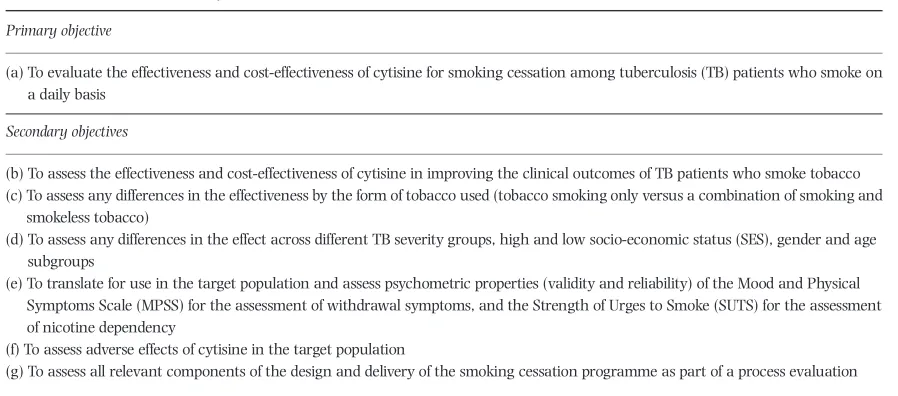
The primary aim of this trial is to evaluate the effective-ness and cost-effectiveeffective-ness of cytisine for smoking cessation among TB patients. Secondary aims include assessment of its effectiveness and cost-effectiveness in improving TB outcomes; differential effect by the form of tobacco used; effect moderators: TB severity, socio-economic status (SES), gender and age; adverse effects; nicotine depen-dency, withdrawals; and process of delivery. An overview of all objectives is listed in Table 1.
METHODS
Design
This is a phase III, double-blind, individually randomized, parallel-group placebo-controlled trial. Participants will receive random allocation in a 1 : 1 ratio to cytisine or matching placebo treatment. Figure 1 illustrates the TB and Tobacco trialflow-chart.
Ethics approval
The trial was granted ethics approval by the Health Sci-ences Research Governance Committee (HSRGC) at the University of York, UK, by the National Bioethics Committee, Pakistan Medical Research Council (Ref: no.
4–87/16/NBC-200 Part-B/RDC/4197) and by the
[image:2.594.68.517.535.733.2]National Research Ethics Committee, Bangladesh Medical
Table 1 TB and Tobacco trial objectives.
Primary objective
(a) To evaluate the effectiveness and cost-effectiveness of cytisine for smoking cessation among tuberculosis (TB) patients who smoke on a daily basis
Secondary objectives
(b) To assess the effectiveness and cost-effectiveness of cytisine in improving the clinical outcomes of TB patients who smoke tobacco (c) To assess any differences in the effectiveness by the form of tobacco used (tobacco smoking only versus a combination of smoking and
smokeless tobacco)
(d) To assess any differences in the effect across different TB severity groups, high and low socio-economic status (SES), gender and age subgroups
(e) To translate for use in the target population and assess psychometric properties (validity and reliability) of the Mood and Physical Symptoms Scale (MPSS) for the assessment of withdrawal symptoms, and the Strength of Urges to Smoke (SUTS) for the assessment of nicotine dependency
(f) To assess adverse effects of cytisine in the target population
Research Council (Ref: BMRC/NREC/2016–2019/1475). As cytisine is not licensed for use in either country, approvals were obtained from the Drug Regulatory Authority of Pakistan (1 December 2016) and the Director-ate General of Drug Administration in Bangladesh (21 March 2017).
Participants
Participants will be newly diagnosed (within the last 4 weeks) adult pulmonary TB patients who smoke (with or without dual smokeless tobacco use) on a daily basis, wish to quit and are able to provide consent. Table 2 pre-sents participants’eligibility criteria.
Participants will not receive financial incentives except nominal travel costs for any follow-up visits that fall outside routine TB care. The trial will be conducted at 17
sites in Bangladesh and 13 in Pakistan. Sites are designated TB treatment centres run by the respective National TB control Programmes (NTP). Supporting information, Appendix S1 lists the trial sites.
Interventions
[image:3.594.136.474.54.485.2]All trial participants will receive brief BS for smoking cessa-tion integrated within the more broad advice offered to TB patients to manage their TB and adhere to TB medication. Two face-to-face BS sessions will be delivered at days 0 and 5 (for 10 minutes and 5 minutes, respectively). Further en-couragement and support is offered, if needed, at the week 5 visit. BS materials have been translated and adapted to the local context in Bangladesh and Pakistan. Thefindings relating to the implementation goal of the TB and Tobacco project will inform further adaptation of the BS, to enable
scale-up and sustainable delivery within National TB Programmes (see Supporting information, Appendix S2 and Appendix S3 for details on BS).
Randomized patients will receive either cytisine (as Desmoxan) (active arm) or matching placebo (control arm) in their Investigational Medicinal Product (IMP), which is manufactured as 1.5 mg hard capsules for oral ad-ministration, with a shelf-life of 2 years. Patients receive 7 days’IMP on the day of enrolment and are expected to re-turn on thefifth day (±2 days), coinciding with their quit date, when they are dispensed another 18 days’supply by the study researcher.
Cytisine
Cytisine, a partial agonist of nicotinic acetylcholine recep-tors, is pharmacologically similar to varenicline (Chantix). With a half-life of 4.8 hours, cytisine is eliminated rapidly from the body [20]. The standard regimen is a 25-day
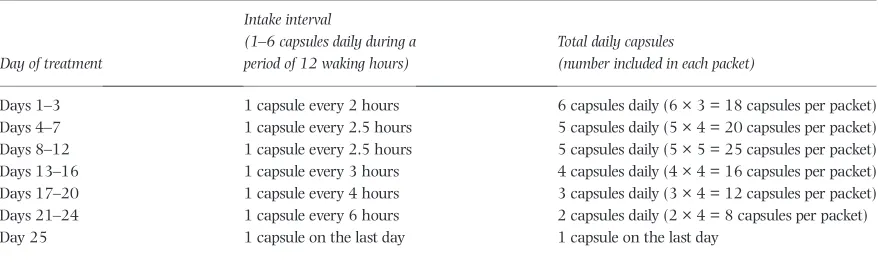
course, reducing gradually from six capsules a day to one capsule on the last day by the end of the treatment period, with a quit date set for day 5 [15]. Table 3 presents the dosing schedule for the cytisine.
Placebo
Patients in the control arm will receive the placebo in ex-actly the same manner as cytisine. A checking exercise was carried out using paired samples of capsules to ensure that placebo pills were unrecognizable. Blinded York Trials Unit staff could not distinguish between placebo and active pills based on their appearance, smell or taste.
Outcomes
[image:4.594.72.510.75.298.2]Patients will have assessments on days 0 (baseline) and 5, weeks 5, 9 and 12 and months 6 and 12. These time-points, except day 5 and month 12, were chosen to corre-spond with routine TB care visits. The day 5 visit is to Table 2 Patient eligibility criteria.
Inclusion criteria
(a) Age at least 15 years in Pakistan and 18 years in Bangladesh (definitions of adult TB patients in the two countries)
(b) Able to provide consent
(c) Diagnosed with pulmonary TB (smear-positive or -negative) in the last 4 weeks (d) Currently smokes tobacco on a daily basis (with or without smokeless tobacco use) (e) Willing to quit tobacco use
Exclusion criteria
(a) Re-treatment TB, MDR TB, miliary or extra-pulmonary TB
(b) Currently receiving streptomycin (category II anti-TB medication) and/or PASAa
(c) Currently using any pharmacotherapy for tobacco dependence Cytisine contraindications:
(d) Pregnant, lactating or planning to become pregnant
(e) Had myocardial infarction, stroke or an attack of severe angina within the previous 2 weeks (f) Uncontrolled high blood pressure despite being on medication
(g) Severe renal impairment (requiring dialysis)
(h) Suffering from schizophrenia or known to be diagnosed with epilepsy
TB = tuberculosis; PASA = para amino salicylic acid; MDR = multi-drug-resistant.aUsing cytisine with anti-TB medicines (PASA, streptomycin) reduces
stim-ulant action of cytisine [39].
Table 3 Dosing schedule of cytisine and packing details.
Day of treatment
Intake interval
(1–6 capsules daily during a
period of 12 waking hours)
Total daily capsules
(number included in each packet)
Days 1–3 1 capsule every 2 hours 6 capsules daily (6 × 3 = 18 capsules per packet)
Days 4–7 1 capsule every 2.5 hours 5 capsules daily (5 × 4 = 20 capsules per packet)
Days 8–12 1 capsule every 2.5 hours 5 capsules daily (5 × 5 = 25 capsules per packet)
Days 13–16 1 capsule every 3 hours 4 capsules daily (4 × 4 = 16 capsules per packet)
Days 17–20 1 capsule every 4 hours 3 capsules daily (3 × 4 = 12 capsules per packet)
Days 21–24 1 capsule every 6 hours 2 capsules daily (2 × 4 = 8 capsules per packet)
[image:4.594.71.510.602.733.2]monitor for any adverse drug reaction and the month 12 visit is to assess longer-term smoking cessation and any TB relapses. Table 4 provides the schedule for trial partici-pants from initial eligibility screening, dispensing of IMP and the data collection/assessments.
Primary outcome measure
The primary outcome is biochemically verified continuous smoking abstinence at 6 months post-randomization, as per Russell Standard [21]; self-report of not using more than five cigarettes/bidis/water pipe sessions/chewing tobacco products from the quit date (5 ± 2 days) supported by a negative exhaled carbon monoxide [CO<10 parts per million (p.p.m.)] test at 6 months, using a Micro MC02 CO Monitor (CareFusion UK Ltd, Wokingham, UK). In con-comitant smokeless tobacco users, instead of CO, a cotinine dipstick test (OneStep Urine Test Strip, sensitivity 200 ng/ml, supplied by Home Health UK, Bushey, UK) will be used for biochemical verification of abstinence. An ele-vated CO or cotinine level will always take precedence over the patient’s self-reported abstinence. In the analysis, pa-tients will be considered smokers if their smoking status could not be determined.
Although smoking status is assessed at both 6 and at 12 months’time-points, in the interest of better retention rates primary outcome is measured at 6 months.
Secondary outcome measures
Abstinence, lapses and relapses. Abstinence, lapses and re-lapses comprise: continuous abstinence at 12 months (same definition as for primary outcome at 6 months); point abstinence, defined as a self-report of not using tobacco in the previous 7 days at weeks 5 and 12 and at months 6 and 12 (abstinence is verified biochemically at months 6 and 12 only). In addition, early-lapse, late-lapse, early-relapse and late-relapse will be assessed according to the definitions presented in Table 5.
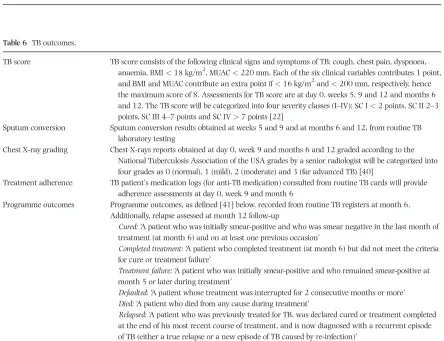
TB outcomes. Assessment for the impact of smoking cessa-tion on TB outcomes includes clinical TB score [22–24]; sputum conversion results; chest X-ray grading (normal, minimal, moderately advanced or far advanced TB) [25]; adherence to TB treatment; and standard TB treatment outcomes (success, failure, default, relapse or death). The researchers will assess signs and symptoms for TB score (supported by the clinical team), while routine reporting on TB cards/registers maintained by the TB programme will provide the remaining TB outcomes. Table 6 presents the definitions of the TB outcomes.
[image:5.594.84.521.422.697.2]Nicotine dependency. Assessment of nicotine dependency includes translated versions of the Mood and Physical Symptoms Scale (MPSS) [27], the Strength of Urges To
Table 4 Schedule of enrolment and follow-up assessments for TB and Tobacco trial.
Assessment
Study period
Time-point Day 0 Day 5
Week 5 (day 35)
Week 9 (day 63)
Week 12 (day 84)
Month 6 (week 25)
Month 12 (week 52)
Allowed variation in days /+2 days /+5 days
Eligibility screen x
Informed consent x
Randomization x
Tobacco use (self-reported) x x x x x
Socio-demographic historya x
Tobacco use and quit historyb x
Nicotine dependencec x x x x x
Economic outcomes x x x
Process outcomes x x
Tobacco use (biochemical measures) x x
Study medication dispensing x (for 7 days) x (for 18 days)
Medication adherence x x
Adverse events review (checklist) x x x
Clinical TB score x x x x x x
TB sputum conversion x x x x x
TB chest X-ray grading x x x x
TB treatment adherence x x x
TB treatment outcomes x x
TB = tuberculosis.aSocio-demographic history includes: age, gender, marital status, household assets, education, work status;btobacco use and quit history
includes: initiation, duration, type, frequency and quantity of tobacco use, smoking restrictions inside homes, number of quit attempts, last quit attempt and duration of longest quit attempt;cnicotine dependence includes: Mood and Physical Symptoms Scale, Strength of Urges To Smoke scale and Heaviness of
Smoke (SUTS) scale [26] and the Heaviness of Smoking Index (HSI) [28,29] in Bangla and Urdu.
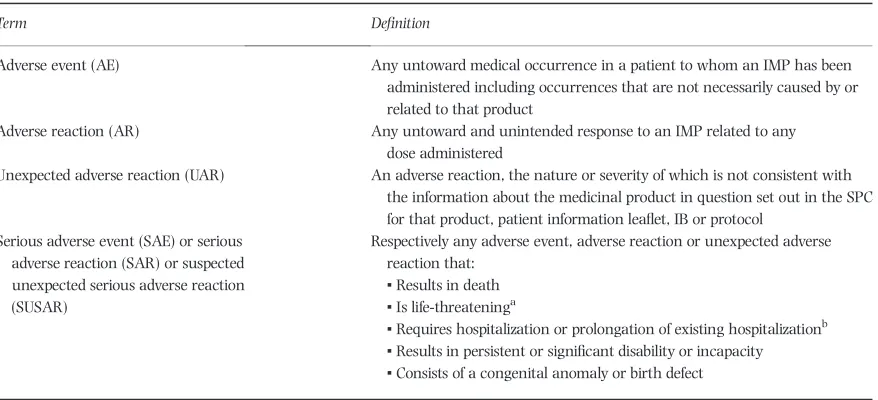
Adverse events. Table 7 presents definitions of adverse events (AEs), which will be collected up to week 9, and self-reports recorded on the‘AEs review’checklist in the pa-tient case-report form that is compiled from the summary
[image:6.594.70.510.77.262.2]of product characteristics for Desmoxan and previous rele-vant randomized controlled trials (RCT) [16,19,30,31]. The checklist includes symptoms relating to possible cytisine side effects: nausea, diarrhoea, dry mouth, epigas-tric pain, headache, insomnia, abnormal dreams, irritabil-ity, anxiety, tachycardia and musculoskeletal pain. A clinical review will be required for patients reporting any Table 5 Smoking cessation outcomes: primary and secondary measures.
Outcome Definition
Primary outcome measure: Continuous abstinence (at 6 months)
Self-report of not using more thanfive cigarettes/bidis/water pipe sessions/chewing tobacco
products from the quit date (5 +/ 2 days) to the reporting date, supported by a negative
biochemical test at 6 months Secondary outcome measures:
Continuous abstinence (at 12 months)
Self-report of not using more thanfive cigarettes/bidis/water pipe sessions/chewing tobacco
products from the quit date (5 +/ 2 days) to the reporting date, supported by a negative
biochemical test at 12 months
Point abstinence Self-report of not using tobacco in the previous 7 days, assessed at weeks 5 and 12, and at
months 6 and 12
Early-lapse Self-report of tobacco use (even once) after the quit date but having point abstinence
at week 5
Late-lapse Self-report of tobacco use (even once) between weeks 5 and 12 but showing point abstinence
at weeks 5 and 12
Early-relapse Abstinence at week 5 but a self-report of tobacco use by week 12
[image:6.594.68.512.259.600.2]Late-relapse Abstinence at weeks 5 and 12 but a self-report of tobacco use by month 6
Table 6 TB outcomes.
TB score TB score consists of the following clinical signs and symptoms of TB: cough, chest pain, dyspnoea,
anaemia, BMI<18 kg/m2, MUAC<220 mm. Each of the six clinical variables contributes 1 point,
and BMI and MUAC contribute an extra point if<16 kg/m2and<200 mm, respectively, hence
the maximum score of 8. Assessments for TB score are at day 0, weeks 5, 9 and 12 and months 6
and 12. The TB score will be categorized into four severity classes (I–IV): SC I<2 points, SC II 2–3
points, SC III 4–7 points and SC IV>7 points [22]
Sputum conversion Sputum conversion results obtained at weeks 5 and 9 and at months 6 and 12, from routine TB
laboratory testing
Chest X-ray grading Chest X-rays reports obtained at day 0, week 9 and months 6 and 12 graded according to the
National Tuberculosis Association of the USA grades by a senior radiologist will be categorized into four grades as 0 (normal), 1 (mild), 2 (moderate) and 3 (far advanced TB) [40]
Treatment adherence TB patient’s medication logs (for anti-TB medication) consulted from routine TB cards will provide
adherence assessments at day 0, week 9 and month 6
Programme outcomes Programme outcomes, as defined [41] below, recorded from routine TB registers at month 6.
Additionally, relapse assessed at month 12 follow-up
Cured:‘A patient who was initially smear-positive and who was smear negative in the last month of
treatment (at month 6) and on at least one previous occasion’
Completed treatment:‘A patient who completed treatment (at month 6) but did not meet the criteria
for cure or treatment failure’
Treatment failure:‘A patient who was initially smear-positive and who remained smear-positive at
month 5 or later during treatment’
Defaulted:‘A patient whose treatment was interrupted for 2 consecutive months or more’
Died:‘A patient who died from any cause during treatment’
Relapsed:‘A patient who was previously treated for TB, was declared cured or treatment completed
at the end of his most recent course of treatment, and is now diagnosed with a recurrent episode
of TB (either a true relapse or a new episode of TB caused by re-infection)’
moderate to severe symptoms, classified using the Com-mon Terminology Criteria for Adverse Events (CTCAE) [32]. A site-designated clinician, trained in study-related AEs, will review and determine the severity and relation-ship of the event to the study treatment.
The researcher at each site will notify all serious ad-verse events to the country coordinating office within 24 hours of becoming aware of an event, who will in turn notify the York trial team within (a further) 24 hours. Med-ically qualified staff at the country coordinating office will confirm ‘causality’ and ‘expectedness’ and code these events using the Medical Dictionary for Regulatory Activi-ties (MedDRA) [33].
Adherence. Adherence will be monitored using a question-naire at day 5 and each subsequent follow-up appoint-ment, as well as by counting empty cells in the blister packets (day 5 and week 5). Dosing schedule cards will be provided to help to maximize adherence.
Process evaluation. A mixed-methods process evaluation will assess reach, dose received, dose delivered andfidelity for trial and BS components; the protocol is submitted sep-arately for publication.
Sample size
The sample size is based on known cessation rates for BS and previously observed group differences using cytisine. The Action for Stopping Smoking In Suspected TB (ASSIST) trial (based on 1955 patients in Pakistan) reported that 41% of regular smokers with presumptive TB sustained biochemically verified smoking cessation at 6 months after random allocation to BS [34].
Previous RCTs of cytisine have shown increases of 6–7% (differences in absolute percentages) for sustained cessation [16,19,30]. To detect an increase of 6% in the 6-month abstinence rate for the addition of cytisine to BS, from 41 to 47% with 80% power, testing at the 5% significance level, requires primary outcome data for a total of 2148 participants (1074 in each arm). The ASSIST trial reported missing primary outcome data on 5.5% of participants. Assuming a more conservative attrition rate of 10% gives a target recruitment of 2388 participants (1194 in each arm).
Randomization
Allocation to the trial arms is by pre-prepared block ran-domization lists for each country, generated by the trial statistician. IMP packs are labelled sequentially in their randomized order and distributed to trial sites in batches. Once a patient has consented to participate, the researcher at the site calls the country coordinating office to obtain the patient’s allocated trial number and confirm the next IMP pack number in the sequence to dispense to the patient.
Blinding
[image:7.594.88.527.75.275.2]Patients, clinical team and researchers will remain blind to treatment allocation. To ensure double-blinding, IMP packs appear identical and only the code-break envelopes prepared separately for each trial number could ascertain treatment allocation. In an emergency, any request to un-blind must be authorized by a clinician or senior trial staff. Each country coordinating office will be contactable Table 7 Definitions of adverse events.
Term Definition
Adverse event (AE) Any untoward medical occurrence in a patient to whom an IMP has been
administered including occurrences that are not necessarily caused by or related to that product
Adverse reaction (AR) Any untoward and unintended response to an IMP related to any
dose administered
Unexpected adverse reaction (UAR) An adverse reaction, the nature or severity of which is not consistent with
the information about the medicinal product in question set out in the SPC
for that product, patient information leaflet, IB or protocol
Serious adverse event (SAE) or serious adverse reaction (SAR) or suspected unexpected serious adverse reaction (SUSAR)
Respectively any adverse event, adverse reaction or unexpected adverse reaction that:
▪Results in death
▪Is life-threateninga
▪Requires hospitalization or prolongation of existing hospitalizationb
▪Results in persistent or significant disability or incapacity
▪Consists of a congenital anomaly or birth defect
aThe term life-threatening in the de
finition of a serious event refers to an event in which the patient is at risk of death at the time of the event; it does not refer to an event that hypothetically might cause death if it were more severe,bhospitalization is defined as an in-patient admission, regardless of length of stay, even if
by in- and out-of-office hours contact numbers; the contacted staff will need to travel to the office in order to access the code-break envelopes and follow the procedure for un-blinding as per manual of operations.
Statistical methods
Analyses will be based on intention-to-treat, analysing par-ticipants in the arm to which they were randomized. Signif-icance tests will be two-sided at the 5% level. Baseline characteristics (see Table 4 for details) will be presented de-scriptively to assess balance between cytisine and placebo arms in terms of: (a) ecological factors at the TB treatment centre level; and (b) individual factors at patient level.
Primary analysis
Missing primary outcome data will be treated as a negative outcome, i.e. continuous smoking [21]. Agreement be-tween self-reported and biochemically verified abstinence will be reported by trial arm. The number and proportion of abstinent patients will be reported by trial arm, and group differences will be illustrated by the risk difference and relative risk with associated 95% confidence intervals (CIs) andP-values. Abstinence rates will be compared be-tween the active and the control arms using logistic regres-sion. Trial sites will be included as a random effect using robust standard errors.
Secondary outcomes analysis
The primary analysis will be repeated for the following sec-ondary outcomes: continuous abstinence for 12 months, point abstinence at weeks 5 and 12 and months 6 and 12, as well as early and late lapses and relapses (Table 5). Point abstinence will be plotted over time. TB outcomes of TB score, sputum conversion, X-ray assessment, treatment adherence and programme outcomes, as well as with-drawal and dependency as measured by MPSS and SUTS, will be analysed using appropriate statistical models for continuous or categorical data using all available time-points.
The total number of AEs, the number of patients with any AE and the number of AEs per patient will be reported by trial arm. The number of patients with any AE will be compared byχ2test between arms.
Levels of adherence to study treatment will be pre-sented descriptively [means and standard deviations (SDs), as well as grouped as≥ 80% (strong adherence),
<80% but≥50% (moderate adherence) and<50% (poor adherence)]. Compliers will be defined as those having taken any dose of medication on 80% or more of the pre-scribed days. Patients with missing data at 5 weeks will be assumed to be non-compliant with the trial regimen.
Sensitivity analyses
Sensitivity analyses will include: (i) primary analysis adjusting for baseline level of dependence; (ii) primary analysis adjusting for baseline level of dependence, age, gender, form of tobacco use and any potentially influential baseline variables for which chance imbalances between groups may have been observed; and (iii) an appropriate re-peat of the primary analysis that takes treatment adher-ence into account.
Subgroup analyses
The primary logistic regression analysis will be repeated, including a treatment × subgroup interaction for six sub-groups, collected at baseline: (i) tobacco use (smoked only, smoked and smokeless), (ii) gender (male, female), (iii) age (< 40,≥ 40), (iv) TB severity (I–IV), (v) SES (percentile cut-off of a wealth index derived from education/
household assets/work status) and (vi) country
(Pakistan, Bangladesh). Abstinence rates, risk differences and relative risk for each subgroup will be reported with 95% CIs. P-values for the interaction terms will be re-ported; however, the trial is not powered to detect interactions.
Cost-effectiveness analysis
In order to undertake a full cost-effectiveness analysis (CEA), costs of the interventions and participants’use of wider health care (e.g. doctor visits, hospital attendances, etc.) will be collected for both groups. Basic unit costs col-lected alongside the trial will then be applied to complete health-care cost profiles. The costs of patients’TB-related care will be included in the service-use questionnaires and costs allocated accordingly. Two outcomes will be used for the CEA; quitters (primary outcome) and quality-adjusted life-years (QALYs), calculated from the EQ-5D-5 L (a measure of health utility) collected during the trial [35]. We will calculate incremental cost-effectiveness ra-tios (ICER) combining treatment and wider health-care costs with each outcome.
Bootstrapping techniques will be employed and cost-effectiveness planes and cost-cost-effectiveness acceptability curves will be constructed to reflect any uncertainty in the results and threshold. The CEA will demonstrate the value for money of adding cytisine to BS from the perspec-tive of the service provider (the public or voluntary sector). We will also estimate the wider societal cost to patients, with a supporting analysis presenting the costs to patients incurred from out-of-pocket payments, productivity loss and travel costs.
Oversight committees
Trial oversight committees include an Independent
Monitoring and Ethics Committee (DMEC) and the Trial Management Team (TMG). Only the DMEC will have ac-cess to the unblinded comparative data from the trial. The study will be stopped, as guided by the ISC and DMEC, if: (i) new literature indicatesfindings that can be applied to this question in terms of benefit or side effects. However, early evidence of clear benefit would not be a reason to halt recruitment in the trial because data on TB outcomes would still be useful for the full sample size. (ii) Reporting of AEs indicates that review of the study protocol is re-quired for the study medication.
Dissemination policy
Results will be disseminated to key stakeholders and pa-tients in several ways. These include: open-access peer-reviewed journal articles; presentation at key scientific meetings; posting on the study website; feedback to trial participants; press releases at collaborating universities. We will explore non-academic routes to dissemination, for example through the NTPs in Bangladesh and Pakistan. Thefindings of the TB and Tobacco trial will be made public (after academic publication), in accordance with the requirements of the funder (EU) andAddiction journal. We are committed to share our behavioural sup-port intervention materials and the related training pack-ages at the end of the study. Requests for access to data and code will be reviewed by the study Chief Investigator and confirmed with the sponsor (University of York). The criteria for authorship will be taken from the International Committee of Medical Journal Editors [38].
Trial status
The current HSRGC approved protocol is version 3.0 (24 March 2017). This manuscript is a re-structured and edited version of the current approved protocol, to comply with the CONSORT reporting guidelines. Thefirst patient was recruited into the trial on 06 June 2017 in Pakistan and 22 July 2017 in Bangladesh. Recruitment is antici-pated to be complete by the end of May 2018.
DISCUSSION
Our trial is innovative and important in several ways. To our knowledge, this is the only pragmatic RCT investigat-ing the safety, effectiveness and cost-effectiveness of cytisine for smoking cessation in LMICs and in TB patients. It is also, so far, the largest trial of cytisine in the world. De-spite an overwhelming case for providing cessation support to TB patients [36], this has generally not been conducted. Lack of evidence on cheap and effective solutions has been a significant barrier. For those living in LMICs it may be considered less expensive to continue smoking than to pur-chase smoking cessation medications [19]. Cytisine, if
proven effective, can offer a cheaper alternative to other cessation aids. Furthermore, because cytisine is a plant-based medication, adherence may be better than with synthetic products. It mayfit well with certain cultures blending traditional approaches with western-style medicine.
The current evidence on the effectiveness of smoking cessation interventions, based on quit rates, has had lim-ited success in convincing TB managers to include these in routine TB care. Our trial will test the impact of smoking cessation on TB outcomes—a key strength of this study. This could provide leverage to include cessation within routine TB care. Identifying cost-efficient means to infl u-ence TB and tobacco—the two converging epidemics— could benefit policy directions in the area [37].
Our trial is conducted in Pakistan and Bangladesh, where smokeless tobacco use is common. With any efforts towards encouraging people to quit smoking, there are al-ways concerns that people may quit smoking but switch to smokeless tobacco. A unique feature of this study is that it can assess any substitution between smoking and smoke-less tobacco.
The study’s results will need to be considered in the light of some caveats, including some anticipated risks. Trial participants’ adherence with the complicated dose regimen of cytisine could be a potential issue. While we will assess adherence with cytisine using a number of self-reported measures, we are concerned that participating TB patients mayfind it challenging to take cytisine (with its frequent dosing schedule) along with their TB treat-ment. Given that ours is an effectiveness trial, any attempts to increase adherence are limited to what is feasible in the real world. It is also important to acknowledge that if BS is not delivered or is not as effective as in previous trials, then cytisine may have lesser (or greater) impact. Secondly, the study is not powered statistically to detect any differences between the two arms for TB outcomes. However, we can provide estimates for future research on TB outcomes by quit status in the cohort. We will also use our data for a fu-ture cumulative meta-analysis to ascertain effectiveness of such interventions on TB outcomes.
with specific advice for patients on how to quit, with the leaflet as an additional resource to take home. Besides, in the current scenario, TB patients who smoke have almost no chance of acquiring any smoking cessation medication; in our trial they have at least a 50% chance. Furthermore, the evidence on the efficacy of cytisine is still not completely established.
Retention and dropout is a key issue for all smoking ces-sation trials. Nonetheless, we will ensure that, where possi-ble, retention remains high. To our advantage, the trial participants will have most of their follow-ups in line with their routine TB treatment visits. However, higher attrition rates are anticipated once TB treatment is completed. We will set up follow-up reminders (text messages or phone calls) and home visits for patients who are unable or un-willing to visit the trial sites.
To summarize, if cytisine is found to be effective, it will be an affordable option for policy makers in LMICs to consider when including smoking cessation in TB programmes.
Clinical trial registration
International Standard Randomized Clinical Trial Number (ISRCTN43811467).
Declaration of interests
K.S. received a research grant from Pfizer (2015–2017) to study the effect of varenicline (a smoking cessation medi-cine) on waterpipe smoking cessation. E.K. received pay-ment from pharmaceutical companies providing smoking cessation medications for clinical studies, educational and consultation activities.
Acknowledgements
This project has received funding from the European Union’s Horizon 2020 research and innovation pro-gramme, under Grant Agreement No. 680995. Aflofarm Pharma Poland provided cytisine (Desmoxan) and placebo free of cost for the trial; however, they have no role in the trial conduct, its analysis or dissemination of results. We would like to thank Farid Ahmed, Mahboob ul Haq, Salman Sohail, Sonia Raja and the researchers based at the study sites for their work on the trial.
References
1. World Health Organisation. Global Tuberculosis Report 2017. Available at: http://www.who.int/tb/publications/global_re-port/en/ (accessed 3 March 2018) (Archived at http://www. webcitation.org/6xcF72zRw on 3 February 2018). 2. Bates M. N., Khalakdina A., Pai M., Chang L., Lessa F., Smith
K. R. Risk of tuberculosis from exposure to tobacco smoke: a
systematic review and meta-analysis.Arch Intern Med2007;
167: 335–42.
3. Lin H., Ezzati M., Murray M. Tobacco smoke. Indoor air pollu-tion and tuberculosis: a systematic review and meta-analysis.
PLOS Med2007;4: e20.
4. Slama K., Chiang C., Enarson D., Hassmiller K., Fanning A.,
Gupta P.et al. Tobacco and tuberculosis: a qualitative
system-atic review and meta-analysis [Review].Int J Tuberc Lung Dis
2007;11: 1049–61.
5. Altet-Gomez M., Alcaide J., Godoy P., Romero M., Hernandez del Rey I. Clinical and epidemiological aspects of smoking
and tuberculosis: a study of 13038 cases.Int J Tuberc Lung
Dis2005;9: 430–6.
6. Elsey H., Dogar O., Ahluwalia J., Siddiqi K. Predictors of cessa-tion in smokers suspected of TB: secondary analysis of data
from a cluster randomized controlled trial.Drug Alcohol
De-pend2015;155: 128–33.
7. Lawson P. J., Flocke S. A. Teachable moments for health
be-havior change: a concept analysis.Patient Educ Couns2009;
76: 25–30.
8. Arcavi L., Benowitz N. L. Cigarette smoking and infection.
Arch Intern Med2004;164: 2206–16.
9. Ng N., Padmawati R., Prabandari Y., Nichter M. Smoking behavior among former tuberculosis patients in Indonesia:
in-tervention is needed.Int J Tuberc Lung Dis2008;12: 567–72.
10. Lee A. C. K., Siddiqi K., Khan M. A., Ahmed M., Shams N., Nazir A. Local determinants of tobacco use in Pakistan and
the importance of context.J Smok Cessat2010;5: 145–50.
11. National Institute for Health and Care Excellence (NICE). Smoking Cessation Services in Primary Care, Pharmacies, Lo-cal Authorities and Workplaces, Particularly for Manual Working Groups, Pregnant Women and Hard to Reach Com-munities, no. 10. February. London: NICE; 2008.
12. Stead L. F., Perera R., Bullen C., Mant D., Hartmann-Boyce J.,
Cahill K.et al. Nicotine replacement therapy for smoking
ces-sation.Cochrane Database Syst Rev2012;11: CD000146.
13. Hughes J. R., Stead L. F., Hartmann-Boyce J., Cahill K.,
Lan-caster T. Antidepressants for smoking cessation. Cochrane
Database Syst Rev2014;1: CD000031.
14. Cahill K., Lindson-Hawley N., Thomas K. H., Fanshawe T. R., Lancaster T. Nicotine receptor partial agonists for smoking
cessation.Cochrane Database Syst Rev2016;4: CD006103.
15. Cahill K., Stevens S., Perera R., Lancaster T. Pharmacological interventions for smoking cessation: an overview and
net-work meta-analysis. Cochrane Database Syst Rev 2013;5:
CD009329.
16. Walker N., Howe C., Glover M., McRobbie H., Barnes J., Nosa
V.et al. Cytisine versus nicotine for smoking cessation.N Engl J
Med2014;371: 2353–62.
17. Walker N., Bullen C., Barnes J., McRobbie H., Tutka P., Raw M.
et al. Getting cytisine licensed for use world-wide: a call to
ac-tion.Addiction2016;111: 1895–8.
18. Vinnikov D., Brimkulov N., Burjubaeva A. A double-blind, randomised, placebo-controlled trial of cytisine for smoking
cessation in medium-dependent workers. J Smok Cessat
2008;3: 57–62.
19. West R., Zatonski W., Cedzynska M., Lewandowska D., Pazik
J., Aveyard P. et al. Placebo-controlled trial of cytisine for
smoking cessation.N Engl J Med2011;365: 1193–200.
20. Prochaska J. J., Das S., Benowitz N. L. Cytisine, the world’s
oldest smoking cessation aid.BMJ2013;347: f5198.
21. West R., Hajek P., Stead L., Stapleton J. Outcome criteria in smoking cessation trials: proposal for a common standard.
Addiction2005;100: 299–303.
22. Rudolf F., Lemvik G., Abate E., Verkuilen J., Schön T., Gomes V.
score for treatment monitoring of patients with pulmonary
tuberculosis.Scand J Infect Dis2013;45: 825–36.
23. Janols H., Abate E., Idh J., Senbeto M., Britton S., Alemu S.
et al. Early treatment response evaluated by a clinical scoring
system correlates with the prognosis of pulmonary
tuberculo-sis patients in Ethiopia: a prospective follow-up study.Scand J
Infect Dis2012;44: 828–34.
24. Wejse C., Gustafson P., Nielsen J., Gomes V. F., Aaby P.,
Andersen PLet al. TBscore: signs and symptoms from
tuber-culosis patients in a low-resource setting have predictive
value and may be used to assess clinical course.Scand J Infect
Dis2008;40: 111–20.
25. National Tuberculosis Association of the USA. Diagnostic
Standards and Classification of Tuberculosis. Smyrna, GA:
National Tuberculosis Association of the USA; 1961. 26. Fidler J. A., Shahab L., West R. Strength of urges to smoke as a
measure of severity of cigarette dependence: comparison with the Fagerström Test for Nicotine Dependence and its
compo-nents.Addiction2011;106: 631–8.
27. West R., Hajek P. Evaluation of the mood and physical
symp-toms scale (MPSS) to assess cigarette withdrawal.
Psychopharmacology (Berl)2004;177: 195–9.
28. Borland R., Yong H.-H., O’connor R., Hyland A., Thompson
M. The reliability and predictive validity of the Heaviness of
Smoking Index and its two components:findings from the
In-ternational Tobacco Control Four Country study.Nicotine Tob
Res2010;12: S45–50.
29. Baker T. B., Piper M. E., McCarthy D. E., Bolt D. M., Smith S. S.,
Kim S.-Y.et al. Time tofirst cigarette in the morning as an
in-dex of ability to quit smoking: implications for nicotine
dependence.Nicotine Tob Res2007;9: S555–70.
30. Hajek P., McRobbie H., Myers K. Efficacy of cytisine in helping
smokers quit: systematic review and meta-analysis.Thorax
2013;68: 1037–42.
31. Cinciripini P. M., Robinson J. D., Karam-Hage M., Minnix J. A.,
Lam C., Versace F. et al. The effects of varenicline and
bupropion-SR plus intensive counseling on prolonged absti-nence from smoking, depression, negative affect and other
symptoms of nicotine withdrawal.JAMA Psychiatry2013;
70: 522–33.
32. Basch E., Iasonos A., McDonough T., Barz A., Culkin A., Kris
M. G.et al. Patient versus clinician symptom reporting using
the National Cancer Institute Common Terminology Criteria for Adverse Events: results of a questionnaire-based study.
Lancet Oncol2006;7: 903–9.
33. International Conference on Harmonisation of Technical Re-quirements for Registration of Pharmaceuticals for Human
Use (ICH). Medical Dictionary for Regulatory Activities (MedDRA). Available at: https://www.meddra.org/ (accessed 2 March 2018) (Archived at http://www.webcitation.org/ 6xcLkRFYu on 3 February 2018).
34. Siddiqi K., Khan A., Ahmad M., Dogar O., Kanaan M., Newell
J. N.et al. Action to stop smoking in suspected tuberculosis
(ASSIST) in Pakistan: a cluster randomized, controlled trial.
Ann Intern Med2013;158: 667–75.
35. van Hout B., Janssen M., Feng Y.-S., Kohlmann T.,
Busschbach J., Golicki D.et al. Interim scoring for the
EQ-5D-5L: mapping the EQ-5D-5L to EQ-5D-3L value sets.Value
Health2012;15: 708–15.
36. World Health Organization.A WHO/The Union Monograph on
TB and Tobacco Control. Geneva: World Heath Organization;
2007.
37. Siddiqi K. Supporting economically disadvantaged tobacco
users to help them stop: time to review priorities?Addiction
2014;109: 1221–2.
38. International Committee of Medical Journal Editors. Available
at:
http://www.icmje.org/recommendations/browse/roles-and-responsibilities/defi
ning-the-role-of-authors-and-contrib-utors.html (accessed 2 March 2018) (Archived at http:// www.webcitation.org/6xcPfvmoG on 3 February 2018). 39. TOXNET: Toxicology Data Network. Cytisine
(Pharmacoki-netics, Interactions). Available at: https://toxnet.nlm.nih. gov/cgi-bin/sis/search/a?dbs+hsdb:@term+@DOCNO+3560 (accessed 3 March 2018) (Archived at http://www. webcitation.org/6xcHm5qS9 on 3 February 2018). 40. Abate E., Elias D., Getachew A., Alemu S., Diro E., Britton S.
et al. Effects of albendazole on the clinical outcome and
immu-nological responses in helminth co-infected tuberculosis
patients: a double blind randomised clinical trial.Int J Parasitol
2015;45: 133–40.
41. World Health Organization. Definitions and reporting
frame-work for tuberculosis–2013 revision. Geneva: 2013.
Supporting Information
Additional Supporting Information may be found online in the supporting information tab for this article.
Appendix S1TB and Tobacco trial participating sites.
Appendix S2Generic behavioural support package.