Abstract: The paper examines and shows the relevance of the reconstruction of architectural monuments at the present stage. Moreover, methodological techniques of historical heritage reconstruction, including using computer technology, are thoroughly analyzed. Scientific publications and data on the topic of virtual reconstruction of architectural monuments are closely studied. The role of literary and documentary descriptions of historical monuments is defined as the main method used in virtual reconstruction. As a result of an in-depth analysis of the issue, it is predicted that the virtual method of reconstruction will become the leading scientific and research system for the restoration of historical and cultural heritage. It enhances the level of scientific research by involving more researchers in the study of architectural monuments of the past. Conceptual methods and the possibility of their introduction into programs of educational institutions of the architectural profile are considered. Technical accessibility and availability of the results of academic research will provide one with an opportunity to become familiar with the architectural monuments of other countries. Moreover, virtual reconstruction creates the basis for the formation of virtual museum spaces, which contributes to the enhancement of the intellectual and educational process on the global level.
Keywords: reconstruction, restoration, conservation, virtual reconstruction, architectural monuments, imaginary architectural spaces, spatial models, easel architecture, paper architecture.
I. INTRODUCTION
The study of the issues and methods of reconstruction of historical heritage is primarily justified by the role of architectural monuments in creating a unique environment and compositional identity of a place [1]. A distinctive feature of modern urban planning is a dynamic approach to the study of architectural space as a developing, as well as time-varying object. Nonetheless, the very notion of change implies the preservation of some stable, relatively changeable elements that provide certain continuity in the development of the
Revised Manuscript Received on August 05, 2019
Abdulkhalyk Sadykhozhaevich Nabiev, Kazakh Leading Academy of
Architecture and Civil Engineering, Almaty, Kazakhstan.
Lyazzat Tuleuvna Nurkusheva, Kazakh Leading Academy of
Architecture and Civil Engineering, Almaty, Kazakhstan.
Kymbat Kasymovna Suleimenova, Kazakh Leading Academy of
Architecture and Civil Engineering, Almaty, Kazakhstan.
Gaukhar Kasenovna Sadvokasova, Kazakh Leading Academy of
Architecture and Civil Engineering, Almaty, Kazakhstan.
Zhanerke Askhatovna Imanbaeva, Kazakh Leading Academy of
Architecture and Civil Engineering, Almaty, Kazakhstan.
whole [2]. Historical monuments determine the structure of a modern city and are likely to be included in the system of future cities [3]. Generally, they are already a part of the city of the future, as attention to the architecture of the past is growing everywhere. According to some designers and researchers, the older the monument, the brighter the image of the surrounding environment and the more desirable it will be in the future. In this sense, the issues of restoration of architectural monuments, search for new creative methods of scientific reconstruction and introduction of new building technologies are becoming increasingly important [4].
II. METHODS
AGeneral description
The study and analysis of this significant issue and the development of virtual reconstruction methods are undoubtedly very important for Kazakhstan and any other country. In accordance with the state program “Cultural Heritage”, which was first introduced in 2004, great attention is paid to the history of Kazakhstan, in connection with which extensive archaeological studies of ancient settlements are carried out in the territory of the republic. In 2002-2004, the UNESCO-Japanese target project “Preservation and Restoration of the Ancient Settlement of Otrar in South Kazakhstan” was conducted. In the course of this project, the staff of the Research and Design Institute for Material Cultures and the Institute of Archeology named after A. Margulan with the participation of international experts discussed the methods and modern tools used in reconstruction and conservation of architectural monuments.
BAlgorithm
One such tool is a total station or total station theodolite. It is a geodetic instrument for measuring distances, horizontal and vertical heights of terrain and coordinates of design points. Total station is used as a replacement for old theodolites for surveying the topography. Its advantage is the high speed and volume of field surveys, as well as almost automated office work with the use of software packages for data processing.
The principle of the total station functions used is quite simple: the sighting tube shoots a laser beam, which after being reflected from the
surface, comes back. The speed of the beam is constant
Virtual Reconstruction of Historical
Architectural Monuments: Methods and
Technologies
and the time of return is tracked. Thus, the distance is calculated. At the same time, the horizontal and vertical angles of the position of the sighting tube are fixed, which makes it possible to calculate the position of a point in space with respect to the total station and other points. The obtained data are recorded in the memory of the total station. The data are subsequently imported into CAD programs (computer-aided design systems). Along with topographic surveys, the total station is used for rectification and orthophotography (an orthophoto, orthophotograph or orthoimage). The tool takes a plane, as a rule, by four points. Then it is photographed so that all points fall in one frame. In graphics programs, the photo is corrected to points obtained from the total station and distortion is removed (geometric distortions of photographs due to imperfections of optical systems, in particular, camera lens). As a result, large-scale orthophotographs are obtained, which are used in the working drawings as a substrate. To obtain the best quality of the orthophoto, it is collected from several photographs, such as, for example, the rectified lateral facade of the Indebay Mausoleum (in the Aktobe region), composed of 15 photographs. Correction of distortion is performed for each photo separately. The result is a well-documented material on the state of the monument in digital form. In order not to lose the high detail of the images, it is recommended to make dimensioned and working drawings on A2 format on a scale of 1:50 and larger. It is obvious that such capabilities of modern technologies allow a new approach to the process of measuring architectural monuments. The goal is to obtain a virtual copy of the monument, using three-dimensional applications. For this, the object is conventionally divided into characteristic planes, which fully reflect its design. All planes are photographed with a total station. At the same time, cylindrical and spherical surfaces, which cause certain difficulties, are carefully divided into corresponding polyhedrons and work with them is carried out in more detail. Further work occurs in programs for three-dimensional modeling. The total station transmits points lying in space and the planes are restored according to them. Planes are textured with photographs and the result is a proportional three-dimensional model of the monument.
This technology has several advantages compared to traditional crowns and dimensioned drawings. First, by cutting the model, it is possible to get as many plans, facades, cuts and sweeps as needed. Second, in these drawings, all details are visible down to each brick or crack, which provides for the opportunity to measure them. Third, the spatial model allows us to fix the deformation of structures, sometimes not noticeable. Fourth, it has become possible to measure complex objects with high precision, such as rock and underground mosques, caves.
[image:2.595.326.523.50.396.2]
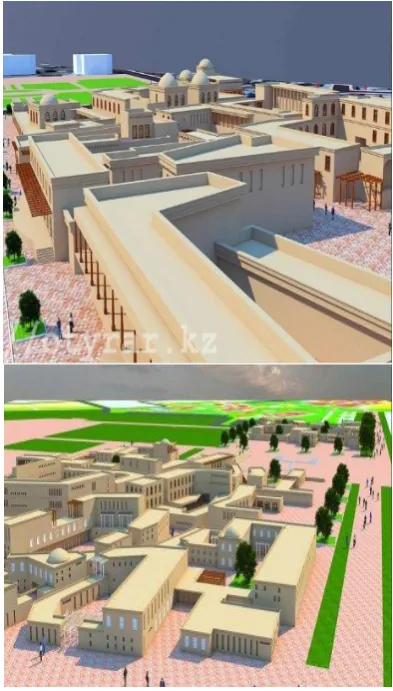
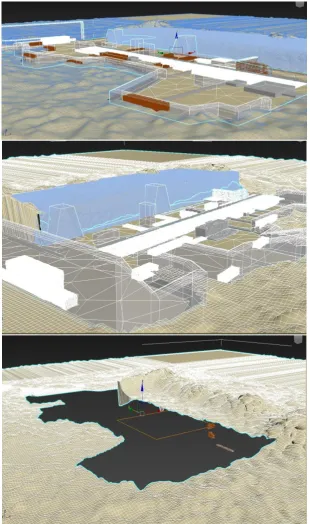
Fig. 1. Examples Of Virtual Reconstruction Of Historical And Cultural Heritage.
III. RESULTS
By using these methods, projects of conservation of the Akyrtas complex in the Zhambyl region, restoration of the Okshi Ata, Asanas and Balanda II mausoleums in the Kyzylorda region, measurements of the Karaman-ata and Shakpak-ata underground mosques and preliminary studies of the Mausoleum of Omar and Tura in the Mangistau region were carried out. These methods allowed us to see the effects of dynamic load in the walls of the Mausoleum of Omar and Tura and the difference in the diagonals of the Nogai Mosque and to perform a full measurement of the fully melted construction of the Balanda II Mausoleum (Figure 1) [5].
Additionally, in the architectural and design activities, research works and scientific investigations are also conducted on the study of historical and cultural heritage. The above-considered methods and examples of the restoration of objects of historical heritage confirm the importance of the theoretical basis for the virtual reconstruction. In 2003, within the framework of the “Cultural Heritage” program, complex archaeological research was also carried out on the site of the ancient settlement of Syganak, which was an ancient city in Kazakhstan and Central Asia. The study was conducted by the Research Center of the Khoja Akhmet Yassawi International Kazakh-Turkish University. According to the researchers, the decline and destruction of
brought by the war. For several centuries, this area was in ruins. The ancient city of Syganak in former times was called the “harbor of the Dasht-i-Kipchak, or Kipchak steppe”. Under the descendants of Jochi Khan Syganak was the center of the White Horde and, at the same time, the main political and economic center in the region (Figure 2).
Fig. 2. The ancient settlement of Syganak. Photos by M. Kasimova.
Historically, the name of the settlement is found in some ancient historical literature, specifically in the work of an outstanding scholar and lexicographer Mahmud al-Kashgari
Fig. 3. Models of the virtual reconstruction of Syganak.
In particular, the principles of modern scientific restoration, formulated in the founding documents of the world community, put forward the concept of the authenticity of monuments, which is the basis of the concept of cultural heritage. They almost completely deny the possibility of reconstruction of monuments, creating copies and replicas of historic structures. This, according to some experts, leads to the devaluation of culture. Nevertheless, the present and the future of an architectural monument is invariably associated with human perception (Figure 3). It invariably generates the desire of the museum visitor not only to learn the monument's history but also to see its historical appearance in the era of its highest bloom, to feel the atmosphere of the era that gave birth to it, as well as its other achievements. However, at the present stage, restorers, historians of architecture and
architectural monuments were studied and analyzed, including the findings of foreign scholars. For instance, On April 22-23, 2011, the Humanitarian Institute of the Siberian Federal University and the Association “History and Computer” held in Krasnoyarsk an All-Russian scientific and methodological seminar called “Virtual reconstruction of the historical and cultural heritage in the formats of scientific research and educational process”, which was attended by leading experts from scientific centers and institutions of Russia and Ukraine. Now, the issue of preserving the historical and cultural heritage turned out to be important due to the ever-growing threats to its existence and, at the same time, due to the lack of funds for restoration, reconstruction and industrial development of the territories where monuments are located, etc. In this case, the above-mentioned scientific and methodological seminar discussed the main methods used in the process of virtual modeling. In addition to these issues, the methodological foundations of the development of virtual reconstruction in the educational process were determined. In the discussion about the methods used in virtual reconstruction, scientists have identified a modern typology of computer models of historical processes. They are statistical, imitation and analytical. According to researchers, this classification practically coincides with the one proposed by Joseph Rogers Hollingsworth and Robert A. Hanneman, well-known American experts in modeling historical and social processes. It was also noted that in practice, computer (mathematical) models are much less tested and their use is not limited to processing the source data. Models of this type belong to the classes of simulation and analytical models in the modern classification. The purpose of such models can be the reconstruction of the missing data on the dynamics of the process under study at a certain time interval; an analysis of alternatives of historical development; theoretical study of the possible behavior of the phenomenon under study (or a class of phenomena) based on the constructed mathematical model. Analytical and simulation models refer to models of the deductive type as opposed to statistical (measuring-reflecting) models, the construction of which is dominated by the inductive approach. Mathematical models of the deductive type allow one to derive new knowledge by analyzing the constructed model as a mathematical object. The basis for constructing such models is the principle of approximate reproduction of the process under study. Elementary phenomena constituting it are simulated with preservation of their logical structure and sequence of flow in time. Simulation models are aimed at reconstructing missing or incomplete source data. An important direction in the use of simulation models is the reconstruction of the dynamics of a historical process, information about which has not been preserved in the sources in sufficient volume [7, 8]. This was done, for example, in the 1970s by a team of historians and mathematicians, whose leader was a prominent academician N.N. Moyseev. Based on some general assumptions and data sources, this team created a computer simulation model for the dynamics of the processes occurring during one of the periods in the history of ancient Greece, in particular, the era of the Peloponnesian Wars, about which little socio-economic information remains. The model reconstructed the dynamics of some parameters of
Fig. 4. Architectural fantasies of Y. Chernikhov.
In particular, a vivid example of the manifestation of architectural fantasies is the creation of an artistic solution of the urban environment in cinema, the so-called “film architecture”. Furthermore, the study of this aspect is an important and crucial basis for the development of the creative concept of creating a unique, artistically rich interaction of historical and modern space. Cinema is a synthetic art form, in which various components of theatrical and visual arts and architecture interact.
In solving the tasks, it is necessary to discuss with students questions concerning the city-ensemble considering its historical and cultural layers, which mark the place in the human mind.
Moreover, on every street, square, in the park, in every house, one feels its own special color, mood, image – “Genius Loci” – “Spirit of a Place”. This expression is firmly established in science, figuratively denoting the historical and
cultural context of architectural creativity (K. Norberg-Schulz, K. Lynch and A.V. Ikonnikov). An important aspect of understanding a place is in the presence of an addressee, a person that perceives the environment and accumulates meaning and emotional messages and is able to express the image of the environment in one’s creative work (P. Vail, “The Genius of Place”)[10]. In all variations of this phrase, the interrelation of spatial and temporal contexts is traced and the interconnection is sensual, based on experiencing traces of the past. At the same time, a collective and multidimensional image provides the key to reading the space of the whole city. It is apparent that time leaves traces on the urban and object levels. When viewed from above, a historic city is a kind of symbolic “text”, which makes it possible to understand the value choice of society at a certain stage. The panoramas of historical cities of different destinies look different. Gradually or spontaneously built-up cities resemble a “patchwork quilt” with inclusions of different-time fragments of buildings, streets, green parks, squares and boulevards. It should be emphasized that cities that have undergone total or partial reconstruction look more smooth and orderly. The first path implies historical authenticity, when traces of the past, sometimes ruins, preserve the memory of a place. The second way (more concerned with functional issues) allows forming a city as an artistic and aesthetic whole, partly neglecting the cultural and historical identity of the space [11].In addition, an artistic metaphysical version of the history of the place is offered by the outstanding Italian journalist and writer Italo Calvino in his work “Invisible Cities” [12]. As the author points out, “In ‘Invisible Cities’, one cannot find recognizable cities, but only fictional cities”. The book is composed of short chapters, each of which provides one sentence, reflecting each city or city in general. Facing the problem of how to organize scattered fragments of the text, the author from the very beginning introduces the title of the series: “Cities & Memory”, “Cities & Desires”, and “Cities & Signs”. It should be pointed out that by using several bases of classifications Italo Calvino looked for new definitions that would fully reflect the specifics of an object. As a result of this, other outstanding publications appeared, among which one can distinguish abstract and aerial “Thin Cities”, “Cities & Eyes”, marked by visual properties, “Trading Cities”, characterized by exchanges of memory, desires, experienced or future. There are 11 different types of city descriptions in the book, which are as follows:
1. Cities & Memory (Le città e la metora); 2. Cities & Desire (Le città e il desidero); 3. Cities & Signs (Le città e i segni); 4. Thin Cities (Lé città sóttili);
5. Trading Cities (Le città e gli scambi); 6. Cities & Eyes (Le città e gli occchi); 7. Cities & Names (Le città e il note); 8. Cities & the Dead (Le città e i morti); 9. Cities & the Sky (Le città e il cielo); 10. Continious Cities (Le città contents); 11. Hidden Cities (Le città
nascost).
one can name the book entitled “Imaginary Architectural Spaces” [13]. The authors of the book consider descriptions of non-existent architectural objects in literature. Further, the authors single out such fragments from the context of a literary work and evaluate them from the point of view of the organization of the space of the described structures. Since these descriptions are the only form of existence of such objects, the authors assume that they have independent artistic value and can be considered as a specific form of existence of architectural work. It is worth noting that a similar approach already exists in architectural practice and concerns architectural drawing. In addition, many techniques can be cited when the image of an architectural object is of value itself, not in connection with a real-life structure. Thus, in architectural practice, the term “easel architecture” was formed, fixing the independent and self-valuable nature of architectural graphics. At the same time, there is also “paper architecture”, reflecting the state of architectural practice in certain periods of history, when intensive architectural creativity did not result in construction. There is also a special genre of architectural creativity called “architectural fantasy” [14].In recent decades, major urban planning changes have occurred in most European countries, affecting entire historical centers of cities and large neighborhoods [15]. The development of a new design system was due, on the one hand, to the threat of destruction and degradation of historical urban monuments under the influence of the rapidly growing urbanization of cities. On the other hand, it was associated with the overestimation of the value of architectural and monumental heritage. Based on these conditions, projects on the reconstruction of historic neighborhoods, which include two areas (architectural planning of historic neighborhoods and presentation of cultural monuments), are becoming major in urban planning. Notably, foreign colleagues pay special attention to comprehensive preliminary research work. In projects on reorganization, it becomes necessary to consider the development of plans for the protection of historic buildings and architectural ensembles in the existing state. In this regard, new laws were introduced into practice to restore and reconstruct buildings of major cultural importance, as well as to improve the quality of the city environment in order to attract local residents and to restore the residential function of these neighborhoods. Due to this approach, the city inhabitants became the custodians of the cultural heritage of their cities. This defines a new specificity of urban planning, which becomes an integral part of the development policy of historic neighborhoods and contains an important museum function – preservation and presentation of the cultural heritage of cities. The introduction of the new terms “urban heritage” and “nomadic museography” radically changed the appearance of cities, turning them into huge open-air museums. Museum conservation of the urban environment and the transformation of the urban environment into open museum galleries have become the main feature of many cities of current time. Due to the museum approach to cities, the urban environment is increasingly acquiring a new educational function [16]. Streets and monuments themselves, being objects of cultural significance, tell about their history and main memorable historical events, as well as introduce the main features of the city. Currently, city streets,
squares and other urban spaces assume the function of guiding visitors in the new educational urban environment [17]. In architectural design, this is reflected in the installation of special visual information systems, represented by special information signs, panels and boards that attract the attention of visitors. To this end, special signs are being increasingly installed on the main streets and squares of European cities with brief information about places of interest with a description of historical events and the history of monuments. At the same time, the project includes three main proposals: the organization of pedestrian paths and the design of new architectural elements for the medieval part of the city; improvement of the existing project with the installation of new interactive informational signs; design of interactive virtual platforms for mobile museography. The term “nomadic museography” refers to the use of smartphones and other wireless mobile systems for interactive obtaining of information about cultural monuments directly on their territory.
IV. CONCLUSION
Thus, the redevelopment projects of historic neighborhoods that were implemented over the past decades in most European cities have led to significant changes in urban planning. The re-evaluation of cultural heritage located in historic areas and humane attitude to the urban environment provide new opportunities for creating open and accessible urban spaces for all groups of the population. New approaches to design have completely changed the appearance of historic neighborhoods, giving each city a unique image, thereby contributing to the development of interest in the study of cultural heritage and the development of mass tourism.
REFERENCES
1. Melechovahttp://www.ejst.tuiasi.ro/Files/71/Contents%2014_4_2018 .pdf
2. A.V. Popov.The Impact of Architectural and Space-Planning Design of Student Accommodation (Dormitories, Campuses) on the Time Budget of The Student Youth. International Journal of Engineering and Advanced Technology, vol. 8(3), 2019, pp. 128-133.
3. K.M. Baypakov. Medieval cities of Kazakhstan. Almaty, 1998. 4. A.V. Makhiyanova, O.L. Panchenko, E.S. Akhmetova, D.K.
Shigapova, D.F. Sadretdinov. City Population as a Subject of Urban Ecosystem’s Development. JARDCS, vol. 11 (05), 2019, pp. 1916-1923.
5. I.V. Grevtsova. Projects of complex reconstruction and musealization of historic quarters in European cities: Main directions and new trends. University of Barcelona, Barcelona, Spain, 2012.
6. Archaeological research of the Alkei Margulan Institute of Archeology on the site of Kayalyk in 2004. Almaty, 2005.
7. K.M. Baypakov, K.A. Akishev, L.B Erzakovich. Otrar in the XIII-XV centuries. Alma-Ata, 1987.
8. K.M. Baypakov. Ancient and medieval Otrar in Collection: City of Turkestan. Almaty, 1999.
9. K.A. Akishev, L.B. Erzakovich. Security work on Otrar near the mosque. Report. Institute of History, Archeology and Ethnography of the Academy of Sciences of Kazakh SSR, Almaty, 1990.
10. P.L. Vail. Genii mesta [The genius of place]. Moscow: KoLibri Publ, 2006.
11. Virtual reconstruction of the historical and cultural heritage in the formats of scientific research and educational process: Collection of scientific articles. Ed. L.I.
Siberian Federal University, 2012.
12. I. Calvino. Invisible Cities. San Diego: Harcourt, 1974.
13. Imaginary Architectural Spaces. – Аlmaty: Kоmpleks, 2000. – P. 15. – 300 pp.
14. D.A. Amandykova, B.K. Shilderkhanov, N.Z. Issakhov, Y.G. Popov, V.P. Trofimov. Compositional features of ethnic interior design. Astra Salvensis, vol. 6, 2018, pp. 569-580.
15. D.A. Amandykova, D.B. Kabylov, M. Moldabekov, K. Koshenov, T.A. Gvozdikova, A.A. Bryantsev. Compositional aspects of the urban environment organization. Man in India, vol. 97, 2017, pp. 281-297. 16. D.A. Amandykova, Z.A. Imanbayeva, A.M. Assylbekova, L.T.
Nurkusheva, I.I. Ostapenko. On the history of the studying museum complexes. Astra Salvensis, vol. 6, 2018, pp. 311-320.