Abstract: Terminal buildings are among the key components of modern transportation systems. In the design of intermodal transportation terminals, one of the key issues that confront architects and engineers is how to achieve effective circulation for passengers and goods at the point of interchange between the different modes of transportation systems. Therefore, the aim of this research was to assess the features of effective circulation spaces with a view to identifying the attributes of internal and external circulation spaces and elements that can promote easy flow of pedestrian and vehicular traffic in intermodal passenger terminals. To achieve this goal, selected road, water and rail transport terminals were studied with data collected from 237 users of such facilities in Lagos, Nigeria using structured questionnaire. The data were analysed using descriptive statistics and the result revealed that the key features of circulation spaces in intermodal passenger terminals are related to their location, ease of accessibility, size and availability of signage to direct users to the various facilities in the buildings. This implies that in order to achieve effective circulation spaces, architects and engineers should pay adequate attention to these aspects in the design and development of circulation spaces in intermodal passenger terminals.
Keywords: Architectural design; Circulation spaces; Intermodal passenger terminals, Transportation system
I. INTRODUCTION
In the past few years, the human population in many cities in Africa has been increasing at an alarming rate. This has consequently led to massive strain on the existing infrastructure in most cities in this continent. Among the several cities in the global South where rapid population growth is escalating with a significant growth in the demand for urban infrastructural facilities, including transportation is Lagos, Nigeria. Lagos is the most populous city in sub-Saharan Africa with an estimated population of 21 million in 2016 [1].
Revised Manuscript Received on June 05, 2019
Eziyi O. Ibem, Professor an architect and teaches Architecture at Covenant University, Ota, Nigeria
Daphne A. Chilaka, Graduate student of Architecture, currently undergoing her Masters’ degree in Architecture at Covenant University, Ota, Nigeria
Sonia E. Nelson, Graduate student of Architecture, currently undergoing her Masters’ degree in Architecture at Covenant University, Ota, Nigeria.
Titilope V. Ogunnubi, Graduate student of Architecture, currently undergoing her Masters’ degree in Architecture at Covenant University, Ota, Nigeria.
The State is viewed as Nigeria’s monetary and business capital. It has an estimated population of 23,305,971, an aggregate zone of 3,577.28 km2 of which 779.56 km2 representing about 22% is a wetland and a population density of 6,515 people for each square kilometre [1]. It is an understatement to say that the road infrastructure in this city is struggling to keep pace with the increasing demand of the huge human population. This has brought about a widespread traffic congestion and loss of man hour on a daily basis. The presence of major commercial facilities in Lagos State has brought about a massive build up of vehicular traffic leading to a huge pressure on the existing modes of transportation. Therefore, there is a need for a well-rounded, effective and developed transport infrastructure in this City – State [2] that will desegregate the major transport systems and ensures that there a free flow of traffic and a significant reduction in the recurrent gridlocks on roads caused by rapid population growth. The type of transportation system that is required to address the current traffic situation in Lagos is the intermodal transportation system. This transport system involves the use of more than one mode of transport in a journey and anecdotal evidence shows that many people in the city oftentimes require the use of more than one mode of transport. For instance, when travelling by air, passengers need to arrive at the airport by another means such as road or rail. The merit of intermodal transportation system lies in its potential to merge the strengths of the distinct transport modes. Its advantages are that helps to reduce pressure on the roads and thus engendering production cost, economic growth stimulation, and a generally improve the living standard of the people [2].
One of the key features of intermodal transport system is the ability to handle passengers and goods from more than one mode of transportation. As a result, there is the recurrent issue of planning and designing of spaces within intermodal transport terminals that meet the circulation needs of users According to Slack [3], this challenge has become evident because in intermodal facilities, there are difficulties during the transference of passengers and goods between the modes of transport at the terminal. Although there is a glowing body of knowledge on the role intermodal transportation system plays in addressing urban transposition challenges[4,5,6], adequate research attention has not been given to investigating how to improve circulation in intermodal passenger terminals.
In view of the above, this
research sought to
investigate the basic features
Assessment of Architectural Design Features of
Effective Circulation Spaces in Intermodal
Passenger Terminals
of effective circulation spaces in intermodal passenger terminal buildings with a view to identifying the attributes of internal and external circulation network that can enhance the circulation experience of users of such facilities. The specific research question addressed in this study is: What are the specific spatial and architectural design features of horizontal, vertical and external circulation elements in intermodal passenger terminal facilities? This research makes contribution to knowledge in identifying specific areas that need more attention in the planning and design of intermodal passenger terminal facilities in order to achieve effective human traffic circulation and management in intermodal passenger terminals.
II. LITERATUREREVIEW
Intermodal Passenger Terminals
Terminals are transportation centres where people and goods are transferred from one mode of transportation to another. These transport infrastructural facilities are designed for the effective transfer of passengers between diverse means of a transportation system. Passenger terminals are divided into four categories; bus terminals, railway terminals, ferry terminals and airports terminals [6]. The goal of all these categories of passenger terminals is to ensure an optimal, functional and effective use of spaces in these facilities. Intermodal passenger terminals are types of passenger terminals that provide a switch between more than one mode of transport (e.g. water, road, rail and air). They are located at the connection point of two or more modes of transport system, allowing for an efficient transference of passengers and goods between different modes of transport systems. They provide a central point for collecting and distributing diverse kinds of transportation services, ensuring that there are well-coordinated and effective interchanges between diverse modes of transport to complete a journey [5]. The primary function of an intermodal passenger terminal is to ensure a desegregated and effective transfer of passengers between the diverse modes of transportation. This facility creates a common ground between all modes of transport, mitigating the stress of travel, travel delays and the cost of travel. Intermodal passenger terminals are usually described as points of arrival, departure and interchange. The challenge with these intermodal facilities is that there are difficulties during the transference of passengers between the modes of transport at these Intermodal facilities [3]. This is why it has become imperative that this type of transportation infrastructure be designed and constructed in such a way that the floor layout engenders ease of pedestrian movement. This is important because it is the floor layout that determines the circulation network, which in turn has influence on the flow of traffic within and around the facilities as well as from the various routes and the different modes of transport.
Circulation in Buildings
According to Bitgood [7], circulation in buildings is a term that describes the movement of people through a space. It is also the pathways taken by the users of a space, whether the users move through a space in the manner which was intended by the designers and the circulation pattern and approach taken by the users. The concept of circulation denotes the manner in which buildings and the spaces in them
are designed to aid ease of human flow in the building [8]. It also refers to the pathways through a building’s floor layout, from which the users of the space experience the architecture of the building. In view of this, circulation networks in any building are considered to be key components of the building, except the structure is to be used solely as a monument. This is because it is the circulation network, which comprises circulation elements that enables users to gain access into and experience and exist from buildings.
From the review of literature, circulation in buildings can be divided into two main types; namely, internal circulation and external circulation [9]. On the one hand, internal circulation deals with the movement of the users within the building envelope. On the other hand, external circulation is concerned with the movement around the exterior parts of the building; the landscape, the pedestrian and vehicular pathways and other external spaces. These two components are very important aspects of design of passenger terminals. This is due to the volume of pedestrian traffic that flows into, within and out of the building while travelling by any mode of transport (road, rail, water, air etc.) and other users of the spaces within and around the building [4].
Circulation Spaces in Intermodal Passenger Terminals Architecturally speaking, in the design of buildings, a circulation space is usually situated between larger spaces in a building, through which the movement of people to and from another space in the building can be achieved [10].They are spaces which are internal to the structure of buildings, yet external to the principal rooms. Circulation spaces in buildings are comprised of two categories. The first are spaces that facilitate horizontal circulation (linear movement) within the building and such spaces are referred to as horizontal circulation spaces [9]. This circulation spaces are located within and around a building and provide connections between major spaces within the same floor level or on the external ground level of the building. Examples of building elements that facilitate horizontal circulation within buildings include entrances, foyers or receptions, lobbies, lounges, ramps and travelators [9].
Of key importance to users of buildings are entrances. Notably, entrances are parts of a building that facilitate access to the building or from a space to another space within the building. They are also referred to as the entry points of a building. In view of their role in buildings, entrances should be designed with adequate consideration given to all possible users of the building. Closely related to entrances are foyers, which are also circulation spaces within a building, located at the entrance, which connects the entrance point of the building to other spaces within the building. It can also be described as a transition space in the building and is usually referred to as an entrance hall, hallway, receiving area, entryway or vestibule [11]. According to Kocabaş [10], the foyer starts at the entrance door and helps the users of the building to understand how to get to other spaces within the building. Further, corridors and lobbies are also linear circulation pathways in buildings that provide a link between various spaces within the building. In public buildings such as passenger terminals, the
corridors and lobbies [10]. In fact, Lacey[12] explained that the main purpose of corridors is to convey information about a building to users and to assist them move around the interior spaces of the building.
There are also lounges, which are horizontal circulation spaces within a building that serves as a repose or relaxation space for the users of the building and provide a link between other spaces in the building. In passenger terminals, it is a space in which travellers prior to the commencement of their journey to their respective destinations, sit and relax while waiting for their journeys to begin.
The second category of circulation spaces is those that which facilitate vertical circulation (up and down movement) within the building and are referred to as vertical circulation spaces. This comprises all circulation spaces and design elements within a building that provide a means of upward and downward movement for users of buildings, from one floor level to another. The placement of vertical circulation design elements within a building is of vital importance because these circulation elements not only influence the floor layout of each floor they link, but also determine the layout of each floor level. Put succinctly, they control access from one floor to the other in buildings [13].
A number of spaces and elements facilitate vertical circulation within buildings. They include; staircases, ramps elevators, escalators and lifts. The staircase is a very common vertical circulation element in buildings. They are designed and constructed to help users move from one floor level to another within the building. Structurally, they are composed of a series of steps, with level landings situated at specific positions, spanning between floors in a building of more than one floors [9]. The ramp also serves the same function as the staircase, but it is structurally different from a staircase by having no risers and threads. Whereas both the staircase and ramps are architectural design elements, elevators, escalators and lifts are electrically-powered vertical circulation installations in buildings and are not included in the current study. The same is applicable to travelators, which are conveyor transport belts that can serve as either a horizontal circulation element or as a vertical circulation element in buildings [14].
Features of Good Circulation Space/element in Buildings From the review of literature, a number of features were identified as having significant influence on the effectiveness of circulation spaces in buildings. These are the physical, spatial and locational attributes of circulation spaces that allow them to serve as useful circulation spaces for human traffic. Chief amongst these features include but are not limited to: the shape/geometry of the building; location of the elements of circulation/circulation spaces; the size of these circulation elements; the shape of the circulation elements and the number of circulation elements available
The geometry or shape of the building influences the circulation design within and around it. The building form is directly related to the size of the building, the size of the site and the organisation of spaces i.e. the spatial arrangement in the building. This in turn has influence on the circulation pattern and how users experience the building. An increase in the size of a building leads to a direct increase in the
horizontal and vertical distance users will have to cover and the time it will take them to get to the various spaces in the building. This has a direct influence on their use of the various spaces in the building while moving through them [9]. The shape of the building can also influence users’ visibility of the entry point into the building and by extension their ability to easily identify the location of the reception/waiting area in the building.
Another important feature that deserves consideration is the location of circulation spaces or elements in the building. This is usually a big challenge when the circulation elements within the building are located in obscure positions that make
it difficult for users to easily see and use them. One of the consequences of this is that the spaces/elements
become inaccessible leading to ineffective circulation networks within the building [9]. To avoid such a scenario, it is important that the location of the various circulation elements in buildings should be properly defined through the use of appropriate signage and other way finding elements. This is very important in ensuring that they can be easily be seen by users at any point within the building.
The size of circulation spaces/ elements in buildings is a direct function of their locations. In fact, it is known that the size of circulation spaces determines how effective they could be in handling human traffic and facilitating easy movement of people even at peak periods. Inadequate size of circulation spaces can hamper efficient circulation network leading to congestion within and around buildings. In order to design adequate sizes of circulation spaces/ elements, authors [9] have reccommended that architects should carry out analysis of traffic flow at peak periods to determine the carry capacity of facilities and services within and around public buildings. Added to the size is the shape of the circulation spaces/ elements. The shape of circulation spaces /element also affects the use of such spaces. For instance, in order to prevent accidents while moving within and around buildings, the use of spiral staircases, staircases without risers and staircases with tapering treads are discouraged [15].
The number of horizontal and vertical circulation elements/spaces available to users also has influence on the movement of the users through a building. The provision of more circulation elements helps to reduce human traffic congestion within the building. For instance, the provision of additional elevators/lifts in buildings helps to facilitate effective movements, taking into consideration the time taken and the distance to be covered. These additional circulation elements can also be used as escape routes/points from the building, in the case of emergencies such as fire outbreak.
III. RESEARCHMETHODS
The data presented in this paper were drawn from a bigger research project designed to investigate the circulation requirements in intermodal passenger terminals for Lagos State, Nigeria. The research design was a cross-sectional survey involving the administration of questionnaires to the users of bus, railway and ferry passenger terminals in the study area. The survey was carried out on these three types of passenger terminals because
there is currently no existing
terminal in Nigeria.
[image:4.595.302.555.405.537.2] [image:4.595.298.554.617.834.2]Anecdotal evidence shows that in a megacity such as Lagos, millions of people use passenger terminals all year round. However, available estimate indicates that the average number of passengers served per day in the different passenger terminals in road, water, rail and airport transport sub-sectors is about 300,000 people [16; 17]. This figure is an estimate, suggesting that the exact number of users of such facilities in the city of Lagos is not known. Therefore, in order to determine scientifically the sample size for this research, the Cochran formula for infinite population was used. The formula is given as
... [Cochran, 1966]
Where n0 = the sample size for infinite population; Z2 = abscissa of the normal curve that cuts off an area α at the tails (The value for Z is found in statistical tables which contain the area under the normal curve. e.g. Z = 1.96 for 95 % level of confidence); p = the estimated proportion of an attribute that is present in the population (assume p is 0.5; maximum variability); q = 1 – p, e = the desired level of precision (0.05), based on a 5% margin of error and a 95% confidence level. The sample size obtained was 384 users of passenger terminals.
The data gathering instrument used was structured questionnaire designed by the researchers. It had both closed and open-ended questions and was designed to gather data from users of the passenger terminals on several things including: 1) the key components of passenger terminals, 2) the features that influence effective circulation in passenger terminals, and 3) the circulation requirements that are considered important in achieving efficient and effective circulation networks in intermodal passenger terminals. The questionnaire was divided into five sections; the first section was used to obtain socio-demographic data of the users of the passenger terminals. The second section helped the researchers to identify the category of users in the passenger terminals, while the third section comprised questions on the horizontal circulation requirements in the passenger terminals. The fourth section of the data gathering instrument comprised questions on the vertical circulation requirements in the passenger terminals and the fifth section comprised the vertical circulation requirements in passenger terminals. The scale of measurement used in the design of the third, fourth and fifth sections of the questionnaire was a 5 point Likert scale. This Likert scale is a survey scale that ranges from one extreme attitude of agreement to another, with the inclusion of a neutral midpoint. The scale of agreement utilised in this research for the Likert scale ranges from strongly disagree, disagree, undecided, agree and strongly agree with the values ranging from 1 to 5, respectively.
Totally, 384 copies of the questionnaire were administered to the respondents by hand. Only users of the terminals were included in the research and they were randomly selected in the different road, rail, water transport terminals visited in the month of February 2019. However, 237 copies of the questionnaire representing around 62 % of the administered questionnaires were retrieved as indicated in Table I.
Table I: Questionnaires retrieved from the respondents Type of
passenger terminal
No. of questionnaires retrieved
Percentage of retrieved questionnaires
Bus 113 47.7
Train 64 27.0
Ferry 60 25.3
Total 237 100.0
The data were analysed using the IBM SPSS Version 21. Based on the goal of the study, the data were analysed using descriptive statistics, which involved computation of frequencies, percentages and means scores, standard deviations and ranking of the mean scores of the responses provided by the participants. Results of the analyses are presented in Tables.
In view of the fact that ordinal data were used in assessing the features of effective circulation spaces/elements in the research, it was important to examine the reliability of this scale of measurement. Cronbach’s Alpha test was conducted for all the ordinal variables used to investigate the features of nine main circulation spaces in buildings investigated in the current research. It is recommended that once Cronbach’s Alpha value is greater than 0.6, the scale of measurement used in designing the data collation instrument is reliable [18]. Table II shows that Cronbach’s Alpha values of the variables used to investigate each of the nine circulation spaces are above the recommended value of 0.6. This implies that the scale of measurement utilised in investigating the specific circulation features in buildings is reliable.
Table II: Reliability analysis of the scale of measurement used for specific circulation features
FEATURE NO. OF VARIABLES
CRONBACH’S ALPHA VALUE
Entrance 7 0.737
Reception 9 0.907
Corridor / lobby 7 0.892
Lounge 6 0.875
Ramp 11 0.958
Staircase 10 0.892
Pedestrian pathways 5 0.822
Roads 3 0.803
Parking spaces 6 0.787
IVRESULTS AND DISCUSSION
Personal Profiles of the Participants
Table III shows result of the analysis of the personal profiles of participants in the research.
Table III: Social – demographic characteristics of the respondents Variable Categories of users n (%)
Gender Male 133 (56.0)
Female 204 (44.0)
Age of respondents
18-30 years 232 (97.9)
31-40 years 5 (2.1)
Occupation Civil servant 26 (11.0)
Employee 62 (26.2)
Self Employed 38 (16.0)
Students 111 (46.8)
Highest level of Education
National Diploma /National Certificate of Education
9 (3.8)
B.Sc. / HND 131 (55.3)
M.Sc. /MBA 97 (40.9)
the respondents are females and 56% of the respondents are males with the majority of them within the age range of 18 – 30 years, having a higher level of education (B. Sc. / HND) and (M. Sc. / MBA). The results also show that a diverse group of users with varying occupations utilise various types of passenger terminals, but the greater percentage of users of these category of buildings are students and workers. Categories of users of passenger terminals
[image:5.595.301.551.51.825.2]Table IV shows result of the analysis of the categories of users in the passenger terminals in the study area.
Table IV: Categories of users in the passenger terminal Variable Categories of users n (%)
Type of passenger terminal
Ferry 60 (25.3)
Train 64 (27)
Bus 113 (47.7)
Category of User Traveller 144 (60.8)
Waiting for relatives/friend 50 (21.2)
Staff 43 (18.1)
The results in Table IV shows that around 47.7% of questionnaires administered to the respondents were retrieved from bus passenger terminal users, 27% from railway passenger terminal users and 25.3% from ferry passenger terminal users. The results also revealed that the highest percentage of users of the passenger terminals encountered in the survey were travellers, followed by individuals who were waiting for their relatives/friends and staff who work in the terminals.
Features of Effective horizontal circulation spaces in the passenger terminal
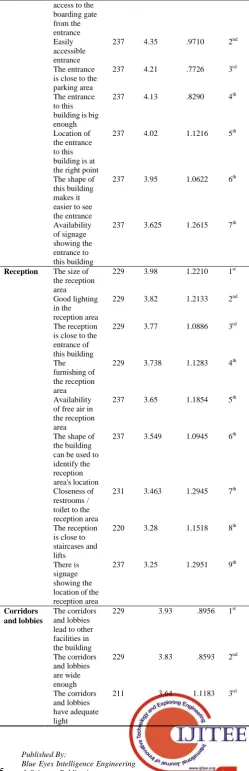
Table V indicates the descriptive statistics of the respondents’ rating of the identified features of horizontal circulation requirements. Examination of the result in Table V reveals that for the entrance, in order of importance; access to the boarding gate from the entrance is the most important feature, followed by the ease of access to the entrance; closeness to the parking area; size; location; the shape of the building and the availability of signage indicating the entrance location, respectively. For the reception, it is evident from the results that in order of importance; the reception size is the most important feature, followed by good lighting in the reception; closeness to the building entrance, furnishing in the reception; free air in the reception; shape of the building; closeness to restrooms, staircases and lifts and signage indicating the reception location, respectively.
For corridors and lobbies, it is evident from the result (Table V) that in order of ranking; their ability to lead to other spaces in the building is the most important feature, followed by their size; lighting; ease of access; the availability of signage in them showing other spaces location and escape routes and signage showing their location, respectively. In the lounge, the result reveals that in order of rank; ease of access from the lobby is the most important feature, followed by good lighting; their size; closeness to restrooms; signage showing their location and the location of other spaces in the building.
Table V: Horizontal circulation requirements in the passenger terminal Requireme
nt
Features No. of respo ndent s
Mean Stadn. deviation
rank
Entrance There is good 237 4.46 .4991 1st
access to the boarding gate from the entrance Easily accessible entrance
237 4.35 .9710 2nd
The entrance is close to the parking area
237 4.21 .7726 3rd
The entrance to this building is big enough
237 4.13 .8290 4th
Location of the entrance to this building is at the right point
237 4.02 1.1216 5th
The shape of this building makes it easier to see the entrance
237 3.95 1.0622 6th
Availability of signage showing the entrance to this building
237 3.625 1.2615 7th
Reception The size of the reception area
229 3.98 1.2210 1st
Good lighting in the reception area
229 3.82 1.2133 2nd
The reception is close to the entrance of this building
229 3.77 1.0886 3rd
The furnishing of the reception area
229 3.738 1.1283 4th
Availability of free air in the reception area
237 3.65 1.1854 5th
The shape of the building can be used to identify the reception area's location
237 3.549 1.0945 6th
Closeness of restrooms / toilet to the reception area
231 3.463 1.2945 7th
The reception is close to staircases and lifts
220 3.28 1.1518 8th
There is signage showing the location of the reception area
237 3.25 1.2951 9th
Corridors and lobbies
The corridors and lobbies lead to other facilities in the building
229 3.93 .8956 1st
The corridors and lobbies are wide enough
229 3.83 .8593 2nd
The corridors and lobbies have adequate light
[image:5.595.41.299.198.275.2]They are easily accessible from every part of the building
237 3.63 1.0242 4th
Availability of signage in the corridors and lobbies to show the location of other facilities in the building
237 3.62 .9651 5th
The corridors and lobbies have signage to show where the escape routes in the building are
237 3.59 1.1448 6th
Presence of signage showing the location of the corridors and lobbies
237 3.29 1.0302 7th
Lounge They are easily accessed from the lobby
237 4.08 .9799 1st
Good lighting in the lounge
237 4.01 1.2108 2nd
The size of the lounge makes the space comfortable to wait and rest in
237 3.87 1.2255 3rd
Closeness of restrooms / toilet to the lounge
223 3.68 1.38264 4th
Presence of signage showing the location of the lounge
237 3.49 1.2165 5th
Availability of signage at the lounge showing the location of other spaces in the building
237 3.42 1.1528 6th
Features of effective vertical circulation spaces in passenger terminal
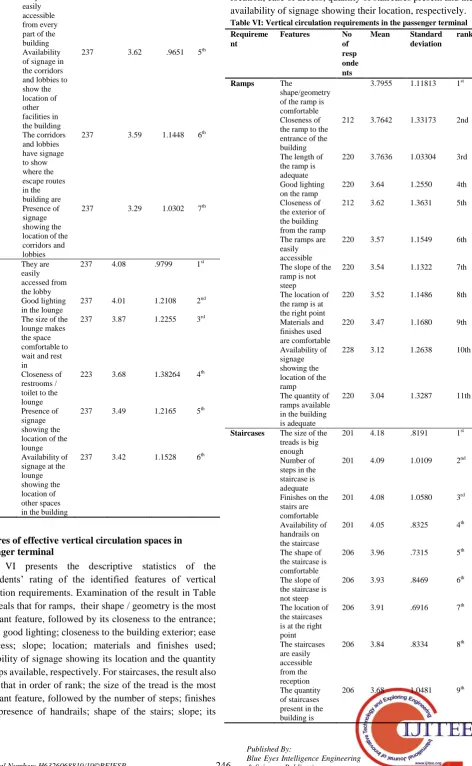
Table VI presents the descriptive statistics of the respondents’ rating of the identified features of vertical circulation requirements. Examination of the result in Table VI reveals that for ramps, their shape / geometry is the most important feature, followed by its closeness to the entrance; length; good lighting; closeness to the building exterior; ease of access; slope; location; materials and finishes used; availability of signage showing its location and the quantity of ramps available, respectively. For staircases, the result also shows that in order of rank; the size of the tread is the most important feature, followed by the number of steps; finishes used; presence of handrails; shape of the stairs; slope; its
location; ease of access; quantity of staircases present and the availability of signage showing their location, respectively.
Table VI: Vertical circulation requirements in the passenger terminal Requireme
nt
Features No of resp onde nts
Mean Standard deviation
rank
Ramps The
shape/geometry of the ramp is comfortable
3.7955 1.11813 1st
Closeness of the ramp to the entrance of the building
212 3.7642 1.33173 2nd
The length of the ramp is adequate
220 3.7636 1.03304 3rd
Good lighting on the ramp
220 3.64 1.2550 4th
Closeness of the exterior of the building from the ramp
212 3.62 1.3631 5th
The ramps are easily accessible
220 3.57 1.1549 6th
The slope of the ramp is not steep
220 3.54 1.1322 7th
The location of the ramp is at the right point
220 3.52 1.1486 8th
Materials and finishes used are comfortable
220 3.47 1.1680 9th
Availability of signage showing the location of the ramp
228 3.12 1.2638 10th
The quantity of ramps available in the building is adequate
220 3.04 1.3287 11th
Staircases The size of the treads is big enough
201 4.18 .8191 1st
Number of steps in the staircase is adequate
201 4.09 1.0109 2nd
Finishes on the stairs are comfortable
201 4.08 1.0580 3rd
Availability of handrails on the staircase
201 4.05 .8325 4th
The shape of the staircase is comfortable
206 3.96 .7315 5th
The slope of the staircase is not steep
206 3.93 .8469 6th
The location of the staircases is at the right point
206 3.91 .6916 7th
The staircases are easily accessible from the reception
206 3.84 .8334 8th
The quantity of staircases present in the building is
[image:6.595.74.547.59.826.2]adequate Availability of signage showing the location of the staircases
214 2.95 1.2875 10th
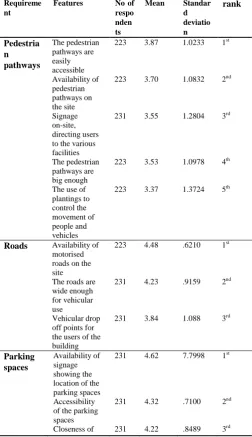
External circulation requirements in passenger terminals Table VII is a display of the descriptive statistics of the features of external circulation. From the result in Table VII it is evident that for pedestrian pathways, in order of rank; ease of accessibility of the pathways is the most important factor, followed by the availability signage showing the location of various facilities; size of the pathways and the use of landscape elements to segregate them from vehicular pathways, respectively. For the circulation features of roads, it is evident from the results that in order of rank; their availability is the most important factor, followed by their width and vehicular drop off points, respectively. In the circulation requirements for parking spaces, it is evident from the result that the availability of signage showing their location is the most important feature, followed by their accessibility; closeness to the entrance; width; quantity and presence of alternative means for parking.
Table VII: External circulation requirements in the passenger terminal Requireme
nt
Features No of respo nden ts
Mean Standar d deviatio n
rank
Pedestria n pathways
The pedestrian pathways are easily accessible
223 3.87 1.0233 1st
Availability of pedestrian pathways on the site
223 3.70 1.0832 2nd
Signage on-site, directing users to the various facilities
231 3.55 1.2804 3rd
The pedestrian pathways are big enough
223 3.53 1.0978 4th
The use of plantings to control the movement of people and vehicles
223 3.37 1.3724 5th
Roads Availability of motorised roads on the site
223 4.48 .6210 1st
The roads are wide enough for vehicular use
231 4.23 .9159 2nd
Vehicular drop off points for the users of the building
231 3.84 1.088 3rd
Parking spaces
Availability of signage showing the location of the parking spaces
231 4.62 7.7998 1st
Accessibility of the parking spaces
231 4.32 .7100 2nd
Closeness of 231 4.22 .8489 3rd
the parking spaces to the entrance of the building The parking spaces are wide enough
231 4.12 1.0057 4th
The number of parking spaces available is adequate
222 3.70 1.2840 5th
On-site or/and multi-storey parking for vehicular use
231 3.39 1.5752 6th
IV. CONCLUSIONS
This study assessed the features of effective circulation in intermodal passenger terminals which will allow for the easy flow of traffic in this transport infrastructure. From findings of this research it is evident that the features of circulation spaces identified and analysed here are very crucial in determining how effective these spaces could be in enhancing the circulation networks within and around passenger terminal buildings.
Among the several features investigated, the most significant ones that can enhance the effectiveness of circulation spaces in intermodal passenger terminals include accessibility, the ease in which the users of the passenger terminal can access facilities within and around the building; location of the circulation element; spatial characteristics of the circulation space, its size and shape / geometry; good lighting and free air in the circulation space, the quantity of the circulation elements and the availability of signage to direct users to the various facilities in and around the passenger terminal building.
Based on these findings, it is recommended that to ensure effective spaces network in intermodal passenger terminals, architects and engineers saddled with the responsibilities of designing such facilities should give adequate attention to these aspects of circular spaces such as entrances, receptions, corridors/lobbies, ramps, staircases, roads, parking spaces and pedestrian walkways. As important components of intermodal transport system, terminal buildings must be easily accessible from outside and also provide internal spaces that can easily distribute people to the different segments of the building. This can help passengers and other users to have a good circulation experience in the course of using such facilities.
REFERENCES
1. Lagos Population. (2018). Lagos Population 2018 (Demographics, Maps, Graphs). Retrieved September 8, 2018, from World Population Review:
http://worldpopulationreview.com/world-cities/lagos-population/ 2. BusinessDay Media. (2018, June 9). Intermodal transport in Lagos.
BusinessDay Media, pp. 1-2. Retrieved from BusinessDay Media: https://www.businessdayonline.com/opinion/analysis/editorial/article/i ntermodal-transport-in-lagos
3. Slack, B. (2017). Intermodal Transporttion. In B. Slack, A. M. Brewer, K. J. Button, & D. A. Hensher (Eds.), Handbook of Logistics and supply - Chain management
[image:7.595.43.296.353.791.2]4. Bernal, L. M. (2016). Basic parameters for the design of intermodal public transport infrastructures. 6th Transport Research Arena April 18 - 21, 2016. 14, pp. 499 - 508. Australia: Elsevier. doi:https://doi.org/10.1016/j.trpro.2016.05.104
5. Ezzedine, H., Bonte, T., Kolski, C., & Tahon, C. (2008). Integration of Traffic Management and Traveller Information Systems: Basic Principles and Case Study in Intermodal Transport System Management. International Journal of Computers, Communications &
Control (IJCC), III(3), 281 - 294.
doi:https://doi.org/10.15837/ijccc.2008.3.2396
6. Pitsiava-Latinopoulou, M., Zacharaki, E., Basbas, S., & Politis, I. (2008). Passenger intermodal terminal stations: role and infrastructure. WIT Transactions on The Built Environment, 101, 233 - 243. doi:10.2495/UT080231
7. Bitgood, S. (2010). An Analysis of Visitor Circulation: Movement Patterns and the General Value Principle. The Museum Journal, 49(4), 463-475.
8. Yang, Y. (2017, April 4). Circulation. Retrieved from SlideShare: https://www.slideshare.net/YungchangYang/circulation-75356195 9. Onugha, O., Ibem, E. O., & Aderonmu, P. A. (2016). Assessment of the
Impact of Circulation Design on Guests’ Satisfaction with Hotel facilities in Port Harcourt, Nigeria. International Journal of Applied Engineering Research, 11(Number 8), 5797 - 5805. Retrieved January 16, 2019, from http://www.ripublication.com
10. Kocabaş, Ş. (2013). Components of Circulation Paths in Public Buildings. In Ş. Kocabaş, Evaluation of Circulation Paths in Public Buildings in terms of Accessibility: Re-functioned Public Historic Buildings in the Nicosia Walled City (pp. 33 - 60). Gazimağusa, North Cyprus: Institute of Graduate Studies and Research.
11. Stefan. (2012, February 9). What is a foyer and how can you decorate it. Retrieved from Homedit: Interior design and Architecture: https://www.homedit.com/what-is-a-foyer-in-a-house-and-apartment/ 12. Lacey, A. (2004, March). Building layout. In A. Lacey, Designing for
Accessibility: An essential guide for public buildings (pp. 26 - 43). Centre for Accessible Environments and RIBA Enterprises. Retrieved
January 31, 2019, from
http://www.bathnes.gov.uk/sites/default/files/design_for_accessibility_ guide_updated.pdf
13. Hernandez, G. (2010). Vertical Circulation. Retrieved from PBWorks: http://gabrielahernandez.pbworks.com/w/page/12138838/Vertical%20 Circulation
14. Connor Pincus Group. (2015, April 30). Escalators and Travelators: What Are Their Advantages in the Modern World? Retrieved February 2, 2019, from Connor Pincus Group: consulting engineers: http://www.cpgroup.com.au/escalators-and-travelators-what-are-their-a dvantages-in-the-modern-world.php
15. National Disability Authority. (2012). Vertical Circulation. In NDA, Building for Everyone: A Universal Design Approach (Vol. III, pp. 5 - 65). Dublin: The National Disability Authority’s Centre for Excellence in Universal Design. Retrieved February 6, 2019, from http://universaldesign.ie/Built-Environment/Building-for-Everyone/Ent ire-Series-Books-1_10.pdf
16. Maritime First. (2017, May 17). Lagos sets CMS, Mile 2 for Intermodal terminals. Retrieved from Maritime First Newspaper: https://www.maritimefirstnewspaper.com/2017/05/17/lagos-sets-cms-mile-2-for-intermodal-terminals
17. The Eagle Online. (2018, August 31). Ambode unveils ultra modern ferry terminal, multi-level car park. The Eagle Online, pp. 1 - 3.
Retrieved February 23, 2019, from
https://theeagleonline.com.ng/ambode-unveils-ultra-modern-ferry-termi nal-multi-level-car-park/
18. Pallant, J. (2011). SPSS survival manual-a step-by-step guide to data analysis using SPSS (4th ed.). Australia: Allen and Unwin
AUTHORS’PROFILE
Professor Eziyi O. Ibem is an architect and teaches Architecture at Covenant University, Ota, Nigeria. His research interests are in the areas of sustainable housing and infrastructure development strategies, post-occupancy evaluation and environment –behaviour.
Daphne A. Chilaka is a Graduate student of Architecture, currently undergoing her Masters’ degree in Architecture at Covenant University, Ota, Nigeria. She is a student member of the Nigerian Institute of Architects (NIA). Her research interests are in the areas of circulation planning and design in transport infrastructure.
Sonia E. Nelson is a Graduate student of Architecture, currently undergoing her Masters’ degree in Architecture at Covenant University, Ota, Nigeria. She is a student member of the Nigerian Institute of Architects (NIA). Her research interests are in the areas of spatial adaptability and building obsolescence in recreational centres.