*
Stress-testing as a method of macroprudential policy and
information security in banking sector
Olena Berezina1,*, Iryna Honcharenko1, Lesya Berezhna1, and Valentina Kunchenko-Kharchenko2 1Cherkasy State Technological University, Finance Department, 460, Schevchenko Blvd., Cherkasy, 18006, Ukraine
2Cherkasy State Technological University, Computer Science, Information Security and Records Management Department, 460,
Schevchenko Blvd., Cherkasy, 18006, Ukraine
Abstract. The article contains an overview of the essence, history, components, scenarios, methodology and results of stress testing of the Ukrainian banking system. The purpose of this paper is to explore and analyze existing approaches to stress testing as a method of macro-prudential policy of the Central Bank, to determine the results of quantitative risk assessment and financial stability of banks and their readiness to have sufficient capital to cover losses in various macroeconomic scenarios, as well as to develop a model of integrated assessment and rating of banks based on the results of stress testing. In order to summarize the results of the study, a model of integrated assessment was developed and a rating of banks was built based on the analysis of their financial stability, capital adequacy and readiness to withstand the crisis. To solve the problem of qualitative analysis of the stress-testing results in terms of a significant number of indicators and calculations a simulation of the integral indicator is proposed which helps information users group the data, obtain a generalized assessment and form a rating of banks according to the financial stability reserve.
1 Introduction
Ensuring the financial stability of the State banking sector every year is becoming increasingly active stipulated by the rapid pace of globalization. As a result, there is a reduction in obstacles to additional cash flows from abroad and an increase in information flows, financial innovation and other technological advances. Such processes contribute to the formation of close links between the financial markets of different countries and regions. Therefore it results in serious risks because financial crises tend to spread beyond national borders and have a strong impact on the world economy.
Central banks of the countries should be prepared for shocks that may occur both outside and within the country and will be transmitted through channels of interconnection to the core of the national economy and are likely to damage financial stability. This raises the question how it is possible to prevent potential banking sector shocks and the country as a whole at an early stage. Macroeconomic stress testing is a key method to ensure an effective financial stability.
2 Related literature
Assessment of financial stability of the banking system be means of stress testing is a relatively new method of macroprudential policy of central banks, the content of which is considered in various regulations of the Basel Committee, the International monetary Fund (2018), the Federal reserve system of the United States (2018, 2019)
modeling of the generalization of indicators for the banks rating construction based on the results of stress testing.
3 The purpose of the research
The aim of this work is to analyze the existing approaches to stress testing as a method of macroprudential policy of the Central Bank, to determine the results of quantitative risk assessment and financial stability of banks and their readiness to have sufficient capital to cover losses in various macroeconomic scenarios, as well as to develop a model of integrated assessment, to make up the rating of banks according to the stress-testing results.
4 Results
According to the “Strategy of the National Bank of Ukraine Action Program 2019” (2019) it can be concluded that the regulator is focused on the issues of macroprudential regulation necessary to prevent the accumulation and implementation of systemic risks in the financial sector. The ultimate goal of macroprudential policy is to ensure financial stability, i.e. the state of the financial system which can properly perform the main functions such as financial intermediation and payments as well as successfully confront the crisis. The achieved goal will contribute to a sustainable economic growth. Macro-prudential policies cannot completely eliminate systemic risks, but can prevent their excessive accumulation and reduce the likelihood of their implementation. Thus, it increases the stability of the economy, reduces the volatility of GDP confirmed by the results of empirical studies.
In the Guidelines on the procedure for stress testing in banks of Ukraine (2009) and Guidelines for the organization and functioning of risk management systems in banks of Ukraine (2004) stress testing is defined as a method of quantitative risk assessment which is to determine the value of the inconsistent position exposing a bank to a risk, and to determine the shock value of changes in the external factor that is the exchange rate, interest rate and the like. The combination of these values gives an idea of possible losses or incomes of a Bank if the events develop under the assumptions. Stress testing is widely used to assess a credit risk, liquidity risk, currency risk, interest rate risk and asset value.
Stress-testing has evolved as a response to the crisis. Since 2010 it has been included in the regulatory practice of many countries. The concept of modern prudential supervision is based on the understanding that banks should always be ready for the crisis. The theoretical basis of the stress-testing is the understanding that in crisis conditions the significant losses are certain to occur. According to the bank, there are requirements to have sufficient capital to cover such losses.
In the stress test scenario, macroeconomic, sectorial and specific financial indicators deteriorate. Therefore, stress-testing allows us to assess how different economic shocks can possibly affect banks, the plausible losses of the banking system. Even if the shock inherent in the scenario never takes place, the NBU receives plethora of
information as a result of testing. It will be the basis for the adoption of special measures or the provision of recommendations to individual financial institutions or the introduction of macroprudential instruments.
Thus, the purpose of stress-testing is to assess risks and determine the aptitude to withstand shocks in the financial market. In other words, stress-testing is aimed at assessing the potential stability of banks during a hypothetical crisis.
The most common objects of stress-testing can include: a sharp change in interest rates on domestic or foreign borrowings, loans, securities etc.; significant exchange rate fluctuations; credit risks in loan portfolios; sharp changes in the volume and structure of capital of a financial institution, the value of collateral for mortgages; reduced liquidity and possible default of the Bank; the possibility of a systemic risk based on a sharp decline in liquidity or capital loss etc.
The innovation of 2018 was the annual assessment of the stability of bank which consists of an assessment of the quality of assets and for the largest banks it was stress-testing which involves the modeling of an adverse low-level but plausible macroeconomic scenario. Asset quality assessment and stress-testing is a well-established practice of the world's leading regulators which makes it possible to prevent excessive accumulation of systemic risks and prepare banks for feasible future crises. As a result, it contributes to the stability of the banking system in Ukraine and financial stability in general.
Every year the NBU tests banks, which account for at least 90% of the assets of the banking sector. Small banks will not be affected because their loss of capital during the crisis is hardly to create systemic risks.
The testing cycle of banks individually and the banking system as a whole includes a calendar year and it covers asset quality assessment, extrapolation and stress-testing of the NBU, preparation and implementation of the capitalization program by the Bank. The regulator conducts stress-testing at the micro and macro levels. As a rule, the NBU assesses the quality of banks’ assets before micro-stress testing. The tests themselves simulate in detail the activities of individual financial institutions. Testing is carried out on a top-down principle. According to the results of micro-stress testing the NBU establishes additional requirements for banks to form additional capital buffers or to restructure assets and business processes. Their implementation should ensure the stability of banks in the event of a crisis.
statements (balance sheet and income statement) for three years after the reporting date.
Stress tests include two macroeconomic scenarios – baseline and adverse scenarios. The most significant risk factors are the basis for modeling of the adverse scenario, according to which the NBU assesses the banks’ resilience to the crisis. The baseline scenario provides a basis for comparison, as well as identifies weaknesses of the current business model of banks. NBU develops scenarios for three years. This period is good for simulating all stages of the crisis that is from its deployment to the beginning of economic recovery.
Banks must meet the minimum requirements for the adequacy of fixed and regulatory capital under the baseline scenario and reduced requirements under the adverse scenario.
It should be noted that the baseline scenario generally corresponds to the macroeconomic forecast of the NBU. The adverse scenario simulates a deep but possible crisis (severe but plausible scenario). It should not necessarily take into account the experience of previous crises and cannot be considered as an alternative macroeconomic forecast of the NBU.
Scenario modeling is based on four key groups of indicators:
1. The volume of GDP and production. It is expected that they will fall significantly and in different sectors in different ways.
2. Exchange rate. A significant devaluation of the hryvnia is expected.
3. Inflation. It is expected that during the crisis, prices will grow at an accelerated pace, including due to devaluation. 4. Interest rate. A sharp increase in the NBU discount rate and commercial rates are being laid, as a result of which the interest spread and the margin of banks are mainly reduced.
As the basic risk factors, the NBU recommends the use of the following:
1) macroeconomic indicators: stability of the economic situation (economic recession, radical change in the vector of economic development, defaults of first-class borrowers, etc.); significant fluctuations in the exchange rate of the national currency; openness and availability of the interbank market; the level of political and international stability; stability of financial markets, including the ability to counter speculative attacks; changes in interest rates, for example, LIBOR, interest rates, etc.; the possibility of depreciation of property, which is provided to ensure the credit operations of banks (in particular, due to falling prices in the real estate market, crisis of certain sectors of the economy, etc.); volatility of energy prices;
2) microeconomic indicators: the Bank's ability to access external sources of liquidity support; competitive position of the Bank (determined by the SWOT analysis method as a generalized assessment).
The following tests and models are used for stress-testing and regular assessment of resistance: sensitivity tests, scenario tests and extreme value tests; NPL forecasting model to predict the change in the share of non-performing loans (NPL) through multivariate regression models. It can evaluate the migration of
debtors (except large ones) to the default class 10; model of stress-testing of large debtors for forecasting financial statements of large debtors of the Bank on the basis of financial modeling. This model can determine the credit risk of the Bank for large debtors; scenario development model to build an adverse scenario based on macro modeling. As a result of modeling macroeconomic variables for regression models as well as macroeconomic and industry variables for financial models are obtained; the balance sheet model of the Bank to assess the balance sheet and income statement of the Bank for the forecast period, as well as to calculate the capital requirements.
It should be noted that depending on the development of the banking sector and the economy, the NBU will change the list of risk factors in an adverse scenario. It is also possible to use reverse testing (reverse stress-testing). To do this, first determine the amount of losses that banks must absorb, and, despite this, the dynamics of key macroeconomic indicators that form the corresponding losses is modeled. Modeling the performance of individual banks or the sector as a whole is not intended to provide the most accurate forecast of their dynamics. This is impossible due to the assumption of static balance. At the same time, the baseline and adverse scenarios can assess how the existing imbalances can be realized and how this will affect the profitability and capital of banks.
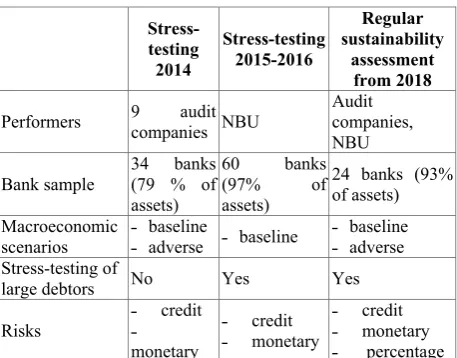
[image:3.595.310.539.486.665.2]The NBU plans to annually inform banks and the public about macroeconomic scenarios for stress tests, explaining in detail the logic of their construction because carrying out stress-testing and capitalization of banks according to its results is one of the conditions for cooperation with the IMF. The history of stress-testing of Ukrainian banks is shown in table 1.
Table 1. History of stress-testing of Ukrainian banks.
Stress-testing
2014
Stress-testing 2015-2016
Regular sustainability
assessment from 2018
Performers 9 audit companies NBU Audit companies, NBU Bank sample 34 banks (79 % of
assets)
60 banks (97% of assets)
24 banks (93% of assets) Macroeconomic
scenarios ˗ ˗ baseline adverse ˗ baseline ˗ ˗ baseline adverse Stress-testing of
large debtors No Yes Yes
Risks ˗ ˗ credit monetary
˗ credit ˗ monetary
˗ credit ˗ monetary ˗ percentage
* systemized by authors based on NBU data (2014, 2015, 2016,
2018)
In 2018 the NBU assessed the stability and stress-testing of the largest banks in Ukraine. According to the schedule for assessing the stability of banks the analysis was carried out in three stages:
2. Extrapolation of the results of the first phase, evaluation of the adequacy and the capital requirements.
The second stage was carried out in case of incorrect display of asset quality by banks during the first stage. 3. Stress-testing (ST), assessment of sufficiency and capital requirements. Stress-testing was conducted by 24 banks, which accounted for more than 94% of the assets of the banking system.
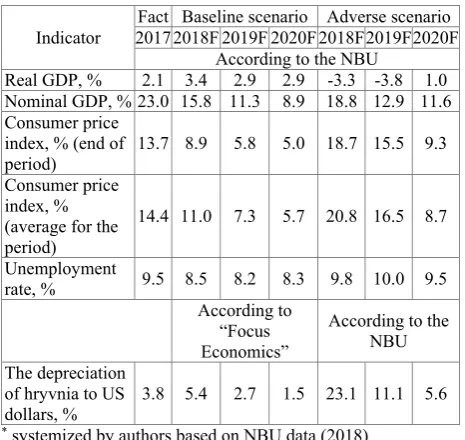
[image:4.595.56.289.290.510.2]For this procedure banks were selected according to the largest on average values of two indicators: risk-weighted assets and deposits of individuals. NBU conducted stress-testing of credit and market risks (interest rate and currency). For the baseline scenario, public forecasts of the NBU were used (table 2). The exchange rate value for the baseline scenario is taken from the “Focus Economics” consensus forecast (2018).
Table 2. Macroeconomic indicators of the baseline and adverse stress test scenarios of 2018.
Indicator 2017 2018F 2019F 2020F 2018F 2019F 2020F Fact Baseline scenario Adverse scenario According to the NBU
Real GDP, % 2.1 3.4 2.9 2.9 -3.3 -3.8 1.0 Nominal GDP, % 23.0 15.8 11.3 8.9 18.8 12.9 11.6 Consumer price
index, % (end of
period) 13.7 8.9 5.8 5.0 18.7 15.5 9.3 Consumer price
index, % (average for the period)
14.4 11.0 7.3 5.7 20.8 16.5 8.7
Unemployment
rate, % 9.5 8.5 8.2 8.3 9.8 10.0 9.5 According to
“Focus Economics”
According to the NBU The depreciation
of hryvnia to US
dollars, % 3.8 5.4 2.7 1.5 23.1 11.1 5.6
* systemized by authors based on NBU data (2018)
The adverse macroeconomic scenario is based on hypothetical assumptions of macroeconomic indicators that lead to the implementation of credit and market risks in significant amounts. According to international practice, the stress test adverse scenario must be tough, but the most likely (severe but plausible scenario). At the same time, it does not show the expectations of economic development in the near future. The adverse scenario is developed by the NBU, it is based on the following assumptions: a decrease in real GDP by one standard deviation (calculated on data from 2000) from the baseline forecast; devaluation of the hryvnia to the US dollar – 23% in 2018 (the average level of devaluation during the previous two crises) and moderately in the future.
In this regard it is advisable to make some international comparisons. Thus, according to the information published by the NBU (2018), an adverse scenario in the US allows for a decline in real GDP at the peak of the crisis by 3.5% and an severely adverse (SA) by 8.9%; in the Euro zone countries, the crisis under the adverse scenario lasts two years and GDP decline is
expected at 2% on average and up to 6% in some countries; in the UK under the adverse scenario, the pound devaluation against the Euro by 24%.
The results of stress-testing should be interpreted only in the context of the key assumptions that formed the basis of the model. Firstly, the regulator assumes that the banks' balance sheet is static, that is, it is influenced only by changes in the quality of assets and changes in the exchange rate. In practice, individual banks are growing quite rapidly and therefore their balances are already significantly different from the balances at the date of stress-testing. Secondly, current profits are expected to capitalize throughout the forecast period. In practice, banks often decide on the distribution of profits between shareholders. According to reports of the NBU (2018), the average capital adequacy under the baseline scenario is growing in the forecast period by almost 13 BP to 24.7%. According to the results of stress-testing, the need for capital for 8 banks in two scenarios and for 5 banks only in an adverse scenario was established), table 3. The amount of capital requirements under the baseline scenario in the 1st year is 224.13 million USD and grows to 1546.89 million USD for all years in adverse scenario.
Table 3. The results of the stress test. Scenario Number of banks* Capital requirement
Baseline 8 2nd year – 290.27 million USD 1st year – 224.13 million USD 3rd year – 349.06 million USD Adverse 13 2nd year – 1451.36 million USD 1st year – 892.86 million USD
3rd year – 1546.89 million USD
* number of banks for which capital requirement is established
The main problem of qualitative analysis of stress test results is the presence of a significant number of calculation results and the lack of a generalized rating of banks on their results. Thus, according to the regulator, information on regulatory capital, fixed capital, regulatory capital adequacy ratio, capital adequacy ratio, the amount of capital need (shortage) based on the results of the sustainability assessment, measures taken after 01.01.2018 and before the publication of the results of the sustainability assessment and the amount of capital need (shortage), taking into account measures in the context of the Bank's data for 01.01.18, the results of forecast calculations for 2018, 2019 and 2020 according to the baseline and adverse macroeconomic scenarios are provided for 24 banks. As a result, more than 25 numerical values for each Bank can be radically different from each other and exclude the understanding of the place of a financial institution among others. That is why we consider it expedient to aggregate all the features of the set of indicators into one integral estimate and identify banks according to stress resistance in the form of a top list. Let us call it “integral stress-testing index (IST)”.
stability (and hence security) of each of the banks on the basis of baseline and adverse macroeconomic scenarios. Construction of the IST contains the following steps:
1. Formation of a set of indicators.
2. Normalization and standardization of identifiers. 3. Calculation of the integral index.
To the set of indicators that will form the feature space, we propose to include:
‒ regulatory capital (x1) – one of the most important
indicators of banks’ activity, the main purpose of which is to cover the negative consequences of the various risks taken by banks in the course of their activities, and to ensure the protection of deposits, financial stability and stability of banking activities,
‒ fixed capital (x2) is the regulatory component and it
contains: the registered authorized capital (ordinary shares) share premium on common shares, unregistered paid shareholders’ contributions, financial assistance from the bank’s shareholders, quarterly/annual retained earnings revaluation surplus of fixed assets as of 31.12.2010 (with gradual exclusion from the calculation in full), funds/reserves, created at the expense of profits, ‒ regulatory capital adequacy ratio (x3) shows the bank’s
ability to timely and fully pay its obligations arising from trading, creditor other transactions of monetary nature,
‒ capital adequacy ratio (x4) is defined as the ratio of fixed
capital to total assets and off-balance sheet liabilities weighted by appropriate credit risk ratios. Since all indicators are stimulants, their standardization will be done according to the formula:
𝑧��=����������
����������, (1)
where xij is the value of the i indicator (i=1, ..., 4) of the
result of stress-testing of the bank for j (j=1, ..., 24), 𝑥����, 𝑥����respectively, the maximum and minimum
values of the i indicator for the group of banks; zij ‒
standardized values of indicators.
We will calculate the integral index of stress-testing according to formula (2), because we believe that all indicators are equilibrium in assessing the stability of banks.
𝐼���= �
�∑ 𝑧������ , (2) The value of the integral indicator IST for 24 banks, that
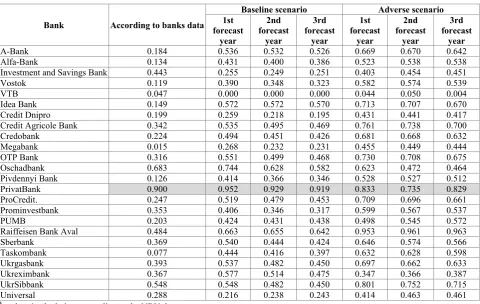
[image:5.595.58.539.382.686.2]were subject of stress-testing, summarized in table 4.
Table 4. Integrated indicators of stress-testing by banks.
Bank According to banks data
Baseline scenario Adverse scenario
1st forecast
year
2nd forecast
year
3rd forecast
year
1st forecast
year
2nd forecast
year
3rd forecast
year
A-Bank 0.184 0.536 0.532 0.526 0.669 0.670 0.642
Alfa-Bank 0.134 0.431 0.400 0.386 0.523 0.538 0.538
Investment and Savings Bank 0.443 0.255 0.249 0.251 0.403 0.454 0.451
Vostok 0.119 0.390 0.348 0.323 0.582 0.574 0.539
VTB 0.047 0.000 0.000 0.000 0.044 0.050 0.004
Idea Bank 0.149 0.572 0.572 0.570 0.713 0.707 0.670
Credit Dnipro 0.199 0.259 0.218 0.195 0.431 0.441 0.417
Credit Agricole Bank 0.342 0.535 0.495 0.469 0.761 0.738 0.700
Credobank 0.224 0.494 0.451 0.426 0.681 0.668 0.632
Megabank 0.015 0.268 0.232 0.231 0.455 0.449 0.444
OTP Bank 0.316 0.551 0.499 0.468 0.730 0.708 0.675
Oschadbank 0.683 0.744 0.628 0.582 0.623 0.472 0.464
Pivdennyi Bank 0.126 0.414 0.366 0.346 0.528 0.527 0.512
PrivatBank 0.900 0.952 0.929 0.919 0.833 0.735 0.829
ProCredit. 0.247 0.519 0.479 0.453 0.709 0.696 0.661
Prominvestbank 0.353 0.406 0.346 0.317 0.599 0.567 0.537
PUMB 0.203 0.424 0.431 0.438 0.498 0.545 0.572
Raiffeisen Bank Aval 0.484 0.663 0.655 0.642 0.953 0.961 0.963
Sberbank 0.369 0.540 0.444 0.424 0.646 0.574 0.566
Taskombank 0.077 0.444 0.416 0.397 0.632 0.628 0.598
Ukrgasbank 0.393 0.537 0.482 0.450 0.697 0.662 0.633
Ukreximbank 0.367 0.577 0.514 0.475 0.347 0.366 0.387
UkrSibbank 0.548 0.548 0.482 0.450 0.801 0.752 0.715
Universal 0.288 0.216 0.238 0.243 0.414 0.463 0.461
*authors’ calculations according to the NBU data
As can be seen from the results obtained in different years and for different scenarios for each bank, the value 𝐼��� can be radically different. For example, according to
the baseline scenario and data of the bank, PAK CB “PrivatBank” had the highest value of the indicator, and in the worst case scenario the result deteriorated,
Raiffeisen Bank Aval took the first place in the rating of banks.
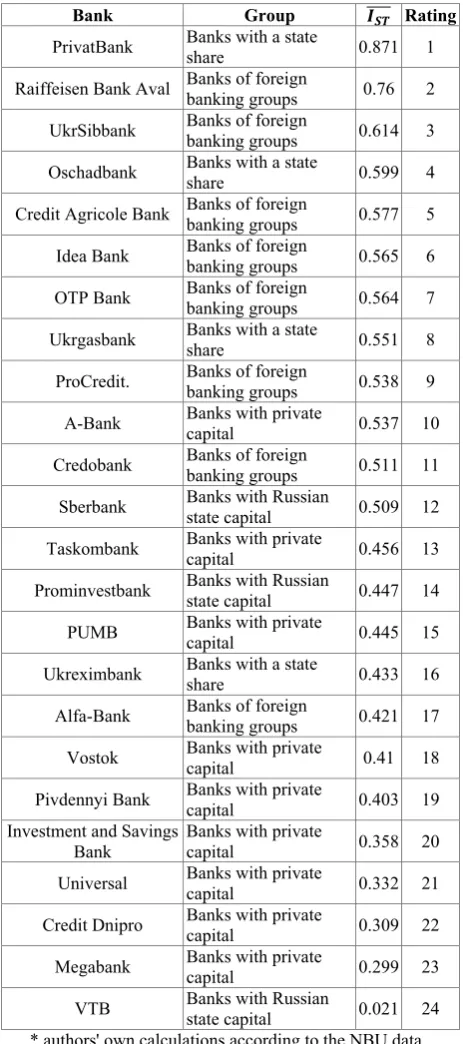
Thus, to form a generalized rating for a group of 24 banks, find the average IST. The results are summarized in
are “ready for shock conditions” and do not need additional capitalization. Other banks (except Sberbank), which are in the top ten of the rating also have no shortage of capital. Oschadbank is in need of 230 million USD in the adverse scenario and according to the restructuring plan should cover until 31.12.2009.
Table 5. Average integral index of stress-testing (𝐼������).
Bank Group 𝑰����𝑺𝑻 Rating
PrivatBank Banks with a state share 0.871 1 Raiffeisen Bank Aval Banks of foreign banking groups 0.76 2 UkrSibbank Banks of foreign banking groups 0.614 3 Oschadbank Banks with a state share 0.599 4 Credit Agricole Bank Banks of foreign banking groups 0.577 5 Idea Bank Banks of foreign banking groups 0.565 6 OTP Bank Banks of foreign banking groups 0.564 7 Ukrgasbank Banks with a state share 0.551 8 ProCredit. Banks of foreign banking groups 0.538 9 A-Bank Banks with private capital 0.537 10 Credobank Banks of foreign banking groups 0.511 11 Sberbank Banks with Russian state capital 0.509 12 Taskombank Banks with private capital 0.456 13 Prominvestbank Banks with Russian state capital 0.447 14 PUMB Banks with private capital 0.445 15 Ukreximbank Banks with a state share 0.433 16 Alfa-Bank Banks of foreign banking groups 0.421 17 Vostok Banks with private capital 0.41 18 Pivdennyi Bank Banks with private capital 0.403 19 Investment and Savings
Bank Banks with private capital 0.358 20 Universal Banks with private capital 0.332 21 Credit Dnipro Banks with private capital 0.309 22 Megabank Banks with private capital 0.299 23 VTB Banks with Russian state capital 0.021 24 * authors' own calculations according to the NBU data
According to the NBU, VTB Bank in November 2018 was recognized as insolvent, which is also confirmed by the 24th place in the ranking of financial institutions with almost zero value 𝐼���. The results of stress-testing vary by group of banks. When assessing the quality of assets (asset quality review, AQR), the capital adequacy ratio
decreased only for private banks and banks under the control of the Russian Federation.
Under the baseline scenario, there is an increase in the capital adequacy of almost all groups of banks, but at different rates. Most notably, the capital adequacy of foreign banks is growing. Only for banks with state-owned Russian capital the capital adequacy falls below the limit of 7%. In the adverse scenario for almost half of the banks’ capital would be reduced below the limit level.
The total cumulative impact of the hypothetical crisis on fixed capital is almost 9 G.P. of capital adequacy; it is reduced to 3.1% in the three-year forecast period. Under the adverse scenario for banks of all groups, except foreign, there was a decrease in fixed capital.
The most significant reduction was expected in the first year of the forecast period of stress-testing. A slight recovery of capital occurred only in the third year of stress. The depth of capital subsidence due to the hypothetical crisis is almost the same for public and private banks. Due to the high entry-level state-owned banks store an average of positive capital.
At the same time, for private banks, the average level of sufficiency becomes negative (equivalent to 6% of capital adequacy). Also, according to table 5, it can be seen that the top ten of the rating includes 3 banks with a state share, 6 banks of foreign banking groups and one Bank with private capital. At the same time, 3 banks with state Russian capital occupy 12, 14 and 24 places in the rating with a lack of capital for the adverse scenario for a total of about 367.43 million USD.
It should be noted that the need (lack) of capital arises when the estimated values of the banks' standards at least in one of the years of the forecast horizon fell below the established limit levels (7% for the baseline and 3.5% for adverse scenarios).
The capital requirement established by the results of the assessment in the first year of the baseline scenario should be covered by the implementation of the capitalization program until the end of March 2019. The need identified in the adverse scenario is covered by the implementation of the restructuring plans until the end of 2019. The total capital requirement of the banks is 1546.89 million USD, for solvent banks (excluding VTB Bank) – 1274.99 million USD (of which 102.88 million USD should be covered by the capitalization program).So far, the NBU has verified and confirmed the measures of banks in the amount of 551.15 million USD. Some of the activities carried out by the banks at the end of 2018 will be taken into account later, after checking their impact on capital. According to the NBU at the end of 2018, the need decreased to 723.84 million USD. Of the 13 banks completely shut down the capital requirement in the adverse scenario four banks: the PUMB, Universal Bank, Bank “Vostok” and the Sberbank.
2018”. In case of revealing the lack of capital following the results of the annual assessment of banks’ stability taking into account the results of stress-testing under the baseline scenario, banks need to develop a program of additional capitalization.
Thus, banks’ compliance with the requirements of the National Bank of Ukraine allows for the results of stress-testing: to create a “safety margin” of the banking system to overcome possible crisis phenomena; to form an understanding of banks' own risks of activity and to stimulate adequate risk management; to discipline all participants of the sustainability assessment process and develop a common understanding of the threats and prospects of the banking system; to increase the level of financial stability; to provide the information security in banking sector.
5 Conclusions and suggestions
According to the results of the study, one of the key methods of macro-prudential policy, which contributes to the effective provision of financial stability and will prevent potential shocks to the banking sector and the country as a whole is macroeconomic stress-testing.
The analysis of the regulatory framework and scientific publications made it possible to clearly identify the approaches, stages, scenarios and the procedure for stress-testing of banks by the National Bank of Ukraine.
By means of modeling of the integrated indicator “stress-testing” (𝐼���) the data was grouped and
generalized assessment of the financial stability of each of the banks was obtained, which in 2018 were subject to the appropriate procedure by the regulator for baseline and adverse macroeconomic scenarios. The analysis of the formed rating showed that according to the results of the 2018 stability assessment, PrivatBank, Raiffeisen Bank Aval and UkrSibbank are among the top three banks “ready for shock conditions” and don’t need additional capitalization. Other banks (except Sberbank), which are in the top ten of the rating, have no shortage of capital. Oschadbank is in need of 230 million USD, in the adverse scenario and according to the restructuring plan should cover until 31.12.2009. At the same time, according to the NBU, VTB Bank was declared insolvent in November 2018, which is also confirmed by the 24th place in the ranking of financial institutions with almost zero 𝐼���.
To sum up, the results of the assessment of the stability of 24 banks in Ukraine indicate that the banking sector is sufficiently capitalized, but should increase the margin of safety to strengthen resistance to possible crises. To do this, the NBU is to:
‒ improve the tools of macroeconomic forecasting, including by expanding the range and modernization of existing models;
‒ bring prudential requirements for banks in line with EU legislation and recommendations of the Basel Committee on banking supervision;
‒ deepen the application of risk-based approach in the process of banking supervision, in the licensing procedures of banks;
‒ regularly conduct stress tests to assess banks in the framework of the SREP;
‒ limit the concentration of risks by determining capital requirements based on the results of stress-testing and the buffer of systemic risk.
The proposed measures will ensure a stable, transparent and efficient banking system, make it resistant to macroeconomic shocks and systemic risks, bring the liquidity standards of the banking system in line with Basel III and EU Directive/ Regulation (CRD IV/CRR); increase the share of highly liquid assets in the banking system to meet the liquidity standard LCR to 100%, get more transparent prudential requirements for banks, improved Supervisory processes and tools, harmonized with the best approaches of the European Central Bank and the European banking Supervisory authority, improve approaches to the construction of the system risk management in banks, contributing to the improvement of the quality of credit portfolios of banks and increase the profitability of the banking system.
References
1. 2019 Supervisory Scenarios for Annual Stress Tests Required under the Dodd-Frank Act Stress-testing Rules and the Capital Plan Rule. https://www.federalreserve.gov/newsevents/pressrel eases/files/bcreg20190213a1.pdf (2019). Accessed 15 Jan 2019
2. Rezuljtaty ocinky stijkosti bankiv ta bankivsjkoji systemy Ukrajiny u 2018 roci (Assessment results of banks and the banking system the stability in Ukraine).
https://bank.gov.ua/doccatalog/document?id=78985 718 (2018). Accessed 21 Jan 2019
3. Čihak, M., Ong, L.L.: Stress Testing at the International Monetary Fund: Methods and Models. In: Ong, L.L. (ed.) A Guide to IMF Stress Testing: Methods and Models. International Monetary Fund (2014)
4. Dadashova, P.: Stres-testuvannja bankiv jak instrument bankivsjkogho naghljadu (Stress-testing of banks as a tool for banking supervision). https://bank.gov.ua/doccatalog/document?id=80321 366. Accessed 10 Jan 2019
5. Djuba, Yu., Murina, A.: Approach of the National Bank of Ukraine to stress-testing of the Ukrainian
banking system. https://bank.gov.ua/control/uk/publish/article?&art_i
d=53082666&cat_id=58429 (2015). Accessed 16 Dec 2018
6. Financial sector assessment programs.
https://www.imf.org/external/np/fsap/fsap.aspx (2018). Accessed 26 Dec 2018
7. Foglia A.: Stress-testing credit risk: a survey of authorities’ approaches, International Journal of Central Banking. 5(3), 9–45 (2009)
https://bank.gov.ua/control/uk/publish/article?art_id =123675 (2014). Accessed 20 Dec 2018
9. Goncharenko, I., Вerezina, O., Schevchenko, A.: Modernization of financial intermediaries’ relations in modern conditions of national economy. Scientific bulletin of Polissia. 2(10), 78–84 (2017)
10. Honcharenko, I., Berezina, O.: Cooperation of the bank and insurance business as an effective model: history and present day. In: Bezpartochnyi, M. (ed.) Organizational and economic mechanisms of development of the financial system, pp. 83–92. Landmark SIA, Riga (2016)
11. Espinosa-Vega, M. A., Sole, J.: Introduction to the network analysis approach to stress-testing. In: Ong, L.L. (ed.) A Guide to IMF Stress Testing: Methods and Models. International Monetary Fund (2014) 12. Kapinos, P., Mitnik, O.: A top-down approach to
stress testing banks. FDIC working paper 2015-02 (2015)
13. Metodychni rekomendaciji shhodo porjadku provedennja stres-testuvannja v bankakh Ukrajiny. Postanova Pravlinnja Nacionaljnogho banku Ukrajiny vid 06.08.2009 r. N 460 (Methodical recommendations for stress testing in banks of Ukraine. Resolution of the Board of the National Bank of Ukraine dated August 6, 2009 No. 460). https://zakon.rada.gov.ua/laws/show/v0460500-09 (2009). Accessed 21 Jan 2019
14. Metodychni rekomendaciji shhodo orghanizaciji ta funkcionuvannja system ryzyk-menedzhmentu v bankakh Ukrajiny. Postanova Pravlinnja Nacionaljnogho banku Ukrajiny vid 02.08.2004 N 361 (Methodical recommendations for the organization and functioning of risk management systems in banks of Ukraine. Resolution of the Board of the National Bank of Ukraine dated August 2, 2004 No. 361).
https://zakon.rada.gov.ua/laws/show/v0361500-04 (2004). Accessed 15 Jan 2019
15. Pidkhody NBU do stres-testuvannja bankiv u 2018 roci (NBU approaches to stress testing of banks in 2018).
https://bank.gov.ua/doccatalog/document?id=65952 478 (2018). Accessed 15 Jan 2019
16. Zvit NBU pro stres-testuvannja u 2018 r (NBU report on stress testing in 2018). https://bank.gov.ua/doccatalog/document?id=84880 329 (2018). Accessed 15 Jan 2019
17. Pro osoblyvosti zdijsnennja ocinky stijkosti bankiv i bankivsjkoji systemy Ukrajiny u 2018 roci. Postanova Pravlinnja Nacionaljnogho banku Ukrajiny vid 14 serpnja 2018 roku N 94 (On the Peculiarities of the Resilience of Banks Assessment and the Banking System of Ukraine in 2018. Resolution of the Board of the National Bank of Ukraine of August 14, 2018, No. 94). https://bank.gov.ua/document/download?docId=757 08363 (2018). Accessed 26 Dec 2018
18. Rezuljtaty ocinky stijkosti u rozrizi bankiv u 2018 roci (Results of the banks' resilience assessment in 2018).
https://bank.gov.ua/control/uk/publish/article?art_id =84880350&cat_id=85515316 (2018). Accessed 22 Jan 2019
19. Schmieder, C., Schumacher, L.: Introduction to the balance sheet-based approach to stress testing. In: Ong, L.L. (ed.) A Guide to IMF Stress Testing: Methods and Models. International Monetary Fund (2014)
20. Strateghija Nacionaljnogho banku Ukrajiny. Proghrama dij 2019 (Strategy of the National Bank of
Ukraine. Action Plan 2019).
https://bank.gov.ua/doccatalog/document?id=86050 888 (2019). Accessed 12 Jan 2019
21. Stress Testing Policy Statement.
https://www.federalreserve.gov/newsevents/pressrel eases/files/bcreg20190205a3.pdf (2018). Accessed 10 Dec 2018
22. Supervisory and bank stress testing: range of practices, December 2017. https://www.bis.org/bcbs/publ/d427.htm (2017). Accessed 21 Dec 2018