ISSN: 2278-3075, Volume-8 Issue-12, October 2019
A Delay and Energy Efficient Multicast Routing
Protocol using IWO and MOLO Algorithm for
Vehicular Networks
H.Prabavathi,K.Kavitha,G.Pradeep
Abstract: Vehicular networks are significantly improving wireless communication network which provides an intelligent transportation system services among faster moving vehicles with internet and brings safety and comfort drive. From a single source vehicle the multicast routing protocols delivers multicast messages to all members of the multicast group by means of multi-hop communication. Increasing the density of vehicles results in channel overload, which increases the probability of data collision; hence reduction in successful received data will increase the delay. Therefore, delay and energy consumption are the major constraints that should affect the performance of routing. In this paper we suggest a delay and energy efficient multicast routing (DEMR) protocol for vehicular network using a hybrid machine learning algorithm. The DEMR protocol consists of four layers; are vehicle layer, fog layer, OpenFlow switch layer, and SDN controller layer. Moreover, to partition the vehicle layer, and select the optimal multicast path based on multiple constraints improved weed optimization (IWO) algorithm is proposed. IWO algorithm separates the multicast request into emergency, common and police requests. We design a multi-objective lion optimization (MOLO) algorithm among fog nodes for resource management, which increases the utilization of resources in fog layer and decrease the response time of multicast session request. MOLO algorithm removes the unnecessary flow table and session table entries in the controller. The DEMR protocol is implemented in Network Simulator (NS3) tool and simulation results are compared with the protocols as EEMSFV, MABC, and CVLMS. From the simulation results we conclude that the DEMR algorithm is better than EEMSFV, MABC and CVLMS in terms of transmission ratio, overhead load, average end to end delay, packet loss ratio and, energy consumption.
Keywords: Vehicular networks, Multicasting, Fog Computing, delay, Energy Efficient, MOLO, IWO
I. INTRODUCTION
Vehicular networks have emerged as an advanced wireless communication network which exchanges data packets between thousands of vehicles. Quick installation of VANET without any central administration is an advantage [1,2]. In VANET vehicles are moving very fast so the topology of the networks is highly dynamic. Topology based protocol is highly preferred because of less utilization of control packets for route discovery which leads to the
Revised Manuscript Received on October 05, 2019.
H.Prabavathi, Research Scholar, Department of CSE, Annamalai University,Annamalai Nagar, Tamilnadu, India, ([email protected])
Dr.K.Kavitha, Associate Professor, Department of CSE, Annamalai University, Annamalai Nagar, Tamilnadu, India, ([email protected])
Dr.G.Pradeep, Professor, Department of MCA, A.V.C.College of Engineering, Mannampandal, Tamilnadu,India, ([email protected])
reduction in routing overhead, routing cost and end to end delay for transferring the packets [3,4].
Position based routing protocols need continuous monitoring and updating of location information about vehicles utilizes additional
control packets for data transfer. The cellular network receives data services from the base station. When the base station is congested due to heavy traffic data packets will not be delivered to the vehicles may result in the colliding of vehicles. This delay in cellular networks will not happen in VANET as the vehicles can communicate directly without any intermittent base station [5].
Vehicles access the VANET services when enters into the communication ranges of any other vehicles in the network [6]. VANETs are projected and expected to provide varieties of services like weather forecasting, advertisements, e-commerce, online game invitations, media uploading and media downloading. Information broadcasting is categorized into geocast and multicast [7]. In the geocast, the RSUs in the broadcasting area forward the data packets to all the vehicles in the communication area [8]. RSUs are very close to the vehicles so, they can use single hop to broadcast destination receiving vehicles, and the position of the destination vehicle is found once. The Multicast broadcasting to the group of vehicles that are not in the same geographical area is a challenging process. After the destination vehicles are grouped and send their location, there is the possibility to move to a new location and lost connection from the source of the multicast messages [9]. Managing and determining the multicast position is a big problem in the VANET. Multicast forwarding is needed as the destination nodes are fast moving vehicles from the source. Greater mobility of destination vehicle is also a problem in VANET. Multicast forwarding to long distance destination nodes is also a problem in VANET. During traffic collision or accident multicasting is used to give the safety information to a group of vehicles or multicast vehicles called destination vehicles through a shared network link [10]. The multicast members must contribute the traffic like stopping the vehicle or roaming in another direction to overcome danger in the crucial time.
The multicast routing protocols are applied to broadcast the safety information to set of vehicles that take in to account the deadlines and bandwidth constraint [11]. On the other hand, energy consumptions is one of the major things that should be considered in designing the multicast routing protocol [12, 13].
The major contributions in this paper include:
• Proposing architecture to combine the fog computing with vehicular ad-hoc network to do multicast routing efficiently.
to decrease the delay and consumption of energy • Developing an algorithm to partitioning the vehicle layer and select the best multicast path based upon multiple constraints like energy consumption, received signal strength, delay, and deadline.
The other topics of this paper are listed as follows. In section II related work is given. Section III suggests the system model. Section IV describes the multicasting routing protocol. Section V demonstrates the simulations and results and finally section VI delivers the conclusion.
II. RELATED WORK
Several multicast routing protocols have been proposed to mitigate the routing problems in vehicular networks. The most recent work will be reviewed in this chapter. Tasneem Darwish et al. [14] presented a lightweight intersection-based traffic aware routing (LITAR) protocol for the vehicle to vehicle communication in urban vehicular networks. The algorithms proposed are used to reduce the network overhead generated by the traffic status measurement process. This protocol makes a routing decision based on traffic and network conditions. Enhanced Validity Period Calculation (EVPC) algorithm rejects the unnecessary generated collected packets. Restricted Collector Packet Reply (RCPR) algorithm restricted the collector packet replies. However, their proposed protocol does not take into account energy consumption, delay, and bandwidth. Alessandro Bazzi et al. [15] proposed two routing algorithms that are designed for crowd sensing vehicular networks (CSVNs). Greedy forwarding with available relays (GFAVR) and greedy forwarding with virtual roadside units (GFVIR) have been proposed to overcome the local minima problem in VANETs, which arises when a greedy forwarding approach is adopted to address fixed RSUs. GFAVR is fully distributed and adds a single overhead bit. GFVIR requires a preliminary design phase to individuate the local minima and alternative paths in the addressed scenario and it needs an increase of the RSU database. The limitation of this paper is that it does not consider energy consumption. Ahmed I. Saleh et al. [16] proposed a highly reliable routing protocols (R2P) which divide the networks into overlapping zone and a special nodes is supported to be the master of nodes, which maintain the up-to-date routing board for inter/intra zones communications. This protocol employs special routes discovery mechanisms to discover available route to the destination nodes, and choose the reliable path not only the shortest path. R2P does not take energy consumption into consideration. Xiu Zhang et al. [17] suggested a micro artificial bee colony (MABC) algorithm that deals with the QoS constraint includes maximizing networks lifetime and minimizing delay costs. New formulas for onlooker bees and employed bees are established for good solutions. Since the populations worked out is micro population the computational time should not be taken into account. Also the energy efficiency of MABC is not stated. S.K.Bhoi et al. [18] used a routing protocol for urban vehicular ad hoc network to support the non safety applications with the consideration of a scenario where the drivers and passengers of different parking lots can play multi-player games with each other. The data needed for the game should reach the destination with minimum time, here the data transmission with minimum time is considered and the energy needed for transmission is not considered.
Mukund B.Wagh et al. [19] suggested a lion optimization algorithm to adopt the minimized routing cost under the VANET. The mutation process is slightly modified in LA algorithm to select optimal route in VANET. Esraa Al-Ezaly et al. [20] used collaborative vehicles location management services for an enhanced hybrid reactive and proactive multicast (EHRPM) facilitate knowing the position information of the moving destinations vehicles. Information dissemination is combined with CVLMS to decide the location information of the vehicle. Ahmed Jawad kadhim et al. [21] proposed an energy efficient multicast routing protocol based on software defined networks and fog computing (EEMSFV) is applied in vehicular networks, which improves the performance constraints as transmitted ratio, end-to-end delay, normalized overhead load, multicast energy consumption, packet loss ratio and percentage of critical multicast sessions that meet the deadline. However the energy consumption is high. Aissaoui et al. [22] suggested a situation aware multi-constrained QoS (SAMQ) routing algorithm for vehicular networks, which is related to ant colony optimization for situation awareness. This algorithm gives desirable routes and also solves NP-hard problems. Shebagarani et al. [23] suggested a multicast algorithm to receive information from RSUs. The FCFS algorithm is used here for insertion and D*S/W method is used for selection process. Data is delivered to all destinations simultaneously, this results in high delay.
III. SYSTEM MODEL
The architecture contains four layers; vehicle layer, fog layer, OpenFlow switch layer, and Software Defined Network (SDN) layer. The main thing in this architecture is the resource management layer is included in the fog layer which applies the MOLO algorithm to increase the utilization of resources and decrease the response time for multicast session requests. The detailed diagram is shown below. This architecture differs from the previous one in the technique of grouping the vehicles and also the resource management system is applied in each fog layer. All layers are connected with other layers. At the vehicles layer, there is high traffic due to the huge number of vehicles moving very fast. In the second layer, there are Road Side Unit (RSU) and Base Station (BS) which has the processing and storing capabilities. 3G/4G/LTE interfaces are used for the connection between RSUs and BSs.
Vehicle to Infrastructure (V2I) and Infrastructure to Infrastructure (I2I) communication is used here in this layer. V2I communication enables any vehicle to communicate with RSUs and BSs. I2I enables any RSUs and BSs to communicate with any other respectively. The fog controller controls a group of RSUs and BSs in a particular geographical area. This controller receives all required data about the RSU, BS, and vehicles from the SDN layer to control the broken links in the coverage area to overcome the deadlines and decrease the overhead. The SDN controller employs a resource management system (RMS) to maintain the storage of necessary data with its path by avoiding duplicates. All vehicles are forwarding their data irrespective of the direction that leads to multiple copies of data received at the fog layer. The RMS employs the multi-objective lion optimization
ISSN: 2278-3075, Volume-8 Issue-12, October 2019
correct data and reject all the duplicate information at the fog controller. The third layer is the OpenFlow switch layer
where the network forwards data packets to the SDN
Fig. 1.System Architecture
environment. OpenFlow channel is used for communication between the SDN Controller and OpenFlow switch. SDN controller uses OpenFlow switch to manage the switch [24]. The fourth layer consists of the SDN controller that has all the information about all the devices and vehicles that are involved in the network. SDN has required data about all network links; it uses the data to generate the multicast route with minimum energy level. The main objective of proposed DEMR is to reduce the energy consumption and delay of multicast data of size ‘D’ from initial source node to destination vehicles.
Table 1: Notations Symbols Notations
N Number of nodes in the network
E Number of links between nodes
eij Essential energy to send one bit from node i to node j
sij Size of data in bits starting from node i to node j
qi Queuing delay of data in node i
di Maximum delay at node i
A VANET is given as a simple directed and connected graph G=(N,E) where N is a finite set of nodes and E is the set of links connecting the nodes. N is a set of nodes which includes network controller, RSUs, BSs and vehicles, and E is the set of links connects them.
Energy consumption of multicast data of size D is represented as
(1)
The original data is divided into many numbers of packets and each packet reach the destination with various route starts from the initial sender node to the destination receiving node i. The total maximum overall-delay includes switching, queuing delay and, propagation delay [25]. (2) The queuing delay (qi) of node i represents the average level of queuing delay of information in node i. Every node repeatedly calculates the queuing delay and sends the qi value computed to the local controller, which then update the value and send it to the SDN controller. Propagation delay from the node i to the node j is represented as pij.. Equation below shows the overall delay attained during the transmission.
(3) for all and
is ineffective.
IV. MULTICASTING ROUTING PROTOCOL
Multicasting is the transmission technique of sending records as data packets from a single initial source node to a group of destination nodes which are located in different geographical areas. Here the data is not transmitted from the source directly but the data is transmitted to a centre node, there the data is copied and transmitted to the destination nodes. The above procedure is to finalize the multicast tree. In this paper, the new routing protocol DEMR is proposed to categorize the vehicles at the base layer and to utilize the resources at the fog layer by employing IWO and MOLO algorithms. The categorization of vehicles is done by the local controller. We assume that there are three applications that represent the vehicle types as emergency vehicles (Ambulance and fire-fighter), police vehicles and common vehicles. The figure 2 below shows the request classifier for IWO algorithm.
[image:4.595.320.535.87.455.2]
Fig. 2. Request classifier
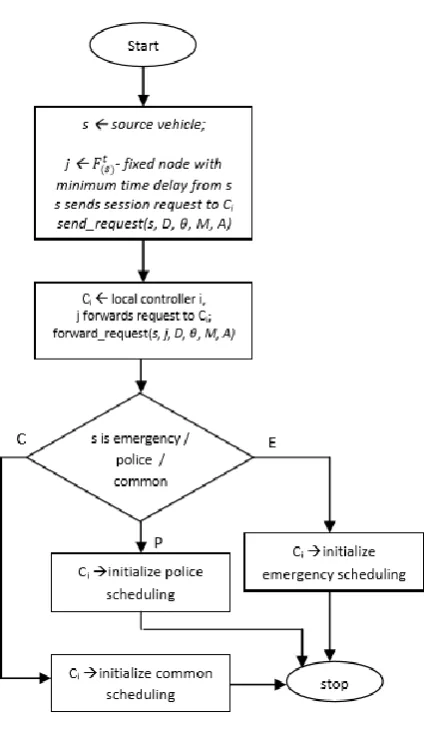
[image:4.595.52.264.286.395.2]Each controller has three queues to categorize the request from the vehicles. All the requests are processed depend upon the priority of the request. Request from the emergency vehicles are given highest priority, their requests are processed first. The second priority is given to the police vehicles. Third priority is given to the common vehicles. The following is the IWO flowchart which processes the request based on priority of the requests.
Fig. 3. Flow Chart – IWO Algorithm
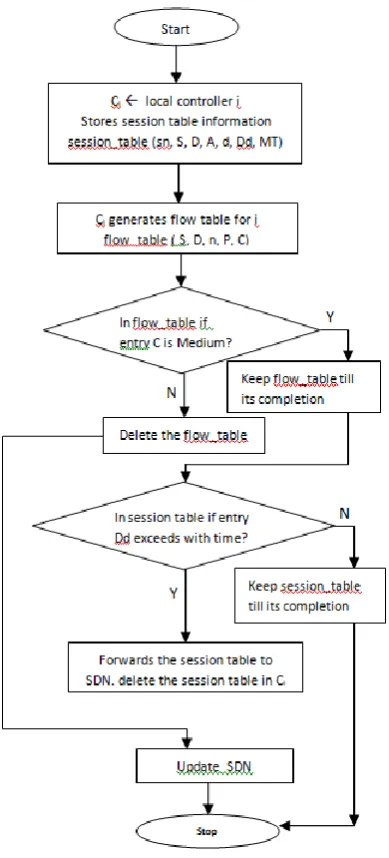
While creating an optimal multicast tree the controller maintain two tables, one is session table and another one is flow table. Session table contains seven entities; session number, IP addresses of source and destination nodes, application category, data size, deadline and binary representation of multicast tree. The flow table contains five entities; source, destination, number of flows, forwarding port and classification. These session table information is stored in the local controller even though the transmission is completed. It is the necessary for the local controller to generate a flow table for different request from different vehicles, this leads to storage space insufficiency in the local controller. Here in this paper the MOLO algorithm is proposed to send the final session table to the SDN controller and delete the flow table after the transmission is completed, thereby avoiding insufficiency of storage space at the local controller.
The flowchart given below is the detailed representation of the MOLO algorithm. Flow table information contains terminal and medium which decides the flow path. For the Queue 1
Queue 2
Queue 3 Request
Analyser
Scheduler
ISSN: 2278-3075, Volume-8 Issue-12, October 2019
Fig. 4. Flowchart – MOLO Algorithm
destination node the value of C in the flow path is terminal, for other nodes the C is medium. After verifying the entries in the flow table and the session table the updated information is finally forwarded to the SDN Controller.
V. SIMULATIONS AND RESULTS
In this paper, the NS-3.26 simulator settings on the operating system ubuntu version 16.04 were used for simulation settings. Proving the efficiency of our proposed work, we compared it with MABC, CVLMS and EEMSFV to prove the multicasting process of vehicular nodes in deciding the locations of multicast destinations. This work employs V2I and I2I connection methods. The parameters used are number of vehicles ranges from 500, 1000, 1500, 2000 and 2500, number of the multicast session employed is 15, and number of the destinations in each session is 9. The network density in the performance of MABC, CVLMS, EEMSFV and DEMR are measured in the form of transmission ratio, overhead load, average end-to-end delay, and packets loss ratio and energy consumption.
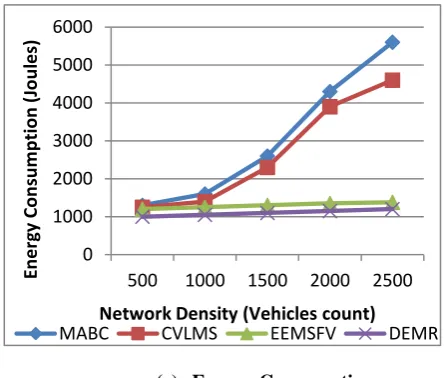
The figure below demonstrates the performance metric of MABC, CVLMS, EEMSFV and DEMR, DEMR is better than others. Figure 5(a) shows that the DEMR is better than
others in successful transmission ratio because it considers the deadlines in calculating the path. The figure 5(b) shows that the DEMR is better when compared with various routing protocols in overhead load because in DEMR the vehicular nodes send control packets to RSUs or BSs and not to other nodes. In figure 5(c) it is shown that the DEMR is better than all in terms of average E2E delay because the broken link can be rectified by the local controllers quickly. Figure 5(d) gives DEMR is better in packet loss ratio. If one link is broken, the next incoming packet is stored in the nearest fixed node and it receives the updated flow tables from the SDN controller. In multicast energy consumption DEMR is better than all other protocols shown in figure 5(e).
DEMR calculates the optimal multicast route with lower energy consumption. The resultant graph indicates that DEMR is better than others. The mobility of speedy vehicles on the performances of MABC, CVLMS, EEMSFV and DEMR are measured in the form of transmission ratio, overhead load, average end to end delay, packets loss ratio and energy consumption (energy measured for route discovery and data transmission). The parameters used are number of vehicles is 1200, number of multicast session is 10, the number of destination in every multicast session is 9, vehicle speed ranges from (5, 10, 15, 20, 25, 30) m/s. The figure below shows the performance metric of MABC, CVLMS, EEMSFV and DEMR. The comparison graph shows that DEMR is better than others regarding mobility.
(a) Successful Transmission ratio
0 0.2 0.4 0.6 0.8 1 1.2
500 1000 1500 2000 2500
Su
cc
essf
u
l Tr
ansm
iss
ion
R
ati
o
Network Density (Vehicles Count)
[image:5.595.318.537.397.575.2](b) Overhead Load
(c) AverageE2E Delay
(d) Packet Loss Ratio
(e) Energy Consumption Fig. 5.(a-e): Performance metrics – Node Density Figure 6(a) shows that DEMR is better than others in successful transmission ratio because DEMR considers the deadline caused due to high link failures and rediscovery process in paths. Figure 6(b) shows that the over head load in DEMR is lesser than MABC, CVLMS and EEMSFV. The link stability is high in DEMR so the retransmission is not frequently happened as like others. Load here states that the broken links needs high transmission of control packets. In figure 6(c) the DEMR shows the average E2E delay is lower when compared to MABC, CVLMS and DEMR. The retransmission for broken links is initiated by the local controller itself so the delay is lower using DEMR. It provides link stability which reduces the retransmission of control packets. This results in low packet loss ratio when compared with MABC, CVLMS and EEMSFV as given in figure 6(d). Figure 6(e) shows that DEMR is better than others in energy consumption which is measured for route discovery and data transmission. Re-route discovery is not happened using DEMR and data transmission is speedup using overflow protocol. This leads to low energy consumption in DMER.
(a) Successful Transmission Ratio
0 50 100 150 200 250 300 350
500 1000 1500 2000 2500
Ov
e
rh
e
ad
Load
Network Density (Vehicles count)
MABC CVLMS EEMSFV DEMR
0 0.2 0.4 0.6 0.8 1 1.2 1.4 1.6
500 1000 1500 2000 2500
A
ve
rag
e
Delay
(s)
Network Density (Vehicles count)
MABC CVLMS EEMSFV DEMR
0 0.2 0.4 0.6 0.8 1
500 1000 1500 2000 2500
Pack
e
t
Loss R
atio
Network Density (Vehicles Count)
MABC CVLMS EEMSFV DEMR
0 1000 2000 3000 4000 5000 6000
500 1000 1500 2000 2500
En
e
rg
y C
o
n
su
m
p
tion
(J
o
u
le
s)
Network Density (Vehicles count)
MABC CVLMS EEMSFV DEMR
0 0.2 0.4 0.6 0.8 1 1.2
5 10 15 20 25 30
Su
cc
e
ssf
u
l Tr
an
sm
issi
o
n
R
atio
Vehicle Speed (m/s)
[image:6.595.315.539.48.237.2] [image:6.595.316.536.501.697.2]ISSN: 2278-3075, Volume-8 Issue-12, October 2019
(b) Overhead Load
(c) Average E2E Delay
(d) Packet Loss Ratio
(e) Energy Consumption
Fig. 6.(a-e): Performance metrics – Node Density
VI. CONCLUSION
The delay and energy efficient multicast routing protocol for vehicular network is proposed in this paper. This protocol gets into account the network density and node mobility. The architecture with four layers is proposed with MOLO algorithm for resource management and IWO algorithm for vehicles classification. These algorithms are employed in local controller to decrease the energy consumption in vehicular networks. The classification of vehicles reduces the overhead load. IWO algorithm improves the scheduling in the local controller by separating the multicast requests. MOLO algorithm gives the better solution to decrease the energy consumption by utilizing the resources in the local controller. The simulation results shows that the DEMR is better than MABC, CVLMS, and EEMSFV in successful transmission ratio, overhead load, average end to end delay, packets loss ratio and energy consumptions.
REFERENCES
1. Toulni, H. and Nsiri, B., 2015. “A hybrid routing protocol for vanet using ontology”. Procedia Computer Science, 73, pp.94-101. 2. Santamaria, A.F. Sottile, C.Fazio, P., 2015. “PAMTree: partitioned
multicast tree protocol for efficient data dissemination in a VANET environment”. Int. J. Distrib. Sensor Netw. 1–13.
3. Wu, F., Hua, C., Shan, H. and Huang, A., 2015. “Cooperative multicast with moving window network coding in wireless networks”. Ad Hoc Networks, 25, pp.213-227.
4. F. Bonomi , R. Milito , P. Natarajan ,J. Zhu ., 2014. “Fog computing: a platform for internet of things and analytics”, Springer Int. Publishing Switzerland 46, 169–186 .
5. Jeong, J.P., Kim, J., Hwang, T., Xu, F., Guo, S., Gu, Y.J., Cao, Q., Liu, M. and He, T., 2015. “TPD: Travel Prediction-based Data Forwarding for light-traffic vehicular networks”. Computer Networks, 93, pp.166-182.
6. Li, L., Yang, Z., Wang, J., Zhang, S. and Zhu, Y., 2016. “Network coding with crowdsourcing-based trajectory estimation for vehicular networks”. Journal of Network and Computer Applications, 64, pp.204-215.
7. Al-Ezaly, E., Abu-Elkeir, M. and Riad, A., 2017. “Collaborative vehicle location management service for enhanced hybrid reactive and proactive multicast in VANETs”. Arabian Journal for Science and Engineering, 42(2), pp.691-704.
8. 8.Rezaeifar, Z.;Hendessi, F.; Ghahfarokhi,B.; Gulliver, T., 2015. “A reliable geocast routing protocol
for vehicular ad hoc networks” .Wirel.Pers. Commun. 83(1), 281–295.
0 50 100 150 200
5 10 15 20 25 30
Ov
e
rh
e
ad
Load
Vehicle Speed (m/s)
MABC CVLMS EEMSFV DEMR
0 0.2 0.4 0.6 0.8 1 1.2 1.4 1.6 1.8
5 10 15 20 25 30
Av
era
g
e
E
2
E
Dela
y
(
s)
Vehicle Speed (m/s)
MABC CVLMS
0 0.1 0.2 0.3 0.4 0.5 0.6 0.7 0.8
5 10 15 20 25 30
Pa
ck
et
L
o
ss
Ra
tio
Vehicle Speed (m/s)
MABC CVLMS
EEMSFV DEMR
0 2000 4000 6000 8000 10000 12000
5 10 15 20 25 30
E
nerg
y
Co
ns
um
ptio
n
(J
o
ules
)
Vehicles Speed (m/s)
MABC CVLMS
9. Bhoi, S.K. and Khilar, P.M., 2016. “Self soft fault detection based routing protocol for vehicular ad hoc network in city environment”. Wireless Networks, 22(1), pp.285-305.
10. Farooq,W.;Khan, M.A.;Rehman, S.; Saqib, N.A., 2015. “A survey of multicast routing protocols for vehicular ad hoc networks”. In: National University of Sciences and Technology (NUST)
11. G. Singal , V. Laxmi , M.S. Gaur , V. Rao ., 2016. “Moralism: mobility prediction with link stability based multicast routing protocol in MANETs”, Wireless Netw. 1–17 .
12. Darwish, T. and Bakar, K.A., 2016. “Traffic aware routing in vehicular ad hoc networks: characteristics and challenges”. Computer Communications, 61(3), pp.489-513.
13. Z. Wu , X. Xia , B. Wang ., 2015 “Improving building energy efficiency by multi objective neighborhood field optimization”, Ener. Buildings 87 45–56.
14. Darwish, T. and Bakar, K.A., 2016. “Lightweight intersection-based traffic aware routing in Urban vehicular networks”. Computer Communications, 87, pp.60-75.
15. Bazzi, A. and Zanella, A., 2016. “Position based routing in crowd sensing vehicular networks”. Ad Hoc Networks, 36, pp.409-424. 16. Saleh, A.I., Gamel, S.A. and Abo-Al-Ez, K.M., 2017. “A reliable
routing protocol for vehicular ad hoc networks”. Computers & Electrical Engineering, 64, pp.473-495.
17. Zhang, X., Zhang, X. and Gu, C., 2017. “A micro-artificial bee colony based multicast routing in vehicular ad hoc networks”. Ad Hoc Networks, 58, pp.213-221.
18. Bhoi, S.K., Khilar, P.M., Singh, M., Sahoo, R.R. and Swain, R.R., 2018. “A routing protocol for urban vehicular ad hoc networks to support non-safety applications”. Digital Communications and Networks, 4(3), pp.189-199.
19. Wagh, M.B. and Gomathi, N., 2018. “Route discovery for vehicular ad hoc networks using modified lion algorithm”. Alexandria engineering journal, 57(4), pp.3075-3087.
20. E. Al-Ezaly , M. Abu-Elkeir , A. Riad .,2017. “Collaborative vehicle location management service for enhanced hybrid reactive and proactive multicast in VANETs”, Arabian J Sci. Eng. (Springer) 42 (2) 691–704.
A. Kadhim and S. Seno,,2019. "Energy-efficient multicast routing protocol based on SDN and fog computing for vehicular networks", Ad Hoc Networks, vol. 84, pp. 68-81.
21. Aissaoui, R.; Dhraief, A.; Belghith, A.; Menouar, H.; Mathkour,H.; Filali, F.; Abu-Dayya, A.,2015. “HCBLS: a hierarchical cluster-based location service in urban environment”. Mob. Inf. Syst. 1–16. 22. S. Sahebgharani , M. Shahverdy , 2012 “A scheduling algorithm for
downloading data from RSU using multicast technique”, in: IEEE Ninth International Conference on Information Technology- New Generations, pp. 809–814.
23. M. Jammal , T. Singh , A. Shami , R. Asal , Y. Li ., 2014. “Software defined networking: state of the art and research challenges”, Comput. Netw. (Elsevier) 72, 74–98 .
24. Kotecha, K.; Khainar, V.D., 2013. “Simulation-based performance evaluation of routing protocols in vehicular ad-hoc network”. Int. J. Sci. Res. Publ. 3(10).
AUTHORS PROFILE
H.Prabavathi received her B.E degree in Computer Science and Engineering from Bharathidasan University, India in 2003, M.E degree from PRIST Univeristy, India in 2011. Now she is a PhD student in the department of Computer Science and Engineering in Annamalai University. Her research interest includes Adhoc network, Vehicular networks, Software defined network and IoT.
Dr.K.Kavitha received her B.E degree in Computer Science and Engineering and M.E degree in Computer Science and Engineering in 1998 and 2007 respectively. She received her PhD degree in Computer Science from Annamalai University in 2014. She is currently an Associate Professor in Computer Science and Engineering department, Annamalai University. Her research interest includes Adhoc network, Vehicular networks, Sensor networks and IoT.
Dr.G.Pradeep received Ph.D in Information
and Communication Engineering at Anna University, Chennai. He is working as a Professor in computer applications at A.V.C College of Engineering, Mayiladuthurai. He has a strong academic background with more than 18 years of teaching and administrative experience. His research domains includes Information Retrieval, Web services and Distributed Systems. He has received various grant from funding agencies like AICTE and has established
MODROBS lab, conducted numerous