SEC (88)524 final Brussels, 13 April 1988
E U R 0 P E 1 9 9 2
Economic gains from the 1992 programme could rise to 200 billion ECU or more, together with
a substantial boost to employment.
The Commission today revealed the results of a major study which It commissioned to evaluate sclentlflcal ly the benefits of the
~Ingle market. This study which wl I I shortly be publ lshed In book form provides the hard evidence, the confirmation of what those who are engaged In bul ldlng Europe have always known: that the failure to achieve a single market has been costing European
Industry dearly In unnecessary costs and lost opportunities; that the completion of the Internal market will provide the economic context for the regeneration of European Industry In both goods and services; and that It wl I I give a permanent boost to the prosperity of the people of Europe.
The study not only quantifies the heavy cost that we now pay because of the many barriers which frag~ent the Community's economy Into twelve separate markets; It also calculates the value of the Immense opportunities which the completion of the
Internal market wl I I open up: opportunities for growth, for Job creation, for economies of scale, for Improved productivity and profltabl I tty, for healthier competition, for profe~slonal and business mobl I lty, for stable prices and for consumer choice. The total potential economic gain to the Community as a whole Is
e~tlmated to be In the region of ECU 200 billion or more expressed In 1988 prices. This would add about 5% to the
Community's gross domestic product. This calculation Includes not only the savings made by removing the barriers which directly affect lntra-EC trade (essentially frontier formal I ties and related delays) but also, and more significantly stl II, the
effects of removing barriers which hinder new market entrants and thus the free play of competition. To that we.must add the cost savings which businesses can achieve through exploiting more fully the potential economies of scale which a single market
they wl I I accrue In the longer run as companies and production units are restructured and get closer to the most efficient possible scales of production. Finally, the estimate Includes other gains In efficiency due to Intensified pressures of competition affecting administrative overhead costs and over-manning at alI levels.
The study further shows that the predicted effects of EC marl<et Integration through removal of customs barriers, opening up publ lc procurement, I lberal lsatlon of financial services, and other supply-side effects wl 11 In the medium-term
In addition to boosting output, employment and I lvlng standards simultaneously cool the economy, deflating consumer prices by an average of 6%;
relax budgetary and external constraints, Improving the balance of publ lc finances by an average equivalent to 2.2%
of GOP and boosting the EC's external position by around 1% of GOP.
(1) The ntudy.
In 1986 Lord Cockfield, on behalf of the Commission, Invited Mr Cecchini to organise n comprehensive enquiry Into the likely economic Impact of completing the programme of actions set out In the 1985 White Paper on the Internal market.
A larger number of Independent economic experts, consultants and research Institutes contributed to the proJect, fully supported also by the services of the Commission.
The methods of work Included:
studies of Individual categories of market barriers (e.g. frontier delays);
studies of how Individual manufacturing Industries are affected (e.g. food-processing, pharmaceuticals,
automobl les, telecommunications equipment . . . );
studies of how Individual service sectors nrc affected (e.g. financial and business services,
telecommunications . . . );
studies of the main economic phenomena that are relevant (e.g. economics of scale, structure of Industries, the Incidence of competition on corporate behaviour ..• )
a survey of the opinion of 11,000 Industrialists, covering nil countries and branches of Industry;
- 3
-The results of the study wl I I be set out In a book ~Y Mr Paolo Cecchini and his col leagues. This book wl I I appear In all
Community languages, and wl I I be distributed by private
publ lshers In the Member States. The first editions wl II begin to become aval table In one month's time. Details of the underlying economic analysis wl I I be made available In a special number of "European Economy" by the Directorate-General of Economic and Financial Affairs of the Commission, also to be published In a month's time.
In addition, three volumes of working papers, to be pub! lshed by the commission, wl 11 set out the summary findings of the numerous sectoral studies nnd business surveys. Finally, the complete reports of the main consultants' studies wl I I also be published as documents by the Commission.
(2) The results
n) Mlcroeconomlc estimates
The direct costs of frontier formal ltles, and associated administrative costs for the private and public sector are
estimated to be of the order of 1.8% of the value of goods traded within the Community. To this must be added the costs for
Industry of other Identifiable barriers In the Internal market, such as technical regulations and other barriers, which are estimated, In opinion surveys of Industrial lsts, to average a
I lttle under 2% of those companies' tot~l costs. The combined total then represents about 3 1/2% of Industrial value-added. These figures reflect the direct cost of Identifiable market barriers. The total gains that are to be expected from
competitive Integration of the product mnrkots are much greater. In particular, Industries and service sector branches, at present subject to market entry restrictions, could experience
The ~tudy show~ that there are substantial unexplolted potential economic~ of scale In European Industry. In more than half of alI branches of Industry, 20 firms of efficient size can co-exist In the commun 1 ty market whereas the I argest nat I ona I marl<ets cou I d only have 4 each. As a result, only an Internal market on a truly European scale can combine the advantages of technical and
economic efficiency, 20 Community-wide operating firms being more
1 lkely to assure effective competition than 4 firms In a domestic national market. Comparing the present Industrial structure with a more rational lsed but stl I I less than optimal one, It Is
estimated that about one third of European Industry could profit from cost reductions of ranging from 1 to 7%, depending on the branch concerned. The aggregate cost saving from Improved
economies of scale would amount to something In the order of 2% of GOP. There are other gains In efficiency due to Intensified pressures of competition. These gnlns may, for example, concern overhead costs, over-manning and Inefficient management of
Inventories. Evidence from a variety of sources suggests that these kinds of efficiency gains can be of considerable
Importance. In addition, where monopoly profits exist as a
result of market protection, they wl I I be reduced or·el lmlnated, and thus offer gains for consumers through price reductions.
Indeed, whl lea significant part of these consumer price differences between countries Is accounted for by Indirect
taxation and excises much of the remainder Is Indicative of Inefficiency and.non-competltlve market segmentation.
In the aggregate, for nil sectors nnd nil types of cost-saving and potential price reductions, tho stud¥ suggests total economic gains of tho order of 4 1/4~ to G 1/2~ of GOP for the Community as a r1ho I e. At 1980 pr I ccs, for tho twc I vc Member States, thIs amounts t o n range of around 170 to 250 billion ECU. (The 200 bll I lon ECU quoted above Is a rounded mid-point In this range). The study did not systematically estimate the distribution of these gains by Member States. However, the evidence Is that all stand to gain. Since many of the potential benefits arise from
lower achieving costs nnd more efficient productions methods, the newer Member States could register above average gains,
especially If account Is also taken of the decision to double the Community's structural funds.
b) Ma.croeconom I c s lmu IntI ons
The study also Includes a series of macroeconomic simulation exercises whose purpose was to give some Idea of the possible tlme-profl le of the Impact of the 1992 programme, and also
express the results In terms of other economic variables such as employment and Inflation. For this purpose, the effects of the
Internal market programme (obtained from the foregoing
- 5
-(a) the removal of frontier delays and costs, (b) the opening of public markets to competition,
(c) the 1 lberal lsatlon and Integration of financial markets, and
(d) more general supply-side effects, reflecting changes In the strategic behaviour of enterprises In a new competitive environment.
The results are In part dependent on the macroeconomic pol Icy accompanying the 1992 programme. The results show that the first and Immediate effects wl I I be In terms of downward pressure on prices and costs. Increases In output would follow with a modest time-lag. After about 5 to 6 years, a cumulative Impact of
+ 41/2% In terms of GOP and - 6% In terms of the price level
could be expected. The positive Impact on employment could In the medium-term amount to about 2 ml I I Ions Jobs, even after absorbing
the significant productivity and restructuring effects, attributable to the Integration of the market.
I f a specific macroeconomic policy that recognized tho potential for faster growth Is pursued; as would be reasonable to expect also In view of the lessening of Inflation, balance· of payment and budget deficit constraints, the gains could mount to 7% In terms of GOP and a 5 million Increase In employment.
c) Ihe ovetnl I rcsultn
The results of the two sets of calculat.lons, mlcroeconomlc and macroeconomic, are thus mutually supporting. The range of
figures may wei I be an underestimate since they excludes certain types of dynamic continuing benefits that market Integration Is
I lkely to confer, which are thought to be Important but which are very difficult to quantify.
Three examples:
Firstly, there Is Increasing evidence that the trend rate of technological Innovation In the economy depends upon whothcr or not there ls·competltlon; only an Integrated market of
European dimensions can offer the benefits both of scale of operation and of competition.
Secondly, there Is evidence In fast-growing high technology Industries of dynamic or learning economies of scale, whereby costs decl lne as the total accumulated production of certain goods and servl~es Increase; market segmentation gravely 1 lmlts the scope for these benefit~ and damages performance In key high-growth Industries.
The ~tudy further makes the point though that the benefits of the single market wl I I develop gradually, they wl I I multiply a~ they grow. In the first phase the removal of barriers wl I I produce narrow, technical and short term gains but a~ market Integration wl I I begin to Impact on structure~. the benefits wl I I become much bigger.
(3) Real lzlng the full ootcntlal g~
The study confirms that If Europe Is to get the most out of Its large home market the Internal frontiers must truly disappear and be free of administrative complications between Member states. AI I barriers have to be removed, otherwise the last remaining barriers may on their own be sufficient to keep the markets
~egmented and to smother competition.
The chat lenge Is pol I tical and social n~ wei I a~ economic. To succeed the programme requires changes which wl I I affect
protected positions: those of region~ as wei I as nations of companle~ and Industries and of their workforce. The road to market Integration, however pnvcd with good Intentions, lends to
1992 by way of hard decl~lons rather than easy option~. The~e wl I I be made easier under the following circumstances:
Business must respond to the chat lenge and seize the new opportunities on offer. Corporate management should nlso seek to make Industrial relations less confl lctunl, encourage employee
Involvement In the I lfe of the enterprise. nnd ensure that workers share In the Jointly achieved productivity gains.
Competition policY must be effectively enforced by both Community and national ndmlnl~trntlon~. to guarantee thnt the barriers which have just been removed nrc not replaced by other anti-competitive device~. Those who wish to compete must be
certain thnt they wl I I be allowed to do ~o. Firms should be able to compete fn I r I y wIth lmown commerc In I r Iva Is, but they cannot be expected to compete with governments standing behind these
rival~. Equally the business world must understand clearly that
commercial practices which tend to protect markets, or lend to the abuse of dominant positions, must be vigorously countered. At present, price discrimination between national markets Is
widespread and substantial, to the considerable detriment of consumers. Competition policy must, for the market to be fully
Integrated, ensure, for example, that para I lei Imports nrc to be welcomed wherever undue price differences are. seen to culst.
The distribution of gnlns must be fair, ns must be the distribution of the costs. It should not be taken for granted that the distributional Impact wll I be excessively problematic. Experience for example with the removal of lntrn-EC. tariff barriers Indicated only n modest redistributive effect. The accesnlon of new members has confirmed the potential for the stimulation of Investment and economic growth. Undoubtedly however assistance will be needed for the Community's
- 7
-Economic policy must be supportive. The survey undertaken for the study revealed that business opinion was optimistic that the 1992 programme Is expected to result In Increased sales and output. These favourable expectations wl I I need to be backed by a wei I co-ordinated, growth-orientated macroeconomic pol Icy.
Monetary policy must continue to stabl I lty within Europe. Removing the markets and fully I lberal Ising capital the risk of exchange rate lnstabl I lty. Increased monetary policy co-operation EMS.
(4) The main conclusion.
promote a zone of
barriers between financial movements wl I I Increase
This must be countered by through a strengthened
Today's fragmentation of the European economy and Its weak competitiveness In many markets means that there Is large
potential for the rational lsatlon of production and dl~trlbutlon
structures, leading to Improvement~ In productivity, and
reductions In costs and prices. The completion of the Internal market wl I I, If appropriately reinforced by the competition pol lcles of both the Community and Member States, have a significant and positive Impact on economic performance and employment. The size of this Impact, In terms of the potential
for Increased non-Inflationary growth- an economic bonus of ECU 200 bl I I lon at 1908 prices and the creation of ml I I Ions of new Jobs - should be sufficient to transform the Community's economic performance from a less than brl II lant one to an
q
Note on Tnblea
1 •
z.
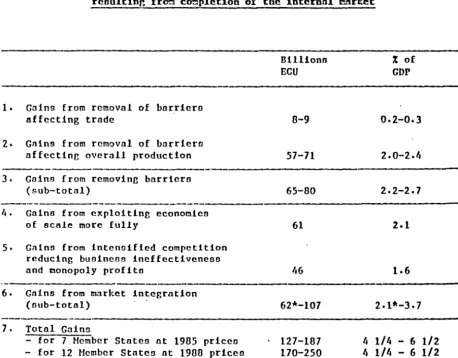
Table 1
Ulcroecononic cot.lnntco of potential cconoruc .;nino for the EC rcoultlnr. froo c~plctlon of the intcronl cnrket
Billiono % of
ECU GDP
G3ins from removal of bnrriero
affecting trade 0-9 0.2-0.J
Gains from removal of barriero
affecting overall production 57-71 2.0-2.4
---3. Gains from removing bnrricro
(sub-total) 65-80 2·2-2.7
----4. Gnlno from exploiting cconomicn
of scale more fully 61 2-1
s.
Gains from intensified competition reducing business ineffectivcnenoand aonopoly profito '•6 1.6
·----6. Gains from market integration
(sub-total) 62*-107 2·1"-3·7
7. Total Gains
- for 7 Member States at 1985 priceo 127-187 4 1/4 - 6 1/2
-
for 12 Member States at 1988 priceo 170-250 4 1/4 - 6 1/2Source: Commission of the EC.
liLT. FIGURP:S EXCEPT In TilE LAST J.INE ARE EXPRESSED AT 198.5 Pnl~S Aim
REl.ATE TO 7 tiEHnEn STATES. TIIF. AGGREGATE rtESUl.T IS SCALED UP In TnmtS
OF THE 12 rtEliDEn STATJ'ItS' 1900 GDl' OllLY Ill nm LAST Lltm.
The ranges for certain linen repreoent the resulto of ueinr; alternative oourceo of information and mcthodologico. The ccvcn Member Stnteo (Germany, France, Italy, United Kingdom, Benelux) account for 88% of the GDP of the EC twelve. Extrapolation of the results in termo of the onme ohnre of GDP for the eeven ·and twelve Member Stnteo io not likely to over-estimate the total for the twelve. The detailed figureo in the table relate only to the oeven Hember Staten because the underlying otudie6 mainly covered thooc countries.
[image:10.586.49.508.114.473.2]nature of economic
policy
lUthout occompnnying econoctic policy aeooureo
Uith occoapany-ing
economic policy ceanuren
ltacroeconomic conoequence~ of EC mnrket intcnrnt1on accoapnnied by economlc policy acnouren
Economic conoequencco GOP Conoumer Employ- Public no priceo ment (ln deficit no % no rnUliono) % point of
% GOP
4.5 -6.1 1-8 2.2
-4.5
s.o
Margin of error: ~ 30%
External balance no % point of
GOP
1.o
-0.2
Source: Commiooion of EC. Simulationo conducted on the IIErutES ond l!tTEnLIUK econo1:1ic rnodelo.
trote: The economic conoequenceo of the mngnitudeo indicated nrc coticntcd to accumulate over a medium-terl:l period.
The accompanying economic policy meaourco (lncrenoed public inveotment, in·come tnx reductlono) nrc calibrated oo that the room for manoeuvre created by internal market integration for the budg~t
[image:11.577.58.513.65.466.2]