eurostat
UMWELTSTATISTIK
ENVIRONMENT STATISTICS
STATISTIQUES DE L'ENVIRONNEMENT
1991
— 7
/
/
/
t
f
t
/
Ξί£
eurostat
STATISTISCHES AMT DER EUROPAISCHEN GEMEINSCHAFTEN STATISTICAL OFFICE OF THE EUROPEAN COMMUNITIES OFFICE STATISTIQUE DES COMMUNAUTÉS EUROPÉENNES L-2920 Luxembourg - Tél. 43 01-1 - Télex: Comeur Lu 3423
B-1049 Bruxelles, bâtiment Berlaymont, rue de la Loi 200 (bureau de liaison) — Tél. 235 1111
Eurostat hat die Aufgabe, den Informa-tionsbedarf der Kommission und aller am Aufbau des Binnenmarktes Beteilig-ten mit Hilfe des europäischen statisti-schen Systems zu decken.
Um der Öffentlichkeit die große Menge an verfügbaren Daten zugänglich zu machen und Benutzern die Orientierung zu erleichtern, werden zwei Arten von Publikationen angeboten: Statistische Dokumente und Veröffentlichungen. Statistische Dokumente sind für den Fachmann konzipiert und enthalten das ausführliche Datenmaterial: Bezugsda-ten, bei denen die Konzepte allgemein bekannt, standardisiert und wissen-schaftlich fundiert sind. Diese Daten werden in einer sehr tiefen Gliederung dargeboten. Die Statistischen Doku-mente wenden sich an Fachleute, die in der Lage sind, selbständig die benötig-ten Dabenötig-ten aus der Fülle des dargebote-nen Materials auszuwählen. Diese Daten sind in gedruckter Form und/oder auf Diskette, Magnetband, CD-ROM verfüg-bar. Statistische Dokumente unterschei-den sich auch optisch von anderen Veröffentlichungen durch den mit einer stilisierten Graphik versehenen weißen Einband.
Die zweite Publikationsart, die Veröffent-lichungen, wenden sich an eine ganz bestimmte Zielgruppe, wie zum Beispiel an den Bildungsbereich oder an Ent-scheidungsträger in Politik und Verwal-tung. Sie enthalten ausgewählte und auf die Bedürfnisse einer Zielgruppe abge-stellte und kommentierte Informationen. Eurostat übernimmt hier also eine Art Beraterrolle.
Fur einen breiteren Benutzerkreis gibt Eurostat Jahrbucher und periodische Veröffentlichungen heraus. Diese enthal-ten statistische Ergebnisse für eine erste Analyse sowie Hinweise auf weiteres Datenmaterial für vertiefende Untersu-chungen. Diese Veröffentlichungen
It is Eurostat's responsibility to use the European statistical system to meet the requirements of the Commission and all parties involved in the development of the single market.
To ensure that the vast quantity of accessible data is made widely avail-able, and to help each user make proper use of this information, Eurostat has set up two main categories of document: statistical documents and publications. The statistical document is aimed at specialists and provides the most com-plete sets of data: reference data where the methodology is well established, standardized, uniform and scientific. These data are presented in great detail. The statistical document is intended for experts who are capable of using their own means to seek out what they re-quire. The information is provided on paper and/or on diskette, magnetic tape, CD-ROM. The white cover sheet bears a stylized motif which distinguishes the statistical document from other publica-tions.
The publications proper tend to be com-piled for a well-defined and targeted public, such as educational circles or political and administrative decision-makers. The information in these docu-ments is selected, sorted and annotated to suit the target public. In this instance, therefore, Eurostat works in an advisory capacity.
Where the readership is wider and less well defined, Eurostat provides the infor-mation required for an initial analysis, such as yearbooks and periodicals which contain data permitting more in-depth studies. These publications are available on paper or in Videotext data-bases.
To help the user focus his research, Eurostat has created 'themes', i.e. a subject classification. The statistical
Pour établir, évaluer ou apprécier les différentes politiques communautaires, la Commission des Communautés euro-péennes a besoin d'informations. Eurostat a pour mission, à travers le système statistique européen, de répon-dre aux besoins de la Commission et de l'ensemble des personnes impliquées dans le développement du marché unique.
Pour mettre à la disposition de tous l'importante quantité de données acces-sibles et faire en sorte que chacun puisse s'orienter correctement dans cet ensemble, deux grandes catégories de documents ont été créées: les docu-ments statistiques et les publications. Le document statistique s'adresse aux spécialistes. Il fournit les données les plus complètes: données de référence où la méthodologie est bien connue, standardisée, normalisée et scientifique. Ces données sont présentées à un niveau très détaillé. Le document statis-tique est destiné aux experts capables de rechercher, par leurs propres moyens, les données requises. Les informations sont alors disponibles sur papier et/ou sur disquette, bande magnétique, CD-ROM. La couverture blanche ornée d'un graphisme stylisé démarque le document statistique des autres publications.
Les publications proprement dites peu-vent, elles, être réalisées pour un public bien déterminé, ciblé, par exemple l'en-seignement ou les décideurs politiques ou administratifs. Des informations sélectionnées, triées et commentées en fonction de ce public lui sont apportées. Eurostat joue, dès lors, le rôle de con-seiller.
les-UMWELTSTATISTIK
ENVIRONMENT STATISTICS
STATISTIQUES DE L'ENVIRONNEMENT
1991
Theme / Thème Environment / Environnement Series / Série Accounts, surveys and statistics / Comptes, enquêtes et statistiques
8
Bibliographische Daten befinden sich am Ende der Veröffentlichung. Cataloguing data can be found at the end of this publication.
EINLEITUNG Zielsetzung
Eurostat legt hiermit im Rahmen des Themenbereichs Umwelt die zweite Ausgabe des statistischen Dokuments
Umweltstatistik vor. Diese regelmäßig erscheinende Veröffentlichung gibt eine systematische und standardisierte Darstellung offizieller und regelmäßiger Statistiken, die für die Gemeinschaftsaktionen zum Schutz der Umwelt von besonderer Bedeutung sind.
Diese Veröffentlichungsreihe trägt damit zur Befriedigung des wachsenden Informationsbedarfs bei, der im Rahmen des fünften Aktionsprogramms der Gemeinschaft Für eine dauerhafte und umweltgerechte Entwicklung; Ein Programm der Europäischen Gemeinschaft für Umweltpolitik und Maßnahmen im Hinblick auf eine dauerhafte und umweltgerechte Entwicklung sowie des gleichzeitig veröffentlichten Berichts über den Zustand der Umwelt in der Europäischen Gemeinschaft, 1992 besonders herausgestellt worden ist. Dieses Aktionsprogramm dient den für die Umweltpolitik im Vertrag über die Europäische Union (Maastricht, 7.2.92) gesetzten Zielsetzungen der Förderung eines dauerhaften und umweltgerechten Wachstums, der Erreichung eines hohen Umweltschutz-niveaus, der Integration des Umweltschutzes in die anderen Politiken der Gemeinschaft und der Förderung der Maßnahmen auf internationaler und globaler Ebene.
Inhalt
Die hier zusammengestellten Statistiken sollen Folgendes liefern:
(a) Indikatoren zur Überwachung und Überprüfung der Auswirkungen der aktuellen Gemeinschaftspolitik auf die Umwelt;
(b) Zahlen, auf deren Grundlage neue umweltpolitische Maßnahmen der Gemeinschaft in Bereichen, die sich als vorrangig zu behandelnde Problemzonen erwiesen haben, konzipiert werden können;
(c) Datenmaterial, das für die Integration des Faktors Umwelt in andere Bereiche der Gemeinschaftspolitik benötigt wird;
(d) Grunddaten, anhand derer die Auswirkungen öffentlicher und privater Projekte auf die Umwelt ermittelt werden können.
Dieser statistische Materialband hat die Aufgabe, den Bericht der Kommission über den Zustand der Umwelt in der Europäischen Gemeinschaft zu ergänzen, indem die zitierten Einzelstatistiken in ihren statistischen Zusammenhang gestellt werden und dadurch zeitliche und räumliche Vergleiche und Interpretationen erleichtert werden.
Beinahe jede Art von statistischem Datenmaterial enthält eine gewisse umweltrelevante Komponente. Bei der Auswahl der in diese Veröffentlichung aufzunehmenden statistischen Reihen wurde ganz bewußt auf folgende Kriterien geachtet:
(e) unmittelbare Relevanz für die aktuelle Umweltpolitik der Gemeinschaft;
(f) unmittelbare Relevanz für die bei zukünftigen Gemeinschaftsmaßnahmen zum Schutz der Umwelt vorrangig zu behandelnden Bereiche;
(g) Verfügbarkeit von qualitativ akzeptablen Daten für mindestens acht Mitgliedstaaten;
(h) Verfügbarkeit von Zeitreihen, da Umweltindikatoren häufig nur als über längere Zeiträume beobachtete Trends aussagekräftig sind;
(i) Basisindikatoren wie Bevölkerungszahl, Fläche und Bruttosozialprodukt, die in jeder Umweltstatistik eine Rolle spielen;
Quellen und Danksagung
Eurostat ist eine Generaldirektion der Kommission der Europäischen Gemeinschaften und verantwortlich für das statistische Informationssystem der Gemeinschaft. Die hier veröffentlichten Statistiken wurden unter Mitwirkung der Mitgliedstaaten, anderen Dienststellen der Kommission und internationalen Organisationen zusammengestellt. Eurostat arbeitet insbesondere eng mit der für Umwelt, Verbraucherschutz und nukleare Sicherheit zuständigen Generaldirektion der Kommission (GD XI) und der Task Force zur Vorbereitung der geplanten Europäischen Umweltagentur zusammen. Daten von internationalem Interesse werden in Zusammenarbeit mit der Organisation für Wirtschaftlichen Zusammenarbeit und Entwicklung (OECD) durch einen gemeinsamen Fragebogen zur
Erfassung ausgewählter Daten bei den Mitglledstaaten und eine gemeinsame Aufbereitung der Daten erarbeitet. Die bei der Erfassung und Veröffentlichung der Umweltstatistiken verwendeten Nomenklaturen und Methoden benutzen soweit wie möglich die von der OECD und der Wirtschaftskommission der UNO für Europa (UNECE) festgelegten Standards und Konzepte.
Eurostat dankt für diese Zusammenarbeit, ohne die diese Veröffentlichung nicht möglich gewesen wäre.
Ausblick
Die zweite Ausgabe ist gegenüber der ersten Auflage durch die Aufnahme neuer Reihen (zum Beispiel weitere Daten zur Abwasserbehandlung,zum Recycling, Statistiken zum Verkehr und zur Landwirtschaft sowie die Waldschadensangaben) und insbesondere einiger Ergebnisse des Corineprogramms (Corinair 1985) der Kommission erweitert. Der Text wurde vollständig überarbeitet.
Die Veröffentlichung ist aber immer noch in Entwicklung und wird in Zukunft weiter ergänzt werden entsprechend den fortschreitenden Arbeiten von Eurostat, den statistischen Dienststellen der Mitgliedstaaten und der internationalen Organisationen an der Harmoisierung der Konzepte und Methoden, der Validation der Daten und der Integration der umweltrelevanten Probleme in den wirtschaftsstatistischen Apparat. Die Beschränkung auf Statistiken, für die lange Zeitreihen und Angaben von allen oder zumindest den meisten Mitgliedstaaten vorliegen, hat ebenfalls die Auswahl der Daten eingeschränkt und zeigt die Lücken und die Größe der Anstrengungen, die noch unternommen werden müssen, um ein befriedigendes System laufender offizieller Statistiken zu entwickeln.
Da die EFTA-Staaten das statistische Programm der europäischen Gemeinschaft im Rahmen des Europäischen Wirtschaftsraumes (EWR) übernommen haben, werden in die nächste Ausgabe dieser Veröffentlichung auch die Daten der EFTA-Staaten integriert.
Luxembourg, den 31. Juli 1992
Dokumentation
Gemeinschaftsrecht im Bereich des Umweltschutzes 1967-1987 (Bd 1 -4)
Generaldirektion Umwelt, Verbraucherschutz und nukleare Sicherheit, Brüssel (Dokument XI/989/87)
Die Lage der Umwelt in den Europäischen Gemeinschaften
Generaldirektion Umwelt, Verbraucherschutz und nukleare Sicherheit, Brüssel (wird 1992 veröffentlicht)
Geltendes Gemeinschaftsrecht
85/337/EWG: Richtlinie des Rates vom 27. Juni 1985 über die Umweltverträglichkeitsprüfung bei bestimmten öffentlichen und privaten Projekten
85/338/EWG: Entscheidung des Rates vom 27. Juni 1985 über die Annahme des Arbeitsprogramms der Kommission für ein Versuchsvorhaben für die Zusammenstellung, Koordinierung und Abstimmung der
Informationen über den Zustand der Umwelt und der natürlichen Ressourcen in der Gemeinschaft (CORINE)
Einheitlich Europäische Akte, 9 September 1985
Vorschlag für eine EntSchliessung des Rates der Europäischen Gemeinschaften über ein Programm der Europäischen Gemeinschaft für Umweltpolitik und Maßnahmen im Hinblick auf eine dauerhafte und umweltgerechte Entwicklung (Teil I vom 3. April 1992)
Für eine dauerhafte und umweltgerechte Entwicklung; Ein Programm der Europäischen Gemeinschaft für Umweltpolitik und Maßnahmen im Hinblick auf eine dauerhafte und umweltgerechte Entwicklung (Teil II vom 3. April 1992)
Der Zustand der Umwelt in der Europäischen Gemeinschaft ; Überblick (Teil III vom 3. April 1992)
Entschließung des Rates vom 19. Juni 1989 über die Durchführung eines Plans für prioritäre Maßnahmen im Bereich der statistischen Information: Statistisches Programm der Europäisches Gemeinschaften (1989-1992).
Verordnung (EWG) 1210/90 des Rates vom 7. Mai 1990 über die Schaffung der Europäischen Umweltagentur und des Europäischen Umweltinformations- und -beobachtungsnetzes
Die Tabellen dieser Publikation sind auf Diskette erhältlich. Alle Anfragen hinsichtlich Daten und Puplikationen von Eurostat sollten gerichtet werden an:
Informationsbüro Eurostat
Bâtiment Jean Monnet L-2920 LUXEMBOURG
Telefon: +352 4301 34567 Telefax: +352 43 64 04
Es ist geplant, diese Veröffentlichung durch, die Aufnahme weiterer geeigneter Daten und die Anwendung neuer Darstellungsverfahren in Zukunft noch zu verbessern. Hinweise der Leser sind ausdrücklich erwünscht und einzusenden an:
John ALLEN
Eurostat - Umwelt (BAK 1638) Bâtiment Jean Monnet
L-2920 LUXEMBURG
INHALTSVERZEICHNIS
EINLEITUNG 3
1. BASISINDIKATOREN 27
1.1 Basisindikatoren 29
2. BEVÖLKERUNG UND BODENNUTZUNG 31
2.1 Bevölkerung 35 2.1.1 Bevölkerung 35
2.1.2 Bevölkerungszunahme 35 2.1.3 Bevölkerungsdichte 36
2.2 Bodennutzung 37 2.2.1 Gesamtfläche Ì....37
2.2.2 Ackerland 38 2.2.3 Ackerland, Anteil an der Gesamtfläche 38
2.2.4 Dauergrünland 39 2.2.5 Dauergrünland, Anteil an der Gesamtfläche 39
2.2.6 Dauerkulturen 40 2.2.7 Dauerkulturen, Anteil an der Gesamtfläche 40
2.2.8 Waldfläche 41 2.2.9 Waldfläche, Anteil an der Gesamtfläche 41
2.2.10 Sonstige Flächen 43 2.2.11 Sonstige Flächen, Anteil an der Gesamtfläche 43
2.2.12 Gewässer '.. 44 2.2.13 Gewässe, Anteil an der Gesamtfläche 44
2.3 Stadt- und Landbevölkerung 45 2.3.1 Anteil der Bevölkerung in Siedlungsgebieten mit >100 000 Einwohnern 45
2.3.2 Anteil der Bevölkerung in Siedlungsgebieten mit <2 000 Einwohnern 45
3. ENERGIE 47
3.1 Primärenergiebedarf 53 3.1.1 Insgesamt 53 3.1.2 Insgesamt, je Einwohner 53
3.1.3 Erdgas 54 3.1.4 Erdgas, als Anteil von insgesamt 54
3.1.5 Flüssige Brennstoffe 55 3.1.6 Flüssige Brennstoffe, als Anteil von insgesamt 55
3.1.7 Feste Brennstoffe 56 3.1.8 Feste Brennstoffe, als Anteil von insgesamt 56
3.1.9 Kernenergie 57 3.1.10 Kernenergie, als Anteil von insgesamt 57
3.1.11 Wasserkraft 58 3.1.12 Wasserkraft, als Anteil von insgesamt 58
3.2 Endenergieverbrauch
3.2.9 Landwirtschaft und Fischerei, als Anteil von insgesamt 65 3.2.10 Haushalte und sonstige, als Anteil von insgesamt 65
3.3 Stromverbrauch. 66 3.3.1 Insgesamt 66 3.3.2 Als Anteil vom gesamten Endenergieverbrauch 66
3.4 Stromerzeugung .67 3.4.1 Insgesamt 67 3.4.2 Anteil aus der Kernenergie 67
3.4.3 Anteil des aus fossilen Brennstoffen erzeugten Stroms 68 3.4.4 Anteil des durch Wasserkraft und Erdwärme erzeugten Stroms 68
3.5 Erneuerbare Energien '. 69
3.5.1 Primärenergieerzeugung 1989 69
4. KOHLENDIOXID ¿ 71
4.1 Kohlendioxid-Emissionen 74 4.1.1 Sämtliche fossilen Brennstoffe 74
4.1.2 Sämtliche fossilen Brennstoffe, je Einwohner 74
4.1.3 Erdgas... 75 4.1.4 Erdgas, je Einwohner 75
4.1.5 Flüssige Brennstoffe .76 4.1.6 Flüssige Brennstoffe, je Einwohner 76
4.1.7 Feste Brennstoffe 77 4.1.8 Feste Brennstoffe, je Einwohner 77
4.1.9 Potentielle C02 Emissionen... 78
4.1.10 Potentielle C02 Emissionen, je Einwohner 78
5. SCHWERMETALLE 79
5.1 Blei 82 5.1.1 Bleiverbrauch 82
5.1.2 Emissionen von Kraftfahrzeugen mit Benzinmotor 82
5.1.3 Lieferungen von bleifreiem Benzin 83 5.1.4 Lieferungen von bleifreiem Benzin, als Anteil an den Gesamtlieferungen 83
5.1.5 Steuerliche Unterschiede zwischen bleihaltigem und bleifreiem Benzin 84 5.2 Quecksilber .· „..85
5.2.1 Verbrauch , 85
6. SONSTIGE STOFFE 87
6.1 Fluorchlorkohlenwasserstoffe 92 6.1.1 FCKW-11, 12 92 6.1.2 FCKW-11, 12, 113, 114, 115 93
6.1.3 Halon-1211, 1301, 2402 94
7. LUFTVERSCHMUTZUNG 95
7.1 Schwefeloxid-Emissionen 101 7.1.1 Insgesamt 101 7.1.2 Insgesamt, je Einwohner 101
7.1.3 Bewegliche Emittenten 102 7.1.4 Ortsfeste Emittenten 102 7.1.5 CORINAIR Bestandsnachweis 1985 104
7.2 Stickstoffoxid-Emissionen.. 113 7.2.1 Insgesamt... 113 7.2.2 Insgesamt, je Einwohner 113
7.3 Staubemissionen 125 7.3.1 Insgesamt 125 7.3.2 Insgesamt, je Einwohner 125
7.3.3 Bewegliche Emittenten 126 7.3.4 Ortsfeste Emittenten .126 7.4 Kohlenmonoxidemissionen 127
7.4.1 Insgesamt 127 7.4.2 Insgesamt, je Einwohner 127
7.4.3 Bewegliche Emittenten 128 7.4.4 Ortsfeste Emittenten 128 7.5 Emissionen durch flüchtige organische Verbindungen 129
7.5.1 Insgesamt 129 7.5.2 Insgesamt, je Einwohner 129
7.5.3 Bewegliche Emittenten 130 7.5.4 Ortsfeste Emittenten .130 7.5.5 CORINAIR Bestandsnachweis 1985 132
8. WASSER 145
8.1 Wasserentnahme 148 8.1.1 Insgesamt 148 8.1.2 Insgesamt, je Einwohner... 148
8.1.3 Oberflächenwasser 149 8.1.4 Grundwasser 149 8.2 Abwasserbehandlung 150
8.2.1 Kläranlagen: insgesamt 150 8.2.2 Kläranlagen: mit mindestens sekundärer Behandlung 151
8.2.3 Kläranlagen: mit tertiärer Behandlung 151 8.2.4 Anschluß der Bevölkerung an Kläranlagen 152 8.2.5 Anschluß der Bevölkerung an Kläranlagen: mit nur Erstbehandlung 152
8.3 Wasserqualität ausgewählter Flüsse 153 8.3.1 Gelöster Sauerstoff 153
8.3.2 Biologischer Sauerstoffbedarf (BSB) '. 154
8.3.3 Nitrate 155 8.3.4 Ammonium 156 8.3.5 Phosphor insgesamt 157
8.3.6 Blei 158 8.3.7 Kadmium... 159
8.3.8 Chrom 160
8.3.9 Kupfer '. 161
8.4 Wasserqualität ausgewählter Seen 162 8.4.1 Phosphor insgesamt 162 8.4.2 Stickstoff insgesamt 163
9 ABFALL 165
9.1 Abfall nach Herkunft 171 9.1.1 Abfallaufkommen, in den 80er Jahren 171
9.5 Rückgewinnung von Metallen 178 9.5.1 Aluminium (Al) 178 9.5.2 Kobalt (Co) 178 9.5.3 Chrom (Cr) 179 9.5.4 Kupfer (Cu) 179 9.5.5 Eisen (Fe) 180 9.5.6 Quecksilber (Hg) 180
9.5.7 Blei(Pb) 181 9.5.8 Nickel (Ni) 181 9.5.9 Antimon (Sb) 182
9.5.10 Zinn (Sn) ; 182
9.5.11 Wolfram (W) , 183
9.5.12 Zink(Zn) ...178
10. SEKTORINDIKATOREN: VERKEHR 185
10.1 Verkehr: allgemeine Trends 188 10.1.1 Bestandan Fahrzeugen: Personenkraftwagen 188
10.1.2 Länge des Straßennetzes: Autobahnen 188
10.1.3 Personen-Wagenkilometer 189 10.1.4 Güter-Wagenkilometer 189 10.1.5 Eisenbahn: mittlere Betriebslänge der Strecken 190
10.1.6 Eisenbahn: Personenverkehr ..: 190
10.1.7 Eisenbahn: Güterverkehr (ohne Transit) 191
10.1.8 Binnenschiffahrt: Güterverkehr 191
10.2 Ausgaben für die Infrastruktur 192 10.2.1 Straßen, Wechselkurse und Preise von 1980 192
10.2.2 Straßen, als Anteil vom BIP 192 10.2.3 Eisenbahn, Wechselkurse und Preise von 1980 193
10.2.4 Eisenbahn, als Anteil vom BIP 193
11. SEKTORINDIKATOREN: LANDWIRTSCHAFT 195
11.1 Landwirtschaft: allgemeine Trends 198 11.1.1 Endproduktion (zu konstanten Preisen von 1985) 198
11.1.2 Anteil der tierischen Produktion an der Endproduktion 198 11.1.3 Anteil der pflanzlichen Produktion an der Endproduktion 199
11.1.4 Rinderbestand im Dezember 199 . 11.1.5 Schweinebestand im Dezember 200
11.1.6 Landwirtschaftliche Nutzfläche 200
11.2 Landwirtschaft: Verbrauch 201
11.2.1 Anteil des Energieverbrauchs an der Endproduktion '. 201
11.2.2 Anteil des Düngemittelverbrauchs an der Endproduktion 201 11.2.3 Anteil des Pflanzenschutzmittelverbrauchs an der Endproduktion 202
11.2.4 Verbrauch von Stickstoffdüngern 202 11.2.5 Verbrauch von Phosphatdüngern 203 11.2.6 Verbrauch von Handelsdüngern 203 11.2.7 Trends im Verbrauch von Insektiziden 204 11.2.8 Trends im Verbrauch von Fungiziden 204 11.2.9 Trends im Verbrauch von Herbiziden 205
12.SCHUTZ DER NATÜRLICHEN RESSOURCEN 207
12.1 / Handel mit Tropenholz 212 12.1.1 Nettoeinfuhren in Mengen 212
12.1.2 Nettoeinfuhren nach Wert 212 12.2 Handel mit Fellen von wilden Katzen 213
12.2.1 Rohfelle: Nettoeinfuhren in Mengen 213 12.2.2 Rohfelle: Nettoeinfuhren nach Wert 213 12.2.3 Bearbeitete Felle: Nettoeinfuhren in Mengen 214
12.3 Waldschadenserhebung 215 12.3.1 Baumanteil in drei Entfärbungsstufen 215
12.3.2 Baumanteil in drei Entlaubungsstufen 216
13. UMWELTBEWUSSTSEIN 217
13.1 Die Öffentliche Meinung hinsichtlich der Bedeutung von Umweltproblemen 220
13.1.1 Die Umwelt in Beziehung zu anderen Problemen 220
13.1.2 Ausgewählte Umweltprobleme 221 13.2 Die öffentliche Meinung zu Ursachen von Umweltproblemen 222
13.2.1 Der Treibhauseffekt 222 13.2.2 Saurer Regen .223 13.2.3 Abbau der Ozonschicht 224
13.3 Die öffentliche Meinung in bezug auf Umweltaktivitäten 225 13.3.1 Aktivitäten der Europäischen Gemeinschaften 225
Abkürzungen und Zeichen 227
Quellen 233
Ausgewählte offizielle Veröffentlichungen der Umweltstatistik 234
VERZEICHNIS DER ABBILDUNGEN
Abbildung 1.1:
Bruttoinlandsprodukt (BIP) pro Einwohner (1989).nach Regionen (NUTS 2) 28
Abbildung 2.1:
Bevölkerungsdichte (1989) nach Regionen (NUTS 2) 34 Abbildung 2.2
Anteil Waldfläche an der Gesamtfläche nach Regionen (NUTS 2) 42
Abbildung 71 :
Schwefeloxid-Emissionen in Europa (1985) nach Regionen (NUTS3) 103 Abbildung 7.2:
INTRODUCTION
Objectives
Eurostat presents here, in the framework of the theme Environment, the second edition of the statistical document
Environment Statistics. This publication, which appears at regular intervals, aims to offer in a systematic and standardized manner a set of regular and official statistics which are directly relevant to Community action on the environment.
This publication contributes to the satisfaction of the growing need for information which has been especially highlighted by the fifth Community environmental action programme Towards sustainability: a European Community programme of policy and action in relation to the environment and sustainable development and in the Commission's report on the State of the environment in the European Community 1992. This action programme serves the objectives of the Treaty on European Union (signed at Maastricht on 7 February 1992): the promotion of sustainable growth respecting the environment, the aim of a high level of protection, the integration of environmental protection requirements into other Community policies and contribution to promoting measures at international and global level.
Contents
The statistics presented aim to deliver the following:
(a) indicators for monitoring and verifying the effects of existing Community policies on the environment;
(b) quantitative information assisting the formation of new environmental policies for the Community, on. subjects which have been identified as priority areas for Community action;
(c) information required for integration of the environmental dimension in other Community policies;
(d) basic data required for assessment of the environmental impact of public and private projects.
This publication of basic quantitative data has the objective of complementing the Commission's report on the Sfare of the Environment in the European Community putting the figures quoted in the report into a statistical framework which facilitates the interpretation of trends over time and comparisons in space.
Almost any statistical data may have some environmental relevance; the scope of this publication has been deliberately focused by choosing statistical series according to the following criteria:
(e) direct relevance to existing Community environmental policies;
(f) direct relevance to priority areas for future Community action on the environment;
(g) availability of data of reasonable quality for at least eight Member States;
(h) availability of time series, since environmental indicators can frequently be interpreted only in terms of trends over long periods;
(i) basic indicators, such as population, land area and gross national product, which are involved in the presentation of all environment statistics;
0) compliance with standard statistical nomenclatures and methodology.
Sources and acknowledgement
statistics follow the standards established by OECD and by the United Nations Economic Commission for Europe (UNECE).
Eurostat acknowledges this collaboration, without which this publication would not have been possible.
Outlook
The second edition has been enlarged compared with the first edition by the introduction of new series (for example, more data on waste water treatment and on recycling, statistics on transport and agriculture, data from forest health surveys) and by the incorporation of some results of the Commission's CORINE programme (the 1985 CORINAIR emissions inventory). The text has been completely updated.
This publication is still in development; it will be enlarged, and gaps filled in the future, as Eurostat, the Member States and the international statistical organisations make progress in the harmonisation of concepts and methods, in the validation of the data and in the integration of the environmental issues in the main body of socio-economic statistics. The restriction to statistics which are available over a long series of years and for all or most Member States has also limited the choice of data and illustrates the gaps and the great efforts which still have to be made on the way to the establishment of regular offical environment statistics.
As the EFTA countries have adopted the Community Statistical Programme in the framework of the European Economic Area (EEA), the next edition will integrate the data for the EFTA countries in close cooperation with their national statistical offices.
Luxembourg, 31 July 1992
Documentation
European Community environmental legislation 1967-1987 (Vols 1-4)
Directorate-General for Environment, Consumer Protection and Nuclear Safety, Brussels (Document XI/989/87)
The state of the environment in the European Community 1989
Directorate-General for Environment, Consumer Protection and Nuclear Safety, Brussels (to be published in 1992)
Community Legislation
Council Directive 85/337/EEC of 27 June 1985 on the assessment of the effects of certain public and private projects on the environment
Council Decision 85/338/EEC of 27 June 1985 on the adoption of the Commission work programme concerning an experimental project for gathering, coordinating and ensuring the consistency of information on the state of the environment and natural resources in the Community (the CORINE project)
Single European Act, 9 September 1985
Proposal for a Resolution of the Council of the European Communities on a Community programme of policy and action in relation to the environment and sustainable development (Volume I; 27 March 1992)
Towards Sustainability; A European Community Programme of Policy and Action in relation to the Environment and Sustainable Development (Volume II; 27 March 1992)
The State of the Environment in the European Community (Volume III; 27 March 1992)
Council Resolution of 19 June 1989 on the implementation of a plan of priority actions in the field of statistical information: Statistical Programme of the European Communities (1989 to 1992)
Council Regulation (EEC) 1210/90 of 7 May 1990 on the establishment of the European Environment Agency and the European environment information and observation network
The tables from this publication are available on diskette. All requests for Eurostat data and publications should be sent to:
Information Bureau Eurostat
Bâtiment Jean Monnet L-2920 LUXEMBOURG
Phone: +352 4301 34567 Fax: +352 43 64 04
It is planned to improve this publication in the future by the inclusion of further suitable data and by new methods of presentation. Comments from readers are welcome and should be sent to:
John ALLEN
Eurostat - Environment (BAK 1638) Bâtiment Jean Monnet
L-2920 LUXEMBOURG
CONTENTS
INTRODUCTION 11
1. BASIC INDICATORS 27
1.1 Basic indicators , 29
2.. POPULATION AND LAND USE 32
2.1 Population 35
2.1 ;1 Population 35
2.1.2 Population growth '. 35
2.1.3 Population density .36
2.2 Land use 37
2.2.1 Total area 37
2.2.2 Arable land : 38
2.2.3 Arable land, as proportion of total area 38
2.2.4 Permanent grassland 39
2.2.5 Permanent grassland, as proportion of total area 39
2.2.6 Perennial crops 40
2.2.7 Perennial crops, as proportion of total area 40
2.2.8 Woodland 41
2.2.9 Woodland, as proportion of total area 41
2.2.10 Other land 43
2.2.11 Other land, as proportion of total area 43
2.2.12 Inland waters 44
2.2.13 Inland waters, as proportion of total area 44
2.3 Urban and rural population... 45
2.3.1 Proportion of population living in settlements >100 000 inhabitants 45 2.3.2 Proportion of population living in settlements <2 000 inhabitants 45
3. ENERGY 49
3.1 Primary energy requirement 53
3.1.1 Total 53
3.1.2 Total, per capita : 53
3.1.3 Natural gas ....54
3.1.4 Natural gas, as proportion of total 54
3.1.5 Liquid fuels 55
3.1.6 Liquid fuels, as proportion of total 55
3.1.7 Solid fuels .■ 56
3.1.8 Solid fuels, as proportion of total 56
3.1.9 Nuclear energy 57
3.1.10 Nuclear energy, as proportion of total 57
3.1.11 Hydroelectric energy 58
3.1.12 Hydroelectric energy, as proportion of total 58
3.2 Final energy consumption
3.2.9 Agriculture and fisheries, as proportion of total....: 65
3.2.10 Households and others, as proportion of total 65
3.3 Electricity consumption 66
3.3.1 Total : : 66
3.3.2 As proportion of total final energy consumption 66
3.4 Electricity generation 67
3.4.1 Total '. 67
3.4.2 Proportion derived from nuclear energy 67
3.4.3 Proportion derived from fossil fuels 68
3.4.4 Proportion derived from hydroelectric and geothermal sources 68
3.5 Renewable energy , 69
3.5.1 Primary energy production in 1989 69
4. CARBON DIOXIDE 72
4.1 Carbon dioxide emissions 74
4.1.1 All fossil fuels 74
4.1.2 All fossil fuels, per capita 74
4.1.3 Natural gas 75
4.1.4 Natural gas, per capita ...75
4.1.5 Liquid fuels 76
4.1.6 Liquid fuels, per capita.. 76
4.1.7 Solid fuels ■...:. 77
4.1.8 Solid fuels, per capita 77
4.1.9 Potential C02 emissions 78
4.1.10 Potential C02 emissions, per capita 78
5. HEAVY METALS 80
5.1 Lead , ; 82
5.1.1 Lead consumption 82
5.1.2 Emissions from petrol engined motor vehicles 82
5.1.3 Deliveries of unleaded petrol 83
5.1.4 Deliveries of unleaded petrol, as proportion of total deliveries 83
5.1.5 Tax differentials between leaded and unleaded petrol 84
5.2 Mercury :...85
5.2.1 Consumption 85
6. OTHER MATERIALS 89
6.1 Chlorofluorocarbons .92
6.1.1 CFC-11,12 92
6.1.2 CFC-11,12, 113, 114,115....; 93
6.1.3 Halon-1211, 1301, 2402 ...94
7. AIR POLLUTION 97
7.1 Emissins of sulphur oxides 101
7.1.1 Total 101
7.1.2 Total, per capita 101
7.1.3 Mobile sources 102
7.1.4 Stationary sources 102
7.1.5 CORINAIR inventory 1985 104
7.2 Emissions of nitrogen oxides 113
7.2.1 Total 113
7.2.2 Total, per capita 113
7.2.3 Mobile sources 114
7.2.4 Stationary sources 114
8. WATER
8.1
7.3 Emissions of particles , 125
7.3.1 Total 125 7.3.2 Total, per capita... 125
7.3.3 Mobile sources : 126
7.3.4 Stationary sources 126 7.4 Emissions of carbon monoxide 127
7.4.1 Total 127 7.4.2 Total, per capita 127
7.4.3 Mobile sources 128 7.4.4 Stationary sources 128 7.5 Emissions of volatile organic compounds 129
7.5.1 Total .129 7.5.2 Total, per capita 129
7.5.3 Mobile sources 130 7.5.4 Stationary sources 130 7.5.5 CORINAIR inventory 1985 :... 132
146
Water withdrawal 148 8.1.1 Total 148 8.1.2 Total per capita 148
8.1.3 Surface water 149 8.1.4 Groundwater 149 8.2 Waste water treatment 150
8.2.1 Waste water treatment plants: total 150 8.2.2 Waste water treatment plants: with at least secondary treatment 151
8.2.3 Waste water treatment plants: with tertiary treatment 151 8.2.4 Population serves by waste water treatment plants 152 8.2.5 Population serves by waste water treatment plants: with primary treatment only 152
8.3 Walter quality indicators for selected rivers 153
8.3.1 Dissolved oxygen 153 8.3.2 Biological oxygen demand (BOD) 154
8.3.3 Nitrate 155 8.3.4 Ammonium 156 8.3.5 Total phosphorus 157
8.3.6 Lead 158 8.3.7 Cadmium 159 8.3.8 Chromium 160 8.3.9 Copper ..· 161
8.4 Water quality indicators for selected lakes 162
8.4.1 Total phosphorus, 162 8.4.2 Total nitrogen 163
9. WASTES 167
9.1 Waste by source 171 9.1.1 Amounts of waste generated, 1980s 171
9.2 Industrial, hazardous and special waste 172
9.5 Recycling of metals 178 9.5.1 Aluminium (Al) 178 9.5.2 Cobalt (Co) 178 9.5.3 Chromium (Cr) 179 9.5.4 Copper (Cu) 179 9.5.5 Iron (Fe) 180 9.5.6 Mercury (Hg) 180 9.5.7 Lead (Pb) 181 9.5.8 Nickel (Ni) 181 9.5.9 Antimony (Sb) 182 9.5.10 Tin (Sn) 182 9.5.11 Tungsten (W) 183 9.5.12 Zinc(Zn) 183
10. SECTORAL INDICATORS: TRANSPORT 186
10.1 Transport: general trends 188 10.1.1 Stock of vehicles: cars 188 10.1.2 Length of road network: motorways 188
10.1.3 Passenger vehicle-kilometres 189 10.1.4 Goods vehicle-kilometres 189 10.1.5 Railways: average length of lines worked 190
10.1.6 Railways: passenger traffic 190 10.1.7 Railways: goods traffic (excluding transit traffic) 191
10.1.8 Inland waterways: goods traffic 191
10.2 Infrastructure expenditure 192 10.2.1 Road, 1980 prices and exchange rates 192
10.2.2 Roads: as proportion of GDP 192 10.2.3 Railways, 1980 pricesand exchange rates 193
10.2.4 Railways, as proportion of GDP 193
11. SECTORAL INDICATORS: AGRICULTURE 194
11.1 Agriculture: general trends 198 11.1.1 Final output (at constant 1985 prices) 198
11.1.2 Animal output as proportion of final output 198 11.1.3 Crop output as proportion of final output 199
11.1.4 Cattle population in December 199 11.1.5 Pig population in December.. 200
11.1.6 Agriculture used area 200 11.2 Agriculture: inputs : 201
11.2.1 Energy input as proportion of final output 201 11.2.2 Fertilizer input as proportion of final output 201 11.2.3 Pesticide input as proportion of final output 202
11.2.4 Consumption of nitrogen fertilizers 202 11.2.5 Consumption of phosphate fertilizers 203 11.2.6 Consumption of commercial fertilizers 203 11.2.7 Trends in the consumption of insecticides 204 11.2.8 Trends in the consumption of fungicides 204 11.2.9 Trends in the consumption of herbicides 205
12. CONSERVATION OF NATURAL RESOURCES 209
12.1 Trade in tropical hardwoods 212 12.1.1 Net imports, by quantity. 212 12.1.2 Net imports, by value 212 12.2 Trade in furskins of wild felines 213
12.2.1 Raw furskins: net imports, by quantity 213 12.2.2 Raw furskins: net imports, by value 213 12.2.3 Tanned or dressed furskins: net imports, by quantity 214
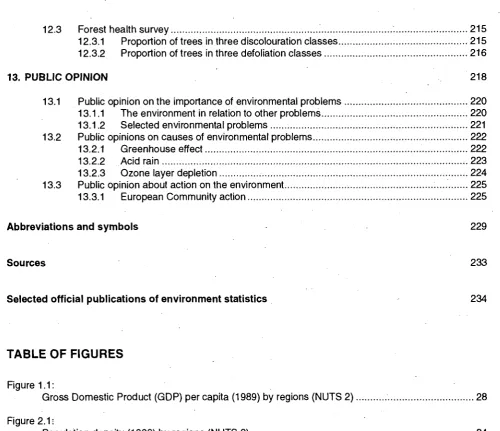
12.3 Forest health survey 215 12.3.1 Proportion of trees in three discolouration classes 215
12.3.2 Proportion of trees in three defoliation classes 216
13. PUBLIC OPINION 218
13.1 Public opinion on the importance of environmental problems 220 13.1.1 The environment in relation to other problems 220
13.1.2 Selected environmental problems 221 13.2 Public opinions on causes of environmental problems 222
13.2.1 Greenhouse effect 222
13.2.2 Acid rain 223 13.2.3 Ozone layer depletion 224
13.3 Public opinion about action on the environment 225
13.3.1 European Community action 225
Abbreviations and symbols 229
Sources 233
[image:20.595.37.552.0.842.2]Selected official publications of environment statistics 234
TABLE OF FIGURES
Figure 1.1:
[image:20.595.38.539.23.454.2]Gross Domestic Product (GDP) per capita (1989) by regions (NUTS 2) 28
Figure 2.1:
Population density (1989) by regions (NUTS 2) 34
Figure 2.2
Woodland as proportion of total area by regions (NUTS 2) 42
Figure 71 :
Emissions of sulphur oxides in Europe (1985) byregions (NUTS3) 103
Figure 7.2:
[image:20.595.45.555.227.834.2]INTRODUCTION
Objectifs
Eurostat présente dans le cadre du thème Environnement la deuxième édition du document statistique Statistiques de l'environnement. Cette publication, qui paraît à intervalles réguliers, met à portée de la main des utilisateurs d'une manière systématique et standardisée un ensemble de statistiques régulières et officielles s.ë rapportant directement aux actions de la Communauté sur l'environnement.
Cette publication contribue à satisfaire le besoin grandissant en informations environnementales qui est
spécialement souligné dans ie cadre du cinquième programme d'action de la Communauté Vers un
développement soutenable; Programme Communautaire de Politique et d'Action pour l'Environnement et le Développement Durable et Respectueux de l'Environnement et dans le rapport de la Commission publié en même temps sur L'Etat de l'Environnement dans la Communauté Européenne, 1992.
Ce programme d'action met en oeuvre les objectifs du traité sur l'Union européenne ( Maastricht, le 7. 2.1992): la promotion d'une croissance durable et respectueuse de l'environnement, la réalisation d'un niveau de protection élevé , l'intégration des exigences en matière de protection de l'environnement dans les autres politiques de la Communauté et, sur le plan international, la promotion de mesures destinées à faire face aux problèmes régionaux ou planétaires de l'environnement.
Contenu
Les statistiques rassemblées ici doivent fournir :
a) des indicateurs pour contrôler et vérifier les effets des politiques communautaires existantes sur l'environnement ;
(b) des informations quantitatives facilitant l'élaboration de nouvelles politiques sur l'environnement pour la Communauté sur des thèmes ayant été identifiés comme prioritaires pour l'action de la Communauté ;
(c) des informations nécessaires pour intégrer la dimension de l'environnement dans d'autres politiques de la Communauté ;
(d) des données de base nécessaires pour évaluer l'impact des projets publics et privés sur l'environnement.
Cette publication a aussi pour vocation de compléter le rapport de la Commission sur L'Etat de l'environnement dans la Communauté Européenne en replaçant les statistiques utilisées dans un cadre statistique cohérent permettant de suivre l'évolution dans le temps et de faciliter la comparabilité dans l'espace.
Pratiquement toutes les données statistiques peuvent avoir un rapport avec l'environnement ; c'est dans un but délibéré que l'on a choisi pour cette publication des séries statistiques qui satisfont aux critères suivants :
(e) rapport direct avec les politiques existantes de la Communauté sur l'environnement ;
(f) rapport direct avec les domaines prioritaires de l'action future de la Communauté sur l'environnement ;
(g) disponibilité de données d'une qualité raisonnable pour au moins huit Etats membres ;
(h) disponibilité de séries chronologiques étant donné que les indicateurs sur l'environnement ne peuvent être fréquemment interprétés qu'en termes de tendances sur de longues périodes ;
(i) indicateurs de base tels que population, superficie agricole et produit national brut qui sont utilisés dans la présentation de toutes les statistiques sur l'environnement ;
Sources et remerciements
Eurostat est une Direction générale de la Commission des communautés européennes, en charge du système d'information statistique communautaire. Les statistiques publiées dans la présente publication sont le produit d'une collaboration avec les services statistiques des Etats membres, d'autres services de la Commission et des organisations internationales statistiques. Eurostat travaille notamment en étroite collaboration avec la Direction générale de la Commission "Environnement, sécurité nucléaire et protection civile" (DG XI), y compris la Task Force chargée de la préparation de la future Agence européenne pour l'environnement. Pour la collecte et le traitement des données d'un intérêt international, Eurostat coopère étroitement avec l'Organisation de coopération et de développement économiques (OCDE), dans le but d'obtenir des données sélectionnées à l'aide d'un questionnaire commun adressé aux Etats membres. Dans la mesure du possible, la nomenclature et les méthodes utilisées pour la collecte et la publication des statistiques sur l'environnement sont conformes aux standards et concepts établis par l'OCDE et par la Commission économique pour l'Europe des Nations unies (CEE/NU).
Eurostat tient à adresser ses remerciements pour ces différentes collaborations sans lesquelles cette publication n'aurait pu être élaborée.
Perspectives
La deuxième publication a été complétée, par rapport à la première édition, par l'insertion de nouvelles séries, notamment sur le traitement des eaux usées, le recyclage, le transport et l'agriculture, et de quelques résultats du programme Corine de la Commission (Corinair 1985). Cette publication est toujours en développement et sera complétée dans le futur au fur et à mesure de l'avancement des travaux d'Eurostat, des services statistiques des Etats membres et des organisations statistiques internationales sur l'harmonisation des concepts et des méthodes, la validation des données et l'intégration des problèmes de l'environnement dans l'appareil des statistiques socio-économiques. La restriction aux données disponibles pour l'ensemble des Etats Membres et sur de longues périodes a limité le choix et montre les lacunes et l'immense effort encore à accomplir dans l'établissement d'un système satisfaisant de statistiques officielles et régulières.
Comme les pays de l'AELE ont adopté le programme statistique communautaire dans le cadre de l'Espace Economique Européen (EEE), la prochaine édition intégrera des données en provenance de ces pays, par l'intermédiaire de leurs offices statistiques nationaux.
Luxembourg, 31 juillet 1992
Eurostat, Direction F
Documentation
Législation de la Communauté européenne sur l'environnement 1967-1987 (Vol. 1-4)
Direction générale Environnement, sécurité nucléaire et protection civile, Bruxelles (Document XI.989/87)
L'état de l'environnement dans la Communauté européenne
Direction générale Environnement, sécurité nucléaire et protection civile, Bruxelles (à paraître en 1992)
Législation communautaire
Directive du Conseil 85/337/CEE du 27 juin 1985, concernant l'évaluation des incidences de certains projets publics et privés sur l'environnement
Décision du Conseil 85/338/CEE du 27 juin 1985, relative à l'adoption du programme de travail de la Commission concernant un projet expérimental pour la collecte, la coordination et la mise en cohérence de l'information sur l'état de l'environnement et des ressources naturelles dans la Communauté (le projet CORINE)
Acte unique européen du 9 septembre 1985
Proposition de Résolution du Conseil des Communautés européennes concernant un programme communautaire de politique et d'action en matière d'environnement et de développement soutenable (Volume I; 30 mars 1992)
Vers un développement soutenable; Programme Communautaire de Politique et d'Action pour lÄEnvironnement et le Développement Durable et Respectueux de l'Environnement (Volume II; 30 mars 1992)
L'Etat de l'Environnement dans la Communauté Européenne; Apercu (Volume III; 30 mars 1992)
Résolution du Conseil du 19 juin 1989, relative à la mise en oeuvre d'un plan d'actions prioritaires dans le domaine de l'information statistique: Programme statistique des Communautés européennes (1989-1992).
Règlement (CEE) 1210/90 du Conseil relatif à la création de l'agence européenne pour l'environnement et du réseau européen d'information et d'observation pour l'environnement
Les tableaux contenus dans cette publication sont disponibles sur'disquette. Toutes demandes concernant des données et des publications Eurostat doivent être adressées à:
Information Bureau Eurostat
Bâtiment Jean Monnet L-2920 LUXEMBOURG
Téléphone: +352 4301 34567 Fax: +352 43 64 04
Il est prévu à l'avenir d'améliorer la présente publication en y incluant d'autres données intéressantes et en utilisant de nouvelles méthodes de présentation. Les lecteurs sont invités à faire des commentaires et à les envoyer à :
John ALLEN
Eurostat - Environnement (BAK 1638) Bâtiment Jean Monnet
L-2920 LUXEMBOURG
CONTENU
INTRODUCTION 19
1. INDICATEURS DE BASE 27
1.1 Indicateurs de base 29
2. POPULATION ET UTILISATION DES SOLS 33
2.1 Population 35 2.1.1 Population 35
2.1.2 Croissance démographique 35 2.1.3 Densité de population 36
2.2 Utilisation des sols 37 2.2.1 Superficie totale 37 2.2.2 Terres arables 38 2.2.3 Terres arables, proportionnellement à la superficie totale 38
2.2.4 Prairies permanentes 39 2.2.5 Prairies permanentes, proportionnellement à la superficie totale 39
2.2.6 Cultures permanentes 40 2.2.7 Cultures permanentes, proportionnellement à la superficie totale 40
2.2.8 Superficies boisées 41 2.2.9 Superficies boisées, proportionnellement à la superficie totale 41
2.2.10 Autres sols 43 2.2.11 Autres sols, proportionnellement à la superficie totale 43
2.2.12 Eaux intérieures 44 2.2.13 Eaux intérieures, proportionnellement à la superficie totale 44
2.3 Population urbaine et rurale 45 2.3.1 Proportion de la population vivant en agglomérations de >100 000 habitants 45
2.3.2 Proportion de la population vivant en agglomérations de <2 000 habitants 45
3. ENERGIE 51
3.1 Besoins en énergie primaire 53
3.1.1 Total 53 3.1.2 Total, par habitant 53
3.1.3 Gaz naturel 54 3.1.4 Gaz naturel, proportionnellement au total ...54
3.1.5 Combustibles liquides 55 3.1.6 Combustibles liquides, proportionnellement au total , 55
3.1.7 Combustibles solides 56 3.1.8 Combustibles solides, proportionnellement au total 56
3.1.9 Energie nucléaire 57 3.1.10 Energie nucléaire, proportionnellement au total 57
3.1.11 Energie hydro-électrique 58 3.1.12 Energie hydro-électrique, proportionnellement au total 58
3.2 Consommation finale énergétique
3.2.9 Agriculture et pêche, proportionnellement au total 65 3.2.10 Foyers domestiques et autres, proportionnellement au total 65
3.3 Consommation d'électricité 66
3.3.1 Total 66 3.3.2 Proportionnellement à la consommation finale énergétique totale 66
3.4 Production d'électricité : 67
3.4.1 Total 67 3.4.2 Part dérivée de l'énergie nucléaire 67
3.4.3 Part des combustibles fossiles 68 3.4.4 Part des sources hydro-électriques et géothermiques 68
3.5 Energie renouvelable 69 3.5.1 Production d'énergie primaire en 1989 69
4. DIOXYDE DE CARBONE 73
4.1 Emissions de dioxyde de carbone 74 4.1.1 Tous combustibles fossiles 74 4.1.2 Tous combustibles fossiles, par habitant 74
4.1.3 Gaz naturel 75 4.1.4 Gaz naturel, par habitant 75
4.1.5 Combustibles liquides 76 4.1.6 Combustibles liquides, par habitant 76
4.1.7 Combustibles solides 77 4.1.8 Combustibles solides, par habitant 77
4.1.9 Emissions potentielles de C02 78
4.1.10 Emissions potentielles de C02, par habitant 78
5. METAUX LOURDS 81
5.1 Plomb 82 5.1.1 Consommation de plomb 82
5.1.2 Emissions provenant des véhicules à essence 82
5.1.3 Livraisons d'essences sans plomb 83 5.1.4 Livraisons d'essences sans plomb, proportionnellement au total 83
5.1.5 Différence fiscale entre essence avec ou sans plomb 84
5.2 Mercure 85 5.2.1 Consommation 85
6. AUTRES MATIERES 90
6.1 Chlorofluorocarbones 92 6.1.1 CFC-11, 12 92 6.1.2 CFC-11, 12, 113, 114, 115 93
6.1.3 Halon-1211, 1301,2402 94
7. POLLUTION DE L'AIR 99
7.1 Emissions d'oxydes de soufre 101
7.1.1 Total 101 7.1.2 Total, par habitant 101
7.1.3 Sources mobiles 102 7.1.4 Sources fixes 102 7.1.5 CORINAIR inventaire 1985 104
7.2 Emissions d'oxyde d'azote 113
7.2.1 Total 113 7.2.2 Total, par habitant 113
7.3 Emissions de particules 125
7.3.1 Total 125 7.3.2 Total, par habitant 125
7.3.3 Sources mobiles 126 7.3.4 Sources fixes 126 7.4 Emissions de monoxyde de carbone 127
7.4.1 Total 127 7.4.2 Total, par habitant 127
7.4.3 Sources mobiles 128 7.4.4 Sources fixes 128 7.5 Emissions de composés organiques volatiles 129
•7.5.1 Total ; 129 7.5.2 Total, par habitant 129
7.5.3 Sources mobiles '.. 130
7.5.4 Sources fixes 130 7.2.5 CORINAIR inventaire 1985 132
8. EAU 147
8.1 Consommation d'eau 148 8.1.1 Total .' 148
8.1.2 Total par habitant 148 8.1.3 Eau de surface 149 8.1.4 Eau souterraine 149 8.2 Traitement des eaux usées 150
8.2.1 Stations de traitement des eaux usées: total 150 8.2.2 Stations de traitement des eaux usées: avec au minimum traitement seconderei 51
8.2.3 Stations de traitement des eaux usées: traitement tertiaire 151 8.2.4 Population desservie par des stations de traitement des eaux 152 8.2.5 Population desservie par des stations de traitement des eaux usées:
traitement primaire uniquement 152 8.3 Indicateurs de qualité des eaux, rivières sélectionnées 153
8.3.1 Oxygène dissous 153 8.3.2 Demande biologique en oxygène (DBO) 154
8.3.3 Nitrates 155 8.3.4 Ammonium 156 8.3.5 Phosphore total 157
8.3.6 Plomb 158 8.3.7 Cadmium 159 8.3.8 Chrome : 160
8.3.9 Cuivre 161 8.4 Indicateurs de qualité des eaux pour quelques lacs sélectionnés 162
8.4.1 Phosphore total 162 8.4.2 Azote total 163
9. DECHETS 168
9.1 Déchets par source 171 9.1.1 Quantité de déchets produits, années 80 171
9.5 Recyclage de métaux 178 9.5.1 Aluminium (Al) 178 9.5.2 Cobalt (Co) 178 9.5.3 Chrome (Cr) 179 9.5.4 Cuivre (Cu) 179 9.5.5 Fer (Fe) 180 9.5.6 Mercure (Hg) 180 9.5.7 Plomb (Pb) 181 9.5.8 Nickel (Ni) 181 9.5.9 Antimoine (Sb) 182 9.5.10 Étain(Sn) 182 9.5.11 Tungstène (W) 183 9.5.12 Zinc(Zn) 183
10. INDICATEURS SECTORIELS: TRANSPORT 187
10.1 Transports: tendances générales 188 10.1.1 Matériel de transport: voitures -188 10.1.2 Longueur du réseau routier: autoroutes 188
10.1.3 Passagers par véhicule-kilomètre 189 10.1.4 Marchandises par véhicule-kilomètre 189 10.1.5 Chemins de fer: longueur moyenne des lignes exploitées 190
10.1.6 Chemins de fer: trafic voyageurs 190 10.1.7 Chemins de fer: trafic marchandises (non compris transit) 191
10.1.8 Navigation intérieure: trafic marchandises 191
10.2 Dépenses en infrastructures 192 10.2.1 Routes, prix et taux de change 1980 192
10.2.2 Routes, proportionnellement au PIB 192 10.2.3 Chemins de fer, prix et taux de changes 1980 193
10.2.4 Chemins de fer, proportionnellement au PIB 193
11. INDICATEURS SECTORIELS: AGRICULTURE 197
11.1 Agriculture: tendances générales 198 11.1.1 Production finale (prix constants de 1985) 198
11.1.2 Production animale proportionnellement à la production finale 198 11.1.3 Production végétale proportionnellement à la production finale 199
11.1.4 Effectifs bovins en Décembre 199 11.1.5 Effectifs porcins en Décembre 200 11.1.6 Superficie agricole utilisée 200
11.2 Agriculture: input 201 11.2.1 Inputs en énergie proportionnellement à la production finale 201
11.2.2 Inputs en engrais proportionnellement à la production finale 201 11.2.3 Inputs en pesticides proportionnellement à la production finale 202
11.2.4 Consommation d'engrais azotés 202 11.2.5 Consommation d'engrais phosphatés 203 11.2.6 Consommation d'engrais commerciaux 203 11.2.7 Evolution de la consommation en insecticides 204 11.2.8 Evolution de la consommation en fongicides 204 11.2.9 Evolution de la consommation en herbicides 205
12. CONSERVATION DE RESSOURCES NATURELLES 210
12.1 Commerce de bois durs tropicaux 212 12.1.1 Importations nettes en quantité 212 12.1.2 Importations nettes en valeur 212
12.2 Commerce des peaux de félins 213 12.2.1 Peaux brutes: importations nettes en quantité 213
12.3 Enquête sur l'état sanitaire des forêts 215 12.3.1 Proportion d'arbres dans trois classes de décoloration 215
12.3.2 Proportion d'arbres dans trois classes de défoliation 216
13. OPINION PUBLIQUE 219
13.1 Opinion publique sur l'importance des problèmes d'environnement 220 13.1.1 L'environnement en relation avec d'autres problèmes 220 13.1.2 Problèmes environnementaux sélectionnés....; 221 13.2 Opinion publique sur les causes des problèmes d'environnement 222
13.2.1 L'effet de serre 222 13.2.2 Les pluies acides 223 13.2.3 La destruction de la couche d'ozone 224
13.3 Opinion publique sur les actions pour l'environnement 225 13.1.1 Action de la Communauté Européenne 225
Signes et abréviations 231
Sources 233
Publications officielles sélectionnées dans le domaine des statistiques de l'environnement 234
LISTE DES FIGURES
Figure 1.1:
Produit intérieur brut (PIB) par habitant (1989) par région (NUTS 2) 28
Figure 2.1:
Densité de population (1989) par région (NUTS 2) 34
Figure 2.2
Superficies boisées proportionnellement à la superficie totale par région (NUTS 2) 42
Figure 71 :
Emissions d'oxydes de soufre (1985) par région (NUTS3) 103
Figure 7.2:
[image:28.595.40.561.35.554.2]1. BASISINDIKATOREN
Diese allgemeinen statistischen Angaben sollen als Hintergrund für die in vorliegender Veröffentlichung dargestellten Umweltindikatoren dienen. Sie verdeutlichen insbesondere jene Unterschiede zwischen den Mitgliedstaaten hinsichtlich Fläche, Bevölkerung und Wirtschaftstätigkeit, die für die Auslegung der umweltstatistischen Daten von Bedeutung sind.
Insbesondere sollte berücksichtigt werden, daß die Konzentration von Industrietätigkeiten in einem kleinen Land wie Luxemburg zum Beispiel zu einer Verzerrung der Umweltindikatoren im Zusammenhang mit Umweltverschmutzung führen kann, wenn sie im Verhältnis zur Einwohnerzahl umgerechnet werden. Die Vergleiche sollten sich nach Möglichkeit auf Verwaltungsregionen von etwa gleicher Größe beziehen, doch liegen zur Zeit in der Gemeinschaft nur wenige umweit-statistische Daten auf regionaler Ebene vor.
1. BASIC INDICATORS
These general statistics are intended to provide a context for the environmental indicators presented in this publication. In particular, they show the differences between Member States in area, population and economic activity, which affect the interpretation of statistics relating to the environment.
In particular, it should be remembered that a concentration of industrial activities in a small country, such as Luxembourg, can produce misleading results for environmental indicators relating to pollution, when expressed on a per capita basis. Ideally, comparisons should refer to administrative regions of comparable size, but in reality few environment statistics are yet available at regional level across the Community.
1. INDICATEURS DE BASE
Ces statistiques générales ont pour objet de fournir un contexte aux indicateurs sur l'environnement décrit dans la présente publication. En particulier, elles montrent les différences entre les Etats membres au niveau de la superficie, population et activité économique, qui affectent l'interprétation des statistiques relatives à l'environnement.
1.1
Basisindikatoren Basic indicators Indicateurs de base
1.1
Basisindikatoren Basic indicators Indicateurs de base
EUR12 Belgique/ België Danmark Deutschland Ellas España France Ireland Italia Luxembourg Nederland Portugal United Kingdom USA
Japan
EUR12 Belgique/ België Danmark Deutschland Ellas España France Ireland Italia Luxembourg Nederland Portugal United Kingdom USA
Japan
Bevölkerung Population Population 1989
BIP GDP PIB 1989
(1 000)
Räche Area Superficie 1989
325 544 9 938 5 133 62100 10 033 38 811 56161 3 515 57 541 377 14 849 9 883 57 205 248 777 123 116
(1 000 Mio ECU)
BIP GDP PIB 1989
3 787 119 80 916 47 262 775 28 637 6 183 32 701 5960 2 078
(knf)
Bevölkerungsdichte Population density Densité de population 1989
(pro/per/par km2)
2 259 876 144 30 519 326 43 093 119 248 619 250 131 957 76 504 765 77 549 086 102
70 283 50 301 281 191
2 586 146 41 478 358 92 071 107 244 139 234 9 372 600 27
377 800 326
(ECU je Einwohner) (ECU per capita) (ECU par habitant)
BIP je Einwohnerin Wachstum sraten Per capita GDP growth
Taux de croissance PIB par habitant 1970-1989
(% pro Jahr/ %per annun/ % annuel)
11 633 2.2% 11 965 2.3% 15 576 1.7% 14 754 2.0% 4 701 2.4% 6 762 2.1% 13 807 1.9%
8 049 2.8% 11074 2.5% 14 641 2.4% 12 314 1.3%
3 287 3.3% 12 250 2.1% 23 956 1.9%
16 882 3.5%
2. BEVÖLKERUNG UND BODENNUTZUNG
Bevölkerung und Bevölkerungsdichte bestimmen wesentlich über die Verwendung von natürlichen Ressourcen und die Auswirkungen der menschlichen Tätigkeiten auf die Umwelt. Gemessen am Weltstandard entwickelt sich die Bevölkerung in der EG langsam und die Zuwachsrate ist schon seit mehreren Jahren rückläufig. Dennoch ist die Bevölkerung in den zwölf EG-Staaten seit 1960 um über 46 Millionen gestiegen. Die hohe Bevölkerungsdichte in vielen Teilen Europas hat dazu geführt, daß die Kontrolle der Bodennutzung für die einzelstaatlichen Umweltpolitiken zu einem wichtigen Element geworden ist. Auf Gemeinschaftsebene gibt es eine Umweltkomponente in der Planungs- und Entwicklungspolitik, die sich auf die gesetzlichen Bestimmungen zur Durchführung des Berner Übereinkommens zur Erhaltung freilebender Tiere und wildwachsender Pflanzen und ihrer natürlichen Lebensräume stützt.
Die hier dargestellten Bodennutzungsstatistiken wurden im Rahmen der Landwirtschaftsstatistik erhoben und sind nur wenig stark untergliedert. Sie verdeutlichen indessen einen Rückgang landwirtschaftlich genutzter Flächen und einen entsprechenden Anstieg in der Kategorie "sonstiges Land", zu dem auch bebautes Land gehört. Waldland und sonstige bewaldete Flächen sind entweder gleichgeblieben, oder haben in einigen Ländern zugenommen, doch lassen die Zahlen nicht erkennen, inwieweit sich die Art des Waldes verändert hat. Es ist damit zu rechnen, daß dank des Landnutzungsprojekts des CORINE-Vorhabens bald eingehendere Angaben über die gegenwärtige Bodennutzung auf der Grundlage von Satellitendaten und unter Verwendung einer Standardklassifizierung für sämtliche Mitgliedstaaten vorliegen werden.
Siedlungsstatistisken auf der Grundlage der Bevölkerung nach Siedlungsgröße sind wegen der von einem Land zum anderen unterschiedlichen Definition von Siedlungen schwierig zu vergleichen. Dennoch ist bei der Landbevölkerung in Siedlungen mit weniger als 2 000 Einwohnern in den meisten Ländern eine deutliche Abwärtstendenz festzustellen. In größeren Ballungsgebieten mit mehr als 100 000 Einwohnern stellt sich die Lage unterschiedlich dar, wobei in Spanien eine Zunahme, in den Niederlanden ein Rückwärtstrend und in den anderen Ländern kein deutlicher Trend zu erkennen ist.
Anmerkungen:
• Die Statistiken über die Gesamtfläche (Tabelle 2.2.1) dienen lediglich als Bezugsangaben. Schwankungen bei der in den amtlichen Statistiken der Mitgliedstaaten erscheinenden Gesamtfläche sind ohne Bedeutung.
• "Gesamtfläche" bedeutet das gesamte staatliche Hoheitsgebiet, Binnengewässer eingeschlossen.
Geltendes Gemeinschaftsrecht
2. POPULATION AND LAND USE
Population and population density are major factors determining the use of natural resources, and the impact of human activities on the environment. By world standards, population growth in the EC is slow, and the rate of growth has been declining for many years. Even so, the population of the 12 EC Member States has increased by more than 46 million since 1960. The high population density in many parts óf Europe means that the control of land use is a major element in national environment policies. At Community level, an environmental component in planning and development policies is supported by legislation implementing the Berne Convention on the conservation of European wildlife and natural habitats.
The land use statistics presented here were collected in the context of agricultural statistics, and are not very detailed. However, they do demonstrate the decline in the area of farmland and a corresponding increase in the "other land" category, which includes built-up land. The area of forest and other wooded land has been stable or, in certain countries, increasing, but changes in the type of forests are not revealed by these figures. It is expected that more detailed statistics on current land use, based on satellite data, and using a standard classification for all Member States, will be provided by the CORINE Land Cover project.
The statistics on urbanization, based on population broken down by settlement size, are difficult to compare between countries because of the different ways in which settlements are defined. However, there is a clear downward trend for most countries in the rural population, living in settlements of less than 2000 inhabitants. For large urban settlements, with more than 100 000 inhabitants, the picture is varied, with an apparent upward trend, in Spain, a downward trend in the Netherlands, and no clear trend elsewhere.
Notes:
• Statistics on total area (Table 2.2.1) are included for reference only; no significance should be attached to variations in total area reported in Member States' official statistics.
• "Total area" means the total national territory including inland waters.
Community Legislation
2. POPULATION ET UTILISATION DES SOLS
La population et la densité de la population sont les facteurs les plus importants qui déterminent l'utilisation des ressources naturelles, et l'impact des activités humaines sur l'environnement. A l'échelle mondiale, la croissance démographique dans la CE est lente, et le taux de croissance est en baisse depuis de nombreuses années. Mais cependant, la population des douze Etats membres de la CE s'est accrue de plus de 46 millions depuis 1960. La forte densité de population dans de nombreuses parties d'Europe signifie que le contrôle de l'utilisation des terres est un élément majeur des politiques nationales de l'environnement. Au niveau de la Communauté, la prise en compte de l'environnement dans les politiques de planification et de développement est encouragée par la législation pour l'application de la convention de Berne sur la conservation de la faune et des habitats naturels européens.
Les statistiques sur l'utilisation des terres fournies dans le présent document ont été collectées dans le contexte des statistiques agricoles, et ne sont pas très détaillées. Cependant, elles montrent le déclin des zones de culture et un accroissement correspondant de la catégorie "autres terres", qui inclut les terres à bâtir. Les zones forestières et les terres boisées sont restées stables ou, dans certains pays se sont étendues, mais des modifications du type des forêts n'ont pas été révélées par ces chiffres. On s'attend à ce que des statistiques plus détaillées sur l'utilisation actuelle des terres, sur la base de données satellite, et utilisant une classification standard pour tous les Etats membres, soient fournies par le projet Land Cover CORINE.
Les statistiques sur l'urbanisation, fondées sur la population ventilée par taille d'agglomérations, sont difficiles à comparer d'un pays à l'autre, parce que les agglomérations sont définies de façons différentes. Cependant, pour beaucoup de pays, il est clair que la population rurale qui vit dans des agglomérations de moins de 2 000 habitants, est nettement en déclin. Pour les grandes agglomérations urbaines de plus de 100 000 habitants, le tableau varie avec une tendance apparemment à la hausse en Espagne, à la baisse aux Pays-Bas et sans tendance claire ailleurs.
Notes:
Les statistiques sur la superficie totale (Tableau 2.2.1) sont indiquées seulement comme référence; aucune importance ne doit être donnée aux variations dans les superficies totales indiquées dans les statistiques officielles des Etats membres.
"Superficie totale" signifie le territoire national, y compris les eaux intérieures.
Législation communautaire
2.1
2.1 Bevölkerung Population Population 2.1.1 Bevölkerung Population Population (1000) EUR12 EUR10 EUR9 Beigique/België Danmark Deutschland Ellas España France I reland Italia Luxembourg Nederland Portugal United Kingdom 1955 231 071 223105 8 868 4 439 52 382 7966 43 428 2 921 48 789 306 10 751 51 221 1960 279 748 240 350 232 023 9119 4 581 55 433 8 327 30 455 45 684 2 832 50 200 315 11 487 8 943 52 373 1965 293 284 252 099 243 549 9448 4 758 58 619 8 550 32 057 48 758 2 876 52112 333 12 295 9129 54 350 1970 303 007 260 565 251 772 9 638 4 929 60 651 8 793 33 779 50 772 2 950 53 822 340 13 039 8 663 55 632 1975 311 909 267 301 258 254 9 795 5 060 61 829 9 047 35 515 52 699 3177 55 441 361 13 666 9 093 56 226 1980 317 890 270 738 261 095 9 847 5123 61 566 9 643 37 386 53 880 3 401 56 434 365 14150 9 766 56 330 1985 321 668 273 259 263 324 9 858 5114 61 024 9 934 38 505 55170 3 540 57141 367 14 492 9 904 56 618 1986 322 470 273 898 263 935 9 862 5121 61 066 9 964 38 668 55 394 3 541 57 246 370 14 572 9 904 56 763 1987 323 267 274 671 264 681 9 870 5127 61 199 9 990 38 696 55 630 3 543 57 345 372 14 665 9 900 56 930 1988 324138 275 478 265 474 9 902 5130 61 422 10 004 38 766 55 884 3 538 57 399 375 14 760 9 893 57 065 1989 325 544 276 850 266 817 9 938 5133 62100 10 033 38 811 56161 3 515 57 541 377 14 849 9 883 57 205 2.1.2 Bevölkerungszunahme Population growth Croissance démographique
(%pro Jahr/%per annum/%annuel)
1955-1960 EUR12 EUR10 EUR9 Beigique/België Danmark Deutschland Ellas España France Ireland Italia Luxembourg Nederland Portugal United Kingdom 0.79% 0.78% 0.56% 0.63% 1.13% 0.89% 1.01% -0.62% 0.57% 0.57% 1.32% 0.44% 1960-1965 0.95% 0.95% 0.97% 0.71% 0.76% 1.12% 0.53% 1.03% 1.30% 0.31% 0.75% 1.12% 1.36% 0.41% 0.74% 1965-1970 0.65% 0.66% 0.66% 0.40% 0.70% 0.68% 0.56% 1.05% 0.81% 0.51% 0.65% 0.40% 1.17% -1.05% 0.47% 1970-1975 0.58% 0.51% 0.51% 0.32% 0.53% 0,38% 0.57% 1.00% 0.75% 1.48% 0.59% 1.18% 0.94% 0.97% 0.21% 1975-1980 0.38% 0.26% 0.22% 0.11% 0.25% -0.09% 1.28% 1.03% 0.44% 1.36% 0.35% 0.24% 0.70% 1.43% 0.04% 1980-1985 0.24% 0.19% 0.17% 0.02% -0.04% -0.18% 0.60% 0.59% 0.47% 0.80% 0.25% 0,13% 0.48% 0.28% 0.10% 1985-1989 0.30% 0.33% 0.33% 0.20% 0.09% 0.44% 0.25% 0.20% 0.44% -0.18% 0.17% 0.64% 0.61% •0.05% 0.26% ANMERKUNG: Bevölkerung: Jahresdurchschnitt NOTE:
Population: annual average
NOTE:
Population: moyenne annuelle
2.1
Bevölkerung Population Population
2.1.3
Bevölkerungsdichte Population density Densité de population
(pro/per/par krrf)
EUR12 EUR10 EUR9
Beigique/België Danmark Deutschland Ellas España France Ireland Italia Luxembourg Nederland Portugal United Kingdom
1955
146 291 103 211
79 42 162 118 306 210
1960
152 299 106 223
83 40 167 122 318 215
1965
159 310 111 236 64 88 41 173 129 341 223
1970
157 165 316 114 244 67 67 92 42 179 131 356 228
1975
161 169 321 117 249 69 70 96 45 184 139 370 230
1980 141 163 171 323 119 248 73 74 98 48 187 141 380 106 231
1985 143 165 172 323 119 245 75 76 100 50 190 142 378 108 232
1986 143 165 173 323 119 246 76 77 101 50 190 143 361 108 233
1987 143 165 173 323 119 246 76 77 101 50 190 144 363 108 233
1988 143 166 174 324 119 247
7é
77 102 50 191 145 365 107 234
1989 144 166 174 326 119 250 76 77 102 50 191 146 358 107 234
ANMERKUNG:
Bevölkerung: Jahresdurchschnitt
NOTE:
Population: annual average
NOTE: