This is a repository copy of
Performance evaluation of SiC MOSFET in 5-level single
phase converter
.
White Rose Research Online URL for this paper:
http://eprints.whiterose.ac.uk/100476/
Version: Accepted Version
Proceedings Paper:
Gomez, J., Foster, M.P. and Stone, D.A. orcid.org/0000-0002-5770-3917 (2016)
Performance evaluation of SiC MOSFET in 5-level single phase converter. In: The 8th IET
International Conference on Power Electronics, Machines and Drives (PEMD) 2016. IET
Power Electronics, Machines and Drives Conference 2016, 19 – 21 April 2016 , Glasgow,
UK. Institution of Engineering and Technology . ISBN 978-1-78561-188-9
https://doi.org/10.1049/cp.2016.0360
This paper is a postprint of a paper submitted to and accepted for publication in The 8th
IET International Conference on Power Electronics, Machines and Drives (PEMD) 2016
and is subject to Institution of Engineering and Technology Copyright. The copy of record
is available at IET Digital Library
[email protected] https://eprints.whiterose.ac.uk/ Reuse
Unless indicated otherwise, fulltext items are protected by copyright with all rights reserved. The copyright exception in section 29 of the Copyright, Designs and Patents Act 1988 allows the making of a single copy solely for the purpose of non-commercial research or private study within the limits of fair dealing. The publisher or other rights-holder may allow further reproduction and re-use of this version - refer to the White Rose Research Online record for this item. Where records identify the publisher as the copyright holder, users can verify any specific terms of use on the publisher’s website.
Takedown
If you consider content in White Rose Research Online to be in breach of UK law, please notify us by
Performance evaluation of SiC MOSFET in 5-level single phase
converter
J. D. Gomez-Palomino, M. P. Foster, D. A. Stone
University of Sheffield, Department of Electronic and Electrical Engineering, Mappin Street Sheffield S1 3JD, United Kingdom
Keywords: Multilevel, single phase, neutral point clamped (NPC), silicon carbide (SiC), efficiency.
Abstract
The use of silicon carbide (SiC) semiconductor power devices has been studied and evaluated in a wide variety of converters. The work presented in this paper shows the performance of C2M SiC MOSFETs compared to Si devices operating as switching elements in a 5-level, single phase, multilevel converter. The paper describes the multilevel converter platform used to undertake the evaluation study and experimental results for the operating temperature of the MOSFETs, and conversion efficiency are shown for frequencies ranging from 20 kHz to 80 kHz. Finally, a discussion of the results obtained to highlight the differences in the performance of the Si and SiC devices and the feasibility of using SiC in MLC.
1 Introduction
The impetus to reduce the use of electrical energy produced from fossil fuel resources, and the continued increased in electric powered equipment, has led to the increased deployment of alternative energy resources. A power converter is often required to ensure its energy is supplied to the load in the most efficient manner. A multilevel converter (MLC) is a DC to AC power electronic converter topology that is able to produce output waveforms featuring a much lower harmonic distortion when compared to the typical 2 level converter. In a MLC lower distortion is achieved by reducing the voltage step-size that occurs during a commutation event. Many different MLC topologies have been studied and all exhibit specific attributes which make them more suitable for certain applications. Indeed, some MLC use individual DC voltage sources whereas others split a single DC voltage into multiple levels using capacitor dividers and require ingenious control algorithms to ensure the capacitor voltage remain in balance so as not to affect waveform purity.
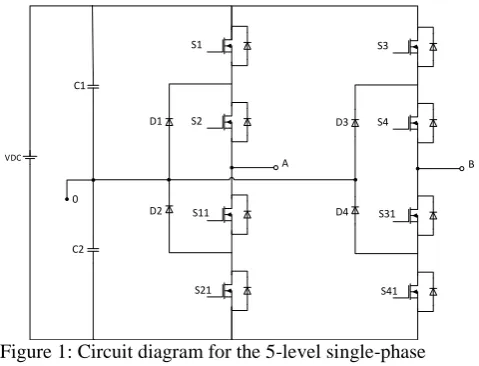
The work presented here is focused on a single phase 5-level Neutral Point Clamped (NPC) and is similar to system described [1], see Figure 1. Capacitor voltage balancing control ensures the voltage at the midpoint of C1 and C2 is stable and uses adapted form of space vector modulation typically employed in single phase drive systems [2].
To reduce filtering requirements it is desirable to operate the MLC at higher frequencies, however, this can reduce efficiency due to switching losses. Emergent semiconductor devices, such as Silicon Carbide (SiC) MOSFETs, enable high switching frequency and high temperature operation thereby reducing filter size and cooling requirement compared to their silicon (Si) counterparts.
Previous work has been reported in [3] to [7] comparing the performance of SiC over Si devices in multilevel topologies. In [3] and [7] a modular multilevel converter comparison simulation study was undertaken to evaluate the performance of Si IGBT and diode over SiC MOSFET and SiC JFET respectively. In reference [4] a study comparing the efficiency and operating temperatures of a medium power 3-level switched neutral point converter was undertaken by replacing the Si IGBT and Si antiparallel diode with their SiC counterparts. The work presented in references [5] and [6] examine improvement that can be achieved with a 3-level NPC topology. Reference [5] uses simulation to evaluate the performance of SiC diodes (antiparallel and clamping) by comparing the average junction temperature and losses differences with an all Si converter. Reference [6] focuses on a 3-phase converter, and uses simulation to evaluate a variety of PWM methods and the Total Harmonic Distortion (THD) for different gate resistances.
In this paper we present the findings of an experimental study on the performance of SiC MOSFETs and SiC anti-parallel
D1
D2
VDC
S1
S2
S11
S21 C1
C2
A D3
D4 S3
S4
S31
S41
B
[image:2.595.311.551.226.409.2]0
diodes operating within a 5-level NPC MLC. The performance of the MLC operating with SiC devices is compared with that of Si devices, which is based on the temperature rise of the devices and the total efficiency of the converter. A description of the complete system and converter is presented in Section 2 and then the semiconductor devices used in the evaluation are described in Section 3. In Section 4 the experimental evaluation of the switching devices is discussed, highlighting the differences in efficiency and operating temperature of the switching components.
2 5-level NPC Converter
The evaluation platform for this work was a 5-level NPC intended for use in a Vehicle to Grid (V2G) application. The block diagram of the complete system is presented in Figure 2. The work presented here concentrates on the DC to AC 5-level converter. The entire system is designed to provide bi-directional power flow and the control of the system is implemented in LabVIEW, with a FPGA providing gate control signals to the MOSFETs.
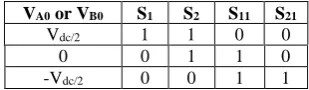
The 5-level MLC is based on utilising 2 phases of the 3-level Half-Bridge Neutral Point Clamped (3L-HB-NPC) proposed in [8]. The DC-link is composed of two capacitors C1 and C2 where the input voltage (V) is divided in 2 discrete levels (V/2 and -V/2), Figure 1. Considering a single leg, the output is taken from A and 0, where 0 is the neutral point between the 2 capacitors. The leg output voltage VA0 can take on one
of three levels -V/2, 0, or V/2 and is produced using the switching states (S1,S2) listed in Table 1 where ‘1’ means the switch is ON and ‘0’ indicating the switch state is OFF.
VA0 or VB0 S1 S2 S11 S21
Vdc/2 1 1 0 0
0 0 1 1 0
[image:3.595.48.286.338.453.2]-Vdc/2 0 0 1 1
Table 1: Switch states 3-level NPC
Although there are different implementations of the NPC topology reviewed in [8], for a single phase system, a topology with an additional leg or phase can be added, taking the output from nodes A and B making the 5-level Full-Bridge NPC (5L-FB-NPC) topology with output voltage levels defined as V, V/2, 0, -V/2 and –V. By using redundant
switching states to generate the output voltage the individual divider capacitor voltages maybe balanced.
3 Si and SiC evaluation devices
Wide bandgap (WBG) semiconductor materials such as SiC is enabling an unprecedented performance to be obtained with power electronic switching devices allowing power electronic converters to operate with higher voltage stress, higher temperatures and with reduced size.
Reference [9] presents a review of a series of SiC and Gallium Nitride (GaN) devices including SiC MOSFETs in the range from 1.2kV to 10kV and provides details on the latest improvements in the technology including the MOSFETs in the 1.2kV range from CREE and ROHM. It has been demonstrated in [10] that the 2nd generation of Cree
MOSFETs (C2M) can provide long term reliability, based on a stress of 1000 hours and 150C and 175C for a VGS of
-15V and 20V respectively.
The power electronic devices evaluated in this study are listed in Table 2. The silicon MOSFET N95 was chosen as its ratings are comparable to the range of the SiC devices being evaluated. MOSFETs SiC 040 and SiC 280, were chosen for comparison due to their low RDS(on) and low current rating
respectively.
4 Experimental evaluation
In order to effectively evaluate the performance of the switching devices, an external antiparallel SiC diode and a blocking diode was used to minimize the effect of the body diode of the MOSFETs were used as shown in Figure 3, the diode characteristics are detailed in Table 3. The diodes were selected to match the specification of the converter and they were mounted on the same heatsink as the switching devices. The terminals shown as G, D and S in Figure 3, represent the actual terminals connected to the converter topology presented in the previous section.
For each device under test its temperature was measured by using thermocouples attached to the heatsink. The ambient temperature in a laboratory was also measured and subtracted from the measured device temperatures to provide measurements for the temperature rise caused by the losses. The efficiency is determined by measuring the input and output power of the converter.
Name MOSFET Manufacturer VDS
(V)
IDS (A) RDS(on)
(m)
Si N95 Si ST 950 10 680
[image:3.595.305.557.406.487.2]Si FDP Si Fairchild 100 164 4.5 SiC 040 SiC CREE 1200 60 40 SiC 280 SiC CREE 1200 10 280 Table 2: Switching devices for performance evaluation in
5-level single phase converter Battery 140V FPGA Mains Load DC-DC converter DC-AC 5-level converter
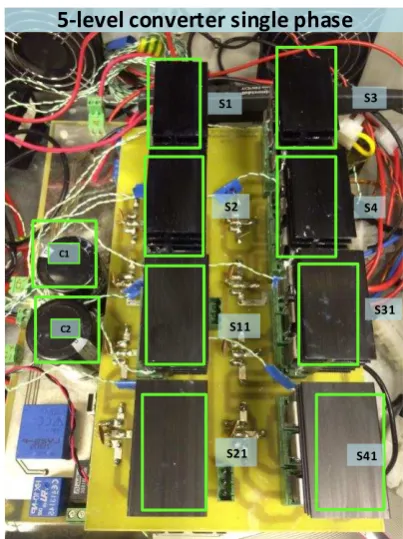
[image:3.595.89.244.609.654.2]The experimental apparatus, Figure 4, is housed inside an enclosure with forced air provided by fans blowing from the S1 and S3 devices to S21 and S41. Since S1 and S3 are located closest to the fans they receive greater cooling. Labels S1-4 and S11-41 show the locations of the heatsinks fitted with the power devices and C1, C2 are the DC capacitors. The heatsinks have a thermal resistance of Rth= 4C/W. The
operating conditions for the experiments are the same, with the evaluation MOSFETs being the only change made during the experiments.
S3
5-level converter single phase
S4
S31
S41 S1
S2
S11
S21
[image:4.595.326.528.83.353.2]C2 C1
Figure 4: Hardware of converter evaluated
[image:4.595.62.272.102.245.2]The results for the Si devices evaluated in the experiments is depicted in Figures 5 and 6 shows that for the N95 the temperature rise fluctuates in the range from 50C to 110C and for the FDP from 15C to 37C, for the range of frequencies tested.
Figure 5: Temperature rise of Si N95 MOSFETs in MLC
Figure 6: Temperature rise of Si FDP MOSFETs in MLC
Name Device Manufacturer VRRM
(V)
IF (A)
Blocking Diode
Si Schottky diode
IXYS 600 50
Antiparallel diode
SiC Diode CREE 1200 11
Table 3: Characteristics of blocking diode and antiparallel diode
SiC diode
Si
Schottky diode
D.U.T.
D
G
[image:4.595.45.290.313.404.2]S
[image:4.595.312.556.461.580.2] [image:4.595.307.557.616.735.2]The results presented in Figure 7 and 8 correspond to the SiC devices 280 and 040 respectively. The temperature rise is in the range from 25C to 55C for 280 MOSFETs and from 12C to 40C for the 040 MOSFETs.
Figure 7: Temperature rise of SiC 280 MOSFETs in MLC
Figure 8: Temperature rise of SiC 040 MOSFETs in MLC
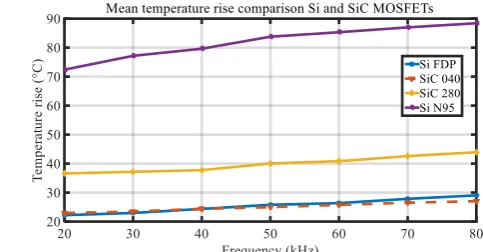
[image:5.595.313.554.166.282.2]Despite the distribution of the temperatures between the devices, the average temperature rise of all the devices increases with frequency. In Figure 9 the mean temperature of all the devices for a given frequency is taken and plotted to show the average temperature rise as a function of frequency for the Si and SiC devices.
Figure 9: Average temperature as a function of frequency for the Si and SiC devices
It can be seen that the device having the larger temperature increase is the Si N95, followed by the SiC 280 but there is a difference of approximately 40C. This is to be expected since the RDS(on) of these devices is quite large which leads to
higher conduction losses. Comparing SiC 040 and Si FDP
[image:5.595.44.297.310.429.2]reveals some interesting behaviour. At low-frequencies the FDP devices provide better performance due to their lower on-state resistance. However, at higher frequencies the 040 devices give slightly better performance where the switching losses incurred by the Si FDP devices begin to take effect. Indeed, one can observe the gradient is shallower for the 040 devices indicating superior high-frequency behaviour.
Figure 10: Efficiency comparison as a function of frequency
Efficiency measurements for the MLC fitted with the four types of MOSFETs is shown in Figure 10. As expected the converter with the SiC 040 devices installed performs the best with efficiencies of 88% to 83%, then the Si FDP gives the next highest efficiency with 88.5% to 80% . SiC 280 gives an overall efficiency of 81% to 75% and finally the device giving the lowest efficiency is the N95 with 72% to 66%.
The results clearly show the impact that RDS(on) and operating
frequency on the performance of the converter. This is clearly seen in the efficiency measurements as the converter fitted with the 040 devices exhibits the highest efficiency for the range of frequencies considered.
5 Conclusions and future work
The evaluation of performance of SiC compared to Si devices in the 5-level MLC presented in this paper shows the effect of the RDS(on) on the temperature rise of the devices and
efficiency. The second generation of SiC MOSFETs and Si MOSFETs evaluated were chosen for their low RDS on (SiC
040 and Si FDP) and for the similarity in current and voltage ratings (SiC 280 and Si N95).
The overall performance of SiC devices evaluated in the converter is significantly higher, the low temperature rise with SiC devices would allow the reduction of size as the cooling systems required by these devices are smaller and operating at higher frequencies implies a reduction in filter
component’s dimensions. Although the temperature rise with
Si FDP and SiC 040 appears to be close, the SiC competitor gives lower temperature rise at higher frequencies. Furthermore, the reliability of the SiC devices should be greater as the Si N95 operates at 85% of its voltage rating compared to less than 10% of SiC 040 rating.
[image:5.595.45.287.543.669.2]losses for the different frequencies considered which could reduce the temperature rise in the devices and improving the overall efficiency and is currently under investigation.
Acknowledgements
This project is supported by the Mexican National Council for Science and Technology (CONACyT) scholarship scheme.
References
[1] J. Lai and F. Z. Peng, “Multilevel Converters-A New
Breed of Power Converters,” IEEE Trans. Ind. Appl.,
volume 32, no. 3, pp. 509–517, (1996).
[2] J. I. Leon, R. Portillo, L. G. Franquelo, S. Vazquez, J.
M. Carrasco, and E. Dominguez, “New Space Vector
Modulation Technique for Single-Phase Multilevel Converters”, IEEE Int. Symp. Ind. Electron., pp. 617– 622, (2007).
[3] L. Wu, J. Qin, M. Saeedifard, O. Wasynczuk, and S.
Krishna, “Efficiency Evaluation of the Modular
Multilevel Converter Based on Si and SiC Switching Devices for Medium / High-Voltage Applications”, IEEE Trans. Electron Devices, volume 62, no. 2, pp. 286–293, (2015).
[4] D. Debashis, et al. "An all SiC MOSFET high performance PV converter cell", Power Electronics and Applications (EPE), 15th European Conference on. IEEE, (2013).
[5] F. Filsecker, R. Alvarez, and S. Bernet. "Comparison of 6.5 kV silicon and SiC diodes", Energy Conversion Congress and Exposition (ECCE), IEEE, (2012). [6] Jahdi, Saeed, Olayiwola Alatise, and Phil Mawby. "On
the Performance of Voltage Source Converters ased on Silicon Carbide Technology." Telecommunications Energy Conference Smart Power and Efficiency'(INTELEC), Proceedings of 2013 35th International. VDE, (2013).
[7] Peftitsis, Dimosthenis, et al. "High-power modular multilevel converters with SiC JFETs." Power
Electronics, IEEE Transactions,” pp. 28-36, (2012).
[8] J. Rodriguez, S. Member, S. Bernet, P. K. Steimer, and
I. E. Lizama, “A Survey on Neutral-Point-Clamped
Inverters,” IEEE Transactions on Industrial Electronics,
volume 57, no. 7, pp. 2219–2230, (2010).
[9] P. Godignon and X. Perpi, “A Survey of Wide Bandgap
Power,” IEEE Transactions on Power Electronics,
volume 29, NO. 5, vol. 29, no. 5, pp. 2155–2163, (2014).
[10] B. Hull, S. Allen, Q. Zhang, D. Gajewski, V. Pala, J. Richmond, S. Ryu, M. O. Loughlin, E. Vanbrunt, L. Cheng, A. Burk, J. Casady, D. Grider, and J. Palmour,
“Reliability and stability of SiC power MOSFETs and
Next-Generation SiC MOSFETs,” Workshop on Wide