This is a repository copy of Transitional fluid flow numerical modelling in sinusoidal heat
exchanger channels.
White Rose Research Online URL for this paper:
http://eprints.whiterose.ac.uk/140785/
Version: Accepted Version
Proceedings Paper:
Greiciunas, E, Borman, D and Summers, J orcid.org/0000-0001-8266-5038 (2016)
Transitional fluid flow numerical modelling in sinusoidal heat exchanger channels. In:
International Conference on Computational Methods for Thermal Problems. Thermacomp
2016, 06-08 Jul 2016, Atlanta, USA. Dalian University of Technology .
This conference paper is protected by copyright. This is an author produced version of a
paper published in Thermacomp 2016.
[email protected] https://eprints.whiterose.ac.uk/
Reuse
Items deposited in White Rose Research Online are protected by copyright, with all rights reserved unless indicated otherwise. They may be downloaded and/or printed for private study, or other acts as permitted by national copyright laws. The publisher or other rights holders may allow further reproduction and re-use of the full text version. This is indicated by the licence information on the White Rose Research Online record for the item.
Takedown
If you consider content in White Rose Research Online to be in breach of UK law, please notify us by
Transitional Fluid Flow Numerical Modelling in Sinusoidal Heat
Exchanger Channels
Evaldas Greiciunas
EPSRC Centre for Doctoral Training in Fluid Dynamics, University of Leeds, Leeds LS2 9JT, United Kingdom, [email protected]
Duncan Borman
School of Civil Engineering, University of Leeds, Leeds LS2 9JT, [email protected]
Jon Summers
School of Mechanical Engineering, University of Leeds, Leeds LS2 9JT, [email protected]
ABSTRACT
The study focuses on modelling heat transfer and fluid flow in a sinusoidal plate-fin heat exchanger channel at . The aim is to investigate the modelling of unsteady flows from 200, a regime that promotes fluid mixing and improves heat transfer [1]. The channel geometry is taken from a study by Zhang et al. [2], in which steady state simulations were presented. Steady and unsteady numerical simulations are undertaken; with the impact of different turbulence modelling assumptions considered. Predictions for were made using turbulence model. Results obtained agree to the observations by Rush et al. [1]. The study includes exploring and verifying simulation approaches for this regime. A further aim of the study is to compare Computational Fluid Dynamics (CFD) codes OpenFOAM and Ansys Fluent.
Key Words: Heat Exchangers, Finite Volume, Forced Convection, OpenFOAM, Ansys Fluent.
1. INTRODUCTION
A heat exchanger (HE) is a device which enables heat transfer between fluid streams or between solid and a fluid stream, provided that there is a temperature difference and a thermal contact [3]. HEs are crucial components in a wide array of industry: process, automotive, aerospace and many others. A common interest of researchers is to increase the compactness of HE systems [4] as compactness saves installation space and unit weight and, as explained in Kays and London [5], can enhance heat transfer. A measure of compactness is the hydraulic diameter, [5] where - cross sectional flow area, - thickness of the HE and - heat transfer surface area.
Bhutta et al. [6] carried out an extensive literature review of HE Computational Fluid Dynamics (CFD) studies. It revealed the adoption of two main numerical modelling methods. Namely, one based on a large scale analysis using a porous media approach to model HE matrices [7], and the other based on detailed flow and heat transfer analysis through small sections of the HE [2]. Detailed predictions enable friction and heat transfer characteristics to be applied in the design of HE matrices [7], [8]. There are a number of studies that employ a detailed flow analysis, e.g. Zhang et al. [2], Rosaguti et al. [9], Manglik et al. [10], all of which analyse the HE channel flow using a single period of geometry and assume that the flow is periodic and laminar. Unsteady behaviour of the flow occurring at the geometry dependent Reynolds number of a few hundred was the limit of the work presented in [2,9,10]. Reynolds number in this study is defined as . Here - fluid density, - mean flow velocity, - channel width and – dynamic viscosity. The experimental evidence supporting the unsteady behaviour was found in the work of Rush et al. [1], who studied the flow through sinusoidal channels. They concluded that unsteady flow increases the heat transfer. Numerical simulations to solve a similar problem were presented for a similar geometry in [11], [12], however, both studies assumed the flow remained laminar.
THERMACOMP2016, July 6-8, 2016, Georgia Tech, Atlanta, USA N. Massarotti, P. Nithiarasu and Y. Joshi (Eds.)
are observed when the flow is steady and unsteady, and also evaluates predictions of two CFD codes: OpenFOAM and FLUENT. Steady state results are obtained at the Reynolds number range
and data from [2] is used to verify predictions. Unsteady analysis is undertaken for Reynolds numbers in the range of . To simulate the unsteady regime a range of turbulence modelling assumptions are considered (including use of model).
2. METHODOLOGY
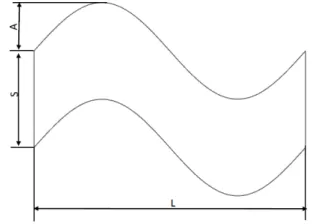
The problem was set up using the non-dimensionalised geometry by Zhang et. al [2], which is parametrised by corrugation aspect and fin spacing ratios for the sinusoidal channel. The corrugation aspect ratio is defined as and fin spacing ratio as (Figure 1). The flow was modelled as two-dimensional, incompressible, steady state and periodic with the properties of air for low Reynolds number predictions. The walls were set at a constant temperature of whilst the flow inlet was set at . The mathematical model of the problem consists of
continuity of mass, momentum and energy equations using the assumptions above [13]:
t p
c Tt T k T
[image:3.612.236.394.397.509.2]For turbulent flow simulations RANS formulation was used [14]. A periodic condition was used to reduce computational complexity for simulations at . This method requires only a single period of the channel (Figure 1) and the modifications to the model can be found in Patankar et al. [15].
FIGURE 1. Schematic of a single period geometry.
Unsteady flow modelling ( ) was carried out using the approach proposed by Zheng et al. [11]. This involved the whole channel of the HE, which consisted of seven sinusoidal periods (Figure 2). The flow was modelled as unsteady and, instead of periodic condition at the start and end of the domain, a velocity inlet and pressure outlet were used. Other flow properties were unchanged. Straight sections at the inlet and the outlet of the sinusoidal section were added to enable the flow to develop and prevent potential errors from flow reversal. The simulations provide detailed information about transient and spatial flow development inside the channel, and are significantly more computationally intensive than the low Reynolds number, steady and periodic cases. In addition, it provided information about flow development inside the channel.
3. RESULTS
a)
b)
is a snapshot of the changing flow field at time 0.18 s. The result is in contrast to the solution at , shown in Figure 2a, where a steady flow field is observed. At mixing of the fluid stream is higher compared to . Simulations at were carried out using a range of turbulence modelling assumptions (results using model are those shown in figure 2b). The need for an appropriate turbulence model was identified by simulating laminar and turbulent predictions for a range of Reynolds number cases. At low Reynolds number predictions agree well for both laminar and turbulence modelling cases, meanwhile at the solutions begin to differ. It should be noted that appropriately small time-steps must be used to observe the instability.
To illustrate the effect unsteady mixing has on the flow, the pressure drop ( ) across the channel length at is presented in Figure 3. It can be observed that pressure drop is also unsteady in nature and the predictions for the laminar and turbulence model cases are significantly different. This in turn have an effect on the resolved temperature fields. The impact
of considering different turbulence models on the resulting heat transfer performance will be presented in the full paper, along with comparisons to validation data.Transient effects, heat transfer and pressure drop will be considered in the context of implementing these different turbulence modelling assumptions in both OpenFOAM and Fluent.
FIGURE 2. a) Steady state laminar ( ) and b) transient ( ) velocity
[image:4.612.94.498.288.444.2]contours using t s (Fluent), .
FIGURE 3. Flow pressure drop through a channel ( ) at versus simulation time. Red and blue lines are and laminar predictions with t ,
(Fluent).
4. CONCLUSIONS
[image:4.612.155.476.489.604.2]THERMACOMP2016, July 6-8, 2016, Georgia Tech, Atlanta, USA N. Massarotti, P. Nithiarasu and Y. Joshi (Eds.)
small time steps to resolve for small length scale velocity fluctuations. These cause fluid mixing and mean temperature differences through the channel to fluctuate periodically. OpenFOAM and Fluent CFD codes are used for comparison throughout the Re number range. To validate the transitional modelling approach, results will be presented alongside validation data in the full paper.
REFERENCES
[1] Rush, T. A., T. A. Newell, and A. M. Jacobi. "An experimental study of flow and heat transfer in sinusoidal wavy passages." International Journal of Heat and Mass Transfer 42.9 (1999): 1541-1553.
[2] Zhang, J. , J. Kundu, and R. M. Manglik. "Effect of fin waviness and spacing on the lateral vortex structure and laminar heat transfer in wavy-plate-fin cores." International Journal of Heat and Mass Transfer 47.8 (2004): 1719-1730.
[3] Rohsenow, W. M. Handbook of heat transfer. Vol. 3. New York: McGraw-Hill, 1998.
[4] Hesselgreaves, J . E. Compact heat exchangers: selection, design and operation. Gulf Professional Publishing, 2001.
[5] Kays, William Morrow, and Alexander Louis London. "Compact heat exchangers." (1984).
[6] Bhutta, M. M. A. , et al. "CFD applications in various heat exchangers design: A review." Applied Thermal Engineering 32 (2012): 1-12.
[7] Hayes, Andrew M., et al. "The thermal modeling of a matrix heat exchanger using a porous medium and the thermal non-equilibrium model." International Journal of Thermal Sciences 47.10 (2008): 1306-1315.
[8] Wen, Jian, et al. "An experimental and numerical investigation of flow patterns in the entrance of plate-fin heat exchanger." International Journal of Heat and Mass Transfer 49.9 (2006): 1667-1678.
[9] Rosaguti, Nathan R., David F. Fletcher, and Brian S. Haynes. "Low-Reynolds number heat transfer enhancement in sinusoidal channels." Chemical engineering science 62.3 (2007): 694-702.
[10] Manglik, Raj M., Jiehai Zhang, and Arun Muley. "Low Reynolds number forced convection in three-dimensional wavy-plate-fin compact channels: fin density effects." International Journal of Heat and Mass Transfer 48.8 (2005): 1439-1449.
[11] Zheng, Zhanying, David F. Fletcher, and Brian S. Haynes. "Transient laminar heat transfer simulations in periodic zigzag channels." International Journal of Heat and Mass Transfer 71 (2014): 758-768.
[12] Dai, Zhenhui, David F. Fletcher, and Brian S. Haynes. "Impact of tortuous geometry on laminar flow heat transfer in microchannels." International Journal of Heat and Mass Transfer 83 (2015): 382-398.
[13] Subrahmanyan Chandrasekhar. Hydrodynamic and hydromagnetic stability. Courier Corpora-
tion, 2013.
[14] Menter, Florian R. "Two-equation eddy-viscosity turbulence models for engineering applications." AIAA journal 32.8 (1994): 1598-1605.