White Rose Research Online URL for this paper:
http://eprints.whiterose.ac.uk/121059/
Version: Published Version
Conference or Workshop Item:
Keenan, Fiona orcid.org/0000-0003-2046-9036 and Pauletto, Sandra
orcid.org/0000-0002-9404-851X (2017) A Mechanical Mapping Model for Real-Time
Control of a Complex Physical Modelling Synthesis Engine with a Simple Gesture. In:
International Conference on Digital Audio Effects (DAFx), 05-09 Sep 2017.
[email protected]
Reuse
Items deposited in White Rose Research Online are protected by copyright, with all rights reserved unless
indicated otherwise. They may be downloaded and/or printed for private study, or other acts as permitted by
national copyright laws. The publisher or other rights holders may allow further reproduction and re-use of
the full text version. This is indicated by the licence information on the White Rose Research Online record
for the item.
Takedown
If you consider content in White Rose Research Online to be in breach of UK law, please notify us by
A MECHANICAL MAPPING MODEL FOR REAL-TIME CONTROL OF A COMPLEX
PHYSICAL MODELLING SYNTHESIS ENGINE WITH A SIMPLE GESTURE
Fiona Keenan Sandra Pauletto
Department of Theatre, Film, Television and Interactive Media
University of York Baird Lane, Heslington East
York, UK
Department of Theatre, Film, Television and Interactive Media University of York
Baird Lane, Heslington East York, UK
ABSTRACT
This paper describes the design and control of a digital synthesis engine developed to imitate the sound of an acoustic wind machine, a historical theatre sound effect first designed in the nineteenth century. This work is part of an exploration of the potential of historical theatre sound effects as a resource for Sonic Interaction Design (SID). The synthesis engine is based on a physical model of friction and is programmed using the Sound DesignerÕs Toolkit (SDT) suite of physical modelling objects in Max/MSP. The program is controlled in real-time with a single stream of rotation data from a rotary encoder and Arduino, with complexity achieved through a mapping strategy that recreates the mechanical process at the heart of the acoustic wind machineÕs sound production. The system is outlined, along with a discussion of the possible application of this approach to the modeling of other historical theatre sound effects.
1. INTRODUCTION
The design and live performance of sound with acoustic materials and mechanical devices has a long history in the theatre space [1]. This research explores this area to inform new strategies for Sonic Interaction Design (SID). SID researches the performative and multisensory aspects of sonic experience to design new sonic interactions [2]. Theatre wind machines were first used in the nineteenth century [3], and this particular sound effect method was chosen for closer investigation to facilitate the exploration of a continuous action-sound coupling [4] in an experimental setting. This work was informed by Serafin and de GštzenÕs [5] approach to replicating a historical acoustic device as a digital synthesis engine and user interface. It is proposed to deconstruct the action-sound coupling afforded by the acoustic wind machine in order to examine the importance of various modes of feedback (sonic, tactile, kinesthetic) while performing with sound [7]. A digital synthesis engine created to imitate the sonic response and performative action of the acoustic wind machine as closely as possible will enable this deconstruction to be achieved.
The first section of this article briefly describes the design of the prototype digital sound synthesis engine that physically models the workings of the acoustic wind machine; the second section describes in detail the digital modelling of the action (a simple rotational gesture) and its mapping and complex effect on the sound engine. In the third and final section of this article, it is proposed that this digital action model can be applied to the reproduction of other historical theatre sound effects, and more broadly to the design and control of real-time physical modelling
synthesis systems that require a simple gesture and a complex audio output.
2. DIGITAL SOUND AND ACTION
2.1. Sound: The Digital Synthesis Engine
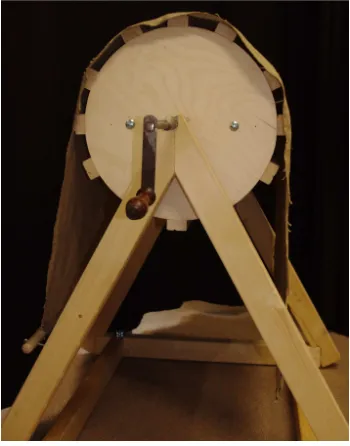
[image:2.595.334.509.487.710.2]An acoustic wind machine consists of a wooden slatted cylinder mounted on a frame so that it can rotate freely about its axle. The performer activates this rotation with a crank handle coupled to the cylinder. The wooden slats rub against an encompassing cloth as the cylinder moves, and the friction created by this interaction produces a wind-like sound. Historical research has revealed that the basic acoustic wind machine design that became popular in the nineteenth century was reinterpreted and adjusted with each iteration by many different practitioners of the craft [8]. As such, there is no single definitive version of this device. Rather than attempt to create an ideal version of a wind machine through physical modeling synthesis, an acoustic version was first constructed to enhance the descriptions available in historical texts and make them more concrete [9]. This version was designed through a synthesis of different designs, following a similar process to that of historical practitioners. A specific example was then available to model in software.
To facilitate real-time performance with a digital wind sound while providing the same multisensory feedback, the acoustic wind machine itself was fitted with a rotary encoder mechanically coupled to its moving cylinder with 3D printed gearing. The movement of the encoder was read with an Arduino prototyping board connected to the computer via USB, sending a single stream of rotation data scaled to a range of 0¡ - 360¡. Max/MSP1 was chosen as the platform for a design-led approach to programming and the production of a functional prototype of a digital wind sound using the Sound DesignerÕs Toolkit (SDT)2 suite of physics-based sound synthesis algorithms. The SDT algorithms are computationally efficient and designed for advanced control mapping, a particularly relevant feature for this project. While Max/MSP is an ideal platform for prototyping this effect, it is envisaged that the overall model could in the future be ported to another platform with similar real-time audio processing and physical modelling functions.
To model the digital wind sound, the acoustic wind machineÕs stages of sound production were first deconstructed and described as an entity-action model [6]. The acoustic wind machine creates sound through friction, but instead of just two surfaces (one cylinder, one cloth) in contact, there are twelve slat ÔrubbersÕ at work. As the cylinder of the acoustic wind machine is rotated, each of its twelve slats come into contact with the encompassing cloth and rub it to produce sound through friction. Each slat falls silent for part of its rotation as it moves out of range of the cloth, and only seven of the slats contact the cloth and produce sound at any one time (Figure 2). This mechanical process, which gives an individual envelope to the friction sound produced by each slat of the cylinder, informed the programming. Twelve instances of a physical model of nonlinear friction, the most recent iteration of the SDTÕs dynamic friction model [11], were created, giving one voice for each slat on the acoustic wind machine example. The physical model, which simulates the friction between a sliding probe and an inertial object with a modal resonator, used the following SDT algorithms:
¥ sdt.scraping~: A scraping texture generator, which outputs a force to be applied to a resonator or another solid. Affords real-time control over the grain, velocity and force of the scrape.
¥ sdt.friction~: An elasto-plastic friction model, which takes its rubbing force input from sdt.scraping~.
¥ sdt.inertial~: Inertial object model
¥ sdt.modal~: Modal resonator
The parameters to these objects were chosen through a process of comparison and evaluation of the sonic outputs of the acoustic wind machine and the digital synthesis engine [as reported in 12, 10] with the aim of creating a digital sound as close as possible to the acoustic sound (Table 1).
1
http://www.cycling74.com/
2
[image:3.595.308.533.133.714.2]For Max/MSP and Pure Data: http://soundobject.org/SDT/
Table 1: Parameters to the Sound DesignerÕs Toolkit (SDT) objects in Max/MSP for each Ôdigital slatÕ [12, 10].
Parameters to sdt.scraping~ Surface profile (A signal) Noise Grain
(Density of micro-impacts)
0.080596, modulated by encoder data
Velocity (m/s) Real-time optical
encoder data
Force (N) 0.546537,
modulated by encoder data Parameters to sdt.friction~ External rubbing force Signal from sdt.scraping~ Bristle stiffness
(Evolution of mode lock-in) 500. Bristle dissipation (Sound bandwidth) 40. Viscosity (Speed of timbre evolution and pitch)
1.2037
Amount of sliding noise (Perceived surface roughness)
0.605833
Dynamic friction coefficient
(High values reduce sound bandwidth)
0.159724
Static friction coefficient
(Smoothness of sound attack)
0.5 (for Hemp cloth and Wood)
Breakaway coefficient (Transients of elasto-plastic state)
0.174997
Stribeck velocity (Smoothness of sound attacks)
0.103427
Pickup index of object 1 (Contact point)
0
Pickup index of object 2 (Contact point)
0
Parameters to sdt.inertial~
Mass of inertial object (Kg) 0.01 Fragment size (To simulate crumpling) 1
Parameters to sdt.modal~
Frequency factor 1
Frequency of each of three modes (Hz)
380, 836, 1710
Decay factor 0.005
Decay of each mode (s)
0.8, 0.45, 0.09
Pickup factor 2.2
Pickup0_1 50.
Pickup0_2 100.
Pickup0_3 80.
To ensure the efficiency of the digital synthesis engine and keep demands on the computerÕs CPU low, a strategy to pause computation of the friction model while the slat is not producing sound was devised. In Max/MSP this can be achieved by housing each digital slat inside a poly~ object. Designed to manage polyphony and DSP, poly~ also affords downsampling and individual voice muting. This ensured that each digital slat voice could be muted when its acoustic counterpart would be out of range of the cloth and therefore silent. Downsampling within each slat voice ensured that the program was responsive and efficient in real-time performance while running twelve nonlinear friction models.
To increase the responsiveness of the resulting sound of the digital wind machine, the grain and force parameters to each sdt.scraping~ object were modulated with real-time encoder data. The grain parameter was programmed to vary with the angular position of the digital slat, with the highest value corresponding to the top position of the acoustic wind machine (at 180
¡
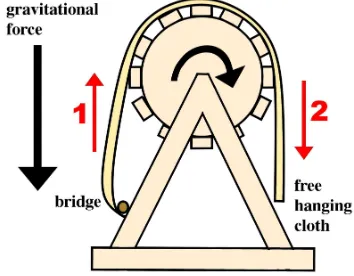
), where the slat is most fully in contact with the cloth. The acceleration data modulated the force parameter to each sdt.scraping~, reflecting the increased effort required for the first part of each rotation when overcoming inertia.The acoustic wind machineÕs cloth is its main resonator, and the sdt.modal~ object in each digital slat adds modal resonance to the nonlinear friction model. To account for the clothÕs role in dispersing the sound, a bidirectional digital waveguide model [13] was adapted. The cloth is pulled tight on one side of the acoustic wind machine, and hangs freely on the other (Figure 3). The tight side of the cloth, which is coupled to a wooden pole ÔbridgeÕ pinned to the a-frame, is similar to a bowed string, with the slatted cylinder ÔbowingÕ the cloth during rotation. A digital waveguide in series with a low-pass filter and an all-pass filter was used to simulate dispersion of the friction sound through the tight side of the cloth, allowing for some damping due to its coupling to the acoustic wind machineÕs Ôbridge.Õ Dispersion through the freely hanging side of the cloth was modeled using the most basic method, without damping, of a delay line in series with an all-pass filter [14].
2.2. Action: The Gesture Mapping
The mapping strategy focused on creating complexity from the encoderÕs single smooth data stream in order to recreate the gesture afforded by the acoustic wind machine as closely as possible. As previously outlined, the trajectory of the rotary encoder coupled to the movement of the acoustic wind machineÕs cylinder was mapped to a 360¡ rotation. Velocity and acceleration were also calculated from the variation in time of the encoderÕs data. A one-to-many mapping strategy was implemented [15]. To drive sound production from each slat model, the single stream of encoder data was parsed into eleven further streams, each placed out of phase with the original to correspond with the degree placement of the slats on the original acoustic wind machine (Figure 2). This provided twelve individual data streams, each corresponding to the movement of one of the slats on the acoustic machine, allowingthe position of each to be tracked and its digital voice activated accordingly. These rotational data streams were mapped to the activation of each digital slat voice, muting it if it passed out of range of the clothÕs position on the acoustic wind machine, and activating it again when it came into range (Figure 3).
Figure 2: Placement of slats on the acoustic wind machine. A black dot marks each of the seven positions where the slats make contact with the cloth at any one time.
[image:4.595.331.508.97.288.2]The rotational gesture afforded by the acoustic wind machine is comprised of two distinct stages due to the way the cloth has been fixed to one side of the frame, and the influence of gravity. This creates a rotational gesture that at first requires more effort to overcome oppositional force from gravity and the clothÕs tension on the upstroke, and then requires less effort with the loose cloth and assistance from gravity on the downstroke (Figure 3). This produces an amplitude envelope that rises in the first half of the rotation, and then decreases in the second half [12]. This amplitude envelope is most pronounced at slow speeds, when the overall amplitude of the wind sound is lower. In addition, as the cylinder gains speed in rotation, and overcomes inertia, it moves much more freely, reducing the difference in amplitude between the upstroke and downstroke of each rotation, while the overall amplitude of the acoustic wind machine is higher.
[image:4.595.331.508.511.649.2]Figure 4: Angular starting positions of each digital slat, with their voice activation region (65¡ - 290¡, in green), amplitude offset region (blue) and envelope of grain and force modulation (peaking at 180¡, in yellow) highlighted.
The velocity parameter to sdt.scraping~ activates each friction model and shapes its amplitude envelope. The 360¡ rotation data for each digital slat was mapped to this parameter, and additional steps were taken to reproduce the complexity of the rotational gesture afforded by the acoustic wind machine within the digital domain:
1. The rotation data mapped to activate the velocity parameter to sdt.scraping~ was split in two, and offset (slightly reduced) during the second half of the rotation (Figure 4) to ensure higher amplitude during the first half of each rotation, and slightly lower amplitude during the second half of each rotation (Figure 5) 2. The rotation data was then filtered through a simple
inertia model [10] to imitate the effect of the oppositional forces on the rotational gesture, effectively recreating the upstroke and downstroke. 3. In addition, the amplitude of the summed outputs of the
twelve digital slats (0. Ð 1.) was scaled by the velocity value of the encoder data stream, ensuring that the digital wind sound (produced by any number of rotations) had lower average amplitude at slower speeds and higher average amplitude at faster speeds, similar to its acoustic counterpart.
The development of the complexity of the digital wind sound is ongoing, and further parameters to the digital slats will be explored for real-time manipulation as required, but the current prototype is already quite effective in producing a digital audio simulation of the mechanical wind machine in action. A diagram detailing signal flow and mapping within Max/MSP is shown at Figure 6.
2.3. Evaluation
A full evaluation of the acoustic wind machine and digital synthesis engine in performance was conducted, with both systems simultaneously recorded to facilitate analysis. This has
been published elsewhere [10], and a summary of the main results now follows.
The digital wind sound begins and ends appropriately when controlled with the acoustic wind machine interface. The digital action model ensures that the amplitude envelope of the digital wind sound is similar to that of the acoustic wind sound (Figure 5), but the inertia model requires some further calibration to ensure it is not overly delaying the progress of the digital sound during repeated rotations.
The digital wind sound is perceivably wind-like, and sounds like a rotating machine during a repetitive rotational gesture. It does, however, lack power at those high frequencies responsible for the acoustic wind machine/s characteristic Ôwhistling.Õ Further real-time modulation of parameters to the friction model and bidirectional cloth model will be investigated to brighten the digital sound at these frequencies during rotation to imitate the acoustic wind machine more fully.
Figure 5: A comparison of the amplitude envelopes of the acoustic wind machine (blue) and digital synthesis engine (red) during the same single rotation [10].
3. FURTHER APPLICATIONS OF THIS ACTION MODEL
A detailed description of a physical model of an acoustic wind machine has been presented, which includes both a model of the sound and a model of the mechanical action that modulates the sound in time. In this mechanical action model, one stream of data from a single rotary encoder, coupled with a one-to-many mapping strategy, is effective in producing a complex continuous digital sound from a simple gesture.
3.1. Modelling Other Historical Designs
Historical theatre sound effects designers produced mechanical devices for a variety of complex sound creations that could be activated by the same simple rotational gesture used by the wind machine. For example:
[image:5.595.84.262.106.264.2] [image:5.595.311.530.294.465.2]of metal shot, dried peas or other small materials rotated inside a sealed barrel [16].
2. Crash machines produced sound from multiple impacts and rolling, with pieces of masonry or large rocks rotated inside a sealed barrel [17]. Some variations of the design were based on a large ratchet mechanism, and produced sound through impacts between pieces of wood [18].
3. Thunder barrels produced sound from rolling metal cannonballs inside a metal-lined barrel or metal container [19].
4. The crackling of a fire was produced by slowly rotating a wooden ratchet or clapper [20].
5. Creaking was produced by rotating a clay pot inside a larger clay pot [18].
6. Designs to imitate machinery, vehicles or motors produced sounds through repetitive impacts between different materials, such as an aeroplane sound achieved by plucking catgut strings with a toothed wheel [21].
7. A simple gesture of rotation was also used to control the production of sound that had previously been achieved manually as devices became more complex in the early twentieth century. A mechanism for the sound of horsesÕ hooves [22] triggered impacts on wooden cups, which would have been usually held in each hand and hit on a wooden surface. The Allefex machine, which offered mechanisms for many kinds of sounds, produced a series of gunshots, thunder and a steam engine controlled with crank handles [23].
The gesture mapping model (using the SDT and data from a rotary encoder and Arduino configuration) could be easily adapted to be used in the digital replication of many of these mechanical sound effects. For example, recreating a cylinder ÔstructureÕ from the rotation data using degree values in a similar way to the digital wind machine described here could trigger a series of sdt.crumpling~ (a model of a stochastic sequence of impacts) and sdt.friction~ objects to model the sliding and multiple impact sounds of an acoustic rain machine in rotation. As the cloth works against the rotational motion in the acoustic wind machine, so could the inertia of the material inside the rain machineÕs barrel be factored into the data stream through the proposed inertia model. Modelling these historical methods of sound production may reveal more useful strategies to increase the potential of simple rotational gestures in the control of physical modelling synthesis systems, as well as the design and DSP management of those systems for real-time performance.
3.2. A Mechanical Approach to Mapping: Extending Rotation
The mapping strategy implemented for the digital wind machine takes a mechanical approach, and recreates the stages of sound
production of the acoustic wind machine outlined in the entity-action model. This enables the digital system to take the individuality of the acoustic wind machine into account through the use of the specific degree placement of its wooden slats. This design could be extended to model other specific examples of acoustic wind machines through the incorporation of the detail of their own structures into the digital domain.
Parsing a single stream of rotation data into twelve distinct streams extends the possibilities for the real-time control of synthesis with a simple gesture of rotation. This is particularly pertinent in the case of real-time performance with physical modelling synthesis, where action and resulting sound should be tightly coupled. Other simple single-gesture controllers could be investigated and extended in a similar way, perhaps to control physical models of other historical sound effects devices. For example, a digital fader could set off a chain of impact events, each triggered by a particular position on its travel.
More broadly, this approach opens a new design space for real-time performance with physical modelling synthesis. By building on historical techniques for making sound with acoustic materials and simple mechanisms, new interactions between virtual materials can be devised and explored while simultaneously affording a simple, but meaningful and rich control interface to the performer. This approach might also be applied in a meaningful way to other synthesis methods, enabling (as in the case of the crank handle example) the control of envelopes and triggers in real-time performance to bring obvious, or more Ômechanical,Õ affordances to potentially more abstract methods of sound creation. This is an area currently under investigation as part of this work.
4. CONCLUSIONS
This paper has proposed a strategy for real-time control over physical modeling synthesis informed by the design and operation of historical theatre sound effects. A description of the design of a digital wind machine synthesis engine based on the Sound DesignerÕs Toolkit (SDT) in Max/MSP was detailed, along with the mechanical mapping model to add complexity to a single stream of rotational data for its performance in real-time. Further applications of this approach and suggestions for future work were also outlined.
5. ACKNOWLEDGMENTS
Figure 6: Diagram of signal flow and mapping for the digital wind machine in Max/MSP.
6. REFERENCES
[1] R. Brown, Sound: A Reader in Theatre Practice: Palgrave Macmillan, 2010.
[2] K. Franinović and S. Serafin, Sonic Interaction Design:
MIT Press, 2013.
[3] J. Moynet, A. S. Jackson, and M. G. Wilson, French Theatrical Production in the Nineteenth Century: "L'Envers du ThŽatre" by M.J. Moynet, 1873 vol. 10. State University of New York, USA: Max Reinhardt Foundation with the Center for Modern Theatre Research, 1976.
[4] A. R. Jensenius, "Action-sound: Developing Methods and Tools to Study Music-Related Body Movement," Department of Musicology, University of Oslo, 2007. [5] S. Serafin and A. De Gštzen, "An Enactive Approach
to the Preservation of Musical Instruments Reconstructing Russolo's Intonarumori," Journal of New Music Research, vol. 38, pp. 231-239, 2009. [6] A. Farnell, Designing Sound: MIT Press Cambridge,
2010.
[7] F. Keenan and S. Pauletto, "ÔListening BackÕ: Exploring the Sonic Interactions at the Heart of Historical Sound Effects Performance," The New Soundtrack, vol. 7, pp. 15-30, 2017.
[8] F. Keenan, "A Theatre Wind Machine as Interactive Sounding Object,Ó presented at the International Conference on Live Interfaces (ICLI), Doctoral Colloquium, University of Sussex, 2016.
[9] D. Elliott, R. MacDougall, and W. J. Turkel, "New old things: Fabrication, physical computing, and experiment in historical practice," Canadian Journal of Communication, vol. 37, 2012.
[10] F. Keenan and S. Pauletto, "Design and Evaluation of a Digital Theatre Wind Machine," in Proceedings of The 17th International Conference on New Interfaces for
Musical Expression (NIME 17), Copenhagen,
Denmark, 2017.
sound synthesis: Library and documentation," Technical report, UNIVERONA (Verona)2007. [12] F. Keenan and S. Pauletto, "An Acoustic Wind
Machine and its Digital Counterpart: Initial Audio Analysis and Comparison," presented at the Interactive Audio Systems Symposium (IASS), University of York, York, UK, 2016.
[13] M. Karjalainen, V. VŠlimŠki, and T. Tolonen, "Plucked-string models: From the Karplus-Strong algorithm to digital waveguides and beyond," Computer Music Journal, vol. 22, pp. 17-32, 1998. [14] J. O. Smith, Physical audio signal processing: For
virtual musical instruments and audio effects: W3K Publishing, 2010.
[15] A. Hunt, M. M. Wanderley, and M. Paradis, "The importance of parameter mapping in electronic instrument design," Journal of New Music Research, vol. 32, pp. 429-440, 2003.
[16] D. Collison, "The Sound of Theatre," ed: London: Professional Lighting and Sound Association, 2008.
[17] F. Napier, Noises Off: A Handbook of Sound Effects: London: JG Miller, 1936.
[18] G. H. Leverton, The Production of Later Nineteenth
Century American Drama: A Basis for Teaching: AMS
Press, 1936.
[19] M. K. Culver, "A History of Theatre Sound Effects Devices to 1927," University of Illinois at Urbana-Champaign, 1981.
[20] A. E. Peterson, "Stage Effects and Noises Off," Theatre and Stage, vol. 1 and 2 1934.
[21] A. Rose, Stage Effects: How to Make and Work Them. Chatham: Mackays Ltd, 1928.
[22] V. D. Browne, Secrets of Scene Painting and Stage Effects: Routledge, 1913.
![Table 1: Parameters to the Sound Designer’s Toolkit (SDT) objects in Max/MSP for each ‘digital slat’ [12, 10]](https://thumb-us.123doks.com/thumbv2/123dok_us/7799421.170414/3.595.308.533.133.714/table-parameters-sound-designer-toolkit-sdt-objects-digital.webp)
![Figure 5: A comparison of the amplitude envelopes of the acoustic wind machine (blue) and digital synthesis engine (red) during the same single rotation [10]](https://thumb-us.123doks.com/thumbv2/123dok_us/7799421.170414/5.595.84.262.106.264/figure-comparison-amplitude-envelopes-acoustic-machine-synthesis-rotation.webp)