European Communities
Financial report
FOREWORD
' I
In many respects, 1989 marked a turning-point in
I
the Community's finances, since iit was the first
· year in which the financial reform measures
adopted by the Brussels
Europ~an
Council of
February 1988 were fully
applied~
I ~
The Interinstitutional Agreement concluded in
IJune 1988 between Parliament, the Council and
the Commission transformed
thes~
decisions into
a financial plan extending up to the end of 1992.
The main features are
containmen~
of the increase
in agricultural expenditure, a dbubling in real
terms of expenditure on structural policy and the
I
setting of ceilings for individual categories of
ex-penditure. The Interinstitutional Agreement is
also intended to help ensure !
a trouble-free
budgetary procedure.
1As a result of this new framework, the President
of Parliament was able to declare the 1989 budget
adopted before the financial year! began, the first
time this has happened since
19~4.I
On the revenue side, 1989 saw
th~
introduction of
a fourth resource to balance the Community
I
budget: with this new resource, ba'sed on Member
States' GNP, the Community is bow guaranteed
the funds it needs to assume
th~
responsibilities
conferred on it by the Treaties antl will no longer
Ihave to resort to exceptional firlancing, as was
often the case in the past.
I
In 1989, for the first time ever, [expenditure on
agricultural guarantees was considerably lower
than in the previous year. In accdrdance with the
objectives laid down by the Singlb European Act,
the increased funds available wbre allocated to
I
structural measures, to strengthen the economic
and social cohesion of the Conimunity, and to ·
research, with a view to boosting competitiveness
in the technological sector.
The principle of budget annuality was applied
more strictly in 1989, this having been one of the
objects of the amendment of the Financial
Regulation in June 1988. Evidence of this is to be
found in the fact that the volume of unused 1988
appropriations carried over to 1989 was severely
curtailed.
The 1989 budget contained a total of ECU 44 870
million. The final outturn showed a surplus of
ECU 5 080 million, although this figure includes
ECU I 642 million in 1988 receipts collected in
1989.
The report contains a wealth of information
which sheds light on the financial results for 1989.
It
will be seen that the 1988 reform has placed the
Community's finances on sound footing, opening
the way to the 1992 single market and the next
steps towards integration.
P.
Schmidhuber
CONTENTS
Page
Financial framework 6
The institutions 11
Revenue 15
Treasury report 18
Expenditure 21
Agricultural market guarantees 22
Fisheries and the sea 25
Structural operations 26
Operations to enhance the human aspect
of Europe 27
Research, energy and industry 29
Cooperation with non-member countries 31
Future expenditure and revenue 34
The consolidated accounts of the Communities 43
Accounting policies 43
Consolidated revenue and expenditure
account 46
Consolidated balance sheet 47
Notes to the consolidated revenue and
expenditure account 48
Notes to the consolidated balance sheet 54
Consolidated revenue and expenditure account:
five-year summary 61
J
FINANCIAL FRAMEWORK
The Community policies provided for by the 1957 Rome Treaties (European Economic Community and European Atomic Energy Community) and the administrative expendi-ture of the Community institutions are finan-ced by the general budget of the European Communities. Community operations provi-ded for by the 1951 Treaty of Paris (European Coal and Steel Community) are financed by a specific budget (totalling ECU 404 million in
1989).
A first point to make is that the general budget of the Communities (totalling ECU 44 870 million in 1989) represents no more than 3% of the aggregate of the various national bud-gets or around 1% of Community GNP. Although its relative share of Community expenditure has fallen in recent years, agricul-ture still accounts for most of the budget; the remainder therefore has to be concentrated on key areas of Community policy.
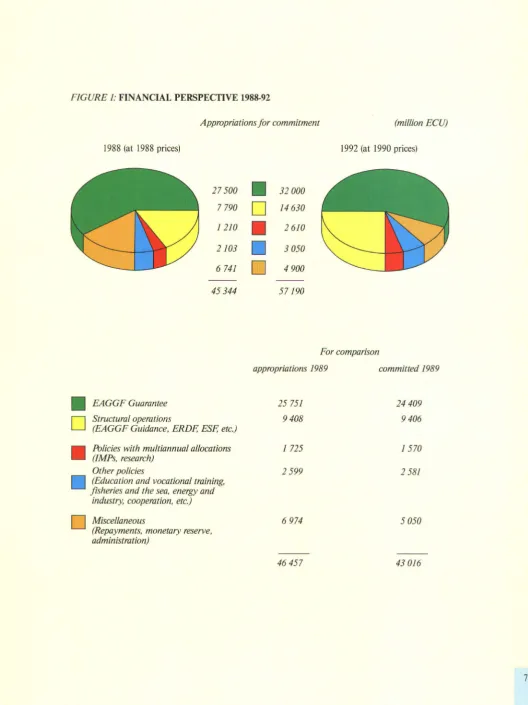
Financial perspective 1988-92 In June 1988 an agreement was reached be-tween the institutions involved in drawing up the general budget of the Communities -Parliament, the Council and the Commis-sion. This Interinstitutional Agreement meets the objectives laid down at the Brussels European Council of February 1988- tigh-ter budgetary discipline for the Community's finances to ensure an orderly increase in bud-get spending and a better balance between the various categories of expenditure.
To satisfy these objectives and thus ensure fi-nancial cover for the policies provided for in the Single European Act, the Agreement con-tains a financial perspective for the period 1988-92 which lays down annual ceilings for the main categories of expenditure under the general budget. The institutions have agreed to keep expenditure beneath these ceilings.
The Commission updates the financial per-spective every year before the budgetary pro-cedure begins, in order to adjust the figures in line with movements in GNP and prices. If all
I
I
threel institutions agree, the perspective may also be adjusted to take account of the condi-tions:ofimplementation, as it was in 1989, on the basis of the schedules of commitment ap-propriations and payment apap-propriations. Fi-nally: the financial perspective may be revised by common agreement between the three in-stitutions. A procedure to revise the financial pers~ective was initiated in early 1990, de-signe~ mainly to cover the Community measures planned for Eastern Europe.
'
The June 1988 Interinstitutional Agreement also l~ys down new pragmatic rules for coope-ration between the three institutions in order
I
FIGURE 1: FINANCIAL PERSPECTIVE 1988-92
Appropriations for commitment (million ECU)
1988 (at 1988 prices) 1992 (at 1990 prices)
27 500
•
32 0007 790
D
I4 630I 210
•
2 6102103 3 050
6 74I
D
4 90045 344 57190
For comparison
•
D
•
D
EAGGF Guarantee
Structural operations
(EAGGF Guidance, ERDF. ESF. etc.)
Policies with multiannual allocations (IMPs, research)
Other policies
(Education and vocational training, fisheries and the sea, energy and
industry, cooperation, etc.) Miscellaneous
(Repayments. monetary reserve, administration)
appropriations 1989
25 75I
9408
I 725
2 599
6 974
46 457
committed 1989
24 409
9406
I 570
2 581
5 050
43 0/6
The budget
The Community budget is subject to the prin-ciple of annuality, which require~ ~ha~ bud~e
tary operations relate to a spectftc fm~~c!al
year so that it is easier to control the actmtles of the Community executive.
Each expenditure operation involves the com-mitment of appropriations followed by actual payment. In the case of multiannual opera-tions, the time lag between the two stages may be considerable. In practical terms, the budget therefore sets two limits to guarantee com-pliance with the principle of annuality: the amount of appropriations for commitment, which is the limit to the new financial com-mitments which may be entered into in the course of the financial year, and the amount of appropriations for payment (identical with the amount of revenue forecast for the finan-cial year), which is the limit to the payments entered into during the year against existing commitments.
The Community has to reconcile application of the principle of annuality with ~he nee~ to administer the multiannual operations whtch have assumed ever-increasing importance in
the budget. Its response to this twin dema~d
takes the form of 'differentiated appropna-tions' which consist of commitment appro-priations and payment approappro-priations; the commitment appropriations cover, for the year in question, the total cost of the legal obligations entered into in respect of opera-tions which may extend over more than one year; the payment appropriations cover ex-penditure deriving from commitments enter-ed during the year in question and, where ap-plicable, previous years up to the limit of the amount entered in the budget.
For the administrative expenditure of all the institutions, EAGGF Guarantee Section ex-penditure and certain other annual opera-tions; the budget contains 'non-differentiated appropriations' which are the limit ~or both the commitments and payments whtch may be made in the financial year. At the end of the year the appropriations corresponding to
commitments entered into during the year but not yet paid are automatically carried over to the following year to allow the payments to be made.
By way of exception to the principle of annua-lity, in addition to the automatic carryove.r of non-differentiated appropriations, non-diffe-rentiated appropriations, commitment appro-priations and payment approappro-priations not used at the end of a financial year may, in cer-tain cases, be carried over to the next year.
Table 1 shows the utilization, in both commit-ments and paycommit-ments, of appropriations avail-able in 1989 (appropriations entered in the 1989 budget and appropriations carried over from 1988).1t also shows the amount of com-mitments outstanding at the end of 1989. Table 7 breaks down this amount for opera-tions with differentiated appropriaopera-tions.
Table 1 shows the year's outturn (as defined and presented in the second part of the report) as the difference between the year's revenue of ECU 45 900 million and the 1989 appropria-tions for payment used during the year (ECU 40 411 million) plus the ECU 439 million in appropriations for payment carried over to 1990.
(millionECU)
Total
The ecu
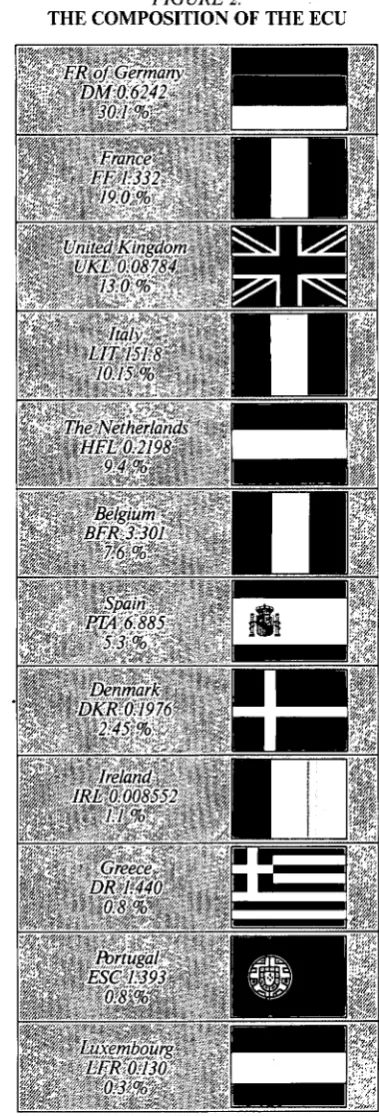
The Communities' currency unit is the ecu, a 'basket' of the 12 Community currencies, the composition of which is periodically adjusted (see Figure 2). The peseta and escudo were incorporated in the basket in September 1989 when the composition of the ecu was revised for the second time. This operation did not af-fect the value of the ecu, which is now quoted on the exchanges of each of the Member States.
[image:9.574.319.509.148.707.2]Some major sections of the budget, such as re-search and energy policy, have been imple-mented in ecus for some time now. In 1989 the Council adopted the principle that expendi-ture under the structural Funds should be im-plemented in ecus and the Commission is now taking the necessary steps. Calls for tenders for the provision of services to the Commun-ity institutions are usually issued in ecus.
FIGURE 2:
THE INSTITUTIONS
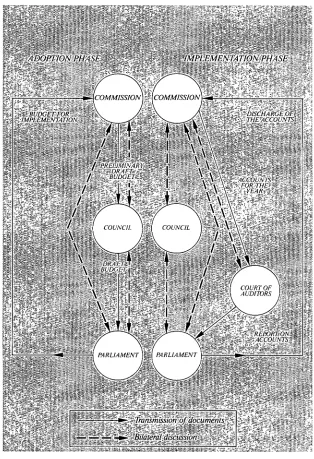
Parliament, the Council, the Commission, the Court of Justice and the Court of Auditors are all involved, in varying degrees, in the adoption, execution and control of the gene-ral budget of the Communities.
The Commission starts the budgetary proce-dure by drawing up a preliminary draft bud-get. Acting by a qualified majority the Coun-cil can endorse or amend the preliminary draft before passing it to Parliament as a draft budget. Parliament can propose modifica-tions to compulsory expenditure and make amendments to non-compulsory expendi-ture. 1 On second reading, the Council must
secure a qualified majority to accept the modi-fications proposed by Parliament which in-crease expenditure and reject the other modi-fications or amendments. Parliament can restore these amendments, within certain limits, on second reading. Unless Parliament rejects the budget, its President then declares it finally adopted.
Responsibility for the implementation of the budget rests with the Commission which, however, allows the other institutions the powers they need to implement the sections of the budget concerning their administrative expenditure.
Control of the implementation of the budget is in two parts: the internal control conducted by each institution for each item of expendi-ture and the external control by Parliament and the Court of Auditors.
1 Compulsory expenditure is that which derives
[image:10.576.232.546.288.747.2]di-rectly from the provisions of the Treaty or from secon-dary legislation; non-compulsory expenditure covers most expenditure other than that on agriculture and repayments to the Member States.
FIGURE 3: THE BUDGETARY PROCEDURE
Parliament
Members of Parliament are directly elected every five years by the people of each Member State. The last elections were in June 1989.
The Members sit in political groups and in 18 parliamentary committees, of which the Committee on Budgets and the Committee on Budgetary Control are the ones most directly concerned with financial questions.
Together with the Council and the Commis-sion, Parliament was a party to the June 1988 Interinstitutional Agreement which con-tained the financial perspective 19 8 8-9 2 form-ing the reference framework for budgets over this period.
Parliament plays a major role in the budget-ary procedure. The draft budget established by the Council is first discussed by Parlia-ment's Committee on Budgets which, after consulting the other committees, proposes modifications to compulsory expenditure and amendments to non-compulsory expenditure. These are then debated in the House when the budget is given its first reading.
The second reading within the Committee on Budgets and in the House is mainly concer-ned with non-compulsory expenditure since the Council will already have had the final say on compulsory expenditure at its second read-ing. When the budgetary procedure is comple-ted, the President of Parliament declares the budget finally adopted.
Parliament also closely monitors the imple-mentation of the budget by means of a perma-nent control on the basis of the Commission's monthly and quarterly reports and through the discharge procedure, at the end of which Parliament gives, defers or withholds the dis-charge to the Commission on the basis of the annual report from the Court of Auditors and a recommendation from the Council. Parlia-ment's control activities are exercised by its Committee on Budgetary Control and are de-bated in the House.
The Financial Regulation and other legisla-tion governing the preparalegisla-tion and imple-mentation of the budget are also adopted or amended in consultation with Parliament, as is the implementing legislation for each of the main spending programmes.
The Council
The Council consists of representatives of the Member States.
The Foreign Ministers of the Member States sit in the General Affairs Council. The Coun-cils may consist of other ministers when they deal with more specific subjects. Each Mem-ber State in turn carries out the role of presi-dent for six months. In 1989 it was the turn of Spain and then France.
The Council's activities during the budgetary procedure begin when the Permanent Repre-sentatives Committee examines the prelimi-nary draft budget prepared by the Commis-sion. The Budget Council eventually establi-shes, by a qualified majority, the draft budget which is then sent to Parliament. At its sec-ond reading, the Budget Council takes a deci-sion on the proposals for modification and on the amendments made by Parliament. The final amount of compulsory expenditure is determined on the basis of the outcome of the Council's discussions during the second reading unless Parliament rejects the entire budget on second reading.
The Council is also involved in the discharge procedure. After the Permanent Representa-tives Committee has examined the Court of Auditors' report accompanied by the replies by the institutions, the Economic and Finan-cial Affairs Council adopts, by a qualified rna-jority, a recommendation to Parliament to grant the Commission a discharge in respect of implementation of the budget.
Since 1975 Heads of State or Government and representatives of the Council and the Commission have met two or three times a year as the European Council and have often discussed budgetary questions in recent years. It was the European Council, in meetings at Copenhagen and Brussels, that took the deci-sion in principle to create a new financial re-source based on the gross national product of the Member States. This fourth resource, de-signed to put a stop to the recurrent budgetary crisis of recent years, appears for the first time in the accounts for 1989.
Commission
The Commission consists of 17 Members ap-pointed by the Governments of the Member States for a four-year term. It is the executive organ of the Communities and initiates Com-munity policies by presenting proposals to Parliament and the Council. On the budget front, for instance, the budgetary procedure begins when the Commission produces its preliminary draft budget. After the final bud-get is adopted by the two arms of the budbud-get· ary authority (Parliament and the Council), the Commission is responsible for implemen-tation.
Since 1989 the preliminary draft budget has been drawn up within the limits set by the fi-nancial perspective. It is based on the fore-casts of expenditure on operations supplied by the Commission departments, forecasts of ad-ministrative expenditure made by each of the institutions and estimates of revenue.
There are two limits on the powers which the Treaties confer on the Commission to imple-ment the budget. First, the Commission al-lows Parliament, the Council, the Court of Justice and the Court of Auditors to handle their own expenditure. Secondly, in connec-tion with the expenditure on operaconnec-tions cove-red by the general budget, the Commission's autonomy is limited by the existence of com-mittees of national experts appointed by the Member States whose role is to advise or, in
some cases, move to direct operations (man-agement and regulatory committees).
The budgetary implementation procedure is based on a series of provisions contained in the Financial Regulation (revised in March 1990) and in the implementing rules. The principle underlying the procedure is the sepa-ration of the roles of authorizing officer (the administrator of appropriations, who alone is responsible for the commitment of expendi-ture, establishment of entitlements and the is-sue of payments and recovery orders) and ac-counting officer (who actually makes pay-ments and recovers amounts due). Within each institution, there is also a financial con-troller who must grant prior approval for any expenditure or revenue operation.
Court of Justice
The Court of Justice has 13 judges and 6 Ad-vocates-General, each appointed for a six-year term.
Since September 1989 the Court of Justice has been assisted by a Court of First Instance consisting of 12 members. This new court has jurisdiction in certain categories of cases brought by natural or legal persons, subject to appeal to the Court of Justice on points of law only.
Under the powers conferred upon it by the Treaties, the Court of Justice may be asked to judge disputes relating to or affecting the bud-get and the finances of the Community. At the end of 1987, for instance, Parliament and then the Commission brought an action against the Council for failure to establish the 1988 draft budget within the prescribed time-limit.
Court of Auditors
The Court of Auditors examines 'the ac-counts of all revenue and expenditure of the Community', irrespective of whether or not it is entered in the budget_ In practice, this means that the Court of Auditors is responsi-ble for auditing the general budget, the · ECSC's borrowing and lending activities,
ope-rations by the European Development Fund financed by contributions from the Member States outside the scope of the budget and any body set up by the Communities except where the body's constitutive instrument rules out this audit.
The findings of the Court's audits are con-tained in annual reports on the implementa-tion of the budget of the instituimplementa-tions or the bodies they have set up or in special reports on the management of a specific sector of Com-munity activity.
The most important of these reports is the an-nual report on the accounts of the European Communities which is published in the Offi-cial Journal together with the replies by the in-stitutions.
Parliament and the Council examine the Court's reports during the annual discharge procedure or as part of their responsibility for monitoring implementation of the budget. The Commission, as the institution responsi-ble for implementing the budget, must take account of the comments of the Court and the discharge authority.
REVENUE
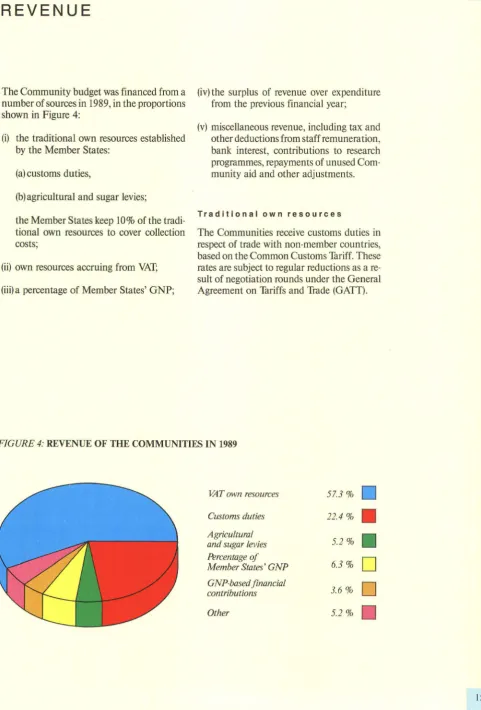
The Community budget was financed from a number of sources in 1989, in the proportions shown in Figure 4:
(i) the traditional own resources established by the Member States:
(a) customs duties,
(b) agricultural and sugar levies;
the Member States keep 10% of the tradi-tional own resources to cover collection costs;
(ii) own resources accruing from VAT;
(iii) a percentage of Member States' GNP;
(iv) the surplus of revenue over expenditure from the previous financial year;
(v) miscellaneous revenue, including tax and other deductions from staff remuneration, bank interest, contributions to research programmes, repayments of unused Com -munity aid and other adjustments.
Traditional own resources
[image:14.578.72.553.64.774.2]The Communities receive customs duties in respect of trade with non·member countries, based on the Common Customs Tariff. These rates are subject to regular reductions as a re-sult of negotiation rounds under the General Agreement on Tariffs and Trade (GATT).
FIGURE 4: REVENUE OF THE COMMUNITIES IN 1989
I-::4T own resources 57.3%
D
Customs duties 22.4%
•
Agriculturai
5.2%
•
and sugar levies Percentage of
6.3%
D
Member States' GNP
GNP·based financial
3.6%
D
contributions
Other 5.2%
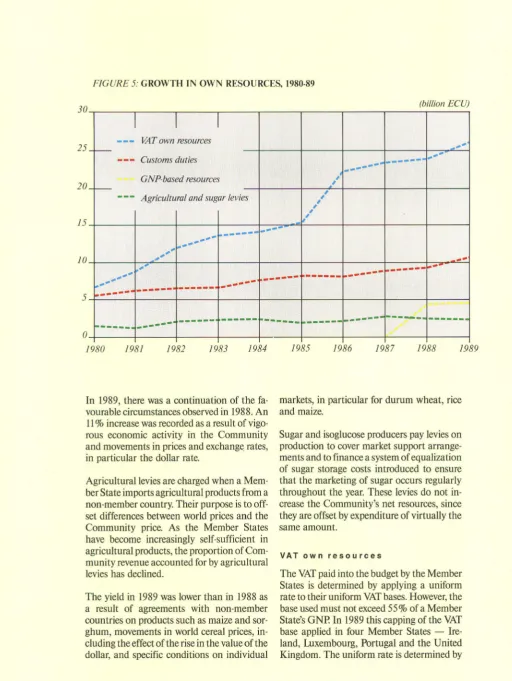
FIGURE 5: GROWTH IN OWN RESOURCES, 1980-89
30 (billion ECU)
I
I
I
---
liltT own resources- f - - <#<#
<#<#
[image:15.574.40.553.71.753.2]---
Customs duties---·
<#...
GNP-based resources
.4----
,
,
-r---
,
---
Agricultural and sugar levies,
,
25
20
,
,
15
i
/
1-
---
----<# . . <# . .
,
..
~--,
..
....
1-' ... ~---~
-10
<#<#
~---~
---....
..
....
---~ . . <#
--- ---
...
~---·
5
--- ---
f-
---
~------
---~-----·
---·
01980 1981 1982 1983 1984
In 1989, there was a continuation of the fa
-vourable circumstances observed in 1988. An 11% increase was recorded as a result of vigo
-rous economic activity in the Community and movements in prices and exchang~ rates, in particular the dollar rate.
Agricultural levies are charged when a Mem
-ber State imports agricultural products from a non-member country. Their purpose is to off-set differences between world prices and the Community price. As the Member States have become increasingly self-sufficient in agricultural products, the proportion of Com
-munity revenue accounted for by agricultural levies has declined.
The yield in 1989 was lower than in 1988 as a result of agreements with non-member countries on products such as maize and sor-ghum, movements in world cereal prices, in-cluding the effect of the rise in the value of the dollar, and specific conditions on individual
1985 1986 1987 1988 1989
markets, in particular for durum wheat, rice and maize.
Sugar and isoglucose producers pay levies on production to cover market support arrange
-ments and to finance a system of equalization of sugar storage costs introduced to ensure that the marketing of sugar occurs regularly throughout the year. These levies do not in-crease the Community's net resources, since they are offset by expenditure of virtually the same amount.
VAT own resources
applying 1.4% to the VAT base and incorpo -rating the correction made to compe~s~te the United Kingdom for the imbalance m 1ts net contributions to the budget. The payments of the other Member States are increased by their share in financing this compensation. Payments for a given year depend ?n the est!-mates for that year and the negative or posi-tive adjustments for previous years estab-lished from the final statements of the bases. Since economic activity in the Community in
1988 was livelier than expected, the Member
States made positive corrections in 1989.
Portugal introduced the harmonized VAT sys -tem in 1989 and so was able to pay VAT own resources for the first time; previously, it had paid a financial contribution.
GNP-based own resources
The part of the budget not covered by other revenue is financed by a share of each Mem-ber State's GNP. In 1989 this percentage was 0.0675%. This new Community resource took effect for the first time in 1989.
Pending ratification of the decision on this fourth resource, the Community asked the Member States for a financial contribution -similarly based on GNP - to balance the
1988 budget. Two Member States paid this
contribution in January 1989.
FIGURE 6: OWN RESOURCES BY MEMBER STATE IN 1989
12 ~---~G~N~P~-b~a=se:d---~
JJ
+--
-
- - -
- 1 - 1 - - - -
-
- -
D
financialcontri-butions
10+
-(billion ECU)
D
Percentage9
+ - - - -
ofGNP• Agricultural and - - - i
8
+ - - - -
sugar levies7 -+--- ---, • Customs duties
6
+---
lij!T own5
+---
resources4+-----
---3+ - - - - -
TREASURY REPORT
The Commission holds accounts with the Treasuries andbr Central Banks of Member
States, on which it receives revenue and
through which it pays the bulk of its
transac-tions, in particular those relating to the
EAGGF, most of the expenditure on the
structural Funds and reimbursements to
Member States.
Each month the revenue paid is equivalent to
one twelfth of the amounts provided in the
budget for VAT and GNP-based resources and on the amount actually established each month for customs duties and agricultural levies (Figure 8).
Normal commercial bank accounts are used
for administrative expenditure and direct pay
-ments to recipients other than national authorities represented some 18% of the an-nual budget.
In contrast to 1988, the monthly cash
[image:17.577.13.533.47.833.2]situa-tion was positive throughout 1989 (see Fig-ures 7 and 8), mainly as a result of savings made in EAGGF Guarantee Section expen-diture.
FIGURE 7: MONTHLY CASH MOVEMENTS IN 1989
6 (billion ECU)
.... ...
5
,,
,'
,
,,,''
r
'
,
4
,
,
,
,
,
3
,
..
,'
,
..
\,
\
,
....
\,
....
\,
..
\,,
,
\,
i,
\2
...
,,'
\,,''
\
~
----
,
10
FIGURE 8: MONTHLY REVENUE AND EXPENDITURE IN 1989
(billion ECU)
6~---~
4
3
2
1
GNP-based
D
financial contributionsD
Percentage of GNP~--- liT] Other
• Traditional own resources
D
J.:llT own resourcesD
ExpenditureJan. Feb. MG!: Apr. May June July Aug. Sepr. Oct. Nov. Dec.
Various situations may arise in the annual im
-plementation of budget revenue and expendi-ture; the difference in relation to the initial estimate determines whether the balance for the year is positive or negative. A surplus can result from under-utilization of appropria-tions (this was the case with the EAGGF Guarantee Section in 1989) or from a revenue outturn higher than the forecast in the budget or from a combination of these two factors. Since spending may not exceed the limit set by the appropriations entered in the budget, a deficit can be caused only by the revenue out-turn being lower than the forecast in the budget.
The cash situation in the course of the finan
-cial year depends on the monthly outturn of revenue and expenditure, which do not neces-sarily balance. Even if the balance for the year shows a surplus, expenditure might have out-stripped revenue during the part of the year,
causing cash-flow difficulties.
For these reasons, the rules in force allow the Commission to overdraw on its accounts with the national treasuries.
[image:18.578.59.558.60.508.2]The rules also stipulate that the positive and negative balances resulting from payment and revenue transactions should be spread over the year in proportion to each Member State's contribution to the budget as a whole. These movements, and the purchase of ecus to cover an ever-increasing proportion of the Commission's payments, demand frequent exchange transactions.
A rolling forecast of cash-flow is used to moni-tor and coordinate these currency transac-tions. Cash-flow management is strictly regu-lated: no borrowing is allowed to cover possi-ble deficits, no loans may be made from posi-tive balances and no interest is receivable or payable on balances with Member States.
EXPENDITURE
The expenditure provided for in the general
budget of the Communities covers the admi
-nistrative costs of the various institutions and the operations under the various Community policies.
The administrative expenditure of the institu-tions in 1989 totalled ECU 2 092 million, i.e.
. around 5% of the general budget. This con
-sists of expenditure on staff and administra
-tion and is broken down by institu-tion in Table 9.
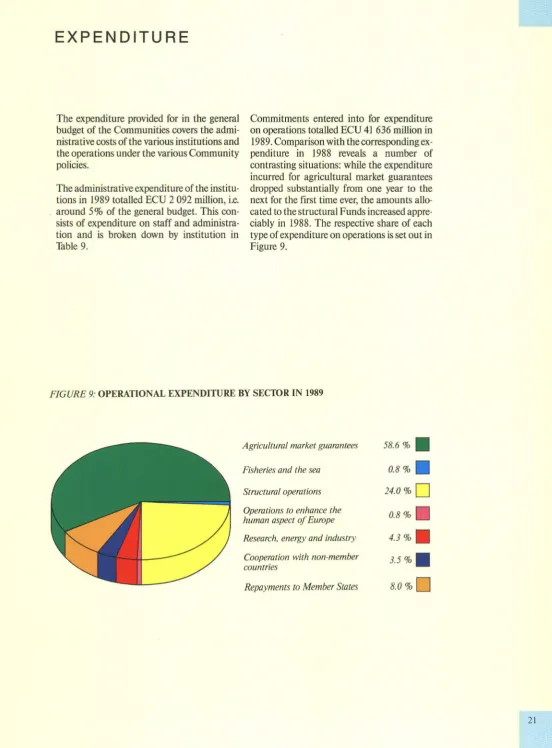
Commitments entered into for expenditure on operations totalled ECU 41 636 million in 1989. Comparison with the corresponding ex-penditure in 1988 reveals a number of contrasting situations: while the expenditure incurred for agricultural market guarantees dropped substantially from one year to the next for the first time ever, the amounts allo-cated to the structural Funds increased appre-ciably in 1988. The respective share of each type of expenditure on operations is set out in Figure 9.
FIGURE 9: OPERATIONAL EXPENDITURE BY SECTOR IN 1989
Agricultural market guarantees
Fisheries and the sea
Structural operations
Operations to enhance the human aspect of Europe
Research, energy and industry
Cooperation with non-member countries
Repayments to Member States
58.6% .
0.8% .
24.0%
D
0.8%
EJj
4.3% .
3.5% .
8.0%0
[image:20.575.13.566.36.785.2]AGRICULTURAL MARKET GUARANTEES
The Brussels European Council of February 1988laid down the principles for tighter bud-getary discipline to ensure a better balance between the various categories of expenditure in the general budget and an orderly increase in these categories of expenditure. For this purpose, various measures have been adopted in connection with agricultural expenditure:
(i) the establishment of a guideline to ensure that EAGGF Guarantee expenditure does not exceed 7 4% of the annual growth rate for Community GNP;
(ii) a strengthening and expansion of the sta-bilization mechanisms and measures to limit production directly by providing in-centives for the temporary abandonment of arable land, possibly accompanied by direct income support;
(iii) the systematic depreciation of old and new agricultural stocks in order to restore stocks to a normal situation by 1992.
In accordance with these principles, the 1989 budget contained ECU 26 841 million for guarantee expenditure (including ECU I 878 million for the depreciation of new stocks and ECU 100 million for set -aside and income aid). Because appropriations were under-utilized, transfers were made to other budget headings, bringing the final budget for 1989 to ECU 25 751 million, broken down as follows:
EAGGF Guarantee
(including ECU I 125 million for the depreciation of new stocks)
Set-aside and income aid
million ECU
25 651 100
The final budget also contained ECU I 449 million for repayments to Member States in connection with the depreciation of old stocks.
Implementation of the budget for agricultural
guarantee expenditure
At ECU 24 403 million, the EAGGF Guar-antee Section appropriations finally used were ECU 2 338 million lower than the appro-priations entered in the initial budget.
This is explained by a number of factors:
(i) the dollar I ecu rate of 0.90 was higher than the 0.81 assumed in the budget, leading to savings of around ECU I 219 million on refunds and production aids;
(ii) the clearance of earlier years' accounts led to some ECU 203 million being recovered from the Member States and booked to
1989;
(iii) developments on the agricultural market and in the parameters affecting them.
Apart from the favourable effect of the move-ment of the dollar against the ecu, the fluctua-tions in the parameters affecting agricultural markets (world prices, production, consump-tion, etc.) also had an impact on the budget, sometimes positive and sometimes negative.
Some chapters, mainly tobacco, milk prod-ucts, pigmeat and eggs and poultrymeat, had insufficient appropriations.
The additional requirements in the tobacco sector were caused by:
(i) the unexpectedly high level of production in 1988;
(ii) the increase in the quantities placed in in-tervention;
In the case of milk products, the val ume of ex-ports, in particular of butter, cheese and skim-med-milk powder, combined with a level of milk production exceeding the quotas, led to higher expenditure than estimated in the budget.
The shortfall of appropriations in the pigmeat and egg and poultrymeat sectors was due to the large volume of exports for which refunds were paid.
To offset these shortfalls, transfers of ECU 53 7 million were made between chapters within the EAGGF Guarantee Section. This figure represents about 2% of the appropria-tions available for agricultural guarantee ex-penditure and is far lower than in previous years.
On the other hand, there was substantial un-der-utilization of appropriations in chapters such as cereals and rice, sugar, oils and fats, fruit and vegetables, products of the wine-growing sector, beef/veal, goods obtained by processing agricultural products, monetary compensatory amounts and other expen-diture.
In the case of cereals, the under-utilization of appropriations was mainly due to the level of exports, which reduced quantities placed in intervention and thus also cut the cost of pub-lic storage and depreciation on buying-in.
The budgetary situation in the sugar sector was influenced by the relative firmness of world prices during the year.
Appropriations remained unused in the oils and fats sector because payments of produc-tion aid for olive oil were slow. The lower level of requirements in the fruit and vegetables sector was because of the relatively low level of withdrawals of citrus fruits. Another factor, less important, was that the quantities re-ceiving production aid for processed products were lower than forecast.
The under-utilization of appropriations in the wine sector was mainly due to the fact that production in 1988 was far lower than as-sumed in the budget. In addition, expenditure on compulsory distillation for the 1988/89 marketing year and the depreciation of the al-cohol produced could not be paid from the 1989 budget.
The reasons for the surplus in the beef/veal sector were as follows:
(i) expenditure on depreciation was lower than budgeted because the quantities bought into intervention were lower than expected;
(ii) the financial effects of the reform of the market organization were slower than ex-pected in working through.
The appropriations available for processed agricultural products were not used in full be-cause of the high level of world prices for the basic agricultural products.
Expenditure on monetary compensatory amounts was less than estimated because of the dismantling of monetary compensatory amounts at the beginning of the 1989/90 mar-keting year and the movements in currency values during the year.
The appropriations for 'other expenditure' which were not used were mainly for the pay-ment of refunds on certain quantities of food aid which were no longer due as a result of an increase in world prices.
Systematic depreciation of stocks
The total of ECU 1 878 million allocated to this new policy in the initial budget for 1989 was reduced to ECU I 125 million by trans-fers. Finally only ECU 1 024 million was used for the reasons set out above. However, a further ECU 151 million was used to pay ad-vances on the cost of disposing of 'mixed' alco
-hol, for which the Community covers only
losses on sales. Combined with the deprecia
-tion of old stocks at the start of the year and
the reduction in the volume of stocks, this po
-licy reduced potential liabilities at 31 Decem-ber 1989 to virtually nil. The value of stocks was reduced to the estimated resale value by the depreciation exercise at the start of the 1990 agricultural year (16 October 1989), i.e. two years ahead of schedule.
FIGURE 10: EXPENDITURE BY SECTOR IN 1989
Cereals and rice
Sugar
Oils and fats
Fruit and vegetables
Wine
Tobacco
Milk and milk products
Beef/veal
Sheepmeat and goatmeat
Other
(billion ECU)
• Expenditure 1988
[image:23.578.16.517.103.750.2]Set-aside of farmland and income aids
The reason why the rate of utilization of the appropriations entered in the 1989 budget for
FISHERIES AND THE SEA
The common policy on fisheries and the sea covers the following main areas:
(i) access, conservation and management of resources;
(ii) common organization of markets;
(iii)a structural operation providing for mul-tiannual guideline programmes to im-prove the productivity of fisheries;
(iv) the conclusion of fishing agreements with non-member countries.
The appropriations for commitment for this policy have risen appreciably in recent years and totalled ECU 348 million in 1989.
the set-aside of arable land and for income aids was very low was that the national authorities failed to take the necessary measu-res to apply the regulations.
J
STRUCTURAL OPERATIONS
The European Regional Development Fund (ERDF), the European Social Fund (ESF) and the Guidance Section of the European Agricultural Guidance and Guarantee Fund (EAGGF) are the three main instruments for Community operations to promote the har-monious development of the Community as a whole by reducing differences between the va-rious regions and the backwardness of the less-favoured regions.
The Single European Act has provided for close cooperation between the three Funds in order to rationalize their tasks and boost their effectiveness. As well as deciding to double the appropriations allocated to these Funds between 1987 and 1993, the Brussels Euro-pean Council in February 1988 also set five general objectives for the Funds to pursue:
(i) promoting the development and structu-ral adjustment of the regions whose devel-opment is lagging behind (Objective 1);
(ii) converting the regions seriously affected by industrial decline (Objective 2);
(iii) combating long-term unemployment (Ob-jective 3);
(iv)facilitating the occupational integration of young people (Objective 4);
(v) speeding up the adjustment of agricultu-ral structures and promoting the develop-ment of rural areas (Objective 5).
The new legal framework for implementing the appropriations allocated to the structural Funds is a regulation adopted by the Council in 1988. This regulation and its implementing regulations entered into force on 1 January 1989.
The; following commitment appropriations
wer~ available in 1989:
ERJ:?F ESFi
EAGGF Guidance Section I
million ECU
4710
3 520 1 465
In addition to the appropriations allocated to these three Funds, the 1989 budget contained ECU 5 39 million for other programmes under the Communities' structural policy, in parti-cular the specific industrial development pro-granime for Portugal (Pedip), the integrated Mediterranean programmes (IMPs) and transport policy.
I
Act:ivity of the three structural Funds
Following the adoption of the new rules gov-erning the activities of the Community's three structural Funds (ERDF, ESF and EAGGF Guidance Section) in 1988, the Community support frameworks for Objec-tivd 1, 2, 3 and 4 were drawn up and approved in l~te 1989.
' '
Thde frameworks were drawn up under the partnership arrangements between the Com-munity, the Member States and the regional and local authorities on the basis of multian-nual plans of three to five years (depending on the 9bjective) submitted to the Commission.
All the commitment appropriations for the European Social Fund were used. Some ECU 1 640 million went towards promoting the de-velopment and structural adjustment of the regions whose development is lagging behind and some ECU 1 010 million towards opera-tions to facilitate the occupational integration of young people.
Virtually all the appropriations allocated to the EAGGF Guidance Section in the 1989 budget were used.
Other structural operations The specific industrial development pro-gramme for Portugal (Pedip) adopted in 1988 has been given an allocation of ECU 500 mil-lion for the five-year period 1988-92. The
ECU 104 million entered in the 1989 budget was committed in full.
However, although the second stage of some of the integrated Mediterranean programmes has now started, use of the appropriations for the IMPs was seriously delayed because of the difficulties encountered in implementing some of them.
At the end of 1988 the Council adopted a spe-cific regulation on the financing of transport infrastructure projects of Community interest in 1988 and 1989, thus enabling all the appro-priations entered in the 1989 budget to be committed. The Communities' financial sup-port reflects the concern to satisfy the trans-port requirements of the single market by pro-viding the necessary links between national networks and is evidence of the special atten-tion given to outlying areas to ensure econo-mic and social cohesion.
OPERATIONS TO ENHANCE THE HUMAN ASPECT OF EUROPE
In addition to the operations financed by the European Social Fund as part of its structural measures, the Community pursues a number of other policies in the social sector (in the broad sense of the term) designed as flanking measures for the completion of the single mar-ket in 1992. Community measures to protect the environment fall into this category.
The appropriations for commitment available in 1989 amounted toECU 311 million, broken down as follows:
million ECU
Education, vocational
training and youth policy 120 Employment, social protection
and public health 76
Protection of the environment
and consumer protection 44 Information, communication
and culture 38
Aid to disaster victims in the
J
28
All these appropriations were committed.
In the education and youth policy sector, seve-ral ongoing programmes (Eramus, 1 Comett,2
YES,3 exchanges of young workers, etc.) were considerably expanded in 1989, confirming the success of previous years. This is particu-larly true with Erasmus, under which the ap-propriations allocated to student mobility more than tripled in relation to 1988, and with the Youth exchange scheme (YES) adopted by the Council in June 1988.
As regards living and working conditions, se-veral measures were continued under the
1989 budget to improve health and safety at work, integrate less-favoured groups, fight po-verty and improve public health (campaigns against cancer, AIDS, alcohol and drug abuse).
The Community measures to protect the envi-ronment continued: the commitments ent-ered in 1989 related to long-term operations (in particular to help protect endangered areas or species and promote the development of clean technologies) or shorter-term opera-tions (e.g. the establishment of a coherent set of operations to protect the environment in
the Mediterranean region). Other operations related to consumer protection and informa-tion ~n particular child safety.
In 1989, operations in the information, com-munication and culture sector benefited from the ihtpetus provided by European Cinema and Television Year in 1988 to continue to en-sure that the Community is present in the cul-tural1life of Europe and in the development of new audiovisual technologies and to promote awareness of European ideas in everyday life.
I
Aid to disaster victims in the Community is granted in the form of direct grants and subsi-dized loans and is charged to the budgets of
succ~ssive financial years. The loans still
out-standing relate to the earthquakes in Italy in 1980. and Greece in 1981 and in 1986.
1 Erasmus: European Community action scheme for
the mobility of university students.
2 cdmett: Community programme in education and
training for technology.
RESEARCH, ENERGY AND INDUSTRY
As stated in the Single Act, the Community's aim is to strengthen the scientific and techno-logical basis of European industry and to en-courage it to become more competitive at in-ternational level. For this purpose, there will have to be a considerable increase in budget funds between now and 1992 for Community policies based largely on measures which will produce economies of scale. These Commun-ity operations are grouped in multiannual framework programmes for research and investment.
The Community is also conducting a number of operations in the energy policy and indus-trial policy sectors as part of the establishment of the single market.
The appropriations for commitment available for these sectors of Community activity in 1989 amounted to ECU I 801 million, allo-cated as follows:
million ECU
Research and technological development
Other policies
Research and technological development
1 482 319
A new framework programme for 1990-94 was produced in 1989 and received the Coun-cil's political endorsement in December. Based on the Single Act and drawn up under a procedure involving detailed examination and analysis of European requirements, this framework programme is made up of six areas of operation under three subject headings. The total amount judged necessary is broken down as follows:
million ECU
Diffusion technologies • Information and
commu-nication technologies 2 221 • Industrial and materials
technologies 888
Management of natural resources
• Environment 518
• Life sciences and
technologies 7 41
• Energy 814
Management of intellectual resources
• Human capital and
mobility 518
5 700
Implementation of the 1987-91 framework programme continued as the 1990-94 frame-work programme was being drawn up. During 1989 the Council adopted 18 specific pro-grammes.' Decisions still have to be taken on several other programmes2 and revisions to
programmes proposed or to be proposed by the Commission, even after adoption of the third framework programme; specific provi-sions exist for this purpose.
I
_j
the JRC's main task in 1989 was to carry out specific programmes, including preparatory research.
European scientific and technical
coopera-tion (COST3) continued; in June the Council
adopted a resolution reaffirming the impor-tance of COST as an instrument to promote European cooperation. Scientific cooperation with the countries of latin America, Asia and the Mediterranean continued to expand in two main directions in 1989: the financing of research scholarships for top scientists and the financing of joint research projects. Co-operation with the industrialized countries in-creased and expanded, largely as a result of continuing cooperation with the United Sta-tes and Canada. The Commission also took part in preliminary work on the Japanese Hu-man frontier science programme. Coopera-tion between the Community and Eureka continued to be strengthened, leading to sy-nergy in a number of programmes launched under the Eureka programme, in particular the Jessi project.4
Other policies
In 1989 the Commission proposed the Ther-mie programme (1990-94)5 to promote energy technologies. This programme is also an im-portant step towards increasing security of supply, maintaining the competitive position of European industry as the internal market is completed and boosting environmental protection.
Community action to develop the market in information services continued under the
Im-pact programme. 6 The dissemination and use
of the results of research and technological de-velopment under Community and national programmes were encouraged through the adoption of the Value and Sprint pro-grammes;7 the Sprint programme is more particularly concerned with promoting inno-vation and overcoming the obstacles to disse-mination.
The policies coming under the industry and
inter~al market sectors mainly cover
meas-ures ~nnected with the completion of the large'internal market, such as business
stimu-'
lation measures which are intended to a very large extent for small and medium-sized firms. In the telecommunications sector, Commun-ity pqlicy gave priorCommun-ity to deregulation of mar-kets, ,the type-approval of terminals and the development of standardization on the basis of the activities of the European standardiza-tion bodies; the establishment of the Euro-pean' Telecommunications Standards Insti-tute has given fresh impetus to these activities with
k
view to achieving the objectives which the Community has set itself for 1993.1 Bridge: Biotechnology research for innovation,
devel-opment and growth in Europe.
Brite/Euram: Basic research in industrial technologies in Europe/European research on advanced materials. D~ses: Development of expert systems for statistics. Eciair: European collaborative linkage of agriculture and industry through research.
Eutotra: European translation.
Flair: Food linked agro-industrial research. Joule: Joint opportunities for unconventional or long· terin energy supply.
MAST: Marine science and technology.
Mbnitor: Strategic analyses, forecasting and evalua· tion in matters of research and technology. SPEs: Stimulation plan for economic science. STEP and Epoch: Science and technology for envi-roqmental protection/European programme on cli-matology and natural hazards.
Teleman: Remote handling in nuclear hazardous and disordered environments.
Value: Valorization and utilization for Europe. Decommissioning of nuclear installations (Fission). Management and storage of radioactive waste (Fission).
Large scientific installations. Raw materials and recycling. Radiation protection.
2 Agricultural research programme; transport (Buret);
amended proposal for a programme on human ge-no~e analysis; revision of the SPES programme.
3 COST (European cooperation in the field of scientific
and technical research).
4 Jes~i (Joint European submicron silicon initiative).
5 Thermie (European technologies for energy
management).
6 Impact (Information market policy actions). 7 Sprint (Strategic programme for the transnational
As regards statistics, the Council adopted are-solution in June 1989 concerning the intro-duction of a priority action plan for 1989-92. This statistical programme represents a logi-cal overall framework to meet the
Communi-ty's needs for statistical information by har-monizing methods and providing a common set of concepts, definitions and standards while taking account of the specific features of each statistical system.
COOPERATION WITH NON-MEMBER COUNTRIES
The Community's policy of cooperation with non-member countries is financed from two sources: the general budget of the Communi-ties (containing appropriations for commit-ment of ECU I 460 million for this sector in 1989) and the European Development Fund, the instrument of cooperation between the Community and the African, Caribbean and Pacific States.
Operations entered in the general budget
Within the budget, food aid remains the lar-gest single form of aid in the field of coopera-tion. At 31 December 1989 allocations had been made from the 1989 programme in fa-vour of 78 countries. The main geographical areas involved were Asia (primarily Bangla-desh), the Mediterranean (primarily Egypt) and the Horn of Africa (primarily Ethiopia). Twenty-eight countries received direct Com-munity grants of aid. The remaining coun-tries received aid via intermediary internatio-nal or non-governmental organizations. Food aid may be granted for a variety of purposes, varying from help in emergency to the
longer-term aims of raising standards of nutrition, improving food security and, partly through linked development projects, contributing to the balanced economic and social develop-ment of the recipient countries. The mecha-nisms adopted may accordingly vary between free distribution to those in need and normal sale of foodstuffs on the local market, the re-sulting counterpart funds being used to finan-ce rural development or other relevant pro-jects in the benefiting country. In some cases, in a 'triangular operation' products are bought in one developing country in order to be supplied as food aid in another.
Other policy objectives financed from the budget in the field of cooperation with non-member countries include cooperation with developing countries in latin America and Asia (ECU 368 million) and with Mediterra-nean countries (ECU 200 million); specific aid measures including support for initiatives taken by non-governmental organizations
(ECU 96 million); emergency and exceptional
coopera-J
32
tion agreements with various countries (ECU 22 million).
The major Community effort in favour of de-veloping countries in latin America and Asia takes the form of the well-established pro-gramme of support for projects situated parti-cularly in the least-prosperous countries and focused on rural development and the im-provement of food production. Other measu-res include trade promotion and joint ventu-res in the investment sector. Since 1976 more than ECU 2 400 million has been committed for these countries.
The aid granted to Mediterranean countries results, in large measure, from a series of fi-nancial protocols annexed to agreements with the various recipient countries. The financial protocols provide a mixture of outright grants of aid for the various development projects and loan finance provided by the European Investment Bank and supported in most cases by interest-rate subsidies charged to the budget.
Community aid is also granted through non-governmental organizations. Development
projects benefiting from this aid are spread worl<;lwide and are mostly small-scale, local-ized schemes, in such fields as rural develop-ment, training and health. The aid granted in 1989 was channelled through 209 different organizations in all 12 Member States and went: to 98 countries. The main beneficiaries were Brazil, Ethiopia, India and Nicaragua.
Emergency and exceptional aid includes, first of all, the contingency fund used to finance emergency grants made in order to demon-strate Community solidarity in support of vic-tims of natural disasters affecting non-asso-ciated countries. There is a similar provision within the European Development Fund for the 68 co-signatories of the lome
Con-vent~on.
Operations financed by the EDF
J
34
FUTURE EXPENDITURE AND REVENUE
It is a feature of the accounting system of the Communities that certain sums due but un-paid at 31 December and certain revenue re-ceivable should be charged to the revenue and expenditure account for that year and entered in the balance sheet.
The main items of future expenditure and re-venue entered in the accounts at the end of 1989 were:
(i) payments authorized in December 1989 and made between 1 and IS January 1990;
(ii) payments to be authorized in 1990 against appropriations for payment not used ai end-1989 and carried over to 1990;
(iii) interest and other sums due in connection with borrowing and lending operations for the New Community Instrument and the European Atomic Energy Community; this future expenditure is almost entirely offset by interest and other sums
receiva-ble in connection with the same borrow-ing and lendborrow-ing operations.
However, other potential liabilities and re-sources are not entered in the accounts but are recorded separately:
(i) certain sums falling due in future years
to
clear commitments existing at the end of 1989, to meet outstanding financial obli-gations or to honour protocols concluded with third parties;(ii) contractual commitments made as part of NCI and Euratom borrowing and lending operations;
(iii) various potential liabilities and resources;
(iv) contingent liabilities.
These future liabilities and resources are listed in this section of the report to provide infor-mation in addition to the consolidated ac-counts of the Communities.
Sur)"ls falling due in future financial years
As stated in the section concerning the finan-cial'framework, some time elapses between the 'commitment and payment of
expendi-tur~: commitment and payment might not take place in the same financial year. This is frequently the case with multiannual
opera-tio~s (which are allocated differentiated ap-propriations), for which the budget usually contains different amounts of commitment appropriations and payment appropriations. I . At the end of the year there are therefore out-standing commitments for which payments will have to be made in future financial years.
For: operations allocated non-differentiated appropriations, the rules allow appropriations needed for payment against commitments to be sarried over automatically to the following financial year only; as stated above, the carry-overs to 1990 are included with the liabilities for 1989.
At : the end of 1989 the commitments outstanding for operations allocated differen-tiated appropriations amounted to ECU
16 579 million. Of this, ECU 58 million is cov-ered by payment appropriations carried over to 1990; the corresponding liability is also in-clu<;led in the accounts for 1989. The balance ofECU 16 521 million will have to be covered by payment appropriations in the budgets for 1990 and subsequent financial years. The commitments from differentiated appropria-tions outstanding at 31 December 1989 are analysed and broken down by probable year of payment in Table 7.
I
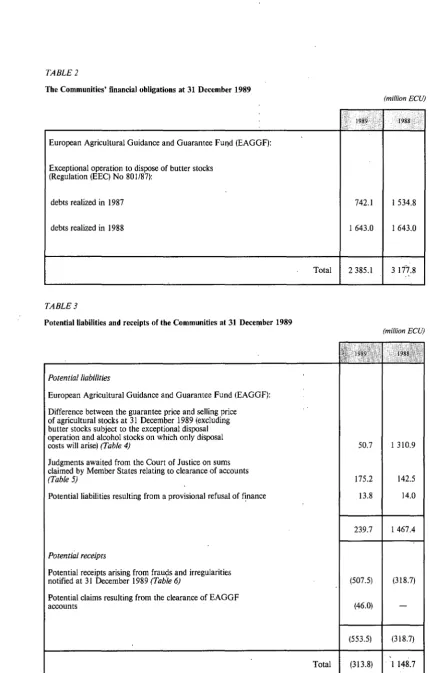
The Communities also have a number of known financial obligations which, in the norynal course of events, will have to be met in 1990 or during subsequent financial years. These obligations, set out in Table 2, consist of <;lebts owing to Member States in connec-tion with the excepconnec-tional disposal of butter stocks in 1987 and 1988: to cover the losses arising from the sale of these stocks, the
ECU 3 178 million to be repaid in instalments of 25% at the beginning of each year between 1989 and 1992; the Community thus made the first refund of ECU 793 million to the Member States in 1989, reducing its liability to ECU 2 385 million at the end of 1989.
Finally, the Communities have entered into other obligations towards non-member coun-tries which have not yet given rise to the com-mitment of appropriations: for cooperation with developing and non-member countries, they signed protocols with the Mediterranean countries for the period 1990-92 and under-took to pay a certain amount of which ECU 358 million still had to be committed at the end of 1989.
Contractual commitments
NCI and Euratom have considerable borrow-ing and lendborrow-ing operations. At 31 December
1989 a number of borrowing and lending transactions were in the course of completion. These transactions will represent expenditure or revenue in future financial years.
Due by Due to NCUEUR NCUEUR
Loans signed but
not paid -
-Borrowings raised
but not received - 23.4 Bank deposits to
cover coupons and
bonds 72.4
-Deferred purchase
of bonds 5.7
-Total 78.1 23.4
Potential liabilities and resources
(million ECU)
Net Net 1989 1988
- 411.9
(23.4) (81.9)
72.4 67.6
5.7
-54.7 397.6
The potential liabilities in Table 3 include the cost of disposing of agricultural stocks. At the end of 1989 this liability was estimated at ECU 51 million, far less than at the end of 1988; the new estimate results from compari-son between the foreseeable sales value of products in store at 31 December 1989 arid their book value, taking into account the preciation applied in accordance with the de-cision adopted by the 1988 Brussels European Council.
For the stocks existing at 31 December 1986 it had been agreed that the provisions for foreseeable losses would be charged to the re-venue and expenditure account as repay-ments to the Member States at the beginning of each financial year for the agricultural sec-tor (from 16 October to the following 15 Octo-ber). The amounts needed had been estimated at ECU 6 800 million (at 1988 prices) for the five-year period 1988-92, as follows:
1988: 1989-92:
ECU 1 200 million; ECU 1 400 million a year.
The first payments of ECU 1 240 million were charged to the 1988 financial year. The pay-ments charged to 1989 totalled ECU 1 443 million- ECU 793 million as the first pay-ment for the butter stocks covered by the ex-ceptional disposal operation in 1987 and ECU 650 million for the depreciation of existing stocks at the start of the financial year. The payments to be charged to 1990 amount to ECU 1 361 million- ECU 797 million as the second payment· for the disposal of butter stocks and ECU 564 million for the deprecia-tion of existing stocks. The book value of the stocks held by the Member States (Table 4) al-ready takes account of this depreciation of ECU 564 million at the start of the new finan-cial year for agriculture, i.e. before 31 De-cember.
Every annual budget contains a provision for losses on stocks newly bought in. These stocks are depreciated from the date on which they enter the stores. The cost of depreciation is fi-nariqed by Titles B 1 and B 2 of the general budget; in 1989 it totalled ECU 1 17 6 million.
The Communities also have potential revenue (Table 3). For instance, on discovering a fraud or irregularity relating to sums paid under the European Agricultural Guidance and Guar-antee Fund, a Member State notifies the Commission and takes steps to recover the sums paid on its behalf. The sums likely to be recovered can only be estimated at present on the ~asis of amounts notified. Similarly, the date of their receipt cannot be estimated with any certainty.
Contingent liabilities
The Communities have identified a number of contingent liabilities, only some of which can be quantified.
Pension costs: The Communities undertake to pay pensions to former employees on the basis of years of service. However, although contributions are made by employees, no sep-arate fund is maintained from which the even-tual liabilities will be met. There is, therefore, a liability for pension costs, which cannot be determined without an actuarial valuation.
Guarantees given: The Commission guaran-tees loans to non-member countries granted by the European Investment Bank from its own funds. Not all loans are guaranteed at 100%, the average being 75% of the capital value of loans guaranteed. Interest may also be guaranteed but is not quantified below.
(millionECU)
1989 1988
75% guarantee 1 923.8 2 319.8
100% guarantee 141.5 141.5