This is a repository copy of
Effect of enhanced dissipation by shear flows on transient
relaxation and probability density function in two dimensions
.
White Rose Research Online URL for this paper:
http://eprints.whiterose.ac.uk/124630/
Version: Published Version
Article:
Kim, E. and Movahedi, I. (2017) Effect of enhanced dissipation by shear flows on transient
relaxation and probability density function in two dimensions. Physics of Plasmas, 24 (11).
112306. ISSN 1070-664X
https://doi.org/10.1063/1.5003014
[email protected] https://eprints.whiterose.ac.uk/ Reuse
Items deposited in White Rose Research Online are protected by copyright, with all rights reserved unless indicated otherwise. They may be downloaded and/or printed for private study, or other acts as permitted by national copyright laws. The publisher or other rights holders may allow further reproduction and re-use of the full text version. This is indicated by the licence information on the White Rose Research Online record for the item.
Takedown
If you consider content in White Rose Research Online to be in breach of UK law, please notify us by
Effect of enhanced dissipation by shear flows on transient relaxation and probability
density function in two dimensions
Eun-jin Kim, and Ismail Movahedi
Citation: Physics of Plasmas 24, 112306 (2017);
View online: https://doi.org/10.1063/1.5003014
View Table of Contents: http://aip.scitation.org/toc/php/24/11
Effect of enhanced dissipation by shear flows on transient relaxation
and probability density function in two dimensions
Eun-jinKimand IsmailMovahedi
School of Mathematics and Statistics, University of Sheffield, Sheffield S3 7RH, United Kingdom
(Received 1 September 2017; accepted 27 October 2017; published online 28 November 2017)
We report a non-perturbative study of the effects of shear flows on turbulence reduction in a decaying turbulence in two dimensions. By considering different initial power spectra and shear flows (zonal flows, streamers and zonal flows, and streamers combined), we demonstrate how shear flows rapidly generate small scales, leading to a fast damping of turbulence amplitude. In particular, a double exponential decrease in the turbulence amplitude is shown to occur due to an exponential increase in wavenumber. The scaling of the effective dissipation time scalese, previ-ously taken to be a hybrid time scalese/s
2=3
X sg, is shown to depend on types of shear flow as
well as the initial power spectrum. Here, sXand sgare shearing and molecular diffusion times,
respectively. Furthermore, we present time-dependent Probability Density Functions (PDFs) and discuss the effect of enhanced dissipation on PDFs and a dynamical time scales(t), which repre-sents the time scale over which a system passes through statistically different states.Published by AIP Publishing.https://doi.org/10.1063/1.5003014
I. INTRODUCTION
Large scale shear flows are one of the most ubiquitous structures that naturally occur in a variety of physical systems and play an essential role in determining the overall transport in those systems. For example, stable shear flows can dramati-cally quench turbulent transport by shear-induced-enhanced-dissipation (see, e.g., Refs.1–16). This occurs as a shear flow distorts fluid eddies, accelerates the formation of small scales, and dissipates them when a molecular diffusion becomes effective on small scales. One remarkable consequence of this turbulence quenching is the formation of transport barrier where the transport is dramatically reduced. The transition from low-confinement to high-confinement mode (L-H transi-tion) in laboratory plasmas results from such formation of a transport barrier by shear flows (e.g., see Refs. 1, 2, 5, and 16), which is believed to be crucial for a successful operation of fusion devices. A similar transport barrier is also induced by a shear layer in the oceans18and by an equatorial wind in the atmosphere.17In the solar interior, a prominent large-scale shear flow due to the radial differential rotation was shown to lead to weak anisotropic turbulence and mixing in the tacho-cline7,8—the boundary layer between the stable radiative inte-rior and unstable convective layer. Our theoretical predictions have been confirmed by various numerical simulations (e.g., see Refs.19and20).
The purpose of this paper is to investigate the effect of shear flows on the time-evolution of turbulence. In most of the previous works, the main focus was on the calculation of turbulent transport in a stationary state in a forced turbu-lence. Different models of turbulence such as 2D and 3D hydrodynamics and magnetohydrodynamic turbulence with/ without rotation and stratification as well as different types of shear flows (e.g., linear, oscillatory, and stochastic shear flows)5–9were considered previously. In comparison, much less work was done on the effect of shear flows on the
dynamics/time-evolution of turbulence, more precisely, how the enhanced/accelerated dissipation is manifested in time-evolution. A clear manifestation of shear flow effects on the dynamics seems especially important, given an ongoing con-troversy over the role of a shear flow in transport reduction, e.g., whether it is due to the reduction in cross phase (via an increased memory, as caused by waves) or the reduction in the amplitude of turbulence via enhanced dissipation (e.g., see Refs.16and20and references therein). A decaying tur-bulence provides us with an excellent framework in which this can be investigated in depth. We thus consider a simple decaying two-dimensional hydrodynamic turbulence model and examine the transient relaxation of the vorticity by dif-ferent types of shear flows. We present time-dependent Probability Density Functions (PDFs) and discuss the effects of enhanced dissipation by shear flows on PDFs and effective dissipation time scale se. We also introduce a dynamical time scale s(t), which measures the rate of change in infor-mation associated with time-evolution; 1/s(t) represents the rate at which a system passes through statistically different states at timet(see Sec.III).
The simplicity of our model permits us to perform detailed analysis for different power spectra and shear flows. Nevertheless, our result that the dissipation and dynamical time scale depend on power spectrum and different types of shears is generic. The remainder of this paper is organised as follows: Section IIintroduces our model and highlights the importance of (i) a careful treatment of a diffusion term in a PDF method and (ii) a non-perturbative treatment of shear flows. Section III introduces dynamical time unit s(t). Section IVdiscusses the effect of different shear flows on the evolution of Gaussian PDFs for different power spectra. Section V presents the analysis of one example of non-Gaussian PDFs. Discussion and Conclusions are found in Sec.VI. Appendixes contain some of the detailed mathemat-ical derivations.
1070-664X/2017/24(11)/112306/12/$30.00 24, 112306-1 Published by AIP Publishing.
II. PROBABILITY DENSITY FUNCTION (PDF)
We consider the evolution equation for the fluctuating vorticity x in two dimensions (2D). In the presence of a large-scale shear flow U, turbulence becomes weak,6–9
and we can thus consider the following linear equation for fluctu-ating vorticity x(¼–r2
/ where/is a stream function, or electric potential in plasmas):
@tþU r
½ x¼r2
x: (1)
For simplicity, Eq. (1) is taken to be dimensionless after appropriate rescaling ofU,x,,x, andt. Note that since our main focus is on elucidating the effect of shear flows, scaling relations and relative values are of interest. Despite the fact that Eq. (1)is linear in x, the equation forp(x,x,t) is not closed due to the dissipation term involving the second deriva-tive. To show this, we expressp(x,x,t) as the Fourier trans-form of the average of a generating function Z¼exp ðikxðx;tÞÞ(e.g., see Refs.21–23) as
pðx;x;tÞ ¼ hdðxðx;tÞ xÞi ¼ 1
2p ð
dkeikðxxðx;tÞÞ
¼ 1 2p
ð
dkeikxhZi; (2)
where the angular brackets denote the average. By differenti-atingZand using Eq.(1), we obtain
@tZ¼ikð@txÞZ¼ik½U rxþr2xZ: (3)
By using@jZ¼ikð@jxÞZand@jjZ¼ikð@jjxÞZk2ð@jxÞ2Z, we recast Eq.(3)
@tZþU rZ¼ @jjZ @jðlnZÞ2
h i
Z
h i
¼ r2
Zþk2ð@jxÞ2Z
h i
: (4)
The second equation in Eq.(4)shows that the diffusion term gives rise to a nonlinear term inZ(½@jðlnZÞ2Z). The Fourier transform of h½@jðlnZÞ
2
Ziwould then induce a convolution of p(x, x, t). On the other hand, the Fourier transform of hk2ð@jxÞ
2
Ziin the last equation in Eq. (4) would require a conditional probability.21 For statistically independent @jx andZ, a linear equation can be written as
@tpþU rp¼r2phð@jxÞ
2
i@xxp: (5)
For a homogeneous turbulence,p(x,x,t) becomes indepen-dent ofx, reducing Eq.(5)to
@tp¼ hð@jxÞ2i@xxp: (6)
In general, the treatment of the diffusion term involving is tricky and has often been done approximately, or the diffu-sion term is simply neglected. Unfortunately, such an approx-imation cannot be justified in the presence of a shear flow as its effect is enhanced due to the accelerated formation of small scales, demanding the exact treatment of this diffusion term. For the same reason, the effect of Ucannot be treated perturbatively.
It is thus pivotal to solve Eq.(1) exactly in the Fourier space by using a time-dependent wave number. For example, let us consider a general type of a shear flow U¼(Us,
Uy)¼(–yXs, –xXz), where Uz and Us are orthogonal flows, with their shearing ratesXzandXs, respectively. We callUz zonal flows (ZF) and Us streamers in this paper. Uhas the mean vorticity hxTi ¼ r U¼ ðXzþXsÞ^z. In order to capture the effect of shear non-perturbatively, we use the fol-lowing time-dependent wavenumber (e.g., see Refs.6–9)
xðx;tÞ ¼x~ðk;tÞexpfiðkxðtÞxþkyðtÞyÞg; (7)
wherekx(t) andky(t) satisfy
dkxðtÞ
dt ¼Xzky
dkyðtÞ
dt ¼Xzkx: (8)
Equations (7) and (8) give us a linear equation for the Fourier component x~ðk;tÞ as @x~@tðk;tÞ¼ ½kxðtÞ
2
þkyðtÞ
2
~
xðk;tÞwith the solution
~
xðk;tÞ ¼x~ðkð0Þ;t¼0Þexp
ðt
0
dt1 kxðt1Þ2þkyðt1Þ2
h i
:
(9)
Equation (9) would then permit us to compute Z¼exp ðikxðx;tÞÞand thusp(x,x,t) in Eq.(2). Once we havep(x,
x,t), we can then find the equation forp(x,x,t).
III. DYNAMICAL TIME UNITs(t)
Having introduced a time-dependent PDF in Sec.II, we now present how to utilize it to extract useful information diagnostics. A key characteristic of non-equilibrium pro-cesses is the variability in time (or in space), time-varying PDFs manifesting the change in information content in the system. We quantify the change in information by the rate at which a system passes through statistically different states.24–29Mathematically, for a time-dependent PDFp(x,t) for a stochastic variablex, we define the characteristic time-scales(t) over which p(x,t) temporally changeson average
at timetas follows:
E 1
sðtÞ ½ 2¼
ð
dx 1 pðx;tÞ
@pðx;tÞ
@t
2
: (10)
As defined in Eq.(10),s(t) is a dynamical time unit, measur-ing the correlation time ofp(x,t). Alternatively, 1/s quanti-fies the (average) rate of change of information in time. A special case ofs(t)¼constant is a geodesic where the infor-mation change is independent of time. Note that s(t) in Eq. (10)is related to the second derivative of the relative entropy (or Kullback-Leibler divergence) (seeAppendix Aand Ref. 26) and that E is the mean-square fluctuating energy for a Gaussian PDF (see Ref.27).
The total change in information between the initial and final times, 0 and t, respectively, is then computed by the total elapsed time in units ofs(t) as LðtÞ ¼Ðt
0
dt1
PDF p(x,t¼0) at timet¼0 to the final state with the PDF
p(x,t) at timet. For instance, in equilibrium, s(t1) is infinite
so that measuringdt1in units of this infinite s(t1) at anyt1
givesdt1/s(t1)¼0 and thusLðtÞ ¼0, manifesting no flow of
time in equilibrium. SeeAppendix Afor the interpretation of L from the perspective of the infinitesimal relative entropy. We note that‘[and thuss(t)] is based on Fisher information (cf. Ref.30) and is a generalisation of statistical distance31–33 to time-dependent problems.
As an example, let us consider the Gaussian PDF of the total vorticityxT ¼ hxTi þxgiven by
pðxT;x;tÞ ¼ ffiffiffi b p r
exp bðxT hxTiÞ2
h i
: (11)
Here, the angular brackets denote the average (hxi ¼0). b
¼ 1
2hx2iis the inverse temperature andb! 1for a very nar-row PDF. By using the property of the Gaussian distribution (e.g.,hx4i ¼3hx2i2
) (e.g., see Refs.21and23), we can show thatEin Eq.(10)is (see Refs.26and28)
EðtÞ ¼ 1
sðtÞ2¼ 1 2
ð@tbÞ
2
b2 þ2bð@thxTiÞ
2
: (12)
The first term in Eq. (12)is due to the temporal change in PDF width (/b1=2), while the second is due to the change in the mean value measured in units of PDF width.
IV. GAUSSIAN PDFs
To gain a key insight, we start with the case where
~
xðkðt¼0ÞÞsatisfies the Gaussian statistics. Using Eq. (9), we compute the average of the generating functionZ¼exp ðikxðx;tÞÞas follows:
hZi ¼ hexpðikxðx;tÞÞi ¼exp 1 2k
2
hx2
ðx;tÞi
; (13)
where
hx2ðx;tÞi ¼
ð
dkðtÞdk0ðtÞeiðkðtÞþk0Þðt0Þx
hx~ðkðtÞÞx~ðk0ðtÞÞi:
(14)
Using Eq.(13)in Eq.(2)gives
pðx;x;tÞ ¼ ffiffiffi b p r
exp bx2: (15)
Here,b¼ 1
2hx2ðx;tÞiis again the inverse temperature.
On the other hand, taking the time derivative Eq. (13) and Fourier transform gives
@tpðx;x;tÞ ¼ 1 2
@2
@x2 @thx 2
ðx;tÞi
pðx;x;tÞ
; (16)
consistent with Eq.(15).
In comparing the RHS of Eqs.(6)and(16), we have
1 2@thx
2
ðx;tÞi ¼ hð@jxÞ2i ¼hxr2xi: (17)
We will shortly show that Eq. (17) indeed holds for the Gaussianx(x,t) in a homogeneous turbulence. In the
follow-ing, we analyse the zonal case in Sec.IV Aand the combined shear flow casesXz>0 andXs>0 in Sec.IV B, andXz>0 andXs<0 in Sec.IV C.
A. ZF case:Xz>0 andXs50
For the case of zonal flow only (ZF),U¼(0,xXz), the mean vorticity hxTi ¼ Xz, and the time dependent wave-number follows from Eq.(8)as
kxðtÞ ¼kxð0Þ þkyXzt; kyðtÞ ¼kyð0Þ; (18)
Q1ðtÞ
ðt
0
dt1jkðt1Þj2
¼1 3ðkyXzÞ
2
t3þkykxð0ÞXzt2þ ðkxð0Þ2þk2yÞt: (19)
With Eq.(19), Eq.(9)is rewritten as
~
xðkxðtÞ;kyÞ ¼eQ1ðtÞx~ðkxð0Þ;kyÞ: (20)
To compute the mean square of x(x, t) from Eq. (20), we assume a homogeneous turbulence att¼0 so that the transla-tional invariance in space constrains the correlation function in the Fourier space ashx~ðkð0ÞÞx~ðk0ð0ÞÞi ¼dðkð0Þ þk0ð0ÞÞ
wðkð0ÞÞ, wherew(k(0)) is the initial power spectrum. Eq.(9)
then gives us
hx~ðkðtÞÞx~ðk0ðtÞÞi ¼dðkð0Þ þk0ð0ÞÞwðkðtÞÞ; (21)
wðkðtÞÞ ¼e2Q1ðtÞwðkð0ÞÞ: (22)
Using Eqs.(21)and(22)in(14), we then obtain
hx2ðx;tÞi ¼
ð
dkwðkðtÞÞ: (23)
We now confirm that Eq. (17)holds for Eqs. (22)and(23) since
@thx2i ¼ 2 ð
dkjkðtÞj2wðkðtÞÞ;
hxr2xi ¼ ð
dkjkðtÞj2wðkðtÞÞ: (24)
In Secs. IV A 1–IV A 3, we discuss PDFs and characteristic dissipation times scales by using differentw(k(0)).
1.d-function power spectrum
The simplest case to consider is a d-function power spectrum given by
wðkð0ÞÞ ¼dðkxð0Þ aÞdðkybÞ/; (25)
where/is a constant. The power spectrumw(k(t))) contin-ues to have a d-function with the peak at kxðtÞ ¼aþbXzt andky(t)¼bgiven by Eq.(18)withkx(0)¼aandky(0)¼b
wðkðtÞÞ ¼e2Q1ðtÞdðkxðtÞ abXztÞdðkyðtÞ bÞ/: (26)
Using(23)and(26), we have
hx2ðx;tÞi ¼exp
2
3 ððkyXzÞ
2
t3þ3kyXzt2kxð0ÞÞ
2ðkxð0Þ
2
þky2Þt
/; (27)
providingb¼ 1
2hx2ðx;tÞiin Eq.(15).
For a strong shearXzk2y, the term23ðkyXzÞ 2
t3in Eq.
(27) causes the enhancement of dissipation over a usual exponential viscous damping expð2ðkxð0Þ2þky2ÞtÞ. The effective dissipation time scalesefor such enhanced damp-ing is found from2
3 ðkyXzÞ 2
s3
e1 as
se ky2X
2
z 13
sgs2Xz 13
; (28)
where sg¼k12
y and sXz ¼
1
Xz are the viscous and shearing
time scales, respectively. We now comparesewith the char-acteristic time scalesðtÞ ¼ E1=2 in Eq.(12)over which the information changes. FromEin Eq.(12), we have
ffiffiffiffiffiffiffiffiffiffiffi 2EðtÞ p
¼jkðtÞj2
¼ k2yX2zt
2
þkykxð0ÞXztþkxð0Þ2þky2
: (29)
The time scale sðtÞ ¼ E1=2/t1 ast
! 1 represents a very short dissipation time scale and enhanced dissipation due to the accelerated formation of small scales and their disruption. Clearly, unlikese,s(t) captures the dynamics of the systems, i.e., the dependence of the rate of dissipation on time. When Xz¼0;sðtÞ ¼ðkxð0Þ
2
þk2
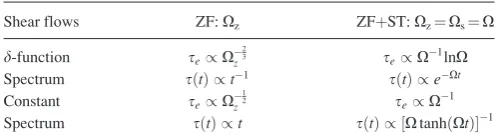
yÞ in Eq. (29) becomes constant, which is the case of a geodesic (see Sec. III). The value of this constants(t) however depends on the initial wave number k(0), meaning that s(t) is not scale invariant. This is to be contrasted to the case considered in Sec. IV B 2. Scalings of se and s(t) are summarized in TableI.
Figures 1(a) and 1(b) compare the time evolution of
p(x,t) forXz¼2 in (a) and forXz¼0 in (b) by usingky¼1,
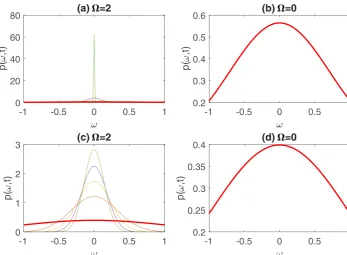
kx(0)¼0, /¼1, and ¼0.1. The initial PDF is shown in the bottom red curve and the time increases from the bot-tom to the top curve as t¼0.6n, where n¼0;1;2;3;
…;10. The narrowing of PDF width in time in Fig.1(a)is in sharp contrast to a much smaller change in Fig. 1(b) between t¼0 and t¼6. A much faster narrowing in Fig. 1(a)manifests the enhanced dissipation of the mean square vorticity byXz.
2. Constant power spectrum
se/Xz2=3 in Eq. (28)is specific to the case of the d -function power spectrum where there is unique wavenumber at t¼0 that evolves according to Eq.(18). To understand howseis affected in the presence of differentk(0) modes, we consider a constant spectrum by taking
w¼constant¼/. Then, the power spectrum evolves in time as follows:
wðkðtÞ;tÞ ¼e2Q1ðtÞ/; (30)
whereQ1(t) is given in Eq.(19). From Eqs.(23)and(30), we
[image:6.607.47.297.102.172.2]obtain
TABLE I. Scalings of se and s(t) for the initial d-function and constant power spectra in the case of ZF with the shearing rateXzand hyperbolic ZFþST with the shearing rateXz¼Xs¼X. Gaussian power spectrum has the scaling betweend-function and constant power spectra.
Shear flows ZF:Xz ZFþST:Xz¼Xs¼X
d-function se/X23
z se/X1lnX
Spectrum sðtÞ /t1 sðtÞ /eXt Constant se/X12
z se/X1
[image:6.607.52.419.463.762.2]Spectrum sðtÞ /t sðtÞ / ½XtanhðXtÞ1
FIG. 1. Time evolution of p(x, t) in panels (a) and (b) for the d-function power spectrum in(25)and in panels (c) and (d) for the Gaussian power spectrum in Eq. (A1); t¼0.6n
hx2
ðx;tÞi ¼ p 2t
ffiffiffiffiffiffiffiffiffiffiffiffiffiffiffiffiffiffiffiffiffi 4þ1
3X
2
zt
2
r / (31)
after performing the Gaussian integrals over ky and kx(0). Equation(31)shows thatXzchanges the scaling ofhx2ðx;tÞi fromt1tot2by the enhanced dissipation. In this case,seis found fromXzs2e1 as
se/ ðXzÞ 1
2: (32)
Thus, the dependence of se/Xz1=2 on Xz is weaker than
se/Xz2=3 for a d-function spectrum as the effect of shear-ing is reduced in the case of multiple modes. This is basically because the distortion of an eddy by shearing follows a wave number specific time evolution [e.g., Eq.(18)]; the effect of a shear on multiple modes is not coherent as eddies with dif-ferent wave numbers evolve difdif-ferently and is thus less effective.
This reduced shearing effect can also be inferred fromE in Eq.(12), which becomes
EðtÞ ¼
4þ2 3Xzt
2
2
2t2 4þ1
3Xzt
2
2: (33)
Thus, Eq. (33) gives the time scale sðtÞ ¼ E1=2
/t for
Xzt1. This should be compared withsðtÞ /t1in the case of a d-function power spectrum above (see Table I). The increase ofs(t) withtmeans a longer time scale of dissipa-tion and thus it manifests that the dissipadissipa-tion becomes less effective for large time. Similar results are shown for the case of an anisotropic power spectrum with kx(0)¼0 in Appendix B. We note that the mean square vorticity in Eq. (31)apparently diverges at t¼0 due to the unlimited range
of the k integral for an initial constant power spectrum. Mathematically, this problem is readily ratified by using a localised spectrum in Sec.IV A 3.
3. Gaussian power spectrum
The initial Gaussian power spectrum wð0Þ ¼ 1
ap
e1aðkxð0Þ2þk2yÞ/gives
wðkðtÞÞ ¼ 1
ape
1
aðkxð0Þ2þk2yÞ2Q1ðtÞ/; (34)
where Q1(t) is given in Eq. (19); arepresents the width of
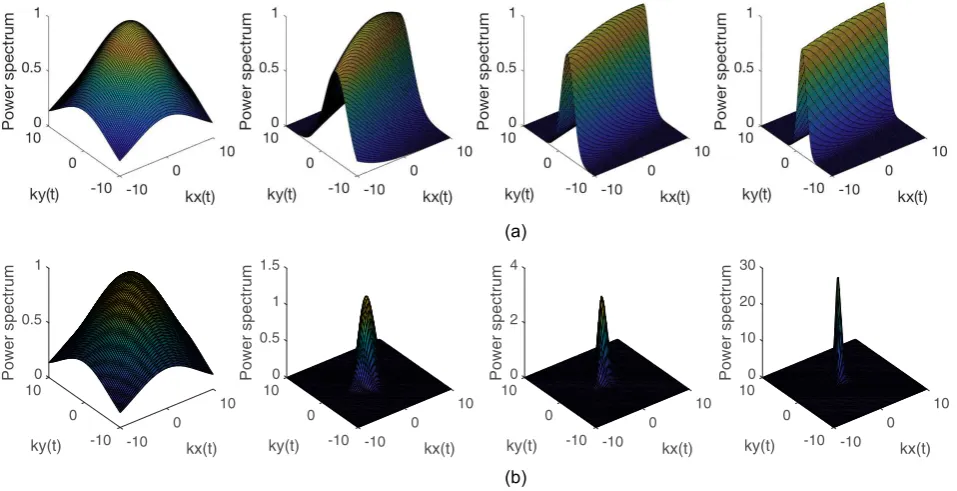
the initial power spectrum;a!0 anda! 1recover thed -function and constant power spectrum, respectively. To understand the effect of Xz on the evolution of w(k(t)) in (34), we usekxð0Þ ¼kxðtÞ Xzkytand presentw(k(t)) in Fig. 2. Without diffusion (¼0), w(k(t)) in Fig.2(a) shows the
generation of large kx wave number due to ZF shearing. When a diffusion (¼0.1) is included in Fig.2(b), largekx (andky) modes quickly damp due to molecular dissipation,
w(k(t)) forming a sharp peak aroundkx¼ky¼0.
On the other hand, using Eqs.(34)and(19)in(23), we find
hx2ðx;tÞi ¼1
a ffiffiffi 1
A
r
/; (35)
where A¼ ð2tþa1Þ2
þ1
3ðtÞðXztÞ 2
½tþ2a1. We note
that in the limit oft!0 andt! 1, Eq.(A1)is reduced to
hx2
ðx;tÞit!0 !/; hx 2
ðx;tÞit!1! ffiffiffi 3 p
aXzt2
/; (36)
respectively. The second equation in Eq. (36) recovers the limit of a d-function power spectrum in Eq.(31) (up to an unimportant small numerical factor). Eq. (35) very
FIG. 2. (a) Time evolution of power spectrum (t¼0, 1, 2, 3 increasing from left to right) forXz¼2,Xs¼0,a¼100,/¼1, and¼0. (b) The same as (a) but for¼0.1.
[image:7.607.66.545.491.736.2]conveniently shows the transition of the scaling of se from /Xz2=3 in Eq. (28) to /X
1=2
z in Eq. (32) as a increases (see also above).
Figures1(c) and1(d)show the evolution of p(x,t) for this Gaussian power spectrum forXz¼2 andXz¼0, respec-tively. Here, parameter values are the same as those in Figs. 1(a)and1(b)apart from a¼100. Comparing Fig.1(c)with Fig.1(a), we see much slower narrowing of the PDFs as the shearing effect is less effective in the presence of multiplek
modes. As observed in Figs. 1(a)and1(b), the PDF in Fig. 1(d) for Xz¼0 narrows slower than that in Fig. 1(c). However, comparing Figs. 1(b) and 1(d), the presence of multiple kmodes tends to promote dissipation (due to high
wave number modes).
B. Hyperbolic ZF1ST case:Xz>0 andXs>0
Compared with the case of zonal flows, the combined effect of Zonal Flows and STreamers (ZFþST) has been stud-ied much less. We show below that the action of ZFþST can lead to an exponentially fast formation of small scale struc-ture. For U¼ ðyXs;xXzÞ with Xs>0 and Xz>0, Uhas
the mean vorticity r U¼ ðXzþXsÞ^z, which becomes zero forXz¼Xs. The solution to Eq.(18)can be found as
kyðtÞ ¼kX
Xz
coshðXtþhÞ; kxðtÞ ¼ksinhðXtþhÞ; (37)
where
X¼ ffiffiffiffiffiffiffiffiffiffiXzXs p
; k k
yð0Þ
2
þkxð0Þ
2X2
X2z
" #12
; (38)
sinhðhÞ ¼kxð0Þ
k ; coshh¼
Xzkyð0Þ
Xk : (39)
We focus on the case ofXz¼Xs¼Xwith zero mean vortic-ity, in which casek2
xþky2¼k
2
cosh½2ðXtþhÞfollows from Eq.(37). Thus, with the help of Eqs.(38)and(39), we obtain
Q2ðtÞ ¼
Ðt
0dt1jkðt1Þj 2
as
Q2ðtÞ ¼
1
4X½ðkxð0Þ þkyð0ÞÞ
2
ðe2Xt1Þ
þ ðkxð0Þ kyð0ÞÞ2ð1e2XtÞ: (40)
Since k(t) starting with k(0) changes in time according to
Eq.(37), in order to see how the power spectrum evolves in time, we need to expressQ2(t) in Eq.(40)in terms of k(t).
To this end, we solve Eq. (37) for kx(0) and ky(0) to find
kyð0Þ ¼ kyðtÞcoshðXtÞ kxðtÞsinhðXtÞ and kxð0Þ ¼ kxðtÞ coshðXtÞ kyðtÞsinhðXtÞ, and thus
kxð0Þ þkyð0Þ ¼ kxðtÞ þkyðtÞeXt;
kxð0Þ kyð0Þ ¼ kxðtÞ kyðtÞeXt:
(41)
By using Eq.(41)in Eq.(40), we have
Q2ðtÞ ¼
1
4X½ kxðtÞ þkyðtÞ 2
ð1e2XtÞ
þ kxðtÞ kyðtÞ 2
ðe2Xt1Þ: (42)
Interestingly, Eq.(42)shows that the dissipationQ2(t) takes
its minimum value whenkx(t)¼ky(t). Furthermore, from Eq. (41), we also find
kxð0Þ2þkyð0Þ2¼ 1
2½ðkxðtÞ kyðtÞÞ
2
e2Xt
þ ðkxðtÞ þkyðtÞÞ2e2Xt; (43)
which also takes its minimum alongkx(t)¼ky(t). The minimum of Eqs.(42)and(43)alongkx(t)¼ky(t) is later shown to give a peak in the power spectrumw(k(t)) in Sec.V(see Fig.3). We refer tokx(t)¼ky(t) as the principle direction in the following.
1.d-function power spectrum
For ad-function power spectrum given by Eq.(25), the power spectrumw(k(t)) continues to have a d-function with the peak at kx(t) and ky(t) given by Eq.(37) with kx(0)¼a andky(0)¼b. This leads to
hx2ðx;tÞi ¼exp
2X½ðkxð0Þ þkyð0ÞÞ
2
ðe2Xt1Þ
ðkxð0Þ kyð0ÞÞ2ðe2Xt1Þ
/: (44)
From Eq.(44), we find the effective diffusion timese
se 1 2Xln
2X jk0j2
!
: (45)
sein Eq.(45)is smaller than Eq.(28)for a sufficiently large
X, with a stronger dependenceX1lnXonX, in comparison withXz2=3 in ZF case. Furthermore, due to the double expo-nential decrease inhx2
i;sðtÞin Eq.(12)is reduced exponen-tially fast as
sðtÞ /eXt: (46)
The exponentially decreasings(t) in Eq.(46)reflects a very efficient dissipation by ZFþST. The evolution of PDF is shown in Fig. 3for X¼2 in (a) and X¼0 in (b). The time
t¼0.2n, wheren¼0, 1, 2, 3, 4, and 5 increases from the bottom to the top curves. The bottom red curve is for the ini-tial PDF. Comparing Fig.3(a)with Fig.1(a), we see a much faster narrowing of the PDFs in the hyperbolic ZFþST case due to a much faster dissipation. (Note that the total time span
t¼[0, 1] in Fig.3is much smaller thant¼[0, 6] in Fig.1.) The change in Fig.3(b)withX¼0 is too small to be seen.
2. Constant power spectrum
For an initial constant power spectrum w(0)¼/, the power spectrum again evolves as wðkðtÞ;tÞ ¼e2Q2ðtÞ/, whereQ2is given in Eq.(40). Therefore, by using Eqs.(23)
and(40), we find
hx2ðx;tÞi ¼1 2 ð
dpdqexp
2X p
2
ðe2Xt1Þ þq2ð1e2XtÞ
/
¼ X/
Here, we performed the integrals overpkx(0)þky(0) and
qkx(0) –ky(0).
Compared with the d-function power spectrum, the effect of shear flow is reduced from double exponential to exponential. For Xt1;hx2
ðx;tÞi X
2peXt/, giving an effective diffusion time
seX1: (48)
Interestingly,s(t) in this case has a similar dependence onX
since
sðtÞ ¼ 1
XtanhðXtÞ; (49)
approaching a constant valueX1(!) fort X1. This is another example of a geodesic, which is more interesting than the case of Xz¼0 in Eq. (29) because Eq. (49) is induced by non-zero X in the presence of different k(t) modes which evolve from an initial constant power spec-trum. In fact,s(t)X1explicitly shows thatXis the very cause of information change. On the other hand, in compari-son with the exponentially decreasing s(t) in Eq. (46), Eq. (49) again illustrates the reduced shearing effect due to the presence of multiple k modes. Finally, we note that the
divergence att¼0 is due to the unbounded power spectrum as in the case of Eq.(31). Scalings ofseands(t) are summa-rized in TableI.
3. Gaussian power spectrum
Forwð0Þ ¼ 1
ape
1
aðkxð0Þ2þkyð0Þ2Þ/, we have
wðkðtÞÞ ¼ 1
ape
1
aðkxð0Þ2þkyð0Þ2Þ2Q2ðtÞ/; (50)
whereQ2is given by Eq.(40). By using Eqs.(42)and(43)
in Eq.(50), we present the evolution of the power spectrum
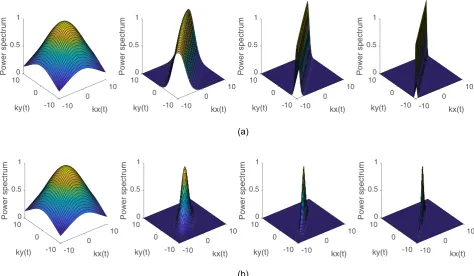
w(k(t)) in Fig.4forX¼2, where time increases from left to right as t¼0, 0.6, 1.2, and 1.8. Without diffusion (¼0),
w(k(t)) in Fig.4(a) shows a fast reduction in w(k(t)) along
kx(t)þky(t)¼0, with the peak forming along the principle direction kx(t)¼ky(t). When diffusion (¼0.1) is included in Fig. 4(b), modes of large wavenumber also damp along the principle direction in time due to the molecular dissipa-tion although the damping is weaker compared to that along
kx(t)þky(t)¼0. This is because the dissipation Q2(t) in Eq.
(42) and kx(0)2þky(0)2 in Eq. (43) are minimized along
kx(t)¼ky(t), as noted previously.
Now, Eq.(50)leads to the mean square vorticity
hx2ðx;tÞi ¼ 2
ap ð
dpdqexp
2X
p2ðe2Xt1Þ
þq2ð1e2XtÞ 1
aðp
2
þq2Þ
/
¼ 2
a ffiffiffiffiffiffi
AB
p ; (51)
where
A¼ 2Xðe
2Xt1Þ þ1
a; B¼
2Xð1e
2XtÞ þ1
a: (52)
se/X1is thus similar to Eq.(48)fort X1. However, in contrast to Eq. (49),s(t) becomes constant fort X1
only for a sufficiently largea, that is, in the limit of a con-stant power spectrum. Figure 3(c) shows the evolution of
p(x, t) for this case using the same parameter values
Xz¼Xs¼X¼2 as in Fig. 3(a) apart from a¼100. Comparing Fig.3(c)with Fig.3(a), we see much slower nar-rowing of the PDFs as the shearing effect is less effective in the presence of multiplekmodes, as observed in Fig.1. The
[image:9.607.51.399.55.310.2]evolution of p(x,t) for X¼0 is shown in Fig. 3(d), which hardly changes.
FIG. 3. Time evolution ofp(x,t) for thed-function power spectrum in Eq. (44)in panels (a) and (b) and for the Gaussian power spectrum in Eq.(51) in panels (b)–(d); t¼0.2n, where
n¼0, 1, 2, 3, 4, 5 increases from the bottom to the top curves. The bottom red curve is for the initial PDF. a¼100,¼0.1, and/¼1.
[image:9.607.314.565.486.631.2]C. Elliptic ZF1ST case
For the hyperbolic ZFþST case in Sec.IV B, the sign of zonal flow and streamer shear is the same. When they have different signs, ZFþST leads to a rotating wave number. To see this, we consider U¼ ðyXs;xXzÞ with Xs>0 and
Xz>0 which has the nonzero mean vorticity r U ¼ ðXzþXsÞ^z. For this ZFþST, we find the solution to Eq. (18) as kyðtÞ ¼kXXzcosðXtþhÞ and kxðtÞ ¼ksinðXtþhÞ,
where X¼ ffiffiffiffiffiffiffiffiffiffi XzXs p
;k¼ ½kxð0Þ
2
þkyð0Þ
2X2
z X2
1
2, and sinðhÞ
¼kxð0Þ
k ; cosh¼
Xzkyð0Þ
Xk . WhenXz¼Xs¼X;k
2
xþk
2
y¼kxð0Þ2 þkyð0Þ
2
is a constant in time, with no enhancement of dissi-pation. However, for Xz6¼Xs, kx2þk2y¼k
2
½sin2ðXtþhÞ þXs
Xzcos
2ð
XtþhÞ. Although the overall dissipation may not be significantly enhanced by this shear flow, there is an inter-esting effect on the dynamics due to oscillatory dissipation,
kxorky, which provides a periodic background (or potential). This is discussed in our accompanying paper.34
V. NON-GAUSSIAN PDFs
In Sec.IV, we investigated the effect of shear flows on the evolution of the Gaussian PDFs and power spectra. The main effect was the shift of power to larger wavenumber, accelerating dissipation, and narrowing PDF width. We now extend our study to a non-Gaussian case to examine the effect of shear flows on the form of PDF. Although there are many possible causes for non-Gaussian PDFs, we consider one example of an inhomogeneous turbulence. That is, we drop the assumption of homogeneous turbulence and instead prescribe the profile of the initial vorticity fluctuation as
~
xðkð0Þ;t¼0Þ ¼ 1
ape
1
aðkxð0Þ2þkyð0Þ2Þ;
xðx;t¼0Þ ¼ea4ðx 2þy2Þ
;
(53)
whereais a positive random variable. Note that whena¼0, Eq.(53)gives a constantx(x, 0) while the nonzero constanta
(>0) gives the typical length scalelof the profile of the initial vorticity fluctuation asla1=2
. A random positiveamakes the profile of the initial vorticity fluctuation on different length scales. By considering the hyperbolic shear flow considered in Sec.IV B, we have
~
xðkðtÞ;tÞ ¼ 1
ape
1
aðkxð0Þ2þkyð0Þ2ÞQ2ðtÞ; (54)
whereQ2(t) is given in Eq.(40). In order to take the inverse
Fourier transform of Eq. (54) to findx(x, t), we first write Eq. (37) in terms ofp¼kx(0)þky(0) andq¼–kx(0)þky(0) as kyðtÞ ¼12½peX
tþqeXt and k
xðtÞ ¼12½peX
tqeXt so that
kðtÞ x¼1
2 pe
Xtz
1þqeXtz2
; (55)
where
z1¼xþy; z2¼yx: (56)
Then, by using Eqs. (40), (54), and (55), we obtainxðx;tÞ
¼Ð
dkðtÞeikðtÞx ~
xðkðtÞ;tÞas
xðx;tÞ ¼ 1
2a ffiffiffiffiffiffiffi
CD
p exp e
2Xtz2 1
8C e2Xtz2
2
8D
: (57)
[image:10.607.66.541.59.335.2]Here
C¼ 4Xðe
2Xt1Þ þ 1
2a; D¼
4Xð1e
2XtÞ þ 1 2a: (58)
Ast!0;C! 1 2a; D!
1
2a, and Eq.(57)recovers Eq.(53).
Fort6¼0,CandDdepend on the relative magnitude of 4/X
and 1/2a.
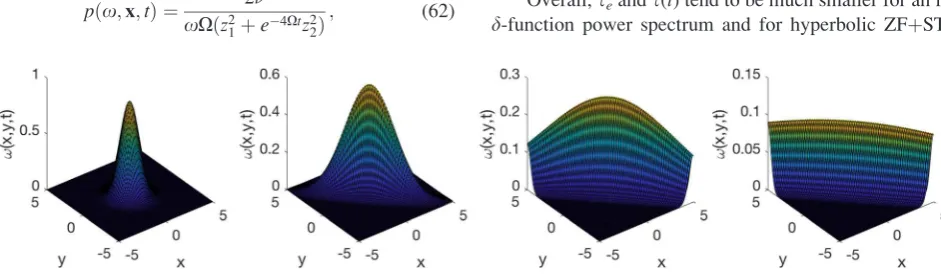
Before proceeding to randoma, we note that for a con-stant value of a, Eq. (57) shows the anisotropic distortion and decay of the profile of vorticity fluctuation by shear flows. The time evolution ofx(x,t) for constanta¼100 is
shown in Fig. 5, where time t¼0, 5, 1, and 1.5 increases from left to right. Of notable is the flattening and elongation of x(x, y, t) along z1¼xþy¼0, with the formation of a
sheet like structure. This is quite similar to what is seen in Fig. 4, recalling that a narrow k profile corresponds to a broadxprofile.
Whena(>0) is random, the statistics ofx(x,t) depends
onaas
pðx;x;tÞ ¼
da
dx
pðaÞ: (59)
In particular, att¼0, Eq. (53)givesa¼ 4ln ðxðt¼0ÞÞ=
r2, wherer2
¼x2þy2, leading to
pðx;x;0Þ ¼ 4
xr2pðaÞ: (60)
For our purpose, it suffices to assume thatais uniformly distributed within a certain range. Two cases of our interest are the limit of weak inhomogeneity, where (i) a¼ ½0;2X
e
2Xt
and of a strong inhomogeneity and (ii) a¼ ½2X
;ac with
ac>2X. In case (i), the shearing does not have much influence on the scale of inhomogeneity, while in case (ii), it does have a significant effect. Starting our analysis in case (i), we approxi-mateCD 1
2a, and consequently
xðx;tÞ exp a
4 e
2Xtz2 1þe
2Xtz2 2
¼exp a 4G1
;
(61)
where G1 ¼e2Xtz21þe2Xtz22. Eqs. (59) and (61) will then
give us
pðx;x;tÞ ¼ 2
xXðz2
1þe4Xtz 2 2Þ
; (62)
for a<2X
e
2Xt. In Eq. (62), we used pðaÞ ¼e2Xt
2X for a¼ ½0;2X
e
2Xt. A rapid decrease of p(x,x,t) in Eq. (62) for largez2
1is similar to the elongation of the vorticity profile
alongz2, observed in Fig.5. We note here that the condition
on a<2X
e
2Xt is translated into xðx;tÞ>exp½XG1
2 e
2Xt
exp½X 2ðz
2
1þe4Xtz22Þ:
The case (ii) where a¼ ½2X
;ac, we have xðx;tÞ 2X
aeXtG2, whereG2¼2Xðz21þe 2Xtz2
2Þ. Thus,
pðx;x;tÞ / 2X
ax2e
XtG2; (63)
forx¼ ½2X
ace
XtG2;eXtG2, becoming very small for large
z2
1. Compared with Eq.(60)or(62),p(x,x,t)/x
2
in Eq. (63)drops more rapidly for largex. Interestingly, this is sim-ilar to the narrowing of Gaussian PDFs by shear flows shown in Sec.IV. Finally, going back to our discussion on the PDF method in Sec. II, we can compute the first three terms in Eq. (5) using our p(x, x, t) above to realize that a correct form of the last term in Eq.(5)is quite complicated and non-linear inp(x,x,t), as noted in Sec.II. The diffusion term in Eq. (1) cannot be simply neglected and needs to be treated very carefully.
VI. DISCUSSION AND CONCLUSIONS
We have presented the first analytical study of the effects of shear flows on enhanced dissipation in a decaying turbulence in 2D by incorporating the effects of shear flows non-perturbatively. We considered different initial power spectra and shear flows (ZF, ZFþST) and clearly demon-strated how shear flows induce the rapid formation of small scales (large wave number modes), significantly enhancing the dissipation of turbulence. We presented time-dependent PDFs and discussed the effects of enhanced dissipation by shear flows on PDFs and effective dissipation time scalese. While previous works advocated a hybrid time scale se /X2=3sg(e.g., Ref.16), wheresgis the time scale due to a
molecular diffusion, we showed that the dependence ofseon
X (Xz) varies with initial power spectra and also types of shear flows. In addition, we demonstrated the utility of a dynamical time scale s(t) in understanding the effect of shears, which quantifies the rate of the change in information (the rate at which a system passes through statistically differ-ent states).
Overall,seands(t) tend to be much smaller for an initial
[image:11.607.51.297.75.107.2]d-function power spectrum and for hyperbolic ZFþST. ZF
FIG. 5. Time evolution ofx(x,y,t) forXz¼Xs¼X¼2,t¼0, 0.5, 1, 1.5 increasing from left to right;a¼2,¼0.1, and/¼1.
[image:11.607.67.538.609.748.2]can dramatically reduces(t) for an initiald-function power spectrum but not for a constant power spectrum. This was however obtained in the case where the mean vorticityhxTi is independent of time.35 A time-varying hxTi ¼ Xz, which is more likely in real situations (e.g., time-varying zonal flows), would however make s(t) very small (see Appendix C), with interesting consequences to be investi-gated. Finally, hyperbolic ZFþST was shown to cause an exponential increase in wavenumber, with a double exponen-tial decrease inhx2i.
The preferential dissipation by shear flows in a certain direction can lead to a strongly anisotropic turbulence, as also shown in Refs.7–9(with a possibility of the reduction in dimension), in analogy to the maintenance of a 2D flow in a forced 3D rotating turbulence.36In 3D, the vortex stretch-ing (which is absent in 2D) could somewhat compensate the severe quenching of vorticity amplitude. However, for a lin-ear shlin-ear flow U¼ xXy^, Eq. (D14) in Appendix D (see also Ref.8) shows that the Fourier components of the veloc-ity damp in time as~vx/t2eQðt;0Þ;~vz/eQðt;0Þ, and~vy/
eQðt;0Þ
to leading order for t>kxð0Þ
kyX. Here, Qðt;0Þ
¼1 3ðkyXÞ
2
t3
þkykxð0ÞXt2þ ½kxð0Þ
2
þk2
yþk
2
zt. Therefore, in addition to the enhanced dissipation e–Q(t,0)through the time-dependent wave number, vx undergoes the additional algebraic (/t2) quenching. The vorticity fluctuationx~would
then be at most/te–Q(t,0)inyandzdirections. Investigation of the effect of different shear flows on 3D turbulence, the extension to different models such as interchange turbu-lence,34magnetic dissipation, and dynamos, and implications for extreme events37are left for future work.
APPENDIX A: RELATION BETWEENLAND RELATIVE ENTROPY
We first show the relation between s(t) in Eq.(10)and the second derivative of the relative entropy (or Kullback-Leibler divergence) Dðp1;p2Þ ¼Ðdx p2lnðp2=p1Þ, where
p1¼p(x,t1) andp2¼p(x,t2) as follows:
@ @t1
Dðp1;p2Þ ¼
ð
dxp2
@t1p1
p1
; (A1)
@2
@t2 1
Dðp1;p2Þ ¼
ð
dxp2 ð
@t1p1Þ2
p2 1
@
2
t1p1
p1
" #
; (A2)
@ @t2
Dðp1;p2Þ ¼
ð
dx @t2p2þ@t2p2ðlnp2lnp1Þ
; (A3)
@2
@t2 2
Dðp1;p2Þ ¼
ð
dx @2
t2p2þð
@t2p2Þ2
p2 þ
@2
t2p2ðlnp2lnp1Þ
" #
:
(A4)
By taking the limit wheret2!t1¼t(p2!p1¼p) and by
using the total probability conservation (e.g., Ð
dx@tp¼0), Eqs.(D3)and(D5)lead to
lim t2!t1¼t
@ @t1
Dðp1;p2Þ ¼ lim
t2!t1¼t
@ @t2
Dðp1;p2Þ ¼
ð
dx@tp¼0;
while Eqs.(D4)and(D6)give
lim t2!t1¼t
@2
@t2 1
Dðp1;p2Þ ¼ lim
t2!t1¼t
@2
@t2 2
Dðp1;p2Þ ¼
ð
dxð@tpÞ
2
p :
To link this to information length L, we then express
D(p1,p2) for smalldt¼t2–t1as
Dðp1;p2Þ ¼
ð
dxð@t1pðx;t1ÞÞ
2
p
" #
ðdtÞ2þOððdtÞ3Þ; (A5)
where O((dt)3) is a higher order term in dt. We define the infinitesimal distance (information length) dl(t1) betweent1
andt1þdtby
dlðt1Þ ¼
ffiffiffiffiffiffiffiffiffiffiffiffiffiffiffiffiffiffi
Dðp1;p2Þ
p
¼
ffiffiffiffiffiffiffiffiffiffiffiffiffiffiffiffiffiffiffiffiffi ð
dxð@tpÞ
2
p
s
dtþOððdtÞ3=2Þ: (A6)
The total change in information between time 0 andtis then obtained by summing overdt(t1) and then taking the limit of
dt!0 as
LðtÞ ¼ lim
dt!0½dlð0Þ þdlðdtÞ þdlð2dtÞ þdlð3dtÞ þ dlðtdtÞ
¼ lim dt!0
ffiffiffiffiffiffiffiffiffiffiffiffiffiffiffiffiffiffiffiffiffiffiffiffiffiffiffiffiffiffiffiffiffiffiffiffiffi
Dðpðx;0Þ;pðx;dtÞÞ
p
þpDffiffiffiffiffiffiffiffiffiffiffiffiffiffiffiffiffiffiffiffiffiffiffiffiffiffiffiffiffiffiffiffiffiffiffiffiffiffiffiffiðpðx;dtÞ;pðx;2dtÞÞ
þ ffiffiffiffiffiffiffiffiffiffiffiffiffiffiffiffiffiffiffiffiffiffiffiffiffiffiffiffiffiffiffiffiffiffiffiffiffiffiffiffiffiffiffi
Dðpðx;tdtÞ;pðx;tÞÞ p / ðt 0 dt1 ffiffiffiffiffiffiffiffiffiffiffiffiffiffiffiffiffiffiffiffiffiffi ð
dxð@t1pÞ
2
p
s
: (A7)
APPENDIX B: ANISOTROPIC CONSTANT POWER SPECTRUM
To demonstrate an incoherent shearing effect in the presence of multiple modes, it is interesting to consider an isotropic power spectrum by keeping a constant spectrum in
kybut takingkx(0)0. The mean square vorticity is obtained from Eq.(31)by takingkx(0)!0, with the result
hx2ðx;tÞi ¼
ffiffiffiffiffiffiffiffiffiffiffiffiffiffiffiffiffiffiffiffiffiffiffiffiffiffiffiffiffiffiffiffiffiffi p
2t 1þ1 3X 2 zt 2 v u u u t
/: (B1)
Thus, hx2
ðx;tÞi /t3=2
, decreasing less rapidly than hx2
ðx;tÞi /t2
in Eq.(31). On the other hand, the effective dissipation timeseis similar to Eq.(32).
APPENDIX C: SLOWLY TIME-VARYING ZF
We assumeXz¼Xz0et=s0andkx00. Then, we have
kxðtÞ ¼ ðt
0
dt1kyXzðt1Þ ¼kyXz0s0ð1et=s0Þ; (C1)
Q1ðtÞ ¼ ðkyXz0s0Þ2
s0
3 1e t=s0 ½ 3þk2yt
1 3ðkyXz0Þ
2
@tXz 1
s0X
z0; (C3)
fort s0. Thus, Eqs.(12),(31), and(33)with the help of Eqs.(C2)and(C3)give us
E ¼ 1
sðtÞ2¼ 1 2
ð@tbÞ2
b2 þ2bð@tXzÞ
2
4þ2 3Xzt
2
2
2t2 4þ1
3Xzt
2
2þ
2t
ffiffiffiffiffiffiffiffiffiffiffiffiffiffiffiffiffiffiffiffiffiffi 4þ1
3Xz0t
2
r
p/s2 0
X2z0: (C4)
The second term is due to the change ofXzmeasured in the unit of the very small PDF width /b12/ hx2i
1
2. As time increases, the second term obviously makes a significant contribution.
APPENDIX D: 3D HYDRODYNAMIC TURBULENCE
In 3 D, the main governing equations for the total veloc-ityu¼vþUare8
@tuþu ru¼ rpþr2uþf; (D1)
r u¼0; (D2)
where f is a small scale forcing in general. By using
U¼ xX^y,
@t^vx¼ ikxp^þf^
x; (D3)
@t^vyX^vx¼ ikyp^þf^
y; (D4)
@t^vz¼ ikzp^þf^
z; (D5)
0¼kx^vxþky^vyþkz^vz; (D6)
where the second term in Eq. (D4) is due to the vortex stretching. Here,w^andw~forw¼vi,p, andfare defined as
wðx;tÞ ¼w~ðk;tÞexpfiðkxðtÞxþkyyþkzzÞg; (D7)
^
ww~expfðk3x=3kyXþkH2tÞg; (D8)
where k2
H¼k2yþk2z;kxðtÞ ¼kxð0Þ þXkyt. Now, to solve coupled equations(D3)–(D6), we introduce a new time vari-ables¼kx/kyþXtand rewrite them as
X@s^vx¼ iskyp^þf^
x; (D9)
X@s^vyX^vx¼ ikyp^þf^
y; (D10)
X@s^vz¼ ikzp^þf^
z; (D11)
0¼s^vxþky^vyþkz
ky
^vz: (D12)
A straightforward, but rather long, algebra then gives us the solutions in the following form:
^
vxðsÞ ¼ 1
cþs2
ðs
ds1h1ðs1Þ;
^vzðsÞ ¼ ðs
ds1
~ b s1 ^ vx ~ b s1 ^
fxþf^z
" #
;
¼ ~bs
c ^vxþ ðs
ds1
1
c
h2ðs1Þ
~ b c1=2 tan
1 s
ffiffiffi c
p tan1 s1ffiffiffi
c
p
h1ðs1Þ
" #
;
^
vyðsÞ ¼ s^vxðsÞ b~u^vzðsÞ;
^
p¼X kyð
@s^vxþf^
xÞ; (D13)
where ~b¼kz=ky;c¼1þb~
2
;h1¼ ð1þb~ 2
Þf^xsf^ysb~f^z, andh2¼ ~bf^yþf^z. Finally, going back to the original vari-ablekx¼kys, we obtain
~
vxðkðtÞ;tÞ ¼ ð
dt1d3k1
k2
y
k2g^ðk;t;k1;t1Þe
Qðt;t1Þh~1ðk1;x;t1Þ;
~vzðkðtÞ;tÞ ¼ kxkz
k2
H
~vxðkðtÞ;tÞ þ ð
dt1d3k1g^ðk;t;k1;t1Þ
eQðt;t1Þh~2ðk1;x;t1Þ
k 2 y k2 H ~
h2ðk1;x;t1Þ
kzk2y jk3
Hj "
tan1 kx jkHj
tan1 k1x jk1Hj
~
h1ðk1;x;t1Þ
;
~
vyðkðtÞ;tÞ ¼ kx
ky
~
vxðkðtÞ;tÞ kz
ky
~
vzðkðtÞ;tÞ: (D14)
Here, Qðt;t1Þ ¼
Ðt t1dt0½k
2
xðt0Þ þk
2
H ¼ ½k
3
xk
3
1x=3kyXþkH2 ðtt1Þ; kH2 ¼ky2þk2z;k2¼ kH2 þk2x; ^gðk;t;k1;t1Þ ¼dðky k1yÞdðkzk1zÞd½kxk1xk1yðtt1ÞX;h~1¼ ð1þk2z=ky2Þf~x kxf~y=kykxkzf~z=k2y; ~h2¼ kzf~y=kyþf~z. By taking f~iðt1Þ
¼~viðt1Þdðt1Þ, we obtain the homogeneous solution without the forcing.
1K. H. Burrell,Phys. Plasmas4, 1499 (1997).
2T. S. Hahm, Plasma Phys. Controlled Fusion44, A87 (2002);1,2940
(1994);2,1648(1995).
3M. Dam, M. Brons, J. J. Rasmussen, V. Naulin, and J. S. Hesthaven,Phys. Plasmas24, 022310 (2017).
4
C. S. Chang, S. Ku, G. R. Tynan, R. Hager, R. M. Churchill, I. Cziegler, M. Greenwald, A. E. Hubbard, and J. W. Hughes,Phys. Rev. Lett.118, 175001 (2017).
5
E. Kim and P. H. Diamond,Phys. Rev. Lett.91, 075001 (2003); E. Kim, Mod. Phys. Lett. B18, 551 (2004).
6
E. Kim,Phys. Rev. Lett.96, 084504 (2006); E. Kim and B. Dubrulle, Phys. Plasmas8, 813 (2001).
7E. Kim,Astron. Astrophys.441, 663 (2005).
8E. Kim and N. Leprovost, Astron. Astrophys. 456, 617 (2006); N.
Leprovost and E. Kim,Astron. Astrophys. Lett.463, L9 (2007); E. Kim and N. Leprovost,Astron. Astrophys.465, 633 (2007); N. Leprovost and E. Kim,Astron. Astrophys.468, 1025 (2007).
9
E. Kim,Phys. Plasmas 12, 090902 (2005); E. Kim,Phys. Plasmas13, 022308 (2006); E. Kim and P. H. Diamond,Phys. Plasmas11, L77 (2004).
10
J. Li and Y. Kishimoto,Phys. Plasmas11, 1493 (2004).
11
Y. Idomura, S. Tokuda, and Y. Kishimoto,Nucl. Fusion45, 1571 (2005).
12X. U. Guosheng and W. U. Xingquan,Plasma Sci. Technol.19, 033001
(2017).
13E. J. Synakowski, S. H. Batha, M. A. Beer, M. G. Bell et al., Phys. Plasmas4, 1736 (1997).
14X. Garbet,Plasma Phys. Controlled Fusion43, A251 (2001).
15G. Rewoldt, M. A. Beer, M. S. Chance, T. S. Hahmet al.,Phys. Plasmas
5, 1815 (1998).
16P. H. Diamond, S.-I. Itoh, K. Itoh, and T. S. Hahm, Plasmas Phys. Controlled Fusion47, R35 (2005); P. H. Diamond, A. Hasegawa, and K. Mima,ibid.53, 124001 (2011).
17M. E. McIntyre,J. Atmos. Terr. Phys.51, 29 (1989). 18
J. C. R. Hunt and P. A. Durbin,Fluid Dyn. Res.24, 375 (1999).
19
A. Sood, E. Kim, and R. Hollerbach,J. Phys. A: Math. Theor.49, 425501 (2016).
20A. P. Newton and E. Kim,Phys. Plasmas18, 052305 (2011). 21
S. B. Pope,Turbulent Flows(Cambridge University Press, 2000).
22
J. Zinn-Justin,Quantum Field Theory and Critical Phenomena(Clarendon Press, 2002).
23
H. Risken, The Fokker-Planck Equation: Methods of Solution and
Applications(Springer, Berlin, 1996).
24S. B. Nicholson and E. Kim,Phys. Lett. A379, 83–88 (2015). 25
S. B. Nicholson and E. Kim,Entropy18, 258 (2016).
26J. Heseltine and E. Kim, J. Phys. A: Math. Theor. 49, 175002
(2016).
27
E. Kim, U. Lee, J. Heseltine, and R. Hollerbach,Phys. Rev. E93, 062127 (2016).
28
E. Kim and R. Hollerbach,Phys. Rev. E95, 022137 (2017).
29R. Hollerbach and E. Kim,Entropy19(6), 268 (2017).
30B. R. Frieden, Physics from Fisher Information(Cambridge University
Press, Cambridge, 2000).
31W. K. Wootters,Phys. Rev. D23, 357 (1981). 32
G. Ruppeiner,Phys. Rev. A20, 1608 (1979).
33
F. Schl€ogl, Z. Phys. B - Cond. Matt.59, 449 (1985).
34
I. Movahedi and E. Kim, “Effects of shear flows on the evolution of fluctu-ations in interchange turbulence,” Phys. Plasmas (to be published); arXiv:1711.04897.
35
In such a case,s(t)essentially measures the rate of change in the differen-tial entropy/ Ð
dxplnp¼1 2½1lnð
b
pÞfor a Gaussian PDF in Eq.(11). 36B. Gallet,J. Fluid Mech.783, 412 (2015).
37