This is a repository copy of Entrepreneurs’ Optimism, Cognitive Style and Persistence. White Rose Research Online URL for this paper:
http://eprints.whiterose.ac.uk/92820/ Version: Accepted Version
Article:
Adomako, S, Danso, A, Uddin, M et al. (1 more author) (2016) Entrepreneurs’ Optimism, Cognitive Style and Persistence. International Journal of Entrepreneurial Behaviour and Research, 22 (1). pp. 84-108. ISSN 1355-2554
https://doi.org/10.1108/IJEBR-07-2015-0158
[email protected] https://eprints.whiterose.ac.uk/
Reuse
Items deposited in White Rose Research Online are protected by copyright, with all rights reserved unless indicated otherwise. They may be downloaded and/or printed for private study, or other acts as permitted by national copyright laws. The publisher or other rights holders may allow further reproduction and re-use of the full text version. This is indicated by the licence information on the White Rose Research Online record for the item.
Takedown
If you consider content in White Rose Research Online to be in breach of UK law, please notify us by
1
Entrepreneurs’ Optimism, Cognitive Style and Persistence
Author Details:
Samuel Adomako
Warwick Business School, University of Warwick, Coventry, United Kingdom
Albert Danso
Richmond, The American University in London, United Kingdom
Moshfique Uddin
Leeds University Business School, University of Leeds, Leeds, United Kingdom
John Ofori Damoah
Central Business School, Central University College, Accra, Ghana
Corresponding author: Albert Danso Email: [email protected]
Abstract
Purpose: The present study examines the moderating effects of cognitive style on the relationship between entrepreneurs’ optimism and persistence
Design/methodology/approach: This theoretically derived research model is empirically
validated using survey data from 198 small and medium-sized enterprises in Ghana.
Findings: The study’s empirical findings are that the relationship between entrepreneurs’
optimism and entrepreneurial persistence is enhanced at higher levels of cognitive planning
and creating styles. Somewhat interestingly, cognitive knowing style negatively moderates the
relationship between optimism and entrepreneurial persistence.
Research limitations/implications: The cross-sectional design of the study does not permit
causal inferences to be made regarding the variables examined. Future studies may use
longitudinal design to examine the causal links of the variables.
Practical implications: The results of this paper can assist entrepreneurs and policy-makers in
understanding the dynamics and processes involved in entrepreneurial decision-making. The
understanding of this issue can promote the development and maintenance of entrepreneurial
2
Originality/value: The paper has a strong theoretical value as it relies on cognitive
explanations of human behaviour, and seeks to advance the theoretical field by demonstrating
the value of cognitive style within the domain of entrepreneurship.
Keywords: Entrepreneurial persistence, entrepreneurs’ optimism, cognitive style, developing economy, Ghana
Paper type-Research paper
Introduction
Persistence is a crucial element in entrepreneurship because the process of founding and
growing a venture is full of uncertainties (Burke and Miller, 1999), and entrepreneurs encounter
several constraints along the way (Cardon and Kirk, 2015; Holland and Shepherd, 2013;
Markman, et al., 2005; Shane, et al., 2003; Wu, et al., 2007).Prior research suggests that these
obstacles create self-doubt and cognitive constraints, or a difficulty in perceiving, processing
and selecting the information needed to make the decisions that facilitates the achievement of
an entrepreneur’s goals (e.g., Busenitz, 1999; Gatewood, et al., 2002; Gimeno, et al., 1997;
Haines and Townsend, 2013). As such persistence is particularly important in entrepreneurship
(Shane et al., 2003), and entrepreneurs who are tenacious in pursuit of their goals have a greater
chance of success (Timmons and Spinelli, 2009). Therefore, understanding the factors that
drive tenacious goal pursuit is critical.
Recent scholarly work has made substantial effort in highlighting the factors that encourage
entrepreneurs to persist (e.g., Cardon and Kirk, 2015; DeTienne et al., 2008; Gimeno et al.,
1997; Holland and Shepherd, 2013) and perhaps one of the most researched is optimism (e.g.,
Brown and Marshall, 2001; Shane and Venkataraman, 2000). This study focuses on
dispositional optimism, defined as generalized expectancies for experiencing positive
3
Individuals’ optimism is increasingly becoming incorporated into mainstream entrepreneurship
studies (e.g., Alvarez and Parker, 2009; Busenitz and Barney, 1997; Cassar, 2010; Cassar and
Craig, 2009; Crane and Crane, 2007; Cooper, Woo and Dunkelberg, 1988; Hmieleski and
Baron, 2009; Simon et al., 2000; Storey, 2011; Ucbasaran et al., 2010). For example, Storey
(2011) combined optimism and chance (OC theory) to explain why high growth firms either
stop growing or decline. According to Storey (2011) ‘‘key empirical regularities among new
and small firms are explained more insightfully by elevating the role of chance and combining
it with the optimism of the business owner’’ (p.317). Moreover, existing scholarly enquiry
suggests that entrepreneurs are high in optimism (e.g., De Meza and Southey, 1996; Hmieleski
and Baron, 2009). A major rationale is that individuals starting new businesses have little
evidence on which to base beliefs about likely success, making those with unrealistic
expectations to disproportionately get attracted into entrepreneurship (De Meza and Southey,
1996). This is consistent with scholarly thought indicating that highly optimistic individuals
are confident of achieving successful outcomes (e.g., Scheier, et al., 2001; Hmieleski and
Baron, 2009). As such optimism is an important part of entrepreneurial process (e.g., Busenitz
and Barney, 1997; Cassar, 2010; Cooper, et al., 1988; Crane and Crane, 2007; Ucbasaran et
al., 2010). Moreover, earlier research suggests that optimism drives persistence (Brown and
Marshall, 2001).However, it remains unclear the cognitive framework under which optimism
is more or less pronounced in the decision to persist. This study, therefore, introduces cognitive
style as a moderator of the relationship between optimism and the tendency to persist.
One may ask why cognitive style must be considered as an important moderating variable of
this relationship. Within entrepreneurial cognition research, the cognitive style perspective has
been identified as promising in explaining entrepreneurial behavior (Carland et al., 2002;
Mitchell et al., 2000). For example, scholars have used cognitive styles to distinguish between
4
1993) and other researchers have applied cognitive styles to understand why some people
discover and exploit particular entrepreneurial opportunities, while others do not (Dimov,
2007; Hmieleski and Corbett, 2006). Therefore, to understand the conditions in which
optimism can affect judgment and decision to persist (Åstebro, et al., 2007; Aspinwall et al.,
2005), researchers need to consider a variable that has a direct influence on an individual’s
approach towards information and how he or she makes decisions (Dutta and Thornhill, 2008).
Accordingly, there is a pressing need to clearly delineate the boundary conditions of optimism;
that is, to identify when it is least and most effective personality characteristic in individuals
decision to persist (e.g., Fraser and Greene, 2006; Lowe and Ziedonis, 2006) and to determine
the extent to which its effectiveness is conditioned by the cognitive style (Riding and Rayner,
1998).
Additionally, empirical tests of the potential persistence outcomes of optimism are heavily
biased to data originating in developed nation settings, meaning that the benefits or costs
associated with optimism in less developed country settings are unknown. A major question
arising from this gap is: how does entrepreneurs’ cognitive style influence the relationship
between optimism and persistence in a developing economy? To answer this question, this
study uses data collected from 198 SMEs in Ghana to introduce cognitive style as moderating
variable on the optimism-persistence relationship. By answering this critical question, and by
highlighting the importance of how entrepreneurs can exploit their optimism and cognitive
style to boost persistence, this study offers two major contributions.
First, this study investigates a critical set of contingencies that might influence the contribution
of entrepreneurs’ optimism to persist, namely, the way people perceive stimuli and how they
use this information to guide their behaviour (i.e., thinking, feeling, actions) or cognitive styles.
5
of the missing link between personality and cognition (Grigorenko and Sternberg, 1995; Riding
and Rayner, 1998). This study considers the roles of cognitive knowing, planning and creating
styles (Cools and Van den Broeck, 2007), and particularly focuses on the impact of these three
cognitive styles on leveraging entrepreneurs’ optimism to persist. Prior scholarly studies
suggest that entrepreneurs have the tendency to endure in the face of adversity (Markman,
Baron, and Balkin, 2005) and that optimism drives individuals to persist in order to discover
and exploit opportunities successfully (Shane and Venkataraman, 2000). Yet, scholarly effort
in understanding the conditions under which optimism is more or least pronounced in
entrepreneurs’ decision to persist is limited. Therefore, there is much to gain from investigating
when optimist entrepreneurs are likely to persist in the face of obstacles and aversive
experiences (Bandura, 1997).
Second, despite broad endorsement of persistence in entrepreneurship research (e.g., Cardon
and Kirk, 2013; Shane, et al, 2003; Markman, et al., 2005, Timmons and Spinelli, 2009; Wu,
et al., 2007), it remains an unanswered question regarding the drivers of persistence in
developing economies. Most economies in sub-Saharan Africa have been noted with several
constraints to entrepreneurship (Robson and Obeng, 2008; World Bank, 2014). In these
economies, persistent may be an important behavior for achieving success in goal pursuit. Yet
research on this issue with a sub-Saharan African economy as a study setting is scant.
According to Welter (2011) context is crucial in investigating when, how, and why
entrepreneurship happens and who becomes involved. Most studies have focused on the
advanced countries (Baum and Locke, 2004; Shane, et al, 2003; Markman, et al., 2005). What
is notable is that entrepreneurs in developed countries may possess conflicting goal pursuit
tendencies vis-à-vis the exhibition of tenacious behaviors (Baum and Locke, 2004) which
raises important questions as to the generalizability of entrepreneurship theories in developing
6
persistence literature by providing fresh evidence regarding how optimism relates to
persistence in a developing economy (Ghana).
In the section that follows next, the theoretical background and research hypotheses, as
displayed in Fig.1, are presented. This is then followed by the study’s analytical approach
relating to measures and an assessment of the hypotheses. The results and discussion of the
study’s contribution are then presented. The study concludes with a discussion of its
contributions to the entrepreneurship and small business literature, the practical implications
and remarks relating to future research trajectory.
Theory and Hypotheses
Existing scholarly studies have used meta-analyses of studies about personality traits and
entrepreneurship to show the need to examine more proximal moderators rather than direct
effects of individual characteristics on entrepreneurial outcomes (e.g., Zhao and Seibert (2006;
Rauch and Frese, 2007). Understanding the relationship between the entrepreneur and more
proximal outcomes such as cognition and decision making provides a richer and more complete
picture of the entrepreneurial process (Shane et al., 2003).
This study follows previous scholarly studies that view persistence as a complex decision that
is a function of both the person and the environment (e.g., DeTienne, et al., 2008; Gimeno, et
al., 1997; Holland and Shepherd, 2013). Thus, entrepreneurial persistence occurs when the
entrepreneur chooses to continue with an entrepreneurial opportunity regardless of
counterinfluences or enticing alternatives (Holland and Shepherd, 2013). Persistence involves
7
imagined (Gimeno, et al., 1997). Persistence thus generally implies not only multiple attempts
oriented toward a particular course of action but repeated efforts in the face of adversity,
challenge, or difficulties (Markman et al., 2005; Wu et al., 2007). As such, recent scholarly
studies have conceived of entrepreneurial persistence as entailing two distinct components: (1)
the decision to continue to pursue a previously selected entrepreneurial opportunity, and (2)
doing so in the face of opposing motivational forces (Holland and Shepherd, 2013).
Starting and growing a new venture requires huge investment of time, effort and money, and
persistence throughout this process is a critical aspect of entrepreneurship. However,
entrepreneurs who escalate their commitment to a failing course of action persist in the same
strategies with an increase in invested resources and end up throwing good money after bad
(DeTienne et al., 2008; Garland, 1990; Staw, 1981). Persistence can result in either positive or
negative consequences. The outcomes of choosing to persist are extremely important and have
been the subject of significant streams of research. For example, resilience and escalation of
commitment both require persistent behavior under adverse circumstances. Entrepreneurs who
are resilient adapt to the feedback from the environment and emerge from the adversity
strengthened and more resourceful (Holland and Shepherd, 2013; Sutcliffe and Vogus, 2003;
Youssef and Luthans, 2007). Conversely, entrepreneurs who escalate their commitment to a
failing course of action persist in the same strategies with an increase in invested resources and
end up investing in wasteful projects (DeTienne et al., 2008; Garland, 1990).Persistence may
ultimately result in the achievement and success sought by the entrepreneur, but it may also be
costly to the individual and to the economy if the result is the allocation of resources to an
unfruitful opportunity when the resources could have been more efficiently applied elsewhere
(McGrath, 1999). Therefore, it is necessary to better understand “how and why entrepreneurs
persist”. A major concern of entrepreneurship scholars is to understand and predict how and
8
(Markman et al., 2005; Wu et al., 2007). This study specifically focuses on its antecedents by
examining the role of cognitive style dimensions in boosting the effect of optimism on
persistence.Following existing scholarly development (e.g., Hayes and Allinson, 1998; Cools,
Van den Broeck and Bouckenooghe, 2009), this study defined a cognitive style as the way
people perceive stimuli and how they use this information to guide their behaviour (i.e.,
thinking, feeling, actions).
Scholars have extensively studied cognitive styles in organizational behaviour and
management literature over the last decades (Grigorenko and Sternberg, 1995; Hodgkinson and
Sadler-Smith, 2003; Riding and Rayner, 1998). Researchers have identified a large variety of
cognitive style dimensions (Kozhevnikov, 2007). However, results of empirical research on
the relationship between different cognitive style measures suggested that cognitive style is a
complex variable with multiple dimensions (e.g., Beyler and Schmeck, 1992; Leonard, Scholl,
and Kowalski, 1999).
With specific regard to entrepreneurship, cognitive style has been widely applied to understand
emergent nature of entrepreneurship (e.g., Baron, 2004; Corbett, 2007; Dutta and Thornhill,
2008; Keh et al., 2002; Knockaert et al., 2015; Krueger et al., 2000; Mitchell et al., 2000). The
cognitive style perspective has been suggested as crucial in explaining entrepreneurial
behaviors (Allinson et al., 2000; Carland et al., 2002; Mitchell et al., 2000).
Thus, cognitive styles are preferences or habitual strategies determining how individuals
perceive, remember, think, solve problems, and relate to others (Witkin et al., 1977).
For example, Cools and Van den Broeck (2007) validated a three-dimensional cognitive style
instrument-the Cognitive Style Indicator (CoSI). Cools and Van den Broeck (2007) argued that
it was important to differentiate between three different cognitive styles (a knowing style, a
9
dimension. Individuals with a knowing style are characterized by a preference for facts and
details whiles a planning style reflects a preference for structure and order (Cools and Van den
Broeck, 2007). With regards to individuals with a creating style, they tend to see problems as
opportunities and challenges. This study used this multidimensional cognitive style model to
examine the effects of these cognitive dimensions on the optimism-persistence relationship.
Following this view, this study explores the potentially moderating effects of cognitive style
dimensions with respect to dispositional optimism.
INSERT FIGURE 1 AROUND HERE
Figure 1 illustrates the study’s model of the decision to persist. The persistence decision is
influenced by the entrepreneurs’ optimism. That is, the present study argues that entrepreneurs’
optimism will be positively related to entrepreneurs’ decision to persist. Additionally, the
present study contends that the level of cognitive style (creating, planning and knowing style)
boosts the effect of entrepreneurs’ optimism on persistence. The next section explains and
develops hypotheses for each of these relationships.
Entrepreneurs’ optimism and persistence
Entrepreneurial persistence generally reflects multiple attempts oriented toward a particular
course of action and repeated efforts in the face of adversity, challenge, or difficulties
(Markman et al., 2005; Wu et al., 2007). Entrepreneurship activities such as discovering an
idea, financing the business, purchasing the assets required, establishing an office, recruiting
personnel, promoting the company and products, and more, require a substantial amount of
time to get a new business off the ground (Carter, et al., 1996).
A vast stream of research has argued within the context of entrepreneurship that optimists, as
opposed to pessimists, often enjoy experiencing various forms of adversity, challenge, or
10
the face of adversity, optimists typically rise to the challenge presented to them, persisting and
remaining engaged in the pursuit of their goals (Carver and Scheier, 2003). In a less developed
market context, entrepreneurs experience numerous constraints (Robson and Obeng, 2008;
Yasuda, 2005). Previous scholarly endeavour suggests that optimism stimulates persistence in
goal pursuit in challenging environments (e.g., Brown and Marshall, 2001; McColl-Kennedy
and Anderson, 2005; Shane and Venkataraman, 2000). Based on the forgoing argument, this
paper proposes that:
H1: Entrepreneurs’ optimism will be positively related to persistence.
Moderating effects cognitive style dimensions
Hypothesis 1 anticipates that entrepreneurs’ optimism will enhance entrepreneurs’ persistence
(Brown and Marshall, 2001). This study further argued that pessimists tend to easily give up in
the face of constraints, while optimists persist in the pursuit of their goals (Carver and Scheier,
2003). Indeed, entrepreneurship research has increasingly been concerned with developing a
deeper understanding about how entrepreneurs think and make decisions (Mitchell et al., 2004;
Sibin, Matthews, and Grace, 2007). The organizational psychology literature argues that
cognitive style is a determinant of individual behavior at work (Allinson, et al., 2000;
Armstrong, et al., 2012). As such, several mechanisms have been proposed to explain cognitive
style influences on entrepreneurial behavior, including entrepreneurial drive (e.g., Armstrong
and Hird, 2009), risk preferences (Barbosa et al., 2007), decision making (e.g., Dutta and
Thornhill, 2008) and entrepreneurial intentions (e.g., Knockaert et al., 2015). A major concern
of cognitive psychology scholars is to understand and predict how people think and learn.
Knowledge of a person's cognitive style is argued to be important because cognitive styles
11
and Mathias, 1991). The literature shows that different of types of cognitive style may provide
a better understanding of individual differences in perceiving and processing information
(Cools and Van den Broeck, 2007). Therefore, resting on the debate about the
multi-dimensionality of cognitive style models, Cools and Van den Broeck (2007) refined an analytic
intuitive cognitive style dimension; arguing a three-dimensional cognitive style model and
instrument-the Cognitive Style Indicator (CoSI) is warranted and crucial to differentiate
between three different cognitive styles (a knowing style, a planning style, a creating style).
Cognitive knowing style refers to individuals who prefer a logical, rational, and impersonal way
of information processing. Research suggests that individuals with a cognitive knowing style
look for facts and data and are inclined to know exactly the way things are and tend to retain
many facts and details (Cools and Van den Broeck, 2007). These individuals tend to like
sophisticated problems and attempt to find rationale and logical solutions to such problems.
Moreover, individuals with a knowing style tend to spend time on a problem by analysing the
problem thoroughly. Inadequate information or data on problems creates doubt in their minds
and they prefer to postpone decision making until further information is collected. As such they
do not like tasks that are undefined and ambiguous (Knockaert, et al., 2015). This study argues
that individuals with a high cognitive knowing style are likely to show high optimism by
looking for facts and data and are inclined to know exactly the way things are and tend to retain
many facts and details (Cools and Van den Broeck, 2007). The reason is that the process of
entrepreneurship is characterised by challenges, unforeseeable risks and high level of
uncertainty (Knockaert, et al., 2015; Nelson and Winter, 1982). Overall, this study concludes
that the need for entrepreneurs to look for facts and figures in decision making process will
facilitate the successful conversion of optimism into improved persistence. Therefore, we state
12
H2: Entrepreneurs’ cognitive knowing style will moderate the relation between optimism and
persistence. Persistence will increase with entrepreneurs’ optimism but at a faster rate for
those with higher cognitive knowing style.
Cognitive planning style denotes the individual’s ability to plan, organize and control (Cools
and Van den Broeck, 2007; Cools et al., 2009). They favour an objective, structured,
conventional, and efficient problem-solving approach. Planning to organize and control tends
to leverage entrepreneurs goal pursuit (Hmieleski and Baron, 2009; Shank and Abelson, 1977).
Consistent with the cognitive theory perspective (Baron, 2004; Corbett, 2007; Wofford and
Goodwin, 1990), this study argues that, the more pronounced the entrepreneurs’ cognitive
planning style, the more likely it is to leverage their optimism into enhanced persistent effort
because planning activities they engage in make them more optimistic about feasibility of an
outcome (Cools and Van den Broeck, 2007). Overall, expect that entrepreneurs’ cognitive
planning ability will enhance the successful translation of optimism into improved persistence
outcomes. Therefore, the present study argues that:
H3: Entrepreneurs’ cognitive planning style will moderate the relation between optimism and
persistence. Persistence will increase with entrepreneurs’ optimism but at a faster rate for
those with higher cognitive planning style.
Cognitive creating style reflects individual’s preference for a creative, unconventional, and
flexible way of decision making (Cools et al., 2009). Entrepreneurial creativity reflects the
generation and implementation of novel, appropriate ideas exhibited both in established
organizations and in start-up firms (Amabile, 1997). Individuals with cognitive creating style
tend to see problems as opportunities and challenges, possess high risk preferences, and they
tend to have likeness for uncertainty and freedom (Barbosa et al., 2007). Cognitive creating
13
and see problems as opportunities and challenges (Armstrong and Hird, 2009; Kickul et al.,
2009; Knockaert, et al., 2015). The ability to engage in such activities in inherently uncertain
environments is a major condition for converting any degree of optimism into improved
persistent outcomes. This study concludes that entrepreneurs’ ability to see problems as
opportunities and challenges and the proclivity for high risk preferences should amplify
optimism into enhanced persistence outcomes. This study summarizes this argument as
follows:
H4: Entrepreneurs’ cognitive creating style will moderate the relation between optimism and
persistence. Persistence will increase with entrepreneurs’ optimism but at a faster rate for
those with higher cognitive creating style.
Method
Study setting
The study’s hypotheses were tested with a sample of entrepreneurs from SMEs operating in
Ghana, a developing sub-Saharan African country. A recent conceptual development suggests
that context is important for understanding when, how, and why entrepreneurship happens and
who becomes involved (e.g., Welter, 2011). Indeed, context can be an asset and a liability for
the nature and extent of entrepreneurship. For example, recent studies in Ghana suggest that
entrepreneurs experience several constraints (Robson and Obeng, 2008; World Bank, 2013).
This challenging environment makes the process of founding and growing a business difficult.
Therefore, in such a context, persistence becomes a central component of entrepreneurial
motivation and success (Baum and Locke, 2004).
Existing studies argued that persistence is a complex decision that is a function of both the
person and the environment (e.g., DeTienne, et al., 2008; Gimeno, et al., 1997). A major
14
Despite the view that persistence is particularly important in entrepreneurship (Shane, et al.,
2003) and critical for venture creation and growth in challenging environments (Barclays Bank,
2012), surprisingly persistence in entrepreneurship in developing economies remains
under-researched. Ghana is, therefore, a useful case example to show drivers of persistence of
entrepreneurs.
Sample and data
The purpose of this study is to explain the drivers of entrepreneurs’ decision to persist in a
developing economy. As such, the sample frame for this study was developed from multiple
business listings including Ghana’s company register database (available at Registrar General’s
Department, Ghana), Ghana Export Promotion Council, the Association of Ghana Industries
and the Ghana Business Directory. The sample includes firms that were privately-owned,
employ fewer than 250 employees and with annual revenue below US$20 million. The
definitional criteria for a SME in Ghana stems from the 1998 national survey of Ghanaian
businesses conducted by the Ghana Statistical Services and also consistent with previous
scholarly studies (Cardon and Kirk, 2015;Taylor and Banks, 1992).
In this study, 1269 firms listed in Ghana company register database (i.e. 358 from a total of 11,
456), Ghana Export Promotion Council (i.e. 207 firms from a total of 787), the Association of
Ghana Industries (i.e. 367 firms from a total of 1,245) and the Ghana Business Directory (i.e.
337 firms from a total of 2,341) were contacted via telephone to elicit information.
Subsequently, questionnaires were administered to 598 firms and received 198 responses
yielding 33.11% response rate. Respondents were entrepreneurs (i.e. founders or owners who
have participated in the start-up process for their firms). The participating ventures were
relatively young: on average they had been in business for 10 years. The average number of
15
growth oriented as indicated by their high average percentage annual sales growth of 13.34%.
On the average the founders were aged 38 years. Table 1 presents descriptive characteristics of
the 198 firms studied.
INSERT TABLE 1 AROUND HERE
Measure of Constructs
The current study relies on previous research for items to measure key constructs examined.
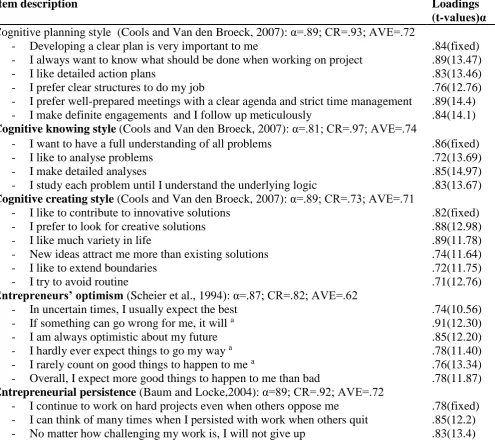
Table 2 displays specific items used to measure the constructs and their respective factor
loadings and t-values.
Entrepreneurial persistence. Following George’s (1992) view of entrepreneurial persistence
as a behaviour resulting from an interaction of trait and situation, entrepreneurial persistence
is measured using three items adapted from Baum and Locke (2004). “Persistence” was not an
observed variable, but it tapped whether an individual has a personal/psychological tendency
to persist (Baum and Locke, 2004). The entrepreneurs who responded to the survey were asked
to register their responses to each of three items using a seven-point Likert-like scale ranging
from: 1= strongly disagree; to 7= strongly agree.
Entrepreneurs’ optimism. Entrepreneurs’ optimism was measured using Scheier et al.’s
(1994) six-item Life Orientation Test-Revised (LOT-R). Entrepreneurs who responded to the
survey registered their responses to each of the six items using a seven-point Likert-like scale
ranging from: 1=strongly disagree, 7=strongly agree. Responses were summed up into an
overall score; high scores indicated a generalized feeling of optimism about the future, and low
scores indicated a more pessimistic outlook (Hmieleski and Baron, 2009).
Cognitive style. The cognitive style measures were adapted from items developed by Cools
16
et al., 2009). Following these studies, respondents were asked rate a series of items on a scale
that measures knowing, planning and creating styles (1 = strongly disagree to 7 = strongly
agree).
Control Variables. In line with existing literature (e.g., Kanfer and Ackerman, 2004; Zhao et
al., 2005), a number of control non-hypothesised variables were tested. This is because
previous studies indicate that these variables have the potential to influence entrepreneurial
persistence. The firm level control variables adopted in this study include firm size and firm
age. Moreover, this study controlled for individual level variables including age of
entrepreneur, gender, level of education and working experience of the entrepreneur. These
control variables were included in the model in order to control for potential liabilities of
newness or inertia associated with firm age or size, which might impact persistence. Founder
age was included to control for potential decreases in cognitive resources affecting persistence
that may be associated with age (Cardon and Kirk, 2013; Kanfer and Ackerman, 2004). This
study controlled for working experience as factors related to previous working conditions
affects perception on the ability to implement entrepreneurial behaviours (Fini et al., 2012).
Additionally, this study controlled for gender given that venture size differs between male and
female entrepreneurs, with women generally involved in lower growth and small scale ventures
(Cassar, 2006).
Validity and Reliability Assessment
This study addressed concerns relating to validity of the responses by ensuring that all the
respondents who completed the questionnaires were entrepreneurs or owner-managers. In
order to help mitigate the potential effects of common method bias, both procedural and
statistical remedies were employed (Podsakoff, et al., 2003). This study included only
17
controls and unrelated questions as separators between questions for dependent and
independent variables (Fulmer et al., 2008).
INSERT TABLE 2 AROUND HERE
This study tested for a potential non-response bias by dividing the answers for the study’s
constructs (optimism, planning style, knowing style, creating style and persistence) into groups
of early and late respondents and then testing the means of early and late respondents, following
Armstrong and Overton (1977). Moreover, to investigate the potential for non-response bias, t
test comparisons of responding versus non-responding firms on age, total employees, sales
turnover and total capital were conducted (Anderson and Eshima, 2013). Since no significant
statistical difference was found, it was concluded that non-response bias is not a concern in this
study.
Following purification, several items were removed from the model. Table 2 displays the final
list of items, their sources, their respective standardized factor loadings and t-values, and results
of reliability and validity tests. The positive and significant loadings confirm convergent
validity and composite reliability of the study’s measures (Boso et al., 2013).
Following previous scholarly developments (e.g., Boso et al., 2013; Cadogan et al., 2006)
confirmatory factor analyses (CFAs) were conducted using LISREL 8.7 (Jöreskog and
Sörbom, 2004) with maximum likelihood technique. All the scales were analysed in subsets
(Cadogan et al., 2006). Scales that are conceptually related were analysed together (Baker and
Sinkula, 1999). Table 3 displays the results of a ‘full measurement model’ (measurement model
set 3) in which all the items were entered simultaneously in a CFA model with a predicted
measurement model imposed (Boso et al., 2013). The results showed that all the loadings were
18
hypothesized and were significant ( ²=1464.69, df=1107, p 0.00, root mean square error of
approximation (RMSEA) =0.04; standardized root mean square residual (SRMR)= 0.05;
non-normed fit index (NNFI)=0.97; and comparative fit index (CFI)=0.93).
INSERT TABLE 3 AROUND HERE
With the exception of normed chi-square value ( ²/df=1464.69/1107=1.32) which was
significant, all the other fit indices were within acceptable cut-off points. The chi-squared test
shows the difference between observed and expected covariance matrices and a value closer to
0 demonstrates a better fit (Bagozzi and Yi, 2012; Fornell and Larcker, 1981). For each latent
variable, the average variance extracted (AVE) by the latent variable’s measures was larger than the latent variable’s shared variance with any other latent variable (Fornell and Larcker,
1981). Thus, discriminant validity was believed to be achieved. Table 3 presents the results of
the Fit indices for the measurement models. Additionally, estimation of discriminant validity
of the constructs was carried out by calculating the square roots of AVE for all multi-item
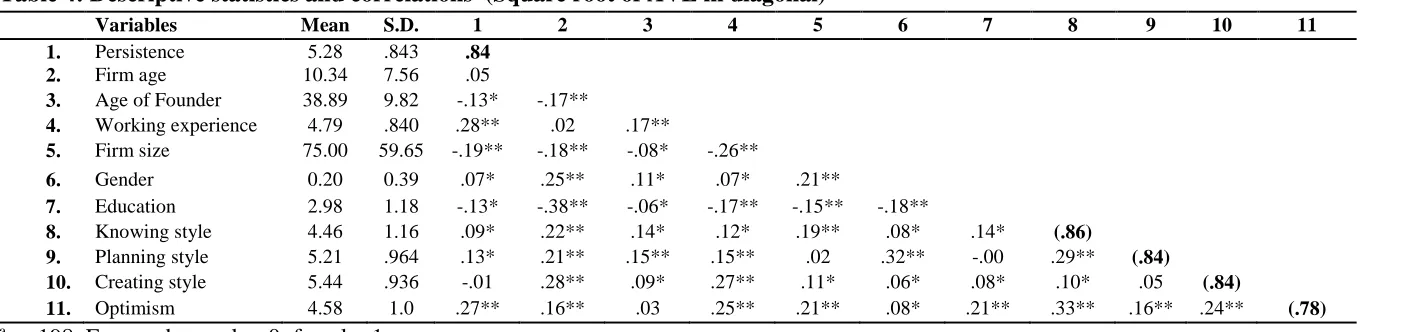
constructs (Table 4). AVE refers to the amount of variance captured by the latent variable in
relation to the amount of variance due to its measurement error (Fornell and Larker, 1981). The
results show that, for all constructs, each correlation of one construct with another is smaller
than the square roots of its AVE, indicating discriminant validity for out measures (Fornnel
and Larcker, 1981), so our measured concepts differ significantly from each other (Bagozzi
19
20
Statistical procedures
Hierarchical linear regression analysis was used to estimate the research model. Hierarchical
regression is well established as a model estimator in entrepreneurship research (Rauch et al.,
2009). Following previous scholarly studies, interaction variables were created (e.g., Boso et
al., 2013; Cadogan et al., 2006). As a result of the inclusion of these interaction terms in the
regression estimate, multicollinearity becomes apparent. Previous scholarly studies have
contended that failure to orthogonize the exogenous and endogenous variables can lead to
structural coefficient bias (e.g., Cadogan et al., 2006). All the variables involved in the creation
of the interaction terms were residually centered and a low variance inflation factor (VIF) was
obtained, way below the recommended cut off of 10.00 (Aiken and West, 1991; Baum, 2006).
Results
Table 4 provides the means, standard deviations, and bivariate correlations for the study
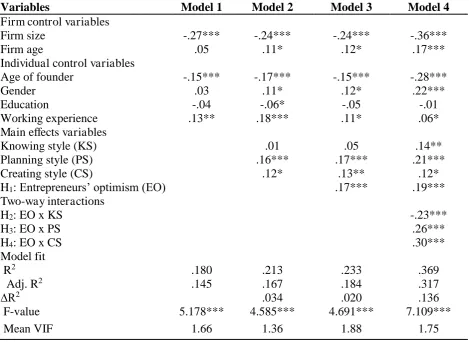
variables. Table 5 presents the results of the hierarchical regression models for persistence.
Model 1 included the control variables, Model 2 added cognitive knowing, planning and
creating styles as main effect variables, Model 3 also added entrepreneurs’ optimism, and
Model 4 included the three interactions of entrepreneurs’ optimism with each cognitive style.
From Model 1 the study finds a negative relationship between firm size and persistence.
Additionally, founders’ age was found to be negatively related to persistence. However,
working experience was positively related to persistence. Further, firm age, gender and
education had no direct effects on entrepreneurial persistence.
The results are described in relation to the individual hypotheses. The interactions are graphed
in Figures 2 to 4. Although not directly hypothesized, Model 2 indicated that some of the
cognitive style dimensions directly contributed to increased persistence, as reflected in the
positive coefficients for cognitive planning style ( =.16 p< .01) and cognitive creating style
21
5). Hypothesis 1 proposed that entrepreneurs’ optimism will be positively related to
persistence. As shown in Model 4 of Table 5, the entrepreneurs’ optimism positively related to
persistence ( =.19, p .01). Therefore, hypothesis 1 receives support. The positive relationship
between entrepreneurs’ optimism and persistence has been conceptually shown in prior
research (Brown and Marshall, 2001; Shane and Venkataraman, 2000).
INSERT TABLE 5 AROUND HERE
A major theoretical contribution results from the present study’s investigation of the interplay
between entrepreneurs’ optimism and cognitive style, and particularly the contingent nature of
entrepreneurs’ optimism-persistent relationship. According to hypotheses 2-4, the relationship
between optimism and persistence should be stronger at high levels of each cognitive style (i.e.
planning, knowing and creating style). In support of hypotheses 3 and 4, the contribution of
optimism to entrepreneurial persistence grew stronger at high levels of cognitive planning style
( =.26, p .01) and cognitive creating style ( =.30, p .01). However, contrary to hypothesis 2,
this study found a negative interaction between entrepreneurs’ optimism and cognitive knowing style ( =-.23, p .01), suggesting that the relative usefulness of entrepreneurs’
optimism for enhancing persistence was actually higher in conditions of low cognitive knowing
style.
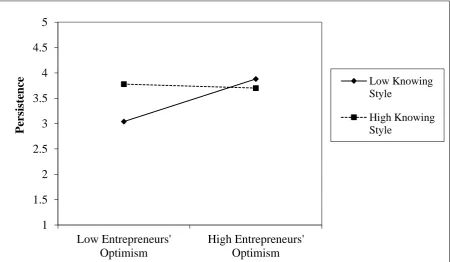
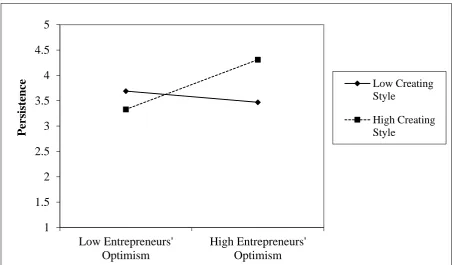
To illustrate the nature of these three significant interactions, the effects of entrepreneurs’
optimism on entrepreneurial persistence at high and low levels of the corresponding cognitive
style dimensions are plotted in Figures 2 to 4 following procedures suggested by Dawson and
Richter (2006). The plots suggest that, whilst cognitive planning and creating styles invigorate
the positive relationship between entrepreneurs’ optimism and persistence, cognitive knowing
style weakens the effect of entrepreneurs’ optimism on persistence. In particular, high levels
22
Discussion
Prior research suggests that entrepreneurs who are tenacious in pursuit of their goals have a
greater chance of success (Foo et al., 2006; Timmons and Spinelli, 2009). A major insight is
to argue that even if entrepreneurs who are tenacious in pursuit of their goals have a greater
chance of success, an equally crucial issue is the circumstances under which such tenacious
behavior is more or less pronounced in entrepreneurs’ persistence. Therefore, the purpose of
our study was to examine the moderating effects of entrepreneurs’ cognitive styles on the
relationship between entrepreneurs’ optimism and persistence. Thus, this paper extends
knowledge on conditions in which entrepreneurs’ optimism is more or less prevalent in
enhancing persistence. The study’s contribution to the optimism literature is the empirical
validation of the theoretical argument that entrepreneurs’ optimism-persistence relationship is
differentially moderated by cognitive styles. Therefore, a better understanding of the conditions
in which optimism strongly relates to persistence will be useful for both practitioners and
researchers. The study helps to answer how cognitive style translates optimism in the decision
to persist. This study uniquely contributes to the literature by explaining the drivers of
persistence.
This study’s findings regarding these moderating effects are mixed. First, cognitive creating
style and cognitive planning style both enhance the relationship between entrepreneurs’
optimism and persistence. As hypothesised, entrepreneurs scoring high on optimism are more
likely to exhibit tenacious behaviour at high levels of cognitive creating and cognitive planning
style dimensions. A key contribution this paper makes to the literature is to illustrate and
empirically support the notion that cognitive creating and cognitive planning styles enhance
the relationship between entrepreneurs’ optimism and persistence. The implications of this
23
management practice is that optimism may be important element necessary in entrepreneurs’
decision to persist, but cognitive creating and planning style may be important moderating
factors that can effectively translate optimism into higher persistence to occur.
INSERT FIGURE 2 AROUND HERE
Second, knowing style negatively moderates the relationship between entrepreneurs’ optimism
and persistence. This may be caused by the fact that other factors related to cognitive knowing
style may affect the optimism-persistence linkage. For example, while aiming to persist may
seem attractive to optimistic entrepreneurs, the motivation to persist may be mitigated by the
continuous search for new opportunities. Moreover, high cognitive knowing style people like
to make decisions based upon facts, information and details, and may find it difficult to cope
with entrepreneurial ventures.
Overall, these findings extend previous theoretical arguments regarding the role of individuals’
optimism in exhibiting tenacious behavior (Brown and Marshall, 2001) by explicating how the
presence of these cognitive styles differentially moderate the link between entrepreneurs’
optimism and persistence.
INSERT FIGURE 3 AROUND HERE
The unexpected finding for cognitive knowing style, Figure 2, indicates that when
entrepreneurs take their time to make decisions, postpone decisions until data is collected for
more information (cognitive knowing style), the relative usefulness of entrepreneurs’ optimism
for stimulating persistence gets subdued. Thus, cognitive knowing style impedes the
conversion of entrepreneurs’ optimism into persistence. A major reason may be that
24
ambiguous, and lack supporting facts and figures (Knockaert, et al., 2015). This is because the
entrepreneurial process is a process fraught with difficulties, unforeseeable hazards and high
levels of uncertainty (Aldrich, 1979; Nelson and Winter, 1982), and often characterized by
decisions that cannot be fully supported by data or facts and figures.
INSERT FIGURE 4 AROUND HERE
This study has theoretical implications for the cognitive style literature by providing support
for the benefits of multidimensional models. The study’s findings suggest that a cognitive
planning and cognitive creating style enhance the optimism-persistence relationship whilst a
cognitive knowing cognitive style works against this relationship. These findings underscore
the benefits of integrating the underlying dimensions of what has been previously united under
an analytical or adaptive cognitive style (Allinsson and Hayes, 1996).
Conclusions
This study set out to empirically examine the relationship between optimism and persistence
and the moderating influence of cognitive style dimensions on this relationship. This
theoretically derived research model which links optimism, cognitive style and persistence was
empirically validated by means of an empirical study of 198 SMEs in Ghana. The findings
from this paper are that optimism positively relates to persistence and that cognitive creating
and planning style positively amplify this relationship. Somewhat interestingly, cognitive
knowing style works against the translation of optimism into improved persistence. The present
study extends our knowledge in the realm of entrepreneurship, suggesting that some cognitive
style dimensions (planning and creating styles) can translate optimism into improved
persistence outcome whilst cognitive knowing style works against the optimism-persistence
25
There are some practical contributions offered by this study. Interpreted from a practitioner’s
point of view, the article provides entrepreneurs with insights into how they can stimulate
persistence in SMEs. To reap benefits from being optimistic, entrepreneurs should assess their
cognitive style underlying their behavior. The usefulness of entrepreneurs’ optimism for
enhancing persistence can be established by stimulating some cognitive styles (planning and
creating style) but not cognitive knowing style. A focus on optimism is more likely to increase
persistence when entrepreneurs structure, organise and control (planning style) and take
high-risk proposals and see problems as opportunities and challenges (creating style).
Moreover, this study revealed that optimism is critical for entrepreneurial persistence. An
implication is that persistence can also lead to significant financial and emotional costs for the
entrepreneur if the resources used in persisting could have been more efficiently applied
elsewhere (McGrath, 1999). Therefore, entrepreneurs may be appreciably aided by an
understanding that there may be an inherent bias toward the status quo and the norm of
persistence. They may be more willing to seek objective data from other sources that can be
used to justify or modify expectancies and valences and ultimately increase the probability of
making quality decisions.
This study also has implications for investors in general, including venture capitalists and angel
investors. It may be relevant to understand whether the entrepreneur is more likely to pursue
their dreams of developing successful ventures despite the great odds against them (Dosi and
Lovallo, 1997). For example, venture capitalists have incentives to grandstand (Gompers,
1996), i.e. to take actions signaling their ability to potential investors. As such, they are
interested in investing in entrepreneurs who will decide to forge ahead in the face of daunting
obstacles in order to create growth companies which can be brought public in an IPO or
26
complement the assessment of the optimism during the due diligence process, which is
currently limited to assessing the entrepreneur’s track record and management skills (Shepherd
and Zacharakis, 1998; Tyebjee and Bruno, 1984).
This study has implications for developing countries too. These countries present a unique
relevant setting for studying the interplay between entrepreneurs’ optimism and the persistence
they expend in pursuit of their goals. The role of entrepreneurial firms in these economies
cannot be underestimated as they play a critical role in functioning as engine of growth and
agents of economic development (Adomako and Danso, 2014), yet they confront several
constraints (Robson and Obeng, 2008). Thus, for policy makers and other stakeholders (e.g.,
consultants, educators, institutions) in developing economies, the study’s findings reveal
different levers they can use to encourage persistence in pursuit of entrepreneurial goals. They
could provide training or other resources to assist these entrepreneurs in meeting their
entrepreneurial goals. It may inform parties involved in education such as public policy on
education and training of current and potential entrepreneurs. An implication is that students
in entrepreneurship education need to learn to cope with incomplete and unsecure information.
Managers in SMEs should also acknowledge individual differences and to use them
constructively, implying careful consideration about when to ‘‘match’’, when to ‘‘mismatch’’,
and how to stimulate cognitive versatility (Sadler-Smith, 1999).
The limitations of this study must be noted. First, a limitation of this research is that
“persistence” was not observed or measured directly, but it was only used a self-reporting tool
that tries to assess whether an individual has a personal/psychological tendency to persist.
Therefore, this must be taken in consideration when interpreting the findings of the present
study. Second, our study is only limited to entrepreneurs operating SMEs in Ghana. A natural
27
countries in sub-Saharan Africa. This is particularly important as it will provide an avenue to
examine whether the constructs examined are also driven by varying institutional context.
Third, the cross-sectional design requires some caution in terms of causality. Thus, the use of
cross-sectional data does not allow us to examine any changes in some of the constructs
examined. Although the directions of our hypotheses were strongly grounded in extant theory,
further research could use longitudinal data to examine whether the explanatory power of the
variables examined could vary with changes over time. Fourth, beyond the cognitive style we
examined, which originated from theoretical reflections in previous scholarly work (Cools and
Van den Broeck, 2007), further research could consider other moderators of the
optimism-persistence relationship. For example, future studies could use firm and environmental levels
variables as moderators of this linkage. Future studies could examine these potential
moderators by drawing from social cognitive theory (Bandura, 1986) and the multi-level
perspective (Hitt et al., 2007). Fifth, this study also used gender as control variable. Future
research should especially address gender differences in cognitive style and persistence in
SMEs. Sixth, this study used hierarchical regression in testing the hypotheses. Although,
hierarchical regression is well established as a model estimator in entrepreneurship research
(Anderson and Eshima, 2013), future studies may apply structural equitation models. Using
such models might offer the opportunity to address any shortcomings of this study’s modelling
methods.Finally, the present study focused on surviving firms, whilst we have no reason to
think that survivorship bias should have systematically biased the study’s results since there is
a good variation in the study’s measurements of both dependent and independent variables.
This is a limitation which is inevitable in studying Ghanaian firms.
References
28
Aldrich, H., 1979. Organizations and Environments, Prentice Hall, Englewood Cliffs, NJ.
Allinson, C., Chell, E., and Hayes, J. (2000), ‘‘Intuition and entrepreneurial behavior’’. European Journal of Work and Organizational Psychology, Vol. 9, pp.31-43. Allinson, C., and Hayes, J., (1996). ‘‘The cognitive styles index: a measure of intuition-
analysis for organisational research’’, Journal of Management Studies, Vol.33, pp.119-135
Amabile, T. M. (1997), ‘‘Motivating creativity in organizations: On doing what you love and loving what you do’’. California Management Review, Vol. 40 No. 1, pp.3958. Anderson, B. S and Eshima, Y. (2013), ‘‘The influence of firm age and intangible resources
on the relationship between entrepreneurial orientation and firm growth among Japanese SMEs’’. Journal of Business Venturing, Vol.28 No.3, pp.413-429
Alvarez, S.A and Parker, S.C (2009), ‘‘Emerging firms and the allocation of control rights: A Bayesian approach’’. Academy of Management Review Vol. 34(2), pp.209-227. Aspinwall, L. G., Sechrist, G. B., and Jones, P. R. (2005), ‘‘Expect the best and prepare for
the worst: Anticipatory coping and preparations for Y2K’’. Motivation and Emotions, Vol.29, pp. 357–388.
Åstebro, T., Jeffrey, S. A., and Adomdza, G. K. (2007), ‘‘Inventor perseverance after being told to quit: The role of cognitive biases’’. Journal of Behavioral Decision Making, Vol. 20, pp.253–272.
Armstrong, S.J., Cools, E., and Sadler Smith, E. (2012), ‘‘Role of cognitive styles in business and management: Reviewing 40 years of research’’. International Journal of
Management Reviews, Vol.14 No.3, pp. 238–262.
Armstrong, S. and Hird, A. (2009), ‘‘Cognitive style and entrepreneurial drive of new and mature business owner-managers’’. Journal of Business and Psychology, Vol. 24, pp. 419-430.
Armstrong, J. S., and Overton, T. S. (1977), ‘‘Estimating nonresponse bias in mail surveys’’. Journal of Marketing Research, Vol. 5, pp.396-402.
Bagozzi, R.P. and Philips, L.W. (1982), ‘‘Representing and testing organisational theories: a holistic construal’’. Administrative Science Quarterly Vol.27 No3, pp.459-490 Bagozzi, R.P., and Yi, Y. (2012), ‘‘On the evaluation of structural equation models’’. Journal
of the Academy of Marketing Science Vol. 14 No.1, pp. 33-46
Baker, W.E and Sinkula, J.M (1999), ‘‘The complementary effects of market orientation and entrepreneurial orientation on profitability in small businesses’’ Journal of small Business Management Vol.47 No.4, pp.443-464
Bandura, A (1986). Social foundations of though and action: A social cognitive theory. Englewood Cliffs. NJ: Prentice Hall
Bandura, A. (1997). Self-efficacy: The Exercise of Control, Freeman, New York, NY.
Baron, R. (2004), ‘‘Opportunity recognition: insights from a cognitive perspective, in: Butler, J. (Ed.), Research in Entrepreneurship and Management: Opportunity Identification and Entrepreneurial Behaviour. Information Age Publishing, Greenwich, Vol.4, pp.47-74.
Barbosa, S., Gerhardt, M. and Kickul, J. (2007), ‘‘The role of cognitive style and risk
preference on entrepreneurial self-efficacy and entrepreneurial intentions’’. Journal of Leadership and Organisational Studies, Vol.13, pp.86-104.
Barclays Bank. (2012), ‘‘The Power of Persistence: Mapping attitudes to adversity’’ Barclays Wealth Insights, Vol.16, pp1-47
29
Baum, J.R and Locke, E.A. (2004), ‘‘The relationship of entrepreneurial traits, skill, and motivation to subsequent venture growth’’, Journal of Applied Psychology, Vol.89 No.4, pp.587–598
Beyler, J., and Schmeck, R. R. (1992). ‘‘Assessment of individual differences in preferences for holistic-analytic strategies: Evaluation of some commonly available
instruments’’. Educational and Psychological Measurement, Vol.52, pp.709-719. Boso, N., Story, V.M., and Cadogan, J.W. (2013), ‘‘Entrepreneurial orientation, market
orientation, network ties, and performance: study of entrepreneurial firms in a developing economy’’, Journal of Business Venturing, Vol.28, No.6, pp. 708-727. Brown J. D. and Marshall M. A. (2001), ‘‘Great expectations: optimism and pessimism in
achievement settings, in Optimism and Pessimism: Implications for Theory, Research, and Practice’’, ed Chang E. C., editor. (Washington, DC: American Psychological Association), pp.239–255.
Burke, L.A. and Miller, M.K. (1999), ‘‘Taking the mystery out of intuitive decision making’’, Academy of Management Executive, Vol.13, pp.91-9.
Busenitz, L. W. (1999), ‘‘Entrepreneurial risk and strategic decision-making: It’s a matter of Perspective’’. The Journal of Applied Behavioral Science, Vol.35, pp.325-340. Busenitz, L.W., and Barney, J.W. (1997), ‘‘Differences between entrepreneurs and managers
in large organizations: biases and heuristics in strategic decision-making’’. Journal of Business Venturing Vol.12 No.6, pp.9–30.
Buttner, H. E., and Gryskiewicz, N. (1993). ‘‘Entrepreneurs’ problem-solving styles: An empirical study using the Kirton adaption/innovation theory’’. Journal of Small Business Management, Vol. 31, No.1, pp.22-31.
Cadogan, J. W., Cui, C. C. Morgan, R. E. and Story, V. M. (2006), ‘‘Factors facilitating and impeding the development of export market-oriented behaviour: A study of Hong Kong manufacturing exporters’’. Industrial Marketing Management, Vol.35, pp.634– 647
Cardon, M. S. and Kirk, C. P. (2015), ‘‘Entrepreneurial Passion as Mediator of the Self- Efficacy to Persistence Relationship’’. Entrepreneurship Theory and Practice. Vol.39No.5, pp.1029-1050
Carland J., Carland J., Ensley M., (2002), ‘‘Hunting the Heffalump: the theoretical basis and dimensionality of the Carland entrepreneurial index’’. Academy of Entrepreneurship Journal, Vol.7, pp.51-84.
Carter, N.M., Gartner, W.B., and Reynolds, P.D. (1996), ‘‘Exploring start-up event sequences’’. Journal of Business Venturing,Vol.11, pp.151–166
Carver, C. S., and Scheier, M. (2003). Optimism. In S. J. Lopez, and Snyder, C. R. (Ed.), Positive Psychological Assessment: A Handbook of Models and Measures. Washington D. C.: American Psychological Association.
Cassar, G (2006), ‘‘Entrepreneur opportunity costs and intended venture growth’’. Journal of Business Venturing, Vol.21, pp.610-632
Cassar, G. (2010), ‘‘Are individuals entering self employment overly optimistic? an empirical test of plans and projections on nascent entrepreneur expectations’’. Strategic Management Journal, Vol.31No.8, pp.822-840.
Cassar, G and Craig, J. (2009), ‘‘An investigation of hindsight bias in nascent venture activity’’. Journal of Business Venturing Vol.24 No.2, pp.149-164.
Chen, M.H., Chang, Y.Y., and Lo, Y.H (2015). Creativity cognitive style,
conflict, and career success for creative entrepreneurs, Journal of Business Research Vol.68, pp. 906–910
30
Cools, E. and Van den Broeck, H. (2007), ‘‘Development and validation of the Cognitive Style Indicator’’. The Journal of Psychology, Vol.141, pp. 359-387.
Cools, E., Van den Broeck, H., and Bouckenooghe, D. (2009), ‘‘Cognitive Styles and Person- environment Fit: Investigating the Consequences of Cognitive (Mis) fit’’, European Journal of Work and Organisational Psychology, Vol.18, pp.167-198.
Cooper, A. C., Woo, C. Y., and Dunkelberg, W. C. (1988), ‘‘Entrepreneurs’ perceived chances for success’’. Journal of Business Venturing, Vol.3, pp.97–108. Corbett, A. (2007), ‘‘Learning asymmetries and the discovery of entrepreneurial
opportunities’’. Journal of Business Venturing, Vol.22, pp.97-118
Crane, F. G., and Crane, E. C. (2007), ‘‘Dispositional optimism and entrepreneurial success’’. The Psychologist-Manager Journal, Vol.10 No.1, pp.13-25
Dawson, J. F., and Richter, A. W. (2006), ‘‘Probing three-way interactions in moderated multiple regression: development and application of a slope difference test’’. Journal of Applied Psychology, Vol.91 No.4, pp. 917-926.
de Meza, D., and Southey, C. (1996), ‘‘The borrower’s curse: Optimism, finance and entrepreneurship’’. Economic Journal, Vol.106, pp. 375–386.
DeTienne, D.R., Shepherd, D.A. and De Castro, J.O. (2008), ‘‘The fallacy of “only the strong survive”: The effects of extrinsic motivation on the persistence decisions for under-performing firms’’. Journal of Business Venturing, Vol.23 No.5, pp.528–546. Dimov, D. (2007), ‘‘From Opportunity Insight to Opportunity Intention: The Importance of
Person-Situation Learning Match’’. Entrepreneurship Theory and Practice, Vol.31, pp.561–583.
Dosi, G., and Lovallo, D. (1997), ‘‘Rational entrepreneurs or optimistic martyrs? Some considerations on technological regimes, corporate entries, and the evolutionary role of decision biases’’. In R. Garud & P. R. Nayyar (Eds.), Technological innovation: Oversights and foresights, pp.41–68. New York: Cambridge University Press. Dutta, D. and Thornhill, S., (2008), ‘‘The evolution of growth intentions: toward a cognition-
based model’’. Journal of Business Venturing, Vol.23, pp.307-332.
Fini, R., Grimaldi, R Marzocchi, G.L and Sobrero, M. (2012), ‘‘The determinants of
corporate entrepreneurial intention within small and newly established firms’’. Entrepreneurship Theory and Practice, Vol.24, pp.387-414
Foo, M. D., Sin, H. P., and Yiong, L. P. (2006), ‘‘Effects of team inputs and intrateam processes on perceptions of team viability and member satisfaction in nascent ventures’’. Strategic Management Journal, Vol.27, pp.389-39
Fornell, C., and Larcker, D. (1981), ‘‘Evaluating structural equation models with observable variables and measurement error’’. Journal of Marketing Research, Vol.18, pp. 39-50
Fraser, S., and Greene, F. J. (2006). ‘‘The effects of experience on entrepreneurial optimism and uncertainty’’. Economica, Vol. 73, pp.169–192.
Fulmer, I., Barry, B and Long, D. (2008). ‘‘Lying and smiling: informational and emotional deception in negotiation’’. Journal of Business Ethics Vol.88, pp.691–709.
Garland, H. (1990), ‘‘Throwing good money after bad: The effect of sunk costs on the decision to escalate commitment to an ongoing project’’. Journal of Applied Psychology, Vol.75, No.6, pp.728–731.
Gatewood, E. J., Shaver, K. G., Powers, J. B., and Gartner, W. B. (2002), ‘‘Entrepreneurial expectancy, task effort, and performance’’. Entrepreneurship Theory and Practice, Vol.27, pp.187-206.
31
Gimeno, J., Folta, T.B., Cooper, A.C., and Woo, C.Y. (1997), ‘‘Survival of the fittest?
Entrepreneurial human capital and the persistence of underperforming firms’’. Administrative Science Quarterly, Vol.42 No.4, pp.750–783.
Goldstein, K., and Blackman, S., (1978), Cognitive Style: Five Approaches and Relevant Research, Wiley, New York
Grigorenko, E. L., and Sternberg, R. J. (1995). Thinking styles. In D. H. Saklofske & M. Zeidner (Eds.), International handbook of personality and intelligence (pp. 205– 229). New York: Plenum Press.
Haines, H. and Townsend, D. (2013), ‘‘Self-Doubt and Entrepreneurial Persistence: How Founders of High-Growth Ventures Overcome Cognitive Constraints on Growth and Persist with their Ventures’’, in: Corbett, A. C. and Katz, J. A. (Hg.) Advances in Entrepreneurship, Firm Emergence and Growth, Vol.15, pp. 95-124.
Hayes, J., and Allinson, C., (1994), ‘‘Cognitive style and its relevance for management practice’’. British Journal of Management, Vol.5, pp.53-71.
Hayes, J., and Allinson, C. W. (1998), ‘‘Cognitive style and the theory and practice of individual and collective learning in organizations’’. Human Relations, Vol.51, pp.847–871.
Hayward, M. L. A., Shepherd, D. A., and Griffin, D. (2006). A hubris theory of entrepreneurship. Management Science, Vol.52 No.2, pp.160-172.
Heye, D. (2006), ‘‘Creativity and innovation: Two key characteristics of the 21st century information professional’’. Business Information Review, Vol.23 No.4, pp. 252-257 Hitt, M. A., Beamish, P. W., Jackson, S. E. and Mathieu, J. E. (2007), ‘‘Building theoretical
and empirical bridges across levels: Multilevel research in management’’. Academy of Management Journal, Vol.50, pp.1385-1399.
Holland, D. and Shepherd, D.A. (2013), ‘‘Deciding to persist: Adversity, values, and
entrepreneurs’ decision policies’’, Entrepreneurship Theory and Practice, Vol.37 No.2, pp.331-358.
Hmieleski, K.M and Baron, R.A. (2009), ‘‘Entrepreneurs’ optimism and new venture performance: a social cognitive perspective’’. Academy of Management Journal, Vol.52 No.3, pp.473-488
Hmieleski, K. M., and Corbett, A. C. (2006), ‘‘Proclivity for improvisation as a predictor of entrepreneurial intentions’’. Journal of Small Business Management, Vol. 44 No.1, pp.45-63.
Hodgkinson, G. P., and Sadler-Smith, E. (2003). Complex or unitary? A critique and empirical reassessment of the Allinson-Hayes Cognitive Style Index. Journal of Occupational and Organizational Psychology, Vol. 76, pp.243–268.
Jöreskog, K.G. and Sörbom, D. (2004), LISREL 8.7 for Windows [Computer Software] . Lincolnwood, IL: Scientific Software International, Inc
Kanfer, R. and Ackerman, P.L. (2004), ‘‘Aging, adult development, and work motivation’’. Academy of Management Review, Vol.29 No.3, pp.440–458.
Keh, H.T., Foo, M.D., and Lim, B.C. (2002), ‘‘Opportunity evaluation under risky
conditions: the cognitive processes of entrepreneurs’’. Entrepreneurship Theory and Practice, Vol.27, pp. 125-148.
Kickul, J., Gundry, L.K., Barbosa, S.D., and Whitcanack, L. (2009), ‘‘Intuition Versus Analysis? Testing Differential Models of Cognitive Style on Entrepreneurial Self-Efficacy and the New Venture Creation Process’’. Entrepreneurship Theory and Practice, Vol.33 No.2, pp.439-453