An empirical investigation of the impact of commitment and trust on
internal marketing
ABSTRACT
This paper seeks to explore the impact of commitment and trust on internal marketing
effectiveness within the hospital industry. This study was exploratory in nature and was
conducted using the case study methodology; involving ten cases in the hospital industry with
a total of 20 interviews being conducted. Results revealed that both commitment and trust
played a moderating role to five of the key tasks (i.e. training, motivation, company
vision/goals, co-optation and communication) of effective internal marketing.
KEYWORDS: Internal marketing, relationship marketing, commitment, trust, services
INTRODUCTION
Services play a major role in the world’s established economies and are increasingly important in developing economies. In today’s increasingly dynamic, deregulated,
technologically enhanced and unpredictable business environments, services organizations
seek to develop competitive advantage through the delivery of consistently high service
quality, to improve customer satisfaction. In order to achieve high level of service quality,
Berry, Hensel, and Burke (1976) had some 30 years ago proposed and highlighted the
importance and significant contribution of internal marketing in this aspect. For this reason,
many hospitals and healthcare service providers nowadays seek to explore ways in which
they can better engage and capitalize internal marketing to enhance the service quality
provided to their customers/patients (Berkowitz, 2011; Cooper & Cronin, 2000; Peltier,
Pointer, & Schibrowsky, 2008).
Despite the extensive literature on internal marketing (e.g. Ahmed & Rafiq, 2003; Ballantyne,
2003; Greene, Walls, & Schrest, 1994; Grönroos, 1994; Rafiq & Ahmed, 2000), there is an
apparent lack of research into the importance of commitment and trust on internal marketing
and specifically within the hospital industry. Therefore, this paper aims to investigate the
impact of commitment and trust on internal marketing. This study draws from both the theory
and the preliminary empirical knowledge acquired from interviewing stakeholders who are
directly involved in internal marketing at hospitals in Taiwan and Singapore. Hence, this exploratory research will seek to address the question ‘What are the impact of commitment
and trust on internal marketing effectiveness? Why?’. The research findings seek to
contribute towards the internal marketing theory, specifically in the hospital context by
exploring new insights and also with the confirmation or disconfirmation of the impact of
practical contributions that are beneficial to hospital managers where their competitiveness in
the industry can be further enhanced through the development of effective internal marketing
that help to deliver consistently high service quality in improving customer satisfaction.
This paper begins by reviewing the literature relevant to the research issue and then discusses
the methodology used in investigating this issue. Next the research findings will be
presented. These are followed by the conclusions drawn from the research, the implications
from these and finally suggestions for future research are drawn.
LITERATURE REVIEW
While there are several different definitions for internal marketing (e.g. Berry &
Parasuraman, 2004; Grönroos, 1985; Han, Hsu, & Sheu, 2010; Piercy & Morgan, 1989), but
there is no one single agreed concept of what it is meant. However, there are five key
components that should be considered when setting the boundaries of the internal marketing
concept, namely (1) customer orientation and customer satisfaction (Arnett, Laverie, &
McLane, 2002; Grönroos, 1981, 1985; Lee, Song, Lee, Lee, & Bernhard, 2013; Robledo &
Arán, 2014); (2) employee motivation and satisfaction (Esfahani, Amirosadat, Rahimi, &
Marandi, 2013; Yao, Chen, & Cai, 2013); (3) marketing-like approach to employee and
customer satisfaction (Cervone & Pervin, 2009; Grönroos, 1994; Han et al., 2010; Keelson,
2014; Wu, Tsai, & Fu, 2013); (4) inter-functional coordination and integration (Al-Hawary,
Al-Qudah, Mash'al Abutayeh, Mash'al Abutayeh, & Al-Zyadat, 2013; Farzad, Nahavandi, &
Caruana, 2008; Ferdous, Herington, & Merrilees, 2013; Han et al., 2010); and (5)
implementation of specific corporate or functional strategies (Karlíček, Chytková, Tyll, &
Mohelská, 2014; Keelson, 2014; Papasolomou & Vrontis, 2006). With this in mind, internal
overcome organizational resistance to change and to align, motivate and inter-functionally
co-ordinate and integrate employees towards the effective implementation of corporate and
functional strategies in order to deliver customer satisfaction through a process of creating
motivated and customer orientated employees.” (Rafiq & Ahmed, 2000, p. 454).
It has been evident that there exists continual internal resistance to marketing in many
organizations, but unless employees’ needs are satisfied, the delivery of high level service
quality to external customers is not possible (Ballantyne, 2003; Han et al., 2010; Malhotra,
Mavondo, Mukherjee, & Hooley, 2013; Wu et al., 2013). Thus, internal marketing plays an
important role in achieving and improving customer satisfaction through a process of
motivating and satisfying employees who will be committed and supportive towards the
implementation of customer-oriented strategies (Arnett et al., 2002; Fang, Chang, Ou, &
Chou, 2014; Fu, 2013).
The literature indicates that there are several activities and/or tasks that a company
undertakes in its internal marketing and the extent to which these activities and/or tasks are
being conducted can potentially influence the effectiveness of internal marketing. Therefore,
a detailed understanding of these activities and/or tasks can further enhance the success of
internal marketing, and leading to improved service quality and a greater level of customer
satisfaction. Although the literature has revealed empirical investigation into the different
categories of activities and/or tasks which can be broadly classified as follow: (1) recruitment
(Akroush, Abu-ElSamen, Samawi, & Odetallah, 2013; Feist & Feist, 2009; Han et al., 2010;
Rafiq & Ahmed, 2000); (2) training (Ahmed, Rafiq, & Saad, 2003; Conduit & Mavondo,
2001; Piercy & Morgan, 1989; Wu et al., 2013); (3) motivation (Chow, Lai, & Loi, 2015;
Ballantyne, 2003; To, Martin, & Billy, 2015); (5) company vision/goals (Hartley & Trout,
2015; Kale, 2012; Tsai & Tang, 2008); and (6) co-optation (Martinez, Stinson, & Jubenville,
2011; Nyongesa, 2014; Peltier et al., 2008), but there is limited evidence of such studies
being conducted to provide greater insights about the impact of commitment and trust on
internal marketing, which is the key focus of this study.
While the commitment-trust theory of relationship marketing proposed by Morgan and Hunt
(1994) was widely documented, the focus has been mainly on external suppliers and
customers (Brito, Brito, & Hashiba, 2014; Eddleston & Morgan, 2014; Friman, Gärling,
Millett, Mattsson, & Johnston, 2002; Gao, Sirgy, & Bird, 2005; Mukherjee & Nath, 2007),
and very few studies were conducted internally within the organization, specifically on
employees and functional departments (Georgiades, 2015; Podsakoff, MacKenzie, &
Bommer, 1996; Ruekert & Walker Jr, 1987). As such, this research study attempts to bring
the two themes together by applying the commitment-trust theory in the context of internal
marketing within the hospital industry.
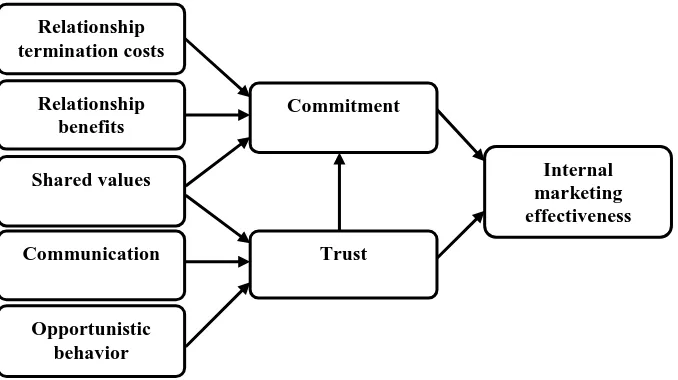
A preliminary framework (Figure 1) is developed and derived from Morgan and Hunt (1994)
for this study to investigate the potential impact of commitment and trust on the effectiveness
of internal marketing. Each of these drivers of commitment and trust will be addressed in
turn.
Insert Figure 1 about here
Commitment is regarded as one of the most important variables in relationship marketing
critical, has significant mutual benefits that requires maximum efforts to maintain (Cullen,
Johnson, & Sakano, 2000; Jap & Ganesan, 2000; Morgan & Hunt, 1994; O'Donnell, Brown,
& Marsh, 2014). Commitment also plays a critical role in determining between ‘stayers and leavers’ where such commitments to the learning processes and investments are evident to
the continuity of the valued relationship (Dwyer, Schurr, & Oh, 1987; Handfield & Bechtel,
2002; Jain, Khalil, Johnston, & Cheng, 2014). Furthermore, commitment can ensure future
value and benefits to businesses that are involved in the relationship (Caceres &
Paparoidamis, 2007; Macht, 2014; Ng, 2012).
On the other hand, trust is seen as a fundamental element in developing successful
relationships and signifies the willingness to rely on and confidence that exchange partners
have on each other (Grudinschi, Sintonen, & Hallikas, 2014; MacMillan, Money, Money, &
Downing, 2005; Morgan & Hunt, 1994; Wong & Sohal, 2002). Trust encourages open
communication, exchange of ideas, knowledge and sharing of resources between exchange
partners that improve the relationship (Cowles, 1997; Ratnasingam, 2005; Schnackenberg &
Tomlinson, 2014). The level of trust between exchange partners serves as a key indicator to
the continuity of the relationship as well as their success (Dahwa, Al-Hakim, & Ng, 2013;
Doney & Cannon, 1997; Sharma & Patterson, 1999). It is also important to highlight that
trust influences commitment since relationship characterized by a high level of trust are
highly valued by exchange partners that will have a stronger desire to commit themselves to
such a relationship (Goodman & Togna, 2014; Kwon & Suh, 2005; Morgan & Hunt, 1994;
Rodríguez & Wilson, 2002).
Relationship termination costs refer to all anticipated losses from the termination of the
(Morgan & Hunt, 1994). These costs can be financial (e.g. switching and opportunity costs,
dissolution expenses) and non-financial (e.g. loss of reputation, unnecessary stress) in nature
that have a significant impact on the level of commitment towards an on-going relationship
(Liao, Wang, & Yeh, 2014; Sharma & Patterson, 2000; Tähtinen & Vaaland, 2006).
Therefore, it is the expectation of total costs that influences commitment where higher costs
involved are likely to generate a higher level of commitment. This study posits that
relationship termination costs will impact on the level of commitments from employees and
the management, which in turn influence the effectiveness of internal marketing.
Another key driver of commitment is relationship benefits. In order to attain a long-term
sustainable relationship, there needs to be perceived values derived from a relationship that
are mutually beneficial to the exchange partners (Hohenthal, Johanson, & Johanson, 2014;
MacMillan et al., 2005; Palmatier, Dant, Grewal, & Evans, 2006). Furthermore, businesses
that deliver superior benefits are highly valued, and in return exchange partners will be more
willing to commit themselves to developing and maintaining such relationships (Edvardsson,
Klaus, Payne, & Frow, 2014; Friman et al., 2002; Wetzels, De Ruyter, & Van Birgelen,
1998). Thus, this study suggests that higher relationship benefits for employees and the
management will lead to greater commitment from both parties towards the development and
maintenance of the relationship, which can have an impact on the effectiveness of internal
marketing.
Shared values are the extent to which exchange partners agree and/or disagree towards the
understanding and beliefs about the behaviors, goals and policies that they have in common
(Danchev, 2005; Morgan & Hunt, 1994; Zineldin et al., 2015). Shared values also play a
commitment and trust between exchange partners (Battisti & Perry, 2015; Dwyer et al., 1987;
Friman et al., 2002; Mukherjee & Nath, 2007). This study proposes that a higher degree of
mutual acceptance of shared values will contribute to increased commitment and trust
between employees and the management, which can affect the effectiveness of internal
marketing.
One of the key drivers of trust is communication, which can be broadly referred to the formal
and informal sharing of valuable information between businesses (Lages, Lages, & Lages,
2005; Shipilov, Gulati, Kilduff, Li, & Tsai, 2014). Regular communications in a relationship
can help minimise and resolve disputes and ambiguities, increase frequency on the exchange
of accurate and critical information, and align perceptions and expectations (Cason & Mui,
2014; Koza & Dant, 2007; Ryssel, Ritter, & Gemünden, 2004). Through communication,
trust and openness between exchange partners can be enhanced and leading to mutual
benefits. This study posits that communications between employees and the management will
have adverse effects on the level of trust they have on one another, which can influence the
effectiveness of internal marketing.
Opportunistic behavior refers to self-interest seeking with guile and can result in extensive
violation of rules and information distortion that affects the trust between exchange partners
(Mastilak, Matuszewski, Miller, & Woods, 2014; Mukherjee & Nath, 2007). In addition,
where exchange partners lack the means to deal with opportunism, relationship risk will be
perceived as high, and resulting in the relationship being terminated (Brown, Dev, & Lee,
2000; Kwon & Suh, 2005; Nooteboom, Berger, & Noorderhaven, 1997; Wiengarten,
Humphreys, Gimenez, & McIvor, 2015). This study proposes that when employees and/or the
will lead to decreased trust and subsequently impact on the effectiveness of internal
marketing.
RESEARCH METHODOLOGY
This research was exploratory in nature and conducted using the case study methodology,
which was aimed to confirm or disconfirm the impact of commitment and trust in the
preliminary framework, as identified in the literature reviewed (Parkhe, 1993; Yin, 2014).
The adoption of the case study approach is justified on three grounds. Firstly, the approach
for this research focused on exploring the complexity and dynamism of the context within
organizational settings and events such as the impact of commitment and trust on internal
marketing in the Taiwan and Singapore hospital industry (Carson, Gilmore, Perry, &
Gronhaug, 2002; Perry, 1998; Yin, 2014). Next, case study research focuses on an
organization or industry with the aim to rigorously explore and analyse thoroughly the
contemporary real-life experiences and events while retaining the holistic and meaningful
characteristics of these experiences and events. This helps to capture the richness and depth
of contextual meaning (such as the reasoning on how the key drivers of commitment and trust
can potentially influence the effectiveness of internal marketing) that can give raise to
possible new insight (Yin, 2014). Lastly, case study research provides a more informed basis
for theory building than surveys and is considered appropriate for new research areas or
research areas where existing theory is inadequate (Eisenhardt, 1989; Patton, 2002; Yin,
2014). As evident in this research, there are limited research studies in this area, particularly
in the Taiwan and Singapore hospital industry context. Through case studies, this research
will attempt to investigate the complex business environment in the hospital industry that
provides a real-life account of the research issue raised in this research and builds on theory
Ten cases within the hospital industry were selected judgmentally based on the criteria that
they have operated in the industry for a minimum of 10 years and practiced internal
marketing for at least three years. For each case, two interviews were conducted with the
relevant director or equivalent (who is involved in managerial activities) and a lower-middle
level manager or operational staff (who is involved in the daily operational activities), to
determine if significant differences existed between management versus operations
perspectives.
In this research, replication logic in multiple case studies was used to achieve external
validity, while the construct validity of this study was achieved with the use of multiple
sources of evidence through secondary sources (such as the hospital’s development plans,
service charters and other relevant documentations) which were used to further triangulate the
results. These interviews were semi-structured in nature and conducted in a flexible and
informal manner that provided a greater sensitivity to misunderstanding by interviewees and
also to reveal in-depth understanding and information about feelings and emotions toward
commitment and trust that were considered influential to the effectiveness of internal
marketing. Furthermore, a case study protocol was developed and used throughout the
interviewing process, in order to enhance the reliability of the study and also to ensure all
relevant issues were consistently addressed and conveyed to the interviewees. The duration
for each of the in-depth interview lasted approximately 60 minutes.
Data analysis
This study has adopted the content analysis procedures that began with the coding of themes
in the interview questions, which assisted in organizing the data for easier retrieval (Berg,
interview was coded in terms of the actual questions on the interview protocol, which could
assist in revealing relationships and new ideas or areas for coding (Berg, 2012; Neuman,
2011). The coded interviewing questions within each interview were then compared and
contrasted to identify the major issues and derive some form of generalization (Berg, 2012;
Neuman, 2011). In addition, narrative text and quotations from case studies were used to
enhance the credibility of data analysis and also to add qualitative insights to the research
issues (Patton, 2002). The findings of this research will be discussed in the next section.
RESULTS
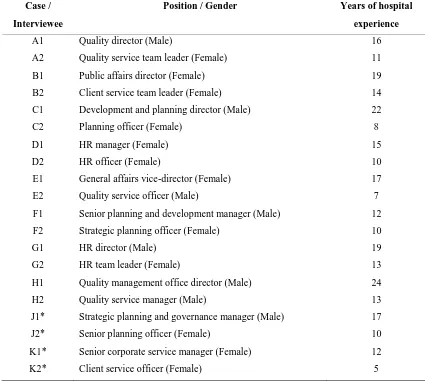
A total of 20 in-depth interviews were conducted with 10 hospital cases (i.e. eight from
Taiwan and two from Singapore) with the majority of the interviewees (12 out of 20) being
females while the remaining eight were males. Seventeen of the 20 interviewees had 10 or
more years of experiences in the hospital industry, while other interviewees had at least five
years of relevant experiences. All interviewees had direct involvement in activities related to
internal marketing. A summary of the interviewees’ profile is presented in Table 1.
Insert Table 1 about here
The findings were generally consistent across the interviewees who agreed that commitment
and trust identified in the literature as being influential to the effectiveness of internal
marketing. Results revealed that both commitment and trust played a moderating role to five
of the key tasks (i.e. training, motivation, company vision/goals, co-optation and
communication) of effective internal marketing. In addition, the study found no major
differing opinions between interviewees from the management and operational perspectives
Relationship termination costs. All interviewees agreed that relationship termination costs
could impact on the effectiveness of internal marketing, particularly through tasks related to
training, motivation and co-optation that company undertakes. Interviewees revealed that
high termination costs would lead to an on-going employer-employee relationship being
regarded as important since there were much higher stakes involved, and as a result both the
employer and employee giving greater commitment to the relationship that would enhance
internal marketing effectiveness.
From the management perspective, they were more likely to commit and engage in activities
and tasks that would motivate (e.g. performance incentive programs) and co-opt (e.g. career
advancement opportunities) their employees so that they were satisfied and remain loyal to
the hospital, which could contribute positively to the effectiveness of internal marketing.
This was supported by an interviewee (C1) stating that: “We cannot afford the significant
costs (related activities and training with new recruitment) involved if we were to lose them.
We would rather invest to retain them, making them feel motivated and valued as part of the
team so that they are happy in their jobs and willing to deliver high quality service to the
patients. Happy staff means happy patients.” Another interviewee (E1) also supported this by commenting: “We have monthly service excellence award for employees who demonstrate
exceptional level of service delivery. This gives them a sense of achievement and recognition
by others of what they have done well. This award also aims to motivate others to excel.
Through this, we hope that good staff will continue to stay on with the hospital.”
On the other hand, interviewees from operational roles also indicated that they would engage
more seriously to understand, adhere and align their performance to the hospital’s service
delivery standards and culture, to avoid hefty termination costs. In order to enhance their
attending relevant training programs provided by the hospital, which could have a positive
impact on internal marketing. This was supported by comments from interviewees (D2 and
K2) stating: “I will do whatever it takes to secure my job, this includes attending additional
training courses and seminars. I suppose this will only benefit me if I intend to stay on at this
hospital.” “It will be silly of me not to take advantage of the training courses to improve on
my knowledge and skills, this at least shows that I am keen to meet the hospital’s
performance requirements and will not lose my job.”
Relationship benefits. Interviewees indicated their support for relationship benefits being
influential to the effectiveness of internal marketing. They suggested that employees and
employers who were capable of delivering superior benefits would be highly valued, and
therefore more committed to the on-going development of such relationships. As a result,
internal marketing effectiveness could be improved.
From the management perspective, they were incline to commit themselves in developing
and maintaining the relationship with the employees, specifically through tasks such as
training, motivation and co-optation. This could motivate employees to attain greater job
satisfaction, improving their performance, and also retaining them as valuable assets to the
hospitals, which could contribute positively to the effectiveness of internal marketing. In
supporting this, an interviewee (H1) commented that: “We provide advance training
programs to our employees whom we see great potential in them. Not only that their skills
and knowledge can be further developed but also giving them career advancement
opportunities. By doing this, we can retain and capitalize our employees’ know-how,
valuable experience, and newly acquired skills and knowledge to the benefit of our hospital.”
performance, long service awards, and customer service excellence) that seek to recognize
the employees’ contributions made towards the hospital. We believe that without these
valuable employees, our hospital will not be as successful.”
Interviewees from operational roles also suggested that their commitment to the hospitals
would greatly increase as a result of substantial benefits arises from the relationship. They
regarded the benefits (e.g. performance incentive) as key motivating factors for them to
remain loyal working at the hospital and played an important role in stimulating job
satisfaction, which in turn impact on the effectiveness of internal marketing. Interviewees
(A2 and E2) who supported this stated: “Given that the hospital provides some great benefits
(e.g. pension, health-related entitlements) to me, I will be very reluctant to quit my job. I will
do my best to help in any way that I can for the hospital to avoid losing these benefits.” “I am
committed to working at this hospital because I feel that my efforts are being recognized and
well compensated. The rewards and performance incentives given are good and I am
encouraged to perform better the next time round.”
Shared values. Interviewees revealed that shared values could impact on internal marketing
effectiveness. They believed that commitment and trust between employees and the
management would be enhanced through a better alignment of their beliefs and understanding
toward the appropriateness of behaviors, goals and policies that existed in the hospital.
Consequently, this would contribute to the effectiveness of internal marketing.
Interviewees from management roles suggested that a higher level of commitment and trust
between employees and the management could occur when there were evidences of
They believed that employees played a critical role in the success of the hospital and needed to be a part of the hospital’s mission and vision statements. This would enable employees to
appreciate how their work would fit into the hospital and its goals, as well as understanding
the rationales behind them. Furthermore, it offered employees the feeling of being an integral
part of the hospital and thus leading to greater job satisfaction. Through this, internal
marketing would be more effective. In supporting this, interviewees (B1 and G1) commented: “When the two (hospital and the employee) see eye to eye, they agree with each other and
will be committed to working together in order to achieve their common goals.” “Our mission
statement reads ‘Employees will be given similar respect and caring attitude within the
hospital that they are expected to demonstrate externally with every patient.’ Our employees
are important to us and we have to ensure that they feel being part of the big family where
they will commit to doing their best and trusting us to do the same in return.”
From the operational perspective, interviewees also agreed that their commitment and trust
towards the management would increase when they share the values and beliefs of the
hospital. They indicated a higher level of performance and enthusiasm in assisting the
hospital to achieve its goals if they concur with them. However, any discrepancies would
only result in their half-hearted effort that would be detrimental and counter-productive.
Therefore, the effectiveness of internal marketing could be affected by co-optation in which
employees seek to foster and support the philosophy and culture of the hospital that their
values coincide with. An interviewee (B2) supported this by commenting that: “I go beyond
my duties to provide good service to the patients as I like to see them being happy. The
hospital that I work for has placed great emphasis on service quality. I embrace this type of
services to patients regardless of you being rich or poor) and provides patients with
healthcare services even though they cannot afford the expenses. I am very supportive of this
important societal value and am proud to be a part of it where I can contribute to this belief.”
Communication. Interviewees suggested that the effectiveness of internal marketing could be
affected by the extent and nature of communications between employees and the
management. They also indicated that regular communications could enhance trust and
openness in their relationship, and more importantly align perceptions and expectations, to
avoid unnecessary disputes and misunderstandings. Therefore, the use of appropriate
communication channels and techniques could impact on internal marketing effectiveness.
From the management perspective, interviewees revealed that it was important for them to
maintain regular communication via different channels, to effectively convey the hospital’s
visions and goals to the employees. Through this, the hospital would generate a greater level of employees’ attention to its service quality standards and therefore delivering quality
service to the patients, and subsequently improving the level of satisfaction. An interviewee (K1) who supported this commented: “By having regular communications (e.g. daily section
and fortnightly departmental meetings) with my staff, there will be no ambiguity in terms of
what our goals are and how we are going to achieve them. Everyone knows their roles and
focus on the tasks to be accomplished.” Furthermore, the hospital could also attract, develop
and retain employees who share its visions and goals, and the level of trust between them
would increase as they gained better mutual understandings. This was supported by an interviewee (F1) who stated: “If we have effectively communicated the hospital’s visions and
missions to the employees, those who share these similar values and beliefs are more likely to
Interviewees from operational roles also agreed that communications played a critical role in
the effectiveness of internal marketing. In fact, they argued that the lack of effective
communication from the management, together with inappropriate channels and techniques
used were one of the key factors that led to many internal marketing failures. This was
supported by an interviewee (C2) stating: “I don’t feel like I am an employee working at this
hospital. Often I only get to know about important policy decisions from outside sources, and
this is embarrassing for me. I like to hear it from the management first instead.” Furthermore,
interviewees also criticized the occasional provision of inaccurate information to them that
led to unnecessary confusions, anxieties and misunderstandings, which had adverse effects to
their trust on the management. An interviewee (F2) supported this by commenting: “I
appreciate the management’s willingness to share information about the hospital’s plans and
decisions with us, but this information needs to be correct. Inaccurate information can cause
chaos and anxiety among us. This affects my level of trust on them.”
Opportunistic behavior. Interviewees revealed their support for opportunistic behavior as
being influential to the effectiveness of internal marketing. They admitted that opportunism
has damaging effects on the relationship between employees and the management. As a
result, their trust for one another would decline and subsequently leading to a decreased
relationship commitment. Interviewees believed that this self-interest seeking attitude had no
or little consideration and respect for the other party (employee or the management) and
would hinder the effectiveness of internal marketing.
From the management perspective, interviewees suggested that employees who demonstrate
hospital’s visions and goals. They also revealed that employees driven by opportunism were
more reluctant and less enthusiastic to participate and attend training programs and
workshops. This could have a significant impact on the effectiveness of internal marketing.
This was attested by interviewees (A1 and J1) who stated: “There are a few of my staff that
does not cooperate because they do not see the direct benefits for them. And this makes my
job a lot more difficult to bring the department together in order to achieve the hospital’s
goals.”“I have a few staff in particular that often look restless and reluctant to attend those
training sessions. When I ask them why, they mention that there are no monetary benefits
involve and instead will delay their time from going home.”
On the other hand, interviewees from operational roles also agreed that they were unwilling
to cooperate if the management (managers or supervisors) had only been motivated to attain
their personal interest (e.g. career promotion) and was not genuine in leading the employees towards achieving the hospital’s goals. In addition, they revealed that in some instances the
management would display opportunistic behavior at the expense of the employees. This had
resulted in severe criticism by the employees and also losing their trust and faith in the
management. With this, the effectiveness of internal marketing would be greatly affected. In
supporting this, interviewees (G2 and H2) had commented: “Some managers will tell the staff
that the directives are coming from higher up in the hospital and they are required to adhere
to the instructions so that the hospital’s missions can be achieved. However, I noticed that
this is not always true since the managers have their own agenda and for obvious personal
gains. How can I trust someone like this? To be cooperative and doing my best will be out of
the question.” “Quite often, some managers will tell their staff to improve on their
performance and do more, but this usually only benefit the hospital and the managers
so. But instead, many of us have to sacrifice our other personal commitments and spend more
of my own time, for the benefits of others (management and the hospital). How is this fair?”
CONCLUSIONS, IMPLICATIONS AND LIMITATIONS
In conclusion, this study has investigated the impact of commitment and trust on internal
marketing effectiveness and provided insights into the current practices of 10 hospitals in
Taiwan and Singapore from 20 in-depth interviews. Using the commitment-trust theory, the
findings have highlighted the support of commitment and trust as being influential to the
effectiveness of internal marketing. Results have also revealed that both commitment and
trust have played a moderating role to five key tasks (i.e. training, motivation, company
vision/goals, co-optation and communication) of effective internal marketing.
Theoretical and managerial implications
This research has several theoretical and managerial implications. First, this study brought
together two themes by applying the commitment-trust theory on internal marketing, which
had not been adequately researched collectively in the past. The findings from this research
have added new knowledge to the existing literature about the commitment-trust theory and
internal marketing, but more importantly the provision of new insights into the impact of
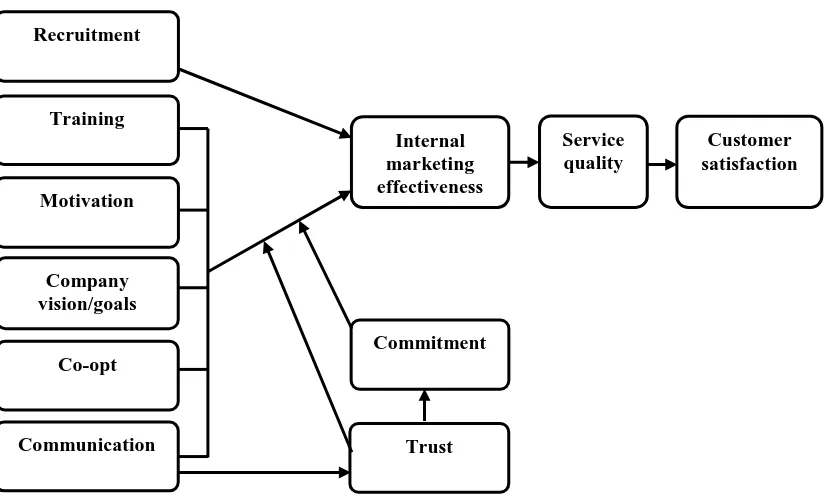
commitment and trust on internal marketing effectiveness. Second, the results led to the
development of an extended theoretical model (Figure 2) for examining internal marketing
effectiveness in a service oriented industry. This provides a more comprehensive framework
to be considered not only by services organizations (e.g. hospitals) but also businesses that
intend to capitalize internal marketing to enhance their service quality provided to their
customers. Third, in addition to the six key tasks of effective internal marketing, managers
effectiveness. Managers have to take into consideration the impact of the various key drivers
(i.e. relationship termination costs, relationship benefits, shared values, communication and
opportunistic behavior) of commitment and trust, and in turn how they can affect the tasks in
developing effective internal marketing plans and strategies. Their understanding and
appreciation of the roles that commitment and trust play in internal marketing will contribute
towards enhancing service quality and customer satisfaction.
Insert Figure 2 about here
Limitations
This study is exploratory in nature and only investigated the impact of commitment and trust
on internal marketing effectiveness in Taiwan and Singapore hospitals, and therefore the
findings cannot be generalized to other geographical areas and/or population at large. Further
conclusive explanatory research is required in order to allow generalization of the findings.
Future studies can also be investigated into other industries and countries, to provide
comparisons and determine their similarities and differences.
REFERENCES
Ahmed, P. K., & Rafiq, M. (2003). Internal marketing issues and challenges. European Journal of marketing, 37(9), 1177-1186.
Ahmed, P. K., Rafiq, M., & Saad, N. M. (2003). Internal marketing and the mediating role of organisational competencies. European Journal of marketing, 37(9), 1221-1241.
Akroush, M., Abu-ElSamen, A., Samawi, G., & Odetallah, A. (2013). Internal marketing and service quality in restaurants. Marketing Intelligence & Planning, 31(4), 304-336.
Al-Hawary, S., Al-Qudah, K., Mash'al Abutayeh, P., Mash'al Abutayeh, S., & Al-Zyadat, D. (2013). The Impact Of Internal Marketing On Employee's Job Satisfaction Of Commercial Banks In Jordan.
Interdisciplinary Journal of Contemporary Research in Business, 4(9), 811.
Arnett, D. B., Laverie, D. A., & McLane, C. (2002). Using job satisfaction and pride as internal-marketing tools.
The Cornell Hotel and Restaurant Administration Quarterly, 43(2), 87-96.
Ballantyne, D. (2003). A relationship-mediated theory of internal marketing. European Journal of marketing, 37(9), 1242-1260.
Battisti, M., & Perry, M. (2015). Small enterprise affiliations to business associations and the collective action problem revisited. Small Business Economics, 44(3), 559-576.
Berkowitz, E. (2011). Essentials of health care marketing (3rd ed.). Burlington, MA: Jones & Bartlett Learning. Berry, L. L., Hensel, J. S., & Burke, M. C. (1976). Improving retailer capability for effective consumerism
response. Journal of Retailing, 52(3), 3-14.
Berry, L. L., & Parasuraman, A. (2004). Marketing services: Competing through quality: Simon and Schuster. Brito, L., Brito, E., & Hashiba, L. (2014). What type of cooperation with suppliers and customers leads to
superior performance? Journal of Business Research, 67(5), 952-959.
Brown, J. R., Dev, C. S., & Lee, D.-J. (2000). Managing marketing channel opportunism: the efficacy of alternative governance mechanisms. The Journal of Marketing, 64(2), 51-65.
Caceres, R. C., & Paparoidamis, N. G. (2007). Service quality, relationship satisfaction, trust, commitment and business-to-business loyalty. European Journal of marketing, 41(7/8), 836-867.
Carson, D., Gilmore, A., Perry, C., & Gronhaug, K. (2002). Qualitative marketing research. London: Sage Publications.
Cason, T., & Mui, V. L. (2014). Coordinating resistance through communication and repeated interaction. The Economic Journal, 124(574), F226-F256.
Cervone, D., & Pervin, L. A. (2009). Personality: Theory and Research (11th Ed.). NY: John Wiley & Sons. Chow, C., Lai, J., & Loi, R. (2015). Motivation of travel agents' customer service behavior and organizational
citizenship behavior: The role of leader-member exchange and internal marketing orientation. Tourism Management, 48, 362-369.
Conduit, J., & Mavondo, F. T. (2001). How critical is internal customer orientation to market orientation?
Journal of Business Research, 51(1), 11-24.
Cooper, J., & Cronin, J. J. (2000). Internal marketing: A competitive strategy for the long-term care industry.
Journal of Business Research, 48(3), 177-181.
Cowles, D. L. (1997). The role of trust in customer relationships: asking the right questions. Management Decision, 35(4), 273-282.
Cullen, J. B., Johnson, J. L., & Sakano, T. (2000). Success through commitment and trust: The soft side of strategic alliance management. Journal of World Business, 35(3), 223-240.
Dahwa, M. P., Al-Hakim, L., & Ng, E. (2013). The Importance of Trust in Procurement Practices and Its Impact on Business Performance: An Empirical Investigation From the Perspective of the Buyer–Supplier Dyad. Journal of Relationship Marketing, 12(4), 280-300.
Danchev, A. (2005). How Strong are Shared Values in the Transatlantic Relationship? 1. The British Journal of Politics & International Relations, 7(3), 429-436.
Doney, P. M., & Cannon, J. P. (1997). An examination of the nature of trust in buyer-seller relationships.
Journal of Marketing, 61, 35-51.
Dwyer, F. R., Schurr, P. H., & Oh, S. (1987). Developing buyer-seller relationships. Journal of Marketing, 51(2), 11-27.
Eddleston, K., & Morgan, R. (2014). Trust, commitment and relationships in family business: Challenging conventional wisdom. Journal of Family Business Strategy, 5(3), 213-216.
Edvardsson, B., Klaus, P., Payne, A., & Frow, P. (2014). Developing superior value propositions: a strategic marketing imperative. Journal of Service Management, 25(2), 213-227.
Eisenhardt, K. M. (1989). Building theories from case study research. Academy of management review, 14(4), 532-550.
Esfahani, A., Amirosadat, S., Rahimi, H., & Marandi, M. (2013). Investigating relationship between internal marketing and job satisfaction with using structural equation modeling. International journal of academic research in economics and management sciences, 2(3), 1-11.
Fang, S.-R., Chang, E., Ou, C.-C., & Chou, C.-H. (2014). Internal market orientation, market capabilities and learning orientation. European Journal of marketing, 48(1/2), 170-192.
Farzad, A., Nahavandi, N., & Caruana, A. (2008). The effect of internal marketing on organizational commitment in Iranian banks. American journal of applied sciences, 5(11), 1480-1486.
Feist, J., & Feist, G. J. (2009). Theories of Personality (7th ed.). NY: McGraw-Hill.
Ferdous, A., Herington, C., & Merrilees, B. (2013). Developing an integrative model of internal and external marketing. Journal of Strategic Marketing, 21(7), 637-649.
Friman, M., Gärling, T., Millett, B., Mattsson, J., & Johnston, R. (2002). An analysis of international business-to-business relationships based on the Commitment–Trust theory. Industrial Marketing Management, 31(5), 403-409.
Fu, Y.-K. (2013). The influence of internal marketing by airlines on customer-oriented behavior: A test of the mediating effect of emotional labor. Journal of Air Transport Management, 32, 49-57.
Georgiades, S. (2015). Employee Engagement and Organizational Change. In S. Georgiades (Ed.), Employee Engagement in Media Management (pp. 9-37). Switzerland: Springer.
Goodman, M., & Togna, G. (2014). Does internal communication to generate trust always increase commitment? A study at Micron Technology. Corporate Communications: An International Journal, 19(1), 64-81.
Greene, W. E., Walls, G. D., & Schrest, L. J. (1994). Internal marketing: the key to external marketing success.
Journal of services marketing, 8(4), 5-13.
Grönroos, C. (1981). Internal marketing–an integral part of marketing theory. In J. H. Donnelly & W. R. George (Eds.), Marketing of services (pp. 236-238). Chicago: American Marketing Association.
Grönroos, C. (1985). Internal marketing–theory and practice. In T. M. Bloch, G. D. Upah, & V. A. Zeithaml (Eds.), Services marketing in a changing environment (pp. 41-47). Chicago: American Marketing Association.
Grönroos, C. (1994). From marketing mix to relationship marketing: towards a paradigm shift in marketing.
Management Decision, 32(2), 4-20.
Grudinschi, D., Sintonen, S., & Hallikas, J. (2014). Relationship risk perception and determinants of the collaboration fluency of buyer–supplier relationships in public service procurement. Journal of Purchasing and Supply Management, 20(2), 82-91.
Han, H., Hsu, L.-T. J., & Sheu, C. (2010). Application of the theory of planned behavior to green hotel choice: Testing the effect of environmental friendly activities. Tourism Management, 31(3), 325-334.
Handfield, R. B., & Bechtel, C. (2002). The role of trust and relationship structure in improving supply chain responsiveness. Industrial Marketing Management, 31(4), 367-382.
Hartley, P., & Trout, R. (2015). Environmental Person-Organization Fit And The Importance Of Promoting Organizational Policy Internally. In L. Robinson Jr (Ed.), Marketing Dynamism & Sustainability: Things Change, Things Stay the Same… (pp. 71-74). LA: Springer.
Hohenthal, J., Johanson, J., & Johanson, M. (2014). Network knowledge and business-relationship value in the foreign market. International Business Review, 23(1), 4-19.
Jain, M., Khalil, S., Johnston, W., & Cheng, J.-S. (2014). The performance implications of power–trust relationship: The moderating role of commitment in the supplier–retailer relationship. Industrial Marketing Management, 43(2), 312-321.
Jap, S. D., & Ganesan, S. (2000). Control mechanisms and the relationship life cycle: Implications for safeguarding specific investments and developing commitment. Journal of marketing research, 37(2), 227-245.
Kale, S. H. (2012). Internal marketing: An antidote for Macau's labor shortage. UNLV Gaming Research & Review Journal, 11(1), 1-11.
Karlíček, M., Chytková, Z., Tyll, L., & Mohelská, H. (2014). Barriers of marketing effectiveness and efficiency within companies: a qualitative study. E+ M Ekonomie a Management, 17(4), 111-124.
Keelson, S. (2014). The moderating role of organizational capabilities and internal marketing in market orientation and business success. Review of Business & Finance Studies, 5(1), 1-17.
Koza, K. L., & Dant, R. P. (2007). Effects of relationship climate, control mechanism, and communications on conflict resolution behavior and performance outcomes. Journal of Retailing, 83(3), 279-296.
Kwon, I.-W. G., & Suh, T. (2005). Trust, commitment and relationships in supply chain management: a path analysis. Supply Chain Management: An International Journal, 10(1), 26-33.
Lages, C., Lages, C. R., & Lages, L. F. (2005). The RELQUAL scale: a measure of relationship quality in export market ventures. Journal of Business Research, 58(8), 1040-1048.
Lee, C.-K., Song, H.-J., Lee, H.-M., Lee, S., & Bernhard, B. (2013). The impact of CSR on casino employees’ organizational trust, job satisfaction, and customer orientation: An empirical examination of responsible gambling strategies. International Journal of Hospitality Management, 33, 406-415. Liao, Y.-W., Wang, Y.-S., & Yeh, C.-H. (2014). Exploring the relationship between intentional and behavioral
loyalty in the context of e-tailing. Internet Research, 24(5), 668-686.
Macht, S. (2014). Reaping Value‐Added Benefits from Crowdfunders: What Can We Learn from Relationship Marketing? Strategic Change, 23(7-8), 439-460.
MacMillan, K., Money, K., Money, A., & Downing, S. (2005). Relationship marketing in the not-for-profit sector: an extension and application of the commitment–trust theory. Journal of Business Research, 58(6), 806-818.
Malhotra, N., Mavondo, F., Mukherjee, A., & Hooley, G. (2013). Service quality of frontline employees: a profile deviation analysis. Journal of Business Research, 66(9), 1338-1344.
Mastilak, C., Matuszewski, L. J., Miller, F., & Woods, A. (2014). Self-Fulfilling Prophecy? An Examination of Exposure to Economic Theory and Opportunistic Behavior. SSRN Electronic Journal. doi:http://dx.doi.org/10.2139/ssrn.2312557
Miles, M. B., Huberman, A. M., & Saldana, J. (2014). Qualitative data analysis: a methods sourcebook (3rd ed.). Thousand Oaks, California: Sage Publications.
Morgan, R. M., & Hunt, S. D. (1994). The commitment-trust theory of relationship marketing. Journal of Marketing, 58(3), 20-38.
Mukherjee, A., & Nath, P. (2007). Role of electronic trust in online retailing: a re-examination of the commitment-trust theory. European Journal of marketing, 41(9/10), 1173-1202.
Neuman, W. L. (2011). Social research methods: qualitative and quantitative approaches (7th ed.). Boston: Pearson/Allyn and Bacon.
Ng, E. (2012). An Empirical Study on the Success Factors of Supplier-Distributor Relationships. Contemporary Management Research, 8(2), 161-180.
Nooteboom, B., Berger, H., & Noorderhaven, N. G. (1997). Effects of trust and governance on relational risk.
Academy of management journal, 40(2), 308-338.
Nyongesa, L. (2014). Internal marketing and organizations performance among large supermarkets in Nairobi: a case study of leading supermarkets in Nairobi county. (Masters of Science), University of Nairobi, Nairobi, Kenya.
O'Donnell, E., Brown, S., & Marsh, L. (2014). To Commit or Not to Commit? the Influence of Relationship Governance on Buyer-Seller Commitment. Academy of Marketing Studies Journal, 18(1), 87-89. Palmatier, R. W., Dant, R. P., Grewal, D., & Evans, K. R. (2006). Factors influencing the effectiveness of
relationship marketing: a meta-analysis. Journal of Marketing, 70(4), 136-153.
Papasolomou, I., & Vrontis, D. (2006). Building corporate branding through internal marketing: the case of the UK retail bank industry. Journal of Product & Brand Management, 15(1), 37-47.
Parkhe, A. (1993). “Messy” research, methodological predispositions, and theory development in international joint ventures. Academy of management review, 18(2), 227-268.
Patton, M. Q. (2002). Qualitative research and evaluation methods (3rd ed.). Thousand Oaks, California: Sage Publications.
Peltier, J. W., Pointer, L., & Schibrowsky, J. A. (2008). Internal marketing and the antecedents of nurse satisfaction and loyalty. Health Marketing Quarterly, 23(4), 75-108.
Perry, C. (1998). Processes of a case study methodology for postgraduate research in marketing. European Journal of marketing, 32(9/10), 758-802.
Piercy, N., & Morgan, N. (1989). Internal marketing strategy: leverage for managing marketing-led change.
Irish Marketing Review, 4(3), 11-28.
Podsakoff, P. M., MacKenzie, S. B., & Bommer, W. H. (1996). Transformational leader behaviors and substitutes for leadership as determinants of employee satisfaction, commitment, trust, and organizational citizenship behaviors. Journal of management, 22(2), 259-298.
Rafiq, M., & Ahmed, P. K. (2000). Advances in the internal marketing concept: definition, synthesis and extension. Journal of services marketing, 14(6), 449-462.
Ratnasingam, P. (2005). Trust in inter-organizational exchanges: a case study in business to business electronic commerce. Decision Support Systems, 39(3), 525-544.
Robledo, J., & Arán, M. (2014). Empirical analysis of the constituent factors of internal marketing orientation at Spanish hotels. Tourism & Management Studies, 10(ESPECIAL), 151-157.
Rodríguez, C. M., & Wilson, D. T. (2002). Relationship bonding and trust as a foundation for commitment in US-Mexican strategic alliances: A structural equation modeling approach. Journal of International Marketing, 10(4), 53-76.
Ruekert, R. W., & Walker Jr, O. C. (1987). Marketing's interaction with other functional units: a conceptual framework and empirical evidence. The Journal of Marketing, 51(1), 1-19.
Ryssel, R., Ritter, T., & Gemünden, H. G. (2004). The impact of information technology deployment on trust, commitment and value creation in business relationships. Journal of Business & Industrial Marketing, 19(3), 197-207.
Schnackenberg, A., & Tomlinson, E. (2014). Organizational Transparency A New Perspective on Managing Trust in Organization-Stakeholder Relationships. Journal of management, 0149206314525202. Sharma, N., & Patterson, P. G. (1999). The impact of communication effectiveness and service quality on
relationship commitment in consumer, professional services. Journal of services marketing, 13(2), 151-170.
Shipilov, A., Gulati, R., Kilduff, M., Li, S., & Tsai, W. (2014). Relational pluralism within and between organizations. Academy of management journal, 57(2), 449-459.
Tähtinen, J., & Vaaland, T. I. (2006). Business relationships facing the end: why restore them? Journal of Business & Industrial Marketing, 21(1), 14-23.
To, W., Martin, E., & Billy, T. (2015). Effect of management commitment to internal marketing on employee work attitude. International Journal of Hospitality Management, 45, 14-21.
Tsai, Y., & Tang, T.-W. (2008). How to improve service quality: Internal marketing as a determining factor.
Total Quality Management & Business Excellence, 19(11), 1117-1126. doi:10.1080/14783360802323479
Wetzels, M., De Ruyter, K., & Van Birgelen, M. (1998). Marketing service relationships: the role of commitment. Journal of Business & Industrial Marketing, 13(4/5), 406-423.
Wiengarten, F., Humphreys, P., Gimenez, C., & McIvor, R. (2015). Risk, risk management practices, and the success of supply chain integration. International Journal of Production Economics, 171(3), 361-370. Wong, A., & Sohal, A. (2002). An examination of the relationship between trust, commitment and relationship
quality. International Journal of Retail & Distribution Management, 30(1), 34-50.
Wu, W. Y., Tsai, C. C., & Fu, C. S. (2013). The Relationships among Internal Marketing, Job Satisfaction, Relationship Marketing, Customer Orientation, and Organizational Performance: An Empirical Study of TFT‐LCD Companies in Taiwan. Human Factors and Ergonomics in Manufacturing & Service Industries, 23(5), 436-449.
Yao, Q., Chen, R., & Cai, G. (2013). How internal marketing can cultivate psychological empowerment and enhance employee performance. Social Behavior and Personality: an international journal, 41(4), 529-537.
Yin, R. K. (2014). Case study research: Design and methods (5th ed.). LA: Sage.
Figure 1: Preliminary framework for the impact of commitment and trust on effective internal marketing
Adapted from: (Morgan and Hunt, 1994)
Relationship termination costs
Relationship benefits
Commitment
Shared values
Communication
Opportunistic behavior
Trust
Figure 2: An extended framework for effective internal marketing
Note: while commitment and trust have not played a moderating role on the recruitment task, it may be explained by the fact that the effects of commitment and trust are only present when a relationship has been established.
Recruitment
Training
Service quality
Customer satisfaction
Commitment Motivation
Communication Company vision/goals
Trust Internal marketing effectiveness
Table 1: Profiles of the interviewees Case /
Interviewee
Position / Gender Years of hospital
experience
A1 Quality director (Male) 16
A2 Quality service team leader (Female) 11
B1 Public affairs director (Female) 19
B2 Client service team leader (Female) 14
C1 Development and planning director (Male) 22
C2 Planning officer (Female) 8
D1 HR manager (Female) 15
D2 HR officer (Female) 10
E1 General affairs vice-director (Female) 17
E2 Quality service officer (Male) 7
F1 Senior planning and development manager (Male) 12
F2 Strategic planning officer (Female) 10
G1 HR director (Male) 19
G2 HR team leader (Female) 13
H1 Quality management office director (Male) 24
H2 Quality service manager (Male) 13
J1* Strategic planning and governance manager (Male) 17
J2* Senior planning officer (Female) 10
K1* Senior corporate service manager (Female) 12
K2* Client service officer (Female) 5