1
Identification of vehicle axle loads from bridge responses using
preconditioned least square QR-factorization algorithm
Zhen Chen
a,b,d*, Tommy H.T. Chan
b, Andy Nguyen
b,c, Ling Yu
da
School of Civil Engineering and Communication, North China University of Water Resources and Electric Power, Zhengzhou 450045, China
b School of Civil Engineering and Built Environment, Queensland University of Technology
(QUT), Brisbane 4000, Australia
c School of Civil Engineering of Surveying, University of Southern Queensland (USQ),
Springfield Central, 4300, Australia
d MOE Key Lab of Disaster Forecast and Control in Engineering, Jinan University,
Guangzhou 510632, China
Abstract: This paper develops a novel method for moving force identification (MFI) called preconditioned least square QR-factorization (PLSQR) method. The algorithm seeks to
reduce the impact of identification errors caused by unknown noise. The biaxial moving
forces travel on a simply supported bridge at three different speeds is used to generate
numerical simulations to assess the effectiveness and applicability of the algorithm. Results
indicate that the method is more robust towards ill-posed problem and has higher
identification precision than the conventional time domain method (TDM). In addition, the
robustness and ill-posed immunity of PLSQR are directly affected by two kinds of
regularization parameters, namely, number of iterations 𝑗𝑗 and regularization matrix 𝐋𝐋.
Compared with the standard form of least square QR-factorization (LSQR), i.e., the
regularization matrix 𝐋𝐋 being the identity matrix 𝐈𝐈𝒏𝒏, the PLSQR with the optimal number of
iterations 𝑗𝑗 and regularization matrix 𝐋𝐋 has many advantages on MFI and it is more suitable
for field trials due to better adaptability with type of sensors and number of sensors.
Keywords: moving force identification; preconditioned least square QR-factorization; time domain method; regularization parameter; preconditioner
1. Introduction
The knowledge of dynamic loads acting on bridges is always required to ensure the safety
and reliability of bridges. This information on traffic loading can enable efficient and
economical management of transport networks and is becoming a valuable tool for bridge
safety assessment [1].
The technique of moving force identification (MFI) on bridges is to solve an inverse
problem through the dynamic characteristics of vehicle-bridge system and the measured
responses of bridges, which is very different from the forward problem. Force reconstruction
techniques are often associated with an ill-posed problem due to the recovery of the input of a
*Corresponding author at: School of Civil Engineering and Communication, North China University of
Water Resources and Electric Power, 36 Beihuan Road, Zhengzhou 450045, PR China
2
dynamic system with influential noise, which leads to the reconstruction results in inaccurate
or non-unique solutions [2].
There are four important indirect moving force identification methods developed by Chan
et al [3-6], which have been incorporated into a moving force identification system and then
evaluated by experimental verification in laboratory and field applications [7]. Comparisons
show that all these four methods have acceptable accuracy; but the identification results from
the time domain method (TDM) and the frequency-time domain method (FTDM) are better
than those from the interpretive method I (IMI) and the interpretive method II (IMII). The
TDM was widely adopted because of its high precision and rigorous theory, which can be
used to identify the load history of each axle of a vehicle passing a bridge without interrupting
the flow of traffic. Zhu and Law [8-10] extended the TDM to several different bridge types.
Chan and Ashebo [11] extended the TDM to continuous bridge by considering the responses
of only one selected span from the continuous bridge. Yu and Chan [12] proposed a method
of moments (MOM) algorithm which improved the efficiency compared with the existing
TDM. However, it was still found that the identification results of improved methods based
on TDM suffer large deviation from real load during the local period of the vehicle crossing
the bridge, since the nature of the MFI is ill-posed [13].
In the last decade, some novel techniques have been presented for MFI. Dowling et al. [14]
utilized the first order regularization method to calculate the moving force from bridge strain
responses. Berry et al. [15] presented the theoretical developments of identifying local
dynamic transverse forces on the surface of a thin plate based on the virtual fields method. Li
et al. [16] proposed a force identification algorithm based on wavelet multi-resolution
analysis. Most of the new methods have noise immunity but ill-posedness should not be
ignored. To overcome the ill-posedness of MFI, regularization methods used to be utilized by
converting ill-posed to well-posed and these conditions can be physical or mathematical [2].
Some researchers introduced Tikhonov regularization approach to overcome ill-posedness
problems in MFI, as long as the optimal regularization parameter can be correctly chosen.
Pinkaew [17] adopted an updated static component (USC) technique to overcome
vehicle-bridge parameter sensitivity issues such as the vehicle speed. González et al. [18] proposed a
new bridge weigh in motion algorithm to reduce the dynamic uncertainty of bridge responses.
Mao et al. [19] presented an improved state space method to deal with the ill-posedness
problem. Ronasi et al. [20] added the traditional Tikhonov regularization method within the
numerical framework to reduce the sensitivity to noise of wheel-rail contact force
identification. Law et al. [21-23] proposed and an iterative regularization method for
structural damping identification and damage identification when noise effect is included in
the measurements. Ding et al. [24] proposed a discrete force identification approach based on
average acceleration discrete algorithm. Feng et al. [25] introduced a Bayesian inference
3
proposed a regularized cubic B-spline collocation (CBSC) method to mitigate the ill-posed
problem. Liu et al. [28-31] proposed a series of new methods for MFI based on Tikhonov
regularization such as time-domain Galerkin method, improved regularization method and the
shape function method based on moving least square fitting.
In linear algebra, the least square QR-factorization (LSQR) is an iterative method similar in
style to the well-known conjugate gradients (CG) as applied to the least squares problem
[32,33]. Benbow [34] extended LSQR with similar preconditioned Krylov methods for
solving augmented linear systems in a generalized least squares problem. Jacobsen and
Hansen [35] presented a subspace preconditioned LSQR for the solution of discrete linear
ill-posed problem. Reichel et al. [36,37] presented a generalization of LSQR that allowed the
choice of an arbitrary initial vector for the solution subspace. Karimi and Zali [38] proposed a
block preconditioned least squares (BPLS) and a block preconditioned global least squares
(BPGLS) algorithms to solve the linear system of equations with block partitioned coefficient
matrix and multiple linear system of equations. Arridge et al. [39] derived a factorization-free
preconditioned LSQR algorithm (MLSQR) for solving large-scale linear inverse imaging
problems.
As mentioned earlier, out of many iterative methods for solving the linear algebraic
equation, LSQR is a popular iterative method for the solution of large linear systems of
equations and least-squares problems [36]. In this paper, based on the LSQR technique, a
preconditioned least square QR-factorization (PLSQR) regularization method is proposed for
MFI by choosing proper regularization parameter, such as the number of iterations and the
regularization matrix. The numerical simulation results show that the PLSQR has excellent
ill-posed immunity and high-quality adaptability with different sensors. These advantages of
PLSQR are practical to the field trials of MFI.
2. Background of theory
2.1. Moving force identification by time domain method (TDM)
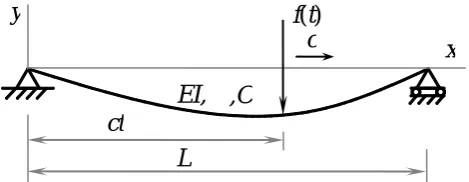
As shown in Fig.1, a moving force 𝑓𝑓(𝑡𝑡) passes over a simply supported Bernoulli-Euler
beam at a constant speed 𝑐𝑐. The span of the beam is 𝐿𝐿 and viscous damping is 𝐶𝐶. The mass
per unit length of the beam is 𝜌𝜌 and flexural stiffness is 𝐸𝐸𝐸𝐸. The dynamic equation of
vehicle-bridge system in modal coordinate 𝑞𝑞𝑛𝑛(𝑡𝑡) can be expressed as 𝑞𝑞̈𝑛𝑛(𝑡𝑡) + 2𝜉𝜉𝑛𝑛𝜔𝜔𝑛𝑛𝑞𝑞̇𝑛𝑛(𝑡𝑡) +𝜔𝜔𝑛𝑛2𝑞𝑞𝑛𝑛(𝑡𝑡) = 2
𝜌𝜌𝜌𝜌𝑝𝑝𝑛𝑛(𝑡𝑡),(n = 1,2, … ,∞) (1)
where 𝜔𝜔𝑛𝑛=𝑛𝑛2𝜋𝜋2 𝜌𝜌2 �
𝐸𝐸𝐸𝐸
𝜌𝜌 is the nth modal frequency;𝜉𝜉𝑛𝑛= 𝐶𝐶
4
f(t)
EI,
ρ
,C
c y
x
L ct
Fig.1. Dynamic model of moving vehicle and simply supported beam
The deflection 𝑣𝑣(𝑥𝑥,𝑡𝑡) and the bending moment 𝑀𝑀(𝑥𝑥,𝑡𝑡)of the simply supported beam at
point 𝑥𝑥 and time 𝑡𝑡 in time domain can be obtained as Law et al. [4]
𝑣𝑣(𝑥𝑥,𝑡𝑡) =�𝜌𝜌𝐿𝐿𝜔𝜔2
𝑛𝑛′ ∞
𝑛𝑛=1
sin𝑛𝑛𝑛𝑛𝑥𝑥𝐿𝐿 � 𝑒𝑒−𝜉𝜉𝑛𝑛𝜔𝜔𝑛𝑛(𝑛𝑛−𝜏𝜏)sin𝜔𝜔
𝑛𝑛′(𝑡𝑡 − 𝜏𝜏)sin𝑛𝑛𝑛𝑛𝑐𝑐𝜏𝜏𝐿𝐿 𝑓𝑓(𝜏𝜏)𝑑𝑑𝜏𝜏 𝑛𝑛
0
(2)
𝑀𝑀(𝑥𝑥,𝑡𝑡) =−𝐸𝐸𝐸𝐸𝜕𝜕2𝜕𝜕𝑥𝑥𝜈𝜈(𝑥𝑥2,𝑡𝑡)=�2𝐸𝐸𝐸𝐸𝑛𝑛𝜌𝜌𝐿𝐿32
∞
𝑛𝑛=1
𝑛𝑛2
𝜔𝜔𝑛𝑛′sin
𝑛𝑛𝑛𝑛𝑥𝑥
𝐿𝐿 � 𝑒𝑒−𝜉𝜉𝑛𝑛𝜔𝜔𝑛𝑛(𝑛𝑛−𝜏𝜏)sin𝜔𝜔𝑛𝑛′(𝑡𝑡 − 𝜏𝜏)sin 𝑛𝑛𝑛𝑛𝑐𝑐𝜏𝜏
𝐿𝐿 𝑓𝑓(𝜏𝜏)𝑑𝑑𝜏𝜏
𝑛𝑛
0
(3)
where 𝜔𝜔𝑛𝑛′ =𝜔𝜔𝑛𝑛�1− 𝜉𝜉𝑛𝑛2.
The MFI from bending moment responses by TDM can be expressed as
𝐁𝐁 ∙ 𝐟𝐟=𝐌𝐌 (4) where𝐁𝐁 ∈ 𝐑𝐑(𝑁𝑁−1)×(𝑁𝑁𝐵𝐵−1), 𝐟𝐟 ∈ 𝐑𝐑(𝑁𝑁𝐵𝐵−1) and 𝐌𝐌 ∈ 𝐑𝐑(𝑁𝑁−1). Definition the time interval is ∆𝑡𝑡, the number of sample points is 𝑁𝑁+ 1 and 𝑁𝑁𝐵𝐵 = 𝜌𝜌
𝑛𝑛∆𝑛𝑛.
Similarly, the acceleration 𝑣𝑣̈(𝑥𝑥,𝑡𝑡) of the simply supported beam at point 𝑥𝑥 and time 𝑡𝑡 in
time domain can be expressed as
𝑣𝑣̈(𝑥𝑥,𝑡𝑡) =�𝜌𝜌𝐿𝐿2 sin𝑛𝑛𝑛𝑛𝑥𝑥𝐿𝐿 ∞
𝑛𝑛=1
[𝑓𝑓(𝑡𝑡)sin𝑛𝑛𝑛𝑛𝑥𝑥𝐿𝐿 +� ℎ̈𝑛𝑛(𝑡𝑡 − 𝜏𝜏)𝑓𝑓(𝜏𝜏)sin𝑛𝑛𝑛𝑛𝑐𝑐𝜏𝜏𝐿𝐿 𝑑𝑑𝜏𝜏] 𝑛𝑛
0
(5) where ℎ̈𝑛𝑛(𝑡𝑡) = 1
𝜔𝜔𝑛𝑛′ 𝑒𝑒
−𝜉𝜉𝑛𝑛𝜔𝜔𝑛𝑛𝑛𝑛× {[(𝜉𝜉𝑛𝑛𝜔𝜔𝑛𝑛)2− 𝜔𝜔𝑛𝑛′2] sin𝜔𝜔𝑛𝑛′𝑡𝑡+ (−2𝜉𝜉𝑛𝑛𝜔𝜔𝑛𝑛𝜔𝜔𝑛𝑛′) cos𝜔𝜔𝑛𝑛′𝑡𝑡}.
The MFI from acceleration responses by TDM can be expressed as
𝐀𝐀 ∙ 𝐟𝐟=𝐕𝐕̈ (6) where 𝐀𝐀 ∈ 𝐑𝐑𝑁𝑁×(𝑁𝑁𝐵𝐵−1),𝐟𝐟 ∈ 𝐑𝐑(𝑁𝑁𝐵𝐵−1) and 𝐕𝐕̈∈ 𝐑𝐑𝑁𝑁.
Likewise, the MFI from bending moment and acceleration combination responses by TDM
can be expressed as
�𝐁𝐁𝐀𝐀//‖𝐌𝐌‖�𝐕𝐕̈��×𝐟𝐟=�𝐌𝐌𝐕𝐕̈//‖𝐌𝐌‖�𝐕𝐕̈� � (7)
where ‖∙‖ is the norm of the vector.
2.2. Theory of least square QR-factorization (LSQR)
Based on the existing TDM, the MFI dynamic equation of vehicle-bridge system can be
[image:4.595.172.407.76.167.2]time-5
varying force need to be identified and the vector 𝐛𝐛 is measured dynamic responses of bridge.
With bidiagonalization procedure, algorithm LSQR is acceptable of solving least-squares
problems min‖𝐀𝐀𝐀𝐀 − 𝐛𝐛‖2, where 𝐀𝐀 ∈ 𝐑𝐑𝑚𝑚×𝑛𝑛, 𝐀𝐀 ∈ 𝐑𝐑𝑛𝑛, 𝐛𝐛 ∈ 𝐑𝐑𝑚𝑚,𝑚𝑚 ≥ 𝑛𝑛. The residual norm �𝐫𝐫𝑗𝑗�2decreases monotonically with 𝑗𝑗-step iterations, where 𝐫𝐫𝑗𝑗=𝐛𝐛 − 𝐀𝐀𝐀𝐀𝑗𝑗.
The symmetric Lanczos process is adopted to solve symmetric linear equations 𝐁𝐁𝐀𝐀=𝐛𝐛
with a symmetric matrix 𝐁𝐁and a starting vector 𝐛𝐛. A sequence of vectors 𝐯𝐯𝑖𝑖,𝐰𝐰𝑖𝑖 and positive
scalars 𝛼𝛼𝑖𝑖,𝛽𝛽𝑖𝑖 (𝑖𝑖 = 1,2, …,) are introduced to make sure matrix 𝐁𝐁 is reduced to tridiagonal form,
which can be expressed as
𝛽𝛽1𝐯𝐯1=𝐛𝐛 𝐰𝐰𝑖𝑖 =𝐁𝐁𝐯𝐯𝑖𝑖− 𝛽𝛽𝑖𝑖𝐯𝐯𝑖𝑖−1
𝛼𝛼𝑖𝑖 =𝐯𝐯𝑖𝑖𝑇𝑇𝐰𝐰𝑖𝑖 (8) 𝛽𝛽𝑖𝑖+1𝐯𝐯𝑖𝑖+1 =𝐰𝐰𝑖𝑖− 𝛼𝛼𝑖𝑖𝐯𝐯𝑖𝑖
where 𝐯𝐯0≡0 and each 𝛽𝛽𝑖𝑖 ≥0 is chosen so that ‖𝐯𝐯𝑖𝑖‖= 1(𝑖𝑖> 0). The solution after 𝑗𝑗-step
iterations can be expressed as
𝐁𝐁𝐕𝐕𝑗𝑗=𝐕𝐕𝑗𝑗𝐓𝐓𝑗𝑗+𝛽𝛽𝑗𝑗+1𝐯𝐯𝑗𝑗+1𝐞𝐞𝑗𝑗𝑇𝑇 (9)
where 𝐞𝐞𝑗𝑗 is the 𝑗𝑗-th unit vector, 𝐓𝐓𝑗𝑗 ≡tridiag�𝛽𝛽𝑗𝑗,𝛼𝛼𝑗𝑗,𝛽𝛽𝑗𝑗+1�=
⎣ ⎢ ⎢ ⎢
⎡𝛼𝛼𝛽𝛽1 𝛽𝛽2 ⋯ 2
⋮ 𝛼𝛼⋱ ⋱2 𝛽𝛽3
0 0 0
⋱ 0⋮
0 0 𝛽𝛽𝑗𝑗−1
0 0 …
𝛼𝛼𝑗𝑗−1 𝛽𝛽𝑗𝑗 𝛽𝛽𝑗𝑗 𝛼𝛼𝑗𝑗⎦
⎥ ⎥ ⎥ ⎤
and
𝐕𝐕𝑗𝑗≡ �𝐯𝐯1,𝐯𝐯2, … ,𝐯𝐯𝑗𝑗�with 𝐕𝐕𝑗𝑗𝑇𝑇𝐕𝐕𝑗𝑗 =𝐈𝐈when no rounding error included.
Multiplying Eq. (9) by an arbitrary 𝑗𝑗-vector 𝐲𝐲𝑗𝑗, whose last element is 𝜂𝜂𝑗𝑗, the Eq. (9) can be
expressed as
𝐁𝐁𝐕𝐕𝑗𝑗𝐲𝐲𝑗𝑗=𝐕𝐕𝑗𝑗𝐓𝐓𝑗𝑗𝐲𝐲𝑗𝑗+𝜂𝜂𝑗𝑗𝛽𝛽𝑗𝑗+1𝐯𝐯𝑗𝑗+1 (10) Since 𝐕𝐕𝑗𝑗(𝛽𝛽1𝐞𝐞1) =𝐛𝐛is defined, by defining𝐓𝐓𝑗𝑗𝐲𝐲𝑗𝑗=𝛽𝛽1𝐞𝐞1 and 𝐀𝐀𝑗𝑗 =𝐕𝐕𝑗𝑗𝐲𝐲𝑗𝑗, then the Eq. (10)
can be expressed as
𝐁𝐁𝐀𝐀𝑗𝑗=𝐛𝐛+𝜂𝜂𝑗𝑗𝛽𝛽𝑗𝑗+1𝐯𝐯𝑗𝑗+1 (11)
By defining ‖𝐮𝐮𝑖𝑖‖=‖𝐯𝐯𝑖𝑖‖= 1, 𝐔𝐔𝑗𝑗≡ �𝐮𝐮1,𝐮𝐮2, … ,𝐮𝐮𝑗𝑗�, 𝐁𝐁𝑗𝑗 ≡
⎣ ⎢ ⎢ ⎢ ⎢ ⎡𝛼𝛼1𝛽𝛽
2 𝛼𝛼2
𝛽𝛽3 ⋱
⋱ 𝛼𝛼𝑗𝑗−1
𝛽𝛽𝑗𝑗−1 𝛼𝛼𝑗𝑗⎦⎥ ⎥ ⎥ ⎥ ⎤
, the
results of min‖𝐀𝐀𝐀𝐀 − 𝐛𝐛‖2 can be reduced to lower bidiagonal form by Lanczos process as 𝐔𝐔𝑗𝑗+1(𝛽𝛽1𝐞𝐞1) =𝐛𝐛
𝐀𝐀𝐕𝐕𝑗𝑗=𝐔𝐔𝑗𝑗+1𝐁𝐁𝑗𝑗 (12) As 𝐫𝐫𝑗𝑗 =𝐛𝐛 − 𝐀𝐀𝐀𝐀𝑗𝑗, 𝐀𝐀𝑗𝑗 =𝐕𝐕𝑗𝑗𝐲𝐲𝑗𝑗 and then the 𝑗𝑗 iterative steps of Lanczos process of problem
min‖𝐀𝐀𝐀𝐀 − 𝐛𝐛‖2 can be expressed as
min�𝐫𝐫𝑗𝑗�2= min�𝐔𝐔𝑗𝑗+1(𝛽𝛽1𝐞𝐞1)− 𝐀𝐀𝐕𝐕𝑗𝑗𝐲𝐲𝑗𝑗�2= min�𝛽𝛽1𝐞𝐞1− 𝐁𝐁𝑗𝑗𝐲𝐲𝑗𝑗�2 (13) The conventional QR factorization of 𝐁𝐁𝑗𝑗 can be used in Eq. (13) and then the identification
6
2.3. Theory of preconditioned least square QR-factorization (PLSQR)
For ill-posed inverse problems, the matrix 𝐀𝐀 is a discretization of a compact operator which
singular values accumulate at zero, rendering such clustering impossible. It is possible to
modify the LSQR algorithm and derive a hybrid between a direct and an iterative
regularization algorithm. A preconditioned version of LSQR for the general form problem
where one minimizes ‖𝐋𝐋𝐀𝐀‖2 instead of ‖𝐀𝐀‖2 can be realized by introducing the regularization
matrix 𝐋𝐋. Here, the matrix 𝐋𝐋 is typically either the identity matrix 𝐈𝐈𝒏𝒏 or a 𝑝𝑝×𝑛𝑛 discrete
approximation of the (𝑛𝑛 − 𝑝𝑝)-th derivative operator, in which case 𝐋𝐋 is a banded matrix with
full row rank. If the matrix 𝐋𝐋 is the identity matrix 𝐈𝐈𝒏𝒏, then it is the standard form of LSQR.
The singular value decomposition (SVD) of matrix 𝐀𝐀 can be expressed as 𝐀𝐀=𝐔𝐔𝐔𝐔𝐕𝐕𝑇𝑇 = ∑𝑛𝑛𝑖𝑖=1𝐮𝐮𝑖𝑖𝛔𝛔𝑖𝑖𝐯𝐯𝑖𝑖𝑇𝑇. Then the generalized singular value decomposition (GSVD) of the matrix pair (𝐀𝐀,𝐋𝐋) are the square roots of matrix pair (𝐀𝐀𝐓𝐓𝐀𝐀,𝐋𝐋𝐓𝐓𝐋𝐋), where𝐀𝐀 ∈ 𝐑𝐑𝑚𝑚×𝑛𝑛, 𝐋𝐋 ∈ 𝐑𝐑𝑝𝑝×𝑛𝑛 and the
constants satisfy 𝑚𝑚 ≥ 𝑛𝑛 ≥ 𝑝𝑝.The matrix 𝐀𝐀 and 𝐋𝐋 of the GSVD can be obtained as 𝐀𝐀=𝐔𝐔 �𝐔𝐔0 𝐈𝐈0
𝑛𝑛−𝑝𝑝� 𝐗𝐗
−1, 𝐋𝐋=𝐕𝐕(𝐌𝐌, 0)𝐗𝐗−1 (14)
where 𝐔𝐔 ∈ 𝐑𝐑𝑚𝑚×𝑛𝑛 and 𝐕𝐕 ∈ 𝐑𝐑𝑝𝑝×𝑝𝑝 are orthonormal columns matrices, ∑= diag�𝜎𝜎1,𝜎𝜎2,⋯,𝜎𝜎𝑝𝑝�
and 𝐌𝐌= diag�𝜇𝜇1,𝜇𝜇2,⋯,𝜇𝜇𝑝𝑝� are 𝑝𝑝×𝑝𝑝 non-negative diagonal elements as 1≥ 𝜎𝜎𝑝𝑝≥ ⋯ ≥ 𝜎𝜎2≥ 𝜎𝜎1≥0 , 1≥ 𝜇𝜇1 ≥ 𝜇𝜇2≥ ⋯ ≥ 𝜇𝜇𝑝𝑝≥0 , 𝜎𝜎𝑖𝑖2+𝜇𝜇𝑖𝑖2= 1 (𝑖𝑖= 1,2,⋯,𝑝𝑝) , 𝐗𝐗 ∈ 𝐑𝐑𝑛𝑛×𝑛𝑛 is nonsingular. The 𝐀𝐀-weighted generalized pseudoinverse of 𝐋𝐋 can be defined as 𝐋𝐋+𝐀𝐀 = 𝐗𝐗 �𝐌𝐌−1
0 � 𝐕𝐕𝑇𝑇 . By introducing 𝐀𝐀�=𝐀𝐀𝐋𝐋+𝐀𝐀 , 𝐛𝐛̅=𝐛𝐛 − 𝐀𝐀𝐀𝐀0 and 𝐀𝐀�=𝐋𝐋𝐀𝐀 where 𝐀𝐀0=
∑𝑛𝑛𝑖𝑖=𝑝𝑝+1�𝐮𝐮𝑖𝑖𝑇𝑇𝐛𝐛�𝐀𝐀𝑖𝑖, the solution of min‖𝐀𝐀𝐀𝐀 − 𝐛𝐛‖2 can be transformed into min�𝐀𝐀�𝐀𝐀� − 𝐛𝐛̅�2 by introducing preconditioner 𝐋𝐋+𝐀𝐀(𝐋𝐋+𝐀𝐀)𝑇𝑇.
Then the Krylov solvers can be used to solve the linearized regularized least squares
problem.
min�𝐀𝐀�𝐀𝐀� − 𝐛𝐛̅�2 subject to 𝐀𝐀� ∈ 𝒦𝒦�𝐀𝐀�𝑇𝑇𝐀𝐀�,𝐀𝐀�𝑇𝑇𝐛𝐛̅� (15) where 𝒦𝒦�𝐀𝐀�𝑇𝑇𝐀𝐀�,𝐀𝐀�𝑇𝑇𝐛𝐛̅� is the Krylov subspace associated with the normal equations, consider
the side constraint in Eq. (15) which implies that there exist constants 𝜉𝜉0,𝜉𝜉1,⋯,𝜉𝜉𝑗𝑗−1 such that
𝐀𝐀�𝑗𝑗 =� 𝜉𝜉𝑖𝑖(𝐀𝐀�𝑇𝑇𝐀𝐀�)𝑖𝑖𝐀𝐀�𝑇𝑇 𝑗𝑗−1
𝑖𝑖=0
𝐛𝐛̅=� 𝜉𝜉𝑖𝑖�(𝐋𝐋+𝐀𝐀)𝑇𝑇𝐀𝐀𝐓𝐓𝐀𝐀𝐋𝐋+𝐀𝐀�𝑖𝑖(𝐋𝐋+𝐀𝐀)𝑇𝑇 𝑗𝑗−1
𝑖𝑖=0
𝐀𝐀𝐓𝐓(𝐛𝐛 − 𝐀𝐀𝐀𝐀0)
(16)
With 𝐀𝐀𝑗𝑗=𝐋𝐋+𝐀𝐀𝐀𝐀�𝑗𝑗+𝐀𝐀0 and (𝐋𝐋+𝐀𝐀)𝑇𝑇𝐀𝐀𝐓𝐓𝐀𝐀𝐀𝐀0=𝟎𝟎, the 𝑗𝑗-step iterations of PLSQR can be
expressed as
𝐀𝐀𝑗𝑗=� 𝜉𝜉𝑖𝑖�𝐋𝐋+𝐀𝐀(𝐋𝐋+𝐀𝐀)𝑇𝑇𝐀𝐀𝐓𝐓𝐀𝐀�𝑖𝑖𝐋𝐋+𝐀𝐀(𝐋𝐋+𝐀𝐀)𝑇𝑇 𝑗𝑗−1
𝑖𝑖=0
𝐀𝐀𝐓𝐓𝐛𝐛+𝐀𝐀 0
(17)
3. Numerical simulation
7
Biaxial time-varying forces pass over passes over the simply supported Bernoulli-Euler
beam at three different speeds. A total of 12 cases have been considered include MFI from
bending moment responses alone, acceleration responses alone and combined responses as
shown inthe first column in Table 1. The biaxial time-varying forces are simulated as follow 𝑓𝑓1(𝑡𝑡) = 20 000[1 + 0.1 sin(10𝑛𝑛𝑡𝑡) + 0.05sin(40𝑛𝑛𝑡𝑡)] N
𝑓𝑓2(𝑡𝑡) = 20 000[1−0.1 sin(10𝑛𝑛𝑡𝑡) + 0.05sin(50𝑛𝑛𝑡𝑡)] N
The distance between biaxial time-varying forces is 4 m and the three decreasing moving
speeds are𝑐𝑐1= 40m∙s−1, 𝑐𝑐2= 30m∙s−1 and 𝑐𝑐3= 20m∙s−1, respectively. The parameters
of the Bernoulli-Euler beam are as follows: 𝐿𝐿= 40m , 𝜌𝜌= 12 000kg∙m−1 , 𝐸𝐸𝐸𝐸=
1.274916 × 10¹¹ N∙m2, the sampling frequency of the beam dynamic responses is 200Hz and the analysis frequency of the numerical simulation is from 0Hz to 40Hz, which contains
the first three natural frequencies of the simply supported beam including 3.2Hz, 12.8Hz and
28.8Hz, respectively.
The random noise is introduced to simulate the polluted dynamic responses by the
following equation
Rmeasured= Rcalculated∙(1 +𝐸𝐸𝑝𝑝∙Nnoise) (18) where 𝐸𝐸𝑝𝑝 is noise level choosing as 1%, 5% and 10% in subsequent studies; Nnoise is a
standard normal distribution vector.
The relatively percentage error (RPE) values between the true force and the identified force
are calculated to evaluate the identification accuracy of the different methods as
RPE =‖fidentified−ftrue‖ftrue‖ ‖× 100% (19)
3.2. Choosing proper regularization matrix 𝐋𝐋 for PLSQR
The preconditioner 𝐋𝐋+𝐀𝐀(𝐋𝐋+𝐀𝐀)𝑇𝑇 is derived from regularization matrix 𝐋𝐋 and vehicle-bridge
system matrix 𝐀𝐀. Related research results show that the choosing of regularization matrix 𝐋𝐋
has tremendous influence on ill-posed immunity of PLSQR, which should be scrutinized
chosen by various cases in subsequent studies. In order to evaluate the effect of different
regularization matrices on the identification accuracy of PLSQR method, a total of ten
different matrices are considered based on the finite difference methods. The first
regularization matrix 𝐋𝐋1 is the identity matrix 𝐈𝐈𝒏𝒏, which corresponds to the standard form
LSQR method since there no regularization process. The second regularization matrix 𝐋𝐋2to
the tenth regularization matrix 𝐋𝐋10 are corresponding to the first derivative operator of
identity matrix to the ninth derivative operator of identity matrix, respectively. A combined
response with one bending moment response at middle span of simply supported
Bernoulli-Euler beam and two acceleration responses at a quarter and middle span of the beam are used
to evaluate the effect of ten regularization matrices on the PLSQR method. The simplified
form of the combined responses can be expressed as 1/2m&1/4a&1/2a and the simplified
8
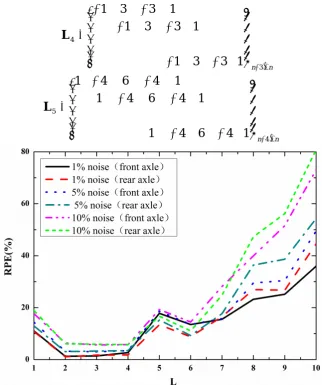
The abscissa values are corresponding to regularization matrices 𝐋𝐋1 to 𝐋𝐋10 in Fig.2,
respectively. The illustration results show the RPE values firstly decrease and then increase
with the increase of 𝑛𝑛-th derivative operators from identity matrix to ninth derivative
operators. By choosing proper regularization matrix 𝐋𝐋, such as the 𝐋𝐋2, 𝐋𝐋3and 𝐋𝐋4, the RPE
values of PLSQR are much lower than LSQR without preconditioner and PLSQR with high
derivative operators from 𝐋𝐋5 to 𝐋𝐋10. When high derivative operators are adopted as
regularization matrix, the RPE values of PLSQR become higher than the those RPE values of
standard form LSQR method, which indicates that the identification accuracy of PLSQR
varies with different regularization matrices. The regularization matrix 𝐋𝐋 is a (𝑛𝑛 − 𝑝𝑝) ×𝑛𝑛
band matrix with full row rank where the number 𝑝𝑝 is corresponding to the 𝑝𝑝-th derivative
operator while the number 𝑝𝑝+ 1 is corresponding to the width of the band. As shown in the
following Eq. (20), the higher order the derivative operator is adopted, the larger the width of
the band is, which complicates the left and right orthogonal transformations due to less null
space of regularization matrix. Moreover, the resulting sparse problem with banded matrix
has effect on non-negative diagonal elements and efficacy of preconditioner. The fundamental
purpose of the preconditioner 𝐋𝐋+𝐀𝐀(𝐋𝐋+𝐀𝐀)𝑇𝑇 is to ensure the𝑗𝑗 iterative steps solution of PLSQR lies in the correct subspace and thus minimizes �𝐋𝐋𝐀𝐀𝑗𝑗�
2. With high derivative operators from 𝐋𝐋5to𝐋𝐋10, the efficacy of preconditioner is reduced leading to large RPE values of PLSQR. The regularization matrices 𝐋𝐋1,𝐋𝐋2 , 𝐋𝐋3,𝐋𝐋4 and 𝐋𝐋5are corresponding to LSQR, PLSQR(𝐋𝐋2),
PLSQR(𝐋𝐋3), PLSQR(𝐋𝐋4) and PLSQR(𝐋𝐋5), respectively, which can be shown as follow
n n× = 1 1 1 1 L
(n−)×n = 1 1 1 -1 1 -1 1 - 2 L
(n− )×n − − − = 2 1 2 1 1 2 1 1 2 1 3
9
(n− )×n − − − − − − = 3 4 1 3 3 1 1 3 3 1 1 3 3 1 L
(n− )×n − − − − − − = 4 5 1 4 6 4 1 1 4 6 4 1 1 4 6 4 1 L
[image:9.595.136.459.71.457.2]Fig.2. The RPE values identified by PLSQR with ten regularization matrices (1/2m&1/4a&1/2a)
Table 1
The RPE values (%) identified by LSQR and PLSQR with three regularization matrices Sensor location regularization
matrix𝐋𝐋
1% noise 5% noise 10% noise front axle rear axle front axle rear axle front axle rear axle 1/4m&1/2m
LSQR(𝐋𝐋1) 26.0 21.3 33.8 28.7 90.6 95.8
PLSQR(𝐋𝐋2) 5.0 5.2 15.2 11.5 29.3 22.9
PLSQR(𝐋𝐋3) 4.6 4.1 17.6 9.9 25.7 19.2
PLSQR(𝐋𝐋4) (6.3) (4.6) (12.3) (9.1) (20.5) (16.4)
1/4m&1/2m&3/4m
LSQR(𝐋𝐋1) 17.1 18.9 24.2 25.3 68.7 70.2
PLSQR(𝐋𝐋2) 3.3 3.1 13.9 7.6 29.3 27.4
PLSQR(𝐋𝐋3) 3.9 2.8 13.8 12.7 27.4 29.2
PLSQR(𝐋𝐋4) (3.7) (2.8) (8.6) (6.9) (17.0) (12.0)
1/4a&1/2a
LSQR(𝐋𝐋1) 7.4 3.2 13.3 10.3 16.8 16.4
PLSQR(𝐋𝐋2) 0.5 1.2 2.8 2.9 5.4 5.6
PLSQR(𝐋𝐋3) 1.4 0.9 2.4 2.7 4.3 4.7
PLSQR(𝐋𝐋4) (1.7) (1.8) (3.4) (3.0) (4.9) (4.7)
1/4a&1/2a&3/4a
LSQR(𝐋𝐋1) 0.6 1.1 2.5 5.2 4.4 11.8
PLSQR(𝐋𝐋2) 0.5 1.1 1.9 1.4 2.8 3.1
PLSQR(𝐋𝐋3) 0.7 0.9 1.5 2.5 2.7 3.9
PLSQR(𝐋𝐋4) (1.7) (1.4) (1.7) (3.1) (2.8) (4.1)
[image:9.595.91.510.505.773.2]10
PLSQR(𝐋𝐋2) 3.3 2.9 9.0 7.2 14.4 9.9
PLSQR(𝐋𝐋3) 3.2 3.5 10.2 7.4 14.9 9.5
PLSQR(𝐋𝐋4) (3.8) (4.2) (13.4) (13.3) (24.5) (18.7)
1/4m&1/2m&1/2a
LSQR(𝐋𝐋1) 14.1 15.3 18.1 20.7 21.1 23.5
PLSQR(𝐋𝐋2) 2.4 3.7 8.1 9,8 14.9 11.2
PLSQR(𝐋𝐋3) 2.6 2.6 8.0 9.6 15.2 9.1
PLSQR(𝐋𝐋4) (3.5) (3.2) (10.9) (11.8) (21.0) (17.7)
1/4m&1/2m&1/4a&1/2a
LSQR(𝐋𝐋1) 8.2 3.1 14.9 11.3 17.8 19.3
PLSQR(𝐋𝐋2) 1.4 1.4 2.8 3.0 8.2 7.8
PLSQR(𝐋𝐋3) 1.6 1.3 3.1 3.7 5.1 5.9
PLSQR(𝐋𝐋4) (1.7) (1.8) (2.6) (4.8) (5.1) (9.8)
1/4m&1/4a
LSQR(𝐋𝐋1) 16.0 15.2 19.4 22.9 23.7 29.7
PLSQR(𝐋𝐋2) 3.7 5.5 6.2 5.2 10.9 9.3
PLSQR(𝐋𝐋3) 4.7 4.7 9.7 7.1 10.2 7.6
PLSQR(𝐋𝐋4) (6.6) (5.1) (13.6) (18.3) (26.6) (28.6)
1/4m&1/4a&1/2a
LSQR(𝐋𝐋1) 8.5 3.1 14.5 12.1 17.2 18.8
PLSQR(𝐋𝐋2) 1.3 1.4 2.7 2.2 4.1 4.2
PLSQR(𝐋𝐋3) 1.7 1.3 2.3 4.3 4.8 3.5
PLSQR(𝐋𝐋4) (1.6) (1.8) (2.2) (4.8) (5.8) (7.4)
1/2m&1/4a
LSQR(𝐋𝐋1) 16.7 17.3 23.5 23.7 27.5 27.3
PLSQR(𝐋𝐋2) 5.0 5.4 8.1 7.6 8.8 9.1
PLSQR(𝐋𝐋3) 4.8 4.8 9.3 9.7 11.1 10.5
PLSQR(𝐋𝐋4) (6.7) (6.0) (24.4) (18.0) (28.1) (24.2)
1/4m&1/2m&1/4a
LSQR(𝐋𝐋1) 15.6 14.5 21.4 21.2 26.2 24.4
PLSQR(𝐋𝐋2) 2.7 4.0 7.2 6.0 8.0 8.5
PLSQR(𝐋𝐋3) 2.8 3.9 6.9 8.0 12.4 10.4
PLSQR(𝐋𝐋4) (4.0) (3.9) (10.2) (14.6) (15.7) (20.2)
1/2m&1/4a&1/2a
LSQR(𝐋𝐋1) 8.0 3.2 14.2 11.4 17.7 18.9
PLSQR(𝐋𝐋2) 1.3 1.1 3.2 3.0 8.8 9.1
PLSQR(𝐋𝐋3) 1.4 1.0 2.9 3.4 5.7 5.9
PLSQR(𝐋𝐋4) (1.7) (1.7) (3.1) (3.5) (5.7) (5.7)
[image:10.595.83.503.76.478.2]Note: Underlined RPE values are for PLSQR with bidiagonal matrix 𝐋𝐋2, italics RPE values are for PLSQR with tri-diagonal matrix𝐋𝐋3, the RPE values in parentheses are for PLSQR with four diagonal matrix 𝐋𝐋4and other values are for LSQR withidentity matrix 𝐋𝐋1.
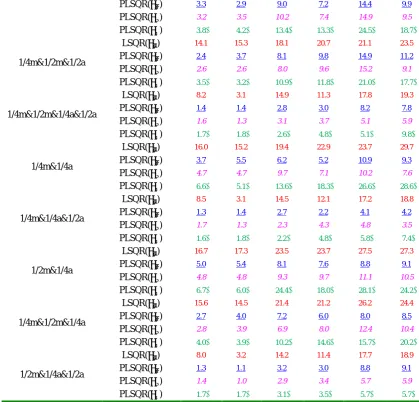
Table 1 tabulates the RPE values of LSQR and PLSQR with three different regularization
matrices in 12 cases. When LSQR is adopted to identify the biaxial time-varying forces, the
RPE values are less than 30% in 10 cases out of all 12 cases with 1%, 5% and 10% noise levels. Jacobsen and Hansen [35] pointed out that the regularization method is a good means
of solving ill-posed problem. Preconditioned LSQR is a typical regularization approach by
choosing proper regularization matrix to solve or to reduce the effects of ill-posedness on
identification results.
When PLSQR(𝐋𝐋2), PLSQR(𝐋𝐋3) and PLSQR(𝐋𝐋4) are adopted to identify the biaxial
time-varying forces, the RPE values are less than 30% in all 12 cases with three kinds of noise
levels. Moreover, with the noise level increases, the RPE values of PLSQR only increase
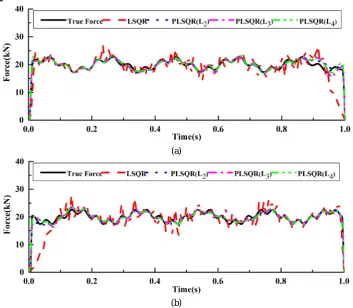
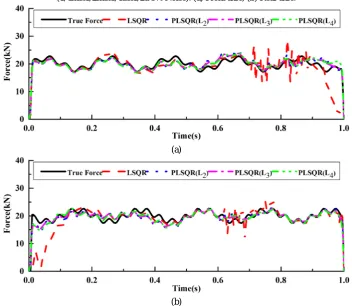
slightly owing to its strong robustness. As shown in the Fig.3 to Fig.5, the identification
forces of PLSQR are very close to the true forces under various cases due to good adaptability
11
PLSQR is much better than LSQR when both front and rear axles are not simultaneously
present on the beam, which means that the PLSQR has strong immunity of ill-posed problem.
Considering altogether the RPE values of PLSQR(𝐋𝐋2), PLSQR(𝐋𝐋3) and PLSQR(𝐋𝐋4) in all
12 cases, the RPE values of PLSQR(𝐋𝐋3) are relatively smaller than PLSQR(𝐋𝐋2) and
PLSQR(𝐋𝐋4). Simultaneously, the matrix 𝐋𝐋3 is chosen as regularization matrix of PLSQR
firstly, and then the calibration studies are carried out with static force, single axle force and
other biaxial time-varying forces. All of the results show that the matrix 𝐋𝐋3of PLSQR has
high identification accuracy and can be chosen as regularization matrix of PLSQR in MFI,
which is case independent. Then the matrix 𝐋𝐋3 is chosen as the optimal regularization matrix
of PLSQR and will be default adopted in subsequent studies. As mentioned above, the
PLSQR is a hybrid method between a direct and an iterative regularization algorithm and the
identification accuracy of PLSQR is influenced by the number of iterations. The optimal
number of iterations is adopted in this study and will be examined in details in the next
section.
(a)
(b)
[image:11.595.121.475.320.628.2]12 (a)
(b)
Fig.4. MFI from combined responses by LSQR and PLSQR with three regularization matrices (1/4m&1/2m&1/4a&1/2a 5% Noise). (a) Front axle; (b) Rear axle.
(a)
(b)
Fig.5. MFI from combined responses by LSQR and PLSQR with three regularization matrices (1/2m&1/4a&1/2a 10% Noise). (a) Front axle; (b) Rear axle.
[image:12.595.123.471.70.371.2] [image:12.595.121.474.394.700.2]13
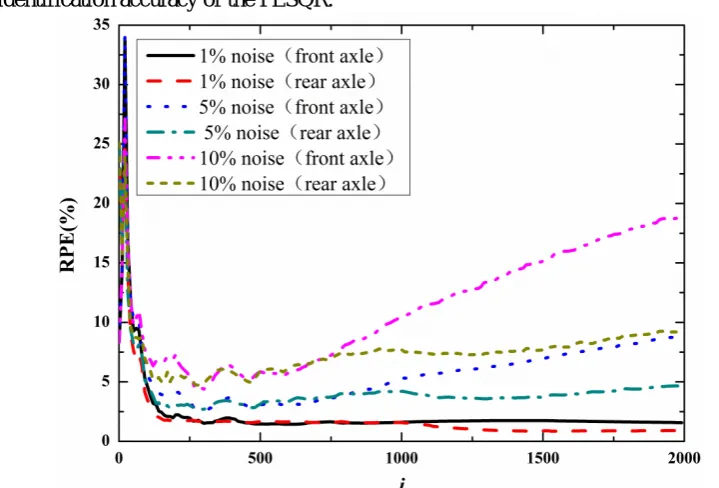
As shown in the Fig.6, the RPE values of MFI from acceleration responses maintain less
than 3% from 200 to 2000 with 1% noise level. It means that when the noise level is low it is
not necessary to find optimal number of iteration because the calculation time and the
identification cost outweigh the benefit. The efficacy of the optimal number of iterations
when there is a high level of noise will be investigated further in this section. As shown in
Table 2, the optimal number of iterations 𝑗𝑗3 is determined by RPE values compared
identification force with true force. So there is obvious limitationwithout knowing the actual
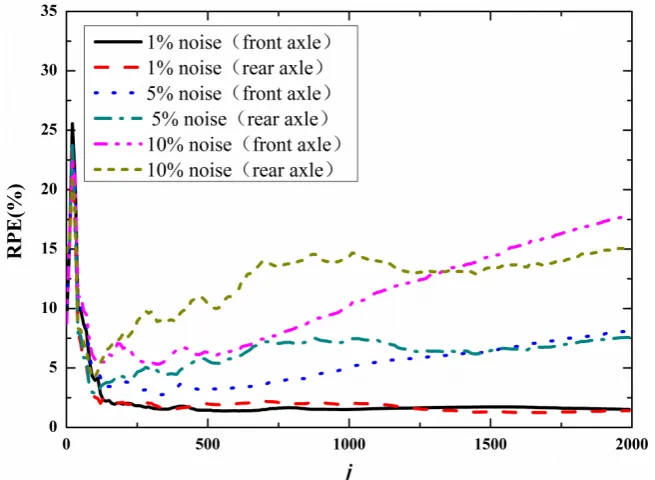
moving force. As shown in the Fig.6 to Fig.8, the effect of the number of iterations has
similar behavior when acceleration responses contained in MFI. With increasing the number
of iterations, the RPE values firstly increase rapidly and then decrease sharply, and then the
RPE values keep asmall fluctuation in the middle of the curve. When the number of iterations is selected close to 200, the RPE values are quite low in all cases as shown in the Fig.6 to
Fig.9. The normal number of iterations 𝑗𝑗4 = 200 is therefore selected to compare with other
number of iterations in the following studies.
As shown in the Fig.6 to Fig.8, the RPE values curve has a significant peak corresponding
to abscissa values 20 and then the worst number of iterations 𝑗𝑗2 = 20 is selected to reveal the
reasons. At the same time, the RPE values are still relatively small corresponding to very
small abscissa values and then the minimum number of iterations 𝑗𝑗1 = 1 is selected to reveal
the identification results of the PLSQR(𝐋𝐋3) with number of iterations only once.
As shown in the Fig.9, when moving force is identified from bending moment responses
alone, the RPE values will exceed 100% when the number of iterations exceeds 1000 with 10%
noise level. Therefore, choosing the optimal number of iterations has significant influence on
the identification accuracy of the PLSQR.
[image:13.595.108.468.480.724.2]14
Fig.7. The RPE values of different number of iterations 𝑗𝑗 in MFI by PLSQR from three combined responses (1/2m&1/4a&1/2a)
[image:14.595.138.461.72.312.2] [image:14.595.134.462.339.579.2]15
Fig.9. The RPE values of different number of iterations 𝑗𝑗 in MFI by PLSQR from three bending moment responses (1/4m&1/2m&3/4m)
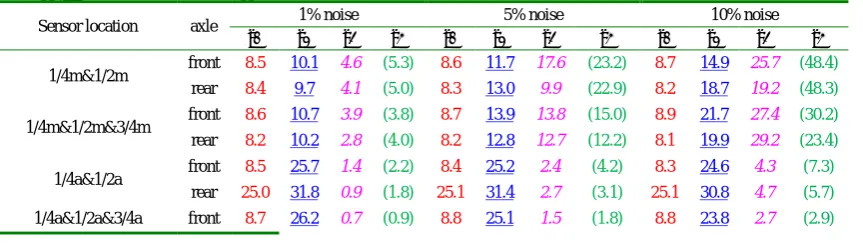
Table 2 tabulates the RPE values of PLSQR(𝐋𝐋3) with four different numbers of iterations in
all 12 cases. The results show that the RPE values are less than 30% in all 12 cases and almost
remain constant with noise level increasing when the minimum number of iterations 𝑗𝑗1 = 1 is
selected. While as shown in the Fig.10 to Fig.12,the identification results are similar to the
average load and cannot truly reflect the load fluctuations with number of iterations 𝑗𝑗1 = 1.
As shown in Fig.10 to Fig.12, the RPE values of PLSQR(𝐋𝐋3) become largest with number
of iterations 𝑗𝑗2 = 20 due to the ill-posed problem, especially when both front and rear axles
are not simultaneously present on the beam. Consequently, it is suggested that the number of 𝑗𝑗2 = 20 should be excluded in PLSQR(𝐋𝐋3).
When the optimal number of iterations 𝑗𝑗3 and the reasonable number of iterations 𝑗𝑗4 =
200 selected, both of the identification forces of the two kinds of number of iterations are very close to the true forces as shown in Table 2 and Fig.10 to Fig.12. It means that when the
optimal number of iterations cannot be reasonably determined without knowing the actual
moving force, the normal number of iterations𝑗𝑗4 = 200 of PLSQR(𝐋𝐋3) can be selected to
[image:15.595.134.463.70.312.2]facilitate MFI.
Table 2
The RPE values (%) of PLSQR(𝐋𝐋3) with four different numbers of iterations
Sensor location axle 1% noise 5% noise 10% noise
𝑗𝑗1 𝑗𝑗2 𝑗𝑗3 𝑗𝑗4 𝑗𝑗1 𝑗𝑗2 𝑗𝑗3 𝑗𝑗4 𝑗𝑗1 𝑗𝑗2 𝑗𝑗3 𝑗𝑗4
1/4m&1/2m front 8.5 10.1 4.6 (5.3) 8.6 11.7 17.6 (23.2) 8.7 14.9 25.7 (48.4) rear 8.4 9.7 4.1 (5.0) 8.3 13.0 9.9 (22.9) 8.2 18.7 19.2 (48.3)
1/4m&1/2m&3/4m front 8.6 10.7 3.9 (3.8) 8.7 13.9 13.8 (15.0) 8.9 21.7 27.4 (30.2) rear 8.2 10.2 2.8 (4.0) 8.2 12.8 12.7 (12.2) 8.1 19.9 29.2 (23.4)
1/4a&1/2a front 8.5 25.7 1.4 (2.2) 8.4 25.2 2.4 (4.2) 8.3 24.6 4.3 (7.3) rear 25.0 31.8 0.9 (1.8) 25.1 31.4 2.7 (3.1) 25.1 30.8 4.7 (5.7)
[image:15.595.86.518.639.765.2]16
rear 26.8 25.9 0.9 (1.8) 26.8 25.4 2.5 (2.6) 26.9 24.9 3.9 (4.4)
1/2m&1/2a front 9.0 29.9 3.2 (3.4) 8.9 33.7 10.2 (10.5) 8.7 35.0 14.9 (21.4) rear 13.4 30.9 3.5 (3.6) 13.1 30.0 7.4 (10.8) 12.8 30.7 9.5 (21.5)
1/4m&1/2m&1/2a front 8.7 30.2 2.6 (3.5) 8.7 30.4 8.0 (8.2) 8.6 30.8 15.2 (16.5) rear 12.1 29.5 2.6 (3.0) 12.0 29.3 9.6 (11.4) 11.9 31.0 9.1 (23.5)
1/4m&1/2m&1/4a&1/2a front 8.9 23.0 1.6 (1.9) 8.8 22.3 3.1 (3.7) 8.7 21.6 5.1 (6.7) rear 15.1 24.7 1.3 (2.1) 14.9 24.3 3.7 (4.2) 14.8 24.0 5.9 (7.9)
1/4m&1/4a front 9.1 24.9 4.7 (9.4) 9.0 23.0 9.7 (18.4) 8.9 20.8 10.2 (33.7) rear 17.8 24.2 4.7 (5.9) 17.9 23.7 7.1 (14.3) 18.1 23.1 7.6 (27.0)
1/4m&1/4a&1/2a front 9.1 26.9 1.7 (1.9) 9.1 26.5 2.3 (3.2) 9.0 26.1 4.8 (5.8) rear 19.0 27.1 1.3 (2.1) 19.0 26.7 4.3 (4.2) 19.1 26.2 3.5 (8.1)
1/2m&1/4a front 9.0 31.4 4.8 (8.2) 8.8 29.0 9.3 (17.0) 8.6 26.4 11.1 (34.3) rear 14.8 26.6 4.8 (6.1) 14.5 25.0 9.7 (14.6) 14.1 23.2 10.5 (29.6)
1/4m&1/2m&1/4a front 8.8 25.8 2.8 (7.4) 8.7 25.4 6.9 (7.0) 8.7 25.4 12.4 (13.2) rear 13.2 23.5 3.9 (4.0) 13.0 24.3 8.0 (8.2) 12.8 25.7 10.4 (17.2)
1/2m&1/4a&1/2a front 9.1 24.7 1.4 (1.9) 9.0 24.0 2.9 (4.3) 8.8 23.2 5.7 (8.0) rear 16.7 27.8 1.0 (2.0) 16.4 27.1 3.4 (3.3) 16.2 26.1 5.9 (6.2)
Note: Underlined RPE values are for PLSQR(𝐋𝐋3) with the worst number of iterations 𝑗𝑗2 = 20, italics RPE values are for PLSQR(𝐋𝐋3) with the optimal number of iterations 𝑗𝑗3, the RPE values in parentheses are for PLSQR(𝐋𝐋3) with normal number of iterations 𝑗𝑗4 = 200and other RPE values are for PLSQR(𝐋𝐋3) with the minimum number of iterations 𝑗𝑗1 = 1.
(a)
[image:16.595.104.485.294.640.2](b)
17 (a)
[image:17.595.125.474.70.372.2](b)
Fig.11. MFI from combined responses by PLSQR with four different numbers of iterations𝑗𝑗 (1/4m&1/2m&1/2a 5% Noise). (a) Front axle; (b) Rear axle.
(a)
(b)
Fig.12. MFI from acceleration responses by PLSQR with four different numbers of iterations𝑗𝑗 (1/4a&1/2a 10% Noise). (a) Front axle; (b) Rear axle.
[image:17.595.120.476.402.699.2]18
Former part of this study shows that all of the PLSQR(𝐋𝐋2), PLSQR(𝐋𝐋3) and PLSQR(𝐋𝐋4)
have strong robustness to responses noise and ill-posedness problem. Then the identification
ability of PLSQR will be compared with the TDM in this part. The illustration results of
Fig.13 show that MFI from bending moment responses alone by TDM suffers from large
fluctuation even with only one percent noise level added. When combined responses from
two sensors are used, the accuracy of TDM is also unacceptable as shown in Fig.14. Only
when three acceleration responses used alone, the identification accuracy of TDM is
improved being similar to that of PLSQR as shown in Fig.15. It means that the TDM is
sensitive to both the type of sensors and the number of sensors; the identification results will
unacceptable when bending moment measurements are used alone or the number of sensors is
small.
Comparing with TDM, the biaxial moving forces identified by PLSQR(𝐋𝐋2), PLSQR(𝐋𝐋3)
and PLSQR(𝐋𝐋4) are very close to the true forces in all cases as shown in Fig.13 to Fig.15. The
PLSQR has excellent adaptability with both the type of sensors and the number of sensors.
The numerical simulation results also show that the accuracy and acceptability of
identification forces by PLSQR will improve with more acceleration responses and lower
disturbance noise. In order to facilitate the economical application of the PLSQR in field tests,
specific sensor requirements are suggested as follows. When noise level is less than 5%, at
least two responses are measured and at least one acceleration response is included. When
noise level is higher than 5%, at least three responses are measured and at least two
acceleration responses are included.
As the moving speed is an important factor affecting in MFI, the effect of the moving
speed on PLSQR(𝐋𝐋3) is simulated with three decreasing moving speeds, namely 𝑐𝑐1= 40m∙
s−1, 𝑐𝑐
2 = 30m∙s−1 and 𝑐𝑐3= 20m∙s−1, respectively. The time for passing over the bridge corresponding to these three speeds is 1s, 4
3s and 2s, respectively. Due to the consistency rule of the effect of vehicle speed on PLSQR(𝐋𝐋3), Table 3 tabulates four representative cases from
all 12 cases. The simulation results show that the identification accuracy is slightly improved
and the optimal number of iterations is increased with the decrease of the speed. Similar to
the normal number of iterations 𝑗𝑗4 = 200 of PLSQR(𝐋𝐋3) can be selected to facilitate MFI
with speed 𝑐𝑐1, the normal number of iterations 𝑗𝑗= 220 and 𝑗𝑗= 300 can be selected to
facilitate MFI corresponding to speed 𝑐𝑐2 and speed 𝑐𝑐3, respectively.
As shown in Fig.16 and Fig.17, the biaxial moving forces identified by PLSQR(𝐋𝐋3) are
very close to the true forces during the vehicle crosses the bridge with all three speeds. The
illustration results show that the identification accuracy of PLSQR remains at a high level
with different moving speeds, which is very beneficial for the application of PLSQR method
19 (a)
[image:19.595.123.472.71.368.2](b)
Fig.13. MFI by PLSQR and TDM from two bending moment responses (1/4m&1/2m 1% Noise). (a) Front axle; (b) Rear axle.
(a)
[image:19.595.119.481.387.698.2](b)
20 (a)
[image:20.595.122.474.62.374.2](b)
[image:20.595.87.511.430.557.2]Fig.15. MFI by PLSQR and TDM from three acceleration responses (1/4a&1/2a&3/4a 10% Noise). (a) Front axle; (b) Rear axle.
Table 3
The RPE values (%) of PLSQR(𝐋𝐋3) with three different moving speeds
Sensor location axle 1% noise 5% noise 10% noise
𝑐𝑐1 𝑐𝑐2 𝑐𝑐3 𝑐𝑐1 𝑐𝑐2 𝑐𝑐3 𝑐𝑐1 𝑐𝑐2 𝑐𝑐3
1/4m&1/2m&3/4m front 3.9 2.7 2.7 13.8 9.3 7.3 27.4 23.3 19.9 rear 2.8 3.2 2.7 12.7 10.6 6.8 29.2 29.0 20.8
1/4m&1/2m&1/4a&1/2a front 1.6 1.6 1.5 3.1 2.7 2.6 5.1 4.1 4.1 rear 1.3 1.3 1.3 3.7 3.3 2.2 5.9 5.2 3.1
1/4m&1/4a&1/2a front 1.7 1.6 1.5 2.3 2.7 2.7 4.8 4.2 4.0 rear 1.3 1.3 1.3 4.3 2.7 2.4 3.5 3.7 3.0
1/2m&1/4a&1/2a front 1.4 1.4 1.3 2.9 3.0 3.0 5.7 4.4 4.3 rear 1.0 1.0 1.0 3.4 3.2 2.4 5.9 4.8 3.4
Note: Italics RPE values are for PLSQR(𝐋𝐋3) with the moving speed 𝑐𝑐1= 40m∙s−1, underlined RPE values are for PLSQR(𝐋𝐋3) with the moving speed 𝑐𝑐2= 30m∙s−1 and other RPE values are for PLSQR(𝐋𝐋3) with the moving speed 𝑐𝑐3= 20m∙s−1.
21 (b)
Fig.16. MFI with three different speeds by PLSQR(𝐋𝐋3) from acceleration responses (1/4m&1/2m 1% Noise). (a) Front axle; (b) Rear axle.
(a)
(b)
Fig.17. MFI with three different speeds by PLSQR(𝐋𝐋3) from acceleration responses (1/4a&1/2a&3/4a 10% Noise). (a) Front axle; (b) Rear axle.
4. Conclusions
In this work, a PLSQR method is proposed to identify moving force by preconditioning
LSQR. By means of numerical simulations, a comprehensive parametric study has been done
and the following conclusions can be drawn:
(1) When PLSQR(𝐋𝐋2), PLSQR(𝐋𝐋3) and PLSQR(𝐋𝐋4) are adopted to identify the moving
force, the identification accuracy in all 12 cases is significantly improved compared with
LSQR(𝐋𝐋1 ). The PLSQR has overcome the ill-posed problem by choosing proper
[image:21.595.113.483.176.538.2]22
PLSQR(𝐋𝐋2) and PLSQR(𝐋𝐋4) as mentioned above. Then the matrix 𝐋𝐋3 is selected as the
optimal regularization matrix for preconditioning LSQR.
(2) When the optimal number of iterations 𝑗𝑗3 and the reasonable number of iterations 𝑗𝑗4 =
200 selected, both of the identification forces of the two kinds of number of iterations are very close to the true forces as shown previously. It means that when the optimal number of
iterations cannot be determined without knowing the actual moving force, the normal number
of iterations 𝑗𝑗4 = 200 of PLSQR(𝐋𝐋3) can be selected which also meet the requirements of
MFI. On the contrary, the number of iterations 𝑗𝑗1 = 1 and 𝑗𝑗2 = 20 of PLSQR(𝐋𝐋3) should be
avoided as the former cannot truly reflect the load fluctuations and the latter amplify the
ill-posed problem.
(3) Comparing with TDM, the identification accuracy of PLSQR is much higher in all
cases. The PLSQR has excellent adaptability with both the type of sensors and the number of
sensors, it also has strong noise immunity and robust with ill-posed problem. Moreover, the
identification accuracy is slightly improved with the decrease of the speed. The illustrated
results show that the identification accuracy of PLSQR(𝐋𝐋3) remains at a very high level with
different moving speeds, which highlights the robustness of PLSQR method infield tests.
Finally, it is noted that,compared with the situations that both of the axles are running on
the bridge, the identification accuracy of PLSQR is still lower when only either the front or
rear axle is on the bridge. It is therefore suggested that MFI through PLSQR not be performed
during these situations, and this problem will be investigated further in future works of the
present authors. In addition, further studies about the independent of regularization matrix
selecting and the improvement of identification efficiency without sacrificing the
identification accuracy will also be discussed in the next paper.
Acknowledgments
This research was supported by Key Science and Technology Program of Henan Province,
China (Grant Number 192102310011), MOE Key Lab of Disaster Forecast and Control in
Engineering, Jinan University (Grant Number 20180930003) and National Natural Science
Foundation of China (Grant Numbers 51678278 and 51278226).
References:
[1] M. Lydon, S.E. Taylor, D. Robinson, A. Mufti, E.J.O. Brien. Recent developments in bridge weigh in motion (B-WIM), J. Civil Struct. Health Monit. 6 (2016) 69-81.
[2] J. Sanchez, H. Benaroya, Review of force reconstruction techniques, J. Sound Vib. 333 (2014) 2999-3018. [3] C. O’Connor, T.H.T. Chan, Dynamic wheel loads from bridge strains, Eng. Struct. 114 (1988) 1703-1723. [4] S.S. Law, T.H.T. Chan, Q.H. Zeng, Moving force identification: a time domain method, J. Sound Vib. 201(1)
(1997) l-22.
[5] T.H.T. Chan, S.S. Law, T.H. Yung, X.R. Yuan, An interpretive method for moving force identification, J. Sound Vib. 219 (1999) 503-524.
[6] S.S. Law, T.H.T. Chan, Q.H. Zeng, Moving force identification-a frequency and time domains analysis, J. Dyn. Sys. Meas. Control ASME 121 (1999) 394-401.
23
[8] X.Q. Zhu, S.S. Law, Identification of vehicle axle loads from bridge dynamic responses, J. Sound Vib. 236 (2000) 705-724.
[9] X.Q. Zhu, S.S. Law, Identification of moving interaction forces with incomplete velocity information, Mech. Syst. Signal Process. 17 (2003) 1349-1366.
[10] X.Q. Zhu, S.S. Law, Moving load identification on multi-span continuous bridges with elastic bearings, Mech. Syst. Signal Process. 20 (2006) 1759-1782.
[11] T.H.T. Chan, D.B. Ashebo, Theoretical study of moving force identification on continuous bridges, J. Sound Vib. 295 (2006) 870-883.
[12] L. Yu, T.H.T. Chan, J.H. Zhu, A MOM-based algorithm for moving force identification: Part I - Theory and numerical simulation, Struct. Eng. Mech. 29 (2008) 135-154.
[13] Y. Yu, C.S. Cai, L. Deng, State-of-the-art review on bridge weigh-in-motion technology, Adv. Struct. Eng. 19 (2016) 1514-1530.
[14] J. Dowling, E.J. Obrien, A. González, Adaptation of cross entropy optimization to a dynamic bridge WIM calibration problem, Eng. Struct. 44 (2012) 13-22.
[15] A. Berry, O. Robin, F. Pierron, Identification of dynamic loading on a bending plate using the virtual fields method, J. Sound Vib. 333 (2014) 7151-7164.
[16] Z. Li, Z.P. Feng, F.L. Chu, A load identification method based on wavelet multi-resolution analysis, J. Sound Vib. 333 (2014) 381-391.
[17] T. Pinkaew, Identification of vehicle axle loads from bridge responses using updated static component technique, Eng. Struct. 28 (2006) 1599-1608.
[18] A. González, C. Rowley, E.J. Obrien, A general solution to the identification of moving vehicle forces on a bridge, Int. J. Numer. Methods Eng. 75 (2008) 335-354.
[19] Y.M. Mao, X.L. Guo, Y. Zhao, A state space force identification method based on Markov parameters precise computation and regularization technique, J. Sound Vib. 329 (2010) 3008-3019.
[20] H. Ronasi, H. Johansson, F. Larsson, A numerical framework for load identification and regularization with application to rolling disc problem, Comput. Struct. 89 (2011) 38-47.
[21] S.Q. Wu, S.S. Law, Moving force identification based on stochastic finite element model, Eng. Struct. 32 (2010) 1016-1027.
[22] Y. Ding, S.S. Law, Structural damping identification based on an iterative regularization method, J. Sound Vib. 330 (2011) 2281-2298.
[23] J. Li, S.S. Law, H. Hao, Improved damage identification in bridge structures subject to moving loads: numerical and experimental studies, Int. J. Mech. Sci. 74 (2013) 99-111.
[24] Y. Ding, S.S. Law, B. Wu, G.S. Xu, Q. Lin, H.B. Jiang, Q.S. Miao, Average acceleration discrete algorithm for force identification in state space, Eng. Struct. 56 (2013) 1880-1892.
[25] D.M. Feng, H. Sun, M.Q. Feng, Simultaneous identification of bridge structural parameters and vehicle loads, Comput. Struct. 157 (2015) 76-88.
[26] B.J. Qiao, X.F.Chen, X.F.Xue, X.J.Luo, R.N.Liu, The application of cubic B-spline collocation method in impact force identification, Mech. Syst. Signal Process. 64-65 (2015) 413-427.
[27] B.J. Qiao, X.W. Zhang, X.J. Luo, X.F. Chen, A Force identification method using cubic b-spline scaling functions, J. Sound Vib. 337 (2015) 28-44.
[28] J. Liu, X.S. Sun, X. Han, A novel computational inverse technique for load identification using the shape function method of moving least square fitting, Comput. Struct. 144 (2014) 127-137.
[29] X.S. Sun, J. Liu, X. Han, A new improved regularization method for load identification, Inverse Probl. Sci. Eng. 22(2014) 1602-1076.
[30] J. Liu, X.S. Sun, X. Han, Dynamic load identification for stochastic structures based on Gegenbauer polynomial approximation and regularization method, Mech. Syst. Signal Process. 56-57 (2015) 35-54. [31] J. Liu, X.H. Meng, C. Jiang, X. Han, D.Q. Zhang, Time-domain Galerkin method for dynamic load
identification,Int. J. Numer. Methods Eng. 105 (2016) 620-640.
[32] C.C. Paige, M.A. Saunders, LSQR: An algorithm for sparse linear equations and sparse least squares, ACM T. Math. Software 8 (1982) 43-71.
[33] M.A. Saunders, Solution of sparse rectangular systems using LSQR and CRAIG, BIT Numer. Math. 35 (1995) 588-604.
[34] S.J. Benbow, Solving generalized least-squares problems with LSQR, SIAM J. Matrix Anal. Appl. 21 (1999) 166-177.
[35] M. Jacobsen, P.C. Hansen, M.A. Saunders, Subspace preconditioned LSQR for discrete ill-posed problems, BIT Numer. Math. 43 (2003) 975-989.
[36] L. Reichel, Q. Ye, A generalized LSQR algorithm, Numer. Linear Algebra Appl. 15 (2008) 643-660. [37] J. Baglama, L. Reichel, D. Richmond, An augmented LSQR method, Numer. Algorithms 64 (2013) 263-293. [38] S. Karimi, B. Zali, The block preconditioned LSQR and GL-LSQR algorithms for the block partitioned
matrices, Appl. Math. Comput. 227 (2014) 811-820.