THE EFFECTIVENESS OF SYSTEMATIC DESIGN PROCESS ON EFFECTIVE TRAINING PRACTICES AT TELEKOM RESEARCH & DEVELOPMENT
AMIRUL FADZLI BIN MOKHTAR
This report is submitted to fulfill the requirement for the award of the degree of Bachelor of Technology Management with Honors (Technology Innovation)
Faculty of Technology Management and Technopreneurship Universiti Teknikal Malaysia Melaka
“Saya akui bahawa telah membaca karya ini dan pada pandangan saya karya ini adalah memadai dari segi skop dan kualiti untuk tujuan penganugerahan Ijazah Sarjana Muda
Pengurusan Teknologi dengan Kepujian (Inovasi Teknologi)”.
Tandatangan :
Nama Penyelia :
Tarikh :
Tandatangan :
Nama Pemeriksa :
ii
Hereby, I acknowledge that this report is my own work except for citations stated in the references
iii
DEDICATION
iv
ACKNOWLEDGEMENT
Foremost, I would like to express my sincere gratitude to my supervisor Prof. Dr Khairul Baharein Mohd Noor for the continuous support of my undergraduate project, for his patience, motivation, enthusiasm, and immense knowledge. His guidance helped me in all the time of research and writing of this research. I could not have imagined having a better advisor and mentor for my project.
Besides my supervisor, I would like to thank my research panel: Mdm. Edna Buyong for her encouragement, insightful comments, and questions.
I thank my fellow supervisory group: Hazirah Mohd Ali Piah, Maizurah Mahmood, Raja Nor Azrinie, Farah Wahiedah and Ahmad Nasharatul Na’im for the stimulating discussions, for the sleepless nights we were working together before deadlines, and for all the fun we have had in the last four years.
v
ABSTRACT
vi
ABSTRAK
vii
TABLE OF CONTENT
Content Page
Declaration………... ii
Dedication………. iii
Acknowledgement……… iv
Abstract………. v
Table of Content………... vii
List of Tables……… ix
List of Figures………... x
Nomenclature………... xi
Chapter 1 Introduction………... 1
1.1 Background………... 1
1.2 Problem Statement………...………….. 2
1.3 Research Objectives……….. 3
1.4 Research Questions……… 3
1.5 Scope and Limitation………. 3
1.6 Significance of the Research………. 4
Chapter 2 Literature Review………... 5
2.1 Definition………... 5
2.2 The Role of Systematic Design Process………. 6
2.3 The Relationship of Training and Practices ……… 7
2.4 Previous Research……… 8
viii
Chapter 3 Research Methodology……… 14
3.1 Introduction………... 14
3.2 Research Design………..………. 14
3.3 Methodology………..…… 15
3.4 Data Sources……….. 15
3.5 Sampling Size………...………. 15
3.6 Data Collection Method and Analysis………. 16
3.7 Summary……… 16
Chapter 4 Result and Discussion………. 17
4.1 Introduction………... 17
4.2 Reliability Test………. 18
4.3 Respondents Profile……… 19
4.3 The Pearson Correlation Coefficients………... 23
Chapter 5 Conclusion and Recommendation………. 26
5.1 Introduction……….. 26
5.2 Summary of Research Finding……… 27
5.3 Recommendation………. 30
5.4 Conclusion………... 32
References……… 33
ix
LIST OF TABLES
Tables Page
Chapter 1 Introduction
Table 1.1………... 2
Chapter 3 Research Methodology Table 3.1………... 15
Table 3.2………... 16
Chapter 4 Result and Discussion Table 4.1……….. 18
Table 4.2……….. 19
Table 4.3……….. 20
Table 4.4……….. 21
Table 4.5……….. 22
Table 4.6……….. 23
Table 4.7……… 23
Table 4.8……….. 24
Table 4.9……….. 24
Table 4.10……… 25
x
LIST OF FIGURES
Figures Page
Chapter 2 Literature Review
Figure 2.1………... 13
Chapter 4 Result and Discussion Figure 4.1………. 19
Figure 4.2………. 20
Figure 4.3………. 21
xi
NOMENCLATURE
SSPS Statistical Software Package for Social Science
TM Telekom Malaysia Berhad
TM R&D Telekom Research & Development Sdn. Bhd
T&D Training and development
1
CHAPTER 1
INTRODUCTION
1.1 Background
Customer service, productivity, safety, employee retention and new technology are examples of issues affecting companies in all industries and sizes and influencing training practices.
Training provides employees with the knowledge and skills to perform more effectively. This allows them to meet current job requirements or prepares them to meet the inventible changes that occur in their jobs. However, training is only an opportunity for learning. What is learned depends on many factors such as the design and implementation of training, the learning style of the trainees and the organization’s learning climate (Blanchard & Thacker, 2010).
2
[image:14.612.108.545.109.345.2]1.2 Problem Statement
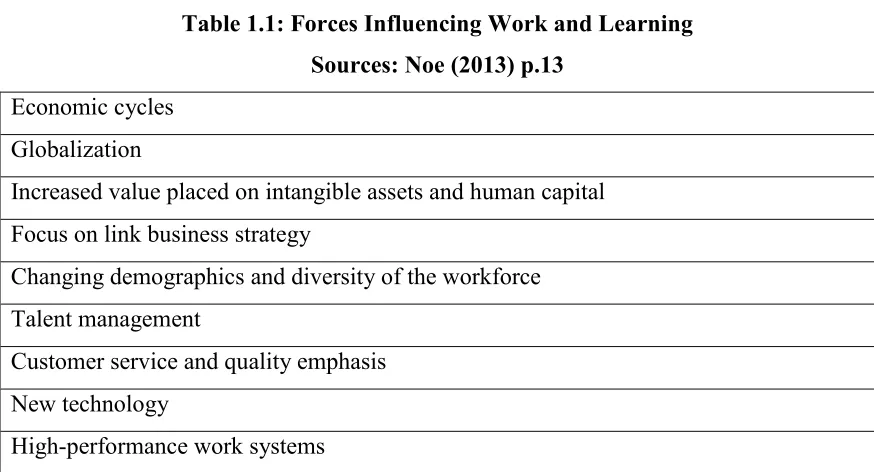
Table 1.1: Forces Influencing Work and Learning Sources: Noe (2013) p.13
Economic cycles Globalization
Increased value placed on intangible assets and human capital Focus on link business strategy
Changing demographics and diversity of the workforce Talent management
Customer service and quality emphasis New technology
High-performance work systems
The above table shows the forces that are influencing working and learning. These forces are affecting individuals, communities, businesses and societies. To survive, companies must address these forces with training.
As company grow and recognize the important role of training for business success, they form entire training function. The training function may include instructional designers, instructors, technical training and experts in instructional technology.
To forming the training functions, training became the most significant investment in a company. Unfortunately, a lot of money is wasted on infective training (Maimunah Aminuddin, 2008).
3
1.3 Research Objectives
i. To determine whether the elements of systematic design process are in place in organization for effective training practices.
ii. To identify the most influential systematic design process element towards effective training practices
iii. To provide recommendation for effective training improvement at TM R&D
1.4 Research Questions
i. Are the elements of systematic design process being practiced for effective training practices in the organization?
ii. What is the most influential element of systematic design process toward effective training practices?
iii. What are the improvements can be made for effective training practices at TM R&D?
1.5 Scope and Limitation
The research is focus on the effect of training design process on training practices at Telekom Research & Development, Cyberjaya.
4
1.6 Significance of the Research
The research is a platform for the researcher to continue study at postgraduate degree in the future.
5
CHAPTER 2
LITERATURE REVIEW
2.1 Definition and Concept of Training
Training and development is the heart of a continuous effort designed to improve employee competency and organizational performance. Training provides learners with the knowledge and skill needed for their presentation jobs (Mondy, 2008).
In other point of view, training is an effective tool for improving performance, but it must be conducted with careful attention to the needs of learners, the context in which learners perform and current evidence about what makes training effective (FHI 360, 2012).
Peter (1987) listed training as one of the key areas to be emphasized if an organization is to survive in the changing world. He stated that the innovation prescriptions were clear that everyone must innovate and be prepared to contribute ideas and to work together with less supervision.
6
According to IOMA-Staff (2003), the human-asset cost is currently a major portion of the expenses faced by organizations. Shareholders and management are constantly looking for ways and means to improve the bottom line of the organization, and training is one way in which organizations can undertake more innovative and involved methods in meeting their changing performance needs.
To show the importance of training, Koehorst and Verhoeven (1986) who did a study on the effectiveness of training in the Netherlands listed twenty indicators of the benefits of training as follows:
a. Higher turnover/profit b. Improved quality of service c. Increased safety
d. Better company image
e. More efficient use of means of production f. Higher overall level of staff education g. High number of internal transfers h. More efficiency/productivity i. Equal opportunity to staff
2.2 The Role of Systematic Design Process
7
Normally, it would take the shape of an empirical exercise to identify current needs but bringing in the organizational objective for consideration. It provided framework within which trainer could ensure a thorough and professional job (Price, 2007).
2.3 The Relationship of Training and Practice
Lussier & Shadrick (2006) explained that training and practice appeared to be similar activities in that they usually involve task performance under real or simulated conditions and because both are significant components in gaining proficiency. It is usually those two activities that are not clearly differentiated and those two terms that are normally used almost interchangeably.
8
2.4 Previous Research
The present study found out many factors which affect training effectiveness in both ways positively and negatively. It also describes the models of measuring training effectiveness explained by many researchers and thus the study will help the managers in measuring the training effectiveness in their organizations. It will also help in solving training problems and implementing training programs successfully. The study also highlights the value of training and development in organizational improvement and summarizes previous investigations in order to enlighten the researchers to the state of current research and find out the gap between existing researches. So as a whole the study gives emphasis on factors affecting training effectiveness and how training can be made more effective for which the authors collected reviews on training effectiveness, its implication and its importance on the basis of which the future research directions have been endeavored.
9
Transfer of training is the main part in training effectiveness program. It is found that transfer of training generally refers to the use of trained knowledge and skills back on the job. Baldwin & Magjuka (1988) mentioned that for transfer to occur, “learned behavior must be generalized to the job context and maintained over a period of time on the job”.
Meanwhile, Saks & Haccoun (2007) views training transfer is the generalization of knowledge and skills learned in training on the job and the maintenance of acquired knowledge and skills over time. According to the transfer of training framework by Saks & Haccoun (2007), the transfer of training activities could be segregated into three phases which is before, during, and after training to facilitate and improve the transfer of training. The trainer should conduct follow-up or booster sessions following a training program.
10
2.5 Research Framework
Noe (2013) defines training design process as a systematic approach for developing training program. There are six steps in the process to ensure a training to be effective:
1. Need assessment
The first step in the instructional design process is need assessment. The step typically involves organizational analysis, person analysis and task analysis. Organizational analysis involves determining the business appropriateness of training, given the company’s business strategy, it resources available for training and supports with managers and peers for training activities. Meanwhile, person analysis helps identify employees who need training and task analysis includes identifying the important tasks and knowledge, skill and behaviors that need to be emphasized in training for employees to complete their task.
2. Employees’ readiness for training
11
3. Learning environment
Educational and industrial psychologists have identified several conditions under which employees learn best:
a. Need to know why they should learn b. Meaningful training content
c. Opportunities to practice d. Feedback
e. Observe, experience and interact with training content, other learners and the instructor
f. Good program coordination and administration g. Commit training content to memory
4. Transfer of learning
Transfer of learning refers to on-the-job use of knowledge, skills and behaviors learned in training. Transfer of training is influenced by climate of transfer, manager support, peer support, opportunity to use learned capabilities, technology support and self-management skills.
5. Training methods
12
6. Training evaluation
Dessler (2009) listed Kirkpatrick’s four basic categories of training outcomes that can be measured:
a. Reaction
Evaluate trainees’ reactions to the program. b. Learning
Test the trainees to determine whether they learned the principles, skills and facts they were supposed to learn.
c. Behavior
Ask what trainees’ behavior on the job changed because of the training program.
d. Results