DEVELOPMENT OF CONCEPTUAL JIGS FOR
PACKAGING TIE PLATE USING TRIZ APPROACH
MOHAMED HAFIZUULAMIR BIN NORDIN
B051010167
UNIVERSITI TEKNIKAL MALAYSIA MELAKA
UNIVERSITI TEKNIKAL MALAYSIA MELAKA
DEVELOPMENT OF CONCEPTUAL JIGS FOR PACKAGING
TIE PLATE USING TRIZ APPROACH
This report submitted in accordance with requirement of the Universiti Teknikal Malaysia Melaka (UTeM) for the Bachelor Degree of Manufacturing Engineering
(Manufacturing Design) (Hons.)
by
MOHAMED HAFIZUULAMIR BIN NORDIN
B051010167
880919-08-6195
UNIVERSITI TEKNIKAL MALAYSIA MELAKA
BORANG PENGESAHAN STATUS LAPORAN PROJEK SARJANA MUDA
TAJUK: Development of Conceptual Jigs for Packaging Tie Plate Using TRIZ
Approach
SESI PENGAJIAN: 2013/14
Saya MOHAMED HAFIZUULAMIR BIN NORDIN
mengaku membenarkan Laporan PSM ini disimpan di Perpustakaan Universiti Teknikal Malaysia Melaka (UTeM) dengan syarat-syarat kegunaan seperti berikut:
1. Laporan PSM adalah hak milik Universiti Teknikal Malaysia Melaka dan penulis. 2. Perpustakaan Universiti Teknikal Malaysia Melaka dibenarkan membuat salinan
untuk tujuan pengajian sahaja dengan izin penulis.
3. Perpustakaan dibenarkan membuat salinan laporan PSM ini sebagai bahan pertukaran antara institusi pengajian tinggi.
4. **Sila tandakan ( )
SULIT
TERHAD
TIDAK TERHAD
(Mengandungi maklumat yang berdarjah keselamatan atau kepentingan Malaysia sebagaimana yang termaktub dalam AKTA RAHSIA RASMI 1972)
(Mengandungi maklumat TERHAD yang telah ditentukan oleh organisasi/badan di mana penyelidikan dijalankan)
Alamat Tetap:
NO. 7 Jalan Tg. Tualang,
Kampung Bt. 7, 31000,
Bt. Gajah, Perak
Tarikh: ________________________
Disahkan oleh:
Cop Rasmi:
Tarikh: _______________________
DECLARATION
I hereby, declared this report entitled “Development of Conceptual Jigs for Packaging Tie Plate Using TRIZ Approach” is the results of my own research
except as cited in references.
Signature : ……….
Author’s Name : ………
APPROVAL
This report is submitted to the Faculty of Manufacturing Engineering of UTeM as a partial fulfillment of the requirements for the degree of Bachelor of Manufacturing Engineering (Manufacturing Design) (Hons.). The member of the supervisory is as follow:
i
ABSTRAK
ii
ABSTRACT
iii
DEDICATION
Especially to my beloved parents and whole my family thank you very much to give me fully support, and also for my respective Lecture and my Supervisor, thank
iv
ACKNOWLEDGEMENT
"In the name of Allah, Most Gracious, Most Merciful"
v
TABLE OF CONTENTS
Abstrak i
Abstract ii
Dedication iii
Acknowledgement iv
Table of Contents v
List of Tables x
List of Figures xi
List of Abbreviations, Symbols and Nomenclatures xiv
CHAPTER 1: INTRODUCTION 1
1.1 Background 1
1.2 Problem Statement 3
1.3 Objective 3
1.4 Scope Of Project 4
CHAPTER 2: LITERATURE REVIEW 5
2.1 Jigs and Fixtures 5
2.1.1 Difference between Jigs and Fixtures 7
2.1.2 Advantages of Jigs and Fixtures 7
2.1.3 Design Consideration of Jigs and Fixtures 8
2.2 Tie Plate (Work piece) 9
2.2.1 Introduction of Tie Plate 9
2.2.2 Specification of ‘Tie Plate’ 9
2.2.3 Process Making Tie Plate 10
2.2.4 Process Packaging for Tie Plate 13
vi
2.3 Theory of Inventive Problem Solving (TRIZ) 16
2.3.1 History of TRIZ 16
2.3.2 Introduction of TRIZ 17
2.3.3 Concept of TRIZ 18
2.3.4 Advantages of TRIZ 19
2.3.5 Comparison of Problem Solving Between Traditional
Approach and TRIZ Approach 19
2.3.6 Tool of TRIZ 23
2.3.7 The 39 Engineering parameters 26
2.3.8 The 40 Inventive Principles 26
2.3.9 The Contradiction Matrix 28
2.4 Concept Selection 29
2.4.1 Concept Screening 30
2.4.2 Concept Scoring 30
2.5 SolidWorks 2013 Application 31
2.5.1 SolidWorks 2013 Methodology 31
2.5.2 SolidWorks 2013 Simulation Xpress 32
2.6 Summary 32
CHAPTER 3: METHODOLOGY 33
3.1 Flow Chart of Project 33
3.1.1 Phase 1: Planning 35
3.1.2 Phase 2: Implementation 35
3.1.3 Phase 3: Concept Development 35
3.1.4 Phase 4: Detail Design & Analysis 36 3.1.5 Phase 5: Report Submission and Presentation 36 3.2 Theoretical Framework on Problem Solving For Development Of
vii
3.3 Flow Chart Of Concept Selection 40
3.3.1 Step 1 – Prepare the selection Matrix. 41
3.3.2 Step 2 – Rate the concept. 41
3.3.3 Step 3 – Rank the concepts. 41
3.3.4 Step 4 – Combine and improve concepts. 42 3.3.5 Step 5 – Select one or more concepts. 42
CHAPTER 4: DEVELOPMENT OF CONCEPTUAL JIG 43
4.1 Identify the numbers of Inventive Principle (TRIZ approach) 43
4.1.1 Identify the Problems 43
4.1.2 Contradiction Matrix 45
4.1.3 Selected the Numbers of Inventive Principle 46
4.2 Generate Idea by Using Concept Sketching 47
4.3 Concept Selection 50
4.3.1 Concept Screening 50
4.3.2 Concept Scoring 51
4.3.3 Final Design 52
4.4 Detail Drawing the Final Design 53
CHAPTER 5: RESULT & DISCUSSION 58
5.1 SimulationXpress Study 58
5.2 Stress, Displacement and Strain Result 59
5.2.1 Stress 59
5.2.2 Displacement 59
5.2.3 Factor of Safety 60
5.3 Simulation of Jig for Material ABS 61
5.3.1 Model Information 61
5.3.2 Material Properties 62
5.3.3 Loads and Fixtures 62
5.3.4 Study Result: Stress 63
viii
5.3.6 Study Result: FOS 65
5.4 Simulation of Guide Top Jig for Material ABS 66
5.4.1 Model Information 66
5.4.2 Material Properties 67
5.4.3 Load and Fixtures 67
5.4.4 Study Result: Stress 68
5.4.5 Study Result: Displacement 69
5.4.6 Study Result: FOS 70
5.5 Simulation of Jig for Material AISI 1020 71
5.5.1 Model Information 71
5.5.2 Material Properties 72
5.5.3 Loads and Fixtures 72
5.5.4 Study Result: Stress 73
5.5.5 Study Result: Displacement 74
5.5.6 Study Result: FOS 75
5.6 Simulation of Top Guide Jig for Material AISI 1020 76
5.6.1 Model Information 76
5.6.2 Material Properties 77
5.6.3 Loads and Fixtures 77
5.6.4 Study Result: Stress 78
5.6.5 Study Result: Displacement 79
5.6.6 Study Result: Factor of Safety (FOS) 80
5.7 Comparison Result 81
5.8 Discussion 82
5.8.1 Weight Analysis 82
5.8.2 Stress Analysis 82
5.8.3 Displacement Analysis 82
5.8.4 Factor of Safety (FOS) Analysis 83
5.8.5 Summary 83
ix
CHAPTER 6: CONCLUSION & RECOMMENDATIONS 87
6.1 Conclusion 87
6.2 Recommendation 88
REFFERENCES 89
x
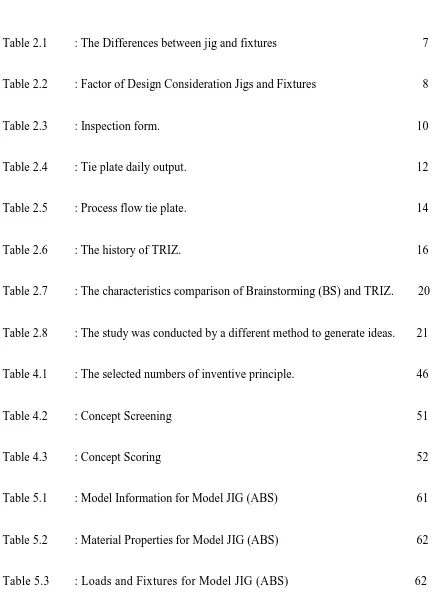
LIST OF TABLES
Table 2.1 : The Differences between jig and fixtures 7
[image:15.612.111.545.104.712.2]Table 2.2 : Factor of Design Consideration Jigs and Fixtures 8
Table 2.3 : Inspection form. 10
Table 2.4 : Tie plate daily output. 12
Table 2.5 : Process flow tie plate. 14
Table 2.6 : The history of TRIZ. 16
Table 2.7 : The characteristics comparison of Brainstorming (BS) and TRIZ. 20
Table 2.8 : The study was conducted by a different method to generate ideas. 21
Table 4.1 : The selected numbers of inventive principle. 46
Table 4.2 : Concept Screening 51
Table 4.3 : Concept Scoring 52
Table 5.1 : Model Information for Model JIG (ABS) 61
Table 5.2 : Material Properties for Model JIG (ABS) 62
xi
Table 5.4 : Model Information for Model Top Guide Jig (ABS) 66
Table 5.5 : Material Properties for Model Top Guide Jig (ABS) 67
Table 5.6 : Load and Fixtures for Model Top Guide Jig (ABS) 67
Table 5.7 : Model Information for Model JIG (AISI 1020) 71
Table 5.8 : Material Properties for Model JIG (AISI 1020) 72
Table 5.9 : Load and Fixtures for Model JIG (AISI 1020) 72
Table 5.10 : Model Information for Model Top Guide Jig (AISI 1020) 76
Table 5.11 : Material Properties for Model Top Guide Jig (AISI 1020) 77
Table 5.12 : Loads and Fixtures for Model Top Guide Jig (AISI 1020) 77
xi
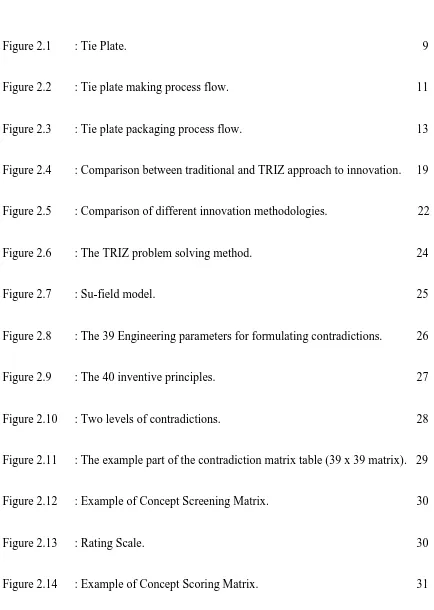
LIST OF FIGURES
Figure 2.1 : Tie Plate. 9
Figure 2.2 : Tie plate making process flow. 11
Figure 2.3 : Tie plate packaging process flow. 13
Figure 2.4 : Comparison between traditional and TRIZ approach to innovation. 19
Figure 2.5 : Comparison of different innovation methodologies. 22
Figure 2.6 : The TRIZ problem solving method. 24
Figure 2.7 : Su-field model. 25
Figure 2.8 : The 39 Engineering parameters for formulating contradictions. 26
Figure 2.9 : The 40 inventive principles. 27
Figure 2.10 : Two levels of contradictions. 28
Figure 2.11 : The example part of the contradiction matrix table (39 x 39 matrix). 29
Figure 2.12 : Example of Concept Screening Matrix. 30
Figure 2.13 : Rating Scale. 30
[image:17.612.111.545.101.711.2]xii
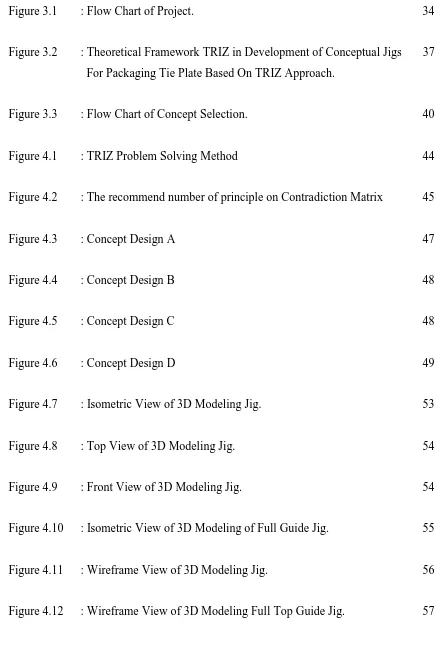
Figure 3.1 : Flow Chart of Project. 34
Figure 3.2 : Theoretical Framework TRIZ in Development of Conceptual Jigs 37
For Packaging Tie Plate Based On TRIZ Approach. Figure 3.3 : Flow Chart of Concept Selection. 40
Figure 4.1 : TRIZ Problem Solving Method 44
Figure 4.2 : The recommend number of principle on Contradiction Matrix 45
Figure 4.3 : Concept Design A 47
Figure 4.4 : Concept Design B 48
Figure 4.5 : Concept Design C 48
Figure 4.6 : Concept Design D 49
Figure 4.7 : Isometric View of 3D Modeling Jig. 53
Figure 4.8 : Top View of 3D Modeling Jig. 54
Figure 4.9 : Front View of 3D Modeling Jig. 54
Figure 4.10 : Isometric View of 3D Modeling of Full Guide Jig. 55
Figure 4.11 : Wireframe View of 3D Modeling Jig. 56
xiii
Figure 5.1 : Stress Study for Jig Material ABS 63
Figure 5.2 : Displacement Study for Jig Material ABS 64
Figure 5.3 : FOS Study for Jig Material ABS 65
Figure 5.4 : Stress Study for Top Guide Jig Material ABS 68
Figure 5.5 : Displacement Study for Top Guide Jig Material ABS 69
Figure 5.6 : FOS Study for Top Guide Jig Material ABS 70
Figure 5.7 : Stress Study for Jig Material AISI 1020 73
Figure 5.8 : Displacement Study for Jig Material AISI 1020 74
Figure 5.9 : FOS Study for Jig Material AISI 1020 75
Figure 5.10 : Stress Study for Top Guide Jig Material AISI 1020 78
Figure 5.11 : Displacement Study for Top Guide Jig Material AISI 1020 79
xiv
LIST OF ABBREVIATIONS, SYMBOLS AND
NOMENCLATURE
3D - 3 Dimensional
ABS - Acrylonitrile butadiene styrene
AM - Additive Manufacturing
AISI 1020 - Low Carbon Steel
BS - Brainstorming
FKP - Fakulti Kejuruteraan Pembuatan
FOS - Factor of Safety
m - Metre
mm - Millimetre
PDD - Product Design and Development SLS - Selective Laser Sintering
SPCC - Steel Plate Cold-Rolled Carbon
SD - Standard
Sec - Second
TRIZ - Theory of Inventive Problem Solving
& - And
1
This chapter provides the background of the project. The projects focus on the development of the conceptual jig of the packaging tie plate using Theory of Inventive Problem Solving (TRIZ) approach. This chapter also describes the problem statement, followed by the objective, and scopes of the project.
1.1 Background
Nowadays, technology grows rapidly. Manufacturing sector, particularly affected by this situation to support production to meet higher consumer demand. In the product development process, engineers as an important role in finding new ideas, in order to solve the problems faced by the workers. Mass production is intended to increase productivity in order to reduce the unit cost of the product. Therefore, to achieve goals those require tools to support the production and fulfil the market demand.
In manufacturing works, a jig is a type of custom made tool used to locate and guide the workpiece. The purpose of a jig is to provide repeatability, accuracy, and interchangeability in the manufacturing of products (Henriksen and Erik Karl, 1973). The use of jigs and fixtures is similar and related that the terms are sometimes confused or used interchangeably. The difference is in the way the tool is guided to the work piece.
A jig is a special device that holds, supports, or is placed on a part to be machined. The jig is not only locates and holds the workpiece but also guides the cutting tool
INTRODUCTION
2
while the operation is performed. Jigs are usually equipped with hardened steel bushings for guiding drills or other cutting tools (Hoff man, 2011). A fixture is used for locates, holds, and supports the work securely so the required machining. Another tool such as set blocks and feeler or thickness gauges are need used with fixtures as reference the cutter to the workpiece (Hoff man, 2011).
There are many types of jigs, every type is custom made to do a specific job. Many jigs are created because there is a necessity to do so by the tradesmen. Some are made to increase productivity through consistency, to do repetitive activities or to do a job more precisely (Hoff man, 2011).
Tie plate is one of the automotive parts that are placed in CamPro engine for proton cars. Tie plate is a product resulting from the stamping process. The function of tie plate is to divide the piston holes found in a car engine before casting process. Means the tie plate will be part of the engine block after casting process is done. Because the engine is an important and requires high accuracy, so the quality of flatness of tie plate is very important and emphasized during the manufacturing process.
The theory of inventive problem solving (TRIZ), is a theory that uses a systematic method that can generate innovation and creative problem solving (Altshuller et al., 2002). Among the industries that use TRIZ to produce competitive products are Samsung, Motorola, Intel, LG, Motorola, Christian Dior, Whirlpool, Delphi Automotive, Boeing and Procter & Gamble (Hamm, 2008). TRIZ consists of several methods that help in bringing the idea to design, including physical conflict, contradiction matrix and curve-S (Mann, 2007).
3
1.2 Problem Statement
The problem examined in this study is related to productivity problems in the product packaging for tie plate. Tie Plate is a product resulting from the stamping process. Tie plate is one of the automotive parts located inside the CamPro engine for PROTON cars. Due to the increasing demand for the car, then automatically the demand for tie plate also increases, and this condition has created a problem for the production of tie plates. This is because the production process is still using the traditional method by manually in the production and packaging process. Because of that, the manual method is no longer relevant to use. The manual packaging processes totally using the human power as a source and this takes a long time for the production process to produce a product. So, to increase productivity and to meet consumer demand, new methods or concepts must be developed to replace the traditional manual method. In addition, it can also reduce the use of manual labour and help to reduce the cost and production time for the tie plate.
1.3 Objective
The objectives of this project are;
a) To identify the design principles of 40 Inventive Principles of TRIZ in development of conceptual jig for the packaging tie plate.
b) To implement product design and development of concept selection to select the suitable design of conceptual jigs for the packaging tie plate.
4
1.4 Scope Of Project