Horizontal Transfer of a Retrotransposon from the Rice
Planthopper to the Genome of an Insect DNA Virus
Qiankun Yang,a,b,cYan Zhang,b,cIda Bagus Andika,eZhenfeng Liao,c,dHideki Kondo,eYanhua Lu,b,cYe Cheng,b,cLinying Li,f Yuqing He,cYujuan He,b,cYuhua Qi,b,cZongtao Sun,b,cYuanhua Wu,aFei Yan,b,cJianping Chen,a,b,c Junmin Lib,c
aPlant Protection College, Shenyang Agricultural University, Shenyang, China
bInstitute of Plant Virology, Ningbo University, Ningbo, China
cThe State Key Laboratory Breeding Base for Sustainable Control of Pest and Disease, Key Laboratory of Biotechnology in Plant Protection of MOA of China and Zhejiang
Province, Institute of Virology and Biotechnology, Zhejiang Academy of Agricultural Sciences, Hangzhou, China
dCentral Laboratory of Zhejiang Academy of Agricultural Sciences, Zhejiang Academy of Agricultural Sciences, Hangzhou, China
eInstitute of Plant Science and Resources, Okayama University, Kurashiki, Japan
fCollege of Horticulture and Plant Protection, Yangzhou University, Yangzhou, China
ABSTRACT Horizontal transfer of genetic materials between virus and host has
been frequently identified. Three rice planthoppers, Laodelphax striatellus,
Nilapar-vata lugens, andSogatella furcifera, are agriculturally important insects because they are destructive rice pests and also the vector of a number of phytopathogenic
vi-ruses. In this study, we discovered that a small region (⬃300 nucleotides [nt]) of the
genome ofinvertebrate iridescent virus6 (IIV-6; genusIridovirus, familyIridoviridae), a
giant DNA virus that infects invertebrates but is not known to infect planthoppers, is highly homologous to the sequences present in high copy numbers in these three planthopper genomes. These sequences are related to the short interspersed nuclear elements (SINEs), a class of non-long terminal repeat (LTR) retrotransposons (retro-posons), suggesting a horizontal transfer event of a transposable element from the rice planthopper genome to the IIV-6 genome. In addition, a number of planthopper transcripts mapped to these rice planthopper SINE-like sequences (RPSlSs) were identified and appear to be transcriptionally regulated along the different develop-mental stages of planthoppers. Small RNAs derived from these RPSlSs are predomi-nantly 26 to 28 nt long, which is a typical characteristic of PIWI-interacting RNAs.
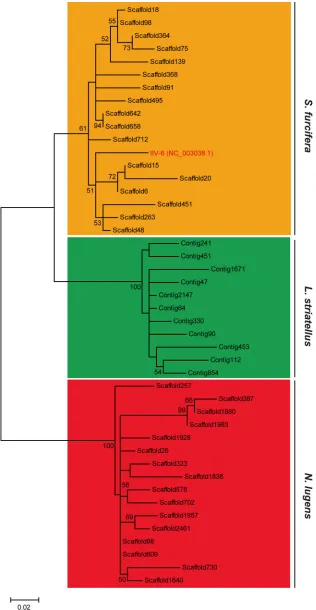
Phylogenetic analysis suggests that IIV-6 acquires a SINE-like retrotransposon fromS.
furcifera after the evolutionary divergence of the three rice planthoppers. This study provides further examples of the horizontal transfer of an insect transposon to virus and suggests the association of rice planthoppers with iridoviruses in the past or present.
IMPORTANCE This study provides an example of the horizontal transfer event from a rice planthopper genome to an IIV-6 genome. A small region of the IIV-6 genome
(⬃300 nt) is highly homologous to the sequences presented in high copy numbers
of three rice planthopper genomes that are related to the SINEs, a class of retro-posons. The expression of these planthopper SINE-like sequences was confirmed, and corresponding Piwi-interacting RNA-like small RNAs were identified and compre-hensively characterized. Phylogenetic analysis suggests that the giant invertebrate
iridovirus IIV-6 obtains this SINE-related sequence from Sogatella furciferathrough a
horizontal transfer event in the past. To the best of our knowledge, this is the first report of a horizontal transfer event between a planthopper and a giant DNA virus and also is the first evidence for the eukaryotic origin of genetic material in iridovi-ruses.
KEYWORDS horizontal transfer, invertebrate iridescent virus 6, iridovirus, rice planthoppers, SINE, transposable element, piRNAs
CitationYang Q, Zhang Y, Andika IB, Liao Z, Kondo H, Lu Y, Cheng Y, Li L, He Y, He Y, Qi Y, Sun Z, Wu Y, Yan F, Chen J, Li J. 2019. Horizontal transfer of a retrotransposon from the rice planthopper to the genome of an insect DNA virus. J Virol 93:e01516-18.https:// doi.org/10.1128/JVI.01516-18.
EditorJoanna L. Shisler, University of Illinois at Urbana Champaign
Copyright© 2019 Yang et al. This is an open-access article distributed under the terms of theCreative Commons Attribution 4.0 International license.
Address correspondence to Jianping Chen, [email protected], or Junmin Li, [email protected].
Q.Y. and Y.Z. contributed equally to this work. Received31 August 2018
Accepted28 December 2018 Accepted manuscript posted online9 January 2019
Published
crossm
5 March 2019
on November 6, 2019 by guest
http://jvi.asm.org/
H
orizontal transfer (HT) of genetic material has been increasingly discovered be-tween different viruses and their eukaryotic hosts, and it shapes the evolution of the viruses and their hosts (1). During long evolution of the virus-host relationship, HT events can occur in two opposite ways: from host to virus or from virus to host. For host-to-virus HT, the viral genome can acquire various host genes, such as ubiquitin (2), chloroplast protein (3), and heat shock protein (4), during evolution. Giant viruses or nucleocytoplasmic large DNA viruses have a very large linear or circular genomic double-stranded DNA (dsDNA) molecule between 100 kb (such as some phycodnavi-ruses and iridoviphycodnavi-ruses) and 2.5 Mb (such as pandoraviphycodnavi-ruses). It has been reported that giant viruses contain high proportions (at least 10%) of host-derived genes, and some of these genes are key factors for viral pathogenesis (5–7). For the virus-to-host direction, viruses hijack many of the host cellular functions to facilitate their own replication, and the sequences of many viruses have occasionally been integrated into host chromosomes during these interactions, a process called endogenization (8). These integrated viral sequences, which may be whole or partial, are referred to as endogenous viral elements (EVEs) (9). With the sequencing of many eukaryotic ge-nomes and advances in bioinformatics, many EVEs derived from retroviral or nonret-roviral viruses have been discovered in a variety of eukaryotes (10). Since EVEs are integrated into the germ line and are vertically inherited in their hosts, they serve as viral imprints (fossils) and provide unprecedented opportunities to explore the evolu-tion of viruses and their interacevolu-tions with various hosts (8). Recent studies have also shown that EVEs derived from nonretroviral viruses can act as templates for the production of PIWI-interacting RNAs (piRNAs; 24 to 32 nucleotides [nt] in length), a small RNA class that was associated with Piwi-subfamily proteins, which might playessential roles in antiviral immunity of the mosquitoAedes aegypti, thereby providing
a memory reservoir of past immunity events (9, 11, 12).
Besides HT events between different viruses and their eukaryotic hosts, eukaryote-to-eukaryote HT are also prevalent in nature (13). Recent studies indicated that most of the eukaryote-to-eukaryote HTs are related to transposable elements (TE), and viruses are major vectors of HT between eukaryotes (14). Piskurek et al. (15) reported that
poxviruses (family Poxviridae) are possible vectors for HT of retroposons (a class of
non-long terminal repeat [LTR] retrotransposon, subfamilies of short interspersed ele-ments, or SINEs) from reptiles to mammals. Another example is that baculovirus (Autographa californica multiple nucleopolyhedrovirus, familyBaculoviridae) infection
facilitates HT of two transposable elements from cabbage looper (Trichoplusia ni)
between several sympatric moth species (16). With the large amounts of new genomes and short read archives deposited in public databases, more virus-mediated eukaryote-to-eukaryote HT will no doubt be revealed and contribute to our understanding of mechanisms underlying HT between eukaryotes.
The small brown planthopper (SBPH; Laodelphax striatellus), brown planthopper
(BPH; Nilaparvata lugens), and white-backed planthopper (WBPH; Sogatella furcifera),
generally called rice planthoppers, belong to familyDelphacidae(orderHemiptera) and
are three of the most destructive insect pests of rice in tropical and temperate regions of Asia (17). In addition to direct feeding damage, they act as efficient vectors of plant viruses and phytoplasmas, including at least 18 important phytopathogenic rice viruses,
some of which replicate in their vector as well as in the host plant, such as Rice
black-streaked dwarf virus(RBSDV, a reovirus) andRice stripe tenuivirus(RSV, a
tenuivi-rus) forL. striatellus(18, 19),Rice ragged stunt virus(a reovirus) andRice grassy stunt virus
(a tenuivirus) forN. lugens(20), andSouthern rice black-streaked dwarf virus(SRBSDV, a
reovirus) forS. furcifera(21). Insect-specific viruses are also commonly reported in rice
planthoppers, including Himetobi P virus (HiPV), a picorna-like virus that infects the
three rice planthoppers asymptomatically with high frequency (22, 23). There has been little reported work on HT in rice planthoppers, except for the identification of nudivirus
(family Nudiviridae, closely related to polydnavirus)-like sequences in the N. lugens
genome. Nudivirus sequences were widely found in the scaffolds or contigs of theN.
lugensgenome, and these viral sequences were reported to be expressed in different
on November 6, 2019 by guest
http://jvi.asm.org/
tissues of the insect. However, although the rod-shaped nudivirus virions were not detected in various insect tissues by electron microscopy, the current evidence does
not rule out the possibility that these integrated viral sequences are free virus inN.
lugensrather than ancient viral relics (24).
Chilo iridescent virus is classified asInvertebrate iridescent virus 6 (IIV-6), the type
species of the genusIridovirus, familyIridoviridae(25). It was originally isolated from
diseased larvae of the rice stem borer (Chilo suppressalis) and has been used as the
standard model for studies on invertebrate iridoviruses (26, 27). Although IIV-6 can
infect more than 100 insect species belonging to at least six orders, includingHemiptera
(leafhoppers) (27, 28), it has never been reported to infect planthoppers. Because the virus causes limited mortality to insects and has a large genome, it has received little research attention (29). Its dsDNA genome has 212,482 bp and contains 468 open
reading frames (ORFs) (30, 31). Although the viruses in the family Iridoviridae have
relatively large genome sizes, iridoviruses seem to be less prone to lateral gene
exchange with their host than other giant viruses, such as poxviruses (familyPoxviridae)
and a marseillevirus (family Marseilleviridae) (6). In addition, eukaryotic class II DNA
transposons (miniature inverted-repeat transposable elements, or MITEs) were recently
identified in the genomes of iridoviruses (Invertebrate iridescent virus 9, IIV-9, and
Invertebrate iridescent virus 22, IIV-22), indicating that these viruses act as vectors for HT of transposable elements between host species (32). Nevertheless, the origins of these transposons in the genome of iridoviruses are still unclear.
In this study, potential HT events of genetic material between three rice planthop-pers and virus genomes were investigated. Interestingly, a small region of the IIV-6
genome (⬃300 nt) is highly homologous to the sequences present in high copy
numbers in rice planthopper genomes that have a sequence relatedness to SINE retroposons. Phylogenic analysis indicated that this SINE-like element is transferred from the planthopper to the IIV-6 genome in the past after the evolutionary divergence of the three rice planthoppers.
RESULTS AND DISCUSSION
Identification of VLSs in the genomes of three rice planthoppers.The availability
of recently published genomes of L. striatellus, N. lugens, and S. furcifera provides
resources to identify virus-like sequences (VLSs) in rice planthoppers (33–35). By homology search using planthopper genomes to NCBI virus RefSeqs, 1,699, 5,422, and
4,038 VLSs were discovered in the genomes ofL. striatellus,N. lugens,andS. furcifera,
respectively (see File S1 in the supplemental material). Interestingly, all identified VLSs were homologous to viruses that have never been reported to infect planthoppers, and none of these viruses were from known planthopper-transmitted rice viruses (such as RSV and RBSDV) or insect-specific viruses (such as HiPV). This contrasts with recent results showing that the genome of mosquitos (major vectors of flaviviruses such as yellow fever virus and dengue virus) contains endogenous flaviviral elements (36–38). Although the VLSs that we identified are similar to those of viruses that are not known to infect rice planthoppers, they might have infected planthoppers in the past and provide persistent viral fossil evidence in the host genome.
Iridovirus-like sequence that is homologous to the sequences with high copy numbers in rice planthopper genomes.Intriguingly, we found that the vast majority of VLSs in planthoppers were homologous to a region in the IIV-6 (an iridovirus) genome. The percentages of VLSs that are homologous to the IIV-6 sequence were
97.76%, 92.23%, and 98.41% inL. striatellus,N. lugens,andS. furcifera, respectively. The
genomes of the three planthoppers next were searched against the IIV-6 genome (NC_003038.1) to confirm the presence of VLSs that are homologous to IIV-6 (File S2).
Our results indicated that 1.54% ofL. striatelluscontigs (587/38,193), 5.34% ofN. lugens
scaffolds (2,485/46,559), and 4.85% ofS. furciferascaffolds (991/20,450) contain at least
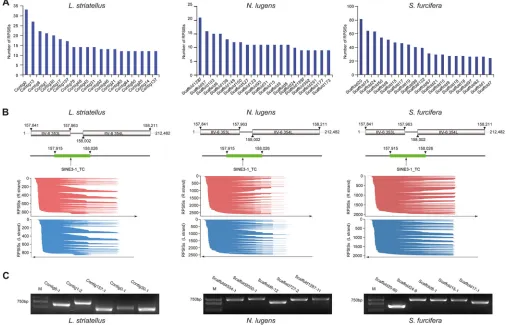
one sequence homologous to IIV-6 with significant matches (Table 1). The top 20 contigs/scaffolds that contain the highest numbers of homologous sequences in the three rice planthoppers are shown in Fig. 1A. IIV-6 has a large genome, and the first (so
on November 6, 2019 by guest
http://jvi.asm.org/
far the only) complete genome was sequenced in 2001 (30). It is 212,482 bp long and has 468 predicted ORFs (30). Surprisingly, mapping results indicated that all of the
discovered homologous sequences (1,686 forL. striatellus, 5,031 forN. lugens,and 3,986
for S. furcifera), except one of N. lugensin scaffold 137, mapped to a short region
(⬃300 nt) from nt 157,843 to 158,142 nt of the viral genome that covered most regions
of ORF 353L, the intergenic region, and parts of ORF 354L (here this region is referred to as IIV6_300) (Fig. 1B). ORFs 353L and 354L are both on the complimentary strand of
the IIV-6 genome; ORF 354L encodes a protein with a predictedL-lactate
dehydroge-nase active site domain, while the function of 353L is currently unknown (30). The
majority of the homologous sequences were only 100 to ⬃200 bp long, and their
[image:4.585.41.543.85.148.2]integrations are almost equal in both directions (Table 1 and Fig. 1B). To experimentally validate the presence of the homologous sequences, five sequences from different contigs/scaffolds (approximately 700 bp) of each of the three planthoppers were TABLE 1Summary of IIV6-LS identified in three planthopper genomesa
Species
Total no. of scaffold/contigs
No. (%) of IIV6-LS matched redundant
No. (%) of IIV6-LS matched unique
No. of matched IIV-6 genome regions
IIV-6 ORFs containing IIV6-LS mapped region
Orientation (sense/antisense)
Avg no. of matched IIV6-LS per scaffold/contig
L. striatellus 38,193 1,686 (4.41) 587 (1.54) 157,843-158,135 353L, 354L 835/851 2.872⫾3.508
N. lugens 46,559 5,031 (10.81) 2,485 (5.34) 157,851-158,142 353L, 354L 2,579/2,452 2.024⫾1.748
S. furcifera 20,450 3,986 (19.49) 991 (4.85) 157,844-158,137 353L, 354L 1,932/2,054 4.022⫾6.791
aIIV6-LS, IIV6-like sequences.
FIG 1Identification of sequences homologous to IIV6_300 sequence (RPSlSs) in three planthopper genomes. (A) Bar plots showing the number of RPSlSs within contigs/scaffolds (top 20) of three planthopper genomes. (B) Coverage plots of RPSlSs mapped to the region between the ORFs 353L and 354L of the IIV-6 genome. Each line represents a single RPSlS, and its length and position denote the region of the indicated ORF to which its sequence is mapped. Red lines
indicated RPSlSs mapped to the R (⫹) strand of IIV-6, and blue lines represents those to the L (⫺) strand. (C) Genomic PCR detection of five randomly selected
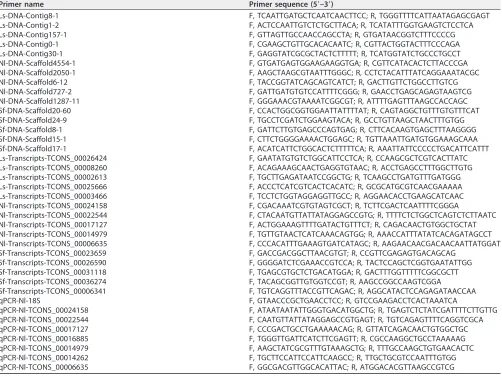
contigs/scaffolds containing RPSlSs in three planthopper genomes.
on November 6, 2019 by guest
http://jvi.asm.org/
[image:4.585.39.545.363.688.2]randomly selected and amplified by PCR. Amplification products with the expected sizes were obtained from all of the selected contigs/scaffolds, and Sanger sequencing of the purified DNA products confirmed their identity (Fig. 1C). Although IIV-6 has a broad host range and can infect more than 100 insect species (27), to the best of our knowledge, this is the first report of an HT event of the genetic material between IIV-6 and a eukaryotic host.
IIV6_300 sequence is a predicted transposable element of rice planthoppers. Transposable elements are the major components of eukaryotic genomes and account
for approximately 25.7%, 38.9%, and 32.6% of sequences in the genomes ofL.
striatel-lus,N. lugens,andS. furcifera, respectively (33–35). Transposable elements are pieces of DNA that are able to jump from one locus to another in the genome of their host, and the majority of HT events reported until now are the transfers of transposable elements (14). Due to the high copy numbers of the sequences that are homologous to the IIV6_300 sequence in the planthopper genomes, these sequences, including a 500-nt
extension in both 5=and 3=termini, were analyzed for the presence of transposable
element motifs using CENSOR (39). The analysis indicated that they contain the conserved SINE3-1_TC motif, which is also present in the IIV6_300 sequence (Fig. 1B). Thus, they may be short interspersed nuclear elements (SINEs), which is a class of non-LTR retrotransposon (retroposon) present in various eukaryotic genomes. Note that we did not find the rice planthopper SINE-like sequences (RPSlSs) in the genome of the rice stem borer, the known host of IIV-6. Taken together, these observations suggest that IIV-6 probably obtained a transposable element from a planthopper through an HT event. In the case of other iridoviruses, IIV-9 and IIV-22 were predicted to contain eukaryotic DNA transposon MITEs, which might result from HT (32), but the origins of the predicted eukaryotic MITEs are still unclear.
Transcription and integration profile of RPSlSs in rice planthoppers.The
com-plete genome of IIV-6 was used as a database and searched with the newly reassem-bled transcriptomes of the three planthoppers. A total of 19, 24, and 178 planthopper
transcripts containing RPSlSs were found in L. striatellus, N. lugens, and S. furcifera,
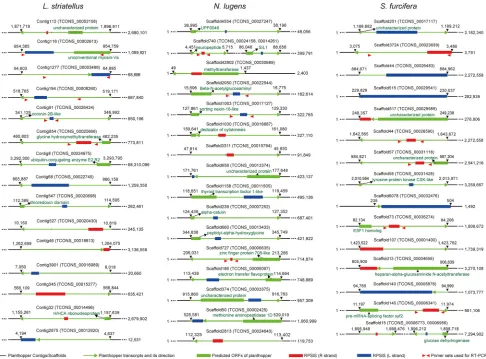
respectively, indicating that some of the RPSlSs are transcribed in planthoppers (Tables 2 and 3 and Table S1). As shown in Fig. 2, some RPSlSs were distributed in the transcribed regions of planthopper genes with various predicted functions, such as
glycine hydroxymethyltransferase and ubiquitin-conjugating enzyme in L. striatellus,
methyltransferase and electron transfer flavoprotein inN. lugens, and tyrosine-protein
kinase and glucose dehydrogenase in S. furcifera. Planthopper transcripts contain
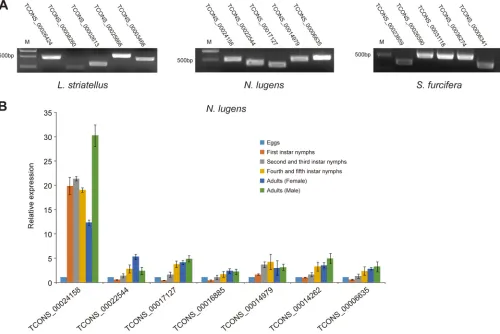
RPSlSs derived from both strands (Fig. 2). In addition, five RPSlSs from each planthopper were randomly selected and analyzed by reverse transcription-PCR (RT-PCR) (Fig. 3A), followed by Sanger sequencing. The positions of the primer sets are indicated by red arrows below the transcripts (Fig. 2). The result confirmed that RPSlSs are indeed expressed in planthoppers rather than contaminant sequences from incidental exog-enous sources.
Notably, none of the RPSlSs were integrated into the coding regions of predicted planthopper genes (Fig. 2). This may be because the disruption of the coding genes leads to detrimental effects on the insects. A previous study showed that transposable elements in the genome can be expressed at low levels and can play important roles in the regulation of gene expression (40, 41). Whether the RPSlSs inserted into plan-thopper genomes have similar transposon-like functions as the regulators of gene expression in rice planthoppers needs further investigation.
To investigate the expression profile of RPSlS loci at different planthopper
devel-opmental stages, seven RPSlSs ofN. lugenswere selected for RT-quantitative PCR (qPCR)
analysis. There were relatively low expression levels in eggs or first-instar nymphs (except transcript TCONS_00024158) and markedly high expression in late-instar nymphs and adults (Fig. 3B). This result shows that RPSlSs containing transcriptions are
differently regulated during the different developmental stages ofN. lugens.
on November 6, 2019 by guest
http://jvi.asm.org/
TABLE 2 RPSlS-containing transcripts identified in assembled L. striatellus (SBPH) transcriptome ID a Transcriptome assembly ID b GenBank accession no. c Orientation Length (nt) E value Match coordinate Annotation d mRNA position IIV-6 genome position Start End Start End IIV6-SBPH-1 TCONS_00002158 XP_022186857 ⫹ 254 7.00E ⫺ 69 8922 9171 157870 158120 Uncharacterized protein LOC111045711 ( Nilaparvata lugens ) IIV6-SBPH-2 TCONS_00002613 XP_015509342 ⫺ 121 9.00E ⫺ 34 15 133 157991 157875 Predicted RNA-directed DNA polymerase from mobile element jockey-like ( Neodiprion lecontei ) IIV6-SBPH-3 TCONS_00003466 XP_022197601 ⫺ 62 1.00E-18 307 367 157958 157897 Uncharacterized protein LOC111054806 ( Nilaparvata lugens ) IIV6-SBPH-4 TCONS_00008260 XP_022206744 ⫺ 57 6.00E ⫺ 16 294 349 158024 157969 Endochitinase A-like isoform X1 ( Nilaparvata lugens ) IIV6-SBPH-5 TCONS_00012920 XP_022204073 ⫺ 72 7.00E ⫺ 21 373 443 157976 157905 Uncharacterized protein LOC111060713 isoform X1 ( Nilaparvata lugens ) IIV6-SBPH-6 TCONS_00014496 No blast hits ⫹ 102 1.00E ⫺ 31 2699 2799 157898 157998 No blast hits IIV6-SBPH-7 TCONS_00014495 2617 2717 IIV6-SBPH-8 TCONS_00015277 XP_014260631 ⫹ 89 6.00E ⫺ 29 44 130 157872 157960 Uncharacterized protein LOC106673143 isoform X2 ( Cimex lectularius ) IIV6-SBPH-9 TCONS_00016989 XP_022204984 ⫺ 84 1.00E ⫺ 26 783 865 157953 157872 Armadillo segment polarity protein isoform X3 ( Nilaparvata lugens ) IIV6-SBPH-10 TCONS_00018813 XP_014247467 ⫹ 96 8.00E ⫺ 28 2929 3023 157865 157958 Cylicin-1 ( Cimex lectularius ) IIV6-SBPH-11 TCONS_00020430 No blast hits ⫹ 110 2.00E ⫺ 33 64 171 157875 157984 No blast hits IIV6-SBPH-12 TCONS_00020698 XP_022186703 ⫺ 120 9.00E ⫺ 33 2471 2587 157989 157871 Sialin-like ( Nilaparvata lugens ) IIV6-SBPH-13 TCONS_00022745 XP_022187702 ⫺ 114 3.00E ⫺ 37 127 239 157987 157876 Tetratricopeptide repeat protein 39B-like ( Nilaparvata lugens ) IIV6-SBPH-14 TCONS_00024976 XP_022185269 ⫺ 120 1.00E ⫺ 34 1796 1913 157990 157872 Probable serine/threonine-protein kinase PBL3 ( Nilaparvata lugens ) IIV6-SBPH-15 TCONS_00024975 XP_022185272 ⫺ 120 1.00E ⫺ 34 1802 1919 157990 157872 Inhibitor of Bruton tyrosine kinase isoform X2 ( Nilaparvata lugens ) IIV6-SBPH-16 TCONS_00025666 XP_022192571 ⫹ 239 8.00E ⫺ 63 2053 2286 157871 158106 Homeobox protein Nkx-2.4-like ( Nilaparvata lugens ) IIV6-SBPH-17 TCONS_00026424 XM_022334380 ⫺ 253 1.00E ⫺ 64 3808 4055 158119 157872 Predicted Nilaparvata lugens coronin-2B-like (LOC111048487) IIV6-SBPH-18 TCONS_00026423 3715 3962 IIV6-SBPH-19 TCONS_00026425 3541 3788 aList of SBPH transcripts that mapped to IIV-6 genome. bID of assembled SBPH transcript. cGenBank accession number for annotated SBPH transcript. dAnnotations of assembled SBPH transcript.
on November 6, 2019 by guest
http://jvi.asm.org/
TABLE 3 RPSlS-containing transcripts identified in assembled N. lugens (BPH) transcriptome ID a Transcriptome assembly ID b GenBank accession no. c Orientation Length (nt) E value Match coordinate Annotation d mRNA position IIV-6 genome position Start End Start End IIV6-BPH-1 TCONS_00027247 XM_022348255 ⫺ 93 7E ⫺ 32 1845 1936 157970 157878 Nilaparvata lugens UPF0046 protein C25E10.12-like (LOC111060582) IIV6-BPH-2 TCONS_00024158 XM_022345494 ⫹ 109 1.00E ⫺ 22 2109 2214 157918 158024 Nilaparvata lugens neuropeptide-like 1 (LOC111058001) IIV6-BPH-3 TCONS_00030689 XM_022351452 ⫹ 201 3.00E ⫺ 50 829 1023 157871 158069 Nilaparvata lugens protein-L-isoaspartate( D -aspartate) O-methyltransferase (LOC111063773) IIV6-BPH-4 TCONS_00022544 XM_022344131 ⫺ 86 1.00E ⫺ 29 1526 1610 157961 157876 Nilaparvata lugens N(4)-(Beta-N-acetylglucosaminyl)-L -asparaginase-like (LOC111056738) IIV6-BPH-5 TCONS_00017127 XM_022339397 ⫺ 114 5.00E ⫺ 29 1734 1843 158007 157895 Nilaparvata lugens sorting nexin-16-like (LOC111052656) IIV6-BPH-6 TCONS_00016887 XM_022339164 ⫹ 120 4.00E ⫺ 39 6461 6579 157872 157989 Nilaparvata lugens dedicator of cytokinesis protein 1 (LOC111052477) (isoform X1-X4) TCONS_00016886 XM_022339165 6476 6594 TCONS_00016888 XM_022339166 6479 6597 TCONS_00016885 XM_022339168 6572 6690 IIV6-BPH-7 TCONS_00015794 XM_022338223 ⫹ 148 4.00E ⫺ 45 2255 2401 157878 158023 Nilaparvata lugens U2 small nuclear ribonucleoprotein A = -like (LOC111051677) IIV6-BPH-8 TCONS_00014979 XM_022337511 ⫺ 96 1.00E ⫺ 24 3710 3804 157966 157871 Nilaparvata lugens zinc finger protein 208-like (LOC111051081) IIV6-BPH-9 TCONS_00014261 XM_022336895 ⫺ 147 3.00E ⫺ 48 2243 2388 158021 157875 Nilaparvata lugens nucleotide exchange factor SIL1 (LOC111050554) (isoform X1-X2) TCONS_00014262 XM_022336896 2260 2405 IIV6-BPH-10 TCONS_00013374 XM_022336116 ⫺ 154 7.00E ⫺ 37 7674 7826 158027 157875 Nilaparvata lugens uncharacterized LOC111049921 (LOC111049921) IIV6-BPH-11 TCONS_00011505 XM_022334458 ⫺ 172 3.00E ⫺ 55 1470 1638 158045 157875 Nilaparvata lugens thyroid transcription factor 1-like (LOC111048546) IIV6-BPH-12 TCONS_00010901 XM_022333940 ⫹ 81 8.00E ⫺ 20 154 231 157869 157949 Nilaparvata lugens phospholipid phosphatase 2-like (LOC111048093) IIV6-BPH-13 TCONS_00007252 XM_022330812 ⫺ 149 2.00E ⫺ 36 3049 3195 158018 157873 Nilaparvata lugens alpha-catulin (LOC111045409), transcript variant X2 IIV6-BPH-14 TCONS_00006635 XM_022330266 ⫹ 176 1.00E ⫺ 63 4098 4270 157871 158045 Nilaparvata lugens zinc finger protein 708-like (LOC111044981) IIV6-BPH-15 TCONS_00006097 XM_022329798 ⫺ 173 1.00E ⫺ 62 1027 1196 158045 157874 Nilaparvata lugens electron transfer flavoprotein regulatory factor 1 (LOC111044608) TCONS_00006098 XM_022329797 1105 1274 TCONS_00006099 XM_022329795 1144 1313 IIV6-BPH-16 TCONS_00003375 XM_022351811 ⫺ 129 1.00E ⫺ 41 589 714 157999 157871 Nilaparvata lugens uncharacterized LOC111064129 (LOC111064129) IIV6-BPH-17 TCONS_00002425 XM_022344945 ⫺ 52 6.00E ⫺ 16 1401 1452 157988 157938 Nilaparvata lugens methionine aminopeptidase 1D, mitochondrial-like (LOC111057488) TCONS_00002428 XM_022344939 1304 1355 TCONS_00002427 XM_022344935 1405 1456 TCONS_00002426 XM_022344928 1355 1406 IIV6-BPH-18 TCONS_00003674 No blast hits ⫹ 95 8.00E ⫺ 37 133 227 157906 157999 No blast hits IIV6-BPH-19 TCONS_00009246 No blast hits ⫺ 63 2.00E ⫺ 15 952 1013 157935 157873 No blast hits IIV6-BPH-20 TCONS_00012337 No blast hits ⫺ 175 2.00E ⫺ 63 150 320 158045 157873 No blast hits IIV6-BPH-21 TCONS_00013433 XP_022191867 ⫺ 74 8.00E ⫺ 27 1621 1694 158026 157953 Peptidyl-alpha-hydroxyglycine alpha-amidating lyase 1-like ( Nilaparvata lugens ) IIV6-BPH-22 TCONS_00024640 XP_021938737 ⫹ 120 1.00E ⫺ 36 722 838 157925 158043 Tubulin-specific chaperone cofactor E-like protein ( Zootermopsis nevadensis ) IIV6-BPH-23 TCONS_00025168 No blast hits ⫹ 156 4.00E ⫺ 54 305 459 157874 158028 No blast hits IIV6-BPH-24 TCONS_00026803 No blast hits ⫹ 124 7.00E ⫺ 31 289 410 157926 158042 No blast hits aList of BPH transcripts that mapped to IIV-6 genome. bID of assembled BPH transcript. cGenBank accession number for annotated BPH transcript. dAnnotations of assembled BPH transcript.
on November 6, 2019 by guest
http://jvi.asm.org/
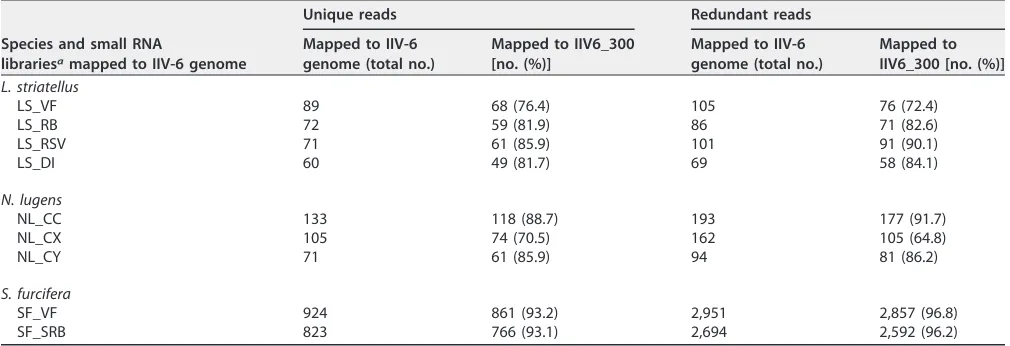
Characteristics of RPSlS-derived small RNAs.The canonical function of the piRNA pathway is in defense against transposable elements and to protect the integrity of the genome in both germ line and gonadal somatic cells of animal species (42). Recent results in mosquitos suggest that piRNAs can also be produced by endogenous flaviviral elements and play a role in insect antiviral immunity (12, 38). Thus, it is interesting to investigate whether RPSlS loci produce small RNAs. Nine publicly avail-able small RNA libraries of three planthoppers were mapped to the complete genome of IIV-6 (NC_003038.1). Of the small RNA reads that mapped to the IIV-6 genome, 70.5% to 93.2% of the unique small RNA reads and 64.8% to 96.8% of redundant reads mapped to the IIV6_300 sequence, which indicates the accumulation of small RNAs derived from RPSlS loci (Table 4).
More RPSlS-derived small RNAs were identified inS. furciferathan in the other two
planthoppers (Table 4), perhaps because of the closer relationship of RPSlSs in S.
furciferawith the reference exogenous IIV-6 (see Fig. 5). Since there are some sequence variations among RPSlSs from the three rice planthoppers and exogenous IIV-6, and for a better understanding of the production of RPSlS-derived small RNAs, small RNA
libraries of LS_VF (L. striatellus), NL_CX (N. lugens), and SF_VF (S. furcifera) were further
mapped to three randomly selected RPSlS-containing transcripts from corresponding planthoppers. As expected, more small RNAs derived from RPSlS loci were identified by this method (Table 4). Evidently, small RNAs were specifically mapped to RPSlS regions
FIG 2Distribution of RPSlSs within planthopper transcripts and genomes. Black lines indicate contigs/scaffolds of the planthopper. Green lines with arrows indicate transcripts of planthoppers and their direction. Green boxes represent the predicted ORF within insect transcripts. The annotation of the predicted ORF is indicated above. Red and blue boxes represent the transcripts of RPSlSs with R and L strands, respectively. Red arrow pairs indicate primer sets used for RT-PCR detection of RPSlSs.
on November 6, 2019 by guest
http://jvi.asm.org/
[image:8.585.56.542.71.430.2]except for the TCONS_00020430 transcript (Fig. 4A). Obvious small RNA hotspots were observed, and these were usually identified in both strands (Fig. 4A). Interestingly, RPSlS-derived small RNAs are predominantly 26 to 28 nt, followed by a 21- to 23-nt peak, although TCONS_00020430 has a clear 22-nt peak (Fig. 4B). However, a 26- to 28-nt small RNA peak was observed in TCONS_00020430 if only the RPSlS region of the transcript was mapped (data not shown), suggesting that the abundant small RNAs with a length of 21 to 23 nt are mainly derived from different regions of the transcript.
The production of piRNAs (a class of the small RNAs) from endogenous viral elements was recently reported from mosquitos; these were antisense strand and could target cognate viral RNA (11, 12, 38). Previous studies indicated that the piRNA pathway plays an essential role in antiviral defense of mosquitos but not of other insects, such
as a fly (Drosophilaspp.) (43). Another study demonstrated that exogenous IIV-6, as a
dsDNA virus, triggers an RNA interference-based antiviral defense mechanism in
Dro-sophilawith the generation of virus-derived small interfering RNA in a DICER2 (RNase III enzyme)-dependent manner (44). From our results, small RNAs derived from RPSlS loci were predominantly 26 to 28 nt long, which is a typical characteristic of piRNAs (24 to 32 nt) (45). We therefore extracted RPSlS-derived small RNAs with
lengths of 26 to 28 nt for further sequence logo analysis (https://weblogo.berkeley
.edu/logo.cgi). However, this analysis did not identify another typical characteristic of
piRNAs, namely, a strong U bias at the 5=terminus or enrichment of A at nt 10 (42 and
data not shown). It is remains unclear whether RPSlS-derived small RNAs function in the piRNA pathway against transposons. It will also be interesting to further investigate
FIG 3Expression of planthopper RPSlSs. (A) RT-PCR detection of planthopper transcripts containing RPSlSs. (B) Expression of RPSlSs at different developmental
stages ofN. lugens. The 18S gene ofN. lugenswas used as an internal control for normalization. Error bars represent the standard deviations using three
replicates.
on November 6, 2019 by guest
http://jvi.asm.org/
[image:9.585.43.543.73.407.2]whether RPSlS-derived small RNAs could mediate antiviral defense against IIV-6 infec-tion.
Phylogenetic relationship of IIV6_300 and RPSlSs. A phylogenetic tree was
constructed based on the RPSlSs using the maximum likelihood method. Evidently, RPSlSs were grouped according to the insect species with strong bootstrap support
(Fig. 5). IIV6_300 sequence is clustered with RPSlSs of S. furcifera, indicating that
IIV-6 obtained a SINE-like transposable element fromS. furciferain the past after the
evolutionary divergence of the three rice planthoppers. Note that we could not find any homologous sequence to RPSlSs in other viruses deposited in the public database. Considering that IIV-6 is a giant DNA virus that commonly obtains genetic material from the host, it is very likely that the transposable element is transferred from a planthopper host to the IIV-6 genome. It will be interesting to investigate the possible HT of RPSlSs between eukaryotic organisms involving virus vectors, as recently reported for other viruses and hosts (14–16).
In conclusion, our investigation on possible occurrences of HT between rice plan-thoppers and viruses leads to the finding of newly identified retroposon-like elements that transfer to an iridovirus. To the best of our knowledge, this is the first report of a potential HT event between a planthopper and a giant DNA virus and also the first evidence for the eukaryotic origin of genetic material in iridoviruses. The results of this study will further contribute to our understanding of HT events between viruses and their eukaryotic hosts.
MATERIALS AND METHODS
Insect cultures.Populations of three planthoppers (L. striatellus,N. lugens,andS. furcifera) that were not carrying the known rice viruses were reared on susceptible rice seedlings (cv. Wuyujing no. 3) in
climate-controlled rooms at 26°C⫾1°C, with a photoperiod of 16 h of light and 8 h of darkness and
70%⫾10% relative humidity.
VLSs in three rice planthopper genomes.The assembled genomes ofL. striatellus,N. lugens,and S. furcifera were retrieved from Gigadb and the NCBI reference genome database (33–35). These
genomes were searched against NCBI virus RefSeqs (ftp://ftp.ncbi.nlm.nih.gov/refseq/release/viral) using
a BLASTN algorithm with a cutoff E value ofⱕ10⫺5. The detected virus-like sequences (VLSs) are listed
in File S1 in the supplemental material. Since most of the planthopper VLSs (⬎90%) were mapped to a
restricted region (⬃300 nt) of IIV-6 (IIV6_300), the three planthopper genomes were then searched
directly against the IIV-6 genome (NC_003038.1) to identify the IIV-6-like nucleotide sequences (se-quences homologous to IIV6_300) in planthoppers. BLAST results are listed in File S2. In addition, contig/scaffold regions of planthoppers that mapped to IIV-6 were further extracted and extended 500
bases at both 5=and 3=termini (to the end of the termini) and used for the identification of potential
transposable elements with CENSOR (https://www.girinst.org/censor/index.php).
[image:10.585.41.546.83.256.2]IIV6_300-like sequences containing transcripts identified from reassembled rice planthopper transcriptomes.Transcriptome raw data were downloaded from the NCBI Sequence Read Archive (SRA)
TABLE 4Numbers of reads of small RNAs of three planthoppers mapped to IIV-6 genome (allowing 1 mismatch)
Species and small RNA
librariesamapped to IIV-6 genome
Unique reads Redundant reads
Mapped to IIV-6 genome (total no.)
Mapped to IIV6_300 [no. (%)]
Mapped to IIV-6 genome (total no.)
Mapped to IIV6_300 [no. (%)] L. striatellus
LS_VF 89 68 (76.4) 105 76 (72.4)
LS_RB 72 59 (81.9) 86 71 (82.6)
LS_RSV 71 61 (85.9) 101 91 (90.1)
LS_DI 60 49 (81.7) 69 58 (84.1)
N. lugens
NL_CC 133 118 (88.7) 193 177 (91.7)
NL_CX 105 74 (70.5) 162 105 (64.8)
NL_CY 71 61 (85.9) 94 81 (86.2)
S. furcifera
SF_VF 924 861 (93.2) 2,951 2,857 (96.8)
SF_SRB 823 766 (93.1) 2,694 2,592 (96.2)
aLS_VF, virus-free adults ofL. striatellus; LS_RB, adults ofL. striatellusinfected with RBSDV; LS_RSV, adults ofL. striatellusinfected with RSV; LS_DI, adults ofL. striatellus
with mixed infection of RBSDV and RSV; NL_CC, female adults ofN. lugens; NL_CX, male adults ofN. lugens; NL_CY, last-instar female nymph ofN. lugens; SF_VF, virus-free adults ofS. furcifera; SF_SRB, adults ofS. furciferainfected with SRBSDV.
on November 6, 2019 by guest
http://jvi.asm.org/
FIG 4Production of small RNAs derived from RPSlS loci in planthoppers. (A) Mapping of small RNAs (18 to 30 nt) to the planthopper transcripts containing RPSlSs. Red and blue colors indicate small RNAs derived from the sense and antisense strands, respectively, of planthopper transcripts.
(Continued on next page)
on November 6, 2019 by guest
http://jvi.asm.org/
[image:11.585.44.517.67.707.2]database forL. striatellus(SRX2013762),N. lugens(SRX023419), andS. furcifera(SRX104935). The filtered
transcriptome raw reads were then aligned against their corresponding genomes using Tophat2 (http://
ccb.jhu.edu/software/tophat/index.shtml) and reassembled using Cufflinks (http://cole-trapnell-lab .github.io/cufflinks/). The newly reassembled transcripts of the three planthoppers are available upon request. The assembled transcriptomes were also searched again against the IIV-6 genome
(NC_003038.1) using BLASTN (E value ofⱕ10⫺5) to identify the transcripts containing the IIV6_300-like
sequence (rice planthopper SINE-like sequences, or RPSlSs). The identified planthopper transcripts were then searched against NCBI NR (NCBI nonredundant protein sequences) and NT (nucleotide sequences)
databases for annotation. The results are listed in Table 2 (L. striatellus), Table 3 (N. lugens), and Table S1
(S. furcifera). Furthermore, to determine the accurate location of the RPSlS within the planthopper transcripts and genome, the planthopper transcripts containing RPSlSs were used as a query to search
against the genome of the three planthoppers using BLASTN (E value ofⱕ10⫺10), and the results are
available upon request.
Detection of planthopper scaffolds/contigs containing RPSlSs.Genomic DNAs were extracted from the three planthoppers using an insect DNA extraction kit (Omega, USA) following the
manufac-turer’s instructions. Five scaffold/contig sequences (partial,⬃500 to⬃700 bp, containing RPSISs) from
each planthopper were randomly selected to verify the presence of RPSISs. The PCR products of each sample were purified, ligated into the pMD18-T vector (TaKaRa, China), and sequenced (Tsingke, China). The primer sets used for genome amplification are listed in Table 5.
Detection of planthopper transcripts containing RPSIS.Total RNAs were extracted from the three planthoppers using TRIzol reagent (Invitrogen, USA). The purified RNAs were mixed with genomic DNA remover (Toyobo, Japan) and used for RT-PCR. cDNA was synthesized using HiScript II reverse transcrip-tion (Vazyme, China) according to the manufacturer’s instructranscrip-tions. Five partial transcripts (approximately 500 bases) containing RPSISs from each planthopper were randomly selected to confirm the expression of RPSISs. The PCR products of each sample were also sequenced as described above. The positions of the primer sets used to amplify the transcripts are shown by red arrows in Fig. 2, and the primer sequences are listed in Table 5.
Expression analysis of RPSISs containing RNAs inN. lugens.To determine the expression of
RPSISs containing transcripts in N. lugens at different developmental stages, samples from eggs,
first-instar nymphs, second- and third-instar nymphs, fourth- and fifth-instar nymphs, and female and male adults were collected for RNA extraction. Equal quantities of total RNA from each sample were used for cDNA synthesis, as described earlier. Primer sets specific for the seven transcripts containing
RPSIS were used for RT-qPCR using the 18S rRNA ofN. lugensas an internal reference gene. The
primer sequences are listed in Table 5. Three independent biological replicates were used in this experiment.
Small RNA analysis derived from RPSIS loci.To investigate the possible presence of small RNAs derived from RPSIS loci, nine publicly available small RNA libraries of three rice planthoppers were
retrieved. FourL. striatelluslibraries were downloaded from the NCBI SRA database: LS_VF (virus-free
adults, SRA no.SRX255768), LS_RB (adults infected with RBSDV, SRA no.SRX255770), LS_RSV (adults
infected with RSV, SRA no.SRX255771), and LS_DI (adults with mixed infections of RBSDV and RSV, SRA
no.SRX255769). ThreeN. lugenslibraries were kindly provided by Yongjun Lin, Huazhong Agricultural University (46): NL_CC (female adults), NL_CX (male adults), and NL_CY (last-instar female nymph). Two S. furciferalibraries were downloaded from the NCBI SRA database: SF_VF (virus-free adults, SRA no. SRX1544811) and SF_SRB (adults infected with SRBSDV, SRA no.SRX1546399). These 9 small RNA libraries were first mapped to the genome of IIV-6 (NC_003038.1), and then 3 small RNA libraries (LS_VF, NL_CX,
and SF_VF) were further mapped to three randomly selected transcripts containing RPSISs (⬎100 bases)
from each planthopper.
For small RNA bioinformatics analysis, preliminary treatment of the raw data was performed as described previously (47). In brief, small RNAs with lengths of 18 to 30 nt were extracted and collapsed
for downstream analysis after 3=adaptor removal and treatment of low-quality and junk sequences. The
treated small RNAs of each library were mapped to the IIV-6 genome (NC_003038.1) using Bowtie
software (http://bowtie-bio.sourceforge.net/index.shtml), allowing for one mismatch to identify
RPSIS-derived small RNAs. In addition, to confirm the presence of RPSIS small RNA within planthopper transcripts, three planthopper small RNA libraries (LS_VF, NL_CX, and SF_VF) were mapped to three randomly selected transcripts (containing RPSISs) from each planthopper. The subsequent analyses were performed using custom Perl scripts and Linux bash scripts.
Phylogenetic analysis of RPSISs.Relatively long RPSISs (the L strand) from each planthopper were selected and aligned in ClustalW implemented in MEGA (version 6) (48), followed by manual editing. Planthopper sequences mapped to a region from nt 158120 to 157874 of the IIV-6 genome (the region of ORFs 353L and 354L of IIV6_300) were used for phylogenetic analysis considering the length concordant to the aligned RPSISs. The only one exogenous IIV-6 (IIV6_300) with the corresponding range and orientation available at present was included in this analysis. Phylogenetic analysis was carried out
FIG 4Legend (Continued)
Schematic representation below each plot shows the organization of the transcripts and the position of small RNAs in the transcripts. Green lines with arrows indicate planthopper transcripts. Green boxes represent the predicted ORF within insect transcripts. Red and blue boxes represent the transcripts of RPSlSs with R and L strands, respectively. One mismatch was allowed during small RNA mapping. (B) Size distribution of small RNAs derived from
the RPSlS loci mapped to planthopper transcripts, corresponding to the mapping shown in panel A. LS_VF, virus-free adults ofL. striatellus. NL_CX, male
adults ofN. lugens. SF_VF, virus-free adults ofS. furcifera.
on November 6, 2019 by guest
http://jvi.asm.org/
FIG 5Phylogenetic analysis of RPSlSs (L strand) in three planthoppers using the maximum likelihood algorithm. Numbers at each branch node represent the values calculated by bootstrap analysis (1,000
replications; only values of⬎50 are shown). Exogenous IIV-6 (IIV6_300, with the corresponding range and
orientation) is indicated with red font.
on November 6, 2019 by guest
http://jvi.asm.org/
[image:13.585.49.365.72.682.2]using MEGA 6, and the tree was generated using the maximum likelihood algorithm (1,000 bootstrap replications) (48).
SUPPLEMENTAL MATERIAL
Supplemental material for this article may be found at https://doi.org/10.1128/JVI
.01516-18.
SUPPLEMENTAL FILE 1, XLSX file, 0.9 MB.
SUPPLEMENTAL FILE 2, XLSX file, 0.8 MB.
SUPPLEMENTAL FILE 3, PDF file, 1.0 MB.
ACKNOWLEDGMENTS
The three rice planthoppers, L. striatellus, N. lugens, and S. furcifera, were kindly
provided by Tong Zhou (Institute of Plant Protection, Jiangsu Academy of Agricul-tural Sciences, China), Junce Tian (Institute of Plant Protection and Microbiology, Zhejiang Academy of Agricultural Sciences), and Guohui Zhou (College of Agricul-ture, South China Agricultural University), respectively. We thank Mike J. Adams (Minehead, UK) for his valuable and constructive suggestions for improving the manuscript.
[image:14.585.43.545.86.463.2]This work was funded by the National Key R&D Program of China (2016YFD0300706), the National Key Research and Development Plan (2016YFD0200804), the State Key Laboratory Breeding Base for Zhejiang Sustainable Pest and Disease Control TABLE 5Primer sets used in this study
Primer name Primer sequence (5=–3=)
Ls-DNA-Contig8-1 F, TCAATTGATGCTCAATCAACTTCC; R, TGGGTTTTCATTAATAGAGCGAGT
Ls-DNA-Contig1-2 F, ACTCCAATTGTCTCTGCTTACA; R, TCATATTTGGTGAAGTCTCCTCA
Ls-DNA-Contig157-1 F, GTTAGTTGCCAACCAGCCTA; R, GTGATAACGGTCTTTCCCCG
Ls-DNA-Contig0-1 F, CGAAGCTGTTGCACACAATC; R, CGTTACTGGTACTTTCCCAGA
Ls-DNA-Contig30-1 F, GAGGTATCGCGCTACTCTTTTT; R, TCATGGTATCTGCCCTGCCT
Nl-DNA-Scaffold4554-1 F, GTGATGAGTGGAAGAAGGTGA; R, CGTTCATACACTCTTACCCGA
Nl-DNA-Scaffold2050-1 F, AAGCTAAGCGTAATTTGGGC; R, CCTCTACATTTATCAGGAAATACGC
Nl-DNA-Scaffold6-12 F, TACCGGTATCAGCAGTCATCT; R, GACTTGTTCTGGCCTTGTCG
Nl-DNA-Scaffold727-2 F, GATTGATGTGTCCATTTTCGGG; R, GAACCTGAGCAGAGTAAGTCG
Nl-DNA-Scaffold1287-11 F, GGGAAACGTAAAATCGGCGT; R, ATTTTGAGTTTAAGCCACCAGC
Sf-DNA-Scaffold20-60 F, CCACTGGCGGTGGAATTATTTTAT; R, CAGTAGGCTGTTTGTGTTTCAT
Sf-DNA-Scaffold24-9 F, TGCCTCGATCTGGAAGTACA; R, GCCTGTTAAGCTAACTTTGTGG
Sf-DNA-Scaffold8-1 F, GATTCTTGTGAGCCCAGTGAG; R, CTTCACAAGTGAGCTTTAAGGGG
Sf-DNA-Scaffold15-1 F, CTTCTGGGGAAAACTGGAGC; R, TGTTAAATTGATGTGGAAAGCAAA
Sf-DNA-Scaffold17-1 F, ACATCATTCTGGCACTCTTTTTCA; R, AAATTATTCCCCCTGACATTCATTT
Ls-Transcripts-TCONS_00026424 F, GAATATGTGTCTGGCATTCCTCA; R, CCAAGCGCTCGTCACTTATC
Ls-Transcripts-TCONS_00008260 F, ACAGAAAGCAACTGAGGTGTAAC; R, ACCTGAGCCTTTGGCTTGTG
Ls-Transcripts-TCONS_00002613 F, TGCTTGAGATAATCCGGCTG; R, TCAAGCCTGATGTTTGATGGG
Ls-Transcripts-TCONS_00025666 F, ACCCTCATCGTCACTCACATC; R, GCGCATGCGTCAACGAAAAA
Ls-Transcripts-TCONS_00003466 F, TCCTCTGGTAGGAGGTTGCC; R, AGGAACACCTGAAGCATCAAC
Nl-Transcripts-TCONS_00024158 F, CGACAAATCGTGTAGTCGCT; R, TCTTCGACTCAATTTTCGGGA
Nl-Transcripts-TCONS_00022544 F, CTACAATGTTATTATAGGAGCCGTG; R, TTTTCTCTGGCTCAGTCTCTTAATC
Nl-Transcripts-TCONS_00017127 F, ACTGGAAAGTTTTGATACTGTTTCT; R, CAGACAACTGTGGCTGCTAT
Nl-Transcripts-TCONS_00014979 F, TGTTGTAACTCATCAAACAGTGG; R, AAACCATTTATATCACAGATAGCCT
Nl-Transcripts-TCONS_00006635 F, CCCACATTTGAAAGTGATCATAGC; R, AAGAACAACGACAACAATTATGGAT
Sf-Transcripts-TCONS_00023659 F, GACCGACGGCTTAACGTGT; R, CCGTTCGAGAGTGACAGCAG
Sf-Transcripts-TCONS_00026590 F, GGGGATCTCGAAACCGTCCA; R, TACTCCAGCTCGGTGAATATTGG
Sf-Transcripts-TCONS_00031118 F, TGAGCGTGCTCTGACATGGA; R, GACTTTGGTTTTTCGGCGCTT
Sf-Transcripts-TCONS_00036274 F, TACAGCGGTTGTGGTCCGT; R, AAGCCGGCCAAGTCGGA
Sf-Transcripts-TCONS_00006341 F, TGTCAGGTTTACCGTTCAGAC; R, AGGCATACTCCAGAGATAACCAA
qPCR-Nl-18S F, GTAACCCGCTGAACCTCC; R, GTCCGAAGACCTCACTAAATCA
qPCR-Nl-TCONS_00024158 F, ATAATAATATTGGGTGACATGGCTG; R, TGAGTCTCTATCGATTTTCTTGTTG
qPCR-Nl-TCONS_00022544 F, CAATGTTATTATAGGAGCCGTGAGT; R, TGTCAGAGTTTTCAGGTCGCA
qPCR-Nl-TCONS_00017127 F, CCCGACTGCCTGAAAAACAG; R, GTTATCAGACAACTGTGGCTGC
qPCR-Nl-TCONS_00016885 F, TGGGTTGATTCATCTTCGAGTT; R, CGCCAAGGCTGCCTAAAAAG
qPCR-Nl-TCONS_00014979 F, AAGCTATCGCGTTTGTAAAGCTG; R, TTTGCCAAGCTGTGAACACTC
qPCR-Nl-TCONS_00014262 F, TGCTTCCATTCCATTCAAGCC; R, TTGCTGCGTCCAATTTGTGG
qPCR-Nl-TCONS_00006635 F, GGCGACGTTGGCACATTAC; R, ATGGACACGTTAAGCCGTCG
on November 6, 2019 by guest
http://jvi.asm.org/
(2010DS700124-ZZ1801), the China Agriculture Research System (CARS-3-1), and the International Science & Technology Cooperation Program of China (2015DFA30700).
REFERENCES
1. Chiba S, Kondo H, Tani A, Saisho D, Sakamoto W, Kanematsu S, Suzuki N. 2011. Widespread endogenization of genome sequences of non-retroviral RNA viruses into plant genomes. PLoS Pathog 7:e1002146. https://doi.org/10.1371/journal.ppat.1002146.
2. Meyers G, Rumenapf T, Thiel HJ. 1989. Ubiquitin in a togavirus. Nature
341:491.https://doi.org/10.1038/341491a0.
3. Mayo MA, Jolly CA. 1991. The 5’-terminal sequence of potato leafroll virus RNA: evidence of recombination between virus and host RNA. J
Gen Virol 72:2591–2595.https://doi.org/10.1099/0022-1317-72-10-2591.
4. Agranovsky AA, Boyko VP, Karasev AV, Koonin EV, Dolja VV. 1991. Putative 65 kDa protein of beet yellows closterovirus is a homologue of HSP70 heat shock proteins. J Mol Biol 217:603– 610.
5. Moreira D, Brochier-Armanet C. 2008. Giant viruses, giant chimeras: the multiple evolutionary histories of mimivirus genes. BMC Evol Biol 8:12. https://doi.org/10.1186/1471-2148-8-12.
6. Filee J, Chandler M. 2010. Gene exchange and the origin of giant viruses.
Intervirology 53:354 –361.https://doi.org/10.1159/000312920.
7. Guo YE, Riley KJ, Iwasaki A, Steitz JA. 2014. Alternative capture of noncoding RNAs or protein-coding genes by herpesviruses to alter host
T cell function. Mol Cell 54:67–79.https://doi.org/10.1016/j.molcel.2014
.03.025.
8. Feschotte C, Gilbert C. 2012. Endogenous viruses: insights into viral evolution and impact on host biology. Nat Rev Genet 13:283–296. https://doi.org/10.1038/nrg3199.
9. Katzourakis A, Gifford RJ. 2010. Endogenous viral elements in animal
genomes. PLoS Genet 6:e1001191.https://doi.org/10.1371/journal.pgen
.1001191.
10. Patel MR, Emerman M, Malik HS. 2011. Paleovirology– ghosts and gifts of
viruses past. Curr Opin Virol 1:304 –309.https://doi.org/10.1016/j.coviro
.2011.06.007.
11. Miesen P, Joosten J, van Rij RP. 2016. PIWIs go viral: arbovirus-derived
piRNAs in vector mosquitoes. PLoS Pathog 12:e1006017.https://doi.org/
10.1371/journal.ppat.1006017.
12. Whitfield ZJ, Dolan PT, Kunitomi M, Tassetto M, Seetin MG, Oh S, Heiner C, Paxinos E, Andino R. 2017. The diversity, structure, and function of
heritable adaptive immunity sequences in theAedes aegyptigenome.
Curr Biol 27:3511–3519.
13. Soucy SM, Huang J, Gogarten JP. 2015. Horizontal gene transfer:
build-ing the web of life. Nat Rev Genet 16:472– 482.https://doi.org/10.1038/
nrg3962.
14. Gilbert C, Cordaux R. 2017. Viruses as vectors of horizontal transfer of
genetic material in eukaryotes. Curr Opin Virol 25:16 –22.https://doi.org/
10.1016/j.coviro.2017.06.005.
15. Piskurek O, Okada N. 2007. Poxviruses as possible vectors for horizontal transfer of retroposons from reptiles to mammals. Proc Natl Acad Sci
U S A 104:12046 –12051.https://doi.org/10.1073/pnas.0700531104.
16. Gilbert C, Chateigner A, Ernenwein L, Barbe V, Bezier A, Herniou EA, Cordaux R. 2014. Population genomics supports baculoviruses as vectors of horizontal transfer of insect transposons. Nat Commun
5:3348.https://doi.org/10.1038/ncomms4348.
17. Heong KL, Hardy B. 2009. Planthoppers: new threats to the sustainability of intensive rice production systems in Asia. International Rice Research Institute, Beijing, China.
18. Shinkai A. 1962. Studies on insect transmission of rice virus diseases in
Japan. Jpn J Phytopathol 14:108.https://doi.org/10.3186/jjphytopath.28
.108.
19. Toriyama S. 1986.Rice stripe virus: prototype of a new group of viruses
that replicate in plants and insects. Microbiol Sci 3:347–351.
20. Hibino H. 1996. Biology and epidemiology of rice viruses. Annu Rev
Phyto-pathol 34:249 –274.https://doi.org/10.1146/annurev.phyto.34.1.249.
21. Zhou G, Wen J, Cai D, Li P, Xu D, Zhang S. 2008. Southern rice black-streaked dwarf virus: a new proposed Fijivirus species in the family Reoviridae. Chin Sci Bull 53:3677–3685.https://doi.org/10.1007/s11434 -008-0467-2.
22. Toriyama S, Guy PL, Fuji S, Takahashi M. 1992. Characterization of a new picorna-like virus, himetobi P virus, in planthoppers. J Gen Virol 73:
1021–1023.https://doi.org/10.1099/0022-1317-73-4-1021.
23. Chen DS, Yang SX, Ding XL, Zhang YK, Hong XY. 2015. Infection rate assay by nested PCR and the phylogenetic analysis of himetobi P virus in the main pests of rice-wheat cropping systems. J Econ Entomol
108:1304 –1312.https://doi.org/10.1093/jee/tov001.
24. Cheng RL, Xi Y, Lou YH, Wang Z, Xu JY, Xu HJ, Zhang CX. 2014. Brown planthopper nudivirus DNA integrated in its host genome. J Virol 88:
5310 –5318.https://doi.org/10.1128/JVI.03166-13.
25. King AMQ, Adams MJ, Carstens EB, Lefkowitz E (ed). 2011. Virus taxon-omy. Classification and nomenclature of viruses. Ninth report of the International Committee on Taxonomy of Viruses. Elsevier Academic Press, San Diego, CA.
26. Fukaya M, Nasu S. 1966. A Chilo iridescent virus (CIV) from the rice stem borer, Chilo suppressalis Walker (Lepidoptera: Pyralidae). Appl Entomol
Zool 1:69 –72.https://doi.org/10.1303/aez.1.69.
27. Nalçacıog˘lu R, Ince IA, Demirbag˘ Z. 2009. The biology of Chilo iridescent
virus. Virol Sin 24:285–294.https://doi.org/10.1007/s12250-009-3051-2.
28. Mitsuhashi J. 1967. Infection of leafhopper and its tissues cultivated in
vitro with Chilo iridescent virus. J Invertebr Pathol 9:432– 434.https://
doi.org/10.1016/0022-2011(67)90084-5.
29. Williams T, Barbosa-Solomieu V, Chinchar VG. 2005. A decade of
ad-vances in iridovirus research. Adv Virus Res 65:173–248.https://doi.org/
10.1016/S0065-3527(05)65006-3.
30. Jakob NJ, Muller K, Bahr U, Darai G. 2001. Analysis of the first complete DNA sequence of an invertebrate iridovirus: coding strategy of the
genome of Chilo iridescent virus. Virology 286:182–196.https://doi.org/
10.1006/viro.2001.0963.
31. Ince IA, Ozcan O, Ilter-Akulke AZ, Scully ED, Ozgen A. 2018. Invertebrate
iridoviruses: a glance over the last decade. Viruses 10:161.https://doi
.org/10.3390/v10040161.
32. Piegu B, Guizard S, Spears T, Cruaud C, Couloux A, Bideshi DK, Federici BA, Bigot Y. 2013. Complete genome sequence of invertebrate iridescent
virus 22 isolated from a blackfly larva. J Gen Virol 94:2112–2116.https://
doi.org/10.1099/vir.0.054213-0.
33. Xue J, Zhou X, Zhang C-X, Yu L-L, Fan H-W, Wang Z, Xu H-J, Xi Y, Zhu Z-R, Zhou W-W, Pan P-L, Li B-L, Colbourne JK, Noda H, Suetsugu Y, Kobayashi T, Zheng Y, Liu S, Zhang R, Liu Y, Luo Y-D, Fang D-M, Chen Y, Zhan D-L, Lv X-D, Cai Y, Wang Z-B, Huang H-J, Cheng R-L, Zhang X-C, Lou Y-H, Yu B, Zhuo J-C, Ye Y-X, Zhang W-Q, Shen Z-C, Yang H-M, Wang J, Wang J, Bao Y-Y, Cheng J-A. 2014. Genomes of the rice pest brown planthopper and its endosymbionts reveal complex complementary contributions
for host adaptation. Genome Biol 15:521.https://doi.org/10.1186/s13059
-014-0521-0.
34. Wang L, Tang N, Gao X, Chang Z, Zhang L, Zhou G, Guo D, Zeng Z, Li W, Akinyemi IA, Yang H, Wu Q. 2017. Genome sequence of a rice pest, the
white-backed planthopper (Sogatella furcifera). Gigascience 6:1–9.
35. Zhu J, Jiang F, Wang X, Yang P, Bao Y, Zhao W, Wang W, Lu H, Wang Q, Cui N, Li J, Chen X, Luo L, Yu J, Kang L, Cui F. 2017. Genome sequence
of the small brown planthopper, Laodelphax striatellus. Gigascience
6:1–12.https://doi.org/10.1093/gigascience/gix109.
36. Crochu S, Cook S, Attoui H, Charrel RN, De Chesse R, Belhouchet M, Lemasson JJ, de Micco P, de Lamballerie X. 2004. Sequences of flavivirus-related RNA viruses persist in DNA form integrated in the genome of Aedesspp. mosquitoes. J Gen Virol 85:1971–1980. https://doi.org/10 .1099/vir.0.79850-0.
37. Roiz D, Vazquez A, Seco MP, Tenorio A, Rizzoli A. 2009. Detection of
novel insect flavivirus sequences integrated inAedes albopictus(Diptera:
Culicidae) in Northern Italy. Virol J 6:93.https://doi.org/10.1186/1743
-422X-6-93.
38. Suzuki Y, Frangeul L, Dickson LB, Blanc H, Verdier Y, Vinh J, Lambrechts L, Saleh MC. 2017. Uncovering the repertoire of endogenous flaviviral
elements inAedesmosquito genomes. J Virol 91:e00571-17.https://doi
.org/10.1128/JVI.00571-17.
39. Jurka J, Klonowski P, Dagman V, Pelton P. 1996. CENSOR–a program for identification and elimination of repetitive elements from DNA se-quences. Comput Chem 20:119 –121.
40. Zhao MX, Zhang B, Liu SY, Ma JX. 2013. Transposon expression and
on November 6, 2019 by guest
http://jvi.asm.org/
potential effects on gene regulation ofBrassica rapaandB. oleracea genomes. Yi Chuan 35:1014 –1022.
41. Zeng L, Pederson SM, Kortschak RD, Adelson DL. 2018. Transposable elements and gene expression during the evolution of amniotes. Mob
DNA 9:17.https://doi.org/10.1186/s13100-018-0124-5.
42. Siomi MC, Sato K, Pezic D, Aravin AA. 2011. PIWI-interacting small RNAs: the vanguard of genome defence. Nat Rev Mol Cell Biol 12:246 –258. https://doi.org/10.1038/nrm3089.
43. Petit M, Mongelli V, Frangeul L, Blanc H, Jiggins F, Saleh MC. 2016. piRNA
pathway is not required for antiviral defense inDrosophila melanogaster.
Proc Natl Acad Sci U S A 113:E4218 –E4227.https://doi.org/10.1073/pnas
.1607952113.
44. Bronkhorst AW, van Cleef KW, Vodovar N, Ince IA, Blanc H, Vlak JM, Saleh MC, van Rij RP. 2012. The DNA virus Invertebrate iridescent virus 6 is a target of the Drosophila RNAi machinery. Proc Natl Acad Sci U S A
109:E3604 –E3613.https://doi.org/10.1073/pnas.1207213109.
45. Morazzani EM, Wiley MR, Murreddu MG, Adelman ZN, Myles KM. 2012. Production of virus-derived ping-pong-dependent piRNA-like small
RNAs in the mosquito soma. PLoS Pathog 8:e1002470.https://doi.org/
10.1371/journal.ppat.1002470.
46. Chen Q, Lu L, Hua H, Zhou F, Lu L, Lin Y. 2012. Characterization and comparative analysis of small RNAs in three small RNA libraries of the
brown planthopper (Nilaparvata lugens). PLoS One 7:e32860.https://doi
.org/10.1371/journal.pone.0032860.
47. Li J, Andika IB, Shen J, Lv Y, Ji Y, Sun L, Chen J. 2013. Characterization of rice black-streaked dwarf virus- and rice stripe virus-derived siRNAs
in singly and doubly infected insect vector Laodelphax striatellus.
P L o S O n e 8 : e 6 6 0 0 7 . h t t p s : / / d o i . o r g / 1 0 . 1 3 7 1 / j o u r n a l . p o n e
.0066007.
48. Tamura K, Stecher G, Peterson D, Filipski A, Kumar S. 2013. MEGA6: Molecular Evolutionary Genetics Analysis version 6.0. Mol Biol Evol
30:2725–2729.https://doi.org/10.1093/molbev/mst197.