E
LM
F
ARM
R
ESEARCH
C
ENTRE
Bulletin
with Technical Updates from
The Organic Advisory Service
No. 81 December 2005
ELM FARM RESEARCH CENTRE
is an international research, advisory and educational organisation based in the UK.
The business of Elm Farm Research Centre is to develop and support sustainable land-use, agriculture and food systems, primarily within local economies, which build on organic principles to ensure the health and wellbeing of soil, plant, animal, man and the environment.
www.efrc.com
Patrons of EFRC
Graham Pye
Peter Kindersley Jan Sundt The Lord Poole Juliet Kindersley The Countess of March and Kinrara
Director:Lawrence Woodward OBE
Council of Management:
Chairman:Christopher Bielenberg
Trustees: Alexander Bielenberg Roger Harrison
Rachel Hood James Skinner
Prof. Dr. Hartmut Vogtmann
Research Director: Prof. Martin Wolfe
Head of Operations:Dr Bruce Pearce
Bulletin Editors and Designers:
Lawrence Woodward, Pat Walters and Alison Walters
Reg. Charity No: 281276
ISSN 1367-6970
Beware of biofuels
The great energy and climate change debates - in London as the government embarks on its energy review and wider afield at the UN's climate change convention in Montreal - point to renewables as the great hope for the future fuelling of a green, sustainable planet.
Part of the renewables mix is biofuels. The UK Government now has in place a Renewable Transport Fuels Obligation which requires 5 per cent of all forecourt fuel to come from renewable sources by 2010. Transport Secretary Alastair Darling calculates that such a move will take one million tonnes of carbon dioxide emissions out of the atmosphere - the equivalent of taking one million cars off the road, says the Minister.
In the delivery of such a "techno-fix" it is vital to ensure that mono-cropping of oilseed rape on a vast scale as an oil source does not ruin the increasingly diverse nature of our countryside.
Even more importantly we must guard against global moves to deliver biofuels at any cost. There is already evidence that the Brazilian rainforest is being felled to provide land for bioethanol production and in Malaysia expanding palm oil plantations, as feedstock for biofuel, are also accelerating forest destruction.
It is folly to pursue renewables at such environmental cost. Instead, let's get the Minister's million car equivalents off the road and introduce policies such as tradable energy quotas (see inside), thereby tackling causes not effects.
Richard Sanders
1-6 Policy A sense of proportion in a world gone Avian 'Flu mad
Coexistence and GM-free regions in Germany Defra listens and learns on FMD policy
6-12 Research Lean Energy Chasing yield and quality in organic winter wheat
Cost-effective weed control in cereals Winter wheat yields What does a Schnitzel really cost?
12-13 Technical Biological Control Agents (BCA) in Crop and Animal Protection
HDRA scoops Green Apple! The Horticultural Market revisited
14-15 News & Reports Organic Market Report 2005 EFRC Making Links Intelligence
16 Events Organic wheat and oat production - moving forward
In this issue
It's a dangerous world out there. Listen to the Government, its chief vet Debby Reynolds and the media masses and very soon you'll believe we're all destined to catch bird 'flu. Half of those infected are doomed to a slow and painful drowning as their lungs liquify as a result. And not only are lots of us going to die - even worse, bird flu is going to cost the global economy over £500 billion when it hits.
And the route to this Doomsday scenario and mass infection with the killer H5N1 bird flu strain? Through wild bird contact and contamination of poultry.
In the UK, if you believe that scenario, we are not then just teetering on the edge of a catastrophic human flu pandemic on the scale of 1918 - we are also on the edge of totally dismantling our highly successful and thriving free-range and organic poultry sector. Under directions from Defra, the race is now on to house all such poultry and remove them from the threat zone that the big wide world represents.
And yet the H5N1 strain has still to be logged within the borders of the EU after tests failed to show its presence in samples from Greece. Less than 70 people worldwide have died from H5N1 infection and no cases of human to human transmission (which would fuel the feared pandemic) have been diagnosed or documented.
So what are the facts (rather than hype) available so far?
The most recent outbreaks suggest that migratory birds may have transmitted the disease between countries and regions although it has yet to be proven. In S E Asia it is movements of domestic poultry which have been largely implicated in spread.
H5N1 is a highly pathogenic influenza virus never before recorded in wild birds before the recent outbreaks in S E Asia, Russia and other Black Sea countries. It seems most likely that it originated in domestic poultry through mutation of low pathogenic types and was subsequently passed to wild bird populations.
The RSPB, BTO and other eminent bird conservation bodies consider there is a low risk of migrating birds bringing H5N1 to the UK this winter. Ducks arriving from Siberia present the most likely candidates and as a result an eagle eye is being kept on European White-fronted geese, Wigeon, Teal, Mallard, Pintail, Shoveler, Tufted Duck, Gadwall and Pochard.
"The risk of infected wild birds arriving in the UK will depend on what proportion of birds have come into contact with the infection, the transmission rate of the
virus and the likelihood that an infected individual could successfully undertake a long-distance migration," says the RSPB and BTO.
All key international agencies, they say, such as the WHO and FAO agree that "the control of avian influenza infection in wild bird populations is not feasible and should not be attempted." Indeed, the conservation bodies say such culls have the potential to make matters worse by dispersing infected individuals and by stressing healthy birds, thereby making them more prone to disease. Valuable resources would be diverted away from other, more important control measures.
So what is the detailed Defra response? At its most basic it can be characterised as - "Lock up your poultry and throw away the key".
In mid November Under the headline "Poultry keepers urged to plan ahead", Defra chief vet Debby Reynolds said
-"As part of the Government's programme to reduce the risks posed by avian influenza (bird flu) British bird owners would need to move their birds indoors as soon as possible if a case of highly pathogenic H5N1 avian influenza was found in this country. If housing is not practicable, the keeper will need to take all reasonable measures to minimise contact with wild birds.
These requirements would be invoked as a precautionary measure to avoid spread of the disease while an outbreak is investigated. They have been adopted in the light of growing evidence that wild birds may carry the highly pathogenic form of avian influenza. "
She added : "We have studied this risk assessment carefully. Our latest assessment is that there is a high risk of further global geographic spread of avian flu in birds. The risk to the UK can be described as 'an increased, but still low likelihood of the imminent introduction of H5N1 to the UK'."
All eyes then on those Siberian ducks.
Once the momentous decision is taken to drive organic and free-range poultry indoors, no indication has been given of when or how the order will be given to move them outside again. No one knows how long the H5N1 strain will swirl around the world causing real or imaginary chaos. When will wild birds be deemed to be H5N1 free?
Just as Defra is urging poultry keepers to plan ahead, EFRC urges Defra to do likewise. Its current focus on outdoor poultry is disproportionate and lacking in exit
Policy
strategy. Already EFRC has called for urgent attention to be addressed to the estimated 500,000 small hobby and domestic poultry flocks which Defra has judged too difficult to tackle but which most closely mimic the S E Asian model of birds intimately mingling with man.
There is a real danger that outdoor poultry are to be sacrificed as the one area where Government - and Defra in particular - can be seen to be "doing something" in a suitably high profile way. There is no practical medium to long term solution for shutting up such commercial flocks of poultry without building severe welfare problems, let alone the loss of true, organic status.
So it is then that without a single case of H5N1 bird flu confirmed in the EU in birds or man, the virus is already poised to kill the thriving organic sectors of table birds
(where consumer demand outstrips the current annual supply of 6 million birds) and in eggs which are also experiencing strong market growth.
How disappointed must be the conventional, indoor poultry sector who so far have escaped any operational restrictions as a result of bird flu - with the likes of Bernard Matthews gleefully stating all his birds are indoors already - and who are now poised to claw back the market share lost in recent years to outdoor and organic units.
It's an ill wind that blows ducks all the way from Siberia…
Richard Sanders
Policy
Coexistence and GM-free regions in Germany
Recent attempts by countries or regions to set up GM free zones legally have been thwarted by the EU Commission but there may be a way around that and this is being tested in Germany…
With the widespread use of 'green' genetic engineering, questions of coexistence are inevitably raised.
Coexistence means how genetically modified organisms (GMOs) can exist alongside GM-free farming. Because of the possibility of outcrossing of GMOs into
neighbouring crops, or the inadvertent mixture of products during transport, storage, and processing, there is a danger that the consumer's freedom of choice will be curtailed, and that GM-free products will become more expensive because of increased expenses during production and processing. Farmers may also no longer be able to harvest GM-free products.
This is true for both conventional and organic farmers, but even more so for organic farmers, who, according to the general principles of organic farming as well as the European Union Regulation on organic farming (EEC 2092/91), are committed to a GM-free farming method.
In order to face the problem, and guarantee GM-free farming, many farmers have voluntarily united to form GM-free regions. Especially in southern and eastern Germany, more and more conventional as well as organic farmers are pledging not to grow or use GMOs. They are uniting with neighbours to form and farm larger contiguous GM-free regions (as of September 2005: 78 regions, some 706.450 hectares used for agriculture, 19.887 participating farmers). They hope to gain, besides an improved public image for the region and/or the single farm, cost reduction during harvesting and storage, since separate handling and processing is not necessary.
Nature conservation benefits from this development, and nature conservation agencies turn into cooperation partners of the farmers. In ecologically sensitive areas such as biosphere reserves, there is an increasing trend toward such regions. GM-free regions are not legally protected, but offer an effective contribution toward securing the coexistence of all methods of farming. The EU Commission mentioned particularly this kind of cooperation between neighbouring farms in its guidelines of 23 July 2003 for the development of strategies and best practices to ensure the co-existence of genetically modified (GM) crops with conventional and organic farming.
In a research and development project promoted by the Federal Agency for Nature Conservation (BfN) with financing from the Federal Environment Ministry (BMU), a GM-free region in the biosphere reserve of Schorfheide-Chorin was under scientific observation in order to identify models for further cooperation
possibilities at federal level. This project is now enlarged for the observation and coordination of the activities from farmers in the whole of Germany with the focus on ecologically sensitive areas such as biosphere reserves and nature parks.
Educational information campaigns (for example www.gentechnikfreie-regionen.de) and conferences on this subject are being supported. Further support for such service activities with closer involvement of farmers is being planned for coming years.
Barbara Niedeggen, Federal Agency for Nature Conservation
Following the 2001 EFRC-led judicial review of Government policy on preventative vaccination to control foot and mouth disease outbreaks and a detailed policy response from EFRC on the subject this autumn, Defra has adopted many of our recommendations.
The modified Defra stance is contained in the detail of the UK's adoption of the EU Foot and Mouth Directive.
"This is a victory for common sense and animal welfare in the fight against future FMD outbreaks. EFRC can be proud of its stance in promoting the modern application of vaccination rather than the primitive and barbaric practice of blanket slaughter and burning," says EFRC Director Lawrence Woodward.
Key parts of the new policy and EFRC's stance on them in the process of Defra consultation are detailed below.
The amendment to the Animal Health Act 1981 to change the Secretary of State's discretion to slaughter susceptible animals to a duty to slaughter such
animals on infected premises, with certain exemptions.
Some respondents (including EFRC) questioned the need to change the discretion to slaughter to a duty, while a similar number supported the change as necessary to fight disease.
Defra will seek to amend the 1981 Act as proposed to fulfil the legal requirement of the FMD Directive that all susceptible animals on infected premises must be slaughtered. However, the amendment will include key exemptions, such as for infected premises that are laboratories, zoos, wildlife parks or similar institutions, and for rare breeds on infected premises and for separate production units (those which are sufficiently separate from the rest of the premises to pose no threat of disease spread). In these cases, Defra would retain the discretion to slaughter and would still do so except in exceptional veterinary circumstances where these animals did not pose a significant risk of disease spread.
This amendment does not reflect any change in UK policy which has always been to slaughter all susceptible animals on infected premises to control disease. The duty to slaughter does not apply to premises where disease has not been confirmed (such as dangerous contacts, suspect or contiguous premises) where Defra would retain full discretion to cull, vaccinate or place under observation as is justified by the scientific and veterinary
risk of disease spread. Although the duty may be applied to epidemiologically linked premises that had not been tested, this is also a requirement of the Directive and would similarly not impose a duty on any premises where Defra’s policy would not be to slaughter.
Defra does not intend to impose additional controls on domestic trade in vaccinated animals once the UK is FMD free.Most respondents (including EFRC) agreed that additional domestic controls were not necessary, over and above the ban on export of live vaccinated animals required by the Directive. In particular, those respondents who commented on this issue unanimously stressed the fact that products from vaccinated animals do not pose any risk to human health. Animals are already vaccinated against a number of diseases and then go into the human food chain with no consequences. Many respondents also emphasised the need for clear communication of this fact to the public to enable the success of a vaccination campaign.
However, concerns were raised over the possibility of a two-tier market where vaccinated animals, which would need to be tagged to prevent live export, might command a lower price.
One respondent felt that the UK's international trade would suffer if vaccinated animals were not tracked domestically.
Defra's intention is to restore trading conditions to as close to normal as soon as possible following an outbreak, therefore it will not be introducing any domestic controls on the trade in vaccinated animals. These animals will be tracked through ear-tagging and marks in cattle passports so there should not be any detrimental effects on the UK's long term international trading status of 'FMD free without routine vaccination'. Defra also agrees strongly with the Food Standards Agency (FSA) which has repeatedly stated that there is no risk to human health from products from animals vaccinated against FMD. The treatments required for products from vaccinated animals and animals from disease affected areas are solely intended to prevent virus spread to susceptible animals. Defra is working with organisations at every point in the food chain to promote this message.
It is also engaging in continued dialogue with retailers and consumers' representatives to prevent discrimination against products from vaccinated animals and therefore remove any justification for price differentials. In
Policy
consultation meetings it was generally accepted that vaccination is a vital part of the options available in fighting an FMD outbreak. Its implications are now seen as practical ones regarding the treatments required rather than the acceptability of treated products to retailers and consumers. Much obviously depends on the scale of any future outbreak and the market reaction at that time. Defra has recently issued a statement in co-operation with consumer organisations supporting the use of vaccination as part of the FMD control strategy. Defra is also seeking to agree a similar statement with major retailers.
Treatment of products from animals in Protection and Surveillance Zones and vaccinated animals.
Although the use of vaccination would be based largely on the veterinary and scientific circumstances of the outbreak, its success would depend on its acceptability to, and the preparedness of, the wider stakeholder community including the farming industry, processors, retailers and the general public as consumers.
The Directive does not recognise deboning and maturing as an effective method of destroying FMD virus in pigmeat, on the basis of veterinary advice. Defra will keep this issue, and electrical stimulation, under review with our veterinary advisors and if the European Commission decides to allow deboning and maturation of pig meat, it will amend the legislation accordingly.
This would not be so serious an issue for beef where the carcase is more suited to being deboned and matured. Some cuts of sheepmeat (eg leg and shoulder) can also be treated in this way. However, the effect on the
industry as a whole, and therefore the market, will depend critically on such variables as the size,
geographical spread, seasonality and the species affected in any future outbreak.
New control measures, such as the six day movement standstill, decrease the likelihood that a future outbreak would be of the scale and spread of 2001 so these additional costs should be limited compared with the overall benefit of increased disease control that the treatments would give.
Defra aims to strike a balance between effective disease control and enabling the industry to function and it will continue to work closely with the industry where possible to mitigate the impact of these treatments.
During an outbreak, Defra will also seek all available derogations from the European Commission from the treatments for all animal products. These derogations apply 30 days after the establishment of the latest PZ or SZ that applies and in Phase 3 of a Vaccination Zone (VZ). These derogations are not set out in the legislation as Defra cannot refer in law to a derogation which has not yet been granted. At the time these derogations are granted, it will amend the legislation accordingly to set out the precise terms of the decision.
Says Lawrence Woodward - "EFRC will now work hard to ensure Defra adheres to the eminently sensible policies it has now drafted. In addition we will also be pressing major retailers and processors to commit publicly to a policy of non-discrimination to any future produce from FMD vaccinated stock."
Richard Sanders
Policy
Antibiotics lurk in vegetables
Scientists at the University of Minnesota in the US Mid-West have clearly shown that antiobiotic residues in livestock manures are readily absorbed and retained in crops.
Their study looked at maize, green onions and cabbage under glasshouse conditions to determine whether or not plants grown in manure-applied soils absorb the
antibiotics present in the muck.
All three crop types were found to take up and absorb chlortetracycline but did not absorb the other antibiotic in the study - tylosin. The scientists point out that although the concentrations of chlortetracycline in the crops were small their volume increased in line with any increase in antibiotics present in the manure.
"With this Minnesota study we once again see the food chain risks of routine antibiotic use in farm livestock affecting produce at some considerable distance from the original application," says EFRC Director Lawrence Woodward. "Such contamination of crops poses a high risk to us all through enhanced microbial resistance generated through consuming such vegetables with an even higher health risk for those of the population allergic to antibiotics."
For more information see:
Chasing yield and quality in organic winter wheat
“This could be the dawn of a new age: the age of Lean Energy. It could be the moment when we develop a common purpose in response to two problems” says Dr David Fleming of the Lean Economy Connection.
There is the climate problem; oil, gas and coal produce the greenhouse gases that are raising the temperature. And there is the supply problem: the stock of oil and gas in the ground is being used-up rapidly; in the coming years, there will be scarcities. So, we have a choice: to wait for trouble affecting both the climate and the supply of energy; or to take it step by step, to descend the energy staircase, co-operating in solutions and
alternatives as we go, and maintaining a fair distribution of the energy on which we all depend.
Tradable Energy Quotas (TEQ's) are a system for rationing fuel which includes everyone - individuals, industry and the Government - and which enables users to sell any rations they do not use. They bring citizens, industry and Government to together in a single scheme. They supply the incentive needed to take action now to achieve a transformation in the way we will be using fuel in the future. They are fair. They are simple and practical. They get their results by uniting us all in the common purpose.
Research
Lean Energy
TRADABLE ENERGY QUOTAS - A Brief Guide
1. Tradable Energy Quotas (TEQs) are an electronic system for rationing energy. 2. There are two reasons why energy-rationing may be needed:
1. Climate change:to reduce the carbon dioxide released into the air when oil, gas and coal are used. 2. Energy supply:to maintain a fair distribution of oil, gas and electric power during shortages. 3. TEQs (pronounced "tex") are measured in units.
4. Every adult is given an equal number of units. Industry and Government bid for their units at a weekly Tender.
5. At the start of the scheme, a full year's supply is placed on the market. Then, every week, the number of units in the market is topped up with a week's supply.
6. Units can be traded. If you use less than your entitlement, you can sell your surplus. If you need more, you can buy them.
7. When you buy energy, such as petrol for your car or electricity for your household, units equivalent to
that amount of energy are deducted from your TEQs account. Most transactions are automatic, using direct-debit technology.
8. The number of units available is set out in the TEQs Budget, which looks 20 years ahead. The size of the Budget goes down week-by-week - step-by-step, like a staircase.
9. The Budget is set by an independent Energy Policy Committee.
10. The Government is itself bound by the scheme; its role is to work out how to live within it, and to help the rest of us to do so.
To order copies of the booklet,
"Energy and the Common Purpose - Descending the Staircase with Tradable Energy Quotas"
(priced £5 each plus; £3 if more than 6 copies plus £1 shipping for any number of copies) send cheques payable to The Lean Economy Connection at PO Box 52449, London NW3 9AN
This work was part funded by Elm Farm Research Centre and was of particular interest to David Astor, a founding Trustee of EFRC
High productivity and high quality in winter wheat remains one of the key goals of organic agriculture
research and especially in the EFRC programme.The
two major aspects are, on the one hand, knowing what to grow, and, on the other, knowing how to grow it. The lack of varieties well-adapted to organic production led to our major project on developing wheat populations.
Knowing how to grow what is available led to a new project (LINK funded by DEFRA and the industry*) on winter wheat agronomy which started this autumn
clover bi-cropping on grain quality and quantity, but to do so in a way that highlights any interactions among the different aspects. For example, the effects of different seed rates may be dependent on the particular type of drill used, which might vary with variety. Particular attention will be paid to weed and nutrient management in winter wheat production. For example, the research will compare mechanical weeding (which also encourages nitrogen release from the soil) with white clover inter-cropping (which provides weed competition as well as nitrogen accumulation) to determine the relative benefits of clover bi-cropping for weed management and nitrogen supply to the crop.
An important part of the project is to have direct input from farmers at all stages, as part of our commitment to the participatory research approach. A logical first step was therefore to develop a collaborative approach with Abacus Organic Associates Ltd in their established OCDP (Organic Crop Development Project) programme. This programme, also funded partly by DEFRA and now at the end of its second year, has provided an
opportunity for farmers around the country to observe and discuss the production of large plots of a wide range of wheat varieties on organic farms across the country. Meetings have been held during the growing season at the crop sites, and post-harvest to hear about and discuss the outcomes of the crop demonstrations.
The latest post-harvest meetings were held in October and November at six sites across the country and
provided an ideal opportunity on the one hand, to look at the OCDP trial results and, on the other, to integrate this with a look forward at how to develop both the OCDP and the LINK agronomy trials. These meetings were attended by more than 60 farmers and agronomists from Battle (East Sussex), Rushall (Wiltshire), Swaffham (Norfolk), York (Yorkshire), Barton (Cambridgeshire) and Telford (Shropshire) who all joined in a series of lively discussions, exchanging experiences and posing questions.
Seed rates and drilling dates
Information relating to seed rates and drilling dates was highlighted as the most important area for development. Seed rate has been studied often as an integral part of wheat production. It is well established that improved yields result when competition for light, water and nutrients is reduced among individual plants within a monocrop. In addition, lower seed rates can lead to increased grain quality. Nevertheless, the environmental conditions must be considered when determining seed rates since high moisture levels and late sowing require high rates, while the converse is true for low soil
moisture and early sowing1.
In this first year of WheatLINK trials, seed rates of 150 kg/ha, 200kg/ha and 250 kg/ha have been used for the 2 varieties Hereward and Aristos. These rates were selected as extremes, with the aim of 'fine tuning' in the second and third years. Indeed, this first year of trials will provide some answers to the major query relating to how low winter wheat seed rates can go. 180kg/ha has been tried with some success in Norfolk, and 148 - 160 kg/ha in Shropshire on heavy soil. The wide variation in seed rate and drilling arrangement in the WheatLINK project enable an assessment of the relative competition between plants in a winter wheat stand with and without clover. Thus, results should provide data to demonstrate the best rates to reduce wheat-wheat and wheat-clover competition but to optimise wheat-weed and clover-weed antagonism.
Unfortunately the large numbers of trial variables prohibit an assessment of the effect of different drill dates on wheat development. Early drilling in some areas of the country, on certain soil types, has resulted in both aphid problems and increased weed competition. However, the rapid establishment of the crop in warmer September/early October soil near Barton and York has provided better competition against weeds. In the first year, WheatLINK trials will be replicated at sites at Wakelyns on heavy, clay-loam soil, and at Sheepdrove on shallow chalky soil, but will also include a site in Scotland near Aberdeen in the second and third years. This will give some, non-controlled, variation in sowing date, but the meetings did highlight the need for research on the interactions between drilling dates, seed rates and wheat variety. Unfortunately, this is currently beyond the scope of the WheatLINK project.
Variety
The Organic Crop Development (OCD) project is providing a training forum to lead the discussion about varieties (including wheat and barley) in the organic sector. There is a demand for improved varietal performance in organic farming systems. This was ranked as second highest priority at the 6 meetings. In the first year, WheatLINK will use the commonly grown variety Hereward with the new low-input variety
Aristos. These two varieties will provide a useful reference point for the first set of trials. In the second and third trial years a composite cross population2from the EFRC-led, Defra funded Wheat Breeding project will also be included. The composite cross populations offer great potential over the long term for adaptation to environmental conditions on individual farms. The research in the WheatLINK project is designed to
determine the optimal agronomic conditions for nitrogen transfer to the wheat, and hence realising the absolute potential for Hereward, Aristos and the composite cross population under the trial conditions. The meetings in Barton and Telford both highlighted Claire as a suitable wheat variety for further trialling; the second and third project years could indeed include Claire, if there is greater interest compared to Hereward or Aristos.
At all meetings farmers and agronomists strongly
emphasised the unreliability of winter wheat varieties for milling. In many cases winter wheat varieties have proved inferior to spring varieties; there was in fact some interest in experimenting with drilling spring varieties in the autumn. On the other hand, the OCD trials at Barton in 2004 - 2005 revealed that a sufficient yield was be gained from the variety Istabraq drilled in February. WheatLINK is focusing on winter wheat drilled in the autumn, to improve the stability of yield and quality; the greatest demand for improvement is in this area.
Weeding and Bi-cropping
A number of farmers indicated that mechanical weeding needs to be done in the early spring, before any evidence of weed infestation. The comb harrow is apparently most effective on light drier soils; with inter row hoeing applied slightly later in the season. Nevertheless, in some cases mechanical weeding has been claimed to be 'more of an art that a science', as in some cases yield deficits have been experienced with apparently no reduction in weed numbers. However, subsequent years may prove the effectiveness of a control strategy by reducing the overall weed infestation, following the previous years' control measures. The WheatLINK project in the second and third year will directly compare inter-row hoeing with clover for weed control; the four variables will be disturbed and undisturbed wheat stands, and wheat with or without clover. This will determine the relative levels of nitrogen released from the different systems, with the potential increase in grain nitrogen, and loss of yield through plant damage. Within the experimental protocol inter row hoeing is planned for late April to early May, when there is the greatest scope for nitrogen transfer from disturbed clover swards and/or soil. Following the input from these 6 meetings, early season harrowing will also be considered; in the next project consortium meeting it will be discussed as a possible additional/supplementary trial variable.
Bi-cropping arable systems offer enormous potential for weed control and improving crop nitrogen supply. There is evidence that there is limited movement of nitrogen from the roots of an established clover ley to a cereal crop3, but the ploughing in of a legume can result in
significant levels of nitrogen build up in the soil to levels as high as 300kg/ha with a lucerne-based ley4. In the first year of the WheatLINK project, white clover (offering high nitrogen fixation potential, lower risk of eelworm attack and appropriate stature) has been sown at the same time as the wheat. Drilling the clover and wheat simultaneously rather than drilling into an existing clover ley reduces the risk of clover out-competing the wheat, hence avoiding the production of 'arable silage'. There is also scope for improving the economic viability of the rotation by maintaining or even improving soil fertility at the point of the first or second wheat.
There are potential advantages and disadvantages with bi-crops depending on the soil, pest and disease load. In Yorkshire, white clovers reduced take all
(Gaeumannomyces sp.) but bi-crops may increase the risk of BYDV and stem eelworm. Disease analyses are included within the WheatLINK trial assessments, to provide further information in this area.
Drilling arrangements
Drilling arrangements, as well as changes in seed rate, can greatly influence yields, through both intra-specific competition within the crop and inter-specific
competition with weeds. Some evidence indicates that spacing has no influence5on yield whereas other researchers indicate that row spacing has a significant impact on yield6. Experience from a number of growers indicated that drilling arrangement influenced tillering ability; a major consideration when growing varieties such as Hereward that produce a low number of tillers, but have a high survival rate7. In addition, wide rows in some cases increased the weed infestation as a result of higher light levels below the crop canopy, but other growers stated that wide rows were better for mechanical weed management. However, many growers were restricted to a specific drill width as a result of their system, thus seed rate is the easiest way of influencing crop competition. The WheatLINK project will compare wide rows, narrow rows, broadcast and strip drill (Claydon Yieldometer Ltd.) systems to determine if the different row widths and types do have a significant influence of crop development.
Interactions
The influence of the combined effects of seed rate, under-sowing and spatial arrangements on wheat yield and quality remains poorly understood. Much research has concentrated on a single set of environmental and climatic conditions, un-replicated across a range of conditions. Organic agriculture needs an ecological approach so as to understand the interactions among
appropriate varieties, basic establishment criteria and legume inter-cropping. The WheatLINK project draws together a number of these agronomic variables that will address some of the questions raised by growers. The expertise and experiences contributed by farmers, at meetings such as EFRC’s Organic Demonstration Farm Network 2005 workshops, in addition to the knowledge of the project consortium offers great scope in ensuring that the project fulfills its potential in improving organic winter wheat agronomy across the UK.
EFRC would like to give a special thanks to farmers who contributed to these discussions
* EFRC, SAC, Claydon Yieldometer Ltd.,Grain Farmers PLC., Organic Grain Link., OAMG, OF&G, OFF, Progressive Farming Trust, SAC Commercial, SOPA, Sheepdrove Organic Farm, Soil Association, SA Cert, Wakelyns Agroforestry
1Wilson, J.A. and Swanson, A.F. (1962) Effect of plant spacing on the development of winter wheat. Agronomy Journal 54:327-328 2Evolutionary Plant breeding. October 2003, Bulletin Number 69. 3B. Rees, pers. comm. 2005
4EFRC (1988) Nitrogen mineralization organic ley/arable farming systems. Elm Farm Bulletin: Research note No. 7
5Lafond, G.P. and Derksen, D.A. (1996) Row spacing and seeding rate effects in wheat and barley under a conventional fallow management system. Canadian Journal of Plant Science 76(4):791-793
Rasmussen, I.A. (2004) The effect of sowing date, stale seedbed, row width and mechanical weed control on weeds and yields of organic winter wheat. Weed Research 44(1):12
6Rasmussen, I.A. (2004) The effect of sowing date, stale seedbed, row width and mechanical weed control on weeds and yields of organic winter wheat. Weed Research 44(1):12
7Todman, M & Briggs, S, Organic Crop Demonstration Project, 2005
Dr Hannah Jones; Prof Martin Wolfe; Dr Sarah Clarke; Kay Hinchsliffe; Zoe Haigh
EFRC Arable Research team
Research
Cost-effective weed control in cereals
using vision guided inter-row hoeing
In organic arable crop production weeds remain one of the most significant agronomic problems. Above critical population thresholds, weeds can significantly reduce crop yield and quality in conventional and organic crops alike. The challenge is to manage weeds to produce a profitable and acceptable crop whilst accommodating their beneficial effects. To achieve this, efficient and predictable techniques are needed for the control of weeds, particularly post-crop emergence. This need is particularly acute for farmers engaged in organic seed production.
One way forward is the increased use of post emergence mechanical weed control. This might be used as part of an overall strategy involving pre-emergence cultivation and crop rotation for organic systems.
The spring-tine harrow is the most popular post-crop emergence weed control measure at this time. Whilst this versatile tool is likely to remain important for some time, it suffers from a number of drawbacks. In
particular, it treats both crop and weed uniformly, relying on the crop to be more robust than the weed. This requires higher crop seed rates to compensate for physical damage, which has economic implications. Spring-tine weeding is most effective on seedling weeds, whilst control of mature broadleaved weeds and grasses is poor.
Inter-row cultivation overcomes many of these problems. Damage to the crop is minimised through spatial
selectivity ie only the inter-rows are cultivated. Due to
its more robust nature, inter-row hoeing can control weeds at a wide range of growth stages and under a wide range of soil conditions. Vigorous inter-row cultivation can uproot, cut or bury even well established weeds without damaging the crop.
Traditionally the difficulty of maintaining accuracy, low forward speeds and restricted working widths have made inter-row cultivation less popular than harrowing
amongst organic arable farmers. The new guided hoe should overcome these restrictions. However, overall economic viability will depend on the magnitude of the benefits associated with improved weed control as the cost of a vision guided hoe is likely to greatly exceed that of a harrow.
Banded operations such as inter-row cultivation can reduce inputs with economic and environmental benefits. However, to achieve the full benefit it is necessary to maintain high precision over long periods, something that is difficult to achieve manually. The importance of automatic precision guidance for agriculture has been recognised for many years but recent innovations have introduced new practical and cost effective technologies.
multiple bouts and sought to demonstrate the technology under field conditions. Particular emphasis was placed on achieving high reliability under difficult conditions.
An analysis of economics comparing a 4m manually guided hoe with a 12m vision-guided machine in organic cereals suggested that the latter would reduce treatment costs by £6/ha. However to achieve payback within 2.5 years it would be necessary to operate close to capacity , at 2600ha.
Conclusions
• Multiple bout spanning using vision guidance techniques was reliable under field conditions
• Lateral hoe blade position for both front and rear sections of the 12m hoe had standard deviations within 10mm at speeds up to 10kph
• Ergonomic user display, error warnings and some automatic error recovery strategies were found to reduce driver workload
• Poor drill bout matching, particularly near headlands, was the largest cause of driver warnings when hoeing cereals
• Further field trials with agronomic and
environmental assessment are needed to evaluate potential opportunities presented by this
technology
A copy of the final project report can be found at www.hgca.com (project report 370)
This was a three-year project led by Dr Nick Tillet of Silsoe Research Institute, Beds, (now working for Tillett and Hague Technology Ltd) and was funded by HGCA, Garford Farm Machinery, Robydome Electronics, Unilever Research, Sheepdrove Organic Farm, Robert Montgomery Ltd, Abacus Organic Associates, The Allerton Research & Educational Trust, Micron Sprayers, and AGCO Ltd, and received government sponsorship from Defra through the Sustainable Arable LINK programme.
Research
Winter wheat yields on participating farms show
increase on previous season
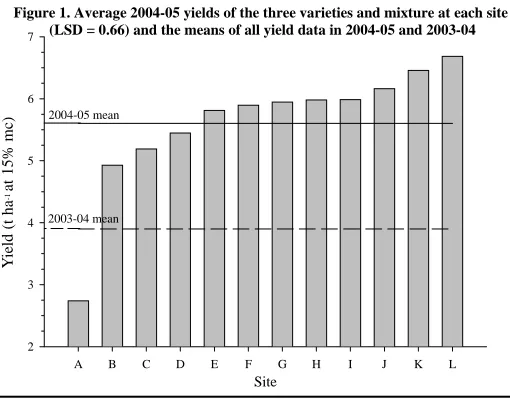
Twelve farmers across the country, from Cornwall to Norfolk, grew winter wheat varieties Hereward, Solstice, Xi19 and their 3-way mixture as a component of this exciting EFRC led, Defra-funded project OF0330 (Developing appropriate participatory methodologies involving farmers, researchers and seed suppliers working in partnership on varietal performance and seed quality research). For the second trial year, each variety was assessed for growth habit, yield and grain quality; the first set of data for yield is presented below.
Yield variation among sites was larger than the
difference between varieties; this is consistent with the results from the previous season. However, the overall average yield this season (5.60 t ha-1) was much higher
than in 2004 (3.9 t ha-1) (Figure 1). Yields at most sites ranged from 4.9 to 6.7 t ha-1, with the varieties at just one site averaging under 3 t ha-1. This was probably a result of late drilling the previous autumn because of the bad weather.
There was no significant difference between yields of the varieties and mixture. However, there was a significant (P < 0.01) interaction between site and variety; this means that the relative performance of the varieties differed at different sites.
The results from last year (BulletinNo. 76, January 2005) revealed an East-West split across the country; the wheat in the west was shorter but higher yielding, compared with the taller and lower yielding wheat in the East. In contrast, this year the wheat grown on the western sites was significantly (P < 0.001) taller than those in the east (77.6 cm and 70.1 cm in the west and east, respectively), although the differences were not as great as last year. The eastern sites also seemed to be lower yielding than the western sites, but this was due to the low yields at site A (Figure 1), which affected the overall average for the eastern sites.
[image:10.595.38.293.584.785.2]The next Bulletin will contain the results of the quality tests carried out on the grain; the combined analyses of grain yield and quality will permit a more in-depth analysis of the reasons behind the differences shown here.
Figure 1. Average 2004-05 yields of the three varieties and mixture at each site (LSD = 0.66) and the means of all yield data in 2004-05 and 2003-04
Site
A B C D E F G H I J K L 2
3 4 5 6 7
2004-05 mean
2003-04 mean
Y
ield (t ha
Summary
The researchers from IÖW (Institute for Ecological Economy, Berlin) found rather surprising results with their study about the real cost of a Schnitzel and they can be summarised as follows:
The extreme difference in price between organically and conventionally produced pork is due to the fact, that on one hand the comparatively high environmental cost for conventional pork is not included in the price, and on the other hand processing and distribution cost are significantly higher for organic pork.
The 60 percent higher producer price for an organic Schnitzel is based upon higher costs for piglets and feed, animal housing and higher labour costs.
A very important additional reason for the price difference lies in the fact that the detrimental
environmental effects and therefore costs, caused by the method of production, are not paid for by the farmers. The environmental damage is significantly higher in conventional as compared to organic production. Damage includes CO2-emissions and also pollution of water with phosphates, nitrates and pesticides. Because these costs are carried by society, they do not appear in the producer price of a Schnitzel. These kinds of costs are much lower in organic production, because chemical fertilizers and pesticides are not used.
In the production of one kg of organic as compared to conventional Schnitzel the following savings occur:
• ¼ of the energy
• ¾ of nitrogen pollution
• ¾ of green house gases
• 100 g mineral fertilizer
• 1,5 g pesticides
At the same time there are additional requirements in organic production, such as
• 50% greater land base for feed production
• 40 - 95% more labour
Environmental Cost
If the conventional producer had to pay for the real environmental cost (approx. 45 Cents for 1 kg Schnitzel), the difference to organic meat would be reduced from 83 Cents to 38 Cents per kg - that means from 58% to only 20% higher price. Instead of only 1,43
/kg of meat the conventional farmer would have to ask for 1,90 /kg, compared to the organic farmer whose
price would be increased only from 2,26 /kg to 2,28 /kg, because of the much lower environmental cost.
Marketing Cost
In the butcher shop organic meat can be as much as 90% more expensive than conventional meat. This has to do with very small amounts of organic in comparison to the total pig market: 61.000 organic pigs as compared to 10,5 million conventional pigs (the organic pig market is only 0,5% of the total market). Organic meat is a niche product within an extremely rationalized system of pork production. The costs for the investment of separate transport, slaughtering, butchering and distribution to the shops are relatively high. This leads to a reduction in demand and in turn again to higher distribution cost (a vicious circle).
Compared with conventionally produced pork additional costs for organically produced pork per kg are:
• 0,14 additional cost for transport to the slaughter unit
• 0,06 higher cost for slaughtering
• 4,00 higher cost for
distribution/marketing into the shop
The 4,00 higher cost for distribution/marketing between conventional and organic meat is due to the fact, that only the high value parts (fillet, ham, Schnitzel etc.) can be sold as organic, the rest has to be sold at conventional prices for processing into sausages. That amounts to approx. half of the pig carcass. The market for organic sausages is not sufficiently developed to take up all the lower value meat. If that situation could be improved and also this meat could be sold at "organic prices", a reduction in price for the other meat parts would be possible at the counter.
The following example shows that if the distribution system of supermarkets is utilized also for organic meat the difference in price at the counter is significantly reduced compared to a "normal" butcher shop. That difference is further reduced, if the environmental costs are included.
Research
What does a Schnitzel really cost?
Influence of environmental cost per kg pork
Summary of the "German Food Watch"- Study by the Institute for Ecological Economy, Berlin (2004). Edited Prof Dr H. Vogtmann, 2005
Technical
The influence of environmental and distribution cost on the price of 1 kilogramme pork WITHOUT
ENVIRONMENTAL COST Price convent. Price organic U in U in % from slaughter house
distribution
1,66 5,30
2,70 9,30
0,38 4,00
63 76 price at counter
(average in shops) price supermarket (selling conv. and organic pork)
7,00 7,00
13,00 8,50
6,00 1,50
86 22 INCLUDING
ENVIRONMENTAL COST price at counter
(average in shops) price supermarket (selling conv. and organic pork)
7,50 7,50
12,02 8,52
4,52 1,02
60 14
Biological Control Agents (BCA) in Crop and Animal Protection
Are BCAs the answer to a non-pesticide agriculture?
This article is a paraphrase of a presentation given to a symposium of scientists working on BCAs in many different forms and the sub-title (their choice) illustrates the communication gap that still exists. 'Non-pesticide' is only a part (and, in my view, a relatively small part) of what organic agriculture is all about. A review of the under-pinning principles of organic production will show that is general terms the use of BCAs is in reality no more acceptable than that of synthetic pesticides.
The position with respect to GMOs provides a parallel, although it is conceded that some limited use of BCAs is already accepted unlike the total ban on GMOs set out in both the EU Regulation and the National Standards. Any BCA proposed for use should be subjected to the most rigorous evaluation with respect to the environment, and health and safety. That said the use of risk assessments will not in any way guarantee acceptance by the organic farming community.
It is important for the wider community to realise that organic agriculture is based on principles and systems, and not a simple reductionist approach. If the
acceptance of inputs had been based purely on risk assessment in the past, organic agriculture today might look very different. It is possible that copper-based fungicides would not have been allowed and it is conceivable that some presently prohibited products might have been allowed. This last is something of a nightmare scenario as far as practitioners and supporters are concerned although the removal of copper would be welcomed by many.
The above is intended to illustrate the fact that BCAs have not and will not be embraced wholeheartedly by the organic sector but it has to be conceded that may be a limited number of areas in which they could be of use. Since this presentation was given a number of products have made it to the marketplace and some at least are being used by organic growers with the permission of their certifying bodies.
It should also be remembered that the use of composts, compost teas and other biologically active materials is a major strand of the use of biology in the control of pests, diseases and fertility. The key difference is that such materials rely on a wide spectrum of organisms to achieve the desired effects as opposed to the very specific isolates that are to be found in the proprietary products that are available or are under development. The use of such diversity clearly has much more in common with natural ecological systems.
The lesson I drew from the symposium in question was that many people had at that time a naïve and rather simplistic view of organic agriculture. I believe the position is changing all the time and there is generally a greater understanding but we still have a long way to go. Companies and researchers are still coming up with single shot answers to questions that are complex by their nature. If we are dealing with biological systems then changing one small aspect can have knock on effects right through the system. This is something we forget at our peril.
I was very pleased to have stimulated some response with the piece in the last Bulletin. One response focused on the relative lack of support for the horticulture sectorin terms of conversion payments. This has been a debate that has gone since discussion on support payments started back in the early 1990s and MAFF then Defra have resisted any differential support beyond the enhanced payments for the conversion of established top fruit orchards. The acceptance of the orchard case implies that a similar case could be made (and was made) for other categories of horticulture including field scale vegetable production, soft fruit, intensive salads and protected cropping. The problem related more to the size of the available budget than to any justified
distinction between orchards and the other sectors.
Our respondent feels that there is a case for re-visiting the issue and one reason for this is the relative reluctance on the part of small producers to become certified. This is so often based on the disproportionate cost of
certification for small producers (my rough definition would say anyone with less than 10 productive acres or 4 hectares). It is interesting that this precise issue is being debated and discussed in Wales. There is a clear
difference in support payments as the Organic Farming Scheme for Wales is still run as a separate scheme rather than being rolled into the Welsh Entry Level Scheme (Tir Cynnal) that has recently been approved by Brussels. The concept of enhancing conversion payments for the first 5 hectares of horticultural
production in Wales is under serious discussion as I write and more details will be supplied in futureBulletins. The work onimport supply chains, that EFRC is involved in, is already providing some intriguing clues as to why imports of organic vegetable are as significant as they are once seasonal issues have been taken into account. In essence there is insufficient land of the right quality being converted for the production of organic vegetable and salads. This applies not only to the supply of produce into the supermarket sector but also to the ever-increasing box scheme market that I referred to in the last article. It is of course technically possible to grow a wide range of vegetables in any part of the country but there is no getting away from the fact that some areas are better than others for the production of high quality crops.
Demand for fresh organic fruit, vegetables and salads continues to rise for all sectors of the retail market. It is even suggested that there is also a latent or unsatisfied demand for some lines. To some extent this demand can
be met from within the existing group of growers but even where land is available for conversion it is not necessarily registered because of the relative lack of incentive as described above. The evidence from our OCIS provision suggests that there is no rush by small growers to convert. Many of the visits are to small growers with an eye on a very local market and more power to their collective elbows.
This links to the second response to the previous article. It came not from a grower but a small livestock farmer who is quite frankly cheesed off with the global organic market, corporate certification bodies and the whole multiple retail sector. I hope to let him speak for himself by putting an edited version of his response into a future
Bulletinbecause it is cogent, relevant, timely and, most important of all, written from the heart. The link from farmer to grower happened in this case because of my reference to growers re-taking control of the food chain through the increasing importance of direct marketing.
This farmer has re-taken control of his particular food chain by selling his meat in the local farmers' market, an activity that addresses many of the current concerns about food miles, globalisation, the insecurity of future oil supplies, animal welfare, etc. He cannot understand why we are not all doing it. Of course it's the real world out there and this sort of thing is not going to change overnight but change it must and not in the long term -that could be too late. The idea of like-minded producer organisations such as the Organic Growers Association was also supported but my respondent thought that the present corporate organic sector would not tolerate it. He may be right but that is no reason for not giving it some serious thought.
Roger Hitchings, Head of Advisory Services
Technical
The Horticultural Market revisited
HDRA scoops Green Apple!
HDRA's Sustainable Waste Management team scooped a top Green Apple Award at a ceremony at the Houses of Parliament.
The team was thrilled to be declared "Green Champions" in the Partnership Category for its successful Cambridgeshire Master Composter Scheme.
This is the second year running that this project has won a Green Apple Award. These prestigious awards are arranged by the Green Organisation to acknowledge those initiatives leading the way in environmental protection around the world.
Anyone interested in finding out more about the Master Composter Programme should contact
If the Soil Association's (SA) latest look at the UK organic market is to be believed, something rather strange is happening. The nation's supermarkets are losing their dominant grip on organic food retailing with other local markets gobbling up a vastly increased share.
Overall organic food sales are growing at the rate of £2.3 million a week says the new-look SA Organic Market Report 2005, published in mid November. The report states the total value of organic product retail sales as £1.213 billion in 2004, up 11 per cent on 2003.
The real growth success story has been in box schemes, farm shops and farmers' markets - growing by 33 per cent in 2004 to an estimated value of £144 million to capture nearly 12 per cent of the market. Independent retailers also made big gains in market share to achieve sales of £159 million, that's 13 per cent of the sector. Their growth has been at the relative expense of the supermarkets whose organic market share fell for the third year running - down to just over 75 per cent in 2004. And that was the line that national newspapers and other media latched on to - the headline in The Guardian was typical - "Supermarkets lose out as organic food market booms".
EFRC has some questions about the validity of the SA's retail sales figures for the trading year January to December 2004. Despite it being accepted as a difficult trading year for food sales generally ( according to the Institute of Grocery Distribution) it is hard to believe that the value of supermarket share of the UK's organic product sales grew by just £34 million whilst between them other independent retailers and direct sales notched up growth worth £81 million.
Are the figures being moulded to fit the very laudable and currently trendy notion that organic must also equal local, ethical and sustainable and not be seen to be simply growing alongside the mighty powerbase of Tesco et al?
The SA says there are 379 vegetable-based organic box schemes in the UK.
An example of the successful uptake of veg box schemes is River Nene Organic Vegetables of Peterborough. Launched at the start of 2005, River Nene had grown to supply 4500 boxes a week after just eight months of trading. The heart of the operation is a grower's group of local Midlands and East Anglian suppliers with the aim of providing 80 per cent of the box contents throughout the year.
They have some way to go catch up with the market dominance of Riverford Farm from Devon which clocked a turnover last year of close to £20 million.
Another success story highlighted by the SA is in the growth of branded organic products. During 2004 the total UK yoghurt market grew by 6.5 per cent to a value of £750 million. Within this sector the star-performing Yeo Valley Organic brand experienced a growth rate of 22 per cent - faster than any other. Yeo Valley now accounts for 6 per cent of all UK yoghurt sales and it has over 66 per cent of the total organic dairy market.
Success has also been logged in the UK's tea and coffee market where the SA estimates that 15 per cent of the total consumer retail spend is on organic.
Against these market advances though are set a string of less happy developments, the most serious of which is the continued lack of real organic farming farm incomes and profitability across the UK. Downward price pressures across the food market as a whole continue to drag back organic commodity prices, says the SA. As a result, despite the buoyancy of the retail market many UK organic farmers are struggling to make a profit or break even. The introduction of the Single Farm Payment has not helped.
Particular concern is growing about the viability of organic beef and sheep enterprises with the beef sector particularly in serious trouble, says SA Head of Food and Farming Helen Browning. Despite signs that major retailers are keen to put UK sourcing at the top of their supply agenda, she is critical of UK supermarkets turning their back on UK suppliers and importing significant quantities of South American beef, even with the fact that UK farmers could have met processor requirements throughout 2004.
The organic beef import market to supermarkets is stimulated by confidence in supply, price benefits to the processor and the fact that specific cuts can be purchased en masse from such countries as Argentina while UK suppliers offer whole carcasses. In 2004 some 19,284 beef organic beef cattle were slaughtered in the UK, an increase of 4.2 per cent on 2003. They had a farm gate value of £13.7 million.
It is frustrating that supermarket imports of beef and also pork are out of step with the local market/food miles concerns of organic consumers and the aims of the Government's Organic Action Plan which aims to see 70 per cent of the temperate zone organic food consumed within these shores produced here by 2010. The SA
News and Reports
reckons the current overall self sufficiency level in such foods is 47 per cent, with little or no improvement having been made in the last two years.
At the report's launch in London, Helen Browning set the challenge for farmers, processors and retailers to make sure the eating experience of all organic food was enjoyable and tasty. "We must ensure that consumers buy organic more than once."
Some 686,100 ha of UK land is managed to organic standards across 4010 organic and in-conversion
holdings in the UK (3.7 per cent of utilisable agricultural area) as at January 2005. There is a growing trend in the figures to see larger, more mechanised UK organic farms producing keenly priced crops and stock which undercut smaller units. The average size of UK organic farms continues to rise.
* More than 300 Scottish farmers have dropped out of the Scottish Executive's organic farming schemeas subsidies have dried up and profit margins have tumbled, says Scotland's deputy environment and rural minister Rhona Brankin.
The high drop-out rate has come amongst hill farmers who thought organic conversion was a simple way to easy money, says the SA in Scotland. Since 2001 over £21.8 million has been spent by the Executive on organic conversion in what is now viewed as a seriously failed effort.
"This was a flawed scheme from the start which wasted taxpayer's money on nothing more than an artificial exercise in inflating the UK's "organic" farmed land area. It is a lesson in how not to target subsidy to our sector and has contributed in large part to the resentment felt by sections of the conservation movement in
Scotland to organic production and funding," says EFRC Director Lawrence Woodward.
The Scottish Executive set a target of doubling the area of quality land in organic production to 30 per cent by 2007 and so far reckons it has achieved 21 per cent. Overall though there has been a downward trend in Scottish farmland supported by the organic aid scheme since 2003.
Richard Sanders
News and Reports
EFRC Making Links
We continue to encourage links between EFRC and the local business community.
Bob Winfield, our Education Project Officer, took part in an Environmental Awareness Day for staff at the Sony UK offices in Thatcham on 24th October. He discussed and demonstrated sustainable farming methods and wildlife conservation with many of those attending, and has been invited to take part in similar events at other Sony offices.
New Publication from
Forum for the Future
"Fishing for good" by Jonathon Porritt with James Goodman was published in July 2005 and may be obtained by contacting James Goodman tel +44 (0)207 7324 3661 or [email protected]. Website www.forumforthefuture.org.uk
The book examines the dilemma of over fishing and Unilever's Fish Sustainability Initiative and the Marine Stewardship Council's work to avert tragedies such as the collapse of the Newfoundland cod fishery in the 80s and 90s.
Denmark has become the first country in the European Union to win EU permission to compensate farmers who are able to detect GMOs in conventional or organic crops, reports Reuters.
Last year Denmark approved a tough new law on GMO co-existence, the system by which three types of farming - GM, organic and conventional - minimise cross-contamination.
Now the European Commission has authorised the use of state aid by Denmark (initially around one million euros) for use as compensation payments to farmers who
can prove that they have suffered economic losses as a result of GMO crop contamination.
Under the Danish scheme, the Danish authorities will both make the compensation payments and recover equivalent amounts from the farm from where the GMO material has spread. In line with EU laws on GMO traceability and labelling, compensation will only be paid to farmers if the presence of GMO material exceeds 0.9%.
Report from Natural Products Online December 2005
Elm Farm Research Centre, Hamstead Marshall, Nr. Newbury, Berkshire
RG20 0HR United Kingdom
Tel: +44(0)1488 658298 Fax: +44(0)1488 658503 E-mail: [email protected]
EFRC's 2006 events
'Organic wheat and oat production- moving forward'
21st June 2006 27th June 2006
10.30am to 4.00pm 10.30am to 4.00pm
Wakelyns Agroforestry
Sheepdrove Organic Farm
Fressingfield Lambourn
Suffolk Berkshire
Come and be inspired by innovative research.
Evolving new winter wheat populations - now in the third year of trials at Wakelyns and Sheepdrove. Undersowing of winter wheat in practice; new husked and naked oat varieties; ideas for cover crops.
A tour of the farm will take you around the system and trials.
The day will include a delicious lunch, based on local, organic
ingredients.
Wakelyn's Speakers: Prof. Martin Wolfe (EFRC), Dr. Hannah Jones (EFRC), Geoff Claydon (Claydon Yieldometer ltd.) and Nigel Gossett (Organic Grain Link) (to be confirmed)
Sheepdrove Speakers: Dr. Hannah Jones (EFRC), Dr. Sarah Clarke (EFRC) and Andrew Trump (OAMG) Wakelyns:
Marketing with Organic Grain Link. See the new
'Claydon' strip
Sheepdrove:
Marketing with Organic Arable Marketing Group
Sustainable Alliances -
2006 Organic Arable Marketing Group Conference
The Organic Arable Marketing Group (OAMG) is to host an Organic Alliance conference on February 8th, 2006 at Harben House, Milton Keynes.
The conference aims to highlight the benefits of strategic alliances between organic arable producers and consumers and hopes to encourage further collaboration in the organic arable market.
It will focus on the existing integrated supply arrangement between OAMG, European Oat Millers and Alara Wholefoods to supply UK organic oats.
The conference will feature a series of technical sessions on organic conversion and protein production, to address supply concerns of the feed compound trade following the recent changes in the organic feed derogation.
There will also be a baking demonstration using flour of good specification and poor specification to show the difficulties caused by below specification wheat.
The target conference audience is organic arable producers; farmers considering conversion to organic production; and trade representatives for both feed grains and cereals for human consumption.