Rochester Institute of Technology
RIT Scholar Works
Theses Thesis/Dissertation Collections
8-10-2015
A Guidance Template for Attack Sequence
Specification in Cyber Attack Simulation
Derek Miles Kreider
Follow this and additional works at:http://scholarworks.rit.edu/theses
This Thesis is brought to you for free and open access by the Thesis/Dissertation Collections at RIT Scholar Works. It has been accepted for inclusion in Theses by an authorized administrator of RIT Scholar Works. For more information, please [email protected].
Recommended Citation
Rochester Institute of Technology
A GUIDANCE TEMPLATE FOR ATTACK SEQUENCE SPECIFICATION IN
CYBER ATTACK SIMULATION
A Thesis
Submitted in partial fulfillment of the
requirements for the degree of
Master of Science in Industrial Engineering
in the
Department of Industrial & Systems Engineering
Kate Gleason College of Engineering
by
Derek Miles Kreider
i
DEPARTMENT OF INDUSTRIAL AND SYSTEMS ENGINEERING
KATE GLEASON COLLEGE OF ENGINEERING
ROCHESTER INSTITUTE OF TECHNOLOGY
ROCHESTER, NEW YORK
CERTIFICATE OF APPROVAL
M.S. DEGREE THESIS
The M.S. Degree Thesis of Student’s Name
has been examined and approved by the
thesis committee as satisfactory for the
thesis requirement for the
Master of Science degree
Approved by:
____________________________________ Dr. Michael E. Kuhl, Thesis Advisor
____________________________________ Dr. Shanchieh Jay Yang
ii
ACKNOWLEDGEMENTS
First of all, thank you to my thesis committee, Dr. Kuhl, Dr. Yang, and Dr. McConky for their
continued support and guidance throughout the development of my thesis work. I have truly
learned a great deal of information and skills within the time I spent researching, developing, and
writing my thesis.
Also I thank Stephen Moskal and Benjamin Wheeler for the initial support and continued
support on the development of this cyber attack simulator. I am very appreciative to be given both
iii
ABSTRACT
Over the past decade the cost and frequency of cybercrime has skyrocketed and is still increasing
year over year. Major targets of cyber attacks are financial organizations, energy and utility
companies, governmental agencies, and technology companies. However, almost all businesses
are at risk. The increasing threat and cost of cyber crime is caused by many factors, including:
the increasing reliance on cyber networks, constantly evolving exploitation and cyber attack
methods, and insufficient development of defensive mechanisms to predict and prevent cyber
attackers. Promising research in the proactive defense against cyber attacks exists in the field of
cyber situational awareness (Cyber SA), but is limited partially due to the limited availability of
cyber attack data from desirable attack scenarios. This work improves upon previous
development of a cyber attack simulator capable of modeling complex cyber attacks consisting
of computer networks, their defenses, and cyber attacker behavior. The main contribution of this
work is the introduction of a new model called the Attack Guidance Template (AGT),
responsible for the definition of simulated cyber attack sequences and for guiding the attacker to
the goal of the attack sequence. The AGT allows the user to define desired cyber attack
sequences with flexibility and ranging levels of specificity. This work also introduces an attack
sequence analyzer to aid the user in understanding the likelihood of the model attack sequences
being accomplished successfully with different attackers across various networks. To ensure the
validity of these developments, both the analyzer and the AGT are verified and compared to the
iv
TABLE OF CONTENTS
CHAPTER 1: INTRODUCTION ...1
CHAPTER 2: BACKGROUND – MULTISTAGE ATTACK SCENARIO SIMULATOR ..5
2.1 The Vulnerability Hierarchy ... 6
2.2 The Virtual Terrain v2 ... 8
2.3 The Attacker Behavior Model ... 8
2.4 The Scenario Guidance Template ... 9
CHAPTER 3: PROBLEM AND SCOPE ...12
CHAPTER 4: LITERATURE REVIEW ...16
4.1 Computer Networks ... 16
4.2 Stages of a Cyber Attack... 19
4.3 Previous Cyber Attack Simulators ... 21
4.4 Cyber Situational Awareness ... 23
4.5 Cyber Attack Models ... 24
CHAPTER 5: CYBER ATTACK AND NETWORK DEFENSE SIMULATOR (CASCADES) ...26
5.1 The Simulation Core ... 26
5.2 The Context Models ... 27
5.2.1 The Computer Network and Dynamic Defenses ... 28
5.2.2 The Behavior of the Attacker ... 29
5.2.3 The Attack Guidance Template ... 29
5.2.4 Context Model Interactions... 30
5.3 Simulator Architecture ... 31
5.4 Contributions and Focus of this Work ... 33
CHAPTER 6: DESIGN OF AN ATTACK GUIDANCE TEMPLATE ...34
6.1 AGT Overview... 34
v
6.1.2 Structure and Functionality ... 35
6.2 AGT Components ... 36
6.2.1 Machine Level Templates ... 37
6.2.2 Sequence Level Templates ... 40
6.3 An Example Attack Sequence ... 43
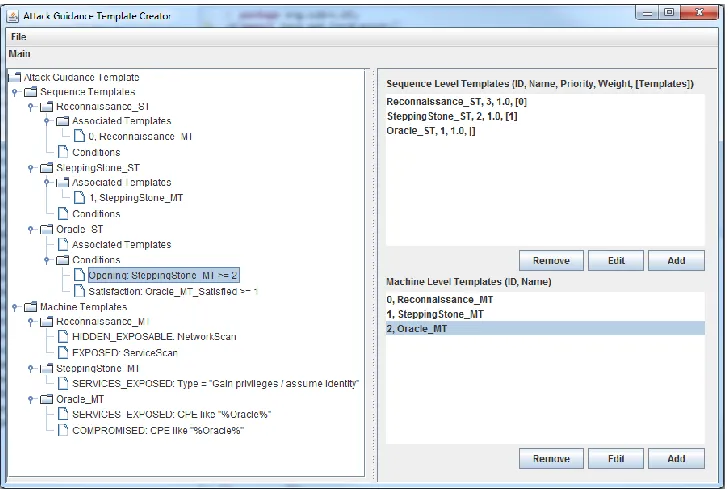
6.3.1 Creating the Attack Guidance Template ... 45
6.3.2 Attack Guidance Template Logic and Sequence Results ... 52
6.4 Verification and Comparison ... 55
6.4.1 Verification of AGT ... 56
6.4.2 Experimentation ... 57
6.4.2 Complex Sequence Comparison ... 60
6.4.3 Simple Sequence Comparison ... 65
6.5 Discussion and Limitations ... 67
CHAPTER 7: DESIGN OF AN AGT SEQUENCE ANALYZER ...70
7.1 Model Comparisons ... 70
7.2 Example Sequence Analysis ... 73
7.3 Current Limitations ... 75
CHAPTER 8: CONCLUSION AND FUTURE WORK ...77
8.1 Conclusion ... 77
8.2 Future Work ... 78
8.2.1 CASCADES ... 78
8.2.2 The AGT ... 80
8.2.3 The Sequence Analyzer ... 82
REFERENCES ...83
APPENDIX A: USER GUIDE ...84
A.1 Using the AGT Creator ... 84
Loading an AGT ... 84
Main Panel ... 84
Adding a Sequence Level Template ... 85
Adding a Machine Level Template... 88
Adding a Condition ... 92
1
CHAPTER 1: INTRODUCTION
Cyber attacks on computer networks are a large concern due to a heavy reliance of businesses
and government agencies on their cyber infrastructure. The cyber networks used by these
organizations are critical to their everyday business and often store sensitive information. A
cyber attack performed on such a network could allow an outsider the ability to gain access to
sensitive information, or even damage portions of the network, disrupting the organization’s
daily function.
Cyber attacks on such organizations are becoming a more frequent and more costly
problem year by year. Ponemon Institute conducts a yearly study to determine the cost of cyber
crime throughout the world. In 2013, Ponemon Institute collected a sample of 234 organizations
from various industries and reported that each organization incurred an average annual cost of
7.2 million dollars due to cyber attacks. This cost was a 30 percent increase from the 2012
average. (Ponemon Institute, 2013). During the 2014 study the average cost raised another 10.4
percent. Along with this yearly cost, it was reported that a single cyber attack took on average 31
days for an organization to resolve. Resulting in an average cost around 600 thousand dollars per
single cyber attack occurrence. (Ponemon Institute, 2014).
A major reason for the large growth is due to the inability of cyber defense measures to
keep pace with the constantly evolving methods of cyber attackers. The current methods of cyber
defense take a reactive approach where most networks that fall victim to a cyber attack are not
aware until a cyber attacker makes their presence known and have already retrieved the
information or performed the task they set out to do. A current common method of cyber defense
includes the adoption of an intrusion detection system (IDS). An IDS consists of a set of sensors
2
monitor both day to day activity, and detect unusual or suspicious activity by using techniques
such as anomaly detection, deep packet inspection, and/or signature matching. The outputs of
these sensors are alerts. These alerts are viewed by someone such as a system administrator or
network security officer who can try to identify any potential threats. Identifying these threats
and separating them from the day to day activity is however, not a simple task, everyday noise of
the network often muddles the true, ground truth alerts generated from a cyber attack. Along
with the everyday noise, cyber attackers are getting better at disguising themselves amongst the
noise. (Pathan, 2014).
For example, on larger networks, an IDS can produce tens of thousands of alerts daily,
the majority of which are associated with the noise of the network. The noise within a network is
defined as the everyday actions which can be considered nonthreatening. This noise can consist
of anything from bad password attempts generated by employees to software bugs causing the
generation of bad packets. Other alerts produced by these sensors are those produced by either
attacks or unwanted sources. These alerts can be indicative of malicious activity occurring within
the network due to a single or multiple attackers. The malicious alerts mixed in with the other
alerts generated from the noise, can become almost impossible to detect, and can occur either
very quickly or over a large period of time. System administrators or network security officers
are then tasked with attempting to identify these malicious attack-related alerts from the large set
and determining what course of action, if any, they should take.
Promising research in combatting cyber attacks and cyber threats exists in the field of
cyber situational awareness (Cyber SA). Cyber SA is centered on identifying and analyzing
cyber attacks as they take place within a network and then providing the relevant information to
3
problem and a broad field encompassing many areas of research. Cyber SA can be broken into
the following main steps: the recognition of an attack, the correlation and fusion of related
information, assessment of the current state and the impact on the network, and providing
potential future state scenarios, all of which must be communicated to the user effectively
(Tadda & Salerno, 2010). Being able to accomplish a useable Cyber SA system requires the
collaboration of several different fields of research. Many issues currently exist with the
development of Cyber SA algorithms, a main one being the limited amount of cyber attack
datasets available. These datasets are needed in order to develop, analyze, and improve upon
Cyber SA algorithms (Barford, et al., 2010).
Ideal datasets for Cyber SA research may include the reported IDS outputs during the
time of the attack, along with the ground truth, the actual alerts that were triggered by the
attacker during the time of the attack, and the corresponding actions which triggered the alerts.
Datasets of this caliber are very limited in number, most organizations that were exposed to a
cyber attack threat are not willing to release this information and data. Other techniques in
generating this data are very difficult and resource intensive. Furthermore, a researcher looking
to obtain these sorts of datasets will also want to analyze attacks of very specific setups. These
setups can consist of different networks, different attacker behaviors, and different attack
sequence goals. The lack of availability of datasets truly limits the development of Cyber SA
algorithms and tools, hindering our progress in the active defense against cyber attacks.
Due to the potential of Cyber SA and the problems currently faced, this research has been
conducted to use simulation as a tool to allow a user to simulate their desired cyber attack
scenarios. This will allow a researcher to produce the desired datasets, containing the IDS output
4
have been added with the development of a new state of the art cyber attack simulation software,
CASCADES: Cyber Attack SCenario And network DEfense Simulator, based off a current
simulator, Multistage Attack Scenario Simulator (MASS) developed by Moskal et al. (2014).
MASS is described in detail in the Chapter 2. The additional features will expand upon its
5
CHAPTER 2: BACKGROUND – Multistage Attack Scenario Simulator
This thesis work builds on current work by Moskal et al. (2014) and their development of a cyber
attack simulator. This background chapter is intended to review the overall structure and function
of Multistage Attack Scenario Simulator (MASS). (Moskal et al., 2014)
MASS is a simulation tool designed to produce IDS output created from a highly flexible
set of inputs. These inputs also known as the context models define the network to be attacked,
the behavior of the attacker(s), and goal(s) of the attack(s). To control the simulation of cyber
attacks MASS is composed of a simulation core. The simulation core drives the simulation by
referencing the four context models: Vulnerability Hierarchy (VH), Virtual Terrain v2 (VT.2),
Attack Behavior Model (ABM), and Scenario Guidance Template (SGT). These context models
provide the necessary input for the simulator to function. The VT.2 and SGT expand upon the
context models from previous works, the Virtual Terrain (Holsopple, Yang, & Argauer, 2008)
and the Guidance Template (Stotz & Sudit, 2007). Both models were previously implemented in
a cyber attack simulator developed by Kuhl et al. (2007), the initial inspiration for MASS. Each
of the context models used in the simulator are treated independently of one another and together
define the attack scenario to be simulated. An attack scenario consists of the simulation of a
single or multiple hackers (ABMs) with various attack goals (AGTs) within a network (VT.2).
6
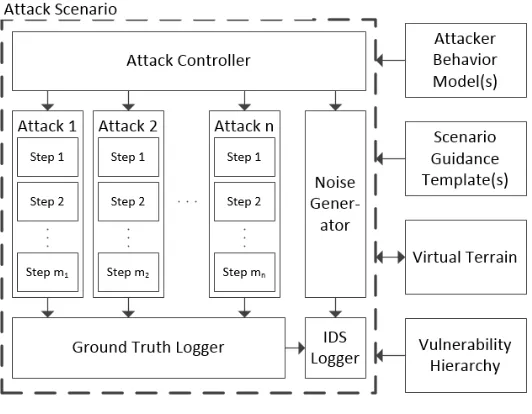
Figure 1: Overview of MASS
Overall, each context model plays a key part in the definition of an attack scenario and
each attack sequence. The VH defines and relates all of the information regarding the
vulnerabilities, the types of attack, the weaknesses exploited, the affected services, and the
exploit performed. The VT.2 defines the computer network, its machines, their services, and the
network’s connectivity. The ABM defines an individual hacker’s behavior including their
capabilities, preferences, skill, etc. The SGT intends to define the goal of the attack sequence and
guide the attacker to the defined goal. These context models are used by the simulator core to
control the simulation and produce the resulting IDS output and ground truth files (Moskal et al.,
2014).
2.1 The Vulnerability Hierarchy
The VH contains a hierarchical mapping of all of the potential vulnerabilities that the simulator
can use. The simulator employs the use of the National Vulnerability Database (NVD) developed
by the National Institute of Standards and Technology (NIST) and managed by the MITRE
Corporation to specify a default VH for the cyber domain. This VH is comprised of four-level
7
(CVEs). The CVEs are the exploits that can be performed to compromise a machine through the
unique vulnerabilities of the services or software. Each of these CVEs contain an associated
parameter to represent the difficulty of the exploit. The Common Platform Enumerations (CPEs)
represent the services that can be represented on the machine. The level above the CPEs contain
the Common Weakness Enumerations (CWEs), a set of categories that define the typical
software weaknesses. The final and highest level of the VH consists of CWE categories or types.
The types allow a user of the simulator to more easily select and define a cyber attack. Examples
of types include: “Denial of Service: resource consumption (CPU)”, “Modify Application Data”,
and “Gain privileges / assume identity.” A small section of the VH is shown in Figure 2. Level
one represents the CWE categories, moving to the CWE’s, CPE’s, and finally the CVE’s at level
four. (Moskal et al., 2014).
Figure 2: Subset of the VH (Moskal et. al, 2014)
To maintain up to date vulnerability exploit information MASS employs an automatic
update function that utilizes the NVD and allows the simulator’s VH to stay up to date as new
vulnerabilities and exploits are discovered and added to the databases. The CVEs are also
mapped to the alerts produced by the IDS sensors. The current setup for MASS employs the use
8
NVD, the VH also includes a reconnaissance category to allow a more realistic simulation. The
reconnaissance category enables the simulator to model network and machine discovery attempts
of the attacker such as ping sweeps, and port scans which are not considered within the NVD.
2.2 The Virtual Terrain v2
The VT.2 is a data structure which contains the information defining the computer network that
the attacks are going to be simulated on. The VT.2 is a graph like structure where the machines
are represented as nodes. These nodes can represent the servers, workstations, and routing
devices. Each machine of the VT.2 contains a set of parameters which define it including the IP
address, type of machine, monitoring IDS sensors, and internet visibility. A node that is not
considered a connector (e.g. routers, switches, hubs, etc.) can contain a list of services referenced
from the VH. Through reference of the VH, these services become the vulnerabilities of the
machines that the simulated attacker is able to exploit to compromise the machine. If an attacker
was to attempt an exploit and the machine had a sensor monitoring it, the attack would be
detected. Sensors contained on a machine can be setup to monitor certain areas of the network
and report the alert mapped to that exploit in the simulator sensor output (Moskal et al., 2014).
2.3 The Attacker Behavior Model
The third context model, the ABM allows the simulation of specific attacker behaviors. The
ABM contains parameters to describe their stealth, persistence, skill, attack preferences, and
node preferences of the hacker. Attack preferences can be made based off of any level of the VH,
and node preferences are based on the IP address of the machines within the network. This
allows the modeling of attackers that more commonly perform specific types of exploits as well
as model attackers that have preexisting knowledge of the network, developed through some
9
determines how often the attacker is capable of avoiding sensors and sensor detection. This
parameter can decrease the amount of alerts that are produced by the attacker throughout the
attack. The persistence of the attacker is represented in the average number of attempts an
attacker will perform of an exploit and for how many different exploits the attacker will attempt
on their target. The attacker’s skills and capabilities are represented by a skill level parameter.
This skill level is compared to the difficulty parameter that is defined on each CVE (Moskal et
al., 2014).
2.4 The Scenario Guidance Template
The final context model is the SGT, which represents a series of steps required to accomplish the
goal of the attack sequence and guides the attacker to this goal. The SGT can be thought of as a
graph like structure composed of nodes and arcs where each node represents a stage of the attack
while the arcs contain the required actions the attacker must perform in order to transition
between stages. After the result of each attack step, a single exploit attempt conducted by the
attacker, is determined the SGT is referenced to determine which arc will be followed. The
actions that are defined on each arc can reference any level within the VH and also if the
performed exploit was successful or not. A default arc is also implemented on each stage to catch
any unspecified conditions. Each stage of the SGT contains parameters allowing the user to
specify if the stage can be used as the starting stage for the simulation, if the stage is the goal of
the sequence, and if the target machine will be changed during that stage. Stages can also be
specified as restricted allowing the simulator to only attempt exploits that satisfy the conditions
on the arcs. This restriction setting is intended to guide the attacker along the defined goal
10
Figure 3: SQL Attack SGT (A: Recon, B: Network Scan, C: DoS Attack, D: MySQL Services) (Moskal et al., 2014)
Figure 3 created by Moskal et al. (2014) depicts a three stage SGT for an SQL attack. An attack
sequence using this SGT will begin on the first stage, “Information Gathering.” Since this stage
is restricted, the simulator will restrict the potential exploit choices to those that satisfy any of the
three arcs: level 1 reconnaissance, level 2 network scans, or level 1 DoS Attacks. An attack is
then selected and performed. If one of these conditions is satisfied a transition in the current
stage will occur. If none of the conditions are satisfied, the default arc will be used. As the
simulation progresses, the goal stage, “SQL Attack” may become the current stage and if arc (3,
D) is satisfied, meaning a machine was compromised through an exploit within a MySQL
service the simulation will end in success.
The four context models described previously are all controlled by the simulator core
logic. The core simulation logic is responsible in referencing each of the context models to select
the actions that will take place, and keep track of the status of the simulation.
The core logic begins with the attack controller whose purpose is to initialize and run
each individual attack sequence which consists of its own an ABM and SGT (attacker with a
goal). Once the attack controller creates the attack sequences, they are responsible for simulating
each of their attacks and tracking the attack’s status until the attacker has reached their goal or
11
During the attack sequences, attack steps are generated which represent an exploit
attempt performed by the attacker. A single attack step is performed by selecting an element
from each of the level of the VH, beginning at the highest level, type and then proceeding
through the lower levels. These selections at each level of the VH can be influenced by
restrictions on the SGT to guide, and by the preferences specified in the ABM to mimic an
attacker. If the current stage of the SGT is restricted, this forces the potential selections to those
that will satisfy one of the arc conditions in the current stage. The attacker’s preferences are then
referenced through the ABM to decide the exploit. Once an exploit has been chosen the
simulator checks to ensure the target machine is vulnerable to the attack and attempts the exploit
until the attack is successful or the attacker gives up. The attack step then returns its result to the
attack sequence to determine the effects of the action.
During the attack sequences, the attack steps and network noise are logged within the two
output files, the ground truth and the sensor output. The attack sequences reference the various
context models and the results of the attack steps they spawn to decide if the current target or
source need to be switched, the stage of the SGT should be changed, and if the goal specified in
the SGT for the attack sequence has been met. Once all attack sequences are completed, the
attack controller will end the simulation and make the output files available to the user. To
complete an attack sequence the goal can be met or the attacker can run out of actions to
12
CHAPTER 3: PROBLEM AND SCOPE
As stated previously, cyber attacks are becoming an increasing threat to the cyber infrastructure
that is used by society. Organizations face this threat, as they often heavily rely on a cyber
infrastructure for day-to-day business. These organizations often store sensitive and proprietary
data such as, intellectual property and customer/employee information. Hackers will often
attempt to target such a network to gain this information. Under the effect of a cyber attack an
attacker can also disrupt the organizations cyber infrastructure taking down valuable resources
such as a web server. Organizations do their best to defend against such attacks however
attackers are evolving at a faster rate than the defenses protecting the network. This increasing
threat of hackers and cyber attacks is also partnered with an increasing annual cost faced due to
cyber attacks.
Current methods in the defense against cyber attacks involve the implementation of
reactive defense mechanisms that are put in place to identify suspicious activity within a network
which may indicate the existence of a hacker. An example of such a mechanism is an IDS system
which monitors network traffic to produce alerts when suspicious activity is detected. Advanced
proactive defense mechanisms are being researched, however, the research is limited by the
availability of cyber attack datasets, which are limited in availability and very costly to generate
with current means. A preexisting cyber attack simulator, MASS has been developed to attempt
to produce these datasets. This thesis will expand upon the work conducted with MASS and
focus on the development of a new cyber attack simulator, Cyber Attack SCenario and network
DEfense Simulator (CASCADES). CASCADES aims to have additional functionality and
greater usability in the field of cyber simulation. The focus of this thesis will be on providing the
13
sequence and guiding the attacker along this goal. MASS’s current context model, the SGT is
responsible for this function, however, can be improved upon.
The current SGT poses limitations on the types of attack sequences a user can model and
simulate. The SGT is graph like structure which defines the goal of the attack sequence and
tracks the progression of the attacker along this goal. The SGT is also capable of providing
guidance to the attacker aiding them in the progression of the goal. A single stage of the SGT is
tracked throughout the simulation and the arcs from that stage represent the attacks that need to
occur to make a transition. This single stage tracking across the course of the simulation causes
complications when designing an SGT. An in-depth knowledge of the simulator core and the
other context models is required in order to setup an attack sequence that will be successful. A
user must consider how the simulator decides to switch machines and perform attacks. Along
with this the layout of the network, and the attacker’s capabilities must be considered. These
requirements limit the ability for these context models to be switched out for one another since
an SGT needs to often be tailored to a specific VT or ABM. Within the SGT, progression and
guidance is only based on the exploits that are performed through the definition of arcs. A user
may also want to guide the attacker based on the machines that have been uncovered throughout
the sequences of the attack. The definition of an arc allows a single vulnerability hierarchy level
to be referenced and only a single item within that level to be selected. Not being able to define
across multiple levels and group items together can cause the user to need to define additional
arcs to create their desired sequence. If these issues are addressed within a new guidance
template, a user will be able to more easily setup and design their desired attack sequences.
Along with these limitations many criteria are important to the overall design of a new
14
to ensure specificity, flexibility and ease of use. Users with different backgrounds may want to
define attack sequence goals with various levels of specificity. For example, a user of the
simulator may want to see an attack sequence where the attacker first penetrates deep into the
network creating various stepping stones, using specific privilege escalation exploits. After this
penetration the attacker is then to accomplish three DoS attacks throughout the network before
finally performing a SQL injection to obtain data from a SQL server. This example covers a
moderately detailed goal, and would be typical of a more advanced user. However, a user with a
deep knowledge of cyber attacks may want to go deeper and simulate a very particular sequence
of exploits, perhaps modeling an attack that has previously occurred on a real network. A goal
should however not be limited to this fine detail and a user may also want to just see a SQL
injection performed anywhere on the network. There are an infinite number of possibilities that a
user may want to simulate and the goal of the new guidance template is to be capable of defining
as many as possible.
To ensure flexibility, a user must be able to guide based on more than just the attack to be
performed and must be able to guide based on where the attack is performed as well. To provide
this, two segmentation levels of an attack sequence can be provided. The first level defines the
overall goal structure which can consist of sequence of attacks. The second level provides a per
machine look at the sequence, and the user can define categories of machines in which the
attacker will perform specific exploits depending upon that machine’s state. These two levels of
detail allow the definition of the goal to be highly flexible.
With the current simulator MASS, the context models are created and stored in XML files.
Storing and defining these context models in XML makes it cumbersome for a user to interpret,
15
and edit guidance templates graphically. A graphical user interface (GUI) will need to be provided to
define the details of the guidance template.
Along with the issues faced in the definition of a new guidance template and the
considerations to be taken, once the attack sequence is created, the user will also want to know if
it is likely to be successful. MASS currently has no visibility on this aspect. The complex
interactions between the network, attacker behavior, and goal of the attack sequence make this
determination difficult for the user. If an attack sequence is impossible or very unlikely the user
will have to perform countless simulations before achieving a successful result or giving up on
the attack sequence.
Overall, the focus of this thesis work will be in the development and definition of a new
guidance template improving upon the limitations of the SGT and taking into account the
considerations discussed. Along with the new guidance template, a GUI will be created to allow
the editing and saving of the raw XML data files the guidance template is stored in. The final
contribution of this work will be the development of a sequence analysis tool to aid the user in
16
CHAPTER 4: LITERATURE REVIEW
This chapter is intended to cover five topics related to this research problem including: computer
networks, stages of cyber attacks, previous cyber attack simulators, cyber situational awareness,
and cyber attack models. The first section, provides information regarding the basics of computer
networks. In this section basic networking principles are covered including network topology,
ports, services, and intrusion detection systems (IDSs). The second section covers the common
stages of a cyber attack. This chapter is intended to provide a reader with little to no knowledge
in this field a basic understanding of a computer networking and the progression of an attacker
within a network during a multistage cyber attack. Research into cyber situational awareness and
cyber attack modeling are relatively new fields, while the first cyber attack simulator was
developed in 1999. Although the early development of cyber attack simulators, not much has
been done recently to further this research. This literature review will serve as a discussion of
these topics, providing an overview to the relatively new field of cyber situational awareness,
and discuss the strengths and weaknesses of both cyber attack simulators and cyber attack
models.
4.1 Computer Networks
A computer network can be defined as a set of two or more computers, and other computing
hardware (e.g., printers, routers, modems, etc.) that are interconnected with the purpose of
communication and sharing of their resources. Computer networks are commonly classified
depending on the geographical spread of the network. This research will focus on local area
networks (LANs), networks in which the interconnected devices are located close together. LAN
17
business with hundreds or even thousands of interconnected computing devices, also known as
enterprise networks (Tanenbaum & Wetherall, 2011).
The physical setup of a network is called the topology, several types of topologies exist
each with their own set of advantages and disadvantages. Figure 4 shows a few example
topologies.
Star
Ring Tree
Figure 4: Example Network Topologies
Within a ring topology, equal access is given to all computers and signals sent to any computer
on the ring will be received by all intermediate computers. The computers must rely on each
other to send and receive packets of information and if one computer fails it will bring down the
rest of the ring. The star topology, a single central device controls the interactions between the
computers. Unlike the ring network, if one of the links or computers is to fail with exception to
the central networking device, the rest of the network will remain functional. The star topology is
also more desirable for a network administrator, allowing easy analysis of traffic and control
over the network through one central hub. The tree topology allows large scalability, and easy
expansion which is desirable in larger networks with multiple departments. Maintenance and
18
often to combine multiple topologies to form a hybrid topology or operate multiple LANs, in
order to better suit each department’s needs (Bonaventure, 2011).
Enterprise networks often employ a client-server model where two main types of
computers are used, clients and servers. While using this network model, servers are capable of
sharing their services with its connected clients. Services are software that provides a specific
functionality to that machine. In a client-server model, the clients send queries to the servers
requesting the use of their resource and the server will grant access to the client. Different types
of servers exist and are often categorized by the services they provide to its clients; examples of
servers include application servers, web servers, print servers, e-mail servers, etc. Clients are also
capable of possessing their own personal services as well. The services contained on the network
machines sometimes contain software bugs, or security issues. These issues contained within the
services are more commonly known as vulnerabilities, and if they remain unpatched can be
exploited by a hacker who can attack and gain access to the machine that is running the service
through the performance of an exploit. Once this is done, an attacker may be capable of
retrieving or deleting information, harming the machine, or using the machine as a stepping stone
to machines further within the network (Tanenbaum & Wetherall, 2011).
Machines contained on a computer network are interconnected and communicate through
the use of ports. Machines are capable of having multiple ports, each of which can communicate
with a single machine. Machines communicate through a network by sending packets of
information which contains data for how the packet should be routed, and what information to
send.
In order to monitor a network of suspicious and malicious activity, an intrusion detection
19
potential intrusions which are reported to a system administrator so they can decide how to
respond. There are three common detection methodologies that are used by an IDS: Signature
Based Detection, Anomaly Based Detection, and Stateful Protocol Analysis. Each of these
techniques use different methodologies to determine if the information it is analyzing has the
potential of being malicious by comparing the current information to commonly observed events
or predefined profiles and activities. IDSs are not perfect, and not all malicious activity will be
detected and reported to the systems administrator. The predefined profiles and activities do not
contain all attacks and malicious activity, hackers are also rapidly finding newer vulnerabilities
and exploits (Scarfone & Mell, 2007).
4.2 Stages of a Cyber Attack
A cyber attack can commonly be broken into five main stages: Passive Reconnaissance, Active
Reconnaissance or Scanning, Gaining Access, Maintaining Access, and Covering Tracks. This
section will go into detail surrounding these five stages (Skoudis & Liston, 2006).
Passive Reconnaissance
Active
Reconnaissance Gaining Access Covering Tracks Maintaining Access Low-technology Techniques Web Searches Whois Lookups Network Scanning Port Scanning Application Based Attacks Network Based Attacks
Denial of Service Attacks
Trojans
Backdoors
Rootkits
Altering Event Logs
Hiding Files/ Directories
Covert Channels
Common Techniques Stages of an Attack
Figure 5: The common stages of a cyber attack, and examples of common techniques used
During the passive reconnaissance stage of an attack, the attacker aims to gather as much
20
and even passwords. There are a variety of passive reconnaissance techniques an attacker can
employ to gather this data and include, low-technology techniques, web searches, and whois
database lookups. When used together these techniques enable an attacker to gain a great
understanding of the network before actively attacking the network. Low-technology techniques
involve gathering information without the aid of computer technology. Social engineering is a
common technique used, where an attacker will trick a member of the target organization into
revealing sensitive information. Another low-technology technique is dumpster diving for old
hard drives, thrown out documents containing system information, user lists, or passwords. Web
searches and whois database lookups are other types of passive reconnaissance that allow an
attacker to gain knowledge of the network. Through Google searches, an attacker can obtain
information regarding employee information, phone numbers, technology being used, and
business partners. Whois databases can be searched to determine an organizations IP addresses,
server names, email addresses, etc. (Skoudis & Liston, 2006).
The next stage of a cyber attack is active reconnaissance, also known as scanning and
begins the actual attacking of the network. The first step of active reconnaissance is to gain
information on the mapping of the network, and the available IPs for attack, this is known as
network scanning. A technique of network scanning is sweeping where the attacker pings, sends
a message to an IP address in the target network to determine if that IP is an active host. If a
message is returned, the IP address has an active machine. Once a machine if found port
scanning is performed. Ports act as the communication end points on the network and often are
linked to specific services. Multiple ports exist on a computer, and allow a computer to have
multiple connections with many machines. Port scanning is very similar to network scanning
21
often employed to scan a range of common ports, and determine if any of them are active.
Obtaining an active port gives the attacker a way to fully communicate with a machine and an
idea on which services are being run (Skoudis & Liston, 2006).
The third stage of a cyber attack is gaining access and is where the actual exploits are
performed on the network. This stage is performed using the information gathered in the first two
stages of the attack. There are various types of exploits which include application attacks,
network attacks, and denial of service (DoS) attacks. Application attacks are those performed by
exploiting vulnerabilities contained within the services of a machine. One of the most common
application attacks is a buffer overflow and allows an attacker to exploit poorly written code to
execute their own malicious code. Network attacks allow an attacker to manipulate the network’s
setup, and how services interact with other areas of the network. This can allow the attacker to
gain access to machines within the network. A common network attack is sniffing which could
provide a user with user IDs and passwords. Many other types of attacks exist, this research
focuses on application or service based attacks (Skoudis & Liston, 2006).
The fourth stage of a cyber attack is maintaining access, and implements a variety of
software to allow the attacker to access the machine in the future. Common techniques an
attacker uses to maintain access to a machine are trojans, backdoors, and root kits. The final
stage of a cyber attack is covering tracks and attackers employ techniques to alter logs, and hide
malicious files. Descriptions of these two stages are outside the scope of this research and are
covered in more detail in the work of Skoudis & Liston (2006).
4.3 Previous Cyber Attack Simulators
The initial cyber attack simulator was developed in 1999 by Fred Cohen and used his previously
22
threat profiles (attackers), attack mechanisms (attacks), and protective mechanisms (defenses).
Cohen’s cause and effect model formed links between attackers to attacks, attacks to defenses,
and attacks/defenses to their effects (Cohen, 1997). The simulator developed employed this
model to measure the effects of several variables, such as defensive strength and defense reaction
time on the outcome of the attack. The simulator developed however is based on predefined
models which were manually created and infeasible to keep updated within the current years
(Cohen, 1999). SECUSIM developed at the Hang Kong University, Korea in the Department of
Computer Engineering in 2001by Park et al. builds upon the previous work of Cohen. With the
addition of a graphical user interface, users of the simulator can, create customized naïve
network configurations, and specify attack mechanisms and defenses. Both of these simulators
used a naive representation of the computer network, not modeling specific vulnerabilities and
exploits (Park, et al., 2011).
Kotenko and Man’kov from St. Petersburg Institute for Informatics and Automation
created a software tool “Attack Simulator” with the purpose of performing analysis of computer
network vulnerabilities. Attack Simulator uses high level categories for attacks such as,
‘Identification of the host Services’ and ‘Escalating Privilege.’ To model the attack probabilistic
state machines were used sequencing each of these high level categories. Like the previous
simulators, a naïve network representation was used, and is no longer scalable to today’s
standards (Kotenko & Man'kov, 2003).
Kuhl, et al (2007), developed a cyber attack simulator in ARENA, a commercial
simulation software with the purpose of generating IDS alerts and a ground truth file associated
with the attack. This simulator was capable of allowing a user to model and setup a computer
23
consisted of a group of identical machines. Machines contained on the network had a few
parameters such as the type of operating system, the IP address of the machine, and if the
machines was observed by an IDS sensor. This simulator also employed a guidance template,
which became the base of the SGT. This guidance template was composed of nine separate
stages which represented high level hacker actions during a cyber attack. These stages were
formed into a graph to model the potential sequences of a hackers actions on a per machine basis.
An attack was chosen based on a categorized list of 2,237 exploits divided into 5 groups with in
total 23 subgroups. Within this simulator basic attack behavior was also modeled using three
parameters: efficiency, skill, and stealth. Within ARENA this simulator was capable of running
up to 25 attacks with 250 steps per attack. Also like the other simulators, this model captures a
high level simulation of cyber attacks, using a high level representation of the attacker and the
network (Kuhl, Kistner, Costantini, & Sudit, 2007).
4.4 Cyber Situational Awareness
Barford, et al. define three main phases of Cyber SA, Cyber defense can be broken into three
phases: situation recognition, situation comprehension, and situation projection. These three
phases contain multiple aspects, seven in total each of which are treated as different research
problems, however the integration of the solutions to all of these aspects is required to develop a
Cyber SA system. Table 1 shows the three phases and their corresponding aspects (Barford, et
24
Table 1: The various aspects of cyber situational awareness
Situation Recognition Situation Comprehension Situation Projection
Awareness of the current situation
Awareness of the quality of the observed and predicted information.
Awareness of the attack impact.
Awareness of the attacker behavior.
Awareness of how the
attack was caused.
Awareness of the
evolution and tracking of the attack.
Assess possible futures for the current situation.
The development of a cyber attack simulator capable of modeling diverse attacks scenarios and
attack behaviors can aid in the development of solutions to many of the above aspects. The
ability to provide IDS output will greatly aid in several of the aspects alone.
4.5 Cyber Attack Models
This section of the literature review is devoted to the discussion of cyber attack models. Research
in cyber attack modeling is expansive in both methods and area of focus. A large portion of
research in attack modeling has been focused on the concept of attack graphs which will be
briefly discussed. Along with attack graphs, a few other cyber attack models relevant to this
research problem will be discussed.
Attack graphs are a commonly used technique when it comes to modeling and forecasting
cyber attacks. An attack graph is a directed graph that can contain two types of vertices, network
security conditions and vulnerabilities. A fully developed attack graph is capable of modeling all
of the potential ways that an attacker can infiltrate a network. A highly scalable tool has been
developed called Topological Vulnerability Analysis (TVA) which is capable of performing
analysis of large networks and their vulnerabilities, and vulnerability interdependencies, through
25
of the potential attack paths an attacker can use to infiltrate a network which can be scanned into
TVA using a variety of network scanning software. In order to populate the vulnerabilities of the
network, TVA uses several vulnerability databases one being the NVD. After the attack graph is
generated, analysis can be done by TVA on various aspects such as, how a change of machine or
introduction of a new vulnerability can affect the network, which areas of the network are at high
26
CHAPTER 5: CYBER ATTACK AND NETWORK DEFENSE
SIMULATOR (CASCADES)
As time goes by cyber attacks and the defenses to prevent these attacks are becoming more and
more complex. In order to keep an accurate representation of this, a new cyber attack simulator is
in the process of being created. The simulator, Cyber Attack SCenario And network DEfense
Simulator (CASCADES) is based on MASS, and not only adds upon its capabilities, but it has
been designed to allow future revisions to be added more easily. This flexibility of redesign
allows the simulator to stay prevalent in the constantly evolving methods of cyber attacks and
defenses.
The additional features being implemented into CASCADES will allow a more realistic
representation of cyber attacks, cyber attacker behavior, the network, and its defenses. The work
of this thesis is, however, focused around the user, allowing them more flexibility and
capabilities with the design and setup of the attack scenario. This work will also provide the user
with the ability to analyze the various inputs before attempting to simulate the attack scenario.
The analysis will provide a look into how likely CASCADES will produce a successful result of
their designed attack sequences, and enable them to identify potential areas of redesign within
the various inputs.
5.1 The Simulation Core
A major redesign of MASS’s core is needed in order to allow CASCADES to have the needed
flexibility and model accuracy. The current design of the core limits the ability to easily add
additional features to the various context models which represent, the network, its defenses, the
attacker, and the goal of the attack sequence. This truly limits the simulator to staying current
with the evolving cyber world. With MASS the context models were designed to maintain
27
combination of the context models. This adds the capability of simulating various attacker
behaviors, and sequence goals, while maintaining the same network definition. This feature is
highly needed; however, the core of the simulator handles the processing and the communication
between each of these context models heavily, while the context models themselves are mainly
used as inputs to the simulation core.
With this in mind, the same flexibility will be kept allowing a user to easily swap in and out
context models. In addition, each context model will process its own information. The core of
CASCADES is designed to provide the communication between the context models,
congregating, translating, and relaying the needed information to each of the context models at
the correct time. Allowing the core to focus mainly on the communication and translation of
information allows new features to be implemented within the context models, or full redesigns
of a particular context model to be more easily accomplished. These adaptations and capabilities
of the core allow CASCADES to adapt and evolve along with computer networks, their defenses,
cyber attacks, and attacker behaviors enabling accurate modeling and simulation of cyber attacks
to be conducted in the future.
5.2 The Context Models
As mentioned, the context models will now not only provide the input to the simulator, but
process their own information providing ease of redesign and a more flexible core structure for
CASCADES. With addition to the context model processors, CASCADES will contain more
advanced context models enabling more accuracy and flexibility to CASCADES. Each of these
context models will contribute their own individual portion of the attack sequence. These attack
sequences can then be combined and simulated at the same time creating the overall attack
28
the attacker’s behavior, and sequence goal definition. Alongside these context models
CASCADES improves upon the modeling of the cyber attacks. The vulnerability hierarchy used
in MASS has been moved into an external database along with new information defining the
cyber attacks and their relation with the services within a network.
5.2.1 The Computer Network and Dynamic Defenses
In order to accurately simulate cyber attacks a representation of the computer network is needed.
CASCADES implements a context model called the dynamic virtual terrain (DVT) to do so. The
DVT allows the user to model a detailed computer network, containing machines, intrusion
detection systems, and dynamic defenses such as: IP address hopping, port hopping, and
dynamic firewalls.
For the model of the network the DVT adapts that of the VT.2 used within MASS.
Within the network model a user is capable of representing multiple machines, each with their
own services, ports, and permissions. Each of these machines can represent the various devices
that are contained on an actual network such as, routers, servers, host machines, etc. Intrusion
detection sensors can also be placed within the network. These sensors produce one form of
output of the simulator, and will spawn alerts dependent upon network noise and any actions
taken by the attacker on the IP range that that sensor monitors. The permissions that are defined
on each of the machines within the network represent the connections between the various
machines and their ports.
A new feature within this context model is the representation of dynamic defense
mechanisms such as, IP and port hopping. These defense techniques are promising researched
techniques that can thwart the attempts of an attacker by varying the machine information and
29
network, the defense can throw off the attacker and make their current knowledge of the network
invalid. This can cause the attacker to perform invalid attacks and allow the defender to prevent
an attack, or identify a current attacker within the network.
The new instantiation of the computer network and defense model was created by
Benjamin Wheeler. Through this work Wheeler analyze various IP and port hopping techniques
and also identified future areas of improvement for CASCADES. All this work is covered in
high detail by Wheeler (2014).
5.2.2 The Behavior of the Attacker
The second context model of CASCADES is the representation of the attacker behavior. The
majority of this model is currently in planning and development but will capture a more accurate
representation of the attacker’s capabilities, skills, and preferences. The ABM currently used in
MASS has various parameters that can be set to represent the capabilities, skills, and preferences.
It is, however, limited in the logic the attacker uses to progress through the network, and mostly
based on random selection. The current logic of progressing through the network is depth first
where each branch of connected machines is searched first before searching the breadth of the
network. The methods used in network search greatly limits the results of the simulator and the
accuracy of the model. In order to improve upon this, the context model will store the active
knowledge of the network and evaluate this knowledge to decide what attack and which area of
the network to perform the attack on. A base attacker knowledge was implemented by Wheeler
but is limited and cannot react to the moving target defenses that were added with the DVT.
5.2.3 The Attack Guidance Template
The final context model for CASCADES represents the definition of the attack sequence and the
30
replaces the Scenario Guidance Template (SGT) used in MASS. The SGT takes a high level goal
based view, defining which attacks are required to be performed by the attacker to reach their
goal. The SGT also has capabilities to guide the attacker along the attacks that are specified. The
definition of the SGT is however difficult and complex. The user must truly think about the
attack sequence being model in order to obtain a successful result. This requires a high amount
of knowledge regarding the simulation back end, the network setup, and the attacker behavior
which is unreasonable to expect of a user.
The focus of this work has been on the development of a new guidance model, the attack
guidance template (AGT). The AGT will improve upon the issues that are faced by the user
when setting up an SGT as well as, additional capabilities and the ability to specify attack
sequence goals at a higher range of specificity. The new model will provide the attacker with a
high level view of what targets and what attacks the attacker should attempt.
5.2.4 Context Model Interactions
With the combination of the three previously mentioned context models: the dynamic virtual
terrain, the advanced attacker behavior model, and the attack guidance template the user of the
simulator will be capable of modeling and simulating complex attack scenarios. Due to the
complex nature of these context models and their interactions a user needs the ability to
understand if the behavior, the network, and the scenario defined mesh well. If they do not, the
user may model an attack that is impossible or highly unlikely to occur resulting in a large
amount of time wasted performing unsuccessful simulations of their attack scenarios.
This issue was prevalent in MASS and this work has provided a remedy with an additional
feature. This new feature is the context model analyzer, and provides the user a way to view their
31
information regarding how well the context models complement each other and what problems
may exist within the current definition. From the analysis view the user can deduce potential
changes that can be made to the defined attack sequences. These changes can then be made by
the user and the analyzer can show their effects. Once a user is satisfied, the simulator can be run
with the edited context models ensuring more successful results are obtained.
5.3 Simulator Architecture
As mentioned previously, improvements and features have been added to the design of
CASCADES. Major improvements include the processing relief on the core, and the more
advanced, easier to use context models. With these changes the inner logic within CASCADES
now varies greatly from MASS and will be covered within this section.
The core architecture of cascades is composed of a few components each of which is
responsible for a variety of the processing. As discussed, the inputs to the simulator are the
context models. Each of these context models are defined within XML files which are parsed
into the simulator and passed to the first main processing component, the attack controller. The
attack controller is responsible for initializing the simulator and is part of the overall attack
scenario which consists of the network and the multiple attackers being simulated. The AGT and
ABM are paired together by the attack controller, and it spawns each of the individual attack
sequences.
Each of these attack sequences contains their own ABM and AGT processor which
handle the logic for each of the context models. The DVT processor and the vulnerability
database are externally shared by each of the attack sequences. Also within the attack sequence is
32
the necessary information between each of them. The process that the attack sequence core
performs is outlined below in the flowchart.
Figure 6: Flowchart of the simulator core attack sequence logic
Shown above, after the attack sequence is initialized, the AGT determines from the current
information which actions are available for the attacker. These actions are composed of both
what attack the attacker should perform, and where the attacker should perform it. After this
process is performed the sequence core processes the returned information and translates it to the
ABM processor. The ABM processor then chooses the action it would like to perform, if no
action is selected a new set of actions is generated by the AGT. Once the AGT is unable to create
any new action sets the sequence will be considered unsuccessful as no actions could be chosen.
If the ABM chooses an action it is performed and the result of the action determines the
necessary updates that are needed. The updates can be made to the attacker’s knowledge and the
AGT as well as, the ground truth and the virtual terrain machine states. Once this process is
complete the AGT is evaluated to determine if the goal was met. If so the attack sequence ends
33
Once all of the sequences have ended, the attack scenario is considered complete and the
outputs are produced from the information logged during each of the sequences. The two types
of output files produced are the ground truth files and the sensor alert files.
5.4 Contributions and Focus of this Work
As mentioned, this work focuses on the development of the attack guidance template, laying the
groundwork for future development of the CASCADES, and the development of the attack
sequence analyzer. The contributions made by this work aim to aid in the development of
CASCADES while focused on improving upon and adding additional features to MASS. These
improvements aim to increase the flexibility and the accuracy of the modeling and simulation of
34
CHAPTER 6: DESIGN OF AN ATTACK GUIDANCE TEMPLATE
The main contribution of this work is the creation of the Attack Guidance Template (AGT). The
AGT is one of the context models used by CASCADES in order to simulate cyber attacks. This
context model acts to guide the attacker along the attack sequence specified by the user. The
AGT accomplishes by keeping track of the attacker’s progress towards the completion of the
attack sequence, and providing a set of actions to the attacker to use their preferences to select
from.
Within this chapter the AGT will be discussed in great detail. An overview of the purpose
and requirements of the AGT will be discussed. Following will be a discussion of the structure
and features of the AGT, its components, and its processes. Following, will be an example
simulated attack scenario consisting of a single sequence that will provide a look into the exactly
how the processes of the AGT are implemented during the attack scenario simulation. A
verification of the AGT and comparison to the SGT is then provided and discussed.
6.1 AGT Overview
6.1.1 Purpose and Requirements
The overall purpose of the guidance template is to define the goal of the attack sequence and
provide guidance to the attacker along the specified goal. Within MASS the scenario guidance
template (SGT) served this purpose. The SGT was a graph like structure where the nodes
represented the stages of the attack, and the arcs represented the attacks that could be performed
to transition between these stages. The SGT was however very difficult for a user to define their
desired attack sequence goal. In order to define the SGT the user needed to deeply understand
how the simulator core controlled the attacker’s target and source selections, how the VT was
35
issues and add additional capabilities providing an easier understanding and implementation of
the guidance template.
The function of the AGT is to provide the ABM with a high-level set of actions to select
from that guide the attacker along the user defined goal for the attack sequence. This action set
intends to give the attacker a general idea of what to do next. This action set contains the targets
that are available and the attacks that should be perform on each of these target types. This action
set is first gathered by the AGT and passed into the core of the simulator. Within the core the
information is translated to the ABM. The ABM will then attempt to choose and perform an
action from the set using its capabilities, preferences, and skill set. Once the action has been
attempted, the information about the performed action is fed back to the AGT which will then
update and determine if the goal of the attack sequence was met or if the attacker needs a new set
of actions to select from.
In order to enable the AGT to perform this function the user must be capable of defining
a few things. The first is the actions that are available throughout the attack sequence. The next is
the actions that cause a change in the available actions or cause a progression towards sequence
goal. Along with this design requirement, an AGT must be able to be created at any level of
complexity and specificity. Allowing an AGT to do this will enable any level of attack be
modeled, whether it be a very specific attack path the user is trying to follow or a generic idea of
what they would like to see, e.g. perform a DoS attack.
6.1.2 Structure and Functionality
To meet the needs of the user and the functionality required of the AGT design choices were
made carefully. The AGT consists of two views which enable the user to define the sequences.