promoting access to White Rose research papers
White Rose Research Online
[email protected]
Universities of Leeds, Sheffield and York
http://eprints.whiterose.ac.uk/
This is a paper published in
Artificial Life XI
White Rose Research Online URL for this paper:
http://eprints.whiterose.ac.uk/74696/
Published paper:
Bryden, J, Hogg, DC, Popat, S and Wallis, M (2008)
Building artificial
Building artificial personalities: expressive communication channels
based on an interlingua for a human-robot dance
John Bryden
1, David Hogg
1, Sita Popat
2and Mick Wallis
21School of Computing,2School of Performance and Cultural Industries,
University of Leeds, Leeds, LS2 9JT, UK [email protected]
Abstract
The development of artificial personalities requires that we develop a further understanding of how personality is com-municated. This can be done through developing human-robot interaction (HRI). In this paper we report on the de-velopment of the SpiderCrab robot. This uses an interlingua based on Laban Movement Analysis (LMA) to intermediate a human-robot dance. Specifically, we developed measure-ments to analyse data in real time from a simple vision system and implemented a simple stochastic dancing algorithm on a custom built robot. This shows how, through some simple rules, a personality can emerge by biasing random behaviour. The system was tested with professional dancers and mem-bers of the public and the results (formal and anecdotal) are presented herein.
Introduction
Can the study of human-robot interaction lead to the devel-opment of embodied agents with emergent artificial
person-alities? We define an artificial personality as a machine that
is (and was been intentionally built to be) socially interac-tive. Socially interactive robots should:
“express and/or perceive emotions; communicate with high-level dialogue; learn models of or recog-nize other agents; establish and/or maintain social re-lationships; use natural cues (gaze, gestures, etc.); ex-hibit distinctive personality and character; and may learn and/or develop social competencies.” (Fong et al., 2003; Dautenhahn, 2007)
Focusing on studying systems that express and perceive emotion, we must understand the principles of emotional communication. We focus here on non-verbal commu-nication as much human-human commucommu-nication is done through body language (Mehrabian, 1981): i.e., communi-cation which is expressive in its nature. In the spirit of AL-ife research, we look for simple models that are hopefully applicable across a broad range of systems.
Considering expressive human movement, we take our inspiration from analysis of dance—an art-form of expres-sive human movement. Dance, and specifically expresexpres-sive
Attribute Description
Simple The protocol for communication between agents should use a tractable mechanism Expressive The protocol should be identifiable by
hu-mans as containing emotive human content Embodied The protocol should work in an embodied system—we use an improvisational dance
Table 1: The attributes required for our development of com-munication channels for an embodied artificial personality
movement quality in dance, has been studied in detail (La-ban, 1971; Laban and Lawrence, 1974). We therefore both explore the principles of dance to outline potential models of expressive communication and also test those models by embodying them in a dance context.
We specify the important attributes for our models of communication channels in Table 1. These three attributes (Simple, Expressive and Embodied) are important in the pro-duction of an artificial personality. We outline three commu-nication channels in this work and discuss them in light of the attributes given in the table.
From a broader scope, we also consider the relevance of the communication channels we have identified to an evolutionary or ALife perspective. Many artificial life projects look for emergent communication [see work by Quinn (2001), Marocco et al. (2003) and Nolfi (2005) for examples], where a new communication channel emerges in a system without any prior specification. Such emergent communication channels are interesting from an evolution-ary perspective as they can define simple mechanisms by which communication can occur with very little extra func-tion being developed. A sociobioligical definifunc-tion of com-munication (Wilson, 1975) sheds further light on the topic:
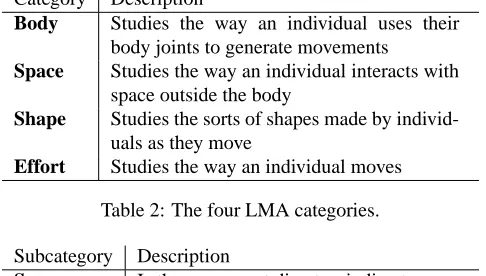
Category Description
Body Studies the way an individual uses their body joints to generate movements
Space Studies the way an individual interacts with space outside the body
Shape Studies the sorts of shapes made by individ-uals as they move
[image:3.612.53.296.60.198.2]Effort Studies the way an individual moves
Table 2: The four LMA categories.
Subcategory Description
Space Is the movement direct or indirect Weight Is the movement strong or light Time Are the movements quick or sustained Flow Are the movements under body control
(bound) or are they allowed to flow
Table 3: The four subcategories of the LMA effort category.
Given this definition there need be no intentionality on the behalf of the sender to transmit a signal—thus a commu-nication channel may emerge just from observations of an-other’s behaviour. We consider whether the expressive chan-nels of communication developed here are relevant as forms of emergent communication.
Dance background
The field of postmodern dance stands out as being particu-larly relevant to the direction of study outlined in the pre-vious section. Other dance forms, such as ballet, focus on structured movements. Ballet dances are commonly formed from a grammar of dance positions called Key Aesthetic
Poses. Expression is conveyed through changing the style
of movement between each dance position. Alternatively, postmodern dance seeks to remove all syntax and structure from dancers movements (Banes, 2003). Dancers are taught to unlearn their usual movement vocabulary so they can move on a purely expressionistic level. Commonly, dancers improvise in pairs (or greater numbers) where they each either copy, oppose or innovate qualities from the other’s movements. Since their movements are no longer con-sciously motivated they therefore become examples of emer-gent communication.
We look here at a method which is widely used for in-terpreting and understanding expression qualities in dance (Laban, 1971; Laban and Lawrence, 1974): Laban Move-ment Analysis (LMA). This has four main categories which are outlined in Table 2. As we are focused on movement quality, we looked more closely at the effort category, which has four subcategories outlined in Table 3.
In a modern improvisational dance context, the dancers make offers to each other through their movement quality. From an LMA perspective, movements can be classified and
dances can be interpreted through this language. In impro-visation, movement quality is often copied with occasional innovations and oppositions—this gives the dancers a sense of performative merging.
Other work
Previous work for generating expressive movements has fo-cused on a computer model of the human arm and torso (Chi et al., 2000) and a computer model of a ballet dancer (Neagle et al., 2004). In both systems, key positions and times were defined for body parts and heuristics, inspired by LMA, were specified for movement between positions. An important factor was found to be the velocity profiles of movement (Neagle et al., 2004).
The analysis of expressive qualities of human movements has been attempted before (Castellano et al., 2007). This ap-proach used features generated from many different move-ment characteristics (Acceleration, Contraction Index, Flu-idity, Quantity of Movement and Velocity) taken from ac-tors making gestures expressing one of four emotions (Joy, Anger, Pleasure and Sadness). Various classifiers were tested with the data in order to generate models which would identify the correct emotion using the features available. The most significant feature was found to be Quantity of Move-ment with the Contraction Index (the degree of contraction and expansion of the body) playing a minor role. However, the system was not able to classify all emotions accurately. The complexity of this approach is not compatible with our requirement that models be tractable (Table 1) because of the large number of features used by the classifiers.
The SpiderCrab system
Given analogues between LMA (see the Dance background section) and mathematical analysis, and success using it in the past, LMA was chosen to act as an interlingua for an im-provisational human/robot dance. The SpiderCrab robot was chosen to embody an artificial personality developed within the requirements of Table 1. The design phase of the robot was done through embodying it (into human form) at dance workshops. This was, in part, to study the application of per-formance arts methodology to the design process (Bayliss et al., 2007). It was also useful to form a picture of how the robot may be capable of expressive behaviour. In this project we focused specifically on the development of a controller for the robot to explore its potential as an improvisational dance partner.
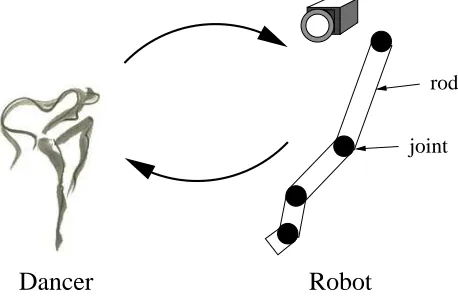
An overview of the system we developed is presented in Fig. 1. The Robot system has three subsystems: the
sen-sory input, robot controller and improvisation subsystems.
the robot should react to different sensory inputs from the dancer were made by the improvisation subsystem.
Dancer
rod
joint
Robot
Figure 1: An overview of the SpiderCrab system showing expression flowing within a closed loop between the dancer and the robot. The robot system controls the robot, respond-ing to the quality of the dancer’s movement by biasrespond-ing the robot’s random movements. The dancer responds to the robot’s movement.
The expressive communication model
The expressive communication model uses LMA to provide a common language for dancer and robot movement. For simplicity we focus on only one primary subcategory of LMA and analyse its role in the expression and communi-cation of emotion. We chose the weight subcategory in the
effort (see Table 3) category for several reasons. Previous
work (Neagle et al., 2004) has shown that it is possible to generate movement in a virtual dancer in which humans can distinguish three emotions: Sadness, Happiness and Anger. These same emotions can also be distinguished when hu-man dancers perform movements on different regions of the weight subcategory spectrum.
Two secondary subcategories of LMA were also consid-ered, to try and understand their roles in the expression of emotion. These were the space subcategory (see Table 3) which is in the effort category and the kinesphere subcat-egory in the space catsubcat-egory. The kinesphere subcatsubcat-egory relates to the area the dancer is moving within and how that relates to other dancers.
The two Effort subcategories were modelled as three dis-crete nouns (see Table 4). The kinesphere subcategory was modelled as a 3D coordinate which represented the position of the armband, and the 3D locations of the joints and rods of the robot limb.
Sensory input subsystem
A simple vision subsystem was used to generate real time data for our system. Some bright green material was fixed to the dancer (often as an armband) and its location was tracked
LMA subcategory Settings
[image:4.612.63.292.92.240.2]Weight Strong; Medium; Light Space Direct; Indirect
Table 4: The two subcategories of the LMA Effort category can have different settings in the expressive communication model. An LMA noun can be formed by choosing a set-ting from each subcategory, e.g., Strong+Direct would mean strong, direct movements.
by digital cameras. We recorded the centre of the green pix-els at each timestep on each camera’s image and this coor-dinate [x(t), y(t)] was used to generate measurements for each camera.
Measurements were taken using the values of x(t), y(t)
to model the two LMA effort subcategories, weight and space. First, we propose that the LMA subcategory weight of movement may be modelled by the power delivered to the armband over a period of time of lengthT. This is approx-imated by assuming the mass of the armband is 1.0 (we do not use standard units). The force on the armband is thus equal to the absolute value of the acceleration of the arm-band at the camera frame. The power over time T is given by,
power(t) = 1
T t
X
t−(T−1)
F l , (1)
whereFis the force on the armband attandlis the distance travelled by the armband over the timestep att. An alterna-tive measurement was also considered, the average absolute speed over timeT,
speed(t) = 1
T t
X
t−(T−1)
|s|, (2)
wheresis the speed of movement of the armband at timet. The indirectness of movement was also considered to model the space subcategory. To do this, the direction of movementθ was calculated at each timestep. The rate of change of direction can be approximated by takingdθ/dt=
θ(t)−θ(t−1). We introduce an indirectness measure over a period of timeT which is given by,
indirectness(t) = 1
T t
X
t
−(T−1)
dθ
dts
. (3)
Our indirectness measurement is greater when the
arm-band changes direction while moving quickly.
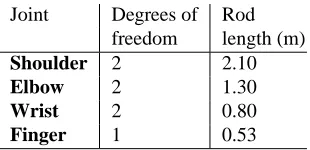
Joint Degrees of Rod freedom length (m) Shoulder 2 2.10
Elbow 2 1.30
Wrist 2 0.80
Finger 1 0.53
Table 5: The four joints of the SpiderCrab robot. The joints are connected in sequence. The Shoulder joint is fixed to the environment with each following joint connected by a sturdy rod.
identified by looking at the acceleration time trace: gesture start and end points were taken from when the acceleration moved from negative to positive values. Very short gestures (< 0.6 seconds) were combined together into longer ges-tures.
Tests with a simple 2 camera setup did not produce ac-curate enough 3-dimensional locations for the power and
indirectnessmeasurements. So we estimated motion
or-thogonal to the viewing direction of each camera using position in the image and assuming a fixed depth. This is a reasonable approximation assuming the dancer would stay roughly the same distance away from the cameras and face the cameras, although it will not include contribu-tions to power and indirectness that arise from motion in depth. Course grained 3-dimensional location information was generated for the kinesphere aspect of the Expression communication model by using a second camera and trian-gulating the position.
The robot and the robot controller subsystem
The robot1is a single limb with four joints, see Table 5. The robot was designed to interact with the public, so needed to be as light and flexible as possible. The four joints of the limb are thus moved using air muscles with each axis of rotation having a pair of air muscles—a flexion muscle and an extension muscle. Valves connected to the air muscles are computer controlled, letting air in or out and contracting or extending the muscle respectively. Sensors on each joint return its angle(s) to the controller.
The quality of movement of the robot is defined by one of the six LMA nouns given in Table 4. The current LMA noun is received from the Improvisation subsystem (see the next section for more details on the Improvisation subsystem).
To control the robot’s quality of movement, three variables are changed according to the LMA noun received from the Improvisation subsystem:
joint instruction length, robot movement power
andjoint direction consistency. A pair of air muscles
rotate the joint around an axis of rotation for a random
1
The robot was designed in partnership with, and built by, the Shadow Robot Company. Seehttp://www.shadowrobot. comfor further technical information.
period of time (selected from a flat distribution between 0 and 1) multiplied by the joint instruction length. The amount of air fed to the muscles (per second) is sampled randomly from a uniform distribution between 0.5 and 1.5 and multiplied by therobot movement power. At the end of each movement the joint either continues its rotation in the same direction or will reverse direction with a prob-ability depending on the joint direction consistency. If at any time a joint rotates past a limit (commonly the maximum rotation of a joint), the rotation direction will be reversed.
The three variables were set by hand for each of the six LMA nouns. They were tuned by assessing the robot’s movement by eye. The robot movement power variable corresponded with the weight subcat-egory, and the joint instruction length and
joint direction consistency variables corresponded
with the space subcategory.
The other important aspect of the robot’s movement is de-termined by the kinesphere subcategory of the LMA space category. Here the robot will either point the elbow joint toward the dancer’s general location, or ignore the dancer’s general location and move the elbow freely. When the elbow must point, it rotates toward the target with an angular ve-locity proportional to the target’s angular distance from the rod extending from the joint.
Improvisation subsystem
The robot was designed to perform within a postmodern dance improvisation context. This means that the robot will embody the expressive communication model by interfac-ing between the sensory input module and the robot con-troller. The improvisation subsystem implements an im-provisational dance by switching between three different modes: Copy, Follow-copy and Oppose. Table 6 describes the three modes.
Improvisation mode
Description
Copy The robot movement quality directly copies the movement quality of the dancer (using the effort and space subcat-egories of the LMA effort category)
Follow-copy
[image:5.612.97.252.52.127.2]As Copy but with the elbow joint point-ing at the dancer (uspoint-ing the kinesphere subcategory of the LMA space category) Oppose The robot movement quality is the oppo-site to that of the dancer (using the effort and space subcategories of the LMA ef-fort category)
The powerandindirectness measurements were used to identify which LMA noun the dancer was using. When in copy mode the dancer’s noun was output to the robot con-troller, when in oppose mode, the opposite noun (i.e., Strong →Light, Light→Strong and Direct→Indirect) was out-put to the robot controller. The robot cycled through the 3 modes spending 30 seconds in Copy mode, 30 seconds in Follow-copy mode and then a random number of seconds (between 5 and 15) in Oppose mode.
Essentially, the robot responds to three key elements mea-sured from the dancer’s movement: the weight of move-ment, the directness of movement and the location of the dancer. It responds by either producing movements with a similar quality, or by producing movements with an oppos-ing quality.
Evaluation
The SpiderCrab system was evaluated from two perspec-tives. First, we focused on the sensory input subsystem to evaluate its capabilities of perceiving emotional quality in movements. Second, the full system was evaluated by mem-bers of the public and dancers from the Salamanda Tandem dance company.
Sensory input subsystem evaluation
We tested the Sensory input subsystem over two dance ses-sions. In the first session the dancer was asked to make the same gesture with different qualities of movement. In the second session the dancer moved freely making varying gestures to different qualities of movement. Evaluations are made with reference to the attributes required by Table 1.
In both sessions the dancer stood at a fixed distance from a single camera. Approximately 20 gestures were made for each movement class by both dancers.
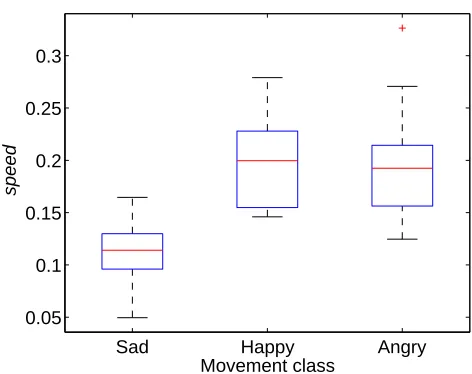
In the first session, we considered whether the sensory in-put subsystem was capable of assessing the emotional con-tent of a dancer’s movement (the Expressive attribute in Ta-ble 1). Dance movements were taken from three different movement classes expressing the three different emotions: Sadness, Happiness and Anger. For each individual gesture, the power and speed measurements (see Eqs. 1 and 2) were calculated using the Sensory Input subsystem. Box plots of the power data, collected within each movement class, are shown in Fig. 2. Box plots of the speed data, collected within each movement class, are shown in Fig. 3.
Figure 2 shows that the power measurement is a good choice for the Sensory Input subsystem to distinguish be-tween the three emotions expressed by the dancer. In fact, the mean absolute acceleration also worked well (not shown). We decided to work with the power measurement as it relates more closely to our sensations of moving in the three movement classes: in an ad hoc experiment, the per-ceived work done by our muscles when expressing the emo-tions correlated with the power recordings of Fig. 2. An
0 1 2 3 4
power
Movement class
[image:6.612.323.557.74.271.2]Sad Happy Angry
Figure 2: The same gesture made with movement quality expressing different emotions. The Sensory Input subsys-tem can distinguish between different emotional qualities of movement by calculating the power (see Eq. 1) delivered to the armband. Two-sample t-test comparisons between the three movement classes all givep <7.7×10−05.
0.05 0.1 0.15 0.2 0.25 0.3
speed
Movement class
Sad Happy Angry
[image:6.612.321.557.406.593.2]alternative measure of considering the average speed (or, by extension, momentum) of the armband did not distinguish between the Happy and Angry gestures (Fig. 3).
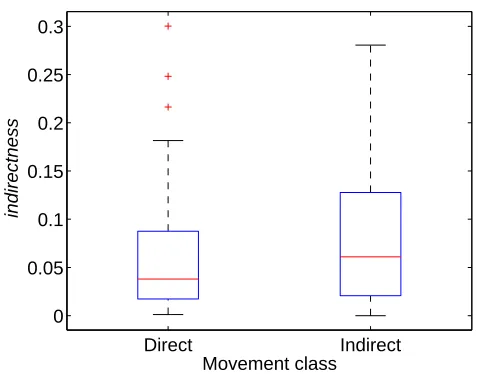
In the second dance session, a dancer was asked to per-form gestures freely with relevant LMA nouns of the weight and space subcategories of the effort category. This formed four classes of movement: Strong+Direct, Strong+Indirect, Light+Direct and Light+Indirect. The output of the power measurement for the strong and light movements is shown in a box plot in Fig. 4. The output of the indirectness mea-surement for the direct and indirect movements is shown in a box plot in Fig. 5.
0 5 10 15
power
Movement class
Strong Light
Figure 4: Varying gestures made with strong and light LMA movement qualities. The Sensory Input subsystem can dis-tinguish the quality of movement by calculating the power delivered to the armband. A two-sample t-test comparison between the two movement classes givesp= 0.018.
The Sensory Input subsystem was able to distinguish be-tween strong and light movements (see Fig. 4). In compari-son to Fig. 2, some gestures were of a much greater power. Greater power can be delivered to the armband when the in-dividual moves their body as well as their arm, rather than just the arm on its own. While the system had some success in distinguishing direct and indirect movements, the results were not significant. This was because it could not distin-guish between an individual moving to start a new gesture (not relevant within and LMA context) and an individual moving within a gesture).
Full system evaluation
We evaluated the full system based on an embodiment test for an artificial dancer partner proposed by Wallis et al. (2007). This argues that “success will be measured by whether or not the human dancer feels that he/she is danc-ing with a true partner”. With this in mind, we evaluated the
0 0.05 0.1 0.15 0.2 0.25 0.3
indirectness
Movement class
[image:7.612.320.559.50.237.2]Direct Indirect
Figure 5: Varying gestures made with direct and indirect LMA movement qualities. The Sensory Input subsystem is unable to distinguish between the two movement classes. A two-sample t-test comparison between the two movement classes givesp= 0.32.
robot using a professional and independent dance company that focuses on improvisational dance. The company, Sala-manda Tandem, use dance as a means of studying and devel-oping social interaction—particularly with disabled people including those on the autistic spectrum.
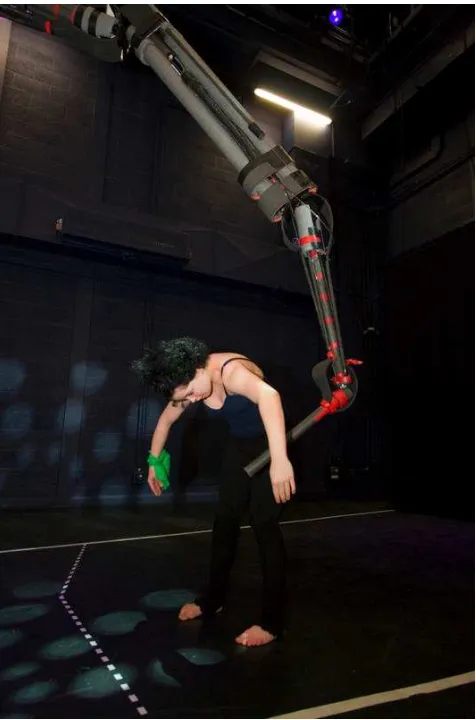
Dancers from the company danced with the robot (see Figure 6) over a period of two days and wrote a report (Jones and Hood, 2008) on their interaction with the robot. So that their experience was not biased in any way, the dancers were told as little as possible about the way the system worked before starting to dance, just that it would respond to move-ments with the green armband.
Their responses to dancing with the robot indicate that it had passed the embodiment test: the robot did feel like a true partner. One of the assessors stated that
“I felt apprehensive when approaching to move with the robot but it’s amazing how quickly I forgot it was a robot and was just dancing with another, it felt friendly” (Julie Hood).
Another dancer felt that
“[a]t first it’s like a robot, then you forget and you are having a duet, getting to know someone—shaking hands... You can build a connection in play and be imaginative with it... It becomes a human limb” (Mickel Smithen).
[image:7.612.56.293.211.399.2]Figure 6: A dance student dances with the robot.
expressive communication channel. When noise was intro-duced so that the system responded erratically (detecting movement when none was there), dancers felt it was less responsive.
Some comments picked up on how we might develop the robot’s personality:
“I’ve noticed in my work with people that there needs to be a pace, a sense of timing to encourage interaction to take place...I believe that SpiderCrab would need to be able to vary [its timing] in response to different sorts of people” (Isabel Jones).
Development along these lines could mean that the Spider-Crab system could become
“a fantastic tool to deconstruct and analyse human in-teraction” (Isabel Jones).
After a while, the dancers started to feel that the robot’s be-haviour was becoming a little predictable and that its qual-ity of movement was limited when compared with a human dancer.
The Sensory Input subsystem was shown, in the previous section, to be able to distinguish between movements ex-pressing different emotions. When the robot was placed in an environment with real dancers, the robot was clearly able to pick up on the weight of the dancer’s movement of the armband.
While there is a long way to go before the robot can fully identify the dancers’ movement qualities, the six dif-ferent qualities of robot movements were, however, quali-tatively identifiable from each other. Reports from dancers were that robot movements could range from “menacing” to “smooth”.
When the robot’s elbow joint pointed toward the dancer’s location, we had mixed responses. For safety reasons we had to slow the movement of the elbow. This meant that the robot was slow to copy the dancers’ movements. Some dancers did not notice the difference between the copy mode and the follow-copy mode. However, when the follow-copy mode was observed, some dancers felt that the robot was crowding them whereas others felt that the robot was being more friendly.
Discussion
In this project, we have developed a robot system that, through improvisational dance, is capable of bidirectional expressive communication. The SpiderCrab system can dis-tinguish between different human emotions, based on the quality of movement. Furthermore, the robot’s movements were responsive to the dancers’ movements and interpreted as such by the dancers. This meant that the robot was suc-cessful as an improvisational dance partner and was able to achieve social interaction [as specified by Fong et al. (2003); Dautenhahn (2007)] through the embodied expression and perception of emotions.
To consider the robot’s potential as an artificial person-ality, we review the communication channels used by the system in light of the attributes outlined in Table 1. Starting with the primary communication channel, the power mea-surement (see Eq. 1) does indeed satisfy all the required at-tributes for use in an artificial personality. This measurement was both simple in that it can easily be calculated and used, but it is also simple in that it is clear how expression can be transmitted through the channel—it can map neatly onto hu-man emotions (see Fig. 2). The success of the channel in the full system evaluation (including the fact that perception of the responsiveness of the system was impaired when noise was introduced) also means that it is successful as both an expressive and embodied channel.
The pointing or following behaviour of the robot (based on the kinesphere LMA subcategory) showed some poten-tial. This is simple to implement, is tractable, and maps neatly onto behaviour. The expressive quality of this com-munication channel relates to attention. The robot can use its physical location to pay attention to the dancer, or to move away to dance in a different space. It was difficult to imple-ment in the full system due to the inaccuracies in our mea-suring systems.
As far as the production of artificial personalities is con-cerned, there is potential to build more sophisticated mod-els into the robot’s Improvisation subsystem. This could al-low us to experiment more closely with different personality models and explore the system as a tool for analysis of hu-man interaction. The development of a methodological ap-proach for studying this in more detail is an exciting project. Insights into emergent communication channels can also be gained from studying the communication channels we have outlined. Put simply, the power measurement measures the amount of energy being expended by an agent during its movement. Observers can quickly make judgements as to an agent’s internal state based on this measurement and any other measurement that measures energy usage (e.g., sound volume, metabolic output, etc). It should be noted that it is also difficult for an agent to hide or fake its energy consump-tion so this forms the basis of a communicaconsump-tion channel that is unintentional and emergent and therefore likely to be an early channel to evolve. Looking for other, unintentional, movement channels may well be productive.
Acknowledgements
The SpiderCrab project was part of Emergent Objects 2 (http://www.emergentobjects.co.uk), funded by the Engineering and Physical Sciences Research Coun-cil and Arts and Humanities Research CounCoun-cil through their Designing for the 21st Century initiative (http://www. design21.dundee.ac.uk). Thanks to Richard Walker and Matthew Godden for building the robot and to Royce Neagle and the dancers at the School of Performance and Cultural Industries at the University of Leeds for dancing with the robot. Dancing for Figs. 2 and 3 was done by Royce Neagle. Dancing for Figs. 4 and 5 was done by Sita Popat.
References
Banes, S. (2003). Reinventing Dance in the 1960s: Everything Was
Possible. University of Wisconsin Press.
Bayliss, A., McKinney, J., Popat, S., and Wallis, M. (2007). Emer-gent objects: Designing through performance. International
Journal of Performing Arts and Digital Media, 3:269–279.
Castellano, G., Villalba, S., and Camurri, A. (2007). Recognising human emotions from body movement and gesture dynamics. In Paiva, A., Prada, R., and Picard, R. W., editors, Affective
Computing and Intelligent Interaction, Second International Conference, ACII 2007, Lisbon, Portugal, September 12-14,
2007, Proceedings: LNCS, vol. 4738, pages 71–82.
Springer-Verlag.
Chi, D., Costa, M., Zhao, L., and Badler, N. (2000). The EMOTE model for effort and shape. In Proceedings of the 27th annual
conference on Computer graphics and interactive techniques,
pages 173–182. ACM Press/Addison-Wesley Publishing Co.
Dautenhahn, K. (2007). Socially intelligent robots: dimensions of human-robot interaction. Philosophical Transactions of the
Royal Society of London. Series B., 362:679–704.
Fong, T., Nourbakhsh, I., and Dautenhahn, K. (2003). A survey of socially interactive robots. Robotics and Autonomous
Sys-tems, 42:143–166.
Jones, I. and Hood, J. (2008). Spidercrab robot evaluation for PCI Leeds University. Technical report, Salamanda Tandem.
Laban, R. (1971). The Mastery of Movement. Plays, Inc.
Laban, R. and Lawrence, F. C. (1974). Effort: Economy in Body
Movement. Plays, Inc.
Marocco, D., Cangelosi, A., and Nolfi, S. (2003). The emergence of communication in evolutionary robots. Philosophical Transactions of the Royal Society of London: A, 361:2397–
2421.
Mehrabian, A. (1981). Silent messages: Implicit communication of
emotions and attitudes. Belmont.
Neagle, R. J., Ng, K., and Ruddle, R. A. (2004). Developing a virtual ballet dancer to visualise choreography. In
Proceed-ings of the AISB 2004 Symposium on Language, Speech and Gesture for Expressive Characters, pages 86–97.
Nolfi, S. (2005). Emergence of communication in embodied agents: co-adapting communicative and non-communicative behaviours. Connection Science, 17:231–248.
Quinn, M. (2001). Evolving communication without dedicated communication channels. In Keleman, J. and Sos´ık, P., editors, Advances in Artificial Life: 6th European
Confer-ence, ECAL 2001, Prague, Czech Republic, September 10-14, 2001. Proceedings, pages 302–311. Springer, Berlin.
Wallis, M., Popat, S., Bayliss, A., McKinney, J., Bryden, J., Hogg, D., Godden, M., and Walker, R. (2007). Spidercrab and the emergent object: Designing for the twenty-first century. In Proceedings of dux07 (Design for User Experience 2007,
Chicago).