Commission of the European Communities
Directorate-General for Economic and Financial Affairs Directorate for National Economies and Economic Trends
EUROPEAN COMMUNITIES
COMMISSION
The Economic Situation in the Community
Contents
I. The overall situation
A. The economic situation: problems and short-term policy
B. Recent developments
1. Demand
2. Production and employment
3. Balance of the markets
C. Outlook
II. The situation in each of the Community countries
A. Germany
1. Recent developments
2. Outlook
3. The economic situation in West Berlin
B. France
1. Recent developments
2. Outlook
C. Italy
1. Recent developments
2. Outlook
D. Netherlands
1. Recent developments
2. Outlook
E. B.L.E.U.
Belgium
1. Recent developments
2. Prospects
Luxembourg
1. Recent developments
2. Outlook
Note:
Page
3
5
8
8
10
11
16
25
27 27 32 34
41
41
47
55
55
60
67
67
72
79
79
79
84
91
91
95
This survey was completed around mid-June 1970. As regards the most recent developments and where it has not been possible to take them into account because of the pace at which national statistics are prepared and the time it takes to publish the Survey in five languages, the latest issue of the "Graphs and Notes on the Economic Situation in the Community" can usefully complete the information supplied here.
I. THE OVERALL SITUATION
The economic upswing in the Community was still very vigorous during the spring. In most member countries utilization of capacity remained extremely high and inflationary pressures were still very marked.
Owing largely to the cooler business climate in the United States, demand from non-member countries made very little progress, but the drive imparted by internal demand gained still further in strength. Private consumers' expenditure, in parti-cular, expanded briskly, mainly as a result of massive wage increases. The growth of gross fixed asset formation, too, was very rapid. The Commission's investment survey, made in the spring, showed that firms' investment schedules, which were already very heavy as planned at the end of 1969, have been revised upwards in all member countries. Despite an appreciable degree of elasticity due to the effects which the liveliness of investment activity has had on production capacity, internal supply has failed to match the expansion of demand. The stresses affecting the labour markets in the Community have grown more severe. The pace at which imports are growing has gained speed and the trade balance has deteriorated further. With the high level of demand making it fairly easy for managements to pass on to their customers the sharp increases in costs they had been experiencing for some time past, the already very lively rise in prices gathered further momentum.
In the light of most of the indicators available, no great change in the trend is to be expected during the second half of 1970. Export demand will remain weak: internal demand will grow vigorously. The very high rate of increase of private consumers' expenditure will be maintained. The propensity to invest is still lively, so there can be little doubt that actual outlay on investment will continue to rise
4
strongly. There is a very serious risk that strains will persist on the markets in production factors, goods and services, and, consequently, that prices will tend to rise further. At consumer level this rise could, for the full year, be as much as 4:% % to 6 % in almost all member countries. The growth rate of the gross Community product can be estimated (in real terms) at 6 %.
A. The economic situation: problems and short-term policy
The Community is enjoying a boom which has been longer, but has also given rise to more strain, than any other since the entry into force of the Treaty of Rome.
The longest period of uninterrupted upswing in production registered before hsted from January 1959 to December 1961, covering three years. In this period, industrial production went up by about one third. In spring 1970, the Com-munity's industrial production was already 35 % higher than in April 1967, when the current phase of expansion began. Given the outlook for the second half of 1970, it is safe to assume that by December this key supply component will be about 40 % up on the level of April 1967.1 Employment touched a new
record in the spring of 1970 and unemployment in most countries had shrunk to its lowest point since 1958.
Inf,lationary strain, especially in the shape of mounting prices and costs, ha:s assumed unpre-cedented proportions. In annual average terms, consumer prices in the Community w.hlil pro-bably be more than 5 % up in 1970 on the level of a year earlier, having already risen very sharply ( 3 % ) in 1969. In investment, the upward thrust of prices is much more vigorous still. Although there are differences in the rate of price increase from one country to another, inflationary pressures are at the moment very heavy throughout the Community.
Inflation is, however, not confined to the Com-munity, for it 1s ,a problem in ailmost ailJl the western countries. In some of them, the rates
of
price increase ha'Jie also set new records. Economic trends in the western world have as a result become very unstable. Should there be sudden changes in the basic variables which govern the economic health of one or more important industrial countries, particularly in the field of production and employment, the system as a whole could suffer disruption and the effects of this could not fail to spread tothe Community countries. It is true that
econo-1 Calculated on the basis of the indices of industrial
production of the Statistical Office of the European Communities, adjusted for seasonal and fortuitous variations.
mic activity in the Community is less sensitive than a few years ago to changes in the merchan-dise trade flows between non-member countries. But by 1969 the Community's trade account (cif/fob), which in 1967 and 1968 had closed with surpluses of $ 730 million and $ 1 500 million respectively, roughly balanced out. In view of the current outlook for external trade, 1970 is likely to bring a deficit of the order of $ 1 500 million. Another factor is that of late there has been less room for manceuvre to offset by internal economic measures the desi-rable impact of world business trends on growth in the Community. For instance, the net foreign exchange holdings of the monetary authorities and the commercial banks are believed to have contracted by roughly one third since the spring of 1968 while trade and capital flows have been expanding vigorously.
As a result of the persistent in£lationary tenden-cies, however, the threats to future economic development have also been growing inside the Community. The longer the upward thrust of prices persists in a member country, the more acute is the danger of a sudden and sharp swing in the trend. Given the increased interdepen-dence of the economies of the member countries, this would affect the other member countries much sooner and much more than in the past.
In therefore remains an urgent task for the Community to eliminate as rapidly as possible the sources of inflationary pressure : heavy excess demand and a rise in incomes that far outstrips the scope for increased production. This is the only way to prevent business acti-vity once again getting out
of
hand, thus creatingthe danger of a recession-though not necessa-rily offering any immediate relief in the upward pressure on prices. In this respect current trends in other major trading countries are a warning to those responsible for economic policy in the Community.
The Commission has repeatedly drawn atten-tion to the dangers entailed by the increase in strain. In the Memorandum which it submitted on 9 July 19691 to the Council on the
"Main-1 Reproduced as an annex to Quarterly Survey
3/4--1969.
tenance of balanced economic growth", it emphasized that "top priority must be given to the removal of inflationary tendencies". In its Memorandum of 22 December 1969 on "The Community's economic policy in 1970'',1 it pointed out that inflationary strain was still severe or had even increased; it emphasized that "should it persist at its present level, expansion may fairly soon get completely out of control, and the authorities would then have to resort to a policy of almost Draconian restric-tions". In the conclusions of the Memorandum of 9 July 1969, the Commission pointed out that energetic, rapid action had to be taken if the imbalances were not to grow even further and become a permanent feature. To this end it proposed a set of measures by means of which the Member States, acting together, were to bring the inflationary process under control as rapidly as possible. In the Memorandum of 22 December 1969, it called for the strengthening of these measures to bring about disinflation in all Member States by means of rapid and ener-getic measures mainly concentrated on the first half of 1970. In both instances the Council endorsed the conclusions of the Commission.
The following analysis of economic develop-ments in the Community shows clearly that the results achieved are not satisfactory. In most Member States, the measures adopted in the past few months feU short of the guidelines drawn up by the Commission and endorsed by the Council. They were not sufficient to curb the expansion of domestic demand as much as was required in a situation in which the limited availability of factors of production made it impossible to step up supply fast enough in all sectors.
The spontaneous forces of expansion have re-mained extremely lively, particularly in the field of industrial investment. Industry's investment plans for 1970, which at the end of 1969 already implied an unsually sharp expansion of invest-ment spending (from 15 to 57 % according to country) have in the past few months been revised further upwards in all countries. And so far there is no evidence of the upward move-ment in wages, registered since the autumn of 1969, losing pace to any significant extent. The rise in wage costs per unit of output has been
1 Reproduced as an annex to Quarterly Survey
1-1970.
6
considerably higher than feared at the end of 1969. The strong upward thrust of wage costs has so far not encroached very far on the profit margins available for ploughing back : the wide-ning gap between demand and internal supply enabling firms to put up their prices conside-rably. The result is that on the internal econo-mic scene there has been a very marked tendency for the upward trend to gather strength from its own momentum. The inflationary climate at world economic level has in its turn facilitated the upward thrust of costs and prices within the Community because price increases in the other indus·trial countries have kept the pressure of external competition down to much the same level and because the deterioration in the cur-rent account has generally given little cause for concern so far or has even, in Germany for example, been a policy aim.
There is a great danger of expansion getting still further out of control in the months ahead.
The problem of restoring the basic equilibria is certainly not the same in all countries, parti-cularly as there are major differences in the speed and the vigour with which measures have been taken to combat inflation.
A contributing factor is that in some Member States the political situation or social problems have made full implementation of the guidelines proposed by the Commission and endorsed by the Council difficult to achieve. Indeed, in many cases the decisions taken in attempts to overcome social conflicts have made a return to the basic equilibria considerably more diffi-cult.
At the moment there is therefore a particularly urgent need to apply an overall strategy that is aimed at bringing inflation under control as rapidly as possible. This must be done not only with a view to consolidating social progress but also to ensuring that the economic situation does not deteriorate at a later stage in such a way that job stability and improvement of the stan-dard of living are jeopardized for the longer term. Under this overall strategy, each country should try hard to eliminate the causes of domestic disequilibria, so that the Community as a whole can become a centre of growth and stability.
into better equilibrium once again. Even more than in the past, public expenditure should be firmly held in check, taxes collected more ra-pidly, extra tax revenues frozen, and such bud-get deficits as still exist financed through long-term saving, despite the rise in tax revenues due to inflation. An increase in direct taxation and suspension of tax reliefs should also be contemplated.
Tax measures are all the more needed the smal-ler the contribution which saving by households makes to the non-inflationary financing of investment and the greater the danger of a further overheating of the boom.
The international seHing still appears to favour the maintenance of the restrictive monetary and credit policy required within the Community. However, the Member Statt:;_s would be well advised to concert their policies at once, well ahead of any change in conditions on the inter-national money and capital markets, particularly the Euro-market, as a result for instance of a relaxation of monetary policy in major non-member countries.
Preparatory work on the 1971 budgets should likewise be guided by a concern to restore the basic equilibria. To this end there appears to be a particularly strong need at the moment for more flexible deployment of the instruments of
budget policy and particularly for the creation of a "strategic reserve" on the revenue as well as the expenditure side, for use to counter busi-ness fluctuations; this need is strengthened by the fact that it can by no means be taken for granted in present circumstances that the eco-nomy will have been sufficiently stahilized by the beginning of 1971 and it is also not impos-sible at the moment that economic activity may 1>low down significantly later in 1971.
For 1971 the principle should be to place a strict limit on the growth of expenditure over the expected level of actual cash disbursements in 1970. Provision should, however, also be made for "counter-cyclical spending program-mes" which would have to be implemented
if
in the course of 1971 there were signs of an unduly sharp slowdown in economic activity and of appreciable threats to the level of em-ployment. On the revenue side, tax concessions should in no circumstances be granted until prices have been stabilized sufficiently.Policy for the second half of 1970 and early 1971 should therefore be concentrated on rapid disinflation of the economies of the member countries. The strategy used should be suffi-ciently flexible to permit at a later stage a prompt switch to policies ensuring growth, a high level of employment and stability.
B. Recent developments
1. Demand
The expansion of internal demand has been the main driving force behind the growth of econcr mic activity.
By contrast, export demand, as reflected in exports of goods and services to non-member countries, is still advancing slowly. From the last quarter of 1969 to the first quarter of 1970, the value of visible exports showed a seasonal-ly adjusted rise of 2 %. Given the persistent increase in export prices, it is quite likely that the volume of exports merely marked time.
This slackening in the expansion of exports is mainlly the result of the slowdown in trade between industrial countries, itself attributable largely to the cooling down of the business climate in the United States and to a lesser extent to weak economic activity in the United Kingdom and some other west European count-ries.
In the United States, the slowdown, which began in the autumn of 1969, has continued. In the closing quarter of 1969 real GNP was 0.1 % down on the figure for the previous quarter. In the first quarter of 1970 it
con-Visible exports to non-member countries
(Values and% change on preceding year)
1969
million Full 1st 2nd 3rd u.a. 1 year quar- quar-
quar-ter ter ter
All non-member countries 39 236
+
11+
3.5+
21+
9.5ofwhich:
Industrialized countries 2 25 605
+
12+
2.5+
21+
11including :
United States 5 958
+
3.5 - 15.5+
19+
1.5EFTA 12 744
+
13.5+
7.5+
17.5+
13United Kingdom 3 364
+
7.5+
2.5+
14+
7Developing countries 3 10 218
+
9.5+
7+
19.5+
7including :
Associated overseas countries and
terri-tories 2 295
+
11+
12+
39.5+
1Other countries 4 3 413
+
10+
3.5+
28+
4.5Source: Statistical Office of the European Communities (SOEC).
1 1 u.a. = 1 unit of account = 0.888671 g of fine gold = US $1 at the official exchange rate. 2 Class 1 of the Standard Country Classification for Foreign Trade Statistics of the EEC. 3 Class 2 of the Standard Country Classification for Foreign Trade Statistics of the EEC.
1970
4th 1st quar-
quar-ter ter
+
11+
16.5+
13.5+
20+
8+
22.5+
15.5+
18.5+
7.5+
4.5+
6+
8.5- 1.5
+
31.5+
6+
184 Class 3 of the Standard Country Classification for Foreign Trade Statistics of the EEC and other destinations.
tracted by a further 0.75 %. Although private consumers' expenditure recovered slightly, the growth of domestic demand was again distinctly slower, particulaPly as a result of the weak trend in stockbuilding. Following a short remission in March, mainly due to the end of a strike in electrical and mechanical engineering, the index of industrial production fell again in April; it is now more than 3 % lower than in July 1969. The unemployment rat:e rose to 5 % in May while prices continued to move upwards. Con-sumer prices were some 6 % higher than a year ear1ier. Wage costs also rose sharply (in the first quarter of 1970 they were 8.4 % up on a year earlier). Although the trade balance im-proved, the overall balance of payments closed with a heavy deficit in the first quarter.
In the United Kingdom, the main feature of the economy until April was a very favourable trend of the ba1ance of payments. Actual growth, however, remained weak. In April, industrial production was only 3.5 % higher than a year earlier while unemployment went up further, reaching the highest level registered in this month for 30 years. Export demand was again almost the only source of substantial stimulus, though. private consumers' expenditure also picked up slightly. There has been a particularly appreciable rise in prices. From December to May the consumer price index rose by no less than 4 %. The greater vigour of imports discer-nible lately is probably in part the result of special factors but in considerable measure also the reflection of the sharp rise in import prices.
While the trend of Community exports to the United States and the United Kingdom remained unfavourable, the Community's deliveries to the continental EFTA countries-notably Switzer-land, Sweden and Austria-climbed sharply, helped by the persisting boom in most of these countries. Exports to Japan also developed along very favourable lines. Sales to Canada and Spain, by contrast, where the restrictive measures are beginning to have increasing im-pact, have expanded slowly since the end of 1969. Deliveries to the developing countries have grown only modestly while the past few months have seen a lively growth in sales to the state-trading countries.
'
The growth of internal demand in the Commu-nity, which had slowed down somewhat at the beginning of 1970, largely under the influence
of special factors, has gathered distinct momen-tum again in the past few months.
Gross fixed asset formation, particulal'lly pur-chases of plant and machinery by firms, con-tinued to expand vigorously. The investment boom may even have gathered a little more momentum, notably in chemicals, mineral oils and metal working: the industries manufactur-ing plant and machinery and consumer durables are the growth leaders here. In agriculture and most branches of mining/quarrying, however, investment activity was weak.
Following unusually heavy production losses during the winter, building investment was gathering momentum in the spring. To judge from the trend of building starts, however, seasonally adjusted growth does not appear to be particularly fast, at least in terms of volume. There has been a sharp rise in industrial build-ing, but the growth of investment in residendal construction in the Community has probably tended to slow down further, at least to judge by what for several months has been a slack trend in building starts. The main reasons for this slowdown are probably the credit restric-tions, the high interest rates on mortgages, the impact of the more restrictive budget policy on subsidized housing and the appreciable rise in building costs in all Member States. Adjusted for seasonal variations, public expenditure on building also appears to have risen only slightly in the Community as a whale.
The tendency for stocks of raw materials and semi-manufactures to build up, noted in some industries at the end of 1969, appears to have continued. In Italy, where stocks dropped sharply as a resclt of the stoppages, they have swo1len again. The results of business surveys and the trend of delivery periods, particularly for consumer durables and plant and machinery, by contrast, suggest that in most industries of the Community stocks of finished products have remained comparatively low.
In the past few months, the faster expansion of demand has been mainly a matter of growing private consumption. Private consumers' ex-penditure continued to expand vigorously in all member countries., particularly as a result of the rapid rise in wages. With the social unrest subsiding, the growth of this demand component in Italy, where there were substan-tial wage increases, seems to have spurted
ply. In France, the firmer trend of expenditure on consumption appears to be mainly due to the faster rise in wages.
2. Production and employment
The expansion of internal supply gathered mo-mentum in the spring of 1970. This was partly because of special factors such as the sharp fall in the number of working days lost through strikes in Italy and the drive to make good the production losses suffered in the winter, espe-cially by the building industry, owing to the particUilarly bad weather. Production still show-ed an unexpectshow-edly great measure of flexibility, partly as a result of the commissioning of new plants.
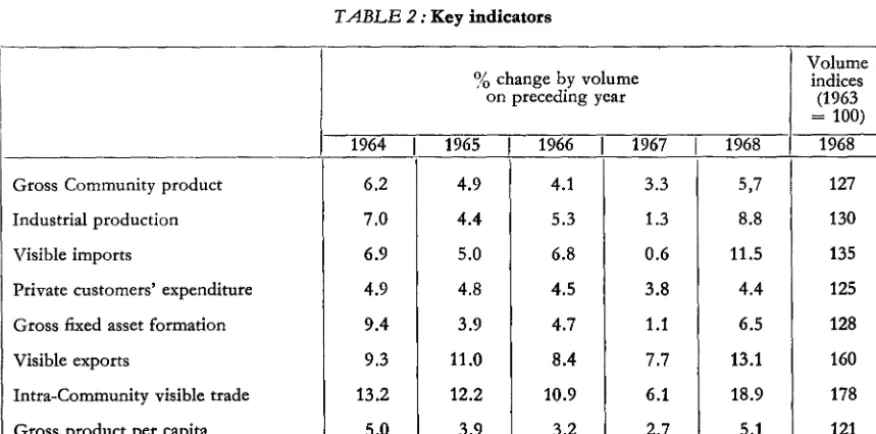
The index of the Statistical Office of the Euro-pean Communities (adjusted for seasonal :md fortuitous variations but excluding construction and food, beverages and tobacco) shows that in the first quarter of 1970 industrial production
in the Community was some 2
%
%
up on the closing quarter of 1969 and 9% %
higher than in the corresponding period of the previous year.
170
160
150
140
130
120
lndultrial production
I I I
I/
\.
I
1968
_..
y
1963-100
I I
CD
/
v
...v
_l_L I
1969 1970
The indicators available suggest that economic activity in the services sector has continued to expand at a lively pace.
Industrial production in the Community (% change on preceding year)l
1969 1970
1968 1969
1st 2nd 3rd 4th 1st
quar- quar- quar- quar-
quar-ter ter ter ter ter
Industry as a whole 3
+
8.8+
11.7+
13.0+
18.2+
9.7+
6.3+
9.5of which:
Germany
+
13.1+
13.8+
17.5+
14.8+
11.9+
11.6+
11.5France
+
4.0+
13.5+
10.8+
33.0+
9.0+
4.6+
5.6Italy
+
6.3+
2.8+
9.0+
7.9+
3.1 - 8.4+
3.7Netherlands
+
12.0+
13.5+
14.5+
12.9+
13.6+
13.4+
15.2 Belgium+
6.4+
10.9+
11.8+
12.7+
7.7+
10.8+
9.1 Luxembourg+
5.5+
13.4+
17.2+
12.9+
12.6+
11.5+
12.5of which:
Mining and quarrying
+
4.3+
4.1+
3.5+
8.1+
2.6+
2.2Textiles
+
9.2+
9.0+
10.8+
15.4+
5.2+
4.9Paper and paperboard
+
7.6+
10.7+
10.9+
14.1+
9.5+
8.4Leather
+
9.9+
51+
12.1+
11.4-
0.3 - 2.52Metalworking
+
7.3+
14.1+
15.5+
23.3+
11.8+
6.8Iron and steel
+
9.7+
8.8+
8.5+
17.0+
6.9+
3.7+
3.5 Electricity+
8.4+
10.2+
9.2+
14.7+
9.3+
8.4'
1 Calculated on the basis of the unadjusted indices of the Statistical Office of the European Communities.
2 Estimates made by the Commission's services.
3 Excluding construction and food, beverages and tobacco.
After several years of economic upswing, pro-duction is still expanding at a very rapid pace; this is all the more remarkable as the heavy strain on the Community's labour market has mounted further. As a result of the excess demand prevailing in the Community generally, of the definite underlying tendency-after al-lowance has been made for the special factors just mentioned-for the increase in production per person in paid employment to decline, and of the shortening of agreed working hours, there has been a further rise in firms' manpower re-quirements, particularly in industry and the services sector. In Italy, where productivity has no doubt gone up again appreciil:bly now that the social unrest has subsided, the drive to make good the losses of production caused by the strikes is likely to have entailed a heavier de-mand for labour. As a result, the numbers in paid employment in the Community as a whole increased; in some member countries, particulil:r-ly in Itaparticulil:r-ly, the extra labour was recruited from domestic manpower reserves, while in other countries, especially Germany, there was only very limited scope for doing so, given the very low level of unemployment. Generally, the num-ber of unemployed tended to decline further in all Community countries except France. The increased labour shortage has in the past few months encouraged immigration of workers from non-member countries; in some member countries, particularly in Italy, workers have, as a r~sullt of the shortage, probably also shown a stronger tendency to move to the more heavily industrialized parts of the country. The number of unfilled vacancies has nevertheless risen further in most member countries. Indeed, in Germany and the Netherlands, the seasonally adjusted ratio of the number of unfilled vacan-cies to the number of unemployed set a new record in May.
3. Balance of the markets
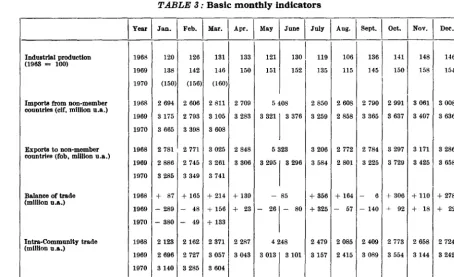
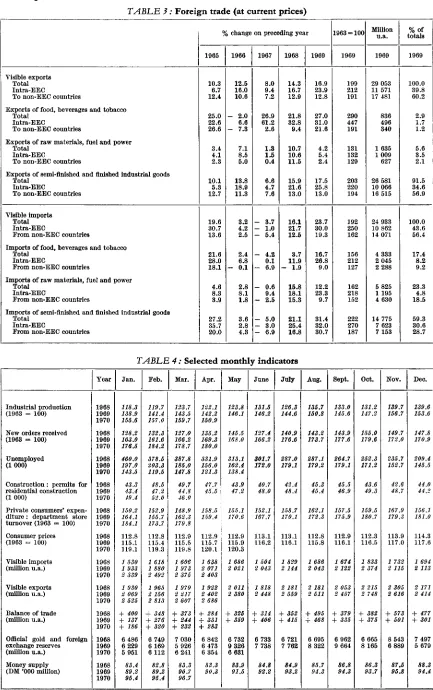
After the slight slowdown from October to January. which was partly attributable to for-tuitous factors, in particular the strikes in Italy, the expansion of the Community's imports from non-member countries has gathered momentum again. SeasonaJ.ly adjusted and in terms of value, visible imports from February to April are estimated to have been running 4.5 % ahead of the figure for the November-January period. In
April they were 17 % higher than a year earlier.
In the past few months the unusually rapid rise in investment by firms has led to a lively growth in imports of plant and machinery. Industrial production has been gathering momentum and stocks of input products in some countries, particularly Italy, have been well below normal levels, so that purchases of raw materials have also shown a further vigorous dse. Food im-ports, which had been marking time in the period up to the autumn of 1969, have risen once again appreciably (value figures) .
Almost aU supplier countries have benefited from the lively growth of demand from the Community, and indeed the boom in the Com-mon Market is at the present time the most important single factor maintaining world busi-ness and the expansion of world trade. The EFT A countries have again benefited most from the trend. There has also been a vigorous in-crease in impo11ts from countries in the Medi-terranean, particularly Spain, Yugoslavia, Greece and Turkey, and in imports from the associated overseas countries and territories.
The slowdown in intra-Community trade obser-ved at the end of 1969 has not continued in the past few months; since February growth has
been
gathering momentum again. From Feb-ruary to April, trade between the member countries showed a seasonally adjusted rise of about 8 % over the period November-January.3400 3200 3000 2800 2600 2400 2200 2 ()()()
Trade between member countries
I I I I I I I I I I
~
v
,,
/
k
1/
1-'
I
1968 1969
million u.a.
I
/
I I I I
®
"""
v
I
1970
Visible trade in the Community has been more buoyant partly because unfavourable fortuitous factors such as the strikes in Italy are now no
Visible imports from non-member countries
(Values and% change on preceding year)
1969 1970
Million Full 1st 2nd 3rd 4th 1st u.a. 1 year quar- quart- quar- quar-
quar-ter ter ter ter ter
All non-member countries 39 242
+
17+
12+
22.5+
14.5+
18+
17.5ofwhich:
Industrialized countries 2 22 236
+
19.5+
11.5+
26+
17+
22+
23.5including :
United States 7 326
+
14.5-
2.5+
25+
13+
21+
41EFTA 9 450
+
20.5+
16.5+
25+
18+
21.5+
11.5United Kingdom 3 588
+
19.5+
15+
24+
17.5+
21.5+
11Developing countries 3 14 222
+
13.5+
13+
18.5+
11+
12+
9.5including :
Associated overseas countries and
terri-tories 2 807
+
12.5+
9+
23+
7+
10.5+
31.5Central and South America 3 166
+
18+
14+
18+
21.5+
18.5+
7Other countries 4 2 784
+
15.5+
9+
18+
18.5+
15.5+
15.5Source : Statistical Office of the European Communities (SOEC).
1 1 u.a. = 1 unit of account = 0.888671 g of fine gold = US $1 at the official exchange rate.
2 Class 1 of the Standard Country Classification for Foreign Trade Statistics of the EEC.
3 Class 2 of the Standard Country Classification for Foreign Trade Statistics of the EEC.
4 Class 3 of the Standard Country Classification for Foreign Trade Statistics of the EEC and other sources.
longer operative. Purchases by Italy, for in-stance, have soared as economic ac~ivity has gathered momentum again. The rapid pace of growth has, however, also been determined by essential factors inherent in the business situa-tion. German imports, for instance, continued to rise vigorously as a result of the very heavy strains on the domestic market and the effects of the revaluation of the mark. In the Belgo-Luxembourg Economic Union, purchases from the other member countries, which had ceased rising since the autumn of 1969, picked up appreciably and the growth of imports gathered momentum in the Netherlands, too. In France, imports have also been reviving since the spring,
12
after having fallen 'significantly for a time imme-diately following the devaluation of the franc.
The lively growth of German imports was parti-cularly beneficial to Dutch exports- deliveries to Germany account for about 50 % of Dutch sales to the other five Community countries The faster expansion of purchases by Italy was in the main reflected in a vigorous rise in French sales. By contrast, the expansion of exports by the Belgo-Luxembourg Economic Union, inhi-bited by 'strikes in the motor industry, slackened for a time.
Changes in consumer price indices1
(%)
April1969 August 1969 December 1969 April1969 August 1969 December 1969 April1970 April1970
Germany
+
0.1+
1.5+
2.1+
3.8France
+
1.5+
1.9+
2.2+
5.7Italy
+
1.5+
1.4+
2.1+
5.1Netherlands - 0.5
+
0.9+
2.7+
3.1Belgium
+1.1
+
1.5+
1.7+
4.4Luxembourg
+
0.5+
1.6+
2.3+
4.41 The figures in this table can be used only as a guide. For statistical reasons, the accuracy with which they reflect
changes is not the same for every country.
may in the immediate future fail to •improve to any significant extent, have unfortunately not proved groundless. In the spring, the upward thrust of prices was still very strong everywhere. In some countries, particularly in Italy, the gap between supply and potential overall demand has indeed tended to widen further, while the rise in costs and particularly in wages has gather-ed additional momentum, especially in Ger-many, Italy and France. The very vigorous rise in producer's prices for industriaJ producrs shows particularly clearly how strong the pres-sure on the whole price system is.
The upward thrust of prices was strengthened by oo extremely sharp rise in farm prices owing to the unusually long winter. In France there was the addirionnal factor that some farm prices which had been temporarily detached from the common level of farm prices in connection with the deVlaluation were later brought back into line. Some other more or 1less autonomous factors also strengthened the essent.ial trends. This applies to France, the Netherlands and Belgium, where the cost-of-living index was forced up by the increase in public service charges .and a review of certain officially-controlled prices. In Luxembourg, the introduc-tion of VAT entailed only a comparatively modest rise in consumer prices.
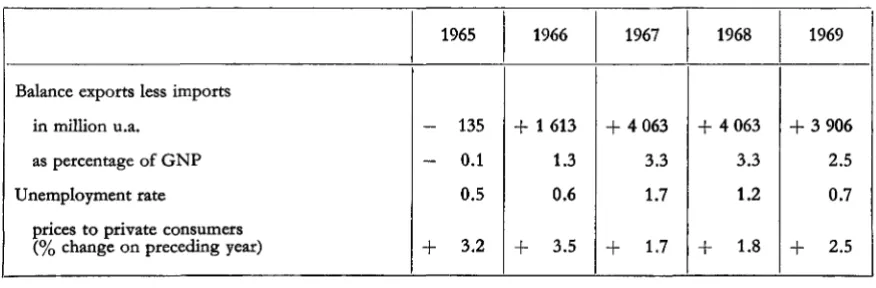
The Community's balance of visible trade with non-member countries tended to deteriorate further. In the first quarter it probably showed a defioit ( cif-fob) of about $ 300 million. The result was that the current account closed in the first quarter with an appreciably lower sur-plus than in the previous quarters. The
Com-Trade with non-member
countriet million u.a.
3800nn~~~TTrrn-rn<T,.TTrrrrrnn>oo,.
1968 1969 1970
munity's capital account, by contrast, improved considerably as exporrs of long-term capital, part:icularly from Germany, fell. At the same time the Community registered a substantial in£low of short-term capital. As the difference between Community interest rates and interest rates on money markets outside the Community, particularly on the Euro-dollar market, was widening, placing money in the Community became more attractive again. In addition, companies-especially German companies-were borrowing heavily abroad. On balance, it is probable that there has been a slight payments deficit in recent months. The gross gold and foreign exchange reserves of the monetary authorities nevertheless rose by some $ 800 mi:llion as the commercial banks, particularly in Germany, stepped up their foreign liabilities under the pressure of the domestic liquidity squeeze. The central gross foreign exchange reserves were also influenced by special trans-actions. The Bundesbank, for instance,
22000 21000 20000 19000 18000 17000 16000
Gold and tonip
exchange reserves
i/
~
i
h
1\
~
I I I I I
1968
million u.a.
I y I
@
~
J1\
'\
1/
\
\!/"
\I I I I I I I I
1969 1970
ed US Treasury bills for foreign unrestricted securities while the Banca d'Italia made substant-ial use ot swap facilities granted by the Federal Reserve Bank of New York. France, by con-trast, repaid by the end of April all of the short•term debts it had contracted with foreign central banks.
In most member countries the cash transactions of the public authorities had little if any ex-pansionary effect on domestic liquidity. In the first quarter, the German federal budget closed with a cash surplus that was higher than usual for the season, as tax receipts had mounted vigorously, moving in line with the trend of incomes and turnover. The French budget too may have shown significant surpluses as a result of high ·tax receipts and strict budget manage-ment. In the Netherlands, the cash deficit was much smaller than a year earlier. It was Hnanced exclusively by loans. The Belgian budget too showed a comparatively small deficit, mainly accounted for by short-term borrowing. In Italy, by contrast, government spending was heavy enough to engender a very high deficit, a1though tax receipts had been rising vigorously; short-term government indebtedness went up sharply in this country.
Bank lending to business and priv·ate customers has expanded appreciably almost everywhere. In the Benelux countries the volume of credit, which until the turn of the year had risen only slightly as a result of substantial inflows of liquidity from abroad (in Belgium there was an actual decline), is now expanding more firmly once again. In March and ApriJ., the Dutch commercial banks exceeded the credit ceilings and were therefore again required to maintain
14
interest-free deposits with the Central Bank. The Belgian monetary authorities maintained the limit on credit expansion in March but at the same time struck medium-term export .:re-dits from the list of items to which the ceiling applies. In Italy, the already very lively ex-pansion of credit has continued since the turn of the year. In Germany, demand for credit remained vigorous but was in part met from foreign sources. In France, where the volume of credit was marking time at the beginning of the year, lending was probably rising again at the beginning of the spring; sometimes lend-ing again appreciably exceeded the Banque de France ceilings. Since 31 March the Banque de France has required banks which exceed the credit ceilings to maintain interest-free deposhs with it; at the beginning of June it also increas-ed the minimum reserve ratios.
Under the influence of the trend obtaining outside the Community, interest rates on the money markets of several member countries declined for a time. The three-month rate on the Euro-dollar market, which was still 10.5 % at the beginning of 1970, was down to 8 % by mid-April but subsequently rose again to about 10 %. Only in Germany have interest rates gone up persistently, mainly as a result of the restrictive monetary and credit policy. By raising Bank rate from 6 % to 7.5 % on 9 March, the Bundesbank put up the cost of credit further. To ensure that this widening of the difference between German and foreign levels of 'interest rate does not lead to increased inflows of money from abroad, the Bundesbank introduced on 1 April an additional minimum reserve of 30 %
on the increase in liabilities to non-residents. With effect from the end of May, the rediscount quotas of the credit institutions have also been reduced by an amount equivalent to the increase in their liabilities to non-residents arising from
en pension transactions, i.e. operations involving
the lending of funds agaffist securities as col-lateral. Also on 9 March the Banca d'Italia in-creased Bank rate from 4 to 5.5 %, with the actual rate running at 7 % for most trans-actions. Both countries at the same time also
very great caution or because the public autho-rities floated comparatively large loans, for in-stance in the Netherlands and of late also in Belgium. After having been comparatively stable
in the first quarter, share prices in almost
aJl
member countries dropped sharply from the middle of April onwards as a result of the weak trend at the New York Stock Exchange.
Demand for and supply of goods and services
1967 1 1968 1 1969 24 1970 3 4
At current
prices % change on preceding year in '000
million u.a.5
Volume Value Volume
Gross fixed asset formation 81.5 + 6.6 + 8.7 +
Public current expenditure on goods and
services 50.3 + 2.5 + 7.7 +
Private consumers' expenditure 212.0 + 4.7 + 7.6 +
Gross Community product 352.8 + 5.7 + 8.7 +
Balance exports less imports (in '000 million
units of account) 5 + 5.9 + 7.0
Source:
1 Statistical Office of the European Communities, National Accounts 1958-1968. 2 Estimates. ·
3 Forecasts.
9¥2
4
6¥2
7
Value Volume Value
+ 16 + 8¥2 + 17¥2
+11 + 3¥2 + 10¥2
+ 11¥2 + 7 + 12
+ 12¥2 + 6 + 12
+ 5.1 + 4
4 Based on Community totals of the aggregates of the individual member countries at official exchange rates
ob-taining in 1963.
5 1 u.a. = 1 unit of account = 0.888671 g of fine gold = US $1 at the official exchange rate.
Note:
(a) The difference between the figures for demand and those for supply is accounted for by movements in stocks and differences in treatment of the balance of exports less imports.
(b) The estimates and forecasts are approximations based on certain hypotheses, generally mentioned in the Quar-terly Surveys. They have been discussed with the experts of the member countries but are established and published on the sole responsibility of the Commission.
C. Outlook
The expansion of trade between the industrial countries is likely to slow down further in the next few months, mainly as a result of weak economic activity in the United States and the restrictive measures adopted in most industrial countries. The stimulus to world trade deriving from economic activity in the Community and the United Kingdom will not suffice to offset the inhibiting innuence of these factors.
In the United States the economic ou~look is particularly uncertain. The wave of price in-creases continues although the business climate has cooled down very appreciably. There are, however, reliable indications that the trend will recover in the second half of the year. Private consumers' expenditure in particular can be expected to pick up appreciably. The 15 % increase in social security benefits, paid out in Apdl with retroacuive effect, and the wag~
in-creases for public-service officials have generated a substantial increase in the incomes of house-holds. Further stimuli to the expansion of private consumers's expenditure will come from the tax reform adopted at the end of 1969 and more particularly from the abolition of the income tax surcharge on 1 July 1970 and the gradual reduction of the tax burden on incomes of households.
The slight easing of credit policy already under way may also have a favourable influence on the business climate. In particular, the trend of building permits and building starts in resi-dential construction point to a revival, fairly moderate though it may still be, of activity in the bum ding sector. Official cash transactions
w~11 also make a substantially stronger contri-bution than originally expected. The Federal budget for fiscal 1969/70, for instance, which was to have yielded a surplus of more than $ 6 000 million, will close with a deficit of some $ 2 000 million, largely because of smal-ler tax receipts. A heavy deficit is at the moment also expected for the new fiscal year beginning on 1 July 1970 unless taxes are increased.
There is nevertheless not much chance of pro-duction reviving very sharply in the immediate future. As pdces have still been rising rapidly in the past few months, the authorities will
16
probably be careful not to ease credit restrictions on too generous a scale in the near future. To judge by the trend of orders in the industries manufacturing plant and machinery, fixed in-vestment by enterprises is also likely to expand only very sluggishly in the second half of 1970. The results of the latest investment survey by the Department of Commerce show that in-vestment plans in manufacturing industry have already been revised downwards very appre-ciably.
Even if the economy expands again in the second half of the year, real GNP for 1970 will probably show little if any advance over the previous year or may even decline slightly. Visible imports are therefore not likely to ex-pand compared with the previous year and, after the usual time-lag, they will probably tend downwards in the second half of the year.
In the United Kingdom, economic activity is likely to gather momentum in the second half of the year. Given the current wage claims and the reduction in direct taxation decided upon under the 1970-71 budget, disposable incomes of households can be expected to go up ap-preciably, probably 'leading to faster expansion of private consumption and stimulating produc-tion. The expansion of private consumption
in terms of volume may, however, be curbed by an appreciable rise in pcices. To judge by the latest trend of orders and given the easing of credit policy, private investment should continue to point upwards. The acceleration of general economic expansion expected in the second half of the year should entail a significant increase in GNP for 1970-of the order of 3 % in real term&--and lead to increasingly dynamic import demand.
Den-mark, the restrictions introduced at the begin-ning of the year in the fields of credit policy and public finance policy have been tightened of late with a view to restoring the balance of payments and the domestic economic and fi-nancial situation. The measures taken comprise in the main an increase in the VAT rate from 12.5 % to 15 % from 1 July 1970 and an immediate increase from 9 % to 15 % in VAT on imports. The economic trend in Austria and Switzerland, by contrast, will probably remain dynamic in the months ahead; towards the end of the year, however, it may well lose a little momentum as a result of the measures taken to combat inflation.
In Japan, where prices are still rising, economic expansion will continue at a rapid pace despite restrictive monetary and credit measures. The dmft budget for 1970 submitted at the begin-ning of February provides for a sharp increase in ,social expenditure. The tendency to dis-mantle obstacles to foreign trade, reflected in the liberalization of imports of some 60 items at the beginning of April, may spur on Japanese imports. In Spain, general economic expansion and particularly the rise in imports (subject since the end of 1969 to a 20 % compulsory advance deposit) will ag~in be held firmly in check.
Imports by the developing countries will pro-bably go on expanding in the second half of the year as the foreign exchange reserves of these countries have risen in the past few years and new international instruments of finance have become available to them, while the trend of world market prices for major raw materials has held firm and demand for their products, particularly in the Community and Japan, has remained vigorous. The growth of imports may well, however, slow down before the end of the year, especially in the countries which are most heavily dependent on trade with the United States and whose trade balances were already tending to deteriorate during 1969.
As numerous new trade agreements have of late been concluded between the Community coun-tries and the state-trading councoun-tries, trade with eastern Europe can be expected to expand fairly vigorously.
Given these assumptions as to the world eco-nomic trend and in view of the volume of trade with the various countries and groups of
count-ries mentioned and of the very high degree of capacity utilization in major export industries of the Community, it is likely that in the period up to the end of the year, Community exports to non-member countries will, taken as a whole, expand only moderately.
Almost all economic indicators available suggest that the growth of internal demand in the Community will remain very brisk in the second half of the year. In particular the strong ten-dency for gross fixed asset formation to expand will continue in the second half of 1970, desp'te previous assumptions to the contrary.
The first results of the Commission's investment survey carried out in the spring suggest that the propensity to invest will remain unusually strong; indeed investment plans for 1970, which at the end of 1969 were already very expan-sionary, have been revised upwards in all Com-munity countries. The flow of new orders for plant and machinery has also again increased appreciably throughout the Community, leading to a further lengthening of order books and of delivery periods in the capital goods industries. Neither the events of 1969 in the monetary field nor the substantial wage increases appear to have entailed any appreciable slowdown of the trend of corporate profits, particularly as in most cases demand has offered scope for major price adjustments. Nor has entrepreneurial drive in the Community so far been curbed to any important extent by the deteriorating ex-port outlook, sales potential inside the Com-munity remaining unusually good. The pressure of internal demand on the resources, the rise in production costs, labour shortages and competi-tion within the Community have continued to spur on investment. What is less clear is whether firms have always given proper atten-tion to longer-term profitability and whether in some industries the favourable trend of profits and demand at the present juncture may not have prompted managements to investments that may prove misguided. If the expected trend for the second half of the year is taken into account, expenditure on plant and machinery at current prices could well grow by 20 % for the full year.
Building investment, adjusted for seasonal varia-tions, is also likely to go on expanding. The key to this trend lies mainly in the persistently dyna-mic development of industrial building, where
Investment survey*
(% change in expenditure on preceding year)
Investment plans for 1970 Actual
investment
in 1969 autumn 1969 Spring 1970
survey survey
Germany 1
+ 36 + 16 + 22
France + 23 + 19 + 27
Italy + 15 + 41 + 42
Belgium 2
+ 35 + 3 + 56
Luxembourg 2 + 108 + 57 + 68
*
The survey covers most industries but generally excludes investment by public enterprises such as railways, postal services and electricity companies. The definition of investment is that of the national accounts.1 Excluding mining and quarrying.
2 Excluding mining, quarrying and food.
s For this survey, investment intentions in Belgium were expressed only in terms of "more"(= +)or "less" ( =).
the number of projects being executed and the level of orders on hand are very high. Invest-ment in residential construction, by contrast, should rise only modestly, although several member countries such as the Netherlands and France have adopted building incentives. With the expansion of public investment comparati-vely weak as a result of the restrictive budget policy, expenditure on building investment in 1970 w1ll, on balance, certainly rise less rapidly than expenditure on plant and machinery; nevertheless it will still expand considerably and be at least 13 % up in terms of value. The growth of building investment in terms of volume, however, will, as a result of the sharp price increase, probably be considerably smaller
and range around 5 %.
Private consumers' expenditure will maintain its very strong upward movement in the second half of 1970, mainly as a result of the continued lively rise in incomes of households. In addi-tion, the propensity to save may well decline in some countries, given the persistent inflationary climate.
The rise in incomes, particularly from pa.id em-ployment, will continue to be very vigorous. As in most member countries future wage nego-tiations will probably be conducted against a background of inflationary strain, there is reason to fear that the wage increases will considerably outstrip the scope for productivity gains and
18
will thus themselves strengthen and extend in time the upward price trend.
In most member countries, paruicularly the Benelux countries and Italy, the repeated acti-vation of the sliding wage scale may well lend addiuional vigour to the upward movement of wages. Only in France may the upward thrust of wages slacken somewhat, but the impact of this will probably be oHset by the tax reductions which are to be granted for lower incomes under the 1970 budget. These reliefs will make themselves felt mainly in the second half
of
year.Benefiting from the vigour of domestic demand, production will remain distinctly expansionary in all member countries. Its growth will how-ever be curbed, to an extent varying with the industry and the country, by the shortage of manpower and of technical production capa-cities. There is therefore little chance of in-dustrial production in the second half of the year growing from quarter to quarter, seasonally adjusted, by more than 1
'h
to 2%.
In 1970, the index of industrial production in the Community (excluding construction and food, beverages and tobacco) wil!l probably be about 8 to 9 % higher than in 1969.
well rise by some 6 % for 1970, i.e. somewhat more rapidly than assumed in the last Quarterly Survey.
The buoyancy of internal demand and the ten-. dency, typical of a persistent boom, for
pro-ductivity gains to weaken, will continue to exert an appreciable influence on the labour market; in almost all Community countries it will probably remain under very heavy strain. With the number of school-leavers tending to 11ise very slowly in ~some member countries, overall domestic labour reserves appear to be very limited. The persistently growing number of unHHed vacancies is in fact already several rimes higher than the number of persons seeking employment. The number of wage- and salary-earners will go up by some 2 % in 1970, but this increase will in large measure be attribu-table to immigration of labour from non-member countries.
In the Benelux countries and Germany, un-employment is down to a "hard core" level, for long periods are needed for the vocational retraining without which such unemployed as are available cannot acquire the necessary special skills.
In Italy, manpower reserves will still be fairly high, but here-as incidentally also in France-the distribution by region and industry and France-the skills offered pose problems which cannot be solved overnight.
In the circumstances, the lively growth of internal demand in the second half of 1970 will also entail a sharp expansion of imports. With the growth of exports probably only weak, the Community's balance of trade will tend to deteriorate further.
The outlook for the trend of prices in the second half of 1970 is unfavourable in most member countries.
The slackening in the pressure of demand at the end of 1969 has proved ephemeral; as expenditure on investment and consumption must be expected to go up rapidly in the second half of the year as well, there is little prospect of the wide gap between supply and potential demand being narrowed to any sufficient extent.
For the rest it must be feared that in most member countries supply will not be very
elastic. Experience in the recent past has shown that the long investment boom has stepped up capacity in some sectol's, but the pattern of capacity expansion is so uneven that more and more bottlenecks are obstructing growth, despite the scope for imports, particularly from member countries.
The persistently strained relationship between supply and demand is all the more disquieting because it is accompanied by a sharp rise in unit costs, particularly wage costs. As a result there is the danger of the most powerful price-wage spiral for twenty years.
All in all it must be feared that in 1970 con-sumer prices (as defined for the national accounts) will in annuarl average terms rise by 4
Y2
%
to 6%,
varying with the member country, except for Germany, where pricesare expected to rise by about 4 %.
The prospect that the distinctly inflationary climate will continue in most member countries makes it difficult to work out the tentative forecasts for the coming year which the Com-mission usually makes at this time of year. Forecasts of the trend in the Community in 1971 are largely dependent on the efficacy of the anti-inflationary policy discussed in general terms at the beginning of this Chapter. This is particu1arly true of developments within the Community.
The prospects for the world economic trend, into which the economic trend of the Com-munity is fitted, are relatively less uncertain, at least in respect of real trade flows. But developments within the Community will them-selves have a major impact on the world eco-nomic trend, particularly in view of their in-fluence on the business situation in some indus-trial countries which are important markets for the Community, and of impol't potential in the developing countries.
In any case, it is safe to assume that in the second half of the year the expansion of world trade will remain moderate. During this period its growth is likely to be curtailed by the trend of expansion in the Community, which must be expected to slow down although productive forces will continue to be fully employed. This factor can be offset only in part by the stimuli expected to come from a revival in the United States and faster economic growth in the United Kingdom.
For the second half of 1971 it is likely that the trend of world trade will be boosted by further expansion in the United States, the United Kingdom and some other industrial countries outside the Community. There is, by contrast, much uncertainty about the pace of growth in the Community and the indirect effects this will have, particularly on imports by the non-member countries.
In the United States, the revival of economic activity expected for the second half of 1970 is likely to continue in 1971 but the situation in respect of interna<l and external equilibrium will remain rather unstable. This will presumably lead the American authorities to maintain their cautious monetary policy, particularly as there is a danger of the expected budget surplus giving way to a heavy deficit. For the time being, the acceleration of general economic growth will in all probability stimulate employment and wages to only a modest extent. The trend of invest-ment in plant and machinery is at the same time likely to be fairly moderate. All in all, it is estimated that real GNP wi11 rise by some 3
%
%
in 1971. In the process, the propen-sity to import of the United States should grow.Against the background of a "middling" world economic trend, economic activity in the United Kingdom will probably gather slight momen-tum. Calculated for the year as a whole, rea] GNP may be up by 3
%
%.
Imports are likely to grow more rapidly than in 1970, particularly if the import deposit scheme is abolished before the end of 1970.In the other countries, the business trends are likely to develop along fairly diverse lines, but growth will probably be slower.
All in all, the world business outlook suggests that exports by the Community will accelerate somewhat in the course of the year, particularly in the second half. According to very tentative estimates, Community exports to non-member countries at current prices will grow by 8 % in 1971.
20
Certain componentJs of internal demand in the Community, particularly investment by enter-prises, wHl presumably expand a good deal more slowly than in 1970. Pointers in this direction are the heavier burden of wage costs, the pres-sure on profit margins, the deterioration in the self-financing ratio and the increase in the cost of borrowing. The same cannot, however, be said with similar certainty of household spend-ing on consumption. Should the inflationary climate persist, gross incomes of households and particula11ly the wages bill must be expected to go on mounting rapidly. Assuming that the necessary steps will be taken to stabilize the level of prices rapidly, the Commission depart-ments currently expect the real gross Com-munity product to rise by 4
%
%.
This should help to safeguard a very high level of employ-ment and do much to ensure optimum utilization of technical capacities.Important economic policy measures
May
The Commission and the Coundl agree to ex-tend until 31 July 1970 the suspension of common external tariff duties on certain iron and steel products, which otherwise expired on 31 May 1970. In 1970 import quotas for foundry pig iron were also increased.
June
( 1 ) The Commission lays before the Council a proposail for the establishment of machinery for medium term financial support as between the Member States.