promoting access to White Rose research papers
White Rose Research Online
[email protected]
Universities of Leeds, Sheffield and York
http://eprints.whiterose.ac.uk/
This is an author produced version of an article published in
Publications of the
Astronomical Society of Australia.
White Rose Research Online URL for this paper:
http://eprints.whiterose.ac.uk/75500/
Published article:
Wareing, CJ (2010)
Rebrightening of Planetary Nebulae Through Interaction with
the Interstellar Medium.
Publications of the Astronomical Society of Australia, 27
(2). 220 - 226.
arXiv:0910.2200v1 [astro-ph.SR] 12 Oct 2009
C. J. Wareing
A,BA
Department of Applied Mathematics, University of Leeds, Woodhouse Lane, Leeds, LS2 9JT, UK.
B
E-mail: [email protected]
Abstract:
The interaction of planetary nebulae (PNe) with the interstellar medium as they move through it is now acknowledged to be a major shaping effect not just for ancient and large PNe, but also for relatively young PNe with high speed central stars. The most common effect is a rebrightening as the PN shell interacts with a pre-existing bow shock structure formed during the previous evolutionary phase of the central star. In this review, we consider this rebrightening in detail for the first time and discuss its origins, highlighting some observed examples. We go on to discuss the AGB star progenitors, reviewing the evidence for bow shock structures, and consider the progeny of rebrightened PNe - strongly disrupted objects which bear very little resemblance to typical PNe. Sh 2-68 is inferred to be perhaps the only documented case so far of such a PN.
Keywords: planetary nebulae:general — stars: AGB and post-AGB — ISM: structure — stars: mass-loss
1
Introduction
Using simple hydrogen atoms, stars forge the entire range of atomic species we observe in Nature. Towards the end of their lives, stars eject these newly forged atoms into interstellar space. Out of this enriched in-terstellar gas, new stars, their planets and even life form. Stellar mass loss is the motor that makes stars and galaxies change over cosmic time. Yet, when and how mass is lost from stars is still an open debate. Stars more than eight times more massive than the Sun end their lives in spectacular explosions known as supernovae. Stars less than eight times more massive than the Sun lose up to 90% of their mass when they become giants, shortly after running of out hydrogen in their cores. The mass that is lost eventually forms beautiful nebulae around the mother star, objects that we call planetary nebulae; a misnomer acquired be-cause they looked like the small circles of planets to 17th century astronomers. Modern telescopes have re-vealed they exhibit complex shapes (butterfly, multi-ple lobes emerging from disks, jets and bullets, objects pretty enough to fill coffee table books!). These shapes are in need of an explanation: how do stars lose quite so much mass and why is this mass not residing in a more or less spherical distribution around the star?
Simple round shapes have been understood in terms of the Interacting Stellar Winds (ISW) model (Kwok 1982). In this model, planetary nebulae (PNe) are formed when stellar material surrounding the central star (CSPN), originating in a slow wind from the asymp-totic giant branch (AGB) progenitor, is swept up into a nebular shell by a hot, fast, ionizing post-AGB wind from the white dwarf CSPN. The great majority of PNe are not spherical and many theories have been in-troduced to explain the wide variety of observed shapes. Many shapes can be reproduced in models by intro-ducing an asymmetry into the slow wind (Kahn 1985;
Balick 1987). Later theories have concentrated on the origins of the asymmetry, considering stellar rotation
and/or magnetic fields (Garc´ıa-Segura et al. 1999; Frank & Blackman 2004; Garc´ıa-Segura et al. 2005). Most recently though,
such effects have been shown to be difficult to main-tain in single AGB stars, leaving binary central star systems as the primary progenitors of PNe (see, for example, De Marco (2009) for a full review and dis-cussion of the binary progenitor hypothesis).
There are several cases though where only the outer shells show a departure from symmetry. This has been postulated to arise from an interaction with the inter-stellar medium (ISM). In this review, we will consider the current knowledge in this area and the previous work which has led up to the interpretation of the PN– ISM interaction as a four stage evolutionary process, including a period of ’rebrightening’, typically occur-ring late in the lifetime of a PN. We will review this particular part of the process, including the dominat-ing effect of the earlier AGB phase of evolution, and consider the immediate progeny of rebrightened PNe, objects which can bear little resemblance to their ori-gins. The observational support for each stage will also be summarized here for the first time. Finally, we will discuss how rebrightening changes the lifetime estimates of typical PNe and how a sizable sample of interacting PNe may change estimates of the PN pop-ulation and the understanding of ISM structure on a galactic scale.
2
Understanding the
interac-tion of PNe with the ISM
The idea that a PN would interact with its surround-ings as it moved through the ISM was first extolled by Gurzadyan (1969). Smith (1976) performed the first theoretical study in which a thin shell
2 Publications of the Astronomical Society of Australia
mation was assumed; the ’snow-plough’ momentum-conserving model of Oort (1951) was applied to shape the external shell of the PN. Isaacmann (1979) used the same approximation with higher relative velocities and ISM densities. Both concluded similarly: that a PN would fade away before any disruption of the shell by interaction with the ISM became noticeable.
The work of Borkowski et al. (1990) challenged this standpoint. They investigated CSPN with proper mo-tions greater than 0.015 arcsec yr−1 and found that all of the PNe showed signs of interaction with the ISM, including dipole asymmetries, distortions in the direction of the CSPN motion and displacement of the CSPN from the geometric centre of the nebula. At the same time investigating PNe with large an-gular extent, they found many of these also showed signs of interaction. Concluding that PN–ISM inter-action must be commonplace, Borkowski et al. (1990) suggested a simple evolution whereby the PN shell is first compressed in the direction of motion and then in later stages this part of the shell is significantly de-celerated with respect to the central star. They cal-culated that the interaction would become apparent when the densities in the expanding shell dropped be-low nH = 40 cm−3 for a PN in the Galactic Plane.
As the PN fades, only the brightest regions where the shell is compressed remain detectable.
Soker et al. (1991) performed the first hydrody-namic simulations modelling the interaction, starting with the nebula shell already formed but above the upper density limit for ISM interaction to become ap-parent derived by Borkowski et al. (1990). They vali-dated the thin shell approximation for calculating the displacement of CSPNs from the geometric centres of their nebulae and concluded similarly that the inter-action with the ISM becomes noticeable only once the density of the shell drops below the same critical limit.
The conclusions of Borkowski et al. (1990) and Soker et al. (1991) reconciled the theory and observations, allow-ing for ISM interaction to become apparent once a PN had become large enough for the densities in the shell to have dropped below the critical limit, butbeforeit faded away. At this stage though, ISM interaction was not thought to cause any increase of emission at late stages (i.e. a rebrightening), but instead to cause some areas - those interacting with the ISM - to fade more slowly than the rest of the PNe.
Soker et al. (1991) also noted that this simple pic-ture breaks down for high velocity PNe in low density environments. Here, a Rayleigh–Taylor (RT) instabil-ity develops, leading to shell fragmentation. This frag-mentation was considered in detail by Dgani & Soker (1994) and then Dgani & Soker (1998). In these pa-pers, the authors performed hydrodynamic simulations of the RT instability and found that it plays an impor-tant role in the shaping of the outer regions of PN surrounding high-speed central stars. They suggested the RT instability can cause fragmentation of the neb-ular shell in the direction of motion. Any fragmenta-tion caused by this instability would only be present if the CSPN relative velocity was greater than 100 km s−1. They also noted the situation could also be further complicated by the KelvHelmholtz (KH)
in-stability and magnetic fields, if inclined to the direc-tion of modirec-tion, could break the cylindrical symmetry of the process and elongate the fragmentary structures (Dgani & Soker 1997).
Consequently, the field reached a consensus that interaction of PNe with the ISM becomes observable only during the late stages of PN evolution and the search for evidence of the interaction became restricted to PNe with large angular extent (Tweedy & Kwitter 1996; Xilouris et al. 1996; Kerber et al. 2000; Rauch et al. 2000) where it was commonly found and such PNe were classed as ancient. The definitive Atlas of An-cient PNe (Tweedy & Kwitter 1996) found observa-tional evidence for ISM interaction in 21 of their 27 targets.
In the first work heralding the next phase of PN– ISM modelling, Villaver et al. (2003) pointed out that the interaction had previously been studied by consid-ering the interaction only after the nebular shell had formed. Villaver et al. performed 2D hydrodynamic simulations following the preceding AGB phase of evo-lution, including the latest theoretical model of mass-loss variation, and found that crucially the interaction begins during that phase when the slow AGB wind is shaped by the ISM. The PN forms much later, ini-tially cocooned within a bubble of undisturbed-by-ISM AGB wind material which, when the CSPN is moving through the ISM, is bounded by a bow shock formed by the AGB wind-ISM interaction and located at the point of ram pressure balance between the slow wind and the oncoming ISM. Choosing a conservative rela-tive velocity for the CSPN,vISM = 20 km s−1 and a
low density of the surrounding ISM ofnH= 0.1 cm−3, they showed that PN–ISM interaction can become ap-parent at a relatively middle age with low velocities and low ISM densities. They also found the first evi-dence for a rebrightening, occurring when the PN shell has expanded far enough to interact with the AGB wind-ISM bow shock, compressing the shell in the di-rection of motion and increasing the density and tem-perature and thus the brightness. In their low-speed, low-density simulation though, this still occurred at a middle to late stage in the PN lifetime.
Showing that neither high velocities, high ISM den-sities, nor the presence of a magnetic field were nec-essary to explain the observed asymmetries in the ex-ternal shells of PNe, Villaver et al. (2003) allowed the PN–ISM interaction to be applied to the majority of PN, not just an exceptional few. This process became important for all PNe. Their simulations also hinted that ram-pressure-stripping of mass downstream dur-ing the AGB and postAGB/PN phases may provide a possible solution to the problem of missing mass in PN whereby only a small fraction of the mass ejected during the AGB phase is inferred to be present during the post–AGB phase.
At the time, observational evidence for the effect of
the ISM on AGB wind structures was limited. Zijlstra & Weinberger (2002) presented evidence for a detached dust ring
concluded a significant proportion of the shell may con-sist of swept-up ISM, with the detached appearance explained by the wind-ISM interaction.
Motivated by recent observations of the PN Sh 2-188 which revealed the true nature of the extended faint emission behind the well-known bright arc of the nebula, of which we will say more later as it is a useful example of rebrightening in PNe, Wareing, Zijlstra & O’Brien (2007c) developed a triple-wind model in the frame of reference of the CSPN, including an initial slow AGB wind, a subsequent fast post–AGB wind, and a third continuous wind reflecting the movement through the ISM. Employing a 3D hydrodynamic scheme, they per-formed a range of simulations investigating the effect on PN formation of relative velocity, ISM density and CSPN mass-loss rate during the AGB and pAGB. With this extensive investigation of parameter space, they were able to generalise a four stage evolutionary clas-sification of PN–ISM interaction, driven by the process of ram-pressustripping. In the next section we re-view the support for the idea of PN rebrightening in the context of the first three stages of this classifica-tion.
3
Rebrightening as part of the
four stages of PN–ISM
in-teraction
In order to demonstrate how a PN can be rebrightened, we will review the first three stages of PN–ISM
interac-tion, according to the classification of Wareing, Zijlstra & O’Brien (2007c). In the first stage, the PN expands inside
the cocoon formed by the AGB wind-ISM bow shock formed during the preceding AGB phase, unhindered by any ISM interaction. The AGB wind-ISM interac-tion is radially further from the central star and it is possible to observe a faint arc of the bow shock around the PN. Such an arc is seen in several cases including the famous Dumbbell nebula, where clumps of mate-rial surrounding the bright nebula are inside what ap-pears to be AGB wind-ISM bow shock (Meaburn et al. 2005). Early models of the interaction which did not take account of the AGB-ISM interaction could not explain the presence of this structure; an explanation required the insight of Villaver et al. (2003). In the case of a slow-moving star with a radially distant bow shock, Wareing et al. noted this stage can last for the entire PN lifetime and hence a PN–ISM interac-tion would never be observed. However, if the central star is moving even at average speed through the ISM (i.e. ∼50 km s−1(Burton 1988)), then in support of Villaver et al. (2003), they noted PN–ISM interaction can rapidly occur. In some extreme cases with low CSPN mass-loss rates in high density regions, Ware-ing et al. noted that interaction can appear at a very young age of only 1000 years. We reproduce figure 7 from Wareing, Zijlstra & O’Brien (2007c) here in Fig-ure 1 to illustrate the primary characteristic of this stage, a swept-up ISM shell up to a few pc away.
The PN enters the second stage when it has ex-panded far enough to interact with the AGB
wind-PN shock bow
direction of motion
(a) (b)
[image:4.612.332.535.51.229.2](c) (d)
Figure 1: A reproduction of figure 7 from Wareing, Zijlstra & O’Brien (2007c) showing a simple illustration of the appearance of a PN dur-ing the four stages of PN–ISM interaction. The direction of motion is to the left and thicker lines indicate the brightest regions. Panel (a) illustrates stage WZO 1, (b) stage WZO 2), (c) stage WZO 3 and (d) stage WZO 4. The position of letters (a), (b), (c) and (d) indicate the position of the central star at each stage.
ISM bow shock. This is the point at which rebright-ening occurs. As the expanding PN shell encounters the AGB wind bow shock in the direction of motion, it merges and drives another shock through the bow shock, increasing the density and temperature of the mixed material in that region and strengthening the emission, a rebrightening, the primary characteristic of this stage. This is illustrated in Figure 1(b). Ware-ing et al. note that if the motion is predominantly in the plane of the sky, this part of the nebular shell may be brighter than the rest, although the PN will con-tinue to appear circular on the sky. As the appearance deviates from circularity/symmetry and the shell is de-celerated in the direction of motion by the AGB wind-ISM bow shock, rather than just interaction with the ISM as originally thought by Borkowski et al. (1990) and Soker et al. (1991), Wareing et al. define the PN to be entering the third stage of interaction.
This stage is characterized by the shift of geometric centre of the nebula downstream away from the CSPN as illustrated in Figure 1(c). The shift, due to the de-celeration of the PN shell in the direction of motion, is guaranteed to occur and provides a measurable ef-fect of the interaction. Again, this has been noted by several authors (Borkowski et al. 1990; Soker et al. 1991; Villaver et al. 2003; Wareing, Zijlstra & O’Brien 2007c).
4 Publications of the Astronomical Society of Australia
(1990); Tweedy & Kwitter (1996). In contrast to pre-vious models though, the one-sided brightness bias ob-served appears to be a consequence of rebrightening, and is followed by deceleration of the shell in the di-rection of motion and shift of the CSPN away from the geometric centre of the nebula. We will now go on to discuss several cases of this situation, beginning with Sh 2-188 which could be considered as a template for future studies of rebrightened PNe.
4
Observed cases of
rebright-ened PN
In the Atlas of Ancient PNe (Tweedy & Kwitter 1996), Sh 2-188 was remarked upon as a bright, one-sided fil-amentary arc-like PN with faint, rather homogeneous material opposite the bright arc revealed by deeper Hαimages. Whilst commenting on the possibility of
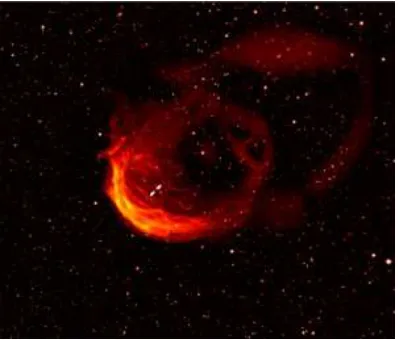
this material being a comet-like tail, the authors opted for the simpler explanation that Sh 2-188 resides in a highly inhomogeneous ISM. 2003 observations, taken as part of the Isaac Newton Group Photometric Hα
Survey of the Northern Galactic Plane (IPHAS) (Drew et al. 2005) revealed the faint material to be a ring-like com-pletion of the arc and a tail stretching away in oppo-sition to the bright arc. Wareing et al. (2006a) mod-elled the nebula as a strong PN–ISM interaction where the CSPN is moving at 125 km s−1 in the direction of the bright arc relative to the ISM. In Figure 2, we reproduce their figure 3 combining the IPHAS obser-vations of the nebula. The nebular shell is interacting with the AGB wind-ISM bow shock and undergoing the exact rebrightening discussed in the previous sec-tion. Sh 2-188 is a prime example then of the effect under discussion in this review. The faint comple-tion of the arc is the original nebular shell continuing to expand into AGB wind material cocooned by the bow shock and tail. The tail consists of far-older ram-pressure-stripped material from the head of the bow shock stretching away to the North-West.
Wareing et al. note that if the central star had not been traveling through the local ISM, Sh 2-188 would most likely have a ring-like appearance on the sky with a radius similar to the distance between the faint com-pletion of the arc and the CSPN - approaching twice the actual radius. The surface brightness of the whole object would be comparable to the faint completion of the ring. Clearly, ISM interaction has strongly af-fected the late evolution of this particular nebula, lim-iting its expansion and rebrightening the nebula on the upstream side of the shell. Finally, Wareing et al. (2006a) performed a proper motion analysis and found the CSPN to have a considerable motion of 0.03 +-0.01 arcsec yr−1in the direction of the bright arc, con-firming the PN–ISM interaction hypothesis. The com-bination of the proper motion and the high velocity re-quired to model the appearance of the nebula, placed it at distance of 850 pc, consistent with other estimates of the distance to the star.
The 21 candidate PN–ISM interactions in the Atlas of Interacting PNe appear to show similar rebright-ening characteristics. Of those, Sh 2-216 shows
fil-Figure 2: A reproduction of figure 3 from Wareing et al. (2006a) showing a combination of observations of the PN Sh 2-188 taken as part of IPHAS. The faint central star is indicated on the image between the markers. In the image, North is up and East to the left.
amentary evidence of a particularly complex magne-tized ISM in the vicinity of the PN (Ransom et al. 2008). Several objects in the search for extensive halos around PNe (Hao Hsia, Zeng Li & Ip 2007) also show evidence for one-sided rebrightening, suggesting the interaction is commonplace. There is also the com-plex case of the bipolar nebulosity surrounding the nova GK Per: thought to be an ancient PN ejected by a member of the binary system, the nebula has a swept back appearance, brightened on the upstream side, in alignment with the proper motion of the sys-tem (Bode, O’Brien & Simpson 2004).
Evidence for other PNe with tails is considerably rarer. Deep Hα+ NIIobservations of HFG1 (Xilouris et al.
1996; Boumis et al. 2009) reveal a strong candidate tail. Szentgyorgyi et al. (2003) find the emission of [S
[image:5.612.335.534.45.215.2]5
The progenitors of
rebright-ened PNe
The AGB progenitors of ISM-interaction-rebrightened PNe must be moving through the ISM at considerable velocities. Wareing et al. (2006a) hypothesized that bow shock-like structures must exist around such pro-genitor stars. This prediction was rapidly borne out in observations of the AGB star R Hya. Recent IR obser-vations of the star, taken as part of the MIRIAD pro-gramme, revealed an arc-like structure to the North-West of the star (Ueta et al. 2006), aligned in the di-rection of the star’s proper motion. Wareing et al. (2006b) modelled this structure as an AGB wind-ISM bow shock ahead of the star, confirming the existence of such structures and showing that the dominant shap-ing factor for PN–ISM interaction and the origin of PNe rebrightening is formed during the preceding AGB phase of evolution.
Evidence for similar bow shocks has now been found around several other giant and AGB stars, e.g. RX Lep (Libert et al. 2008) and R Cas (Ueta et al. 2009). In the case of the famous red giant α Orionis,
ob-servations presented by Noriega-Crespo et al. (1997) revealed an arc-like structure through a novel data-reduction technique. The observations constitute what is probably the earliest evidence for a late-evolution stellar wind-ISM bow shock, recently confirmed and analytically modelled by Ueta et al. (2008). None of these cases, including that of R Hya, found any clear evidence for a tail of ram-pressure-stripped material behind the bow shock.
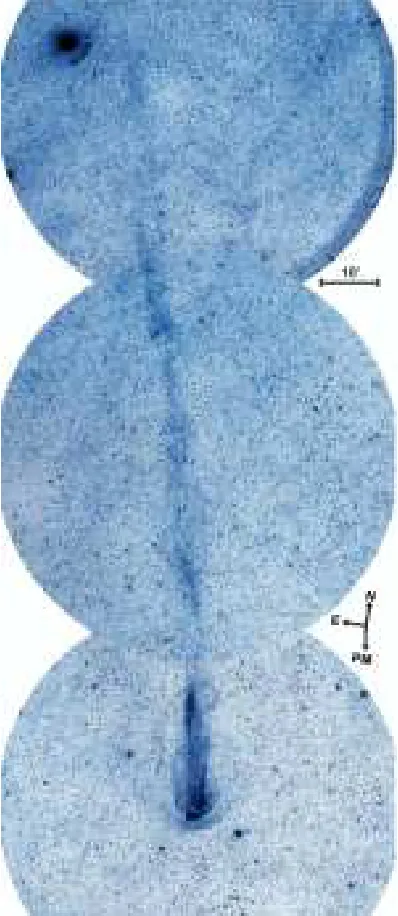
Definitive evidence of such a tail was fortuitously discovered behind the famous Mira binary system as part of routine GALEX UV observations, originating from the AGB star Mira A (Martin et al. 2007). The narrow collimated tail stretches 2 degrees on the sky, equivalent to 4 pc at the distance of the binary sys-tem, behind an arc-like structure ahead of the system. We reproduce an image of the structure in Figure 3. Wareing et al. (2007b) modelled the structure as a bow shock and ram-pressure-stripped tail stretching away from the location of the binary system. For a full dis-cussion of Mira’s tail and its characteristics, we re-view the reader to the recent rere-view of Wareing (2008). Close to the binary system, there is evidence for asym-metric outflow close to the system (Meaburn et al. 2009). This recent outflow (∼ 1000 years old), whilst not
aligned with the tail, will strongly affect the PN which Mira A will eventually form. The most-likely bipolar PN will then later experience a complex rebrightening as it interacts with the bow shock. Given the relatively high speed and close proximity of the bow shock to the binary system, the simulations of Wareing, Zijlstra & O’Brien (2007c) suggest Mira’s PN will relatively rapidly in-teract with the ISM. Mira and its tail are a template progenitor of PN–ISM interaction.
6
The progeny of rebrightened
PNe: implications for future
observational work
The four stage classification of Wareing, Zijlstra & O’Brien (2007c) predicts the future of rebrightened PNe in the final stage. At this time, their model predicts a de-celeration of the shell in the direction of motion com-bined with ram-pressure-stripping of material, driving the majority of nebular material into the tail. The fast wind from the CSPN has formed another bow shock, much closer to the CSPN. The remaining AGB wind material and the remnants of the PN shell are swept downstream in turbulent regions of high density and temperature as illustrated in Figure 1(d). Wareing et al. note that any observable structure would be diffi-cult to identify as a PN.
We are able to show two snapshots of this evolution in Figure 4. The snapshots are taken from the Case E simulation presented in Wareing, Zijlstra & O’Brien (2007c). They are at later times, 15,000 and 20,000 years into the PN phase, than the snapshots presented in Wareing et al.’s work. Moving at 125 km s−1through an average galactic plane ISM density ofnH= 2 cm−3,
the PN has long since entered the fourth stage of inter-action. The fast wind bow shock has formed against the oncoming ISM and the remains of the nebular shell and AGB wind bow shock are being swept downstream in turbulent regions of high density and temperature. There are very few possible detections of such ob-jects in the literature and given their likely advanced age and high speed central stars, this comes as no sur-prise. The primary example is Sh 2-68, a nebula that shows all the signs of being swept downstream behind the central star. The CSPN which has one of the largest measured proper motions - 0.053±0.005arcsec yr−1 Kerber (2002). Various distance estimates exist to the
nebula, but range over 500-1000 pc Napiwotzki & Schoenberner (1991, 1995). At this distance, the CSPN is likely at
6 Publications of the Astronomical Society of Australia
investigation.
Large, faint objects such as Sh 2-68 and Sh 2-188 are now regularly being observed as part of sky sur-veys, e.g. IPHAS, VPHAS, MASH-II, and new astro-nomical tools are able to take deeper observations, e.g. the Herschel space telescope will soon begin its survey of cold dust around evolved stars and is likely to reveal many more tails such as the one behind Mira. These surveys and instruments are likely to reveal the an-cient, faint, extended progenies of rebrightened PNe, such as Sh 2-68. The structures will have little re-semblance to young PN, their central stars may be far from the strongest emission and any remnants of neb-ular shells are likely to have been long since swept into turbulent regions in the tail. Identification of candi-date CSPN will be possible by proper motion studies - elements of the structure are highly likely to be a aligned with the direction of motion. These objects will have to be carefully filtered and confirmations of a candidate stage WZO 4 PN revealed by IPHAS are already proving difficult (private communication: L. Sabin; see Sabin’s paper elsewhere in this volume).
7
Concluding remarks
Simulations have shown that interaction with the ISM strongly affects the death of a PN, even one with an av-erage velocity central star. The structure of the AGB wind around the CSPN is changed from a wall into a bow shock during the preceding phase of evolution. This bow shock and the ram pressure stripping of ma-terial into the accompanying tail then dominates the evolution of the PN. Rebrightening and rejuvenation occur, on a short timescale for high speed CSPN, as the PN shell interacts with the bow shock. Follow-ing this, the PN is stripped downstream in turbulent regions moving down the tail, resulting in the central star leaving its PN.
Further study of rebrightened PN and their sur-roundings can provide considerable information regard-ing several other research avenues. As highlighted in the opening paragraph, tracing the ejected mass in cir-cumstellar structures such as bow shocks, tails and late-evolution turbulent regions swept down the tail can reveal much about the way AGB and postAGB stars lose mass. Such information as the position of the bow shock and the parameters of the tail can also reveal, taking into account the method of formation, not only historical stellar mass-loss rates and local ISM conditions, but also details of galactic orbits for the first time. The few objects that have observed lengthy tails, including Mira, HFG1 and Sh 2-68, are currently uniquely placed to derive such orbits. Future surveys of cool dust around AGB stars should reveal many more tails allowing a deeper investigation of a mean-ingful sample.
Once we have a meaningful sample of rebrightened PNe, we should also be able to see how the observ-able lifetimes of PNe are extended. Current statistical population estimates, which depend on estimated life-times, indicate a larger population than we have cur-rently detected, but by extending that lifetime,
popu-lation estimates accordingly reduce and we are likely to see much more of an agreement between the numbers we actually observe, which is believed to be fairly com-plete within the Milky Way, and the predicted popu-lation.
The model of PN–ISM interaction then can ac-count for many characteristics of PNe and explain highly complex, disrupted objects such as Sh 2-68, but it does not reproduce several observed details. In par-ticular, the fragmentation of the nebular rim is not reproduced by the simulations. More advanced mod-els must be able to reproduce this, at least in the cases of high speed CSPN as it seems common at this end of the velocity distribution, e.g. Sh 2-188. No theo-retical investigation has yet been performed employing 3D MHD simulations which include the galactic mag-netic field. This would seem a natural next step and as Dgani and Soker point out, this may rapidly pro-vide an explanation of particularly fragmentary shells. In a greater challenge to the model, the existence of ancient, effectively spherical PNe with very few signs of ISM interaction are difficult to explain within the model context, especially if they have displaced central stars which rules out an alignment between viewing angle and direction of motion. The model of PN–ISM interaction has come along way and revealed the phe-nomenon of rebrightened PNe, but there are a still a number of open questions to be solved and no doubt future observations will reveal many more.
Acknowledgments
The author acknowledges and thanks several researchers who’s input has greatly helped in this project and the creation of this review paper including Prof. A. A. Zi-jlstra, Ass. Prof. O. De Marco, Dr T. J. O’Brien, Dr M. Lloyd and Dr L. Sabin. CJW is funded through a post-doctoral Research Fellowship supported by the Science & Technology Facilities Council [grant number PP/E001092/1].
References
Balick, B., 1987, AJ, 94, 671
Bode, M. F., O’Brien, T. J., Simpson, M., 2004, ApJ, 600, L63
Borkowski, K. J., Sarazin, C. L., Soker, N., 1990, ApJ, 360, 173
Boumis, P., Meaburn, J., Lloyd, M., Akras, S., 2009, MNRAS, 396, 1186
Burton W.B., 1988, in Galactic and Extragalactic Ra-dio Astronomy, ed. K. Kellermann & G.L. Verschuur (New York: Springer), 295
De Marco, O., 2009, PASP, 121, 316
Dgani, R., Soker, N., 1994, ApJ, 434, 262
Dgani, R., Soker, N., 1998, ApJ, 495, 337
Drew, J. E. et al., 2005, MNRAS, 362, 753
Frank, A., Blackman, E. G., 2004, ApJ, 614, 737
Garc´ıa-Segura, G., Langer, N., R´o˙zyczka, M., Franco, J., 1999, ApJ, 517, 767
Garc´ıa-Segura, G., L/’ opez, J. A., Franco, J., 2005, ApJ, 618, 919
Gurzadyan, G. A., 1969, Planetary Nebula (New York: Gordon & Breach), p.235
Hao Hsia, C., Zeng Li, J., Ip, W.-H., 2007, eprint arXiv:0712.2639
Isaacmann, R., 1979, A&A, 77, 327
Kahn, F. D., West, K. A., 1984, MNRAS, 212, 837
Kerber, F., Furlan, E., Rauch, T., Roth, M., 2000, in ASP Conf. Ser. 199: Asymmetrical Planetary Neb-ulae II: From Origins to Microstructures. p.313
Kerber, F., Guglielmetti, F., Mignani, R., Roth, M., 2002, A&A, 381, L9
Kwok, S., 1982, AJ, 258, 280
Libert, Y., Le Bertre, T., G´erard, E., Winters, J. M., 2008, 491, 789
Martin, D. C. et al. 2007, Nature, 448, 780
Matthews, L. D., Libert, Y., G´erard, E., Le Bertre, T., Reid, M. J., 2008, ApJ, 684, 603
Meaburn, J., L´opez, J. A., Noriega-Crespo, A., 2000, ApJS, 128, 321
Meaburn, J., Boumis, P., Christopoulou, P. E., Goudis, C. D., Bryce, M., L´opez, J. A, 2005, RMxAA, 41, 109
Meaburn, J., L´opez, J. A., Boumis, P., Lloyd, M., Red-man, M. P., 2009, A&A, 500, 827
Napiwotzki, R., Schoenberner, D., 1991, A&A, 249, L16
Napiwotzki, R., Schoenberner, D., 1995, A&A, 301, 545
Noriega-Crespo, A., van Buren, D., Cao, Y., Dgani, R., AJ, 114, 837
Oort, J. H., 1951, Problems of Cosmical Aerodynamics (Dayton: Central Air Document Office)
Ramos-Larios, G., Phillips, J. P., 2009, MNRAS accepted, doi:10.1111/j.1365-2966.2009.15485.x. arXiv:0909.1839v1
Ransom, R. R., Uyaniker, B., Kothes, R., Landecker, T. L., 2008, ApJ, 684, 1009
Rauch, T., Furlan, E., Kerber, F., Roth, M., 2000, in ASP Conf. Ser. 199: Asymmetrical Planetary Neb-ulae II: From Origins to Microstructures. p.341
Smith, H., 1976, MNRAS, 175, 419
Soker, N., Borkowski, K. J., Sarazin, C. L., 1991, AJ, 102, 1381
Soker, N., 1996, ApJ, 469, 734
Szentgyorgyi, A., Raymond, J., Franco, J., Villaver, E., L´opez-Martin, L., 2003, 594, 874
Tweedy, R. W., Napiwotzki, R., 1994, AJ, 108, 978
Tweedy, R. W., Kwitter, K. B., 1996, ApJS, 107, 255
Ueta, T., et al., 2006, ApJ, 648, L39
Ueta, T., 2008, ApJ, 687, L33
Ueta, T., et al., 2008, PASJ, 60, S407
Ueta, T., et al., 2009, Poster contribution to be pub-lished in the proceedings of ’AKARI, a light to il-luminate the misty Universe’, held at the Univer-sity of Tokyo, Japan, 16-19 February 2009. eprint arXiv:0905.0750
Villaver, E., Garcia–Segura, G., Manchado, A., 2003, ApJ, 585, L53 (VGM)
Wareing, C. J., et al., 2006a, MNRAS, 366, 387
Wareing, C. J., et al., 2006b, MNRAS, 372, L63
Wareing, C. J., Zijlstra, A. A., O’Brien, T. J., 2007a, ApJ, 660, L129
Wareing, C. J., Zijlstra, A. A., O’Brien, T. J., Seibert, M., 2007b, ApJ, 670, L125
Wareing, C. J., Zijlstra, A. A., O’Brien, T. J., 2007c, MNRAS, 382, 1233
Wareing, C. J., 2008, Phil. Trans. Roy. Soc. A, 366, 4429
Xilouris, K. M., Papamastorakis, J., Paleologou, E., Terzian, Y., 1996, Astron. Astrophys., 310, 603
8 Publications of the Astronomical Society of Australia
Figure 3: A reproduction of figure 1b from Wareing et al. (2007b) showing the 2 degree struc-ture stretching behind the location of the Mira bi-nary system.
Figure 4: Panels showing gas density during the PN phase for a PN moving at a relative speed of 125 km s−1. On the left we show a slice through
the gas density datacube at the position of the cen-tral star, perpendicular to the direction of motion, at 15,000 years into the PN phase, on the right at 20,000 years into the PN phase. The slices are 1 pc on a side.
[image:9.612.95.294.112.570.2] [image:9.612.324.566.320.563.2]